Trekking Gear List: Complete Nepal Packing Guide 2026
Essential trekking gear for Nepal centres on a layered clothing system, broken-in boots, a down jacket, a sleeping bag rated to -10C or colder, a 25-35L daypack, water purification, and sun protection. This trekking gears list covers every Priority 1 item plus brand picks, weights, and Kathmandu rental costs.
Planning your Nepal trekking adventure but overwhelmed by packing decisions? This comprehensive trekking gear guide covers everything you need to know about trekking equipment for the Himalayas, from essential base layers to optional luxury items.
Whether you're heading to Everest Base Camp, Annapurna Circuit, or exploring remote regions like Manaslu, this guide will ensure you pack smart, stay comfortable, and trek safely at high altitude. Once your kit is dialled in, you can book your trek with a verified local agency with confidence.
Introduction: The Complete Packing Philosophy
Packing for Nepal trekking is a delicate balance between being prepared and traveling light. Over-packing leads to unnecessary porter costs and physical strain, while under-packing can compromise comfort, safety, and enjoyment.
Key Packing Principles:
- Weight matters: Keep your duffel bag under 15 kg (porters typically carry up to 20 kg maximum)
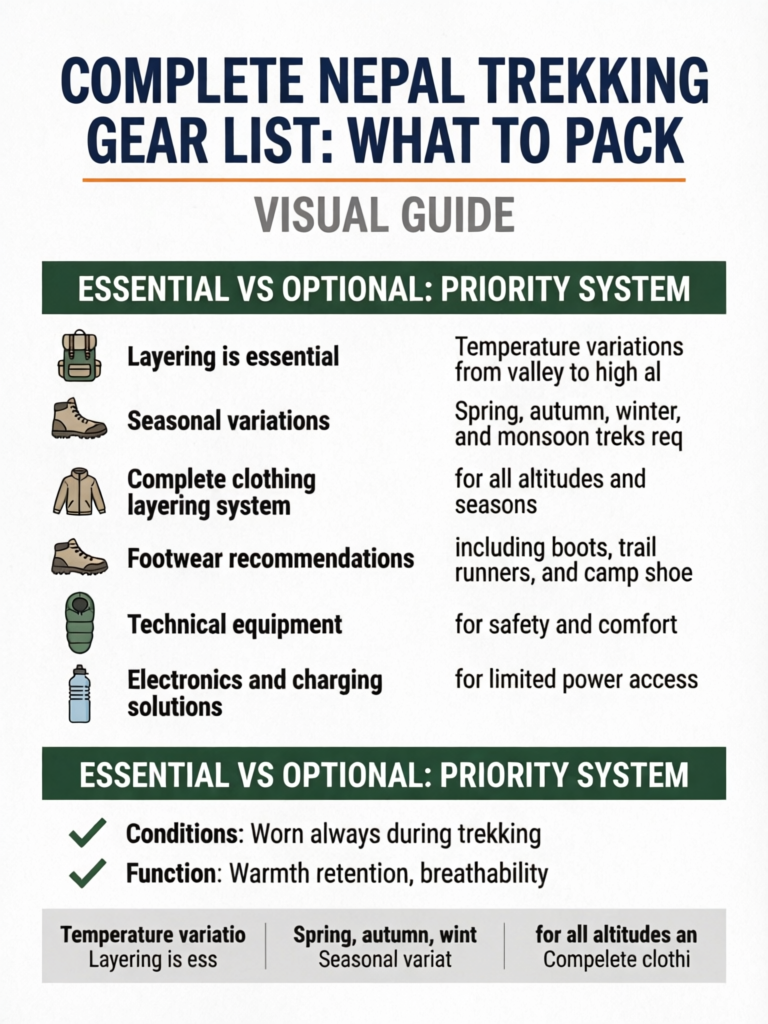
- Layering is essential: Temperature variations from valley to high altitude require adaptable clothing systems
- Quality over quantity: Invest in fewer high-quality items rather than many cheap alternatives
- Rental options available: Many items can be rented affordably in Kathmandu, reducing luggage weight
- Seasonal variations: Spring, autumn, winter, and monsoon treks require different gear priorities
What This Guide Covers
This comprehensive resource includes:
- Essential vs. optional gear classification with priority ratings
- Complete clothing layering system for all altitudes and seasons
- Footwear recommendations including boots, trail runners, and camp shoes
- Technical equipment for safety and comfort
- Electronics and charging solutions for limited power access
- First aid and toiletries appropriate for multi-day treks
- Buy vs. rent analysis with cost comparisons
- Trek-specific packing for EBC, ABC, Manaslu, and other routes
- Seasonal variations for spring, autumn, winter, and monsoon
- Weight management strategies to pack efficiently
- Comprehensive printable checklist
Essential vs Optional: Priority System
Understanding what's truly essential versus optional helps you make smart packing decisions. Here's our priority classification system:
Priority 1: Absolute Essentials (Cannot trek without these)
Clothing & Footwear:
- Trekking boots (broken in)
- Base layers (3-4 sets)
- Insulated down jacket
- Rain jacket (waterproof)
- Trekking pants (2 pairs)
- Warm hat and sun hat
- Gloves (liner + insulated)
- Hiking socks (4-6 pairs)
Technical Gear:
- Backpack/daypack (25-35L)
- Sleeping bag (-10°C to -20°C rated)
- Headlamp with extra batteries
- Water bottles or hydration system
- Trekking poles
Health & Safety:
- Sunscreen (SPF 50+)
- Sunglasses (UV protection)
- First aid kit
- Water purification (tablets/filter)
- Personal medications
- Altitude sickness medication (Diamox)
Documents:
- Passport with visa
- Travel insurance documents
- Trek permits (TIMS, park permits)
- Cash (Nepali Rupees)
- Emergency contact information
Priority 2: Highly Recommended (Significantly enhance comfort/safety)
- Down vest or synthetic jacket
- Fleece mid-layer
- Base layer bottoms (thermal)
- Neck gaiter/buff
- Camp shoes (sandals/slippers)
- Power bank (10,000-20,000mAh)
- Camera
- Toiletry kit
- Quick-dry towel
- Stuff sacks/packing cubes
- Duct tape and repair kit
- Whistle
Priority 3: Optional Comfort Items (Nice to have)
- E-reader/book
- Playing cards
- Journal and pen
- Trekking umbrella
- Compression socks
- Sleeping bag liner
- Pillow (inflatable)
- Gaiters
- Hand warmers
Priority 4: Luxury/Non-Essential (Skip to save weight)
- Laptop/tablet
- Drone (requires permits)
- Hair dryer
- Full toiletry collection
- Multiple clothing changes
- Cotton clothing
- Heavy books
Weight Distribution Strategy:
- Priority 1 items: ~70% of pack weight
- Priority 2 items: ~20% of pack weight
- Priority 3 items: ~10% of pack weight
- Priority 4 items: Leave at hotel in Kathmandu
Clothing System: The Layering Strategy
The key to comfort in Nepal's variable mountain climate is mastering the layering system. Temperatures can range from 25°C (77°F) in lower valleys to -20°C (-4°F) at high altitude, often on the same day.
The Four-Layer System
Layer 1: Base Layer (Next to Skin)
- Function: Moisture wicking, odor control, warmth
- Material: Merino wool or synthetic (avoid cotton)
- Conditions: Worn always during trekking
Layer 2: Mid Layer (Insulation)
- Function: Warmth retention, breathability
- Material: Fleece, lightweight synthetic, or merino wool
- Conditions: Cool mornings, evenings, higher altitudes
Layer 3: Insulation Layer (Warmth)
- Function: Maximum warmth during rest or extreme cold
- Material: Down or synthetic puffy jacket
- Conditions: High altitude, early mornings, evenings at tea houses
Layer 4: Outer Layer (Weather Protection)
- Function: Wind and rain protection
- Material: Waterproof, breathable shell (Gore-Tex or equivalent)
- Conditions: Rain, wind, snow, summit days
How Layering Works in Practice
Morning start (cold):
- Base layer top + bottom
- Mid layer fleece
- Down jacket
- Outer shell if windy
Mid-day trekking (warm):
- Base layer top only
- Maybe light fleece if shaded
Afternoon rest at tea house:
- Base layer
- Mid layer
- Down jacket (tea houses are cold inside)
Evening at high altitude:
- All layers
- Sleep in base layers + add down jacket if needed
Base Layers: Foundation of Comfort
Base layers are your most important clothing investment. They regulate body temperature, wick moisture, and provide the foundation for your entire layering system.
Base Layer Tops
Quantity Needed: 3-4 long-sleeve tops
Material Options:
Merino Wool (Recommended):
- Pros: Natural odor resistance (wear 3-5 days), excellent temperature regulation, soft on skin
- Cons: More expensive, slower drying than synthetic, requires careful washing
- Best brands: Icebreaker, Smartwool 260, Patagonia Capilene Thermal
Synthetic (Polyester/Nylon blends):
- Pros: Fast drying, durable, less expensive, excellent moisture wicking
- Cons: Develops odor faster (1-2 day wears), less warm than merino
- Best brands: Patagonia Capilene, Arc'teryx Phase, North Face
Merino/Synthetic Blends:
- Pros: Combines benefits of both materials
- Cons: Premium pricing
- Best brands: Smartwool Intraknit, Icebreaker BodyfitZONE
Weight Categories:
- Lightweight (150-200 gsm): Spring/autumn lower altitudes, high output activities
- Midweight (200-260 gsm): Best all-around choice for Nepal trekking
- Heavyweight (260-300 gsm): Winter trekking, extreme cold, low activity levels
Recommended Setup:
- 2x midweight merino wool long-sleeve (Smartwool 260 or Icebreaker 260)
- 1x lightweight synthetic for high-output days
- 1x heavyweight for extreme cold (winter treks)
Top Picks:
- Smartwool Merino 250 Base Layer - $100-120 (Excellent odor control, durable)
- Icebreaker 260 Tech LS Crewe - $110-130 (Premium quality, soft)
- Patagonia Capilene Thermal Weight - $80-100 (Great warmth-to-weight)
- Arc'teryx Rho LT - $120-140 (Superior construction, trim fit)
- REI Co-op Midweight Base Layer - $45-60 (Budget-friendly, reliable)
Base Layer Bottoms
Quantity Needed: 2-3 pairs
When You'll Wear Them:
- Sleeping at tea houses (essential for warmth)
- Under trekking pants in extreme cold
- High altitude summit days
- Winter trekking
Material Recommendations:
- Same as tops: merino wool or synthetic
- Midweight (200-260 gsm) is ideal
Top Picks:
- Smartwool Merino 250 Bottoms - $100-115
- Patagonia Capilene Thermal Weight Bottoms - $80-95
- Icebreaker 260 Tech Leggings - $100-120
- REI Co-op Midweight Base Layer Bottoms - $45-55
Pro Tips:
- Bring one pair specifically for sleeping (keeps them clean and odor-free)
- Darker colors hide stains better during multi-day wear
- Test your base layers on training hikes before departure
- Wash in tea house sinks with mild soap, air dry overnight
- Pack in stuff sack to keep organized
Underwear and Sports Bras
Quantity: 4-6 pairs underwear, 2-3 sports bras
Material: Quick-dry synthetic or merino wool (never cotton)
Recommended Brands:
- ExOfficio Give-N-Go - Quick-dry underwear, industry standard
- Smartwool Merino 150 - Odor-resistant, comfortable
- Patagonia Active Hipster/Briefs - Durable, comfortable
Sports Bras (Women):
- Medium support sufficient for trekking
- Adjustable straps for layering flexibility
- Top picks: Patagonia Barely Bra, Moving Comfort Juno, Brooks Dare
Insulation Layers: Warmth Without Bulk
Insulation layers trap warm air while allowing moisture to escape. For Nepal trekking, you'll need multiple insulation options for varying conditions.
Mid-Layer Fleece
Function: Active warmth during trekking, evening wear at tea houses
Quantity Needed: 1-2 fleeces
Types:
Lightweight Fleece (100-200 weight):
- Best for: Spring/autumn, lower altitudes, active trekking
- Top picks: Patagonia R1, Arc'teryx Delta LT, North Face TKA 100
Midweight Fleece (200-300 weight):
- Best for: All-season trekking, best versatility
- Top picks: Patagonia R2, Arc'teryx Kyanite, Mountain Hardwear Monkey Man
Heavyweight Fleece (300+ weight):
- Best for: Winter trekking, extreme cold, minimal layering
- Top picks: Patagonia R3, Arc'teryx Fortrez
Fleece Recommendations by Trek Season:
Spring/Autumn (March-May, Sept-Nov):
- 1x lightweight fleece (R1 equivalent)
- 1x midweight fleece OR down vest
Winter (Dec-Feb):
- 1x midweight fleece
- 1x heavyweight fleece OR extra insulation layer
Monsoon (June-Aug):
- 1x lightweight fleece (dries quickly)
Top Fleece Picks:
- Patagonia R1 Hoody - $160-180 (Best all-around, breathable, versatile)
- Arc'teryx Delta LT - $150-170 (Lightweight, excellent fit, durable)
- Patagonia R2 TechFace - $200-220 (Wind-resistant face fabric)
- North Face TKA Glacier - $60-80 (Budget option, warm)
- Mountain Hardwear Monkey Man 2 - $130-150 (High pile warmth)
Down Jacket: Essential Insulation
Priority Rating: Absolute Essential (Priority 1)
A down jacket is non-negotiable for Nepal trekking above 3,000m. It provides maximum warmth with minimum weight and compresses well in your pack.
When You'll Wear It:
- Evenings at tea houses (they're cold inside!)
- Rest breaks during trekking
- High altitude camps (above 4,500m)
- Early morning starts before sunrise
- Summit days (EBC, Thorong La Pass, etc.)
Fill Power Explained:
Fill power measures down quality (loft and insulation per ounce):
- 500-650 fill: Heavier, less compressible, budget-friendly
- 700-800 fill: Best balance of warmth, weight, and price (recommended)
- 850-950 fill: Ultralight, highly compressible, premium price
Fill Weight (Amount of Down):
More fill = warmer jacket, but heavier
- 3-5 oz fill: Lightweight layer, spring/autumn lower altitudes
- 5-8 oz fill: Standard trekking jacket, ideal for Nepal (autumn/spring)
- 8-12 oz fill: Winter expeditions, extreme cold
Down vs. Synthetic:
Down Advantages:
- Superior warmth-to-weight ratio
- Highly compressible
- Long-lasting with proper care
- More comfortable
Down Disadvantages:
- Loses insulation when wet
- More expensive
- Slower drying
- Requires careful washing
Synthetic Advantages:
- Insulates when wet
- Less expensive
- Fast drying
- Low maintenance
Synthetic Disadvantages:
- Heavier for same warmth
- Less compressible
- Shorter lifespan
Recommendation for Nepal: Down jacket is superior for Nepal trekking because:
- Tea house trekking keeps you sheltered (rain protection from outer shell)
- Down provides better warmth at high altitude
- Compression saves pack space
- Modern hydrophobic down treatments improve wet performance
Top Down Jacket Picks:
- Patagonia Down Sweater - $250-280 (800-fill, 5.4 oz fill, excellent all-around)
- Arc'teryx Cerium LT - $380-420 (850-fill, premium quality, technical fit)
- Mountain Hardwear Ghost Whisperer/2 - $380-400 (800-fill, ultra lightweight)
- REI Co-op 650 Down Jacket 2.0 - $150-180 (Budget option, reliable)
- North Face Aconcagua - $200-230 (Durable, warm, value option)
- Montbell Superior Down - $220-250 (800-fill, excellent warmth-to-weight)
- Rab Microlight Alpine - $240-280 (Hydrophobic down, UK quality)
Hooded vs. Non-Hooded:
Hooded (Recommended):
- Extra warmth for head/neck
- Better wind protection
- More versatile
Non-Hooded:
- Lighter weight
- Less bulk
- Pair with warm hat
Recommendation: Get a hooded down jacket for maximum versatility.
Features to Look For:
- Hydrophobic down treatment (resists moisture)
- Helmet-compatible hood (fits over warm hat)
- Two-way zipper (ventilation, access to harness)
- Internal chest pocket (valuables storage)
- Stuff sack included (compression storage)
- Elastic cuffs and hem (draft prevention)
Rental Option in Kathmandu:
- Cost: $1-3 USD per day ($15-45 for 2-week trek)
- Quality: Variable (inspect carefully for rips, zipper function, loft)
- Fill power: Usually 600-700 fill
- Brands: Generic Chinese brands, some North Face/Marmot copies
- Recommendation: If budget is tight, renting works, but buying is better for fit, quality, and future use
Down Vest: Versatile Layering Option
Priority Rating: Highly Recommended (Priority 2)
When It's Useful:
- Active trekking warmth without arm bulk
- Layering under rain jacket
- Sleeping extra warmth
- Spring/autumn shoulder seasons
Top Picks:
- Patagonia Down Sweater Vest - $180-200
- Arc'teryx Cerium SL Vest - $250-280
- REI Co-op 650 Down Vest - $100-120
Who Should Bring One:
- Cold sleepers
- Spring/autumn trekkers
- Those who layer often
- Lightweight enthusiasts
Who Can Skip:
- Winter trekkers (need full jacket)
- Budget-conscious (redundant with jacket)
- Minimalist packers
Outer Layers: Weather Protection
Your outer layer (shell) is your first defense against rain, wind, and snow. In Nepal's unpredictable mountain weather, a quality rain jacket is essential.
Rain Jacket (Hard Shell)
Priority Rating: Absolute Essential (Priority 1)
Essential Features:
Waterproof Rating:
- Minimum 10,000mm waterproof rating
- Recommended: 20,000mm+ for Nepal monsoon/storms
- Gore-Tex, eVent, or proprietary membranes (Patagonia H2No, Arc'teryx, etc.)
Breathability:
- Minimum 10,000g/m²/24hr breathability
- Recommended: 20,000g+ for high-output trekking
- Pit zips for additional ventilation
Must-Have Features:
- Helmet-compatible adjustable hood
- Two-way front zipper
- Pit zips or ventilation
- Taped seams (all seams, not just critical)
- Multiple pockets (chest, hand)
- Adjustable cuffs (Velcro or snaps)
- Drawcord hem
- Durable Water Repellent (DWR) coating
Top Rain Jacket Picks:
- Arc'teryx Beta AR - $500-575 (Gold standard, Gore-Tex Pro, bombproof)
- Patagonia Torrentshell 3L - $180-220 (Budget-friendly, reliable, H2No)
- Outdoor Research Foray - $180-200 (Great value, AscentShell breathable)
- Marmot Precip Eco - $100-130 (Entry-level, decent protection)
- REI Co-op XeroDry GTX - $200-250 (Gore-Tex, value option)
- Mountain Hardwear Exposure/2 - $300-350 (Gore-Tex Pro, durable)
- Rab Downpour Plus 2.0 - $180-220 (Pertex Shield, UK quality)
Sizing Considerations:
- Size up to fit over all layers (base + fleece + down jacket)
- Test by wearing all insulation layers underneath
- Arms should allow full range of motion with layers
- Length should cover hips when wearing backpack
Hard Shell vs. Soft Shell:
Hard Shell (Recommended for Nepal):
- Fully waterproof
- Wind-proof
- Packable
- Best for rain/snow
Soft Shell:
- Water-resistant (not waterproof)
- More breathable
- Stretchy, comfortable
- Best for dry, cold conditions
Recommendation: Bring a hard shell rain jacket for Nepal. Soft shells don't provide adequate rain protection during monsoon season or mountain storms.
Rain Pants
Priority Rating: Highly Recommended (Priority 2 for spring/autumn, Priority 1 for monsoon)
When You Need Them:
- Monsoon season trekking (June-August)
- Spring afternoon showers
- High passes in poor weather
- Snow conditions
Types:
Full-Zip Side Entry:
- Easy on/off over boots
- Better ventilation
- More expensive
- Recommended for trekking
Elastic Waist Pull-On:
- Lighter weight
- Less expensive
- Must remove boots to put on
Top Picks:
- Outdoor Research Helium - $120-150 (Lightweight, packable, side zips)
- Patagonia Torrentshell 3L Pants - $130-150 (Durable, reliable)
- Marmot PreCip Eco Pants - $80-100 (Budget option)
- Arc'teryx Beta SL - $200-250 (Premium quality)
Can You Skip Rain Pants?
Yes, if:
- Trekking in dry season (October-November)
- Short 5-7 day treks
- Low altitude routes (below 3,500m)
No, bring them if:
- Monsoon trekking (June-August)
- Spring treks (afternoon showers common)
- High passes (Thorong La, Cho La, etc.)
- 10+ day treks
Windproof Jacket
Priority Rating: Optional (Priority 3)
Purpose: Lightweight wind protection without bulk of rain jacket
When Useful:
- Dry season high-altitude winds
- Active trekking in cold but dry conditions
- Alternative to rain jacket on clear days
Top Picks:
- Patagonia Houdini - $100-120 (Classic windshell)
- Arc'teryx Squamish - $140-160 (Durable, packable)
- Outdoor Research Helium Wind - $70-90 (Budget option)
Recommendation: Skip for most trekkers. Rain jacket serves as windbreaker. Only bring if you're an ultralight enthusiast or have extra pack space.
Trekking Pants & Shorts
Lower body clothing needs to balance durability, comfort, weather protection, and freedom of movement.
Trekking Pants
Quantity Needed: 2 pairs (one to wear, one to wash/dry)
Material Requirements:
- Quick-drying (synthetic or synthetic blends)
- Durable (reinforced knees, seat)
- Stretchy (mechanical or fabric stretch)
- Lightweight (avoid heavy cotton)
Types:
Convertible Pants (Zip-Off Legs):
Pros:
- Two-in-one: pants and shorts
- Versatility for varying temperatures
- Popular choice for Nepal trekking
Cons:
- Zippers can be uncomfortable
- Heavier than dedicated pants
- Less stylish
Recommended: Yes, great for Nepal spring/autumn
Top Picks:
- Prana Stretch Zion Convertible - $90-110 (Excellent stretch, durable)
- REI Co-op Sahara Convertible - $70-90 (Budget-friendly, reliable)
- Columbia Silver Ridge Convertible - $60-80 (Value option)
Dedicated Trekking Pants:
Pros:
- More comfortable (no zippers)
- Better style
- Often lighter weight
Cons:
- Not convertible to shorts
- Need separate shorts if desired
Top Picks:
- Outdoor Research Ferrosi - $90-110 (Soft-shell, stretchy, breathable)
- Patagonia Quandary - $90-110 (Durable, comfortable, versatile)
- Arc'teryx Gamma LT - $200-230 (Premium soft-shell)
- Prana Brion - $90-110 (Stylish, comfortable, stretchy)
Features to Look For:
- Articulated knees (pre-shaped for hiking movement)
- Gusseted crotch (prevents binding, allows full range)
- Multiple pockets (cargo pockets, zippered security pocket)
- Reinforced areas (knees, seat, cuffs)
- Adjustable waist (belt loops, some have internal adjustment)
- UPF sun protection (bonus for high altitude)
- DWR coating (water resistance)
Fit Considerations:
- Regular fit (room for base layer underneath)
- Not too loose (catch on rocks, less efficient hiking)
- Not too tight (restricts movement, uncomfortable with layers)
- Test by doing high steps, squats, lunges
Trekking Shorts
Quantity Needed: 1 pair (optional)
When You'll Wear Them:
- Lower altitude valleys (warm days)
- Spring/autumn midday hiking
- Rest days in villages
Recommended Only If:
- Trekking in spring/summer/autumn
- Low to moderate altitude routes
- You have convertible pants (skip if so)
Top Picks:
- Patagonia Baggies - $55-65 (Comfortable, quick-dry, versatile)
- Prana Brion Short - $65-75 (Stretchy, stylish)
- REI Co-op Active Pursuits - $40-50 (Budget option)
Length: 7-9 inch inseam ideal (not too short for cultural respect, not too long for hiking)
Leggings/Tights (Women)
Quantity: 1-2 pairs (optional)
When Useful:
- Sleeping warmth at tea houses
- Under trekking pants in extreme cold
- Yoga/stretching at tea houses
- Comfortable evening wear
Types:
Base Layer Tights: Worn under pants for warmth (Smartwool 260, Patagonia Capilene)
Trekking Leggings: Can be worn as outer layer in warm conditions
Top Picks:
- Outdoor Research Ferrosi Tights - $80-100 (Durable, weather-resistant)
- Patagonia Pack Out Tights - $90-110 (Stretchy, comfortable)
- Prana Becksa 7/8 Legging - $70-90 (Stylish, functional)
Footwear: Your Most Important Investment
Comfortable, appropriate footwear can make or break your trek. Blisters, cold toes, or unstable ankles will turn paradise into misery.
Trekking Boots
Priority Rating: Absolute Essential (Priority 1)
Boot Categories:
Approach Shoes/Trail Runners:
- Best for: Lower altitude, short treks, experienced hikers, dry season
- Altitude limit: Up to 3,500m
- Pros: Lightweight, comfortable, faster hiking, great for warm weather
- Cons: Less ankle support, less durable, cold in winter, limited waterproofing
- Examples: Salomon X Ultra 4, La Sportiva TX4, Hoka Speedgoat
Mid-Cut Hiking Boots:
- Best for: Most Nepal treks (EBC, ABC, Annapurna Circuit)
- Altitude limit: All altitudes
- Pros: Ankle support, waterproof, versatile, lighter than full boots
- Cons: Less insulation than mountaineering boots
- Examples: Salomon Quest 4, La Sportiva Nucleo High, Scarpa Zodiac Plus
- Recommendation: Best choice for spring/autumn trekking
Full Mountaineering Boots:
- Best for: Winter trekking, peak climbing, extreme cold
- Altitude limit: All altitudes including 6,000m+ peaks
- Pros: Maximum warmth, crampon-compatible, very durable
- Cons: Heavy, overkill for tea house trekking, expensive
- Examples: La Sportiva Nepal Cube, Scarpa Mont Blanc, Asolo Everest
Boot Recommendations by Trek & Season:
Everest Base Camp (Spring/Autumn):
- Mid-cut hiking boots
- Waterproof essential
- Insulation helpful but not critical
- Top pick: Salomon Quest 4 GTX
Everest Base Camp (Winter):
- Insulated mountaineering boots or heavily insulated hiking boots
- Top pick: La Sportiva Nepal Cube or similar
Annapurna Circuit (Spring/Autumn):
- Mid-cut hiking boots
- Good tread for varied terrain
- Top pick: La Sportiva Nucleo High GTX
Poon Hill/Lower Altitude (Any Season):
- Trail runners acceptable
- Mid-cut boots more comfortable
- Top pick: Salomon X Ultra 4 GTX
Top Trekking Boot Picks:
- Salomon Quest 4 GTX - $220-260 (Excellent all-around, comfortable, durable)
- La Sportiva Nucleo High GTX - $250-290 (Superior support, technical terrain)
- Scarpa Zodiac Plus GTX - $260-300 (Comfortable, versatile, well-made)
- Lowa Renegade GTX Mid - $240-280 (Classic choice, reliable, supportive)
- Asolo Fugitive GTX - $260-300 (Durable, stiff sole, long-lasting)
- Merrell Moab 3 Mid GTX - $150-180 (Budget option, comfortable out of box)
- Keen Targhee III Mid - $150-180 (Wide toe box, budget-friendly)
Essential Boot Features:
Waterproofing:
- Gore-Tex (industry standard, reliable)
- eVent (more breathable than Gore-Tex)
- Proprietary membranes (Salomon's own, Scarpa's, etc.)
- Requirement: Essential for Nepal (river crossings, snow, rain)
Ankle Support:
- Mid-cut minimum for multi-day trekking with pack weight
- High-cut for technical terrain or weak ankles
Sole:
- Vibram soles preferred (best traction, durability)
- Moderate stiffness (flex for comfort, stiffness for support)
- Deep lugs for mud, scree, mixed terrain
Insulation:
- Not needed for spring/autumn tea house trekking
- Essential for winter or high-altitude camping
Fit Considerations:
- Break-in period: 30-50 miles before your trek (non-negotiable!)
- Toe room: Thumb width between longest toe and boot end (prevents black toenails on descents)
- Heel lock: Heel shouldn't lift when walking
- Width: Snug but not tight (feet swell during long days)
- Try with trekking socks: Wear the socks you'll trek in when trying boots
- Afternoon fitting: Feet swell during day (shop in afternoon)
Boot Care:
- Break in thoroughly before trek (cannot emphasize enough!)
- Treat with waterproofing spray before trip
- Air dry each night at tea houses (never near fire!)
- Use trekking gaiters in snow/mud
- Bring spare laces
Camp Shoes
Priority Rating: Highly Recommended (Priority 2)
After 5-8 hours in trekking boots, your feet desperately want freedom. Camp shoes are essential for comfort, hygiene, and foot health.
Types:
Sandals:
Pros:
- Breathable, feet dry out
- Easy on/off for tea house bathroom trips
- Lightweight
- Can cross shallow streams
Cons:
- Cold in evening/high altitude
- Less toe protection
- Not suitable for winter treks
Top Picks:
- Teva Hurricane XLT2 - $50-70 (Lightweight, adjustable, durable)
- Chaco Z/1 - $100-120 (Very durable, arch support, heavier)
- Keen Newport H2 - $100-120 (Toe protection, versatile)
- Crocs Classic - $40-50 (Ultra lightweight, packable, warm-ish)
Down Booties:
Pros:
- Maximum warmth for cold evenings
- Comfortable for sleeping
- Cozy at high altitude tea houses
Cons:
- Not waterproof (can't use for bathrooms in rain)
- Heavier than sandals
- More expensive
Top Picks:
- Western Mountaineering Down Bootie - $80-100 (Very warm, durable)
- Mountain Equipment Glacier Bootie - $70-90 (Insulated, grippy sole)
- Outdoor Research Tundra Aerogel Booties - $90-110 (Packable, warm)
Lightweight Camp Shoes:
Pros:
- Versatile (walking around village, tea house)
- Reasonable warmth with socks
- Lightweight
Top Picks:
- Xero Shoes Prio - $80-90 (Minimalist, packable)
- Vivobarefoot Primus Trail - $130-150 (Zero-drop, lightweight)
- Salomon RX Slide - $50-70 (Slides, comfortable, quick on/off)
Recommendation by Season:
Spring/Autumn: Sandals (Teva, Chaco, Crocs) Winter: Down booties + backup lightweight shoes Monsoon: Waterproof sandals or Crocs
What to Skip:
- Heavy sneakers (too much weight)
- Flip-flops (not secure enough)
- Slippers without back strap (fall off easily)
Socks: The Blister Prevention Foundation
Priority Rating: Absolute Essential (Priority 1)
Quantity Needed: 4-6 pairs
Material:
Merino Wool (Highly Recommended):
- Natural odor resistance (wear 2-3 days)
- Temperature regulation
- Cushioning
- Moisture wicking
- Brands: Darn Tough, Smartwool, Farm to Feet, Icebreaker
Synthetic Blends:
- Quick drying
- Durable
- Less expensive
- More odor than merino
- Brands: Balega, Feetures, Injinji
Never Cotton:
- Retains moisture = blisters
- Takes forever to dry
- Loses cushioning when wet
- Cold when damp
Sock Weight:
Lightweight: Warm weather, lower altitudes, tight-fitting boots Midweight: Best all-around for Nepal trekking Heavyweight: Winter trekking, loose boots, extra cushioning
Height:
Crew (Mid-Calf): Recommended for boot trekking (prevents rubbing) Ankle: Only for trail runners/approach shoes Knee-High: Unnecessary weight, hard to dry
Top Sock Picks:
- Darn Tough Hiker Boot Midweight - $25-30 (Lifetime warranty, excellent quality)
- Smartwool PhD Outdoor Heavy Crew - $24-28 (Cushioned, durable, warm)
- Farm to Feet Damascus Lightweight - $20-24 (Made in USA, comfortable)
- Injinji Trail Midweight Crew (Toe Socks) - $16-20 (Prevents toe blisters)
- REI Co-op Merino Wool Hiking - $16-20 (Budget option, reliable)
Sock Strategy:
- Wear 1 pair while trekking
- Wash 1 pair in evening (dries overnight usually)
- Rotate through 4-6 pairs (always have dry backup)
- Keep 1 pair pristine for sleeping only (foot hygiene)
Blister Prevention Tips:
- Break in boots with your trekking socks (30-50 miles minimum)
- No wrinkles in socks when putting on (causes hot spots)
- Start with dry feet each morning (powder or air dry thoroughly)
- Liner socks optional (thin silk or synthetic under wool socks reduces friction)
- Address hot spots immediately (stop, adjust, apply blister tape/moleskin)
- Keep toenails trimmed short (prevents black toenails on descents)
- Rotate socks (wear different pairs to vary pressure points)
Gaiters
Priority Rating: Optional (Priority 3 for most, Priority 2 for winter/monsoon)
Purpose:
- Keep snow out of boots (winter, high passes)
- Prevent mud/debris entering boots
- Keep pants dry in wet conditions
- Add warmth layer around ankles
When You Need Them:
Yes:
- Winter trekking (snow above ankles)
- Monsoon trekking (muddy trails)
- High passes with snow (Thorong La, Cho La in spring)
- Off-trail or camping treks
No:
- Dry season tea house trekking (Oct-Nov, March-April)
- Lower altitude treks (below 3,500m)
- Well-maintained trails in good conditions
Types:
Full Gaiters (Knee-High):
- Maximum protection
- Heavier, warmer
- Best for snow, winter
Low Gaiters (Ankle Height):
- Trail running style
- Lighter weight
- Debris protection only
Top Picks:
- Outdoor Research Crocodile - $80-100 (Durable, waterproof, bomber)
- Black Diamond Distance - $50-60 (Trail gaiter, lightweight)
- REI Co-op Backpacker - $40-50 (Budget option, reliable)
Recommendation: Skip for spring/autumn EBC/ABC treks. Bring for winter or monsoon.
Accessories: Small Items, Big Impact
Gloves
Priority Rating: Absolute Essential (Priority 1)
You'll need multiple pairs for different conditions and backup.
Glove System (Layering):
Layer 1: Liner Gloves
- Thin synthetic or merino
- Worn alone in moderate cold
- Under other gloves for extreme cold
- Allow use of phone/camera
- Quantity: 1-2 pairs
- Top picks: Smartwool Liner Glove, Icebreaker Quantum
Layer 2: Fleece/Softshell Gloves
- Moderate warmth
- Active trekking use
- Water-resistant (not waterproof)
- Quantity: 1 pair
- Top picks: Outdoor Research PL400, Arc'teryx Venta
Layer 3: Insulated Gloves/Mittens
- Maximum warmth
- High altitude, cold weather, rest stops
- Down or synthetic insulation
- Quantity: 1 pair
- Top picks: Black Diamond Guide, Outdoor Research Alti Mitts
Gloves vs. Mittens:
Gloves:
- Better dexterity (using trekking poles, zippers, camera)
- Less warm than mittens
- Recommended for most trekking
Mittens:
- Much warmer (fingers share warmth)
- Less dexterity
- Best for extreme cold (winter, high altitude camps)
Recommended Glove Setup:
Spring/Autumn EBC/ABC:
- 1 pair liner gloves
- 1 pair midweight fleece gloves
- 1 pair insulated gloves (down or synthetic)
Winter Trekking:
- 2 pairs liner gloves (backup essential)
- 1 pair fleece gloves
- 1 pair insulated mittens (heavy duty)
Top Glove Picks:
- Outdoor Research Versaliner - $60-70 (Removable liner, versatile, waterproof shell)
- Black Diamond Guide Glove - $100-120 (Warm, durable, removable liner)
- Outdoor Research Stormtracker Heated - $200-250 (Battery heated, extreme cold)
- Smartwool Liner Glove - $30-35 (Touch-screen compatible, merino)
- Mountain Hardwear Power Stretch - $40-50 (Stretchy, comfortable, warm)
Pro Tips:
- Keep one pair in jacket pocket (always accessible)
- Clip gloves to jacket with carabiner when not wearing
- Bring extras (gloves get lost easily)
- Dry thoroughly each night (wet gloves = frozen morning gloves)
Hats
Priority Rating: Absolute Essential (Priority 1)
You'll need two types: sun protection and warmth.
Sun Hat:
Purpose: UV protection, shade, prevent sunburn at high altitude
Features to Look For:
- Wide brim (3+ inches, 360° coverage)
- Chin strap (prevents blowing away in wind)
- Breathable material
- Quick-dry
- UPF 50+ rating
Types:
Bucket Hat: Good coverage, packable, casual style Wide-Brim Hat: Maximum coverage, sun protection Cap with Neck Flap: Versatile, technical
Top Picks:
- Outdoor Research Sombriolet Sun Hat - $35-40 (Great all-around, chin strap, breathable)
- Sunday Afternoons Adventure Hat - $35-40 (Wide brim, UPF 50+, packable)
- Patagonia Quandary Brimmer - $40-45 (Stylish, functional, durable)
Warm Hat (Beanie):
Purpose: Warmth at altitude, evenings, early mornings
Features:
- Merino wool or synthetic fleece
- Covers ears
- Snug but not too tight
Top Picks:
- Smartwool Merino 250 Beanie - $30-35 (Warm, odor-resistant, comfortable)
- Patagonia Better Sweater Beanie - $35-40 (Fleece, very warm, durable)
- Black Diamond Merino Beanie - $25-30 (Simple, effective, affordable)
Bonus: Balaclava
Priority: Optional (Priority 3, but Priority 2 for winter)
Purpose: Full face/neck protection in extreme cold or wind
When Useful:
- Winter trekking
- High passes in bad weather
- Extreme wind protection
- Summit days (EBC, high passes)
Top Picks:
- Outdoor Research Gorge - $30-35 (Warm, breathable, comfortable)
- Smartwool Merino 250 Balaclava - $50-60 (Premium merino, odor-free)
Neck Gaiter / Buff
Priority Rating: Highly Recommended (Priority 2)
Purpose:
- Sun protection for neck
- Dust protection on trails
- Warmth in cold
- Moisture-wicking
- Multi-purpose (headband, hat liner, face mask)
How You'll Use It:
- Dust protection on dry trails (essential for Annapurna Circuit's Kali Gandaki valley)
- Neck warmth in cold
- Prevent "Khumbu cough" (dust/dry air irritation)
- Face protection from sun/wind
Material:
- Merino wool (odor-resistant, warm, comfortable)
- Synthetic (quick-dry, less expensive)
Top Picks:
- Buff Original - $20-25 (Classic, versatile, many designs)
- Smartwool Merino 250 Neck Gaiter - $35-40 (Warm, odor-free, comfortable)
- Outdoor Research Echo Ubertube - $20-25 (Lightweight, breathable, quick-dry)
Quantity: 1-2 (nice to have backup)
Sunglasses
Priority Rating: Absolute Essential (Priority 1)
At high altitude, UV radiation increases dramatically. Quality sunglasses prevent:
- Snow blindness (can happen in hours of unprotected exposure)
- Headaches from bright glare
- Eye strain
- Long-term eye damage
Essential Features:
UV Protection:
- Minimum: 100% UVA/UVB protection
- Recommended: Category 3-4 lenses (darker for snow/glacier)
- Wraparound or side shields (prevents light entering from sides)
Other Features:
- Polarized lenses (reduce glare, better vision)
- Durable frames (metal or quality plastic)
- Secure fit (won't fall off when bending over)
- Strap/retainer (prevents loss)
- Case (protection when not wearing)
Top Picks:
- Julbo Explorer 2.0 - $130-160 (Mountaineering-specific, removable side shields, Cat 4)
- Oakley Flak 2.0 - $150-180 (Durable, great optics, comfortable)
- Smith Pivlock Overdrive - $150-180 (Interchangeable lenses, quality)
- Suncloud Milestone - $50-70 (Budget option, polarized, reliable)
- Goodr OG - $25-30 (Ultra budget, surprisingly good, no-slip)
Prescription Sunglasses:
Options:
- Get prescription sunglasses made (best option)
- Wear contacts + regular sunglasses
- Fit-over sunglasses (wear over regular glasses)
- Clip-on sunglasses for your prescription frames
Recommendation: Bring two pairs if possible (sunglasses break/get lost frequently on treks)
Backup: Regular prescription glasses + cheap sunglasses
Backpack & Bags: Carrying Systems
Daypack (You Carry This)
Priority Rating: Absolute Essential (Priority 1)
Capacity Needed: 25-35 liters
What You'll Carry Daily:
- Water (2-3 liters)
- Snacks/lunch
- Rain jacket
- Down jacket
- Camera
- Sunscreen, lip balm
- First aid kit
- Extra layers
- Valuables (passport, money, permits)
- Electronics
Essential Features:
Fit & Comfort:
- Padded shoulder straps
- Hip belt (transfers weight to hips)
- Sternum strap (stabilizes load)
- Ventilated back panel (reduces sweating)
- Load lifters (adjusts weight distribution)
Organization:
- Main compartment (large items)
- Top pocket (quick access: sunscreen, snacks)
- Hip belt pockets (camera, phone, lip balm)
- Side pockets (water bottles)
- Internal sleeve (hydration bladder or valuables)
Weather Protection:
- Integrated rain cover OR
- Purchase separate rain cover OR
- Line with dry bag/trash bag
Hydration:
- Side water bottle pockets (easy access)
- OR hydration bladder sleeve (hands-free drinking)
Top Daypack Picks:
- Osprey Talon 33 - $140-160 (Excellent ventilation, comfortable, durable)
- Gregory Citro 30 - $130-150 (Comfortable, well-organized, quality)
- Deuter Speed Lite 32 - $120-140 (Lightweight, comfortable, German quality)
- REI Co-op Flash 33 - $100-120 (Budget-friendly, lightweight, versatile)
- Osprey Stratos 34 - $180-200 (Premium comfort, excellent ventilation)
- Patagonia Nine Trails 36 - $150-170 (Durable, comfortable, eco-friendly)
Sizing Your Daypack:
- Measure your torso length (base of neck to top of hip bones)
- Try on with weight (load 15-20 lbs when trying)
- Hip belt should sit on hip bones (not waist)
- Shoulder straps shouldn't gap
- Can reach hip belt pockets without removing pack
Men's vs. Women's Packs:
Women-specific features:
- Shorter torso range
- Narrower shoulder straps
- Contoured hip belt
- Different weight distribution
Recommendation: Women should try women-specific models first, but not all women need them (try both)
Duffel Bag (Porter Carries This)
Priority Rating: Absolute Essential if using porter (Priority 1), Optional if trekking independently
Capacity Needed: 60-80 liters
Weight Limit: Maximum 15 kg (33 lbs) – porters typically carry bags up to 20 kg, but keep yours under 15 kg for ethical reasons
What Goes in Duffel:
- Sleeping bag
- Extra clothing
- Toiletries (bulk items)
- Extra shoes (camp shoes if bulky)
- Items you don't need during the day
What NEVER Goes in Duffel (Keep in Daypack):
- Passport, permits, money
- Camera, phone, electronics
- Medications
- Items needed during trekking day
Essential Features:
Durability:
- Waterproof or very water-resistant
- Heavy-duty zippers
- Reinforced handles
- Abrasion-resistant bottom
Organization:
- Wide opening (easier packing/unpacking in dark tea houses)
- Internal compression straps
- Lockable zippers (security at tea houses)
- External straps (lash extra items)
Portability:
- Backpack straps (carry yourself if needed)
- Padded shoulder straps
- Multiple grab handles
Top Duffel Picks:
- The North Face Base Camp Duffel (Large 95L) - $150-180 (Bombproof, waterproof, legendary durability)
- Patagonia Black Hole Duffel 70L - $150-170 (Very durable, water-resistant, eco-friendly)
- Osprey Transporter 95 - $150-170 (Comfortable backpack straps, durable, organized)
- Sea to Summit Duffle 65L - $100-130 (Waterproof, lightweight, budget-friendly)
- REI Co-op Roadtripper Duffel 100L - $120-140 (Large, durable, value option)
Waterproofing Strategy:
Even "waterproof" duffels benefit from internal organization:
- Use dry bags inside duffel for critical items (sleeping bag, clothing)
- Stuff sacks for organization (easier to find items in dark tea houses)
- Plastic bags as backup (cheap insurance against leaks)
Recommended Setup:
- 1 dry bag for sleeping bag
- 1 dry bag for clean clothes
- 1 dry bag for dirty clothes
- 1 toiletry bag
- Stuff sacks for miscellaneous organization
Packing Cubes & Dry Bags
Priority Rating: Highly Recommended (Priority 2)
Why They're Valuable:
Organization:
- Find items quickly in dark tea houses (no electricity in many)
- Separate clean from dirty
- Keep similar items together
Protection:
- Keep clothing dry (even if duffel gets wet)
- Protect sleeping bag (critical)
- Prevent odors spreading
Compression:
- Squeeze extra air out
- Maximize space
- Create more room
Recommended System:
Dry Bags (Waterproof):
- 20L dry bag: Sleeping bag
- 10L dry bag: Clean clothes
- 10L dry bag: Dirty clothes
- 5L dry bag: Electronics (in daypack)
Packing Cubes (Organization):
- 1 cube: Underwear and socks
- 1 cube: Base layers
- 1 cube: Mid-layers
- 1 cube: Accessories (gloves, hat, buff)
Top Picks:
Dry Bags:
- Sea to Summit Ultra-Sil Dry Sack - $15-30 (Ultralight, waterproof, durable)
- Outdoor Research Lightweight Dry Sacks - $15-35 (Reliable, various sizes)
- REI Co-op Lightweight Dry Bag - $10-25 (Budget option, works well)
Packing Cubes:
- Eagle Creek Pack-It Cubes - $15-30 (Durable, various sizes, compression)
- Peak Design Packing Cube - $50-70 (Premium, very organized, compression)
- REI Co-op Expandable Packing Cube - $10-20 (Budget, reliable)
Sleeping: Rest and Recovery
Sleeping Bag
Priority Rating: Absolute Essential (Priority 1)
Your sleeping bag is critical for warmth, recovery, and health at high altitude. Tea houses provide blankets, but they're often dusty, insufficient for cold nights, and vary greatly in quality.
Temperature Rating Needed:
Comfort Rating vs. Lower Limit:
- Comfort Rating: Temperature at which average sleeper is comfortable
- Lower Limit: Temperature at which average man can sleep (uncomfortably)
- Extreme Rating: Survival temperature (risk of hypothermia)
Use Comfort Rating for planning (not lower limit)
Recommended Ratings by Season:
Spring/Autumn (March-May, Sept-Nov):
- Lower elevations (2,000-3,500m): -5°C to -10°C comfort rating
- High altitude (3,500-5,500m): -10°C to -15°C comfort rating
- Recommended: -10°C to -15°C (covers most nights comfortably)
Winter (Dec-Feb):
- All elevations: -15°C to -20°C minimum
- High altitude: -20°C to -25°C safer
- Recommended: -20°C (serious cold protection)
Summer/Monsoon (June-Aug):
- Lower elevations: 0°C to -5°C sufficient
- High altitude: -5°C to -10°C
- Recommended: -5°C to -10°C (lighter, easier to pack)
Down vs. Synthetic:
Down Sleeping Bags:
Pros:
- Superior warmth-to-weight ratio
- Highly compressible (saves pack space)
- Long-lasting (20+ years with care)
- More comfortable
Cons:
- Expensive ($300-600 for quality)
- Loses insulation when wet
- Requires careful storage
- Slow drying
Fill Power: 650-950 (higher = warmer per ounce, more expensive)
- 650-750 fill: Budget-friendly, heavier, bulkier
- 800-850 fill: Best balance (recommended)
- 900-950 fill: Premium, ultralight, expensive
Synthetic Sleeping Bags:
Pros:
- Less expensive ($150-300)
- Insulates when wet
- Fast drying
- Low maintenance
- Allergy-friendly
Cons:
- Heavier (1-2 lbs more for same warmth)
- Bulkier (takes more pack space)
- Shorter lifespan (5-10 years)
- Less comfortable
Recommendation for Nepal: Down sleeping bag (800-850 fill) is superior for tea house trekking because:
- Tea houses provide shelter (bag stays dry)
- Weight and pack space matter on long treks
- Superior warmth at high altitude
- Better long-term value
- Modern hydrophobic down resists moisture
Sleeping Bag Shape:
Mummy (Recommended):
- Tapered shape (wide shoulders, narrow feet)
- Most thermally efficient
- Lightest weight
- Includes hood
Rectangular:
- More room to move
- Less efficient (cold air pockets)
- Heavier
- Can unzip fully (use as blanket)
Semi-Rectangular:
- Compromise between two
- More room than mummy
- Better warmth than rectangular
Top Sleeping Bag Picks:
Spring/Autumn (-10°C to -15°C):
- Western Mountaineering UltraLite - $550-650 (850-fill, 2 lbs, luxury, -10°C comfort)
- Feathered Friends Hummingbird - $500-600 (900-fill, ultralight, -9°C comfort)
- REI Co-op Magma 15 - $400-450 (850-fill, excellent value, -9°C comfort)
- Sea to Summit Flame FmII - $450-500 (750-fill, great all-around, -12°C comfort)
- Marmot Phase 20 - $350-400 (650-fill, budget option, -7°C comfort)
Winter (-20°C):
- Western Mountaineering Puma MF - $650-750 (850-fill, -23°C comfort, legendary)
- Feathered Friends Vireo - $600-700 (900-fill, -18°C comfort, quality)
- Mountain Hardwear Phantom 0°F - $500-550 (800-fill, -18°C comfort)
- REI Co-op Magma 0 - $500-550 (850-fill, value option, -18°C comfort)
Features to Look For:
- Draft collar (prevents warm air escaping at neck)
- Draft tube along zipper (eliminates cold spots)
- Contoured hood (seals warmth around head)
- Zipper side (left or right – consider if zipping with partner)
- Stash pocket (internal pocket for valuables, phone)
- Compression sack (included usually)
- Hydrophobic down (DWR-treated down resists moisture)
Sleeping Bag Care on Trek:
- Air out daily (hang outside tea house for 30-60 minutes)
- Fluff before sleeping (restores loft, maximizes warmth)
- Use sleeping bag liner (keeps bag cleaner)
- Store properly (never compressed long-term – damages loft)
- Spot clean only (full wash after trek, specialized down soap)
Rental Option in Kathmandu:
- Cost: $1-3 USD per day ($15-45 for 2-week trek)
- Quality: Variable (inspect loft, zippers, rips before accepting)
- Temperature rating: Usually -5°C to -20°C (23°F to -4°F) comfort rating for spring/autumn, -15°C to -20°C for winter
- Cleanliness concern: Unknown washing history (use liner!)
- Recommendation: Renting is acceptable for budget travelers, but buying is better for fit, cleanliness, and warmth assurance
Sleeping Bag Liner
Priority Rating: Highly Recommended (Priority 2)
Benefits:
Warmth Boost:
- Adds 5-15°F (3-8°C) of warmth
- Extends sleeping bag's temperature range
- Essential if bag is slightly under-rated for conditions
Hygiene:
- Barrier between you and sleeping bag (less washing needed)
- Protects against tea house blankets (if you use them)
- Much easier to wash than sleeping bag
Versatility:
- Use alone in warm conditions (lower altitude)
- Transition item (add when needed, remove if too warm)
Material Options:
Silk:
- Lightest weight (~5 oz)
- Adds ~5°F warmth
- Luxurious feel
- Most expensive
- Best for: Ultralight packers, warm season
Synthetic (Coolmax, Thermolite):
- Medium weight (~8-12 oz)
- Adds ~10-15°F warmth (Thermolite Reactor)
- Quick-drying
- Less expensive
- Best for: Cold season, maximum warmth boost
Cotton:
- Heaviest
- Slow drying
- Most comfortable in hot weather
- Best for: Skip for Nepal (too heavy, slow dry)
Fleece:
- Very warm (~15°F boost)
- Comfortable
- Heavy (~1 lb)
- Best for: Winter trekking, cold sleepers
Top Liner Picks:
- Sea to Summit Thermolite Reactor - $65-75 (Adds 15°F, lightweight, fast-dry)
- Cocoon TravelSheet Silk - $50-70 (Ultralight, compact, luxurious)
- Sea to Summit Silk Stretch Liner - $60-70 (Stretchy, comfortable, light)
- REI Co-op Silk Sleeping Bag Liner - $40-50 (Budget silk option)
Recommendation: Bring a Thermolite Reactor liner for spring/autumn treks (warmth boost worth the weight). Skip for summer treks (unnecessary).
Sleeping Pad
Priority Rating: Optional (Priority 3 for tea house trekking, Priority 1 for camping)
Tea House Trekking:
- Tea houses provide thin foam mattresses (comfort varies)
- Many trekkers skip bringing their own pad
- Helpful for comfort, warmth, and hygiene
Camping Trekking:
- Absolutely essential (ground insulation)
If You Bring One:
Types:
Foam (Closed-Cell):
- Indestructible
- No inflation needed
- Bulky (straps to outside of pack)
- Less comfortable
- Cheap ($20-40)
- Best: Therm-a-Rest Z Lite Sol
Self-Inflating:
- Moderate comfort
- Compact
- Heavier
- Moderate price ($80-150)
- Best: Therm-a-Rest ProLite
Air (Inflatable):
- Most comfortable
- Lightest & most compact
- Can puncture (bring patch kit)
- Expensive ($150-250)
- Best: Therm-a-Rest NeoAir XLite
Recommendation for Tea House Trekking: Skip to save weight, or bring ultralight inflatable for comfort/warmth if you're a poor sleeper.
Pillow
Priority Rating: Optional (Priority 3)
Options:
Bring Inflatable Pillow:
- Compact
- Lightweight (2-4 oz)
- Adjustable firmness
- Top picks: Sea to Summit Aeros ($40), Therm-a-Rest Compressible ($30)
Improvise:
- Stuff sack filled with clothes (down jacket, fleece)
- Free, no extra weight
Recommendation: Skip inflatable pillow (save weight, use clothing stuff sack).
Technical Gear: Safety and Convenience
Trekking Poles
Priority Rating: Highly Recommended (Priority 2, but Priority 1 for those with knee issues)
Benefits:
Ascent:
- Distribute effort to arms/shoulders
- Improve balance on steep climbs
- Maintain rhythm and pace
Descent:
- Reduce knee impact by 25-30%
- Prevent slips on loose terrain
- Improve stability on steep descents
Balance:
- Extra points of contact (4 points instead of 2)
- Confidence on river crossings
- Stability with heavy pack
Other Uses:
- Test trail conditions (depth of mud, stream)
- Tent pole substitute (camping)
- Self-defense (dogs, wildlife rare but possible)
- Walking rhythm (meditative quality)
Types:
Fixed-Length:
- Lightest
- No moving parts (most durable)
- Cannot adjust or collapse
- Awkward to pack when flying
Telescoping:
- Adjustable length
- Collapsible (easier to pack, stow when not using)
- Heavier
- Moving parts can fail
- Recommended for Nepal (versatility)
Folding (Z-Poles):
- Fold like tent pole
- Very packable
- Lightweight
- Usually fixed length when deployed
- More expensive
Material:
Aluminum:
- Durable (bends rather than breaks)
- Heavier
- Less expensive
- Recommended for most trekkers
Carbon Fiber:
- Lighter
- More expensive
- Can shatter if over-stressed
- Better vibration dampening
Features to Look For:
Grips:
- Cork (comfortable, absorbs sweat, molds to hand) – Recommended
- Foam (soft, comfortable, absorbs sweat)
- Rubber (durable, less comfortable, doesn't absorb sweat)
Straps:
- Padded, adjustable
- Quick-release (easy on/off)
- Some models have no straps (faster transitions)
Locking Mechanism (Telescoping Poles):
- Twist lock (simple, reliable, can loosen during use)
- Lever lock (FlickLock) (fast, secure, easy to adjust with gloves) – Preferred
- Push-button (less common, convenient)
Baskets:
- Small baskets (standard, firm terrain)
- Large snow baskets (winter, deep snow) – Swap for winter treks
Shock Absorption:
- Anti-shock (internal spring reduces impact)
- No shock (lighter, more direct feedback) – Preferred by most experienced trekkers
Top Trekking Pole Picks:
- Black Diamond Trail Ergo Cork - $140-160 (Excellent all-around, comfortable grips, FlickLock)
- Leki Makalu Lite - $150-170 (Premium, very comfortable, SpeedLock 2)
- Black Diamond Alpine Carbon Cork - $170-200 (Lightweight carbon, comfortable)
- REI Co-op Trailmade - $80-100 (Budget option, reliable, adjustable)
- Cascade Mountain Tech Trekking Poles - $30-40 (Ultra budget, surprising quality)
Sizing Your Poles:
Method 1: Elbow Test
- Hold pole with tip on ground
- Your elbow should be at 90° angle
Method 2: Height Calculation
- Your height × 0.68 = pole length
- Example: 5'10" (70") × 0.68 = 47.6" (round to 48")
Adjustment for Terrain:
- Uphill: Shorten by 2-3 inches
- Downhill: Lengthen by 2-3 inches
- Traversing: Shorter pole for uphill side, longer for downhill side
Using Poles Effectively:
Technique:
- Opposite arm/leg (right pole plants with left foot step)
- Plant behind current foot position (push backward for propulsion)
- Light touch (don't lean heavily, use for balance and rhythm)
- Use straps properly (hand comes up through strap, then grips handle – transfers weight to strap, not just grip strength)
Etiquette:
- Collapse or secure when not using (tea house stops)
- Don't bang poles unnecessarily (noise, trail damage)
- Be mindful of other trekkers (wide trails, don't block)
Can You Trek Without Poles?
Yes, if:
- Young with excellent knees
- Short trek (3-5 days)
- Flat terrain
- Minimal pack weight
Highly recommend poles if:
- Knee issues (previous injuries, age)
- Heavy pack
- Long trek (10+ days)
- Steep descents (EBC, Thorong La descent)
- Older trekker (45+)
Rental in Kathmandu:
- Cost: ~$1-2 USD per day
- Quality: Variable (check locking mechanisms)
- Recommendation: OK for budget travelers, but buying is better (fit, reliability)
Headlamp
Priority Rating: Absolute Essential (Priority 1)
Why Essential:
- Early starts (summit days, passes often start 3-4 AM)
- Evening activities (many tea houses have limited or no electricity)
- Bathroom trips at night (outhouses are dark)
- Emergency situations (if delayed on trail)
- Reading in bed (tea house rooms are dark)
Brightness Needed:
Lumens Guide:
- 50-100 lumens: Walking around tea house, reading
- 150-250 lumens: Trail hiking, general use (recommended)
- 300-500 lumens: Fast hiking, complex terrain
- 500+ lumens: Unnecessary for trekking (drains batteries quickly)
Recommendation: 200-300 lumens is ideal for Nepal trekking
Battery Type:
Rechargeable (Recommended):
- USB rechargeable
- Environmentally friendly
- Cost-effective long-term
- Concern: Need access to charging (tea houses charge for electricity)
- Solution: Bring power bank backup
Replaceable Batteries (AAA/AA):
- Easy to find replacements
- No charging needed
- More expensive long-term
- Battery waste
Recommendation: Rechargeable headlamp + power bank + spare AAA batteries as emergency backup
Features to Look For:
Red Light Mode:
- Preserves night vision
- Less disruptive to others
- Battery saving
Tilt Function:
- Angle beam up/down
- Hands-free task lighting
Brightness Modes:
- Low, medium, high
- Strobe (emergency signaling)
Water Resistance:
- IPX4 (splash-resistant) minimum
- IPX7 (submersible) better
Comfort:
- Lightweight (under 3 oz)
- Adjustable, comfortable headband
- Doesn't bounce when moving
Top Headlamp Picks:
- Petzl Actik Core - $60-70 (Rechargeable, 450 lumens, versatile, great battery)
- Black Diamond Spot 400 - $45-50 (400 lumens, waterproof, reliable, takes AAA)
- Petzl Tikka - $30-35 (Budget option, 300 lumens, simple, works)
- Black Diamond ReVolt 350 - $70-80 (Rechargeable, dual power, 350 lumens)
- Nitecore NU25 - $35-45 (Ultralight, USB rechargeable, 360 lumens)
Backup Light:
Recommendation: Bring a small backup flashlight or smartphone as redundancy
Options:
- Small LED keychain light (backup for headlamp failure)
- Smartphone flashlight (always have it anyway)
Batteries & Charging:
Pack:
- 1 headlamp (primary)
- 1 power bank (recharge headlamp)
- 2-4 spare AAA batteries (emergency backup)
Water Bottles & Hydration Systems
Priority Rating: Absolute Essential (Priority 1)
Hydration Needs:
- 3-4 liters per day minimum
- More at high altitude (dry air causes increased fluid loss)
- More on hot days, strenuous sections
Water Bottle vs. Hydration Bladder:
Water Bottles:
Pros:
- Easy to see water level (monitor intake)
- Easy to refill at tea houses
- Can use for hot drinks (if suitable material)
- Less prone to leaking
- Easier to clean
- Freeze less easily (can insulate)
Cons:
- Need to stop to drink (remove from pack)
- Occupy hands when drinking
Recommended:
- 2x 1-liter Nalgene bottles OR
- 1x 1.5-liter bottle + 1x 0.5-liter bottle
Top Picks:
- Nalgene Wide Mouth 1L - $12-15 (Indestructible, versatile, can pour boiling water)
- Hydro Flask 32 oz - $40-45 (Insulated, keeps cold, durable)
- Platypus SoftBottle 1L - $10-12 (Collapsible, lightweight, BPA-free)
Hydration Bladder (Reservoir):
Pros:
- Drink without stopping (tube over shoulder)
- Hands-free
- Even weight distribution (inside pack)
Cons:
- Can't see water level easily
- Tube can freeze (big problem in cold!)
- Harder to refill
- Leak risk (soaks everything in pack)
- Harder to clean
Top Picks:
- Platypus Big Zip - $35-45 (Wide opening, easy clean, 2-3L)
- CamelBak Crux - $30-40 (Reliable, 2-3L)
- Osprey Hydraulics - $35-45 (Quality, easy fill)
Recommendation for Nepal:
Best Setup: 2x Nalgene 1L bottles (daypack side pockets)
Why:
- Easy refill at tea houses
- No freezing tube issue
- Can see intake (hydration monitoring important at altitude)
- Can fill one with hot water for warmth (hands, sleeping bag warmer)
- Unbreakable
- Simple, reliable
Alternate Setup: 1x Nalgene 1L + 1x hydration bladder 2L (more water capacity, convenience)
Insulated Bottle Sleeve:
Priority: Optional (Priority 3)
Purpose: Prevent freezing in extreme cold
When Useful: Winter trekking, high passes, pre-dawn starts
DIY Option: Wrap bottle in spare sock or buff
Water Purification
Priority Rating: Absolute Essential (Priority 1)
Why You Need It:
Tea houses provide boiled/treated water (for a fee: $1-3 USD per liter), but:
- Cost adds up over 2-week trek ($50-100+)
- Not always available at remote tea houses
- Emergency situations (illness closes tea house, delayed on trail)
- Environmental impact (plastic bottle waste if buying bottled)
Purification Methods:
1. Chemical Tablets
Types:
- Iodine tablets (Potable Aqua)
- Chlorine dioxide (Aquamira, Katadyn Micropur)
Pros:
- Lightweight
- Cheap
- No moving parts
- Reliable
- Long shelf life
Cons:
- Wait time (30 mins - 4 hours depending on type)
- Chemical taste (iodine especially)
- Not effective against Cryptosporidium (chlorine dioxide is better)
- Single-use (creates waste)
Top Picks:
- Aquamira Chlorine Dioxide Tablets - $15-20/30 tabs (No taste, effective, 4-hour wait)
- Katadyn Micropur MP1 - $15-20/30 tabs (Chlorine dioxide, reliable)
Best For: Backup purification, lightweight backpackers, budget option
2. UV Light Purifier
How It Works: UV light damages microorganism DNA
Pros:
- Very fast (60-90 seconds)
- No chemicals (no taste)
- Effective against all microorganisms
- Rechargeable
Cons:
- Requires battery/charging
- Doesn't work in murky water (must pre-filter)
- Can break if dropped
- Expensive
Top Pick:
- SteriPEN Ultra - $90-110 (USB rechargeable, reliable, fast)
Best For: Clear water sources, tech enthusiasts, speed priority
3. Filter Pumps
How It Works: Physical filtration (0.2-0.1 micron pores)
Pros:
- Fast (1 liter per minute)
- No chemicals
- No batteries
- Works in murky water
- Can filter large quantities
Cons:
- Heavy (10-16 oz)
- Bulky
- Moving parts can clog/break
- Requires pumping effort
Top Picks:
- MSR MiniWorks EX - $90-100 (Durable, field-maintainable, reliable)
- Katadyn Hiker Pro - $80-90 (Lightweight, fast, effective)
Best For: Group trekking (filtering for multiple people), camping treks
4. Gravity Filters
How It Works: Gravity pulls water through filter (hang bag, wait)
Pros:
- No pumping (hands-free)
- Fast (filters while you rest/eat)
- Good for groups
- Effective filtration
Cons:
- Bulky
- Requires hanging space
- Slower than pump
- Can freeze (winter)
Top Picks:
- Platypus GravityWorks 4L - $130-150 (Fast, reliable, 4-liter capacity)
- MSR AutoFlow Gravity - $120-140 (Quality, durable)
Best For: Group trekking, base camps, when time isn't critical
5. Squeeze/Straw Filters
How It Works: Squeeze water through filter or drink directly
Pros:
- Lightweight (2 oz)
- Cheap ($20-45)
- No chemicals
- Fast
- Simple
Cons:
- Squeezing effort required
- Slower for large quantities
- Can freeze (winter)
Top Picks:
- Sawyer Squeeze - $35-45 (Lightweight, reliable, 100,000-gallon lifespan)
- LifeStraw Peak Series Squeeze - $45-55 (Quality, comfortable)
- Katadyn BeFree - $45-50 (Fast flow, collapsible)
Best For: Solo trekking, ultralight backpacking, budget-conscious
Recommendation for Nepal Trekking:
Best Overall: Sawyer Squeeze (lightweight, reliable, cost-effective)
Setup:
- 1x Sawyer Squeeze filter ($40)
- 2x spare filter bags (squeeze bags wear out)
- 1x backup: Aquamira tablets (30-count, $15)
Why This Works:
- Fast filtration (squeeze into Nalgene bottle)
- Lightweight (adds only 3 oz)
- Backup if filter fails (tablets)
- No ongoing costs (filter lasts 100,000 gallons)
- No batteries needed
Alternative (Tech-Savvy): SteriPEN Ultra + power bank + backup tablets
Boiled Water at Tea Houses:
Cost: $1-3 USD per liter (adds up!)
Strategy to Save Money:
- Use purification for daytime trail drinking
- Buy boiled water for evening (hot tea, soup stock)
- Refill bottles in morning (purify from streams/taps during day)
Important: Never drink unpurified water in Nepal (risk of giardia, dysentery, other waterborne illness that will ruin your trek)
Navigation, Communication & Safety Gear
Most Nepal tea house routes are well-trodden and signposted, but navigation and communication gear add a critical safety margin on high passes and remote trails. Carry an offline map app, a way to call for help, and a basic first aid and repair kit on every trek above 3,000m.
Navigation:
- Offline maps app (Maps.me, Gaia GPS, or AllTrails+) downloaded before you lose signal -- see our best offline maps guide
- GPS watch or smartphone GPS for tracking and re-routing if you stray off-trail
- Paper map and compass as a battery-free backup on circuits like Manaslu and the Three Passes
Communication:
- Local SIM card (Ncell or NTC) -- coverage reaches most of Everest and Annapurna; details in our SIM cards and WiFi guide
- Satellite messenger (Garmin inReach Mini or similar) for restricted and remote areas with no cell coverage -- see satellite communication for trekking
- Whistle clipped to your daypack for signalling
First aid and repair:
- First aid kit with blister care, painkillers, rehydration salts, and your altitude medication -- build it from our first aid kit checklist
- Repair kit: duct tape, spare laces, safety pins, needle and thread, and a multi-tool or knife
- Power bank (20,000mAh) to keep your phone, headlamp, and GPS charged where electricity costs $2-4 per hour
For altitude-specific safety preparation, pair this gear with our acclimatization guide.
Do I Need All This Gear for Nepal Trekking?
Not every item on this list is required for every trek. Your gear needs depend on your route, season, and altitude. For a short, lower-altitude trek like Poon Hill or Mardi Himal, you can skip several items marked as optional. For high-altitude treks like Everest Base Camp or the Annapurna Circuit, the Priority 1 essentials are non-negotiable. Use this list alongside our detailed packing list which includes altitude-specific and season-specific variations. Many items can be rented or purchased affordably in Kathmandu -- see our rent vs buy guide for cost comparisons.
What Gear Do I Need for Everest Base Camp?
The EBC trek requires every Priority 1 item on this list. Key essentials include: properly broken-in trekking boots, a complete layering system including a down jacket, a sleeping bag rated to -15 degrees Celsius or colder, trekking poles, water purification, and a power bank of 20,000mAh minimum. Pack everything in a duffel bag organized with dry bags for waterproofing. For treks extending to Island Peak, add technical climbing equipment.
Frequently Asked Questions
Ready to plan your Nepal trek?
Get matched with a verified local agency that handles permits, porters, and logistics so you can focus on the trail.