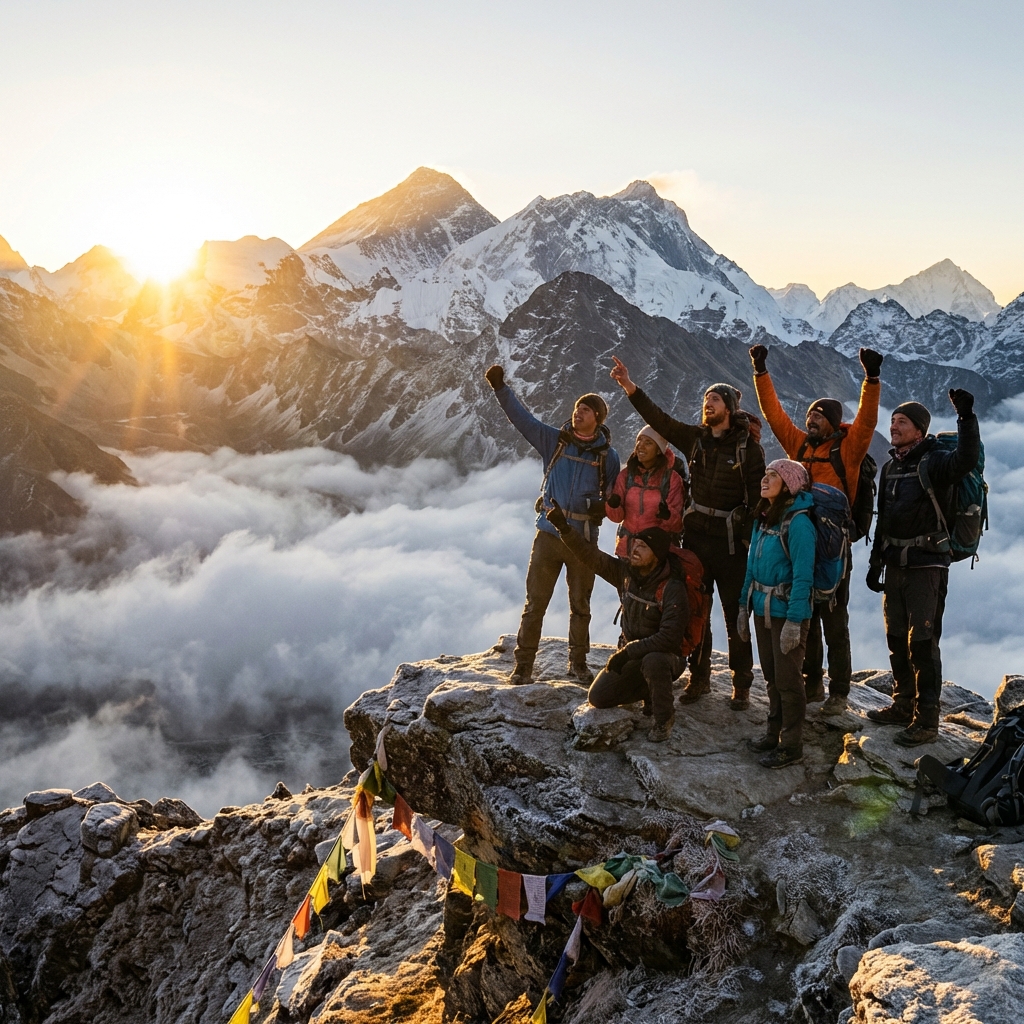

Manaslu Region Trekking Guide 2026: Nepal's Mountain of the Spirit and Last Great Secret
The Manaslu region is a restricted trekking area in north-central Nepal's Gorkha District, centred on Mount Manaslu (8,163m), the world's eighth-highest peak. Its signature treks are the 14–18 day Manaslu Circuit (crossing Larkya La Pass, 5,160m) and the sacred Tsum Valley. Permits cost $150–200 and a licensed guide is mandatory.
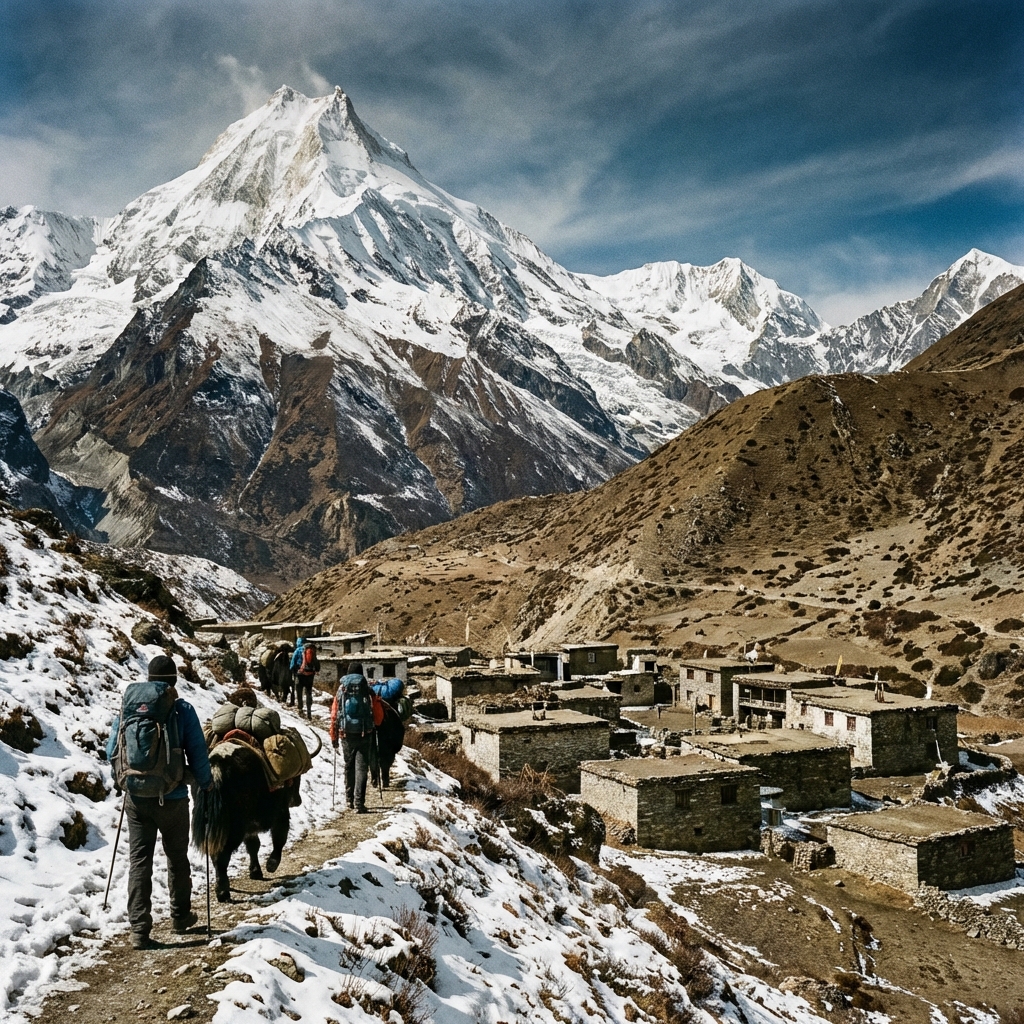
The Manaslu region is Nepal's most compelling answer to overtourism—a pristine Himalayan wilderness centered around Mount Manaslu (8,163m), the world's eighth-highest peak, known reverently as "Mountain of the Spirit." While Everest Base Camp welcomed over 50,000 trekkers and the Annapurna Circuit saw nearly 250,000 visitors in 2026, the Manaslu region hosted just 12,000 adventurers, preserving the authentic teahouse experience and Tibetan Buddhist culture that has vanished from Nepal's more famous trails.
Located in north-central Nepal along the border with Tibet's Gorkha region, Manaslu represents what Everest was in the 1970s and what Annapurna was in the 1990s—a genuine adventure where trails feel remote, villages remain authentically Tibetan, and the mountains dominate with humbling scale. This is not a region for first-time trekkers seeking comfort, but for those ready to embrace Nepal's restricted area regulations, mandatory guide requirements, basic teahouse conditions, and the challenge of crossing Larkya La Pass at 5,160 meters.
The region's restricted status is both its barrier and its blessing. Permits cost $100 USD during peak season (September-November), guides are mandatory, and you must trek with at least one companion. But these regulations have preserved what elsewhere has been lost: villages where Tibetan remains the primary language, monasteries that serve communities rather than tourists, and trails where you can hike for hours without seeing another group. The Manaslu Conservation Area Project (MCAP) ensures that permit fees directly support local communities, maintaining the delicate balance between tourism development and cultural preservation.
Who this guide is for:
- Experienced Nepal trekkers seeking the "next level" beyond Everest or Annapurna
- Cultural explorers wanting authentic Tibetan Buddhist immersion in Nepal
- Adventure photographers seeking pristine, crowd-free Himalayan landscapes
- Trekkers with 2-3 weeks for the classic circuit or Tsum Valley extension
- Those willing to embrace basic facilities for genuine remoteness
- Anyone comparing Manaslu against other Nepal regions before committing
If you've completed EBC or Annapurna and want something more challenging yet less crowded, Manaslu delivers. If this is your first Nepal trek, consider starting with Annapurna Base Camp or Langtang Valley before tackling Manaslu's remoteness and restrictions.
September–November (Autumn, peak season) | March–May (Spring, warmer)
14–18 days (Manaslu Circuit) | 18–22 days (Tsum Valley) | 24+ days (Combined)
Difficult to Very Strenuous
5,160m (Larkya La Pass on circuit) | 3,700m (Tsum Valley high point)
Manaslu RAP $100 Sept-Nov, $75 Dec-Aug | MCAP $30 | TIMS $20 | Guide mandatory
$1,400–$2,200 (Circuit) | $1,800–$2,800 (Tsum) | $2,500–$4,000 (Combined)
Basic teahouses throughout (improving annually), camping optional for extensions
Mandatory—restricted area permits require registered agency, solo trekkers now allowed (with licensed guide)
Critical Understanding: Restricted Area Regulations
The Manaslu region operates under Nepal's restricted area regulations. You cannot trek independently:
- Restricted Area Permit (RAP) required from Nepal Immigration in Kathmandu
- Registered trekking agency mandatory to process permits (no freelance guides)
- Minimum 2 trekkers required (solo trekking not permitted)
- Licensed guide mandatory throughout the trek
- Permit costs: $100 per person for September-November, $75 for December-August (first 7 days, then $15/day)
- Processing time: Minimum 2-3 days in Kathmandu before departure
Budget $150-200 per person for all permits combined, and plan to spend 2-3 days in Kathmandu handling paperwork before starting your trek. If you want independent trekking freedom, consider Annapurna or Langtang instead.
What Makes Manaslu Unique: The Five Defining Features
1. The Mountain of the Spirit: Manaslu Massif and Geography
Mount Manaslu (8,163m / 26,781 ft) dominates this region with spiritual and physical presence. The name "Manaslu" derives from the Sanskrit word "manasa," meaning "mountain of the spirit" or "soul," and locals refer to it as "Kutang," reflecting its deep integration into Tibetan Buddhist culture.
Geographic Position:
- Location: North-central Nepal, Gorkha District, bordering Tibet (Autonomous Region of China) to the north
- Mountain Range: Part of the Mansiri Himal sub-range of the Himalayas
- Valley System: Primarily the Budhi Gandaki River valley, which drains south from the Tibetan plateau
- Area Coverage: Manaslu Conservation Area spans 1,663 square kilometers (642 square miles)
- Neighbors: Dhaulagiri massif to the west, Annapurna range to the southwest, Ganesh Himal to the east
The Manaslu Massif:
Mount Manaslu anchors a stunning massif of peaks visible throughout the circuit:
- Manaslu (8,163m): Eighth-highest mountain globally, first climbed in 1956 by Japanese expedition
- Manaslu North (7,157m): Prominent northern satellite peak
- Naike Peak (6,211m): East face visible from Samagaon
- Manaslu East Pinnacle (7,992m): Technical peak rarely attempted
- Himlung Himal (7,126m): Marks the border between Manaslu and Annapurna regions
- Cheo Himal (6,820m): Visible from Larkya La Pass
Why Geography Matters for Trekkers:
The Manaslu region's position creates distinct characteristics:
- Tibetan border proximity: Upper villages like Samdo sit just kilometers from Tibet, creating authentic trans-Himalayan cultural zones
- Rain shadow effect: Upper valleys receive less monsoon precipitation than southern Nepal, though not as dramatically as Mustang or Dolpo
- Valley orientation: The north-south Budhi Gandaki valley funnels weather systems, creating localized conditions different from neighboring regions
- Glacial activity: Active glaciers feed the Budhi Gandaki, creating dramatic gorges and unstable sections requiring bridge crossings
2. Restricted Area Status: Exclusivity by Design
Manaslu's restricted area designation sets it fundamentally apart from Nepal's most popular trekking regions. Understanding this system is essential before committing to the region.
How Restricted Area Permits Work:
The Manaslu region falls under Nepal's Special Trekking Permit system, originally designed to protect sensitive border areas and preserve fragile cultures:
Permit Requirements:
-
Restricted Area Permit (RAP): Issued by Nepal Immigration Department in Kathmandu
- September–November: $100 USD for first 7 days, then $15/day
- December–August: $75 USD for first 7 days, then $10/day
- Must be processed through a registered trekking agency (no independent applications)
-
Manaslu Conservation Area Permit (MCAP): $30 USD
- Issued by MCAP office or through agency
- Funds support conservation and community development
-
Trekkers' Information Management System (TIMS): $20 USD
- Organized trekker TIMS card (blue)
- Tracks trekker movements for safety
Agency and Guide Requirements:
- Registered trekking agency mandatory: Only government-licensed agencies can process RAP permits
- Licensed guide required: Must be government-certified, carries your permits
- Minimum 2 trekkers: Solo trekking not permitted (but two solo travelers can team up through agencies)
- Porter regulations: Agencies must follow porter welfare guidelines (insurance, equipment, wages)
Why the Restrictions Exist:
The government implemented restricted status for several reasons:
- Border security: Proximity to Tibet requires controlled access
- Cultural preservation: Limiting numbers protects Tibetan Buddhist communities from rapid tourism impact
- Sustainable development: Permit fees fund infrastructure and community projects
- Safety oversight: Mandatory guides reduce rescue incidents in remote areas
What This Means for Your Trek:
These restrictions create both challenges and benefits:
Challenges:
- Higher permit costs than Everest or Annapurna ($150-200 total vs. $45-50)
- Loss of independent trekking flexibility
- Must find a companion if traveling solo
- Agency fees add to overall cost
- 2-3 days required in Kathmandu for permit processing
Benefits:
- Dramatically fewer trekkers (12,000/year vs. 50,000+ on EBC)
- Preserved cultural authenticity in villages
- Better guide-to-trekker ratios ensure safety
- Permit fees directly support local communities
- Trails remain less commercialized
Pro Tip
If you're a solo traveler, many Kathmandu agencies offer "group joining" services where they pair solo trekkers for permit purposes. You split permit costs but can still trek independently with your respective guides. Alternatively, post on Nepal trekking forums 2-3 months before your trip to find a trekking partner directly.
Comparing Restricted vs. Open Areas:
| Factor | Manaslu (Restricted) | Everest (Open) | Annapurna (Open) |
|---|---|---|---|
| Permit Cost | $150-200 total | $45-50 total | $40-45 total |
| Solo Trekking | Not permitted | Allowed | Allowed |
| Guide Requirement | Mandatory | Optional (recommended) | Mandatory 2024+ |
| Agency Requirement | Mandatory for permits | Optional | Optional |
| Min. Group Size | 2 trekkers | No minimum | No minimum |
| Annual Trekkers | ~12,000 | ~50,000 | ~250,000 |
| Cultural Preservation | High | Moderate | Variable |
3. Larkya La Pass: The 5,160-Meter Challenge
For those trekking the Manaslu Circuit, Larkya La Pass represents the physical and emotional climax—a demanding high-altitude crossing that separates Manaslu from easier Nepal treks.
Pass Specifications:
- Elevation: 5,160 meters (16,929 feet)
- Crossing Day: Dharamsala (4,460m) to Bhimtang (3,590m) via pass
- Total Distance: 16 kilometers
- Elevation Gain to Pass: 700 meters from Dharamsala
- Descent from Pass: 1,570 meters to Bhimtang
- Typical Duration: 8-10 hours total
- Start Time: 3:00-4:00 AM (essential for weather window)
- Technical Difficulty: Non-technical but extremely demanding
Why Larkya La Is Challenging:
Unlike Thorong La on the Annapurna Circuit (5,416m) which has established lodges on both sides and more gradual approaches, Larkya La demands:
- Extreme Altitude Start: You sleep at 4,460m and wake to climb higher
- Pre-Dawn Departure: Must start 3:00-4:00 AM to beat afternoon weather deterioration
- Weather Dependency: Pass creates its own microclimate; conditions can change rapidly
- Long Descent: 1,570m down steep, rocky terrain punishes knees and concentration
- Limited Bailout Options: Once committed, you must complete the crossing
- Year-Round Snow: Even in dry season, snow and ice require microspikes/crampons
The Crossing Experience:
Pre-Dawn (3:00-5:00 AM): You depart Dharamsala in complete darkness, headlamps illuminating the moraine trail. Temperatures can drop to -20°C (-4°F). The climb is steady but relentless, following cairns and guide tracks through rocky terrain.
Dawn to Pass Summit (5:00-8:00 AM): As dawn breaks, Manaslu's north face emerges in alpenglow—one of Nepal's most spectacular mountain moments. The final approach to the pass traverses snowfields and glacier edges. Prayer flags mark the summit, and on clear days, views extend to Annapurna II (7,937m), Himlung Himal (7,126m), Cheo Himal (6,820m), and Kang Guru (6,981m).
Descent to Bhimtang (8:00 AM-2:00 PM): The descent is brutal—1,570 meters of steep switchbacks, loose scree, and rocky terrain. Most altitude sickness incidents occur on descent due to exhaustion and reduced oxygen uptake when descending rapidly. Trekking poles are essential.
Weather Window Realities:
Larkya La has a narrow weather window that determines success:
- Best months: October-November (autumn), April-May (spring)
- Optimal window: October 10-25 offers most reliable conditions
- Morning stability: 3:00 AM-11:00 AM typically stable
- Afternoon deterioration: Clouds build from 11:00 AM, snow possible from 1:00 PM
- Danger periods: June-August (monsoon), January-February (extreme cold, deep snow)
Your guide monitors weather closely and may decide to wait 1-2 days if conditions are unsafe. Budget 2-3 buffer days in your itinerary for potential delays.
Required Gear for Pass Crossing:
- Microspikes or light crampons: Essential for snow/ice sections
- Trekking poles: Critical for steep descent
- Headlamp with fresh batteries: Pre-dawn start in darkness
- Four-season sleeping bag: -15°C/-20°C rating minimum
- Down jacket: Summit temperatures -10°C to -20°C
- Insulated gloves and hat: Frostbite risk is real
- High-altitude sunglasses: Glacier glare causes snow blindness
- Sunscreen SPF 50+: UV intensity extreme at 5,160m
Larkya La Pass Safety: When to Turn Back
Larkya La claims lives every year from altitude sickness, hypothermia, and weather exposure. Turning back is not failure—it is survival:
- Turn back if: You have headache, nausea, dizziness, or confusion (AMS symptoms)
- Turn back if: Weather deteriorates (whiteout, high winds, heavy snow)
- Turn back if: You're not at the pass by 11:00 AM (afternoon conditions worsen)
- Trust your guide: Their judgment on pass safety is final
Most groups that turn back successfully cross 1-2 days later. Those who push through with AMS symptoms risk High Altitude Cerebral Edema (HACE) or High Altitude Pulmonary Edema (HAPE)—both life-threatening and requiring immediate descent and evacuation.
4. Tibetan Buddhist Culture: Living Heritage
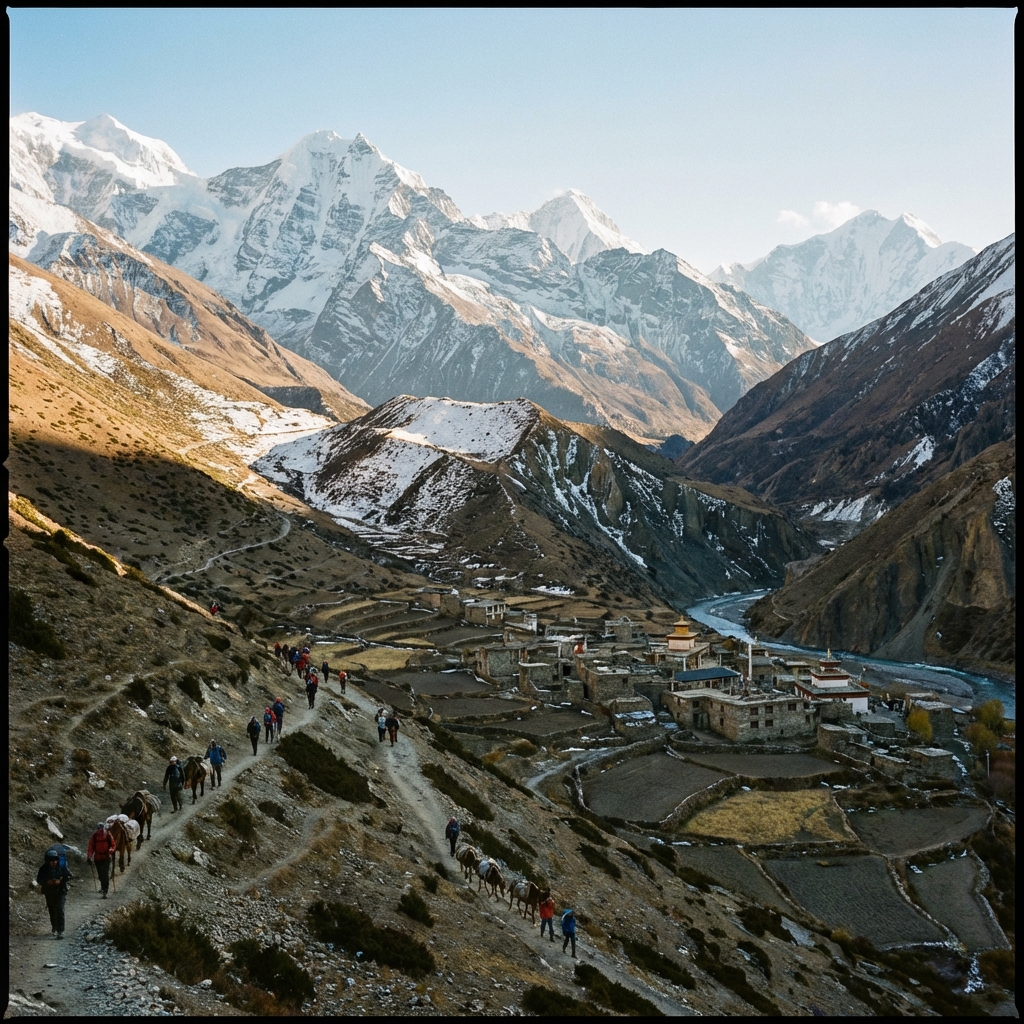
The Manaslu region's cultural authenticity rivals its natural beauty. Upper valley villages maintain Tibetan Buddhist traditions that have largely disappeared from more accessible regions.
Cultural Geography:
The Budhi Gandaki valley creates a cultural gradient:
- Lower Valley (Machha Khola to Jagat, 870m-1,340m): Mixed Hindu-Buddhist, Gurung and Magar influences
- Middle Valley (Deng to Namrung, 1,860m-2,630m): Transitional zone, increasing Tibetan influence
- Upper Valley (Lho to Samdo, 3,180m-3,865m): Predominantly Tibetan Buddhist, culturally trans-Himalayan
- Tsum Valley (side valley): Isolated Tibetan enclave, sacred valley with restricted access
Key Villages and Cultural Highlights:
Samagaon (3,530m): The cultural heart of upper Manaslu, Samagaon is a large Tibetan village with 400+ residents:
- Ribung Gompa: 16th-century monastery overlooking the village
- Pungyen Gompa: Ancient monastery with butter lamp chambers and murals
- Mani walls: Extensive stone walls carved with "Om Mani Padme Hum" prayers
- Spinning prayer wheels: Line the main trail, turned by passing trekkers
- Traditional architecture: Stone houses with flat roofs, prayer flags
- Community life: Yak herding, potato farming, Buddhist ceremonies
Samagaon serves as the primary acclimatization stop, and spending 2 days here allows cultural immersion—watching morning prayers, visiting monastery festivals, and understanding daily life in a high-altitude Tibetan village.
Samdo (3,865m): The highest permanent settlement on the circuit, Samdo sits just 8 kilometers from the Tibetan border:
- Historic trade village: Once a major salt trading post with Tibet (trade route now closed)
- Tibetan refugees: Population includes descendants of 1959 Tibetan exodus
- Dual language: Tibetan primary language, Nepali secondary
- Monastery visits: Small gompa with active monks
- Tibet border views: Clear days reveal Tibetan plateau landscapes
Lho Village (3,180m): Smaller village between Namrung and Samagaon with extraordinary monastery:
- Ribung Gompa Lho: Perched on cliff overlooking Manaslu
- Chorten and mani walls: Elaborate Buddhist monuments
- Traditional Tibetan houses: Well-preserved architecture
- Quieter atmosphere: Less touristy than Samagaon
Mu Gompa (Tsum Valley, 3,700m): For those adding the Tsum Valley extension, Mu Gompa represents one of Nepal's most remote active monasteries:
- Location: Far northern Tsum Valley, near Tibet border
- Elevation: 3,700 meters
- Significance: Major Tibetan Buddhist monastery, sacred pilgrimage site
- Isolation: Days from nearest road, maintains medieval monastery life
- Cultural practices: Morning prayers, butter lamp offerings, sky burial traditions nearby
Rachen Gompa (Tsum Valley, 3,240m): Important nunnery in Tsum Valley:
- Nunnery complex: Active community of Tibetan Buddhist nuns
- Cultural programs: Visitors can observe prayer ceremonies with permission
- Traditional crafts: Nuns create traditional Buddhist art and textiles
Religious Practices and Etiquette:
When visiting monasteries and villages, respect cultural norms:
Do:
- Remove shoes before entering gompas (monasteries)
- Walk clockwise around stupas, chortens, and mani walls
- Turn prayer wheels clockwise
- Ask permission before photographing monks, nuns, or religious ceremonies
- Dress modestly (cover shoulders and knees)
- Make donations at monasteries (suggested $2-5 USD)
- Accept butter tea when offered (sip slowly, polite to leave some)
Don't:
- Touch or sit on religious objects without permission
- Point feet toward Buddha statues or monks
- Enter monasteries during private ceremonies unless invited
- Photograph sky burial sites or funeral ceremonies
- Disturb prayer flag lines or mani stones
- Bargain aggressively in village shops
- Display public affection
Festivals and Cultural Events:
Timing your trek with festivals adds profound cultural dimension:
Lhosar (Tibetan New Year, February-March):
- Timing varies by lunar calendar
- Multi-day celebrations in Samagaon, Samdo, and Tsum Valley villages
- Monastery ceremonies, traditional dances, family feasts
- Difficult trekking conditions (late winter) but extraordinary cultural experience
Dashain and Tihar (October-November):
- Nepal's biggest Hindu festivals, celebrated in lower valley villages
- Upper villages have muted celebrations (primarily Buddhist)
- Some guide/porter shortages as locals return to families
- Flights and buses crowded, book well in advance
Monastery Festivals:
- Various throughout year at Ribung Gompa and other monasteries
- Check with trekking agency for specific dates
- Monks perform cham dances, butter lamp offerings, ritual music
Pro Tip
Spend your acclimatization days actively engaging with local culture. In Samagaon, wake early to attend morning prayers at Pungyen Gompa (5:30-7:00 AM), visit the monastery museum, and walk to traditional homes where families may invite you for butter tea. These interactions create memories far beyond the trekking itself and support cultural preservation through respectful tourism.
5. The Conservation Success Story: Manaslu Conservation Area Project (MCAP)
The Manaslu Conservation Area Project represents one of Nepal's most successful community-based conservation models, balancing environmental protection with local livelihoods.
MCAP at a Glance:
- Established: December 1998 by National Trust for Nature Conservation (NTNC)
- Area: 1,663 square kilometers (642 square miles)
- Altitude Range: 1,400m to 8,163m (Manaslu summit)
- Buffer Zone: Additional 27 Village Development Committees (VDCs)
- Headquarters: Philim village (1,590m)
- Funding: MCAP permit fees ($30 per trekker), international conservation grants, government support
Manaslu Conservation Area Biodiversity at a Glance:
The Manaslu Conservation Area protects a remarkable range of Himalayan wildlife across its 1,400m–8,163m elevation band:
- Mammals: 33 species, including snow leopard, Himalayan tahr, blue sheep, musk deer, and red panda
- Birds: 110 species, including the Himalayan Monal (Nepal's national bird), Blood Pheasant, and Snow Partridge
- Reptiles: 3 species
- Butterflies: 11 species
- Flowering plants: 1,500–2,000 species, with 19 varieties of rhododendron
Ethnic Groups and People of the Manaslu Region:
Roughly 7,000 people live within the conservation area, predominantly from the Gurung (Nubri) community in the lower valley and Tibetan-origin (Bhotia) communities in the upper villages. The main ethnic groups are Gurung, Tibetan, Tamang, Magar, Brahmin, and Chhetri. Principal settlements include Samagaon, Lho, Prok, Bihi, Chumchet, Chhekampar, and Sirdibas. This cultural mix—Buddhist in the high country, mixed Hindu-Buddhist lower down—is a defining feature of trekking in this part of Nepal.
Biodiversity Highlights by Ecological Zone:
The extreme elevation range creates multiple ecological zones:
Flora:
- 1,400-2,000m: Sal forests, rhododendron, oak, subtropical vegetation
- 2,000-3,000m: Temperate forests—pine, fir, birch, juniper
- 3,000-4,000m: Alpine shrubs, rhododendron species, medicinal herbs
- 4,000m+: Alpine meadows, mosses, lichens, high-altitude grasses
- Special note: 19 species of rhododendron, including rare varieties
Fauna:
- Snow Leopard: Estimated 10-15 individuals in upper conservation area
- Himalayan Tahr: Common in alpine zones above 3,500m
- Blue Sheep (Bharal): Herds visible near Samdo and around Larkya La
- Himalayan Marmot: Often seen sunbathing near trails
- Red Panda: Lower forests (rarely seen, shy)
- Himalayan Black Bear: Lower to middle elevations
- Birds: 110 species including Himalayan Monal (Nepal's national bird), Blood Pheasant, Snow Partridge
Conservation Challenges:
MCAP addresses multiple environmental threats:
-
Deforestation: Locals historically relied on forests for firewood, building materials
- Solution: Kerosene subsidies, alternative energy programs, reforestation projects
-
Wildlife-Human Conflict: Snow leopards occasionally prey on livestock
- Solution: Livestock insurance programs, predator-proof corrals
-
Waste Management: Increased trekking brings plastic waste, human waste issues
- Solution: Waste management committees, porter loads for garbage removal, toilet facilities at teahouses
-
Climate Change: Glacial retreat affecting water sources, changing vegetation zones
- Solution: Climate monitoring, adaptation programs for farmers
Community Development Programs:
Your $30 MCAP permit directly funds:
- Education: School improvements, scholarship programs
- Healthcare: Mobile health clinics, first aid training
- Infrastructure: Trail maintenance, bridge construction
- Cultural preservation: Monastery restoration, traditional craft support
- Alternative livelihoods: Homestay development, handicraft cooperatives
Comparing MCAP to Other Nepal Conservation Areas:
| Conservation Area | Size (km²) | Annual Visitors | Permit Fee | Community Benefit Model |
|---|---|---|---|---|
| Manaslu (MCAP) | 1,663 | ~12,000 | $30 | Direct community funding, strong local involvement |
| Annapurna (ACAP) | 7,629 | ~250,000 | $30 | Established model, extensive infrastructure |
| Sagarmatha (SNP) | 1,148 | ~50,000 | $30 | Government-managed, moderate community role |
| Langtang (LNP) | 1,710 | ~30,000 | $30 | Post-earthquake recovery, rebuilding focus |
Responsible Trekking in MCAP:
Support conservation efforts through responsible practices:
Energy and Water:
- Use solar-charged electronics instead of requesting teahouse charging (drains their power)
- Take short showers (hot water requires firewood or kerosene)
- Drink boiled water or use purification tablets (avoid plastic bottles)
- Turn off lights when leaving rooms
Waste Management:
- Carry out all non-biodegradable waste (batteries, plastics, wrappers)
- Use designated toilets (never defecate near water sources)
- Tip porters who carry out accumulated garbage
- Choose teahouses with waste management systems
Cultural Respect:
- Support local businesses (buy snacks, crafts from village shops)
- Hire local guides and porters when possible
- Participate in community homestays (available in some villages)
- Ask permission before photographing people or religious sites
Wildlife Protection:
- Never feed wildlife (alters natural behavior)
- Maintain distance from animals (especially marmots, which can carry disease)
- Report snow leopard or other rare wildlife sightings to conservation authorities
- Stay on trails (prevents habitat disturbance)
Best Treks in Manaslu Region: Complete Breakdown
Manaslu Circuit Trek: The Classic 14-18 Day Journey
The Manaslu Circuit is the region's signature trek—a complete circumnavigation of the Manaslu massif following the Budhi Gandaki valley north before crossing Larkya La Pass and descending into the Marsyangdi valley (Annapurna region).
Route Snapshot:
- Duration: 14-18 days (shorter = faster pace with minimal rest days)
- Distance: 177 kilometers (110 miles)
- Maximum Altitude: 5,160m at Larkya La Pass
- Start Point: Soti Khola or Machha Khola (870m)
- End Point: Dharapani, connecting to Annapurna Circuit route
- Trek Style: Teahouse-based, point-to-point
- Best Seasons: September-November (autumn), March-May (spring)
Day-by-Day Overview:
Days 1-2: Lower Budhi Gandaki Valley (870m-1,340m)
- Drive from Kathmandu to Soti Khola/Machha Khola (7-9 hours)
- Trek through subtropical gorge, suspension bridges, terraced fields
- Villages: Soti Khola, Machha Khola, Khorlabesi, Tatopani, Doban, Jagat
- Culture: Hindu-Buddhist mix, Gurung villages
- Teahouses: Basic but comfortable, hot showers available
Days 3-4: Middle Valley Transition (1,340m-2,630m)
- Jagat → Deng → Ghap → Namrung
- Enter restricted area at Jagat (permit check)
- Landscape shifts to pine forests, increasing Tibetan influence
- Villages: Deng (first Tibetan architecture), Ghap, Namrung
- Culture: Transition from Hindu to Buddhist majority
- Teahouses: Simple but clean, food options decrease
Days 5-6: Upper Tibetan Valley (2,630m-3,530m)
- Namrung → Lho → Samagaon
- Spectacular Manaslu north face views emerge
- First acclimatization concerns (altitude gains more significant)
- Villages: Shyala, Lho (stunning monastery), Samagaon (major village)
- Culture: Fully Tibetan Buddhist, active monasteries
- Teahouses: Basic facilities, shared toilets common
Day 7: Samagaon Acclimatization Day
- Critical rest day for altitude adjustment
- Side trip options: Manaslu Base Camp (4,800m, 6-8 hours), Pungyen Gompa, Birendra Lake
- Most trekkers choose Base Camp hike or monastery visits
- Sleep at 3,530m but hike higher (important for acclimatization)
Day 8: Samagaon to Samdo (3,530m-3,865m)
- Short day (3-4 hours) to allow further acclimatization
- Trail along upper Budhi Gandaki valley
- Tibet border views, increasingly barren landscape
- Samdo: Highest permanent village, historic salt trading post
- Teahouses: Very basic, limited menu options
Day 9: Samdo Acclimatization Day
- Another critical rest day
- Side trip to Tibet border viewpoint or Samdo Peak (4,500m)
- Some itineraries skip this day (risky for altitude adjustment)
- Essential for preparing body for Larkya La crossing
Day 10: Samdo to Dharamsala/Larkya Phedi (3,865m-4,460m)
- 3-4 hours to pre-pass camp
- Gradual ascent into high alpine zone
- Sparse vegetation, glacial moraine
- Dharamsala: Extremely basic shelters, no village (just teahouses)
- Teahouses: Shared rooms common, very cold, early dinner (5-6 PM) before early sleep
Day 11: Dharamsala to Bhimtang via Larkya La Pass (5,160m)→ 5,160m → 3,590m)
- The big day: 3:00-4:00 AM start, 8-10 hours total
- Pre-dawn ascent to pass, spectacular sunrise on Manaslu
- Pass summit: Prayer flags, 360° Himalayan panorama
- Steep descent to Bhimtang meadows
- Bhimtang: Beautiful alpine setting, Manaslu west face views
- Teahouses: Better than Dharamsala, warm atmosphere after pass success
Day 12: Bhimtang to Tilije (3,590m-2,300m)
- Long descent through rhododendron forests
- Re-enter vegetation zones, warmer temperatures
- Tilije: First Annapurna Circuit village (you've crossed into Annapurna region)
- Teahouses: Improved facilities, expanded menus
Day 13: Tilije to Dharapani (2,300m-1,970m)
- Continue descent, join main Annapurna Circuit trail
- Dharapani: Junction village where Manaslu trekkers end or continue into Annapurna
- Most trekkers: Drive to Besisahar, then Kathmandu
- Optional: Continue Annapurna Circuit to Thorong La Pass (adds 8-10 days)
Day 14: Dharapani to Kathmandu
- Drive to Besisahar (3-4 hours), then Kathmandu (6-7 hours)
- Or continue Annapurna Circuit
Detailed trek information: See Manaslu Circuit Trek complete guide.
Tsum Valley Trek: The Sacred Hidden Valley
Tsum Valley is a sacred Himalayan pilgrimage valley that branches north from the Manaslu Circuit at Lokpa village. This remote side valley offers extraordinary Tibetan Buddhist culture in near-complete isolation.
Route Snapshot:
- Duration: 18-22 days total (includes approach and return)
- Maximum Altitude: 3,700m at Mu Gompa
- Trek Style: Out-and-back from Lokpa, teahouse-based
- Cultural Focus: Primary draw is monasteries, not high passes
- Best Seasons: September-November, March-May
- Additional Permits: Tsum Valley Restricted Area Permit required (separate from Manaslu RAP)
Why Trek Tsum Valley:
Tsum Valley offers a completely different Manaslu experience:
- No high passes: Maximum altitude 3,700m (safer for altitude concerns)
- Cultural immersion: Days spent visiting monasteries, nunneries, sacred sites
- Extreme remoteness: Even quieter than Manaslu Circuit (5,000-6,000 annual visitors)
- Tibetan purity: Valley culturally separate from Nepal until recently
- Religious significance: Milarepa (famous Tibetan saint) meditated here
Route Overview:
Tsum Valley treks typically follow this pattern:
Days 1-4: Kathmandu → Soti Khola → Machha Khola → Jagat → Lokpa
- Follow Manaslu Circuit route to Lokpa (1,950m)
- Lokpa: Junction where Tsum Valley trail branches north
Days 5-7: Lokpa → Chhokang Paro → Nile → Chhule
- Enter Tsum Valley proper, increasing isolation
- Villages: Chhokang Paro, Nile, Chhule
- Monasteries: Begin visiting gompas along valley
Days 8-9: Chhule → Rachen Gompa → Mu Gompa
- Rachen Gompa (3,240m): Important nunnery, active nun community
- Mu Gompa (3,700m): Valley's highest point, major monastery complex
- Spend night at Mu Gompa or nearby Chhule village
Day 10: Mu Gompa Exploration Day
- Visit monastery complex
- Hike to viewpoints, sacred sites
- Observe Buddhist ceremonies (if permitted)
Days 11-14: Return Journey
- Retrace route to Lokpa
- Typically faster descent (consolidate days)
Days 15-18: Lokpa → Jagat → Machha Khola → Kathmandu
- Complete return journey
Cultural Highlights:
Monasteries and Gompas:
- Mu Gompa: Highest monastery, active monks, prayer ceremonies
- Rachen Gompa: Nunnery with 50+ nuns, traditional Buddhist arts
- Gumba Lungdang: Ancient monastery with rare murals
- Phurbe Gompa: Small monastery with meditation caves
Sacred Sites:
- Milarepa's Cave: Where famous Tibetan saint meditated (pilgrimage site)
- Piren Phu: Cave monastery in cliffside
- Mani walls: Extensive carved stone prayer walls throughout valley
- Chortens and stupas: Elaborate Buddhist monuments at village entrances
Tsum Valley + Manaslu Circuit Combined:
Many trekkers combine both for the ultimate Manaslu experience (24-28 days total):
Combined Route:
- Trek Manaslu Circuit to Lokpa (Day 4)
- Divert north into Tsum Valley (7-8 days)
- Return to Lokpa, continue Manaslu Circuit
- Complete circuit via Larkya La Pass
Advantages:
- Experience both cultural immersion and high-pass challenge
- See full breadth of Manaslu region
- Better value (already in region, minimal extra permit cost)
Disadvantages:
- Requires 24-28 days minimum
- Higher total cost (more guide/porter days, food, accommodation)
- More physically demanding (more total trekking days)
Best for: Trekkers with 4 weeks available who want comprehensive Manaslu experience.
For deeper planning, see the dedicated Tsum Valley trek guide and our Manaslu + Tsum Valley combination itinerary. Comparing this against Nepal's other classic loop? Read Annapurna Circuit vs Manaslu Circuit.
Manaslu Base Camp Extension
Some trekkers add a side trip to Manaslu Base Camp from Samagaon during the acclimatization day.
Route Details:
- Start/End: Samagaon (round trip)
- Duration: 6-8 hours round trip
- Maximum Altitude: 4,800m
- Distance: 12 kilometers round trip
- Difficulty: Strenuous (high altitude, moraine hiking)
The Experience:
The trail to Manaslu Base Camp follows glacial moraine and requires scrambling over loose rocks. Views of Manaslu's north face are spectacular, and you'll see mountaineering expeditions if trekking during climbing season (spring).
Is It Worth It?
Pros:
- Close-up Manaslu views
- Excellent acclimatization hike (high elevation gain and return)
- See mountaineering camps during climbing season
- Sense of accomplishment reaching 4,800m
Cons:
- Physically demanding on acclimatization day (may be too tiring)
- Route is rough moraine (risk of ankle injury)
- Alternative Birendra Lake hike is easier and still excellent for acclimatization
- Larkya La Pass views arguably more spectacular
Recommendation: If you're strong and well-acclimatized, the base camp hike is rewarding. If you're struggling with altitude or want a gentler acclimatization day, visit Pungyen Gompa and Birendra Lake instead.
Best Time to Trek Manaslu Region: Month-by-Month Analysis
Timing your Manaslu trek correctly is critical given the region's high-altitude challenges and weather dependency, especially for Larkya La Pass crossing.
| Month | High | Low | Conditions | Crowds | Notes |
|---|---|---|---|---|---|
| January | -3°C | -18°C | Low (15-20mm) | Very Low | Extreme cold, Larkya La often impassable with deep snow, most teahouses closed above Namrung, only for experienced winter mountaineers |
| February | 0°C | -15°C | Low (20-25mm) | Very Low | Still very cold, Lhosar festival in Tibetan villages (variable dates), pass conditions improving late month, limited services |
| MarchBest | 5°C | -10°C | Low-Moderate (35-50mm) | Low-Moderate | Spring begins, warming trend, rhododendrons bloom in lower valleys, pass clearing of winter snow, good value pricing |
| AprilBest | 9°C | -6°C | Moderate (60-80mm) | Moderate-High | Excellent conditions, comfortable temperatures, stable weather, ideal for acclimatization, spring flowers, occasional afternoon clouds |
| MayBest | 12°C | -3°C | Moderate-High (90-120mm) | Moderate | Warmest trekking month, comfortable high-altitude nights, increasing afternoon clouds, pre-monsoon haze affects views, best early May |
| June | 13°C | 0°C | Very High (220-280mm) | Very Low | Monsoon begins, daily rain in lower valleys, landslide danger, leeches below 3,000m, poor visibility, pass conditions deteriorating |
| July | 14°C | 2°C | Extreme (350-400mm) | Very Low | Peak monsoon, trails dangerous, rivers swollen, landslides common, Larkya La treacherous, extremely dangerous period |
| August | 13°C | 2°C | Very High (300-350mm) | Very Low | Monsoon continues, similar to July, slight improvement late month but still not recommended |
| SeptemberBest | 11°C | -2°C | Moderate-High (150-200mm) | Moderate | Monsoon clearing, dramatic improvement mid-late September, fresh snow on peaks, excellent late-month conditions, crowds building |
| OctoberBest | 8°C | -8°C | Low (25-40mm) | Very High | PEAK SEASON - best visibility, most stable weather, October 10-25 optimal for Larkya La, Dashain festival, busiest month, book months ahead |
| NovemberBest | 4°C | -12°C | Very Low (10-20mm) | Moderate | Excellent early-mid November, crystal-clear views, cooling rapidly, crowds thin after Nov 15, some teahouses closing late month, -20°C at Larkya La |
| December | 0°C | -16°C | Low (15-25mm) | Low | Cold but clear early month, heavy snow risk increases, pass conditions deteriorating, many teahouses closed, only for experienced winter trekkers |
Autumn Season (September-November): Peak Trekking Window
Why Autumn Is Best:
- Post-monsoon air clarity creates crystal-clear mountain views
- Stable high-pressure weather systems minimize precipitation
- Larkya La Pass most reliably passable
- All teahouses open with full services
- Trail conditions excellent after monsoon trail maintenance
September: Monsoon Transition
- Early September still risky (monsoon tail end)
- Mid-September improving rapidly
- Late September (after Sept 20) excellent conditions
- Fresh snow on high peaks creates dramatic scenery
- Fewer crowds than October
- Best for: Trekkers seeking quieter trails with good weather
October: The Golden Month
- Peak season for excellent reasons
- October 10-25: Optimal window for Larkya La crossing
- Clearest skies of the year
- Stable temperatures (cold but not extreme)
- Dashain festival (mid-October, variable dates)
- Downside: Busiest month, teahouses can fill, book 2-3 months ahead
- Best for: First-time Manaslu trekkers prioritizing safety and reliability
November: Crystal Clarity
- Early-mid November still excellent (until Nov 15)
- Spectacular mountain clarity
- Rapidly cooling temperatures (20°C+ drop from October)
- Larkya La extremely cold (-20°C to -25°C)
- Teahouses begin closing after Nov 20
- Crowds thin dramatically after Dashain
- Best for: Experienced cold-weather trekkers seeking solitude
Detailed seasonal guide: Best Time to Trek Manaslu Circuit
Spring Season (March-May): Warmer Alternative
Why Spring Works:
- Warmer temperatures than autumn (10-15°C higher)
- Rhododendron blooms in lower valleys (March-April)
- More comfortable high-altitude nights
- Excellent Larkya La conditions (especially April)
- Tradeoffs: More afternoon clouds, pre-monsoon haze affects distant views
March: Spring Emergence
- Winter releasing its grip
- Pass clearing of heavy snow
- Rhododendrons blooming below 3,000m
- Cooler than April/May but stable
- Fewer trekkers than autumn
- Best for: Budget-conscious trekkers and those seeking quieter trails
April: Spring Peak
- Ideal spring trekking conditions
- Warm days, cool nights (manageable)
- Excellent Larkya La window
- Full rhododendron bloom
- Increasing crowds (second-busiest month after October)
- Best for: Trekkers who dislike cold weather, families with older children
May: Pre-Monsoon Warmth
- Warmest trekking month
- Comfortable sleeping temperatures even at altitude
- Early May excellent, late May risky
- Increasing afternoon clouds and precipitation
- Pre-monsoon haze reduces distant visibility
- Pass conditions still good early month
- Best for: Cold-averse trekkers willing to trek early May and accept some afternoon clouds
Winter and Monsoon: Why to Avoid
Winter (December-February):
- Extreme cold (-20°C to -30°C at altitude)
- Larkya La often impassable due to deep snow
- Most teahouses closed above Namrung
- Short daylight hours
- Serious frostbite risk
- Only consider if: You're an experienced winter mountaineer with appropriate gear and flexibility
Monsoon (June-August):
- Daily heavy rain in lower Budhi Gandaki valley
- Landslide danger on narrow gorge trails
- Rivers swell, bridge crossings dangerous
- Leeches below 3,000m
- Larkya La Pass extremely dangerous (snow, ice, whiteouts)
- Poor visibility ruins mountain views
- Do not attempt: Monsoon trekking in Manaslu is genuinely dangerous
Pro Tip
The single best piece of timing advice: If you have flexibility, choose October 10-25 for the Manaslu Circuit. This narrow window offers the most reliable Larkya La conditions, excellent visibility, and manageable (not extreme) temperatures. If October doesn't work, late April (April 20-30) is your second-best choice for warmer conditions without pre-monsoon instability.
Planning Your Manaslu Trek: Permits, Costs, and Logistics
Required Permits and How to Get Them
Three Permits Required for Manaslu Circuit:
1. Manaslu Restricted Area Permit (RAP)
- Issuing Authority: Nepal Immigration Department, Kalikasthan, Kathmandu
- Cost:
- September-November: $100 USD for first 7 days, then $15/day
- December-August: $75 USD for first 7 days, then $10/day
- Requirements:
- Must apply through registered trekking agency (cannot apply individually)
- solo trekkers now allowed (with licensed guide) required
- Licensed guide mandatory
- Passport copy, 2 passport photos, agency recommendation letter
- Processing time: 2-3 working days
- Note: For Tsum Valley, separate Tsum Valley RAP required ($40 for 7 days)
2. Manaslu Conservation Area Permit (MCAP)
- Issuing Authority: Nepal Tourism Board office or MCAP office
- Cost: NPR 3,000 (~$30 USD) for foreigners
- Requirements: Passport, 2 photos (agency can process)
- Processing time: Same day possible
- Funds support: Conservation efforts, community development
3. TIMS Card (Trekkers' Information Management System)
- Issuing Authority: Nepal Tourism Board
- Cost: NPR 2,000 (~$20 USD) for organized trekkers
- Type: Blue card (organized trekker, since guide is mandatory)
- Purpose: Trekker safety tracking, emergency response coordination
- Processing time: Same day
Permit Processing Options:
Option 1: Through Trekking Agency (Recommended)
- Agency handles all permits as part of package
- Typical timeline: Submit passport copy/photos 3-4 days before trek start
- Agency coordinates Nepal Immigration appointment for RAP
- You'll need 1-2 half-days in Kathmandu for final signatures/payments
- Cost: Usually included in trek package, or $50-100 service fee if permits-only
Option 2: DIY Permit Processing (Not Possible for RAP)
- You CANNOT get Manaslu RAP without registered agency
- You CAN get MCAP and TIMS yourself, but must still hire guide through agency for RAP
- Not recommended: Minimal savings, significant hassle
Permit Check Points:
Your permits will be checked at:
- Jagat (1,340m): First restricted area checkpoint, RAP verified
- Samagaon (3,530m): Secondary check
- MCAP checkpoints: Multiple along route
- Trail exits: Final check when leaving conservation area
Keep permits accessible in waterproof bag—guides carry duplicates but you need originals.
Trek Costs: Complete Budget Breakdown
Manaslu costs vary widely based on trek duration, group size, guide/porter hiring, and season. Here's realistic cost breakdown:
Budget Trek (Basic Comfort):
- Total cost: $1,400-$1,800 for 14-day circuit
- Includes:
- Permits ($150-200)
- Guide fee ($25-$40 /day)
- Shared porter ($15-20/day, one porter per 2 trekkers)
- Basic teahouse accommodation ($5-10/night)
- Meals at teahouses ($20-30/day)
- Kathmandu-Soti Khola-Kathmandu transport ($50-70)
- Agency service fee (if booking locally)
- Excludes: International flights, Kathmandu hotel, tips, personal expenses
Standard Trek (Comfortable):
- Total cost: $1,800-$2,200 for 14-day circuit
- Includes: All above plus:
- Better teahouse selection
- Personal porter (1:1 ratio, carries all your gear)
- Upgraded meals (variety, hot drinks)
- Better guide with excellent English
- Travel insurance processing assistance
Premium Trek (Full Service):
- Total cost: $2,500-$3,500 for 14-day circuit
- Includes: All above plus:
- Senior guide with 10+ years experience
- Personal porter plus assistant guide
- Best available teahouse rooms (when available)
- Satellite phone for emergency
- Comprehensive emergency evacuation support
- Pre-trek briefing and gear check
- Post-trek celebration dinner
Tsum Valley Extension Costs:
- Add $600-1,000 to circuit costs for 7-8 additional days
- Tsum Valley RAP: $40 for 7 days
- Additional guide/porter days, accommodation, meals
Cost Comparison Table:
| Expense Category | Budget | Standard | Premium |
|---|---|---|---|
| Permits (all 3) | $150-200 | $150-200 | $150-200 |
| Guide | $350-420 (14 days) | $420-500 | $500-700 |
| Porter | $210-280 (shared) | $280-350 (personal) | $350-420 |
| Accommodation | $70-140 | $100-180 | $150-250 |
| Meals | $280-420 | $350-500 | $450-650 |
| Transport | $50-70 | $70-100 | $100-150 |
| Tips | $80-120 | $120-180 | $200-300 |
| Emergency fund | $200 | $300 | $500 |
| TOTAL | $1,390-$1,850 | $1,790-$2,210 | $2,600-$3,370 |
Additional Costs Not Included:
- International flights to/from Kathmandu
- Kathmandu accommodation (budget $20-100/night for 3-4 nights)
- Nepal visa ($30-50 depending on duration)
- Travel insurance ($120-$280 for 3-week coverage)
- Gear purchases/rentals ($100-300 if buying new)
- Personal expenses (WiFi, charging, snacks, souvenirs)
Money-Saving Tips:
- Trek in shoulder season: March or late November offer 20-25% savings on guide/accommodation
- Join group trek: Share guide/porter costs with others (agencies offer "group joining" services)
- Book locally in Kathmandu: Can save 30-40% vs. booking from home country
- Share porter: One porter per 2 trekkers cuts porter cost in half
- Bring your own snacks: Chocolate bars cost $3-5 at altitude vs. $0.50 in Kathmandu
- Limit hot showers: Each shower costs $3-5, adds up over 14 days
- Drink boiled water: $1-2 vs. $3-5 for bottled water
What You Cannot Save On:
- Permits (fixed government fees)
- Quality guide (cheap guides lack experience, language skills, safety training)
- Travel insurance (non-negotiable for high-altitude trekking)
For a line-by-line breakdown of every expense—permits, guide, porter, teahouse, food, transport, and tips—see our Manaslu Circuit cost breakdown. To trim gear costs, weigh your options in our rent vs buy gear in Kathmandu guide before you fly.
Getting There: Access and Transportation
Kathmandu to Soti Khola/Machha Khola (Trek Start):
Option 1: Public Bus (Cheapest)
- Route: Kathmandu → Arughat Bazaar → Soti Khola
- Duration: 8-10 hours total
- Cost: $5-8 USD
- Departures: Early morning (6:00-7:00 AM) from Kathmandu
- Comfort: Very basic, crowded, no AC, winding roads
- Best for: Extreme budget travelers, those with strong stomachs for rough roads
Option 2: Private Jeep (Standard)
- Route: Kathmandu → Soti Khola direct
- Duration: 7-9 hours
- Cost: $120-$280 for entire jeep (seats 5-7 trekkers, split cost)
- Advantages: Flexible departure time, stops as needed, much more comfortable
- Best for: Small groups, those valuing comfort and flexibility
Option 3: Tourist Bus + Jeep
- Route: Kathmandu → Arughat (tourist bus) → Soti Khola (local jeep)
- Duration: 7-8 hours + 1-2 hours
- Cost: $15-25 per person
- Comfort: Better than public bus, worse than private jeep
- Best for: Solo travelers or pairs who want middle option
Most Agencies Include: Private jeep transport in trek package (shared among trekkers in group)
Road Conditions:
- First 60km paved highway
- Remaining 100km rough dirt road (especially bad during/after monsoon)
- Frequent construction delays
- Motion sickness common (bring medication)
Return Journey: Dharapani to Kathmandu:
After crossing Larkya La and completing the circuit, you'll end at Dharapani village, which connects to the Annapurna Circuit route.
Transport Options:
- Dharapani → Besisahar: 3-4 hours by jeep ($20-30 per person, shared)
- Besisahar → Kathmandu: 6-7 hours by bus ($10-15) or private jeep ($100-150 split)
- Total return time: 10-12 hours
- Cost: $30-50 per person (shared transport)
Alternative: Continue Trekking From Dharapani, you can continue the Annapurna Circuit to Thorong La Pass (adds 8-10 days), creating an epic combined trek.
Choosing a Trekking Agency and Guide
Since guide and agency are mandatory for Manaslu, choosing well is critical.
What to Look for in an Agency:
Essential Criteria:
- Government registration: Verify with Nepal Tourism Board (ask for registration number)
- RAP permit processing capability: Not all agencies can process restricted area permits
- Insurance coverage: Agency should have liability insurance
- Transparent pricing: Detailed cost breakdown, no hidden fees
- Emergency protocols: Clear evacuation procedures, satellite phone access
- Porter welfare compliance: Following Nepal's porter protection regulations
Red Flags:
- Suspiciously cheap prices (indicates poor guide quality or hidden fees)
- Cannot provide registration number
- No written contract
- Vague emergency procedures
- No porter insurance
Recommended Agency Questions:
Before booking, ask:
- "What is your Nepal Tourism Board registration number?"
- "How many years has our specific guide been leading Manaslu treks?"
- "What emergency communication equipment will we carry?"
- "What is your evacuation protocol if someone gets severe altitude sickness?"
- "Are porters insured and provided proper equipment?"
- "What exactly is included/excluded from the quoted price?"
- "What is your cancellation policy?"
- "Can I speak with previous clients who've done this trek with you?"
Guide Quality Indicators:
Excellent Guide:
- 5+ years Manaslu experience
- Fluent English (or your language)
- Wilderness First Responder or similar medical training
- Deep knowledge of Tibetan culture, monasteries
- Conservative on Larkya La pass decisions (safety over summit fever)
- Strong relationships with teahouse owners (gets you better rooms)
Average Guide:
- 2-3 years experience
- Basic English
- Government guide license but minimal medical training
- Knows route but limited cultural knowledge
Poor Guide:
- First-year guide or "assistant" presented as lead guide
- Limited English creates communication problems
- No medical training
- Pushes to cross pass in marginal conditions
- Focuses on speed over experience quality
Tipping Guidelines:
Tipping is expected and represents significant income for guides/porters:
Standard Tips (for good service):
- Guide: $8-$15 per day ($110-170 for 14-day trek)
- Porter: $5-8 per day ($70-110 for 14-day trek)
- Total for standard trek: $180-280 in tips
Excellent Service:
- Increase by 30-50% (guide saves your trek through exceptional weather decision, handles emergency expertly, goes far beyond)
Poor Service:
- Reduce or withhold tips, provide feedback to agency
Tip Timing: Give at trek end, preferably in rupees (they can't always change dollars in villages)
For help vetting operators, read our guide to the best trekking agencies for the Manaslu Circuit and the questions to ask trekking agencies before you book.
Plan Your Manaslu Trek With a Verified Local Agency
Get a no-obligation quote for the Manaslu Circuit or Tsum Valley from a vetted, government-licensed Nepal agency. We match you with the right guide and handle every permit.
Accommodation and Dining: What to Expect
Teahouse Lodging Standards
Manaslu teahouses are significantly more basic than Everest or Annapurna region, reflecting the region's remoteness and lower trekker volumes.
Lower Valley Teahouses (Soti Khola to Deng, 870m-1,860m):
- Rooms: Private twin rooms with beds, thin mattresses, shared bathrooms
- Facilities: Hot showers ($3-5), flush toilets, electricity (evening hours)
- Heating: None (not needed at lower elevations)
- Comfort level: Basic but acceptable
Middle Valley Teahouses (Ghap to Lho, 2,130m-3,180m):
- Rooms: Private rooms, mattresses getting thinner, shared squat toilets becoming common
- Facilities: Hot showers sporadic, electricity limited (solar power), WiFi rare
- Heating: Wood stoves in dining areas only
- Comfort level: Rustic
Upper Valley Teahouses (Samagaon to Samdo, 3,530m-3,865m):
- Rooms: Private rooms but walls are thin plywood, mattresses minimal
- Facilities: No hot showers above Samagaon, squat toilets only, no electricity in rooms
- Heating: Dining hall stoves only (rooms freezing at night)
- Comfort level: Survival-level basic
Dharamsala (4,460m):
- Rooms: Often shared dormitories (private rooms rare), ultra-thin mattresses
- Facilities: Squat toilets only, no showers, no heating, no electricity
- Temperature: Well below freezing at night
- Comfort level: Extremely basic (one night only, sleep early for 3 AM pass start)
Bhimtang and Below (3,590m descending):
- Improvement: After pass crossing, facilities gradually improve
- Bhimtang: Basic but warmer than Dharamsala, celebration atmosphere
- Tilije/Dharapani: Annapurna Circuit standard teahouses (better facilities)
What to Bring for Sleeping:
- Sleeping bag: 4-season rated to -15°C minimum (teahouse blankets insufficient above 3,000m)
- Sleeping bag liner: Adds warmth, hygiene layer
- Inflatable pillow: Teahouse pillows are thin, sometimes non-existent
- Earplugs: Thin walls mean you hear everything
- Headlamp: For nighttime toilet trips, pre-dawn starts
Teahouse Etiquette:
Expected Behavior:
- Remove shoes before entering
- Order dinner from your lodging teahouse (they make money from food, not rooms)
- Spend evenings in communal dining area (only heat source)
- Charge devices during limited electricity hours
- Use toilet paper sparingly (bring your own, dispose in bins not toilets)
- Don't waste water (hot water is precious resource)
Room Costs:
- Lower valley: $2-$7 per person
- Upper valley: $5-10 per person
- Dharamsala: $10-15 (limited supply, high demand)
- Note: Teahouses make real money from meals, rooms are loss-leaders
Food and Dining
Manaslu teahouse menus follow Nepal trekking standards but with decreasing variety as you ascend.
Typical Menu Items Throughout Trek:
Breakfast:
- Dal bhat (rice, lentils, vegetables) - $5-8
- Porridge (oatmeal) - $4-6
- Tibetan bread with jam/honey - $3-5
- Eggs (fried, boiled, scrambled) - $3-5
- Chapati (flatbread) - $2-4
- Tea/coffee - $2-4
Lunch/Dinner:
- Dal bhat (unlimited refills) - $6-10
- Fried rice or chow mein - $5-8
- Momos (dumplings) - $5-8
- Thukpa (noodle soup) - $5-7
- Pizza (lower valley only) - $8-12
- Pasta - $6-9
Drinks:
- Hot tea - $2-3
- Coffee - $3-5
- Hot chocolate - $3-5
- Soft drinks - $3-5 (increase with altitude)
- Beer - $5-8 (avoid alcohol above 3,500m)
Altitude-Specific Notes:
Below 3,000m:
- Full menu variety
- Fresh vegetables available
- Meat options (chicken, buffalo)
- Beer/alcohol available
3,000m-4,000m:
- Reduced menu
- Vegetables mostly potato/cabbage
- Limited meat
- Avoid alcohol (altitude risk)
Above 4,000m (Samdo, Dharamsala):
- Very limited menu (dal bhat, soup, noodles)
- No fresh vegetables
- No meat
- Focus on carbohydrates for energy
Dietary Restrictions:
Vegetarian: Easy (most trekkers eat vegetarian by default—meat quality questionable at altitude) Vegan: Challenging but possible (dal bhat without ghee, vegetable dishes, rice, bread) Gluten-free: Difficult (rice-based meals work, but bread/noodles limited) Allergies: Communicate clearly, carry own safe snacks
Food Safety:
- Eat at busy teahouses (higher turnover = fresher food)
- Avoid meat above 3,000m (refrigeration limited)
- Stick to cooked foods (no salads at altitude)
- Drink only boiled/purified water
- Bring water purification as backup (tablets or filter)
Dal Bhat Power:
Most experienced trekkers eat dal bhat twice daily because:
- Unlimited refills (best value, stay full)
- Nutritionally balanced (protein, carbs, vegetables)
- Always fresh (made daily, not stored)
- High calorie (needed for trekking)
- Local staple (supporting local culture)
Daily Food Budget:
- Budget: $20-25/day (dal bhat focus, limited snacks/drinks)
- Standard: $30-40/day (variety, hot drinks, occasional treats)
- Comfort: $40-50/day (whatever you want whenever you want)
Pro Food Tips:
- Bring high-calorie snacks from Kathmandu: Chocolate bars, energy bars, nuts (cost 5x at altitude)
- Order dinner early: Teahouses cook in order, last orders wait hours
- Eat before you're hungry: Appetite decreases with altitude
- Hydrate constantly: 3-4 liters daily minimum
- Try Tibetan butter tea: Salty tea with yak butter (cultural experience, high calories)
- Avoid alcohol above 3,500m: Worsens altitude acclimatization
Health, Safety, and Altitude Considerations
Altitude Sickness: The Primary Risk
Acute Mountain Sickness (AMS) is the most significant health risk on the Manaslu Circuit, particularly before and during the Larkya La crossing.
Altitude Profile Risk Points:
- Jagat to Namrung (1,340m to 2,630m): Low risk, acclimatization begins
- Namrung to Samagaon (2,630m to 3,530m): Moderate risk, first AMS symptoms possible
- Samagaon acclimatization day: Critical for preventing later problems
- Samdo (3,865m): High risk zone, many trekkers feel symptoms
- Dharamsala (4,460m): Very high risk, sleeping at extreme altitude
- Larkya La Pass (5,160m): Extreme altitude, HACE/HAPE risk if not acclimatized
AMS Symptoms (Recognize Early):
Mild AMS:
- Headache
- Nausea or loss of appetite
- Fatigue beyond normal exertion
- Dizziness
- Difficulty sleeping
Moderate AMS:
- Severe headache not relieved by medication
- Vomiting
- Weakness
- Shortness of breath at rest
- Decreased coordination
Severe AMS (Life-Threatening):
- HACE (High Altitude Cerebral Edema): Confusion, loss of consciousness, inability to walk straight
- HAPE (High Altitude Pulmonary Edema): Extreme breathlessness at rest, coughing pink froth, chest tightness
Golden Rules of Altitude:
- Ascend slowly: "Climb high, sleep low" principle
- Never ignore symptoms: Mild AMS can become severe in hours
- Don't ascend with symptoms: Stay at same altitude or descend
- Descend if symptoms worsen: Immediate descent is only cure for severe AMS
- Stay hydrated: 3-4 liters water daily
- Avoid alcohol and sleeping pills: Both worsen acclimatization
Manaslu-Specific Altitude Strategy:
The standard 14-day itinerary includes two acclimatization days (Samagaon, Samdo). DO NOT skip these:
Samagaon Acclimatization (Day 7):
- Sleep at 3,530m but hike to 4,400m+ (Manaslu Base Camp or Birendra Lake)
- "Climb high, sleep low" principle
- Allows body to produce more red blood cells
- Critical preparation for Larkya La
Samdo Acclimatization (Day 9):
- Sleep at 3,865m but hike to 4,500m (Tibet border viewpoint)
- Final preparation before pass
- Some itineraries skip this (dangerous)
Pre-Trek Altitude Preparation:
- Arrive Kathmandu 2-3 days early (acclimatize to 1,400m)
- Consider spending day hiking near Kathmandu (Nagarjun, Champadevi)
- If coming from sea level, consider adding extra rest day at Namrung
- Acetazolamide (Diamox) prophylaxis: Consult doctor, consider 125mg twice daily starting 1-2 days before ascent
When to Descend Immediately:
- Any HACE symptoms (confusion, inability to walk straight)
- Any HAPE symptoms (extreme breathlessness at rest, pink frothy cough)
- Moderate AMS not improving after 24 hours at same altitude
- Guide recommends descent (trust their experience)
Evacuation Options:
- Helicopter rescue: Possible from Samagaon, Samdo, Dharamsala (weather permitting)
- Cost: $3,000-7,000 USD (travel insurance essential)
- Limitations: Weather delays common, night rescues impossible
- Walking descent: May be faster than waiting for helicopter in bad weather
Other Health Risks
Hypothermia and Frostbite:
- Risk areas: Larkya La Pass, Dharamsala camp
- Prevention: Proper layering, stay dry, recognize early signs (shivering, confusion)
- Frostbite zones: Fingers, toes, nose, ears
- Protection: Insulated gloves, warm socks, face coverage
Gastrointestinal Issues:
- Common: Traveler's diarrhea, food poisoning
- Prevention: Hand washing, safe water only, cooked foods
- Treatment: Bring oral rehydration salts, anti-diarrheal medication
- When to worry: Blood in stool, high fever, unable to stay hydrated
Injuries:
- Common: Sprained ankles, blisters, knee problems
- Prevention: Proper footwear, trekking poles, gradual pace
- Treatment: First aid kit, guide's medical training
- Serious injuries: May require helicopter evacuation
Sun Exposure:
- UV intensity: Extreme at altitude
- Protection: SPF 50+ sunscreen, UV sunglasses, sun hat
- Risk: Severe sunburn, snow blindness without protection
Required Vaccinations:
Consult travel doctor 6-8 weeks before trip:
- Hepatitis A and B
- Typhoid
- Tetanus/Diphtheria
- Rabies (optional but recommended)
- COVID-19 (check current Nepal requirements)
Comprehensive First Aid Kit:
Your guide carries basic supplies, but bring personal kit:
- Altitude sickness medication (Diamox, Dexamethasone if prescribed)
- Pain relievers (ibuprofen, acetaminophen)
- Anti-diarrheal (loperamide)
- Antibiotics (ciprofloxacin if prescribed)
- Oral rehydration salts
- Blister treatment (moleskin, bandages)
- Antiseptic cream
- Personal medications (bring double what you need)
- Water purification tablets (backup)
Travel Insurance (Non-Negotiable):
Must Cover:
- Emergency helicopter evacuation from 6,000m+
- Medical treatment in Nepal
- Repatriation to home country
- Trip cancellation/interruption
- Lost/stolen gear
Recommended Providers:
- World Nomads (popular with trekkers)
- Global Rescue (premium, excellent evacuation services)
- IMG Global (comprehensive coverage)
Cost: $120-$280 for 3-week coverage
Critical: Read policy carefully—many exclude "mountaineering" but trekking should be covered. Verify maximum altitude coverage (some cap at 4,000m).
Manaslu Region Comparisons
| Route | Duration | Max Altitude | Difficulty | Permits | Teahouses | Crowds |
|---|---|---|---|---|---|---|
| Manaslu Circuit | 14-18 days | 5,160m | Difficult | $150-200 | Basic | Low (12,000/year) |
| Everest Base Camp | 12-16 days | 5,364m | Moderate-Difficult | $45-50 | Excellent | High (50,000+/year) |
| Annapurna Circuit | 12-21 days | 5,416m | Moderate-Difficult | $40-45 | Excellent | Very High (250,000/year) |
| Langtang Valley | 7-10 days | 4,984m | Moderate | $45 | Good | Moderate (30,000/year) |
| Tsum Valley | 18-22 days | 3,700m | Moderate | $190-240 | Basic | Very Low (5,000/year) |
Manaslu vs. Everest: Which Should You Choose?
Choose Manaslu if:
- You've already done Everest and want something more remote
- You prefer quiet trails over established infrastructure
- You're comfortable with basic teahouse facilities
- You want authentic Tibetan culture without commercialization
- You don't mind higher permit costs and mandatory guide
- You're attracted to high pass challenges (Larkya La)
Choose Everest if:
- This is your first major Nepal trek
- You want better teahouse comfort and facilities
- You value the "Everest" name recognition
- You prefer independent trekking (if allowed) or easier guide-finding
- You want more comprehensive medical facilities en route
- You're willing to accept crowds for better infrastructure
Head-to-Head Comparison:
| Factor | Manaslu | Everest |
|---|---|---|
| Crowds | Light | Heavy (peak season) |
| Cultural Authenticity | High | Moderate (commercialized) |
| Teahouse Quality | Basic | Excellent |
| Permit Cost | $150-200 | $45-50 |
| Guide Required | Mandatory | Optional (but recommended) |
| Pass Challenge | Larkya La 5,160m | No pass (or Cho La 5,420m) |
| Trek Length | 14-18 days | 12-16 days |
| Mountain Views | Manaslu massif | Everest, Lhotse, Ama Dablam |
| WiFi/Connectivity | Limited/none | Widely available |
| Medical Facilities | Basic health posts | HRA clinic in Pheriche |
Bottom Line: Manaslu for adventure and authenticity; Everest for infrastructure and iconic status.
Detailed comparison: Everest Base Camp vs Manaslu Circuit
Manaslu vs. Annapurna Circuit
Both are classic Himalayan circuits with high pass crossings, but distinct in character.
Choose Manaslu if:
- You want fewer trekkers on trail
- You prefer mostly teahouse trek (vs. Annapurna's road sections)
- You want stronger Tibetan Buddhist culture
- You're okay with more basic facilities
- You prefer single dramatic pass day over gradual ascent
Choose Annapurna Circuit if:
- You want maximum geographic diversity (from jungle to desert)
- You value comfort (better teahouses, more services)
- You want more route flexibility (many side trip options)
- You're doing first Nepal trek (more forgiving)
- You don't mind some road walking
Key Differences:
| Factor | Manaslu Circuit | Annapurna Circuit |
|---|---|---|
| Road Impact | Minimal (road ends at Soti Khola) | Significant (road reaches Manang) |
| Cultural Zone | Tibetan Buddhist focus | Hindu to Buddhist gradient |
| Pass Approach | Steep ascent to Larkya La | Gradual ascent to Thorong La |
| Post-Pass | Connect to Annapurna Circuit | Various exit options |
| Trekker Numbers | 12,000/year | 250,000/year |
| Infrastructure | Developing | Highly developed |
| Remoteness Feel | Strong | Moderate (road proximity) |
Can You Do Both?
Yes! The combined Manaslu-Annapurna Circuit is an epic 24-28 day trek:
- Complete Manaslu Circuit to Dharapani
- Continue Annapurna Circuit from Dharapani to Thorong La
- Finish in Jomsom or continue to Pokhara
Best for: Trekkers with 4+ weeks wanting the ultimate Nepal circuit experience.
Packing List: Comprehensive Gear Guide
Essential Clothing
Base Layers:
- Merino wool or synthetic long underwear (top and bottom) - 2 sets
- Moisture-wicking t-shirts - 3-4
- Trekking shirts (long sleeve) - 2
- Trekking pants (convertible zip-off ideal) - 2 pairs
- Trekking shorts - 1 (for lower elevations)
- Underwear - 5-6 pairs (quick-dry)
- Hiking socks (wool blend) - 5-6 pairs
- Liner socks - 3 pairs (prevent blisters)
Insulation Layers:
- Fleece or synthetic midlayer jacket - 1
- Down jacket (700+ fill, packable) - 1 ESSENTIAL
- Down pants (optional but recommended for Larkya La) - 1
- Insulated vest - 1 (optional)
Outer Layers:
- Waterproof/breathable rain jacket (Gore-Tex or similar) - 1 ESSENTIAL
- Rain pants - 1
- Windproof jacket - 1 (if rain jacket not windproof)
Extremities:
- Warm hat (wool or fleece) - 1
- Sun hat with brim - 1
- Neck gaiter or buff - 2
- Lightweight gloves - 1 pair
- Insulated gloves or mittens - 1 pair ESSENTIAL
- Glove liners - 1 pair
Footwear:
- Trekking boots (waterproof, ankle support, broken in) - 1 pair ESSENTIAL
- Camp shoes (lightweight sandals or running shoes) - 1 pair
- Gaiters (optional, useful for snow) - 1 pair
Essential Gear
Backpack and Bags:
- Daypack (25-35L if using porter for main bag) - 1
- Main trekking backpack (50-70L if carrying everything) - 1
- Waterproof pack cover or dry bags - 1
- Stuff sacks for organization - multiple
Sleeping:
- Sleeping bag (-15°C/-20°C rating minimum) - 1 ESSENTIAL
- Sleeping bag liner (adds warmth, hygiene) - 1
- Inflatable sleeping pad (optional, for extra comfort) - 1
Trekking Equipment:
- Trekking poles (adjustable) - 1 pair HIGHLY RECOMMENDED
- Headlamp with extra batteries - 1 ESSENTIAL
- Water bottles (1L each) - 2, or hydration bladder 3L
- Water purification (tablets or filter) - 1
- Sunglasses (UV protection, Category 4 for glacier) - 1 ESSENTIAL
- Trekking towel (quick-dry, compact) - 1
Navigation and Communication:
- Phone with offline maps (Maps.me, Gaia GPS) - 1
- Portable power bank - 1-2
- Plug adapter for Nepal (Type C/D) - 1
- Watch with altimeter (optional but useful) - 1
Larkya La Pass Specific Gear
These items are CRITICAL for safe pass crossing:
- Microspikes or light crampons: For snow/ice sections ESSENTIAL
- Trekking poles: Non-negotiable for steep descent ESSENTIAL
- High-altitude sunglasses: Cat 4 UV protection, glacier-rated ESSENTIAL
- Face covering: Balaclava or buff for wind protection
- Down jacket AND down pants: Temperatures -15°C to -25°C
- Hand warmers: Chemical warmers as backup (bring from home)
- Thermos: For hot tea during crossing (optional but nice)
Personal Items
Toiletries (Minimal):
- Toilet paper and trowel (for emergencies)
- Wet wipes (biodegradable)
- Hand sanitizer
- Toothbrush and toothpaste
- Sunscreen SPF 50+ - ESSENTIAL
- Lip balm with SPF - ESSENTIAL
- Basic soap/shampoo (small quantities)
- Feminine hygiene products (bring from home)
- Quick-dry towel
First Aid and Medications:
- Personal medications (2x what you need)
- Altitude sickness medication (Diamox if prescribed)
- Pain relievers (ibuprofen, acetaminophen)
- Anti-diarrheal medication
- Antibiotics (if prescribed)
- Blister treatment kit
- Basic first aid supplies
- Oral rehydration salts
Optional Comfort Items:
- Camera and extra batteries/cards
- Book or e-reader
- Journal and pen
- Playing cards
- Earplugs (thin teahouse walls)
- Eye mask (for shared rooms)
- Duct tape (repairs everything)
- Safety pins
- Sewing kit
- Zip-lock bags (multiple sizes)
Snacks from Home:
- Energy bars - 10-14
- Electrolyte powder packets
- Trail mix or nuts
- Chocolate (high calorie)
- Hard candy (helps with altitude)
What NOT to Bring
- Multiple books (bring e-reader)
- Jeans (heavy, don't dry)
- Cotton clothing (stays wet)
- Hair dryer (no electricity)
- Full-size toiletries (buy small sizes)
- Jewelry or valuables
- Laptop (phone sufficient)
- More than 2 sets of trekking clothes
Rental vs. Purchase in Kathmandu
Good to Rent in Kathmandu:
- Sleeping bags (if you won't use again)
- Down jackets (save luggage space)
- Trekking poles (if flying carry-on only)
- Duffel bags for porters
Must Buy/Bring from Home:
- Trekking boots (must be broken in)
- Socks and underwear (hygiene)
- Technical base layers (quality matters)
- Medications and first aid
- Sunglasses (proper UV protection critical)
- Microspikes/crampons (rental quality variable)
Where to Rent in Kathmandu:
- Thamel district (main tourist area)
- Rental shops on Tridevi Marg
- Typical costs: Sleeping bag $1-2/day, down jacket $1-2/day, trekking poles $0.50-1/day
Packing Weight Guidelines
If Using Porter:
- Porter carries up to 20kg (split between 2 trekkers typically)
- Your daypack: 5-8kg (water, snacks, camera, layers for day)
- Pack non-essentials in porter bag, essentials in daypack
If Carrying Everything:
- Target total pack weight: 12-15kg maximum
- Every extra kilogram matters at altitude
- Ruthlessly eliminate non-essentials
Pro Tip
Do a "shakedown" hike before your trek. Load your pack with planned gear and hike 4-6 hours on hilly terrain. This reveals: uncomfortable pack fit, inadequate footwear, unnecessary items, and missing essentials. Make adjustments before Kathmandu, not on trail.
Cultural Insights: Tibetan Buddhist Heritage
Understanding Tibetan Culture in Manaslu
The upper Manaslu region (Lho, Samagaon, Samdo) and Tsum Valley represent some of Nepal's most authentic Tibetan Buddhist cultural zones. Understanding this heritage deepens your trek experience immeasurably.
Historical Context:
- Pre-1950s: Upper Manaslu valleys maintained strong trade and cultural ties with Tibet
- 1959 Tibetan Uprising: Refugees fled Tibet, many settling in Manaslu region villages
- Border Closure: China closed Tibet-Nepal border routes, isolating communities
- Language: Tibetan dialects remain primary language in upper villages
- Religion: Tibetan Buddhism (Nyingma and Kagyu schools) dominates daily life
Religious Landmarks Along the Trek:
Mani Walls:
- Stone walls carved with "Om Mani Padme Hum" mantra
- Some walls stretch hundreds of meters
- Always pass clockwise (Buddhist circumambulation)
- Commissioned by families for blessings, merit, or remembering deceased
Chortens (Stupas):
- Buddhist monuments containing relics or sacred objects
- Mark village entrances, trail junctions, high points
- Always pass clockwise
- Often painted white with colorful prayer flags
Prayer Wheels:
- Cylindrical wheels containing mantras
- Turned clockwise while walking
- Each rotation equals reciting all contained mantras
- Found along trails, at monasteries, in villages
Prayer Flags:
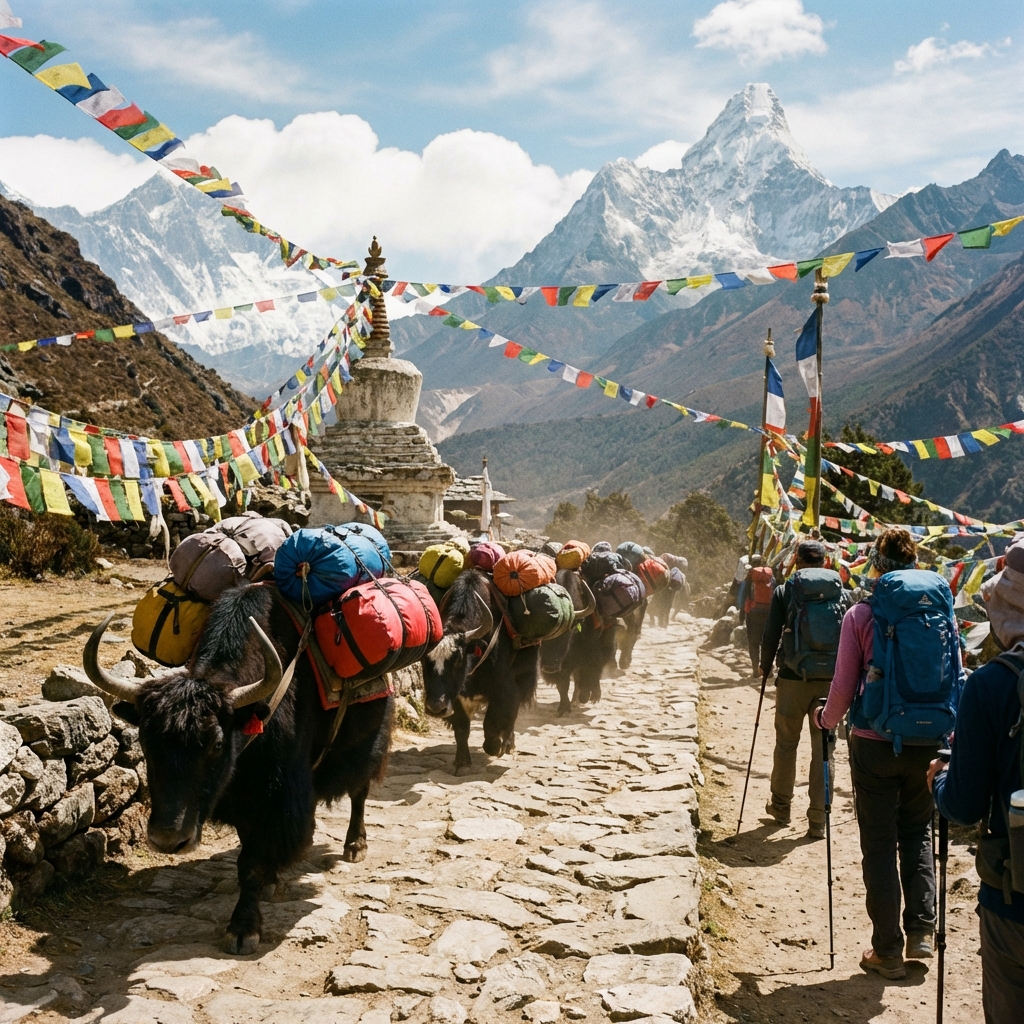
- Five colors represent elements: blue (sky), white (air), red (fire), green (water), yellow (earth)
- Mantras and prayers printed on fabric
- Wind carries prayers to benefit all beings
- Faded flags not replaced—natural decay is part of cycle
Monasteries (Gompas):
Ribung Gompa (above Samagaon):
- 16th-century monastery with resident monks
- Morning prayers open to visitors (ask permission)
- Contains sacred texts, Buddha statues, thangka paintings
- Donation appreciated (NPR 500-1000 / $4-8)
Pungyen Gompa (Samagaon):
- Ancient monastery with butter lamp chambers
- Elaborate wall murals depicting Buddhist cosmology
- Monk may offer tour (tip expected)
- Photography inside usually prohibited (ask first)
Mu Gompa (Tsum Valley):
- Major pilgrimage monastery near Tibet border
- Active monastic community
- Annual festivals attract pilgrims from region
- Sacred in Tibetan Buddhist tradition
Religious Practices You May Witness:
Morning Prayers (Puja):
- Monks gather 5:30-7:00 AM
- Chanting, horn blowing, drum beating
- Visitors can observe from back (sit respectfully, no photos during prayers)
- Profound cultural experience
Butter Lamp Offerings:
- Yak butter lamps lit at monasteries
- Each lamp represents prayer or dedication
- Visitors can sponsor lamps (small donation)
- Hundreds of lamps create beautiful, contemplative atmosphere
Prostrations:
- Full-body prostrations performed by devoted pilgrims
- Demonstrates humility, accumulates merit
- May see villagers performing at monastery entrances
Sky Burial Platforms:
- Traditional Tibetan funeral practice in some areas
- Bodies offered to vultures (return to nature)
- NEVER approach or photograph these sites
- Sacred and private ceremony
Social Structure and Daily Life:
Traditional Occupations:
- Yak and dzo (yak-cow hybrid) herding
- Potato and barley farming (short growing season)
- Former salt trading with Tibet (now ended)
- Tourism (increasingly important income source)
Family Structure:
- Polyandry practiced historically (woman marries multiple brothers)
- Extended families live together
- Strong community bonds (cooperative farming, monastery support)
Festivals:
Lhosar (Tibetan New Year, February-March):
- Most important festival
- Multi-day celebrations with monastery ceremonies
- Traditional dances, family feasts, new clothes
- If trekking during Lhosar, participate respectfully if invited
Monastery Festivals:
- Various dates throughout year
- Cham dances (masked lama dances depicting Buddhist stories)
- Community gatherings, special foods
- Check with agency for specific dates
Responsible Cultural Engagement
Photography Etiquette:
Always Ask First:
- NEVER photograph people without permission
- Especially ask before photographing monks, elders, women
- Some may refuse—respect this without pressure
- Offering to send photos later creates positive interaction
Sacred Sites:
- Many monasteries prohibit interior photography
- NEVER photograph sky burial sites or funeral ceremonies
- Prayer flags, chortens, mani walls generally okay (but ask guides)
Compensation:
- If someone poses for portrait, small donation appreciated (NPR 100-200)
- Children asking "photo, photo" may expect money—use judgment
Respectful Behavior in Villages:
Dress Modestly:
- Cover shoulders and knees
- Avoid revealing clothing (especially women)
- Remove hats when entering monasteries
Monastery Visits:
- Remove shoes before entering
- Sit lower than religious objects/monks
- Don't point feet toward Buddha statues
- Turn prayer wheels and walk clockwise
- Leave donation before leaving
Social Interactions:
- "Namaste" (Nepal) or "Tashi Delek" (Tibetan) greetings
- Accept tea offers graciously (okay to sip and leave some)
- Remove shoes before entering homes
- Don't give money/candy to children (creates begging culture)
Supporting Local Culture:
Economic Support:
- Buy handicrafts directly from artisans
- Eat at family-run teahouses
- Hire local guides and porters when possible
- Donate to monasteries and schools
Cultural Preservation:
- Express genuine interest in traditions
- Ask questions respectfully
- Learn basic Tibetan phrases ("thank you" = tuchi che)
- Share meals with locals if invited
What to Avoid:
- Bargaining aggressively (undermines fair wages)
- Giving gifts to children (creates dependency)
- Public displays of affection
- Loud behavior near monasteries
- Disrespecting religious practices
What Treks Are in the Manaslu Region?
The signature trek is the Manaslu Circuit (14-18 days), circling the world's eighth-highest peak and crossing the 5,160m Larkya La pass. The Tsum Valley side trek adds 5-7 days of cultural immersion in a hidden Tibetan valley. Both require a restricted area permit, MCAP conservation permit, and TIMS card, with a minimum of 2 trekkers plus a licensed guide.
How Do I Get to the Manaslu Region?
Drive from Kathmandu to Soti Khola or Machha Khola (7-9 hours by jeep via Arughat). The road is rough and can be landslide-affected during monsoon. No flights are needed. The circuit ends at Dharapani on the Annapurna Circuit road, from where you can return to Kathmandu or continue to Pokhara. For complete gear planning, see our packing guide.
Frequently Asked Questions (FAQ)
About the Region
Where is the Manaslu region located in Nepal? The Manaslu region sits in north-central Nepal's Gorkha District (Gandaki Province), along the Tibet border. It is built around Mount Manaslu (8,163m), the world's eighth-highest mountain, in the Mansiri Himal range. The trek follows the Budhi Gandaki valley north from Soti Khola before crossing into the Annapurna region at Dharapani.
Why is the Manaslu region a restricted trekking area? The Nepal government designated the area between Jagat and Dharapani a restricted area to control tourist numbers near the sensitive Tibet border and to protect its fragile Tibetan Buddhist culture. Restricted status means you cannot trek independently—you need a Restricted Area Permit issued through a registered agency, a licensed guide, and a minimum of two trekkers.
Permits and Regulations
Q1: Can I trek Manaslu independently with a mandatory licensed guide? A: No. Manaslu is a restricted area requiring a Restricted Area Permit (RAP), which can only be obtained through a registered trekking agency. You must trek with a licensed guide and minimum one companion (2 trekkers total). Solo independent trekking is not permitted.
Q2: How much do Manaslu permits cost? A: Total permits cost $150-200 per person:
- Manaslu RAP: $100 (Sept-Nov) or $75 (Dec-Aug) for first 7 days
- MCAP: $30
- TIMS: $20 For Tsum Valley, add Tsum Valley RAP ($40 for 7 days).
Q3: How long does permit processing take? A: 2-3 working days in Kathmandu. You'll need to be present for final signatures. Most agencies handle everything as part of your trek package.
Q4: What if I'm traveling solo—can I still trek Manaslu? A: Yes, but you must pair with at least one other trekker for permit purposes. Many agencies offer "group joining" services to pair solo travelers. Alternatively, find a partner through trekking forums before your trip.
Q5: Do children need the same permits? A: Yes, all foreign trekkers regardless of age need RAP, MCAP, and TIMS. Permit costs are the same for adults and children.
Q6: Can I get permits on arrival or must I arrange in advance? A: You must arrange through a registered Nepal trekking agency. Permits cannot be obtained at the trailhead. Process in Kathmandu before starting your trek.
Trek Difficulty and Preparation
Q7: How difficult is the Manaslu Circuit compared to Everest Base Camp? A: Manaslu is more challenging than EBC:
- Higher pass (Larkya La 5,160m vs. EBC 5,364m, but no pass on EBC)
- Longer daily stages
- More basic facilities (harder recovery)
- More remote (limited medical access)
- Steeper ascent/descent profiles However, maximum sleeping altitude is similar.
Q8: Do I need previous trekking experience? A: Highly recommended. Manaslu is not ideal for first-time trekkers. Previous multi-day trekking experience, preferably at altitude (3,000m+), is advised. If new to Nepal trekking, start with Annapurna Base Camp or Langtang Valley.
Q9: How fit do I need to be? A: Very fit. You should be able to:
- Hike 6-8 hours daily carrying a light daypack
- Ascend 1,000m elevation gain comfortably
- Handle consecutive long days without complete rest
- Train for 2-3 months before trek (cardio + hiking with weight)
Q10: What's the youngest/oldest age for Manaslu Circuit? A: No official limits, but:
- Children: Rarely appropriate under age 14-16 (altitude risk, long days, basic facilities)
- Older trekkers: Many 60-70+ successfully complete if fit and properly acclimatized
- Individual fitness matters more than age
Altitude and Health
Q11: Will I get altitude sickness on Manaslu? A: Many trekkers experience mild AMS symptoms (headache, nausea) above 3,500m. Proper acclimatization (following the standard itinerary with rest days) minimizes risk. About 10-20% of trekkers may need to descend or skip Larkya La due to altitude issues.
Q12: Should I take Diamox (altitude sickness medication)? A: Consult your doctor. Many trekkers take Diamox prophylactically (125mg twice daily) starting 1-2 days before high altitude exposure. It's not required but can help acclimatization. Side effects include frequent urination and tingling in extremities.
Q13: What happens if I get severe altitude sickness? A: Immediate descent is the only cure for severe AMS/HACE/HAPE. Your guide will arrange:
- Descent to lower altitude (usually Samagaon or lower)
- Helicopter evacuation if necessary (costs $3,000-7,000, covered by travel insurance)
- Medical treatment at nearest facility This is why travel insurance with helicopter evacuation coverage is mandatory.
Q14: Is there mobile phone coverage for emergencies? A: Very limited. Some Nepal Telecom coverage in lower valleys (Jagat area) and occasionally in Samagaon. Above 3,500m, essentially no coverage. Guides carry satellite phones or emergency communication devices for serious emergencies.
Q15: Are there medical facilities on the trail? A: Very basic. Small health posts in larger villages (Jagat, Namrung, Samagaon) with limited supplies and no doctors. Serious medical issues require evacuation to Kathmandu. This is NOT like EBC with HRA clinic in Pheriche.
Larkya La Pass Specifics
Q16: How dangerous is Larkya La Pass? A: Larkya La is serious but manageable with proper preparation:
- Main risks: Altitude sickness, hypothermia, getting lost in whiteout, avalanche (rare)
- Safety factors: Experienced guide, proper acclimatization, good weather window, appropriate gear
- Claims 2-4 lives per year (usually from altitude sickness or hypothermia)
- Proper planning makes it safe for prepared trekkers
Q17: What if weather is bad on pass day? A: Your guide will delay the crossing. Budget 2-3 buffer days in your itinerary. Most groups wait 1-2 days at Dharamsala or Samdo for better conditions. If weather doesn't improve, you may need to turn back (rare but happens).
Q18: Can I cross Larkya La in winter or monsoon? A: Winter (Dec-Feb): Possible but extremely difficult—deep snow, -25°C to -30°C temperatures, high avalanche risk. Only for experienced mountaineers. Monsoon (Jun-Aug): Extremely dangerous—heavy snow, whiteouts, trail washouts. DO NOT attempt.
Q19: Do I need crampons and ice axe for the pass? A: Microspikes or light crampons: YES, essential for snow/ice sections. Ice axe: Not required (no technical climbing), but some bring for security on steep snow. Trekking poles: Essential for balance and steep descent.
Q20: What time do we start pass crossing day? A: 3:00-4:00 AM from Dharamsala. The early start is essential to:
- Cross pass during morning weather stability window
- Complete long descent before dark
- Avoid afternoon cloud buildup and potential snow
Costs and Budgeting
Q21: How much does the Manaslu Circuit cost? A: Realistic total costs:
- Budget: $1,400-1,800 (basic services, shared porter)
- Standard: $1,800-2,200 (comfortable, personal porter)
- Premium: $2,500-3,500 (best guides, full support) Does NOT include international flights, Kathmandu hotels, or travel insurance.
Q22: Is Manaslu more expensive than Everest or Annapurna? A: Yes, due to:
- Higher permit costs ($150-200 vs. $45-50)
- Mandatory guide requirement
- Longer approach drives
- Lower trekker volume means less competition/higher prices Expect 30-50% more than equivalent EBC or Annapurna trek.
Q23: Can I save money by booking in Kathmandu instead of home country? A: Yes, typically 30-40% savings. Kathmandu agencies have lower overhead and can negotiate better. However:
- Less time to research agency quality
- Harder to verify credentials
- May encounter last-minute availability issues in peak season If booking locally, arrive 4-5 days early to compare agencies and arrange permits.
Q24: What's not included in trek package costs? A: Typical exclusions:
- International flights
- Nepal visa ($30-50)
- Kathmandu accommodation and meals
- Travel insurance
- Alcoholic drinks on trek
- Hot showers ($3-5 each)
- Battery charging ($2-4 per charge)
- WiFi access
- Tips for guide/porter
- Personal shopping/souvenirs
Q25: How much should I tip guides and porters? A: Standard tipping:
- Guide: $8-12 per day ($120-$280 for 14-day trek)
- Porter: $5-8 per day ($70-110 for 14-day trek)
- Total: $180-280 for full trek team Adjust up for exceptional service, down for poor service. Give at trek end in Nepali rupees.
Food and Accommodation
Q26: What are teahouses like on the Manaslu Circuit? A: Very basic compared to EBC or Annapurna:
- Lower valley: Private rooms, shared toilets, occasional hot showers
- Upper valley: Thin-walled rooms, squat toilets, no showers, minimal heat
- Dharamsala: Often shared dorms, no facilities, freezing cold Bring good sleeping bag and manage expectations.
Q27: Can vegetarians/vegans eat well on the trek? A: Vegetarian: Easy—most trekkers eat vegetarian by default. Vegan: Challenging but possible—dal bhat without ghee, vegetable curries, rice, bread. Communicate clearly with teahouse owners. Other restrictions: Gluten-free difficult (rice-based meals work). Severe allergies: bring backup food.
Q28: Should I bring my own food? A: Bring high-calorie snacks from Kathmandu (energy bars, chocolate, nuts, dried fruit) as they cost 5x on the trail. But main meals are available at all teahouses—no need to carry days of food.
Q29: Is the water safe to drink? A: No, never drink untreated water:
- Teahouses offer boiled water ($1-2 per liter)
- Use water purification tablets or filter
- Avoid plastic bottles (environmental impact)
- Need 3-4 liters daily for proper hydration
Q30: Can I charge my electronics? A: Limited:
- Lower valley: Yes, for fee ($2-4 per charge)
- Upper valley: Solar power only, unreliable, expensive
- Above Samagaon: Very limited or not available Bring portable power bank(s) with sufficient capacity for your devices.
Timing and Seasons
Q31: What's the absolute best month for Manaslu Circuit? A: October, specifically October 10-25, offers optimal conditions:
- Most stable weather
- Clearest mountain views
- Best Larkya La pass conditions
- All services fully operational However, it's also the busiest time—book 2-3 months ahead.
Q32: Can I trek Manaslu in spring instead of autumn? A: Yes, spring (March-May) is excellent:
- Warmer temperatures (more comfortable)
- Rhododendron blooms in lower valleys
- Good Larkya La conditions (especially April)
- Tradeoff: More afternoon clouds, pre-monsoon haze affects distant views Many prefer spring's warmth over autumn's perfect clarity.
Q33: I can only trek in June, July, or August—is it possible? A: Strongly not recommended:
- Monsoon brings daily heavy rain
- Landslide danger in Budhi Gandaki gorge
- Larkya La extremely dangerous (snow, ice, whiteouts)
- Leeches below 3,000m
- Near-zero visibility If these are your only months, consider Mustang or Dolpo (rain shadow regions) instead.
Q34: How crowded is Manaslu compared to Everest? A: Much less crowded:
- Manaslu: ~12,000 trekkers/year
- Everest: ~50,000 trekkers/year
- Annapurna Circuit: ~250,000 trekkers/year Even in peak October, you'll have quiet trails. You may go hours without seeing other groups.
Q35: When is the quietest time with still-good weather? A: Late September or late November:
- Late September (after Sept 20): Post-monsoon clarity, fewer crowds, excellent conditions
- Late November (Nov 1-15): Crystal clear, very cold, thinning crowds Both offer 60-70% fewer trekkers than October peak with great weather.
Logistics and Planning
Q36: How do I get to the Manaslu trailhead from Kathmandu? A: Drive to Soti Khola or Machha Khola:
- Distance: ~140km
- Duration: 7-9 hours
- Options: Public bus ($5-8), private jeep ($120-180 split among group), tourist bus ($15-25)
- Road: Rough, winding, paved highway then dirt road Most trek packages include private jeep transport.
Q37: How many days should I allow for the Manaslu Circuit? A: Standard itineraries:
- 14 days: Minimum (Kathmandu-Kathmandu including drive days)
- 16 days: Recommended (adds buffer day for weather/altitude)
- 18 days: Comfortable (slower pace, extra acclimatization) Allow additional days for Kathmandu permit processing (2-3 days).
Q38: Can I shorten the trek to 10-12 days? A: Technically possible by cutting acclimatization days, but:
- Dramatically increases altitude sickness risk
- Reduces Larkya La crossing safety margin
- Makes trek miserable (no rest, continuous hard days)
- Not recommended—the standard itinerary exists for good safety reasons
Q39: What happens if I run out of time before finishing? A: Exit options:
- From Samagaon: Helicopter evacuation (expensive, ~$2,000+)
- From Samdo: Same as above
- Turn back: Retrace route to Soti Khola Limited mid-trek exits—budget sufficient time and 2-3 buffer days.
Q40: Should I get travel insurance? A: Absolutely mandatory. Must cover:
- Emergency helicopter evacuation from 6,000m+
- Medical treatment in Nepal
- Trip cancellation/interruption
- Cost: $100-200 for 3-week coverage Without insurance, a single helicopter evacuation can cost $3,000-7,000 out of pocket.
Related Resources and Links
- Manaslu Circuit Trek — Detailed Route Guide
- Tsum Valley Trek — Sacred Hidden Valley
- Manaslu Circuit Cost Breakdown
- Manaslu Circuit 14-Day Itinerary
- Larkya La Pass Crossing Guide
- Manaslu Restricted Area Permit
- Best Time to Trek Manaslu Circuit
- EBC vs Manaslu Circuit — Which to Choose
- Annapurna Circuit vs Manaslu Circuit
- Manaslu Circuit Packing List
- Mustang Region Overview (Compare)
- Dolpo Region Overview (Compare)
Trek Route Guides
- Manaslu Circuit Trek Complete Guide - Detailed day-by-day itinerary, village descriptions, and route planning
- Best Time to Trek Manaslu Circuit - Month-by-month weather analysis and timing recommendations
Comparisons
- Everest Base Camp vs Manaslu Circuit - Head-to-head comparison to help you choose
Other Nepal Trekking Regions
- Annapurna Region Guide - Nepal's most diverse trekking area with routes for all levels
- Everest Region Guide - Home to the world's highest peak and iconic Sherpa culture
- Langtang Region Guide - Accessible Himalayan trekking close to Kathmandu
- Dolpo Region Guide - Nepal's most remote trekking area, even more isolated than Manaslu
- Mustang Region Guide - The forbidden kingdom, Tibet within Nepal
Specific Trek Routes
- Gokyo Lakes Trek - Alternative Everest region trek
- Langtang Valley Trek - Classic Langtang experience
- Three Passes Trek - Ultimate Everest region challenge
- Poon Hill Trek - Beginner-friendly Annapurna trek
Planning Resources
- Nepal Trekking Permits Guide - Comprehensive permit information
- Altitude Sickness Prevention - Essential health and safety information
- Best Trekking Seasons in Nepal - When to trek different regions
Cultural and Conservation
- Manaslu Conservation Area Project Official Website - MCAP conservation initiatives and community programs
- Tibetan Buddhism in Nepal - Understanding the religious heritage of upper Manaslu
Booking and Agencies
- Nepal Tourism Board - Official tourism information and agency verification
- Trekking Agencies Association of Nepal (TAAN) - Verify registered agencies
- Nepal Mountaineering Association - Additional agency credentials
Final Thoughts: Is Manaslu Right for You?
The Manaslu region represents Nepal trekking at a crossroads—developed enough to support teahouse trekking, yet remote enough to feel like genuine adventure. It's the sweet spot between the overcrowded trails of Everest and Annapurna, and the extreme remoteness of Dolpo or Upper Mustang.
Choose Manaslu if you:
- Value authentic cultural experiences over tourist comfort
- Want dramatic Himalayan scenery without Everest-level crowds
- Are willing to embrace basic teahouse facilities for the reward of remoteness
- Have previous multi-day trekking experience (preferably at altitude)
- Can commit 14-18 days minimum (20-28 for Tsum Valley additions)
- Are comfortable with mandatory guide requirements and higher permit costs
- Seek the challenge of a legitimate high-pass crossing (Larkya La)
- Want to support communities through responsible, regulated tourism
Consider other regions if you:
- Are doing your first Nepal trek (start with ABC or Langtang)
- Require reliable WiFi, charging, comfortable facilities (choose Everest or Annapurna)
- Want independent trekking freedom with a mandatory licensed guides (choose non-restricted areas)
- Have limited time (under 12 days available)
- Are very budget-conscious (lower permit regions save $100-150)
- Prefer not to deal with permit bureaucracy
The Manaslu region won't stay secret forever. Road construction creeps closer each year, trekker numbers grow annually, and teahouses gradually improve. But for now—in 2026—it remains what the Annapurna Circuit was twenty years ago: a spectacular Himalayan journey that feels like discovery rather than tourism.
If you're ready for the commitment, Manaslu delivers rewards that match its challenges: sunrise over the world's eighth-highest peak, prayer wheels turning in centuries-old monasteries, the euphoria of standing atop Larkya La Pass, and the satisfaction of completing one of Nepal's great trekking circuits while it's still gloriously uncrowded.
The Mountain of the Spirit awaits those willing to meet it on its own terms.
Pro Tip
Start planning 3-6 months before your desired trek date. This gives you time to: research and book a reputable agency, train properly (cardio + weighted hiking), acquire quality gear, get necessary vaccinations, arrange travel insurance, and book flights during optimal weather windows. Last-minute Manaslu planning is possible but limits your options and increases costs.
Related Guides: