
| Route | Duration | Max Altitude | Difficulty | Permits | Teahouses | Crowds |
|---|---|---|---|---|---|---|
| Annapurna Base Camp | 10-14 days | 4,130m | Moderate | $40-45 | Excellent | Moderate |
| Everest Base Camp | 12-16 days | 5,364m | Moderate-Challenging | $45-50 | Excellent | High (Peak Season) |
| Annapurna Circuit | 12-21 days | 5,416m | Challenging | $40-45 | Good | Moderate |
| Ghorepani Poon Hill | 4-5 days | 3,210m | Easy-Moderate | $40 | Excellent | High |
Annapurna Base Camp Trek
The Annapurna Base Camp trek is a 10-14 day moderate trek to the heart of the Annapurna Sanctuary in Nepal, reaching a height of 4,130m (13,550 ft) beneath Annapurna I (8,091m). It costs $1,200-$2,500, requires ACAP and TIMS permits, and is best done October-November or March-May—making it Nepal's most accessible high-Himalaya adventure.
The Annapurna Base Camp (ABC) trek is Nepal's most beloved moderate-altitude journey, taking you into the heart of the Annapurna Sanctuary—a sacred amphitheater ringed by some of the world's most spectacular peaks. At 4,130 meters, you'll stand beneath the towering south face of Annapurna I (8,091m), the world's tenth-highest mountain, while surrounded by Machapuchare's iconic fishtail summit, Hiunchuli, Annapurna South, and Gangapurna.
What makes ABC extraordinary isn't just the destination—it's the journey. In less than two weeks, you'll traverse subtropical bamboo forests, walk through traditional Gurung villages, pass through blooming rhododendron groves (in spring), and emerge into the stark alpine grandeur of the high Himalayas. No other trek in Nepal offers such dramatic ecological diversity in such a compact timeframe.
This comprehensive guide covers everything you need to know: detailed itineraries from 10 to 14 days, honest difficulty assessments, current costs for 2026, permit requirements, and the cultural experiences that make ABC more than just a mountain trek. Whether you're a first-time trekker or an experienced hiker seeking Nepal's classic route, this guide helps you plan with confidence.
Route Snapshot
10-14 days
4,130m (13,550 ft) at Annapurna Base Camp
110-115 km (68-71 miles) round trip
Moderate
Oct-Nov (Autumn), Mar-May (Spring)
Annapurna Conservation Area
Nayapul or Jhinu Danda (via Pokhara)
ACAP + TIMS Card
Teahouse/Lodge throughout
$1,200-$2,500 (all-inclusive)
Key Route Variants:
| Variant | Duration | Highlights | Best For |
|---|---|---|---|
| Short ABC | 10 days | Direct route via Jhinu, skips Ghorepani | Limited time, fit trekkers |
| Standard ABC | 12 days | Classic route with buffer days | Most trekkers, first-timers |
| ABC + Poon Hill | 13-14 days | Combines two iconic viewpoints | Sunrise seekers, photography |
| Extended ABC | 14+ days | Extra acclimatization, side trips | Leisurely pace, exploration |
The Annapurna Sanctuary: A Sacred Amphitheater
The Annapurna Sanctuary is one of the most remarkable natural formations in the Himalaya. First explored by British mountaineer Colonel Jimmy Roberts in 1956, he aptly named it the "Sanctuary of the Gods" for its overwhelming spiritual presence. The sanctuary is a glacial basin completely encircled by towering peaks, accessible only through a narrow gorge guarded by the sacred mountain Machapuchare.
The Giants That Surround You
When you stand at Annapurna Base Camp, you're enclosed by an unbroken ring of giants:
| Peak | Height | Notable Features |
|---|---|---|
| Annapurna I | 8,091m (26,545 ft) | World's 10th highest, first 8,000m peak ever climbed (1950) |
| Annapurna South | 7,219m (23,684 ft) | Dramatic south face visible throughout ascent |
| Machapuchare (Fishtail) | 6,993m (22,943 ft) | Sacred peak, climbing forbidden, iconic twin summit |
| Hiunchuli | 6,441m (21,132 ft) | Popular climbing peak, stunning from ABC |
| Gangapurna | 7,455m (24,459 ft) | Impressive glaciated peak to the east |
| Annapurna III | 7,555m (24,787 ft) | Part of the northern wall |
| Tent Peak (Tharpu Chuli) | 5,663m (18,579 ft) | Popular trekking peak near ABC |
The Sacred Mountain: Machapuchare
Machapuchare—meaning "Fishtail" in Nepali for its distinctive double summit—is considered the home of the god Shiva. No climbing permits have been issued since 1964, making it one of the world's highest unclimbed peaks. The only climbing attempt, by a British team in 1957, stopped 50 meters short of the summit out of respect. The mountain's sacred status adds a profound spiritual dimension to the ABC trek.
Annapurna Conservation Area Project (ACAP)
The entire trek falls within the Annapurna Conservation Area, the largest protected area in Nepal, established in 1986. ACAP covers 7,629 square kilometers and is home to remarkable biodiversity:
- 1,352 plant species including 38 types of orchids
- 128 mammal species including snow leopard, musk deer, and Himalayan tahr
- 514 bird species making it a prime destination for ornithologists
- Over 100,000 local residents whose sustainable livelihoods ACAP supports
Your permit fees directly fund conservation efforts and community development programs in the region.
Complete Itinerary Options
ABC's flexibility is one of its greatest strengths. Below are three itinerary options to match different schedules, fitness levels, and interests. For day-by-day detail, see our 11-day ABC itinerary, 10-day itinerary, or the 7-day fast-track route.
Short Itinerary: 10 Days (For Fit Trekkers)
This compressed itinerary starts from Jhinu Danda and moves efficiently to ABC. Recommended only for those with prior trekking experience and good fitness.
| Day | Route | Altitude | Hours | Distance |
|---|---|---|---|---|
| 1 | Arrive Kathmandu | 1,400m | - | - |
| 2 | Drive to Pokhara | 820m | 7 hrs | 200 km |
| 3 | Drive to Jhinu, trek to Chomrong | 2,170m | 3 hrs | 5 km |
| 4 | Trek to Dovan | 2,310m | 6 hrs | 11 km |
| 5 | Trek to Deurali | 3,230m | 4 hrs | 7 km |
| 6 | Trek to Annapurna Base Camp | 4,130m | 5 hrs | 9 km |
| 7 | Trek to Bamboo | 2,350m | 7 hrs | 15 km |
| 8 | Trek to Jhinu, drive to Pokhara | 820m | 5 hrs trek | 12 km |
| 9 | Drive to Kathmandu | 1,400m | 7 hrs | 200 km |
| 10 | Departure | - | - | - |
Standard Itinerary: 12 Days (Recommended)
The most popular option, providing adequate acclimatization and a comfortable pace.
| Day | Route | Altitude | Hours | Notes |
|---|---|---|---|---|
| 1 | Arrive Kathmandu | 1,400m | - | Permit arrangements, gear check |
| 2 | Drive to Pokhara | 820m | 7 hrs | Scenic highway drive |
| 3 | Drive to Nayapul, trek to Tikhedhunga | 1,540m | 4 hrs | Enter Annapurna Conservation Area |
| 4 | Trek to Ghorepani | 2,860m | 6 hrs | Stone staircase ascent |
| 5 | Poon Hill sunrise, trek to Tadapani | 2,630m | 6 hrs | Optional 1-hr sunrise hike |
| 6 | Trek to Chomrong | 2,170m | 5 hrs | Gateway to the sanctuary |
| 7 | Trek to Dovan | 2,310m | 6 hrs | Enter bamboo forests |
| 8 | Trek to Deurali | 3,230m | 4 hrs | Above treeline terrain |
| 9 | Trek to ABC via MBC | 4,130m | 5 hrs | Summit day! |
| 10 | Trek to Bamboo | 2,350m | 6 hrs | Rapid descent |
| 11 | Trek to Jhinu, drive to Pokhara | 820m | 5 hrs | Hot springs reward |
| 12 | Fly or drive to Kathmandu, depart | - | - | Buffer for delays |
Extended Itinerary: 14 Days (Leisurely)
Ideal for those wanting maximum acclimatization, cultural immersion, and photography opportunities.
| Day | Route | Altitude | Hours | Special Features |
|---|---|---|---|---|
| 1 | Arrive Kathmandu | 1,400m | - | City exploration optional |
| 2 | Fly to Pokhara (25 min) | 820m | - | Lake views, preparation |
| 3 | Drive to Nayapul, trek to Tikhedhunga | 1,540m | 4 hrs | Bhurungdi Khola valley |
| 4 | Trek to Ghorepani | 2,860m | 5-6 hrs | 3,300 stone steps |
| 5 | Poon Hill sunrise, acclimatization | 3,210m | 3 hrs | Sunrise photography |
| 6 | Trek to Tadapani | 2,630m | 4 hrs | Rhododendron forests |
| 7 | Trek to Chomrong | 2,170m | 5 hrs | Gurung culture |
| 8 | Trek to Sinuwa | 2,360m | 3 hrs | Short day, rest |
| 9 | Trek to Deurali | 3,230m | 5 hrs | Bamboo to alpine |
| 10 | Trek to Machhapuchhre Base Camp | 3,700m | 3 hrs | Acclimatization buffer |
| 11 | Trek to ABC, explore | 4,130m | 2 hrs | Full day at sanctuary |
| 12 | Trek to Bamboo | 2,350m | 6 hrs | Descent begins |
| 13 | Trek to Jhinu Danda, hot springs | 1,780m | 5 hrs | Well-earned soak |
| 14 | Drive to Pokhara and Kathmandu | - | 8-10 hrs | Or split with overnight in Pokhara |
Trail Overview: From Jungle to Glacier
The ABC trek is renowned for its ecological diversity—few treks on Earth cover such varied terrain in such a short distance.
The Ecological Journey
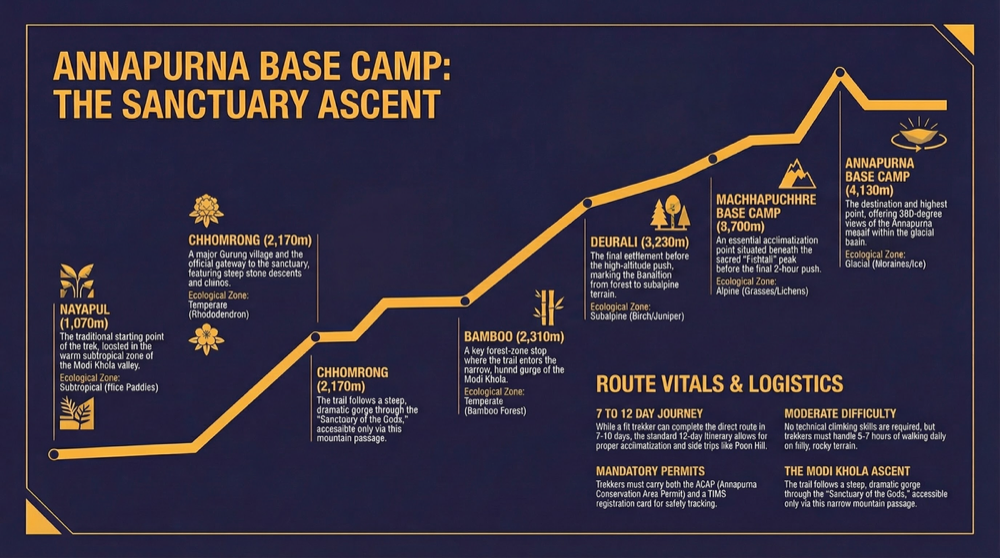
Zone 1: Subtropical (800m-2,000m) From Nayapul through Tikhedhunga, you walk through terraced rice paddies, banana groves, and scattered farming villages. The air is warm and humid. Traditional Gurung and Magar settlements dot the hillsides.
Zone 2: Temperate Forest (2,000m-3,000m) Between Ghorepani and Chomrong, dense rhododendron forests dominate. In spring (March-April), these forests explode with red, pink, and white blooms. Oak and maple trees mix with bamboo stands. Wildlife sightings—langur monkeys, pheasants—become common.
Zone 3: Subalpine (3,000m-4,000m) Above Chomrong, bamboo forests give way to birch and juniper. The vegetation thins as you approach the sanctuary entrance. The trail narrows, following the Modi Khola gorge—the only passage into the sanctuary.
Zone 4: Alpine and Glacial (4,000m+) At Machhapuchhre Base Camp and ABC, you're in high alpine terrain. Grasses, lichens, and scattered shrubs survive. Moraines and glacial debris cover the landscape. The peaks tower directly overhead.
Key Trail Sections
Nayapul to Tikhedhunga (4-5 hours) Gentle start through farmland and villages. Some sections follow the road, but most is dedicated trail. The Bhurungdi Khola valley provides a scenic corridor.
Tikhedhunga to Ghorepani (5-6 hours) The famous stone staircase—approximately 3,300 steps carved into the hillside over centuries. Challenging but rewarding, with views improving throughout the climb. Multiple tea stops available.
Chomrong to Sinuwa (2-3 hours) Descent from Chomrong across terraced hillsides, then a steep climb to Sinuwa. This section marks the entry to the sanctuary proper—the ACAP checkpoint here registers all trekkers.
Bamboo to Deurali (4-5 hours) Dense bamboo forests create a tunnel-like passage. The terrain can be muddy after rain. Several suspension bridges cross the Modi Khola. Avalanche debris may be visible on the trail depending on season.
Avalanche Risk Zone
The section between Bamboo and Deurali passes through known avalanche zones. During and after heavy snowfall (typically December-February), trails may be temporarily closed. Always check current conditions and follow your guide's advice. The Nepal Tourism Board provides safety updates.
Deurali to Machhapuchhre Base Camp (3-4 hours) Terrain opens dramatically as you leave the gorge. Rocky moraines replace forest. Machapuchare's south face dominates the view ahead. The trail is well-marked but exposed.
MBC to ABC (1.5-2 hours) The final push across the sanctuary floor. Gentle grade, increasingly spectacular views in every direction. The iconic ABC signboard awaits at 4,130m.
Day-by-Day Detailed Guide (Standard 12-Day Itinerary)
Day 1: Arrival in Kathmandu (1,400m)
Your ABC adventure begins in Nepal's capital. After clearing customs at Tribhuvan International Airport, your agency representative will transfer you to your hotel in Thamel or Boudha.
Essential tasks:
- Confirm permits are arranged (ACAP and TIMS)
- Attend trek briefing with your agency
- Final gear check—Thamel has excellent rental shops
- Early dinner and rest for early departure
Accommodation: Hotel in Kathmandu (included by most agencies)
Day 2: Drive Kathmandu to Pokhara (820m)
The 200-kilometer drive to Pokhara takes 6-8 hours via the Prithvi Highway, following the Trisuli River valley. You'll stop for lunch at Kurintar or Riverside Spring Resort, famous for fresh river fish.
Alternatively, a 25-minute scenic flight offers spectacular Himalayan views (additional $100-150 each way).
Upon arrival in Pokhara:
- Explore Lakeside district
- Views of Annapurna range reflected in Phewa Lake
- Final opportunity for gear purchases
Accommodation: Hotel in Pokhara Lakeside
Day 3: Drive to Nayapul (1,070m), Trek to Tikhedhunga (1,540m)
After breakfast, a 1.5-hour drive through winding roads brings you to Nayapul, the traditional starting point for ABC treks. The trek begins immediately, following the Modi Khola valley through farming villages.
Trek details:
- Distance: 8 km
- Duration: 3-4 hours
- Elevation gain: 470m
- Terrain: Paved sections, dirt trails, village paths
The trail passes through Birethanti, an attractive riverside village, before climbing gradually to Tikhedhunga.
Information current as of January 2025.
Nayapul
1,070m
Trek starting point. Last chance for any forgotten supplies.
Birethanti
1,025m
Room: $5-8/night
Dal Bhat: $4-6
Beautiful riverside village with suspension bridge crossing.
Tikhedhunga
1,540m
Room: $5-10/night
Dal Bhat: $4-6
Gateway to the famous stone staircase.
Day 4: Trek Tikhedhunga to Ghorepani (2,860m)
This is the most demanding day of the first half—and one of the most rewarding. The legendary stone staircase (approximately 3,300 steps) climbs relentlessly through terraced hillsides and rhododendron forests.
Trek details:
- Distance: 10 km
- Duration: 5-6 hours
- Elevation gain: 1,320m
- Terrain: Stone stairs, forest trails
The climb is divided by tea stops at Ulleri (1,960m)—a Magar village with excellent views—and Nangethanti (2,430m). The final push to Ghorepani rewards with panoramic views of Dhaulagiri (8,167m) and the Annapurna range.
Pro Tip
Start early (before 7 AM) to tackle the steepest sections in cool morning air. Pace yourself on the stairs—experienced trekkers call this a "slow and steady" day. Your body will thank you tomorrow.
Day 5: Poon Hill Sunrise (3,210m), Trek to Tadapani (2,630m)
An optional but highly recommended pre-dawn hike takes you to Poon Hill, one of Nepal's most famous viewpoints. The 360-degree panorama encompasses Dhaulagiri, the entire Annapurna massif, Machapuchare, Manaslu, and the Himalayan horizon stretching to Tibet.
Morning schedule:
- 4:30 AM: Wake-up call
- 5:00 AM: Begin 45-minute climb to Poon Hill
- 5:45-6:30 AM: Sunrise viewing
- 7:00 AM: Return to Ghorepani for breakfast
After breakfast, the trail descends through dense rhododendron forest to Tadapani. In spring, this section is arguably the most beautiful on the entire trek.
Trek details:
- Distance: 12 km (including Poon Hill)
- Duration: 6 hours total
- Net elevation loss: 230m
- Terrain: Forest trails, some descents steep
Day 6: Trek Tadapani to Chomrong (2,170m)
The trail continues through rhododendron forests before descending to the Kimrong Khola and climbing to Chomrong—the largest village in the region and the gateway to the Annapurna Sanctuary.
Trek details:
- Distance: 9 km
- Duration: 5-6 hours
- Net elevation loss: 460m (with significant ups and downs)
- Terrain: Stone steps, forest trails, village paths
Chomrong is a prosperous Gurung village with excellent facilities. Many trekkers spend extra time here, enjoying the hospitality and preparing for the sanctuary ahead.
Information current as of January 2025.
Chomrong (Chhomrong)
2,170m
Room: $8-15/night
Dal Bhat: $5-8
Last major settlement before ABC. Good place to rest and stock up. Famous Gurung village with cultural significance.
Day 7: Trek Chomrong to Dovan (2,310m)
After passing the ACAP checkpoint at Chomrong, the trail descends sharply to the Chomrong Khola before climbing to Sinuwa. From here, you officially enter the Annapurna Sanctuary, passing through increasingly dense bamboo forests.
Trek details:
- Distance: 11 km
- Duration: 6-7 hours
- Elevation change: Net +140m (significant descent and ascent)
- Terrain: Stone steps, bamboo forest, suspension bridges
The descent from Chomrong involves many steps—your knees will feel it! The bamboo zone provides welcome shade and a unique atmosphere.
Overnight stops options: Sinuwa (2,360m), Bamboo (2,310m), or Dovan (2,505m)
Day 8: Trek Dovan to Deurali (3,230m)
The trail climbs steadily through the Modi Khola gorge. The bamboo forest gives way to birch and rhododendron, then thins as you gain altitude. Views of Machapuchare and Hiunchuli appear more frequently.
Trek details:
- Distance: 7 km
- Duration: 4-5 hours
- Elevation gain: 920m
- Terrain: Rocky trails, some exposed sections
This section passes through avalanche-prone zones in winter and early spring. The Himalaya Hotel at 2,840m provides a good tea stop midway.
Information current as of January 2025.
Deurali
3,230m
Room: $10-15/night
Dal Bhat: $6-8
Final settlement before MBC. Above treeline. Cold nights—bring layers.
Day 9: Trek to Annapurna Base Camp via MBC (4,130m)
Summit day! The trail opens dramatically as you leave the gorge and enter the sanctuary proper. Moraines and glacial debris cover the landscape. The peaks surround you—Machapuchare ahead, Hiunchuli to the left, the Annapurna range on all sides.
Trek details:
- Distance: 9 km
- Duration: 5-6 hours
- Elevation gain: 900m
- Terrain: Rocky moraines, glacial debris, marked trail
Schedule:
- Early departure from Deurali
- Reach Machhapuchhre Base Camp (3,700m) in 2-3 hours for tea/snack
- Continue 1.5-2 hours to Annapurna Base Camp
- Explore the sanctuary, take photos
- Watch sunset on the peaks
At Annapurna Base Camp: The iconic signboard marks 4,130m elevation. You're surrounded by:
- Annapurna I's massive south face directly ahead
- Machapuchare's fishtail summit to the south
- Hiunchuli, Annapurna South, and Gangapurna encircling you
- The Khumbu Icefall spilling from Annapurna I
Information current as of January 2025.
Machhapuchhre Base Camp (MBC)
3,700m
Room: $12-18/night
Dal Bhat: $7-10
Many trekkers stop here for acclimatization before ABC push.
Annapurna Base Camp (ABC)
4,130m
Room: $15-25/night
Dal Bhat: $8-12
The goal! Limited capacity in peak season. Morning views are unforgettable.
Day 10: Trek ABC to Bamboo (2,350m)
After experiencing sunrise at ABC—an absolutely spectacular display as light hits Annapurna and Machapuchare—you begin the long descent. Many trekkers combine two descent days into one, covering significant distance.
Trek details:
- Distance: 15 km
- Duration: 6-7 hours
- Elevation loss: 1,780m
- Terrain: Rocky, then forest trails
Pro Tip
Wake early (around 5:30 AM) to catch sunrise at ABC. The first light hitting the peaks is worth losing a little sleep. Pack the night before so you're ready to start trekking by 7:30-8:00 AM after breakfast.
The descent is faster but demanding on knees. Use trekking poles and take breaks. You'll retrace your path through MBC, Deurali, Himalaya Hotel, and into the bamboo zone.
Day 11: Trek Bamboo to Jhinu Danda (1,780m), Drive to Pokhara
The final trekking day rewards you with natural hot springs at Jhinu Danda—a perfect way to soothe tired muscles.
Trek details:
- Distance: 12 km
- Duration: 5-6 hours (plus hot springs time)
- Elevation change: Variable (descent to Jhinu)
- Terrain: Forest trails, stone steps
Schedule:
- Trek from Bamboo via Sinuwa and Chomrong
- Descend to Jhinu Danda (alternate exit point)
- Soak in natural hot springs (30-45 minutes)
- Jeep/bus transfer to Pokhara (3-4 hours)
The hot springs at Jhinu sit beside the Modi Khola river—the perfect temperature after days of trekking. A $2-3 fee supports local maintenance.
Accommodation: Hotel in Pokhara Lakeside
Day 12: Return to Kathmandu and Departure
Options for the return journey:
- Tourist bus: 6-7 hours ($10-15)
- Private vehicle: 5-6 hours ($80-100)
- Scenic flight: 25 minutes ($110-150)
This day also serves as a buffer for any delays during the trek. If you completed the trek on schedule, enjoy a morning in Pokhara before heading to Kathmandu.
Difficulty Assessment: Is ABC Right for You?
Why ABC is Perfect for First-Time Trekkers
Annapurna Base Camp has earned its reputation as an ideal introduction to Himalayan trekking for several key reasons:
1. Moderate Maximum Altitude At 4,130m, ABC is significantly lower than Everest Base Camp (5,364m) or the Annapurna Circuit's Thorong La Pass (5,416m). This substantially reduces altitude sickness risk and allows faster acclimatization.
2. Well-Developed Trail Infrastructure Teahouses every few hours provide reliable accommodation and meals. No camping or cooking equipment needed. Emergency evacuation by helicopter is feasible from most points.
3. Gradual Altitude Progression The standard itinerary allows natural acclimatization. You only spend 1-2 nights above 3,000m before reaching ABC, reducing exposure to altitude stress.
4. No Technical Skills Required The trail requires no climbing equipment, rope work, or technical mountaineering knowledge. It's hiking, not mountaineering.
5. Flexible Duration Unlike Everest or Annapurna Circuit, ABC can be completed in 10-14 days, accommodating various schedules and fitness levels.
Difficulty Comparison
| Trek | Max Altitude | Days Above 3,500m | Technical Difficulty | Overall Rating |
|---|---|---|---|---|
| Ghorepani Poon Hill | 3,210m | 1-2 days | None | Easy-Moderate |
| Annapurna BC | 4,130m | 2-3 days | None | Moderate |
| Langtang Valley | 4,984m | 3-4 days | None | Moderate |
| Everest Base Camp | 5,364m | 6-8 days | None | Moderate-Challenging |
| Annapurna Circuit | 5,416m | 3-4 days | None | Challenging |
| Three Passes (Everest) | 5,545m | 10+ days | Some glacier travel | Very Challenging |
Physical Fitness Requirements
Minimum fitness baseline:
- Walk 10-15 km on hilly terrain without significant fatigue
- Climb 800-1,000m elevation in a single day comfortably
- Handle 5-6 hours of walking daily for 8-10 consecutive days
- Carry a 5-8 kg daypack throughout
Recommended training (8-12 weeks before trek): Follow our structured 8-week ABC training plan, and read the full ABC difficulty assessment to gauge whether the route suits your fitness.
| Weeks | Activity | Details |
|---|---|---|
| 1-4 | Cardio base | 30-45 min walking/jogging 4x/week |
| 5-8 | Stair work | Include stairs or inclines, build to 1-hour sessions |
| 9-10 | Weighted hiking | Weekend hikes with 5-8 kg pack, 3-4 hours |
| 11-12 | Back-to-back days | Two consecutive hiking days to simulate trek |
Who Should Reconsider ABC?
While ABC is accessible to most reasonably fit adults, the following situations warrant consultation with a doctor or reconsideration:
- Severe respiratory conditions (chronic asthma, COPD)
- Heart conditions or recent cardiac events
- Recent major surgery
- Pregnancy (especially second and third trimesters)
- Inability to commit minimum 10 days
- Unwillingness to turn back if altitude symptoms emerge
For a gentler introduction to Himalayan trekking, consider Ghorepani Poon Hill (4-5 days) first.
Best Time to Trek Annapurna Base Camp
| Month | High | Low | Conditions | Crowds | Notes |
|---|---|---|---|---|---|
| January | -2°C | -15°C | 20mm | Very Low | Cold, possible snow above Deurali, clear skies |
| February | 2°C | -12°C | 25mm | Low | Cold improving, good visibility, quiet trails |
| MarchBest | 7°C | -5°C | 40mm | Moderate | Spring begins, rhododendrons blooming, warming |
| AprilBest | 10°C | -2°C | 55mm | High | Peak spring, forests in full bloom, ideal weather |
| MayBest | 12°C | 2°C | 100mm | Moderate | Warm, pre-monsoon clouds, still good trekking |
| June | 10°C | 4°C | 280mm | Very Low | Monsoon begins, rain, leeches, poor visibility |
| July | 9°C | 5°C | 450mm | Very Low | Peak monsoon, trail closures possible, landslide risk |
| August | 10°C | 5°C | 400mm | Very Low | Monsoon continues, not recommended |
| September | 8°C | 2°C | 220mm | Low | Monsoon ending, improving conditions late month |
| OctoberBest | 8°C | -3°C | 35mm | Very High | Peak autumn, best visibility, busiest month |
| NovemberBest | 5°C | -8°C | 15mm | High | Excellent weather, cooling temps, clear skies |
| December | 0°C | -12°C | 15mm | Low | Cold, possible snow, fewer crowds |
Spring Season (March-May)
Pros:
- Rhododendron forests in spectacular bloom (especially March-April)
- Warming temperatures, longer days
- Vibrant greenery throughout lower elevations
- Wildlife more active
Cons:
- Afternoon clouds may obscure peak views
- Pre-monsoon rain possible in late May
- Peak season crowds in April
Best for: Photographers, flower enthusiasts, those who prefer warmer conditions
Autumn Season (October-November)
Pros:
- Clearest skies and best mountain visibility
- Stable, predictable weather
- Post-harvest season, golden landscapes
- Major festivals (Dashain, Tihar) add cultural dimension
Cons:
- Peak crowds, especially October
- Teahouses fill quickly—booking ahead helpful
- Cooler nights at high camps
Best for: First-time trekkers, those prioritizing mountain views
Shoulder Seasons
Late September: Monsoon retreating, trails drying, crowds building. Good option for avoiding peak traffic.
Early December: Cold but manageable with proper gear. Fewer trekkers, clear skies. Some teahouses may close.
Late February: Winter easing, trails reopening, spring crowds haven't arrived. Excellent value period.
Monsoon Season (June-August)
Not recommended. Heavy rainfall makes trails slippery and dangerous. Leeches are prevalent below 3,000m. Landslides and trail washouts common. Mountain views obscured by clouds. Some teahouses close.
For detailed seasonal information, see our Best Time to Trek Nepal guide.
Cost Breakdown for 2026
ABC is notably more affordable than Everest Base Camp while offering comparable experiences. Here's what to budget (see our full ABC trek cost breakdown for line-by-line figures):
Package Tour Costs
| Budget Level | Price Range | What's Included |
|---|---|---|
| Budget | $599-900 | Basic teahouses, group guide, no porter, bus transport |
| Standard | $1,200-1,800 | Good teahouses, experienced guide, porter, some meals |
| Premium | $2,000-2,500 | Best lodges, private guide, full porter support, all meals, flexibility |
Independent Trekking Costs (Per Day)
| Category | Budget | Mid-Range | Comfortable |
|---|---|---|---|
| Accommodation | $5-8 | $10-15 | $15-25 |
| Meals (3x) | $12-18 | $18-25 | $25-35 |
| Hot showers | $0 (skip) | $2-4 | $3-5 |
| WiFi/Charging | $2-3 | $3-5 | $5-8 |
| Snacks/drinks | $2-4 | $5-8 | $8-12 |
| Daily Total | $21-33 | $38-57 | $56-85 |
10-day trek estimate: $210-330 (budget) to $560-850 (comfortable)
Fixed Costs
| Item | Cost | Notes |
|---|---|---|
| ACAP Permit | NPR 3,000 (~$23) | Annapurna Conservation Area |
| TIMS Card | NPR 2,000 (2025) | Registration mandatory |
| Guide (optional but recommended) | $25-35/day | Licensed guide with TAAN |
| Porter | $20-25/day | One porter carries 15-20kg for 2 trekkers |
| Kathmandu-Pokhara transport | $15-25 | Bus; $100+ flight |
| Pokhara-Nayapul transport | $30-50 | Shared jeep round-trip |
| Travel insurance | $50-100 | Essential; covers evacuation |
Hidden Costs to Anticipate
- Hot showers increase significantly above 2,500m ($3-5)
- Phone/device charging at high camps ($3-5)
- Bottled water (better to bring purification tablets)
- Gear rental in Kathmandu/Pokhara ($5-10/day for sleeping bag, jacket, poles)
- Tips for guide and porter ($8-12/day per person is customary)
- Extra nights if weather delays occur
ABC vs EBC Cost Comparison
| Cost Element | Annapurna BC | Everest BC |
|---|---|---|
| Permits | $23 (ACAP) + TIMS (NPR 2,000 for foreigners) | $37+ (SNP + TIMS + Municipality) |
| Flights | Not required | $350-400 RT (Lukla) |
| Teahouse costs | Lower (~$20-30/day) | Higher (~$35-50/day) |
| Guide costs | Similar | Similar |
| Total package | $1,200-2,500 | $1,500-4,000 |
| Duration | 10-14 days | 12-16 days |
Bottom line: ABC typically costs 20-40% less than EBC, primarily due to no Lukla flights and lower high-altitude prices.
Permits Required for ABC Trek
ACAP (Annapurna Conservation Area Permit)
Cost: NPR 3,000 (~$23 USD) for foreigners; NPR 200 for SAARC nationals
Purpose: Funds conservation, community development, and trail maintenance in the Annapurna region.
Where to obtain:
- Nepal Tourism Board office, Kathmandu
- ACAP office, Pokhara
- Through registered trekking agency (most common)
Required documents:
- Passport-size photos (2)
- Passport copy
- Completed application form
TIMS (Trekkers' Information Management System) Card
Cost: Free (as of 2026)
Purpose: Tracking and safety management for trekkers. Enables search-and-rescue coordination if needed.
Where to obtain:
- Nepal Tourism Board, Kathmandu
- TAAN office, Kathmandu or Pokhara
- Through registered agency
Note: TIMS cards are checked at multiple points along the route, particularly at Chomrong and Bamboo.
2026 Regulation Updates
Nepal's government has implemented new trekking regulations:
-
Guide requirement: Foreign nationals must trek with a licensed guide or porter. Solo trekking is no longer permitted in national parks and conservation areas, including Annapurna.
-
Permit verification: Increased checkpoint monitoring ensures compliance.
-
Insurance verification: Agencies may request proof of travel insurance covering emergency helicopter evacuation.
For complete permit information, see our Nepal Trekking Permits Guide.
ABC vs EBC: Choosing Nepal's Classic Treks
This is the most common question for first-time Nepal trekkers. Both are world-class experiences, but they suit different preferences.
Side-by-Side Comparison
| Factor | Annapurna BC | Everest BC |
|---|---|---|
| Max altitude | 4,130m | 5,364m |
| Duration | 10-14 days | 12-16 days |
| Difficulty | Moderate | Moderate-Challenging |
| Altitude sickness risk | Lower | Higher |
| Ecological diversity | Higher (jungle to glacier) | Moderate (alpine-focused) |
| Cultural immersion | Strong (Gurung villages) | Strong (Sherpa culture) |
| Crowds | Moderate | High (peak season) |
| Cost | $1,200-2,500 | $1,500-4,000 |
| Flights required | No (optional) | Yes (Lukla) |
| Iconic factor | High | Highest |
| Physical demand | 5-6 hrs/day | 6-7 hrs/day |
Choose ABC If You:
- Are a first-time high-altitude trekker
- Have 10-14 days available
- Want lower altitude sickness risk
- Prioritize diverse landscapes over single dramatic view
- Prefer fewer crowds
- Have a tighter budget
- Are nervous about the Lukla flight
- Value accessibility over extremity
Choose EBC If You:
- Dream specifically of Everest
- Have 14+ days available
- Handle altitude well or have previous experience
- Accept higher costs for the "bucket list" experience
- Don't mind crowded trails during peak season
- Are comfortable with the Lukla flight
- Want the pinnacle Himalayan experience
Can You Do Both?
Absolutely—many trekkers return to Nepal for the other classic route. ABC often serves as excellent preparation for EBC, building altitude experience and confidence.
For detailed EBC information, see our Everest Base Camp Trek Guide.
Gurung Villages and Cultural Experiences
The Gurung People
The Gurung (or Tamu) people are the predominant ethnic group in the lower Annapurna region. Known for their warm hospitality and rich cultural traditions, Gurung communities have lived in these hills for centuries, traditionally practicing agriculture and animal husbandry.
Key cultural elements:
- Gurung language: Distinct Tibeto-Burman language with its own script
- Animist-Buddhist traditions: Blend of shamanism and Tibetan Buddhism
- Rodhi houses: Traditional youth gathering places
- Lhosar festival: Gurung New Year (December/January)
Village Highlights Along the Trail
Chomrong (Chhomrong) The largest village on the route and the gateway to the sanctuary. Perched dramatically on a hillside, Chomrong offers excellent views of Annapurna South and Machapuchare. The village features:
- Traditional stone houses with slate roofs
- Several Buddhist gompas (monasteries)
- Local honey (famous throughout Nepal)
- Cultural museum showcasing Gurung heritage
Ghandruk Though not on the direct ABC route, Ghandruk is accessible via a short detour and represents the most well-preserved Gurung village in the region. Features include:
- Protected heritage area status
- Traditional architecture maintained
- ACAP visitor center with cultural exhibits
- Stunning sunrise views of Annapurna South
Landruk A quieter alternative to Ghandruk, Landruk offers authentic village atmosphere with fewer tourists. The Gurung Heritage Trail connects several villages in this area.
Pro Tip
Request a homestay experience in Chomrong or Ghandruk for deeper cultural immersion. Many families offer traditional meals and accommodation. Your guide can arrange this—expect to pay $20-30 for full room and board, with proceeds going directly to families.
Hot Springs at Jhinu Danda
The natural hot springs at Jhinu Danda are a highlight for many trekkers—the perfect reward after days of hiking. The springs sit beside the Modi Khola river, with pools at temperatures ranging from warm to hot.
Practical information:
- 30-minute descent from the main trail
- Entry fee: NPR 200-300 (~$2-3)
- Changing facilities and lockers available
- Best enjoyed afternoon/evening of your descent day
- Separate pools for different temperatures
The minerals in the water are believed to have therapeutic properties for sore muscles—whether or not that's scientifically proven, the experience feels rejuvenating after a week of trekking.
Starting Point Options
Three main approaches exist for the ABC trek, each with advantages:
Nayapul Start (Most Common)
Access: 1.5-hour drive from Pokhara Trail includes: Ghorepani and Poon Hill option Duration: Adds 1-2 days compared to Jhinu start Best for: Trekkers wanting the complete experience including Poon Hill sunrise
Jhinu Danda Start (Direct Route)
Access: 3-hour drive from Pokhara Trail skips: Ghorepani section Duration: Shortest option (saves 1-2 days) Best for: Trekkers with limited time or returning from ABC wanting different scenery
Ghandruk Start (Cultural Focus)
Access: 2-hour drive from Pokhara, then short trek Highlights: Begins in Nepal's most famous Gurung village Duration: Similar to Nayapul route Best for: Those prioritizing cultural experiences and photography
Most agencies default to Nayapul start (including Poon Hill) with Jhinu finish, providing the best combination of experiences.
Photography Guide for ABC Trek
Best Sunrise/Sunset Spots
Poon Hill (3,210m) The premier sunrise location on the route. Arrive by 5:30 AM for the light show across the Dhaulagiri-Annapurna range. West-facing position captures sunset glow on peaks.
Annapurna Base Camp (4,130m) Sunrise illuminates Annapurna I and Machapuchare in spectacular fashion. Position yourself east of the lodges for unobstructed views. Sunset creates golden light on the peaks—don't miss it.
Machhapuchhre Base Camp (3,700m) Excellent alternative if weather is uncertain at ABC. Machapuchare dominates the southern view; Annapurna I frames the north.
Chomrong (2,170m) Often overlooked, but offers intimate views of Annapurna South and Machapuchare. Early morning light catches the peaks while the valley remains in shadow.
Subject Recommendations
| Subject | Best Time | Location Tips |
|---|---|---|
| Mountain panoramas | Sunrise/sunset, clear days | Poon Hill, ABC, MBC |
| Rhododendron forests | March-April, morning light | Ghorepani to Tadapani section |
| Village life | Morning activities, 6-8 AM | Chomrong, Landruk, Ghandruk |
| Machapuchare | All day, best at golden hour | Throughout upper trail |
| Suspension bridges | Midday (less crowded) | Multiple points along Modi Khola |
| Star trails/Milky Way | Clear nights, new moon | ABC, MBC (no light pollution) |
Practical Photography Tips
- Batteries: Cold drains batteries fast. Keep spares warm inside your jacket.
- Memory: 64GB+ recommended; 128GB for serious shooters
- Protection: Dust is minimal, but altitude condensation can form when moving between warm teahouse and cold outdoors. Let camera acclimatize before shooting.
- Drone: Permits required for drone photography in Nepal. Check current regulations before bringing one.
- Weight: Consider mirrorless over DSLR for weight savings. A quality smartphone handles most casual photography well.
Emergency Information and Safety
Nepal Tourism Board
Tourist information and assistance
Himalayan Rescue Association (HRA)
Altitude medicine specialists
Nepal Police Tourist Unit
24-hour emergency line
CIWEC Clinic (Kathmandu)
Western-standard medical care
Helicopter evacuation cost: $3,000-5,000 USD (covered by travel insurance)
Ensure your policy specifically covers helicopter evacuation to 6,000m altitude and high-altitude trekking. Standard travel insurance often has lower altitude caps.
Altitude Sickness Prevention
At ABC's altitude (4,130m), altitude sickness is a real concern, though less severe than on higher treks.
Prevention strategies:
- Follow the recommended itinerary—don't skip acclimatization days
- Climb high, sleep low when possible
- Stay hydrated (3-4 liters daily)
- Avoid alcohol above 2,500m
- Eat regularly even if appetite decreases
- Communicate symptoms immediately to your guide
Warning signs requiring descent:
- Severe headache unresponsive to medication
- Vomiting or persistent nausea
- Difficulty walking straight (ataxia)
- Confusion or disorientation
- Breathlessness at rest
- Fluid sounds when breathing (HAPE)
For comprehensive altitude safety information, see our Altitude Sickness Prevention Guide.
Frequently Asked Questions
About the Trek
What is the height of Annapurna Base Camp? Annapurna Base Camp sits at 4,130 metres (13,550 feet) above sea level. The intermediate Machhapuchhre Base Camp (MBC) is at 3,700m, and the trek's other high point, Poon Hill, reaches 3,210m. ABC's moderate altitude is the main reason the trek carries a lower altitude-sickness risk than higher routes like Everest Base Camp (5,364m).
How long is the Annapurna Base Camp trek? The Annapurna Base Camp trek takes 10-14 days depending on your start point and itinerary, covering roughly 110-115 km (68-71 miles) round trip. The 12-day standard itinerary—starting at Nayapul and including Poon Hill—is the most popular for first-timers. Fit, experienced trekkers can complete a direct Jhinu-start route in 7-10 days.
Is the Annapurna Base Camp trek worth it? Yes. The ABC trek packs subtropical forest, Gurung villages, blooming rhododendron, and a 360-degree alpine amphitheatre into under two weeks—rare ecological range for a moderate-difficulty trek. Standing at 4,130m encircled by Annapurna I, Annapurna South, Hiunchuli, and Machapuchare is widely rated among Nepal's finest mountain experiences for the effort involved.
Where is Annapurna Base Camp in Nepal? Annapurna Base Camp lies in north-central Nepal, inside the Annapurna Conservation Area in Gandaki Province, about 40 km north of the lakeside city of Pokhara. Trekkers reach the trailhead (Nayapul or Jhinu Danda) by road from Pokhara, which is itself a 6-8 hour drive or 25-minute flight from Kathmandu.
Planning and Logistics
How far in advance should I book the ABC trek? For peak seasons (October-November, March-April), book 4-8 weeks ahead for reputable agencies. Shoulder seasons allow more flexibility. Independent trekkers can arrange permits upon arrival, but guide requirement means some advance planning is now necessary.
Can I trek ABC independently without an agency? Yes, but since 2026 you must have a licensed guide or porter. You can hire guides independently in Pokhara (around $25-30/day) and handle teahouse bookings yourself. This offers more flexibility but requires more planning.
Do I need to book teahouses in advance? Not typically. During peak October weeks, popular lodges like those at ABC may fill up—your guide can call ahead. Otherwise, walk-in availability is standard.
Is WiFi available on the ABC trek? Limited. Most teahouses offer WiFi for a fee ($2-5), but expect slow speeds and frequent outages above Chomrong. Download entertainment, maps, and anything critical before leaving Pokhara.
What happens if I can't complete the trek due to altitude sickness? Your guide will assist with descent. Most agencies' policies allow for helicopter evacuation (covered by your insurance) if necessary. Communicate symptoms early—it's always better to descend than risk serious illness.
Physical Preparation
How fit do I need to be for ABC? You should comfortably walk 10-15 km on hilly terrain and handle 5-6 hours of daily hiking for 8-10 consecutive days. Prior multi-day hiking experience helps but isn't mandatory. Start training 8-12 weeks before your trek.
Can beginners do the ABC trek? Absolutely. ABC is considered one of the best treks for first-timers due to its moderate altitude, excellent infrastructure, and manageable daily distances. That said, take training seriously and don't underestimate the physical demands.
Are trekking poles necessary? Highly recommended, especially for the stone staircase sections and descents. They reduce knee stress by 20-30% and improve stability on rocky terrain. Available for rent in Pokhara ($1-2/day).
What shoes should I wear? Proper trekking boots with ankle support and good grip are essential. Break them in thoroughly before your trip—new boots cause most blister issues. Trail runners work for experienced hikers in dry conditions but offer less protection.
Health and Safety
Do I need altitude medication (Diamox)? Discuss with your doctor. Acetazolamide (Diamox) helps acclimatization for many trekkers, particularly those with limited time or previous altitude sensitivity. The standard preventive dose is 125mg twice daily starting 1-2 days before ascending above 3,000m.
Is the water safe to drink? Never drink untreated water. Options include:
- Water purification tablets (cheapest, 30-minute wait)
- SteriPen UV purifier (fast, battery-dependent)
- Bottled water (expensive at altitude, creates plastic waste)
Are there medical facilities on the trail? Basic first aid is available at most teahouses. The nearest proper clinic is the HRA station in Manang (on the Annapurna Circuit). For serious issues, helicopter evacuation to Pokhara or Kathmandu is standard protocol.
What vaccinations are required? No vaccinations are legally required for Nepal entry, but the following are recommended:
- Hepatitis A (essential)
- Typhoid
- Routine vaccines (MMR, Tetanus, Polio)
- Consider: Hepatitis B, Japanese Encephalitis, Rabies
Consult a travel medicine specialist 6-8 weeks before departure.
Weather and Timing
What temperatures should I expect at ABC? October-November: Daytime highs 5-10°C, nighttime lows -5°C to -10°C March-April: Daytime highs 8-12°C, nighttime lows -2°C to -8°C Temperatures at lower elevations (Chomrong) are significantly warmer.
Can I trek ABC in winter (December-February)? Possible but challenging. Expect temperatures below -15°C at ABC, potential snow on trails above Deurali, and some teahouses closed. Proper cold-weather gear is essential. The upside: crystal-clear skies and far fewer crowds.
What if weather delays my trek? Build 1-2 buffer days into your itinerary. ABC is less affected by weather delays than Everest (no Lukla flights). The main concern is heavy snowfall closing high sections, which your guide will monitor.
Accommodation and Food
What are teahouses like? Basic but comfortable. Expect:
- Twin or dormitory rooms with foam mattresses
- Shared bathrooms (squat toilets standard)
- Common dining halls with wood or kerosene heating
- Limited hot water (available for purchase at higher elevations)
- Simple but filling food
What food is available? Dal bhat (lentils with rice) is the staple—delicious, nutritious, and unlimited refills are standard. Most teahouses also offer:
- Tibetan dishes: momos, thukpa
- Western options: pasta, pancakes, pizza (quality varies)
- Eggs in various preparations
- Soups (excellent for hydration)
- Tea, coffee, hot chocolate
Prices increase with altitude—expect to pay 50-100% more at ABC than in Chomrong.
Do I need to bring my own sleeping bag? Highly recommended, especially for October-November or the winter months. Teahouses provide blankets, but a -10°C to -15°C rated sleeping bag ensures comfortable sleep at high camps. Rental available in Pokhara ($2-3/day).
Budget and Money
How much cash should I bring? Bring all cash from Kathmandu or Pokhara—no ATMs exist on the trail. Budget NPR 25,000-40,000 ($190-300) for independent trekking, covering:
- Accommodation and meals
- Hot showers and charging
- Snacks and drinks
- Tips for guide and porter
Are tips expected? Yes. Standard guidelines:
- Guide: $10-15 per day
- Porter: $8-10 per day
For a 12-day trek with one guide and one shared porter, budget $150-200 for tips.
Can I pay by credit card? Very rarely. A few lodges in Chomrong and Ghorepani accept cards with surcharges (5-7%). Plan on cash for everything.
Bridge Block: Planning Your ABC Trek
Ready to start planning? Here are your next steps:
- Compare verified ABC trekking agencies
- Complete permit guide for Nepal treks
- Best time to trek in Nepal
- Altitude sickness prevention and response
- What to pack for a Nepal trek
Related Routes and Extensions
Within Annapurna Region:
- Annapurna Circuit — The classic 12-21 day traverse with Thorong La Pass
- Ghorepani Poon Hill Trek — 4-5 day introduction to Annapurna
- Mardi Himal Trek — Off-the-beaten-path alternative with fewer crowds
- Khopra Ridge Trek — Remote viewpoint with stunning panoramas
Other Regions:
- Everest Base Camp Trek — Nepal's most famous trek
- Langtang Valley Trek — Closer to Kathmandu, excellent acclimatization
- Manaslu Circuit — Remote alternative to Annapurna Circuit
Back to Region Overview:
This guide is maintained by the Nepal Trekking Team with input from verified local agencies and experienced guides. Last updated June 2026 for the 2026 trekking season. For corrections or updates, contact our editorial team.
The Route
Interactive Route Map
Explore the trek on a topographic map. Tap a waypoint for elevation, accommodation, and day-by-day detail. Scroll to zoom.
Loading interactive map…


