Nepal Trekking Permit Guide 2026: Everything You Need to Know
A Nepal trekking permit is the legal authorisation you need to trek in a protected or restricted region. Most treks require two: a national park or conservation area permit ($30 / NPR 3,000 for foreigners) plus a TIMS card (NPR 2,000). Restricted areas like Upper Mustang add a special permit (from $50 per person per day) and a licensed guide.
Nepal's trekking permit system can seem overwhelming at first glance—a maze of acronyms, varying fees, and regulations that change more often than the weather in the Himalaya. But understanding these permits isn't just administrative box-ticking. It's a critical step that determines where you can legally trek, what it will cost, and whether you need to arrange a guide, join a group, or obtain special permissions weeks in advance.
This comprehensive guide cuts through the confusion. We cover every permit you might need for Nepal trekking in 2026: the ubiquitous TIMS card, national park entry fees for Sagarmatha, Annapurna, and beyond, the complex restricted area permits for legendary destinations like Upper Mustang and Upper Dolpo, and the newest local municipality fees that have emerged in recent years. We also address the significant regulatory changes implemented in 2026 that affect solo trekkers and explain exactly where and how to obtain each permit.
Whether you're planning the classic Everest Base Camp trek, the cultural immersion of the Annapurna Circuit, or an expedition to Nepal's most remote corners, this guide provides the complete picture.
NPR 2,000 (NPR 1,000 SAARC) via agency
$30 USD for foreigners
$75-$500 depending on region and season
Licensed guide required in most TIMS regions
NTB Kathmandu, Pokhara Tourism Office, Park Entrances
Passport, photos, agency letter (if applicable)
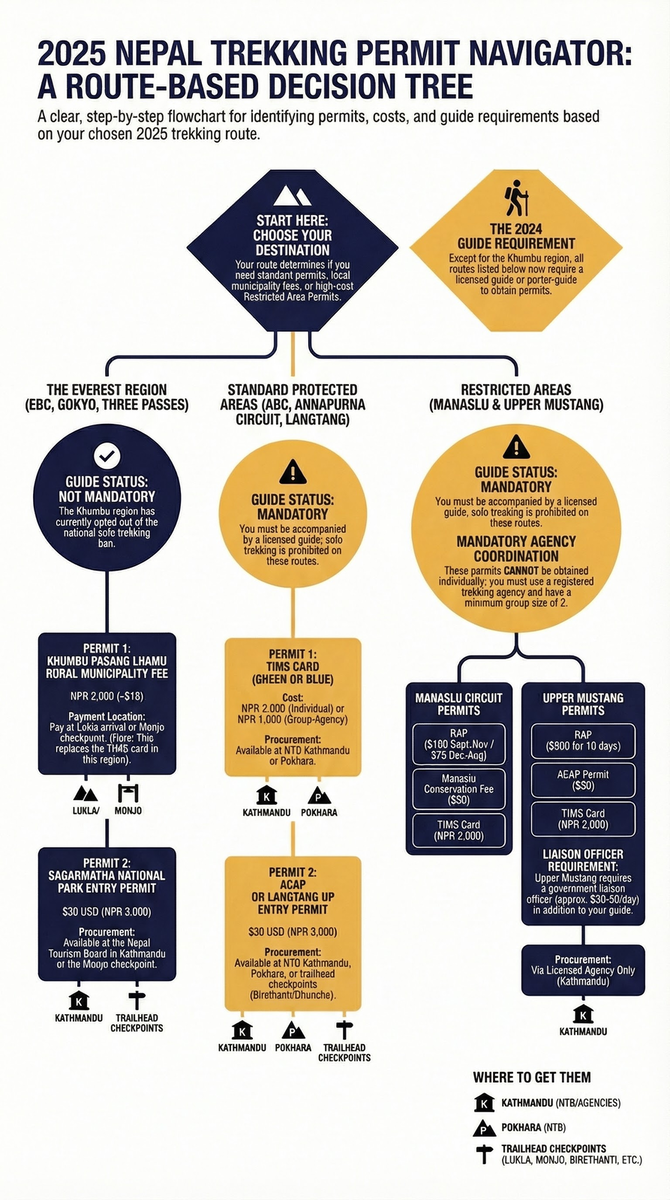
Table of Contents
- Understanding Nepal's Permit System
- TIMS Card: The Foundation Permit
- National Park and Conservation Area Permits
- Restricted Area Permits
- Local Municipality Permits
- 2026/2027 Regulation Updates
- Do You Need a Guide? Permit vs Guide by Region
- Permits Required by Route
- Where to Obtain Permits
- Required Documents
- Frequently Asked Questions
- Choosing a Verified Agency
Understanding Nepal's Permit System
Nepal's trekking permit system evolved from basic conservation needs into a multi-layered framework serving four distinct purposes: safety tracking, conservation funding, cultural protection, and tourism revenue management. Understanding why these permits exist helps make sense of which ones you need.
The Four Layers of Nepal's Permit System
Layer 1: Safety Tracking (TIMS) The Trekkers' Information Management System card exists primarily for emergency response. When accidents, natural disasters, or political unrest occur, authorities use TIMS data to locate and account for trekkers. This system proved invaluable during the 2015 earthquake when officials tracked down thousands of trekkers in affected areas.
Layer 2: Conservation Funding (National Parks) Nepal's protected areas—Sagarmatha, Langtang, Annapurna, and others—require funding for trail maintenance, wildlife protection, anti-poaching efforts, and community development. Entry permits directly finance these activities. The $30 USD foreign national park fee generates millions annually for conservation.
Layer 3: Cultural and Environmental Protection (Restricted Areas) Remote regions like Upper Mustang, Upper Dolpo, and the Manaslu corridor were opened to tourism gradually and reluctantly. These areas contain fragile ecosystems and traditional cultures that authorities want to protect from mass tourism. High permit fees and group requirements serve as deliberate barriers that limit visitor numbers while generating significant revenue for local communities.
Layer 4: Local Community Benefit (Municipality Fees) The newest addition to Nepal's permit structure, local municipality fees ensure tourism revenue reaches the specific communities that host trekkers. The Khumbu Pasang Lhamu Rural Municipality fee exemplifies this approach—a direct payment to the Sherpa communities of the Everest region.
Which Permits Do You Actually Need?
The permits required for your trek depend on three factors:
- Which region you're trekking in
- Whether the area is restricted or open
- Whether you're trekking independently or through an agency
Most trekkers need at minimum a TIMS card plus a national park or conservation area permit. Restricted area treks add substantial additional permits—and in most cases require agency coordination, group formation, and liaison officers.
The Solo Trekking Ban (since April 2023)
Since 1 April 2023, the Nepal Tourism Board requires foreign trekkers to use a licensed guide on routes that fall under TIMS — most notably the Annapurna region. This doesn't affect permit costs directly, but it does mean most trekkers now work with agencies who handle permit logistics. The rule is enforced unevenly by region: it is strictly applied in restricted areas, increasingly checked in Langtang since 2025, and effectively not enforced in the Khumbu (Everest) region. See 2026 Regulation Updates below for the current region-by-region reality.
TIMS Card: The Foundation Permit
The Trekkers' Information Management System (TIMS) card serves as Nepal's primary safety registration for trekkers. Introduced in 2008, this permit creates a centralized database of all trekkers in Nepal's backcountry—information that proves critical during emergencies. For a deep dive on application steps and current rates, see our dedicated TIMS Card Guide.
What Is the TIMS Card?
TIMS is a registration card containing your personal details, emergency contacts, trek itinerary, and insurance information. It's checked at various points along trekking routes, allowing authorities to track trekker movements and respond quickly if someone goes missing or emergencies occur.
The card comes in two categories:
Green TIMS (Individual/FIT): For trekkers arranging their own journey, whether solo or in informal groups. Cost: NPR 2,000 (~$15 USD) per person for foreign nationals.
Blue TIMS (Group/Organized): For trekkers booking through registered trekking agencies. Cost: NPR 1,000 (~$8 USD) per person for foreign nationals. Many agencies include this cost in their package and handle registration on your behalf.
SAARC nationals pay less. For trekkers from SAARC countries (India, Bangladesh, Bhutan, Maldives, Pakistan, Sri Lanka, Afghanistan), group trekkers pay NPR 300 each and independent trekkers pay NPR 600 each. Nepali citizens pay NPR 100 (group) or NPR 200 (individual).
TIMS Card Costs (2026)
| TIMS Category | Cost (NPR) | Cost (USD Approx.) | Who It's For |
|---|---|---|---|
| Green TIMS (Individual) | NPR 2,000 | ~$15 | Independent trekkers, informal groups |
| Blue TIMS (Group) | NPR 1,000 | ~$8 | Agency-organized treks |
| Agency-Arranged | Free (included) | $0 | When permit fee is absorbed by agency |
Who Needs a TIMS Card?
Required for:
- All foreign trekkers in Nepal
- Treks in Annapurna, Langtang, Manaslu (non-restricted areas), and most other standard trekking regions
- Both teahouse and camping-style treks
Not required for:
- Khumbu (Everest) region since October 2018—replaced by local municipality permit
- Day hikes that don't enter protected areas
- Climbing expeditions (different permit system applies)
Important TIMS Clarification for Everest Trekkers
If you're trekking solely within the Khumbu region (Everest Base Camp, Gokyo Lakes, Three Passes), you do NOT need a TIMS card. The Khumbu Pasang Lhamu Rural Municipality permit replaced TIMS for this region. However, if your trek enters other regions (like combining with Langtang), you'll need TIMS for those portions.
Where to Get Your TIMS Card
Primary Location: Nepal Tourism Board Office, Kathmandu
- Address: Tourist Service Center, Pradarshani Marg, Bhrikutimandap
- Hours: Sunday–Friday, 10:00 AM – 4:00 PM (closes 3:00 PM in winter)
- Processing time: 15-30 minutes if documents are complete
Secondary Location: Tourism Office, Pokhara
- Address: Lakeside (east of Phewa Lake)
- Hours: Sunday–Friday, 10:00 AM – 4:00 PM
- Processing time: 15-30 minutes
TAAN Counters (Trekking Agencies' Association of Nepal) The TIMS system is jointly run by the Nepal Tourism Board and TAAN. You can also obtain a card at the TAAN Secretariat in Maligaun, the TAAN TIMS counter in Thamel (convenient if you're staying in Kathmandu's trekker district), or the TAAN office in Pokhara.
Through a Trekking Agency Most agencies handle TIMS registration as part of their service. You provide passport copies and photos; they do the rest. If using an agency, confirm whether TIMS is included in your package. Note that since the 2023 rule, TIMS cards are issued only through a government-registered agency on most standard routes.
What Documents Do You Need for TIMS?
- Valid passport with at least 6 months validity
- Two passport-sized photos
- Your trek itinerary (dates, route, planned stops)
- Emergency contact information
- Travel insurance details (policy number, company name, emergency contact)
- Agency letter if booking through an agency
Pro Tip
Bring multiple copies of your passport photo page and extra passport photos to Nepal. You'll need them for TIMS, national park permits, SIM card registration, and potentially restricted area permits. Having 10-15 copies saves significant time and hassle.
National Park and Conservation Area Permits
Nepal's protected areas require separate entry permits that directly fund conservation efforts. These fees apply regardless of your TIMS status and are collected either in advance or at park entry checkpoints.
Understanding the Protected Area Types
National Parks: Highest protection status. Regulated by the Department of National Parks and Wildlife Conservation. Examples: Sagarmatha, Langtang, Shey Phoksundo.
Conservation Areas: Managed for sustainable use, often with community involvement. Can include human settlements. Examples: Annapurna Conservation Area, Manaslu Conservation Area.
Wildlife Reserves: Primarily for wildlife protection. Less common for trekking. Example: Koshi Tappu Wildlife Reserve.
National Park and Conservation Permit Fees (2026)
| Protected Area | Fee (Foreigners) | Fee (SAARC) | Notes |
|---|---|---|---|
| Sagarmatha National Park | $30 USD (NPR 3,000) | $15 USD | Everest region, entry at Monjo |
| Annapurna Conservation Area (ACAP) | $30 USD (NPR 3,000) | $10 USD | ABC, Circuit, Poon Hill, Mardi Himal |
| Langtang National Park | $30 USD (NPR 3,000) | $15 USD | Langtang Valley, Gosaikunda |
| Manaslu Conservation Area | $30 USD (NPR 3,000) | $10 USD | Plus restricted area fee if applicable |
| Makalu-Barun National Park | $30 USD (NPR 3,000) | $15 USD | Makalu Base Camp trek |
| Shey Phoksundo National Park | $30 USD (NPR 3,000) | $15 USD | Lower Dolpo region |
| Gaurishankar Conservation Area | $30 USD (NPR 3,000) | $10 USD | Rolwaling Valley, Jiri approach to Everest |
| Kanchenjunga Conservation Area | $30 USD (NPR 3,000) | $10 USD | Plus restricted area fee |
| Rara National Park | $30 USD (NPR 3,000) | $15 USD | Remote western Nepal |
| Chitwan National Park | $25 USD (NPR 2,000) | $10 USD | Not for trekking—wildlife safari area |
Detailed Guide to Major Protected Areas
Sagarmatha National Park (Everest Region)
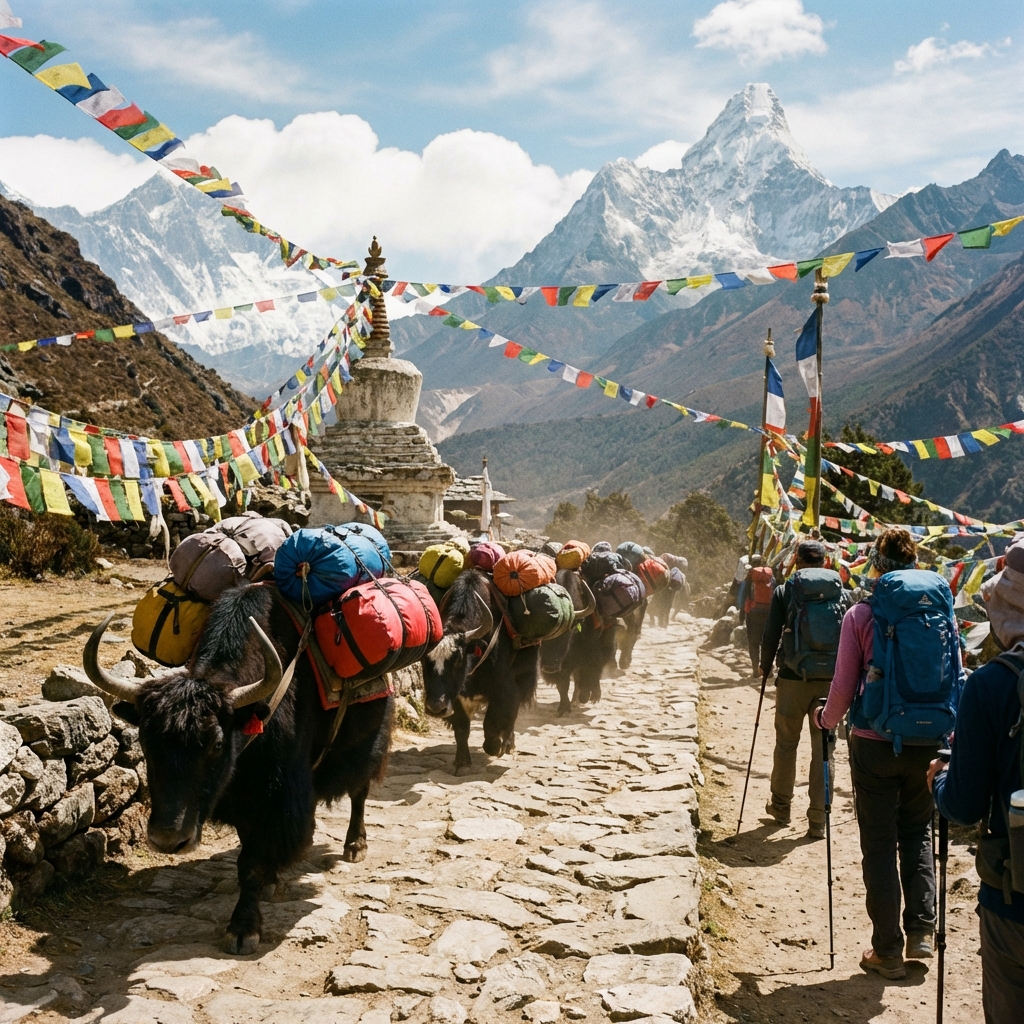
Established in 1976 and designated a UNESCO World Heritage Site in 1979, Sagarmatha National Park protects 1,148 square kilometers of the Khumbu region, including Mount Everest itself. The park entrance is at Monjo village, where permits are checked and can be purchased if not obtained in advance.
What the fee covers:
- Trail maintenance on the main Everest routes
- Wildlife protection (snow leopards, Himalayan tahr, musk deer)
- Management of the Khumbu Icefall route for expeditions
- Waste management programs (though these struggle with the volume)
- Conservation education programs
Entry point: Monjo (approximately 2 hours below Namche Bazaar)
Best obtained: In Kathmandu at Nepal Tourism Board office for certainty, or at the Monjo checkpoint
For detailed Everest region planning, see our Everest Region Trekking Guide.
Annapurna Conservation Area (ACAP)
The largest protected area in Nepal at 7,629 square kilometers, the Annapurna Conservation Area Project (ACAP) pioneered the conservation area model that balances protection with sustainable community development. ACAP covers all major Annapurna treks: Base Camp, Circuit, Poon Hill, Mardi Himal, and more.
What the fee covers:
- Community development projects in Gurung, Thakali, and other villages
- Alternative energy programs (reducing firewood consumption)
- Trail maintenance and signage
- Eco-tourism training for local communities
- Anti-poaching programs
Entry points: Multiple checkpoints including Birethanti (ABC/Poon Hill), Chame (Circuit from north), Besi Sahar (Manaslu approach)
Best obtained: In Pokhara at the ACAP office near the Nepal Tourism Board, or at entry checkpoints
For Annapurna region planning, see our Annapurna Region Trekking Guide.
Langtang National Park
The first Himalayan national park established in Nepal (1976), Langtang protects the region closest to Kathmandu. The park was severely affected by the 2015 earthquake—the village of Langtang was almost entirely destroyed by an avalanche, with over 175 deaths. Today, the rebuilt valley offers poignant trekking with incredible scenery.
What the fee covers:
- Post-earthquake reconstruction support
- Trail rehabilitation
- Red panda conservation programs
- Forest management and anti-poaching
- Support for affected communities
Entry point: Dhunche (accessible by bus from Kathmandu)
Best obtained: At the park office in Dhunche, or in Kathmandu at Nepal Tourism Board
For Langtang planning, see our Langtang Region Trekking Guide.
Makalu-Barun National Park
Nepal's only park to include an 8,000-meter peak entirely within its boundaries, Makalu-Barun protects one of Nepal's most remote and biologically diverse areas. The trek to Makalu Base Camp is demanding but rewarding, with far fewer trekkers than Everest or Annapurna regions.
Entry point: Tumlingtar (flight from Kathmandu) or Hile (bus from Kathmandu)
Special considerations: This is true wilderness trekking—basic teahouse facilities exist but camping may be necessary on some routes.
For Makalu information, see our Makalu Region Trekking Guide.
Shey Phoksundo National Park
Home to Phoksundo Lake—Nepal's deepest and arguably most beautiful lake—this park in the Dolpo region combines alpine and trans-Himalayan landscapes. The lower Dolpo trek to Phoksundo Lake requires only standard permits; upper Dolpo requires restricted area permits.
Entry point: Dunai (flight from Nepalgunj) or overland via Beni
Key attraction: The pristine turquoise waters of Phoksundo Lake, setting of the book "The Snow Leopard" by Peter Matthiessen
Pro Tip
National park permits are valid only for single entry during your specified dates. If you leave the park (even briefly) and re-enter, you technically need a new permit. Plan your itinerary to avoid unnecessary exits and re-entries if possible.
Restricted Area Permits
Nepal's restricted area permits represent the premium tier of trekking access—regions that were closed to foreigners until recently or remain tightly controlled due to their sensitive locations, fragile environments, or traditional cultures. These permits cost significantly more, require additional logistics, and almost always mandate group trekking with licensed agencies.
Why Are These Areas Restricted?
Border sensitivity: Many restricted areas lie along Nepal's borders with Tibet (China). Security concerns and geopolitical sensitivities led to closure for foreigners until the 1990s or later.
Cultural preservation: Communities in these areas maintained traditional Tibetan Buddhist cultures largely unchanged for centuries. Unrestricted tourism would risk rapid cultural erosion.
Environmental fragility: The trans-Himalayan landscape is extremely vulnerable. Limited vegetation, harsh conditions, and sparse populations mean human impact is disproportionately significant.
Tourism revenue management: Higher fees and limited numbers generate more revenue per trekker while reducing overall impact—a sustainable tourism model.
Restricted Area Permit Fees (2026)
| Restricted Area | Permit Fee | Minimum Group Size | Liaison Officer | Season Notes |
|---|---|---|---|---|
| Upper Mustang | USD 50 per person per day (no minimum-days lump sum) | 2 persons | Required | Year-round same fee |
| Upper Dolpo | USD 50 per person per day | 2 persons | Required | Year-round same fee |
| Manaslu Circuit | $100 (Sep-Nov) / $75 (Dec-Aug) | 2 persons | Not required | Seasonal pricing |
| Tsum Valley | $35 per week (1st week) / $10 per day (after) | 2 persons | Not required | Lower fees than other restricted areas |
| Nar Phu Valley | $100 (Sep-Nov) / $75 (Dec-Aug) | 2 persons | Not required | Adjacent to Annapurna Circuit |
| Kanchenjunga (North & South) | $20 per week (1st week) / $5 per day (after) | 2 persons | Not required | Relatively affordable |
| Dolpo (Lower) | $10 per week | None | Not required | Inner Dolpo is restricted, not lower |
| Humla & Simikot | $50 per week | None | Not required | Depends on specific route |
Detailed Guide to Restricted Areas
Upper Mustang: The Last Forbidden Kingdom
Upper Mustang remained closed to foreigners until 1992 and still requires special permits to enter. This region was historically the Kingdom of Lo, a semi-independent Tibetan Buddhist kingdom that only fully integrated with Nepal in 2008. The capital, Lo Manthang, preserves medieval Tibetan architecture, monasteries, and culture found almost nowhere else on Earth.
Permit details:
- Cost: USD 50 per person per day (Department of Immigration rate, charged for each day inside the restricted zone — a typical 10-day Lo Manthang trip is around $500). There is no minimum-days lump sum; you pay per day.
- Minimum group size: 2 persons minimum (cannot trek solo)
- Liaison officer: Required (arranged by agency, costs extra)
- Processing time: 2-3 business days minimum
- Valid entry point: Kagbeni (north of Jomsom on Annapurna Circuit)
What the high fee protects: Upper Mustang's permit fee is deliberately high to limit visitor numbers. Annual trekker numbers are capped at approximately 3,000-4,000. Revenue supports preservation of centuries-old monasteries, cave systems with ancient Buddhist art, and the traditional way of life in villages like Lo Manthang, Ghami, and Tsarang.
Logistics requirements:
- Must book through a licensed trekking agency
- Agency arranges liaison officer (typically $30-50/day additional)
- All camping equipment if doing camping trek (teahouse options now available on main route)
- Sufficient supplies—this is a rain shadow desert with limited resources
Season considerations: Unlike other treks, Upper Mustang lies in the Himalayan rain shadow and is actually best during monsoon (June-August) when the rest of Nepal is too wet. Spring (April-May) and autumn (October-November) are also excellent.
For the full fee schedule, group rules and application timeline, see our dedicated Upper Mustang Permit Guide. For route and itinerary planning, see our Upper Mustang Trekking Guide.
Upper Dolpo: Into the Snow Leopard's Domain
Made famous by Peter Matthiessen's "The Snow Leopard" (1978), Upper Dolpo remains one of Earth's most remote inhabited regions. This is not a trek for casual tourists—it's a genuine expedition through some of Nepal's wildest terrain.
Permit details:
- Cost: USD 50 per person per day (charged for each day inside the Upper Dolpo restricted zone — long circuits of 3+ weeks therefore carry a substantial permit bill)
- Minimum group size: 2 persons minimum
- Liaison officer: Required
- Processing time: 2-3 business days minimum
- Entry point: Via Juphal airstrip (Dunai) or overland routes
What makes Dolpo special: Upper Dolpo has no roads, very limited infrastructure, and preserves ancient Bon and Buddhist traditions. Shey Gompa, the destination Matthiessen sought, sits at 4,300m amid a landscape of extraordinary beauty. Crystal Mountain (Shey Ri) nearby is a sacred pilgrimage site.
Important considerations:
- This is a fully self-supported camping trek—no teahouses
- Minimum 21-25 days required for most Upper Dolpo circuits
- Porter/guide support essential
- Medical evacuation extremely difficult and expensive
- Best suited for experienced high-altitude trekkers
Lower Dolpo distinction: Lower Dolpo (to Phoksundo Lake) requires only standard national park permits—no restricted area permit. The restricted area begins beyond Phoksundo.
For Dolpo region information, see our Dolpo Region Trekking Guide.
Manaslu Circuit: The Restricted Area Most Accessible
The Manaslu Circuit offers a restricted area experience without the extreme costs of Mustang or Dolpo. The 14-18 day circuit around the world's eighth-highest peak provides comparable scenery to the Annapurna Circuit with a fraction of the trekkers.
Permit details:
- Cost: $100 USD (September-November), $75 USD (December-August)
- Minimum group size: 2 persons minimum
- Liaison officer: Not required
- Processing time: 1-2 business days
- Additional required: Manaslu Conservation Area Permit (NPR 3,000 / ~$22 USD), TIMS
Why the seasonal pricing: The cheaper December-August rate acknowledges the less favorable trekking conditions (cold winter, monsoon summer). September-November is prime season when most trekkers visit.
The group requirement reality: The "two person minimum" is enforced at checkpoints. Solo trekkers have two options:
- Find a trekking partner through forums, agencies, or hostels
- Book with an agency that groups solo trekkers together
Many agencies maintain lists of solo trekkers seeking partners for Manaslu—inquire when booking.
What you get:
- Crossing the Larkya La pass (5,160m)—comparable to Thorong La on the Annapurna Circuit
- Views of Manaslu (8,163m) and surrounding peaks
- Traditional Tibetan Buddhist villages with minimal outside influence
- Far fewer trekkers than Annapurna or Everest routes
For the permit fee schedule and checkpoint details, see our Manaslu Restricted Area Permit Guide. For route planning, see our Manaslu Circuit Trekking Guide.
Tsum Valley: The Hidden Valley
Tsum Valley branches off the Manaslu Circuit into a glacial valley that was isolated from the outside world until 2008. This deeply Buddhist region preserves Tibetan traditions, ancient monasteries, and a peaceful atmosphere rarely found elsewhere in Nepal.
Permit details:
- Cost: $35 USD first week, $10 per day after
- Minimum group size: 2 persons minimum
- Liaison officer: Not required
- Processing time: 1-2 business days
- Additional required: Manaslu Conservation Area Permit (NPR 3,000 / ~$22 USD), TIMS
Why Tsum Valley is special: The valley's name means "vivid" in Tibetan, referring to its beauty. Unlike other restricted areas, Tsum Valley's lower fees make it more accessible while still limiting numbers. The valley is non-violent by tradition—even hunting is forbidden.
Can be combined with: Manaslu Circuit (adding 5-7 days)
For Tsum Valley information, see our Tsum Valley Trekking Guide.
Nar Phu Valley: The Secret Valley
Hidden behind the Annapurna range, Nar Phu Valley offers a glimpse into traditional trans-Himalayan life. The permit was only introduced in 2003, and visitor numbers remain low.
Permit details:
- Cost: $100 USD (September-November), $75 USD (December-August)
- Minimum group size: 2 persons minimum
- Liaison officer: Not required
- Processing time: 1-2 business days
- Additional required: ACAP permit ($30), TIMS
What makes it worthwhile:
- Villages of Nar and Phu preserve Tibetan architecture and customs
- Can be combined with Annapurna Circuit (adds 4-5 days)
- Far fewer trekkers than main Annapurna routes
- Views of Annapurna II, Lamjung Himal, and other peaks
For Nar Phu information, see our Nar Phu Valley Trekking Guide.
Kanchenjunga: The Five Treasures of Snow
The Kanchenjunga region in far eastern Nepal offers trekking to the base of the world's third-highest peak. Though technically restricted, the permit fees are relatively modest compared to Mustang or Dolpo.
Permit details:
- Cost: $20 USD first week, $5 per day after
- Minimum group size: 2 persons minimum
- Liaison officer: Not required
- Processing time: 1-2 business days
- Additional required: Kanchenjunga Conservation Area Permit ($30)
Route options:
- North Base Camp only (7-8 days each way)
- South Base Camp only (6-7 days each way)
- Both camps circuit (20-25 days)
Logistics note: This is remote trekking. The town of Taplejung (the trailhead) is a long bus journey from Kathmandu or a flight to Biratnagar plus onward travel. Infrastructure is basic compared to Everest or Annapurna regions.
For Kanchenjunga planning, see our Kanchenjunga Trekking Guide.
Restricted Area Requirements Summary
Non-Negotiable Requirements for Restricted Areas
- Minimum two trekkers: You cannot obtain restricted area permits as a solo trekker
- Licensed agency required: All restricted area permits must be processed through a registered Nepali trekking agency
- Liaison officer for some: Upper Mustang and Upper Dolpo require government liaison officers
- Advance planning: Allow minimum 1 week before trek start for permit processing (2-3 weeks recommended for Mustang/Dolpo)
- Check entry points: Restricted area permits are checkpoint-controlled; don't attempt alternative routes
Local Municipality Permits
The newest layer of Nepal's permit system, local municipality permits channel tourism revenue directly to the communities hosting trekkers. This decentralized approach ensures villages and districts directly benefit from the trekkers passing through their territory.
Khumbu Pasang Lhamu Rural Municipality Fee
Implemented in 2018, this fee replaced the TIMS card requirement for the Everest (Khumbu) region specifically. It's collected locally and funds community projects in the Sherpa villages along the trekking routes.
Details:
- Cost: NPR 2,000-3,000 (~$15-22 USD) depending on entry point and current rate
- Where to pay: Lukla airport upon arrival, or Monjo checkpoint
- What it replaces: TIMS card (not required for Khumbu-only treks)
- What it funds: Local school improvements, trail maintenance, health posts, clean energy projects
Important: If trekking only in the Khumbu region (EBC, Gokyo, Three Passes), you need this permit INSTEAD of TIMS, not in addition to it. You still need Sagarmatha National Park permit.
Annapurna Region Local Fees
Some areas within the Annapurna Conservation Area have introduced additional local fees:
Mustang District Fee (Lower Mustang): NPR 500-1,000 at some checkpoints (separate from Upper Mustang restricted permit)
Individual VDC fees: Some Village Development Committees collect small fees (NPR 100-500). These are legitimate local taxes, though not always consistently applied.
Other Emerging Local Fees
Nepal's decentralization process means more local governments are establishing trekking-related fees. These change frequently and are best confirmed with current trekkers or agencies. Check for potential local fees in:
- Helambu region
- Makalu region
- Far western Nepal
Pro Tip
Local fees are typically modest (under $10 USD) and directly benefit the communities you're visiting. Paying them cheerfully, even when unexpected, supports sustainable tourism. Always get a receipt.
2026/2027 Regulation Updates
Nepal's trekking regulations underwent significant changes in 2026, most notably the much-discussed solo trekking ban. Understanding these changes is essential for planning any 2026 trek.
The Solo Trekking Ban (Effective April 2023)
What changed: Since 1 April 2023, foreign nationals trekking on routes covered by TIMS must be accompanied by a licensed guide or porter-guide. True solo trekking—setting off alone without any Nepali staff—is no longer officially permitted on most standard routes. The headline regions affected are the Annapurna treks (ABC, Circuit, Poon Hill, Mardi Himal).
Official stated reasons:
- Safety concerns (several high-profile deaths of solo trekkers in 2023)
- Better emergency response when guides can report incidents
- Economic benefit distribution to local guides and porters
- Consistent tracking of trekker movements
How it's enforced:
- TIMS registration now requires your guide's licence details
- Checkpoints on affected routes verify that a licensed guide is present
- Without a registered guide, you may be refused a TIMS card or turned back at a checkpoint on routes where the rule is applied
Affected regions:
- Annapurna Conservation Area (including ABC, Circuit, Poon Hill, Mardi Himal) — the rule is most consistently enforced here
- All restricted areas (Upper Mustang, Manaslu, Nar Phu, Tsum, Kanchenjunga, Upper Dolpo) — a licensed guide has been mandatory here for decades, independent of the 2023 rule
- Most other standard trekking regions on paper
The Langtang exception (2025 onward): Langtang National Park is not a restricted area, so the national guide mandate does not automatically apply. However, since spring 2025 the park authority has independently asked foreign trekkers to use a guide. Enforcement is inconsistent and some trekkers report being pressured into hiring an unofficial "guide" simply to buy a park ticket in Dhunche. To avoid this, you can buy the Langtang National Park ticket at the Nepal Tourism Board office in Kathmandu before you travel.
Effectively exempt regions:
- Khumbu (Everest region, including EBC, Gokyo and Three Passes) — the local municipality did not adopt the guide mandate, and unguided trekking remains widely practised here
- The Makalu Base Camp approach and a handful of other Solukhumbu-area routes
Guide Requirements in Practice
What "guide" means:
- Must hold a government-issued trekking guide or porter license
- Can be a full guide (more expensive) or porter-guide (carries load + basic guiding)
- Cannot be an informal arrangement with a friend or unlicensed local
Minimum costs added:
- Porter-guide: $20-30 per day
- Licensed trekking guide: $35-50 per day
For those who wanted to trek solo:
- Hire a porter-guide (cheapest compliant option)
- Trek in Khumbu region (still allows unguided trekking)
- Find trekking partners and share guide costs
Other 2026/2027 Updates
Fee adjustments: National park fees have been stable since 2023. Minor fluctuations in exchange rates affect USD equivalents. Always confirm current NPR amounts.
Restricted area permits: No significant changes to restricted area fees or requirements in 2026.
Digital permits pilot: Nepal Tourism Board has piloted digital TIMS registration, though physical cards remain the norm. Full digital transition expected in coming years.
Insurance verification: Agencies increasingly verify travel insurance before trek departure. Ensure your policy specifically covers:
- High-altitude trekking to your maximum planned altitude
- Helicopter emergency evacuation
- Trip cancellation/interruption
Future Regulation Changes
Nepal's tourism ministry periodically revises trekking regulations. Changes typically take effect at the start of the Nepali fiscal year (mid-July) or the main trekking season (September). Check official sources or your agency for the latest requirements before finalizing plans.
Do You Need a Guide? Permit vs Guide by Region
A permit and a guide are two separate requirements, and the confusion between them trips up many trekkers. You always need the relevant permits; whether you also need a licensed guide depends on the region.
Treks where a licensed guide is mandatory:
- All restricted areas — Upper Mustang, Upper Dolpo, Manaslu Circuit, Tsum Valley, Nar Phu, Kanchenjunga (guide + 2-person minimum, enforced for decades)
- Annapurna region treks — ABC, Annapurna Circuit, Poon Hill, Mardi Himal, Tilicho (since the April 2023 rule)
Treks you can still do without a guide (as of 2026):
- Everest/Khumbu region — Everest Base Camp, Gokyo Lakes, Three Passes, Mera Peak approach
- Makalu Base Camp approach and several other Solukhumbu routes
- Lower-altitude trails like the Tamang Heritage Trail, Ruby Valley and Helambu (verify locally before you go)
The grey area — Langtang: Officially not restricted, but the park has pushed a guide requirement since 2025 with patchy enforcement. Buy your Langtang ticket in Kathmandu to sidestep checkpoint pressure.
Permit ≠ Guide
Buying a permit does not automatically require a guide, and hiring a guide does not exempt you from any permit. Budget for both separately: permits as listed in the tables here, and a porter-guide at $20-30/day or a full guide at $35-50/day where one is required. See our hiring guides and porters guide for current rates.
Permits Required by Route
This comprehensive table shows all permits and fees required for Nepal's most popular trekking routes, updated for 2026.
Standard Trekking Routes (Non-Restricted)
| Route | TIMS | National Park/Conservation | Local Fees | Guide Required | Total Permit Cost (Approx.) |
|---|---|---|---|---|---|
| Everest Base Camp | Not required | Sagarmatha NP ($30) | Khumbu Municipality (NPR 2,000 / ~$15) | Not mandatory | $45-50 |
| Gokyo Lakes | Not required | Sagarmatha NP ($30) | Khumbu Municipality (~$15) | Not mandatory | $45-50 |
| Everest Three Passes | Not required | Sagarmatha NP ($30) | Khumbu Municipality (~$15) | Not mandatory | $45-50 |
| Annapurna Base Camp | NPR 2,000 (~$15) | ACAP ($30) | None | Yes | $45-50 |
| Annapurna Circuit | NPR 2,000 (~$15) | ACAP ($30) | None | Yes | $45-50 |
| Poon Hill | NPR 2,000 (~$15) | ACAP ($30) | None | Yes | $45-50 |
| Mardi Himal | NPR 2,000 (~$15) | ACAP ($30) | None | Yes | $45-50 |
| Langtang Valley | NPR 2,000 (~$15) | Langtang NP ($30) | None | Yes | $45-50 |
| Gosaikunda Lakes | NPR 2,000 (~$15) | Langtang NP ($30) | None | Yes | $45-50 |
| Helambu | NPR 2,000 (~$15) | Langtang NP ($30) | None | Yes | $45-50 |
| Makalu Base Camp | NPR 2,000 (~$15) | Makalu-Barun NP ($30) | None | Yes | $45-50 |
| Lower Dolpo (Phoksundo Lake) | NPR 2,000 (~$15) | Shey Phoksundo NP ($30) | Dolpo fee ($10/week) | Yes | $55-60 |
Restricted Area Routes
| Route | TIMS | Conservation Permit | Restricted Permit (Peak/Off) | Group Min. | Liaison Officer | Total Permit Cost (Approx.) |
|---|---|---|---|---|---|---|
| Manaslu Circuit | NPR 2,000 | Manaslu CA ($30) | $100 / $75 | 2 persons | No | $145-175 |
| Tsum Valley | NPR 2,000 | Manaslu CA ($30) | $35 first week | 2 persons | No | $80-100 |
| Manaslu + Tsum | NPR 2,000 | Manaslu CA ($30) | $100 + $35 | 2 persons | No | $180-200 |
| Nar Phu Valley | NPR 2,000 | ACAP ($30) | $100 / $75 | 2 persons | No | $145-175 |
| Upper Mustang | NPR 2,000 | ACAP ($30) | $50/person/day (~$500 for 10 days) | 2 persons | Yes (+$30-50/day) | $700-900+ |
| Upper Dolpo | NPR 2,000 | Shey Phoksundo ($30) | $50/person/day (~$500 for 10 days) | 2 persons | Yes (+$30-50/day) | $700-900+ |
| Kanchenjunga | NPR 2,000 | KCA ($30) | $20 first week | 2 persons | No | $65-80 |
Combined/Extended Routes
| Route Combination | Total Permits Required | Estimated Total Cost |
|---|---|---|
| EBC + Gokyo via Cho La | Sagarmatha NP + Khumbu Municipality | $45-50 |
| Annapurna Circuit + Nar Phu | TIMS + ACAP + Nar Phu restricted | $145-175 |
| Annapurna Circuit + Tilicho Lake | TIMS + ACAP (no additional) | $45-50 |
| Manaslu + Tsum Valley | TIMS + Manaslu CA + both restricted permits | $180-200 |
| Langtang + Gosaikunda + Helambu | TIMS + Langtang NP (single permit covers all) | $45-50 |
| Great Himalaya Trail sections | Varies by section—multiple permits | $100-500+ |
Budget Planning Tip
For standard routes (EBC, ABC, Langtang), budget $50 USD for permits. For restricted areas (Manaslu, Nar Phu, Kanchenjunga), budget $150-200. For premium restricted areas (Upper Mustang, Upper Dolpo), budget $700-1,000+ including liaison officer costs.
Where to Obtain Permits
Nepal Tourism Board (NTB) Office, Kathmandu
The primary permit center for most trekkers.
Address: Tourist Service Center, Pradarshani Marg, Bhrikutimandap (Exhibition Road), Kathmandu
What you can get here:
- TIMS cards (Green and Blue)
- National park entry permits
- Restricted area permits (with agency submission)
Hours:
- Sunday–Friday: 10:00 AM – 4:00 PM
- Winter hours: 10:00 AM – 3:00 PM
- Closed Saturdays and public holidays
Processing time:
- TIMS: 15-30 minutes if documents complete
- National park permits: 15-30 minutes
- Restricted area permits: 2-5 business days
Tips for efficiency:
- Arrive early (10:00-11:00 AM) to avoid queues during peak season
- Have all documents prepared and photocopied
- Bring exact change or small bills in NPR
- Consider having your agency handle this (many trekkers waste half a day here)
Tourism Office, Pokhara
Convenient for treks starting from Pokhara (Annapurna region).
Address: Lakeside, Pokhara (opposite the Nepal Tourism Board building, east side of Phewa Lake)
What you can get here:
- TIMS cards
- ACAP permits
- Some other national park permits
Hours: Similar to Kathmandu (Sunday–Friday, 10:00 AM – 4:00 PM)
Advantage: Less crowded than Kathmandu, convenient if flying directly to Pokhara
National Park Entry Checkpoints
Permits can often be purchased at park entrances—but with caveats.
Where this works:
- Monjo checkpoint (Sagarmatha National Park)
- Birethanti checkpoint (ACAP)
- Dhunche checkpoint (Langtang National Park)
- Other major entry points
Advantages:
- Saves time in Kathmandu
- Convenient if arriving directly to trailhead
Disadvantages:
- Risk of payment issues (exact change needed, systems sometimes down)
- May face queues during peak season
- Some checkpoints have limited hours
- Not all permits available at all checkpoints
Recommendation: For standard permits, getting them at checkpoints is usually fine. For restricted areas, always arrange in advance through your agency.
Through a Trekking Agency
The most convenient option for most trekkers.
What agencies handle:
- All permit applications and fees
- Photocopying and form completion
- Waiting in queues on your behalf
- Restricted area permit processing (required for restricted areas)
What you provide:
- Passport (or clear copy)
- Passport photos (2-4)
- Trek itinerary information
- Payment (usually included in package price)
Cost: Many agencies include permit costs in their package. Others charge separately plus a processing fee (typically $10-20). Always clarify what's included before booking.
For restricted areas: You MUST use a registered agency. Only licensed trekking agencies can apply for restricted area permits. This isn't optional—the permit system requires agency involvement.
For agency selection guidance, see our How to Choose a Verified Trekking Agency guide.
Immigration Department (Restricted Areas)
For some restricted area permits, particularly Upper Mustang and Upper Dolpo.
Address: Department of Immigration, Kalikasthan, Kathmandu
What's processed here:
- Liaison officer arrangements
- Some restricted area permit categories
- Extensions for restricted area stays
Note: Your agency typically handles this interaction. Individual trekkers don't usually need to visit Immigration directly.
Required Documents
For TIMS Card
- Valid passport - Original needed for verification, plus 2 photocopies of the photo page
- Passport photos - 2 recent photos (standard passport size)
- Trek itinerary - Route, dates, planned overnight stops
- Emergency contact - Name, relationship, phone number, email
- Travel insurance details - Company name, policy number, emergency contact number
- Agency letter - If booking through an agency, a letter confirming your booking
For National Park/Conservation Area Permits
- Valid passport - Original for verification, 1 photocopy
- Passport photo - 1 photo
- TIMS card - Required for most parks (except Khumbu)
- Payment - Cash in NPR or USD (exact amount preferred)
For Restricted Area Permits
- Valid passport - Original and 4-6 photocopies
- Passport photos - 4-6 photos
- Agency application letter - On agency letterhead
- Detailed itinerary - Day-by-day breakdown
- Group roster - Names and passport details of all group members (minimum 2)
- Travel insurance proof - Policy covering high altitude and evacuation
- Payment - Typically handled by agency
Document Preparation Tips
Pro Tip
Before leaving home:
- Scan all documents and email copies to yourself
- Make 10-15 passport photo copies (you'll use them for SIM cards, permits, etc.)
- Prepare a document folder with everything organized
- Save digital copies on your phone (offline accessible)
In Kathmandu:
- Passport photo services available throughout Thamel (NPR 100-200 for 4 photos)
- Photocopy shops on every corner (NPR 5-10 per page)
- Don't rely on being able to print from phone/email—not always easy
Frequently Asked Questions
Choosing a Verified Agency
For most trekkers, working with a reputable agency simplifies the permit process enormously. But agency quality varies widely, and permit handling is one indicator of overall professionalism.
Why Agency Selection Matters for Permits
A good agency will:
- Handle all permit applications and fees transparently
- Include permit costs in quoted prices (or clearly itemize separately)
- Process restricted area permits with proper lead time
- Provide photocopies and documentation backup
- Know current regulations and any recent changes
- Have established relationships with permit offices (faster processing)
Red flags include:
- Vague answers about what permits are included
- Unclear pricing that doesn't specify permit fees
- Claims that permits can be "arranged later" for restricted areas
- Inability to confirm current permit requirements
- Suggestions to skip checkpoints or avoid permits
Questions to Ask About Permits
Before booking with any agency:
- "Are all required permits included in the quoted price? If not, what's the additional cost?"
- "Do you handle permit processing, or is that my responsibility?"
- "For restricted areas: How far in advance do you need my documents?"
- "What happens if permits are delayed or denied?"
- "Can you provide a breakdown of which permits I'll receive?"
Agencies with Restricted Area Competence
Not all agencies are experienced with restricted area permits. The process requires:
- Familiarity with Immigration Department procedures
- Relationships with liaison officer networks
- Experience managing group requirements
- Understanding of checkpoint verification
When booking Upper Mustang, Upper Dolpo, or other restricted area treks, specifically ask:
- "How many groups have you sent to [destination] in the past year?"
- "Who handles the liaison officer arrangement?"
- "What's your process if one group member needs to withdraw?"
For agencies verified for restricted area competence, see our Restricted Area Competence Badge criteria.
Bridge Block: Choosing a Verified Operator
Understanding permits is essential, but it's just one piece of planning a successful Nepal trek. The agency you choose determines not only how smoothly permit logistics go, but also your safety, experience quality, and ethical impact.
Route-Specific Guides
Explore our detailed guides for routes mentioned in this article:
Standard Routes:
- Everest Base Camp Trek Complete Guide
- Annapurna Base Camp Trek Guide
- Annapurna Circuit Complete Guide
- Langtang Valley Trek Guide
- Gokyo Lakes Trek Guide
- Poon Hill Trek Guide
- Mardi Himal Trek Guide
Restricted Area Routes:
- Manaslu Circuit Complete Guide
- Upper Mustang Trek Guide
- Tsum Valley Trek Guide
- Nar Phu Valley Trek Guide
- Kanchenjunga Base Camp Guide
Region Guides
- Everest-Khumbu Region Overview
- Annapurna Region Overview
- Langtang Region Overview
- Manaslu Region Overview
- Mustang Region Overview
- Dolpo Region Overview
- Kanchenjunga Region Overview
Verification and Standards
Learn about the standards we use to evaluate trekking agencies:
- How We Verify Trekking Agencies
- Safety-Ready Badge Standards
- Transparent Pricing Badge
- Porter Welfare Badge
- Restricted Area Competence Badge
Compare Verified Agencies
Ready to book? Compare verified operators by route:
- Compare Everest Base Camp Agencies
- Compare Annapurna Circuit Agencies
- Compare Manaslu Circuit Agencies
Dedicated Permit Guides
For permit-specific detail beyond this overview:
- TIMS Card Guide
- Sagarmatha National Park Permit
- Annapurna Conservation Area Permit
- Langtang National Park Permit
- Manaslu Restricted Area Permit
- Upper Mustang Permit
- Restricted Area Permits Overview
- Nepal Permit Offices Directory
Supporting Information
Complete your planning with these resources:
- Altitude Sickness Prevention Guide
- Nepal Trek Cost Breakdown Guide
- Best Time to Trek Nepal by Region
- Porter Welfare: What Fair Treatment Looks Like
- Hiring Guides and Porters in Nepal
Conclusion
Nepal's trekking permit system, while complex, exists to fund conservation, protect cultures, ensure safety, and distribute tourism benefits to local communities. Understanding which permits you need—and planning ahead to obtain them—is a fundamental part of responsible trekking.
Key takeaways:
-
Budget appropriately: Standard routes cost $45-50 in permits; restricted areas can reach $700+ including liaison officers.
-
Plan ahead: Restricted area permits require 1-2 weeks minimum processing time. Peak season means longer waits.
-
Consider an agency: For anything beyond the standard routes, agency coordination simplifies permit logistics dramatically—and is required for restricted areas.
-
Comply with the guide requirement: Since April 2023, most TIMS regions (notably Annapurna) require licensed guides, and restricted areas always have. Khumbu remains the main exception. Factor this cost into your planning.
-
Keep documents handy: Permits are checked at multiple checkpoints. Carry originals in a waterproof bag and keep copies separately.
-
Understand what you're paying for: Permit fees directly fund trail maintenance, conservation, cultural preservation, and local community development. Your contribution matters.
The Himalaya have drawn trekkers for decades, and Nepal's permit system—for all its bureaucracy—helps ensure these mountains remain accessible for generations to come. Plan thoughtfully, pay your fees cheerfully, and enjoy the incredible journeys these permits unlock.
This guide is maintained by our editorial team with regular verification against Nepal Tourism Board, Department of Immigration, TAAN, and national park office sources. Last updated June 2026. For corrections, updates, or questions, contact our editorial team.
Permit fees and regulations change periodically. Always confirm current requirements with official sources or your trekking agency before departure.