
| Route | Duration | Max Altitude | Difficulty | Permits | Teahouses | Crowds |
|---|---|---|---|---|---|---|
| Poon Hill (Ghorepani) | 4-5 days | 3,210m | Easy-Moderate | $40 | Excellent | Moderate-High |
| Mardi Himal | 5-7 days | 4,500m | Moderate | $40 | Good | Low |
| Annapurna Base Camp | 10-14 days | 4,130m | Moderate | $40-45 | Excellent | Moderate |
| Khopra Ridge | 5-7 days | 3,660m | Moderate | $40 | Basic-Good | Low |
Poon Hill Trek: Nepal's Best Short Trek
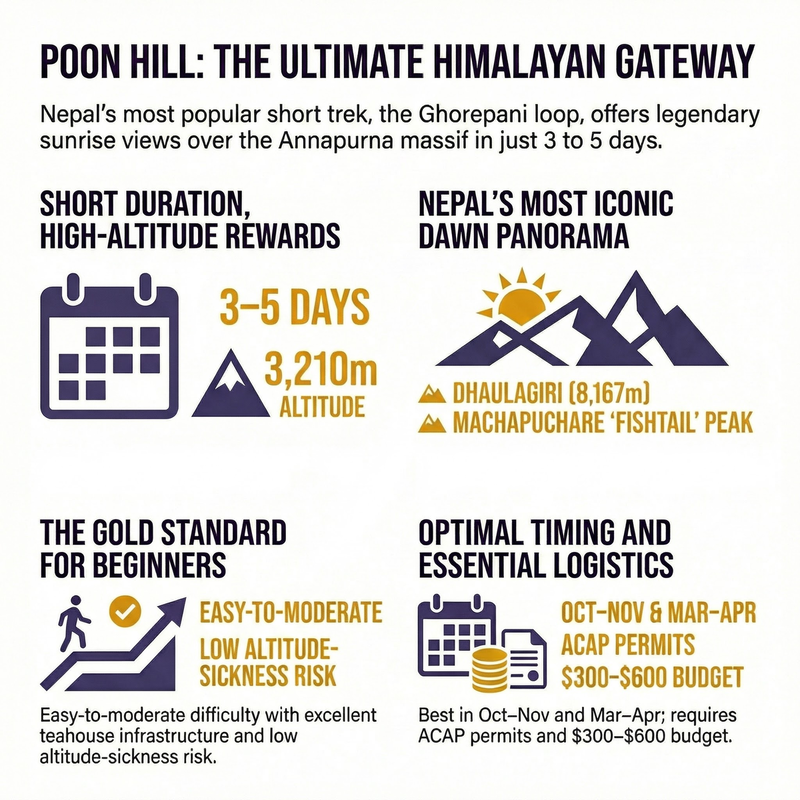
The Poon Hill trek is a 4-5 day loop in Nepal's Annapurna region, climbing to the 3,210m Poon Hill viewpoint for a sunrise panorama of Dhaulagiri, Annapurna and Machapuchare. It is beginner-friendly, costs roughly $200-650, requires an ACAP permit and a licensed guide, and runs best in autumn and spring.
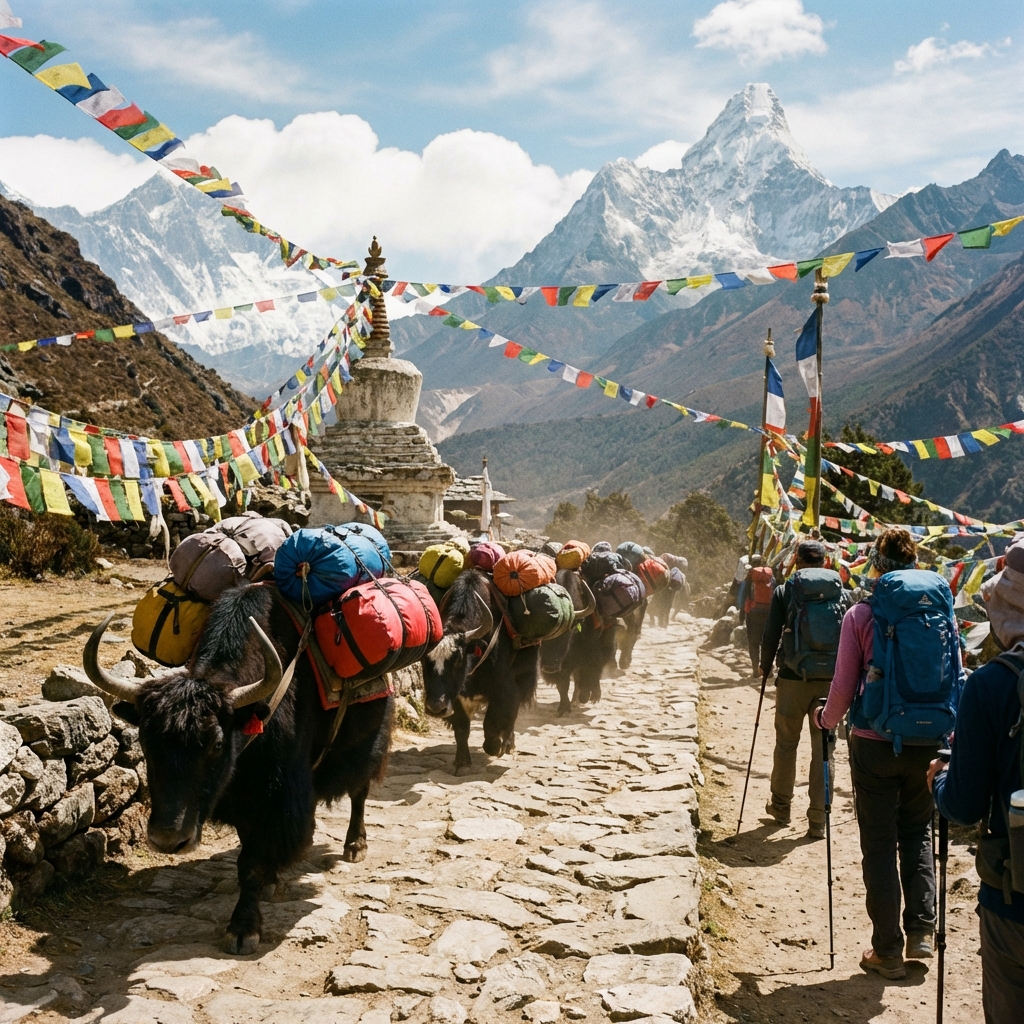
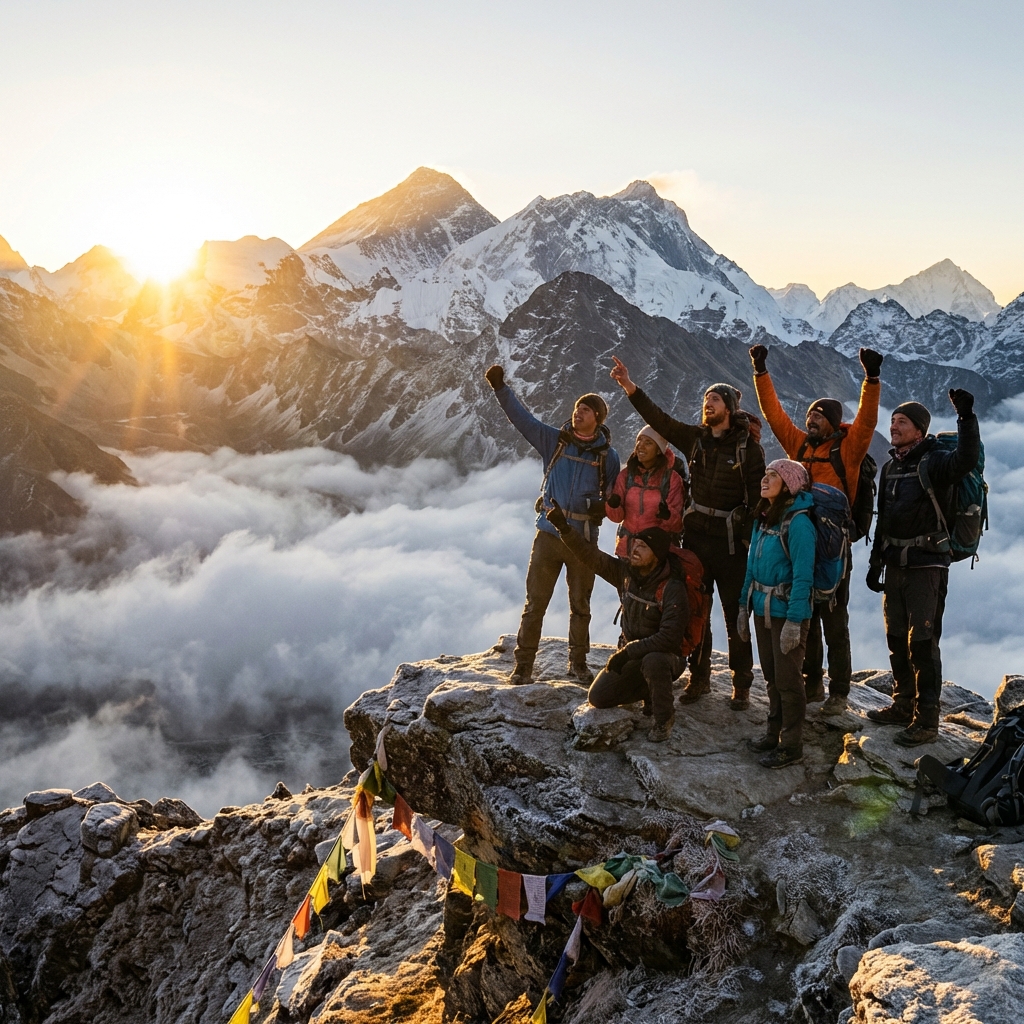
There are moments in life that stay with you forever—and watching the sun rise over the Himalayas from Poon Hill is one of them. At 3,210 meters, standing on this legendary viewpoint as golden light spills across Dhaulagiri, the Annapurna massif, and Machapuchare's iconic fishtail summit, you'll understand why this short trek has captured the hearts of travelers for generations.
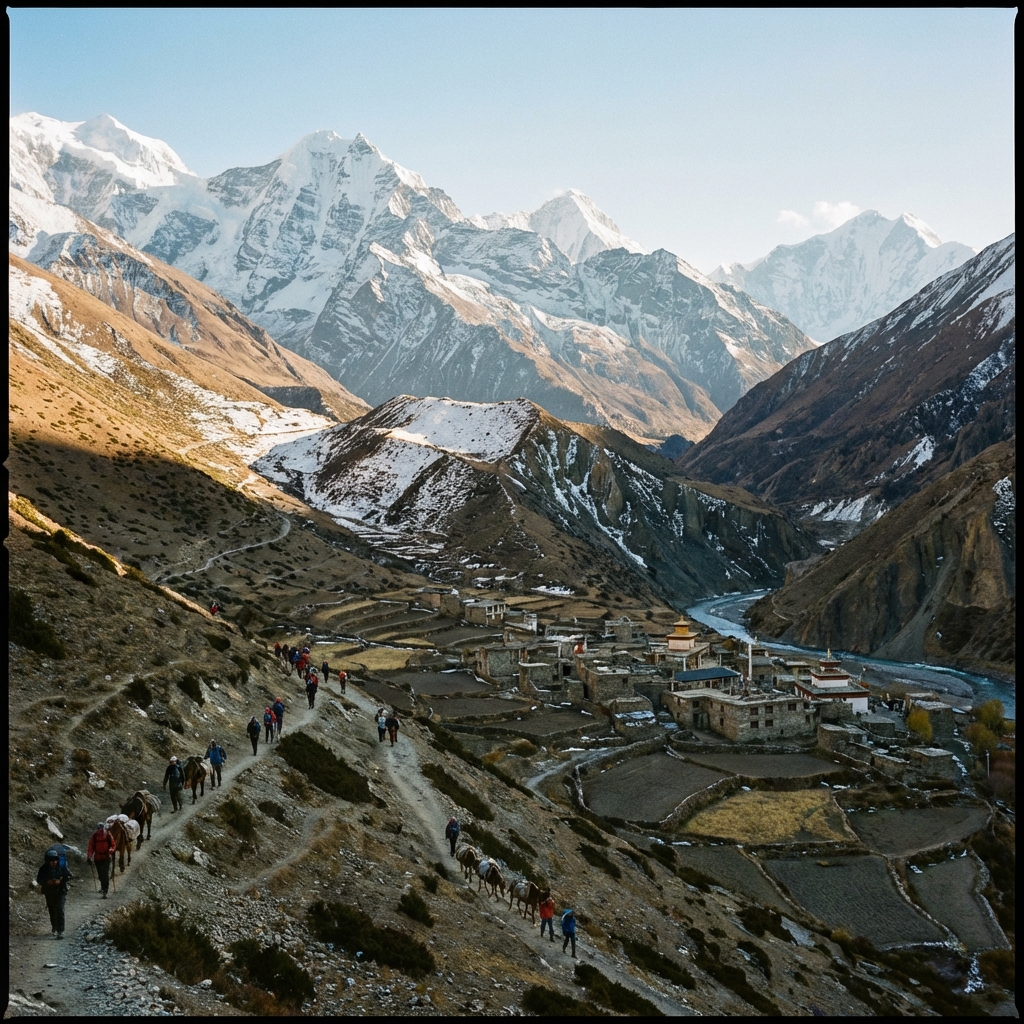
The Ghorepani Poon Hill trek is Nepal's most beloved introduction to Himalayan trekking. In just 4-5 days, you'll experience everything that makes Nepal special: rhododendron forests that blaze with color in spring, traditional Gurung villages where hospitality flows as freely as dal bhat, challenging stone staircases that test your determination, and finally, that transcendent sunrise that makes every step worthwhile.
What makes Poon Hill exceptional isn't just the destination—it's the accessibility. Unlike longer expeditions that demand weeks of your time and significant altitude acclimatization, this trek welcomes first-timers, families, and anyone with limited vacation days who refuses to settle for ordinary experiences. You don't need to be an extreme athlete or experienced mountaineer. You just need the desire to witness something extraordinary.
This comprehensive guide covers everything you need to plan your Poon Hill adventure: detailed day-by-day itineraries, honest cost breakdowns, fitness preparation, the best time to visit (hint: spring rhododendrons are magical), and insider tips that transform a good trek into an unforgettable journey.
Route Snapshot
4-5 days (3-7 days possible)
3,210m (10,531 ft) at Poon Hill
45-55 km (28-34 miles) loop
Easy to Moderate
Oct-Nov (Autumn), Mar-May (Spring)
Annapurna Conservation Area
Nayapul (via Pokhara)
ACAP + TIMS Card
Teahouse/Lodge throughout
$400-$900 (all-inclusive)
Popular Route Variants:
| Variant | Duration | Route | Best For |
|---|---|---|---|
| Express | 3 days | Nayapul-Ghorepani-Nayapul | Very fit trekkers with minimal time (3-day itinerary) |
| Standard | 4 days | Nayapul-Ghorepani-Ghandruk-Nayapul | Most trekkers, balanced experience |
| Classic | 5 days | Full loop with Tadapani | First-timers, photography enthusiasts |
| Extended | 6-7 days | Adding Khopra Ridge or ABC connection | Adventure seekers, extended holidays |
The Poon Hill Sunrise: Nepal's Most Iconic Dawn
There's a reason why thousands of trekkers wake at 4:30 AM, bundle into every layer they own, and climb 45 minutes in pre-dawn darkness to reach Poon Hill summit. The sunrise here isn't just beautiful—it's transformational.
What You'll Witness
As the first light crests the eastern horizon, the entire Himalayan panorama awakens. The peaks don't just catch the sun—they glow from within, shifting from cold blue to warm pink to blazing gold in a display that lasts about 45 magical minutes.
The Mountain Giants Revealed:
| Peak | Height | Position from Poon Hill | Notable Features |
|---|---|---|---|
| Dhaulagiri I | 8,167m (26,795 ft) | Northwest | World's 7th highest, dominates the western view |
| Annapurna I | 8,091m (26,545 ft) | North | World's 10th highest, first 8,000er ever climbed |
| Annapurna South | 7,219m (23,684 ft) | Northeast | Dramatic pyramidal shape |
| Machapuchare | 6,993m (22,943 ft) | East | Iconic "Fishtail" summit, sacred and unclimbed |
| Hiunchuli | 6,441m (21,132 ft) | Northeast | Popular trekking peak |
| Nilgiri | 7,061m (23,166 ft) | North | Stunning ice-clad faces |
The 360-degree panorama encompasses more than a dozen major peaks. On exceptionally clear days, you can spot Manaslu (8,163m) to the east—the world's eighth-highest mountain.
Sunrise Timing Guide
Optimal Sunrise Viewing Times by Season
Autumn (October-November): Sunrise around 6:00-6:20 AM. Leave Ghorepani by 4:45 AM. Spring (March-May): Sunrise around 5:30-6:00 AM. Leave Ghorepani by 4:15-4:30 AM. Winter (December-February): Sunrise around 6:30-6:45 AM. Leave by 5:00 AM.
Arrive at least 30 minutes before sunrise to secure your viewing spot and watch the entire light show unfold.
Photography Tips for Poon Hill Sunrise
The sunrise at Poon Hill offers world-class photography opportunities, but capturing it well requires preparation:
Essential gear:
- Wide-angle lens (16-35mm) for panoramas
- Telephoto lens (70-200mm) for peak details
- Sturdy tripod for low-light shooting
- Extra batteries kept warm inside your jacket (cold drains batteries fast)
Timing for best shots:
- Blue hour (30 min before sunrise): Soft, ethereal light on peaks, excellent for long exposures
- First light (5-10 min after sunrise): Pink alpenglow on highest summits
- Golden hour (15-30 min after sunrise): Warm light across entire range, most dramatic shadows
Composition ideas:
- Include the Poon Hill tower for scale
- Use prayer flags as foreground interest
- Capture fellow trekkers silhouetted against the peaks
- Focus on individual peaks with telephoto for dramatic effect
Pro Tip
Bring a thermos of hot tea or coffee from your teahouse—there's nothing quite like sipping something warm while watching the sun paint the Himalayas. The small cafe at the summit opens early, but the hot chocolate is mediocre; your own provisions are better.
Route Overview: The Ghorepani Poon Hill Circuit
The classic Poon Hill trek follows a loop through the Annapurna foothills, offering varied terrain and cultural experiences. Understanding the route helps you plan appropriately and appreciate what's ahead.
The Main Route Options
Option A: Nayapul-Ghorepani-Ghandruk Loop (Most Popular)
This 4-5 day circuit offers the best balance of experience and efficiency:
Day 1: Nayapul → Tikhedhunga (or Hille)
Day 2: Tikhedhunga → Ghorepani (the big stair day)
Day 3: Poon Hill sunrise → Tadapani
Day 4: Tadapani → Ghandruk → Nayapul
Option B: Out-and-Back via Ghorepani
Faster but less scenic variety:
Day 1: Nayapul → Tikhedhunga
Day 2: Tikhedhunga → Ghorepani
Day 3: Poon Hill sunrise → Return to Tikhedhunga
Day 4: Tikhedhunga → Nayapul
Option C: Extended with Tadapani Overnight
More relaxed pace, beautiful forest section:
Day 1: Nayapul → Tikhedhunga
Day 2: Tikhedhunga → Ghorepani
Day 3: Poon Hill sunrise, explore Ghorepani
Day 4: Ghorepani → Tadapani
Day 5: Tadapani → Ghandruk → Nayapul
Trail Terrain Summary
The Poon Hill trek involves significant elevation change despite its modest maximum altitude. Here's what to expect:
| Section | Distance | Elevation Change | Trail Type | Challenge Level |
|---|---|---|---|---|
| Nayapul to Tikhedhunga | 8-10 km | +500m | Gravel road, village paths | Easy |
| Tikhedhunga to Ghorepani | 10-12 km | +1,300m | Stone stairs, forest trails | Challenging |
| Ghorepani to Poon Hill | 1.5 km | +350m | Stone steps | Moderate (steep) |
| Ghorepani to Tadapani | 10-12 km | -230m net | Forest trails, some stairs | Moderate |
| Tadapani to Ghandruk | 5-6 km | -460m | Stone paths, village trails | Moderate |
| Ghandruk to Nayapul | 8-10 km | -1,100m | Stone stairs, road | Moderate (knees) |
Total ascent over the trek: Approximately 2,200-2,400 meters Total descent: Similar (loop returns to start elevation)
Complete Itinerary: Standard 4-Day Trek
This is the most popular itinerary, balancing experience with efficiency. Each day includes manageable distances while allowing time to appreciate the journey.
Day 1: Pokhara to Tikhedhunga
Drive: Pokhara to Nayapul (1.5-2 hours) Trek: Nayapul (1,070m) to Tikhedhunga (1,540m) Distance: 8-10 km | Duration: 3-4 hours | Elevation Gain: 470m
Your adventure begins with a scenic drive from Pokhara through terraced hillsides and traditional villages. At Nayapul, you'll register at the ACAP checkpoint (bring your permits) and begin walking.
The first day serves as a gentle introduction. The trail follows the Bhurungdi Khola river valley, passing through farming communities where children wave from doorways and women work in vegetable gardens. Some sections share the path with local jeeps, but most is dedicated walking trail.
Trail highlights:
- Suspension bridge crossing at Birethanti
- Traditional Nepali village life on display
- Gradual acclimatization to trekking rhythm
- First glimpses of the peaks you'll see close-up tomorrow
Tikhedhunga Village: This small settlement marks the start of tomorrow's famous stone staircase. Teahouses here are basic but comfortable, and the evening atmosphere—with trekkers sharing dinner and swapping stories—sets the tone for the trek ahead.
Information current as of January 2025.
Nayapul
1,070m
Trek starting point. Stock up on any forgotten items—last chance before the trail.
Birethanti
1,025m
Room: $5-8/night
Dal Bhat: $4-6
Charming riverside village with suspension bridge. Good lunch stop.
Tikhedhunga
1,540m
Room: $5-10/night
Dal Bhat: $4-6
Gateway to the famous stone staircase. Rest well tonight—tomorrow is demanding.
Day 2: Tikhedhunga to Ghorepani (The Stairmaster Day)
Trek: Tikhedhunga (1,540m) to Ghorepani (2,860m) Distance: 10-12 km | Duration: 5-7 hours | Elevation Gain: 1,320m
This is the most challenging day of the trek—and also one of the most rewarding. The trail climbs approximately 3,300 stone steps carved into the mountainside over centuries, ascending through terraced farmland into rhododendron forest.
The famous staircase: The stone steps begin immediately upon leaving Tikhedhunga. They're not uniform—some are shin-height, others knee-height—requiring constant attention and steady pacing. Most trekkers describe this as the day that tests their resolve.
Conquering the Stone Staircase
Pacing is everything. Start slowly and maintain a rhythm you can sustain. The Nepali phrase "bistari, bistari" (slowly, slowly) is your mantra. Take breaks every 30-45 minutes, but keep them short to prevent legs from stiffening. Most importantly: look up regularly—the views improve with every step!
Key waypoints:
| Stop | Altitude | From Tikhedhunga | Notes |
|---|---|---|---|
| Ulleri | 1,960m | 1.5-2 hours | Magar village, first major views, essential tea stop |
| Banthanti | 2,250m | 3-4 hours | Small settlement, good lunch spot |
| Nangethanti | 2,430m | 4-5 hours | Final push to Ghorepani |
| Ghorepani | 2,860m | 5-7 hours | Destination! |
Entering the Rhododendron Forest: Above Ulleri, the terrain transforms. Dense rhododendron trees—some over 200 years old—form a canopy overhead. In spring (March-April), these forests explode with red, pink, and white blooms. Even outside bloom season, the gnarled, moss-covered trunks create an enchanting atmosphere.
Arriving at Ghorepani: The village of Ghorepani sits on a saddle between two ridges, offering views in multiple directions. On clear days, Dhaulagiri dominates the western horizon while Annapurna South and Hiunchuli glow to the northeast.
Choose your teahouse carefully—those on the upper ridge (toward Poon Hill) offer better evening views and shorter walks the next morning.
Pro Tip
Order dinner immediately upon arrival—kitchens at altitude work slowly, and with many hungry trekkers, food takes time. Dal bhat (lentils with rice and vegetables) is the best choice: nutritious, warming, and you get unlimited refills.
Day 3: Poon Hill Sunrise, Trek to Tadapani
Sunrise hike: Ghorepani (2,860m) to Poon Hill (3,210m) and back Main trek: Ghorepani to Tadapani (2,630m) Distance: 12-14 km total | Duration: 7-8 hours | Net Elevation: -230m
This is the day you came for. The early start is brutal, but the reward is sublime.
Sunrise schedule:
- 4:00-4:30 AM: Wake up, layer up, grab headlamp
- 4:30-5:00 AM: Begin climb to Poon Hill (3,210m, about 45 minutes)
- 5:15-5:45 AM: Arrive at summit, secure viewing spot
- Sunrise time varies by season (see timing guide above)
- 7:00-7:30 AM: Return to Ghorepani for breakfast
The climb to Poon Hill follows a well-maintained stone path with clear markers. You'll likely join a procession of headlamps bobbing through the darkness—a uniquely communal experience. At the top, a viewing tower offers 360-degree visibility, but the ground level provides equally spectacular views with less crowding.
Entry fee: NPR 100 (~$0.75) at the Poon Hill gate
After breakfast and rest, the main trek continues through the Deurali pass and into the most beautiful forest section of the route. The rhododendron trees here are massive, and the trail winds through a wonderland of twisted trunks and dappled light.
Ghorepani to Tadapani highlights:
- Views of Annapurna South and Machapuchare from the trail
- Dense rhododendron forest (spectacular in spring)
- Bird watching opportunities (Danphe pheasant, laughing thrushes)
- Gentle terrain after yesterday's climb
Tadapani Village: Perched on a ridge with stunning views of Machapuchare, Tadapani makes an excellent overnight stop. Teahouses here are comfortable, and the sunset views rival the sunrise you witnessed at Poon Hill.
Day 4: Tadapani to Ghandruk to Nayapul
Trek: Tadapani (2,630m) to Ghandruk (1,940m) to Nayapul (1,070m) Distance: 14-16 km | Duration: 5-6 hours trekking + drive | Elevation Loss: 1,560m
The final trekking day is primarily descent, which means your knees will work harder than your lungs. The reward is cultural immersion in Ghandruk, Nepal's most famous Gurung village.
Morning section—Tadapani to Ghandruk (3-4 hours): The trail descends through more rhododendron forest before emerging onto terraced hillsides. Views of Machapuchare accompany you throughout, and the scale of the traditional agriculture is impressive.
Ghandruk—A Living Heritage: Ghandruk deserves at least 1-2 hours of exploration. This is Nepal's showcase Gurung village, with protected heritage architecture, an excellent ACAP museum, and panoramic views that rival any viewpoint on the trek.
Must-see in Ghandruk:
- ACAP Visitor Center and Gurung Museum
- Traditional stone houses with slate roofs
- Gurung honey (locally famous, available for purchase)
- Buddhist gompa (monastery) with mountain backdrop
Information current as of January 2025.
Ghandruk
1,940m
Room: $8-15/night
Dal Bhat: $5-8
Nepal's most famous Gurung village. Protected heritage architecture, stunning views. Worth extended exploration.
Afternoon section—Ghandruk to Nayapul (2-3 hours + drive): The descent from Ghandruk involves—you guessed it—more stone stairs. The 2,000+ steps down to Kimche or Syauli Bazaar can be tough on knees; trekking poles help significantly.
From the road head, a jeep or shared taxi returns you to Nayapul (~30 minutes) and onward to Pokhara (~1.5 hours), arriving in time for a celebratory lakeside dinner.
Extended 5-Day Itinerary (Recommended for First-Timers)
Adding a fifth day allows for a more relaxed pace, extra exploration time, and better recovery. This itinerary splits the final day's long descent into manageable sections.
| Day | Route | Distance | Hours | Elevation | Highlights |
|---|---|---|---|---|---|
| 1 | Nayapul → Tikhedhunga | 8-10 km | 3-4 hrs | +470m | Gentle introduction, village life |
| 2 | Tikhedhunga → Ghorepani | 10-12 km | 5-7 hrs | +1,320m | Stone staircase, rhododendron entry |
| 3 | Poon Hill, rest in Ghorepani | 3 km | 2-3 hrs | +350m (return) | Sunrise! Afternoon exploration |
| 4 | Ghorepani → Tadapani | 8-10 km | 4-5 hrs | -230m net | Forest beauty, bird watching |
| 5 | Tadapani → Ghandruk → Nayapul | 14-16 km | 5-6 hrs | -1,560m | Cultural immersion, completion |
Why Poon Hill is Perfect for Beginners
Poon Hill has earned its reputation as Nepal's ideal first trek for very good reasons. Understanding these factors helps you prepare appropriately and set realistic expectations.
Moderate Maximum Altitude
At 3,210m, Poon Hill is significantly lower than most Himalayan trek destinations:
| Trek | Maximum Altitude | Altitude Sickness Risk |
|---|---|---|
| Poon Hill | 3,210m | Very Low |
| Mardi Himal | 4,500m | Low-Moderate |
| Annapurna Base Camp | 4,130m | Low-Moderate |
| Everest Base Camp | 5,364m | Moderate |
| Annapurna Circuit (Thorong La) | 5,416m | Moderate-High |
Most healthy adults experience minimal altitude effects at Poon Hill's elevation. The itinerary's gradual ascent (typically reaching 2,860m on Day 2 and 3,210m briefly on Day 3) allows natural acclimatization without requiring specialized high-altitude experience.
Excellent Teahouse Infrastructure
The Poon Hill route features Nepal's best-developed teahouse network. You'll find:
- Comfortable rooms: Twin or double beds with foam mattresses, warm blankets
- Reliable meals: Multiple teahouses in each village with consistent menus
- Hot showers: Available in most villages (sometimes for additional charge)
- Charging facilities: Solar or generator power for devices
- Clear trail marking: Impossible to get seriously lost on main route
- Emergency access: Helicopter evacuation possible from Ghorepani
This infrastructure means you can trek with just a daypack while porters carry the rest—or go porter-free with a light load.
Achievable Daily Distances
Unlike longer treks that may demand 7-8 hours of walking daily for extended periods, Poon Hill's stages are manageable:
| Day | Trekking Time | Challenge Level | Notes |
|---|---|---|---|
| Day 1 | 3-4 hours | Easy | Warm-up day |
| Day 2 | 5-7 hours | Hard | The big stair day |
| Day 3 | 6-7 hours | Moderate | Most scenic |
| Day 4 | 5-6 hours | Moderate | Cultural focus |
Only Day 2 requires significant endurance, and even that is achievable with proper pacing and rest stops.
Family-Friendly Option
Poon Hill welcomes families with children aged 10 and above (with reasonable fitness). The teahouse setup means no camping equipment, the altitude is safe for children, and the daily distances are adjustable based on family pace.
For Children and Less Fit Trekkers
Consider extending to a 5-6 day itinerary with shorter daily stages. The Tikhedhunga-to-Ghorepani day can be split by overnighting in Ulleri (1,960m). This halves the challenging stair section and makes the trek significantly more comfortable.
Best Time to Visit Poon Hill
The best time to do the Poon Hill trek is autumn (October-November) and spring (March-May). Autumn delivers the clearest skies and most stable weather; spring brings the rhododendron bloom. Winter is cold but quiet, and the monsoon (June-August) is not recommended. For a month-by-month view, see our best time to trek the Annapurna region guide and the Poon Hill best time overview.
| Month | High | Low | Conditions | Crowds | Notes |
|---|---|---|---|---|---|
| January | 5°C | -5°C | 15mm | Very Low | Cold but clear; snow possible above Ghorepani |
| February | 8°C | -3°C | 20mm | Low | Warming; good visibility; rhododendrons beginning |
| MarchBest | 12°C | 2°C | 35mm | Moderate | Rhododendrons blooming; excellent conditions |
| AprilBest | 15°C | 5°C | 55mm | High | Peak rhododendron bloom; best spring month |
| MayBest | 16°C | 8°C | 120mm | Moderate | Pre-monsoon; afternoon clouds; still good trekking |
| June | 15°C | 10°C | 350mm | Very Low | Monsoon begins; rain, leeches, poor views |
| July | 14°C | 11°C | 550mm | Very Low | Peak monsoon; not recommended |
| August | 15°C | 11°C | 500mm | Very Low | Monsoon continues; muddy trails |
| September | 14°C | 9°C | 280mm | Low | Monsoon ending; improving late month |
| OctoberBest | 14°C | 4°C | 30mm | Very High | Peak autumn; best visibility; busiest month |
| NovemberBest | 10°C | 0°C | 10mm | High | Excellent conditions; cooler nights; clear skies |
| December | 7°C | -3°C | 10mm | Low | Cold but clear; fewer crowds; some teahouses close |
Autumn Season (October-November): Peak Trekking
The post-monsoon months deliver Nepal's most stable weather. Skies are crystal clear, humidity is low, and the mountains are visible virtually every day. October sees the highest trail traffic of the year—expect company but also excellent conditions.
October highlights:
- Clearest skies of the year
- Dashain and Tihar festivals add cultural dimension
- Lush green landscapes from recent monsoon
- Warm days, cool nights
November highlights:
- Slightly fewer crowds than October
- Views remain excellent
- Cooler temperatures (pack warm layers)
- Harvest season in villages
Spring Season (March-May): The Rhododendron Spectacle
Spring transforms the Poon Hill trail into a botanical wonderland. The rhododendron forests that line the route from Ulleri to Ghorepani and beyond burst into spectacular bloom, with red, pink, white, and magenta flowers creating a tunnel of color.
March highlights:
- Rhododendrons beginning to bloom (lower elevations)
- Warming temperatures after winter
- Fewer crowds than April-October peak
April highlights:
- Peak rhododendron bloom throughout the trek
- The most photogenic time to visit
- Busy but not overwhelming crowds
- Excellent weather window
May highlights:
- Late rhododendrons at higher elevations
- Pre-monsoon clouds add drama to peaks
- Warm temperatures (sometimes hot at lower elevations)
- Afternoon rain possible but usually brief
Timing for Rhododendron Bloom
The rhododendron bloom progresses upward with warming temperatures. In a typical year:
- Mid-March: Lower forests (1,500-2,000m) in bloom
- Late March-Early April: Mid-elevation forests (2,000-2,500m) peak
- Mid-April: High forests near Ghorepani (2,500-3,000m) reach full bloom
- Late April-Early May: Late bloomers at highest elevations
For the complete spectacle, time your trek for early to mid-April.
Shoulder Seasons and Winter
Late September: The monsoon typically retreats around mid-September. Late September offers improving conditions with fewer crowds than October.
December-February: Winter trekking is possible but cold. Temperatures at Ghorepani drop well below freezing at night, and snow can accumulate on the trail above 2,500m. The rewards are empty trails, crystal-clear views, and a very different atmosphere. Proper cold-weather gear is essential.
Cost Breakdown: Budget Analysis for 2026
Poon Hill stands out as one of Nepal's most budget-friendly treks. The short duration, developed infrastructure, and proximity to Pokhara all contribute to lower costs compared to longer expeditions. For a line-by-line breakdown, see our dedicated Poon Hill cost breakdown.
Package Tour Costs
| Package Type | Price Range | What's Included |
|---|---|---|
| Budget Group | $250-400 | Basic teahouses, shared guide (6-10 people), bus transport, meals |
| Standard | $400-600 | Good teahouses, smaller group (4-6), experienced guide, some meals |
| Private | $600-900 | Best lodges, private guide, porter, all meals, flexibility |
| Luxury | $1,000-1,500 | Premium lodges, personal porter, private transport, premium service |
Independent Trekking Daily Costs
| Category | Budget | Mid-Range | Comfortable |
|---|---|---|---|
| Accommodation | $5-8 | $10-15 | $15-25 |
| Meals (3x daily) | $10-15 | $15-22 | $22-30 |
| Hot showers | Skip | $2-3 | $3-5 |
| WiFi/Charging | $1-2 | $2-4 | $4-6 |
| Snacks/drinks | $2-4 | $4-6 | $6-10 |
| Daily Total | $18-29 | $33-50 | $50-76 |
4-day trek estimate: $72-116 (budget) to $200-300 (comfortable)
Fixed Costs
| Item | Cost (USD) | Notes |
|---|---|---|
| ACAP Permit | $23 | Annapurna Conservation Area Permit |
| TIMS Card | NPR 2,000 | Trekkers' Information Management System |
| Guide (required) | $25-30/day | Licensed guide mandatory since 2023 |
| Porter (optional) | $20-25/day | One porter for 2 trekkers |
| Pokhara-Nayapul transport | $30-50 | Round trip (shared jeep) |
| Poon Hill entry fee | $0.75 | NPR 100 at the summit gate |
Sample Total Budgets (4-Day Trek)
| Budget Style | Daily Costs | Fixed Costs | Total |
|---|---|---|---|
| Budget (with guide) | ~$80-120 | ~$120-150 | $200-270 |
| Standard (with guide + porter) | ~$140-200 | ~$180-220 | $320-420 |
| Comfortable (private) | ~$200-300 | ~$250-350 | $450-650 |
Pro Tip
Poon Hill is one trek where going budget doesn't significantly diminish the experience. The teahouses are uniformly decent, the food is similar everywhere, and the views are free. Spending more buys convenience and privacy, but the sunrise looks the same to everyone.
Ghandruk Village: The Cultural Heart of the Trek
While Poon Hill delivers the mountain views, Ghandruk provides the cultural depth that transforms this trek from a scenic walk into a genuine Himalayan experience. This is Nepal's most famous Gurung village—and its most beautiful.
The Gurung Heritage
The Gurung (Tamu) people have inhabited these hills for centuries, developing a unique culture that blends Tibetan Buddhist influences with indigenous traditions. Historically renowned as fierce warriors (Gurkha regiments draw heavily from Gurung communities), they're equally known for warm hospitality and rich artistic traditions.
Cultural elements you'll encounter:
- Architecture: Stone houses with slate roofs, intricate wood carvings
- Buddhism: Village gompas (monasteries) with colorful murals and prayer wheels
- Dress: Traditional woven clothing, especially on older women
- Cuisine: Local specialties including honey, millet wine (tongba), and wild vegetables
- Music: Traditional songs and dances during festivals
Must-Visit Sites in Ghandruk
ACAP Visitor Center and Museum: This excellent small museum provides context for both the natural environment and Gurung culture. Displays cover local wildlife, conservation efforts, traditional crafts, and historical photographs. Entry is included with your ACAP permit.
Buddhist Gompa: The village monastery sits on a promontory with stunning mountain views. Visitors are welcome (remove shoes, walk clockwise around prayer wheels and stupas). Early morning or late afternoon offers the best light for photography.
Traditional Architecture Walk: Wander through the village's stone-paved alleys to admire centuries-old houses, carved doorways, and rooftop drying racks laden with corn and chilis. Many homes have been in the same families for generations.
Viewpoint at Sunrise: If you have a day in Ghandruk, consider the early morning viewpoint walk. The sunrise over Machapuchare and Annapurna South rivals Poon Hill for beauty, with far fewer people.
Information current as of January 2025.
Ghandruk Upper
2,040m
Room: $10-20/night
Dal Bhat: $6-8
Upper village has best preserved architecture and views. Stay here for authentic experience.
Ghandruk Lower
1,940m
Room: $8-15/night
Dal Bhat: $5-7
More facilities, easier access. Good option if descending late.
Gurung Homestay Experience
For deeper cultural immersion, consider a homestay in Ghandruk or the nearby village of Landruk. Several Gurung families offer accommodation in their traditional homes, complete with home-cooked meals and family interaction.
What to expect:
- Simple but clean room in a traditional house
- Authentic home-cooked Gurung meals
- Evening conversation with family members
- Opportunity to help with daily activities if interested
- Cost: $20-30 per person including meals
Your guide can arrange homestays in advance, or inquire at the ACAP office in Ghandruk for recommendations.
Fitness Requirements and Preparation
The Poon Hill trek is accessible to most reasonably fit adults, but preparation significantly improves your experience. Arriving in shape means you can enjoy the scenery instead of just surviving the stairs.
What the Trek Demands
Physical requirements:
- Walk 4-7 hours daily for 3-5 consecutive days
- Climb approximately 3,300 steps in a single day (Day 2)
- Descend 2,000+ steps (Day 4)
- Carry a daypack (5-8 kg) throughout
- Handle uneven terrain: stone steps, rocky trails, occasional mud
The honest assessment: Day 2 (Tikhedhunga to Ghorepani) is challenging for everyone, regardless of fitness. The stone staircase is relentless, and even experienced hikers find their thighs burning. However, the day is achievable at any pace—there's no time pressure, and rest stops are frequent.
Preparation Training Plan (6-8 Weeks)
| Weeks | Focus | Activities |
|---|---|---|
| 1-2 | Cardio base | Walking 30-45 min, 4x/week; add hills if available |
| 3-4 | Stair focus | Stair climbing sessions; stadium stairs or stair machines |
| 5-6 | Endurance building | Weekend hikes 2-3 hours with daypack |
| 7-8 | Trek simulation | Back-to-back hiking days; practice with full daypack weight |
Key exercises:
- Stair climbing: The single most relevant preparation. Find a building, stadium, or hiking trail with steps
- Lunges and squats: Build the leg strength for ascending and descending
- Walking with weight: Practice with your actual daypack at increasing weights
- Balance exercises: Uneven steps require stability
Stair Preparation Benchmark
If you can climb 80-100 floors (roughly 1,600-2,000 steps) in a single session with a daypack, you're well-prepared for Day 2's stone staircase. If this sounds impossible now, start training early—most people improve rapidly with consistent practice.
Who Should Take Extra Care
The trek is suitable for most healthy adults, but these situations warrant additional consideration:
Consult a doctor first if you:
- Have heart conditions or respiratory issues
- Have recent joint surgery or chronic knee/hip problems
- Are pregnant (first trimester may be manageable; later trimesters not recommended)
- Have severe altitude anxiety (though 3,210m is very low risk)
Consider a longer itinerary if you:
- Are over 65 or have limited recent hiking experience
- Have mild knee concerns
- Are trekking with children
- Want a relaxed rather than athletic experience
Poon Hill vs. Mardi Himal: Choosing Your Short Trek
Mardi Himal has emerged as the popular alternative to Poon Hill for trekkers seeking a short Annapurna experience. Both are excellent; the choice depends on your priorities.
Head-to-Head Comparison
| Factor | Poon Hill | Mardi Himal |
|---|---|---|
| Duration | 4-5 days | 5-7 days |
| Maximum Altitude | 3,210m | 4,500m |
| Difficulty | Easy-Moderate | Moderate |
| Crowds | Moderate-High | Low |
| Infrastructure | Excellent teahouses | Basic to good |
| Signature Experience | Sunrise panorama | Intimate with Machapuchare |
| Cultural Villages | Ghandruk, Gurung heritage | Fewer villages, more wilderness |
| Best For | First-timers, families | Adventure seekers, solitude |
| Cost | $400-600 | $450-700 |
Choose Poon Hill If You Want:
- The iconic Himalayan sunrise experience
- Reliable, comfortable teahouse infrastructure
- Cultural immersion in Gurung villages
- Lower altitude with minimal acclimatization concerns
- Family-friendly trekking
- Maximum scenery in minimum time
Choose Mardi Himal If You Want:
- Fewer tourists and quieter trails
- A closer, more intimate mountain experience
- Higher altitude challenge (4,500m)
- Wilder, more adventurous atmosphere
- Stunning ridgeline walking
- Something less "touristy"
For a detailed Mardi Himal guide, see our Mardi Himal Trek page, or read our side-by-side Mardi Himal vs Poon Hill comparison.
Extension Options: Beyond Poon Hill
The Poon Hill trek serves as an excellent starting point for longer adventures. If your schedule allows, consider these extensions:
Continue to Annapurna Base Camp (ABC)
The most popular extension connects Poon Hill to the ABC trek, creating a comprehensive 10-14 day journey through the Annapurna region.
Route option: After Poon Hill, trek to Tadapani, then to Chomrong, and join the main ABC route ascending to 4,130m.
What this adds:
- Entry into the sacred Annapurna Sanctuary
- Close-up views of Annapurna I, Machapuchare, and surrounding peaks
- Higher altitude experience (4,130m)
- Approximately 5-6 additional days
See our complete Annapurna Base Camp Trek Guide for details.
Add Khopra Ridge
Khopra Ridge (3,660m) offers a quieter viewpoint with stunning perspectives on Dhaulagiri and Annapurna. The trail branches from Ghorepani and can be combined with Poon Hill for a 6-8 day trek.
What this adds:
- Off-the-beaten-path experience
- Community-run lodges supporting local villages
- Different mountain perspectives than Poon Hill
- 2-3 additional days
See our Khopra Ridge Trek guide.
Loop via Hot Springs
The Jhinu Danda hot springs lie on an alternative descent route from Chomrong. By extending your trek slightly, you can soak tired muscles in natural riverside pools—a perfect trek finale.
Route modification: From Tadapani, descend to Chomrong and continue to Jhinu Danda for hot springs, then exit via New Bridge to the road.
What this adds:
- Natural hot springs experience
- 1 additional day
- Different descent scenery
The Rhododendron Forest: Spring Bloom Spectacle
The rhododendron forests lining the Poon Hill trail deserve special attention—they're among Nepal's most spectacular natural displays and a major reason to consider spring trekking.
Understanding the Rhododendrons
Nepal's national flower, the rhododendron (lali gurans in Nepali), grows throughout the mid-hills between 2,000m and 4,000m elevation. The Annapurna region hosts particularly dense forests with specimens reaching tree-size proportions.
Species you'll encounter:
| Species | Color | Elevation Range | Peak Bloom |
|---|---|---|---|
| Rhododendron arboreum | Red, pink | 1,500-3,000m | March-April |
| Rhododendron campanulatum | White, pale pink | 3,000-4,000m | April-May |
| Rhododendron barbatum | Deep red | 2,500-3,500m | March-April |
Best Sections for Rhododendrons
Ulleri to Ghorepani (Day 2): The forest intensifies above Ulleri, with massive rhododendron trees forming a canopy over the trail. Some specimens here are 200+ years old, their trunks gnarled and moss-covered, their crowns exploding with color in spring.
Ghorepani to Tadapani (Day 3): This section passes through the highest concentration of rhododendrons on the trek. On clear spring days, you'll walk through tunnels of blooms with snow-capped peaks visible through the flowers—possibly the most photogenic section of any Nepal trek.
Tadapani to Ghandruk (Day 4): Lower elevation rhododendrons bloom earlier, so by mid-April this section may be past peak while higher areas are still spectacular.
Pro Tip
The blooms are even more stunning after rain, when water droplets catch light on the petals. If you encounter rain during your trek (common in late spring), plan photography for immediately after the sky clears.
What to Pack for the Poon Hill Trek
Because Poon Hill stays below 3,210m and teahouses supply bedding, your packing list is lighter than for high-altitude treks. The trail still swings from warm, sweaty climbs to near-freezing pre-dawn sunrises, so layering is the priority. Aim for a 5-8 kg daypack if portering the rest, or a 8-12 kg pack if carrying everything yourself.
| Category | Essentials | Notes |
|---|---|---|
| Layers | Base layer, fleece/midlayer, insulated jacket, waterproof shell | Cold at the summit even in spring; you peel off fast on the stairs |
| Lower body | Trekking trousers, leggings/thermals, shorts (lower sections) | Lower elevations get hot midday |
| Footwear | Broken-in trekking boots, camp sandals, 3-4 pairs trekking socks | Stone stairs reward grippy soles |
| Headlamp | Headlamp + spare batteries | Essential for the 4:30 AM Poon Hill climb |
| Sun & rain | Sunglasses, sunhat, sunscreen, rain cover | UV is strong; afternoon showers common in spring |
| Health | Personal meds, blister plasters, hand sanitiser, water purification | No pharmacies on the trail |
| Misc | Power bank, quick-dry towel, NPR cash, reusable water bottle | No ATMs above Ghandruk |
A full breakdown is in our Nepal trekking packing list and complete trekking gear list. Trekking poles are worth their weight on the descent — see our trekking poles guide. You can rent down jackets, sleeping bags and poles cheaply in Pokhara if you don't want to fly with them.
Pro Tip
You don't need a sleeping bag for the standard teahouse route — blankets are provided — but a lightweight liner adds warmth and hygiene on cold nights at Ghorepani. See our sleeping bag liner guide before deciding.
Frequently Asked Questions
Planning and Logistics
How far in advance should I book the Poon Hill trek? For peak season (October-November, March-April), booking 2-4 weeks ahead is advisable for organized tours. Independent trekkers can arrange guides and permits upon arrival in Pokhara, but during peak October, teahouses at Ghorepani can fill up—having a guide call ahead helps.
Can I do Poon Hill with a mandatory licensed guide? Since 2023, Nepal requires foreign trekkers to have a licensed guide or porter. Solo trekking without local support is no longer permitted in the Annapurna Conservation Area. Guides can be hired in Pokhara for around $25-30 per day.
Is the trek suitable for solo travelers? Absolutely. Solo trekkers regularly complete Poon Hill. You'll meet many fellow trekkers at teahouses and often end up walking with others. The guide requirement actually adds security for solo travelers.
How do I get from Kathmandu to the trek starting point? Fly or bus to Pokhara (7-8 hours by bus, 25 minutes by flight), then drive to Nayapul (1.5-2 hours). Most trekkers spend at least one night in Pokhara before and after the trek.
Do I need to book teahouses in advance? Not usually. During peak October weeks, Ghorepani teahouses can fill up—your guide should call ahead on Day 1. Off-peak, walk-in availability is standard.
Where can I store my main luggage during the trek? Leave it at your Pokhara hotel. Almost every Pokhara and Thamel hotel offers free luggage storage for guests between trekking trips—just keep valuables and documents with you. You only need your daypack (and your porter's load) on the trail. See our luggage storage in Kathmandu guide for the same setup before flying out.
Should I start hiking early each day? Yes. Start by 7:00-8:00 AM so you reach the next village before the afternoon clouds and (in spring) afternoon rain roll in. Mornings also offer the clearest mountain views, and an early start leaves a buffer for the long Day 2 climb to Ghorepani.
Physical Requirements
How fit do I need to be? You should be comfortable walking 4-6 hours on hilly terrain and climbing many stairs. Day 2's 3,300-step ascent is challenging for everyone but manageable with good pacing. Start training 6-8 weeks before if you're not regularly active.
Are trekking poles necessary? Highly recommended, especially for the stone staircase sections and descents. They reduce knee stress by 20-30% and improve stability. Available for rent in Pokhara ($1-2/day).
What if I can't complete Day 2's climb? You can split the day by overnighting in Ulleri (1,960m), turning one hard day into two moderate ones. Communicate with your guide if you're struggling—flexibility is one of teahouse trekking's advantages.
Is there altitude sickness risk? Very low. At 3,210m maximum altitude reached briefly during sunrise, and most of the trek below 2,900m, altitude sickness is uncommon. Stay hydrated, avoid alcohol, and listen to your body.
Weather and Conditions
What happens if the weather is bad at Poon Hill? Cloud cover at sunrise is disappointing but not unusual, especially in spring. If conditions are poor on your scheduled sunrise day, most itineraries have flexibility to try again the following morning before descending. Check forecasts and ask your guide for advice.
Can I trek Poon Hill in winter? Yes, but expect cold conditions. Nighttime temperatures at Ghorepani drop below -10°C, and snow is possible on upper trails. Bring serious cold-weather gear. The upside: empty trails and crystal-clear views.
What's the trail like during monsoon? Not recommended. Heavy rain makes trails slippery and dangerous, leeches are prevalent, and mountain views are obscured by clouds. Some teahouses close during monsoon months (June-August).
Accommodation and Food
What are teahouses like? Simple but comfortable. Expect twin rooms with foam mattresses and blankets, shared bathrooms (squat toilets standard), common dining rooms with heating, and basic but filling food. Not luxury, but warm and friendly.
What food is available? Menus are surprisingly varied: dal bhat (rice, lentils, vegetables—unlimited refills), momos (dumplings), noodle dishes, eggs, pancakes, and basic Western options like pasta. Quality is consistent; prices increase with altitude.
Can I get vegetarian/vegan food? Easily. Nepali cuisine is naturally vegetarian-friendly. Dal bhat, vegetable momos, noodle soups, and egg dishes are widely available. Vegan options exist but are more limited.
Is there WiFi on the trek? Limited and slow. Most teahouses offer WiFi for a fee ($2-5), but expect spotty connectivity. Download entertainment and offline maps before leaving Pokhara.
Can I find coffee on the trail, and should I pack snacks? Yes to both. Most teahouses serve hot drinks including instant and (in larger villages) filter coffee, plus the famous early-opening cafe at Poon Hill summit. Quality is variable, so coffee lovers should pack their own. Bring your own trail snacks too—chocolate, nuts and energy bars cost noticeably more once you're past Nayapul.
Is the Poon Hill trek accessible for nervous or first-time trekkers? Very. The trail is wide, well-marked stone path the whole way, you're never far from a teahouse, the maximum altitude (3,210m) carries little altitude-sickness risk, and a licensed guide accompanies you. The only real challenge is the staircase fitness on Day 2, which you can split over two days if needed.
Cost and Money
How much cash should I bring? Bring all cash from Pokhara—there are no ATMs on the trail (Ghandruk sometimes has one, but don't rely on it). Budget NPR 8,000-15,000 ($60-120) for trail expenses plus guide/porter tips.
What's the currency, and can I use cards? Nepali Rupees (NPR). Cash only on the trail—no cards accepted at teahouses.
Are tips expected? Yes. Standard tipping:
- Guide: $8-12 per day
- Porter: $6-10 per day
For a 4-day trek with one guide, budget $35-50 for tips.
Health and Safety
What vaccinations do I need? No vaccinations are legally required, but recommended include Hepatitis A, Typhoid, and routine vaccines. Consult a travel medicine clinic 6-8 weeks before departure.
Is the water safe to drink? Never drink untreated water. Options:
- Water purification tablets (cheapest, 30-minute wait)
- UV purifier like SteriPen (fast, battery-dependent)
- ACAP safe water stations (filtered water available at checkpoints)
What if I get sick or injured? Your guide will assist with assessment and next steps. Mild illness can usually wait until Pokhara for treatment. Serious injury may require helicopter evacuation (covered by travel insurance). Ensure your insurance covers high-altitude trekking and emergency evacuation.
Related Routes and Planning Resources
Nearby Treks in Annapurna:
- Annapurna Base Camp Trek — Continue from Poon Hill for the complete experience
- Mardi Himal Trek — Alternative short trek with fewer crowds
- Khopra Ridge Trek — Off-the-beaten-path extension
- Annapurna Circuit — The classic long traverse
Essential Planning Guides:
- Annapurna Region Overview — Complete region information
- Nepal Trekking Permits Explained — ACAP, TIMS, and requirements
- Best Time to Trek Nepal — Seasonal planning guide
- Altitude Sickness Prevention — Safety essentials
Other Nepal Trek Options:
- Everest Base Camp Trek — Nepal's most famous trek
- Langtang Valley Trek — Closer to Kathmandu
- Gokyo Lakes Trek — Everest region alternative
- Manaslu Circuit Trek — Remote and spectacular
Ready to plan your Poon Hill trek?
Tell us your dates and fitness level. We'll match you with a verified local agency and a realistic 4-5 day Ghorepani Poon Hill itinerary for the 2026 season.
Final Thoughts: Why Poon Hill Stays With You
Poon Hill is often described as a "beginner" trek, and in terms of technical difficulty and altitude, that's accurate. But don't mistake accessible for unremarkable. The experience of standing in pre-dawn cold, watching the first light transform the Himalayan skyline from black silhouettes to blazing gold, touches something deeper than physical challenge.
This trek offers what many longer, harder expeditions promise but don't always deliver: the pure, undiluted experience of being in the presence of mountains that dwarf human scale, in landscapes that have inspired spiritual seekers for centuries, among people whose hospitality and warmth make you feel like a welcomed guest rather than a tourist passing through.
Whether Poon Hill is your first trek or your fiftieth, the sunrise will remind you why you came. The rhododendron forests will enchant you. Ghandruk's stone houses and smiling villagers will warm your heart. And when you descend those final steps to Nayapul, legs tired but spirit soaring, you'll understand why thousands of trekkers return to Nepal year after year.
The mountains will be here. The trails are waiting. Your adventure begins with a single step.
This guide is maintained by the Nepal Trekking Team with input from verified local agencies and experienced guides. Last updated June 2026. For corrections or updates, contact our editorial team.
The Route
Interactive Route Map
Explore the trek on a topographic map. Tap a waypoint for elevation, accommodation, and day-by-day detail. Scroll to zoom.
Loading interactive map…


