
Mardi Himal Trek: Complete 2026 Guide
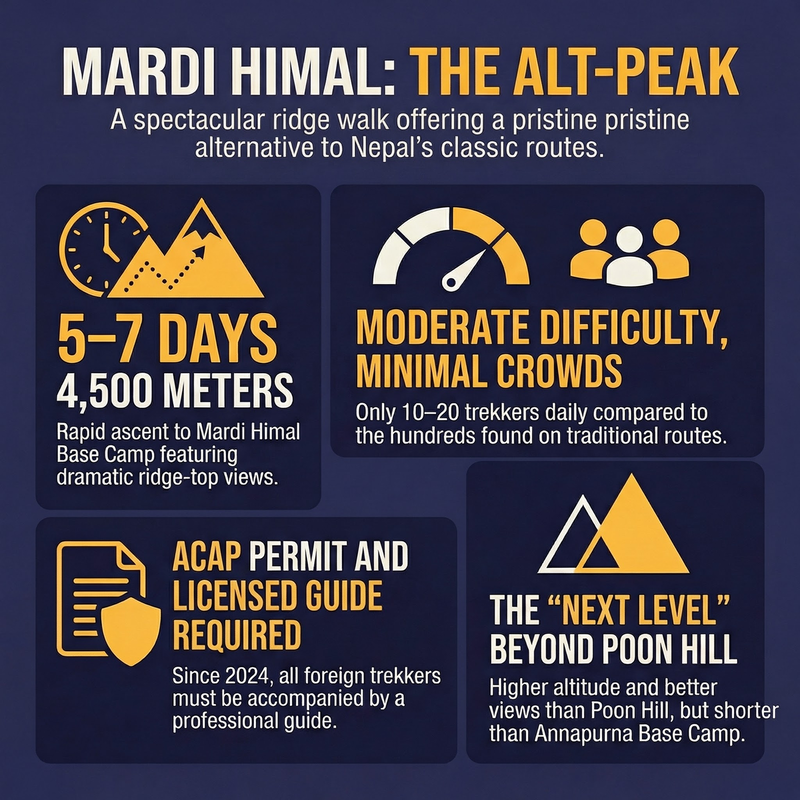
The Mardi Himal trek is a 5-7 day ridge trek in Nepal's Annapurna region that climbs to Mardi Himal Base Camp at 4,500m (14,764 ft) for the closest trekker views of Machapuchare (Fishtail). It covers roughly 40-45 km point-to-point from Kande to Siding, costs about $600-$1,500 all-inclusive, requires ACAP and TIMS permits, and is rated moderate with very low crowds.
Planning the Mardi Himal trek?
This guide covers the full itinerary, costs, permits, difficulty, the famous ridge walk, and the best season. When you're ready, you can plan your Mardi Himal trek and book with a verified local agency that runs this route.
| Route | Duration | Max Altitude | Difficulty | Permits | Teahouses | Crowds |
|---|---|---|---|---|---|---|
| Mardi Himal Base Camp | 5-7 days | 4,500m | Moderate | $40-45 | Good (Basic) | Very Low |
| Poon Hill | 4-5 days | 3,210m | Easy-Moderate | $40 | Excellent | Very High |
| Annapurna Base Camp | 10-14 days | 4,130m | Moderate | $40-45 | Excellent | High |
| Khopra Ridge | 7-9 days | 3,660m | Moderate | $40-45 | Limited | Very Low |
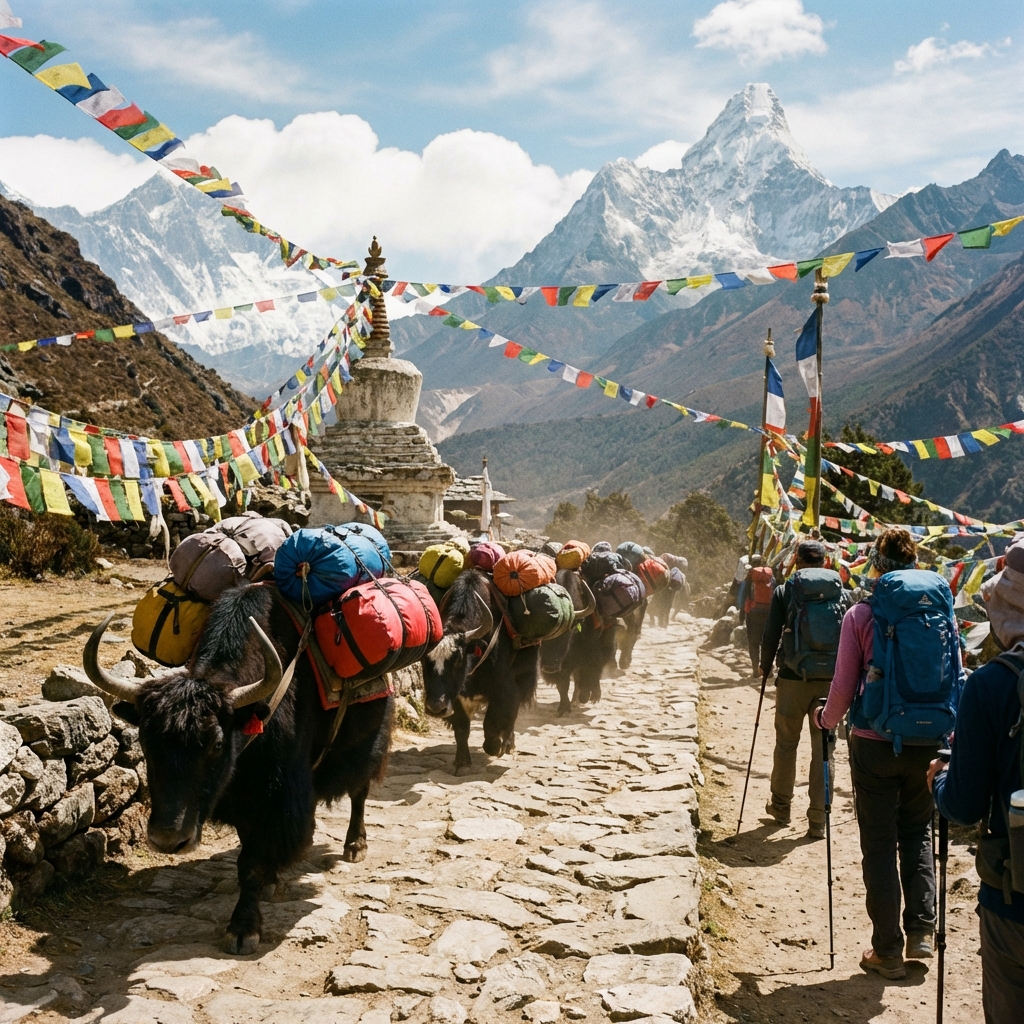
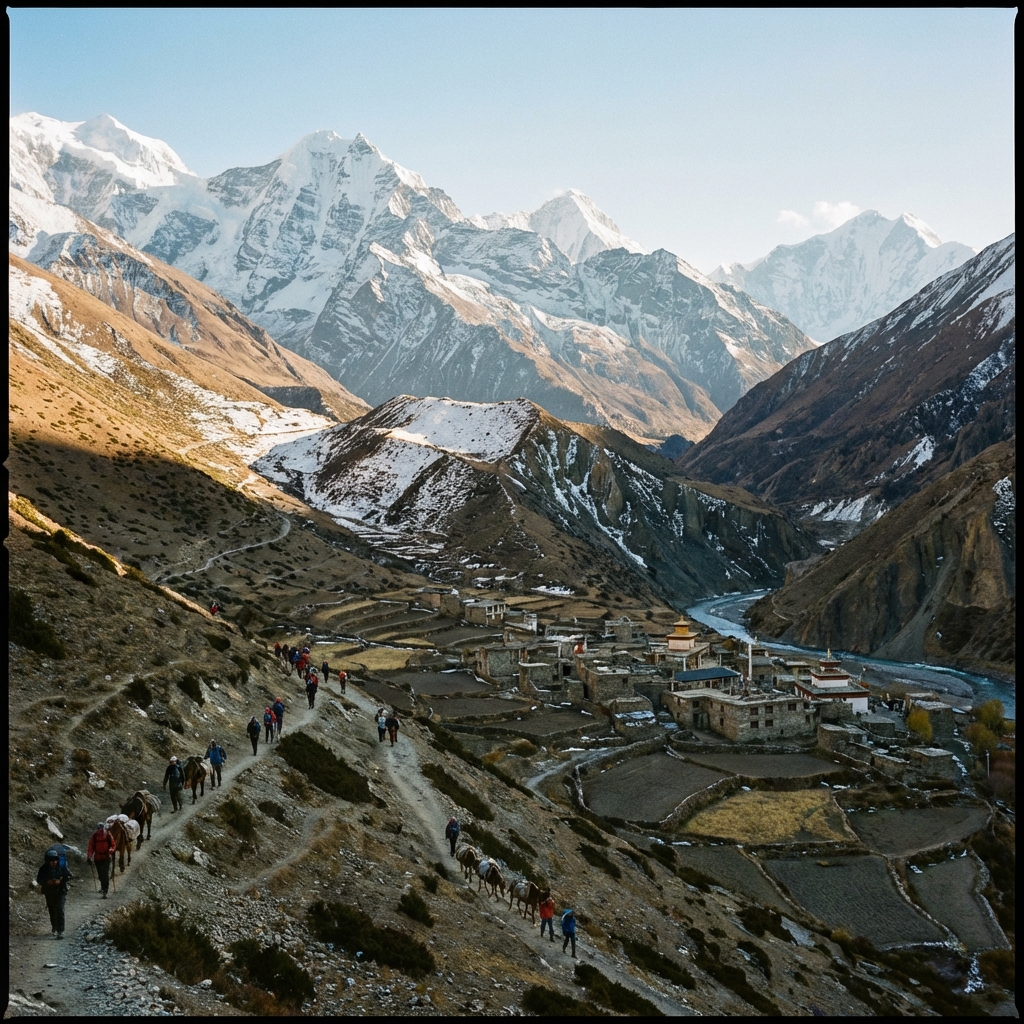
The Mardi Himal Trek is Nepal's best-kept secret—a spectacular ridge walk to a dramatic amphitheater at 4,500 meters that offers the most intimate views of Machapuchare (Fishtail Mountain) you'll find anywhere. Officially opened to trekkers only in 2012, this hidden gem delivers everything adventurous souls crave: pristine trails, jaw-dropping mountain panoramas, authentic teahouse culture, and that rare commodity in modern Nepal—solitude.
What makes Mardi Himal extraordinary is the perfect balance it strikes. More adventurous than the crowded Poon Hill trek, yet shorter and more accessible than the Annapurna Base Camp route. The trek's signature experience is the exposed ridge walk from Low Camp through High Camp to Base Camp—you'll traverse narrow trails with clouds rising from valleys on both sides while Machapuchare's sacred summit looms impossibly close overhead.
Unlike the heavily trafficked routes, Mardi Himal retains an exploratory feel. Teahouses are family-run and basic. Trails are quiet enough to hear the wind and bird calls. The landscape transitions dramatically from lush rhododendron forests to high alpine meadows in just a few days. By the time you reach the base camp amphitheater—ringed by Mardi Himal, Machapuchare, Annapurna South, and Hiunchuli—you'll feel like you've discovered a secret sanctuary that few others know about.
This comprehensive guide covers everything: detailed day-by-day itineraries, honest difficulty assessments, current costs, the famous ridge walk experience, and why Mardi Himal deserves serious consideration as your first (or next) Himalayan adventure.
Route Snapshot
5-7 days
4,500m (14,764 ft) at Base Camp
40-45 km (25-28 miles) round trip
Moderate (with exposure)
Oct-Nov (Autumn), Mar-May (Spring)
Annapurna Conservation Area
Kande or Phedi (via Pokhara)
ACAP + TIMS Card
Teahouse/Lodge (basic)
$600-$1,500 (all-inclusive)
Key Route Variants:
| Variant | Duration | Highlights | Best For |
|---|---|---|---|
| Short Mardi | 5 days | Direct Kande to Base Camp | Limited time, fit trekkers |
| Standard Mardi | 6-7 days | Classic route with acclimatization | Most trekkers, first-timers |
| Mardi + Poon Hill | 8-9 days | Combines ridge trek with sunrise viewpoint | Maximum mountain views |
| Extended Mardi | 7-8 days | Via Australian Camp, extra rest days | Leisurely pace, photography |
Why Mardi Himal is Nepal's Hidden Gem
Discovered in 2012, Still Pristine in 2026
The Mardi Himal trek's story begins with legendary British explorer Colonel Jimmy Roberts, who first documented the area in 1961 while attempting to climb Machapuchare. But it wasn't until 2012 that the Nepalese government officially opened this route to international trekkers. Before that, only local shepherds knew these trails.
That recent opening means something remarkable: Mardi Himal feels genuinely undiscovered. While thousands march daily to Everest Base Camp and hundreds crowd Annapurna Base Camp, you might encounter just 10-20 trekkers per day on the Mardi trail—and sometimes none at all. The teahouses remain family operations, not commercial enterprises. The forest paths show wear from yak hooves, not trekking poles. The ridge walks offer silence, not selfie queues.
The Ridge Walk: Mardi's Signature Experience
What sets Mardi Himal apart from every other trek in Nepal is the exposed ridge traverse from Low Camp through High Camp to Base Camp. Picture this: you're walking a narrow trail with dramatic drop-offs on both sides. Clouds rise like ocean waves from the valleys thousands of feet below. Machapuchare's twin summits tower directly ahead, so close you feel you could touch them.
The ridge experience delivers:
- Unobstructed 360-degree views of the Annapurna range
- Exposure that's thrilling, not terrifying (well-maintained trails, no technical sections)
- The sensation of walking in the sky when clouds settle in valleys
- Machapuchare close-ups from angles impossible on other treks
- High-altitude meadows that glow golden at sunrise
The Sacred Mountain: Machapuchare
Machapuchare—"Fishtail" in Nepali for its distinctive twin summit—is one of the world's most beautiful unclimbed peaks. Considered sacred as the home of Shiva, climbing permits were permanently revoked after a 1957 British expedition stopped 50 meters from the summit out of respect. From Mardi Himal High Camp and Base Camp, you'll experience closer, more intimate views of this 6,993m peak than anywhere else accessible to trekkers.
Why Mardi Beats Poon Hill for Adventurous Beginners
Both treks attract first-timers, but they offer vastly different experiences:
Poon Hill is:
- Crowded (hundreds daily in peak season)
- Well-developed with commercial lodges
- Lower altitude (max 3,210m)
- Less challenging
- More predictable
Mardi Himal is:
- Quiet (10-20 trekkers daily)
- Basic teahouses with authentic atmosphere
- Higher altitude (4,500m base camp)
- More rewarding for those wanting adventure
- The "next level" after Poon Hill
If you want comfort and guarantees, choose Poon Hill. If you want the feeling of discovery and raw mountain beauty, choose Mardi Himal.
The Perfect Middle Ground: More Than Poon Hill, Less Than ABC
Mardi Himal occupies a sweet spot in Nepal's trekking spectrum:
| Factor | Poon Hill | Mardi Himal | Annapurna BC |
|---|---|---|---|
| Days required | 4-5 | 5-7 | 10-14 |
| Max altitude | 3,210m | 4,500m | 4,130m |
| Base camp experience | None | Yes | Yes |
| Crowd level | Very High | Very Low | High |
| Difficulty | Easy-Moderate | Moderate | Moderate |
| Cost | $400-800 | $600-1,500 | $1,200-2,500 |
Mardi delivers a genuine base camp achievement and high-altitude experience without requiring the time commitment of ABC. It's challenging enough to feel earned, accessible enough for adventurous beginners.
Complete Itinerary Options
Short Itinerary: 5 Days (For Fit Trekkers)
This compressed route is ideal for those with limited time or combining Mardi with other Annapurna treks.
| Day | Route | Altitude | Hours | Distance |
|---|---|---|---|---|
| 1 | Drive to Kande, trek to Forest Camp | 2,550m | 5 hrs | 9 km |
| 2 | Trek to Low Camp | 3,150m | 4 hrs | 6 km |
| 3 | Trek to High Camp, explore | 3,700m | 3 hrs | 4 km |
| 4 | Sunrise at Base Camp (4,500m), descent to Low Camp | 3,150m | 6 hrs | 10 km |
| 5 | Trek to Siding, drive to Pokhara | - | 5 hrs trek | 12 km |
Altitude Consideration
The 5-day itinerary gains altitude quickly—Kande (1,770m) to Forest Camp (2,550m) to Low Camp (3,150m) in just two days. Only attempt this if you have previous altitude experience or excellent fitness. Most first-timers should opt for the 6-7 day standard route for proper acclimatization.
Standard Itinerary: 6-7 Days (Recommended)
The most balanced option, providing adequate acclimatization while maintaining steady progress.
| Day | Route | Altitude | Hours | Notes |
|---|---|---|---|---|
| 1 | Arrive Pokhara, prepare | 820m | - | Permit arrangements, gear check |
| 2 | Drive to Kande, trek to Deurali | 2,200m | 4 hrs | Gentle introduction |
| 3 | Trek to Forest Camp | 2,550m | 3 hrs | Through rhododendron forests |
| 4 | Trek to Low Camp | 3,150m | 4 hrs | Above treeline terrain begins |
| 5 | Trek to High Camp via Badal Danda | 3,700m | 4 hrs | Ridge walking begins |
| 6 | Sunrise at Base Camp, return to High Camp or Low Camp | 3,150m | 6 hrs | Summit day! |
| 7 | Trek to Siding, drive to Pokhara | 820m | 5 hrs | Hot springs optional |
Extended Itinerary: 7-8 Days (Leisurely)
Ideal for maximum acclimatization, photography, and soaking in the atmosphere.
| Day | Route | Altitude | Hours | Special Features |
|---|---|---|---|---|
| 1 | Arrive Pokhara | 820m | - | Lake city exploration |
| 2 | Drive to Kande, trek to Australian Camp | 2,065m | 3 hrs | Spectacular sunset views |
| 3 | Trek to Forest Camp | 2,550m | 4 hrs | Birding opportunities |
| 4 | Trek to Low Camp | 3,150m | 4 hrs | Lunch at Badal Danda |
| 5 | Trek to High Camp, acclimatization | 3,700m | 3 hrs | Afternoon exploration |
| 6 | Sunrise hike to Base Camp, full exploration | 4,500m | 5 hrs | Extended time at amphitheater |
| 7 | Descend to Forest Camp | 2,550m | 5 hrs | Rapid descent |
| 8 | Trek to Lwang, drive to Pokhara | 820m | 6 hrs | Alternative route down |
Day-by-Day Detailed Guide (Standard 6-7 Day Itinerary)
Day 1: Pokhara Preparation Day
Start your Mardi Himal adventure in Nepal's lake city. After arriving from Kathmandu (7-hour drive or 25-minute flight), settle into a lakeside hotel and handle final preparations.
Essential tasks:
- Confirm ACAP and TIMS permits arranged
- Final gear check (Pokhara has excellent rental shops near Lakeside)
- Meet your guide for trek briefing
- Purchase last-minute supplies (purification tablets, snacks, batteries)
- Early dinner and rest
Pro tip: Visit the ACAP office or Tourism Board in Pokhara to review current trail conditions and get weather forecasts for the next week.
Day 2: Drive to Kande (1,770m), Trek to Deurali (2,200m)
The trek begins with a scenic 45-minute drive northwest from Pokhara through terraced hillsides and traditional villages. Kande marks the official trailhead at 1,770m.
Trek details:
- Distance: 6 km
- Duration: 3-4 hours
- Elevation gain: 430m
- Terrain: Stone steps, forest paths, village trails
From Kande, the trail climbs gradually through Australian Camp (2,065m)—an excellent viewpoint for your first Annapurna panorama. The afternoon walk to Deurali passes through mixed forests and farmland. Deurali is a small settlement with basic teahouses offering your introduction to mountain hospitality.
Information current as of January 2025.
Kande
1,770m
Traditional trailhead. Last chance for any forgotten supplies.
Australian Camp
2,065m
Room: $5-8/night
Dal Bhat: $4-5
Named after Australian volunteers who worked here. Excellent sunset spot.
Deurali
2,200m
Room: $6-10/night
Dal Bhat: $4-6
Junction village. Quiet and authentic.
Pro Tip
Start early from Pokhara (around 7-8 AM) to avoid midday heat during the initial climb. The afternoon light at Australian Camp is spectacular for photography—don't rush past this viewpoint.
Day 3: Trek Deurali to Forest Camp (2,550m)
Today marks your entry into the pristine Mardi Himal wilderness. The trail leaves farmland behind and enters the rhododendron forests that characterize the lower Annapurna slopes.
Trek details:
- Distance: 5 km
- Duration: 3-4 hours
- Elevation gain: 350m
- Terrain: Forest trails, some muddy sections, gentle climbing
The path winds through dense forests of oak, rhododendron, and magnolia. In spring (March-April), the rhododendrons explode in red, pink, and white blooms creating a tunnel of color. Wildlife sightings are possible—watch for langur monkeys, Himalayan monals (Nepal's national bird), and various pheasant species.
Forest Camp is the first truly remote settlement—just 3-4 basic teahouses run by local families. The atmosphere shifts here: no electricity, minimal amenities, maximum tranquility. This is where the adventure truly begins.
Forest Camp Birding Paradise
Early morning birding at Forest Camp is exceptional. The area hosts over 100 species including the colorful Danphe (Himalayan Monal), Spiny Babbler, Whistling Thrush, and Green-tailed Sunbird. Bring binoculars and walk quietly at dawn for best sightings.
Day 4: Trek Forest Camp to Low Camp (3,150m)
The trail continues climbing through increasingly sparse forest. You're gaining altitude now, and the vegetation shows it—rhododendrons grow smaller, bamboo becomes more common, and views start opening up.
Trek details:
- Distance: 6 km
- Duration: 4-5 hours
- Elevation gain: 600m
- Terrain: Forest trails transitioning to alpine, some steep sections
The midpoint at Badal Danda (2,900m)—"Cloud Hill"—lives up to its name. On clear days, you'll get your first dramatic views of Machapuchare and Annapurna South. When clouds settle in the valleys below, the sensation of walking above a white ocean is otherworldly.
By the time you reach Low Camp, the forest has thinned significantly. You're approaching the treeline, and the landscape takes on an alpine character. The views expand with every step—Hiunchuli (6,441m) appears to the west, and Machapuchare dominates the southern skyline.
Information current as of January 2025.
Badal Danda (Cloud Hill)
2,900m
Room: Tea stop only
Dal Bhat: $3-5 for snacks
Best views between camps. Cloud inversion phenomenon common.
Low Camp
3,150m
Room: $8-12/night
Dal Bhat: $5-7
Above treeline. Cold nights. First real alpine camp.
Pro Tip
Pace yourself on this day's climb. The elevation gain (600m) is significant. Take frequent breaks, stay hydrated, and watch for any altitude symptoms (headache, nausea, unusual fatigue). This is where acclimatization becomes important.
Day 5: Trek Low Camp to High Camp (3,700m) via Badal Danda
This is the day trekkers fall in love with Mardi Himal. You'll leave the last remnants of forest behind and traverse the exposed ridge that makes this trek legendary.
Trek details:
- Distance: 4-5 km
- Duration: 3-4 hours
- Elevation gain: 550m
- Terrain: Ridge trail, exposed sections, alpine meadows
The trail climbs steadily along the ridge between Low Camp and High Camp. This is where the famous Mardi Himal ridge walk delivers its magic:
The Ridge Experience:
- Narrow trails with drop-offs on both sides (well-maintained, not technical)
- Clouds rising from Modi Khola valley to your left
- Views into the Annapurna Sanctuary to your right
- Machapuchare looming impossibly close ahead
- Wind that makes you feel alive
- Silence interrupted only by prayer flags flapping
Badal Danda serves as the perfect rest stop midway. The views here rival those from High Camp itself—some say they're better for photography because Machapuchare sits at the perfect angle.
High Camp sits on a small plateau at 3,700m. The teahouses here are basic—stone structures with tin roofs, minimal amenities, but positioned for unforgettable sunset and sunrise views. On clear afternoons, the peaks glow golden. At night, the stars appear in impossible numbers.
What to Expect at High Camp:
- 4-5 basic teahouses
- Spectacular mountain amphitheater views
- Cold temperatures (especially at night)
- Limited facilities (pit toilets, no showers)
- Dining halls with wood or kerosene heating
- Fellow trekkers sharing the same sense of awe
Day 6: Sunrise at Mardi Himal Base Camp (4,500m), Descend to Low Camp
Summit day! This is what you came for—the dramatic amphitheater of Mardi Himal Base Camp at 4,500m.
Trek details:
- Distance: 8 km round trip
- Duration: 6-7 hours total (3 hrs up, 1 hr at BC, 2 hrs down to High Camp + descent to Low Camp)
- Elevation gain/loss: +800m / -1,350m
- Terrain: Rocky moraines, glacial debris, exposed ridges
Morning Schedule:
- 4:30 AM: Wake-up call (tea and light breakfast)
- 5:00 AM: Begin trek to Base Camp by headlamp
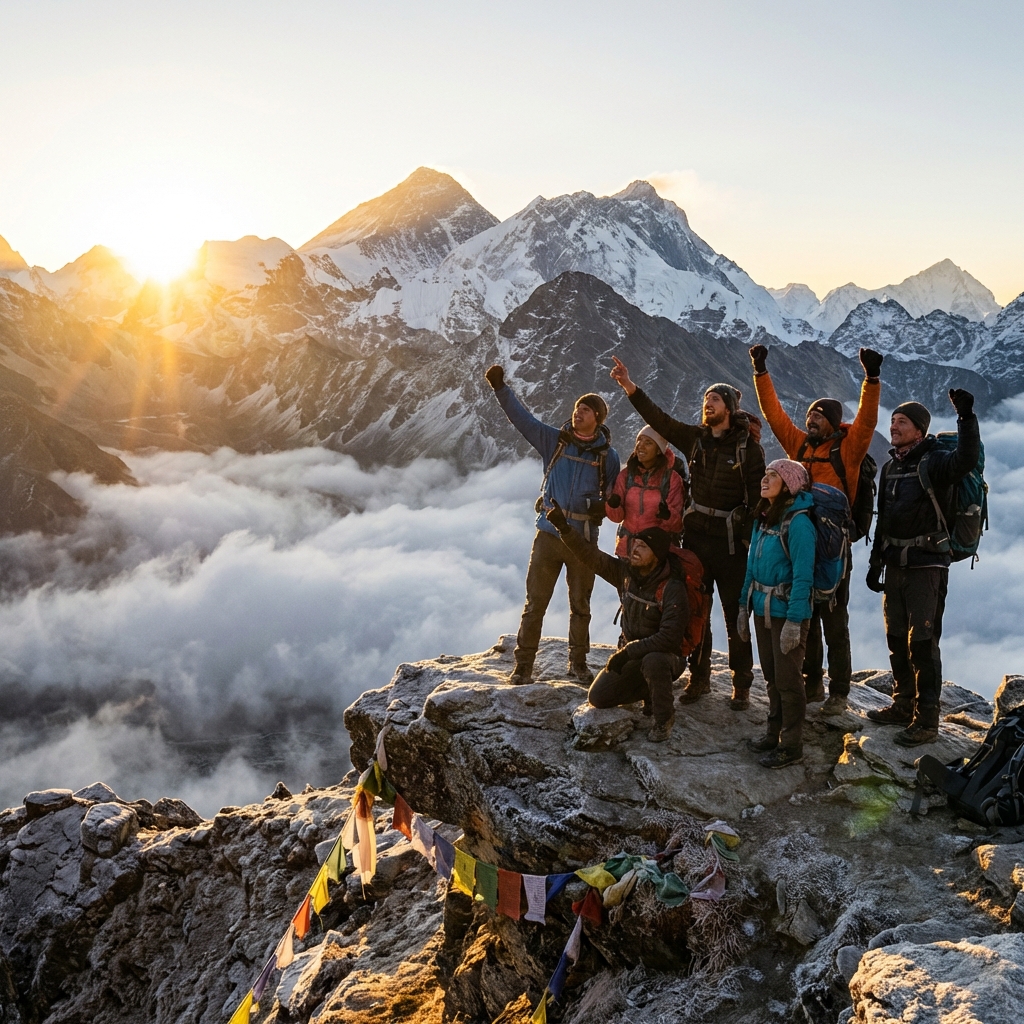
- 6:30-7:00 AM: Arrive at Mardi Himal Base Camp for sunrise
- 7:00-8:30 AM: Explore amphitheater, photography, celebrate
- 9:00 AM: Begin descent to High Camp
- 11:00 AM: Full breakfast at High Camp
- 12:00 PM: Continue descent to Low Camp for overnight
The Mardi Himal Base Camp Experience
When you step into the base camp amphitheater, the mountain walls surround you in 270 degrees:
The Peaks:
- Mardi Himal (5,587m) directly north—the trekking peak itself
- Machapuchare (6,993m) southeast—so close the twin summits appear as separate pillars
- Annapurna South (7,219m) east—massive wall of ice and rock
- Hiunchuli (6,441m) northeast—sharp pyramid peak
- Annapurna I (8,091m) visible in the distance north
The sunrise spectacle unfolds in stages: first light hits the highest summits, slowly creeping down the faces until the entire amphitheater glows orange-gold. The contrast between shadowed glaciers and illuminated peaks is breathtaking. This is why you trekked for five days.
Base Camp Photography Tips
Best light: 30 minutes before and after sunrise. Arrive early for predawn blue hour. Composition: Include trekkers for scale against the massive peaks. Angles: Walk the full amphitheater (200m across) for varied perspectives. Gear protection: Extreme cold drains batteries—keep spares warm inside your jacket. Drone note: Drones require permits in conservation areas. Check regulations before bringing one.
The descent retraces your morning route. By mid-afternoon, you'll be back at High Camp for a full breakfast. Most itineraries continue down to Low Camp (or even Forest Camp) the same day to reduce altitude exposure and position for the final descent.
Pro Tip
Pack your Base Camp bag the night before: camera, spare batteries, headlamp, warm layers, water, snacks, sunglasses. Wake-ups are early and cold—you want to grab your pack and go. Bring extra layers—temperatures at Base Camp at dawn can reach -10°C to -15°C even in peak season.
Day 7: Trek to Siding (1,280m), Drive to Pokhara
The final trekking day is a long descent back to civilization. Most itineraries exit via Siding rather than retracing the original route—this offers new scenery and a more direct path to the road.
Trek details:
- Distance: 14 km
- Duration: 5-6 hours
- Elevation loss: 1,870m
- Terrain: Steep descents, forest trails, village paths
The descent is fast but demanding on knees—trekking poles are essential. You'll pass through Kalimati and Lwang villages before reaching Siding, where jeeps wait for the 2-hour drive back to Pokhara.
Optional: Some itineraries include a stop at Jhinu Danda's natural hot springs (30-minute detour from the main trail). After six days of trekking, the warm mineral water feels heavenly on sore muscles. Entry fee is around NPR 200-300 ($2-3).
Accommodation: Hotel in Pokhara Lakeside. Celebrate with a proper shower, a lakefront dinner, and perhaps a cold Everest beer.
The Ridge Walk: Mardi's Defining Feature
What makes Mardi Himal unlike any other trek in Nepal is the spectacular ridge traverse between Low Camp and Base Camp. This section deserves its own focus because it defines the entire experience.
What is the Mardi Himal Ridge?
The ridge is a narrow, high-altitude pathway that follows the spine of a mountain buttress leading toward Machapuchare. Geologically, it's a lateral moraine—rock debris deposited by ancient glaciers. Visually, it's one of the most dramatic hiking experiences in the Himalayas.
Ridge characteristics:
- Length: Approximately 4-5 km from Low Camp to High Camp
- Width: 2-5 meters at narrowest points
- Exposure: Drop-offs of 500-1,000 meters on both sides
- Trail quality: Well-maintained, marked with stone cairns
- Technical difficulty: None (no climbing skills required)
- Psychological challenge: Moderate (exposed but safe)
The Ridge Walk Experience
Walking the Mardi ridge is unforgettable:
The Sensation:
- You're literally walking a knife-edge suspended between sky and earth
- Clouds rise from the Modi Khola valley on your left like ocean waves
- The Annapurna Sanctuary opens to your right
- Machapuchare's twin summits grow larger with every step
- Wind buffets you, making you feel alive and very small
- Prayer flags mark high points, fluttering in the constant breeze
When Clouds Settle: The ridge walk is spectacular in clear conditions, but magical when clouds fill the valleys. This creates the famous "sea of clouds" phenomenon—you walk above a white ocean with only mountain summits protruding like islands. This typically happens in early morning or late afternoon, especially during monsoon tail-end (late September) or pre-monsoon (May).
Is the Ridge Dangerous?
The Mardi ridge has a reputation for exposure, which worries some first-time trekkers. Here's the honest assessment:
Safety considerations:
- The trail is well-maintained and clearly marked
- No technical climbing or equipment required
- Most "exposed" sections are 3-4 meters wide—narrower sections have stable footing
- Thousands of trekkers (including beginners) complete it safely every year
- Guides are experienced in pacing nervous trekkers
- Weather is the main concern (high winds or whiteout conditions can make it challenging)
Not recommended if you have:
- Severe vertigo or fear of heights
- Difficulty with balance
- Unwillingness to walk exposed trails
- Plans to trek during winter storms
Recommended if you:
- Are reasonably fit and coordinated
- Can handle exposed trails (similar to Colorado 14ers or Scottish Highlands ridges)
- Trust well-maintained paths
- Want a thrilling but manageable adventure
Weather Conditions on the Ridge
The ridge is exposed to weather systems moving through the Annapurna region. High winds, sudden snow, and whiteout conditions can make the trail challenging. Always check weather forecasts before starting from Low Camp. Your guide will make the final decision on proceeding—trust their judgment. Most closures occur December-February during winter storms.
Ridge Walking Tips
Pacing:
- Walk slowly and deliberately—this isn't a race
- Focus on the trail 2-3 meters ahead, not the drop-offs
- Take breaks at wider sections to enjoy views
- Walk one at a time if nervous—don't feel pressured to keep up
Gear:
- Trekking poles provide stability and confidence
- Sunglasses essential (intense UV reflection at altitude)
- Layers for wind protection (fleece + windproof shell)
- Gloves (even in spring/autumn, wind creates severe chill)
Mental approach:
- Trust the trail—it's been walked thousands of times
- Focus on the incredible privilege of being in this landscape
- If nervous, communicate with your guide—they'll help
Mardi Himal Base Camp: The Amphitheater at 4,500m
Reaching Mardi Himal Base Camp is the culmination of your trek—and it delivers a mountain experience as dramatic as any in the Himalayas.
The Base Camp Setting
Mardi Himal Base Camp sits at 4,500 meters in a glacial amphitheater directly beneath Mardi Himal Peak (5,587m). Unlike Annapurna Base Camp, which sits in a broad sanctuary surrounded by distant peaks, Mardi's base camp feels intimate and enclosed—the mountains loom overhead, creating a cathedral-like atmosphere.
What You'll Find:
- A rocky, moraines platform approximately 200 meters across
- Prayer flags marking the "official" base camp spot
- Spectacular 270-degree mountain wall
- Glacial debris and ice fields
- Absolute silence (no permanent settlements)
- An overwhelming sense of accomplishment
Facilities: None at base camp itself. This is a day visit location—all trekkers ascend from High Camp (3,700m) for sunrise, spend 1-2 hours at the amphitheater, and descend the same day. Some ultra-basic shelter exists for emergencies, but no teahouses operate at base camp.
The Mountain Panorama
The peaks that surround you at Mardi Himal Base Camp create one of the most spectacular mountain panoramas accessible to non-climbers:
| Peak | Height | Direction | Notable Features |
|---|---|---|---|
| Mardi Himal | 5,587m | North | Trekking peak, steep ice faces, your immediate backdrop |
| Machapuchare | 6,993m | South-Southeast | Twin summits (North and South), sacred mountain, closest views anywhere |
| Annapurna South | 7,219m | East | Massive hanging glaciers, dramatic south face |
| Hiunchuli | 6,441m | Northeast | Pyramid summit, popular climbing peak |
| Annapurna I | 8,091m | North (distance) | World's 10th highest, visible from viewpoint ridge |
| Tent Peak | 5,663m | East | Also called Tharpu Chuli, technical climbing peak |
Sunrise at Base Camp
The sunrise ritual at Mardi Himal Base Camp rivals any mountain experience in Nepal:
Timeline:
- 4:30 AM: Wake at High Camp in freezing darkness
- 5:00 AM: Begin ascent by headlamp (trail is clear)
- 6:30 AM: Arrive at base camp for pre-dawn light
- 6:45-7:15 AM: Sunrise hits peaks (exact time varies by season)
- 7:15-8:30 AM: Golden hour photography, exploration
- 8:30 AM: Most trekkers begin descent to High Camp
The Light Show: First light touches Mardi Himal's summit, turning ice gold. The glow spreads to Machapuchare's twin peaks, then creeps down the faces to Annapurna South and Hiunchuli. Shadows retreat. The amphitheater transforms from blue-gray to orange-gold to brilliant white as full sun arrives. The entire spectacle takes 30-40 minutes.
Photographers call this "magic hour" for good reason—the contrast between illuminated summits and shadowed glaciers creates drama impossible to capture at midday.
Mardi Himal vs Annapurna Base Camp
Trekkers often ask: how do the two base camps compare?
| Factor | Mardi Himal BC | Annapurna BC |
|---|---|---|
| Altitude | 4,500m | 4,130m |
| Setting | Intimate amphitheater | Broad sanctuary |
| Peak proximity | Very close (overwhelming) | Moderate (impressive) |
| Crowds | 5-15 people at sunrise | 50-100 people at sunrise |
| Facilities | None (day visit only) | Multiple teahouses |
| Days to reach | 3-4 days | 5-6 days |
| Mountain views | Machapuchare close-up | Annapurna range panorama |
| Experience | Raw, adventurous | Classic, well-developed |
Both are spectacular—Mardi feels more remote and adventurous, while ABC offers the iconic Nepal trekking experience.
How Hard Is the Mardi Himal Trek? (Difficulty)
The Mardi Himal trek is rated moderate. You walk 3-6 hours a day for 5-7 days, gaining roughly 2,700-3,400m of total elevation (about 800-1,050 m) over the route, with a maximum altitude of 4,500m at Base Camp. No technical climbing or equipment is needed, but you must be comfortable with steady uphill days, exposed ridge sections, and moderate altitude. It is more challenging than Poon Hill and more accessible than high passes like Thorong La.
Here's the honest breakdown of what makes it challenging and who should (or shouldn't) attempt it.
Physical Demands
Daily trekking hours: 3-6 hours Elevation gain per day: 300-600m (varies by itinerary) Terrain: Forest trails, ridge walking, alpine paths Technical skills: None required
Fitness requirements:
- Walk 10-15 km on hilly terrain without significant fatigue
- Climb 500-600m elevation gain in a single day comfortably
- Handle 3-5 hours of walking daily for 5-7 consecutive days
- Carry a 5-7 kg daypack (porters available for main luggage)
- Comfortable with exposed trails (ridge sections)
Most challenging days:
- Low Camp to High Camp: Altitude + exposure combination
- High Camp to Base Camp: Pre-dawn start at 3,700m, climbing to 4,500m
- Descent to Siding: Long downhill (hard on knees)
Altitude Considerations
At 4,500m, Mardi Himal Base Camp sits in the moderate altitude sickness risk zone. Most healthy adults acclimatize successfully with proper pacing, but altitude affects everyone differently.
Altitude profile:
- Days 1-2: Below 2,500m (minimal altitude effect)
- Days 3-4: 2,550m-3,150m (mild symptoms possible)
- Days 5-6: 3,700m-4,500m (moderate altitude, acclimatization important)
Common altitude symptoms at High Camp / Base Camp:
- Mild headache (normal, usually resolves)
- Decreased appetite
- Fatigue beyond normal exertion
- Slight breathlessness
Warning signs requiring descent:
- Severe headache unresponsive to ibuprofen
- Vomiting or persistent nausea
- Difficulty walking straight (ataxia)
- Confusion or disorientation
- Breathlessness at rest
The standard 6-7 day itinerary includes gradual ascent that allows natural acclimatization. You only spend 1-2 nights above 3,500m before reaching base camp, then descend immediately—this significantly reduces altitude sickness risk compared to treks where you remain at high altitude for many days.
For comprehensive altitude information, see our Altitude Sickness Prevention Guide.
The Ridge Exposure Factor
The Mardi ridge adds a psychological challenge beyond normal trekking. While technically easy (no climbing), the exposed sections require comfort with:
- Narrow trails (2-4 meters wide at tightest points)
- Drop-offs on one or both sides
- Walking deliberately without handrails or cables
- Wind exposure
Not dangerous if:
- You follow the trail and don't approach edges
- Weather is clear (no whiteout or extreme wind)
- You walk at your own pace
- You trust your guide's advice
Reconsider if:
- You have severe vertigo (medical condition)
- You panic on exposed trails
- You're unwilling to walk ridges in photos
Most trekkers find the ridge thrilling rather than terrifying. The trail is well-maintained, and thousands complete it safely every year.
Training Recommendations
8-12 weeks before trek:
| Weeks | Focus | Activities |
|---|---|---|
| 1-4 | Cardio base | 30-45 min walking/jogging 4x/week, stairs 2x/week |
| 5-8 | Hill training | Weekend hikes on hills/mountains, 2-3 hours with elevation gain |
| 9-10 | Weighted practice | Add 5-7 kg backpack to weekend hikes, build to 4-5 hours |
| 11-12 | Back-to-back days | Two consecutive hiking days to simulate trek fatigue |
Training focus:
- Cardiovascular endurance (ability to walk uphill for hours)
- Leg strength (quads, glutes, calves for climbing and descending)
- Core stability (balance on uneven terrain)
- Mental stamina (multiple consecutive trekking days)
Before you go, build your kit from our complete trekking gear list and review the full Mardi Himal difficulty assessment for a deeper fitness breakdown.
Who is Mardi Himal Perfect For?
Ideal candidates:
- Adventurous first-time trekkers wanting a real mountain experience
- Experienced hikers looking for a short Nepal trek
- Photographers seeking uncrowded mountain landscapes
- Solo travelers (guide required but easy to arrange)
- Those with 7-10 days total trip time
- Trekkers wanting "the next level" after Poon Hill
- Anyone seeking solitude and pristine trails
Better alternatives exist for:
- Those with severe altitude sensitivity → Try Poon Hill (3,210m max)
- Nervous about ridge exposure → Try Annapurna Base Camp (broader trails)
- Very limited time (3-4 days only) → Try Poon Hill
- Seeking maximum comfort and facilities → Try ABC
- First trek ever with no fitness → Build fitness first or choose Poon Hill
Best Time to Trek Mardi Himal
| Month | High | Low | Conditions | Crowds | Notes |
|---|---|---|---|---|---|
| January | -5°C | -18°C | 15mm | Very Low | Very cold, possible heavy snow at High Camp/BC, crystal clear skies |
| February | 0°C | -15°C | 20mm | Low | Cold improving, good visibility, winter gear essential |
| MarchBest | 5°C | -8°C | 35mm | Moderate | Spring begins, rhododendrons start blooming, warming |
| AprilBest | 8°C | -4°C | 50mm | High | Peak spring, forest in full bloom, ideal weather |
| MayBest | 10°C | 0°C | 90mm | Moderate | Warm, pre-monsoon clouds possible afternoon, excellent trekking |
| June | 8°C | 3°C | 250mm | Very Low | Monsoon begins, rain, leeches below 3,000m, poor visibility |
| July | 7°C | 4°C | 400mm | Very Low | Peak monsoon, trail muddy, landslide risk, not recommended |
| August | 8°C | 4°C | 380mm | Very Low | Monsoon continues, occasional clear days but unreliable |
| September | 6°C | 1°C | 180mm | Low | Monsoon ending, improving late month, clouds still common |
| OctoberBest | 6°C | -5°C | 25mm | High | Peak autumn, best visibility, perfect trekking weather |
| NovemberBest | 3°C | -10°C | 10mm | Moderate | Excellent weather, cooling temps, clear mountain views |
| December | -2°C | -15°C | 10mm | Very Low | Cold, snow likely at High Camp, fewer crowds, clear skies |
Autumn Season (October-November): Peak Trekking Time
Pros:
- Clearest skies and best mountain visibility of the entire year
- Stable, predictable weather patterns
- Crisp air, minimal precipitation
- Post-harvest golden landscapes
- Festivals (Dashain, Tihar) add cultural dimension
- Ridge walks spectacular in clear conditions
Cons:
- More crowded than other seasons (though still quiet compared to ABC/EBC)
- Teahouses busier, especially at High Camp
- Cooler nights require proper sleeping bag
- Higher prices in peak weeks (mid-October)
Best for: First-time trekkers, photographers prioritizing mountain views, anyone wanting predictable weather.
Temperature ranges:
- Day (High Camp): 5-10°C
- Night (High Camp): -5°C to -10°C
- Base Camp sunrise: -10°C to -15°C
Spring Season (March-May): Rhododendron Spectacular
Pros:
- Rhododendron forests in spectacular bloom (especially March-April)
- Warming temperatures, longer days
- Vibrant greenery throughout lower elevations
- Wildlife more active (birds, monkeys)
- Excellent visibility (especially March-early April)
- Fewer crowds than autumn
Cons:
- Afternoon clouds may obscure peak views (especially May)
- Pre-monsoon rain possible in late May
- Warmer temperatures can mean more insects at lower camps
- Occasional dust haze from valley pollution
Best for: Nature enthusiasts, flower photographers, those who prefer warmer conditions, birders.
Rhododendron bloom timeline:
- March: Lower forests (Forest Camp area)
- April: Mid-altitude forests peak bloom
- May: High-altitude rhododendrons near Low Camp
Winter Season (December-February): For the Adventurous
Pros:
- Crystal-clear skies and exceptional visibility
- Absolute solitude (very few trekkers)
- Snow-covered landscapes create magical scenery
- Lower prices, easier teahouse availability
- Unique winter Himalayan experience
Cons:
- Very cold temperatures, especially above Low Camp
- Heavy snow can make High Camp to Base Camp challenging or impossible
- Some teahouses may close (check in advance)
- Requires serious cold-weather gear
- Shorter days (less trekking time)
- Higher risk of trail closures due to snow
Best for: Experienced trekkers comfortable with cold, those seeking solitude, winter mountaineering enthusiasts.
Requirements:
- -15°C to -20°C rated sleeping bag
- Microspikes or crampons (for snow/ice)
- Heavy down jacket and insulated pants
- Face protection (balaclava, goggles)
- Confirmation that teahouses are open
Monsoon Season (June-August): Not Recommended
Why to avoid:
- Heavy rainfall makes trails muddy and slippery
- Leeches prevalent below 3,000m (Forest Camp area)
- Landslides and trail washouts possible
- Mountain views obscured by clouds
- Many teahouses close
- Ridge walking dangerous in rain/fog
Exception: Late September can work if monsoon retreats early—confirm with recent trek reports before booking.
Month-by-Month Summary
Best months: October, November, March, April Good months: May, late September Possible but challenging: December, January, February Avoid: June, July, August
Cloud Patterns and Photography
Understanding cloud behavior helps plan photography:
Autumn (Oct-Nov):
- Clearest mornings (90%+ clear sky rate)
- Clouds develop afternoon if at all
- Sunset views excellent
Spring (Mar-May):
- Clear mornings (80% clear sky rate early spring)
- Afternoon clouds more common (especially May)
- Sunrise photography prioritized
General pattern:
- Best light: 30 minutes before and after sunrise
- Second-best: Late afternoon/sunset
- Clouds often form 10 AM-2 PM, may clear by late afternoon
Cost Breakdown for 2026
Mardi Himal is one of Nepal's most affordable mountain treks, with costs significantly lower than Annapurna Base Camp or Everest Base Camp while delivering comparable mountain experiences. For a line-by-line breakdown, see our dedicated Mardi Himal cost breakdown.
Package Tour Costs
| Budget Level | Price Range | What's Included |
|---|---|---|
| Budget | $600-900 | Basic teahouses, group guide, porter (shared), bus to Pokhara, permits |
| Standard | $1,000-1,300 | Good teahouses, private guide, dedicated porter, all meals, transport |
| Premium | $1,400-1,800 | Best available lodges, private guide, full porter support, flexibility, extras |
Independent Trekking Costs (Per Day)
| Category | Budget | Mid-Range | Comfortable |
|---|---|---|---|
| Accommodation | $5-8 | $8-12 | $12-18 |
| Meals (3x daily) | $10-15 | $15-20 | $20-28 |
| Hot showers | $0 (skip) | $2-3 | $3-5 |
| WiFi/Charging | $2-3 | $3-4 | $4-6 |
| Snacks/drinks | $2-4 | $4-6 | $6-10 |
| Daily Total | $19-30 | $32-45 | $45-67 |
6-day trek estimate: $115-180 (budget) to $270-400 (comfortable)
Fixed Costs
| Item | Cost (USD) | Notes |
|---|---|---|
| ACAP Permit | $23 | Annapurna Conservation Area entry |
| TIMS Card | NPR 2,000 (2025) | Trekkers' registration |
| Guide | $25-35/day | Mandatory since 2026, licensed guide |
| Porter | $20-25/day | One porter carries 15-20kg for 2 trekkers |
| Pokhara-Kande transport | $30-40 | Shared jeep round-trip |
| Kathmandu-Pokhara | $10-25 | Bus; $10-$25 (tourist bus $15, VIP $20-25) if flying |
| Travel insurance | $50-100 | Essential; must cover 5,000m+ evacuation |
Price Increases by Altitude
Expect costs to rise significantly as you gain altitude:
| Location | Accommodation | Dal Bhat | Tea/Coffee | Hot Shower |
|---|---|---|---|---|
| Deurali (2,200m) | $6-10 | $4-5 | $1-2 | $2-3 |
| Forest Camp (2,550m) | $8-12 | $5-6 | $2-3 | $3-4 |
| Low Camp (3,150m) | $10-15 | $6-7 | $3 | $4-5 |
| High Camp (3,700m) | $12-20 | $8-10 | $4-5 | $5-7 (if available) |
Why prices increase:
- Everything above Forest Camp is portered by humans or mules
- No road access beyond Kande
- Fuel for cooking/heating is expensive at altitude
- Limited competition (fewer teahouses)
Hidden Costs to Anticipate
- Hot showers: Limited above Low Camp; when available, $4-7
- Phone/device charging: $3-5 per device per night at high camps
- Bottled water: $1-5 depending on altitude (bring purification tabs instead)
- Snacks and treats: Mars bars, Pringles, etc. 2-3x valley prices
- WiFi: Spotty and expensive ($3-5); download entertainment in advance
- Tips: 10-15% of guide/porter daily wages is customary
- Gear rental: If needed: sleeping bag ($3/day), down jacket ($3/day), poles ($2/day)
- Extra nights: Weather delays rare but possible (budget 1 contingency day)
Mardi Himal vs Other Annapurna Treks Cost Comparison
| Trek | Duration | Total Cost (Standard) | Cost Per Day |
|---|---|---|---|
| Mardi Himal | 5-7 days | $600-1,300 | $120-185/day |
| Poon Hill | 4-5 days | $450-850 | $110-170/day |
| ABC | 10-14 days | $1,200-2,500 | $120-180/day |
| Annapurna Circuit | 12-18 days | $1,400-3,000 | $115-165/day |
Bottom line: Mardi Himal offers exceptional value—genuine base camp experience at half the cost and time of ABC, with more adventure than Poon Hill.
Money-Saving Tips
- Trek in shoulder season (late September, early December) for 15-20% lower prices
- Bring cash from Kathmandu/Pokhara —no ATMs on trail, teahouses give better rates for cash
- Purify water instead of buying bottled (saves $20-30 over trek)
- Share a porter with another trekker (splits cost)
- Order dal bhat at every meal (unlimited refills, best value)
- Skip WiFi and hot showers above Forest Camp (saves $30-40)
- Bring your own sleeping bag instead of renting ($20 saved)
- Join a group trek if solo (shares guide/permit costs)
Mardi Himal vs Poon Hill: Choosing Your Annapurna Trek
Both treks attract first-timers to the Annapurna region, but they deliver vastly different experiences. Here's the honest comparison to help you choose.
Side-by-Side Comparison
| Factor | Poon Hill | Mardi Himal |
|---|---|---|
| Duration | 4-5 days | 5-7 days |
| Max altitude | 3,210m (Poon Hill) | 4,500m (Base Camp) |
| Difficulty | Easy-Moderate | Moderate |
| Altitude risk | Very Low | Low-Moderate |
| Base camp experience | No | Yes (4,500m) |
| Crowds | Very High (hundreds daily) | Very Low (10-20 daily) |
| Trail development | Excellent (stone steps, lodges) | Good (rustic, authentic) |
| Machapuchare views | Distant (beautiful) | Extremely close (overwhelming) |
| Ridge walking | None | Signature experience |
| Cost | $450-850 | $600-1,300 |
| Teahouse quality | Excellent (electricity, WiFi) | Basic (rustic, authentic) |
| Cultural immersion | Good (Gurung villages) | Moderate (fewer villages) |
| Photography | Excellent sunrise panorama | Excellent intimate peaks |
| "Adventure" factor | Low | High |
Choose Poon Hill If You:
- Have only 4-5 days maximum
- Want an easy introduction to Himalayan trekking
- Prefer comfort and developed infrastructure
- Are uncomfortable with altitude above 3,500m
- Like being around other trekkers
- Want excellent cultural village experiences
- Prioritize sunrise panoramas over base camp experiences
- Prefer very low altitude sickness risk
- Are trekking with children or elderly family members
Choose Mardi Himal If You:
- Have 6-8 days available
- Want a genuine mountain adventure with some challenge
- Seek solitude and off-the-beaten-path experiences
- Are comfortable with moderate altitude (4,500m)
- Dream of reaching a Himalayan base camp
- Want the closest possible views of Machapuchare
- Enjoy ridge walking with exposure
- Prefer basic teahouses and authentic atmosphere
- Want to feel like an explorer, not a tourist
- Are looking for "the next level" beyond Poon Hill
Can You Combine Both?
Yes! The Mardi Himal + Poon Hill combo trek (8-9 days) is increasingly popular. You get:
- Poon Hill's famous sunrise panorama
- Cultural immersion in Gurung villages
- Mardi Himal's ridge walk and base camp
- Maximum value for your time in Nepal
Most combined itineraries start with Poon Hill (days 1-3), then continue to Mardi Himal via Tadapani and Chomrong (days 4-8). This allows gradual acclimatization and diverse scenery.
The Verdict
Poon Hill is the perfect comfortable introduction to Himalayan trekking—predictable, social, beautiful.
Mardi Himal is the adventure seeker's choice—challenging, solitary, spectacular.
Neither is "better"—they serve different purposes. For first-time trekkers wanting a true mountain challenge, Mardi Himal delivers more adventure and accomplishment. For those prioritizing comfort and certainty, Poon Hill is the wiser choice.
Low Camp, High Camp, Base Camp: The Progression
The three high camps of Mardi Himal create a natural progression as you ascend toward the mountain amphitheater. Each has its own character and purpose.
Low Camp (3,150m): Gateway to Alpine Zone
Altitude: 3,150m (10,334 ft) Teahouses: 3-4 basic lodges Facilities: Dining halls, pit toilets, limited charging Water: Stream nearby
Low Camp marks your entry into the alpine zone—trees thin dramatically, and you're above the rhododendron belt. This is where most trekkers first feel the effects of altitude (mild headache, faster breathing).
What to expect:
- Cold nights (0°C to -5°C even in peak season)
- First panoramic mountain views
- Wind picks up noticeably
- Vegetation shifts to grasses and shrubs
- Yaks or mules may be grazing nearby
Strategic importance: Low Camp serves as the acclimatization buffer before pushing to High Camp. Most itineraries spend one night here, allowing your body to adjust to 3,150m before climbing another 550m to High Camp.
Views: Excellent first glimpses of Machapuchare, Annapurna South, and Hiunchuli. The ridge ahead becomes visible—you can see your route to High Camp.
High Camp (3,700m): The Launch Point
Altitude: 3,700m (12,139 ft) Teahouses: 4-5 basic stone structures Facilities: Dining halls with heating, pit toilets, charging (expensive) Water: Melted snow or stream
High Camp sits on a small plateau directly beneath the Mardi Himal amphitheater. This is base camp for most trekkers—you'll spend 1-2 nights here and make the predawn push to Base Camp as a long day hike.
What to expect:
- Very cold nights (-8°C to -12°C)
- Spectacular 270-degree mountain views
- Absolute quiet (except wind and prayer flags)
- Basic accommodations (foam mattresses, shared rooms, limited heat)
- Fellow trekkers sharing the same anticipation
- Brilliant stargazing on clear nights
Facilities reality check: High Camp is basic. Don't expect:
- Hot showers (maybe a bucket of warm water for $7)
- WiFi (occasionally available, very slow)
- Electricity (solar panels, limited hours)
- Privacy (shared rooms common)
- Warmth (dining halls have wood stoves, but rooms are freezing)
Views: This is where the trek's payoff begins. Machapuchare dominates the south, so close you can see individual ice seracs. Annapurna South's hanging glaciers glow at sunset. Mardi Himal rises directly north. The amphitheater beckons.
Strategic importance: High Camp is the staging point for Base Camp summit day. You'll rest, eat a big dinner (altitude kills appetite, but force yourself), pack your Base Camp bag, and sleep as much as cold and anticipation allow. Wake-up is around 4:30 AM for the 3-hour climb to Base Camp.
Mardi Himal Base Camp (4,500m): The Amphitheater
Altitude: 4,500m (14,764 ft) Teahouses: None (day visit only) Facilities: None (emergency shelter only) Water: Snow melt
Base Camp is the culmination—a rocky moraine amphitheater directly beneath Mardi Himal Peak, surrounded by towering walls of ice and rock.
What to expect:
- Overwhelming mountain proximity
- Silence (no wind if you're inside the amphitheater)
- Prayer flags marking the symbolic base camp spot
- Other trekkers (5-15 people at sunrise peak times)
- Glacial moraines and debris
- Profound sense of accomplishment
The morning experience:
- Arrive in predawn darkness by headlamp
- Find a spot on the moraines facing Machapuchare
- Watch the sky lighten from black to blue to orange
- First light hits Mardi Himal summit at around 6:45-7:15 AM (varies by season)
- Glow spreads to Machapuchare, then Annapurna South
- Full sun illuminates the entire amphitheater by 8:00 AM
- Spend 1-2 hours exploring, photographing, celebrating
- Descend to High Camp by 9:00-10:00 AM
Strategic importance: Base Camp is a milestone achievement. At 4,500m, you've reached legitimate high-altitude trekking—higher than Annapurna Base Camp (4,130m), higher than most peaks in the Alps or Rockies. This is a real mountain accomplishment.
Why you don't sleep here: Altitude exposure should be minimized. The climbing adage "climb high, sleep low" applies—spending the night at 4,500m increases altitude sickness risk significantly. Better to summit for sunrise, enjoy the morning, and descend to 3,150m or lower for sleep.
The Three-Camp Strategy
Most itineraries follow this proven progression:
Day 5: Low Camp (sleep at 3,150m) — Acclimatization Day 6: High Camp (sleep at 3,700m) — Positioning Day 7: Base Camp predawn (4,500m), descend to Low Camp or lower (sleep at 3,150m or below) — Summit and descend
This maximizes your time at altitude while minimizing altitude sickness risk through proper "climb high, sleep low" protocol.
Photography Guide: Capturing Mardi's Magic
Mardi Himal offers some of Nepal's most spectacular photography opportunities—intimate mountain close-ups, dramatic ridge walks, and that rare commodity: no crowds ruining your compositions.
Best Sunrise and Sunset Locations
Mardi Himal Base Camp (4,500m)
- Best for: Sunrise on Machapuchare and Mardi Himal
- Timing: Arrive 6:15 AM for pre-dawn blue hour, stay until 8:00 AM for full golden hour
- Composition: Include prayer flags, fellow trekkers for scale, glacial moraines
- Angles: Walk the entire amphitheater (200m across) for varied perspectives
High Camp (3,700m)
- Best for: Sunset on the mountain amphitheater, star photography
- Timing: Sunset around 5:30-6:00 PM (varies by season); stars after 7:30 PM
- Composition: Use teahouses and prayer flags for foreground interest
- Angles: West-facing position captures sunset glow on peaks
Badal Danda / Cloud Hill (2,900m)
- Best for: Cloud inversion phenomenon, ridge perspective shots
- Timing: Early morning (6-8 AM) when clouds fill valleys
- Composition: Clouds below, mountains above, ridge trail curving ahead
- Angles: Slightly elevated position shows cloud ocean below
Low Camp (3,150m)
- Best for: Machapuchare close-ups at sunset, forest-to-mountain transition
- Timing: Late afternoon light (4-5 PM)
- Composition: Foreground alpine shrubs, Machapuchare background
The Ridge Walk: Photography Tips
The exposed ridge between Low Camp and High Camp offers Nepal's most dramatic trekking photography:
Composition ideas:
- Trekker on narrow trail with valley drop-offs both sides
- Prayer flags against mountain backdrop
- Clouds rising from Modi Khola valley
- Wide-angle showing ridge curving toward Machapuchare
- Close-up of trail with mountains behind
Timing:
- Morning (8-10 AM): East light, shadows dramatic
- Afternoon (2-4 PM): West light, warm glow
- Avoid midday (harsh overhead light)
Safety note: Don't compromise safety for photos. The ridge has exposure—focus on safe footing first, photography second. Set up shots at wider sections, not on exposed edges.
Machapuchare: The Star Subject
Machapuchare's distinctive fishtail summit makes it one of the most photogenic peaks in the Himalayas. From Mardi, you'll capture angles impossible from other treks.
Best angles:
- High Camp: Straight-on view of twin summits (iconic)
- Base Camp: Slightly below peaks, emphasizing their height
- Ridge trail: Looking up at Machapuchare from exposed trail
- Low Camp: Framed by alpine vegetation
Light conditions:
- Sunrise (6:45-7:30 AM): Golden glow on ice faces (best light)
- Midday (11 AM-2 PM): Harsh light (least interesting)
- Sunset (5:00-6:00 PM): Warm orange light on peaks
- Blue hour (30 min before sunrise/after sunset): Ethereal purple-blue on summits
Technical Recommendations
Camera gear:
- Best option: Mirrorless camera (lighter than DSLR, excellent quality)
- Budget option: Quality smartphone (iPhone 14+, Samsung S23+ handle alpine conditions well)
- Lenses: Wide-angle (16-35mm) for ridges and amphitheaters; telephoto (70-200mm) for peak details
- Tripod: Small travel tripod for low-light and star photography (adds weight, optional)
Settings for sunrise:
- ISO 400-800 (balances noise and shutter speed)
- Aperture f/8 to f/11 (good depth of field for mountain scenes)
- Shutter 1/125s to 1/500s (depends on light)
- Shoot RAW for maximum post-processing flexibility
Battery management:
- Cold drains batteries extremely fast at altitude
- Keep spares warm inside your jacket
- Bring 3-4 batteries minimum for serious shooting
- USB power bank (10,000+ mAh) for phone and camera charging
Memory:
- 64GB minimum; 128GB for serious photographers
- Expect 500-1,000 photos over 5-7 days
- Consider dual SD slots for backup
Protection:
- Dust is minimal (no dry desert conditions)
- Cold is the main challenge (condensation when moving warm to cold)
- Let camera acclimatize before shooting (5 minutes outside teahouse)
- Microfiber cloth for lens cleaning
- Dry bag for electronics in case of rain
Drone Photography Regulations
Drones require permits in Nepal:
- Conservation areas (including Annapurna/Mardi): Special permission needed
- Process: Apply through Nepal Tourism Board with trek itinerary
- Cost: Around $250-300
- Processing time: 2-4 weeks minimum
- Reality: Most amateur pilots skip this due to complexity
Alternative: Use a quality smartphone or camera on a pole for unique perspectives without drone regulations.
Subject Recommendations by Location
| Location | Best Subjects | Optimal Time |
|---|---|---|
| Forest Camp | Rhododendron forests, bird life | Morning (7-9 AM) |
| Badal Danda | Cloud inversion, ridge trails | Early morning (6-8 AM) |
| Low Camp | Alpine meadows, Machapuchare | Afternoon (4-5 PM) |
| Ridge | Exposed trails, cloud valleys | Mid-morning or late afternoon |
| High Camp | Mountain amphitheater, sunset | Sunset (5-6 PM), night stars |
| Base Camp | Mardi Himal, Machapuchare close-up, glaciers | Sunrise (6:45-8:00 AM) |
Star and Milky Way Photography
High Camp and Base Camp offer exceptional night sky viewing due to zero light pollution and high altitude.
Best conditions:
- New moon phase (darkest skies)
- Clear nights (check weather forecast)
- October-November or March-April (driest air)
Settings:
- ISO 3200-6400
- Aperture f/2.8 or wider (fast lens)
- Shutter 15-25 seconds (star trails beyond this)
- Manual focus to infinity (autofocus won't work in dark)
Challenges:
- Extreme cold (fingers numb quickly)
- Altitude fatigue (you'll be exhausted after summit day)
- Need tripod and remote shutter
Photography Ethics
- Don't approach edges for risky shots
- Ask permission before photographing local people
- Don't use drones without permits (violates conservation area rules)
- Pack out all trash including lens wipes, packaging
- Respect prayer flags and sacred sites (don't move or alter for compositions)
Permits Required for Mardi Himal Trek
ACAP (Annapurna Conservation Area Permit)
Cost: NPR 3,000 (~$23 USD) for foreigners; NPR 200 for SAARC nationals
Purpose: Entry permit for the Annapurna Conservation Area. Funds support conservation efforts, trail maintenance, community development, and wildlife protection.
Where to obtain:
- Nepal Tourism Board office, Kathmandu (Pradarshani Marg)
- ACAP office, Pokhara (near Damside)
- Through registered trekking agency (most common and easiest)
Required documents:
- 2 passport-size photos
- Passport copy (photo page)
- Completed application form
Validity: Single entry, valid for duration of trek
Checkpoints: You'll show this permit at Kande (trailhead) and occasionally at teahouses along the route.
TIMS (Trekkers' Information Management System) Card
Cost: Free (as of 2026)
Purpose: Trekker registration and safety tracking. Allows Nepal Tourism Board and local authorities to monitor trekker movements for safety and search-and-rescue coordination if needed.
Where to obtain:
- Nepal Tourism Board, Kathmandu
- Tourism Board office, Pokhara
- Through registered trekking agency
- TAAN (Trekking Agencies Association of Nepal) office
Required documents:
- Passport copy
- Passport-size photo
- Trek itinerary
- Emergency contact information
Validity: Specific to your trek dates and route
Note: TIMS cards must be carried at all times. Spot checks occur occasionally at major junctions, though less frequently on Mardi than on Everest or ABC routes.
2026/2027 Regulation Updates: Guide Requirement
Nepal implemented new trekking regulations in 2026 that significantly impact independent trekkers:
New mandatory requirement: Foreign nationals must trek with a licensed guide or porter. Solo independent trekking is no longer permitted in national parks and conservation areas, including Annapurna (and therefore Mardi Himal).
What this means:
- You must hire a licensed guide ($25-35/day) OR porter ($20-25/day)
- You can arrange this independently in Pokhara (doesn't require full agency package)
- Guides/porters must be registered with TAAN or NMA (Nepal Mountaineering Association)
- Your guide/porter will help with permit verification and checkpoints
Enforcement: Increasing. ACAP checkpoints now verify you have a guide or porter. Attempting to trek solo may result in fines or being turned back.
Alternative: Join a small group trek to share guide costs, or hire a porter (less expensive than guide, still fulfills requirement).
For complete permit information, see our Nepal Trekking Permits Guide.
Safety and Emergency Information
Nepal Tourism Board
Tourist information and assistance
Himalayan Rescue Association (HRA)
Altitude medicine specialists
Nepal Police Tourist Unit
24-hour emergency line
ACAP Emergency
Annapurna Conservation Area emergency
Western Regional Hospital Pokhara
Nearest major hospital
Helicopter evacuation cost: $3,000-4,500 USD (must be covered by travel insurance)
Ensure your policy specifically covers helicopter evacuation to 5,000m altitude and high-altitude trekking. Standard travel insurance often caps at 3,000-4,000m. World Nomads, IMG, and Global Rescue offer appropriate high-altitude coverage.
Altitude Sickness Prevention on Mardi Himal
At 4,500m, Mardi Himal Base Camp sits in the moderate altitude sickness risk zone. Proper acclimatization and awareness prevent most issues.
Prevention strategies:
- Follow the itinerary: Don't rush. The 6-7 day route allows natural acclimatization.
- Climb high, sleep low: This is built into standard itineraries (summit to 4,500m, descend to 3,150m or lower).
- Hydrate aggressively: 3-4 liters of water daily minimum.
- Avoid alcohol: Above 3,000m, alcohol worsens dehydration and altitude effects.
- Eat regularly: Appetite decreases at altitude, but your body needs fuel. Force yourself to eat.
- Walk slowly: "Pole pole" (slowly slowly in Swahili, adopted by Himalayan guides). Speed increases altitude sickness risk.
- Communicate symptoms: Tell your guide immediately if you feel unwell.
Common mild symptoms (normal):
- Slight headache responsive to ibuprofen
- Decreased appetite
- Mild fatigue beyond normal exertion
- Slight breathlessness during activity
Warning signs requiring immediate descent:
- Severe headache unresponsive to medication
- Vomiting or persistent nausea
- Difficulty walking straight (ataxia)
- Confusion, disorientation, or personality changes
- Breathlessness at rest
- Fluid sounds when breathing (pulmonary edema)
- Persistent dry cough
Diamox (Acetazolamide): Discuss with your doctor before the trek. The standard preventive dose is 125mg twice daily, starting 1-2 days before ascending above 3,000m. Side effects include increased urination and tingling fingers (harmless). Not recommended if allergic to sulfa drugs.
For comprehensive altitude safety information, see our Altitude Sickness Prevention Guide.
Weather Hazards on the Ridge
The exposed ridge sections present weather-related challenges:
High winds: The ridge is exposed to weather systems moving through the Annapurna region. Winds can reach 40-60 km/h during storms, making walking difficult and cold dangerous.
Whiteout conditions: Sudden cloud cover can reduce visibility to meters. The trail becomes difficult to follow with a mandatory licensed guide.
Snow and ice: December-February snowfall can make the ridge slippery and dangerous. Microspikes may be necessary.
When to turn back:
- Visibility less than 50 meters
- Winds preventing safe walking
- Active snowfall accumulating on trail
- Your guide advises retreat (trust their judgment)
Your guide's role: Experienced guides monitor weather constantly and know when conditions are unsafe. Always defer to their judgment—reaching Base Camp isn't worth risking your safety.
Helicopter Evacuation
In case of serious altitude sickness, injury, or medical emergency, helicopter evacuation to Pokhara or Kathmandu is the standard protocol.
Process:
- Your guide contacts the agency/emergency services
- Helicopter dispatched from Pokhara (30-45 minute flight)
- Landing zones: High Camp, Low Camp, or lower (weather dependent)
- Evacuation to Western Regional Hospital, Pokhara, or CIWEC/Grande Hospital, Kathmandu
- Insurance company billed directly (with pre-authorization)
Cost: $3,000-4,500 USD depending on pickup altitude and weather conditions
Critical: Your travel insurance MUST cover:
- Helicopter evacuation
- Altitude to 5,000m minimum (Mardi Base Camp is 4,500m)
- Medical treatment in Nepal
- Repatriation to home country if needed
Insurance recommendations:
- World Nomads (covers to 6,000m)
- IMG Global (specific high-altitude policies)
- Global Rescue (premium evacuation specialist)
Verify before booking: Read the policy fine print. Many standard travel insurance policies cap altitude coverage at 3,000-4,000m, which excludes High Camp and Base Camp.
Trail Safety
Landslides: Rare on Mardi Himal compared to monsoon-affected regions, but possible during heavy rain (June-August) or after earthquakes.
Wildlife: Minimal danger. Himalayan black bears exist in the region but are rarely seen. No aggressive wildlife common on the trail.
Trail conditions: Well-maintained but narrow in ridge sections. Watch footing on descents—loose rocks can cause slips. Trekking poles help significantly.
River crossings: None requiring wading. All streams have bridges (suspension or log).
Theft/crime: Extremely rare. Nepal is one of the safest trekking destinations globally. Still, don't leave valuables unattended in teahouses.
Cultural Experiences and Gurung Villages
While Mardi Himal is less village-focused than routes like Poon Hill or ABC, you'll still encounter authentic Gurung culture, especially in the lower sections.
The Gurung People
The Gurung (or Tamu) are one of Nepal's major ethnic groups, traditionally residing in the mid-hills of the Annapurna region. Known for their mountaineering skills, hospitality, and distinctive culture, Gurung communities have been guides and porters for Himalayan expeditions for generations.
Cultural characteristics:
- Language: Tamu Kyi (Gurung language), though most speak Nepali and basic English
- Religion: Mix of Buddhism and shamanism (Bon traditions)
- Traditional occupation: Agriculture (millet, corn), animal husbandry, military service (Gurkha soldiers)
- Distinctive traits: Warm hospitality, strong mountaineering tradition, vibrant festivals
Villages Along the Mardi Route
Deurali (2,200m) Small junction village where trails to Mardi, ABC, and Poon Hill meet. Basic Gurung settlement with 5-6 teahouses. Good place to observe traditional stone houses with slate roofs.
Australian Camp (2,065m) Named after Australian volunteers who worked on development projects here in the 1990s. Offers excellent Gurung cultural insights—ask your guide to arrange tea with a local family.
Forest Camp / Low Camp / High Camp Not traditional villages—these are seasonal settlements created for trekkers. The teahouse operators often come from lower Gurung villages and operate lodges during trekking seasons (October-November, March-May), returning to home villages during monsoon.
Cultural Etiquette
Namaste greeting: Press palms together at chest level and say "Namaste" (I greet the divine in you). This shows respect.
Remove shoes: Before entering homes or teahouses, remove shoes at the door.
Use right hand: For eating, giving/receiving items. The left hand is considered unclean.
Ask permission: Before photographing people, ask "Photo hajur?" (Photo please?).
Respect prayer flags and stupas: Don't move or disturb prayer flags. Walk clockwise around Buddhist stupas and mani walls.
Dress modestly: Cover shoulders and knees, especially when visiting religious sites. This is less critical on the trail but appreciated.
Don't touch heads: The head is considered sacred in Hindu and Buddhist culture.
Traditional Food on the Trail
Dal Bhat: The staple meal—lentil soup, rice, vegetable curry, and pickles. Unlimited refills are standard. This is the fuel for Himalayan trekking—nutritious, filling, affordable.
Momos: Tibetan dumplings (steamed or fried) with vegetable or chicken filling. Delicious but can be heavy for altitude.
Thukpa: Tibetan noodle soup with vegetables. Excellent for hydration and warmth.
Dhindo: Traditional Gurung porridge made from millet or buckwheat. Served with butter and honey for breakfast.
Sel roti: Sweet, ring-shaped rice bread (like a doughnut). Traditional Gurung snack.
Tongba: Fermented millet beverage served hot. Traditional Gurung drink (mildly alcoholic). Avoid above 3,000m (alcohol worsens altitude effects).
Supporting Local Communities
The Mardi Himal route is relatively new (opened 2012), meaning tourism income is still developing. Your trekking spending directly supports Gurung families who operate teahouses.
Ways to support:
- Choose local teahouses over international-style lodges
- Buy snacks and drinks at teahouses (rather than bringing from Pokhara)
- Hire local guides and porters
- Tip fairly (10-15% of daily wages)
- Respect the environment (pack out all trash)
- Be patient and understanding (facilities are basic for a reason—remoteness)
Frequently Asked Questions
Bridge Block: Planning Your Mardi Himal Trek
Ready to start planning your Mardi Himal adventure? Here are your next steps:
Essential Reading:
- Annapurna Region Overview — Regional context and alternatives
- Nepal Trekking Permits Explained — ACAP and TIMS details
- Altitude Sickness Prevention Guide — Critical safety information
Compare Similar Treks:
- Poon Hill Trek — Easier 4-5 day alternative
- Annapurna Base Camp Trek — Classic 10-14 day route
- Khopra Ridge Trek — Another hidden gem alternative
Practical Planning:
- Best Time to Trek Nepal — Seasonal information
Related Routes and Extensions
Within Annapurna Region:
- Annapurna Base Camp — The classic sanctuary trek, 10-14 days
- Poon Hill Trek — Shorter introduction to Annapurna, 4-5 days
- Khopra Ridge Trek — Remote community-focused trek, 7-9 days
- Annapurna Circuit — Epic 12-21 day traverse with Thorong La Pass
Other Regions:
- Langtang Valley Trek — Closer to Kathmandu, excellent acclimatization
- Everest Base Camp Trek — Nepal's most famous trek
- Manaslu Circuit — Remote alternative to Annapurna Circuit
Back to Region Overview:
Ready to Plan Your Mardi Himal Trek?
Get a tailored 5-7 day Mardi Himal itinerary with transparent pricing and ridge-walk timing matched to your dates. Book with a verified local Annapurna agency or guide.
This guide is maintained by the Nepal Trekking Team with input from local Mardi Himal guides, verified teahouse operators, and experienced trekkers. Last updated June 2026. For corrections or updates, contact our editorial team.
The Route
Interactive Route Map
Explore the trek on a topographic map. Tap a waypoint for elevation, accommodation, and day-by-day detail. Scroll to zoom.
Loading interactive map…


