Best Time to Trek Nepal: Month-by-Month Guide (2026)
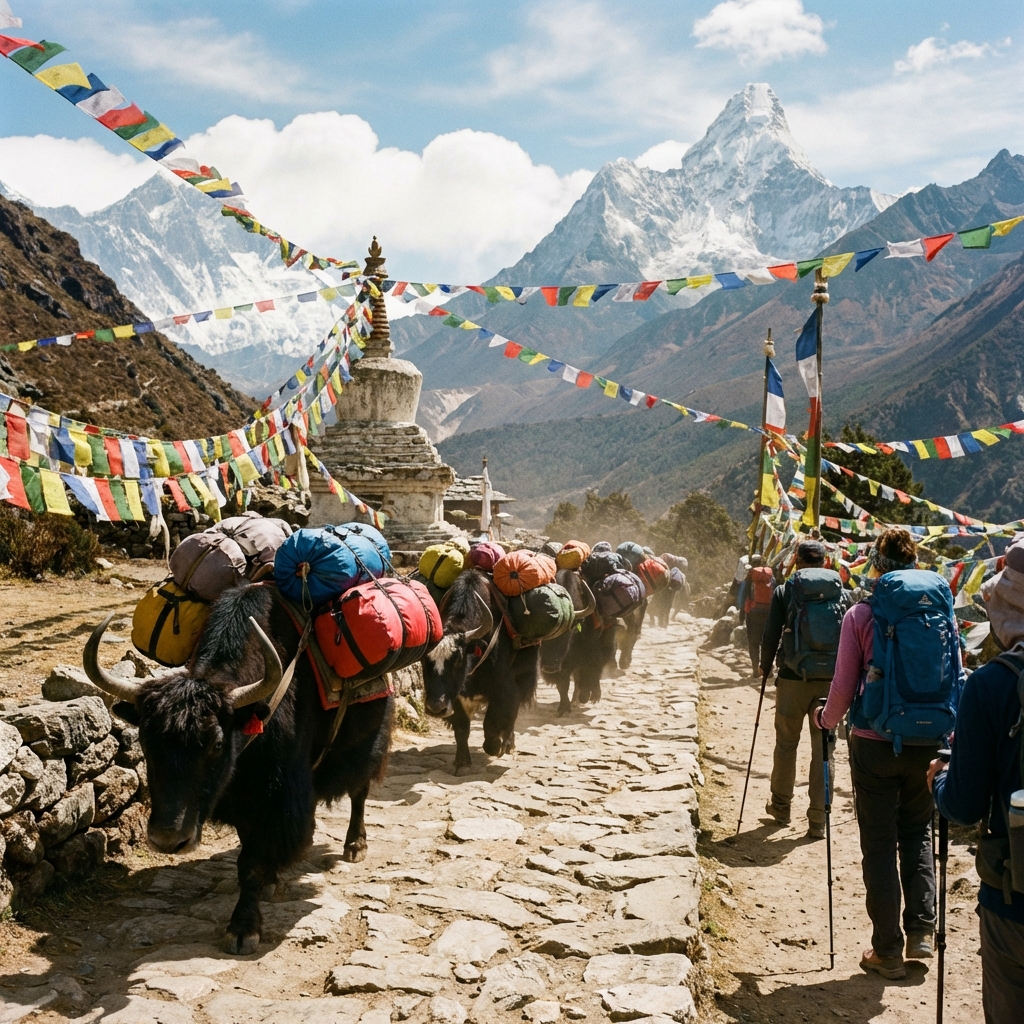
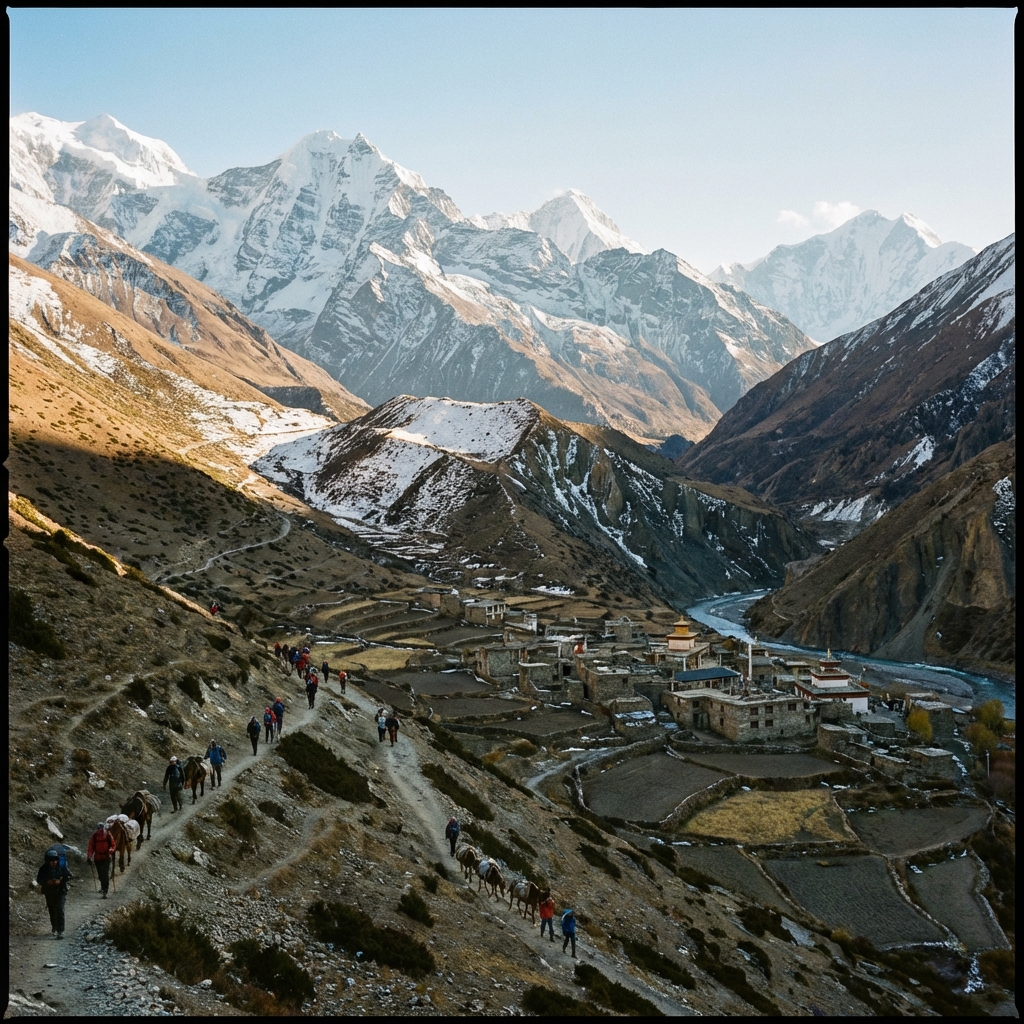
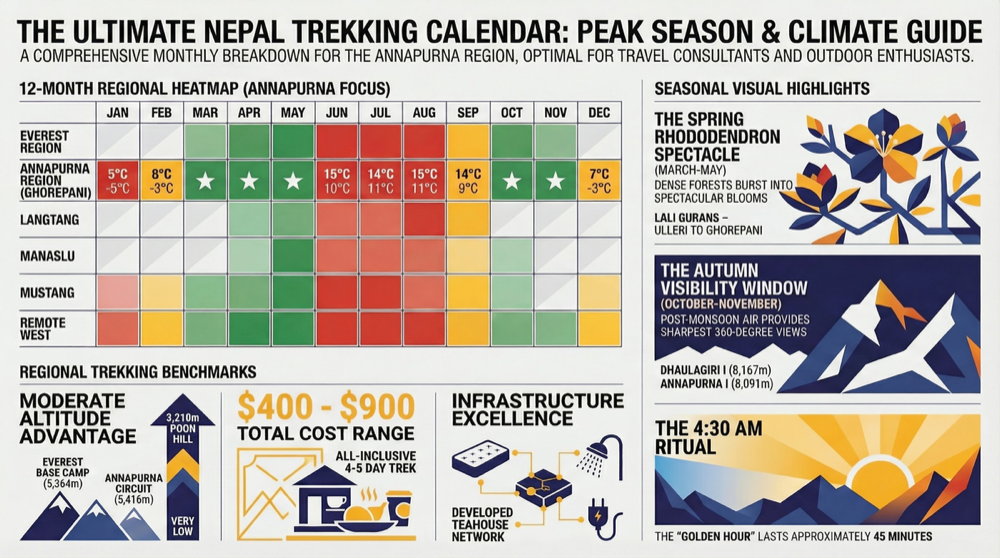
The best time to trek Nepal is autumn (October-November) and spring (March-May). October delivers the most stable weather and clearest mountain views, while spring brings warmer temperatures and blooming rhododendrons. June-August (monsoon) and January-February (deep cold) suit only specialist treks.
Choosing when to trek in Nepal can be the difference between crystal-clear Himalayan panoramas and cloud-obscured disappointment, between comfortable trail conditions and dangerous weather, between sharing trails with hundreds of trekkers and experiencing mountain solitude. With four distinct seasons, multiple climatic zones from subtropical valleys to Arctic-like high passes, and dramatic weather variations between regions, timing your Nepal trek requires understanding far more than "spring and autumn are good."
This comprehensive guide breaks down all twelve months across Nepal's major trekking regions, compares the distinct characteristics of each season, analyzes crowd patterns tied to festivals and international holidays, and provides region-specific recommendations for Everest, Annapurna, Langtang, Manaslu, and the remote western zones. Whether you're planning a classic teahouse trek or venturing into restricted areas, understanding seasonal patterns is essential for safety, enjoyment, and trip success.
October, November, April
October (Dashain/Tihar festivals)
March, Late November
December-February (20-35% savings)
June-August (limited regions only)
Late March-April
October-November
May (pre-monsoon)
Quick Answer: When Should You Trek Nepal?
For most trekkers heading to major routes, the answer is: Spring (March-May) or Autumn (September-November).
These two seasons offer optimal combinations of stable weather, clear visibility, open trails, full teahouse services, and manageable temperatures. But within these windows, significant differences exist that may better suit your specific priorities and destination.
| Priority | Best Months | Why Choose This Window |
|---|---|---|
| Best overall weather | October-November | Post-monsoon stability, minimal rain, clearest skies, excellent visibility |
| Warmest temperatures | May | Pre-monsoon warmth, comfortable high-altitude nights, less snow on passes |
| Fewest crowds | March, late November | Shoulder season with 40-60% fewer trekkers, easier lodge booking |
| Best value/budget | December-February | 20-35% lower costs, negotiable rates, lodge discounts |
| Rhododendron blooms | Late March-April | Lower elevation forests explode with color, vibrant landscapes |
| Photography conditions | October, November | Exceptional clarity, dramatic post-monsoon light, snow-dusted peaks |
| Festival atmosphere | October (Dashain), November (Tihar) | Experience Nepal's biggest celebrations on the trail |
| Monsoon alternatives | June-August | Upper Mustang, Dolpo rain shadow regions only |
The Universal Sweet Spot
If you have complete flexibility and want the most reliable conditions across all major trekking regions, late October offers the best balance: post-monsoon clarity, stable weather, comfortable (not extreme) temperatures, full services, and slightly smaller crowds than peak October. Second choice: late April for warmer conditions and expedition season excitement in the Everest region.
Nepal's Four Trekking Seasons: Complete Overview
Nepal's location at the southern edge of the Himalayas creates four distinct seasons heavily influenced by the Indian monsoon system and Tibetan plateau weather patterns. Understanding these seasonal characteristics is fundamental to trek planning.
Autumn Season: September to November
Character: Post-monsoon stability, crystal-clear air, perfect visibility Weather: Dry, stable high-pressure systems dominate Temperatures: Gradually cooling from warm September to cold late November Landscape: Fresh snow on peaks, lush greenery below 4,000m from monsoon rains Crowds: Peak season—highest trekker numbers of the year Best for: First-time trekkers, photography, guaranteed good weather
Autumn is Nepal's premier trekking season, delivering the year's most reliable weather conditions. The monsoon has cleared the atmosphere, creating exceptional visibility—100+ km views are common. Stable high-pressure systems mean minimal precipitation, and trails are dry and well-maintained. October represents peak season with the highest trekker volumes, especially during Nepal's biggest festivals (Dashain and Tihar). November maintains excellent weather while temperatures drop noticeably, and crowds thin after the first week.
Typical conditions:
- Precipitation: Very low (15-35mm monthly)
- Visibility: Excellent to exceptional
- Daytime temperatures: 15-20°C at lower elevations, 5-12°C at mid-altitudes, -5 to 5°C above 4,500m
- Night temperatures: 5-10°C lower elevations, -5 to 0°C mid-elevations, -15 to -8°C at high camps
Spring Season: March to May
Character: Warming temperatures, blooming vegetation, stable weather with increasing afternoon clouds Weather: Generally stable with occasional pre-monsoon showers, especially late May Temperatures: Progressively warming from cool March to warm May Landscape: Rhododendron forests in full bloom, green valleys, melting high-altitude snow Crowds: High in April-May, moderate in March Best for: Warmth seekers, rhododendron lovers, Everest expedition atmosphere
Spring is Nepal's second prime season, offering warming temperatures after winter's cold. Lower elevation forests (2,000-4,000m) burst into bloom—rhododendrons create spectacular displays in late March and April. The Everest climbing season runs April-May, transforming Base Camp into an exciting tent city. Weather remains generally stable, though afternoon clouds build more frequently than autumn, and late May sees increasing pre-monsoon showers. Spring offers comfortable temperatures and vibrant landscapes but slightly less predictable weather than autumn.
Typical conditions:
- Precipitation: Low to moderate (30-80mm monthly, increasing in May)
- Visibility: Very good mornings, afternoon clouds common
- Daytime temperatures: 12-18°C lower elevations, 8-15°C mid-altitudes, 0-8°C above 4,500m
- Night temperatures: 3-8°C lower elevations, -2 to 5°C mid-elevations, -10 to -5°C high camps
Monsoon Season: June to August
Character: Heavy rainfall in most regions, lush green landscapes, poor visibility Weather: Daily rain, persistent cloud cover, high humidity Temperatures: Warm at all elevations, humid conditions Landscape: Vibrant green forests, waterfalls at peak flow, blooming wildflowers Crowds: Very low—only specialized routes viable Best for: Rain shadow treks (Mustang, Dolpo), solitude seekers, cultural immersion
The monsoon season brings Nepal's heaviest rainfall, making most trekking routes dangerous or unpleasant. However, this isn't a complete shutdown—certain regions in the rain shadow of the Himalayas (north of the main range) remain dry and trekable. Upper Mustang, Dolpo, and the trans-Himalayan zones receive minimal monsoon precipitation. These areas offer unique summer trekking with dramatically different landscapes—arid, desert-like terrain resembling Tibet. For standard routes (Everest, Annapurna Circuit, Langtang), monsoon means muddy trails, leeches, landslide risks, and mountain views obscured 80-90% of the time.
Typical conditions (non-rain-shadow areas):
- Precipitation: Very high (250-400mm monthly)
- Visibility: Poor—peaks obscured most days
- Trail conditions: Muddy, slippery, landslide-prone
- Challenges: Leeches below 3,500m, flight delays, limited lodge services
Rain shadow regions (Upper Mustang, Dolpo):
- Precipitation: Low (20-50mm monthly)
- Conditions: Dry, clear, excellent trekking
- Permits: Special restricted area permits required
- Costs: Higher than standard treks
Winter Season: December to February
Character: Extreme cold at altitude, clear skies, empty trails Weather: Dry, stable, but very cold—especially nights Temperatures: Severe cold at high elevations, manageable at lower altitudes Landscape: Snow-covered peaks, frozen streams, white-dusted forests Crowds: Very low—5-10% of peak season numbers Best for: Lower-altitude treks, budget travelers, experienced cold-weather trekkers
Winter offers crisp, clear skies and complete solitude on trails that are packed during peak season. However, extreme cold limits most trekking to lower and mid-elevations (below 4,000m). High passes accumulate snow and become dangerous or impassable. Many remote lodges above 4,000m close for the season. Winter trekking requires serious cold-weather preparation—temperatures at popular high camps like Gorak Shep (Everest) or Thorong High Camp (Annapurna) regularly drop below -20°C. The tradeoffs: spectacular clarity when skies are clear, dramatic price savings (20-35% lower), and an intimate mountain experience with minimal crowds.
Typical conditions:
- Precipitation: Low (10-30mm monthly, mostly as snow at altitude)
- Visibility: Excellent when not snowing
- Recommended maximum altitude: 4,000m for most trekkers
- Required gear: Expedition-grade cold weather equipment above 4,000m
Month-by-Month Deep Dive: All 12 Months Analyzed
Understanding each month's specific characteristics helps you choose optimal timing for your abilities, priorities, and destination. The following analysis covers conditions across multiple altitude zones and regions. For a single-month deep dive, jump to our dedicated guides for trekking Nepal in October, November, March, or April.
January: Deep Winter
Season: Winter Overall Rating: Not Recommended (except lower-altitude treks) Trekker Volume: Very Low (5% of peak)
January represents Nepal's coldest month. High-altitude trekking is extremely challenging, with nighttime temperatures at popular camps regularly reaching -20°C to -25°C. Many lodges above Namche (Everest), Manang (Annapurna), and Kyanjin Gompa (Langtang) close for the season. High passes like Thorong La (5,416m) and Cho La (5,420m) are often impassable due to snow and ice.
Weather conditions:
- Lower elevations (2,000-3,000m): Daytime 8-14°C, nights 0-5°C, generally dry and clear
- Mid-elevations (3,000-4,000m): Daytime 2-8°C, nights -8 to -2°C, occasional snow
- High altitude (4,000m+): Daytime -5 to 0°C, nights -20 to -12°C, frequent snow
Where you CAN trek:
- Ghorepani Poon Hill (3,210m max) — Excellent in January with clear views
- Pikey Peak (4,065m) — Just manageable with proper gear
- Kathmandu Valley cultural hikes — Comfortable temperatures
- Helambu Circuit (3,650m) — Lower altitude, accessible
Where to AVOID:
- Everest Base Camp — Extreme cold at Gorak Shep
- Annapurna Circuit — Thorong La often impassable
- Manaslu Circuit — Larkya La Pass closed
- Langtang Valley — Very cold above Kyanjin
Who should consider January:
- Experienced cold-weather mountaineers with expedition gear
- Trekkers targeting low-altitude routes only
- Those seeking absolute solitude
- Budget-conscious travelers (lowest prices of the year)
January Cold Reality Check
At Gorak Shep (Everest) in January, nighttime temperatures of -25°C are common. Water freezes solid in bottles overnight. Some trekkers have suffered frostbite on fingers and toes despite "proper" gear. January high-altitude trekking requires expedition-grade equipment—this is not optional. If you lack winter mountaineering experience, stick to treks below 3,500m.
February: Late Winter Transition
Season: Winter transitioning to Spring Overall Rating: Possible (with preparation) Trekker Volume: Very Low (8% of peak)
February sees gradual warming, especially in the second half of the month. Early February remains very cold at altitude, but by late February, conditions begin resembling early March. Lodges start reopening, and trails see slightly more traffic. This is Nepal's best "budget month" for those comfortable with cold—prices are at yearly lows, and late February offers increasingly spring-like conditions.
Weather conditions:
- Lower elevations: Daytime 10-16°C, nights 2-7°C, mostly clear
- Mid-elevations: Daytime 4-10°C, nights -6 to 0°C, improving
- High altitude: Daytime -3 to 2°C, nights -18 to -10°C, cold but warming
Best regions:
- Annapurna region lower routes: Ghorepani, Mardi Himal (lower sections), Australian Camp
- Everest region: Possible to EBC for experienced trekkers in late February
- Langtang: Lower valley accessible, upper valley very cold
- Manaslu: Still too cold and snowy
Late February sweet spot: By February 15-28, you can experience near-March conditions with winter pricing and solitude. Lodges reopen, weather improves, but crowds haven't arrived. Excellent for budget-conscious trekkers who can handle some cold.
March: Spring Awakening
Season: Early Spring Overall Rating: Recommended Trekker Volume: Moderate (40% of peak)
March marks the transition from winter to spring. Early March can still feel wintery at high elevations, but by late March, spring is firmly established. This is one of the best months for avoiding crowds while enjoying good weather. Rhododendrons begin blooming at lower elevations (below 3,500m), creating beautiful forest scenes.
Weather conditions:
- Lower elevations: Daytime 14-18°C, nights 5-10°C, pleasant
- Mid-elevations: Daytime 8-14°C, nights 0-5°C, comfortable
- High altitude: Daytime 0-6°C, nights -12 to -6°C, manageable with proper gear
Advantages:
- 40-50% fewer crowds than October
- Good weather stability improving through the month
- Better prices than peak season
- Rhododendron forests blooming at lower elevations
- Longer daylight hours than autumn
- Easier lodge booking
Challenges:
- Colder than April-May, especially early March
- Some lingering winter snow on high passes
- Agricultural burning can create haze, reducing visibility
- Limited expedition activity at Everest Base Camp (climbing season hasn't started)
Regional performance:
| Month | High | Low | Conditions | Crowds | Notes |
|---|---|---|---|---|---|
| Everest RegionBest | 8-12°C (Namche) | -5 to 0°C | Low | Moderate | Good conditions, improving through month |
| AnnapurnaBest | 10-15°C (Ghorepani) | 2-7°C | Low | Moderate | Excellent for all routes, rhododendrons blooming |
| LangtangBest | 9-13°C (Kyanjin) | -3 to 2°C | Low | Low-Moderate | Warming nicely, fewer crowds than EBC/ABC |
| ManasluBest | 8-12°C | -4 to 1°C | Low | Low | Late March best for pass conditions |
| Upper MustangBest | 10-14°C | -2 to 3°C | Very Low | Very Low | Excellent conditions, dry and clear |
Verdict: Highly recommended for mid-to-late March. Excellent value with good weather and manageable crowds.
Pro Tip
March 15-31 represents a sweet spot combining good weather, spring awakening, and significantly lower crowds than April. If you're targeting popular routes like Everest Base Camp or Annapurna Base Camp, late March offers near-peak conditions without peak-season chaos.
April: Peak Spring — The Balanced Choice
Season: Spring Overall Rating: Highly Recommended Trekker Volume: High (75% of peak)
April represents the heart of spring trekking season. Temperatures are comfortably warm, the Everest climbing season begins, and conditions are generally excellent throughout the month. This is Nepal's second-busiest trekking month after October. Rhododendrons bloom at higher elevations (3,000-4,500m), creating spectacular forest displays.
Weather conditions:
- Lower elevations: Daytime 16-22°C, nights 8-13°C, warm and pleasant
- Mid-elevations: Daytime 12-17°C, nights 3-8°C, comfortable
- High altitude: Daytime 3-8°C, nights -8 to -3°C, manageable
Advantages:
- Comfortable temperatures—not too cold, not yet humid
- Stable weather patterns most of the month
- Rhododendrons blooming at multiple elevations
- Everest expedition season creates exciting atmosphere at Base Camp
- All services fully operational
- Snow cleared from most high passes
- Good visibility, especially mornings
Challenges:
- High season crowds on popular routes
- Afternoon cloud buildup common, especially late April
- Premium pricing—second highest after October
- Popular lodges require advance booking
- Pre-monsoon haze can reduce distant views late month
Regional performance:
| Month | High | Low | Conditions | Crowds | Notes |
|---|---|---|---|---|---|
| Everest RegionBest | 12-15°C (Namche) | 0-4°C | Moderate | High | Expedition season begins, Base Camp bustling |
| AnnapurnaBest | 14-18°C (Ghorepani) | 5-10°C | Moderate | High | Perfect temperatures, rhododendrons at peak |
| LangtangBest | 12-16°C (Kyanjin) | 1-6°C | Moderate | Moderate | Excellent conditions, less crowded than EBC/ABC |
| ManasluBest | 11-15°C | 0-5°C | Moderate | Moderate | Ideal for Larkya La crossing |
| Upper MustangBest | 12-17°C | 0-5°C | Very Low | Low | Excellent, warming nicely |
Best routes for April:
- Everest Base Camp: Peak expedition season excitement
- Annapurna Base Camp: Perfect temperatures, blooming rhododendrons
- Manaslu Circuit: Ideal conditions for Larkya La Pass
- Langtang Valley: Excellent weather, fewer crowds than EBC
- Gokyo Lakes: Great visibility, warming temperatures
Verdict: Highly recommended for all trekkers. Book flights and lodges 2-3 months in advance for peak April dates.
May: Warmest Pre-Monsoon Trekking
Season: Late Spring Overall Rating: Recommended (with caveats) Trekker Volume: High early month (70%), Moderate late month (50%)
May offers the warmest trekking temperatures but with increasing afternoon cloudiness and approaching monsoon. The Everest summit season peaks in mid-May, making Base Camp particularly exciting. Early May is excellent; late May becomes risky as monsoon onset can arrive unexpectedly.
Weather conditions:
- Lower elevations: Daytime 18-24°C, nights 12-16°C, warm to hot
- Mid-elevations: Daytime 14-19°C, nights 6-11°C, very comfortable
- High altitude: Daytime 5-12°C, nights -5 to 0°C, warmest of the year
Advantages:
- Warmest temperatures of the trekking season
- Most comfortable nights at high camps—less extreme cold
- Peak Everest summit season (May 10-25) creates electric Base Camp atmosphere
- Crowds thin significantly after mid-May
- Minimal snow/ice concerns on high passes
- Pleasant for cold-sensitive trekkers
Challenges:
- Afternoon clouds and reduced visibility common
- Occasional thunderstorms, especially late May
- Pre-monsoon haze reduces distant views
- Early monsoon possible last week of May
- Hot and dusty at lower elevations
- Increased avalanche risk on some routes
Early vs. Late May:
| Factor | Early May (1-15) | Late May (16-31) |
|---|---|---|
| Weather stability | Good | Declining |
| Visibility | Good mornings | Cloudy afternoons |
| Crowds | High | Moderate-Low |
| Rain risk | Low | Moderate-High |
| Recommended | Yes | Risky |
Regional performance:
| Month | High | Low | Conditions | Crowds | Notes |
|---|---|---|---|---|---|
| Everest RegionBest | 14-17°C (Namche) | 3-7°C | Moderate-High | High early, Low late | Summit season peak May 10-25, avoid late May |
| AnnapurnaBest | 16-20°C (Ghorepani) | 8-12°C | Moderate-High | Moderate | Warm, afternoon clouds, avoid last week |
| LangtangBest | 14-18°C (Kyanjin) | 4-9°C | Moderate-High | Low-Moderate | Pleasant temperatures, watch for monsoon onset |
| ManasluBest | 13-17°C | 3-8°C | Moderate-High | Low | Early May good, late May risky |
| Upper MustangBest | 15-20°C | 3-8°C | Low | Low | Excellent all month, rain shadow protection |
Best strategy: Plan for early-to-mid May (May 1-20). Avoid departures after May 20 unless trekking rain shadow regions.
Witnessing Everest Summit Season
Want to experience the Everest climbing season? May 10-20 is the typical summit push window when hundreds of climbers attempt the peak. Base Camp becomes a vibrant tent city with expedition teams, helicopters, and an exciting international atmosphere. This is a unique experience available only in late April through late May.
June: Monsoon Arrival
Season: Early Monsoon Overall Rating: Not Recommended (except rain shadow regions) Trekker Volume: Very Low (10% of peak)
The monsoon typically arrives in Nepal by early-to-mid June, bringing daily rainfall that makes most trekking routes unpleasant or dangerous. However, this is when rain shadow regions (Upper Mustang, Dolpo) become ideal destinations—they remain dry while offering summer trekking opportunities.
Weather conditions (non-rain-shadow):
- Daily afternoon rain beginning, building through month
- Trails becoming muddy and slippery
- Clouds obscuring mountain views 60-80% of time
- Leeches appearing below 3,500m
- Landslide risks increasing
Where you CANNOT trek (safely/enjoyably):
- Standard Everest Base Camp route
- Annapurna Circuit and Base Camp
- Langtang Valley
- Most Annapurna region treks
- Manaslu Circuit (though possible with significant challenges)
Where you CAN trek (rain shadow regions):
- Upper Mustang — Excellent in June, dry and clear
- Dolpo region — Remote, rain shadow, good conditions
- Upper sections of Annapurna Circuit — Manang to Jomsom via Thorong La (rain shadow on north side)
- Nar Phu Valley — Partially protected
Monsoon trekking requirements:
- Waterproof gear (jacket, pants, pack cover)
- Leech socks/gaiters for lower elevations
- Flexible schedule (allow extra days for delays)
- Mental preparation for limited mountain views
- Acceptance of challenging trail conditions
Verdict: Only trek rain shadow regions in June. Standard routes become unpleasant and potentially dangerous.
July: Peak Monsoon
Season: Monsoon Peak Overall Rating: Not Recommended (except specialized routes) Trekker Volume: Very Low (5% of peak)
July sees the heaviest monsoon rainfall—200-400mm monthly in most regions. Trails are waterlogged, visibility is minimal, and landslide risks peak. Only the most protected rain shadow areas remain viable for trekking.
Monsoon intensity by region:
| Region | July Rainfall | Trekking Viability | Notes |
|---|---|---|---|
| Everest (Khumbu) | 250-350mm | Not viable | Daily rain, no views, dangerous |
| Annapurna south | 300-450mm | Not viable | Heavy rain, leeches, landslides |
| Langtang | 280-380mm | Not viable | Muddy trails, poor conditions |
| Manaslu | 250-350mm | Not viable | Landslide risks high |
| Upper Mustang | 20-40mm | Excellent | Rain shadow—dry and clear |
| Dolpo | 30-60mm | Very Good | Protected, minimal monsoon impact |
The ONLY recommended treks in July:
- Upper Mustang — Nepal's premier rain shadow destination, remains completely dry
- Upper Dolpo — Remote wilderness, minimal rainfall
- Nar Phu Valley — Partially protected, for experienced trekkers only
Challenges even in rain shadow regions:
- Flights to trailheads (Jomsom, Juphal) can be delayed due to weather in Kathmandu/Pokhara
- Higher permit costs for restricted areas
- Limited trekker numbers mean less social atmosphere
- Some support services operate with reduced capacity
Verdict: Unless trekking Upper Mustang or Dolpo, avoid July entirely. Plan trips for autumn or spring instead.
August: Late Monsoon
Season: Monsoon Continuing Overall Rating: Not Recommended (except rain shadow regions) Trekker Volume: Very Low (6% of peak)
Conditions remain similar to July—heavy rainfall, poor visibility, challenging trail conditions. Late August sometimes sees improvement as the monsoon begins retreating, but it's unreliable. Rain shadow regions continue to offer good trekking.
Late August consideration: By August 20-31, the monsoon occasionally begins clearing earlier than expected. Some trekkers gamble on late August departures hoping for early post-monsoon conditions. This is risky—you might catch excellent early clear skies, or you might get full monsoon conditions. Not recommended unless you have complete schedule flexibility and can postpone if conditions are poor.
Viable options:
- Upper Mustang (continues to be excellent)
- Dolpo region (good conditions persist)
- Late August gamble on standard routes (high risk)
Verdict: Similar to July—rain shadow regions only. Wait for September for standard routes.
September: Post-Monsoon Transition
Season: Autumn Beginning Overall Rating: Recommended (mid-to-late September) Trekker Volume: Moderate (50% of peak early month, 70% late month)
September marks the transition from monsoon to prime trekking season. Early September can still see monsoon remnants, but by mid-to-late September, conditions dramatically improve. This is an excellent month for those wanting good autumn weather without peak October crowds.
Weather conditions:
- Early September (1-10): Monsoon clearing, variable conditions, occasional rain
- Mid September (11-20): Rapidly improving, good to excellent conditions emerging
- Late September (21-30): Excellent conditions, near-October quality weather
Advantages:
- 30-40% fewer crowds than October
- Fresh snow on peaks from late monsoon creates stunning photography
- Reasonable prices—not yet peak season rates
- Lush vegetation from monsoon rainfall—vibrant greens
- Pleasant temperatures—not too cold
- Easier lodge bookings than October
Challenges:
- Early September can still have monsoon weather
- Trail sections may be muddy/slippery early month
- Leeches possible below 3,500m in early September
- Less predictable than October-November
- Some high passes may have fresh snow requiring caution
Regional performance:
| Month | High | Low | Conditions | Crowds | Notes |
|---|---|---|---|---|---|
| Everest RegionBest | 12-14°C (Namche) | 3-6°C | Moderate early, Low late | Moderate | Mid-late September excellent, avoid early Sept |
| AnnapurnaBest | 14-17°C (Ghorepani) | 6-10°C | Moderate early, Low late | Moderate | Beautiful post-monsoon, lush and green |
| LangtangBest | 12-15°C (Kyanjin) | 4-8°C | Moderate early, Low late | Low-Moderate | Excellent late September |
| ManasluBest | 11-14°C | 2-6°C | Moderate early, Low late | Moderate | Late September best for Larkya La |
| Upper MustangBest | 14-18°C | 2-6°C | Low | Low | Excellent all month |
Best strategy: Target departures after September 15. Late September (Sept 20-30) offers near-October conditions with better value and fewer crowds.
Verdict: Highly recommended for mid-to-late September. Avoid first week unless you have schedule flexibility.
October: Peak Season — The Gold Standard
Season: Autumn Peak Overall Rating: Highly Recommended (if you can handle crowds) Trekker Volume: Very High (100% peak—busiest month)
October is unquestionably Nepal's most popular trekking month, and for good reason. Weather conditions are at their most stable, visibility is exceptional, and the entire trekking infrastructure operates at full capacity. This is also when Nepal's biggest festivals (Dashain, Tihar) occur, adding cultural richness but also maximum crowds.
Weather conditions:
- All regions: Stable high-pressure systems, minimal precipitation
- Lower elevations: Daytime 15-20°C, nights 6-12°C, pleasant
- Mid-elevations: Daytime 10-15°C, nights 1-6°C, comfortable
- High altitude: Daytime 2-8°C, nights -10 to -4°C, manageable cold
Advantages:
- Best visibility of the year—crystal clear views, 100+ km range common
- Most stable weather patterns—minimal precipitation
- All trails and passes accessible
- Full teahouse services operating at peak efficiency
- Comfortable daytime temperatures across all elevations
- Perfect photography conditions—dramatic post-monsoon light
- Festival atmosphere—Dashain and Tihar celebrations
Challenges:
- Very crowded—especially during festival periods
- Premium prices—highest of the year
- Lodges fully booked—advance reservations essential
- Lukla flights oversubscribed—delays more likely
- Popular viewpoints and trails can feel congested
- Less intimate mountain experience due to crowds
Dashain and Tihar festival impact:
Dashain (usually early-mid October) and Tihar (usually late October) are Nepal's biggest festivals. During these periods, domestic tourism surges dramatically as Nepali families trek together. International and domestic trekkers combine, creating the year's absolute peak. In 2026, Dashain runs September 29 - October 8, and Tihar occurs around October 20-22.
Crowd management strategies:
- Book all lodges and flights 3-4 months in advance
- Consider alternative routes (Gokyo Lakes, Manaslu Circuit) that see 30-50% fewer people
- Trek less popular directions (counter-clockwise on circuit treks)
- Start trekking days very early (5:30-6am) to reach lodges before crowds
- Embrace the social atmosphere—October's crowds create a community feel
Regional performance:
| Month | High | Low | Conditions | Crowds | Notes |
|---|---|---|---|---|---|
| Everest RegionBest | 10-12°C (Namche) | 0-3°C | Very Low | Very High | Peak season, exceptional visibility, very crowded |
| AnnapurnaBest | 13-16°C (Ghorepani) | 4-8°C | Very Low | Very High | Perfect conditions, festival crowds |
| LangtangBest | 10-13°C (Kyanjin) | 2-6°C | Very Low | High | Excellent weather, less crowded than EBC/ABC |
| ManasluBest | 9-13°C | 0-5°C | Very Low | High | Ideal conditions, alternative to overcrowded routes |
| Upper MustangBest | 12-16°C | 0-5°C | Very Low | Moderate | Excellent, cooling toward month end |
Verdict: Highly recommended if you book well in advance and can accept crowds. The definitive Nepal trekking experience. If crowds concern you, choose late September, November, or March instead.
October Booking Requirements
For October treks, book flights to Lukla/Jomsom and reserve teahouse lodges 3-4 months in advance. During Dashain week, Lukla flights are completely full, and popular lodges in Namche, Tengboche, Ghorepani, and Manang require confirmed reservations. Walk-up trekking in October without advance booking is risky.
November: Excellent Conditions, Cooling Temperatures
Season: Autumn Continuing Overall Rating: Highly Recommended Trekker Volume: High early month (80%), Moderate mid-month (60%), Low late month (30%)
November maintains October's excellent weather stability while temperatures drop noticeably. Crowds thin dramatically after Tihar festival (usually early November), making mid-to-late November an underrated gem. Many experienced trekkers consider November the best month overall—combining superb weather with manageable crowds.
Weather conditions:
- Early November: Similar to October, slightly cooler
- Mid November: Noticeably colder, especially nights, excellent visibility continues
- Late November: Cold settling in, winter approaching, some high-altitude lodges closing
Advantages:
- Exceptional visibility—among the best of the year
- Crowds thin significantly after Tihar (usually Nov 1-5)
- Very stable weather—driest month of the year
- Better prices and lodge availability than October
- Crisp, clear air perfect for photography
- More intimate mountain experience than peak season
Challenges:
- Noticeably colder than October—especially nighttime temperatures
- Some high-altitude lodges begin closing late November
- Shorter daylight hours than spring
- Cold can be severe at camps above 4,500m (-15°C+ common)
- Some high-pass routes may see early winter snow
Temperature comparison (November vs. October):
| Location | October Night Temp | November Night Temp | Difference |
|---|---|---|---|
| Namche (3,440m) | 0-3°C | -4 to 0°C | -4 to -5°C colder |
| Gorak Shep (5,164m) | -8 to -6°C | -14 to -10°C | -6 to -8°C colder |
| Thorong High Camp (4,925m) | -6 to -3°C | -12 to -8°C | -6 to -9°C colder |
Early vs. Late November:
| Factor | Early Nov (1-10) | Mid Nov (11-20) | Late Nov (21-30) |
|---|---|---|---|
| Crowds | High (post-Tihar) | Moderate | Low |
| Weather | Excellent | Excellent | Very cold but clear |
| Prices | Moderate | Moderate | Lower |
| Lodge availability | Good | Very Good | Some closures |
| Cold severity | Manageable | Cold | Very cold |
| Recommended | Yes | Highly | Experienced trekkers only |
Regional performance:
| Month | High | Low | Conditions | Crowds | Notes |
|---|---|---|---|---|---|
| Everest RegionBest | 6-10°C (Namche) | -4 to 0°C | Very Low | High early, Moderate late | Excellent visibility, cold nights, crowds thin mid-month |
| AnnapurnaBest | 10-14°C (Ghorepani) | 2-6°C | Very Low | High early, Moderate late | Perfect clarity, comfortable days, cold nights |
| LangtangBest | 8-12°C (Kyanjin) | -2 to 3°C | Very Low | Moderate | Excellent conditions, fewer trekkers |
| ManasluBest | 7-11°C | -3 to 2°C | Very Low | Moderate early, Low late | Late November gets cold, mid-month ideal |
| Upper MustangBest | 8-13°C | -3 to 2°C | Very Low | Low | Cold but clear, excellent visibility |
The November Sweet Spot: November 10-25 represents ideal timing for experienced trekkers: October-quality weather, 40-50% fewer people, easier lodge booking, and better prices. The tradeoff is colder nights—bring a -20°C rated sleeping bag if going late November.
Verdict: Highly recommended, especially mid-November. One of the best months for those who can handle cold nights and want excellent weather without peak crowds.
Pro Tip
Many trekking veterans prefer November over October specifically for the crowd reduction. By mid-November, trails that saw 500+ trekkers daily in October host 200-250. This makes popular stops like Namche, Ghorepani, and Manang feel more like mountain villages and less like trekker highways.
December: Early Winter
Season: Winter Beginning Overall Rating: Possible (with serious preparation) Trekker Volume: Low (20% of peak early month, 10% late month)
December sees dramatic drops in both temperatures and trekker numbers. Early December can still offer reasonable conditions for experienced cold-weather trekkers; late December becomes genuinely challenging. This is Nepal's prime "budget month" for those with proper gear and cold tolerance.
Weather conditions:
- Lower elevations: Daytime 8-14°C, nights 0-5°C, manageable
- Mid-elevations: Daytime 4-10°C, nights -6 to 0°C, cold
- High altitude: Daytime -3 to 3°C, nights -18 to -12°C, very cold
Where December works:
- Ghorepani Poon Hill — Excellent all month, lower altitude
- Mardi Himal lower sections — Base Camp gets very cold
- Annapurna Panorama routes — Below 3,500m comfortable
- Pikey Peak — Manageable with preparation
- Kathmandu Valley hikes — Ideal temperatures
Where December becomes challenging:
- Everest Base Camp — Extreme cold at Gorak Shep (-20°C nights)
- Annapurna Circuit — Thorong La crossing difficult/dangerous
- Manaslu Circuit — Larkya La often closed
- High passes generally — Snow accumulation, ice hazards
December advantages:
- 20-35% lower prices across all services
- Empty trails and lodges—complete solitude
- Exceptional clarity when weather is clear
- Guide/porter rates negotiable
- Intimate mountain experience
December challenges:
- Extreme cold at high elevations
- Shorter daylight hours (approximately 6:30am-5pm useful light)
- Many lodges above 4,000m close late December
- Ice hazards on trails
- Lukla flight delays possible (fog)
Early December (1-15) vs. Late December (16-31):
Early December remains relatively accessible for high-altitude treks if you have expedition-grade gear. Late December transitions toward deep winter—only lower-altitude routes recommended unless you're an experienced winter mountaineer.
Verdict: Possible for experienced cold-weather trekkers in early December. Late December recommended only for low-altitude routes (below 4,000m) unless you have winter mountaineering experience and expedition gear.
December Budget Savings
December offers Nepal's best budget trekking opportunities. Expect 20-35% savings on: guide/porter fees (highly negotiable), teahouse rates (can negotiate lower prices), gear rental (seasonal discounts), and agency packages (off-season rates). The tradeoff: extreme cold at altitude requiring expensive rental gear (expedition sleeping bags, down jackets), so factor gear costs into budget calculations.
Autumn vs. Spring: The Head-to-Head Comparison
These two seasons dominate Nepal trekking planning. Understanding their distinct characteristics helps you choose which better suits your priorities. For a dedicated side-by-side breakdown, see our Spring vs Autumn trekking in Nepal comparison.
Complete Seasonal Comparison
| Route | Duration | Max Altitude | Difficulty | Permits | Teahouses | Crowds |
|---|---|---|---|---|---|---|
| Factor | Spring (Mar-May) | Autumn (Sep-Nov) | Winner | Notes | ||
| Weather Stability | Very Good | Excellent | Autumn | Autumn's post-monsoon high pressure more reliable | ||
| Mountain Visibility | Very Good | Exceptional | Autumn | Autumn's clearer air, less haze | ||
| Temperature (Daytime) | Mild to Warm | Cool to Mild | Spring | Spring warmer, especially May | ||
| Temperature (Night) | Moderate | Cold | Spring | Spring nights less severe | ||
| Crowds | High (Apr-May) | Very High (Oct) | Spring | October busiest, but April also crowded | ||
| Rhododendrons | Peak Bloom | None | Spring | Late March-April spectacular | ||
| Precipitation | Low-Moderate | Very Low | Autumn | Autumn driest season | ||
| Afternoon Clouds | Common | Rare | Autumn | Spring sees more cloud buildup | ||
| Snow on Passes | Variable | Minimal (Sep-Oct) | Autumn | Spring snow conditions less predictable | ||
| Everest Expeditions | Peak Season | None | Spring | April-May Base Camp tent city | ||
| Festival Atmosphere | Holi/Buddha Jayanti | Dashain/Tihar | Autumn | Autumn festivals bigger, more widespread |
Detailed Season Characteristics
Autumn's Strengths:
- Weather predictability: Stable post-monsoon high-pressure systems
- Visibility: Clearest air of the year—exceptional mountain views
- Dry conditions: Minimal rain, dry trails
- Photography: Crisp air, dramatic lighting, fresh snow on peaks
- Festival culture: Experience Dashain and Tihar celebrations
Autumn's Weaknesses:
- Crowds: Peak season, especially October
- Cold: Progressively colder through season
- Prices: Highest of the year in October
- Booking difficulty: Advance reservations essential
Spring's Strengths:
- Warmth: Comfortable temperatures, less extreme cold
- Flora: Rhododendrons and wildflowers blooming
- Expedition season: Everest Base Camp excitement (April-May)
- Fewer crowds: Than October (though April is still busy)
- Longer days: More daylight hours than autumn
Spring's Weaknesses:
- Afternoon clouds: More frequent than autumn
- Haze: Agricultural burning and pre-monsoon conditions reduce distant visibility
- Variable conditions: Less predictable than autumn
- Late season rain: May sees increasing showers
Which Season for Which Trekker?
Choose AUTUMN if you prioritize:
- Maximum weather reliability
- Best possible mountain views
- Photography conditions
- Experiencing Nepali festivals
- Don't mind crowds and premium prices
Choose SPRING if you prioritize:
- Warmer temperatures (especially important for cold-sensitive trekkers)
- Blooming rhododendrons and vibrant landscapes
- Everest expedition atmosphere (April-May)
- Slightly fewer crowds than October
- Longer daylight trekking hours
Choose EITHER if:
- You have moderate flexibility
- You're trekking standard routes
- You want reliable good weather
- You're comfortable with crowds
Region-Specific Seasonal Timing
Different trekking regions in Nepal have slightly different optimal timing based on altitude profiles, climatic zones, and specific route characteristics.
Everest Region (Khumbu)
Optimal Months: October, November, April, May Acceptable: Late September, March, early December Avoid: June-August, January-February
The Everest region sits at Nepal's highest trekking altitudes (5,000m+ common), making weather stability crucial. The cold at altitude is severe, so warmer months within the trekking seasons are preferable for most trekkers.
Month-by-month for Everest:
- September 15-30: Excellent, fewer crowds than October
- October: Peak season, best visibility, very crowded, cold nights
- November: Excellent weather, thinning crowds, very cold late month
- December-February: Extreme cold, only for experienced winter trekkers
- March: Good conditions, improving through month, moderate crowds
- April: Excellent, expedition season begins, high crowds
- May 1-20: Very good, warmest temperatures, summit season peak
- May 21-31: Risky, monsoon approaching
- June-August: Monsoon, not recommended
Best routes by month:
- Everest Base Camp: Oct-Nov, Apr-May
- Gokyo Lakes: Oct-Nov, Apr-May
- Three Passes Trek: Late Sep, May (pass conditions critical)
Detailed seasonal guide: Best Time to Trek Everest Region
Annapurna Region
Optimal Months: October, November, March, April Acceptable: September, May, December (lower routes) Avoid: June-August, January-February (high-altitude routes)
The Annapurna region spans diverse altitudes from 800m to 5,416m, offering more seasonal flexibility than Everest. Lower routes work well in shoulder seasons and even winter.
Month-by-month for Annapurna:
- September: Good, post-monsoon clearing, lush and green
- October: Excellent, peak season, crowded, best visibility
- November: Excellent, cooling, fewer crowds mid-month
- December-February: Lower routes (Poon Hill, Mardi lower) good; high passes closed
- March: Excellent, rhododendron blooms beginning, moderate crowds
- April: Peak rhododendron season, excellent weather, high crowds
- May: Good early month, afternoon clouds increase, avoid late May
- June-August: Monsoon, avoid (except upper circuit sections in rain shadow)
Best routes by month:
- Annapurna Base Camp: Oct-Nov, Mar-Apr (rhododendrons!)
- Annapurna Circuit: Oct-Nov, Apr-May
- Ghorepani Poon Hill: Year-round except monsoon (Dec-Feb good!)
- Mardi Himal: Oct-Nov, Mar-Apr
- Khopra Ridge: Oct-Nov, Apr
Langtang Region
Optimal Months: October, November, April, March Acceptable: September, May, December (with preparation) Avoid: June-August, January-February
Langtang offers excellent trekking close to Kathmandu with fewer crowds than Everest or Annapurna. Maximum altitude (4,984m at Tserko Ri) is lower than EBC, making shoulder seasons more accessible.
Month-by-month for Langtang:
- September: Good late month, clearing from monsoon
- October-November: Excellent, less crowded than EBC/ABC
- December: Possible for lower valley, very cold above Kyanjin
- January-February: Very cold, lower valley only
- March: Excellent, warming, fewer crowds than April
- April-May: Excellent, comfortable temperatures, blooming vegetation
- June-August: Monsoon, not recommended
Best routes by month:
- Langtang Valley: Oct-Nov, Mar-May
- Gosainkunda: Oct-Nov, Apr-May (lake frozen in winter)
- Tamang Heritage Trail: Oct-Apr (lower altitude, more flexible)
- Helambu Circuit: Oct-May (lower altitude, winter viable)
Manaslu Region
Optimal Months: October, Late September, April, May Acceptable: November (cold), March (pass conditions variable) Avoid: June-August, December-February
Manaslu Circuit crosses Larkya La Pass at 5,160m, requiring good weather and stable snow conditions. This remote trek sees far fewer trekkers than Everest or Annapurna.
Month-by-month for Manaslu:
- September 15-30: Excellent, post-monsoon, fewer crowds
- October: Peak season, best weather, moderate crowds (far less than EBC)
- November: Good early month, very cold late month, pass can be snowy
- December-February: Pass impassable, extreme cold
- March: Variable pass conditions, late March better
- April-May: Excellent, ideal for pass crossing, warming temperatures
- June-August: Monsoon, dangerous conditions
Best route timing:
- Manaslu Circuit: Late Sep-Oct, Apr-early May
Upper Mustang & Rain Shadow Regions
Optimal Months: April-November (complete reversal of standard routes!) Also Good: March, December Monsoon Excellence: June-August (when everywhere else is closed)
Upper Mustang sits in the rain shadow north of the Annapurna range, receiving minimal monsoon precipitation. This creates a unique trekking calendar.
Month-by-month for Upper Mustang:
- March-May: Excellent, warming, clear skies, wildflower blooms (limited)
- June-August: EXCELLENT—dry while everywhere else has monsoon
- September-November: Excellent, cooling, very clear
- December-February: Very cold, possible for experienced trekkers
Best routes in monsoon (rain shadow):
- Upper Mustang: Jun-Aug excellent
- Dolpo region: Jun-Aug good
- Nar Phu Valley: Jun-Aug possible (partially protected)
Festival Calendar & Cultural Timing
Nepal's festivals significantly impact trekking—both through crowd levels and cultural experiences. Understanding festival timing helps you either avoid peak crowds or embrace the cultural atmosphere.
Major Festivals Affecting Trekking
Dashain (September/October)
- 2026 Dates: September 29 - October 8
- Impact: Biggest domestic tourism surge; trails extremely crowded
- Cultural experience: Family reunions, animal sacrifices, celebrations
- Recommendation: Avoid if you hate crowds; embrace if you want cultural immersion
Tihar (October/November)
- 2026 Dates: Approximately October 18-20
- Impact: Continued domestic tourism, slightly less crowded than Dashain
- Cultural experience: Festival of lights, dog/crow worship, beautiful decorations
- Recommendation: Wonderful cultural experience, moderate crowds
Losar (Tibetan New Year, February/March)
- 2026 Dates: February 18
- Impact: Celebrations in Sherpa/Tamang communities (Everest, Langtang, Manaslu)
- Cultural experience: Tibetan Buddhist celebrations, monastery ceremonies
- Recommendation: Excellent cultural timing for Everest/Langtang regions
Holi (March)
- 2026 Dates: March 3
- Impact: Minimal trekking disruption, mostly celebrated in cities
- Cultural experience: Color festival, joyful celebrations
- Recommendation: Fun to experience in Kathmandu before/after trek
Buddha Jayanti (May)
- 2026 Dates: May 1
- Impact: Minimal trekking impact
- Cultural experience: Buddhist celebrations, Lumbini pilgrimage
- Recommendation: Special for Buddhist heritage sites
Festival-Based Timing Strategy
Want to AVOID crowds?
- Skip October 1-15 (Dashain period)
- Avoid late October (Tihar)
- Choose March, late November, or early September
Want cultural IMMERSION?
- Trek during Dashain (Oct 1-15) to experience Nepal's biggest celebration
- Visit Everest/Langtang during Losar (early March) for Tibetan Buddhist ceremonies
- Time trek to end in Kathmandu during Tihar for Festival of Lights
Crowd Management: Avoiding (or Embracing) Peak Periods
Crowd levels vary dramatically by month and route. Here's how to navigate based on your preferences.
Annual Crowd Calendar
| Month | High | Low | Conditions | Crowds | Notes |
|---|---|---|---|---|---|
| January | 5% | Very Low | Empty trails | Budget seekers | Extreme cold limits trekking |
| February | 8% | Very Low | Near-empty | Budget, experienced | Cold but improving |
| MarchBest | 40% | Moderate | Comfortable | Value seekers | Shoulder season sweet spot |
| AprilBest | 75% | High | Busy | Most trekkers | Peak spring, crowds building |
| MayBest | 60% | High→Moderate | Busy early, thinning | Warmth seekers | Crowds drop late month |
| June | 10% | Very Low | Empty (monsoon) | Rain shadow only | Monsoon limits options |
| July | 5% | Very Low | Empty (monsoon) | Mustang/Dolpo | Standard routes closed |
| August | 6% | Very Low | Empty (monsoon) | Rain shadow | Late month improving slightly |
| SeptemberBest | 50% | Moderate | Building | Bargain hunters | Late September excellent |
| OctoberBest | 100% | Very High | PEAK | Everyone | Busiest month, book ahead |
| NovemberBest | 70%→30% | High→Moderate | Busy→Comfortable | Quality seekers | Crowds thin mid-month |
| December | 15% | Low | Quiet | Cold-tolerant, budget | Early month viable, late month harsh |
Route-Specific Crowd Levels
| Route | October Crowds | Quieter Alternatives | Timing Strategy |
|---|---|---|---|
| Everest Base Camp | Extremely High | Gokyo Lakes, Jiri approach | Go in March or late Nov |
| Annapurna Circuit | Very High | Manaslu Circuit | Trek counter-clockwise |
| Annapurna Base Camp | Very High | Mardi Himal, Khopra Ridge | Early March or late Nov |
| Poon Hill | High | Khopra Ridge, Mohare Danda | Go in December-February |
| Langtang Valley | Moderate | Always less crowded option | Any prime season month |
| Manaslu Circuit | Moderate | Naturally less crowded | Late September ideal |
Practical Crowd Avoidance Strategies
- Choose shoulder seasons: March and late November offer 40-60% fewer trekkers than October
- Pick alternative routes: Gokyo Lakes over EBC, Mardi Himal over ABC
- Trek alternative directions: Counter-clockwise on circuit treks encounters fewer people
- Start early daily: 5:30-6am departures mean reaching lodges before crowds, better bed selection
- Book in advance: Secure beds at less-popular lodges, avoid the "always full" properties
- Add rest days: Stopping at less-trafficked villages breaks you from the trekker pack
- Extend itineraries: Longer routes (Three Passes, Jiri-EBC) filter out casual trekkers
Climate Change Impact on Seasonal Patterns
Nepal's trekking seasons are experiencing noticeable shifts due to climate change. Understanding these changes helps set realistic expectations.
Observable Pattern Shifts
Monsoon variability:
- Traditional: Monsoon arrived reliably early June, ended mid-September
- Current: Arrival varies (late May to mid-June), retreat unpredictable (late August to late September)
- Impact: Late May and early September trekking more variable than historically
Temperature increases:
- Observed: Average temperatures rising 0.06°C per year at altitude
- Impact: Warmer shoulder seasons (good), increased avalanche risk in some areas (bad)
- Glacier retreat: Reduced snow/ice on passes in late season
Precipitation unpredictability:
- Traditional: Clear autumn/spring, wet monsoon pattern reliable
- Current: Occasional unseasonal rain events, dry spells during monsoon
- Impact: Weather forecasting less reliable, more day-to-day flexibility needed
Adaptation Strategies
Build in flexibility:
- Add 1-2 buffer days for weather delays
- Purchase comprehensive trip insurance with weather-related cancellation coverage
- Mental preparation for variable conditions even during "prime" seasons
Check recent conditions:
- Consult recent trip reports (within 2-4 weeks)
- Ask agencies about current pass/trail conditions
- Monitor Nepal weather patterns week before departure
Conservative timing:
- Choose core season months (October, April) over edges (early September, late May)
- Avoid gambling on early/late season windows unless you have complete flexibility
Booking Timing: How Far in Advance?
Booking requirements vary dramatically by season and route popularity.
Recommended Booking Lead Times
| Month Trekking | Flights (Lukla/Jomsom) | Agency/Guide | Lodge Reservations | Total Lead Time |
|---|---|---|---|---|
| October | 4-5 months | 3-4 months | 3-4 months (essential) | 4-5 months |
| April | 3-4 months | 2-3 months | 2-3 months (recommended) | 3-4 months |
| November | 2-3 months | 1-2 months | 1-2 months (early Nov) | 2-3 months |
| March | 1-2 months | 1-2 months | Not essential | 1-2 months |
| September | 2-3 months | 1-2 months | Not essential | 2-3 months |
| May | 2-3 months | 1-2 months | Not essential late May | 2-3 months |
| December-Feb | 2-4 weeks | 2-4 weeks | Walk-up fine | 2-4 weeks |
Peak Season Booking Critical Paths
For October treks:
- 6 months out: Start researching agencies
- 4-5 months out: Book flights to Nepal, domestic flights to Lukla/Jomsom
- 3-4 months out: Confirm trekking agency, finalize itinerary
- 2-3 months out: Confirm lodge reservations (agency handles this)
- 1 month out: Final payments, gear preparation
For shoulder seasons (March, November):
- 3 months out: Research and compare agencies
- 2 months out: Book international flights, confirm agency
- 1-2 months out: Book domestic flights (less critical than October)
- 2-4 weeks out: Final preparations, gear check
Walk-up trekking viability:
- October: Not recommended without significant risk
- April: Risky on popular routes
- November: Possible mid-late November
- March, September: Generally fine
- Winter (Dec-Feb): Easy, lodges often empty
Frequently Asked Questions
Regional Seasonal Guides (Related Resources)
For deeper seasonal analysis specific to your destination, see these region-specific guides:
- Best Time to Trek Everest Region — Month-by-month Khumbu analysis with altitude-specific data
- Best Time to Trek Annapurna Region — Annapurna seasonal timing with rhododendron bloom calendar
- Manaslu Circuit: Best Time to Trek — Larkya La Pass timing and conditions
- Year-Round Nepal Trekking: 12-Month Guide — A trek for every month of the year
- Monsoon Trekking Nepal: What to Expect — Rain shadow routes and monsoon preparation
- Winter Trekking Nepal: Routes That Work — Cold-weather trekking guide
Final Recommendations: Choosing Your Perfect Window
After analyzing all twelve months across Nepal's diverse trekking regions, here are definitive recommendations by trekker type and priorities:
For First-Time Nepal Trekkers
Go in late October or late April. You'll get reliable weather, full infrastructure support, and conditions forgiving of preparation gaps. Late October (Oct 20-31) offers October's weather stability with slightly fewer crowds than peak Dashain period. Late April (Apr 20-30) provides warmth, spring atmosphere, and pre-monsoon excitement.
For Experienced Trekkers Seeking Solitude
Go in late March or mid-to-late November. March 15-31 offers excellent weather with 40-50% fewer trekkers and better value. November 10-25 delivers October-quality weather with dramatically reduced crowds—many consider this the secret best month. Prepare for colder nights in November.
For Budget-Conscious Trekkers
Go in early December or late February. December 1-15 offers manageable conditions with 20-35% savings. Late February (Feb 15-28) provides improving spring-like conditions with winter pricing. Both require proper cold-weather gear for high-altitude routes, or stick to lower treks (Poon Hill, Pikey Peak).
For Photographers
Go in October or November. Post-monsoon clarity, crisp air, dramatic lighting, and fresh snow on peaks create ideal photography conditions. November's lower crowds make getting unobstructed shots easier. Bring extra batteries—cold drains them quickly.
For Warmth-Sensitive Trekkers
Go in late April or early May. April 20 - May 15 offers the warmest trekking temperatures, most comfortable high-altitude nights, and minimal cold stress. Avoid late May as monsoon approaches.
For Rhododendron Enthusiasts
Go in early-to-mid April. April 1-20 captures peak rhododendron blooms at multiple elevations. The Annapurna region (Annapurna Base Camp, Ghorepani Poon Hill) offers the most spectacular displays. Late March sees lower-elevation blooms.
For Everest Expedition Atmosphere
Go in late April or early May. The May 10-20 window captures Everest summit season when Base Camp transforms into a vibrant international tent city with climbers preparing summit attempts. Unique atmosphere available only during this window.
For Three Passes or Advanced Routes
Go in late September or mid-May. These windows offer stable weather with manageable pass conditions. Late September (Sep 20-30) provides post-monsoon stability; mid-May sees warm conditions and stable snow. Avoid winter entirely for high-pass routes—extremely dangerous.
For Monsoon Alternatives
Go to Upper Mustang or Dolpo in June-August. These rain shadow regions remain dry and offer excellent summer trekking while standard routes are closed. Higher permit costs but unique landscapes and cultural experiences.
The Universal Best Window
If you're torn between seasons and have complete flexibility, late October (Oct 20-31) represents the single best window for most trekkers: post-monsoon stability, exceptional visibility, comfortable temperatures, full services, and slightly reduced crowds compared to peak Dashain. This 10-day window consistently delivers the most reliable conditions across all major regions.
Related Planning Resources
Route-Specific Guides
- Everest Base Camp Trek — Complete Guide
- Annapurna Circuit Trek
- Annapurna Base Camp Trek
- Manaslu Circuit Trek
- Langtang Valley Trek
- Gokyo Lakes Trek
- Three Passes Trek
- Upper Mustang Trek
- Ghorepani Poon Hill Trek
- Mardi Himal Trek
Regional Hubs
- Everest Region (Khumbu) — All Routes
- Annapurna Region — Complete Overview
- Langtang Region — Near Kathmandu
- Manaslu Region — Remote Alternative
Seasonal Guides
- Best Time to Trek Everest Region
- Best Time to Trek Annapurna Region
- Monsoon Trekking Nepal: What to Expect
- Winter Trekking Nepal: Routes That Work
Safety & Preparation
- Altitude Sickness: Signs, Prevention & Turnaround Rules
- Acclimatization Best Practices for Nepal Treks
- Emergency Evacuation in Nepal: How It Works
- Teahouse Trek Safety Checklist
Permits & Logistics
- Nepal Trekking Permits Explained (2026)
- Everest Base Camp Trek Cost Breakdown
- Hidden Costs on Nepal Treks
- How to Choose a Trekking Agency in Nepal
Ready to Plan Your Nepal Trek?
Now that you know the optimal timing for your priorities, take the next step. Use our trek planning wizard for personalized route and season recommendations, or browse verified operators who meet our safety and ethics standards.
This comprehensive seasonal guide is maintained by the Trek and Tour Nepal editorial team using data from Nepal Department of Hydrology and Meteorology, Nepal Tourism Board, regional weather stations, and verified agency reports. Weather data represents historical averages; actual conditions vary year to year. Climate change is affecting traditional patterns—always check recent conditions before departure. Last updated June 2026.
Have questions about timing your specific trek? Contact our editorial team for personalized seasonal guidance.