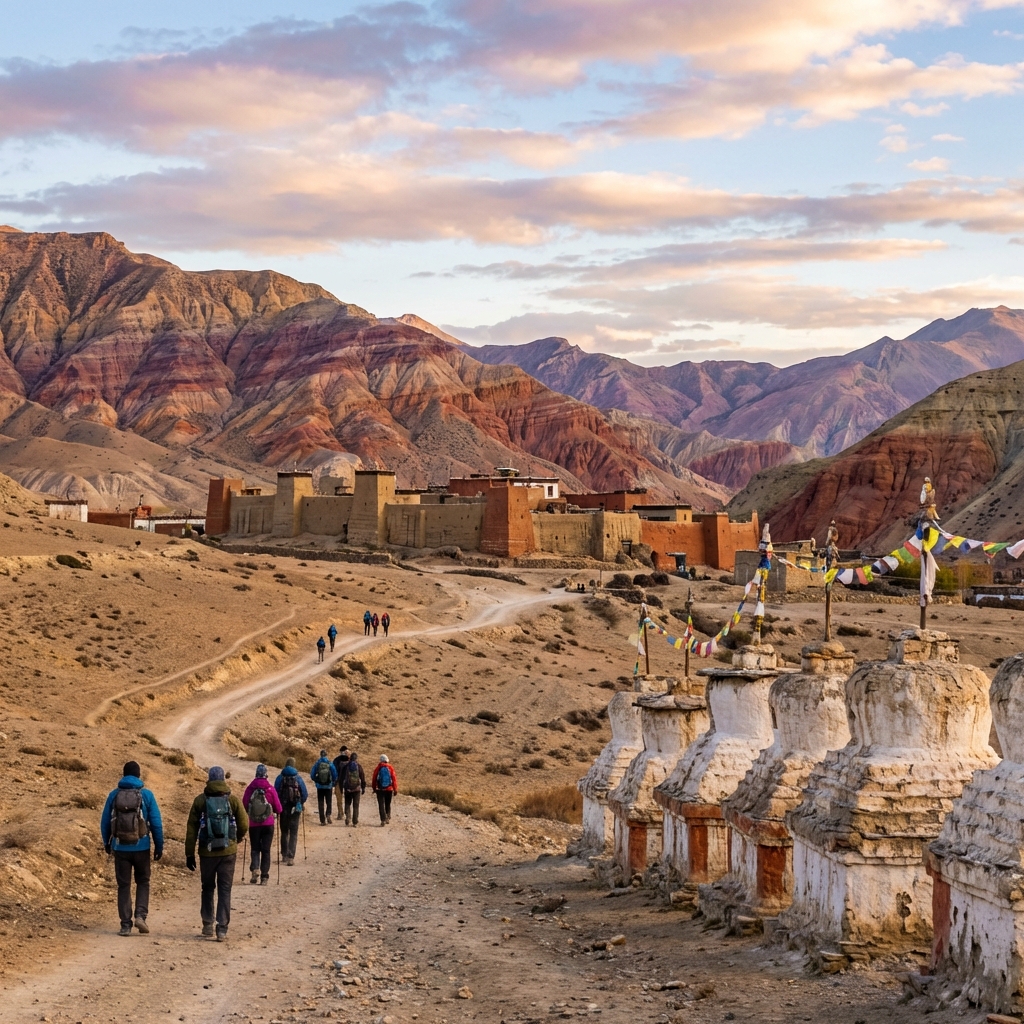
Dolpo, Nepal: Complete Trekking Guide 2026 to the Remote Himalaya
Dolpo (or Dolpa) is a high-altitude, culturally Tibetan region in far-northwest Nepal, bordering Tibet to the north and sheltered behind the Dhaulagiri massif. Most of it lies within Shey Phoksundo National Park, and it is Nepal's largest, least-populated district (~36,700 people). Trekking in Dolpo means Phoksundo Lake, Shey Gompa, restricted-area permits, and 14–28-day camping expeditions through Nepal's most remote Himalayan wilderness.
The Dolpo region is Nepal's final frontier—the most isolated, pristine, and culturally intact trekking destination in the entire Himalaya. Tucked away in the far northwest corner of Nepal, bordering Tibet to the north and sheltered behind the massive Dhaulagiri Himal, Dolpo represents everything that has disappeared elsewhere: ancient Tibetan Buddhist culture untouched by roads, medieval villages where salt caravans still depart for months-long journeys, and wildlife habitats where snow leopards roam freely among blue sheep herds numbering in the thousands.
This is not a region for casual trekkers. Upper Dolpo requires the most expensive permits in Nepal (USD 500 for the first 10 days, then USD 50/day), demands weeks of commitment (18-28 days minimum), necessitates full camping logistics in the highest sections, and tests even experienced high-altitude trekkers with passes exceeding 5,000 meters. Yet for those willing to invest the time, money, and effort, Dolpo delivers rewards unmatched anywhere else: the surreal turquoise waters of Phoksundo Lake (Nepal's deepest), the 800-year-old cliff monasteries of Shey Gompa where sky burials still occur, Tibetan villages that feel transported from another century, and the privilege of trekking during July-August monsoon season when the rest of Nepal drowns in rain—Dolpo's rain shadow location keeps skies clear while crowds disappear entirely.
Dolpo gained international fame through Eric Valli's Oscar-nominated film Himalaya (1999) and Peter Matthiessen's mystical book The Snow Leopard (1978), both documenting the region's extraordinary cultural and natural wealth. But unlike Everest or Annapurna, Dolpo has resisted mass tourism. Road construction stops at Juphal airport. Mobile phone coverage doesn't exist beyond lower valleys. The Tibetan border closure has isolated communities further. This remoteness is both Dolpo's challenge and its greatest asset—it remains what the Khumbu was in the 1960s, what Mustang was in the 1990s, a living museum of Himalayan Tibetan culture on the verge of transformation.
Who this guide is for:
- Experienced trekkers ready for Nepal's ultimate remote adventure
- Cultural explorers seeking authentic Tibetan Buddhist immersion
- Wildlife enthusiasts hoping to glimpse snow leopards and blue sheep
- Adventure photographers wanting pristine, crowd-free landscapes
- Those with 3+ weeks and budgets of $3,500-5,000+ for the journey of a lifetime
- Trekkers specifically seeking monsoon-season opportunities (July-August)
If you're comparing regions, understand this: Dolpo is categorically different from Everest, Annapurna, or Langtang. It's not about teahouse comfort, daily WiFi updates, or accessible logistics. It's about accepting genuine remoteness, embracing camping-based trekking, respecting cultural sensitivity (sky burials, sacred sites), and committing to an expedition-style adventure. If you want challenging, culturally profound, and utterly authentic Himalayan trekking—Dolpo is unmatched.
May–October (esp. July-Aug for monsoon advantage)
18–28 days for Upper Dolpo | 14–18 days for Lower Dolpo
Very Strenuous to Extreme
5,310m+ (Kang La, Sela Pass) | 3,611m (Phoksundo Lake - Lower Dolpo)
Upper Dolpo: $500 first 10 days + $50/day | Lower Dolpo: $20-25/week | Shey Phoksundo NP: $30
$3,500–5,000+ for Upper Dolpo | $2,200–3,500 for Lower Dolpo
Camping (Upper Dolpo high sections) | Basic teahouses (Lower Dolpo, lower sections)
Mandatory—restricted area permits require registered agency, min. 2 trekkers
Critical Understanding: This is Not a Standard Nepal Trek
Dolpo is Nepal's most challenging trekking region for good reasons:
- Permits alone cost $500+ USD (most expensive in Nepal)
- No independent trekking — a licensed guide is mandatory (restricted-area rule, registered agency required, minimum 2 people)
- Full camping required in Upper Dolpo high sections (no teahouses above Shey)
- Access is difficult (Kathmandu → Nepalgunj → Juphal flights, weather-dependent)
- Remote medical access (helicopter evacuation difficult, nearest hospital days away)
- Cultural sensitivity essential (Tibetan sacred sites, sky burial platforms, photography restrictions)
If this sounds daunting, consider Annapurna or Langtang first. Dolpo rewards experience, preparedness, and respect—not casual ambition.
What Makes Dolpo Unique: The Five Defining Features
1. Geographic Isolation: Nepal's Most Remote Trekking Region
Dolpo (or Dolpa) is officially Nepal's largest district at 7,889 square kilometers, yet also its least populated with only ~36,700 residents. The region occupies the northwestern corner of Karnali Province, bordered by Tibet to the north, the Dhaulagiri massif to the south, and ringed by high passes that isolate it from the rest of Nepal.
Why Dolpo is So Isolated:
- No roads penetrate beyond Juphal (2,475m), the gateway airport serving lower Dolpo
- Tibetan border crossings closed since China restricted access, cutting historic salt trade routes
- Mountain barriers on all sides: Access from any direction requires multi-day trekking over 4,000m+ passes
- Weather extremes: Winter snowfall closes passes for 6-7 months annually
- No mobile phone coverage beyond lower valleys (complete digital detox)
- Sparse population: Villages are days apart, separated by high wilderness
This isolation has preserved Dolpo in a time capsule. While the Khumbu has espresso bars in Namche and the Annapurna Circuit battles road construction, Dolpo's remoteness protects its authenticity—at the cost of accessibility.
2. Rain Shadow Effect: The Monsoon Advantage (July-August Excellence)
Dolpo's position behind the massive Dhaulagiri Himal (8,167m) creates a dramatic rain shadow effect that fundamentally changes when you can trek here:
How the Rain Shadow Works:
- Monsoon clouds from the south hit the Dhaulagiri barrier
- Moisture dumps as rain on southern slopes (Annapurna, Pokhara region)
- Clouds rise, cross the range, and descend into Dolpo already depleted of moisture
- Result: Dolpo receives minimal rainfall even during peak monsoon (June-August)
What This Means for Trekkers:
- July-August trekking is excellent in Dolpo when everywhere else drowns in rain
- Clear skies and dry trails during Nepal's monsoon season
- Zero crowds (you may see 5-10 other trekkers total on entire Upper Dolpo Circuit)
- Lower Dolpo sections still experience some monsoon moisture, but Upper Dolpo is pristine
- Trade-off: Afternoon clouds can obscure mountain views, but trails remain dry
Seasonal Comparison:
| Season | Rest of Nepal | Dolpo Region |
|---|---|---|
| Oct-Nov | Peak season, clear, crowded | Excellent, clear, almost empty |
| Dec-Feb | Cold, some lodges closed | Extremely cold, passes closed by snow |
| Mar-May | Spring peak, warming | Excellent, warming, wildflowers |
| Jun-Aug | Monsoon, rain, leeches, cancelled | IDEAL—rain shadow advantage, zero crowds |
For trekkers seeking solitude and monsoon-season trekking opportunities, Dolpo is unparalleled. When Everest Base Camp and Annapurna Circuit are off-limits due to rain, Dolpo thrives.
3. Tibetan Buddhist Culture: Living Medieval Heritage
Dolpo's cultural landscape is not Nepali—it's Tibetan. The population is ethnically Tibetan (known as Dolpo-pa), practicing Bon-influenced Tibetan Buddhism in a cultural continuum that stretches across the border into Tibet's Ngari prefecture.
Cultural Highlights:
- Shey Gompa (Shey Monastery): 800-year-old clifftop monastery overlooking the Crystal Mountain (Shey Ri), sacred pilgrimage site, site of traditional sky burials
- Bon-Buddhism blend: Unique mix of ancient Bon shamanism and Tibetan Buddhism (rare elsewhere in Nepal)
- Language: Dolpo-pa speak Kaike and Tibetan dialects, not Nepali as first language
- Architecture: Flat-roofed stone houses, whitewashed walls, prayer flag forests, chortens at every pass
- Salt caravans: Traditional yak and horse caravans still carry salt from Tibetan plateau to lowlands (though declining due to border closure and road salt availability)
- Sky burials: Traditional Tibetan funerary practice still performed (closed to tourists, culturally sacred)
- Polyandry: Traditional practice of fraternal polyandry (multiple brothers marrying one woman) still exists in remote villages
Eric Valli's "Himalaya" Film: The 1999 film Himalaya (original title: Himalaya - l'enfance d'un chef), directed by photographer Eric Valli, was filmed entirely in Dolpo with local villagers as actors. It tells the story of a generational conflict during a salt caravan journey, capturing authentic Dolpo culture before it transforms. The film received an Academy Award nomination for Best Foreign Language Film and remains the definitive cinematic portrait of Dolpo life.
Peter Matthiessen's "The Snow Leopard": The 1978 National Book Award-winning memoir documents Matthiessen's 1973 journey to Dolpo's Crystal Mountain (Shey Ri) with naturalist George Schaller, blending natural history, Buddhism, and personal grief into one of travel literature's masterpieces. The book introduced Dolpo to Western readers and remains essential pre-trek reading.
4. Wildlife Sanctuary: Snow Leopards, Blue Sheep, and Pristine Ecosystems
Dolpo sits within Shey Phoksundo National Park (established 1984), Nepal's largest national park at 3,555 square kilometers. The park protects trans-Himalayan ecosystems that are among the least disturbed in the entire Himalaya.
Wildlife of Dolpo:
Snow Leopards (Panthera uncia):
- Population: 90+ snow leopards recorded in Shey Phoksundo NP (highest density in Nepal)
- Best sighting opportunities: Upper Dolpo high valleys (4,000-5,500m), winter months when they descend
- Prey base: 4,000+ blue sheep (bharal) support this thriving population
- Conservation: Community-based conservation programs employ locals as wildlife monitors
- Trekking connection: Specialized "Snow Leopard Trek" itineraries focus on winter sightings (January-March)
Blue Sheep (Bharal - Pseudois nayaur):
- Massive herds (100-300 individuals) graze high alpine slopes
- Primary prey for snow leopards
- Easily visible from trails near Shey Gompa, Saldang, and high passes
- Trekkers commonly photograph herds from close range
Other Notable Wildlife:
- Himalayan wolf (Canis lupus chanco): Rare sightings in upper valleys
- Tibetan wild ass (kiang): Occasionally crosses from Tibet
- Himalayan tahr, musk deer, Himalayan marmot
- Birds: Himalayan griffon vulture, lammergeier, Tibetan snowcock, snow partridge
- Endangered species: Red panda (lower forests), Tibetan argali sheep
Phoksundo Lake (Shey Phoksundo):
- Depth: 650+ meters (Nepal's deepest lake)
- Altitude: 3,611 meters
- Color: Striking turquoise-blue due to glacial minerals and lack of aquatic life
- Cultural significance: Sacred to both Bon and Buddhist traditions
- Wildlife: Surrounding forests and cliffs support diverse ecosystems
For wildlife photographers and naturalists, Dolpo offers unmatched opportunities—blue sheep herds guaranteed, snow leopard tracks common, and actual sightings possible with luck and patience.
5. Extreme Permits and Costs: Nepal's Most Expensive Trek
Dolpo's restricted area status creates the highest permit costs in Nepal, serving as both conservation measure and crowd control:
Upper Dolpo Restricted Area Permit:
- Cost: USD $500 for the first 10 days
- Additional days: USD $50 per day after day 10
- Typical trek duration: 21-28 days = $1,000-1,400 in permits alone
- Obtained through: Registered trekking agency only (Department of Immigration, Kathmandu)
- Requirements: Minimum 2 trekkers, mandatory licensed guide
Lower Dolpo Restricted Area Permit:
- Cost: USD $20-25 per week
- Additional days: USD $5 per day after first week
- More accessible but still requires agency booking
Additional Required Permits:
- Shey Phoksundo National Park Entry Permit: USD $30 per person (entire trek duration)
- TIMS card: NPR 2,000 through a registered agency (as of 2026)
- If entering Upper Dolpo: You need TWO Lower Dolpo permits (one to enter Upper Dolpo, another when exiting Upper Dolpo back through Lower Dolpo to reach Juphal)
Why So Expensive?
- Conservation funding for Shey Phoksundo National Park
- Crowd control (limiting trekker numbers protects fragile culture and environment)
- Infrastructure costs (trail maintenance in extreme remoteness)
- Community benefit sharing (permits fund local development)
Total Trek Costs:
- Upper Dolpo: USD $3,500-5,000+ per person (permits, flights, guide, porter, camping, food, transportation)
- Lower Dolpo: USD $2,200-3,500 per person
These costs put Dolpo beyond casual trekking budgets, but they ensure that those who come are committed, prepared, and contribute meaningfully to local economies and conservation.
Upper Dolpo vs Lower Dolpo: Critical Distinctions
Understanding the difference between Upper and Lower Dolpo is essential for choosing your trek. They are not simply "easier" vs "harder" versions—they are fundamentally different experiences.
Lower Dolpo: The Gateway Experience
Geographic Coverage:
- Southern Dolpo region, primarily around Phoksundo Lake
- Lower altitude range (2,500m - 4,000m+)
- Accessible via Juphal airport with 3-4 days trekking to Phoksundo Lake
Cultural Highlights:
- Ringmo village (Phoksundo Lake shore)
- Lower altitude Tibetan villages
- Bon and Buddhist monasteries
- Traditional architecture and lifestyles
Logistics:
- Duration: 14-18 days typical
- Accommodation: Basic teahouses available along main routes
- Permits: Lower Dolpo permit ($20-25/week) + Shey Phoksundo NP ($30)
- Camping: Optional (some sections), not required
- Difficulty: Strenuous (high altitude but manageable)
- Best for: First-time Dolpo trekkers, those with 2-3 weeks, trekkers wanting Phoksundo Lake without extreme commitment
Trek Options:
- Phoksundo Lake Trek: 12-14 days, teahouse-based, moderate difficulty
- Lower Dolpo Circuit: 16-18 days, includes Numa La and Baga La passes (5,190m, 5,070m), teahouse + camping mix
Advantages:
- Lower cost ($2,200-3,500 vs $3,500-5,000+)
- Shorter time commitment
- Teahouse accommodation available
- Still very remote and culturally rich
- Stunning Phoksundo Lake experience
Limitations:
- Misses Shey Gompa, Crystal Mountain, and highest cultural sites
- Doesn't reach Tibet border region
- Less extreme wilderness feeling
- More trekkers (though still very few compared to Everest/Annapurna)
Upper Dolpo: The Ultimate Wilderness
Geographic Coverage:
- Northern Dolpo, approaching Tibetan border
- Highest altitude range (3,000m - 5,300m+)
- Includes Shey Gompa, Crystal Mountain, Saldang, and remote trans-Himalayan valleys
Cultural Highlights:
- Shey Gompa: 800-year-old monastery, sky burial site, Crystal Mountain pilgrimage
- Saldang: Largest village in upper Dolpo, medieval Tibetan architecture
- Namgung Monastery: Ancient gompa with precious murals
- Traditional villages: Shimen, Tinje, Tokyu, Karang—nearly unchanged for centuries
- Salt caravan culture: Witness or join traditional trading journeys (seasonal)
Logistics:
- Duration: 21-28 days minimum
- Accommodation: Camping mandatory in high sections (Shey area, high passes)
- Permits: Upper Dolpo permit (USD 50/day) + Lower Dolpo permits (x2) + Shey Phoksundo NP ($30)
- Total permit cost: Often $1,000-1,400 for full trek
- Camping: Full expedition-style camping with kitchen crew, camping gear, porters
- Difficulty: Extreme (multiple 5,000m+ passes, remote wilderness, altitude challenges)
- Best for: Experienced high-altitude trekkers, those with 4+ weeks, serious cultural explorers
Trek Options:
- Upper Dolpo Circuit: 24-28 days, full loop via Shey Gompa, Saldang, and high passes
- Dolpo to Jomsom Traverse: 26-30 days, links Dolpo to Annapurna Circuit (Mustang region)
- Extended Upper Dolpo with Lower Dolpo: 30+ days, comprehensive exploration
Advantages:
- Ultimate cultural immersion (Shey Gompa, sky burial culture, medieval villages)
- Pristine wilderness (near-zero trekkers in high sections)
- Wildlife opportunities (snow leopards, blue sheep herds)
- Authentic expedition-style trekking
- Life-changing adventure
Limitations:
- Extremely expensive ($3,500-5,000+)
- Requires 4+ weeks commitment
- Camping mandatory (no teahouse comfort at altitude)
- Altitude challenges (multiple high passes)
- Logistically complex (requires experienced agency and crew)
Which Dolpo Trek Should You Choose?
Choose Lower Dolpo if:
- You have 2-3 weeks available
- Budget is $2,500-3,500 USD
- You want Phoksundo Lake and cultural experience without extreme commitment
- Teahouse accommodation is preferred over camping
- This is your first trek in a restricted area
- You want to "test" Dolpo before committing to Upper Dolpo on a return trip
Choose Upper Dolpo if:
- You have 4+ weeks available
- Budget supports $4,000-5,000+ investment
- You're experienced with high-altitude trekking (5,000m+ passes)
- Cultural authenticity and remoteness are top priorities
- You want the ultimate Nepal trekking challenge
- You're comfortable with full camping logistics
- You seek near-total solitude and wilderness immersion
Consider Both (Extended Journey): Some trekkers combine Lower and Upper Dolpo in a single 30-35 day mega-trek, experiencing the full spectrum from Phoksundo Lake to Shey Gompa to Tibet border villages. This requires serious time and budget but delivers the definitive Dolpo experience.
Geography & Landscapes: Trans-Himalayan Wilderness
The Dolpo Massif: Peaks and Valleys
Dolpo's topography is defined by its position in the trans-Himalayan zone—the high-altitude Tibetan plateau environment that spills south across the Himalayan crest into Nepal.
Major Peaks Visible from Dolpo:
- Dhaulagiri I (8,167m): 7th highest mountain, massive southern barrier creating rain shadow
- Kanjirowa Himal (6,883m): Dolpo's "guardian peak" visible from many angles
- Putha Hiunchuli (7,246m): Dramatic pyramid peak
- Crystal Mountain (Shey Ri): Sacred peak above Shey Gompa, pilgrimage site
- Countless 6,000m+ unnamed peaks lining valleys and passes
The Four Historic Valleys of Dolpo:
Geographically and culturally, Dolpo, Nepal is traditionally divided into four valleys, each home to a distinct cluster of Tibetan villages and, since 1975, its own village development committee:
- Tsharka (Chharka): "good growing-place" — easternmost valley, including Nepal's highest farmed villages (Chharka, ~4,180m).
- Tarap: "auspicious excellent" — the long agricultural valley centred on Dho Tarap, the main gateway between Lower and Upper Dolpo.
- Panzang (Tinje): "abode of monks" — high northern valley draining toward Tibet via the Langu River.
- Nangkhong (Saldang): "innermost place" — the most populous valley, home to Saldang, Dolpo's largest settlement.
Valleys south of the watershed drain into the Bheri River; the northern valleys drain westward to the Karnali system. This four-valley structure is the clearest way to understand Dolpo's geography when planning which sections a trek will actually visit.
Key Valleys and Regions:
1. The Phoksundo Valley (Lower Dolpo):
- Phoksundo Lake basin at 3,611m
- Ringmo village on lake shore
- Steep-walled glacial valley with dramatic waterfalls
- Transitional zone from forested lower reaches to barren high plateaus
2. The Tarap Valley (Upper Dolpo Gateway):
- Long valley connecting lower and upper Dolpo
- Villages: Dho Tarap (main settlement), Tokyu, Koma
- Agricultural valley (barley, buckwheat) surrounded by barren peaks
- Cultural crossroads between Tibetan and Nepali influences
3. The Panzang Valley (Upper Dolpo Heartland):
- High desert plateau valley approaching Tibet
- Villages: Saldang (largest), Namdo, Shimen
- Vast open landscapes resembling Tibetan plateau
- Blue sheep habitat, snow leopard territory
4. The Shey Region (Sacred Heartland):
- Crystal Mountain (Shey Ri) and Shey Gompa monastery
- High alpine environment (4,000-5,000m)
- Pristine wilderness, almost no human habitation
- Spiritual heart of Dolpo Buddhism
High Passes: The Dolpo Challenge
Upper Dolpo treks cross multiple high passes, each demanding acclimatization, fitness, and mountain skills:
Major Passes:
Kang La Pass (5,320m):
- Connects Shey Gompa to Shimen/Saldang
- One of the highest trekking passes in Dolpo
- Stunning views of Crystal Mountain
- Challenging snow crossing (crampons recommended in shoulder seasons)
Sela Pass (5,094m):
- Links Saldang to Tarap Valley
- Wide, gradual approach
- Excellent blue sheep habitat
Numa La (5,190m) and Baga La (5,070m):
- Twin passes linking Phoksundo to Tarap Valley
- Lower Dolpo Circuit route
- Snow cover common except mid-summer
Neng La (5,400m+):
- Optional high pass on extended routes
- Extremely remote, rarely crossed
- Expedition-level difficulty
Jyangla Bhanjyang (5,220m):
- Upper Dolpo to Mustang crossing
- Multi-day wilderness approach
- Only for extended treks linking Dolpo to Jomsom/Kagbeni
Pass Preparation:
- Acclimatization days mandatory before high passes
- Pre-dawn starts essential (passes often close by afternoon due to wind/weather)
- Full camping gear required (no teahouses near high passes)
- Guides assess conditions daily (safety trumps itinerary)
Phoksundo Lake: The Turquoise Jewel
Shey Phoksundo Lake is Dolpo's signature natural wonder and often the primary goal for Lower Dolpo trekkers:
Vital Statistics:
- Altitude: 3,611 meters (11,849 feet)
- Depth: 650+ meters (Nepal's deepest lake, one of deepest alpine lakes globally)
- Surface Area: 4.94 square kilometers
- Color: Striking turquoise-blue from glacial minerals and absence of organic matter
- Water: Oligotrophic (low nutrients, no fish, minimal aquatic life)
Cultural Significance:
- Sacred to Bon religion (pre-Buddhist tradition still practiced in Dolpo)
- Buddhist pilgrims circumambulate the lake (kora)
- Ringmo village monastery overlooks the lake
- Subject of countless prayers, legends, and spiritual practices
Trekking Experience:
- Approach: 3-4 days from Juphal via lower Dolpo villages
- Views: Best from eastern shore and ridges above Ringmo
- Photography: Morning light ideal for turquoise color intensity
- Swimming: Culturally inappropriate (sacred lake), extremely cold water
- Camping: Lakeside camping possible but windy and cold
Wildlife:
- Surrounding forests: Red panda habitat (lower elevations)
- Cliffs: Lammergeier and Himalayan griffon vulture nesting sites
- Slopes: Blue sheep, Himalayan tahr
Eric Valli Connection: The opening scenes of Himalaya were filmed at Phoksundo Lake, with the dramatic turquoise waters and Ringmo village prominently featured. The lake has become an iconic image representing Dolpo's pristine beauty.
Tibetan Buddhist Culture: Sacred Sites and Living Traditions
Shey Gompa (Shey Monastery): The Spiritual Heart
Shey Gompa is Upper Dolpo's most sacred site, an 800-year-old monastery perched beneath the Crystal Mountain (Shey Ri) at approximately 4,343 meters.
Religious Significance:
- Crystal Mountain (Shey Ri): Sacred peak believed to embody the deity Vajrabhairava
- Pilgrimage site: Tibetan Buddhists from across the region make arduous journeys to circumambulate the mountain
- Monastery: Houses ancient murals, statues, and religious texts
- Hermitages: Meditation caves dot the surrounding cliffs
- Sky burial site: Traditional Tibetan funerary practice performed nearby (strictly off-limits to tourists)
Architectural Features:
- Flat-roofed stone construction typical of Tibetan high-altitude design
- Vivid red-painted walls contrast with barren landscape
- Prayer wheel gallery
- Main assembly hall with elaborate altar
- Monk quarters (monastery hosts 6-12 monks depending on season)
Trekking Logistics:
- Camping required: No teahouses in Shey area
- Access: Multi-day trek from Saldang or Phoksundo via high passes
- Altitude considerations: 4,300m+ requires excellent acclimatization
- Cultural etiquette: Remove shoes before entering, no photography of sacred interior without permission, dress modestly
- Donations: Monastery accepts offerings (USD $10-50 appreciated)
Best Time to Visit:
- May-October: Monastery accessible and monks in residence
- July-August: Monsoon season sees fewer trekkers, clearer weather due to rain shadow
- Festival times: Inquire with agency about monastic festivals (dates vary by lunar calendar)
Peter Matthiessen Connection: The Snow Leopard chronicles Matthiessen's 1973 journey to Shey Gompa with naturalist George Schaller. The book's spiritual and naturalistic observations center on the Crystal Mountain region, making this essential pre-trek reading for cultural context.
Sky Burials: Understanding Sacred Funerary Traditions
Sky burial (jhator) is the traditional Tibetan Buddhist funerary practice still performed in upper Dolpo, where bodies are offered to vultures on sacred platforms.
Cultural and Religious Context:
- Buddhist belief: The body is an empty vessel after death; offering it to vultures is a final act of generosity
- Practical considerations: Frozen ground makes burial impossible; wood scarcity makes cremation impractical
- Sacred sites: Specific platforms near Shey Gompa and other monasteries
- Rituals: Performed by specialized practitioners (rogyapas), accompanied by monks' prayers
Critical Trekking Etiquette:
- Never approach sky burial sites: These are sacred spaces, off-limits to outsiders
- No photography: Attempting to photograph sky burials is profoundly disrespectful and may result in serious consequences
- Respect mourning: If you encounter funeral processions or rituals, maintain distance and silence
- Ask your guide: They will navigate cultural sensitivities and keep you appropriately distant from sacred practices
Why This Matters: Tourists attempting to photograph or approach sky burials have caused severe cultural offense in the past, damaging community relationships with trekkers. Respect these boundaries absolutely.
Major Villages: Tibetan Settlement Life
Saldang (4,120m):
- Upper Dolpo's largest village with ~500 residents
- Traditional flat-roofed architecture
- Active monastery and chortens throughout village
- Agricultural terraces (barley, buckwheat)
- Trekking: Multi-day camping approach from Phoksundo or Shey
- Teahouses: 2-3 very basic guesthouses (no guarantee of space)
- Cultural highlights: Village festivals, traditional dress, medieval lifestyles
Dho Tarap (4,040m):
- Gateway between Lower and Upper Dolpo
- Bon monastery (rare glimpse of pre-Buddhist traditions)
- Camping sites available
- Lower Dolpo Circuit hub: Most trekkers pass through
- Cultural blending: Mix of Buddhist and Bon practices
Ringmo (3,640m):
- Village on Phoksundo Lake shore
- Lower Dolpo base: Teahouses and lodges available
- Monastery with lake views
- Access: 3-4 days from Juphal
- Photography paradise: Turquoise lake, traditional architecture
Shimen (4,630m):
- One of Upper Dolpo's highest villages
- Near Kang La pass approach
- Spectacular blue sheep habitat
- Minimal facilities, camping required
Tokyu and Karang:
- Remote Tarap Valley villages
- Traditional polyandry still practiced
- Agricultural communities (limited growing season)
- Camping-based stops on Upper Dolpo routes
Bon Religion: Pre-Buddhist Traditions
Bon is the indigenous religion of Tibet that predates Buddhism's arrival. Dolpo preserves Bon practices more than almost anywhere:
Key Bon Sites:
- Dho Tarap Bon Monastery: One of few active Bon monasteries accessible to trekkers
- Ritual differences: Circumambulation is counterclockwise (opposite to Buddhism)
- Deities: Pre-Buddhist spirits and nature deities
- Practices: Shamanic elements, ritual dances, distinctive iconography
Buddhist-Bon Syncretism: Most Dolpo residents practice a blend of Bon and Buddhism, with village monasteries incorporating both traditions. This religious fusion is unique to Dolpo and a few other trans-Himalayan regions.
Wildlife & Natural History: Shey Phoksundo National Park
Snow Leopards: The Ghost Cats of Dolpo
Dolpo offers the best snow leopard habitat in Nepal, with Shey Phoksundo National Park recording 90+ individuals (highest density in the country).
Why Dolpo is Prime Snow Leopard Territory:
- Massive prey base: 4,000+ blue sheep provide ample food
- Remote wilderness: Minimal human disturbance allows natural behaviors
- Ideal habitat: 4,000-5,500m alpine slopes and cliffs
- Protected status: National park regulations and community conservation
Sighting Opportunities:
- Winter (January-March): Snow leopards descend to lower elevations (3,500-4,500m) following blue sheep
- Summer (May-October): Higher elevations, harder to spot but tracks and signs common
- Best areas: Shey region, Kang La approaches, Saldang area cliffs
- Specialized treks: Some agencies offer "Snow Leopard Trek" winter itineraries focused on sightings
Realistic Expectations:
- Sighting probability: 10-20% on dedicated winter wildlife treks (higher than most regions)
- Tracks and signs: 90%+ of trekkers see paw prints, scat, or scrapes
- Blue sheep sightings: Nearly guaranteed (herds of 50-300 common)
- Patience required: Wildlife observation demands early mornings, quiet movement, and luck
Conservation: Community-based snow leopard conservation programs employ local herders as wildlife monitors, reducing human-wildlife conflict and creating economic value for conservation. Your trekking fees support these initiatives.
Blue Sheep (Bharal): The Snow Leopard's Prey
Blue sheep (Pseudois nayaur), known as bharal, are the keystone prey species supporting Dolpo's snow leopard population.
Sightings:
- Guaranteed encounters: Herds of 50-300+ individuals visible from trails
- Best locations: Shey Gompa area, Kang La approaches, Saldang cliffs
- Behavior: Surprisingly tolerant of humans; often graze within 50-100m of trekkers
- Photography: Excellent opportunities for close-range wildlife photography
Ecology:
- Habitat: 3,500-5,500m alpine slopes
- Diet: Grasses, sedges, alpine vegetation
- Social structure: Mixed-sex herds, males display during autumn rut
- Predators: Snow leopards (primary), Himalayan wolf (secondary)
Why They Matter: The 4,000+ blue sheep in Shey Phoksundo NP create a sustainable prey base that supports Nepal's highest snow leopard density. Conservation of blue sheep is conservation of snow leopards.
Other Notable Wildlife
Himalayan Wolf (Canis lupus chanco):
- Rare but present in upper Dolpo
- Pack size typically 3-8 individuals
- Prey on blue sheep, marmots
- Sightings very rare (tracks more common)
Himalayan Tahr:
- Lower elevation (2,500-4,000m) than blue sheep
- Forest-dwelling vs. alpine slopes
- Common in Phoksundo area forests
Tibetan Wild Ass (Kiang):
- Occasionally crosses from Tibet into upper Dolpo
- Very rare sightings (northern borderlands only)
Marmots:
- Himalayan marmot: Common above 4,000m
- Whistle alarms echo across valleys
- Comic relief for tired trekkers
Birds:
- Lammergeier (Bearded Vulture): Massive wingspan, bone-dropping behavior
- Himalayan Griffon Vulture: Sky burial participants
- Tibetan Snowcock: Large gamebird of high slopes
- Snow Partridge, Alpine Chough, Red-billed Chough
Red Panda:
- Lower Dolpo forests (2,500-3,500m)
- Extremely rare, nocturnal, shy
- Sightings nearly impossible (tracks occasionally found)
Flora: From Forests to Alpine Deserts
Vegetation Zones:
Subtropical Forests (below 2,500m):
- Blue pine, spruce, fir forests
- Rhododendron understory
- Lower Dolpo approach trails
Temperate Forests (2,500-3,500m):
- Juniper, birch, willow
- Medicinal plants (yarsagumba, rhodiola)
- Phoksundo area forests
Alpine Scrub (3,500-4,500m):
- Dwarf juniper, cushion plants
- Wildflowers (primula, edelweiss, gentian) in May-June
- Sparse vegetation
Trans-Himalayan Desert (above 4,500m):
- Virtually barren
- Sparse grasses and sedges
- High-altitude mosses and lichens
- Resembles Tibetan plateau
Seasonal Changes:
- Spring (May-June): Wildflower blooms, verdant valleys
- Summer (July-August): Peak vegetation, monsoon growth
- Autumn (September-October): Golden grasses, clear air
- Winter (November-April): Barren landscapes, frozen rivers
Best Time to Trek Dolpo: The Monsoon Advantage
Dolpo's rain shadow location fundamentally changes its trekking calendar compared to the rest of Nepal.
Month-by-Month Guide
| Month | High | Low | Conditions | Crowds | Notes |
|---|---|---|---|---|---|
| January | - | - | Extreme cold, deep snow, passes closed | ||
| February | - | - | Very cold, snow leopard season, difficult access | ||
| March | - | - | Transitional, passes opening, cold nights | ||
| April | - | - | Spring begins, excellent trekking, wildflowers | ||
| May | - | - | Peak spring, ideal conditions, warming | ||
| June | - | - | Early monsoon, rain shadow begins, good trekking | ||
| July | - | - | EXCELLENT—rain shadow peak, zero crowds | ||
| August | - | - | EXCELLENT—rain shadow continues, pristine trails | ||
| September | - | - | Peak autumn begins, crystal clear, excellent | ||
| October | - | - | Peak trekking season, clear skies, cold nights | ||
| November | - | - | Late autumn, very clear, increasing cold | ||
| December | - | - | Winter arrives, passes closing, snow leopard season |
Seasonal Analysis
Peak Trekking Season (September-October):
- Advantages: Crystal-clear skies, stable weather, excellent visibility, comfortable temperatures
- Disadvantages: Most expensive permits still apply, slightly more trekkers (though still very few)
- Best for: Classic trekking experience, photography, first-time Dolpo visitors
The Monsoon Advantage (July-August):
- Advantages:
- Rain shadow effect in full force: Upper Dolpo receives <50mm rainfall while Everest region drowns in 300mm+
- Zero crowds: You may be the ONLY trekkers in upper Dolpo during these months
- Wildflowers: Alpine meadows bloom with color
- Warmer temperatures: Daytime highs 18-25°C make high-altitude camping more pleasant
- Lower Dolpo accessible: Lower sections see more rain but still trekable
- Disadvantages:
- Lower sections (below Phoksundo) can be muddy first few days
- Afternoon clouds may obscure distant mountain views
- Juphal flights more weather-dependent (backup days essential)
- Best for: Adventurous trekkers seeking ultimate solitude, those wanting monsoon-season trekking, experienced trekkers comfortable with uncertainty
Spring Season (April-June):
- Advantages: Warming temperatures, wildflower blooms, passes clearing of snow, long daylight hours
- Disadvantages: Pre-monsoon clouds can build by May, dust on trails
- Best for: Wildlife photography (blue sheep), comfortable camping temperatures
Winter Season (December-February):
- Advantages: Snow leopard sightings peak (animals descend to lower elevations), crystal-clear air, ultimate solitude
- Disadvantages: Extreme cold (-20°C+ at altitude), many passes closed by snow, difficult logistics, requires 4-season camping gear
- Best for: Hardcore wildlife photographers, snow leopard enthusiasts, extreme cold-weather specialists
- Not recommended for: Standard trekkers (passes are impassable without technical mountaineering skills)
When to Go: Decision Matrix
Choose September-October if:
- You want guaranteed stable weather
- Photography and mountain views are priorities
- You prefer classic trekking conditions
- This is your first trek in Dolpo or restricted areas
Choose July-August if:
- You seek absolute solitude (near-zero trekkers)
- You want to trek during Nepal's monsoon when other regions are impossible
- You're comfortable with some afternoon cloud cover
- You prioritize unique experiences over perfect weather
- You're an experienced trekker who embraces uncertainty
Choose May-June if:
- You want wildflower blooms and greener landscapes
- Warmer camping temperatures are important
- You're targeting the transition from spring to summer
Avoid November-March unless:
- You're on a specialized snow leopard photography expedition (winter only)
- You have extreme cold-weather mountaineering experience
- You accept that many high passes will be closed or require technical skills
Special Considerations:
- Festivals: Dolpo's Buddhist festivals follow the lunar calendar; consult with your trekking agency for specific dates
- Juphal flights: More reliable in autumn (Sept-Oct); monsoon season (June-Aug) sees more delays
- Permit processing: Allow 2-3 weeks in Kathmandu for restricted area permits regardless of season
Permits, Regulations & Requirements: Navigating the Bureaucracy
Complete Permit Breakdown
Dolpo's restricted area status creates Nepal's most complex (and expensive) permitting system.
For Upper Dolpo Trekking:
1. Upper Dolpo Restricted Area Permit
- Cost: USD $500 for the first 10 days
- Additional days: USD $50 per day (day 11+)
- Typical duration: 21-28 days = $1,000-1,400 in permits
- Issued by: Department of Immigration, Kathmandu
- Processing time: 7-14 days (agency handles)
- Requirements:
- Minimum 2 trekkers (no solo permits)
- Registered trekking agency required
- Licensed guide mandatory
- Passport copy, photos, itinerary
- Valid for: Specified trek duration
2. Lower Dolpo Restricted Area Permits (x2 required for Upper Dolpo access)
- Why two? You need one to enter Lower Dolpo (to reach Upper Dolpo), and another to exit Upper Dolpo back through Lower Dolpo to Juphal
- Cost per permit: USD $20-25 per week + $5 per day beyond 7 days
- Typical cost: USD $40-60 total for both permits
- Issued by: Department of Immigration, Kathmandu
3. Shey Phoksundo National Park Entry Permit
- Cost: USD $30 per person
- Validity: Entire trek duration
- Issued by: National Park office in Kathmandu or Juphal
- Purpose: Park conservation funding
4. TIMS Card (Trekkers' Information Management System)
- Cost: FREE (registration only, as of 2026)
- Required for: Safety tracking
- Issued by: Nepal Tourism Board or TAAN office
Total Upper Dolpo Permit Costs:
- 21-day trek: $500 (Upper) + $50 (Lower x2) + $30 (Park) = ~$580 + agency fees
- 28-day trek: $1,400 (Upper for 28 days) + $50 (Lower x2) + $30 (Park) = ~$1,480 + agency fees
- Agency markup: Expect $100-200 additional for processing
For Lower Dolpo Trekking:
1. Lower Dolpo Restricted Area Permit
- Cost: USD $20-25 per week (first 7 days)
- Additional days: USD $5 per day beyond day 7
- Typical 16-day trek: ~$35-40 total
- Issued by: Department of Immigration, Kathmandu
2. Shey Phoksundo National Park Entry Permit
- Cost: USD $30 per person
- Validity: Entire trek duration
3. TIMS Card
- Cost: FREE (registration)
Total Lower Dolpo Permit Costs:
- 16-day trek: ~$65-70 + agency fees
Mandatory Requirements: No Exceptions
1. Trekking Agency Required:
- You CANNOT apply for restricted area permits independently
- You CANNOT trek Dolpo without agency booking
- Why: Nepal regulations mandate agency involvement for all restricted areas
- What this means: Add 10-15% agency markup to all costs
2. Minimum Two Trekkers:
- Solo trekking permits NOT issued for Dolpo
- Exception: If you book solo, agency pairs you with another trekker OR charges you for two permits (expensive)
- Workaround: Join scheduled group departures (cost-sharing)
3. Licensed Guide Mandatory:
- All Dolpo treks require licensed guide (not just porter)
- Guide must be registered with TAAN and have restricted area experience
- Guide costs: $25-$35 per day for experienced Dolpo guides
4. Itinerary Must Be Submitted:
- Your permits specify exact route, entry/exit points, duration
- Flexibility: Some variation allowed, but major changes require permit amendments
- Checkpoints: You'll show permits at Juphal, Shey Phoksundo NP gate, and village checkpoints
Where to Obtain Permits
Option 1: Through Trekking Agency (99% of Trekkers)
- How it works: Agency handles all paperwork, you provide passport copy and photos
- Advantages: Zero hassle, expertise in processing, relationships with officials
- Disadvantages: Markup costs ($100-200+), less control over process
- Processing time: 10-14 days in Kathmandu before trek
Option 2: Independent Application (Extremely Rare for Dolpo)
- Reality: Restricted area permits require agency registration; truly independent application is nearly impossible for Dolpo
- If you try: You'll still need to register a "trekking agency" status, defeating the purpose
- Recommendation: Don't attempt this for Dolpo—work with established agencies
Choosing a Trekking Agency
Critical Criteria for Dolpo Agencies:
1. Dolpo-Specific Experience:
- How many Dolpo treks has the agency operated?
- Do they have Dolpo-native guides and staff?
- Can they provide references from past Dolpo clients?
2. Camping Logistics Expertise:
- Upper Dolpo requires full camping—kitchen tent, dining tent, sleeping tents, toilet tents
- Do they own equipment or rent it? (ownership = better quality control)
- What's the food menu at high altitude?
3. Environmental Practices:
- Waste management (pack out all trash, including human waste at high camps)
- Kerosene stoves (not wood burning)
- Leave No Trace principles
4. Cultural Sensitivity:
- Guide training in cultural etiquette (sky burials, sacred sites, photography restrictions)
- Community benefit-sharing (do they hire local porters, purchase local food?)
5. Safety Protocols:
- Emergency evacuation procedures (satellite phone, insurance coordination)
- Guide training in altitude illness recognition
- Comprehensive first aid kits
6. Transparent Pricing:
- Detailed cost breakdown (permits, flights, guide, porter, food, camping gear)
- No hidden fees
- Clear tipping guidelines
Recommended Budget:
- Lower Dolpo: $2,200-3,500 all-inclusive with reputable agency
- Upper Dolpo: $3,500-5,000+ all-inclusive
- Budget agencies: May save $500-800 but often cut corners on food, gear, guide experience
- Premium agencies: Worth the investment for comfort, safety, cultural insight
Permit Checkpoints on Trail
Where You'll Show Permits:
Juphal Checkpoint:
- Upon arrival at Juphal airport
- Police and TAAN office verify permits
- 5-10 minute process
Shey Phoksundo National Park Gate:
- Usually near Chhepka or Sulighat (2-3 hours from Juphal)
- Park rangers check national park permits
- Entry recorded in logbook
Village Checkpoints:
- Some villages (Dho Tarap, Saldang) have local checkpoints
- Quick verification, friendly process
- Keep permits accessible in waterproof pouch
Important:
- Never leave permits in Kathmandu or hotel safes—you need them on trail
- Photocopies useful: Keep copies separate from originals
- Waterproof protection: Monsoon and river crossings can damage paper permits
- Loss procedure: Extremely difficult to replace on trail; report to guide immediately
Getting There: Access to Dolpo (The Journey is Part of the Adventure)
Kathmandu to Juphal: The Multi-Stage Journey
There is no direct access to Dolpo. The journey requires patience, flexibility, and built-in buffer days.
Standard Route: Kathmandu → Nepalgunj → Juphal
Stage 1: Kathmandu to Nepalgunj (Terai Lowlands)
By Air (Recommended):
- Flight time: 1 hour
- Frequency: 3-5 flights daily (Buddha Air, Yeti Airlines)
- Cost: $150-220 USD one-way
- Reliability: 80-90% on-time in clear weather
- Advantages: Fast, avoids 12+ hour bus journey
- Disadvantages: Expensive, occasional delays
By Bus (Budget Option):
- Duration: 12-14 hours overnight bus
- Cost: $12-20 USD
- Comfort: Tourist bus slightly better than local
- Advantages: Cheap, overnight = no lost day
- Disadvantages: Long, uncomfortable, arrives exhausted for next day's flight
Nepalgunj Stopover:
- Required: You'll spend 1 night in Nepalgunj (Juphal flights depart early morning only)
- Hotels: Basic but adequate ($15-40 USD)
- Preparation: Final gear checks, cash withdrawal (last ATMs before Dolpo)
Stage 2: Nepalgunj to Juphal (Gateway to Dolpo)
Flight Details:
- Airlines: Summit Air, Tara Air, Sita Air
- Aircraft: Small Twin Otter (15-17 passengers)
- Flight time: 35 minutes
- Cost: $200-250 USD one-way
- Baggage limit: 15kg checked + 5kg hand carry (strictly enforced)
- Frequency: Morning flights only (6:00-9:00 AM window)
The Juphal Flight Experience:
- Scenic: Spectacular views of Dhaulagiri range, deep valleys
- Unpredictable: Weather-dependent (winds, clouds, visibility)
- Delays common: 1-3 day delays occur during monsoon and winter
- Seat strategy: Left side Nepalgunj→Juphal for mountain views
Weather Challenges:
- Morning-only operations: Afternoon winds make landing dangerous
- Cloud cover: Even slight clouds cancel flights (runway visibility critical)
- Monsoon impact: June-August sees higher cancellation rates (30-40%)
- Winter impact: December-February can see snow delays
Buffer Days Essential:
- Recommendation: Build 2-3 buffer days into itinerary (Nepalgunj on entry, Juphal/Nepalgunj on exit)
- Backup plan: If stuck 3+ days, road/bus options exist but add 2-3 days to return journey
- Insurance: Trip delay coverage critical (pay for extra Nepalgunj hotels)
Juphal Airport (2,475m):
- Facilities: Tiny single-room terminal, basic lodge, minimal services
- Trekking starts immediately: Most trekkers begin hiking within 1-2 hours of landing
- Supplies: Last chance for emergency supplies (limited shop, inflated prices)
- ATMs: None (carry all cash from Nepalgunj or Kathmandu)
Alternative Access: Road Construction and Future Routes
Current Reality:
- Roads are being constructed from Tarakot toward Dolpo
- Not yet complete (as of 2026), and progress is slow
- When complete: Will change Dolpo access dramatically (likely 5-10 years)
Potential Future Access (2030s):
- Bus/jeep from Nepalgunj to Juphal or beyond
- Faster access but cultural impacts uncertain
- For now, flight access protects Dolpo's remoteness
Exit Strategy: Ending Your Trek
Standard Exit: Juphal Flight Out
- Same route as entry: Juphal → Nepalgunj → Kathmandu
- Buffer days even more critical on exit: You have international flights to catch
- Stuck in Juphal: Basic lodges exist, but it's a dusty, uncomfortable wait
Alternative Exits (Extended Treks Only):
1. Dolpo to Jomsom Traverse:
- Duration: 26-30 days total (Juphal to Jomsom via Upper Dolpo)
- Route: Cross high passes to link with Annapurna Circuit at Kagbeni/Jomsom
- Advantages: Avoids Juphal backtrack, epic journey
- Disadvantages: Adds 7-10 days, requires additional permits (Upper Mustang or standard ACAP)
2. Overland Return (Emergency Only):
- If flights canceled for 4+ days, bus/jeep from Juphal to Surkhet to Nepalgunj possible
- Duration: 2-3 days of rough roads
- Cost: $80-150 USD for private jeep
- Last resort only: Uncomfortable, time-consuming
Helicopter Charter (Emergency/Luxury):
- Direct Juphal to Kathmandu: Possible but extremely expensive ($5,000-8,000 USD for charter)
- Used for: Medical evacuations, ultra-luxury treks
- Not practical for: Standard trekkers
Accommodation & Logistics: Camping vs Teahouses
Lower Dolpo: Hybrid Teahouse + Camping
Teahouse Availability:
- Lower sections (Juphal to Phoksundo): Basic teahouses exist in most villages
- Quality: Very basic—shared rooms, bunk beds, simple dal bhat meals
- Facilities: Squat toilets, no hot showers above Ringmo, minimal electricity
- Costs: NPR 500-1,000 ($4-8) per room, meals NPR 600-900 ($5-7)
Where Teahouses Exist:
- Dunai, Ankhe, Chhepka (lower approach)
- Ringmo (Phoksundo Lake shore)
- Dho Tarap (Tarap Valley hub)
Camping Required:
- High pass approaches: Numa La, Baga La base camps have no teahouses
- Remote sections: Between Dho Tarap and upper valleys
- Flexibility: Camping allows flexibility to stop anywhere
Typical Lower Dolpo Mix:
- 60% teahouse nights (villages)
- 40% camping nights (passes, remote sections)
Upper Dolpo: Expedition-Style Full Camping
Reality: No Teahouses Above Shey Region
- Upper Dolpo = camping trek: Full camping infrastructure required
- Saldang exception: 2-3 extremely basic "guesthouses" exist but NO guarantee of space
- Plan for camping: Even if you hope for village lodging, carry full camping gear
Camping Logistics:
Required Equipment (Agency Provides):
- Sleeping tents: 2-person tents for clients
- Dining tent: Large mess tent for meals
- Kitchen tent: Cook tent with equipment
- Toilet tent: Portable toilet with privacy tent
- Crew tents: Guide, cook, porters' accommodation
Typical Camping Crew (Upper Dolpo):
- 1 guide (licensed, Dolpo-experienced)
- 1 cook (high-altitude cooking specialist)
- 1-2 kitchen assistants
- 4-8 porters (depending on group size, carrying tents, food, fuel)
- Total crew: 8-12 people for 2 trekkers (Dolpo is labor-intensive)
Food at Altitude:
- Breakfast: Porridge, eggs, pancakes, tea/coffee
- Lunch: Trail lunch (packed sandwiches, fruit) or cooked lunch at midday camp
- Dinner: Dal bhat, noodles, soup, vegetables (cooking skills vary by agency)
- Quality matters: Good agencies bring varied menus, fresh ingredients (within weight limits)
Camping Challenges:
- Cold nights: Expect -10 to -15°C at 4,500m+ camps (quality sleeping bag essential)
- Altitude cooking: Water boils at lower temperature (pasta takes longer, food less tasty)
- Wind: High camps exposed to strong winds (tent quality critical)
- Toilet facilities: Squat over portable toilet or dig catholes (agency dependent)
Environmental Considerations:
- Pack out all trash: Responsible agencies carry ALL waste back to Juphal
- Human waste: High camps require either pack-out systems or deep catholes (150m+ from water)
- Kerosene stoves: No wood burning allowed (agencies carry kerosene fuel)
What to Bring: Personal Camping Gear
Agency Provides:
- Tents (sleeping, dining, kitchen)
- Sleeping pads (foam or inflatable)
- Dining tables and chairs
- Cookware and utensils
You Must Bring:
- Sleeping bag: -15°C to -20°C rated (critical—rent quality bags in Kathmandu if needed)
- Sleeping bag liner: Adds warmth, cleanliness
- Headlamp: Essential (dinner/bathroom in dark tents)
- Personal eating utensils: Some agencies provide, but bring your own for hygiene
- Water bottles/hydration system: 3+ liters capacity (long days between water sources)
- Personal first aid kit
Cold Weather Camping Tips:
- Sleeping bag fluff: Shake out sleeping bag 30 min before bed (maximizes loft)
- Warm water bottle: Ask cook to fill Nalgene with hot water (foot warmer overnight)
- Pee bottle: Avoid leaving tent at night (1L wide-mouth bottle essential)
- Morning routine: Everything freezes overnight—water bottles, boots, etc.
Major Dolpo Treks: Route Options & Itineraries
1. Lower Dolpo Circuit (16-18 Days)
Overview: The classic Lower Dolpo trek circumnavigates Phoksundo Lake and crosses two high passes (Numa La and Baga La), delivering a taste of Dolpo's remoteness without the extreme commitment and cost of Upper Dolpo. For a day-by-day plan, see our Lower Dolpo trek guide.
Typical Itinerary:
- Day 1-2: Kathmandu → Nepalgunj → Juphal
- Day 3: Trek Juphal to Ankhe (2,660m)
- Day 4: Trek to Chhepka via Shey Phoksundo NP gate (2,670m)
- Day 5: Trek to Ringmo village (3,640m) on Phoksundo Lake shore
- Day 6: Acclimatization day, explore Phoksundo Lake
- Day 7: Trek to Phoksundo Khola camp (3,630m)
- Day 8: Trek to Phoksundo Bhanjyang (4,120m), prepare for pass
- Day 9: Cross Kang-La or Numa La pass (5,190m), descend to Numa La base camp (4,440m)
- Day 10: Trek to Danigar (4,631m)
- Day 11: Cross Baga La pass (5,070m), descend to Yak Kharka (3,850m)
- Day 12: Trek to Dho Tarap (4,040m), visit Bon monastery
- Day 13: Rest day in Dho Tarap, cultural exploration
- Day 14: Trek to Tarap Khola (3,800m)
- Day 15: Trek to Khanigaon (3,150m)
- Day 16: Trek to Juphal (2,475m)
- Day 17: Fly Juphal → Nepalgunj → Kathmandu
- Day 18: Buffer day (flight delays)
Highlights:
- Phoksundo Lake (Nepal's deepest)
- Two high passes (Numa La, Baga La)
- Dho Tarap Bon monastery
- Ringmo village Tibetan culture
- Blue sheep sightings
Difficulty: Strenuous (high altitude, long days, camping required for passes)
Cost: $2,200-3,500 USD all-inclusive
Best For: First-time Dolpo trekkers, those with 2.5-3 weeks, trekkers wanting high passes without Upper Dolpo expense
2. Upper Dolpo Circuit (24-28 Days)
Overview: The ultimate Dolpo experience—a complete circuit linking Phoksundo, Shey Gompa, Crystal Mountain, Saldang, and the highest Tibetan villages, crossing multiple 5,000m+ passes through pristine wilderness. See the full Upper Dolpo trek guide for the detailed itinerary and our Dolpo permits guide for the restricted-area paperwork.
Typical Itinerary:
- Day 1-2: Kathmandu → Nepalgunj → Juphal
- Day 3-6: Trek Juphal to Phoksundo Lake (same as Lower Dolpo)
- Day 7: Acclimatization day at Phoksundo
- Day 8-10: Trek from Phoksundo to Shey Gompa via high route (camping)
- Day 11: Rest day at Shey Gompa, monastery visit, Crystal Mountain pilgrimage
- Day 12: Trek to Namduna Gaon (4,800m)
- Day 13: Cross Kang La Pass (5,320m), descend to Shimen (4,630m)
- Day 14: Trek to Saldang (4,120m), largest upper Dolpo village
- Day 15: Rest day in Saldang, cultural immersion
- Day 16: Trek to Yangze Gompa (4,960m)
- Day 17: Cross Sela Pass (5,094m), trek to Jeng La Phedi (4,900m)
- Day 18: Cross Jyangla Bhanjyang (5,220m), descend to Tokyucamp
- Day 19: Trek to Dho Tarap (4,040m)
- Day 20: Rest day in Dho Tarap
- Day 21-23: Trek from Dho Tarap to Juphal (3 days descent)
- Day 24: Fly Juphal → Nepalgunj → Kathmandu
- Day 25-28: Buffer days for flight delays
Extended Options:
- Add Tilicho Lake side trip: Links Dolpo to Annapurna Circuit (30-35 days total)
- Dolpo to Jomsom traverse: Exit via Kagbeni/Mustang instead of Juphal (28-32 days)
Highlights:
- Shey Gompa and Crystal Mountain (spiritual heart)
- Saldang (medieval Tibetan village life)
- Multiple high passes (Kang La, Sela, Jyangla—all 5,000m+)
- Snow leopard habitat and blue sheep herds
- Complete cultural immersion (weeks without seeing other trekkers)
Difficulty: Extreme (altitude, remoteness, full camping, physical endurance)
Cost: $3,500-5,000+ USD all-inclusive
Best For: Experienced high-altitude trekkers, those with 4+ weeks, cultural explorers seeking ultimate authenticity
3. Phoksundo Lake Short Trek (12-14 Days)
Overview: A shortened Dolpo introduction focusing on Phoksundo Lake without high passes, suitable for those with limited time or seeking lower-altitude trekking.
Itinerary:
- Day 1-2: Kathmandu → Nepalgunj → Juphal
- Day 3-5: Trek Juphal to Phoksundo Lake (Ringmo village)
- Day 6: Explore Phoksundo Lake, Ringmo monastery
- Day 7: Optional day hike to higher viewpoints
- Day 8-10: Trek back to Juphal (3 days)
- Day 11: Fly out (buffer day)
Highlights:
- Phoksundo Lake (primary goal)
- Lower Dolpo Tibetan villages
- Teahouse-based (camping optional)
- Lower altitude (max 3,640m)
Difficulty: Moderate (lower altitude, no high passes)
Cost: $1,800-2,800 USD
Best For: Limited time (2 weeks), altitude-sensitive trekkers, those wanting Dolpo flavor without extreme commitment
Safety, Altitude & Emergencies: Critical Protocols
Altitude Challenges in Dolpo
Dolpo's multiple high passes and sustained high-altitude camping create serious acclimatization demands.
Altitude Profile:
- Lower Dolpo: Up to 5,190m (Numa La pass)
- Upper Dolpo: Multiple passes 5,000-5,320m, sleeping altitudes 4,000-5,000m for days
Acclimatization Strategy:
1. Gradual Ascent from Juphal (2,475m):
- Days 1-3: Slow approach to Phoksundo (3,640m) allows initial acclimatization
- Day at Phoksundo: Mandatory rest day before higher ascents
- Climb high, sleep low: Daily hikes above sleeping altitude
2. Pre-Dolpo Acclimatization:
- Ideal: Trek Everest Base Camp or Annapurna Circuit BEFORE Dolpo (body pre-acclimatized)
- Alternative: Spend 2-3 days in Kathmandu valley hiking (Nagarkot, Chisapani) to 2,500m
3. Diamox (Acetazolamide):
- Recommended: 125mg twice daily starting 1-2 days before ascending above 3,500m
- Consult doctor: Pre-trek medical consultation essential
- Not a cure: Still follow acclimatization protocols even on Diamox
4. Hydration:
- 4-5 liters water daily (high altitude + dry climate = rapid dehydration)
- Urine should be clear and frequent
5. Recognize AMS Symptoms:
- Mild AMS: Headache, nausea, fatigue, dizziness (common above 4,000m)
- Moderate AMS: Severe headache, vomiting, coordination loss
- Severe (HACE/HAPE): Life-threatening—immediate descent required
Dolpo-Specific Altitude Risks:
- Multi-day high camping: Unlike Everest where you ascend and descend quickly, Dolpo keeps you at 4,500m+ for days
- Remote passes: If AMS strikes at Kang La base camp, descent takes 2+ days
- Limited rescue: Helicopter evacuation difficult (weather, remoteness)
Altitude Kills: Dolpo Reality Check
Dolpo's remoteness means altitude sickness can become life-threatening before help arrives. Unlike Everest where helicopter rescue is hours away, Dolpo evacuations may take 2-3 days in bad weather. Never push through severe AMS symptoms. Descend immediately, even if it means abandoning the trek. Your guide has authority to turn back—trust their judgment.
Emergency Medical Resources
On-Trail Medical Facilities:
- NONE. Dolpo has no hospitals, no clinics, no HRA posts.
- Ringmo/Dho Tarap: Small health posts with VERY basic supplies (bandages, aspirin)
- Village "doctors": Traditional healers, not Western medicine
Communication:
- Mobile phone: Coverage limited to Juphal and lower villages (Ringmo spotty)
- Satellite phone: Essential for Upper Dolpo (agency should provide)
- Emergency numbers: Satellite phone can call Kathmandu rescue coordination
Helicopter Evacuation:
- Cost: $5,000-8,000 USD (Dolpo to Kathmandu)
- Challenges:
- Weather-dependent (clouds = no flight)
- High-altitude limits (helicopters struggle above 5,000m)
- May require walking to lower altitude for pickup (Phoksundo Lake is common evacuation point)
- Insurance CRITICAL: Verify coverage up to $10,000 for high-altitude evacuation
Common Injuries & Illnesses:
1. Gastrointestinal Issues:
- Causes: Contaminated water, unfamiliar food, altitude-related nausea
- Prevention: Water purification tablets, avoid raw vegetables, hand hygiene
- Treatment: Oral rehydration salts, Imodium, antibiotics (ciprofloxacin) for severe cases
2. Frostbite:
- Risk: High camps in autumn/spring see -10 to -20°C nights
- Prevention: Quality gloves (liner + insulated), warm boots, change wet socks immediately
- Treatment: Gradual rewarming, avoid rubbing, seek evacuation if severe
3. Sunburn & Snow Blindness:
- Causes: Intense UV at altitude, snow reflection
- Prevention: SPF 50+ sunscreen, glacier glasses (400 UV protection), reapply every 2 hours
- Treatment: Aloe gel, cool compresses, cover affected areas
4. Twisted Ankle/Knee Strain:
- Causes: Rocky trails, uneven terrain, heavy packs
- Prevention: Trekking poles (ESSENTIAL in Dolpo), proper boots, watch your step
- Treatment: RICE protocol (rest, ice, compression, elevation), porter carries pack if severe
Pre-Trek Medical Preparation:
- Comprehensive checkup: Cardiac stress test if over 50 or risk factors
- Dental check: No dentists in Dolpo (tooth problems are evacuation-worthy)
- Vaccinations: Hepatitis A/B, typhoid, tetanus up-to-date
- Medications: Bring 2x what you think you'll need (Diamox, painkillers, antibiotics, personal prescriptions)
- First aid kit: Band-aids, blister treatment, antibiotic ointment, altitude meds, diamox, pain relievers, anti-diarrheal, antibiotics
Insurance Requirements
Mandatory Coverage:
- Helicopter evacuation: Up to $10,000 USD (high-altitude coverage to 6,000m+)
- Medical treatment abroad: $50,000+ recommended
- Trip cancellation/interruption: Covers permit costs if you must abandon trek
- Flight delays: Juphal flights cancel frequently—coverage pays for extra Nepalgunj hotels
Recommended Insurers:
- World Nomads: Popular with trekkers, good coverage
- Global Rescue: Premium service, 24/7 coordination
- Austrian Alpine Club: Budget-friendly, excellent coverage
- IMG Global: Comprehensive adventure travel policies
What to Bring:
- Physical insurance certificate: Agencies and lodges will ask to see it
- Emergency contact numbers: Saved in phone + written copy
- Policy details: Keep digital copy accessible
Sustainable & Responsible Trekking: Protecting Dolpo's Future
Environmental Conservation
Dolpo's fragility demands conscientious trekking practices:
Waste Management:
- Pack out ALL trash: No exceptions (candy wrappers, batteries, toiletries, etc.)
- Human waste: Use toilet tents or dig catholes 150m+ from water sources, 15cm deep
- Feminine hygiene products: Pack out (never bury or burn)
- Agency responsibility: Verify agency packs out all waste (kitchen waste, fuel canisters)
Water Protection:
- No soap in streams: Wash 50m+ away from water sources
- Biodegradable soap: Even biodegradable soap shouldn't enter streams directly
- Water purification: Use tablets/filters instead of buying bottled water (plastic waste crisis)
Fuel Use:
- No wood burning: Dolpo has minimal vegetation; wood fires devastate fragile ecosystems
- Kerosene stoves: Agencies should use kerosene for all cooking (verify before booking)
- Solar power: Some agencies bring solar chargers (reduces kerosene for electricity)
Trail Etiquette:
- Stay on trails: Shortcutting switchbacks causes erosion
- Don't disturb wildlife: Maintain distance from blue sheep, marmots, birds
- Leave stones/fossils: Kali Gandaki ammonites are sacred; take photos, not specimens
Cultural Sensitivity & Community Support
Dolpo's Tibetan culture is sacred—respect is non-negotiable:
Photography Restrictions:
- NEVER photograph sky burials: Absolute prohibition
- Ask permission: Always ask before photographing people, monasteries, religious sites
- Monastery interiors: Some allow photography with donation (NPR 100-500); many prohibit it entirely
- Respect refusals: If someone says no, don't push
Religious Sites:
- Shoes off: Remove shoes before entering monasteries, homes
- Clockwise circumambulation: Walk clockwise around chortens, mani walls, monasteries
- No touching: Don't touch altars, prayer wheels (unless invited), statues
- Silence: Speak quietly near religious sites
- Donations: Offerings to monasteries appreciated (NPR 200-1,000 / $2-8 USD)
Sky Burial Respect:
- Maintain distance: If you see funeral preparations, ask guide to give wide berth
- No questions: Don't ask villagers about recent burials (insensitive)
- Photography ban absolute: Cannot be stressed enough—severe cultural offense
Community Economics:
- Hire local porters: Dolpo-native porters benefit home communities
- Buy local: Purchase snacks, crafts from village shops (limited availability but supports locals)
- Fair wages: Ensure agency pays porters fairly (TAAN guidelines: $25-35/day for Dolpo)
- Porter welfare: Verify porters have warm clothing, proper footwear, insurance
Cultural Etiquette:
- Dress modestly: Cover shoulders and knees in villages
- Accept offerings: If offered tea or food, accept graciously (refusal is rude)
- Learn basic Tibetan phrases: "Tashi delek" (hello), "Thuk je che" (thank you)
- Respect polyandry: Don't ask intrusive questions about marriage arrangements
Supporting Conservation
Shey Phoksundo National Park Contributions:
- Your $30 park permit funds snow leopard conservation, anti-poaching patrols, community development
- Optional donations: Park office in Kathmandu accepts additional donations
Community Development:
- Some agencies partner with community projects (schools, clinics)
- Ask if your agency contributes directly to Dolpo villages
Wildlife Conservation:
- Snow leopard protection: Don't disturb dens, scat, or tracks (wildlife monitors track these)
- Leave blue sheep alone: They're snow leopard prey base; disturbance affects entire ecosystem
- No hunting: Obvious, but worth stating
Trek Costs: Detailed Breakdown (2026 Pricing)
Upper Dolpo All-Inclusive Package: $3,500-5,000 USD
What's Included:
Permits & Fees ($1,200-1,500):
- Upper Dolpo restricted permit: $500-1,400 (10-28 days)
- Lower Dolpo permits (x2): $40-60
- Shey Phoksundo NP permit: $30
- TIMS card: NPR 2,000 (registration)
- Agency processing fees: $100-200
Flights ($600-850):
- Kathmandu → Nepalgunj return: $300-440
- Nepalgunj → Juphal return: $400-500
- Note: Prices fluctuate seasonally; budget high end
Guide & Porter Salaries ($1,200-1,800 for 24-28 days):
- Licensed guide: $35-50/day x 25 days = $875-1,250
- Cook: $30-40/day x 25 days = $750-1,000
- Porters (6-8 total): $25-35/day each
Camping Equipment Rental ($300-500):
- Tents (sleeping, dining, kitchen)
- Sleeping pads, tables, chairs
- Toilet tent
- Kitchen equipment
Food & Fuel ($600-900):
- All meals on trek (breakfast, lunch, dinner, snacks)
- Kerosene fuel for cooking
- Drinking water (purification or boiled)
- Quality varies dramatically by agency—investigate menus
Accommodation:
- Kathmandu hotels (2-3 nights): $60-120
- Nepalgunj hotels (2 nights): $30-60
- Juphal lodges (if weather delays): $20-40
Insurance & Miscellaneous:
- Travel insurance: $150-300 (depends on coverage)
- Tips for guide/porter: $300-500 (10-15% of trek cost)
What's NOT Included:
- International flights to Kathmandu
- Nepal visa ($50 USD on arrival)
- Meals in Kathmandu/Nepalgunj (budget $20-40/day)
- Personal gear (sleeping bag, trekking poles, clothing)
- Snacks and drinks on trail (chocolate, soda, beer)
- Hot showers (rare above Phoksundo anyway)
- WiFi/charging (essentially non-existent in upper Dolpo)
- Emergency evacuation costs (insurance should cover)
Lower Dolpo All-Inclusive Package: $2,200-3,500 USD
What's Included:
Permits & Fees ($120-180):
- Lower Dolpo restricted permit: $35-50
- Shey Phoksundo NP permit: $30
- TIMS card: NPR 2,000
- Agency fees: $50-100
Flights ($600-850):
- Same as Upper Dolpo (Kathmandu → Nepalgunj → Juphal return)
Guide & Porter Salaries ($800-1,200 for 16-18 days):
- Guide: $35-45/day x 17 days = $595-765
- Porter: $25-35/day x 17 days (shared 1:2 trekkers)
Teahouse Accommodation ($150-300):
- 10-12 nights teahouse: NPR 500-1,000/night per person
- 4-6 nights camping (passes)
Camping Equipment (Partial - $200-400):
- Only needed for high pass sections (Numa La, Baga La)
Food ($400-700):
- Teahouse meals: NPR 600-900 per meal
- Camping meals for pass sections
- Fuel costs lower (less camping)
Accommodation, Insurance, Miscellaneous:
- Similar to Upper Dolpo but fewer buffer days needed (shorter trek)
Budget Breakdown by Category
| Category | Lower Dolpo | Upper Dolpo |
|---|---|---|
| Permits | $120-180 | $1,200-1,500 |
| Flights | $600-850 | $600-850 |
| Guide/Porter | $800-1,200 | $1,200-1,800 |
| Accommodation | $150-300 | $300-500 (camping gear) |
| Food | $400-700 | $600-900 |
| Insurance | $150-250 | $200-300 |
| Tips | $200-350 | $300-500 |
| Buffer/Misc | $200-400 | $300-600 |
| TOTAL | $2,620-4,230 | $4,700-6,950 |
Ranges reflect budget vs. premium agency services
What Treks Are in the Dolpo Region?
The main Dolpo treks are the Upper Dolpo Circuit (18-28 days, requiring a restricted area permit at $500 for the first 10 days), the Lower Dolpo / Phoksundo Lake trek (8-12 days, requiring only a national park permit), and various linking routes to Jumla or the Great Himalayan Trail. Upper Dolpo is a full camping expedition; Lower Dolpo has basic teahouse accommodation. See the full Dolpo trekking route for stage-by-stage details, or the dedicated Phoksundo Lake trek guide if the lake is your main goal.
How Do I Get to the Dolpo Region?
Access is via Juphal Airport (Dolpo Airport), reached by Twin Otter flights from Nepalgunj in the Terai. Nepalgunj is connected to Kathmandu by a 1-hour flight or 12-hour road journey. Flight cancellations to Juphal are common — budget 2-3 buffer days in Nepalgunj. There is no road access to the main trekking areas. For permit details, see our Dolpo permits guide.
Frequently Asked Questions About Dolpo, Nepal
Related Links & Further Reading
- Dolpo Trekking Route Overview
- Upper Dolpo Trek Guide
- Lower Dolpo Trek Guide
- Dolpo & Phoksundo Lake Trek Guide
- Dolpo Permits Guide
- Annapurna Region Trekking Guide
- Everest Region Trekking Guide
- Langtang Region Trekking Guide
- Upper Mustang Trek Guide
- Manaslu Circuit Trek Guide
- Nepal Trekking Permits Explained
- Altitude Sickness Prevention & Treatment
- Best Time to Trek Nepal
- Nepal Trekking Packing List
- Trekking Nepal in July & August (Monsoon)
- How to Choose a Trekking Agency
- Solo Trekking Nepal Safety Guide
- Budget Trekking in Nepal
- Nepal Visa Guide for Trekkers
- Travel Insurance for Nepal Trekking
Final Thoughts: Is Dolpo Right for You?
Dolpo is not a trek—it's an expedition into one of Earth's last truly remote places. It's where Tibetan culture thrives in medieval isolation, where snow leopards outnumber trekkers, where turquoise lakes mirror barren peaks, and where you'll walk for weeks seeing fewer than a dozen other foreigners. It's where monsoon season is prime trekking time, where permits cost more than some people's entire Nepal trek budget, and where the journey to the trailhead is as challenging as the trek itself.
Choose Dolpo if:
- You have 3-4 weeks available (minimum for Upper Dolpo)
- Budget supports $3,500-5,000+ investment
- You've successfully completed at least one 5,000m+ trek (EBC, Annapurna Circuit, etc.)
- Cultural authenticity matters more than comfort
- You seek near-total solitude and wilderness immersion
- You're comfortable with full camping logistics
- You want to trek during monsoon (July-August) when other regions are impossible
- You're prepared for genuine remoteness (no WiFi, no ATMs, no bailout options)
Consider alternatives if:
- This is your first high-altitude trek → Try Everest Base Camp or Annapurna Base Camp first
- You have less than 3 weeks → Try Manaslu Circuit or Upper Mustang
- Budget is under $3,000 → Try Annapurna Circuit or Langtang
- Teahouse comfort is important → Nearly all other Nepal treks offer better infrastructure
- You're nervous about extreme remoteness → Dolpo's isolation is absolute; choose more accessible regions
The Dolpo Promise:
If you commit to Dolpo—the cost, the time, the remoteness, the challenges—you will experience trekking as it was before teahouses and WiFi transformed the Himalaya. You'll stand beneath the 800-year-old walls of Shey Gompa as monks chant ancient prayers. You'll watch blue sheep herds scatter across alpine slopes while scanning for the ghost-like shadow of a snow leopard. You'll cross 5,000-meter passes in complete silence, your only companions the whistle of marmots and the flutter of prayer flags. You'll sleep in tents beneath stars so thick they cast shadows, and you'll wake to frost-covered peaks glowing pink in the dawn.
You'll return home fundamentally changed, carrying memories of a place that exists outside modern time—a hidden corner of the Himalaya that remains, for now, exactly as it has been for centuries.
Namaste from the remotest corners of the Himalaya. May Dolpo's mountains call to those ready to answer.
Research Sources & Further Reading
This guide synthesizes research from multiple sources:
Permits & Regulations:
Weather & Seasons:
Wildlife:
- 90 Snow Leopards in Shey Phoksundo
- Snow Leopard Trek Upper Dolpo
- Trekking to Save Nepal's Snow Leopards
Cultural & Historical:
Logistics:
Last Updated: June 24, 2026