
Trekking Nepal doesn't require a fortune. While luxury operators charge $100-200 per day, thousands of independent trekkers complete iconic routes like Everest Base Camp, Annapurna Circuit, and Langtang Valley on budgets of $30-40 per day—proving that financial constraints need not prevent you from experiencing the Himalayas.
This comprehensive guide reveals exactly how budget trekking works in Nepal. You'll learn the real costs for each major trek, money-saving strategies that work, hidden expenses to anticipate, and the quality trade-offs you'll make. Whether you're a student, career-break traveler, or simply budget-conscious, this guide provides the roadmap to trekking Nepal affordably without compromising safety.
Unlike generic budget travel advice, this guide draws from verified data, budget agency pricing, and hundreds of independent trekker reports. We provide honest cost breakdowns, realistic daily budgets for multiple routes, and the crucial distinction between saving money and cutting corners that affect safety.
Understanding Budget Trekking: What's Realistic?
Budget trekking in Nepal exists on a spectrum. Understanding where you fit helps set appropriate expectations.
The Budget Spectrum
$20-30/day
$30-40/day
$40-60/day
$60-100/day
$100-200+/day
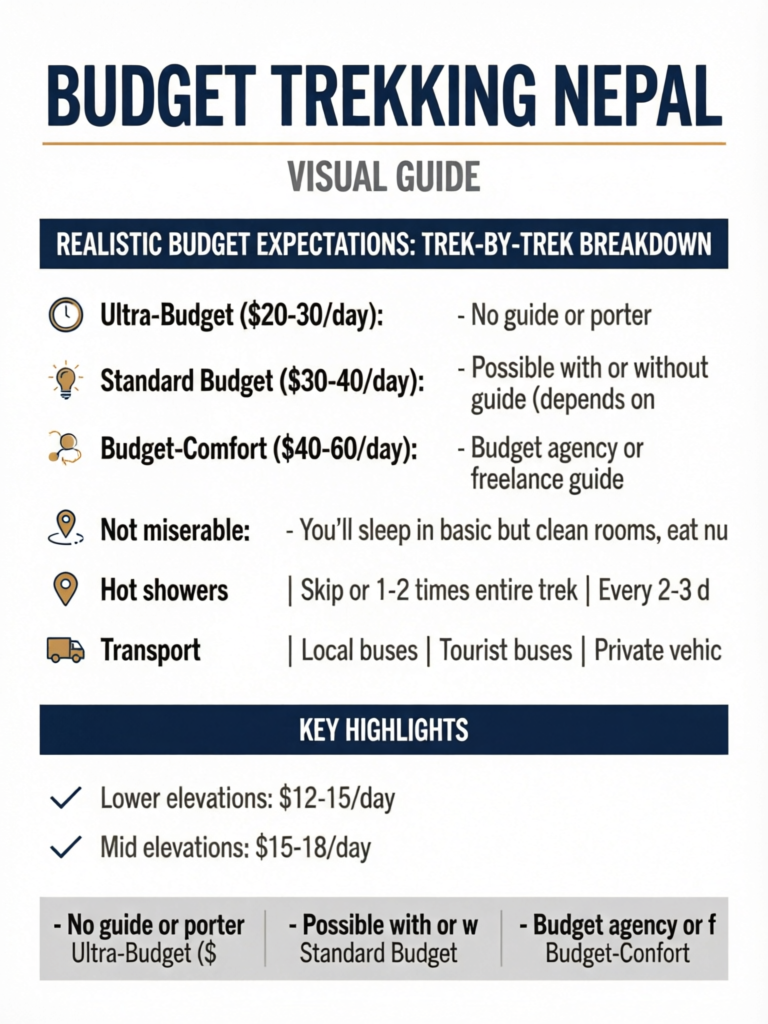
Ultra-Budget ($20-30/day):
- No guide or porter
- Cheapest teahouses only
- Dal bhat for most meals
- Skip hot showers and charging
- No amenities, no WiFi
- Suitable for experienced budget travelers only
Standard Budget ($30-40/day):
- Possible with or with a mandatory licensed guide (depends on route)
- Mix of budget teahouses
- Dal bhat for 2 meals, occasional treats
- Selective hot showers
- Limited charging
- Realistic for most budget-conscious trekkers
Budget-Comfort ($40-60/day):
- Budget agency or freelance guide
- Better teahouse selection
- More food variety
- Regular hot showers
- Charging as needed
- Best balance for first-time budget trekkers
What Budget Trekking Is NOT
Let's be clear about what budget trekking doesn't mean:
- Not unsafe: Budget doesn't mean skipping permits, ignoring altitude protocols, or hiring unqualified guides
- Not unsustainable: Responsible budget trekking still pays fair wages and respects local communities
- Not miserable: You'll sleep in basic but clean rooms, eat nutritious food, and have incredible experiences
- Not solo (anymore): Nepal now requires guides/porters for foreign trekkers in national parks and conservation areas
2026 Regulation Change: Guide Requirement
As of 2026, Nepal requires foreign trekkers to hire a licensed guide or porter for treks in national parks and conservation areas (which includes most major routes). This adds $20-35/day to costs, making true solo budget trekking no longer possible. However, sharing a guide with other trekkers significantly reduces per-person costs.
Budget vs. Mid-Range vs. Premium: What You Give Up
| Element | Budget ($30-40) | Mid-Range ($60-100) | Premium ($100-200+) |
|---|---|---|---|
| Teahouse rooms | Basic, shared bathrooms, cold | Better quality, some private bathrooms | Best lodges, heated rooms, western toilets |
| Meals | Dal bhat focus, limited variety | Full menu choice | Gourmet options, special dietary needs |
| Hot showers | Skip or 1-2 times entire trek | Every 2-3 days | Daily |
| Guide | Shared or budget freelance | Experienced agency guide | Senior guide, private |
| Porter | Carry own pack or shared | Dedicated porter | Personal porter |
| Transport | Local buses | Tourist buses | Private vehicles |
| Flexibility | Fixed itinerary | Some flexibility | Fully customizable |
| Backup | Self-managed | Agency support | Helicopter backup, medical insurance |
Realistic Budget Expectations: Trek-by-Trek Breakdown
Let's examine actual costs for Nepal's most popular treks on a budget.
Everest Base Camp Budget Trek
Total cost range: $800-1,200 (12-14 days)
| Category | Budget Approach | Cost |
|---|---|---|
| Permits | TIMS (NPR 2,000) + Sagarmatha NP ($23) + Municipality ($15) | $38 |
| Kathmandu-Lukla flights | Round-trip domestic flight | $215-400 |
| Guide (required) | Shared with 2-4 trekkers, 12 days @ $25/day | $75-125/person |
| Accommodation | Budget teahouses, 11 nights @ $3-5/night | $35-55 |
| Food | Dal bhat 2x/day, simple breakfast, 12 days @ $25-$40 /day | $180-220 |
| Hot showers | 2-3 total @ $3-5 | $10-15 |
| Charging | 3-4 charges @ $2-3 | $8-12 |
| WiFi | Skip or minimal use | $0-10 |
| Snacks/treats | Minimal | $20-30 |
| Tips | Guide 12 days @ $10/day | $120 |
| Buffer | Weather delays, contingency | $50-100 |
| TOTAL | $886-1,195 |
Money-saving strategies:
- Share a guide with 3-4 other trekkers to split costs
- Book Lukla flights well in advance for lower prices
- Carry your own daypack to avoid porter costs
- Stick to dal bhat for lunch and dinner
- Skip WiFi entirely
- Trek in shoulder season (late September, early December) for better lodge rates
Budget vs. Premium comparison:
- Budget EBC: $900-1,200
- Mid-range EBC: $1,500-2,200
- Premium EBC: $2,500-4,000+
The Lukla flights are the biggest non-negotiable expense. No budget alternatives exist for this cost.
Pro Tip
The Lukla flight is EBC's budget killer. Consider walking in from Jiri (adds 5-7 days) to save $350-400. This traditional route is less crowded, culturally rich, and provides better acclimatization. Total trek becomes 18-21 days but costs drop to $550-800 total.
Annapurna Base Camp Budget Trek
Total cost range: $500-800 (10-12 days)
| Category | Budget Approach | Cost |
|---|---|---|
| Permits | TIMS (NPR 2,000) + ACAP ($23) | $23 |
| Kathmandu-Pokhara transport | Tourist bus round-trip | $20-30 |
| Pokhara-Nayapul transport | Shared jeep | $15-25 |
| Guide (required) | Shared guide, 10 days @ $25/day | $65-85/person |
| Accommodation | Budget teahouses, 9 nights @ $5-8/night | $45-72 |
| Food | Dal bhat focus, 10 days @ $25-$40 /day | $120-180 |
| Hot showers | 2-3 total | $8-15 |
| Charging | Minimal | $6-10 |
| WiFi | Skip | $0-5 |
| Snacks/treats | Limited | $15-25 |
| Tips | Guide 10 days @ $8/day | $80 |
| Buffer | Contingency | $30-50 |
| TOTAL | $427-600 |
Add Poon Hill extension: +$80-120 (2 extra days)
Money-saving strategies:
- Start from Jhinu instead of Nayapul to save 1-2 days
- Trek in shoulder season (September, late November) for quieter trails
- Share guide with other budget trekkers
- Carry own daypack
- Hot springs at Jhinu are free natural reward
ABC is significantly cheaper than EBC primarily because no expensive flights are required—everything is accessible by bus and jeep.
Poon Hill Budget Trek
Total cost range: $200-400 (4-5 days)
| Category | Budget Approach | Cost |
|---|---|---|
| Permits | TIMS (NPR 2,000) + ACAP ($23) | $23 |
| Pokhara-Nayapul transport | Shared jeep round-trip | $15-25 |
| Guide (required) | Shared guide, 4 days @ $25/day | $25-35/person |
| Accommodation | Budget teahouses, 3 nights @ $5-8 | $15-24 |
| Food | 4 days @ $25-$40 /day | $48-60 |
| Hot showers | 1-2 | $5-8 |
| Charging | Minimal | $3-6 |
| Snacks | Limited | $10-15 |
| Tips | Guide 4 days @ $8/day | $32 |
| Buffer | Small contingency | $20-30 |
| TOTAL | $196-266 |
Poon Hill is Nepal's most accessible budget trek—short duration, low altitude, minimal expenses. Perfect for testing budget trekking before committing to longer routes.
Langtang Valley Budget Trek
Total cost range: $400-700 (7-10 days)
| Category | Budget Approach | Cost |
|---|---|---|
| Permits | TIMS (NPR 2,000) + Langtang NP ($30) | $30 |
| Kathmandu-Syabrubesi transport | Local bus round-trip | $20-30 |
| Guide (required) | Shared guide, 8 days @ $25/day | $65-85/person |
| Accommodation | Budget teahouses, 7 nights @ $5-8 | $35-56 |
| Food | 8 days @ $25-$40 /day | $96-144 |
| Hot showers | 2-3 | $8-12 |
| Charging | Minimal | $6-10 |
| Snacks | Limited | $15-25 |
| Tips | Guide 8 days @ $8/day | $64 |
| Buffer | Contingency | $30-50 |
| TOTAL | $369-506 |
Langtang offers excellent value—stunning scenery, rich Tamang culture, lower costs than Annapurna or Everest regions. Closest major trek to Kathmandu (7-8 hour bus ride).
Annapurna Circuit Budget Trek
Total cost range: $600-1,000 (12-16 days)
| Category | Budget Approach | Cost |
|---|---|---|
| Permits | TIMS (NPR 2,000) + ACAP ($23) | $23 |
| Kathmandu-Pokhara transport | Bus round-trip | $10-$25 (tourist bus $15, VIP $20-25) |
| Besisahar-Pokhara jeep | Circuit entry/exit | $30-50 |
| Guide (required) | Shared guide, 14 days @ $25/day | $90-120/person |
| Accommodation | Budget teahouses, 13 nights @ $5-10 | $65-130 |
| Food | 14 days @ $25-$40 /day | $210-280 |
| Hot showers | 3-4 | $12-20 |
| Charging | Regular | $15-25 |
| Snacks | Moderate | $25-40 |
| Tips | Guide 14 days @ $8-10/day | $112-140 |
| Buffer | Weather, contingency | $50-80 |
| TOTAL | $652-938 |
The circuit's length creates higher cumulative costs despite per-day expenses being similar to ABC. Thorong La Pass crossing requires proper acclimatization, making short-cutting dangerous.
Budget Breakdown by Category: Where Your Money Goes
Accommodation Costs: Tea House Budget Strategies
Teahouse accommodation in Nepal operates on a simple model: rooms are cheap (sometimes free), but you buy meals there. This benefits budget trekkers.
Typical teahouse pricing by altitude:
| Altitude Zone | Room Cost | Notes |
|---|---|---|
| Below 2,000m | $3-5/night | Often negotiable, especially if eating there |
| 2,000-3,000m | $5-8/night | Standard rate, rooms basic but adequate |
| 3,000-4,000m | $8-15/night | Increasing scarcity, limited competition |
| Above 4,000m | $15-25/night | EBC Gorak Shep, ABC, high camps |
Budget accommodation tactics:
- Arrive early (before 2 PM): First arrivals get best room selection and negotiating leverage
- Commit to meals: Tell lodge owner you'll eat breakfast and dinner there for better room rates
- Share rooms: Twin rooms cost the same as singles—share with a trekking partner
- Bring sleeping bag: Even if blankets provided, your -10°C bag ensures warm sleep
- Lower lodges: In villages with upper/lower sections, lower lodges often charge less
- Shoulder season: September and December see 20-30% lower rates than peak October
What budget teahouse rooms include:
- Twin beds with foam mattresses
- Blankets (quantity varies)
- Pillow (bring pillowcase for hygiene)
- Shared squat or western toilet
- Shared washing facilities
- Sometimes a single electrical outlet
What they DON'T include:
- Hot showers (pay separately, $2-5)
- Heating (cold nights above 3,000m)
- Privacy (thin walls, shared spaces)
- Charging (pay per device, $2-4)
- WiFi (pay separately if available)
Pro Tip
Many teahouses offer free accommodation if you commit to eating breakfast and dinner there. Since you'll spend $8-15 on meals anyway, this effectively makes lodging free. Ask politely: "Room free if we take breakfast and dinner here?"
Food Budget: The Dal Bhat Strategy
Food is your biggest controllable daily expense. The secret to budget trekking in Nepal: dal bhat.
What is dal bhat? Lentil soup (dal) poured over rice (bhat), served with vegetable curry, pickles, and papad. It's Nepal's national dish, nutritious, filling, and most importantly: unlimited refills are standard.
Dal bhat pricing:
| Location | Cost | Notes |
|---|---|---|
| Kathmandu/Pokhara | $2-3 | Baseline city rate |
| Lower trail (<2,500m) | $4-5 | Budget teahouses |
| Mid-elevation (2,500-3,500m) | $5-7 | Standard trekking rate |
| High elevation (3,500-4,500m) | $7-10 | Transport costs increase prices |
| Highest camps (>4,500m) | $10-12 | EBC Gorak Shep, ABC |
Budget meal strategy:
- Breakfast: Simple (porridge $3-4, Tibetan bread $2-3, eggs $2-3)
- Lunch: Dal bhat ($5-8)
- Dinner: Dal bhat ($5-8)
Daily food budget using dal bhat method:
- Lower elevations: $12-15/day
- Mid elevations: $15-18/day
- High elevations: $18-25/day
Menu pricing comparison (at 3,000m elevation):
| Item | Typical Cost | Budget Impact |
|---|---|---|
| Dal bhat (refills) | $6-8 | Best value |
| Fried rice | $7-9 | Single serving |
| Pasta | $8-10 | Single serving |
| Momos (dumplings) | $5-7 | Not filling |
| Pizza | $10-15 | Terrible value |
| Snickers bar | $2-3 | 5x Kathmandu price |
| Bottled water (1L) | $1-3 | Increases with altitude |
| Tea | $1-2 | Free if eating meals |
| Beer | $4-6 | Luxury item |
Foods to skip on budget:
- Western dishes (pasta, pizza, burgers)
- Meat dishes (more expensive)
- Bottled water (use purification)
- Chocolate and imported snacks
- Alcohol
What dal bhat provides:
- Carbohydrates for energy (rice)
- Protein (lentils)
- Vitamins (vegetable curry)
- Salt replacement (pickles)
- Calories: 800-1,200 per serving
- Unlimited refills until you're full
The Dal Bhat Power: 24-Hour Guarantee
Nepali saying: "Dal bhat power, 24 hour!" It's true—this meal provides sustained energy for trekking. Many budget trekkers eat dal bhat twice daily for entire treks. It's nutritious, filling, and economical.
Water purification savings:
Buying bottled water costs $1-3 per liter and creates plastic waste. Better budget options:
- Purification tablets: $10-15 for 50 tablets, treats 50+ liters
- SteriPen: $50-70 one-time investment, unlimited uses
- Boiled water: Ask teahouses for boiled water ($0.50-1/liter)
Savings: $50-100 over a two-week trek, plus environmental benefit.
Transportation: Budget Routes to Trailheads
Kathmandu to Pokhara:
| Option | Cost | Duration | Comfort |
|---|---|---|---|
| Local bus | $7-10 | 7-8 hours | Basic, crowded |
| Tourist bus | $10-15 | 6-7 hours | Better seats, AC |
| Flight | $215-150 | 25 min | Fast but expensive |
Budget choice: Tourist bus ($10-15). The $5 premium over local bus buys comfort worth having.
Pokhara to Nayapul (ABC/Poon Hill start):
| Option | Cost | Notes |
|---|---|---|
| Shared jeep | $8-12 | Standard budget option |
| Private jeep | $60-80 | Split with 6-8 trekkers: $8-13/person |
| Local bus | $5-7 | Slower, less comfortable |
Kathmandu to Syabrubesi (Langtang start):
| Option | Cost | Duration |
|---|---|---|
| Local bus | $10-15 | 8-9 hours |
| Tourist bus | $15-20 | 7-8 hours |
| Private jeep | $120-150 | Split with 6-8: $15-20/person |
Kathmandu to Lukla (EBC start):
| Option | Cost | Notes |
|---|---|---|
| Flight | $215-200 one-way | No budget alternative |
| Helicopter | $500+ | For emergencies only |
| Walk from Jiri | Bus $10-15 to Jiri | Adds 5-7 days, saves flight cost |
The Jiri walk-in approach is the only budget alternative to Lukla flights. It follows the original Everest route, provides superior acclimatization, and cuts $350-400 from total costs—but requires 18-21 days total.
Permits and Entry Fees: Non-Negotiable Costs
Permit costs are fixed and cannot be reduced. Budget for these exactly:
| Trek | Permits Required | Total Cost |
|---|---|---|
| Everest Base Camp | TIMS (NPR 2,000) + Sagarmatha NP ($23) + Municipality ($15) | $38 |
| Annapurna BC/Circuit | TIMS (NPR 2,000) + ACAP ($23) | $23 |
| Langtang | TIMS (NPR 2,000) + Langtang NP ($30) | $30 |
| Manaslu | TIMS + Manaslu RAP ($100) + ACAP ($23) | $123 |
| Upper Mustang | TIMS + Restricted Area ($500) | $500 |
TIMS cards became NPR 2,000 in 2026 but remain mandatory for registration purposes.
Where to get permits:
- Nepal Tourism Board office, Kathmandu
- Immigration Office, Kathmandu (for restricted areas)
- TAAN office, Kathmandu or Pokhara
- Through agency (small service fee may apply)
Budget agencies typically arrange permits as part of packages. Independent trekkers can get permits directly.
For complete permit information, see our Nepal Trekking Permits Guide.
Guide and Porter Costs: The 2026 Reality
Guide requirement (as of 2026): Foreign trekkers must hire a licensed guide or porter for treks in national parks and conservation areas. This affects all major routes.
Standard guide costs:
| Type | Daily Rate | Who Provides |
|---|---|---|
| Budget freelance guide | $25-$35 /day | Independent guides in Kathmandu/Pokhara |
| Standard agency guide | $25-35/day | Budget trekking agencies |
| Experienced agency guide | $25-$40 /day | Mid-range agencies |
| Senior private guide | $50-80/day | Premium agencies, expert guides |
What guide costs include:
- Their salary
- Their food and accommodation
- Insurance (verify this)
What guide costs DON'T include:
- Your permits (you pay separately)
- Your food and accommodation
- Tips (customary, budget $25-$35 /day)
Budget guide strategies:
- Share with other trekkers: 3-4 trekkers sharing one guide pay $6-10/person/day instead of $25
- Find partners in Kathmandu: Thamel guesthouses and trekking agencies help connect budget trekkers
- Use budget agencies: They provide shared guides for solo travelers
- Hire in Pokhara: Slightly cheaper than Kathmandu for Annapurna treks
Porter costs:
| Service | Cost | Details |
|---|---|---|
| Porter | $20-$30 /day | Carries up to 20-25 kg for two trekkers |
| Porter-guide | $25-30/day | Carries and provides basic guiding |
Porter cost-benefit for budget trekkers:
Hiring a porter costs $25-$40 /day. For a 12-day trek, that's $240-300—significant for budget trekkers. Options:
- Carry your own daypack: You only need 5-8 kg (clothes, water, snacks)
- Share a porter: 2-4 trekkers split costs: $6-12/person/day
- Porter-guide combo: Fulfills guide requirement while carrying gear
Many budget trekkers carry their own daypacks and hire only a guide (required). This works if you:
- Pack light (under 8 kg)
- Are physically fit
- Have a good backpack with hip belt
Pro Tip
Connect with other budget trekkers at Kathmandu guesthouses in Thamel (Hotel Norbu Linka, Hotel Shree Tibet, Alobar 1000) or Pokhara Lakeside (Kiwi Backpackers, Pushkar Guest House). Sharing a guide transforms costs from $25/day to $6-8/person/day.
Hidden Costs to Plan For
Beyond obvious expenses, these "small" costs accumulate:
Hot Showers
| Location | Cost | Frequency |
|---|---|---|
| Lower elevations (<2,500m) | $2-3 | Every 2-3 days acceptable |
| Mid elevations (2,500-3,500m) | $3-4 | Every 3-4 days |
| High elevations (>3,500m) | $4-5 | Rare; use wet wipes |
Budget approach: 2-3 hot showers for entire 12-day trek = $10-15 total
Cold showers are free but miserable above 3,000m. Baby wipes are budget trekker's friend.
Charging Electronics
| Location | Cost per Device | Notes |
|---|---|---|
| Lower elevations | $2-3 | Per full charge |
| Higher elevations | $3-5 | Solar power limited |
Budget approach:
- Bring power bank (charge fully in Kathmandu)
- Charge phone every 3-4 days only
- Keep phone in airplane mode
- Skip charging camera (bring spare batteries)
Total charging budget: $10-20 for 12-day trek
WiFi
| Location | Cost | Speed |
|---|---|---|
| Lower elevations | $3-5/hour or $5-8/day | Slow but functional |
| Higher elevations | $5-8/hour | Very slow, unreliable |
Budget approach: Skip WiFi entirely. Use offline maps, download entertainment before trek.
Savings: $30-50 per trek
Snacks and Treats
The snack trap catches many budget trekkers. A Snickers bar costs $0.50 in Kathmandu, $2-3 at high camps.
Budget snack strategy:
- Buy in Kathmandu/Pokhara: energy bars, chocolate, nuts
- Carry 5-7 days' worth in pack
- Resupply at Namche or Chomrong (last reasonable prices)
- Avoid buying snacks above 3,500m except emergencies
Savings: $30-50 versus buying on trail
Extras That Add Up
| Item | Cost | How to Minimize |
|---|---|---|
| Tea/coffee between meals | $1-2 each | Drink with meals (often free) |
| Toilet paper | $1-2/roll | Bring from Kathmandu |
| Wet wipes | $3-5/pack | Essential; buy in city |
| Laundry | $3-5/load | Hand wash in room |
| Gear rental extension | $1-3/day | Return on time |
| Tips | $100-200 | Non-negotiable; budget realistically |
Gear on a Budget: Buy, Rent, or Borrow?
Rent in Kathmandu or Pokhara
Thamel (Kathmandu) and Lakeside (Pokhara) have excellent gear rental shops with reasonable prices.
Typical rental rates (per day):
| Item | Daily Rate | 12-Day Cost | Buy New | Verdict |
|---|---|---|---|---|
| Sleeping bag (-15°C) | $1-2 | $12-24 | $60-150 | RENT |
| Down jacket | $2-3 | $24-36 | $80-200 | RENT |
| Trekking poles (pair) | $1 | $12 | $30-80 | RENT |
| Backpack (60L) | $1-2 | $12-24 | $80-150 | Rent if needed |
| Waterproof jacket | $2-3 | $24-36 | $100-300 | Rent if needed |
| Gaiters | $0.50-1 | $6-12 | $20-40 | RENT |
| Duffle bag | $1 | $12 | $30-50 | RENT |
Best items to rent:
- Sleeping bag (huge savings, quality available)
- Down jacket (unless you own one)
- Trekking poles (worth the small cost)
- Gaiters (for snow/rain)
What to buy before leaving home:
- Trekking boots (MUST be broken in)
- Base layers (cheap at home, expensive in Nepal)
- Socks (same reason)
- Headlamp and batteries
- Water purification tablets
What to buy in Nepal:
- North Face knockoffs (surprisingly decent quality)
- Buffs and sun hats ($3-5)
- Gloves ($5-10)
- Sunglasses ($5-15 for decent ones)
Thamel bargaining tips:
- Multiple shops: Get prices from 3-4 shops before committing
- Bargain: Expect to pay 60-70% of initial asking price
- Package deals: Renting multiple items gets better rates
- Deposit: Bring cash deposit or leave passport copy
- Condition: Inspect gear carefully; reject damaged items
- Return on time: Late returns charge extra days
Total gear rental budget: $50-100 for 12-day trek
What You Actually Need
Budget trekkers often over-pack. Essential gear only:
Absolutely necessary:
- Trekking boots (broken in)
- Sleeping bag rated to -10°C to -15°C
- Warm layers (fleece + down jacket)
- Waterproof jacket and pants
- Base layers (2 sets)
- Warm hat and sun hat
- Gloves
- Sunglasses
- Trekking poles
- Headlamp
- Water bottles/bladder
- First aid kit
Can skip:
- Camping equipment (teahouses throughout)
- Luxury items
- Multiple outfit changes
- Heavy books (use phone/kindle)
For complete packing guidance, see our Nepal Trekking Packing List.
Independent vs. Budget Agency: Cost Comparison
Independent Trekking (With Required Guide)
Pros:
- Maximum flexibility
- Choose your own guide
- Control all expenses
- No agency markup
Cons:
- Must arrange everything
- Share guide costs alone unless finding trek partners
- No backup if problems occur
- More research required
Sample independent EBC budget:
- Permits: $38
- Lukla flights: $215-400
- Freelance guide (12 days): $300 (or $75 if shared with 4 trekkers)
- Accommodation: $35-55
- Food: $180-220
- Extras: $50-80
- Tips: $120
- Total: $1,073-1,263 (solo) or $848-1,088 (shared guide)
Budget Agency Package
Pros:
- Everything arranged
- Shared guide automatically
- Permits handled
- Some meals included
- Agency support if issues
Cons:
- Fixed itinerary
- Less flexibility
- Must follow group schedule
- Small agency markup
Sample budget agency EBC package:
- Typical price: $900-1,200
- Includes: Permits, flights, guide, accommodation, some meals
- Excludes: Kathmandu hotels, extra snacks, tips, hot showers
Cost comparison verdict:
- Solo independent: Usually more expensive than budget agency
- Group of 3-4 independent: Slightly cheaper than agency
- Solo on budget agency: Best value for solo trekkers
Finding Quality Budget Agencies
Budget agencies exist on a spectrum from excellent to questionable. How to identify quality:
Green flags:
- Licensed with Nepal Tourism Board
- TAAN (Trekking Agencies' Association of Nepal) member
- Transparent pricing breakdown
- Verifiable reviews (TripAdvisor, Google, independent sites)
- Clear cancellation and refund policy
- Written confirmation of guide qualifications
- Porter welfare policy stated
Red flags:
- Prices significantly below market ($700 for EBC when others charge $900+)
- No physical office in Kathmandu
- Vague about what's included
- Pressure to book immediately
- No porter insurance mentioned
- Poor English communication
- No online presence or reviews
Budget agency pricing (typical ranges):
- EBC: $900-1,200
- ABC: $600-900
- Annapurna Circuit: $700-1,000
- Langtang: $500-700
- Poon Hill: $250-400
How to book budget agencies:
- Research online: TripAdvisor, Lonely Planet Thorn Tree, Reddit r/Nepal
- Contact 5-6 agencies: Request detailed quotes
- Compare inclusions: What's actually included vs. excluded?
- Verify guide: Ask about guide experience and qualifications
- Read contract: Understand cancellation policy
- Pay deposit only: 20-30% deposit, rest upon arrival
- Meet guide: Request to meet your guide before departure
For verified budget agencies, see our Compare Budget Trekking Agencies page.
Peak Season vs. Off-Season: Price Differences
Timing your trek affects costs significantly.
Peak Season (October-November, April-May)
Advantages:
- Best weather
- Clear mountain views
- Full services
- Social atmosphere (meet other trekkers)
Disadvantages:
- Higher prices (15-25% premium)
- Crowded trails
- Teahouses fill quickly
- Flight delays more common
Budget impact:
- Teahouse rooms: +$2-5/night
- Meals: Similar pricing
- Guide demand: Higher rates, less negotiable
- Lukla flights: Higher prices, booking essential
Shoulder Season (September, December, Early March)
Advantages:
- Lower prices (10-20% discount)
- Fewer crowds
- Still decent weather
- Better negotiating leverage
Disadvantages:
- September: Monsoon just ending, possible rain
- December: Cold at high camps
- Early March: Still cold, warming up
Budget impact:
- Teahouse rooms: Negotiable rates
- Meals: Standard pricing
- Guide rates: More flexible
- Flights: Lower demand, better availability
Off-Season (January-February, June-August)
Advantages:
- Lowest prices (20-40% discount)
- Empty trails
- Excellent negotiating power
Disadvantages:
- January-February: Extreme cold, some lodges closed
- June-August: Monsoon, dangerous conditions, poor visibility
- Services limited
- Weather unreliable
Budget impact:
- Teahouse rooms: Heavily negotiable or free
- Some lodges closed (limited choice)
- Guide rates: Very negotiable
- Flights: Weather delays common
Best budget season verdict:
- Late September: Optimal budget-weather balance
- Early December: Good weather, lower prices
- Late February: Improving conditions, pre-season rates
Savings potential: A 12-day trek in late September vs. peak October can save $100-200 total through better rates and easier negotiation.
Solo Budget Trekking: Feasibility and Costs
Solo trekking in Nepal changed in 2026 with the guide requirement. True solo is no longer permitted on major routes.
The Solo Budget Challenge
Why solo costs more:
- Cannot share guide costs ($25-$35 /day vs. $6-8/person shared)
- Less negotiating power for rooms
- Full cost of everything
- No shared porter option
Solo budget EBC realistic cost:
- Permits: $38
- Flights: $350-400
- Guide (just for you): $300
- Accommodation: $35-55
- Food: $180-220
- Extras: $50-80
- Tips: $120
- Total: $1,073-1,263
Compare to group of 4 sharing guide: $848-1,088 (save $225-175)
Solutions for Solo Budget Trekkers
Option 1: Join a budget agency group
- Cost: $900-1,200 for EBC
- Automatic group guide
- Meet other solo trekkers
- Best value for solo travelers
Option 2: Find trek partners in Kathmandu/Pokhara
- Post in Thamel guesthouses
- Use Facebook groups (Trekking Partners Nepal)
- Reddit r/solotravel and r/Nepal
- Hire shared guide independently
- Save 50-70% on guide costs
Option 3: Budget porter-guide
- Hire a porter-guide ($25-$40 /day)
- They carry your pack AND fulfill guide requirement
- Cost: ~$350 for 12 days + tips
- Better value than guide alone if you need porter anyway
Where to find trek partners:
- Kathmandu: Thamel guesthouses, especially Hotel Norbu Linka, Alobar 1000
- Pokhara: Lakeside guesthouses, Kiwi Backpackers
- Online: Facebook "Trekking Partners Nepal" group, Reddit r/Nepal
Pro Tip
Arrive in Kathmandu 2-3 days before your planned trek start. Stay in Thamel, post on guesthouse noticeboards, chat with other trekkers. Finding 2-3 partners to share a guide is easier than you think, especially in September-November.
Porter vs. No Porter: Cost-Benefit for Budget Trekkers
Porter costs:
- $25-$40 /day
- 12-day trek: $240-300
- Plus tips: $10/day = $120
- Total: $360-420
What porter carries:
- Your main pack (up to 20 kg)
- Typically shared between 2 trekkers (10 kg each)
Porter cost-benefit analysis for budget trekkers:
| Your Fitness | Pack Weight | Verdict |
|---|---|---|
| Excellent | <8 kg daypack | Skip porter, carry own pack, save $360-420 |
| Good | 8-12 kg | Consider porter if sharing costs with partner |
| Moderate | >12 kg | Porter recommended for safety and enjoyment |
| Limited | Any weight | Porter essential to complete trek |
Budget alternative: Porter-guide
- Cost: $25-$40 /day ($300-360 for 12 days)
- Carries your pack AND fulfills guide requirement
- More economical than guide ($300) + porter ($300) separately
- Best budget solution if you need both
How to hire a porter ethically:
- IPPG guidelines: International Porter Protection Group standards
- Maximum load: 25 kg total (trekker's gear + porter's personal items)
- Proper gear: Porter must have warm clothes, shoes, sleeping bag
- Insurance: Verify porter is insured
- Fair wages: $20-25/day is standard fair wage
- Accommodation: Porter gets same lodging and meals
- No exploitation: Reputable agencies follow these standards
Budget porter reality: Most budget trekkers carry their own daypacks (5-8 kg) and skip porter costs entirely. This is feasible if you:
- Pack minimally
- Rent heavy items (sleeping bag) rather than carrying from home
- Are reasonably fit
- Trek shorter routes (ABC, Poon Hill) before longer ones
For porter welfare standards, see our Porter Welfare Verification.
Money Management on the Trail
ATMs and Cash
Where ATMs exist:
- Kathmandu: Everywhere
- Pokhara: Lakeside, plentiful
- Lukla: One ATM (unreliable)
- Namche Bazaar: One ATM (often empty)
- Elsewhere on trails: NONE
Budget trekker cash strategy:
- Withdraw in Kathmandu: Get all cash before leaving
- How much: NPR 30,000-50,000 ($225-375) for 12-day trek
- Breakdown:
- Large bills: NPR 1,000 notes for big purchases
- Small bills: NPR 100, 500 for daily expenses
- Storage: Split between pack, wallet, and money belt
- Backup: Small amount of USD ($50-100) for emergencies
Daily cash usage:
| Expense Type | Daily Amount (NPR) | Daily Amount (USD) |
|---|---|---|
| Accommodation | 500-800 | $4-6 |
| Food (dal bhat) | 1,200-1,800 | $9-14 |
| Hot shower (if any) | 0-400 | $0-3 |
| Charging (if any) | 0-300 | $0-2 |
| Snacks | 200-400 | $1.50-3 |
| Total | 1,900-3,700 | $14-28 |
Add guide/porter daily wages if paying cash (many budget trekkers pay lump sum at end).
Currency Exchange
Best exchange rates:
- Kathmandu: Thamel money changers (compare 3-4 shops)
- Pokhara: Lakeside money changers
- Banks: Lower rates but reliable
Worst exchange rates:
- Airport: 5-10% worse rates
- On trail: Not available
- Hotels: Poor rates
What currency to bring:
- USD: Most widely accepted
- EUR: Accepted but USD gets better rates
- GBP: Accepted but less common
- Other currencies: Exchange to USD first
Budget tip: Bring slightly worn but clean USD bills. Damaged or very old bills may be rejected. $50 and $100 bills get best rates.
Mobile Payments and Cards
Credit cards on trail: Virtually useless. Rare lodges accept them with 5-10% surcharge.
Digital payments (eSewa, Khalti): Not useful for budget trekkers. Requires Nepali bank account.
Mobile banking: Load funds before trek; no connectivity on trail.
Verdict: Budget trekking is a cash economy. Bring physical NPR.
Budget Mistakes to Avoid
Learning from others' expensive errors:
Mistake 1: Skipping Travel Insurance
The mistake: "I'm on a budget, I'll skip insurance to save $75."
Why it's dangerous: Helicopter evacuation from EBC costs $3,000-5,000. A broken leg, altitude sickness requiring descent, or any emergency will bankrupt you without insurance.
Budget solution: Insurance costs $50-100 for 2-3 weeks. World Nomads, SafetyWing, and IMG offer budget policies covering Nepal trekking.
What to verify:
- Helicopter evacuation to 6,000m
- Trekking up to highest altitude you'll reach
- Medical coverage $100,000+
- Repatriation coverage
Cost: $50-100 Savings vs. risk: Potentially $3,000-100,000
This is the one expense you absolutely cannot cut.
Mistake 2: Inadequate Cash
The mistake: "I'll just withdraw from ATMs on the trail."
Reality: No ATMs exist beyond Lukla/Namche. Even those are frequently broken or empty.
Consequence: Borrowing from guide, other trekkers, or cutting trek short.
Budget solution: Withdraw full amount in Kathmandu. Calculate maximum possible expenses + 20% buffer.
Mistake 3: Booking Lukla Flights Too Late
The mistake: "I'll book flights when I arrive in Kathmandu."
Reality: Peak season flights fill 2-4 weeks in advance. Last-minute flights (if available) cost 30-50% more.
Budget solution: Book Lukla flights minimum 2-3 weeks in advance during peak season.
Savings: $50-100 per flight through advance booking
Mistake 4: Renting Gear Without Inspection
The mistake: Grabbing first sleeping bag offered, discovering at 4,000m it has a broken zipper.
Reality: Rental gear sees heavy use. Damaged items are common.
Budget solution:
- Thoroughly inspect gear before accepting
- Test zippers, check for holes
- Reject damaged items
- Get receipt with gear description
Mistake 5: Not Bringing Snacks from Kathmandu
The mistake: "I'll buy snacks as I go."
Reality: Snickers bar costs $0.50 in Kathmandu, $2-3 at Gorak Shep (6x markup).
Budget solution: Buy 5-7 days of energy bars, chocolate, nuts in Kathmandu. Resupply at last reasonable prices (Namche, Chomrong).
Savings: $30-50 per trek
Mistake 6: Over-Packing
The mistake: "I might need this... and this... and this..."
Reality: Carrying 15 kg pack makes trekking miserable and increases likelihood of hiring porter ($360-420).
Budget solution:
- Pack ruthlessly
- 5-8 kg is achievable
- Rent heavy items (sleeping bag, down jacket)
- One outfit for trekking, one for evening
- Wear same clothes multiple days (everyone does)
Savings: $360-420 by avoiding unnecessary porter
Mistake 7: Skipping Altitude Acclimatization to Save Time
The mistake: "I only have 10 days, I'll skip the Namche rest day."
Reality: Acute Mountain Sickness forces descent, ruins trek, potentially causes helicopter evacuation.
Budget solution: Follow recommended itineraries. The "extra" days aren't optional—they're essential.
Cost of rushing: $3,000-5,000 for helicopter evacuation, plus ruined trek
Mistake 8: Falling for "Too Good to Be True" Agency Prices
The mistake: Agency offers EBC for $600 when others charge $900-1,200.
Reality: Cut corners show up in unqualified guides, forced shopping stops, hidden fees, poor safety standards.
Budget solution: If price is 30%+ below market, investigate thoroughly. Budget agencies exist at $900-1,200 for EBC—prices below this are red flags.
Mistake 9: Not Tipping Guide/Porter
The mistake: "Tipping is optional, right?"
Reality: Tips are culturally expected and form significant portion of guide/porter income. Not tipping damages Nepal trekking industry and burns bridges.
Budget solution: Budget tips from the start:
- Guide: $10-12/day
- Porter: $8-10/day
- 12-day EBC: $120-140 for guide, $96-120 for porter
Total tip budget: $150-250 for typical trek
This isn't optional. If you can't afford tips, you can't afford the trek.
Mistake 10: Ignoring Weather Forecasts
The mistake: "It'll be fine, it's October."
Reality: Freak storms happen. Ignoring warnings leads to dangerous situations or expensive helicopter evacuations.
Budget solution:
- Check forecasts in Kathmandu before leaving
- Listen to lodge owners' weather advice
- Build 1-2 buffer days for weather delays
- Be flexible with itinerary
Is Budget Trekking Safe? Quality Considerations
Budget trekking often raises safety concerns. Let's address them directly.
What Budget Trekking Does NOT Mean
It does NOT mean:
- Hiring unqualified guides to save money
- Skipping permits
- Ignoring altitude sickness symptoms
- Rushing itineraries to save days
- Accepting damaged safety gear
- Trekking alone without required guide
- Skipping travel insurance
- Exploiting porters with heavy loads and low wages
What Budget Trekking DOES Mean
It DOES mean:
- Choosing budget teahouses over luxury lodges (both are safe)
- Eating dal bhat instead of expensive Western food (dal bhat is nutritious)
- Skipping WiFi and hot showers (uncomfortable but not dangerous)
- Carrying your own daypack (if you're fit enough)
- Sharing guide costs with other trekkers (guide quality unchanged)
- Renting gear instead of buying expensive equipment (rental gear works fine)
- Traveling in shoulder season (weather still decent)
Safety Standards That Cannot Be Compromised
Regardless of budget level, these are non-negotiable:
- Licensed guide: Verify your guide has proper government license
- Proper permits: Always obtain required permits
- Travel insurance: With helicopter evacuation coverage
- Acclimatization: Follow recommended itineraries, don't skip rest days
- Weather awareness: Respect weather warnings
- Adequate gear: Sleeping bag, warm layers, waterproofs must be functional
- Communication: Guide should have phone/satellite device
- Porter welfare: If hiring porter, ensure fair treatment
Quality Budget Agencies vs. Dangerous Cheap Agencies
How to distinguish:
| Quality Budget Agency | Dangerous Cheap Agency |
|---|---|
| Licensed and registered | Unlicensed or fake license |
| $900-1,200 for EBC | $600-700 for EBC |
| Experienced guides with certifications | Inexperienced "guides" |
| Clear inclusions/exclusions | Vague about what's included |
| Porter insurance provided | No porter insurance |
| Verifiable reviews | Fake or no reviews |
| Physical office in Kathmandu | No office or unclear address |
| Written contract | Verbal agreement only |
| Respects acclimatization | Rushes itinerary |
Budget vs. Safety verdict: You can trek safely on $30-40/day by making smart choices about accommodation, food, and extras. You cannot trek safely by cutting corners on guides, permits, insurance, or acclimatization.
Sample Budget Itineraries with Cost Breakdowns
12-Day Everest Base Camp Budget Trek
Total budget: $900-1,150
| Day | Route | Accommodation | Food | Other | Daily Total |
|---|---|---|---|---|---|
| Day 1 | Kathmandu arrival | Hotel ($10) | Dinner ($5) | - | $15 |
| Day 2 | Kathmandu-Lukla flight, trek to Phakding | Teahouse ($5) | 3 meals ($215) | Flight ($175) | $215 |
| Day 3 | Phakding-Namche | Teahouse ($5) | Dal bhat 2x ($14) | - | $19 |
| Day 4 | Namche rest day | Teahouse ($8) | Dal bhat 2x ($16) | - | $24 |
| Day 5 | Namche-Tengboche | Teahouse ($8) | Dal bhat 2x ($16) | - | $24 |
| Day 6 | Tengboche-Dingboche | Teahouse ($10) | Dal bhat 2x ($18) | Shower ($4) | $32 |
| Day 7 | Dingboche rest day | Teahouse ($10) | Dal bhat 2x ($18) | Charging ($3) | $31 |
| Day 8 | Dingboche-Lobuche | Teahouse ($15) | Dal bhat 2x ($20) | - | $35 |
| Day 9 | Lobuche-Gorak Shep-EBC | Teahouse ($20) | Dal bhat 2x ($22) | Charging ($4) | $46 |
| Day 10 | Gorak Shep-Pheriche | Teahouse ($10) | Dal bhat 2x ($18) | - | $28 |
| Day 11 | Pheriche-Namche | Teahouse ($8) | Dal bhat 2x ($16) | Shower ($4) | $28 |
| Day 12 | Namche-Lukla | Teahouse ($5) | Dal bhat 2x ($14) | Flight ($175) | $215 |
| Day 13 | Lukla-Kathmandu | Hotel ($10) | Meals ($8) | - | $18 |
Subtotal trek days: $706
Additional costs:
- Permits: $38
- Shared guide (÷4 trekkers): $75
- Snacks and extras: $30
- Tips for guide: $120
- Buffer: $50
- Total: $1,019
Cost-saving modifications:
- Walk from Jiri instead of Lukla flight: Save $215 but add 5-7 days
- Share guide with 4 trekkers instead of 2: Save $50
- Skip both hot showers: Save $8
- Zero snacks: Save $30
- Rock-bottom total: $581 (but requires Jiri walk-in)
10-Day Annapurna Base Camp Budget Trek
Total budget: $500-650
| Day | Route | Accommodation | Food | Other | Daily Total |
|---|---|---|---|---|---|
| Day 1 | Pokhara-Nayapul-Tikhedhunga | Teahouse ($5) | 2 meals ($10) | Bus ($10) | $25 |
| Day 2 | Tikhedhunga-Ghorepani | Teahouse ($6) | Dal bhat 2x ($12) | - | $18 |
| Day 3 | Poon Hill sunrise, trek to Tadapani | Teahouse ($6) | Dal bhat 2x ($12) | - | $18 |
| Day 4 | Tadapani-Chomrong | Teahouse ($7) | Dal bhat 2x ($13) | Shower ($3) | $23 |
| Day 5 | Chomrong-Dovan | Teahouse ($7) | Dal bhat 2x ($14) | - | $21 |
| Day 6 | Dovan-Deurali | Teahouse ($10) | Dal bhat 2x ($16) | - | $26 |
| Day 7 | Deurali-ABC | Teahouse ($18) | Dal bhat 2x ($20) | Charging ($3) | $41 |
| Day 8 | ABC-Bamboo | Teahouse ($7) | Dal bhat 2x ($14) | - | $21 |
| Day 9 | Bamboo-Jhinu (hot springs) | Teahouse ($6) | Dal bhat 2x ($12) | Springs ($2) | $20 |
| Day 10 | Jhinu-Pokhara | Hotel ($10) | Meals ($8) | Jeep ($12) | $30 |
Subtotal trek days: $243
Additional costs:
- Permits: $23
- Shared guide (÷3 trekkers): $83
- Snacks: $20
- Tips for guide: $80
- Buffer: $40
- Total: $489
5-Day Poon Hill Budget Trek
Total budget: $200-280
| Day | Route | Accommodation | Food | Other | Daily Total |
|---|---|---|---|---|---|
| Day 1 | Pokhara-Nayapul-Tikhedhunga | Teahouse ($5) | 2 meals ($10) | Bus ($8) | $23 |
| Day 2 | Tikhedhunga-Ghorepani | Teahouse ($6) | Dal bhat 2x ($12) | - | $18 |
| Day 3 | Poon Hill sunrise, trek to Tadapani | Teahouse ($6) | Dal bhat 2x ($12) | - | $18 |
| Day 4 | Tadapani-Ghandruk-Nayapul | - | Dal bhat + snack ($10) | Bus ($8) | $18 |
| Day 5 | Pokhara | Hotel ($8) | - | - | $8 |
Subtotal trek days: $85
Additional costs:
- Permits: $23
- Shared guide (÷4 trekkers): $25
- Snacks: $10
- Tips for guide: $32
- Total: $175
Budget vs. Comfort Trade-offs: What You Actually Give Up
Let's be honest about the budget trekking experience.
Accommodation Trade-offs
Budget teahouse ($5-8/night):
- Room: Twin beds with thin foam mattresses
- Bathroom: Shared squat toilet, cold water
- Heating: None (bring sleeping bag)
- Noise: Thin walls, hear everything
- Privacy: Minimal
- Cleanliness: Basic but usually acceptable
Mid-range lodge ($15-25/night):
- Room: Better mattresses, sometimes private bathroom
- Bathroom: Western toilet, hot water available
- Heating: Some rooms have heaters
- Noise: Better insulation
- Privacy: More private rooms available
- Cleanliness: Higher standards
What you actually miss:
- Comfortable mattress (bring sleeping pad)
- Hot shower whenever wanted (budget: 2-3 total)
- Warm room (wear layers at night)
- Privacy (everyone shares spaces)
- Western toilet (squat toilets are fine once you adapt)
Reality check: After 6-8 hours of trekking, you'll sleep fine on foam mattresses in your sleeping bag. The discomfort is minor compared to cost savings.
Food Trade-offs
Budget approach (dal bhat 2x/day):
- Breakfast: Porridge or Tibetan bread
- Lunch: Dal bhat with refills
- Dinner: Dal bhat with refills
- Drinks: Tea with meals only
- Snacks: Minimal, carried from Kathmandu
- Variety: Low
- Nutrition: Excellent
- Fullness: Always satisfied (unlimited refills)
Mid-range approach:
- Breakfast: Full menu (eggs, pancakes, muesli)
- Lunch: Varies (fried rice, momos, noodles)
- Dinner: Varies (pasta, pizza, meat dishes)
- Drinks: Tea, coffee, hot chocolate anytime
- Snacks: Regular purchases
- Variety: High
- Nutrition: Good
- Fullness: Satisfied
What you actually miss:
- Menu variety (dal bhat gets repetitive by day 8-9)
- Western comfort food (pizza, pasta)
- Hot drinks between meals
- Snacks and treats
Reality check: Dal bhat is delicious for the first week. It gets repetitive, but it's nutritious and filling. You won't go hungry. You might crave variety.
Experience Trade-offs
Budget trekking:
- Shared guide with 3-4 other trekkers
- Carry your own daypack (5-8 kg)
- Skip some hot showers
- No WiFi
- Limited charging
- Basic teahouses
- Local buses to trailheads
- Weather delay risk (no helicopter backup)
Mid-range trekking:
- Personal or small group guide
- Porter carries your pack
- Hot shower every 2-3 days
- WiFi at major stops
- Regular charging
- Better teahouses
- Tourist buses
- Some agency support for delays
Premium trekking:
- Private guide
- Personal porter
- Hot shower daily
- Constant connectivity
- Best lodges
- Private vehicles
- Full helicopter backup
- Concierge service
What you actually miss on budget:
- Comfort and convenience
- Constant connectivity (actually a plus for many)
- Having your pack carried
- Hot showers on demand
- Menu variety
What you DON'T miss:
- The mountain views (identical)
- The trekking experience (identical trail)
- The accomplishment (reaching EBC feels the same)
- Cultural immersion (arguably better mixing with local trekkers)
- The adventure (maybe even more authentic)
The Budget Trekker Mindset
Budget trekking requires attitude adjustment:
Embrace discomfort: Cold showers, foam mattresses, and dal bhat repetition are temporary. The Himalayas are forever.
Focus on the goal: You're not here for luxury accommodations. You're here to trek to EBC, ABC, or wherever.
Appreciate simplicity: Stripping away amenities often enhances the adventure. No WiFi means more conversations with fellow trekkers.
Take pride in efficiency: Completing EBC for $900 when others pay $3,000 is an accomplishment itself.
Remember your budget: Every hot shower skipped, every dal bhat meal, every cold night saves money for your next adventure.
Frequently Asked Questions: Budget Trekking Nepal
Planning and Feasibility
Can I really trek EBC for $25-$40 /day?
No, not quite. EBC requires Lukla flights ($215-400 round-trip), which inflates the total. Daily costs on the trail run $25-35, but flight costs average to $30-35/day extra. Total realistic EBC budget: $60-70/day all-inclusive.
ABC, Langtang, Annapurna Circuit: Yes, $30-40/day is achievable since no flights required.
Is budget trekking safe?
Yes, if done correctly. Budget trekking means basic accommodation and simple food—not compromising on guides, permits, insurance, or safety gear. Licensed guides, proper acclimatization, and insurance are non-negotiable at any budget level.
How much cheaper is budget trekking than mid-range?
Typical savings: 40-60%
- EBC: Budget $900-1,200 vs. Mid-range $1,500-2,200 (save $600-1,000)
- ABC: Budget $500-800 vs. Mid-range $1,200-1,800 (save $700-1,000)
Can I trek Nepal for $500 total?
Yes, but limited to short, accessible treks:
- Poon Hill: $200-280
- Short ABC (10 days): $500-650
- Short Langtang (8 days): $400-550
EBC requires minimum $800-900 due to Lukla flights.
Money and Costs
How much cash should I carry?
For 12-day trek: NPR 30,000-50,000 ($225-375)
- Lower estimate: Ultra-budget, dal bhat only, no extras
- Higher estimate: Budget-comfort, some treats, contingency
Withdraw full amount in Kathmandu. No ATMs on trails (except unreliable ones in Lukla/Namche).
Can I use credit cards on the trail?
No. Cash economy. Rare lodges accept cards with heavy surcharges (5-10%).
Are there ATMs on the trek?
EBC: One in Lukla (unreliable), one in Namche (often empty) ABC/Annapurna: None after Pokhara Langtang: None after Kathmandu
Don't rely on trail ATMs.
How much should I tip my guide?
Standard: $10-12/day for guide, $8-10/day for porter
- 12-day trek guide tip: $120-140
- 12-day trek porter tip: $96-120
This is expected and forms significant income portion. Budget for it from the start.
Food and Accommodation
What is dal bhat and why is it recommended?
Dal (lentil soup) poured over bhat (rice), served with vegetable curry, pickles, and papad. Nepal's national dish. Budget trekkers love it because:
- Unlimited refills are standard
- Nutritious and filling
- Cheapest meal on menus
- Provides sustained energy
- Every teahouse serves it
Do I really have to eat dal bhat every meal?
No, but it saves money. Variation:
- Breakfast: Porridge, Tibetan bread, eggs (cheaper)
- Lunch: Dal bhat
- Dinner: Dal bhat
Or alternate days with fried rice, noodles, momos when craving variety.
Are teahouses clean and safe?
Generally yes. Standards vary, but most teahouses are family-run, clean enough, and serve safe food. Stick to busy lodges (high turnover = fresh food). Avoid meat dishes at high altitude (refrigeration limited).
Can I get vegetarian food?
Yes, easily. Most Nepali food is vegetarian. Dal bhat, momos, fried rice, noodles all available vegetarian.
Guides and Regulations
Can I trek with a mandatory licensed guide to save money?
No longer legal. As of 2026, foreign trekkers must hire licensed guide or porter for national parks and conservation areas (all major treks). Solo trekking is prohibited.
How do I find other trekkers to share a guide?
- Stay in Thamel (Kathmandu) or Lakeside (Pokhara) guesthouses
- Post on guesthouse noticeboards
- Facebook: "Trekking Partners Nepal" group
- Reddit: r/Nepal, r/solotravel
- Ask your guesthouse to connect you with other solo trekkers
Many budget trekkers find partners this way.
What's the difference between budget and expensive guides?
Budget freelance guide ($20-25/day):
- Licensed and qualified
- Less English proficiency sometimes
- Less experience maybe
- No agency backup
Expensive agency guide ($40-60/day):
- Highly experienced
- Excellent English
- Agency support and backup
- Senior guides with years of experience
For standard routes (EBC, ABC), budget guides are perfectly adequate. They know the routes, handle logistics, and keep you safe.
How do I verify my guide is licensed?
Ask to see:
- Trekking Guide License (issued by Nepal Government)
- TAAN membership card
- First aid certification
Reputable guides carry these and show them willingly.
Gear and Packing
Should I rent or buy gear in Nepal?
Rent these:
- Sleeping bag (-15°C): $1-2/day
- Down jacket: $2-3/day
- Trekking poles: $1/day Total rental: $50-100 for 12 days vs. $300+ to buy
Buy these before leaving home:
- Trekking boots (must be broken in)
- Base layers
- Socks
Buy these in Nepal:
- Buffs, hats, gloves
- North Face knockoffs (surprisingly decent)
How much should my backpack weigh?
If carrying yourself: 5-8 kg maximum
- Sleeping bag (rental): 1.5 kg
- Clothes: 2-3 kg
- Toiletries: 0.5 kg
- Water: 1-2 kg
- Misc: 1 kg
If hiring porter: Up to 15-20 kg (shared with partner)
What's the most important gear to not skimp on?
- Trekking boots: Must fit well, broken in, waterproof
- Sleeping bag: Must be rated to -10°C minimum
- Down jacket: Essential above 3,500m
- Water purification: Saves money and environment
- Headlamp: Critical for safety
These items affect safety and comfort. Rent quality versions.
Routes and Timing
Which trek is cheapest?
Poon Hill: $200-400 total (4-5 days)
- Shortest duration
- Lowest altitude
- No flights
- Close to Pokhara
Perfect budget introduction to Nepal trekking.
Which major trek offers best budget value?
Annapurna Base Camp: $500-800 (10-12 days)
- Stunning scenery
- Lower altitude than EBC (less risk)
- No expensive flights
- Good teahouse infrastructure
- Cultural immersion
- 10-14 days duration
Best balance of experience, cost, and accessibility.
When is cheapest time to trek?
Late September: Post-monsoon, pre-peak season
- Weather improving
- Trails quieter
- Lower prices
- Services fully open
Early December: Post-peak season
- Still good weather
- Much quieter
- 15-25% lower prices
- Cold but manageable
Can I trek in monsoon to save money?
Technically yes, but not recommended. Savings aren't worth the risks:
- Dangerous trail conditions (slippery, landslides)
- Zero mountain views (clouds)
- Leeches below 3,000m
- Many lodges closed
- Miserable experience
Savings: 20-30% on lodge prices Risk: Ruined trek, potential danger
Not worth it.
Health and Safety
Do I need travel insurance for budget trekking?
YES. Absolutely non-negotiable. helicopter rescue costs $1,800-$5,000 depending on location (EBC to Lukla $1,800-$2,500, EBC to Kathmandu $4,500-$5,000). Skipping $75 insurance to save money is the worst possible budget decision.
Budget insurance options:
- World Nomads: $80-120 for 2-3 weeks
- SafetyWing: $50-80 for 2-3 weeks
- IMG: $60-100 for 2-3 weeks
Verify coverage includes:
- Helicopter evacuation to 6,000m
- Trekking to your maximum altitude
- Medical coverage $100,000+
Is altitude sickness more dangerous on budget treks?
No. Altitude sickness doesn't discriminate by budget. The key is following proper acclimatization schedules.
Budget trekkers should NOT:
- Rush itineraries to save days
- Skip acclimatization days
- Ignore symptoms to avoid descent costs
Budget trekking affects comfort, not safety protocols.
What if I need helicopter evacuation?
Your travel insurance covers it (verify this before trek). Process:
- Guide contacts helicopter company
- Helicopter flies to nearest landing zone
- Evacuation to Kathmandu hospital
- Insurance handles payment
Cost: $3,000-5,000 (insurance pays)
This is why insurance is mandatory.
Social and Practical
Will I meet other budget trekkers?
Yes! Budget trekkers gravitate to same lodges, creating great social atmosphere. Many lifelong friendships form on trails.
Connect with budget travelers at:
- Basic teahouses (not luxury lodges)
- Communal dining halls
- Kathmandu/Pokhara budget guesthouses
Is it embarrassing to be a budget trekker?
Not at all. Most trekkers are budget-conscious. Even wealthier trekkers respect the adventure and resourcefulness.
Many experienced trekkers prefer budget style for authenticity.
Can I do budget trekking with a family?
Challenging but possible:
- Kids need porter support (can't carry packs)
- Altitude limits apply strictly to children
- Budget teahouses lack family rooms usually
- Costs multiply per person
Family trekking usually requires mid-range budget minimum ($60-80/person/day).
How do budget trekkers handle laundry?
Hand wash in rooms:
- Bring travel laundry detergent or soap
- Wash in sink or bucket
- Hang dry in room or outside
- Quick-dry fabrics essential
Laundry services exist ($3-5/load) but unnecessary expense.
Do luxury trekkers look down on budget trekkers?
No. The trails are for everyone. Most trekkers respect each other's choices and budgets.
The views are the same. The achievement is the same. The budget is just different.
Bridge Block: Planning Your Budget Trek
Ready to start planning your affordable Nepal adventure? Here are your next steps:
Essential Planning Resources:
- Compare Budget Trekking Agencies
- Nepal Trekking Permits Explained
- Best Time to Trek Nepal
- Nepal Trekking Packing List
- Altitude Sickness Prevention
Budget-Friendly Trek Routes:
- Poon Hill Trek — Best budget introduction ($200-400)
- Annapurna Base Camp Trek — Best value major trek ($500-800)
- Langtang Valley Trek — Close to Kathmandu ($400-700)
- Annapurna Circuit Trek — Epic adventure ($600-1,000)
- Everest Base Camp Trek — Bucket list on budget ($900-1,200)
By Region:
- Annapurna Region — Most budget-friendly area
- Everest-Khumbu Region — Higher costs but iconic
- Langtang Region — Excellent budget value
Verification Standards:
- Safety-Ready Badge — What we verify
- Transparent Pricing Badge — Fair pricing standards
- Porter Welfare Badge — Ethical trekking
This guide is maintained by HimalayanNepal's editorial team with input from budget trekking agencies, independent trekkers, and local guides. Last updated January 2026. For budget trekking advice or corrections, contact our editorial team.