



Upper Mustang Nepal: The Lo Manthang Trek Guide
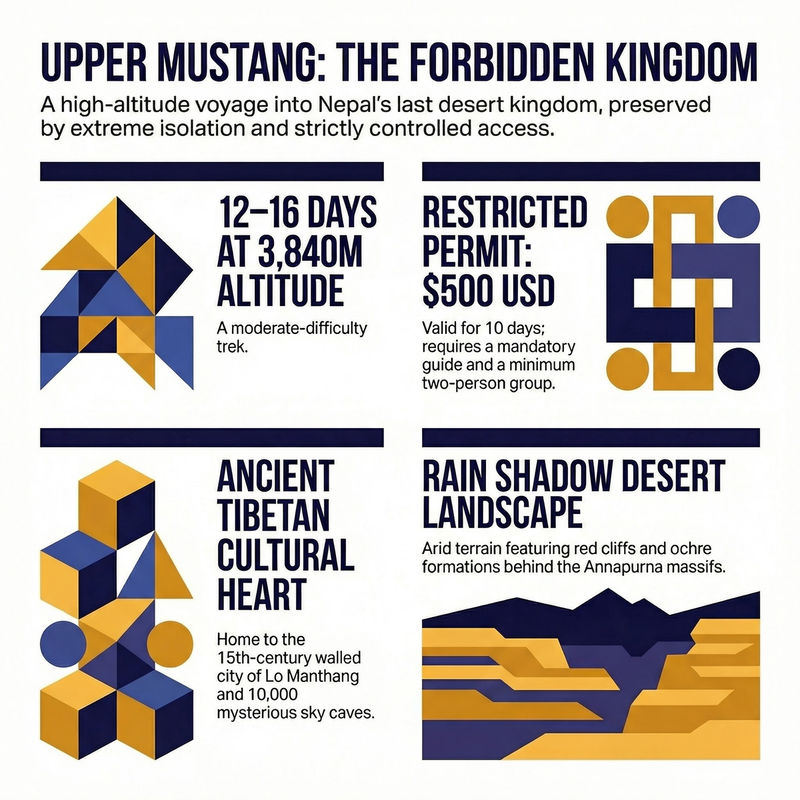
Upper Mustang is a restricted high-altitude desert region in north-central Nepal, home to the walled capital of Lo Manthang and Nepal's best-preserved Tibetan Buddhist culture. The Upper Mustang trek takes 10-14 days, requires a USD 50/day restricted-area permit (USD 500 minimum), a licensed guide and a minimum group of two, and is rated Moderate at a top altitude of 4,200m.
| Route | Duration | Max Altitude | Difficulty | Permits | Teahouses | Crowds |
|---|---|---|---|---|---|---|
| Upper Mustang | 10-14 days | 4,200m | Moderate | $500-700 | Basic-Good | Very Low (Restricted) |
| Annapurna Circuit | 12-21 days | 5,416m | Difficult | $40-50 | Excellent | Moderate |
| Manaslu Circuit | 14-18 days | 5,160m | Challenging | $150-200 | Basic-Good | Low |
| Everest Base Camp | 12-16 days | 5,364m | Moderate-Challenging | $45-50 | Excellent | High (Peak Season) |
Picture yourself walking through a landscape that feels like stepping onto another planet—towering red cliffs carved by ancient winds, prayer flags dancing against crystalline blue skies, and medieval walled cities where Tibetan Buddhist culture thrives unchanged for centuries. Welcome to Upper Mustang, Nepal's last forbidden kingdom, a high-altitude desert region that remained sealed from the outside world until 1992.
The Upper Mustang trek is not merely a walk in the Himalayas; it is a profound voyage into a lost world, a living museum of Tibetan culture preserved behind the rain-shadow of the Annapurna and Dhaulagiri massifs. Often called "Lo" or the "Forbidden Kingdom," this remote region in north-central Nepal offers something genuinely rare in modern travel—a journey through preserved culture and stark natural beauty that hasn't been diluted by mass tourism.
Unlike the lush, forested trails of the Annapurna or Everest regions, Upper Mustang presents an arid, windswept landscape reminiscent of the Tibetan plateau. Wind and time have sculpted this terrain into otherworldly shapes—red and ochre cliffs, deep gorges, and mysterious cave complexes carved into sheer rock faces. You're walking through what was once an ancient seabed, now thrust skyward into dramatic formations of layered sedimentary rock.
Fewer than 1,000 trekkers visit this restricted region annually, meaning you'll experience a sense of discovery that's increasingly difficult to find in our connected world. This comprehensive guide covers everything you need to plan your journey to the walled capital of Lo Manthang and the hidden valleys beyond.
Route Snapshot
10-14 days
4,200m (13,780 ft) at Dhakmar Pass
3,840m at Lo Manthang
140-180 km depending on route
Moderate
Mar-Nov (Year-round except winter)
Upper Mustang Restricted Area
Jomsom (2,720m) via Kagbeni
Jomsom (return) or alternative routes
RAP (USD 50/day) + ACAP + TIMS
Basic Teahouse/Lodge
Mandatory (minimum 2 persons + guide)
Not Permitted
Key Route Variants:
| Variant | Duration | Highlights | Best For |
|---|---|---|---|
| Standard Circuit | 10-12 days | Jomsom-Kagbeni-Lo Manthang-Return | First-time visitors, time-limited trekkers |
| Extended with Chhoser | 12-14 days | Includes sky cave complex exploration | Culture enthusiasts, archaeology buffs |
| Via Korala Border | 14-16 days | Trek toward Tibet border viewpoint | Adventure seekers, extended itinerary |
| Tiji Festival Tour | 10-12 days | Timed for May festival in Lo Manthang | Cultural immersion, festival enthusiasts |
Restricted Area Requirements
Upper Mustang is a restricted area requiring special permits. You cannot trek independently. Requirements include:
- Minimum group size of 2 persons
- Licensed guide from registered Nepali trekking agency
- Upper Mustang Restricted Area Permit (USD 50 per person per day, minimum 10 days)
- Annapurna Conservation Area Permit (ACAP)
- Entry permits checked at Kagbeni checkpoint
Why Upper Mustang is Unique
The Forbidden Kingdom Mystique
Upper Mustang's isolation created a time capsule of Tibetan culture. Founded in 1380 by King Ame Pal, Lo Manthang served as the capital of the Kingdom of Lo for over 600 years. The region maintained semi-autonomous rule until 2008, allowing its Tibetan Buddhist culture to flourish without outside influence. The last king, Jigme Dorje Palbar Bista, passed away in 2016, but the royal lineage remains deeply respected by the local Loba people.
The Nepalese government restricted tourism to protect this fragile cultural and environmental treasure and maintain control over a sensitive border area with Tibet (China). Even today, access is tightly controlled through expensive permits and mandatory guide requirements. This very restriction is what makes the trek so special—you're walking where few have gone before.
A Desert in the Himalayas
Upper Mustang sits in the rain shadow of the Annapurna and Dhaulagiri ranges, creating a high-altitude desert ecosystem unique in Nepal. The monsoon (June-August) has little effect here, making it an ideal summer trek when other regions become muddy and cloud-covered. Annual precipitation averages just 250-400mm, creating an arid landscape of sculpted cliffs in shades of ochre, red, brown, and grey.
The geology tells a fascinating 100-million-year story. These layered sedimentary formations were once the floor of the ancient Tethys Sea. Tectonic forces thrust them skyward during the collision of the Indian and Asian continental plates. Fossils of ancient marine life, including ammonites, can still be found embedded in the rock—a reminder that you're walking on what was once an ocean floor.
Unique Ecological Features:
- Arid climate: 250-400mm annual rainfall (compared to 2,500-5,000mm in southern Nepal)
- Temperature extremes: Summer days reach 20-25°C; winter nights drop to -20°C
- Flora: Hardy species including juniper, wild roses, sea buckthorn, and medicinal herbs
- Fauna: Blue sheep (bharal), Himalayan wolves, snow leopards (rare), Tibetan snowcocks
- Agricultural adaptation: Barley, buckwheat, mustard, and apples grown in irrigated terraces
Tibetan Buddhist Heritage at Its Purest
Upper Mustang is a stronghold of the Sakyapa sect of Tibetan Buddhism. The culture here is purer and less commercialized than in more touristed regions. Lo Manthang contains three ancient 15th-century monasteries—Jampa Lhakhang, Thubchen Gompa, and Chode Gompa—featuring centuries-old murals, golden statues, and priceless manuscripts.
These aren't museums frozen in time; they're living centres of worship where monks continue traditions passed down through generations. Prayer wheels spin constantly in villages. Chortens (stupas) and mani walls inscribed with mantras line every path. The spiritual atmosphere permeates daily life in ways rarely experienced in the modern world.
Cultural Traditions That Endure:
- Polyandry: While increasingly rare, some families still practice fraternal polyandry (brothers sharing a wife) to preserve land holdings
- Sky burials: Traditional Tibetan funeral rites practiced in remote areas
- Tiji Festival: Three-day ritual in May celebrating the victory of good over evil
- Traditional medicine: Amchi (Tibetan medical practitioners) still treat ailments with herbal remedies
- Ancient trade routes: Paths connecting Tibet and India remain visible as worn trails
The Forbidden Kingdom History
Kingdom of Lo: Six Centuries of Independence
The Kingdom of Lo traces its origins to 1380 when King Ame Pal unified the region and established Lo Manthang as his capital. For centuries, Lo maintained a unique position—formally integrated into Nepal in the 18th century but retaining its king and considerable autonomy.
The kingdom's strategic location on salt trading routes between Tibet and India brought wealth and cultural exchange. Tibetan salt, wool, and livestock traveled south; grain, manufactured goods, and Indian products moved north. This trade sustained Lo's economy until the mid-20th century when the closure of the Tibet-Nepal border after China's occupation of Tibet (1959) and the subsequent modernization disrupted traditional patterns.
The monarchy officially ended in 2008 when Nepal became a federal democratic republic, but the royal family continues to command respect. The former royal palace in Lo Manthang now serves as a museum, offering glimpses into the kingdom's aristocratic past.
The 1992 Opening: Controlled Access
Until 1992, Upper Mustang remained completely closed to foreign visitors. The Nepalese government's decision to open the region came with strict conditions designed to limit impact:
- High permit fees: Originally set at USD 700 for 10 days to restrict numbers
- Mandatory guides: All trekkers must employ licensed guides
- Group requirements: Minimum two persons (no solo trekking)
- Registered agencies: Permits only issued through government-approved companies
These restrictions succeeded in their goal—fewer than 1,000 foreign trekkers visit annually, compared to 40,000+ on Everest Base Camp and 25,000+ on the Annapurna Circuit. The current permit fee (USD 50 per person per day as of 2026) maintains this exclusivity while generating revenue for conservation and community development.
Cultural Preservation in the Modern Era
The isolation that preserved Upper Mustang's culture now faces challenges from modernization. A rough dirt road now connects Jomsom to Lo Manthang, bringing easier access to goods and services but also changing traditional ways of life. Solar panels and satellite dishes are increasingly common in villages.
However, the strict permit system, expensive fees, and mandatory guide requirements continue to protect the region from mass tourism. Your presence as a trekker, when conducted responsibly, actually supports preservation efforts. Permit fees fund conservation projects, restoration of ancient monasteries, and community development initiatives that give locals economic incentives to maintain their cultural heritage.
Lo Manthang: The Walled Capital
Inside the Medieval City
Lo Manthang represents the spiritual and political heart of Upper Mustang, and reaching it is the goal of the classic Lo Manthang trek in Nepal. The name translates to "Heart's Desired Land"—Lo meaning heart, Man meaning wish, and Thang meaning land. Walking through the main gate transports you into a living medieval settlement where approximately 900 Loba people maintain traditions largely unchanged for centuries.
The earthen walls stretch 856 metres in circumference, stand 6 metres high, and measure 1 metre thick—built entirely from clay compacted by yaks according to local tradition. Four gates provide entry, though the main northern gate serves as the primary entrance. Narrow earthen alleyways wind between traditional mud-brick homes with flat roofs that serve as gathering spaces where families dry barley and store firewood for the harsh winter.
Brightly painted doorways and window frames add splashes of colour to the ochre walls. Prayer flags flutter from rooftops, their Buddhist mantras carried by the constant wind. The atmosphere feels suspended in time, a medieval city functioning much as it has for six centuries.
Architectural Features:
- Building materials: Sun-dried mud bricks, timber beams from distant forests
- Roof design: Flat roofs for drying crops and social gathering
- Water system: Ancient underground channels directing glacial meltwater for irrigation
- Defensive layout: Narrow alleyways designed to confuse invaders and protect against wind
- Religious elements: Chortens, prayer wheels, and mani walls integrated throughout
The Royal Palace
The four-storey Royal Palace dominates Lo Manthang's central square. This imposing structure, with its distinctive red and white bands and golden roof ornaments, housed the ruling dynasty for centuries. While formal monarchy ended in 2008, descendants of the royal family still reside in private quarters.
Parts of the palace now operate as a museum, displaying artifacts from the kingdom's aristocratic past: ceremonial costumes, religious implements, ancient weapons, historical documents, and personal items of former rulers. The palace's architectural style—thick walls, small windows, internal courtyards—reflects both defensive needs and adaptation to the extreme climate.
The Three Sacred Monasteries
Jampa Lhakhang (Champa Temple)
Built in the early 15th century under King Angon Sangpo, Jampa Lhakhang ranks as the oldest Sakya monastery in Lo Manthang. The three-storey structure contains a massive Maitreya Buddha (the future Buddha) statue dominating both ground and first floors. The statue's imposing presence creates a powerful spiritual atmosphere.
What makes this monastery exceptional are 108 ancient mandalas adorned with gold, silver, turquoise, coral, and gemstones depicting Buddhist iconography. These intricate geometric designs represent the cosmos in Buddhist cosmology. The mandalas, remarkably preserved despite their age, demonstrate the sophisticated artistic traditions of medieval Mustang.
Thubchen Gompa
Constructed in the 15th century, Thubchen Gompa features some of Upper Mustang's most stunning murals. The monastery spans 37.20 metres long by 24 metres wide—an enormous assembly hall by Himalayan standards. Ancient wall paintings created using turquoise, malachite, cinnamon, and gold pigments depict scenes from Buddhist history, religious teachings, and protective deities.
The atmospheric interior, lit by butter lamps and filled with incense, creates profound spiritual ambiance. Restoration work by international organizations has helped preserve these irreplaceable artworks, though some deterioration from age, water damage, and Nepal's 2015 earthquake remains visible.
Chode Gompa (Chode Monastery)
Established in the 13th century by King Ama Pal, Chode Monastery serves as the primary Sakya monastery in Lo Manthang. Monks residing here participate in daily prayers and the annual Tiji Festival with intricate masked dances and rituals. The monastery's active spiritual life gives visitors rare glimpses into living Buddhist traditions.
A monastic museum within the complex displays religious artifacts, Bonpo scriptures (from Tibet's pre-Buddhist tradition), thangkas (Buddhist scroll paintings), musical instruments, masks used in religious dances, and historical items illuminating the region's spiritual heritage.
Permit Requirements and Costs
New 2026 Permit Policy
Significant changes to Upper Mustang permit costs took effect in late 2024. The government replaced the flat USD 500 fee for 10 days with a daily rate of USD 50 per person. This fundamentally alters trip planning:
- Shorter treks (4-7 days) now cost less: USD 200-350
- Standard treks (10-12 days) cost similar: USD 500-600
- Extended treks (14+ days) cost more: USD 700+
Required Permits
Three permits enable your Upper Mustang adventure:
1. Upper Mustang Restricted Area Permit (RAP)
- Cost: USD 50 per person per day (minimum 10 days typically required: USD 500)
- Who issues: Department of Immigration through registered trekking agencies only
- Requirements: Passport copy, 2 passport photos, completed application form
- Processing time: 1-2 days in Kathmandu
- Validity: Specific dates and route specified on permit
- Solo trekking: Not permitted—minimum 2 persons plus guide required
2. Annapurna Conservation Area Permit (ACAP)
- Cost: NPR 3,000 (approximately USD 23) for foreign nationals
- Where to obtain: Nepal Tourism Board (Kathmandu), ACAP Office (Pokhara), or through trekking agency
- Purpose: Conservation fee for Annapurna protected area
- Checked at: Jomsom entry checkpoint
3. Trekkers' Information Management System (TIMS) Card
- Cost: Generally not required for restricted areas, but some agencies obtain it as a safety measure (USD 20)
- Purpose: Trekker tracking and safety database
Total Trip Cost Breakdown
For a deeper line-item analysis, see our dedicated Upper Mustang cost breakdown and the Upper Mustang permit guide.
Overall Budget Range: USD 2,000 - 3,500+ per person for 10-14 day trek
Cost Components:
| Item | Cost Range | Notes |
|---|---|---|
| Permits | USD 550-750 | RAP + ACAP + processing |
| Guide Services | USD 250-480 | USD 25-40/day for 10-12 days |
| Porter Services | USD 250-400 | USD 25-40/day (optional but recommended) |
| Accommodation | USD 60-120 | USD 6-10/night in teahouses (twin share) |
| Meals | USD 120-200 | USD 12-20/day (3 meals + drinks) |
| Flights | USD 150-250 | Kathmandu-Pokhara-Jomsom-Pokhara-Kathmandu |
| Ground Transport | USD 40-80 | Kathmandu-Pokhara options if not flying |
| Agency Service Fee | USD 200-400 | Permit processing, logistics, support |
| Tips | USD 100-200 | Guide: USD 10-15/day, Porter: USD 8-12/day |
| Contingency | USD 200-300 | Weather delays, extra expenses |
Budget vs. Comfort Options:
- Budget Package: USD 2,000-2,500—basic lodges, shared rooms, minimal extras
- Standard Package: USD 2,500-3,000—good lodges, some upgrades, comprehensive support
- Comfort Package: USD 3,000-3,500+—best available lodges, single rooms where possible, jeep support options
Money-Saving Tips
- Travel in shoulder season (March-April or late October-November) for better rates
- Join existing groups to share guide/porter costs
- Book directly with Nepali agencies rather than international operators
- Bring water purification tablets instead of buying bottled water (saves USD 50-100)
- Carry enough cash from Jomsom—no ATMs in Upper Mustang, high fees for extra services
Complete Itinerary Options
Standard 10-Day Upper Mustang Trek
This classic itinerary provides comprehensive coverage of Upper Mustang's highlights while maintaining proper acclimatization pacing.
Day 1: Kathmandu to Pokhara
- Travel: Tourist bus (6-7 hours, USD 10) or flight (25 min, USD 100-130)
- Accommodation: Pokhara hotel (USD 20-80)
- Activities: Rest, gear check, meet guide for trek briefing
- Altitude: 822m
Day 2: Pokhara to Jomsom (2,720m), Trek to Kagbeni (2,810m)
- Flight: 25 minutes through Annapurna-Dhaulagiri corridor
- Trek: 3-4 hours (9-10 km) along Kali Gandaki River
- Altitude gain: +90m
- Highlights: Dramatic mountain flight, entry to Mustang region, Kagbeni's medieval atmosphere
Day 3: Kagbeni to Chele (3,050m)
- Trek: 5-6 hours (15 km)
- Altitude gain: +240m
- Route: Cross checkpoint into restricted zone → Tangbe village (whitewashed houses, apple orchards) → Chhusang (cross suspension bridge) → steep climb to Chele
- Highlights: Entering the forbidden kingdom, stark landscape transition, dramatic cliff formations
Day 4: Chele to Syangboche (3,800m)
- Trek: 5-6 hours (14 km)
- Altitude gain: +750m (significant day)
- Route: Climb to Taklam La Pass (3,624m) → Samar village → continue to Syangboche
- Highlights: High pass crossing, prayer flags, panoramic valley views, traditional Tibetan villages
- Acclimatization: Important rest stops, gradual pace essential
Day 5: Syangboche to Ghami (3,520m)
- Trek: 5-6 hours (16 km)
- Altitude gain: +210m net (cross Nyi La Pass 4,010m first)
- Route: Climb to Nyi La Pass (highest before Lo Manthang) → descend to Ghami
- Highlights: Nyi La Pass views, longest mani wall in Nepal (hundreds of metres), red cliff formations
Day 6: Ghami to Tsarang (3,560m)
- Trek: 4-5 hours (12 km)
- Altitude gain: +40m (relatively easy day)
- Route: Traverse plateau → descend to stream → climb to Tsarang
- Highlights: Tsarang monastery (impressive murals), ruins of old fortress, second former capital of Lo
Day 7: Tsarang to Lo Manthang (3,810m)
- Trek: 4-5 hours (14 km)
- Altitude gain: +250m
- Route: Descend to Charang River canyon → long climb to Lo La Pass (3,950m) → first views of Lo Manthang → descend to walled city
- Highlights: Dramatic approach to Lo Manthang, unforgettable first view of the walled city
- Arrival: Enter through main gate, check into teahouse, explore the city
Day 8: Explore Lo Manthang
- Activities: Full rest/acclimatization day
- Morning: Visit three monasteries (combined ticket NPR 1,000)
- Jampa Lhakhang (oldest, Maitreya Buddha, 108 mandalas)
- Thubchen Gompa (stunning murals, massive assembly hall)
- Chode Monastery (active monastery, museum)
- Afternoon: Royal Palace museum, walk city walls, optional day trip
- Optional Extension: Day trip to Chhoser Cave Complex (4-5 hours round trip)
Day 9: Lo Manthang to Drakmar (3,810m) via Ghar Gompa
- Trek: 6-7 hours (18 km)
- Route: Alternative southern route → visit Ghar Gompa (founded by Padmasambhava) → stunning red cliffs → Drakmar village
- Highlights: Different return route, one of Upper Mustang's oldest monasteries, dramatic red hoodoo formations
- Why different route: Avoids retracing steps, sees new landscapes and villages
Day 10: Drakmar to Ghiling (3,806m)
- Trek: 6-7 hours (16 km)
- Route: Climb from Drakmar → Dhakmar La Pass (4,200m—highest point of trek) → long descent to Ghiling
- Highlights: Highest pass of the trek, spectacular red cliff formations, panoramic mountain views
Day 11: Ghiling to Chhusang (2,980m)
- Trek: 5-6 hours (14 km)
- Altitude loss: -826m
- Route: Retrace part of inbound route through Samar area → descend to Kali Gandaki valley at Chhusang
- Highlights: Easier descent day, reentry to greener landscape, celebration of approaching completion
Day 12: Chhusang to Jomsom (2,720m)
- Trek: 4-5 hours (12 km)
- Route: Follow riverbed south → past Tangbe and Kagbeni → arrive Jomsom
- Activities: Trek completion celebration, hot shower, beer, preparation for flight next morning
Day 13: Jomsom to Pokhara, Optional Kathmandu
- Flight: Morning flight to Pokhara (weather permitting)
- Rest: Pokhara relaxation, or continue to Kathmandu same day
- Contingency: Build in 1 extra day for possible flight delays
Extended 14-Day Itinerary with Chhoser Caves
For those with extra time and interest in archaeological wonders, extend your Lo Manthang stay with a full day exploring the mysterious sky cave complex.
Modified Days 8-9 in Lo Manthang:
Day 8: Lo Manthang Monastery Exploration
- Morning: Three monasteries
- Afternoon: Royal Palace, city walls, local interactions
Day 9: Day Trip to Chhoser Cave Complex
- Trek: 4-5 hours round trip from Lo Manthang
- Highlights: 10,000+ man-made caves carved into cliff faces, ancient meditation chambers, storage caves, mysterious origins
- Archaeological significance: Caves date back 2,000-3,000 years; some contain ancient murals and artifacts
- Physical demands: Some caves require scrambling and climbing—not suitable for everyone
Day 10: Continue to Drakmar
- Resume standard itinerary Day 9
Optional Extensions
1. Korala Pass Extension (Add 2-3 days)
- Trek north from Lo Manthang toward Nepal-Tibet border
- Reach viewpoint overlooking Chinese territory (cannot cross without special permits)
- High-altitude landscapes, remote exploration
- Requires additional permit considerations
2. Tiji Festival Timing (Same duration, specific dates)
- When: Three days in May (dates vary by lunar calendar—confirm annually)
- What: Masked dance rituals celebrating victory of good over evil
- Experience: Vibrant cultural celebration, entire community participation, once-in-a-lifetime event
- Booking: Must reserve 4-6 months advance—accommodations fill completely
- Cost: Expect 20-30% premium on standard rates during festival
3. Jeep-Supported Trek (Variable duration)
- Use jeep on sections sharing the new dirt road to shorten trek
- Combine trekking best sections with vehicle transport on dusty road areas
- Reduces overall trek time to 7-8 days
- Good for those with limited time or physical limitations
- Maintains cultural experiences while minimizing road walking
Standard Route vs. Upper Mustang Loop (Eastern Side)
Because a dirt road now follows much of the western Kali Gandaki, experienced trekkers increasingly choose the Upper Mustang loop instead of the straight out-and-back standard route. Knowing the difference helps you plan a Lo Manthang trek in Nepal that still feels wild.
| Route | Days | Character | Trade-offs |
|---|---|---|---|
| Standard out-and-back | 10-12 | Up and down the western side via Chele, Ghami, Tsarang | Easier, more teahouses, but shares dusty jeep road in sections |
| Upper Mustang loop | 12-14 | Up the western side, return down the wilder eastern side of the Kali Gandaki | No road, more traditional villages, fewer trekkers, tougher walking and one possible camping night in a yak pasture |
The eastern return is more scenic but harder: water is scarcer, villages are spaced further apart, and there are steep, exposed cliff paths that vertigo sufferers should consider carefully. The loop also makes it easy to detour to Luri Gompa, a hidden cave monastery with exceptionally preserved 14th-century chortens and frescoes. The most demanding variants—Teri La (5,595m) and Saribung La (5,600m)—link Upper Mustang to the Nar Phu Valley and require full expedition support, camping above 4,000m, and ropes, crampons and ice axes. Only book these with an operator that has genuine experience of the passes.
Kali Gandaki Gorge and Shaligram Fossils
Your trek begins and ends in the Kali Gandaki gorge, often described as the world's deepest gorge, carved between the Annapurna and Dhaulagiri 8,000m massifs. The riverbed here is famous for Shaligram—black ammonite fossils dating back over 100 million years to when this region lay beneath the ancient Tethys Sea. Hindus revere Shaligram stones as sacred representations of Vishnu, and you can find them in the riverbed around Kagbeni and Jomsom (collecting large quantities is discouraged). The constant, powerful afternoon winds that funnel up the gorge are a defining feature of the lower trek—an early start each day helps you walk before they peak.
Best Time to Visit Upper Mustang
| Month | High | Low | Conditions | Crowds | Notes |
|---|---|---|---|---|---|
| January2 | - | - | Very cold, possible snow | Minimal | |
| February2 | - | - | Cold, occasional snow | Very Low | |
| March4 | - | - | Warming, mostly clear | Low-Moderate | |
| April5 | - | - | Pleasant days, cold nights | Moderate | |
| May5 | - | - | Warm days, cool nights | Moderate-High (Tiji Festival) | |
| June4 | - | - | Warm, dusty, occasional clouds | Low | |
| July4 | - | - | Warmest month, some clouds | Low | |
| August4 | - | - | Warm, occasional afternoon clouds | Low | |
| September5 | - | - | Clear skies returning | Moderate | |
| October5 | - | - | Crystal clear, stable | Moderate-High | |
| November4 | - | - | Clear, cooling, dry | Moderate | |
| December2 | - | - | Cold, possible snow | Minimal |
The Unique Monsoon Advantage
Unlike most Himalayan trekking regions, Upper Mustang excels during monsoon season (June-August). The Annapurna and Dhaulagiri ranges block moisture from reaching this arid valley, creating a microclimate that receives minimal rainfall (250-400mm annually vs. 2,500-5,000mm in southern Nepal).
Monsoon Season Benefits (June-August):
- Clear trails while other regions are muddy
- Fewer trekkers, better prices, quieter experience
- Warm comfortable days (20-25°C)
- Lower elevations show greenery from occasional moisture
- No concerns about monsoon-related trail damage or leeches
Trade-offs:
- Increased dust when wind blows
- Occasional afternoon clouds (but rarely sustained rain)
- Strong winds in valleys (especially Kali Gandaki gorge)
Peak Season: Spring and Autumn
Spring (March-May):
- Warming temperatures, comfortable trekking
- Wildflowers bloom at lower elevations
- Barley fields green around villages
- Tiji Festival in May (specific dates annually)
- Moderate crowds, excellent weather stability
Autumn (September-November):
- Crystal-clear skies, exceptional mountain visibility
- Post-monsoon clarity, spectacular photography
- Harvest season cultural experiences
- Comfortable daytime temperatures (10-20°C)
- Moderate to high crowds (peak season)
Off-Season Considerations
Winter (December-February):
- Very cold (-10°C to 5°C)
- Heavy snow possible, especially at passes
- Many teahouses closed
- Challenging but rewarding for experienced winter trekkers
- Almost completely empty—ultimate solitude
Recommended for: Only experienced winter trekkers with proper cold-weather gear and flexible schedules
Detailed Day-by-Day Guide
Trail Conditions and Terrain
Upper Mustang trekking follows ancient trading paths and modern trails through high-altitude desert terrain. Unlike Nepal's greener trekking regions with stone steps and well-maintained paths, here you'll encounter:
Terrain Types:
- Dusty mountain paths, sometimes sharing route with jeep road
- Rocky sections requiring careful foot placement
- Steep climbs to passes (500-800m ascent days)
- Loose scree on descents
- River crossings on suspension bridges
- Exposed ridgeline walking in constant wind
Trail Infrastructure:
- Less developed than Everest/Annapurna circuits
- Some sections follow the new jeep road (dusty when vehicles pass)
- Prayer flags, mani walls, and chortens guide the way
- Few facilities between villages (5-7 hour walking days)
Difficulty Assessment:
- Not technically difficult: No climbing, scrambling, or specialized skills required
- High altitude challenge: Consistently above 3,000m, multiple days 3,500m+
- Physical demand: 5-7 hours daily walking, cumulative 500-800m ascents
- Environmental factors: Wind, dust, intense sun, dry air
- Remote nature: Basic teahouse facilities, limited medical access
Altitude Profile
Acclimatization Strategy:
- Gradual ascent from 2,810m (Kagbeni) to 3,840m (Lo Manthang) over 5 days
- Rest day at Lo Manthang (3,840m) for cultural exploration and acclimatization
- Highest sleeping altitude: 3,840m at Lo Manthang
- Highest point: 4,200m at Dhakmar La Pass (trekked during daytime, sleep lower)
- Consistent high altitude exposure requires proper hydration and listening to your body
Daily Schedule Expectations
Typical Trekking Day:
- 6:30-7:30 AM: Wake up, breakfast
- 8:00-8:30 AM: Start trekking
- 10:30-11:00 AM: Tea break at teahouse or trail stop
- 12:30-1:30 PM: Lunch stop (1 hour)
- 2:00-4:00 PM: Continue trekking
- 4:00-5:00 PM: Arrive at day's destination
- 5:00-6:00 PM: Rest, journal, explore village
- 6:30-7:30 PM: Dinner (group dining around stove)
- 8:00-9:00 PM: Bedtime (nights are long at altitude)
Walking Hours: 5-7 hours actual walking time, not including breaks
Pack Weight:
- Day pack: 5-8 kg (water, snacks, camera, extra layers, first aid)
- Porter carries: 12-15 kg of your main luggage (sleeping bag, clothing, non-essentials)
Cultural Highlights: Living History
The Enigmatic Sky Caves
One of Upper Mustang's most mysterious features: over 10,000 man-made caves carved into sheer cliff faces throughout the region. These ancient dwellings, meditation chambers, burial sites, and storage facilities date back 2,000-3,000 years, though their exact purpose and construction methods remain subjects of archaeological debate.
Cave Types:
- Residential caves: Multi-room living quarters carved into soft sandstone
- Meditation chambers: Small isolated caves used by monks for years-long retreats
- Burial caves: Human remains and artifacts found in some locations
- Storage caves: Granaries carved high in cliffs to protect food stores
- Monastery caves: Complex cave systems with murals and religious artifacts
Chhoser Cave Complex: The most accessible and impressive cave system lies near Chhoser village, a 2-3 hour trek from Lo Manthang. The site contains hundreds of interconnected caves stacked vertically in a cliff face rising over 300 meters. Some caves contain ancient murals, though most remain empty and mysterious.
Archaeological Significance: Researchers have uncovered artifacts suggesting habitation dating to pre-Buddhist times. The engineering feat of carving these caves at extreme heights using primitive tools astounds modern archaeologists. Theories suggest they were carved from the top down as cliffs eroded, though definitive answers remain elusive.
Visiting Considerations:
- Access requires some scrambling and climbing (not suitable for everyone)
- Local guides provide safest access and historical context
- Many caves are unstable—only enter with experienced guides
- Photography is permitted (no religious restrictions in abandoned caves)
- Locals believe stones from these caves possess medicinal properties for back pain
Ancient Monasteries and Gompas
Upper Mustang contains dozens of ancient monasteries, many with priceless murals and artifacts dating to the 14th-15th centuries. Beyond the three major monasteries in Lo Manthang, several others deserve attention:
Ghar Gompa (Ghar Monastery)
- Founded by Padmasambhava (Guru Rinpoche) in the 8th century
- One of the oldest monasteries in all of Mustang
- Contains ancient Bonpo (pre-Buddhist Tibetan religion) artifacts
- Located on alternative southern route from Lo Manthang
- Active monastery with resident monks maintaining traditions
Luri Gompa
- Hidden gem requiring 2-3 hour side trek from main route
- Cave monastery with exceptionally well-preserved 13th-century murals
- Depicts Buddhist iconography, mandalas, protective deities
- Intimate setting—one of Upper Mustang's most atmospheric sacred sites
Nyphu Monastery
- Located in side valley requiring special permission
- Contains some of the region's oldest Buddhist art
- Less visited due to restricted access
- Highlights importance of Buddhism to Mustang culture
Tibetan Buddhism in Daily Life
Religion permeates every aspect of life in Upper Mustang. As you trek, you'll constantly encounter tangible expressions of faith:
Prayer Flags: Multicolored flags inscribed with mantras flutter everywhere—on ridges, passes, village rooftops, monastery poles. Wind carries the prayers to benefit all beings.
Mani Walls: Long walls constructed from stones carved with the mantra "Om Mani Padme Hum." Always walk clockwise around them, following Buddhist practice.
Chortens (Stupas): White dome-shaped monuments containing relics or representing enlightened mind. Found at village entrances, passes, and alongside trails.
Prayer Wheels: Cylindrical wheels containing mantras. Spin clockwise while walking past to accumulate merit.
Daily Rituals:
- Morning and evening prayers in monasteries
- Circumambulation (kora) around sacred sites
- Butter lamp offerings
- Prostrations for devoted practitioners
- Sky burial ceremonies (rarely witnessed by outsiders)
The Tiji Festival: Victory of Good Over Evil
The Tiji Festival represents Upper Mustang's most significant annual celebration, a three-day ritual held in Lo Manthang every spring (typically May, dates set by lunar calendar).
Festival Origin and Meaning: "Tiji" derives from "Tempa Chirim," meaning "Prayer for World Peace." The festival re-enacts the legend of Dorje Sonnu (Buddha's son) defeating demons threatening the kingdom of Mustang with drought and destruction. The victory symbolizes the triumph of Buddhism over Bon (Tibet's pre-Buddhist religion) and, more broadly, good over evil.
Three-Day Ceremony:
Day 1: Tsa Chham (The Opening)
- Monks dressed in elaborate costumes and masks perform ritual dances
- Represent demons and deities in stylized movements
- Drums, cymbals, horns create powerful soundscape
- Crowds gather in the main square before the Royal Palace
Day 2: Nga Chham (The Killing of the Demons)
- Most elaborate day with intensive ritual dances
- Depicts Dorje Sonnu's battle against demons
- Monks perform for hours in heavy costumes
- Community participation with offerings and prayers
Day 3: Rha Chham (The Banishing)
- Final defeat and banishing of evil forces
- Ceremonial destruction of demons (symbolic burning)
- Celebration with archery competitions, horse races
- Blessing ceremonies for community prosperity
For Trekkers:
- Timing: Check exact dates annually (May, dates vary)
- Booking: Reserve 4-6 months advance—accommodations completely fill
- Costs: Expect 20-30% premium on standard rates
- Experience: Once-in-a-lifetime cultural immersion, vibrant atmosphere, authentic celebration
- Photography: Permitted but respectful distance maintained during ceremonies
Traditional Arts and Crafts
Upper Mustang maintains artistic traditions passed down through generations:
Thangka Painting: Intricate Buddhist scroll paintings depicting deities, mandalas, and religious stories. Artists use natural pigments (turquoise, gold, coral, lapis lazuli) on cotton canvas. Authentic thangkas take months to complete and serve as meditation tools and teaching aids.
Metalwork: Skilled artisans craft prayer wheels, butter lamp holders, religious implements, and jewelry using traditional techniques. Copper, bronze, and silver are the primary metals, often decorated with turquoise and coral.
Woodcarving: Intricate carvings adorn monastery doors, prayer wheels, and household items. Designs typically feature religious symbols, auspicious patterns, and protective deities.
Textile Weaving: Women weave traditional clothing, blankets, and bags using yak wool and sheep wool. Natural dyes create subtle earth tones, while some incorporate bright synthetic colors for modern appeal.
Where to Purchase:
- Small handicraft shops in Lo Manthang
- Direct from artisans in villages (better prices, supports families directly)
- Monastery workshops (purchases support monks and conservation)
- Quality varies—genuine antique items are rare and expensive
Practical Trekking Information
What to Pack: Desert Trek Essentials
Upper Mustang's high-altitude desert environment requires different preparation than Nepal's greener trekking regions.
Clothing (Layering System Critical):
Base Layers:
- 2-3 moisture-wicking synthetic or merino wool tops (long sleeve)
- 2-3 thermal bottoms
- 4-5 sets underwear, socks (wool or synthetic, no cotton)
Mid Layers:
- Fleece jacket or pullover (medium weight)
- Lightweight down or synthetic insulated vest
- Warm down or synthetic jacket (800-fill power recommended)
Outer Shell:
- Hard-shell windproof and waterproof jacket (wind protection crucial)
- Waterproof/windproof pants
- Lightweight trekking pants (2 pairs—convertible zips useful)
- Thermal trekking pants for cold days
Extremities:
- Warm beanie/hat (wool or fleece)
- Wide-brim sun hat (sun protection essential)
- Buff/neck gaiter (wind and dust protection)
- Thin liner gloves + insulated trekking gloves
- Warm mittens for very cold conditions
Footwear:
- Well-broken-in waterproof hiking boots (ankle support recommended)
- Comfortable camp shoes or sandals for evenings
- Gaiters (useful for dusty conditions)
Trekking Gear:
Sleep System:
- Sleeping bag rated to at least -10°C to -15°C (nights are cold)
- Sleeping bag liner (adds warmth, improves hygiene)
- Inflatable pillow (lodge pillows are basic)
Trekking Equipment:
- Daypack 40-50 liters for items you'll carry
- Trekking poles (highly recommended for knee protection)
- Headlamp with extra batteries (LED, 200+ lumens)
- Sunglasses with 100% UV protection + spare pair
- Ski goggles or glacier glasses (optional but useful in strong wind/dust)
Water and Hydration:
- 2-3 liter water carrying capacity (bottles or hydration bladder)
- Water purification: iodine/chlorine tablets, SteriPEN, or quality filter
- Insulated bottle (prevents freezing in cold conditions)
Sun and Skin Protection:
- Sunscreen SPF 50+ (100ml+ tube—you'll use a lot)
- Lip balm with SPF 30+ (multiple sticks)
- Moisturizer for extremely dry air
- After-sun care/aloe vera
Dust Protection:
- Bandana or buff for face covering (dusty, windy conditions)
- Optional: respiratory mask for heavy dust
Personal First Aid and Health:
- Personal medications (prescription + copies of prescriptions)
- Altitude sickness medication: Diamox (acetazolamide)—consult doctor
- Pain relievers: ibuprofen, acetaminophen
- Anti-diarrhea: Imodium
- Antibiotics for infection (consult travel doctor)
- Rehydration salts (Oralyte, Pedialyte)
- Blister treatment: moleskin, Second Skin, tape
- Basic first aid: bandages, antiseptic, tweezers
- Diamox for altitude sickness prevention (prescription required)
Hygiene and Sanitation:
- Quick-dry towel (compact, lightweight)
- Toilet paper (minimal available in teahouses, none on trail)
- Hand sanitizer (60%+ alcohol)
- Wet wipes/baby wipes (water is scarce)
- Toothbrush, toothpaste, biodegradable soap
- Feminine hygiene products (not available in villages)
- Nail clippers, tweezers
Electronics and Documentation:
- Camera with extra batteries and memory cards (dust protection important)
- Smartphone (limited use, but useful for photos/emergencies)
- Power bank 10,000-20,000 mAh (charging is expensive in teahouses)
- Universal adapter and charging cables
- Headphones/earbuds
- E-reader or book for downtime
Documents:
- Passport with valid Nepal visa (required for permits)
- 4-5 passport photos (permits, unexpected needs)
- Travel insurance documents with emergency numbers
- Permits: Upper Mustang RAP, ACAP, TIMS (provided by agency)
- Emergency contact information
- Digital backup of all documents (email to yourself)
Money and Valuables:
- Cash in Nepali Rupees (bring sufficient from Jomsom—no ATMs in Upper Mustang)
- USD $50-100 (emergency backup, widely accepted)
- Small denominations essential (change is difficult)
- Money belt or secure pouch
- Credit card (limited use, emergencies only)
Miscellaneous:
- Ziplock bags (multiple sizes for organization, dust protection)
- Duct tape (wrapped around trekking pole—repairs everything)
- Sewing kit (basic repairs)
- Earplugs (teahouse walls are thin)
- Journal and pen
- Playing cards or games for evenings
- Small gifts for locals (pens, school supplies, photos—avoid cash/candy)
Packing Tips
Weight Management:
- Total gear should not exceed 12-15 kg (porter limit)
- Wear heaviest items on travel days (boots, jacket)
- Use stuff sacks to organize and compress
- Pack essentials in your daypack (water, warm layers, first aid, camera, snacks)
Dust Protection:
- Double-bag electronics in ziplock bags
- Keep camera gear protected when not in use
- Dry bags useful for clothes and sleeping bag
Laundry:
- Limited washing facilities (cold water, no soap provided)
- Quick-dry synthetic fabrics essential
- Wool naturally resists odor (better than cotton)
Accommodation and Food
Teahouse Standards
Upper Mustang teahouses provide basic but adequate accommodation. Facilities are simpler than on Everest Base Camp or Annapurna Circuit due to extreme remoteness and logistics challenges.
Teahouse/Lodge Facilities:
Rooms:
- Twin-share wooden bed frames with thin mattresses
- Blankets provided (quality varies—bring good sleeping bag)
- No heating in rooms (only communal dining area heated)
- Shared bathrooms (squat or Western toilets)
- Basic wooden construction (thin walls, sounds travel)
- Cost: USD 6-10 per person per night (twin share)
- Single room: Often double price (you're paying for both beds)
Communal Dining Area:
- Heart of teahouse—where all guests gather
- Yak-dung or wood-burning stove provides warmth (evenings only)
- Cushioned benches around low tables
- Social atmosphere, meet other trekkers
- Limited hours for stove heating (typically 6-9 PM)
Bathroom Facilities:
- Shared outdoor toilets (some indoor in newer lodges)
- Mix of squat and Western-style
- No running hot water in most locations
- Bucket showers available (hot water costs NPR 200-400)
- Bring your own toilet paper and hand sanitizer
Electricity and Charging:
- Solar panels common (limited capacity)
- Charging available for fee: NPR 200-500 per device
- Bring power bank (10,000+ mAh) to minimize charging costs
- Limited outlets, competition for charging in evenings
- Electricity blackouts common (headlamp essential)
WiFi and Communication:
- Available in some teahouses (not all)
- Cost: NPR 300-500 per hour or NPR 1,000+ for full stay
- Very slow and unreliable (satellite internet)
- Often doesn't work at all
- Mobile coverage: Nepal Telecom (NTC) has sporadic coverage in villages; Ncell very limited
- Recommend: Inform family of limited communication beforehand
Food and Meals:
Menu Options:
- Dal Bhat: Nepal's staple—rice with lentil soup, vegetable curry, pickle. Usually includes free refills ("dal bhat power, 24 hour!"). Most economical and nutritious option. NPR 600-1,000.
- Noodle Dishes: Chow mein, thukpa (Tibetan noodle soup), fried noodles. NPR 400-700.
- Tibetan Specialties: Momos (dumplings—vegetable, potato, yak meat), tingmo (steamed bread), tsampa (roasted barley flour). NPR 300-600.
- Rice Dishes: Fried rice, vegetable fried rice. NPR 400-600.
- Pasta: Spaghetti with tomato sauce, macaroni. NPR 400-700.
- Potatoes: Fried potatoes, potato curry, hash browns. NPR 250-500.
- Eggs: Omelet, fried, boiled, scrambled. NPR 150-300.
- Bread: Tibetan bread, chapati, toast. NPR 100-300.
- Soup: Vegetable soup, garlic soup, noodle soup. NPR 200-400.
Beverages:
- Tea: Milk tea (chiya), black tea, lemon tea, ginger tea, herbal tea. NPR 80-200.
- Coffee: Instant coffee, milk coffee. NPR 150-300.
- Hot Drinks: Hot lemon, hot chocolate, ginger honey lemon. NPR 150-250.
- Cold Drinks: Bottled water (NPR 100-400 depending on location), soft drinks (NPR 150-300), juice (NPR 200-300).
- Alcohol: Beer (NPR 300-600), local spirits—rakshi (traditional grain alcohol), apple brandy from Marpha (NPR 200-400 per glass).
Meal Cost Expectations:
- Breakfast: USD 3-5
- Lunch: USD 4-7
- Dinner: USD 5-8
- Hot drinks: USD 1-3 each
- Bottled water: USD 1-4 (increases with altitude/remoteness)
- Daily food budget: USD 12-20 per person
Dietary Considerations:
Vegetarian/Vegan: Easy to accommodate—most menus are vegetarian-focused. Vegan options include dal bhat (without curd), vegetable dishes, noodles, potatoes.
Meat Options: Limited and not recommended. Refrigeration is unreliable in remote areas. Yak meat sometimes available in larger villages, but quality varies. Most experienced trekkers avoid meat for food safety.
Gluten-Free: Challenging but possible. Rice-based meals work (dal bhat). Gluten-free bread/pasta not available. Bring supplemental gluten-free snacks.
Allergies: Communicate clearly with lodge owners. Limited ingredient variety means cross-contamination possible. Serious allergies should bring emergency medication.
Food Safety Tips:
- Eat well-cooked, hot food only
- Avoid raw vegetables and salads (washed in untreated water)
- Peel fruits yourself
- Drink only purified or boiled water
- Use hand sanitizer before meals
- Avoid meat for food safety
- Dal bhat is generally the safest choice (freshly cooked, hot)
Health and Safety
Helicopter evacuation cost:
Altitude Sickness: The Primary Health Risk
Acute Mountain Sickness (AMS) represents the single biggest health concern on the Upper Mustang trek. While the maximum altitude (4,200m) is lower than many Himalayan treks, you spend extended time above 3,500m, which still poses significant risk.
AMS Symptoms:
- Mild: Headache, nausea, loss of appetite, fatigue, dizziness, difficulty sleeping
- Moderate: Severe headache, vomiting, weakness, shortness of breath, confusion
- Severe (HACE/HAPE): Extreme confusion, inability to walk straight, coughing pink/frothy sputum, severe breathing difficulty, unconsciousness
Prevention Strategies:
- Gradual ascent: Follow itinerary's acclimatization schedule
- Climb high, sleep low: Day trips above sleeping altitude help acclimatization
- Stay hydrated: Drink 3-4 liters water daily (pale urine indicates proper hydration)
- Avoid alcohol and sleeping pills: Both suppress respiration
- Light activity: Short walks after arriving at new altitude
- Proper nutrition: Eat well despite reduced appetite
- Diamox (Acetazolamide): Preventive medication—consult doctor before trek (typical dose: 125mg twice daily, starting day before ascent)
Treatment Protocol:
- Mild symptoms: Rest at current altitude, hydrate, wait 24 hours before ascending
- Moderate symptoms: Descend immediately (even 300-500m helps), seek medical evaluation
- Severe symptoms: MEDICAL EMERGENCY—descend immediately, evacuate to lower altitude, seek emergency medical care
When to Descend (No Exceptions):
- Symptoms worsen despite rest at same altitude
- Ataxia (inability to walk straight line—tandem walking test)
- Altered mental status or confusion
- Severe breathlessness at rest
- Crackling sounds in lungs (pulmonary edema)
Critical Safety Rule
Never ascend with symptoms of altitude sickness. More people die from pushing through mild symptoms than from severe, sudden altitude illness. Descending is always the right choice. Your guide's recommendation to descend must be followed immediately—this is not negotiable.
Other Health Concerns:
Dehydration:
- The dry, high-altitude air causes rapid water loss
- Symptoms: Headache, dark urine, fatigue, dizziness
- Prevention: Drink 3-4 liters water daily, even when not thirsty
- Monitor: Urine color (should be pale yellow)
Gastrointestinal Issues:
- Common cause: Water contamination, unwashed hands, poor food hygiene
- Prevention: Purify all water, use hand sanitizer before meals, eat only hot well-cooked food
- Treatment: Rehydration salts, Imodium for short-term relief, antibiotics if severe (ciprofloxacin)
- When to worry: Blood in stool, high fever, severe dehydration, symptoms lasting 48+ hours
Sunburn and Windburn:
- High altitude intensifies UV radiation (30% more than sea level)
- Dry air and wind cause rapid skin damage
- Prevention: SPF 50+ sunscreen (reapply every 2 hours), lip balm with SPF, wide-brim hat, sunglasses, buff covering face
- Treatment: Aloe vera, moisturizer, stay covered
Hypothermia:
- Risk increases in cold, windy conditions, especially if wet
- Symptoms: Shivering, confusion, slurred speech, drowsiness, loss of coordination
- Prevention: Proper layering, stay dry, warm drinks, high-calorie food, recognize early warning signs
- Treatment: Get to shelter, remove wet clothes, warm gradually with dry layers, warm drinks, body-to-body warmth in severe cases
Travel Insurance: Non-Negotiable Requirement
Comprehensive travel insurance covering trekking and emergency helicopter evacuation is absolutely mandatory for Upper Mustang.
Essential Coverage:
- Trekking coverage: Up to 4,500m minimum (your policy must explicitly cover trekking/hiking)
- Emergency evacuation: Minimum USD 100,000 coverage for helicopter rescue
- Medical treatment: USD 50,000+ for emergency medical care
- Repatriation: Coverage to return home if seriously ill/injured
- Trip cancellation: Weather delays, personal emergencies forcing early end
- Lost/delayed baggage: Gear loss protection
Recommended Insurance Providers:
- World Nomads (popular with trekkers)
- IMG Global
- Allianz Global Assistance
- Travel Guard
- True Traveller (UK)
Critical Policy Verification:
- Read policy carefully—many exclude "trekking above 3,000m" without additional coverage
- Confirm helicopter evacuation explicitly covered
- Understand claim procedures before departure
- Carry insurance documents and emergency contact numbers at all times
- Inform family of policy details and contact information
Helicopter Evacuation Costs:
- Jomsom to Pokhara: USD 3,000-5,000
- Lo Manthang to Pokhara: USD 5,000-8,000
- Payment usually required upfront (insurance reimburses later)
- Your trekking agency will coordinate evacuation
Environmental Responsibility
Upper Mustang's fragile high-altitude desert ecosystem and preserved Tibetan culture demand conscious stewardship from every visitor.
Leave No Trace Principles:
1. Waste Management:
- Carry out everything you carry in: Especially batteries, plastic wrappers, toiletries
- Use toilet facilities: Every teahouse has toilets—use them exclusively
- If nature calls on trail: Move 50+ meters from water sources and trails, dig shallow cat hole (15cm), bury waste, pack out toilet paper in sealed plastic bag
- Avoid buying plastic water bottles: Use purification tablets/filter instead (saves USD 50-100, prevents 15-20 plastic bottles entering waste stream)
- Burning trash: Some teahouses burn garbage—don't dispose of plastic, batteries, or non-biodegradable items in burn barrels
2. Water Conservation:
- Water is precious in this desert region
- Use water sparingly for washing
- Avoid long showers (bucket showers use less)
- Share purification efforts with trek mates
3. Cultural Respect:
- Always walk clockwise around religious structures
- Ask permission before photographing people (especially monks, elderly)
- Dress modestly in villages and monasteries
- Remove shoes before entering homes and monasteries
- Don't touch religious objects without permission
- Donate appropriately when visiting monasteries (NPR 100-500)
4. Support Local Economy:
- Stay in locally-owned teahouses (avoid new "luxury" lodges built by outside investors)
- Purchase handicrafts directly from artisans
- Hire local guides and porters through Nepali agencies
- Buy local products (apple brandy, dried fruits, handicrafts)
- Tip fairly but not excessively (maintains local economy balance)
5. Wildlife and Environment:
- Stay on established trails (fragile desert vegetation)
- Don't disturb wildlife or habitat
- No littering—even organic waste (orange peels take 6+ months to decompose at altitude)
- Don't pick plants or flowers
- Report wildlife sightings to guides (helps conservation monitoring)
Positive Impact of Your Visit:
Your expensive permit fees (USD 500+) fund critical conservation and community development:
- Monastery restoration and preservation
- Trail maintenance
- Health post operation
- School supplies and teacher salaries
- Clean water projects
- Waste management infrastructure
- Cultural heritage preservation
Responsible trekking ensures this fragile region remains preserved for future generations while providing sustainable livelihoods for the Loba people.
Cost Breakdown: Budget Planning
Detailed Expense Analysis
Understanding where your money goes helps with budgeting and ensures you support the local economy effectively.
Pre-Trek Expenses (Not Included in Package):
- International flight to/from Kathmandu: USD 700-1,800 (varies by origin)
- Nepal visa on arrival: USD 30 (15 days), USD 50 (30 days), USD 125 (90 days)
- Kathmandu hotel before/after trek: USD 15-150/night depending on standard
- Meals in Kathmandu: USD 5-25 per day
- Trekking gear purchases/rentals: USD 50-500 (if missing items)
- Travel insurance: USD 50-200 depending on coverage and duration
Included in Standard Package (USD 2,000-3,500):
- Upper Mustang Restricted Area Permit (USD 50/day+)
- ACAP and TIMS permits (USD 40-50)
- Kathmandu-Pokhara-Jomsom flights round trip (USD 150-250)
- Licensed guide services (full trek)
- Porter services (typically 1 porter per 2 trekkers)
- Teahouse accommodation during trek (twin-share rooms)
- Three meals daily during trek (breakfast, lunch, dinner)
- Guide/porter accommodation, meals, insurance
- Agency coordination and support
- Government taxes
NOT Included (Additional Cash Needed):
- Hot showers: NPR 200-400 per shower (USD 1.50-3) × 10-12 days = USD 15-36
- Device charging: NPR 200-500 per device (USD 1.50-4) × 10 uses = USD 15-40
- WiFi: NPR 300-500 per hour (USD 2.50-4) × usage = USD 10-50
- Hot beverages beyond meals: NPR 80-200 each (USD 0.60-1.50) × 30-40 drinks = USD 18-60
- Bottled water if not purifying: NPR 100-400 each (USD 0.75-3) × 15-20 bottles = USD 11-60
- Snacks and extras: USD 3-10 per day = USD 30-120
- Monastery entrance fees: NPR 1,000 (USD 7.50) combined ticket in Lo Manthang
- Personal shopping/souvenirs: USD 20-200 depending on purchases
- Tips for guide and porter: USD 100-200 total
- Extra drinks in Kathmandu/Pokhara: USD 20-100
Recommended Cash to Carry:
- Minimum: USD 300-400 or NPR 40,000-55,000
- Comfortable: USD 500-600 or NPR 65,000-80,000
- Generous: USD 700-1,000 or NPR 90,000-130,000
ATM Availability
There are NO ATMs beyond Jomsom. The last ATM is in Jomsom at the trek starting point. Carry sufficient cash in Nepali Rupees for your entire trek. USD dollars are accepted by some lodges but at poor exchange rates. Plan for more cash than you think necessary—unexpected expenses arise.
Tipping Guidelines:
Tipping is customary and expected in Nepal's trekking industry. Your guide and porter work hard to ensure your safety and comfort.
Recommended Tips (Per Group, Not Per Person):
- Guide: USD 10-15 per day of service (for 10-day trek: USD 100-150 total)
- Porter: USD 8-12 per day of service (for 10-day trek: USD 80-120 total)
How to Tip:
- Tip at trek conclusion, not daily
- Give tips in sealed envelopes with thank-you notes
- Tip individually if multiple guides/porters
- USD or Nepali Rupees both acceptable
- Consider performance, helpfulness, and personal relationship
Group Tipping: If trekking as a group, pool tips together:
- 2-person group: USD 180-270 total (split between members)
- 4-person group: USD 180-270 total (more people doesn't increase tip proportionally)
Budget vs. Comfort Trade-offs
Budget-Conscious Trekking (USD 2,000-2,500 total):
- Book directly with small Nepali agency
- Join existing scheduled group departures (share costs)
- Skip hot showers (cold washing or wet wipes)
- Limit device charging (bring large power bank)
- Avoid WiFi usage (embrace digital detox)
- Drink lodge tea included with meals, skip extras
- Purify water instead of buying bottled
- Minimal shopping/souvenirs
- Standard teahouse accommodation (no single room supplements)
Standard Comfort Trekking (USD 2,500-3,000 total):
- Book with established agency (better support)
- Private group with friends/family
- Occasional hot showers (every 2-3 days)
- Charge essential devices as needed
- Limited WiFi for check-ins
- Enjoy hot beverages and snacks
- Mix of purified and bottled water
- Modest souvenir purchases
- Twin-share rooms (standard)
Comfort-Focused Trekking (USD 3,000-3,500+ total):
- Premium agency with excellent reputation
- Private trip with experienced guide
- Daily hot showers
- Charge devices freely
- WiFi access for staying connected
- All beverages and snacks desired
- Bottled water throughout (though environmentally questionable)
- Generous souvenir shopping
- Single room where available (supplements apply)
- Possible jeep support on return (reduces final trekking days)
Ready to Plan Your Upper Mustang Nepal Trek?
Get matched with a verified local agency for the Lo Manthang trek in Nepal. Compare 10-14 day itineraries, permit-inclusive quotes (USD 2,000-3,500), and Tiji Festival departures—no booking fee.
Frequently Asked Questions
Your Journey to the Forbidden Kingdom Awaits
Upper Mustang offers something increasingly rare in our hyper-connected world—genuine remoteness paired with authentic cultural preservation. This isn't Nepal packaged for mass tourism. It's Nepal as it has existed for centuries, where ancient traditions thrive and landscapes humble even the most traveled souls.
The trek to Lo Manthang challenges you physically while rewarding you spiritually and visually beyond measure. Walking through this high-altitude desert with prayer flags snapping overhead, surrounded by geology that predates human civilization, reminds you of Earth's vastness and your humble place within it. The warm welcome from Loba villagers, the haunting beauty of ancient monasteries, the silence of the sky caves—these experiences linger long after you've returned home.
The visible impacts of climate change and modernization threaten this fragile region, making responsible, timely visitation more important than ever. Your permit fees fund conservation. Your respectful presence supports communities maintaining ancient ways of life against the pressures of the modern world.
Whether you're drawn by Buddhist spirituality, dramatic Himalayan landscapes, archaeological mysteries, or simply the allure of one of the world's last remaining forbidden kingdoms, Upper Mustang delivers experiences that transcend typical travel. This is pilgrimage, adventure, and cultural immersion woven together in a journey that changes perspectives.
The walled city waits. Ancient monasteries call. The stark beauty of the kingdom of Lo beckons those brave enough to venture beyond the ordinary. Your journey to the forbidden kingdom awaits.
Plan Your Upper Mustang Nepal Trek
Use these guides to plan, price and book your Lo Manthang trek in Nepal:
Itinerary, Cost & Permit:
- Upper Mustang Trek Itinerary - Detailed day-by-day Lo Manthang trek plan
- Upper Mustang Cost Breakdown - Full budget: permits, guide, teahouse, flights and extras
- Upper Mustang Permit Guide - Restricted-area permit (USD 50/day) process and documents
- Lo Manthang Exploration Guide - Monasteries, royal palace and sky caves of the walled capital
Region & Connecting Routes:
- Mustang Region Overview - Complete guide to the Mustang district, Upper and Lower Mustang
- Annapurna Circuit Trek - Classic circuit passing through Jomsom, gateway to Upper Mustang
- Jomsom Muktinath Trek - Lower Mustang pilgrimage route below Kagbeni
- Manaslu Circuit Trek - Another restricted-area trek with similar permit requirements
Book & Prepare:
- Best Trekking Agencies for Upper Mustang - Verified local operators for the restricted region
- Nepal Trekking Permits Explained - How restricted-area permits work
- Altitude Sickness Signs and Turnaround Rules - Critical for high-altitude trekking
- Helicopter Rescue in Nepal - Emergency evacuation from remote regions
- Yartung Festival in Mustang - The region's other major cultural celebration
The Route
Interactive Route Map
Explore the trek on a topographic map. Tap a waypoint for elevation, accommodation, and day-by-day detail. Scroll to zoom.
Loading interactive map…