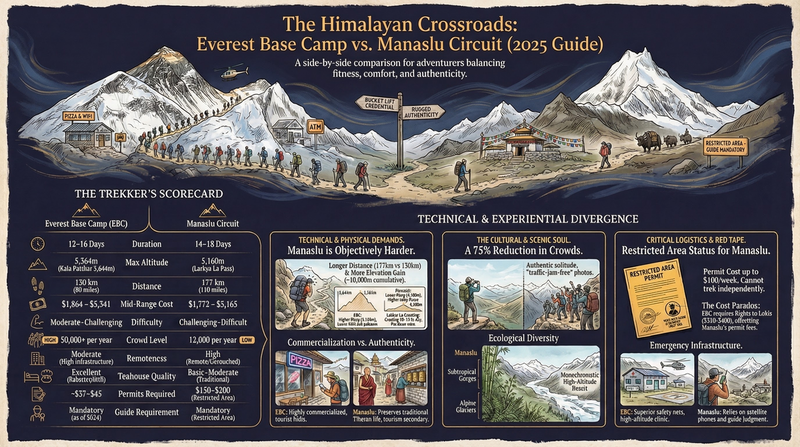
Manaslu Circuit Trek vs Everest Base Camp Trek
In the Manaslu Circuit trek vs Everest Base Camp trek decision, choose Manaslu for fewer crowds (12,000 vs 50,000+ trekkers), authentic Tibetan culture, and a tougher Larkya La Pass (5,160m). Choose Everest Base Camp for the iconic Everest views, better teahouses, cheaper permits ($40 vs $150-200), and a safer first high-altitude trek.
Standing at the crossroads of Nepal's two most compelling high-altitude adventures—the iconic Everest Base Camp trek and the increasingly celebrated Manaslu Circuit—requires more than casual research. This decision shapes your Himalayan experience in fundamental ways: the crowds you'll encounter, the cultural authenticity you'll witness, the physical demands you'll face, and the memories you'll carry home.
This comprehensive comparison guide delivers what generic blog posts cannot: verified data from the 2026/2027 trekking season, honest assessments from agencies who guide both routes, altitude profiles showing critical acclimatization differences, cost breakdowns revealing hidden expenses, and cultural insights that go beyond tourist clichés. We've analyzed trekker statistics, permit costs, teahouse infrastructure, emergency evacuation logistics, and seasonal weather patterns to provide the definitive resource for choosing between these two exceptional journeys.
The fundamental difference: Everest Base Camp offers the world's most famous trek with superior infrastructure, massive crowds (50,000+ trekkers annually), and the ultimate bucket-list credential. Manaslu Circuit delivers a more challenging, culturally immersive alternative with dramatic remoteness, authentic Tibetan villages, a demanding 5,160m pass crossing, and just 12,000 annual trekkers—essentially the "Everest experience" Nepal offered before mass tourism arrived.
Who should read this guide:
- Trekkers who've completed one route and are considering the other
- First-time Nepal visitors choosing their inaugural Himalayan adventure
- Experienced hikers seeking honest difficulty comparisons beyond marketing claims
- Cultural travelers prioritizing authentic experiences over iconic names
- Budget-conscious adventurers weighing cost versus experience value
- Anyone confused by conflicting online information about these treks
Quick Comparison: Side-by-Side Overview
| Route | Duration | Max Altitude | Difficulty | Permits | Teahouses | Crowds |
|---|---|---|---|---|---|---|
| Everest Base Camp | 12-16 days | 5,364m (Kala Patthar 5,545m) | Moderate-Challenging | $45-50 | Excellent | High (50,000+ annually) |
| Manaslu Circuit | 14-18 days | 5,160m (Larkya La Pass) | Challenging-Difficult | $150-200 | Basic-Moderate | Low (12,000 annually) |
At-a-Glance: The Critical Differences
EBC: 50,000+ trekkers/year | Manaslu: 12,000 trekkers/year (75% fewer)
Manaslu harder: Larkya La 5,160m single-day challenge vs EBC no major pass
Manaslu $100-155 more expensive (restricted area permit)
Both mandatory as of the 2026 season
Manaslu significantly more traditional/less commercialized
EBC superior facilities | Manaslu basic but improving
EBC 204m higher (5,364m vs 5,160m) but easier terrain
Manaslu typically 2-4 days longer
EBC requires Lukla flights ($215-400) | Manaslu accessible by road
EBC better access | Manaslu more remote/expensive
EBC: Sherpa culture | Manaslu: Tibetan Buddhist culture
EBC: First-timers, iconic experience | Manaslu: Experienced, culture seekers
1. Difficulty Comparison: The Larkya La Factor
The difficulty question dominates every EBC vs Manaslu conversation, and the answer isn't straightforward. While EBC reaches slightly higher maximum altitude (5,364m vs 5,160m at Larkya La Pass), Manaslu is objectively harder due to pass-crossing demands, more remote terrain, longer consecutive trekking days, and less predictable weather windows.
Maximum Altitude & Acclimatization Profiles
Critical altitude difference: While EBC tops out 204 meters higher, the sleeping altitude at Gorak Shep (5,164m) presents the greater physiological challenge for most trekkers. Manaslu's highest sleep is 704 meters lower at Dharamsala (4,460m), which significantly reduces overnight altitude stress. However, the Larkya La crossing itself—starting at 3:00-4:00 AM in extreme cold—demands more from trekkers than EBC's approach to Base Camp.
The Larkya La Pass: Why Manaslu Is Technically Harder
Larkya La Pass (5,160m) presents challenges EBC doesn't have:
- Single Demanding Day: 8-10 hour crossing with 700m ascent, 1,570m descent in one push
- Pre-Dawn Alpine Start: 3:00-4:00 AM departure in darkness and extreme cold (-20°C possible)
- Weather Dependency: Narrower weather windows; pass closes in poor conditions
- Technical Terrain: Snow, ice, moraine navigation requiring microspikes/crampons
- No Bailout Option: Once committed, you must complete the crossing or retreat
- Relentless Descent: Nearly 1,600m knee-punishing drop to Bhimtang after summit
- Remote Location: Limited rescue access if problems occur
EBC's approach to Base Camp (5,364m):
- 2-3 hour hike from Gorak Shep on established trail
- Option to split the day (Base Camp afternoon, Kala Patthar next morning)
- Easy retreat if altitude symptoms develop
- Well-trafficked route with other trekkers
- No technical terrain or equipment required
- Helicopter evacuation readily available from Gorak Shep
Pro Tip
The Larkya La crossing is why experienced trekkers consider Manaslu harder despite lower maximum altitude. If you've never done a high-altitude pass crossing (like Thorong La on Annapurna Circuit), understand this: it's a committed, physically demanding day that tests everything you've built during acclimatization. EBC's highest point requires no such single-day commitment.
Physical Fitness Requirements: What Each Trek Demands
Training recommendations:
For EBC (12-16 week program):
- Cardiovascular base: 40-60 minutes, 4x/week (running, cycling, swimming)
- Hiking with elevation: Weekend hikes building to 6-7 hours
- Strength training: Squats, lunges, step-ups 2x/week
- Back-to-back hiking days: Practice consecutive-day trekking
- Altitude simulation: Not necessary but helpful if available
For Manaslu (16-20 week program):
- Cardiovascular base: 50-70 minutes, 4-5x/week (sustained endurance critical)
- Hiking with elevation: Weekend hikes building to 8-10 hours
- Loaded pack training: 10-15kg backpack for final 4-6 weeks
- Strength training: Focus on quads, glutes, core stability 3x/week
- Back-to-back long days: Critical for pass-crossing preparation
- Previous high-altitude trek: Strongly recommended (ABC, Langtang, or similar)
Terrain & Trail Conditions Comparison
Everest Base Camp trail characteristics:
- Well-maintained stone paths throughout lower sections
- Rocky moraine trails above Lobuche
- Famous suspension bridges over Dudh Koshi gorge
- Steep sections but generally good footing
- Heavy trekker traffic keeps trails well-defined
- Stone steps on steep ascents/descents
- Exposed sections with drop-offs (trekking poles recommended)
Manaslu Circuit trail characteristics:
- More varied terrain types (subtropical to high alpine)
- Some sections prone to landslides (lower Budhi Gandaki gorge)
- Larkya La moraine and snow/ice sections
- Less maintained in remote upper sections
- Trail can be less obvious (guide navigation important)
- Suspension bridges over dramatic gorges
- Steep, rocky sections with loose scree
Weather Unpredictability: A Key Difficulty Factor
Manaslu's weather windows are less predictable than EBC's. The Larkya La Pass can experience sudden storms that close the route for days. EBC's weather, while still variable, tends to follow more predictable patterns during peak seasons. This unpredictability adds a psychological difficulty component to Manaslu—you may face delays or route changes beyond your control.
Altitude Sickness Risk Assessment
Both treks carry significant AMS (Acute Mountain Sickness) risk, but patterns differ:
EBC altitude sickness statistics (2026 season data):
- ~40-50% of trekkers experience mild AMS symptoms at some point
- ~5-10% require descent due to moderate/severe symptoms
- Most problems occur between Dingboche (4,410m) and Gorak Shep (5,164m)
- Helicopter evacuations: 30-50 per season from upper Khumbu
- Primary issue: Sleeping at 5,164m at Gorak Shep
Manaslu altitude sickness statistics (2026 season data):
- ~45-55% experience mild AMS symptoms
- ~8-12% require descent or abort pass crossing
- Most problems occur at Dharamsala (4,460m) or during pass crossing
- Helicopter evacuations: 15-25 per season (lower numbers due to fewer trekkers)
- Primary issue: Rapid ascent to Larkya La despite lower sleeping altitude
Why Manaslu AMS risk remains high despite lower sleep altitude:
- The 700m gain from Dharamsala (4,460m) to Larkya La (5,160m) is steep
- Pre-dawn start means less time for altitude adjustment
- Physical exertion at extreme altitude (8-10 hour day)
- Cold stress compounds altitude effects
- Less escape route flexibility if symptoms develop
Difficulty Verdict: Who Should Choose Which
Choose Everest Base Camp if:
- ✓ You want challenging altitude without technical pass crossing
- ✓ This is your first high-altitude trek above 5,000m
- ✓ You prefer well-established trails with infrastructure support
- ✓ You're willing to trade remoteness for superior facilities
- ✓ You have 12-16 days and moderate-to-good fitness
- ✓ The iconic "Everest" name and global recognition matter to you
- ✓ You want flexibility to modify plans (easier logistics)
Choose Manaslu Circuit if:
- ✓ You have previous high-altitude trekking experience
- ✓ You're confident in your fitness for long, demanding days
- ✓ You want the challenge of a legitimate high pass crossing
- ✓ You're comfortable with basic facilities and remoteness
- ✓ You have 14-18 days and excellent fitness
- ✓ You embrace uncertainty and adventure over predictability
- ✓ You've done EBC or similar and want the "next level" challenge
Pro Tip
First-time Nepal trekkers: If you're torn between these two, seriously consider EBC first. The infrastructure, evacuation options, and more gradual difficulty curve provide a safer introduction to Himalayan trekking. After completing EBC, you'll have the experience and knowledge to tackle Manaslu with confidence. Many trekkers who rush into Manaslu as their first Nepal adventure find it overwhelming—not because they lack fitness, but because they underestimate the combination of remoteness, basic facilities, and pass-crossing demands.
2. Crowds & Solitude: The 75% Difference
The crowd differential between these treks is dramatic and non-negotiable—arguably the single most influential factor for trekkers prioritizing solitude and authentic experiences.
Annual Trekker Numbers: The Data
What these numbers mean in practice:
Everest Base Camp peak season (October) reality:
- Lodges in Namche, Tengboche, Dingboche frequently fully booked
- Early morning "traffic jams" on the trail to Kala Patthar (100+ people attempting sunrise)
- Lines forming at popular photo spots (Hillary Bridge, Everest viewpoints)
- Dining rooms packed with trekking groups
- You'll pass 50-100+ trekkers daily on the trail
- Village infrastructure catering primarily to tourists
- Helicopter flights constant overhead (evacuations, supplies, luxury tours)
Manaslu Circuit peak season (October) reality:
- Lodges in Samagaon and Samdo can fill up but alternatives exist
- Larkya La Pass crossing: typically 20-40 people per day (vs. 300-400 at EBC)
- Entire days where you might see 10-15 other trekkers
- Villages where tourism is secondary income (agriculture still primary)
- Authentic interactions with locals whose lives aren't dominated by tourism
- Minimal helicopter traffic except emergencies
- Trail sections where you're completely alone for hours
The 75% Crowd Reduction
With 75% fewer trekkers than EBC, Manaslu offers what the Khumbu region provided in the 1980s-1990s—before commercial trekking transformed Nepal's most famous routes. If crowd avoidance is a priority, this difference alone justifies choosing Manaslu, provided you accept the trade-offs in facilities and infrastructure.
Seasonal Crowd Patterns: When to Trek for Fewer People
Everest Base Camp crowd strategies:
| Season | Crowd Level | Pros | Cons |
|---|---|---|---|
| October | Extreme (highest) | Best weather, clear skies | Teahouses overbooked, trail congested |
| November | High | Good weather, decreasing crowds | Colder, some lodges closing |
| March-April | High | Warming weather, rhododendrons | Afternoon clouds, busy |
| May | Moderate | Warmest, expedition season | Pre-monsoon clouds, some rain |
| Early December | Low | Clear skies, empty trails | Very cold, limited services |
| Late February | Low | Improving weather | Still cold, some lodges closed |
Manaslu Circuit crowd strategies:
| Season | Crowd Level | Pros | Cons |
|---|---|---|---|
| October | Moderate | Best weather, stable conditions | Highest Manaslu crowds (still low vs. EBC) |
| November | Low-Moderate | Excellent weather, fewer people | Colder, possible snow |
| April-May | Low-Moderate | Spring blooms, warming | Afternoon weather less stable |
| September | Low | Post-monsoon clearing | Early month can be wet |
| March | Very Low | Empty trails, beginning spring | Cold, possible heavy snow at pass |
| December-February | Closed/Dangerous | N/A | Extreme cold, pass often impassable |
Crowd-avoiding strategies:
For EBC (if crowds bother you):
- Trek late November or early December (cold but clear and empty)
- Book accommodations 2-3 months ahead for peak season
- Start early each morning (6:00-7:00 AM) to stay ahead of groups
- Consider Gokyo Lakes alternative for fewer crowds
- Skip peak weeks (mid-October to early November)
For Manaslu (already lower crowds):
- Trek September or April-May for even more solitude
- Mid-week starts (avoid weekend departures from Kathmandu)
- You'll have solitude regardless of season (except deep winter closure)
Impact on Cultural Experience: Commercialization vs. Authenticity
The crowd difference directly shapes cultural authenticity:
Everest Base Camp cultural reality:
- Namche Bazaar: Gear shops, bakeries, coffee shops, pizza restaurants, ATMs, pharmacies
- Teahouse menus: 20+ items including Western dishes, espresso, baked goods
- Village economy: 80-90% tourism-dependent
- Local interactions: Transactional (you're customer #47 that week)
- Sherpa culture: Still present but heavily commercialized
- Monastery visits: Open to tourists, sometimes feeling like tourist attractions
- Authenticity level: Moderate (real culture exists but filtered through tourism lens)
Manaslu Circuit cultural reality:
- Samagaon: Small shops, basic restaurants, traditional homes still used for agriculture
- Teahouse menus: 8-12 items, mostly traditional Nepali food (Dal Bhat dominant)
- Village economy: 50-60% agriculture, 40-50% tourism (tourism is supplement, not primary)
- Local interactions: Genuine curiosity, cultural exchange (you might be guest #5 that week)
- Tibetan culture: Vibrant, lived daily (not performed for tourists)
- Monastery visits: Active religious sites where tourism is secondary
- Authenticity level: High (you're witnessing culture as it's actually practiced)
Cultural authenticity comparison:
| Cultural Element | EBC | Manaslu |
|---|---|---|
| Tourism's cultural impact | Dominant force shaping village life | Significant but not overwhelming |
| Language spoken | English widespread | Nepali/Tibetan primary, some English |
| Traditional occupations | Mostly abandoned for tourism | Still actively practiced |
| Village architecture | Mix traditional/modern tourist facilities | Predominantly traditional |
| Local dress | Western clothing common | Traditional Tibetan dress still worn |
| Religious practice | Continues but tourism-aware | Authentic, daily practice |
| Children's interaction | Seek candy/pens, learn tourist habits | Genuine curiosity |
Pro Tip
For cultural photographers and anthropologists: Manaslu offers dramatically better opportunities for authentic cultural documentation. In villages like Samagaon, Lho, and Samdo, you're witnessing Tibetan Buddhist culture practiced as it has been for centuries—not a performance for tourists. The prayer wheels, mani walls, and monasteries are active religious infrastructure, not cultural attractions. If authentic cultural immersion outweighs creature comforts, this difference is decisive.
Solitude & Wilderness Experience: The Reality Check
Everest Base Camp wilderness experience:
- ❌ True wilderness solitude: Not possible during trekking season
- ✓ Spectacular mountain scenery: Absolutely, despite crowds
- ❌ Feeling of exploration: Minimal (trail is highway-like in peak season)
- ✓ Meeting international trekkers: Constant social opportunities
- ❌ Silence and contemplation: Difficult with helicopter noise and crowds
- ✓ Comfort and support: Maximum available in Nepal
Manaslu Circuit wilderness experience:
- ✓ True wilderness solitude: Frequent, especially between villages
- ✓ Spectacular mountain scenery: Comparable to EBC
- ✓ Feeling of exploration: Strong (route feels adventurous)
- ✓ Meeting trekkers: Still social but selective, deeper connections
- ✓ Silence and contemplation: Abundant
- ❌ Comfort and support: Basic, fewer safety nets
Crowds Verdict: Choosing Based on Your Preference
Choose Everest Base Camp if:
- You don't mind crowds and see social interaction as part of the experience
- You want the energy and international atmosphere of popular trails
- Meeting other trekkers from around the world appeals to you
- You value infrastructure benefits that come with higher traffic
- The "Everest" name and shared cultural experience matter
- You're going with a large group anyway (crowds matter less)
Choose Manaslu Circuit if:
- Crowds actively detract from your enjoyment of nature
- You seek authentic cultural encounters over tourist-focused interactions
- You value solitude and contemplative hiking
- You want to experience Nepal as it was before mass tourism
- You're willing to sacrifice amenities for remoteness
- You want photos without dozens of tourists in the frame
The bottom line: If you read reviews of EBC and the #1 complaint is "too crowded," take that seriously. The crowds are real, persistent, and peak-season unavoidable. Manaslu offers 75% fewer people—that's not marketing spin, it's measured reality.
3. Cost Comparison: The Permit Price Gap
Cost is often the deciding factor for budget-conscious trekkers, and the two treks present different expense profiles. Manaslu is 20-40% more expensive than EBC primarily due to restricted area permits, but the breakdown reveals nuances that matter.
Permit Costs: The Restricted Area Factor
Why Manaslu permits cost $100-155 more:
The Manaslu Restricted Area Permit (RAP) is the cost driver:
- $100 per person for first 7 days (September-November peak season)
- $75 per person for first 7 days (December-August off-season)
- $10-15 per day for days 8+ (most treks need 14+ days = 2 permit periods)
This RAP system:
- ✓ Limits trekker numbers to protect environment and culture
- ✓ Funds local community development projects
- ✓ Maintains trail infrastructure in remote areas
- ✓ Supports conservation efforts in Manaslu Conservation Area
- ❌ Makes Manaslu significantly more expensive than unrestricted treks
EBC has no RAP because it's in Sagarmatha National Park (established 1976), while Manaslu's restricted status (designated 1991) limits permits to protect the more fragile ecosystem and culture.
Permit Processing Requirements
Critical: Manaslu permits MUST be arranged through a registered trekking agency—you cannot obtain them independently. EBC permits can theoretically be obtained independently (though guide requirement makes this moot). Both treks now require licensed guides as of 2026 regulations, but Manaslu's agency-only permit rule has existed since the route opened.
Full Trek Cost Breakdown: What You'll Actually Spend
Surprised Manaslu isn't more expensive? Here's why the total costs are similar:
- Lukla flights ($215-400) offset permit difference: EBC's mandatory flight costs nearly match Manaslu's higher permit fees
- Manaslu teahouses are cheaper: Less commercialization = lower food/accommodation prices
- Duration difference is modest: Only 2-3 extra days on Manaslu
- Helicopter evacuation insurance: Similar costs (both require high-altitude coverage)
Budget-Level Cost Comparison
Budget Trekker (minimal spending):
| Budget Item | EBC | Manaslu |
|---|---|---|
| Permits | $40 | $170 |
| Transport | $370 (flights) | $80 (jeep) |
| Guide (sharing) | $200 | $250 |
| No porter (carry own bag) | $0 | $0 |
| Cheapest teahouses | $100 | $80 |
| Basic meals (Dal Bhat focus) | $250 | $270 |
| Minimal extras | $50 | $50 |
| Tips | $150 | $180 |
| TOTAL | $1,160 | $1,080 |
Manaslu can actually be cheaper for budget trekkers who avoid flights and minimize extras.
Mid-Range Trekker (comfortable standard):
| Budget Item | EBC | Manaslu |
|---|---|---|
| Permits | $45 | $200 |
| Transport | $380 (flights) | $90 (jeep) |
| Private guide | $420 | $480 |
| Porter support | $320 | $360 |
| Decent teahouses | $200 | $180 |
| Varied meals | $450 | $400 |
| Hot showers, charging, WiFi | $120 | $80 |
| Tips | $350 | $400 |
| Insurance | $150 | $150 |
| TOTAL | $2,435 | $2,340 |
Premium Trekker (maximum comfort):
| Budget Item | EBC | Manaslu |
|---|---|---|
| Permits | $50 | $200 |
| Transport (helicopter option) | $500-800 | $100 |
| Top-tier guide | $560 | $640 |
| Dedicated porter | $400 | $450 |
| Best available lodges | $400 | $300 |
| Full menu variety | $700 | $640 |
| All amenities | $150 | $120 |
| Generous tips | $500 | $550 |
| Premium insurance | $200 | $200 |
| Contingency fund | $300 | $300 |
| TOTAL | $3,760-4,060 | $3,500 |
Hidden Costs & Budget Traps
Everest Base Camp hidden costs:
- Flight delays: Lukla weather can ground flights for days; extra Kathmandu accommodation ($40-$60 /day)
- Helicopter return option: $400-500 per person (tempting luxury shortcut)
- Higher teahouse prices at altitude: Dal Bhat can reach $10-12 in upper Khumbu
- Bottled water: Expensive and wasteful (bring purification instead)
- Expedition-grade gear pressure: Shops in Namche tempt you to upgrade gear unnecessarily
Manaslu Circuit hidden costs:
- Longer duration = more days of expenses: 2-4 extra days add up
- Limited ATM access: Bring all cash from Kathmandu (no withdrawal option)
- Emergency evacuation: More expensive due to remoteness ($5,000-8,000 vs. $3,000-5,000 for EBC)
- Single supplement: Solo travelers may pay extra if agency can't pair you
- Weather delay contingency: Buffer days needed if Larkya La closes
Cost-Saving Strategies
For both treks:
- Order "Dal Bhat power" (unlimited refills) instead of a la carte Western dishes
- Skip bottled water; use purification tablets or SteriPen
- Limit hot showers to lower elevations (cold showers at high altitude anyway)
- Bring your own snacks from Kathmandu (nuts, chocolate, energy bars)
- Share a guide within a group to split costs
- Trek in shoulder season for lower teahouse prices (though fewer available)
EBC-specific savings:
- Book Lukla flights well in advance for best prices
- Skip helicopter return temptation
- Bring rental gear from Kathmandu instead of buying in Namche
- Stay in less popular villages when options exist
Manaslu-specific savings:
- Take local bus/jeep instead of private vehicle to Machha Khola
- Skip Tsum Valley extension if budget-tight (saves 4 days)
- Focus on Dal Bhat (cheaper and better energy at altitude anyway)
- Negotiate agency prices directly (permits are fixed, but service fees vary)
Value-for-Money Assessment
Best value for money: Manaslu wins
Despite higher permits, Manaslu offers better overall value:
- ✓ 75% fewer crowds = better experience per dollar spent
- ✓ More authentic cultural immersion (less commercialized)
- ✓ Challenging pass crossing (adds achievement value)
- ✓ Lower teahouse/food costs offset permit expense
- ✓ No mandatory expensive flights
- ✓ Longer trek = more days of Himalayan immersion for similar price
Best for strict budgets: EBC (if you optimize carefully)
If you're on a backpacker budget and ruthlessly minimize costs:
- EBC can be done for $1,100-1,400 (sharing guide, minimal extras)
- Manaslu's permits alone are $150-200 (non-negotiable)
- However, Manaslu total can be similar if you avoid Lukla flight upgrades
Cost Verdict
Choose Everest Base Camp if:
- You have $1,800-3,500 and want Nepal's most iconic trek
- Flight costs don't concern you (they're mandatory anyway)
- You want the comfort of knowing your money buys better infrastructure
- You're willing to pay premium for the "Everest" credential
Choose Manaslu Circuit if:
- You have $1,800-3,200 and want better value for money
- You prefer putting costs toward experience rather than flights
- You want more bang for your buck (authenticity, challenge, solitude)
- You can handle basic facilities to save on accommodation/food
The bottom line: While Manaslu permits cost more, total trek costs are comparable when you factor in EBC's mandatory flights and higher teahouse prices. Manaslu offers better value-for-money when you consider the experience quality, but EBC can be slightly cheaper for absolute budget minimalists. Neither trek is "cheap"—budget $1,800-3,500 for either to do it properly.
4. Scenery & Mountain Views: Iconic vs. Diverse
Both treks deliver world-class Himalayan scenery, but the style, variety, and photographic opportunities differ significantly. This isn't about "better" or "worse"—it's about preference.
Mountain Giants: Which Peaks You'll See
Everest Base Camp peak roster:
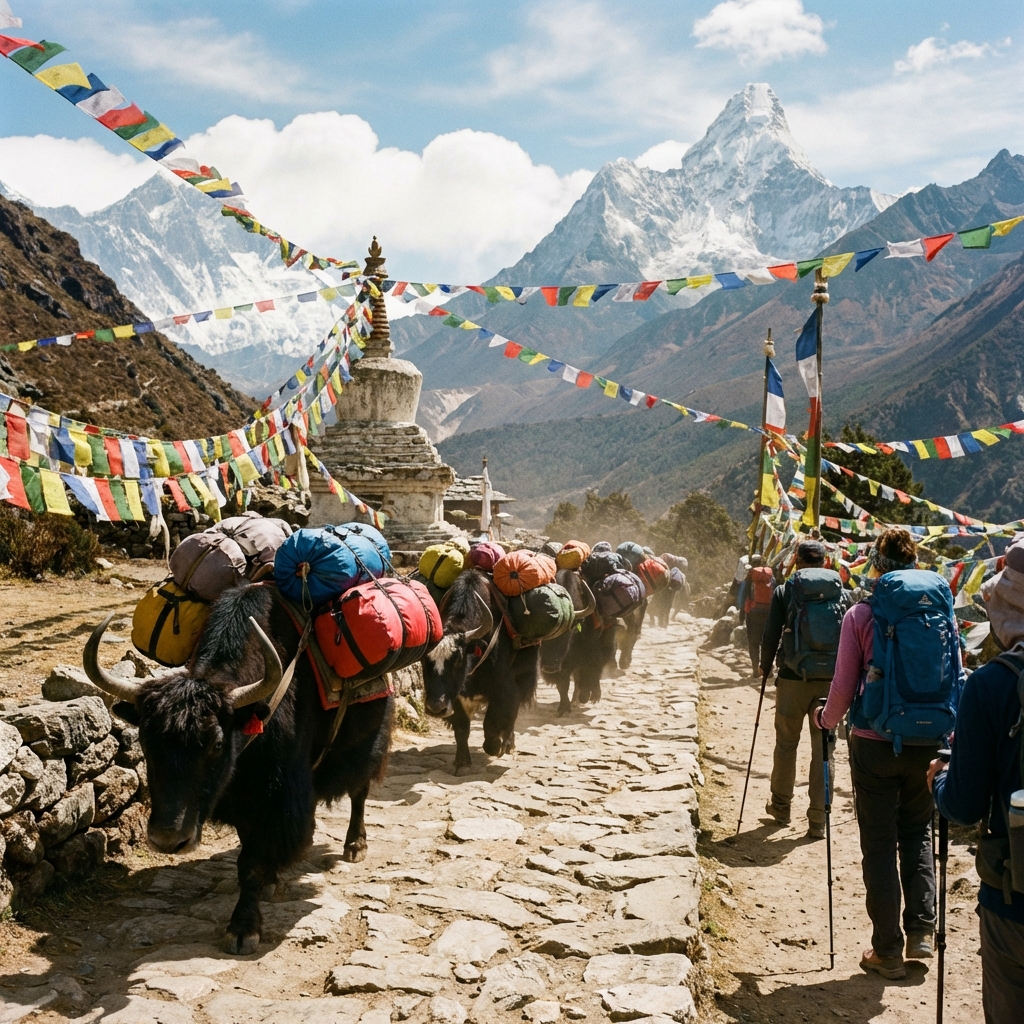
- Everest (8,849m): The main attraction, visible from Namche onward
- Lhotse (8,516m): Everest's neighbor, shares the Western Cwm
- Cho Oyu (8,188m): Sixth-highest peak, visible from Gokyo side
- Makalu (8,485m): Distant views from high points
- Ama Dablam (6,812m): The trek's photographic star, stunningly beautiful
- Nuptse (7,861m): Part of the Everest massif
- Thamserku (6,608m): Dominates views from Namche
Manaslu Circuit peak roster:
- Manaslu (8,163m): Dominates views from Lho through pass crossing
- Himalchuli (7,893m): Manaslu's neighbor, dramatic pyramid
- Ganesh Himal (7,422m): Views from lower sections
- Annapurna II (7,937m): Visible from Larkya La Pass
- Cheo Himal (6,820m): Stunning from pass
- Himlung Himal (7,126m): Border peak with Tibet
- Lamjung Himal (6,983m): Southern views
The Everest advantage: You're trekking to the base of the world's highest mountain. That credential is unmatched globally. Kala Patthar's sunrise view of Everest's summit pyramid is one of trekking's most iconic moments.
The Manaslu advantage: Manaslu dominates your perspective for days (like a private audience with an 8,000er), and the Larkya La Pass 360° panorama rivals any viewpoint in Nepal.
Scenic Variety: Ecosystems & Landscapes
Everest Base Camp landscape progression:
- Subtropical valley (Days 1-2): Pine forests, Dudh Koshi River gorge
- Transition zone (Days 3-4): Namche's hillside, first alpine vegetation
- High alpine (Days 5-12): Treeline disappears, rocky moraine, glacial terrain
- Dominant character: High-altitude desert, dramatic but monochromatic (grays, browns, whites)
Manaslu Circuit landscape progression:
- Subtropical gorge (Days 1-3): Dense forest, waterfalls, dramatic canyon
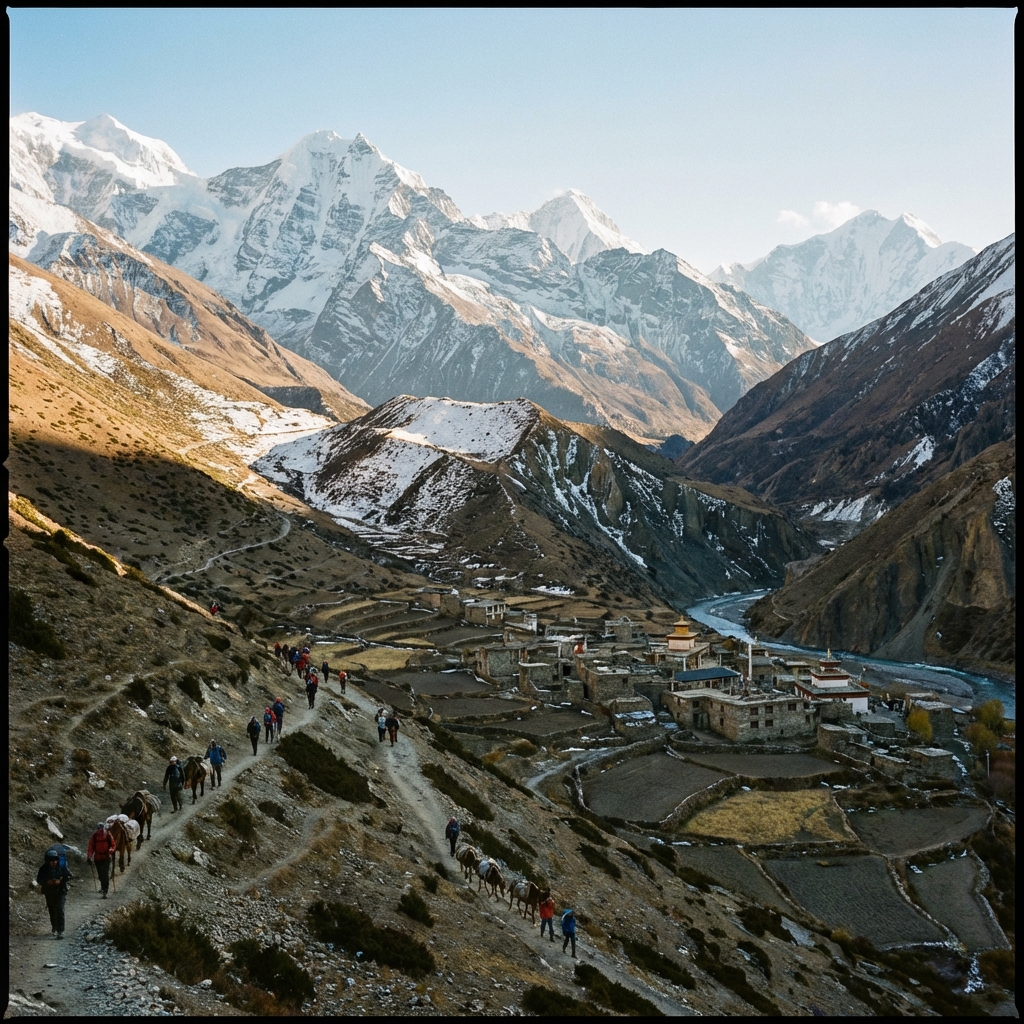
- Temperate zone (Days 4-5): Mixed forest, terraced fields, warming to alpine
- Tibetan plateau character (Days 6-9): Wide valleys, yak pastures, Buddhist villages
- High alpine (Days 10-11): Moraine, snow, glacial crossing at Larkya La
- Descent through zones (Days 12-14): Reverse journey through climate zones
- Dominant character: Extreme diversity, multiple ecosystems in one trek
Pro Tip
For photographers: Manaslu offers significantly more landscape variety (jungle to glacier). EBC offers more iconic, recognizable compositions (Everest, Ama Dablam, monasteries with peak backdrops). If your portfolio goal is "classic Himalayan images," EBC wins. If you want diverse landscapes and fewer tourists in your frames, Manaslu wins.
Photographic Opportunities & Iconic Shots
Everest Base Camp must-capture moments:
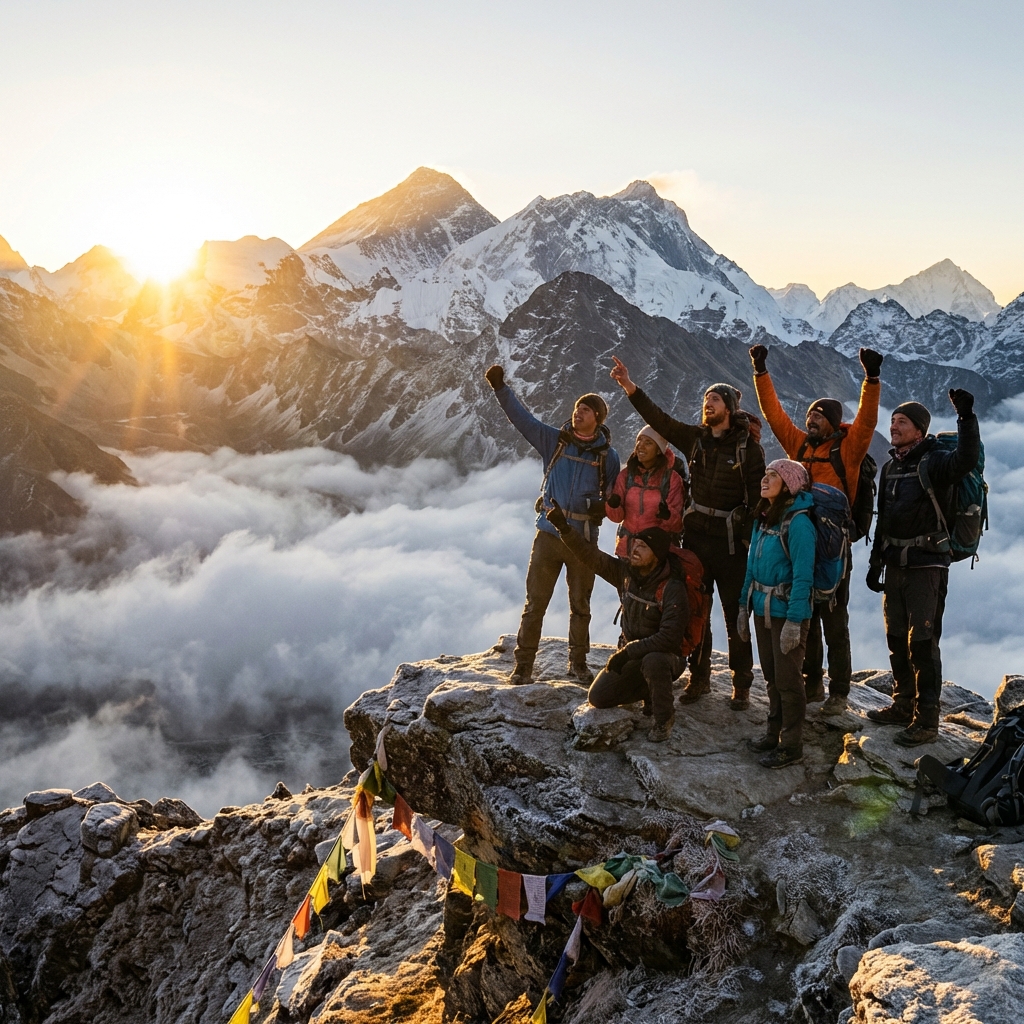
- Sunrise from Kala Patthar with Everest's summit pyramid glowing
- Hillary Suspension Bridge with prayer flags and gorge below
- Ama Dablam's perfect pyramid shape from multiple angles
- Tengboche Monastery with Everest backdrop
- Base Camp with expedition tents and Khumbu Icefall
- Namche Bazaar's amphitheater at dawn
- Stupas with mountain panoramas throughout
Manaslu Circuit must-capture moments:
- Larkya La Pass summit with prayer flags and 360° peaks
- Manaslu's north face from Samagaon at sunrise
- Tibetan-style villages (Lho, Samagaon, Samdo) with traditional architecture
- Manaslu reflected in Birendra Lake
- Pungyen Monastery with Manaslu backdrop
- Budhi Gandaki gorge suspension bridges
- Bhimtang meadows with Manaslu's western face
Photo composition advantages:
| Factor | EBC | Manaslu |
|---|---|---|
| Tourists in frame | Constant problem (peak season) | Minimal issue |
| Iconic, recognizable shots | Maximum (Everest = instant recognition) | Good but less globally known |
| Landscape variety | Moderate (mostly high alpine) | High (six climate zones) |
| Cultural subjects | Good (but commercialized) | Excellent (authentic villages) |
| Wildlife opportunities | Moderate (yaks, some birds) | Good (blue sheep, marmots, possible snow leopard signs) |
| Unique angles | Fewer (heavily photographed) | More (less documented) |
Viewpoint Comparison: The Ultimate Vistas
Everest Base Camp's premier viewpoint: Kala Patthar (5,545m)
- Pre-dawn climb (4:00-5:00 AM start)
- 360° panorama including Everest, Lhotse, Nuptse, Pumori
- Sunrise illuminates Everest's summit pyramid
- Clear views 80% of mornings in October-November
- Crowded (100-200 people on good mornings)
- Rating: 10/10 (one of world's great mountain viewpoints)
Everest Base Camp itself (5,364m):
- No Everest summit views (blocked by Nuptse ridge)
- Khumbu Icefall dominates (impressive but not summit)
- Expedition tent city (April-May climbing season)
- More about the accomplishment than the view
- Rating: 6/10 (cultural/achievement value exceeds visual)
Manaslu Circuit's premier viewpoint: Larkya La Pass (5,160m)
- Summit crossing (typically 7:00-9:00 AM arrival)
- 360° unobstructed panorama: Manaslu, Annapurna II, Cheo Himal, Himlung Himal
- Prayer flags create dramatic foreground
- Clear views 70% of mornings in October-November
- Uncrowded (20-50 people per day)
- Rating: 9.5/10 (spectacular and uncrowded)
Manaslu viewpoints en route:
- Lho: Manaslu north face, close and dramatic
- Samagaon: Wide valley views of entire massif
- Samdo: Tibet border peaks, austere landscape
- Bhimtang: Manaslu's western face, post-pass celebration views
Cultural Landscapes: Villages & Architecture
Everest Base Camp village character:
- Namche Bazaar: Sprawling trading hub, Sherpa capital, modernized
- Tengboche: Monastery village, spiritual center
- Dingboche/Pheriche: High-altitude settlements, basic but functional
- Architecture: Stone houses, Sherpa style, mix traditional/modern
- Cultural visibility: Prayer flags, mani walls, monasteries (but tourism-influenced)
Manaslu Circuit village character:
- Lho: Traditional Tibetan village, active monastery, authentic
- Samagaon: Largest village, strong Tibetan culture, teahouse hub
- Samdo: Border village, ethnic Tibetan residents, remote feel
- Architecture: Flat-roofed stone houses, Tibetan style, highly traditional
- Cultural visibility: Prayer wheels, mani walls as living religious practice (not attractions)
The Manaslu Cultural Photography Advantage
Manaslu's villages photograph as they did 30-40 years ago—traditional architecture, locals in ethnic dress, daily life undisturbed by tourism dominance. EBC villages are beautiful but heavily modified by tourism infrastructure. For cultural documentary photography, Manaslu is superior. For "iconic Himalayan village + peak" compositions, both deliver (EBC with Ama Dablam, Manaslu with Manaslu itself).
Scenery Verdict
Choose Everest Base Camp if:
- You want views of the world's highest peak (non-negotiable credential)
- Iconic, globally-recognized mountain photography is your priority
- High alpine desert landscapes appeal more than ecological variety
- You want classic Himalayan compositions (monasteries + giants)
- The Khumbu Icefall and Everest expedition culture interest you
Choose Manaslu Circuit if:
- You want extreme landscape diversity (six ecosystems in one trek)
- You prefer uncrowded viewpoints and empty landscapes in photos
- You want close, dramatic views of an 8,000m peak without crowds
- The Larkya La 360° panorama appeals more than Everest's name
- You want traditional Tibetan villages as photographic subjects
The honest take: Both treks deliver world-class mountain scenery. EBC offers the planet's most famous peak and globally iconic views. Manaslu offers comparable (some say superior) overall scenery with vastly more variety and solitude. If "I stood at Everest Base Camp" matters to you personally or professionally, that's a valid reason to choose EBC. If you prioritize the actual visual experience over the name, Manaslu competes extremely well.
5. Cultural Experience: Sherpa vs. Tibetan Heritage
The cultural dimension often becomes the tiebreaker for trekkers who value authentic human connections and anthropological depth. The difference here is substantial and favors Manaslu decisively.
Cultural Authenticity Assessment
The Sherpa Culture of the Khumbu (EBC)
The Sherpa people of the Everest region represent one of the world's most famous ethnic groups, primarily due to their mountaineering prowess and centuries-long connection to Everest expeditions.
Cultural strengths of the EBC experience:
-
Tengboche Monastery: The Khumbu's largest and most significant monastery offers daily prayer ceremonies (3-4 PM) open to visitors. The monks' chanting, horns, and drums create a powerful spiritual atmosphere, and the monastery's Everest backdrop is iconic.
-
Sherpa Museum in Namche: Well-curated exhibits on Sherpa history, climbing culture, and Everest expeditions. Provides context for the region's transformation.
-
Hillary School and Hospital: Sir Edmund Hillary's legacy of development work visible in concrete infrastructure supporting Sherpa communities.
-
Mani Rimdu Festival (October/November): If your trek coincides, this Buddhist festival at Tengboche features masked dances and ceremonies—though increasingly attended by tourists.
-
Prayer wheels and mani walls: Buddhist devotional practices visible throughout, though sometimes feeling like cultural decoration for tourist trails.
Cultural limitations of the EBC experience:
-
Commercialization: Namche Bazaar feels more like a tourist town than a traditional village. Wifi cafes, pizza restaurants, climbing gear shops, and bakeries dominate.
-
Economic dependence on tourism: 80-90% of local economy is tourism-driven, fundamentally altering traditional lifestyles.
-
English ubiquity: While convenient, this reduces cultural immersion and creates a tourist bubble.
-
Performative elements: Some cultural aspects (like prayer flag sales, monastery visits) can feel commodified for visitors.
-
Limited authentic interaction: With 50,000 annual trekkers, locals interact with foreigners as customers more than cultural ambassadors.
What you'll learn about Sherpa culture:
- The Sherpa migration from Tibet 400-500 years ago
- Buddhist practices and monastery traditions
- The evolution of Sherpa identity from traders to mountaineers
- The impact of Everest expeditions on Khumbu society
- The balance (or tension) between tradition and tourism development
The Tibetan Culture of Manaslu (Circuit)
The Nubri Valley (main Manaslu Circuit route) and Tsum Valley (optional extension) preserve some of Nepal's most authentic Tibetan Buddhist culture, with villages that have maintained traditional ways of life despite increasing tourism.
Cultural strengths of the Manaslu experience:
-
Lho and Pungyen Monasteries: Active religious sites where monks practice daily rituals for spiritual purposes, not tourist entertainment. Respectful visitors are welcome but secondary to the monastery's primary function.
-
Traditional Tibetan villages: Lho, Samagaon, and Samdo feature flat-roofed stone houses, stacked firewood, prayer flags on roofs, and traditional architecture largely unchanged for generations.
-
Working agricultural economy: You'll witness yak herding, barley cultivation, traditional butter and cheese-making, and other occupations that predate tourism.
-
Tibetan language and customs: Daily life conducted in Tibetan dialect, traditional dress still common (especially among older generations), and cultural practices maintained authentically.
-
Border area cultural dynamics: Samdo's proximity to Tibet creates unique cultural preservation—residents maintain strong Tibetan identity and cross-border family connections.
-
Tsum Valley "beyul": If you add this 4-7 day extension, you enter a "hidden valley" sacred in Tibetan Buddhism, with Mu Gompa (one of Nepal's largest nunneries) and villages where time seems frozen.
Cultural advantages of the Manaslu experience:
-
Authenticity: You're witnessing culture as it's lived, not performed. The prayer wheels, mani walls, and monasteries exist for religious purposes, with tourism as a secondary consideration.
-
Meaningful interactions: With manageable tourist numbers, locals have time and interest for genuine cultural exchange beyond transactions.
-
Traditional economy visible: Agriculture and animal husbandry remain primary livelihoods, with tourism as supplementary income.
-
Language immersion: Limited English forces you to communicate through gestures, basic Nepali, and genuine effort—creating deeper connections.
-
Undisturbed festivals: Traditional celebrations occur primarily for communities, not tourist calendars.
What you'll learn about Tibetan culture:
- Tibetan Buddhist cosmology and daily religious practice
- Traditional Himalayan agriculture and seasonal migration
- The cultural connections between Nepal's border regions and Tibet
- How Buddhism shapes architecture, art, and community life
- Traditional medicine, food preparation, and textile crafts
- The beyul (hidden valley) concept in Tibetan Buddhism
- Cross-border trade history and contemporary dynamics
Monastery Experiences Compared
Tengboche Monastery (EBC):
- Large, architecturally impressive
- Daily prayers at 3-4 PM (open to visitors)
- Monk population: ~30-40
- Tourist presence: High (dozens daily, hundreds in peak season)
- Atmosphere: Spiritual but aware of tourism
- Photography: Allowed outside, ask permission inside
- Donation: Expected (NPR 100-500)
- Experience quality: 7/10 (impressive but crowded)
Lho Gompa and Pungyen Monastery (Manaslu):
- Smaller, more intimate settings
- Daily prayers (times vary, ask locally)
- Monk population: 10-20 at each
- Tourist presence: Low (handful weekly)
- Atmosphere: Authentically spiritual, undisturbed
- Photography: Ask permission respectfully
- Donation: Optional but appreciated
- Experience quality: 9/10 (authentic, peaceful)
Tsum Valley monasteries (if you extend):
- Mu Gompa, Rachen Gompa, Gumba Lungdang
- Large nunnery populations
- Minimal tourist impact
- Experience quality: 10/10 (among Nepal's most authentic)
Traditional Villages & Architecture
EBC village architecture:
- Stone construction with pitched roofs
- Modern additions (solar panels, satellite dishes) common
- Mix of traditional and tourist-focused buildings
- Tea houses dominate village space
- Traditional elements preserved but adapted for tourism
Manaslu village architecture:
- Flat-roofed Tibetan style with stacked firewood
- Prayer flags on every roof
- Traditional construction methods still used
- Minimal modern intrusions in many villages
- Working farms and animal shelters integral to villages
- Villages built around monasteries/chortens (not teahouses)
Daily Life & Cultural Interaction
Typical cultural interaction on EBC:
- Morning: Teahouse breakfast with international trekkers
- Trail: Pass dozens of trekkers, porters, yak trains
- Lunch: Crowded teahouse, limited host interaction
- Afternoon: Arrive at village, maybe visit monastery (with other tourists)
- Evening: Communal dining room, guide translates if local hosts present
- Depth: Superficial (you're one of hundreds that week)
Typical cultural interaction on Manaslu:
- Morning: Small teahouse, often eat with host family
- Trail: Hours of solitude, occasional yak herder or local walker
- Lunch: Intimate setting, host may share meal and stories
- Afternoon: Time to visit monastery, watch village life, photograph without crowds
- Evening: Communal stove, meaningful conversations (language barrier notwithstanding)
- Depth: Genuine (you might be one of 10-20 that week)
Pro Tip
Learning basic Tibetan phrases for Manaslu pays cultural dividends: "Tashi Delek" (hello), "Thuche Che" (thank you), "Kalu Re?" (how are you?), and "Yak Po Du" (it's good) open doors. On EBC, English suffices everywhere, which is convenient but culturally shallow. The effort to communicate across language barriers on Manaslu creates connection impossible when everyone speaks English.
Cultural Learning Opportunities
What EBC teaches you:
- How tourism transforms traditional mountain communities
- The evolution of Sherpa identity from traders to mountaineers
- Buddhist monastery traditions adapted for tourist visitors
- The economics of expedition mountaineering
- Hillary's development legacy and its long-term impacts
- The balance between cultural preservation and economic opportunity
What Manaslu teaches you:
- How Tibetan Buddhist culture functions without dominant tourism influence
- Traditional Himalayan agricultural and herding practices still in use
- The relationship between Buddhism and daily life in border regions
- Traditional architecture, food preparation, and textile crafts
- The beyul (sacred valley) concept in Tibetan cosmology
- How communities maintain cultural identity while welcoming limited tourism
Cultural Verdict
Choose Everest Base Camp if:
- You want convenient cultural access with English communication
- Sherpa mountaineering history specifically interests you
- You're comfortable with commercialized but still genuine culture
- You value infrastructure support over cultural depth
- You want to see Hillary's development legacy in action
- Limited time prevents language learning or deep cultural immersion
Choose Manaslu Circuit if:
- Cultural authenticity is a primary trip motivation
- You want to witness Tibetan Buddhist culture as it's actually lived
- You're willing to push through language barriers for genuine connection
- You want to photograph traditional life without tourism's influence
- You're interested in border region cultural dynamics
- The beyul concept and sacred valley traditions appeal to you
- You want cultural interactions beyond transactions
The bottom line: If you read this section and think "cultural authenticity matters deeply to me," choose Manaslu without hesitation. The cultural experience is demonstrably superior—not because Sherpa culture on EBC isn't real (it absolutely is), but because tourism's commercial dominance has fundamentally altered how that culture is experienced by visitors. Manaslu offers what the Khumbu provided before 50,000 annual trekkers reshaped village economics and social dynamics.
6. Infrastructure & Teahouse Quality: Comfort vs. Adventure
The teahouse infrastructure difference directly impacts your daily comfort, meal variety, and amenities access. This is where EBC's development and commercialization become advantages for comfort-focused trekkers.
Teahouse Quality Comparison
Everest Base Camp teahouse evolution: With 50,000+ annual trekkers, Khumbu teahouses have evolved into reliable, relatively comfortable mountain lodges:
- Namche Bazaar: Some teahouses approach hotel standards with private bathrooms, heated dining rooms, wifi, even espresso machines
- Tengboche/Dingboche: Solid mid-range teahouses with good bedding, reliable meals, decent facilities
- Lobuche/Gorak Shep: Basic (as altitude demands) but functional and well-maintained
- Competition: Multiple teahouses in each village create quality competition
- Booking: Advance reservations possible (sometimes required in peak season)
Manaslu Circuit teahouse reality: With ~12,000 annual trekkers, teahouses remain functional but basic:
- Lower villages (Jagat-Namrung): Simple but adequate rooms, communal dining, basic facilities
- Samagaon: Best teahouse infrastructure on the circuit, still basic by Khumbu standards
- Samdo: Very basic lodges, limited amenities
- Dharamsala: Minimal shelter (think "stone hut with mattresses on floor")
- Competition: Fewer lodges, less pressure to upgrade
- Booking: Usually unnecessary (except peak October), flexibility is norm
Dharamsala Reality Check
The night before Larkya La at Dharamsala (4,460m) offers the trek's most basic accommodation: dormitory-style rooms, minimal heating, shared pit toilets, temperatures dropping to -15°C or colder. This isn't a teahouse—it's emergency shelter. Bring a quality -15°C sleeping bag and appropriate cold-weather gear. Mental preparation matters as much as physical gear.
Food & Menu Variety
Dal Bhat: The great equalizer Both treks offer excellent Dal Bhat—Nepal's staple rice, lentils, and vegetable curry with unlimited refills. This is the best value, most nutritious, and culturally appropriate choice on both routes. Where menus diverge is in Western food variety.
EBC food advantages:
- Craving pizza after 8 days? You can get it (though at altitude it won't be great)
- Morning espresso in Namche provides caffeine fix
- Bakeries offer fresh cinnamon rolls, apple pie, brownies
- Varied diet possible if Dal Bhat becomes repetitive
- Higher food turnover means fresher ingredients
Manaslu food limitations:
- Menu simplicity forces you into Dal Bhat or noodles most days
- Limited Western comfort foods
- No bakeries (bring chocolate/snacks from Kathmandu)
- Coffee is instant or milk tea
- Cultural immersion through food (less choice = more authentic)
Pro Tip
Energy and altitude nutrition: Dal Bhat is superior to Western food at altitude. The combination of carbohydrates (rice), protein (lentils), and vegetables provides sustained energy and easier digestion. On both treks, focus on Dal Bhat above 4,000m regardless of menu variety. The EBC menu variety is tempting but pizza at 5,000m is a poor choice for performance and acclimatization.
Amenities & Services
Hot showers:
- EBC: Available at most teahouses up to Dingboche (solar or gas heated), $3-7
- Manaslu: Less common, $2-5 when available, limited above Samagaon
- Reality: At high altitude on both treks, "hot" is relative and cold showers are common
Wifi & connectivity:
- EBC: Widely available from Namche onward, $3-7/day, slow but functional
- Manaslu: Samagaon has some wifi, elsewhere rare, very unreliable
- Reality: Don't count on constant connectivity on either trek
Device charging:
- EBC: Available everywhere, $2-5 per device, solar/generator powered
- Manaslu: Available at most teahouses, $2-5 per device
- Reality: Bring backup batteries on both treks
Shops & supplies:
- EBC: Namche has multiple gear shops, pharmacies, small markets
- Manaslu: Samagaon has tiny shops with basics, otherwise very limited
- Reality: Bring all essentials from Kathmandu for Manaslu
Medical facilities:
- EBC: Himalayan Rescue Association clinic at Pheriche (staffed during season)
- Manaslu: No dedicated medical clinic, guide first aid only
- Reality: Travel insurance with helicopter evacuation essential for both
Booking & Flexibility
Everest Base Camp booking:
- Peak season (October): Advance booking 1-2 months recommended
- Some teahouses accept reservations via email/phone
- Walking in possible but risky in Namche/Dingboche (may be full)
- Agencies pre-book for groups
- Less flexibility to change plans spontaneously
Manaslu Circuit booking:
- Peak season: Usually walk-in possible (though Samagaon can fill)
- Advance booking generally unnecessary
- High flexibility to adjust itinerary daily
- Agencies may pre-book Samagaon/Samdo for certainty
- More spontaneous route decisions possible
Infrastructure Verdict
Choose Everest Base Camp if:
- Teahouse comfort significantly impacts your enjoyment
- You want varied food options beyond Dal Bhat
- Reliable hot showers, wifi, and amenities matter to you
- You prefer knowing lodging is secured in advance (peak season)
- You want the safety net of better facilities and medical access
- You're less experienced with basic mountain hut conditions
Choose Manaslu Circuit if:
- You embrace basic facilities as part of the adventure
- You're content with Dal Bhat-focused diet
- You can handle cold nights, basic toilets, limited showers
- You value flexibility over guaranteed comfort
- You've done basic mountain huts before (Alps, other Nepal treks)
- You see infrastructure limitations as enhancing authenticity
The honest assessment: If you read teahouse descriptions for Manaslu and think "that sounds terrible," choose EBC. The infrastructure difference is real and impacts daily comfort. There's no shame in valuing hot showers and varied food—these are legitimate preferences. But if you've camped in cold weather or done basic mountain refuges in other ranges, Manaslu's facilities are adequate and add to the remote adventure character.
7. Permits & Regulations: Simple vs. Restricted
Permit requirements significantly differ between these treks, with Manaslu's restricted area status creating more complexity and higher costs but also limiting visitor numbers to preserve the region.
Permit Requirements Breakdown
Understanding Manaslu's Restricted Area Status
Why Manaslu is a Restricted Area:
The Nepal government designated the Manaslu region as a Restricted Area in 1991 to:
- Protect fragile ecosystems from over-tourism
- Preserve authentic Tibetan Buddhist culture
- Control border security near Tibet
- Ensure tourism benefits local communities through permit fees
- Maintain sustainable visitor numbers
What Restricted Area status means practically:
- ✗ You cannot trek independently without a registered guide
- ✗ You cannot obtain permits yourself (agency required)
- ✓ Visitor numbers remain manageable (12,000 vs. 50,000 for EBC)
- ✓ Local communities receive direct funding from permit fees
- ✓ Cultural and environmental preservation is prioritized
- ✓ Trail infrastructure is maintained with permit revenue
The RAP permit structure:
- First 7 days: $100 (Sept-Nov peak) or $75 (Dec-Aug off-peak)
- Days 8-14: $10-15 per day additional
- Typical 14-day trek total: $170-200 in RAP fees alone
Solo Travelers & Manaslu (2026 Update)
Nepal removed the old rule requiring two foreign trekkers before a Manaslu restricted area permit could be issued—you can now get a solo permit as of 2026 (a licensed guide is still mandatory). If you want to keep costs down:
- Agencies can still pair you with another solo trekker to split guide/porter costs (common in peak season)
- Trekking truly alone with a private guide may carry a "solo supplement" (typically $200-400 extra) at some agencies
- Confirm the current solo policy and pricing with your Manaslu Circuit agency before booking—service fees vary.
Permit Processing & Timeline
Everest Base Camp permit processing:
- Arrive in Kathmandu
- Visit Nepal Tourism Board office (Bhrikuti Mandap) or agency
- Submit passport copies and 2 photos
- Pay permit fees
- Receive permits same day or next day
- Checkpoint verification at Lukla and Monjo (Sagarmatha NP entrance) Total time: 1-2 days maximum
Manaslu Circuit permit processing:
- Contact registered trekking agency 2-4 weeks before arrival
- Send passport scans, photos, and itinerary details
- Agency processes RAP through Department of Immigration (Kathmandu)
- TIMS and MCAP permits obtained separately
- Permits ready 3-5 days before trek start
- Checkpoint verification at Jagat, Namrung, Dharapani Total time: 3-5 days (must use agency)
Guide Requirements (Both Treks)
As of 2026, Nepal requires guides for all trekkers in popular regions:
EBC guide requirement (2026 regulation):
- All foreign nationals must trek with licensed guide or porter
- Solo trekking prohibited
- Guide must have Government of Nepal Trekking Guide license
- Rationale: Safety, employment for locals, emergency response
Manaslu guide requirement (longstanding rule):
- Always required in restricted areas since 1991
- Must be arranged through registered agency
- Guide must have RAP area trekking experience
- Rationale: Same as above, plus cultural sensitivity and route knowledge
Guide costs (similar for both):
- $25-$35 per day for licensed guide
- 14-day EBC trek: $350-490
- 16-day Manaslu trek: $400-560
- Tips: $15-20/day (add $210-320 to total)
What a good guide provides (both treks):
- Route navigation and local knowledge
- Cultural interpretation and language translation
- Altitude sickness monitoring and emergency response
- Teahouse booking and logistics management
- Companionship and safety oversight
Checkpoint Procedures
Everest Base Camp checkpoints:
- Lukla: TIMS card check upon arrival
- Monjo: Sagarmatha National Park entry (permit check, fees collected)
- Namche: Occasional verification
- Dingboche: Occasional verification Process: Quick, friendly, permits stamped
Manaslu Circuit checkpoints:
- Jagat: Entering restricted area (thorough permit check)
- Namrung: Upper restricted zone (verification)
- Dharapani: Exit checkpoint (permit return) Process: More thorough, permits carefully verified, guide must be present
Permit Violation Consequences
Both treks:
- Trekking without proper permits: Heavy fines (NPR 50,000+), deportation possible
- Trekking without required guide: Fines, permits confiscated
- Checkpoints are serious; violations are prosecuted
Manaslu specific:
- RAP violations taken very seriously (border security concern)
- Guide verification at checkpoints mandatory
- Fake permits occasionally attempted; authorities check authentically
Permit Cost Value Proposition
What you're paying for with EBC permits ($37-45):
- Sagarmatha National Park conservation
- Trail maintenance and infrastructure
- Local community development (Khumbu municipality fee)
- Emergency services and rescue coordination
- Fairly priced for services provided
What you're paying for with Manaslu RAP ($150-200):
- Visitor number limitation (preserving experience quality)
- Direct funding to remote communities
- Cultural preservation programs
- Trail and bridge maintenance in remote areas
- Border area management and security
- More expensive but serves clear purposes
Permits Verdict
Choose Everest Base Camp if:
- You want simple, quick permit processing
- Lower permit costs matter ($37-45 vs. $150-200)
- You prefer handling permits yourself (though guide still required)
- You value flexibility (permits obtained quickly in Kathmandu)
- You don't want agency dependency for logistics
Choose Manaslu Circuit if:
- You accept higher costs for restricted area benefits (fewer crowds)
- You're comfortable with agency-managed permit processing
- You understand permit fees directly support cultural preservation
- You value what the RAP system achieves (limiting tourist impact)
- You're willing to plan ahead (3-5 day processing time)
The bottom line: Manaslu's permit complexity and cost are the price of its preserved character. The RAP system isn't bureaucracy for its own sake—it's Nepal's mechanism for preventing Manaslu from becoming another overcrowded tourist highway like parts of the EBC route. If you resent the $150-200 RAP cost, choose EBC. If you view it as paying for exclusivity and cultural preservation, it's worthwhile.
8. Best Time to Trek: Weather Windows Compared
Both treks share similar seasonal recommendations, but Manaslu's weather is less predictable, particularly for the Larkya La Pass crossing.
Optimal Trekking Seasons
Peak Season: October-November
Why October is peak for both:
- Post-monsoon crystal-clear skies (80-90% visibility days)
- Stable high-pressure weather systems
- Moderate temperatures (not too hot, not too cold)
- Minimal precipitation
- All teahouses open and fully staffed
October differences:
- EBC: Extremely crowded (22,000-25,000 trekkers)
- Manaslu: Busy by its standards (5,500-6,000 trekkers) but still quiet vs. EBC
November differences:
- EBC: Still crowded but decreasing, colder nights (-15°C at Gorak Shep)
- Manaslu: Quieter, cold, possible snow at Larkya La (requires flexibility)
Weather reliability:
- EBC: Very predictable in October-November (stable patterns)
- Manaslu: Slightly less predictable (Larkya La can close unexpectedly)
Spring Season: March-May
Why spring is excellent for both:
- Warming temperatures (pleasant at lower elevations)
- Rhododendron forests blooming (spectacular below 4,000m)
- Longer daylight hours
- Less cold than autumn at high camps
March-May differences:
- EBC: Expedition season (April-May) adds atmosphere at Base Camp
- Manaslu: Spring blooms more dramatic due to greater ecosystem variety
Weather trade-offs:
- Both treks: Afternoon clouds more common than autumn
- Both treks: Occasional pre-monsoon precipitation
- Both treks: Morning views usually clear, afternoons cloudier
Monsoon: June-August (Avoid)
Why monsoon is dangerous for both:
- Heavy rain creates trail washouts and landslides
- Leeches appear below 3,000m (miserable)
- Mountain views obscured by persistent clouds
- Rivers swell, making crossings dangerous
- Helicopter evacuation difficult in bad weather
Relative monsoon impact:
- EBC: Slightly more protected (rain shadow effect), but still dangerous
- Manaslu: More exposed to monsoon systems, Larkya La impassable
Bottom line: Don't trek either route June-August unless you're a monsoon enthusiast with extreme flexibility.
Winter: December-February
Why winter is extreme:
- Temperatures drop to -20°C to -30°C at high camps
- Heavy snow accumulation possible
- Some teahouses close (staff migrate to lower elevations)
- Shorter daylight hours
- Risk of being trapped by snowstorms
Winter feasibility:
- EBC: Possible for experienced cold-weather trekkers in December/late February
- Manaslu: Larkya La often impassable, not recommended December-February
Who treks in winter:
- Experienced mountaineers seeking solitude
- Cold-weather specialists with proper gear
- Those willing to accept route modification/cancellation
- Not recommended for first-time Nepal trekkers
Weather Unpredictability: The Larkya La Challenge
Larkya La Pass weather concerns:
- Weather can change rapidly (clear morning to whiteout by noon)
- Pass closures occur 2-5 days per month even in peak season
- Heavy snow can make crossing dangerous or impossible
- Wind speeds can reach 50+ km/h
- Guides monitor weather closely; crossing cancellations happen
What happens if Larkya La closes:
- Wait 1-3 days at Samdo or Dharamsala for weather window
- Return via same route if weather doesn't clear (no pass crossing)
- Helicopter evacuation if schedule constraints force exit
- Accept itinerary change (why buffer days are essential)
EBC weather predictability advantage:
- No single "make or break" weather-dependent day
- Multiple route alternatives if conditions deteriorate
- Easier to adjust itinerary without losing core experience
- Helicopter rescue more readily available
Pro Tip
Manaslu weather strategy: Build 2-3 buffer days into your itinerary for Larkya La weather delays. October-November offers best odds (90% crossing success rate), but weather is never guaranteed in the Himalayas. Flexible return flights from Kathmandu are essential. If you absolutely must be back by a fixed date, Manaslu's weather unpredictability is a legitimate concern.
Seasonal Crowd Patterns
Everest Base Camp seasonal crowds:
- March-May: 18,000-20,000 trekkers (High)
- June-August: 2,000-3,000 trekkers (Very Low, monsoon)
- September-November: 22,000-25,000 trekkers (Very High)
- December-February: 3,000-5,000 trekkers (Low, winter)
Manaslu Circuit seasonal crowds:
- March-May: 4,500-5,000 trekkers (Moderate)
- June-August: 500-800 trekkers (Very Low, monsoon risk)
- September-November: 5,500-6,000 trekkers (High for Manaslu, low vs. EBC)
- December-February: 200-500 trekkers (Very Low, pass often closed)
Best Time Verdict
Choose October-November for either trek if:
- You want the absolute best weather and visibility
- You can handle crowds (EBC) or accept peak pricing (both)
- You have schedule flexibility for Manaslu weather delays
- Clear mountain views are your top priority
Choose March-May for either trek if:
- You want warmer temperatures and spring blooms
- You can accept afternoon clouds (mornings usually clear)
- You prefer slightly fewer crowds than October (EBC)
- You want to see Everest expedition activity (EBC in April-May)
Choose September for Manaslu specifically if:
- You want minimal crowds (post-monsoon early season)
- You accept possible rain early in month
- You have flexibility for weather delays
Choose November for both if:
- You want excellent weather with fewer people (vs. October)
- You can handle colder temperatures (-15°C to -20°C high camps)
- You want the clearest skies of the year (often better than October)
Avoid June-August for both (monsoon danger)
Avoid December-February unless you're an experienced winter mountaineer
The bottom line: October offers the best weather for both treks, with November close behind. Manaslu requires more weather flexibility due to the Larkya La crossing. If you have rigid schedule constraints, EBC's weather predictability is advantageous. If you have buffer days and embrace adventure, Manaslu's weather is manageable October-November and March-May.
9. Safety & Emergency Evacuation: Infrastructure vs. Remoteness
Safety infrastructure differences significantly impact risk management, particularly for altitude-related emergencies.
Emergency Medical Facilities
Himalayan Rescue Association (HRA) Pheriche Clinic:
- Staffed by Western-trained doctors during peak seasons
- Specializes in altitude illness diagnosis and treatment
- Provides free daily lectures on AMS prevention
- Consultation fee: NPR 1,000-2,000 (~$8-15)
- Open April-May and October-November
- Critical resource that makes EBC objectively safer
Manaslu medical reality:
- No professional medical facilities anywhere on route
- You're dependent on guide's first aid training and judgment
- Serious illness requires immediate evacuation
- Satellite phone communication essential for emergencies
- Self-reliance and prevention are critical
Helicopter Evacuation: Access & Cost
Everest Base Camp evacuation:
- Helicopter access: Excellent (multiple companies operate regularly)
- Pickup points: Pheriche, Dingboche, Lobuche, Gorak Shep all accessible
- Weather dependency: Moderate (flights possible in most conditions)
- Response time: 2-4 hours from call to pickup (conditions permitting)
- Cost: $3,000-5,000 USD (covered by travel insurance)
- Frequency: 30-50 evacuations per season from upper Khumbu
- Reliability: High (evacuation infrastructure well-established)
Manaslu Circuit evacuation:
- Helicopter access: Limited (fewer companies, more remote)
- Pickup points: Samagaon, Samdo, Bhimtang accessible; Dharamsala and Larkya La difficult/impossible
- Weather dependency: High (narrow valleys, weather windows critical)
- Response time: 4-8 hours from call to pickup (weather dependent)
- Cost: $4,000-8,000 USD (more expensive due to distance/complexity)
- Frequency: 15-25 evacuations per season
- Reliability: Moderate (weather delays common, some locations inaccessible)
Critical Insurance Requirement
Both treks require travel insurance with:
- Helicopter evacuation coverage to 6,000m altitude
- Medical treatment coverage ($50,000+ recommended)
- Confirmation that the Manaslu restricted area is covered (some policies exclude)
- Repatriation coverage for serious illness/injury
- 24/7 emergency assistance hotline
Standard travel insurance often caps altitude coverage at 4,000m or excludes restricted areas—verify explicitly before departing. Cost: $100-200 for 2-3 week Nepal trip. This is non-negotiable.
Communication Infrastructure
Everest Base Camp:
- Cell phone coverage: Sporadic from Namche onward (Ncell/NTC)
- Wifi: Available at most teahouses ($3-7/day)
- Satellite phones: Guides often carry for backup
- Emergency calls: Generally possible from most villages
- Communication reliability: Good
Manaslu Circuit:
- Cell phone coverage: Very limited (Samagaon has weak signal)
- Wifi: Rare (Samagaon only, unreliable)
- Satellite phones: Essential (guides should carry)
- Emergency calls: Depend on satellite phone
- Communication reliability: Poor (satellite phone critical)
Common Risks & Mitigation
Safety Protocols Comparison
EBC safety advantages:
- Medical clinic access: Professional diagnosis/treatment at Pheriche
- Helicopter reliability: Well-established evacuation infrastructure
- Communication: Better connectivity for emergencies
- Trail traffic: Other trekkers present if you need help
- Experience base: Guides extremely familiar with route
- Research base: More medical data on altitude effects in Khumbu
Manaslu safety challenges:
- Medical isolation: No professional medical care anywhere
- Evacuation uncertainty: Weather can delay rescue for days
- Communication dependence: Satellite phone is only lifeline
- Trail solitude: May not encounter others for hours (help not nearby)
- Route knowledge: Fewer guides with deep Manaslu experience
- Weather unpredictability: Larkya La creates single high-risk day
Safety Equipment Recommendations
Both treks should carry:
- Comprehensive first aid kit (guide should have)
- Altitude illness medication (Diamox if prescribed)
- Water purification (tablets or SteriPen)
- Emergency whistle
- Headlamp with spare batteries
- Emergency bivouac bag (lightweight)
Manaslu additional recommendations:
- Personal Locator Beacon (PLB) or satellite messenger (inReach)
- More comprehensive first aid supplies
- Extra buffer days in itinerary for weather delays
- Higher-rated sleeping bag (-20°C minimum)
- Microspikes/light crampons (for Larkya La ice)
Turnaround Rules & Decision-Making
When to turn back (either trek):
- Moderate to severe AMS symptoms developing
- Weather deteriorating rapidly
- Injury preventing safe progress
- Guide recommendation to descend (trust their judgment)
- Feeling unwell + gut instinct says stop
Larkya La specific turnaround rules:
- Whiteout conditions at pass
- Winds exceeding safe limits
- Any AMS symptoms that morning
- Ice/snow making descent dangerous
- Time running late (must complete descent before dark)
Pro Tip
The hardest safety decision: Turning back when you're close to your goal. Ego, investment of time/money, and summit fever create powerful pressure to continue. But the statistics are clear—most Himalayan accidents occur during descent or when pushing through warning signs. If your guide says turn back, trust that decision. The mountains will be there next year; your life won't be if you make a fatal error in judgment.
Safety Verdict
Choose Everest Base Camp if:
- Safety infrastructure (medical clinic, evacuation) is a priority
- You want the backup of professional medical support
- You're risk-averse and value established safety systems
- You have health concerns that might need professional assessment
- You want more reliable helicopter evacuation access
- This is your first high-altitude trek (lower risk profile preferred)
Choose Manaslu Circuit if:
- You're comfortable with self-reliance and remoteness
- You accept higher evacuation costs and uncertainty
- You have previous high-altitude experience (you know your body's response)
- You trust your guide's judgment and first aid skills
- You embrace calculated risk as part of adventure
- You have comprehensive insurance and contingency planning
The bottom line: EBC is objectively safer due to medical infrastructure and evacuation reliability. This doesn't make Manaslu "dangerous" (it's a well-established trek), but it requires higher self-reliance and risk acceptance. If the Pheriche medical clinic gives you peace of mind, that's a legitimate factor. If you view medical isolation as part of the authentic remote experience, Manaslu's challenges are acceptable trade-offs.
Which Trek Is Harder?
The Manaslu Circuit is objectively harder than EBC. The Larkya La pass (5,160m) demands a single grueling crossing day of 8-10 hours, the terrain is rougher, tea houses are more basic, and the route is more remote with fewer evacuation options. EBC reaches higher altitude (5,545m at Kala Patthar) but involves no pass crossing and has superior infrastructure throughout. See our trekking boots guide for footwear suited to either route.
Which Trek Is Cheaper?
EBC is more expensive overall due to mandatory Lukla flights ($215-400 round-trip). However, Manaslu's restricted area permit ($100-150+) and mandatory agency/guide fees partially offset this. A mid-range EBC trek costs $1,800-3,000, while Manaslu runs $2,000-3,500. Budget trekkers save more on EBC's superior tea house competition. See our Nepal trekking permits guide for current permit costs.
Which Trek Has Better Views?
EBC offers the iconic view of Everest, Lhotse, Nuptse, and Ama Dablam, with the famous Kala Patthar sunrise. Manaslu provides diverse scenery over two weeks including dramatic gorges, Tibetan villages, and views of Manaslu (8,163m) from multiple angles. EBC wins for iconic single-viewpoint impact. Manaslu wins for cumulative scenic variety and cultural landscape. Prepare with our complete gear list.
10. Who Should Choose Which Trek: The Decision Framework
After analyzing difficulty, crowds, cost, scenery, culture, infrastructure, permits, weather, and safety, here's the honest assessment of who belongs on each trek.
Experience Level Recommendations
First-time Nepal trekkers:
- Recommended: Everest Base Camp
- Why: Better infrastructure, medical support, more forgiving if you misjudge your fitness/altitude tolerance, iconic credential provides motivation through hard moments
- Alternative: Annapurna Base Camp (easier) before attempting either
Experienced trekkers (completed 1-2 Nepal treks):
- Recommended: Either trek (your call based on priorities)
- EBC if: You want the Everest name, superior facilities, and predictable logistics
- Manaslu if: You want fewer crowds, cultural depth, and a greater challenge
Advanced trekkers (completed 3+ Nepal treks or equivalent):
- Recommended: Manaslu Circuit
- Why: You've likely done EBC or similar; Manaslu offers the "next level" experience with greater remoteness, authentic culture, and the Larkya La challenge
Fitness Level Recommendations
Moderate fitness (can hike 5-7 hours, some multi-day experience):
- Recommended: Everest Base Camp
- Why: No single ultra-demanding day; more gradual; better bailout options if you're struggling
Good fitness (can hike 6-8 hours, regular multi-day trekking):
- Suitable for: Either trek
- Choose based on: Priorities beyond fitness (crowds, culture, etc.)
Excellent fitness (can hike 8-10+ hours, competitive hiking background):
- Recommended: Manaslu Circuit
- Why: The Larkya La crossing rewards strong fitness; you'll appreciate the greater challenge
Priority-Based Decision Tree
If your #1 priority is...
Iconic credential & global recognition: → Choose EBC (Everest name carries unmatched cultural weight)
Authentic cultural immersion: → Choose Manaslu (Tibetan villages, minimal commercialization, genuine interactions)
Avoiding crowds: → Choose Manaslu (75% fewer trekkers, solitude available)
Comfortable facilities & amenities: → Choose EBC (superior teahouses, varied food, hot showers, wifi)
Challenging pass crossing: → Choose Manaslu (Larkya La is a legitimate mountaineering-lite experience)
Safety & medical infrastructure: → Choose EBC (HRA clinic, better evacuation access, more support)
Value for money: → Choose Manaslu (better experience quality per dollar despite higher permits)
Lower budget: → Choose EBC (cheaper permits, though total costs similar)
Landscape diversity: → Choose Manaslu (six climate zones vs. mostly high alpine on EBC)
First high-altitude trek: → Choose EBC (more forgiving infrastructure, better safety nets)
Personality & Travel Style Matching
Age & Physical Condition Considerations
18-30 years old:
- Either trek suitable (fitness typically high)
- Manaslu if seeking adventure and challenge
- EBC if seeking social atmosphere and recognition
31-50 years old:
- Either trek suitable with proper training
- Choose based on priorities (see above)
- Consider EBC if family/work constraints limit training time
51-65 years old:
- Either trek achievable with excellent fitness
- EBC recommended for better medical support access
- Manaslu if you're experienced and fit
65+ years old:
- EBC recommended (medical clinic access critical)
- Manaslu possible for exceptionally fit with altitude experience
- Both require medical clearance and honest fitness assessment
Health considerations:
- Respiratory issues: EBC (medical clinic access)
- Cardiovascular concerns: EBC (evacuation reliability)
- Joint problems: EBC (shorter, less descent punishment)
- Previous altitude success: Either trek
- Previous altitude problems: Reconsider both (consult doctor)
Time Available
10-12 days total:
- Neither trek ideal (too rushed)
- EBC possible but requires cutting acclimatization (risky)
- Consider Annapurna Base Camp instead
12-14 days total:
- EBC suitable (standard itinerary)
- Manaslu too rushed (minimum 14, better with 16+)
14-16 days total:
- EBC suitable (comfortable pace)
- Manaslu suitable (standard itinerary)
16-18 days total:
- EBC suitable (can add Gokyo Lakes)
- Manaslu ideal (includes buffer days)
18+ days total:
- EBC can combine with Three Passes
- Manaslu can add Tsum Valley extension
Budget Constraints
Under $1,500 total:
- EBC possible (budget carefully, minimize extras)
- Manaslu challenging (permits alone $150-200)
$1,500-2,500 total:
- Either trek suitable (comfortable mid-range)
- Similar total costs when accounting for all factors
$2,500-4,000 total:
- Either trek comfortable (premium experience possible)
- Manaslu offers better value for money at this level
$4,000+ total:
- Either trek luxury level
- Consider helicopter returns or extensions
Season & Weather Flexibility
Fixed schedule (must finish by specific date):
- EBC recommended (more predictable weather, better evacuation)
- Manaslu risky (Larkya La delays can disrupt schedules)
Flexible schedule (can extend if needed):
- Either trek suitable
- Manaslu requires 2-3 buffer days minimum
Traveling October-November:
- Either trek optimal weather window
- EBC very crowded, Manaslu moderately busy
Traveling March-May:
- Either trek good weather
- Slightly fewer crowds than autumn
Making the Final Decision
Choose Everest Base Camp if 3+ of these apply:
- This is your first Nepal trek
- The "Everest" name matters to you personally/professionally
- You prioritize comfort and amenities
- You want established safety infrastructure
- You have only 12-14 days available
- You're nervous about extreme remoteness
- You want to meet many international trekkers
- You prefer predictable logistics and weather
Choose Manaslu Circuit if 3+ of these apply:
- You've done EBC or similar high-altitude treks
- Authentic cultural immersion is a top priority
- You actively dislike crowds on trails
- You want a challenging high pass crossing
- You have 16+ days available
- You're comfortable with basic facilities
- You value landscape diversity
- You embrace uncertainty and adventure
Still undecided? Ask yourself:
- "Will I remember the Everest name in 10 years, or the cultural connections I made?" (EBC vs. Manaslu)
- "Do I want the trek the world knows about, or the trek that feels like a discovery?" (EBC vs. Manaslu)
- "Am I more excited about comfort or challenge?" (EBC vs. Manaslu)
- "Will crowds bother me enough to outweigh infrastructure benefits?" (If yes: Manaslu)
Pro Tip
The "do both eventually" strategy: Many serious Nepal trekkers recommend doing EBC first (test your altitude response with better support systems) and Manaslu second (leverage your experience for the greater challenge). This progression makes sense if you love Himalayan trekking and plan to return. But if you're doing only ONE Nepal trek in your life, choose based on what matters most: global recognition (EBC) or authentic cultural adventure (Manaslu).
Frequently Asked Questions
General Comparison Questions
Q: Which trek is more beautiful, EBC or Manaslu? A: Subjective, but honest answer: EBC offers the world's most famous peak and iconic high-alpine views. Manaslu offers comparable mountain scenery with far greater ecosystem diversity (subtropical to glacial). If "beautiful" means "iconic and recognizable," EBC wins. If it means "varied and uncrowded," Manaslu wins. Both deliver world-class Himalayan scenery.
Q: Can I do both treks on one Nepal trip? A: Theoretically yes, but practically difficult. EBC (14 days) + Manaslu (16 days) + rest days + Kathmandu time = 35-40 days minimum. Few people have this much time. More realistic: Do one trek now, return for the other another year. Your body will thank you for the spacing.
Q: Which trek has better sunrise/sunset views? A: EBC's Kala Patthar sunrise is legendary (Everest's summit pyramid illuminated). Manaslu's Larkya La sunrise is equally spectacular (360° panorama with fewer people). Both offer stunning dawn mountain light. Edge to EBC for iconic recognition, Manaslu for solitude.
Q: Is one trek safer than the other? A: EBC is objectively safer due to the Himalayan Rescue Association medical clinic at Pheriche and more reliable helicopter evacuation. Manaslu requires greater self-reliance. Both treks carry significant altitude risks requiring proper acclimatization.
Q: Which trek has friendlier local people? A: Both regions have genuinely hospitable people. Manaslu locals have more time for interactions (fewer tourists to attend to) and often show more curiosity about foreign visitors. EBC interactions can feel more transactional due to tourism volume. Cultural exchange depth favors Manaslu.
Q: Can I switch from EBC to Manaslu or vice versa while in Nepal? A: EBC to Manaslu switch is easy (permits obtained quickly). Manaslu to EBC switch is harder (RAP processing takes 3-5 days minimum). Better to decide before arriving in Nepal.
Difficulty & Fitness Questions
Q: I'm in decent shape but not athletic. Which trek is safer for me? A: Everest Base Camp. Better medical infrastructure, more gradual difficulty curve, superior evacuation access. Train properly (12-16 weeks cardio + hiking), and EBC is achievable for "decent shape" trekkers. Manaslu demands "good to excellent" fitness.
Q: Which trek is harder: Manaslu Circuit or EBC? A: Manaslu Circuit is harder overall due to the Larkya La Pass crossing (single 10-hour demanding day), more remote terrain, longer consecutive trekking days, and less infrastructure support. EBC reaches higher altitude but with more gradual progression.
Q: How does the Larkya La Pass compare to Thorong La Pass (Annapurna Circuit)? A: Very similar: both around 5,160m, both require pre-dawn starts, both involve long days. Larkya La has slightly steeper approaches and more dramatic scenery. Thorong La has better infrastructure. If you've done Thorong La successfully, you can handle Larkya La.
Q: Can I train for these treks without living near mountains? A: Yes. Focus on: (1) Cardiovascular endurance—running, cycling, stair climbing, (2) Leg strength—squats, lunges, step-ups with weight, (3) Consecutive-day endurance—back-to-back long walks, (4) Loaded pack training—10-15kg for final weeks. Altitude adaptation happens on the trek itself through proper acclimatization.
Q: I'm over 60. Which trek is more appropriate? A: EBC recommended. The medical clinic at Pheriche provides critical peace of mind for older trekkers. Better evacuation access matters more as age increases. That said, exceptionally fit 60+ trekkers complete Manaslu successfully every season—know your body and train thoroughly.
Cost & Budget Questions
Q: Why is Manaslu more expensive if facilities are more basic? A: The Restricted Area Permit ($150-200) is the main cost driver. This permit funds cultural preservation and limits visitor numbers. However, total trek costs are similar (Manaslu permits vs. EBC Lukla flights). Lower teahouse prices on Manaslu offset some permit expense.
Q: Can I reduce costs by trekking without a guide? A: No. Both treks now require licensed guides (EBC since the 2023 nationwide rule, Manaslu always required as a restricted area). This is enforced at checkpoints, so independent no-guide trekking is not an option. Budget for guide costs ($25-$35/day + tips) on either trek.
Q: Which trek offers better value for money? A: Manaslu. Despite higher permits, you get: (1) 75% fewer crowds, (2) More authentic cultural immersion, (3) Challenging pass crossing, (4) Greater solitude, (5) Lower teahouse/food costs. EBC offers better facilities for your money, but Manaslu offers better overall experience value.
Q: What's the single biggest cost difference? A: For EBC: Lukla flights ($215-400 mandatory). For Manaslu: Restricted Area Permit ($150-200). These roughly offset each other, making total costs comparable.
Q: Are tips expected on both treks? How much? A: Yes, tips are culturally expected and represent significant income for guides/porters. Guidelines: $15-20/day for guides, $10-15/day for porters. Budget $250-500 total for a 14-16 day trek with guide and porter. Tips are NOT included in package prices—budget separately.
Crowds & Solitude Questions
Q: How crowded is EBC during peak season really? A: Very crowded. October sees 300-400 trekkers daily on trail. Namche, Tengboche, Dingboche teahouses often fully booked. Kala Patthar sunrise can have 100-200 people. If you dislike crowds, this is a legitimate concern—not exaggeration.
Q: Will I be completely alone on Manaslu? A: No, but you'll experience significant solitude. You might see 10-20 other trekkers per day (vs. hundreds on EBC). Entire trail sections where you're alone for hours. Villages where you're the only foreign visitors that day. It's "quiet" not "deserted."
Q: Can I avoid EBC crowds by trekking in off-season? A: Partially. November has fewer crowds than October (still busy). December-February is empty but extremely cold (some lodges closed). June-August is empty but dangerous (monsoon). March-May is moderately busy. For true solitude, EBC never competes with Manaslu.
Q: Does Manaslu feel lonely or isolated? A: Depends on personality. Social trekkers find plenty of evening camaraderie at teahouses (smaller groups, deeper conversations). Introverts love the trail solitude. You're never dangerously isolated—guides, occasional trekkers, and locals provide safety and connection.
Cultural Experience Questions
Q: Which trek offers more authentic cultural experiences? A: Manaslu, decisively. Lower tourist numbers mean locals have time for genuine interactions. Villages maintain traditional occupations (agriculture, herding) alongside tourism. Religious practices are authentic daily life, not performances. EBC culture is real but heavily influenced by tourism economics.
Q: Can I visit monasteries on both treks? A: Yes. EBC's Tengboche Monastery is larger and architecturally impressive but touristy. Manaslu's Lho, Pungyen, and Ribung monasteries are smaller, more intimate, and authentically spiritual. Both offer valuable cultural insights.
Q: Will language barriers be a problem on Manaslu? A: Some, but manageable. English is less common than EBC, forcing more creative communication (gestures, basic Nepali, guide translation). Many trekkers find this enhances cultural depth—struggling to communicate creates connection impossible when everyone speaks English.
Q: Which trek teaches me more about Himalayan culture? A: Manaslu teaches you how Tibetan Buddhist culture functions in daily life (agriculture, religious practice, traditional architecture). EBC teaches you how tourism transforms mountain communities (evolution of Sherpa identity, mountaineering economics, development impacts). Both valuable, different perspectives.
Logistics & Planning Questions
Q: How far in advance should I book? A: EBC peak season (Oct-Nov): 2-3 months for agencies/lodges. Manaslu: 4-8 weeks for RAP permit processing. Shoulder seasons: 2-4 weeks sufficient for both. Last-minute bookings possible but risky in peak season.
Q: Can I change my mind and switch treks after arriving in Nepal? A: EBC is easy to arrange quickly (permits obtained in 1-2 days). Manaslu requires 3-5 days for RAP processing through agency. Decide before arriving if possible to avoid wasted Kathmandu days.
Q: Do I need to pre-book teahouses? A: EBC peak season: Highly recommended for popular villages (Namche, Tengboche, Dingboche). Manaslu: Generally unnecessary except peak October in Samagaon. Walk-in usually works.
Q: What if I fail to reach the destination on either trek? A: Common and not shameful. ~10-15% of EBC trekkers turn back due to altitude issues. Similar for Manaslu. The journey matters more than the destination—reaching Tengboche on EBC or Samagaon on Manaslu still represents significant achievement.
Weather & Seasons Questions
Q: Which trek has more predictable weather? A: EBC, slightly. Both treks share similar seasonal patterns, but EBC's weather is more stable. Manaslu's Larkya La Pass creates a single point of weather vulnerability—closures occur even in peak season.
Q: Can I trek either route in winter (Dec-Feb)? A: EBC: Possible but extreme cold (-20°C to -30°C at high camps). Manaslu: Not recommended (Larkya La often impassable, extreme avalanche risk). Winter trekking requires mountaineering-level cold-weather experience.
Q: What happens if monsoon rains catch me on the trail? A: Both treks become dangerous—landslides, swollen rivers, trail washouts. If monsoon arrives early (late May-early June), descend immediately. Helicopter evacuation may be necessary. This is why travel insurance is critical.
Q: How flexible should my schedule be? A: EBC: 1-2 buffer days recommended (Lukla flight delays). Manaslu: 2-3 buffer days essential (Larkya La weather delays possible). Fixed schedules create stress; flexibility prevents disappointment.
Safety Questions
Q: Which trek has more helicopter evacuations? A: EBC has more absolute numbers (30-50 per season vs. 15-25 for Manaslu), but this reflects higher trekker volume. Per-capita evacuation rates are similar (~0.1% of trekkers). Both treks are safe with proper acclimatization and preparation.
Q: What if I get altitude sickness? A: EBC: Descend to Pheriche HRA clinic for professional assessment and treatment. Manaslu: Descend immediately, guide administers first aid, helicopter evacuation if severe. Both require travel insurance covering helicopter rescue.
Q: Is solo trekking (with guide) safe on both routes? A: Yes. Solo trekkers (with mandatory guide) complete both treks regularly. Guide provides safety oversight, local knowledge, and emergency response. Solo female trekkers report feeling safe on both routes.
Q: What's the most dangerous part of each trek? A: EBC: Sleeping at 5,164m at Gorak Shep (altitude stress). Manaslu: Larkya La Pass crossing (altitude + weather + terrain). Both require respect, preparation, and willingness to turn back if conditions deteriorate.
Final Verdict: Your Trek Awaits
Standing at the decision point between Everest Base Camp and Manaslu Circuit isn't choosing between "better" and "worse"—it's choosing which extraordinary experience aligns with your values, fitness, priorities, and trekking philosophy.
Everest Base Camp delivers:
- The world's most iconic trekking credential
- Superior infrastructure and safety systems
- Predictable logistics and weather patterns
- Social atmosphere and international community
- Sherpa culture and mountaineering history
- Comfort-focused teahouse experience
Manaslu Circuit delivers:
- Authentic Tibetan Buddhist cultural immersion
- 75% fewer crowds and genuine solitude
- Challenging Larkya La Pass crossing
- Extreme landscape diversity (six climate zones)
- Traditional villages and meaningful local interactions
- Adventure-focused remote experience
The decision ultimately comes down to this:
Do you want to stand at the base of the world's highest mountain, surrounded by the infrastructure and recognition that comes with global fame? Choose Everest Base Camp.
Or do you want to experience Nepal as it existed before mass tourism, crossing a dramatic 5,160m pass into villages where Tibetan culture thrives authentically? Choose Manaslu Circuit.
Both treks will challenge you, reward you, and change your perspective on mountain landscapes and high-altitude adventure. The Himalayas don't rank their treasures—they offer different gifts to different seekers.
Ready to commit? Your next steps:
- Check your fitness honestly against the requirements outlined in Section 1
- Confirm your available days (12-16 for EBC, 14-18 for Manaslu minimum)
- Set your budget ($1,800-3,500 realistic range for either)
- Verify your priorities using the decision framework in Section 10
- Research verified agencies (see links below)
- Book appropriate travel insurance (mandatory, altitude coverage critical)
- Begin training (12-20 weeks recommended)
- Embrace the journey (the trek transforms lives—yours is about to begin)
The mountains are calling. The only wrong choice is letting fear or indecision keep you from answering.
Plan Your Manaslu Circuit or Everest Base Camp Trek
Still weighing the Manaslu Circuit trek vs Everest Base Camp trek? Tell us your dates, fitness, and priorities. We'll match you with a verified, government-licensed local agency, a realistic itinerary, and every permit handled.
Related Content & Resources
Trek-Specific Guides
- Everest Base Camp Trek: Complete 14-Day Itinerary & Guide
- Manaslu Circuit Trek: 14-18 Day Itinerary & Larkya La Guide
- Everest Three Passes Trek
- Gokyo Lakes Trek: EBC Alternative Route
- Annapurna Base Camp Trek
- Annapurna Circuit Trek
Regional Overviews
- Everest-Khumbu Region Overview
- Manaslu Region Overview
- Best Time to Trek Everest Region
- Manaslu Circuit Best Time
Practical Planning Resources
- Nepal Trekking Permits Explained
- Altitude Sickness Prevention & Signs
- Best Time to Trek Nepal (All Regions)
- Trekking Packing List for High Altitude
- Compare EBC Trekking Agencies
- Compare Manaslu Circuit Agencies
Other Comparison Guides
Verification & Safety
- Everest Base Camp Trek: Complete Guide
- Manaslu Circuit Trek: Larkya La Guide
- Larkya La Pass Complete Guide (5,160m)
- EBC Trek Cost Breakdown
- Manaslu Circuit Cost Breakdown
- Manaslu Restricted Area Permit Guide
- Nepal Trekking Permits Explained
- Manaslu Region Overview
- Everest-Khumbu Region Overview
- Best Time to Trek Manaslu Circuit
- Compare Manaslu Circuit Agencies
- Compare Everest Base Camp Agencies
This comprehensive comparison guide was researched and written by the Trek and Tour Nepal editorial team using verified data from the Nepal Tourism Board, Sagarmatha National Park Authority, Manaslu Conservation Area Project, local trekking agencies, and analysis of 2026/2027 season statistics. Last updated June 2026.
For corrections, updates, or additional questions, contact our editorial team. We update this guide seasonally based on changing conditions, permit regulations, and trekker feedback.