



Everest Three Passes Trek
The Everest Three Passes trek is an 18-21 day circuit in Nepal's Khumbu region that crosses three high passes—Kongma La (5,535m), Cho La (5,420m), and Renjo La (5,360m)—while also reaching Everest Base Camp, Kala Patthar, and the Gokyo Lakes. Rated Very Difficult, it is the Everest region's hardest teahouse trek and costs roughly $1,800-$5,500 with a licensed guide.
| Route | Duration | Max Altitude | Difficulty | Permits | Teahouses | Crowds |
|---|---|---|---|---|---|---|
| Three Passes Trek | 18-21 days | 5,545m | Very Difficult | $45-50 | Good to Basic | Low-Moderate |
| Everest Base Camp | 12-14 days | 5,364m | Moderate-Challenging | $45-50 | Excellent | High |
| Gokyo Lakes Trek | 12-14 days | 5,357m | Moderate-Challenging | $45-50 | Good | Moderate |
| EBC + Cho La + Gokyo | 16-18 days | 5,420m | Challenging | $45-50 | Good | Moderate |
The Everest Three Passes Trek stands as the definitive high-altitude challenge in Nepal's Khumbu region—a grueling yet profoundly rewarding circuit that separates casual trekkers from serious mountain adventurers. While the standard Everest Base Camp trek attracts over 50,000 trekkers annually, fewer than 3,000 attempt the Three Passes route each year. Those who do are rewarded with experiences that most Everest visitors never encounter: glacier crossings at dawn, remote valleys untouched by crowds, and panoramic views from three of the Himalaya's most spectacular high passes.
This comprehensive guide draws from decades of collective guiding experience, current route conditions, and hard-won lessons from countless pass crossings. Whether you're an experienced high-altitude trekker ready to test your limits or an ambitious adventurer planning your most challenging trek yet, this resource provides the detailed information you need to prepare properly and maximize your chances of success.
Route Snapshot
18-21 days (trek only)
160-170 km circuit
5,545m (Kala Patthar)
5,535m (Kongma La)
8,000m+ cumulative
Very Difficult (Grade 5)
Oct-Nov, Apr-May
Good (some basic at altitude)
Mandatory (Nepal law since 2026)
Strongly Recommended
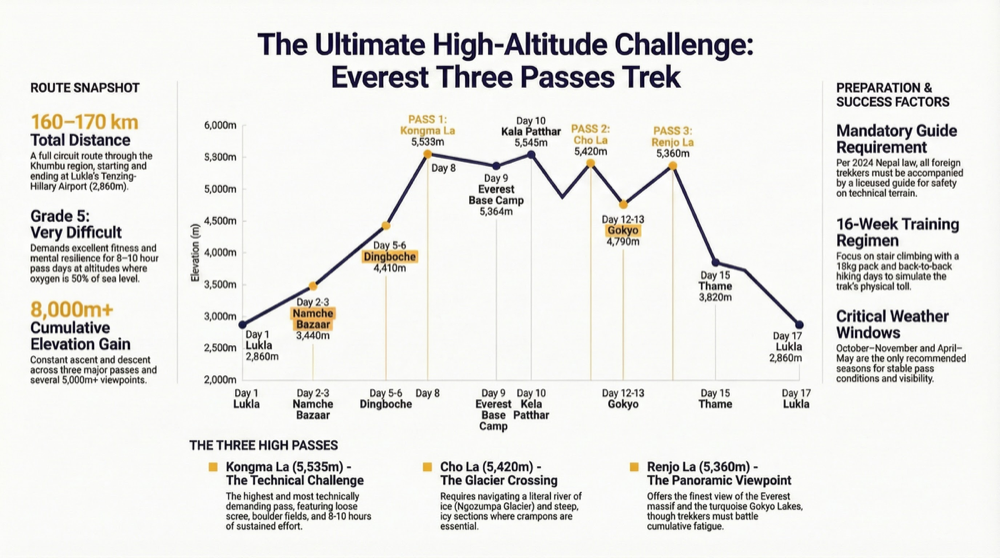
What Makes Three Passes Different from Standard EBC:
| Factor | EBC Trek | Three Passes Trek |
|---|---|---|
| Highest Sleep Altitude | 5,164m (Gorak Shep) | 5,164m (Gorak Shep) |
| Pass Crossings | 0 | 3 (all above 5,300m) |
| Technical Sections | None | Glacier, scree, fixed ropes |
| Route Type | Out-and-back | Full circuit |
| Daily Hours | 5-7 hours | 6-10 hours on pass days |
| Weather Dependency | Moderate | High (pass windows critical) |
| Fitness Requirement | Good | Excellent |
| Mental Demands | Moderate | High |
Why the Three Passes Trek Is Nepal's Ultimate Challenge
The Three Passes Trek isn't simply a longer version of the EBC trek—it's a fundamentally different experience that demands everything a trekker can give. Here's what sets it apart:
Physical Intensity: While EBC involves steady ascent and descent on established trails, the Three Passes route requires crossing three major passes in quick succession, each involving 600-1,000m of elevation gain and loss in a single day. Pass days routinely exceed 8-10 hours of strenuous effort at altitudes where oxygen levels are 50% of sea level. Understanding how altitude affects your body is essential preparation.
Technical Elements: Unlike the well-maintained EBC trail, pass crossings involve scrambling over loose rock, navigating glacial ice, and potentially using fixed ropes. Cho La Pass, in particular, requires crossing a glacier where crampons may be necessary depending on conditions.
Weather Vulnerability: Each pass has specific weather windows, and being caught in a sudden storm above 5,000m can be life-threatening. The circuit nature means you can't simply turn back—you must either complete the pass or wait for conditions to improve.
Remote Sections: After crossing Kongma La, you'll enter valleys that see far fewer trekkers than the main EBC trail. Teahouse options are limited, rescue is more complicated, and self-sufficiency becomes essential.
Cumulative Altitude Exposure: Spending 10+ days above 4,000m with multiple forays above 5,000m creates sustained physiological stress. Even well-acclimatized trekkers may experience cumulative fatigue that affects judgment and performance.
Critical Reality Check
The Three Passes Trek has a significantly higher turnaround rate than standard EBC. Approximately 20-25% of trekkers who attempt it fail to complete all three passes due to altitude sickness, fitness limitations, weather, or injury. Honest self-assessment before booking is essential—this is not a trek to "see how it goes."
The Three Passes: A Detailed Breakdown
Understanding each pass's unique character, challenges, and rewards is essential for proper preparation. For pass-by-pass deep dives, see our dedicated Kongma La Pass guide, Cho La Pass guide, and Renjo La Pass guide. Here's what you'll face:
Kongma La Pass (5,535m) — The Technical Challenge
Position in circuit: First pass when trekking clockwise Crossing direction: Chhukung (4,730m) to Lobuche (4,940m) Typical crossing time: 8-10 hours Technical rating: Most technically demanding of the three
Kongma La earns its reputation as the most challenging pass through a combination of altitude, terrain, and sustained difficulty. The approach from Chhukung begins with a steep climb through rocky moraine before reaching a boulder field that requires careful scrambling. Near the pass itself, sections may be snow-covered or icy, particularly in early morning.
Key challenges:
- Loose scree and unstable boulders on the approach
- Potential ice patches requiring careful footwork
- Significant altitude gain (800m+) from Chhukung
- Long descent on tired legs to Lobuche
- Limited bailout options once committed
Views from the top: The reward for this effort is extraordinary. From Kongma La's summit, you'll see Makalu (8,485m), Lhotse (8,516m), and the entire Everest massif spread before you. Island Peak, Baruntse, and Ama Dablam complete a 360-degree panorama of 8,000m giants.
Critical weather window: Start no later than 5:00 AM to cross before afternoon clouds roll in. The pass can become extremely cold and windy by mid-morning, even on clear days.
Cho La Pass (5,420m) — The Glacier Crossing
Position in circuit: Second pass when trekking clockwise Crossing direction: Dzongla (4,830m) to Thagnak/Dragnag (4,700m) Typical crossing time: 7-9 hours Technical rating: Most technical due to glacier
Cho La presents the circuit's most serious technical challenge: a glacier crossing that varies dramatically with conditions. In spring and after fresh snow, the glacier requires crampons and possibly rope skills. In autumn's drier conditions, the ice may be minimal but the exposed rock becomes loose and slippery.
Key challenges:
- Active glacier with crevasse potential (guided crossing essential)
- Seasonal variation makes conditions unpredictable
- Steep, icy descent on the Gokyo side
- Crampon skills may be necessary
- Weather changes rapidly in the glacier zone
Views from the top: Cho La offers perhaps the most dramatic perspectives on Cholatse (6,440m) and Taboche (6,542m), their icy faces appearing close enough to touch. Looking back toward Everest, you'll see the mountain from an angle few trekkers experience.
Essential gear note: Carry crampons regardless of season—conditions can change overnight. Many guided groups include crampons in their rental packages; independent trekkers should arrange this in Namche or Kathmandu.
Pro Tip
If you've never used crampons, practice before reaching Cho La. Your guide can provide basic instruction in Lobuche or Dzongla, but the middle of a glacier crossing is not the place to learn. Even simple strap-on microspikes significantly improve traction on icy sections.
Renjo La Pass (5,360m) — The Panoramic Viewpoint
Position in circuit: Third pass when trekking clockwise Crossing direction: Gokyo (4,790m) to Lumde/Marlung (4,380m) Typical crossing time: 7-8 hours Technical rating: Least technical but still demanding
Renjo La is often described as the "easiest" of the three passes—a designation that can be misleading. At 5,360m with significant elevation gain and loss, it remains a serious high-altitude undertaking. However, the trail is generally more established, with less technical terrain than Kongma La or Cho La.
Key challenges:
- Long, steady climb from Gokyo (570m gain)
- Rocky, uneven descent toward Thame valley
- Fatigue from two prior pass crossings
- Altitude effects compounded by cumulative exposure
- Remote descent route with limited teahouses
Views from the top: Many consider Renjo La the most scenic of the three passes. The entire Everest massif rises dramatically to the east, with Cho Oyu (8,188m) dominating the northern horizon. Below, the turquoise Gokyo Lakes shimmer against glacier-carved valleys. This is the viewpoint that appears on countless Everest region postcards.
Timing advantage: Renjo La's eastern aspect means morning light illuminates the Everest range beautifully. An early start (4:30-5:00 AM) positions you at the pass for golden hour photography.
Pass Crossing Summary
| Pass | Altitude | From → To | Time | Technical Level | Key Challenge |
|---|---|---|---|---|---|
| Kongma La | 5,535m | Chhukung → Lobuche | 8-10 hrs | High | Loose rock, altitude |
| Cho La | 5,420m | Dzongla → Thagnak | 7-9 hrs | Highest | Glacier crossing |
| Renjo La | 5,360m | Gokyo → Lumde | 7-8 hrs | Moderate | Cumulative fatigue |
Complete 21-Day Itinerary
This is our recommended itinerary for the Three Passes Trek, including essential acclimatization days and buffer time for weather delays. Cutting acclimatization days significantly increases altitude sickness risk; cutting buffer days leaves no margin for the weather delays that are common on passes.
Phase 1: Approach and Acclimatization (Days 1-7)
Day 1: Fly Kathmandu to Lukla (2,860m), Trek to Phakding (2,610m)
- Flight time: 25-35 minutes (weather dependent)
- Trek duration: 3-4 hours
- Elevation change: -250m
The adventure begins with one of the world's most exciting flights—a 25-minute journey from Kathmandu to Lukla's Tenzing-Hillary Airport, perched on a mountainside with a runway that ends at a cliff. After landing, you'll descend gently through pine forests to Phakding, crossing suspension bridges over the milky-blue Dudh Koshi River.
First-day tips: Drink plenty of water during the flight and start hydrating immediately upon landing. The excitement of arrival often masks early dehydration, which compounds altitude effects later.
Day 2: Phakding to Namche Bazaar (3,440m)
- Trek duration: 5-6 hours
- Elevation gain: +830m
The steepest day of the approach, with a demanding final 2-hour climb to Namche. You'll enter Sagarmatha National Park at Monjo, where permit checks confirm your registration. The famous Hillary Suspension Bridge marks the halfway point of today's climb.
First views of Everest typically appear on the final switchbacks to Namche—a moment that never loses its impact regardless of how many times you've trekked here. The town serves as the gateway to the Everest-Khumbu region and all its trekking routes.
Day 3: Acclimatization Day in Namche Bazaar (3,440m)
- Day hike: 4-5 hours to Everest View Hotel (3,880m)
- Sleep altitude: 3,440m
This day is non-negotiable. Namche sits at the altitude where acute mountain sickness (AMS) symptoms commonly first appear. The classic acclimatization hike to Everest View Hotel allows your body to experience higher altitude while returning to sleep low—the foundation of safe altitude adaptation.
Use the afternoon to explore Namche's Saturday market (if timing aligns), stock up on any forgotten gear, and enjoy the last reliable WiFi and hot showers for a while.
Information current as of January 2025.
Namche Bazaar
3,440m
Room: $5-15
Dal Bhat: $8-12
Last major town with full services. Stock up on cash and any gear needs.
Day 4: Namche to Tengboche (3,870m)
- Trek duration: 5-6 hours
- Elevation change: +430m net
A scenic traverse high above the Dudh Koshi Valley with continuous views of Everest, Lhotse, Nuptse, and the magnificent Ama Dablam. After descending to Phunki Tenga, a steep climb leads to Tengboche, home to the Khumbu's largest monastery.
Cultural note: If possible, attend afternoon prayers at Tengboche Monastery (3-4 PM). The deep resonance of monks' chanting, combined with the mountain backdrop, creates one of the trek's most memorable spiritual moments. The monastery is a significant site within the Everest-Khumbu region's rich Buddhist heritage.
Day 5: Tengboche to Dingboche (4,410m)
- Trek duration: 5-6 hours
- Elevation gain: +540m
The landscape transforms dramatically as you climb above the treeline into the alpine zone. You'll pass through Pangboche—home to the Khumbu's oldest monastery—and cross the Imja Khola to reach Dingboche, a windswept yak-herding settlement.
Evening ritual: Watch the sunset paint Ama Dablam's west face in alpenglow while acclimatizing to the thin air. This is when the Three Passes Trek begins to feel genuinely remote.
Day 6: Acclimatization Day in Dingboche (4,410m)
- Day hike: 4-5 hours to Nangkartshang Peak viewpoint (~4,800m)
- Sleep altitude: 4,410m
Second critical acclimatization day. The hike toward Nangkartshang Peak provides spectacular views of Makalu, Lhotse's south face, and Island Peak while allowing your body to produce additional red blood cells for the challenging days ahead.
Pay attention to how you feel today. Any significant AMS symptoms (persistent headache, nausea, severe fatigue) must be addressed before proceeding to higher camps. This is your last easy opportunity to adjust the itinerary.
Day 7: Dingboche to Chhukung (4,730m)
- Trek duration: 3-4 hours
- Elevation gain: +320m
A shorter day allows final preparation for tomorrow's first pass crossing. The trail follows the Imja Valley toward Island Peak's base camp, with the glacier-carved valley walls rising steeply on both sides.
Evening briefing: Your guide will review tomorrow's Kongma La crossing in detail—expected timing, technical sections, weather forecast, and turnaround criteria. Listen carefully and ask questions; this information could prove critical.
Phase 2: The Three Passes (Days 8-14)
Day 8: Cross Kongma La Pass (5,535m) to Lobuche (4,940m)
- Trek duration: 8-10 hours
- Maximum altitude: 5,535m
- Elevation change: +805m / -595m
The first major test begins before dawn. Most groups depart by 4:30-5:00 AM to cross Kongma La before afternoon weather deteriorates. The initial climb through moraine gives way to a challenging boulder field, followed by steeper sections that may require scrambling.
At the pass summit, pause to absorb the extraordinary panorama—Makalu, Lhotse, Everest, Baruntse, and Island Peak arrayed before you—before beginning the long descent to Lobuche. The final hours on tired legs require concentration; loose rock and fatigue are a dangerous combination.
Success tip: Eat and drink consistently throughout the day. Altitude suppresses appetite, but caloric deficit compounds exhaustion. Force yourself to consume 300-400 calories per hour during the crossing.
Kongma La Turnaround Rule
If you haven't reached the pass by 11:00 AM, turn back. Afternoon weather on Kongma La can deteriorate rapidly, and descending in a whiteout on unstable terrain risks serious injury. There is no shame in attempting again the next day with an earlier start.
Day 9: Lobuche to Gorak Shep (5,164m), Visit Everest Base Camp (5,364m)
- Trek duration: 6-7 hours total
- Maximum altitude: 5,364m (EBC)
- Sleep altitude: 5,164m
After yesterday's efforts, today feels almost gentle despite the altitude. The morning trek across Khumbu Glacier's lateral moraine leads to Gorak Shep, the final settlement before Base Camp.
After lunch and rest, the 2-3 hour round trip to Everest Base Camp takes you to the foot of the Khumbu Icefall. During climbing season (April-May), the camp buzzes with expedition activity; at other times, the site is quieter but equally impressive.
Sleep at altitude note: Gorak Shep at 5,164m will likely be your highest sleeping altitude of the trek. Expect disturbed sleep, periodic waking, and possible Cheyne-Stokes breathing (irregular breathing patterns). These are normal at extreme altitude but can be unsettling. Communicate any concerning symptoms to your guide.
Day 10: Kala Patthar (5,545m) and Trek to Dzongla (4,830m)
- Trek duration: 7-8 hours total
- Maximum altitude: 5,545m (trek high point)
- Sleep altitude: 4,830m
Pre-dawn ascent of Kala Patthar rewards early risers with the trek's most iconic view—sunrise illuminating Everest's summit pyramid in golden light. This 5,545m viewpoint is the trek's highest point, surpassing even the passes.
After descending to Gorak Shep for breakfast, the day continues with a traverse to Dzongla (also spelled Dzonglha), the staging point for tomorrow's Cho La crossing. The trail passes the memorial cairns at Dugla, honoring climbers and Sherpas lost on Everest—a sobering reminder of the mountains' demands.
Day 11: Cross Cho La Pass (5,420m) to Thagnak/Dragnag (4,700m)
- Trek duration: 7-9 hours
- Maximum altitude: 5,420m
- Elevation change: +590m / -720m
The second pass presents the trek's most technical terrain. Early departure is essential—glacier conditions are most stable in early morning cold. The approach from Dzongla involves steep switchbacks through scree before reaching the glacier zone.
The glacier crossing varies dramatically with conditions. In autumn, it may be largely dry rock with isolated ice patches. In spring or after fresh snow, expect consolidated ice requiring crampons and careful rope work. Your guide's experience here is invaluable; follow their footsteps exactly.
The descent toward Thagnak involves steep, rocky terrain that demands attention on tired legs. The views of Cholatse and Taboche compensate for the effort.
Crampon protocol: Even if conditions seem mild, carry crampons across your pack. Conditions can change within hours, and being prepared for ice is non-negotiable on Cho La.
Day 12: Thagnak to Gokyo (4,790m)
- Trek duration: 2-3 hours
- Elevation change: +90m
A well-deserved short day after two consecutive pass crossings. The trail follows the edge of the Ngozumpa Glacier—the largest in Nepal—to reach the turquoise Gokyo Lakes.
Use the afternoon to rest, explore the lakes, or simply absorb the extraordinary setting. You've now completed two of three passes, and the hardest technical terrain is behind you.
Information current as of January 2025.
Gokyo
4,790m
Room: $8-12
Dal Bhat: $10-15
Limited electricity; charge devices when available. Hot showers available but expensive.
Day 13: Rest Day in Gokyo — Optional Gokyo Ri (5,357m)
- Day hike: 3-4 hours round trip to Gokyo Ri
- Sleep altitude: 4,790m
This rest day serves multiple purposes: physical recovery, weather buffer for Renjo La, and opportunity to climb Gokyo Ri for one of the Himalaya's finest viewpoints.
The pre-dawn ascent of Gokyo Ri rivals Kala Patthar for panoramic impact. From its 5,357m summit, you'll see Everest, Lhotse, Makalu, and Cho Oyu—four of the world's five highest peaks—along with the Ngozumpa Glacier flowing below and the Gokyo Lakes' distinctive turquoise waters.
Weather watching: This rest day also allows monitoring conditions on Renjo La. If weather looks marginal, staying an extra day in Gokyo is far preferable to being caught in a storm on the pass.
Day 14: Cross Renjo La Pass (5,360m) to Lumde (4,380m)
- Trek duration: 7-8 hours
- Maximum altitude: 5,360m
- Elevation change: +570m / -980m
The final pass crossing begins with a steady climb from Gokyo through yak pastures before steepening toward the pass. Though less technical than Kongma La or Cho La, Renjo La demands respect—your body carries the cumulative fatigue of two weeks at altitude.
From the pass, the entire Everest massif spreads across the eastern horizon in what many consider the trek's finest panorama. Savor this moment; you've earned it.
The descent toward Lumde (also called Marlung) traverses remote terrain with limited teahouse options. This section sees far fewer trekkers than the main routes, offering a final taste of wilderness before returning to civilization.
Phase 3: Return to Lukla (Days 15-17)
Day 15: Lumde to Thame (3,820m)
- Trek duration: 5-6 hours
- Elevation change: -560m
Continued descent through the remote Thame Valley, passing traditional Sherpa villages that rarely see trekkers. The settlement of Thame has historical significance as the birthplace of Tenzing Norgay, who summited Everest with Edmund Hillary in 1953.
Cultural highlight: Visit Thame Monastery, perched dramatically above the village. This gompa holds special significance in Sherpa Buddhism and offers peaceful grounds for reflection on your journey.
Day 16: Thame to Namche Bazaar (3,440m)
- Trek duration: 4-5 hours
- Elevation change: -380m
The trail follows the Bhote Koshi River through a valley that was historically a trade route to Tibet. Rejoining the main EBC trail near Thamo, you'll feel the contrast between the quiet passes route and the busier main trail.
Returning to Namche feels almost surreal after the remote passes. Hot showers, bakery treats, and reliable WiFi await—luxuries that now feel extraordinary.
Day 17: Namche to Lukla (2,860m)
- Trek duration: 6-7 hours
- Elevation change: -580m
The final trekking day retraces the familiar route through Monjo, Jorsale, and Phakding to Lukla. The lower altitude air feels thick and rich with oxygen; you'll notice dramatically improved energy compared to higher camps.
Celebration tradition: Evening in Lukla typically includes a celebratory dinner with your guide and porter team. This is the customary time for tip distribution—a practice that recognizes the essential role your support team plays in trek success.
Phase 4: Departure (Days 18-21)
Days 18-21: Lukla to Kathmandu and Buffer Days
- Flight time: 25-35 minutes
- Buffer days: Minimum 2-3 recommended
Lukla flights are famously weather-dependent. Cloud, wind, and visibility issues regularly cause delays ranging from hours to days. Your itinerary must include buffer time; being stranded in Lukla while missing an international connection is a common and preventable mistake.
Delay options:
- Wait for next available flight (often same day when weather clears)
- Helicopter charter ($400-600 per person, seats limited)
- Trek to Salleri/Jiri and drive to Kathmandu (adds 2-3 days)
International Flight Timing
Schedule international departures no earlier than Day 20 of a 17-day trek. This provides minimum 3 buffer days for Lukla flight delays—a margin that has saved countless travelers from missed connections and expensive rebookings.
Physical Preparation and Training
The Three Passes Trek demands a higher fitness level than almost any other teahouse trek in Nepal. Here's how to prepare properly:
Baseline Requirements
Before beginning training, honestly assess whether you meet these minimums:
- Walk 15-20 km on varied terrain without exhaustion
- Climb 1,200m elevation gain in a single day
- Handle 6-8 hours of continuous hiking
- Previous multi-day trekking experience (minimum 3-5 days)
- Comfort with basic accommodation and cold conditions
- Mental resilience for challenging days
If you cannot meet these baselines, consider starting with a less demanding trek like the standard EBC route or Gokyo Lakes before attempting Three Passes.
16-Week Training Program
| Phase | Duration | Cardio | Strength | Hiking | Focus |
|---|---|---|---|---|---|
| Base Building | Weeks 1-4 | 30-40 min, 4x/week | Squats, lunges, core 2x/week | Weekend hike 3-4 hrs | Build aerobic foundation |
| Volume Increase | Weeks 5-8 | 45-60 min, 4x/week | Add weighted step-ups 3x/week | Weekend hike 5-6 hrs with pack | Increase endurance |
| Intensity Phase | Weeks 9-12 | 60 min including hills, 5x/week | Heavy leg work, stairs 3x/week | Back-to-back 6-8 hr hikes | Simulate trek demands |
| Peak & Taper | Weeks 13-16 | Maintain 60 min, 4x/week | Reduce intensity 50% | One final long weekend trek | Recovery before departure |
Critical Training Elements
Stair climbing: Nothing simulates pass ascents better than stairs. Find a tall building or stadium and practice climbing 1,000+ steps with a weighted pack (10-15 kg). Your quads and lungs will thank you on Kongma La.
Back-to-back training days: The trek involves consecutive days of 6-10 hour effort. Training on tired legs—hiking Saturday after a hard Friday workout—builds the specific endurance you'll need. Our fitness requirements for Nepal trekking guide provides detailed workout plans.
Altitude simulation: If you have access to altitude training facilities or masks, they can provide modest benefits. However, nothing truly replicates high-altitude conditions; the only real preparation is proper acclimatization during the trek.
Mental conditioning: Long training days also build mental resilience. When you're exhausted at hour seven of a training hike and want to quit, push through. That mental toughness will serve you when conditions are hard on the passes.
For detailed training guidance, see our fitness requirements for Nepal trekking guide.
Technical Skills Required
While the Three Passes Trek doesn't require mountaineering certification, several technical skills significantly improve safety and confidence:
Essential Skills
Trekking pole proficiency: Proper pole technique reduces knee strain by 25% and improves balance on unstable terrain. Practice adjusting pole length for ascents (shorter), descents (longer), and traverses.
Crampon basics: On Cho La and potentially Kongma La, you may need crampons for ice crossings. Essential skills include:
- Proper fitting and adjustment
- Walking with a slightly wider stance
- Front-pointing on steep ice
- Not catching crampon points on gaiters or pants
Scrambling confidence: Class 2-3 scrambling (using hands for balance on steep rock) is required on Kongma La. If you're uncomfortable on rocky terrain, practice before arrival.
Fixed rope use: Some steep sections may have fixed ropes for assistance. Know how to grip a rope for balance and haul yourself up without relying entirely on the rope's strength.
Navigation Awareness
While guides handle navigation, understanding the route improves safety:
- Carry a detailed map and know how to read it
- Understand GPS basics (phone apps like maps.me work offline)
- Recognize trail markers (rock cairns, prayer flags)
- Know emergency descent routes from each pass
Weather Reading Basics
Pass crossings depend on weather windows. Learn to recognize:
- Cumulus buildup indicating afternoon storms
- Wind direction shifts preceding weather changes
- Cloud types associated with stable vs. unstable conditions
- When visibility is too poor to proceed safely
Gear Requirements
Standard trekking gear isn't sufficient for Three Passes. Here's what you need beyond the basic equipment:
Essential Technical Gear
| Item | Specification | Notes |
|---|---|---|
| Crampons | Strap-on or hybrid | Required for Cho La; useful elsewhere |
| Gaiters | Waterproof, full-length | Essential for snow crossings |
| Trekking poles | Adjustable, high-quality | Budget poles often fail at altitude |
| Headlamp | 200+ lumens, spare batteries | Pre-dawn pass crossings |
| Sunglasses | Category 4, side shields | Snow blindness risk is real |
| Sleeping bag | -20°C comfort rating | Teahouse blankets aren't enough at Gorak Shep |
Cold Weather Gear
| Item | Specification | Notes |
|---|---|---|
| Down jacket | 700+ fill, lightweight | Essential above 4,500m |
| Base layers | Merino or synthetic, 2 sets | Never cotton at altitude |
| Mid layer | Fleece or synthetic insulation | Wind-resistant preferred |
| Shell jacket | Waterproof, breathable (Gore-Tex or equivalent) | Quality matters here |
| Shell pants | Waterproof, full-zip sides | Must fit over boots |
| Warm hat | Covers ears completely | Heat loss through head is significant |
| Gloves | Liner + insulated outer | Bring backup pair |
| Warm socks | Merino, 4-5 pairs | Wet feet = cold feet = dangerous feet |
Boots and Footwear
Your boots are the most critical equipment decision:
- Four-season trekking boots with ankle support
- Crampon compatible (at minimum, semi-automatic front bale)
- Well broken in (minimum 50km before departure)
- Waterproof construction (not just treated)
Rental note: Quality gear rentals are available in Kathmandu's Thamel district. Sleeping bags, down jackets, and crampons can all be rented at reasonable rates. However, boots should be your own and thoroughly broken in. Review our high-altitude trekking gear list for specific brand recommendations and rental shop details.
For a complete gear checklist, see our high-altitude trekking gear list.
Best Time for Three Passes Trek
Pass crossings add weather complexity beyond standard EBC timing. Here's month-by-month analysis:
| Month | High | Low | Conditions | Crowds | Notes |
|---|---|---|---|---|---|
| March | 3°C | -12°C | 35mm | Low | Late winter conditions on passes; snow possible |
| AprilBest | 6°C | -8°C | 55mm | Moderate | Warming but passes may be icy; good stability |
| MayBest | 9°C | -5°C | 75mm | Moderate | Warmest month; afternoon clouds increase |
| June | 7°C | -2°C | 160mm | Very Low | Pre-monsoon; pass conditions deteriorate |
| July | 6°C | 0°C | 290mm | Very Low | Monsoon; passes dangerous or impassable |
| August | 6°C | 0°C | 260mm | Very Low | Monsoon continues; poor visibility |
| September | 6°C | -4°C | 130mm | Low | Monsoon ending; unstable conditions |
| OctoberBest | 5°C | -10°C | 25mm | Moderate | Peak season; best visibility and stable weather |
| NovemberBest | 2°C | -14°C | 12mm | Moderate | Excellent weather but colder; shorter days |
| December | -2°C | -18°C | 10mm | Very Low | Extreme cold; some teahouses close |
Optimal Windows
October-November (Autumn): The premier season for Three Passes. Post-monsoon clarity provides extraordinary visibility, weather is stable, and passes are generally snow-free (though Cho La may have ice). Temperatures are cold but manageable. Expect moderate crowds on main trails but relative solitude on passes. For detailed seasonal analysis, see our Best Time to Trek Everest Region guide.
April-May (Spring): Warmer temperatures make cold nights more bearable, and passes are typically stable after winter consolidation. Rhododendrons bloom at lower elevations. Afternoon clouds are more common than autumn, and passes may retain more snow/ice. Coincides with Everest climbing season, adding energy at Base Camp.
Pass-Specific Considerations
Kongma La: Best in October-November when snow has consolidated or melted. Spring may have lingering ice requiring extra care.
Cho La: Glacier conditions vary dramatically. Autumn often has more exposed rock; spring may have better consolidated snow but requires more technical skills. Check recent conditions with your agency.
Renjo La: Most forgiving of the three regarding season. Snow is less common than the other passes, but wind can be severe in late autumn/winter.
Weather Window Strategy
Each pass crossing needs a weather window of 6-8 hours of stability. Your itinerary should include:
- Buffer days that can be used to wait out weather
- Flexibility to swap rest days and pass days
- Backup plans if a pass becomes impassable
For regional weather patterns, see our Best Time to Trek Everest Region guide.
Cost Breakdown
The Three Passes Trek costs more than standard EBC due to its length, technical requirements, and need for experienced guides. Here's realistic budgeting:
Package Cost Ranges
| Budget Level | Cost Range | What's Included |
|---|---|---|
| Budget | $1,800-2,500 | Basic agency, shared guide, standard lodges |
| Mid-Range | $2,800-3,500 | Reputable agency, experienced guide, better lodges, crampons included |
| Premium | $4,000-5,500 | Top-rated agency, senior guide, private porter, best accommodations, full emergency support |
Cost Breakdown (Mid-Range Example)
Fixed Costs:
| Item | Cost (USD) | Notes |
|---|---|---|
| Agency package (guide, permits, accommodation, meals) | $2,200-2,800 | 18-21 days |
| Kathmandu-Lukla flights | $215-420 | Included in most packages |
| Travel insurance with evacuation | $200-350 | Required, verify altitude coverage |
| Nepal visa (30 days) | $50 | On arrival |
| Subtotal Fixed | $2,830-3,620 |
Variable Costs:
| Item | Cost (USD) | Notes |
|---|---|---|
| Gear rental (sleeping bag, jacket, crampons) | $150-250 | If needed |
| Hot showers | $50-100 | $3-5 each, increases at altitude |
| Device charging | $30-60 | $2-5 per charge above Namche |
| Bottled drinks, snacks | $150-250 | Beyond included meals |
| WiFi | $50-100 | Unreliable above 4,000m |
| Tips (guide + porter) | $300-450 | 18-21 days @ $15-25/day |
| Emergency fund | $500 | Essential buffer |
| Subtotal Variable | $1,230-1,710 |
Total Budget: $4,060-5,330 USD (not including international flights)
Cost-Saving Tips
- Off-season timing: March and late November offer lower prices with acceptable conditions
- Longer itinerary: Counterintuitively, building in rest days reduces daily costs (no tips on rest days, cheaper lodges at lower altitudes)
- Group joining: Joining a scheduled group trek rather than private reduces per-person costs significantly
- Gear ownership: If you trek regularly, buying quality gear is cheaper than repeated rentals
Hidden Costs to Watch
- Flight delay accommodations: If stranded in Lukla, who pays for extra nights?
- Emergency evacuation payment: Some policies require upfront payment with later reimbursement
- Helicopter return: If weather prevents return flight and you have time pressure
- Medical consultation fees: HRA clinics charge consultation fees
Food, Water, and Money on the Trail
Self-sufficiency planning matters more on the Three Passes circuit than on the standard EBC trail, because the remote sections beyond Kongma La and Renjo La have fewer, simpler teahouses and no banking.
Food and Eating at Altitude
Dal bhat (lentil soup, rice, and vegetable curry) is the staple meal and the smartest choice on the trek—it is freshly cooked, calorie-dense, and almost always comes with free refills ("dal bhat power, 24 hour," as the local saying goes). Menus also include fried potatoes, noodle and pasta dishes, Tibetan bread, momos, soups, and porridge for breakfast. Meat becomes increasingly unreliable and expensive above Namche, where it is carried in unrefrigerated for days—most experienced trekkers go vegetarian above Dingboche. Expect meals to cost $8-12 lower down and $10-18 in remote villages like Gokyo, Thagnak, and Lumde, where everything is portered in. See our dal bhat trekking guide for how to fuel for consecutive pass days.
Water and Hydration
Never drink untreated tap or stream water on this route. Reliable options are purification tablets, a SteriPen or UV purifier, or a filter bottle. Boiled or bottled water is sold in teahouses but gets expensive at altitude (up to $3-4 per litre near Gorak Shep) and bottled plastic is an environmental problem in the Khumbu. Aim for 3-4 litres per day, more on pass-crossing days, and carry at least 2 litres on Kongma La where there is no water source between Chhukung and Lobuche. Our water purification guide compares the main treatment methods.
ATMs, Cash, and Connectivity
Namche Bazaar (3,440m) has the last reliable ATMs on the route, and they frequently run out of cash or go offline. Withdraw all the Nepalese rupees you expect to need—for snacks, drinks, hot showers, charging, WiFi, and tips—before leaving Namche, and carry a buffer for delays. Card payment is essentially unavailable above Namche. Hot showers cost $3-5 (more at altitude), device charging $2-5 per charge above Namche, and WiFi (often via the local Everest Link or Airlink cards) runs $3-5 but is slow and unreliable above 4,500m. Download offline maps before you go and tell family that daily contact may not be possible across the passes.
Getting to the Trailhead: Lukla Flights and Alternatives
Most Three Passes trekkers start by flying Kathmandu to Lukla (2,860m), a 25-40 minute flight into Tenzing-Hillary Airport. There are two logistics points first-time trekkers often miss:
- Ramechhap (Manthali) departures in peak season: During the busiest months (roughly March-May and October-November), Lukla flights are usually shifted from Kathmandu to Ramechhap (Manthali) airport to ease congestion. This means a 4-5 hour pre-dawn drive from Kathmandu (often departing around 12:30 AM) to catch the morning flight. Factor this into your arrival and rest planning. In quieter months, flights typically depart directly from Kathmandu.
- Weather delays both ways: Lukla flights are weather-dependent year-round. Build in buffer days and consider booking the earliest morning flight, which is least likely to be cancelled.
For trekkers with extra time who want to acclimatize gradually and avoid the Lukla flight altogether, it is possible to start lower down by road and trek in via the classic Jiri to Everest Base Camp route, adding roughly 4-6 days but building excellent early conditioning. See our Kathmandu to Lukla flights guide and Lukla flight delays and alternatives for current options.
Route Variations
The classic clockwise circuit can be modified based on your priorities, fitness, and available time:
Clockwise vs. Counter-Clockwise
Clockwise (recommended):
- Kongma La → Cho La → Renjo La
- Better acclimatization progression
- Hardest pass (Kongma La) when freshest
- Ends with easier descent through Thame
- Most common itinerary; easier logistics
Counter-clockwise:
- Renjo La → Cho La → Kongma La
- Saves hardest pass for last (when most acclimatized)
- Less crowded (going against flow)
- More challenging logistics
- Better for very experienced trekkers
Adding Island Peak (6,189m)
For trekkers wanting a mountaineering summit, Island Peak fits naturally after the Dingboche acclimatization phase:
- Additional time: 3-4 days
- Additional cost: $1,500-2,500 (climbing permit, gear, guide)
- Requirements: Basic mountaineering skills, additional permit
- Benefit: Legitimate 6,000m summit experience
The summit day involves fixed rope sections, crampon climbing on steep ice, and potential crevasse navigation—significantly more technical than pass crossings.
EBC + Cho La + Gokyo (Two Passes)
If time is limited, dropping Renjo La creates a manageable 16-18 day itinerary:
- Approach via standard EBC route
- Cross Cho La to Gokyo
- Return via Namche (same as arrival route)
This variation includes the most technical pass (Cho La) and the stunning Gokyo Lakes while saving 3-4 days. See our Gokyo Lakes Trek guide for this route.
Helicopter Extensions
For time-constrained trekkers:
Helicopter return from Gorak Shep: After completing Kongma La and visiting EBC/Kala Patthar, fly directly to Lukla (adds ~$400-600, saves 4-5 days)
Helicopter start: Fly to Namche to begin trek (saves 1-2 days, $300-400)
Both options reduce natural acclimatization time—use with caution and only if you've demonstrated good altitude tolerance previously.
Day-by-Day Detailed Guide
This section provides granular detail for each section of the trek, including timing, key waypoints, and specific challenges:
Chhukung to Kongma La to Lobuche (Day 8 Detail)
4:30 AM: Wake-up and hot breakfast 5:00 AM: Depart Chhukung with headlamps 5:00-6:30 AM: Gradual climb through moraine, gaining 300m 6:30-8:00 AM: Steeper section through boulder field, scrambling required 8:00-9:30 AM: Final push to Kongma La summit (5,535m) 9:30-10:00 AM: Summit time (photos, rest, snacks) 10:00 AM-12:30 PM: Descent through scree and rocky terrain 12:30-1:30 PM: Traverse above Khumbu Glacier 1:30-3:00 PM: Final descent to Lobuche
Water sources: Carry minimum 2 liters from Chhukung; no reliable water until Lobuche Food: Bring 1,000+ calories in easily digestible form (energy bars, chocolate, nuts) Technical sections: Boulder field at 5,100-5,300m requires hands-free climbing in places
Dzongla to Cho La to Thagnak (Day 11 Detail)
4:00 AM: Wake-up (earlier due to glacier timing) 4:30 AM: Depart Dzongla 4:30-6:00 AM: Steep switchbacks through scree, gaining 400m 6:00-7:30 AM: Approach to glacier; crampon check point 7:30-9:00 AM: Glacier crossing (rope may be deployed) 9:00-9:30 AM: Cho La summit (5,420m) 9:30-11:30 AM: Technical descent on ice/rock 11:30 AM-1:30 PM: Moraine traverse to Thagnak
Rope protocol: If your guide deploys a rope on the glacier, clip in and maintain tension. Space out to prevent multiple people pulling simultaneously. Crampon check: Ensure crampons are properly fitted before the glacier. Stopping to adjust on ice is dangerous and time-consuming. Turnaround: If not on the glacier by 8:30 AM, conditions may become unsafe. Trust your guide's judgment.
Gokyo to Renjo La to Lumde (Day 14 Detail)
4:30 AM: Wake-up 5:00 AM: Depart Gokyo (optional early start for sunrise at pass) 5:00-7:30 AM: Steady climb through yak pastures, gaining 570m 7:30-8:00 AM: Renjo La summit (5,360m), sunrise over Everest 8:00-10:30 AM: Rocky descent toward Thame valley 10:30 AM-12:30 PM: Traverse to Lumde
Photography tip: Renjo La's eastern aspect means the best light is at sunrise. The effort of an early start is rewarded with golden light on Everest. Fatigue management: This third pass comes after two weeks at altitude. Mental fatigue may exceed physical fatigue. Stay focused on foot placement during the descent.
Safety and Altitude Protocol
Understanding the Risk
The Three Passes Trek's altitude profile presents serious AMS risks:
- 10+ days above 4,000m
- Three days crossing above 5,300m
- Cumulative physiological stress
- Limited evacuation options from passes
For comprehensive altitude safety information, see our Altitude Sickness Signs and Turnaround Rules guide.
Recognizing AMS Symptoms
| Severity | Symptoms | Action Required |
|---|---|---|
| Mild | Headache, mild nausea, fatigue, appetite loss | Monitor, hydrate, don't ascend next day |
| Moderate | Severe headache unrelieved by medication, vomiting, marked fatigue | Do NOT ascend; strongly consider descent (see turnaround rules) |
| Severe (HACE) | Confusion, ataxia (can't walk straight line), altered consciousness | IMMEDIATE DESCENT—life threatening |
| Severe (HAPE) | Breathlessness at rest, wet cough, pink/frothy sputum | IMMEDIATE DESCENT—life threatening |
Pass-Specific Safety Considerations
Kongma La:
- Loose rock creates fall hazard; maintain spacing
- Afternoon storms can strand trekkers
- No shelter between Chhukung and pass summit
- Rescue difficult; self-evacuation may be necessary
Cho La:
- Crevasse risk on glacier requires roped travel
- Sudden weather can create whiteout conditions
- Icefall on descent is active; don't linger
- Helicopter landing impossible; evacuation to Lobuche or Gokyo
Renjo La:
- Cumulative fatigue may impair judgment
- Long descent through remote terrain
- Limited teahouse options if injured
- Radio communication may be necessary for rescue coordination
Himalayan Rescue Association (Pheriche)
Altitude medicine clinic, staffed during trekking season
HRA Gokyo Aid Post
Seasonal clinic at Gokyo (Oct-Nov, Apr-May)
Nepal Tourism Police
24/7 emergency coordination
CIWEC Clinic (Kathmandu)
Western-standard medical care for post-trek issues
Helicopter evacuation cost: $4,000-8,000 USD depending on location and conditions
Insurance MUST explicitly cover trekking to 6,000m altitude AND helicopter evacuation. Standard travel policies often have lower altitude limits that would leave you uncovered at Kongma La (5,535m).
Medication Considerations
Discuss these with your doctor before travel:
Acetazolamide (Diamox): Common AMS preventive, 125-250mg twice daily starting 1-2 days before altitude exposure. Side effects include tingling extremities, frequent urination, and altered taste. Does NOT mask symptoms—you'll still know if you're developing AMS.
Dexamethasone: Prescription steroid for emergency treatment of severe AMS/HACE. Powerful but temporary; descent still essential. Carry if prescribed, but it's not a substitute for proper acclimatization.
Nifedipine: For emergency treatment of HAPE. Carry if prescribed by altitude-experienced physician.
Ibuprofen: Effective for altitude headaches; carry 400mg doses. Avoid if dehydrated.
Frequently Asked Questions
Experience and Fitness
Is prior high-altitude experience required for Three Passes? Strongly recommended but not strictly required. If you've never been above 4,000m, you're gambling that you'll acclimatize well—a bet that fails for approximately 15-20% of trekkers. Consider a shorter trek like Gokyo Lakes or standard EBC first to test your altitude tolerance. Understanding the Everest-Khumbu region through an easier trek first provides valuable experience.
How does Three Passes compare to Kilimanjaro in difficulty? Three Passes is significantly harder. While Kilimanjaro (5,895m) is higher, it's typically completed in 5-7 days. Three Passes involves 18-21 days of trekking, three technical pass crossings, and sustained exposure above 4,000m. Physical demands are greater, technical skills are necessary, and the cumulative stress is higher.
Can I train for the altitude? You can train for the physical demands but not the altitude itself. Altitude simulation masks and hypoxic tents provide modest benefits, but nothing replaces actual acclimatization. Focus your training on endurance, leg strength, and the ability to perform when fatigued.
What if I can't complete all three passes? Each pass has escape routes that return you to main trails. If you struggle on Kongma La, you can retreat to Dingboche and take the standard EBC route. If Cho La proves too difficult, you can return to Lobuche and descend via the main trail. The circuit nature provides flexibility—completing two passes is still a significant achievement. The Gokyo Lakes trek via Cho La alone is a worthy alternative.
At what age is this trek too difficult? Age itself isn't the limitation—fitness and health are. Trekkers in their 60s and 70s have completed Three Passes, while some 25-year-olds have failed. Honest fitness assessment matters more than birth year. That said, altitude tolerance may decrease with age, and recovery from exertion is typically slower.
Logistics and Planning
Can I trek Three Passes independently? As of 2026, Nepal requires all foreign trekkers to have a licensed guide. Beyond the legal requirement, the technical terrain, weather variability, and remote sections make experienced guides essential for safety. True independent trekking is neither legal nor advisable on this route.
How far in advance should I book? For peak seasons (October-November, April-May), book 2-3 months ahead. Quality guides for technical routes are in demand, and teahouse capacity on passes is limited. Shoulder seasons allow more flexibility.
What permits are required?
- Sagarmatha National Park Entry Permit (~$22 USD)
- Khumbu Pasang Lhamu Rural Municipality Fee (~$15 USD)
- TIMS registration (NPR 2,000 but mandatory)
Your agency should handle all permit arrangements. The Sagarmatha National Park permit is required for all Everest region treks. See our Nepal Trekking Permits Guide for complete details.
Do I need crampons? Yes, carry them regardless of season. Cho La glacier conditions vary, and being caught without crampons when they're needed is dangerous. Quality strap-on crampons can be rented in Namche (~$5/day) or Kathmandu.
Is there WiFi on the route? Sporadic and unreliable above Namche. Most teahouses offer WiFi for $3-5, but speeds are slow and connections drop frequently. Above 4,500m, don't count on connectivity. Download offline maps and inform family that daily communication may not be possible.
Should I trek the Three Passes clockwise or counterclockwise? Both work. We recommend clockwise (Kongma La → Cho La → Renjo La) so you cross the hardest pass when freshest and finish with the easier descent through Thame. Many independent trekkers prefer counterclockwise (Renjo La first) for gentler acclimatization and fewer crowds, saving the toughest pass for when you are most adapted. Your guide will set direction based on your fitness and current pass conditions.
Where is the last ATM, and how much cash should I carry? Namche Bazaar (3,440m) has the last reliable ATMs. Withdraw all the rupees you will need for the whole circuit there—machines higher up do not exist and cards are not accepted in remote villages. Budget cash for snacks, drinks, hot showers, charging, WiFi, and tips, plus a buffer for flight or weather delays.
Health and Safety
What's the success rate for completing all three passes? Approximately 75-80% of trekkers who attempt Three Passes with proper preparation and acclimatization complete all three. Failures are typically due to altitude sickness (50%), weather (25%), injury (15%), or other factors (10%).
How cold does it get? At pass altitudes (5,300-5,535m), expect -15°C to -25°C in the morning, especially in November. Gorak Shep nights regularly reach -20°C. Wind chill makes temperatures feel even colder. Proper gear isn't optional.
What happens if someone gets altitude sickness? Mild symptoms: Rest, hydrate, don't ascend the next day. Moderate symptoms: Strongly consider descent; medication may help but isn't a substitute for going down. Severe symptoms: Immediate evacuation by the fastest means available—typically helicopter from the nearest accessible landing zone.
Is the water safe to drink? Never drink untreated water. Options: purification tablets (chlorine or iodine), SteriPen UV treatment, or purchased bottled water. Bottled water above Namche creates significant plastic waste; purification is more environmentally responsible.
Should I take Diamox? Discuss with your doctor. Acetazolamide (Diamox) is commonly prescribed as a preventive measure, typically 125-250mg twice daily starting 1-2 days before altitude exposure. It speeds acclimatization but doesn't eliminate AMS risk. Side effects include tingling extremities and frequent urination.
Timing and Weather
When is the absolute best time for Three Passes? Mid-October to mid-November offers the optimal combination of stable weather, clear visibility, manageable cold, and consolidated pass conditions. If choosing a single two-week window, this is it.
Can I do Three Passes in monsoon season? Not recommended. Passes become dangerous with fresh snow, visibility drops to near-zero in clouds, trails become slippery, and helicopter evacuation may be impossible. The few trekkers who attempt it face serious safety risks.
What's the weather delay risk? Plan for 2-3 days of potential weather delays. This includes Lukla flight delays (common year-round) and pass crossing delays (more common in spring and at season edges). Building buffer time into your itinerary is essential.
Cost and Value
Why is Three Passes more expensive than EBC? Several factors: longer duration (more daily guide/porter fees), technical expertise required (senior guides command higher rates), remote sections (higher teahouse prices), and additional gear requirements (crampons, etc.).
Are tips really expected? Yes, tipping is standard practice and culturally important. Budget $15-20/day for guides and $10-15/day for porters. For an 18-day trek with one guide and one porter, budget $350-500 for tips.
Can I do Three Passes on a tight budget? The minimum realistic budget is approximately $2,500-3,000 including flights, agency fees, and extras. Going cheaper typically means compromising on guide experience, which directly affects safety on technical terrain.
Related Guides and Routes
Essential Reading Before You Go
- Altitude Sickness Signs and Turnaround Rules — Critical safety information for high-altitude trekking
- Nepal Trekking Permits Explained — Understanding the permit system
- Best Time to Trek Everest Region — Seasonal planning guide
- high-altitude trekking gear list — Comprehensive gear checklist
- fitness requirements for Nepal trekking — Training program details
Related Treks in the Everest Region
- Everest Base Camp Trek — The classic route, excellent preparation for Three Passes
- Gokyo Lakes Trek — Beautiful alternative with single pass option
- Island Peak Climbing Guide — Add a 6,000m summit to your Three Passes itinerary
- Three Passes vs Standard EBC — Decide which Everest trek suits you
- Everest-Khumbu Region Overview — Complete regional information
Choosing Your Agency
Selecting the right agency for Three Passes is more critical than for standard treks. Guide experience on technical terrain, safety protocols, and emergency response capabilities should drive your decision. Look for agencies with documented Three Passes experience and client references specifically for this route.
Key questions to ask:
- How many Three Passes treks has your assigned guide led?
- What is your turnaround protocol for deteriorating conditions?
- What communication equipment do guides carry?
- What happens if we need evacuation from a pass?
- Can you provide references from recent Three Passes clients?
For deeper planning, compare the full Three Passes trek cost breakdown, study the Three Passes difficulty assessment, and confirm timing with our best time for the Three Passes trek guide before you book.
Ready to plan your Everest Three Passes trek?
Get a tailored 18-21 day itinerary and a transparent quote from a verified local agency with proven Three Passes and high-pass experience.
This guide is maintained by the Nepal Trekking Team with input from experienced guides, HRA medical staff, and verified trekking agencies operating in the Everest region. Last verified June 2026. For corrections, updates, or specific questions, contact our editorial team.
The Three Passes Trek represents serious commitment and carries genuine risk. This guide provides information, not guarantees. Weather, conditions, and individual health can create situations beyond any guide's control. Trek responsibly, respect your limits, and remember that the mountains will always be there for another attempt.
The Route
Interactive Route Map
Explore the trek on a topographic map. Tap a waypoint for elevation, accommodation, and day-by-day detail. Scroll to zoom.
Loading interactive map…


