Annapurna or Everest: Which Nepal Trekking Region Should You Choose?
Annapurna or Everest? Choose Annapurna if you want lower altitude, more route variety (4-21 days), road access, and 30-50% lower costs. Choose Everest if reaching the world's highest peak is your bucket-list goal and you can commit 12+ days and a higher budget. For most first-time trekkers, Annapurna is the safer, more flexible start.
Choosing between the Everest (Khumbu) region and the Annapurna region is the most fundamental decision facing Nepal trekkers. These are not just two popular destinations—they are Nepal's two dominant trekking landscapes, accounting for approximately 75% of all trekking permits issued annually. Both deliver world-class Himalayan experiences, but they cater to fundamentally different preferences, logistics, and trekking philosophies.
This isn't a simple "better or worse" question. The Everest region offers the world's highest peaks, Sherpa Buddhist culture, and the ultimate bucket-list credential. The Annapurna region offers extraordinary ecological diversity, multiple cultural groups, more flexible itineraries, and better budget options. Your choice depends on your priorities: altitude ambitions, available time, budget constraints, cultural interests, and tolerance for crowds and logistics.
This comprehensive comparison analyzes both regions across 20+ critical factors using verified data from tourism boards, local agencies, and field research. Whether you're planning your first Nepal trek or your fifth, this guide helps you make an informed regional choice based on facts, not marketing hype.
The short answer: Choose Everest if you want the iconic world's highest peak experience, can commit 12+ days, handle higher costs and altitude, and embrace Sherpa culture. Choose Annapurna if you want ecological diversity, flexible itineraries (4-21 days), better budget options, easier accessibility, and cultural variety. Can't decide? Many experienced trekkers eventually do both.
Quick Regional Comparison Overview
| Route | Duration | Max Altitude | Difficulty | Permits | Teahouses | Crowds |
|---|---|---|---|---|---|---|
| Everest/Khumbu Region | 7-21+ days | 5,545m typical (EBC/Kala Patthar) | Moderate-Very Strenuous | $37-50 (SNP + TIMS + Municipality) | Excellent above 2,800m | Very High (50,000+ annual) |
| Annapurna Region | 4-21 days | 3,210m-5,416m (route dependent) | Easy-Very Strenuous | $23 ACAP + TIMS | Excellent throughout | Very High (150,000+ annual, but spread) |
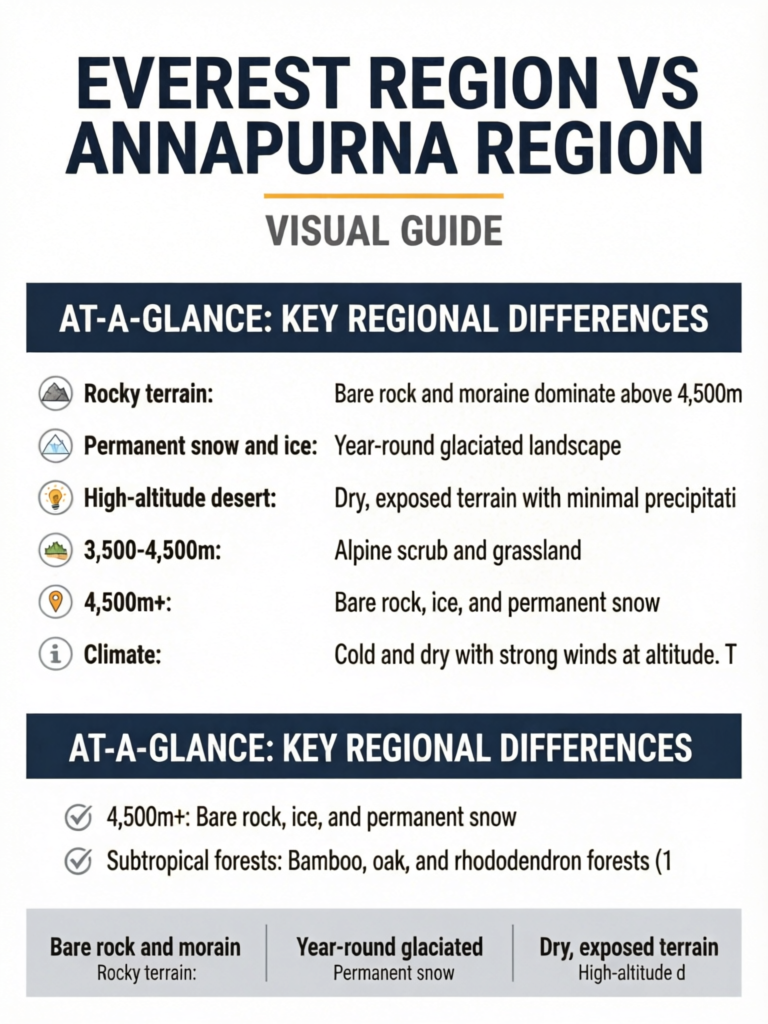
At-a-Glance: Key Regional Differences
Everest: World's highest peak; Annapurna: Ecological diversity
Everest 20-40% more expensive
Everest: Lukla flights required; Annapurna: Road access
Everest: $215-400 mandatory; Annapurna: $0-100 optional
Everest: Higher overall; Annapurna: More variety
Everest: 6-8 major routes; Annapurna: 12+ major routes
Everest: Sherpa Buddhist; Annapurna: Gurung/Thakali/Magar
Everest: ~50,000; Annapurna: ~150,000
Annapurna has more beginner-friendly options
Everest: Kathmandu → Lukla; Annapurna: Pokhara
Everest: 7-12 days; Annapurna: 4 days
Everest: None (flights only); Annapurna: Multiple access points
1. Geography & Landscape: Rocky Giants vs Ecological Rainbow
The fundamental difference between these regions lies in their geographical character and ecological diversity.
Everest/Khumbu Region: High-Altitude Specialization
Geographical Character: The Everest region is defined by extreme altitude and glacial landscapes. The entire trekking experience takes place above 2,800m (Lukla airport), with most popular routes spending significant time above 4,000m. This is a high-altitude ecosystem dominated by bare rock, glacial moraines, alpine scrub, and permanent ice.
Landscape Features:
- Glacial valleys: Khumbu Glacier, Ngozumpa Glacier (longest in Nepal at 36km)
- Rocky terrain: Bare rock and moraine dominate above 4,500m
- Limited vegetation: Juniper, rhododendron at lower altitudes; nothing above ~4,500m
- Permanent snow and ice: Year-round glaciated landscape
- High-altitude desert: Dry, exposed terrain with minimal precipitation
Ecosystem Zones:
- 2,800-3,500m: Lower alpine with some forest (pine, juniper, rhododendron)
- 3,500-4,500m: Alpine scrub and grassland
- 4,500m+: Bare rock, ice, and permanent snow
Climate: Cold and dry with strong winds at altitude. Temperatures at Base Camp range from -10°C to +5°C during trekking seasons, dropping to -25°C at night in winter.
The Everest Region Aesthetic
If you picture the Himalayas as towering rock and ice giants in a stark, otherworldly landscape, the Everest region delivers this vision perfectly. This is high-altitude mountaineering country adapted for trekking—raw, powerful, and dominated by the planet's highest peaks.
Annapurna Region: Five Climate Zones on One Trek
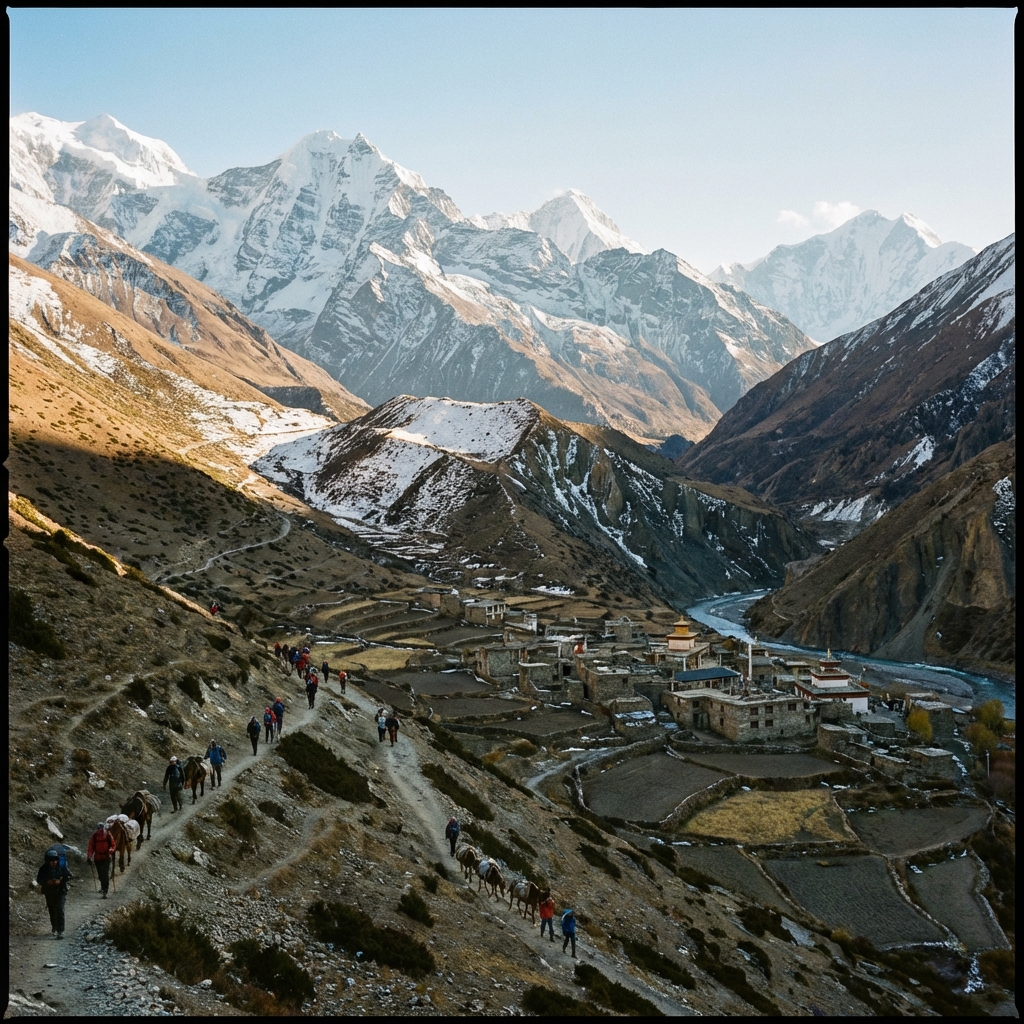
Geographical Character: The Annapurna region's defining feature is ecological diversity. Major treks like the Annapurna Circuit pass through five distinct climate zones—from subtropical lowlands (800m) to high-altitude desert (5,416m at Thorong La). This creates continuously changing landscapes and vegetation that make multi-day treks feel like journeys through different countries.
Landscape Features:
- Terraced farmland: Rice paddies and wheat fields at lower elevations (800-2,000m)
- Subtropical forests: Bamboo, oak, and rhododendron forests (1,500-3,000m)
- Alpine meadows: High pastures with wildflowers in spring (3,000-4,000m)
- High-altitude desert: Rain-shadow zones beyond Manang (north of Annapurna)
- Glacial amphitheaters: ABC sanctuary surrounded by 7,000m+ peaks
Ecosystem Zones:
- 800-2,000m: Subtropical with rice, banana, and citrus cultivation
- 2,000-3,000m: Temperate forest with rhododendron, oak, and pine
- 3,000-4,000m: Subalpine with juniper, birch, and alpine flora
- 4,000-5,000m: Alpine desert with sparse vegetation
- 5,000m+: Permanent snow and rock (limited trekking areas)
Climate: More varied than Everest. Lower elevations are humid and warm; high passes are cold and windy. The region spans both wet southern slopes (heavy monsoon impact) and dry northern slopes (rain shadow of Annapurna massif).
Pro Tip
The Annapurna Circuit is often called "the trek through all of Nepal" because it condenses the country's full ecological range—from tropical lowlands to Tibetan plateau—into a single journey. You'll need clothing for both 25°C sunny afternoons and -15°C high-pass crossings.
Landscape Comparison Verdict
Choose Everest Region if:
- You want dramatic high-altitude scenery throughout
- You prefer stark, glacial landscapes
- You envision the Himalayas as rock, ice, and towering peaks
- You're comfortable with limited vegetation and exposed terrain
Choose Annapurna Region if:
- You want continuously changing landscapes
- You prefer ecological variety (forests, villages, high mountains)
- You enjoy walking through terraced fields and diverse vegetation
- You want the full spectrum of Nepal's environments on one trek
2. Major Treks Comparison: Focus vs Variety
Both regions offer multiple trekking routes, but the Annapurna region provides significantly more diversity in duration, difficulty, and experience.
Everest Region: Six Major Routes (High-Altitude Focus)
Classic Base Camp Treks:
-
Everest Base Camp (EBC) - 12-14 days, 5,364m
- The iconic trek to the base of the world's highest mountain
- Most popular route in the region (~40,000 trekkers annually)
- Out-and-back from Lukla via Namche-Tengboche-Dingboche
-
Gokyo Lakes - 12-14 days, 5,357m (Gokyo Ri)
- Turquoise glacial lakes and views of four 8,000m peaks
- Quieter alternative to EBC with stunning scenery
- Can be combined with EBC via Cho La Pass
Advanced High-Altitude Circuits: 3. Everest Three Passes - 18-21 days, 5,535m (Renjo La)
- The complete Khumbu circuit crossing Kongma La, Cho La, Renjo La
- Most challenging non-technical trek in the region
- Combines EBC, Gokyo, and high-pass adventure
- Jiri to Everest Base Camp - 20-24 days, 5,364m
- The classic approach route used before Lukla airport
- Longer but avoids flight dependency and crowds
- Cultural immersion through lower Sherpa villages
Shorter/Alternative Routes: 5. Everest View Trek - 7-9 days, 3,880m (Tengboche)
- Best short trek for Everest views without extreme altitude
- Lower AMS risk, suitable for beginners
- Stops at Tengboche Monastery with Everest, Ama Dablam views
- Pikey Peak Trek - 6-8 days, 4,065m
- Panoramic views of Everest from lower Solu region
- Quieter trails, budget-friendly
- Can be linked to Jiri-Lukla route
Peak Climbing Extensions:
- Island Peak (6,189m) - Popular trekking peak, 3-4 days from EBC
- Mera Peak (6,476m) - Nepal's highest trekking peak
- Lobuche East (6,119m) - Technical peak near EBC
Annapurna Region: 12+ Major Routes (All Difficulties)
Classic Base Camp & Circuit Treks:
-
Annapurna Circuit - 12-21 days, 5,416m (Thorong La)
- One of the world's greatest long-distance treks
- Circumnavigates entire Annapurna massif
- Five climate zones, rich cultural immersion
-
Annapurna Base Camp (ABC) - 7-12 days, 4,130m
- Spectacular amphitheater surrounded by 7,000m+ peaks
- Moderate altitude, excellent for first-time Himalayan trekkers
- Well-developed teahouse infrastructure
Beginner-Friendly Short Treks: 3. Ghorepani Poon Hill - 4-5 days, 3,210m
- Nepal's most accessible trek with world-class sunrise views
- Perfect for limited time or first-time trekkers
- Zero altitude risk, comfortable lodges
- Mardi Himal - 5-7 days, 4,500m
- Quieter base camp alternative with dramatic mountain views
- Newer route with fewer crowds than ABC/Poon Hill
- Close-up views of Machapuchare and Annapurna
Remote & Cultural Routes: 5. Khopra Ridge - 8-10 days, 3,660m (Khopra Danda)
- Community lodge trek with excellent panoramas
- Fewer trekkers, authentic Gurung village experience
- Can include Khair Lake extension (4,660m)
-
Nar Phu Valley - 10-14 days, 5,416m (Thorong La)
- Restricted area with ancient Tibetan culture
- Remote valley with limited trekkers (<1,000 annually)
- Usually combined with upper Annapurna Circuit
-
Upper Mustang - 12-14 days, 3,840m (Lo Manthang)
- Forbidden kingdom with Tibetan Buddhist culture
- High-altitude desert landscape
- Restricted area permit required (USD 50/day (no minimum days))
Other Notable Routes: 8. Ghorepani Loop via Ghandruk - 5-7 days 9. Jomsom Trek - 7-9 days (often done as Circuit exit) 10. Tilicho Lake Extension - Add 2-3 days to Circuit for world's highest lake 11. Dhaulagiri Circuit - 14-16 days, very remote 12. Annapurna Sanctuary Short - 7 days (direct to ABC)
Annapurna's Flexibility Advantage
The Annapurna region's greatest strength is range. Whether you have 4 days or 21, whether you're a beginner or expert, whether you want budget guesthouse or luxury lodge, Annapurna has a route that fits. Everest's routes are more uniformly high-altitude and time-intensive.
Trek Variety Comparison Table
| Factor | Everest Region | Annapurna Region |
|---|---|---|
| Total major routes | 6-8 main routes | 12+ distinct routes |
| Shortest trek available | 7 days (Everest View) | 4 days (Poon Hill) |
| Longest standard trek | 21 days (Three Passes) | 21 days (Full Circuit + extensions) |
| Easy/beginner routes | 1-2 options | 4-5 options |
| High-altitude challenges | Majority of routes | 3-4 routes only |
| Cultural immersion focus | Limited options | Multiple options |
| Restricted area options | None (open region) | 2 major (Upper Mustang, Nar Phu) |
| Peak climbing add-ons | Multiple (Island, Mera, Lobuche) | Limited (Chulu peaks, Pisang) |
Major Treks Verdict
Choose Everest Region if:
- You want the specific EBC or Gokyo experience
- You're interested in high-altitude trekking exclusively
- You prefer a focused regional experience
- You're considering trekking peak climbing (Island Peak, Mera)
Choose Annapurna Region if:
- You want maximum route variety and flexibility
- You need options for different durations (4-21 days)
- You want beginner-friendly lower-altitude treks
- You're interested in cultural immersion or restricted areas
3. Difficulty & Altitude: Higher Challenges vs Broader Range
Altitude is the single biggest factor determining difficulty for most Nepal treks. The regions differ significantly in typical altitude exposure.
Everest Region: High Altitude is the Norm
Typical Altitude Profile:
- Airport starting point: Lukla at 2,800m (already at significant altitude)
- Most treks max out: 5,300-5,550m (EBC, Gokyo Ri, Three Passes)
- Time above 4,000m: 5-8 days on standard itineraries
- Time above 5,000m: 1-3 days typical
Altitude Sickness Risk: The Everest region has the highest AMS (Acute Mountain Sickness) incidence rate of any major trekking region in Nepal. Studies indicate:
- 40-50% of EBC trekkers experience mild AMS symptoms above 4,500m
- 5-10% experience moderate to severe symptoms requiring descent
- 1-2% require helicopter evacuation
Why Everest Altitude is Challenging:
- High starting point: You land at 2,800m with no acclimatization
- Rapid gain: You're above 3,500m within 1-2 days of arrival
- Sustained high altitude: Multiple consecutive days above 4,000m
- Limited escape routes: Descending takes time; you're committed
Physical Difficulty Factors:
- Long daily stages (5-7 hours) at high altitude
- Rocky, exposed trails with significant elevation gain
- Cold temperatures (-5°C to -20°C at high camps)
- Thin air impacts stamina and recovery
Difficulty Range:
- Easiest: Everest View Trek (7-9 days, 3,880m) - Moderate
- Standard: EBC Classic (12-14 days, 5,364m) - Moderate-Challenging
- Advanced: Three Passes (18-21 days, 5,535m) - Challenging-Strenuous
- Expert: Mera Peak climb (21 days, 6,476m) - Very Strenuous + Technical
Everest Region Altitude Reality Check
Don't underestimate Everest region altitude. Even fit trekkers with marathon experience can struggle at 5,000m+. Success depends more on genetics (how your body responds to altitude) than fitness. Always add extra acclimatization days and be prepared to descend if symptoms develop.
Annapurna Region: Easy to Extreme Options
Typical Altitude Range by Route:
- Easy routes: 800-3,210m (Poon Hill, Ghandruk Loop) - Minimal altitude risk
- Moderate routes: 4,130m (ABC) - Low to moderate risk
- High-altitude routes: 5,416m (Circuit Thorong La) - Moderate to high risk
Altitude Sickness Risk: AMS risk varies dramatically by route:
- Poon Hill/Ghandruk: <5% experience any symptoms (max 3,210m)
- ABC: 10-20% experience mild symptoms at sanctuary
- Annapurna Circuit: 30-40% experience symptoms crossing Thorong La
- Upper Mustang/Nar Phu: Similar to ABC (moderate risk zones)
Why Annapurna Offers More Flexibility:
- Low-altitude options: Multiple treks stay below 4,000m entirely
- Gradual gain: Most routes ascend more slowly than Everest routes
- Road access: Can drive to trailheads at various altitudes
- Easier bailout: More exit points and road access if needed
Physical Difficulty Factors:
- Stairs: Lower Annapurna trails have thousands of stone steps
- Distance: Circuit covers 160-230km depending on route
- Thorong La: The high pass requires a 7-9 hour summit day
- Heat: Lower sections can be hot and humid (25-30°C)
Difficulty Range:
- Easiest: Poon Hill (4-5 days, 3,210m) - Easy-Moderate
- Moderate: ABC (10-12 days, 4,130m) - Moderate
- Challenging: Annapurna Circuit (15-18 days, 5,416m) - Moderate-Challenging
- Advanced: Circuit + Tilicho + Nar Phu (21+ days) - Challenging-Strenuous
Pro Tip
If you're uncertain about altitude tolerance, the Annapurna region gives you safer "test run" options. Do Poon Hill (3,210m) or ABC (4,130m) first to gauge your body's response before committing to 5,000m+ routes in any region.
Altitude & Difficulty Comparison Table
| Factor | Everest Region | Annapurna Region |
|---|---|---|
| Minimum route altitude | 3,880m (Everest View) | 800-3,210m (Multiple options) |
| Maximum standard trek altitude | 5,545m (Kala Patthar) | 5,416m (Thorong La) |
| Routes under 4,000m | 1 (Everest View) | 5+ routes |
| Routes above 5,000m | Most major routes | 1-2 routes only |
| AMS risk level | High on most routes | Low to high (route dependent) |
| Acclimatization flexibility | Limited (high throughout) | Excellent (gradual options) |
| Beginner suitable routes | 1-2 (with caveats) | 4-5 excellent options |
| Fitness requirement | Good to excellent | Moderate to excellent |
Difficulty & Altitude Verdict
Choose Everest Region if:
- You're confident in your altitude tolerance (or willing to test it)
- You want high-altitude challenge as part of the experience
- You've successfully trekked at 4,000m+ before
- You can commit to proper acclimatization schedules
Choose Annapurna Region if:
- You're uncertain about altitude tolerance
- You prefer low-to-moderate altitude trekking
- You want more beginner-friendly options
- You need flexible difficulty choices for mixed-ability groups
4. Cost Comparison: The Lukla Flight Factor
Cost is a major differentiator. Everest region treks are consistently 20-40% more expensive than comparable Annapurna treks, primarily due to mandatory flights and high-altitude logistics.
Everest Region Costs: $900-$4,000+
Major Cost Components:
1. Lukla Flights (Mandatory): $215-$450
- Kathmandu-Lukla return: $350-400 (Nepali price)
- Foreign tourist price: Often $400-450
- Flight from Ramechhap: Sometimes used in peak season (adds 4-5 hour bus)
- Weather delay buffer: Budget $50-150/day for Kathmandu accommodation during delays
2. Permits: $37-$50
- Sagarmatha National Park: $30
- Khumbu Pasang Lhamu Rural Municipality: $20 (village entry fee)
- TIMS Card: Now included in municipality fee for most routes
3. Accommodation: $10-$40/night
- Lodges get more expensive with altitude
- Namche-Lukla zone: $5-15/night (often free if you eat meals)
- Above 4,500m: $10-30/night
- Luxury lodges: $60-150/night
4. Meals: $20-$60/day
- Prices increase significantly with altitude
- Below 4,000m: $15-25/day
- Above 4,500m: $30-50/day
- Breakfast: $5-8; Lunch: $6-12; Dinner: $8-20
5. Services:
- Guide: $25-35/day ($300-560 for 12-16 days)
- Porter: $20-25/day ($240-400 for 12-16 days)
- Hot shower: $3-7 per shower
- Battery charging: $2-5 per device
- WiFi: $5-10/day or $50-80 for package
6. Additional Costs:
- Drinking water: $1-5/liter (higher at altitude)
- Equipment rental: $10-30/day for sleeping bag, down jacket
- Travel insurance: $80-150 with altitude coverage
- Tips: $120-$280 for guide/porter team
Total Budget Breakdown (EBC 12-14 days):
| Budget Category | Independent | Standard Guided | Premium/Luxury |
|---|---|---|---|
| Flights (Lukla) | $350-400 | $350-400 | $400-450 |
| Permits | $50 | $50 | $50 |
| Accommodation | $120-200 | Included | $800-2,000 |
| Meals | $250-500 | Included | Included |
| Guide/Porter | $0 | $500-800 | $800-1,200 |
| Extras | $100-200 | $150-300 | $300-500 |
| Buffer days | $50-150 | $100-200 | $200-400 |
| TOTAL | $920-1,500 | $1,650-2,750 | $3,150-5,000 |
Annapurna Region Costs: $600-$3,500
Major Cost Components:
1. Transportation (Road Access): $15-$200
- Kathmandu-Pokhara bus: $10-$25 (tourist bus $15, VIP $20-25) (6-8 hours)
- Kathmandu-Pokhara flight: $105+ for foreigners (optional, 25 minutes)
- Pokhara-trailhead: $10-50 by jeep/bus
- No flight dependency: Major cost savings vs Everest
2. Permits: $23-$30
- ACAP (Annapurna Conservation Area Permit): $30 (recently reduced to $23 for SAARC)
- TIMS Card: NPR 2,000 for registered guided treks (mandatory guide rule)
3. Accommodation: $5-$30/night
- Generally cheaper than Everest throughout
- Lower altitude areas: $3-10/night (often free with meals)
- High-altitude areas: $10-25/night
- Luxury lodges: $50-120/night
4. Meals: $15-$40/day
- More stable pricing across altitude zones
- Lower sections: $12-20/day
- High-altitude sections: $20-35/day
- Breakfast: $4-6; Lunch: $5-8; Dinner: $6-12
5. Services:
- Guide: $25-30/day (mandatory for foreign trekkers)
- Porter: $18-22/day
- Hot shower: $1-4 per shower (often free in lower areas)
- Battery charging: $1-3 per device (often free)
- WiFi: Free to $5/day in most lodges
6. Additional Costs:
- Drinking water: $0.50-3/liter
- Equipment rental: $8-25/day
- Travel insurance: $80-150
- Tips: $120-$280 for guide/porter team
Total Budget Breakdown (ABC 10-12 days):
| Budget Category | Independent | Standard Guided | Premium/Luxury |
|---|---|---|---|
| Transport to trailhead | $30-80 | $50-150 | $150-250 |
| Permits | $23-30 | $23-30 | $23-30 |
| Accommodation | $50-120 | Included | $500-1,200 |
| Meals | $150-350 | Included | Included |
| Guide/Porter | Required* | $400-650 | $650-1,000 |
| Extras | $80-150 | $120-200 | $250-400 |
| TOTAL | $600-900 | $1,100-2,200 | $2,300-3,800 |
*Note: Foreign trekkers now require licensed guides in ACAP
Direct Cost Comparison: Similar Duration Treks
12-Day Standard Package Comparison:
| Cost Element | ABC (12 days) | EBC (12 days) | Difference |
|---|---|---|---|
| Permits | $23 | $50 | +$27 (117%) |
| Flights | $0-100 | $350-400 | +$250-400 |
| Accommodation | $50-100 | $120-200 | +$70-100 (70%) |
| Meals | $180-300 | $250-500 | +$70-200 (39%) |
| Guide/Porter | $400-550 | $500-700 | +$100-150 (23%) |
| Extras | $100-150 | $150-250 | +$50-100 (43%) |
| TOTAL Independent | $650-900 | $1,100-1,500 | +$450-600 (58%) |
| TOTAL Guided Package | $1,200-1,800 | $1,800-2,800 | +$600-1,000 (50%) |
Why Everest Costs 30-50% More
The primary cost driver is the mandatory $350-400 Lukla flight, which has no equivalent in Annapurna. Secondary factors include higher altitude logistics (everything costs more to transport above 4,500m) and longer minimum durations. Even budget trekkers cannot avoid these costs—they're structural to the region.
Hidden Costs & Considerations
Everest Region Hidden Costs:
- Flight delay insurance: Lukla weather delays affect 20-30% of flights
- Buffer days: Need 2-3 extra days of Kathmandu accommodation budget
- Higher altitude premium: Food, showers, charging all cost 50-100% more above 4,500m
- Limited alternatives: Once committed to Lukla flight, you're locked into costs
Annapurna Region Hidden Savings:
- Free hot showers: Many lodges in lower areas offer free showers
- Free WiFi: More common than Everest
- Road bailout option: Can exit early via jeep if needed ($100-150)
- No flight dependency: Weather delays don't trap you
Cost Breakdown by Trekker Type
Budget Backpacker:
- Annapurna: $600-900 (ABC/Poon Hill) - Excellent value
- Everest: $900-1,500 (EBC) - Challenging to do cheaply due to flight
- Winner: Annapurna by 30-40%
Standard Package Trekker:
- Annapurna: $1,200-2,200 (ABC/Circuit) - Good value with comfort
- Everest: $1,800-2,800 (EBC) - Standard experience
- Winner: Annapurna by 33-50%
Premium/Luxury Trekker:
- Annapurna: $2,500-4,000 (Luxury lodges, private guide)
- Everest: $3,500-6,000 (Luxury lodges, helicopter options)
- Winner: Annapurna by 20-40%
Pro Tip
If you're on a tight budget, Annapurna is the clear winner. But don't choose Annapurna solely for cost if your heart is set on Everest—you'll always wonder. Many trekkers save longer to afford Everest and find it worth the investment. The question is: does the iconic Everest experience justify 30-50% higher costs for you? For exact figures, see our ABC trek cost breakdown and EBC trek cost breakdown.
Cost Comparison Verdict
Choose Everest Region if:
- Budget is flexible ($1,500-4,000 total)
- The iconic EBC experience justifies premium pricing
- Flight costs don't concern you
- You can afford 2-3 buffer days for weather delays
Choose Annapurna Region if:
- Budget is limited ($600-2,500 total)
- You want maximum value for money
- You prefer predictable costs without flight dependency
- You want to save money for other Nepal experiences or longer treks
5. Accessibility & Gateway Cities: Flights vs Roads
How you reach the trekking region significantly impacts costs, logistics, and stress levels.
Everest Region: Flight-Dependent from Lukla
Primary Access Route:
- Kathmandu to Lukla flight: 30-40 minutes
- Lukla airport (2,800m): World's most dangerous airport (officially)
- Trek begins: Immediately from Lukla
Lukla Flight Realities:
Pros:
- Fast access (40 minutes vs 7+ days walking from Jiri)
- Spectacular mountain views during flight
- Immediate immersion at altitude
Cons:
- Weather dependency: 20-30% of flights delayed or cancelled
- Seasonal routing changes: Sometimes from Ramechhap (4-5 hour drive from Kathmandu)
- Cost: $215-400 non-negotiable expense
- Stress factor: Delays can derail entire trek schedules
- Limited alternatives: Once booked, you're committed
Lukla Flight Statistics:
- On-time rate: 70-80% in peak season, 50-60% in shoulder season
- Average delay: 1-3 days when weather closes in
- Cancellation policy: Often non-refundable or high rebooking fees
Alternative Access (Avoiding Lukla):
Jiri to Lukla Trek:
- Duration: 7-10 days additional trekking
- Start elevation: 1,905m (gradual acclimatization benefit)
- Cost savings: Eliminates $215-400 flight cost
- Cultural bonus: Pass through traditional Sherpa villages
- Downside: Adds 2 weeks to total trip duration
Phaplu/Salleri Entry:
- Duration: 5-7 days to join main EBC trail
- Flight from Kathmandu: Small aircraft, weather-dependent
- Best for: Those wanting adventure and cultural immersion
The Lukla Flight Gamble
Every Everest trekker must accept flight risk. Budget 2-3 extra days in Kathmandu at trip start and end for weather delays. Peak season (October-November) offers better odds but no guarantees. Delays are particularly common during monsoon transitions (June, September) and winter storms (December-February).
Gateway City: Kathmandu
- International access: Tribhuvan International Airport
- Altitude: 1,400m (good for acclimatization preparation)
- Trek logistics: All gear shops, agencies, permit offices
- Accommodation: $10-200+ per night depending on budget
- Buffer days needed: 2-3 days recommended for Lukla delay contingency
Annapurna Region: Road Access from Pokhara
Primary Access Routes:
For ABC, Poon Hill, Mardi Himal:
- Kathmandu to Pokhara: Bus (6-8 hours, $10-25) or flight (25 min, $100-140)
- Pokhara to Nayapul: 1.5 hours by jeep/taxi ($10-30)
- Trek begins: From Nayapul (1,070m)
For Annapurna Circuit:
- Kathmandu to Pokhara: Same as above
- Pokhara to Besisahar or Chamje: 6-8 hours by jeep ($30-50)
- Trek begins: Various elevations depending on start point
- Exit options: Multiple road access points allow flexibility
Alternative: Direct Road to Manang
- Pokhara to Manang: Now possible by jeep (12-14 hours, rough road)
- Allows: Starting Circuit from Manang, skipping lower sections
- Cost: $100-150 for private jeep
- Downside: Misses acclimatization and lower valley culture
Road Access Benefits:
Reliability:
- No weather dependency: Roads are passable except during heavy monsoon
- Fixed schedule: Buses and jeeps run daily
- No flight delays: Eliminates single biggest Everest stress factor
Flexibility:
- Multiple entry/exit points: Can start or finish at various locations
- Easy bailout: If injured or sick, can exit via jeep
- Cheaper alternatives: Bus vs flight to Pokhara
Cost:
- Much cheaper: $20-80 total vs $350-400 for Lukla flights
- Predictable: No surprise fees or delay costs
Gateway City: Pokhara
- Access from Kathmandu: 6-8 hours by road, 25 min by air
- Altitude: 827m (low, more comfortable)
- Trek logistics: Excellent gear shops, trekking agencies, permit offices
- Accommodation: $8-150 per night (wide range)
- Setting: Beautiful lakeside city with mountain views
- Bonus: Great place to rest before/after trek
Pro Tip
Pokhara is a significantly more pleasant base than Kathmandu for trek preparation. It's cleaner, quieter, less chaotic, and offers beautiful Annapurna views from town. Many trekkers prefer arriving 2-3 days early to acclimatize to Nepal, organize gear, and enjoy the lakeside atmosphere.
Time Efficiency Comparison:
| Factor | Everest (via Lukla) | Annapurna (via Pokhara-Nayapul) |
|---|---|---|
| Kathmandu to gateway | 40 min flight (+ delays) | 6-8 hours bus or 25 min flight |
| Weather risk | High (20-30% delay rate) | Low (road accessible year-round) |
| Gateway to trailhead | Trek starts immediately | 1.5 hour drive |
| Buffer days needed | 2-3 days recommended | 0-1 day (optional) |
| Total access time | 1-4 days (with delays) | 7-10 hours reliable |
| Cost | $350-400 + delay costs | $20-170 total |
Accessibility Comparison Verdict
Choose Everest Region if:
- You accept flight dependency as part of the adventure
- Your schedule has 2-3 day buffer for delays
- You prefer fast access over gradual approach
- Flight costs fit your budget
Choose Annapurna Region if:
- You want predictable, reliable access
- Road travel doesn't bother you
- You prefer Pokhara's atmosphere over Kathmandu
- You want flexible entry/exit options
- You're traveling during monsoon/winter (better road reliability)
6. Cultural Experience: Sherpa Buddhism vs Ethnic Diversity
Both regions offer rich cultural immersion, but the ethnographic focus differs significantly.
Everest Region: Sherpa Buddhist Culture
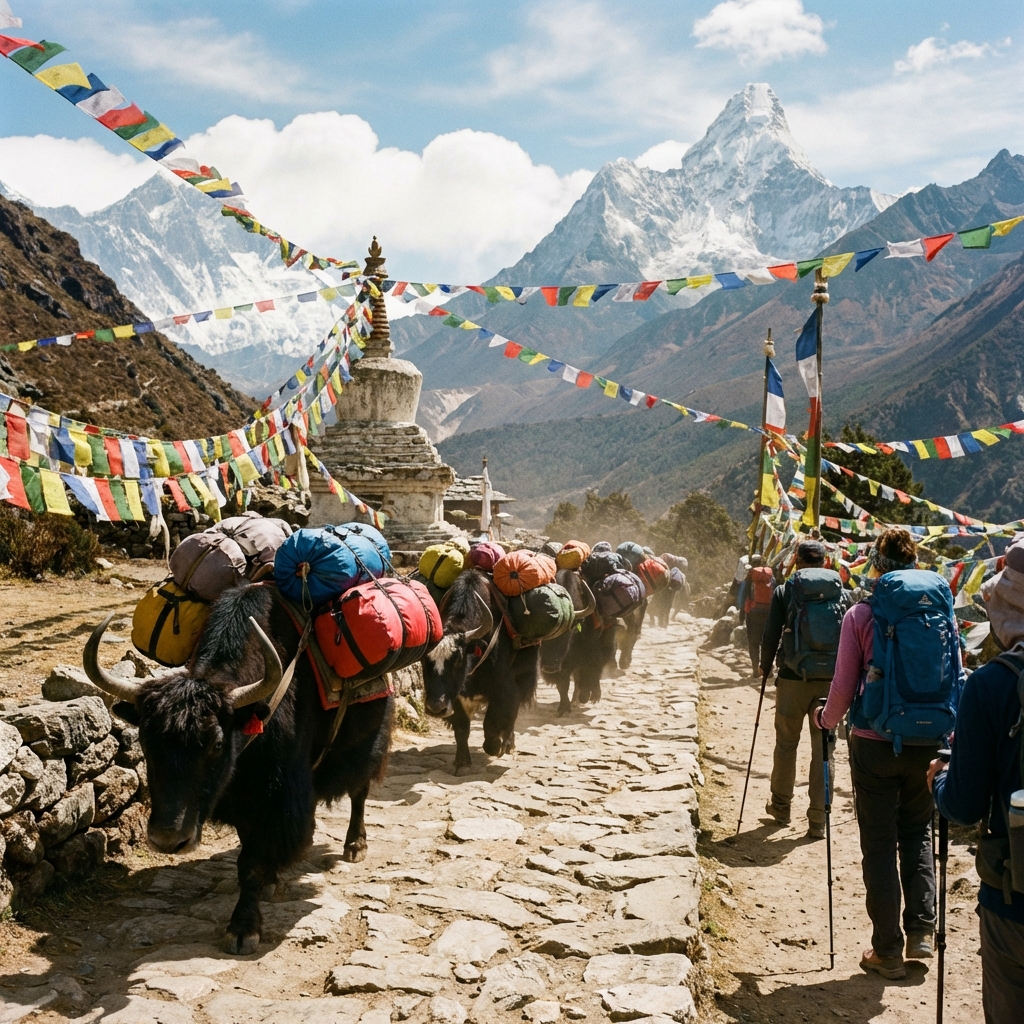
Primary Ethnic Group: Sherpa The Khumbu is the heartland of Sherpa culture. Sherpas are an ethnic group who migrated from Tibet 500+ years ago and maintain strong Tibetan Buddhist traditions.
Cultural Highlights:
Monasteries & Gompas:
- Tengboche Monastery: Most famous in the region, active Buddhist monastery at 3,860m
- Thame Gompa: Historic monastery where Tenzing Norgay was blessed
- Pangboche: Oldest Sherpa village with ancient monastery
- Morning prayers and ceremonies: Often open to respectful visitors
Villages:
- Namche Bazaar: Sherpa capital and main trading hub (3,440m)
- Khumjung: Traditional village with Hillary School
- Dingboche & Pheriche: High-altitude farming communities
- Traditional architecture: Stone houses with prayer flag decorations
Religious Elements:
- Prayer wheels: Line the trails throughout the region
- Chortens (stupas): Buddhist monuments at trail junctions
- Mani walls: Stone walls with carved Buddhist mantras
- Prayer flags: Colorful flags carrying prayers to the wind
- Masked dances: Mani Rimdu festival if timing aligns (October/November)
Cultural Practices:
- Potato farming: Primary crop at high altitude
- Yak herding: Essential for transport and dairy
- Mountaineering heritage: Many Sherpas work as climbing guides
- Saturday market: Traditional trading in Namche Bazaar
Language:
- Sherpa language: Tibetic language, distinct from Nepali
- English: Widely spoken due to tourism
- Nepali: Also commonly used
Religion:
- Tibetan Buddhism: Nearly universal in the region
- Monastery visits: Respectful visitors welcome
- Buddhist philosophy: Influences local hospitality and environmental ethics
The Sherpa Mountaineering Legacy
The Everest region offers unique insight into Sherpa mountaineering culture. Many lodge owners, guides, and community members have summited Everest or other 8,000m peaks. You're trekking through the homeland of the world's most famous high-altitude climbers—a living mountaineering museum.
Cultural Immersion Opportunities:
- Lodge stays with Sherpa families
- Monastery visits and prayer sessions
- Traditional Sherpa food (thukpa, momos, butter tea)
- Mountaineering museum in Namche Bazaar
- Hillary School and healthcare facilities (cultural impact of mountaineering)
Annapurna Region: Multi-Ethnic Mosaic
Primary Ethnic Groups: The Annapurna region is home to multiple distinct ethnic groups, each with unique languages, traditions, and cultural practices.
Gurung People (Lower Annapurna & ABC Route):
- Villages: Ghandruk, Chomrong, Landruk, Chhomrong
- Known for: Gurkha soldiers, traditional round houses
- Religion: Hindu-Buddhist blend with shamanic elements
- Culture: Traditional dances, honey hunting, weaving
Thakali People (Kali Gandaki Valley):
- Villages: Marpha, Tukuche, Jomsom
- Known for: Trading heritage, excellent hospitality
- Cuisine: Famous Thakali set meals (dal bhat excellence)
- Religion: Buddhist-Hindu syncretism
Manangi & Loba (Upper Circuit & Mustang):
- Villages: Manang, Kagbeni, Lo Manthang
- Culture: Tibetan heritage, ancient trade routes
- Religion: Tibetan Buddhism
- Landscape: High-altitude desert, similar to Tibet
Magar People (Lower Trails):
- Villages: Lower Ghorepani-Poon Hill area
- Known for: Agriculture, terraced farming
- Religion: Primarily Hindu with animist elements
Cultural Highlights by Route:
Annapurna Circuit:
- Maximum cultural diversity: Pass through 4-5 distinct ethnic zones
- Manang village: Tibetan culture, ancient trading heritage
- Kagbeni: Medieval walled village at Mustang entrance
- Apple orchards: Marpha region famous for apples and brandy
- Religious shift: Hindu temples in lowlands to Buddhist gompas in highlands
Annapurna Base Camp:
- Gurung villages: Ghandruk and Chomrong are Gurung cultural centers
- Traditional architecture: Round stone houses with slate roofs
- Community museums: Cultural centers in major villages
- Agricultural terraces: Centuries-old rice and millet terraces
Poon Hill & Ghorepani:
- Mixed Magar and Gurung: Lower elevation ethnic groups
- Rhododendron forests: National flower in spectacular displays (March-April)
- Traditional lodges: Family-run guesthouses with cultural atmosphere
Upper Mustang (Restricted Area):
- Forbidden Kingdom: Isolated Tibetan culture preserved for centuries
- Lo Manthang: Medieval walled capital
- Ancient monasteries: 15th-century Buddhist art and architecture
- Tibetan Bon religion: Pre-Buddhist spiritual practices still practiced
Pro Tip
For maximum cultural immersion, the Annapurna Circuit offers unmatched ethnic diversity. You'll experience Hindu lowlands, Buddhist highlands, Tibetan desert culture, and everything in between—a condensed journey through South Asian mountain cultures.
Cultural Immersion Opportunities:
- Multiple ethnic village homestays
- Traditional Gurung, Thakali, and Manangi cuisine
- Ancient monasteries and Hindu temples
- Local festivals (if timing aligns)
- Community-run lodges and cultural centers
- Traditional farming and livestock practices
- Craft workshops (weaving, pottery in some villages)
Cultural Comparison Table
| Factor | Everest Region | Annapurna Region |
|---|---|---|
| Primary ethnic groups | Sherpa (dominant) | Gurung, Thakali, Magar, Manangi, Loba |
| Cultural diversity | Focused (Sherpa culture) | High diversity (5+ groups) |
| Religion | Tibetan Buddhism | Hindu-Buddhist blend + Tibetan Buddhism |
| Monastery quality | Excellent (Tengboche, Thame) | Excellent (Muktinath, Braga, Manang, Mustang) |
| Village architecture | Sherpa stone houses | Varies by ethnicity (round Gurung, Tibetan, etc.) |
| Cultural immersion depth | Deep (single culture) | Broad (multiple cultures) |
| Language diversity | Sherpa, Nepali, English | 5+ languages depending on route |
| Mountaineering culture | Central to identity | Less prominent |
| Agricultural practices | Potato, yak herding | Rice terraces, diverse crops, orchards |
| Tourist impact on culture | High (heavy tourism) | Moderate to high (varies by route) |
Cultural Experience Verdict
Choose Everest Region if:
- You want deep immersion in Sherpa Buddhist culture
- You're interested in mountaineering history and heritage
- You prefer cultural focus over diversity
- Tibetan Buddhism and monastery visits appeal to you
- You want to experience the homeland of famous climbers
Choose Annapurna Region if:
- You want exposure to multiple ethnic groups
- You prefer cultural diversity over depth
- You're interested in Hindu-Buddhist cultural mixing
- You want to see how culture changes with altitude
- You're interested in restricted area Tibetan culture (Upper Mustang)
- Traditional agriculture and village life interest you more than mountaineering
7. Scenery & Photography: Iconic Giants vs Diverse Landscapes
Both regions deliver spectacular Himalayan scenery, but the photographic opportunities and landscape aesthetics differ significantly.
Everest Region: High-Altitude Drama
Signature Views:
The Everest Massif:
- Mount Everest (8,849m): The world's highest peak
- Lhotse (8,516m): Fourth highest, dramatic south face
- Nuptse (7,861m): Massive wall separating Base Camp and Lhotse
- Ama Dablam (6,812m): "Matterhorn of the Himalayas," most photographed peak
- Cho Oyu (8,188m): Sixth highest, visible from Gokyo
Landscape Features:
- Khumbu Icefall: Everest's legendary climbing route, visible from Base Camp
- Ngozumpa Glacier: Longest glacier in Nepal (36km)
- Gokyo Lakes: Six turquoise glacial lakes
- Khumbu Glacier moraine: Dramatic ice formations
- High-altitude desert: Stark, rocky terrain above 4,500m
Best Photo Opportunities:
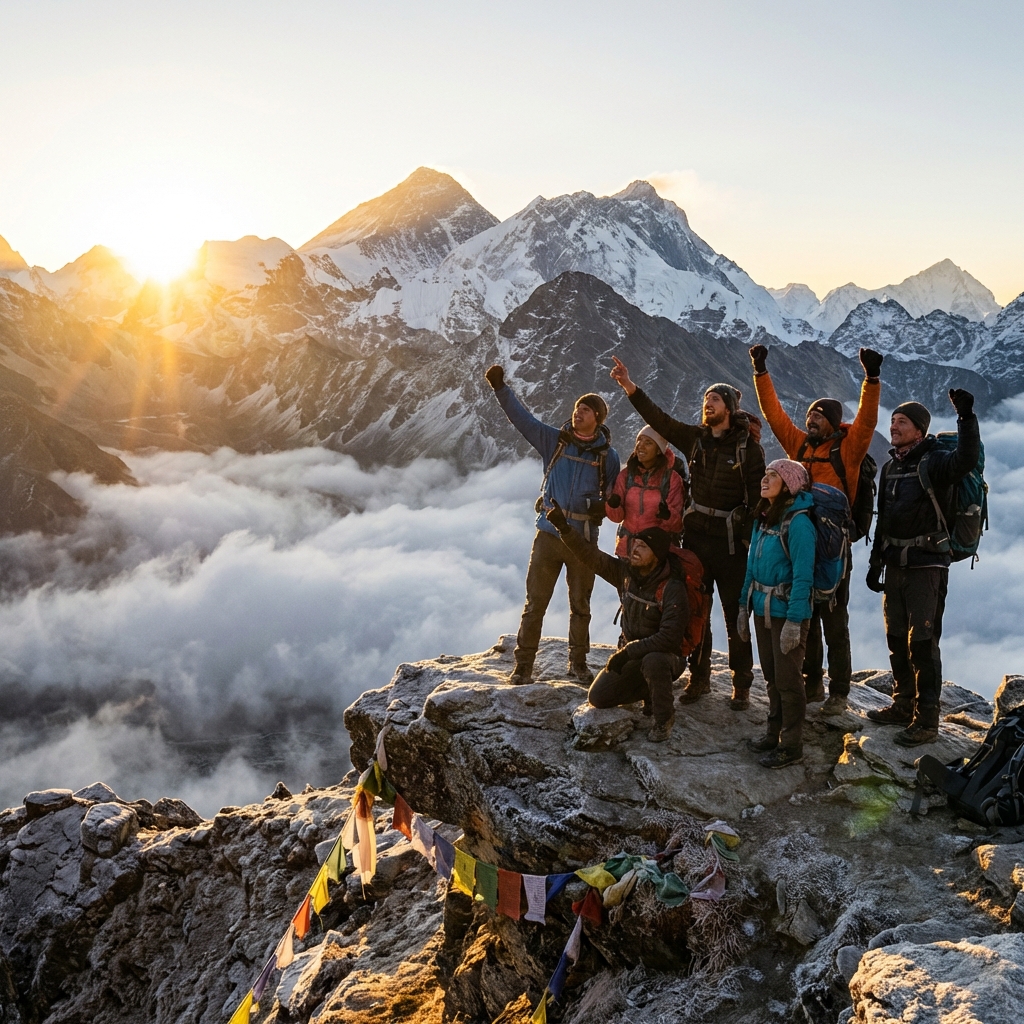
Kala Patthar (5,545m):
- Sunrise over Everest, Nuptse, Changtse
- Best Everest view on the entire trek
- Clear 360° panorama of highest peaks
- Photography challenge: Extreme cold, thin air
Gokyo Ri (5,357m):
- Four 8,000m peaks in one frame (Everest, Lhotse, Cho Oyu, Makalu)
- Gokyo Lakes foreground with mountains behind
- Often clearer than Kala Patthar
- Less crowded than EBC viewpoints
Tengboche Monastery:
- Ama Dablam framed by monastery architecture
- Buddhist culture with mountain backdrop
- Sunset light on peaks
- Prayer flags and cultural elements
Namche Bazaar viewpoint:
- Sunrise on Kongde Ri, Thamserku, Everest (distant)
- Sherpa village with mountain amphitheater
- Gateway introduction to the region
Aesthetic Character:
- Color palette: Whites (snow), grays (rock), blue sky, minimal color otherwise
- Scale: Massive peaks dominating every vista
- Mood: Raw, powerful, otherworldly
- Foreground: Rocky, sparse vegetation, prayer flags, glaciers
Everest's Photographic Superpower: Iconic Recognition
Everest region photos carry instant recognition. When you say "I took this at Everest Base Camp," everyone knows where and why it matters. The region's photos have inherent cultural weight that few other locations match. This isn't just beautiful—it's historically and culturally iconic.
Annapurna Region: Ecological Rainbow
Signature Views:
The Annapurna Massif:
- Annapurna I (8,091m): Tenth highest, dramatic south face
- Dhaulagiri (8,167m): Seventh highest, visible from Circuit
- Machapuchare (6,993m): Sacred "Fishtail" peak, never climbed
- Annapurna South (7,219m): Dominates ABC sanctuary
- Gangapurna (7,455m): Massive glacier face
Landscape Diversity:
- Terraced farmland: Rice paddies and wheat fields (lower elevations)
- Rhododendron forests: Vibrant red blooms (March-April)
- Deep gorges: Kali Gandaki, world's deepest gorge
- High-altitude desert: Beyond Manang in rain shadow
- Alpine meadows: Wildflower displays in spring
Best Photo Opportunities:
Poon Hill Sunrise (3,210m):
- Panorama of Dhaulagiri to Annapurna range
- Often-photographed sunrise location
- Foreground prayer flags and cultural elements
- Accessible to all fitness levels
ABC Sanctuary (4,130m):
- 360° amphitheater of 7,000m+ peaks
- Machapuchare close-up shots
- Glaciers descending from Annapurna massif
- Dramatic morning/evening light
Thorong La Pass (5,416m):
- High-altitude desert landscape
- Prayer flags with mountain backdrop
- Sense of achievement imagery
- Tibetan cultural elements
Manang Village:
- Traditional Tibetan architecture
- Gangapurna glacier backdrop
- Cultural life with mountain scenery
- Apple orchards (Marpha area)
Muktinath Temple:
- Sacred Hindu-Buddhist pilgrimage site
- Mountain backdrop
- Cultural and religious significance
- Fire and water spring (natural phenomenon)
Aesthetic Character:
- Color palette: Greens (forests), reds (rhododendrons), golds (terraces), white peaks
- Scale: Varied—intimate forests to massive peaks
- Mood: Warm, diverse, accessible
- Foreground: Rich vegetation, villages, terraced fields, varied textures
Seasonal Color Variation:
- Spring (March-May): Rhododendron blooms, green terraces
- Autumn (Oct-Nov): Golden rice harvests, clear skies
- Winter: Snow-covered forests, dramatic contrasts
- Summer: Lush vegetation, challenging for clarity
Pro Tip
Annapurna region excels at foreground diversity. While Everest gives you iconic peaks against sky, Annapurna gives you peaks framed by forests, villages, terraced fields, and rivers. This creates more varied composition opportunities and helps tell richer visual stories.
Photographic Comparison Table
| Factor | Everest Region | Annapurna Region |
|---|---|---|
| Iconic peak recognition | World's highest (Everest) | 10th and 7th highest peaks |
| Peak proximity | Very close to 8,000m giants | Good proximity, less extreme |
| Foreground diversity | Limited (rock, ice, sky) | Excellent (forests, villages, fields) |
| Color palette | Monochrome (grays, whites) | Multicolor (greens, reds, golds) |
| Best sunrise spot | Kala Patthar (5,545m) | Poon Hill (3,210m) |
| Photo accessibility | Requires high-altitude endurance | Multiple accessible viewpoints |
| Cultural elements | Prayer flags, monasteries | Villages, temples, diverse architecture |
| Seasonal variation | Minimal (always high-altitude) | Significant (forest, crops, flowers) |
| Instagram factor | Maximum (Everest name recognition) | High (beautiful but less iconic) |
| Photography difficulty | High (altitude, cold, thin air) | Moderate (easier breathing, varied) |
Specific Photo Category Winners
Best for:
- Iconic bucket-list shots: Everest (Base Camp sign, Kala Patthar sunrise)
- Mountain close-ups: Everest (proximity to 8,000m peaks)
- Foreground diversity: Annapurna (forests, terraces, villages)
- Color photography: Annapurna (rhododendrons, fields, cultural color)
- Black & white: Everest (dramatic contrasts, minimal color anyway)
- Cultural architecture: Annapurna (diverse village styles)
- Accessible viewpoints: Annapurna (Poon Hill, lower altitudes)
- Challenging conditions: Everest (thin air, extreme cold tests gear/skill)
Scenery & Photography Verdict
Choose Everest Region if:
- You want the iconic Everest name and recognition
- Dramatic high-altitude landscapes are your priority
- You prefer powerful, stark mountain scenery
- Monochromatic aesthetic appeals to you
- You're willing to shoot in challenging high-altitude conditions
- Instagram-worthy iconic locations matter to you
Choose Annapurna Region if:
- You want diverse landscapes and foreground variety
- Colorful photography (flowers, forests, fields) appeals to you
- You prefer accessible viewpoints without extreme altitude
- You want cultural elements integrated with mountain scenery
- You enjoy shooting varied subjects (not just mountains)
- You want more comfortable shooting conditions
8. Crowds & Tourism: Very Busy vs Extremely Busy (But Different)
Both regions are among the most popular trekking destinations on Earth. The question isn't "which is less crowded" but "how do crowds manifest differently?"
Everest Region: 50,000+ Annual Trekkers, Concentrated Routes
Annual Statistics:
- Total trekkers: Approximately 50,000-60,000 permits issued annually
- Peak months: October and November account for 40-45% of annual traffic
- Spring season: March-May accounts for 30-35%
- Main route concentration: 80% trek the classic EBC route
Where Crowds Concentrate:
- Lukla to EBC main trail: Very busy, bottleneck effect
- Namche Bazaar: Major hub, always bustling
- Tengboche to Dingboche: Moderate to high traffic
- Base Camp itself: Can have 100+ people on peak days
- Kala Patthar sunrise: 50-100+ people scrambling for sunrise spots
Quieter Everest Options:
- Gokyo Valley: 50-70% fewer trekkers than EBC
- Three Passes Trek: Much quieter despite passing through EBC zone
- Jiri approach: Very few trekkers (mostly locals)
- Off-season (December-February, June-August): 80% reduction in crowds
Crowd Impact:
- Lodge availability: Can be tight in peak October without bookings
- Trail congestion: Suspension bridges and narrow sections create queues
- Dining halls: Full lodges mean busy, noisy evenings
- Authenticity: Heavily commercialized in main villages
- Prices: Competition for rooms drives up costs in peak season
Why Everest Feels Crowded:
- Single main trail (limited route variation)
- Everyone shares the same teahouses for 200km+ trek
- Bottleneck geography (narrow valleys)
- Short trekking season (Oct-Nov, Mar-May)
The Everest Crowd Reality
Accept that EBC is a crowded trek, especially in October. You will not have solitude. You will share dining halls with 30-50 people nightly. You will queue for bathrooms. BUT you'll also share the experience with people from 50+ countries, creating a unique international trekking community atmosphere.
Annapurna Region: 150,000+ Annual Trekkers, Spread Across Routes
Annual Statistics:
- Total trekkers: Approximately 150,000-180,000 ACAP permits annually
- Peak months: October (30,000+), November (25,000+)
- Route distribution: Much better spread across 10+ major routes
Crowd Distribution by Route:
Very Busy Routes:
- Poon Hill: 40,000-50,000 annual (most popular short trek in Nepal)
- Annapurna Base Camp: 50,000-60,000 annual
- Annapurna Circuit: 30,000-40,000 annual (declining since road access)
Moderate Traffic Routes:
- Mardi Himal: 10,000-15,000 annual (growing popularity)
- Khopra Ridge: 2,000-3,000 annual
Quiet Routes:
- Nar Phu Valley: <1,000 annual (restricted area)
- Upper Mustang: ~3,000 annual (expensive restricted permit)
- Circuit remote extensions: Tilicho Lake adds crowds, but other branches quiet
Why Annapurna Feels Less Crowded (Despite More Trekkers):
- Route variety: 10+ major routes spread out the traffic
- Multiple entry/exit points: Not everyone on same trail
- Different durations: 4-day and 21-day trekkers don't overlap much
- Road access: Some trekkers drive partway, fragmenting trail traffic
Peak Season Lodge Situation:
- Poon Hill corridor: Can be very tight in October without bookings
- ABC trail: Moderate pressure, usually find rooms
- Circuit: Spread out over longer distance, less congestion
- Remote routes: Rarely full
Pro Tip
If avoiding crowds is your priority, neither region offers true solitude in peak season. However, Annapurna's route variety means you can choose quieter alternatives (Khopra, Nar Phu, Mardi Himal) within the same region. Everest's quieter routes (Gokyo, Three Passes) still intersect with the busy EBC trail.
Crowds Comparison Table
| Factor | Everest Region | Annapurna Region |
|---|---|---|
| Total annual trekkers | 50,000-60,000 | 150,000-180,000 |
| Route concentration | Very high (80% on EBC route) | Spread across 10+ routes |
| Busiest trail | Lukla-EBC corridor | Poon Hill (but only 4-5 days) |
| Peak season impact | Severe (October-November) | High but manageable |
| Lodge availability | Can be very tight | Generally available |
| Trail congestion | Narrow valleys, bottlenecks | Better spread, less queuing |
| Quiet alternatives | Limited (Gokyo, Jiri approach) | Multiple (Khopra, Nar Phu, etc.) |
| Off-season crowds | Much quieter (80% drop) | Still busy but manageable |
| Solitude opportunities | Very rare on main trails | Possible on remote routes |
Timing Strategies to Avoid Crowds
Everest Region:
- Trek in late November-early December: Post-peak season, 50% fewer trekkers, colder weather
- Spring (March-early April): Less busy than October, warming weather
- Choose Gokyo over EBC: Significant crowd reduction
- Three Passes Trek: Quieter despite passing through EBC zone
- Walk-in from Jiri: First week almost empty
Annapurna Region:
- Choose quieter routes: Khopra Ridge, Nar Phu, Mardi Himal instead of Poon Hill/ABC
- Trek in late November-December: 60% reduction vs October
- Early March: Pre-peak spring season
- Circuit counterclockwise: 90% go clockwise, but counterclockwise is harder
- Avoid Poon Hill on weekends: Domestic tourists add to crowds
Crowds & Tourism Verdict
Choose Everest Region if:
- You're comfortable with busy trails and lodges
- The social/international atmosphere appeals to you
- You're trekking off-season (December-February, June-August)
- You accept that Everest's popularity is part of its character
Choose Annapurna Region if:
- You want options to avoid crowds (choose quieter routes)
- You prefer spreading out from other trekkers
- You want flexibility to switch routes if one is too busy
- You're willing to pay for restricted areas (Upper Mustang, Nar Phu)
9. Infrastructure & Accommodation: Excellent in Both, Cheaper in Annapurna
Both regions have highly developed teahouse lodge systems, but costs and amenities differ.
Everest Region Infrastructure
Teahouse Quality:
- Generally excellent above Lukla (2,860m)
- Standard rooms: Twin beds, thin mattresses, shared bathrooms
- Blankets provided: Usually adequate with sleeping bag
- Heating: Communal dining hall stoves (wood or yak dung)
- Private bathrooms: Available at extra cost (rare above 4,500m)
Altitude-Based Pricing:
- Namche-Phakding zone: $5-15/night (often free with meals)
- Tengboche-Dingboche: $10-20/night
- Above 4,500m: $15-30/night (fewer lodges, higher transport costs)
- Luxury lodges: $60-150/night (available in key villages)
Amenities & Costs:
- Hot showers: $3-7 (solar or gas heated)
- WiFi: $5-10/day or $50-80 for trek-long package
- Battery charging: $2-5 per device per charge
- Boiled water: $1-4/liter (increases with altitude)
- Western toilets: Common in lower areas, squat toilets higher up
Food Options:
- Extensive menus: Dal bhat, momos, noodles, pasta, pizza, pancakes
- Quality: Good to excellent in main villages
- Prices: Increase 50-100% above 4,000m
- Breakfast: $5-8; Lunch: $6-12; Dinner: $8-20
Communication:
- Mobile coverage: NCell and Ncell work in most areas up to ~4,500m
- WiFi: Available but expensive and slow
- Satellite phones: Some lodges have them for emergencies
Medical Facilities:
- Himalayan Rescue Association clinic in Pheriche (4,371m)
- Health posts in Namche Bazaar and Khunde
- Helicopter rescue: Accessible from most locations (insurance required)
Luxury Lodge Options:
- Yeti Mountain Home chain: Upscale lodges in key locations
- Everest Summit Lodge: Premium accommodations
- Features: Private bathrooms, hot showers, better food, heated rooms
- Cost: $80-150/night vs $10-30 for standard teahouses
Annapurna Region Infrastructure
Teahouse Quality:
- Excellent throughout the region
- Standard rooms: Similar to Everest (twin beds, shared bathrooms)
- Generally cheaper than Everest equivalents
- More competition: More lodges mean better value
- Varied quality: From basic to very comfortable
Pricing:
- Lower areas (under 3,000m): $3-10/night (often free with meals)
- Mid-altitude (3,000-4,000m): $5-15/night
- High areas (above 4,000m): $10-25/night
- Luxury lodges: $50-120/night
Amenities & Costs:
- Hot showers: $1-4 (often FREE in lower areas)
- WiFi: $2-5/day or FREE in many lower lodges
- Battery charging: $1-3 per device (often FREE in lower areas)
- Boiled water: $0.50-3/liter
- Western toilets: Very common throughout
Food Options:
- Similar variety to Everest region
- Thakali set meals: Regional specialty, excellent value
- Better budget options: More competition keeps prices lower
- Prices: 20-30% cheaper than Everest equivalents
- Breakfast: $4-6; Lunch: $5-8; Dinner: $6-15
Communication:
- Mobile coverage: NCell and Ncell widely available
- WiFi: More common and often free in lower areas
- Better connectivity: Overall more reliable than Everest
Medical Facilities:
- Manang medical clinic: Excellent altitude sickness facility
- Jomsom hospital: Modern facility with evacuation access
- Health posts: Throughout major villages
- Helicopter rescue: Accessible (insurance required)
Luxury Lodge Options:
- Ker & Downey lodges: Premium accommodations on ABC/Poon Hill routes
- Sanctuary Lodge chain: Comfortable upgraded lodges
- Features: Similar to Everest luxury options
- Cost: $60-120/night (slightly cheaper than Everest)
Annapurna's Infrastructure Value
Annapurna region offers equivalent or better infrastructure at 20-40% lower cost. Free hot showers, free WiFi, and free charging in lower areas add up to significant savings over a 10-14 day trek. Competition among lodges benefits trekkers.
Infrastructure Comparison Table
| Factor | Everest Region | Annapurna Region |
|---|---|---|
| Lodge quality | Excellent (above 2,800m) | Excellent throughout |
| Room costs | $10-30 typical | $5-20 typical |
| **hot shower costs $2-$10 depending on altitude | $1-4 (often FREE lower) | |
| WiFi cost | $5-10/day | $2-5/day (often FREE lower) |
| Charging cost | $2-5/device | $1-3 (often FREE lower) |
| Food prices | Higher throughout | 20-30% cheaper |
| Lodge density | Good (fewer in high areas) | Excellent (many options) |
| Competition | Moderate | High (better value) |
| Luxury options | Excellent | Excellent (slightly cheaper) |
| Medical facilities | Good (HRA clinics) | Good (Manang clinic, Jomsom) |
| Mobile coverage | Good up to 4,500m | Good throughout |
| Overall value | Good but expensive | Excellent value |
Infrastructure & Accommodation Verdict
Choose Everest Region if:
- You're willing to pay premium prices for high-altitude infrastructure
- Luxury lodge chains (Yeti Mountain Home) appeal to you
- You accept that altitude drives up costs
Choose Annapurna Region if:
- You want maximum value for accommodation and services
- Free amenities (hot showers, WiFi, charging) matter to you
- You prefer having more lodge choices and competition
- Budget is a significant factor
10. Best Time to Trek: Similar Seasons, Different Considerations
Both regions share the same optimal trekking windows, but weather patterns and seasonal experiences differ slightly.
Optimal Seasons (Both Regions)
Autumn: October-November
- Best overall weather: Clear skies, stable conditions, moderate temperatures
- Peak tourist season: Expect maximum crowds and higher prices
- Temperature range: 10-20°C at lower elevations, -5 to +5°C at high camps
- Visibility: Excellent mountain views (post-monsoon clarity)
Spring: March-May
- Second-best season: Warming weather, good visibility
- Rhododendron bloom: Spectacular in Annapurna region (March-April)
- Temperature range: Warmer than autumn, 15-25°C lower, 0-10°C higher
- Crowds: Moderate to busy (less than autumn)
Regional Weather Differences
Everest Region Specifics:
Autumn (October-November):
- Pros: Clearest visibility of the year, stable weather, good temperatures
- Cons: Very crowded, Lukla flight delays still possible (10-15% chance)
- October: Peak month, expect full lodges
- November: Quieter late November, colder temperatures
Spring (March-May):
- Pros: Warming temperatures, fewer crowds than autumn
- Cons: Afternoon clouds can obscure views, windier at high passes
- March: Cold but clear, snow possible
- April: Ideal temperature balance
- May: Warmer but pre-monsoon clouds increase
Winter (December-February):
- Pros: Very quiet trails (80% fewer trekkers), crystal-clear visibility
- Cons: Extreme cold (-20°C to -30°C at high camps), some lodges closed, shorter days
- Feasibility: Possible for experienced winter trekkers with proper gear
- Main challenge: Altitude + cold combination
Monsoon (June-September):
- Pros: Very quiet, lower prices, green landscapes
- Cons: Clouds obscure views, rain at lower elevations, Lukla flights unreliable
- Feasibility: Not recommended due to flight issues and poor visibility
Annapurna Region Specifics:
Autumn (October-November):
- Pros: Perfect weather, golden rice harvests, excellent visibility
- Cons: Busy trails (especially Poon Hill and ABC), higher prices
- October: Peak month across all routes
- November: Excellent choice, slightly quieter
Spring (March-May):
- Pros: Rhododendron forests in full bloom (March-April), warming weather
- Cons: Afternoon clouds more common than autumn
- March: Rhododendron peak, excellent for photography
- April-May: Warmer, but pre-monsoon humidity increases
Winter (December-February):
- Pros: Quiet trails, lower prices, clear views
- Cons: Cold at high passes (Thorong La can be dangerous), snow possible
- Feasibility: Lower routes (Poon Hill, Ghorepani) very doable; Circuit possible with caution; ABC feasible
- Advantage vs Everest: Lower maximum altitudes make winter more manageable
Monsoon (June-September):
- Pros: Green landscapes, fewer trekkers, wildflowers
- Cons: Rain at lower elevations, leeches, clouds obscure mountains
- Feasibility: Upper Mustang excellent (rain shadow), other routes not recommended
- Advantage: Road access means no flight cancellation issues
Monsoon Exception: Upper Mustang
The Annapurna region has one major monsoon advantage: Upper Mustang lies in the rain shadow of the Annapurna massif and receives minimal monsoon rain. June-September is actually an excellent time for Upper Mustang, offering clear skies when other regions are clouded.
Month-by-Month Comparison
| Month | Everest Region | Annapurna Region |
|---|---|---|
| January | Very cold, clear, quiet (challenging) | Cold but feasible on lower routes |
| February | Cold, clear, quiet (challenging) | Cold, good for Poon Hill/lower treks |
| March | Warming, good visibility, moderate crowds | Excellent (rhododendron bloom) |
| April | Excellent conditions, busier | Excellent (peak spring) |
| May | Warming, afternoon clouds increase | Good but pre-monsoon humidity |
| June | Monsoon starts, flights unreliable | Monsoon starts (Upper Mustang good) |
| July-August | Monsoon peak (not recommended) | Monsoon peak (Upper Mustang only) |
| September | Monsoon tail, improving late month | Monsoon tail, trails muddy |
| October | Peak season (excellent but crowded) | Peak season (excellent but crowded) |
| November | Excellent, quieter late month, colder | Excellent, quieter late month |
| December | Cold, clear, quiet (challenging) | Cold, good for lower routes |
Seasonal Verdict by Priority
Best Overall Months (Both Regions):
- October: Best weather but busiest crowds
- November: Excellent balance (slightly quieter, colder)
- April: Good spring alternative with warming temperatures
If You Want Fewer Crowds:
- Late November-December: Much quieter, colder weather
- March-early April: Pre-peak spring season
If You Want Warmest Weather:
- May: Pre-monsoon warmth (risk of afternoon clouds)
- April: Warming spring temperatures
If You Want Rhododendron Blooms:
- March-April in Annapurna: Spectacular floral displays (not present in Everest)
If You Have Flexible Dates:
- Either region: October-November or March-April
- Annapurna advantage: More feasible year-round (lower routes in winter, Upper Mustang in monsoon)
Best Time to Trek Verdict
Choose Everest Region timing if:
- You can commit to October-November or March-May (limited seasonal flexibility)
- You accept that winter is very challenging
- You avoid monsoon entirely due to Lukla flight issues
Choose Annapurna Region timing if:
- You want year-round options (lower routes work in winter)
- You're interested in monsoon trekking (Upper Mustang)
- Rhododendron bloom season appeals to you (March-April)
- You prefer warmer lower-altitude winter trekking (Poon Hill accessible year-round)
For month-by-month planning, see our dedicated guides to the best time to trek the Everest region and the best time to trek the Annapurna region.
11. Permits & Regulations: Similar Costs, Different Systems
Both regions require permits, but the systems and costs differ slightly.
Everest Region Permits
Required Permits:
1. Sagarmatha National Park Entry Permit
- Cost: NPR 3,000 (~$23) for foreign nationals
- SAARC nations: NPR 1,500 (~$11)
- Purpose: Conservation fund for national park
- Where to get: Nepal Tourism Board office in Kathmandu, or at Monjo checkpoint
- Valid for: Duration of trek (no time limit)
2. Khumbu Pasang Lhamu Rural Municipality Entry Permit
- Cost: NPR 2,000 (~$15)
- Purpose: Local village development fee
- Where to get: At Lukla airport arrival or Monjo checkpoint
- Required since: 2019 (relatively new)
3. TIMS Card (Trekkers' Information Management System)
- Cost: Previously separate fee
- Current status: Now included in municipality permit for registered agency treks
- Independent trekkers: May still need separate TIMS (verify current rules)
Total Permit Cost: ~$37-50 depending on nationality and whether TIMS is separate
Where to Obtain:
- In Kathmandu: Nepal Tourism Board office in Bhrikutimandap
- At entry point: Monjo checkpoint (Sagarmatha NP) or Lukla (Municipality)
- Through agency: Most agencies include permit processing
Documents Required:
- Passport with valid Nepal visa
- 2 passport photos
- Completed application form
- Agency registration (if trekking with guide)
Regulations:
- Solo trekking: Currently allowed in Everest region (no guide mandate)
- National park rules: No plastic bottles, proper waste disposal, stay on trails
- Checkpoint registration: Must register at Monjo and show permits
Pro Tip
Get your Sagarmatha National Park permit in Kathmandu before flying to Lukla to avoid queues at Monjo checkpoint. The municipality permit must be obtained in Lukla or Monjo. Most guided treks include permit processing in package costs.
Annapurna Region Permits
Required Permits:
1. Annapurna Conservation Area Permit (ACAP)
- Cost: NPR 3,000 (~$23) for foreign nationals
- SAARC nations: NPR 1,000 (~$8) recent reduction
- Purpose: Conservation fund for ACAP management
- Where to get: Nepal Tourism Board in Kathmandu or Pokhara, or entry checkpoints
- Valid for: Duration of trek
2. TIMS Card (Trekkers' Information Management System)
- Cost: Previously NPR 2,000 (~$15)
- Current status: FREE for registered agency treks (guide mandatory rule)
- Independent trekkers: Cannot trek independently anymore (2026 regulation change)
Total Permit Cost: ~$23-30 for ACAP only (TIMS costs NPR 2,000 for foreigners (NPR 1,000 SAARC) with required guide)
Special Permits for Restricted Areas:
Upper Mustang:
- Cost: USD 50/day (no minimum), then $50/day additional
- Purpose: Restricted area preservation
- Requirements: Must trek with registered agency and licensed guide
- Where to get: Only through registered agencies in Kathmandu
Nar Phu Valley:
- Cost: $90 USD per person per week (7 days), $15/day additional
- Requirements: Must trek with registered agency
- Where to get: Through agencies in Kathmandu or Pokhara
Where to Obtain:
- In Kathmandu: Nepal Tourism Board office
- In Pokhara: Nepal Tourism Board office or ACAP office
- At entry points: Various checkpoints (Nayapul, Besisahar, etc.)
- Through agency: Mandatory for foreign trekkers now
Documents Required:
- Passport with valid Nepal visa
- 2-4 passport photos
- Completed application form
- Guide/agency registration (mandatory)
New 2026 Regulation:
- Guide mandatory: Foreign trekkers must hire licensed guide
- No solo trekking: Independent trekking no longer allowed in ACAP
- Rationale: Safety and employment for local guides
- Impact: Increases minimum cost by $250-400 for guide fees
Annapurna Region Guide Requirement
As of 2026, foreign trekkers cannot trek independently in the Annapurna Conservation Area. You must hire a licensed guide through a registered agency. This regulation change adds approximately $25-30/day ($250-400 total) to trek costs but includes benefits like cultural insights, route navigation, and emergency support.
Permit Comparison Table
| Factor | Everest Region | Annapurna Region |
|---|---|---|
| Main permit | Sagarmatha NP ($23) | ACAP ($23) |
| Secondary fees | Municipality ($15) | None (TIMS card costs NPR 2,000 for foreigners (NPR 1,000 for SAARC nationals)dom to trek solo with a mandatory licensed guide |
- You prefer simpler regulations (no restricted areas)
- You don't mind paying slightly more for permits
Choose Annapurna Region if:
- You're comfortable with (or prefer) having a guide
- Lower permit costs matter ($14-25 savings)
- You're interested in restricted areas (Upper Mustang, Nar Phu) despite higher costs
12. Trekking Duration: Longer Commitments vs Flexible Options
Time available is often the deciding factor for region choice.
Everest Region: Minimum 12 Days, Typically 12-18 Days
Minimum Duration Routes:
Everest View Trek (7-9 days):
- Itinerary: Lukla-Namche-Tengboche-return
- Max altitude: 3,880m (Tengboche)
- Suitable for: Limited time, lower altitude preference
- Downside: Doesn't reach Base Camp
Standard EBC Trek (12-14 days):
- Itinerary: Lukla-Namche-Tengboche-Dingboche-Lobuche-Base Camp-return
- Max altitude: 5,545m (Kala Patthar)
- Standard duration: Most common itinerary
- Cannot be shortened safely: Altitude requires this duration minimum
Gokyo Lakes (12-14 days):
- Similar duration to EBC
- Itinerary: Lukla-Namche-Dole-Gokyo-return
- Max altitude: 5,357m (Gokyo Ri)
Extended Routes:
EBC + Gokyo via Cho La (16-18 days):
- Combines both base camp and lakes
- Crosses Cho La Pass (5,420m)
- More challenging, rewards panoramic views
Three Passes Trek (18-21 days):
- Complete Khumbu circuit
- Crosses three high passes: Kongma La, Cho La, Renjo La
- Maximum challenge, maximum scenery
Jiri to EBC (20-24 days):
- Classic approach route
- Adds 7-10 days to standard EBC
- Best cultural immersion
Why Everest Takes Longer:
- High starting altitude: Lukla at 2,800m requires acclimatization
- Altitude safety: Cannot rush above 4,000m
- Out-and-back routes: You repeat sections (except circuits)
- Weather buffer: Need extra days for potential Lukla delays
Cannot Safely Rush Everest Region
Resist the temptation to compress EBC into 10 days or less. Altitude sickness risk increases dramatically with rushed itineraries. Standard 12-14 day itineraries exist for safety reasons—they include necessary acclimatization days at Namche and Dingboche.
Annapurna Region: 4 Days to 21+ Days
Short Duration Routes:
Poon Hill (4-5 days):
- Itinerary: Nayapul-Tikhedhunga-Ghorepani-Poon Hill-return
- Max altitude: 3,210m
- Perfect for: Limited time, first-time Himalayan trekkers
- Advantage: Can see world-class mountains in under a week
Mardi Himal (5-7 days):
- Itinerary: Pokhara-Kande-Forest Camp-High Camp-Base Camp-return
- Max altitude: 4,500m
- Advantage: Quiet base camp experience in short timeframe
Ghandruk Loop (3-5 days):
- Cultural trek through Gurung villages
- Max altitude: 2,000m (minimal altitude risk)
- Great introduction to Nepal trekking
Medium Duration Routes:
Annapurna Base Camp (7-12 days):
- Standard itinerary: 10-12 days
- Short version: 7-8 days possible for fit trekkers
- Max altitude: 4,130m
- Flexible: Can adjust pace and duration
Khopra Ridge (8-10 days):
- Community lodge trek
- Max altitude: 3,660m (Khopra), 4,660m (Khair Lake extension)
- Quiet alternative to ABC
Long Duration Routes:
Annapurna Circuit (12-21 days):
- Traditional full circuit: 15-18 days
- Shortened versions: 12-14 days (road access at both ends)
- Extended versions: 21+ days with Tilicho Lake, Nar Phu, side valleys
Nar Phu Valley + Circuit (18-21 days):
- Restricted area extension
- Maximum cultural immersion
- High-altitude desert landscapes
Upper Mustang (12-16 days):
- Restricted area
- Tibetan Buddhist culture
- Can be done as standalone or Circuit extension
Duration Flexibility:
- Road access: Can shorten or extend by driving partway
- Multiple routes: Choose based on available time
- Lower altitudes: Safer to adjust pace
- No flight dependency: Can extend without Lukla deadline
Pro Tip
Annapurna's flexibility is perfect for travelers with uncertain schedules or those wanting to test their fitness. Start with Poon Hill (4-5 days) and if you're loving it, extend to ABC (add 6-8 days) or pivot to other routes. Everest doesn't offer this flexibility—you're committed to 12+ days from the start.
Duration Comparison Table
| Available Time | Everest Region Best Options | Annapurna Region Best Options |
|---|---|---|
| 3-5 days | Not feasible | Poon Hill (4-5 days), Ghandruk |
| 6-8 days | Everest View (7-9 days, tight) | Poon Hill, Mardi Himal, Short ABC |
| 9-12 days | Everest View comfortably | ABC (7-12 days), Khopra Ridge |
| 12-15 days | Standard EBC, Gokyo | ABC extended, Short Circuit |
| 16-18 days | EBC + Gokyo combination | Full Annapurna Circuit |
| 19-21+ days | Three Passes, Jiri to EBC | Circuit + Tilicho, Nar Phu, Upper Mustang |
Trekking Duration Verdict
Choose Everest Region if:
- You have 12+ days minimum available
- You can commit to a fixed itinerary
- You accept that shorter options skip Base Camp
- You have 2-3 extra buffer days for Lukla delays
Choose Annapurna Region if:
- You have limited time (under 12 days)
- You want flexibility to adjust duration mid-trek
- You prefer having options for different timeframes
- You want world-class trekking in as little as 4-5 days
- You're uncertain about fitness and want to start short
13. Beginner-Friendliness: Challenging vs Accessible
First-time Himalayan trekkers face different challenges in each region.
Everest Region: Intermediate to Advanced
Challenges for Beginners:
1. High Altitude (Primary Challenge):
- Starting elevation: Lukla at 2,800m (immediate altitude exposure)
- Rapid ascent: Above 3,500m within 1-2 days
- Extended high-altitude exposure: 5-8 days above 4,000m
- AMS risk: 40-50% of trekkers experience symptoms
- No altitude "test": You're committed once you fly to Lukla
2. Longer Duration:
- Minimum 12 days: Requires significant vacation time
- Physical endurance: 10-12 consecutive trekking days
- Limited bailout options: Difficult to exit early
3. Cost Barrier:
- $1,500-4,000 total: Higher investment for first trek
- Flight dependency: Additional stress factor
4. Weather/Logistics Stress:
- Lukla flight delays: 20-30% chance adds uncertainty
- Cold temperatures: -10°C to -20°C at high camps
Positives for Beginners:
1. Excellent Infrastructure:
- Well-marked trails throughout
- Teahouses every 2-3 hours
- Experienced guides widely available
- Medical facilities (HRA clinics)
2. International Community:
- Trek with people from 50+ countries
- Shared experience reduces anxiety
- Easy to find trekking partners
3. No Technical Skills:
- Trekking only, no climbing
- No equipment beyond basic gear
- Well-maintained trails
Best Everest Option for Beginners:
- Everest View Trek (7-9 days, 3,880m max): Lower altitude, shorter duration, still sees Everest
- Standard EBC with guide and good pace: Manageable with proper preparation
Beginner Success Factors:
- Hire experienced guide
- Add extra acclimatization days
- Train cardio endurance for 3-6 months
- Accept possibility of not summiting if AMS develops
Altitude is the Great Equalizer
Marathoners struggle at 5,000m. Fitness helps with endurance but doesn't predict altitude tolerance. Beginners should approach Everest with humility, flexibility, and willingness to descend if symptoms develop. It's not about being "tough enough"—it's about genetics and acclimatization.
Annapurna Region: Beginner to Advanced Options
Beginner-Friendly Features:
1. Low-Altitude Options:
- Poon Hill (3,210m): Minimal altitude risk, excellent views
- Ghorepani loop: Even lower altitude options
- Gradual ascent: Routes allow natural acclimatization
2. Short Duration Options:
- 4-5 days minimum: Test the experience without huge commitment
- Weekend-extension possibility: Add days if enjoying it
- Lower financial risk: Can start with $600-900 budget
3. Flexible Difficulty:
- Choose your challenge: Easy (Poon Hill) to very hard (Circuit)
- Test fitness: Start with easier trek before committing to harder ones
- Easier bailout: Road access allows early exit
4. Warmer Temperatures:
- Lower altitudes: 10-20°C warmer than Everest equivalents
- Less gear required: Lighter pack, lower equipment costs
Challenges for Beginners:
1. Stairs (Lower Elevations):
- Thousands of stone steps: Tough on knees
- Up and down: Constant elevation changes
- Different muscle strain: Than altitude hiking
2. Circuit-Specific Challenges:
- Thorong La Pass (5,416m): High altitude crossing
- Long duration: 15-18 days commitment
- Not beginner-friendly: Despite lower starting altitude
Best Annapurna Options for Beginners:
Excellent Beginner Choices:
- Poon Hill (4-5 days): Perfect introduction
- Ghandruk Short Loop (3-5 days): Cultural, low altitude
- ABC (10-12 days): Manageable altitude, supported infrastructure
Moderate Beginner Choices: 4. Mardi Himal (5-7 days): Slightly more challenging, less support 5. Khopra Ridge (8-10 days): Community lodges, moderate altitude
Not for Beginners:
- Annapurna Circuit: Too long and high for first trek
- Nar Phu Valley: Remote, high altitude
- Upper Mustang: Expensive, requires experience
Pro Tip
First-time Himalayan trekkers should seriously consider starting with Annapurna's Poon Hill or ABC. Success builds confidence for future treks. Many trekkers who struggle on their first Everest attempt would have loved the Himalayas if they'd started with a more manageable Annapurna route.
Beginner-Friendliness Comparison
| Factor | Everest Region | Annapurna Region |
|---|---|---|
| Easiest route max altitude | 3,880m (Everest View) | 3,210m (Poon Hill) |
| Shortest beginner route | 7-9 days | 4-5 days |
| Altitude risk on easiest route | Moderate | Very low |
| Cost of easiest route | $900-1,500 | $600-900 |
| Technical difficulty | Moderate | Easy to moderate |
| Bailout options | Limited | Good (road access) |
| Guide requirement | Recommended | Mandatory (2024+) |
| Success rate for beginners | 70-80% (EBC with proper pace) | 95%+ (Poon Hill/ABC) |
| Training required | 3-6 months recommended | 1-3 months sufficient |
| Risk of disappointment | Higher (altitude, weather) | Lower (manageable routes) |
Beginner-Friendliness Verdict
Choose Everest Region as first trek if:
- You've hiked at 3,000m+ altitude before (successfully)
- You have 14+ days available
- Budget permits $1,500-3,000 investment
- You accept 20-30% chance of not reaching Base Camp due to AMS
- You're working with experienced guide and agency
Choose Annapurna Region as first trek if:
- You've never been above 3,000m
- You want to test altitude tolerance first
- You have limited time (under 12 days)
- You prefer starting with manageable challenge
- You want to build confidence before attempting Everest
- Budget is limited
14. Advanced Trekking & Peak Climbing: Technical Opportunities
For experienced trekkers seeking next-level challenges, both regions offer options.
Everest Region: World-Class Peak Climbing Base
Trekking Peak Options:
Island Peak (Imja Tse) - 6,189m
- Technical grade: Alpine PD+ (basic mountaineering skills required)
- Duration: Add 3-4 days to standard EBC itinerary
- Requirements: Crampon, ice axe skills; rope work; glacier travel
- Success rate: 70-80% with proper acclimatization
- Cost: $1,500-3,000 additional for permits, guide, equipment
- Best for: Trekkers wanting to summit a 6,000m peak
Mera Peak - 6,476m
- Technical grade: Alpine PD (moderate, but high altitude)
- Height: Highest trekking peak in Nepal
- Duration: 18-21 days total
- Requirements: Basic crampon skills, excellent acclimatization
- Challenge: Altitude (thin air at 6,400m+) more than technical difficulty
- Cost: $2,500-4,500 for full expedition
Lobuche East - 6,119m
- Technical grade: Alpine PD+/AD- (more technical than Island)
- Duration: Add 3-4 days to EBC trek
- Requirements: Solid crampon skills, exposed ridge climbing
- Success rate: 60-70% (weather and technical difficulty)
- Cost: $1,500-3,000 additional
Advanced Trekking Routes:
Three Passes Trek (18-21 days):
- Passes crossed: Kongma La (5,535m), Cho La (5,420m), Renjo La (5,360m)
- Difficulty: Very strenuous, sustained high altitude
- Technical elements: Glacier crossings, exposed sections, long days
- Best for: Experienced high-altitude trekkers
- Not a peak climb but requires mountaineering fitness
Ama Dablam Base Camp Extension:
- Add to EBC route: 2-3 days
- Max altitude: ~4,600m (Base Camp)
- Challenge: Off-trail hiking, less infrastructure
- Rewards: Close-up views of "Matterhorn of Himalayas"
Everest Advanced Advantages:
- Established climbing infrastructure: Peak climbing is well-supported
- Experienced Sherpa guides: Best high-altitude guides in the world
- Acclimatization: Already at altitude from EBC trek
- Prestige: Summiting 6,000m+ peaks in Everest region carries weight
- Multiple peaks: Can combine Island + Lobuche or attempt several
Everest Region: Gateway to Himalayan Mountaineering
The Khumbu is where most climbers begin their high-altitude mountaineering careers. Island Peak is often called "the world's easiest 6,000m peak" (though still demanding), and success here opens doors to higher objectives. Many Everest summiteers started with Island Peak.
Annapurna Region: Fewer Peak Options, More Advanced Treks
Trekking Peak Options:
Chulu East - 6,584m
- Technical grade: Alpine PD+/AD
- Duration: Add to Annapurna Circuit (20-23 days total)
- Requirements: Crampon skills, rope work, glacier travel
- Challenge: High altitude, remote approach
- Cost: $2,000-3,500 for climb extension
- Less popular: Fewer climbers than Everest region peaks
Pisang Peak - 6,091m
- Technical grade: Alpine PD
- Duration: Add 3-4 days to Circuit itinerary
- Requirements: Basic mountaineering skills
- Advantage: Integrates well with Circuit route
- Cost: $1,500-2,500 for extension
Tharpu Chuli (Tent Peak) - 5,663m
- Technical grade: Alpine PD
- Location: Near ABC, glacier approach
- Duration: Add 2-3 days to ABC trek
- Requirements: Crampon skills, rope work
- Cost: $1,200-2,000 for climb
Peak Climbing Reality:
- Less developed infrastructure: Compared to Everest region
- Fewer climbers: More remote feeling
- Guide quality varies: Not the same depth as Khumbu Sherpa guides
- Better value: Generally 20-30% cheaper than equivalent Everest peaks
Advanced Trekking Routes:
Annapurna Circuit with Tilicho Lake (16-19 days):
- Tilicho Lake (4,919m): World's highest lake (disputed)
- Extension: Add 2-3 days to Circuit
- Challenge: Remote side valley, sustained altitude
- Best for: Experienced trekkers wanting Circuit + extra adventure
Nar Phu Valley (18-21 days):
- Restricted area: <1,000 trekkers annually
- Cultural immersion: Ancient Tibetan villages
- Crosses: Kang La Pass (5,306m) - very remote, challenging
- Best for: Experienced trekkers seeking culture + challenge
Annapurna Sanctuary with Khopra Danda (14-16 days):
- Combines ABC with Khopra Ridge
- Crosses: Multiple high passes
- Challenge: Long daily stages, varied terrain
- Best for: Strong trekkers wanting less-crowded ABC alternative
Upper Mustang (12-16 days):
- Restricted area: Expensive permit (USD 50/day)
- Cultural focus: More cultural than physical challenge
- Altitude: Moderate (3,800m max typical)
- Best for: Experienced trekkers interested in Tibetan Buddhism
Dhaulagiri Circuit (14-18 days):
- Very remote: Camping trek, no teahouses
- Crosses: French Pass (5,360m) or Dhampus Pass (5,240m)
- Challenge: Extreme remoteness, glacier crossings
- Best for: Expert trekkers with camping experience
Annapurna Advanced Advantages:
- Cultural depth: Restricted areas offer unique experiences
- Fewer crowds: Remote routes very quiet
- Lower costs: Generally cheaper than Everest equivalents
- Diversity: More varied advanced options (cultural, remote, high-altitude)
Pro Tip
If your goal is peak climbing, Everest region is the clear winner with better infrastructure, more options, and higher-quality guiding. If your goal is remote, culturally rich advanced trekking without peak climbing, Annapurna offers better options with Nar Phu, Upper Mustang, and Dhaulagiri Circuit.
Advanced Trekking Comparison
| Factor | Everest Region | Annapurna Region |
|---|---|---|
| Peak climbing options | Excellent (3+ major peaks) | Moderate (3-4 peaks, less developed) |
| Guide quality (peaks) | World-class Sherpa climbers | Good but less specialized |
| Peak climbing cost | $1,500-4,500 | $1,200-3,500 (cheaper) |
| Technical difficulty (peaks) | PD to AD range | PD to AD range |
| Peak success rates | 60-80% | 50-70% |
| Advanced treks (no peaks) | Three Passes (excellent) | Multiple options (Nar Phu, Dhaulagiri, etc.) |
| Remoteness | Moderate (well-developed) | High (truly remote options) |
| Cultural depth (advanced) | Moderate | Excellent (restricted areas) |
| Camping treks | Limited | Multiple (Dhaulagiri, etc.) |
Advanced Trekking & Peak Climbing Verdict
Choose Everest Region for advanced challenges if:
- Peak climbing (6,000m+) is your goal
- You want world-class Sherpa mountain guides
- You prefer established infrastructure even for challenges
- Island Peak, Mera Peak, or Lobuche appeal to you
- You're building toward 7,000m or 8,000m peaks
Choose Annapurna Region for advanced challenges if:
- You want remote, less-traveled routes
- Cultural immersion matters as much as physical challenge
- You prefer camping/expedition-style treks (Dhaulagiri)
- You want unique restricted-area experiences (Nar Phu, Upper Mustang)
- Budget is tighter (20-30% savings vs Everest peaks)
15. Natural Diversity & Ecology: Specialization vs Variety
The regions differ dramatically in biodiversity and ecological range.
Everest Region: High-Altitude Specialization
Ecosystem Focus:
- High-altitude alpine: 2,800m to 6,000m+ elevation range
- Limited biodiversity: Harsh conditions support fewer species
- Specialized flora/fauna: Adapted to extreme conditions
Flora:
- Lower zones (2,800-3,500m): Rhododendron, pine, juniper, fir forests
- Mid zones (3,500-4,500m): Alpine scrub, juniper, dwarf rhododendron
- High zones (4,500m+): Mosses, lichens, minimal flowering plants
- Spring bloom: Limited rhododendron (March-April) but not spectacular
- Tree line: ~4,200m (above this, only scrub and grass)
Fauna:
- Mammals: Himalayan tahr, musk deer, snow leopard (rare), red panda (lower), yak (domesticated)
- Birds: Himalayan monal (national bird), blood pheasant, snow cock, lammergeier vulture
- High-altitude species: Bar-headed geese fly over at extreme altitude
- Limited sightings: Wildlife is shy and sparse
Sagarmatha National Park:
- Established: 1976, UNESCO World Heritage Site
- Size: 1,148 km²
- Conservation focus: Snow leopard, musk deer, red panda habitat
- Challenges: Tourism pressure, climate change impacts
Ecological Highlights:
- Glacial ecosystems: Khumbu Glacier, Ngozumpa Glacier (36km, longest in Nepal)
- High-altitude wetlands: Small lakes and ponds near Gokyo
- Extreme conditions: Study site for climate change and high-altitude adaptation
Seasons:
- Spring: Rhododendron bloom (moderate), warming temperatures
- Summer/Monsoon: Green vegetation at lower elevations, cloud cover
- Autumn: Post-monsoon clarity, brown/dormant vegetation
- Winter: Snow-covered, minimal wildlife activity
Ecological Experience:
- Focused: High-altitude specialization
- Stark beauty: Glaciers, bare rock, snow-capped peaks
- Scientific interest: Extreme environment adaptation
Everest's Ecological Niche
The Everest region is an ecological specialist, not a generalist. You won't see lush forests, diverse wildlife, or seasonal flower explosions. What you will see is extreme high-altitude adaptation—species that survive where almost nothing else can. It's a masterclass in extremophile ecology.
Annapurna Region: Five Climate Zones, Maximum Diversity
Ecosystem Range:
- Subtropical (800-2,000m): Humid, biodiverse lowlands
- Temperate (2,000-3,000m): Mixed forests, high biodiversity
- Subalpine (3,000-4,000m): Conifer and rhododendron forests
- Alpine (4,000-5,000m): Scrub, grasslands, sparse vegetation
- High-altitude desert (5,000m+): Rain shadow, Tibetan plateau ecology
Flora:
- Lowlands: Banana, citrus, rice paddies, bamboo forests
- Mid-elevations: Oak, maple, rhododendron (spectacular blooms), pine
- High elevations: Juniper, birch, alpine flowers
- Rhododendron forests: Nepal's national flower in stunning March-April displays
- Upper Circuit/Mustang: Desert flora (minimal), similar to Tibet
Fauna:
- Lowlands: Langur monkeys, wild boar, leopards (rare)
- Mid-elevations: Red panda, Himalayan black bear, barking deer
- High elevations: Snow leopard, blue sheep, Himalayan tahr
- Birds: 450+ species recorded (vs 200 in Everest), including Impeyan pheasant, eagles, vultures
- Butterflies: Hundreds of species at lower elevations
Annapurna Conservation Area Project (ACAP):
- Established: 1986 (largest protected area in Nepal)
- Size: 7,629 km² (6.6x larger than Sagarmatha NP)
- Management: Community-based conservation model
- Success: Balance between tourism, conservation, and local livelihoods
- Biodiversity: Highest in any Nepal protected area
Ecological Highlights:
- Five climate zones on single trek: Unmatched diversity
- Rhododendron forests: Best in Nepal (30+ species)
- Kali Gandaki Gorge: World's deepest gorge, unique microclimate
- Mustang high-altitude desert: Tibetan plateau ecology
- Terraced agriculture: Centuries-old sustainable farming
Seasons:
- Spring (March-April): Rhododendron explosion, wildflowers, green landscapes
- Summer/Monsoon: Lush vegetation, challenging trails, leeches at lower elevations
- Autumn: Golden harvest season, clear skies, brown but beautiful
- Winter: Snow at high passes, green at lower elevations, crisp air
Ecological Experience:
- Comprehensive: From tropical to arctic in one trek
- Dynamic: Constantly changing ecosystems
- Educational: See climate zones stack vertically
Pro Tip
March-April is the optimal time to experience Annapurna's ecological diversity. The rhododendron blooms alone are worth the trip—imagine hillsides covered in red, pink, and white flowers with snowy peaks above. Everest has rhododendrons too, but nothing like Annapurna's forests.
Natural Diversity Comparison
| Factor | Everest Region | Annapurna Region |
|---|---|---|
| Elevation range | 2,800-8,849m | 800-8,091m |
| Climate zones | 1-2 (high alpine) | 5 (subtropical to arctic) |
| Flora diversity | Low (high-altitude specialists) | Very high (all zones) |
| Fauna diversity | Moderate | High |
| Bird species | ~200 species | ~450 species |
| Rhododendron display | Moderate | Spectacular (30+ species) |
| Forest trekking | Limited (below 4,200m only) | Extensive (800-4,000m) |
| Agricultural landscapes | Minimal (potato fields) | Extensive (terraced rice, wheat) |
| Seasonal variation | Minimal | Dramatic |
| Conservation area size | 1,148 km² | 7,629 km² |
| Ecosystem type | Specialist (high-altitude) | Generalist (full range) |
Natural Diversity & Ecology Verdict
Choose Everest Region if:
- You're interested in extreme high-altitude ecosystems
- Glacial landscapes fascinate you
- You prefer stark, powerful natural beauty
- High-altitude wildlife (snow leopards, tahr) interests you
Choose Annapurna Region if:
- You want maximum ecological diversity on one trek
- Rhododendron forests and spring blooms appeal to you
- You enjoy seeing how ecosystems change with altitude
- Agricultural landscapes and human-nature interaction interest you
- You prefer varied, colorful natural settings
16. Which Region For You: Decision Framework
After comparing 15+ factors, let's create a clear decision framework.
Choose Everest Region If You Answer "Yes" to Most:
Priorities & Goals:
- ☐ Reaching Everest Base Camp is a specific bucket-list goal
- ☐ The iconic name "Everest" matters to you personally
- ☐ You want to tell people you trekked to the world's highest mountain
- ☐ You're interested in mountaineering culture and history
- ☐ You prefer cultural depth (Sherpa Buddhism) over diversity
Physical & Experience:
- ☐ You have high-altitude experience (successfully trekked 4,000m+)
- ☐ You're confident in your altitude tolerance (or willing to test it)
- ☐ You can commit to 12-16+ days of trekking
- ☐ You want the challenge of higher altitude trekking
- ☐ You're considering future peak climbing (Island Peak, Mera)
Logistics & Budget:
- ☐ Your budget is flexible ($1,500-4,000 total)
- ☐ You can absorb potential Lukla flight delays (2-3 buffer days)
- ☐ You're comfortable with flight-dependent access
- ☐ Higher costs for iconic experience are acceptable
Aesthetics & Experience:
- ☐ You picture the Himalayas as rocky giants and glacial landscapes
- ☐ Stark, powerful high-altitude scenery appeals to you
- ☐ You want the most famous sunrise viewpoint (Kala Patthar)
- ☐ You're okay with busy trails in exchange for the EBC experience
Your Everest Match Score: Count your checkmarks
- 10-14 checks: Everest is your region—book it!
- 7-9 checks: Strongly suited to Everest, consider EBC
- 4-6 checks: Could work, but compare with Annapurna scores below
- 0-3 checks: Annapurna likely better suited to your priorities
Choose Annapurna Region If You Answer "Yes" to Most:
Priorities & Goals:
- ☐ You want maximum flexibility in routes and duration
- ☐ Ecological diversity is as important as mountain views
- ☐ You prefer cultural variety (multiple ethnic groups) over depth
- ☐ Budget-conscious trekking is important ($215-2,500 range)
- ☐ You want Himalayan experience without Everest's premium pricing
Physical & Experience:
- ☐ You're new to high-altitude trekking (or uncertain about tolerance)
- ☐ You want beginner-friendly options (Poon Hill, ABC)
- ☐ You have limited time (4-12 days available)
- ☐ You prefer gradually testing your limits vs. jumping to 5,000m+
- ☐ Lower altitude appeals more than extreme altitude challenge
Logistics & Budget:
- ☐ Your budget is limited ($600-2,000 total)
- ☐ You prefer road access over flight dependency
- ☐ You want predictable logistics without weather delays
- ☐ You appreciate free amenities (hot showers, WiFi) and cost savings
- ☐ Pokhara as a base city appeals more than Kathmandu
Aesthetics & Experience:
- ☐ You want colorful, diverse landscapes (forests, fields, mountains)
- ☐ Rhododendron forests and spring blooms interest you
- ☐ You enjoy seeing how landscapes change with altitude
- ☐ Agricultural terraces and village life are part of the appeal
- ☐ You prefer varied photography subjects over single mountain focus
Flexibility & Options:
- ☐ You want to choose difficulty level based on fitness/interest
- ☐ You might want to extend or shorten trek based on experience
- ☐ You're interested in restricted areas (Upper Mustang, Nar Phu)
- ☐ You want quieter route options within the same region
- ☐ Year-round trekking options appeal to you
Your Annapurna Match Score: Count your checkmarks
- 12-19 checks: Annapurna is perfect for you!
- 9-11 checks: Very well-suited to Annapurna region
- 6-8 checks: Good fit, especially for first trek or budget concerns
- 0-5 checks: Consider Everest if scoring higher there
Tie-Breakers (If Both Regions Score Similarly):
Go with Everest if:
- EBC is a specific personal dream (not just "a Himalayan trek")
- You're building toward peak climbing or mountaineering
- You have only one Nepal trip planned ever
- Budget is not a constraint
Go with Annapurna if:
- This is your first Himalayan trek
- You plan to return to Nepal for other regions
- Budget savings matter ($400-1,000 difference)
- Time is limited (under 12 days)
Hybrid Strategy: Can't Decide? Do Both!
Multi-Region Nepal Itinerary (25-35 days):
Option 1: Start Easy, Build Up
- Week 1-2: Annapurna Base Camp (10-12 days) - Test altitude, build confidence
- Travel days: 2-3 days between regions
- Week 3-4: Everest Base Camp (12-14 days) - Tackle the icon with experience
Option 2: Maximize Diversity
- Week 1-2: Annapurna Circuit (15-18 days) - Cultural and ecological diversity
- Week 3: Rest and recover in Pokhara/Kathmandu
- Week 4-5: Gokyo Lakes (12-14 days) - Everest region alternative to busy EBC
Option 3: Short Sampler + Deep Dive
- Week 1: Poon Hill (4-5 days) - Easy Annapurna introduction
- Week 2: Rest, repack, travel to Lukla
- Week 3-4: Everest Base Camp (12-14 days) - Full EBC experience
- Total: 18-21 days
Budget for Both Regions:
- Independent trekker: $2,000-3,500 total
- Guided packages: $3,500-6,000 total
- Luxury: $7,000-12,000 total
Pros of Doing Both:
- Compare regions firsthand
- Experience full spectrum of Nepal trekking
- Build altitude confidence progressively
- See different cultural groups and landscapes
Cons of Doing Both:
- Requires 4-5 weeks minimum
- Higher total cost
- Significant physical demand (25-30 days trekking)
- Risk of trek fatigue
The Ultimate Nepal Trekking Experience
If you have 4-5 weeks and the budget, doing both regions is the ultimate Nepal trekking adventure. You'll experience Sherpa and Gurung cultures, high-altitude specialization and ecological diversity, iconic Everest and beautiful Annapurna. Many serious trekkers eventually do both—the only question is whether you do them on one trip or return to Nepal.
17. Combining Regions: Multi-Week Itineraries & Logistics
For trekkers with extended time, combining regions offers the ultimate Nepal experience.
Logistics of Multi-Region Trekking
Transportation Between Regions:
Annapurna to Everest:
- Pokhara to Kathmandu: 6-8 hours by bus ($10-25) or 25 min by flight ($100-140)
- Kathmandu to Lukla: 40 min flight ($350-400)
- Total transition: 1-2 days including rest day
- Recommended rest: 1-2 days in Kathmandu/Pokhara between treks
Everest to Annapurna:
- Lukla to Kathmandu: 40 min flight
- Kathmandu to Pokhara: Road or flight
- Total transition: 1-2 days
- Recommended rest: 2-3 days (recovering from EBC altitude)
Rest Days Between Treks:
- After Annapurna → Before Everest: 1-2 days minimum (you're going higher)
- After Everest → Before Annapurna: 2-3 days recommended (recover from altitude)
- Use rest for: Gear washing, equipment check, body recovery, buffer for delays
Sample Multi-Region Itineraries
Itinerary 1: Progressive Challenge (25-28 days)
Start easy, build to harder
Phase 1: Annapurna Base Camp (12 days)
- Days 1-2: Kathmandu arrival, Pokhara travel
- Days 3-11: ABC trek (10 days including acclimatization)
- Day 12: Return to Pokhara
Phase 2: Transition (2-3 days)
- Day 13: Rest in Pokhara, lakeside relaxation
- Day 14: Fly to Kathmandu
- Day 15: Kathmandu preparation, fly to Lukla (or rest day)
Phase 3: Everest Base Camp (13-14 days)
- Days 15-16: Lukla arrival, trek to Namche
- Days 17-26: EBC trek with acclimatization days
- Days 27-28: Return to Lukla, fly to Kathmandu
Total: 27-28 days | Budget: $2,500-5,000 depending on comfort level
Itinerary 2: Cultural & Altitude Diversity (32-35 days)
Maximum variety: short trek, circuit, base camp
Phase 1: Annapurna Circuit (18 days)
- Days 1-2: Kathmandu to Pokhara, Besisahar
- Days 3-17: Full Annapurna Circuit including Thorong La
- Days 18-19: Jomsom to Pokhara, rest
Phase 2: Transition (3 days)
- Day 20: Pokhara rest and recovery
- Day 21: Fly to Kathmandu
- Day 22: Kathmandu rest, permits, Lukla flight
Phase 3: Everest Base Camp (13-14 days)
- Days 23-35: EBC trek, return to Kathmandu
Total: 35 days | Budget: $3,000-6,000
Itinerary 3: The Altitude Test (22-24 days)
Short test trek, then full experience
Phase 1: Poon Hill Sampler (6 days)
- Days 1-2: Kathmandu, Pokhara, Nayapul
- Days 3-5: Poon Hill trek (4 days)
- Day 6: Return to Pokhara
Phase 2: Rest & Decision (2-3 days)
- Day 7: Rest, evaluate fitness and enjoyment
- Day 8: Fly to Kathmandu, prepare for Everest
- Day 9: Fly to Lukla (or buffer day)
Phase 3: Everest Base Camp (14 days)
- Days 10-23: Full EBC experience
- Day 24: Return to Kathmandu
Total: 24 days | Budget: $2,200-4,500 | Advantage: Test run before committing to EBC
Logistical Considerations
Gear Management:
- Single gear set works for both regions (similar climate, altitude)
- Washing/drying between treks: Use rest days in Pokhara/Kathmandu
- Equipment rental: Return Annapurna gear, rent Everest gear if needed (higher altitude sleeping bag)
- Storage: Most hotels offer free luggage storage for trekkers
Physical Recovery:
- Don't underestimate fatigue: 10-18 days of trekking is exhausting
- Rest days crucial: 2-3 days between major treks recommended
- Nutrition: Replenish calories, vitamins during rest
- Injury check: Address blisters, joint pain before starting second trek
Budget Considerations:
- Accommodation during rest: $15-80/night in Kathmandu/Pokhara
- Meals during rest: $10-30/day
- Transport between regions: $100-150 (Pokhara-Kathmandu-Lukla)
- Contingency fund: $300-500 for unexpected delays or changes
Permits:
- Separate permits required for each region
- TIMS Card: May cover multiple regions (verify)
- Get all permits in advance: Save time during transitions
Flight Buffers:
- Lukla flight buffer: Still need 1-2 extra days at both ends
- Weather delays can derail multi-region plans: Build flexibility
Which Order Works Best?
Start with Annapurna, Then Everest (Recommended):
- Pros: Build altitude confidence, easier to harder, test gear and fitness
- Cons: Everest may feel similar to ABC altitude-wise (not if doing Circuit)
Start with Everest, Then Annapurna:
- Pros: Do the iconic trek first, Annapurna feels easier after Everest
- Cons: If you struggle with Everest altitude, you won't enjoy it; need longer recovery
Verdict: Most trekkers prefer starting with Annapurna (ABC or Circuit) to build confidence, then tackling Everest with experience.
Multi-Region Logistics Verdict
Combine regions if:
- You have 25+ days available
- Your budget allows $2,500-6,000+
- You're physically capable of 20-30 days of trekking (with rest)
- You want the ultimate Nepal trekking experience
- You may not return to Nepal for years
Do separate trips if:
- You have limited vacation (under 25 days)
- Budget is tight (focus funds on one excellent trek)
- Physical endurance is uncertain (one trek tests limits enough)
- You prefer focused experience over variety
18. Regional Gateways: Kathmandu-Lukla vs Pokhara Access
The gateway cities and access logistics shape your overall experience significantly.
Everest Region: Kathmandu Base, Lukla Gateway
Kathmandu as Base City:
Characteristics:
- Elevation: 1,400m
- Population: 1.5+ million (chaotic, busy)
- Air quality: Poor (pollution, dust)
- Atmosphere: Bustling, traffic-heavy, tourist-saturated
- Cultural sites: UNESCO World Heritage Sites (Durbar Square, Swayambhunath, Pashupatinath)
Logistics Hub:
- All permit offices: Nepal Tourism Board, TAAN office
- Gear shops: Thamel district (extensive options, rental and purchase)
- Trekking agencies: Hundreds of agencies, easy to arrange guides/porters
- Accommodation: $10-200+ per night (wide range)
- Food: International and Nepali cuisine everywhere
Lukla Flight Experience:
Tenzing-Hillary Airport (Lukla):
- Elevation: 2,860m
- Runway: 527m long, 12% gradient, cliff at end
- Reputation: "World's most dangerous airport" (officially)
- Reality: Statistically safer than reputation suggests, but weather-dependent
Flight Schedule:
- Peak season: Multiple flights daily (6am-10am typical)
- Flight time: 30-40 minutes
- Aircraft: 14-18 seat Twin Otter or Dornier
- Scenic: Incredible mountain views (sit on left for Everest)
Weather Dependency:
- Closure rate: 20-30% of flights delayed or cancelled
- Primary issue: Cloud cover at Lukla (mountain airport)
- Typical delay: 1-3 days when weather closes in
- Worst seasons: Monsoon (June-Sept), winter storms (Dec-Feb)
- Best reliability: October-November, March-April (but not guaranteed)
Ramechhap Alternative:
- Used during: Peak season (Oct-Nov, Mar-May) to reduce Kathmandu airport congestion
- Location: 4-5 hour drive east of Kathmandu
- Advantage: Slightly better weather reliability
- Disadvantage: Long early morning drive (3-4am departure)
Cost:
- Kathmandu-Lukla-Kathmandu: $215-450 roundtrip
- Non-refundable usually: Or high rebooking fees
- Weight limit: 15kg baggage + 5kg hand carry (strictly enforced)
The Lukla Flight Factor
Every Everest trekker must mentally and financially prepare for potential Lukla delays. This isn't a rare inconvenience—it's a 20-30% probability that affects thousands of trekkers annually. Budget extra days and money for delays, and maintain flexibility in your schedule.
Kathmandu Accommodation During Delays:
- Budget: $10-25/night (Thamel guesthouses)
- Mid-range: $30-60/night (comfortable hotels)
- Luxury: $100-200+/night (5-star)
- Meals: $10-30/day
- Activities during delay: Kathmandu sightseeing, gear shopping, rest
Annapurna Region: Pokhara Base, Road Access
Pokhara as Base City:
Characteristics:
- Elevation: 827m (much lower, warmer)
- Population: 400,000 (much more manageable)
- Air quality: Good (clean, clear air)
- Atmosphere: Relaxed, lakeside, tourist-friendly but chill
- Setting: Phewa Lake with Annapurna range backdrop
Why Pokhara is Preferred by Many:
- Beautiful location: Lake views, mountain views, peaceful
- Cleaner air: Dramatic difference from Kathmandu pollution
- Relaxed vibe: Less chaotic, easier to rest and prepare
- Lakeside cafes: Great places to plan or recover from trek
- Post-trek recovery: Perfect place to rest after trekking
Logistics Hub:
- Permit offices: Nepal Tourism Board, ACAP office, TAAN
- Gear shops: Adequate but smaller selection than Kathmandu
- Trekking agencies: Many agencies, easy arrangements
- Accommodation: $8-150+ per night
- Food: Excellent international food, lakeside restaurants
Getting to Pokhara:
Option 1: Tourist Bus
- Duration: 6-8 hours
- Cost: $10-25 depending on bus quality
- Comfort: Tourist buses have AC, reclining seats, rest stops
- Advantage: Very cheap, scenic route
- Disadvantage: Long, winding roads (motion sickness possible)
Option 2: Private Jeep/Car
- Duration: 5-6 hours
- Cost: $80-150 for private vehicle
- Advantage: Flexible stops, more comfortable
- Best for: Groups (split cost)
Option 3: Flight
- Duration: 25 minutes
- Cost: $100-140 per person
- Advantage: Fast, scenic, reliable
- Disadvantage: Higher cost (but saves 7+ hours)
- Weather: Rarely cancelled (valley airport, reliable)
Road Access to Trailheads:
For ABC, Poon Hill, Mardi Himal:
- Pokhara to Nayapul: 1.5 hours by taxi/jeep ($15-30)
- Public bus available: $2-5 (longer, less comfortable)
- Start elevation: 1,070m (Nayapul)
- No flight dependency: Drive any time
For Annapurna Circuit:
- Pokhara to Besisahar: 4-6 hours by jeep ($20-40)
- Pokhara to Chamje/Tal: 6-8 hours by jeep ($40-60) - skips lower section
- Can drive partway: Flexibility to shorten or customize
- Exit points: Multiple (Jomsom, Nayapul, Beni)
No Weather Delays:
- Road access means predictability: Can always reach trailhead
- Flexibility: Choose start point based on time available
- Easy bailout: If injured/sick, can exit via jeep ($50-150)
Pro Tip
Many trekkers prefer flying to Pokhara (25 min, $100-140) to save time and arrive refreshed, then taking the bus back to Kathmandu (6-8 hours, $10-25) after the trek when they have more time and want to save money. This combines time efficiency with budget consciousness.
Pokhara Activities:
- Pre-trek: Lake boating, gear shopping, permit office, rest
- Post-trek: Massage, lakeside dining, mountain views, yoga, rest
- If weather delays: Never an issue (road access)
Gateway Comparison Table
| Factor | Kathmandu-Lukla (Everest) | Pokhara (Annapurna) |
|---|---|---|
| Base city elevation | 1,400m | 827m |
| Base city character | Chaotic, busy, polluted | Relaxed, clean, lakeside |
| Air quality | Poor | Good |
| Cultural sites | Extensive (UNESCO sites) | Moderate (lake, temples) |
| Gear shops | Excellent (Thamel) | Good (sufficient) |
| Getting there from KTM | Already there | 6-8 hrs bus or 25 min flight |
| Trailhead access | Flight to Lukla (mandatory) | Road to multiple trailheads |
| Access cost | $350-450 (flights) | $10-150 (road or optional flight) |
| Weather dependency | High (20-30% delay rate) | None (road reliable) |
| Access reliability | Moderate (delays common) | Excellent (road always open) |
| Flexibility | Low (committed once booked) | High (multiple options) |
| Buffer days needed | 2-3 days | 0-1 day |
| Stress level | Higher (flight uncertainty) | Lower (predictable) |
Regional Gateway Verdict
Kathmandu-Lukla works well if:
- You accept flight dependency as part of the adventure
- You have 2-3 buffer days at trip start and end
- You're interested in Kathmandu's cultural sites
- The Lukla flight itself is part of the experience you want
Pokhara works better if:
- You prefer relaxed, beautiful base city
- You want predictable, reliable access without delays
- Road travel doesn't bother you
- You value flexibility in start/end points
- You want a pleasant place to rest before/after trekking
19. Frequently Asked Questions: Everest vs Annapurna Regions
General Comparison Questions
Q: Which region is better for first-time Nepal trekkers?
A: Annapurna region is generally better for first-timers due to:
- Lower altitude options (Poon Hill at 3,210m, ABC at 4,130m vs EBC at 5,364m)
- Shorter duration options (4-12 days vs 12-16+ days minimum)
- Lower costs ($600-2,000 vs $1,500-4,000)
- More gradual altitude gain
- Road access (no flight stress)
However, if you've trekked at 4,000m+ altitude before successfully and have 14+ days available, EBC is feasible as a first Nepal trek with proper preparation.
Q: Which region has better views?
A: This is subjective:
- Everest: More iconic (world's highest peak), dramatic high-altitude scenery, massive 8,000m peaks up close
- Annapurna: More varied views (forests to peaks), spectacular from lower altitudes, colorful foregrounds
Verdict: Everest for iconic peak recognition; Annapurna for scenic diversity.
Q: Which region is less crowded?
A: Neither region offers true solitude in peak season (Oct-Nov). However:
- Everest: 50,000+ annual trekkers, mostly concentrated on single EBC route
- Annapurna: 150,000+ annual trekkers, but spread across 10+ routes
Less crowded options:
- Everest: Gokyo Valley, Three Passes, Jiri approach, off-season
- Annapurna: Khopra Ridge, Nar Phu, Mardi Himal, Upper Mustang
Q: Can I do both regions in one trip?
A: Yes, if you have 25-35 days total and budget for both. Recommended order:
- Annapurna first (ABC or Circuit) - 10-18 days
- Rest in Pokhara/Kathmandu - 2-3 days
- Everest second (EBC or Gokyo) - 12-16 days
This builds altitude confidence progressively. Total budget: $2,500-6,000 depending on comfort level.
Cost & Budget Questions
Q: How much more expensive is Everest than Annapurna?
A: Everest is typically 30-50% more expensive than comparable Annapurna treks:
- Budget trekker: Everest $900-1,500 vs Annapurna $600-900 (50-60% more)
- Standard package: Everest $1,800-2,800 vs Annapurna $1,200-2,200 (40-50% more)
- Luxury: Everest $3,500-6,000 vs Annapurna $2,500-4,000 (30-40% more)
Primary cost driver: Mandatory Lukla flights ($215-400) which Annapurna doesn't require.
Q: Are there budget-friendly options in the Everest region?
A: Everest is inherently more expensive due to:
- Mandatory Lukla flights ($215-400)
- Higher altitude logistics (everything costs more above 4,500m)
- Longer minimum duration (12+ days)
Budget strategies:
- Trek independently with a mandatory licensed guide/porter (if experienced)
- Stay in basic lodges, eat simple dal bhat
- Avoid luxury items (hot showers, WiFi, charging can add $50-100 total)
- Trek in shoulder season for better lodge bargaining
- Consider Jiri approach to eliminate flight cost (adds 7-10 days)
Realistic minimum for Everest: $900-1,200. For Annapurna: $600-900.
Altitude & Difficulty Questions
Q: Which region has higher altitude sickness risk?
A: Everest region has significantly higher AMS risk:
- EBC max altitude: 5,364m (Kala Patthar 5,545m)
- ABC max altitude: 4,130m
- Difference: 1,234m+ higher at Everest
AMS incidence rates:
- Everest: 40-50% experience symptoms, 5-10% require descent
- Annapurna ABC: 10-20% experience mild symptoms
- Annapurna Circuit (Thorong La 5,416m): 30-40% experience symptoms
Q: I've never been above 3,000m. Which region should I choose?
A: Start with Annapurna for altitude safety:
- Poon Hill (3,210m): Zero AMS risk, tests your altitude response
- ABC (4,130m): Moderate altitude, manageable for most
- If you handle these well: Consider Everest on future trip
Don't jump directly to Everest (5,364m) without altitude experience. Altitude tolerance is genetic—you can't predict it without testing.
Q: Which region is physically easier (not counting altitude)?
A: Terrain difficulty:
- Annapurna lower elevations: Thousands of stone stairs (harder on knees)
- Everest: Rocky, exposed trails (more technical footing)
- Annapurna Circuit: Longer distance (160-230km vs EBC's 130km)
- Everest: Out-and-back means repeating sections
Verdict: Similar physical difficulty, but Everest's altitude makes it objectively harder overall.
Logistics & Planning Questions
Q: Do I need a guide for either region?
A: Current regulations (2024):
- Everest: Guide mandatory since April 2023, but strongly recommended
- Annapurna: Guide mandatory for foreign trekkers in ACAP (new 2026 rule)
Practical reality:
- First-timers benefit greatly from guides (navigation, altitude management, cultural insights)
- Experienced high-altitude trekkers can go solo in Everest if comfortable
- Guides cost $25-$35 /day in both regions
Q: How do I deal with Lukla flight delays?
A: Pre-trek strategies:
- Buffer days: Add 2-3 extra days before return flight home
- Book flexible international flights: Use buffer effectively
- Travel insurance: Cover accommodation during delays
- Mental preparation: Accept delays as part of the adventure
During delays:
- Stay in Kathmandu hotels ($10-100/night)
- Visit cultural sites (Durbar Square, temples)
- Relax and catch up on rest
- Stay in touch with airline for updates
Emergency options:
- Helicopter charter (very expensive: $400-600/person minimum 5 people)
- Walk out to Jiri (7-10 days additional trekking)
Q: When should I book my trek?
A: Booking timeline:
- Guided packages: 2-6 months in advance (peak season) or 1-2 months (shoulder season)
- Independent: Can arrive and arrange last-minute, but riskier in October
- Everest: Book Lukla flights as early as possible (can book 6 months+ out)
- Annapurna: More flexibility due to road access
Peak season (October) considerations:
- Lodges can fill up (especially Everest)
- Lukla flights book up fast
- Book guides/porters in advance
Season & Weather Questions
Q: Can I trek both regions in monsoon (June-September)?
A: Everest monsoon: Not recommended
- Heavy clouds obscure views
- Lukla flights very unreliable (50%+ cancellation rate)
- Rain at lower elevations, clouds at high elevations
- Trails muddy, leeches common below 3,000m
Annapurna monsoon: Mostly not recommended, except:
- Upper Mustang: Excellent in monsoon (rain shadow, dry)
- Other Annapurna routes: Same issues as Everest
Q: Which region is better in winter (December-February)?
A: Annapurna has advantage in winter:
Everest winter:
- Very cold (-20°C to -30°C at night in high camps)
- Some lodges closed above 4,500m
- Feasible only for experienced winter trekkers with proper gear
- Much quieter (80% fewer trekkers)
Annapurna winter:
- Lower routes (Poon Hill, Ghorepani): Very feasible, comfortable
- ABC: Feasible with warm gear, some lodges may close
- Circuit (Thorong La): Risky due to snow and cold at pass
- Upper Mustang: Excellent (high-altitude desert, less affected by cold)
Verdict: Annapurna offers more winter-friendly options.
Cultural & Experience Questions
Q: Which region has better cultural immersion?
A: Depends on what you mean by "cultural":
Everest:
- Deep dive into Sherpa Buddhist culture (single ethnic focus)
- Mountaineering heritage and history
- Famous monasteries (Tengboche, Thame)
- Living climbing culture (lodge owners are climbers)
Annapurna:
- Multi-ethnic diversity: Gurung, Thakali, Magar, Manangi, Loba cultures
- Hindu-Buddhist religious mixing
- Traditional agricultural lifestyles
- Restricted areas with preserved Tibetan culture (Upper Mustang, Nar Phu)
Verdict: Everest for cultural depth (one culture); Annapurna for cultural diversity (many cultures).
Q: Which region has better food?
A: Very similar overall, slight differences:
Both regions offer:
- Dal bhat (rice, lentils, vegetables) - unlimited refills
- Momos (Tibetan dumplings)
- Noodle dishes (chow mein, thukpa)
- Western food (pancakes, pasta, pizza - variable quality)
- Hot drinks (tea, coffee, hot chocolate)
Differences:
- Annapurna: Famous for Thakali set meals (exceptional dal bhat) in Marpha/Jomsom area
- Annapurna: Apple pie and apple products in Marpha (apple orchards)
- Everest: Slightly more expensive (altitude logistics)
- Both: Quality decreases at very high altitude (limited fresh ingredients)
Verdict: Annapurna slightly better food diversity and regional specialties.
Safety & Health Questions
Q: Which region is safer?
A: Both are generally safe, with different risk profiles:
Everest risks:
- Altitude sickness: Higher risk due to higher elevations
- Cold exposure: Extreme cold at high camps
- Flight access: Helicopter rescue easier but dependent on weather
- Trail safety: Some exposed sections, suspension bridges
Annapurna risks:
- Altitude sickness: Lower risk except on Circuit (Thorong La)
- Weather on Thorong La: Snowstorms can be deadly (several deaths annually)
- Trail erosion: Some sections vulnerable to landslides (monsoon season)
- Avalanche risk: ABC amphitheater in heavy snow years
Medical facilities:
- Everest: Himalayan Rescue Association clinic in Pheriche (4,371m)
- Annapurna: Manang clinic, Jomsom hospital, multiple health posts
Verdict: Both are safe with proper preparation. Everest's altitude is the bigger health risk; Annapurna's Thorong La has weather risks.
Q: Do I need evacuation insurance for both regions?
A: Yes, absolutely critical for both regions.
Coverage requirements:
- Altitude coverage: Minimum 6,000m (covers helicopter rescue from anywhere)
- Evacuation coverage: $100,000+ recommended
- Medical coverage: $50,000+ for treatment
**helicopter rescue costs $1,800-$5,000 depending on location (EBC to Lukla $1,800-$2,500, EBC to Kathmandu $4,500-$5,000) depending on location
- Insurance covers: Most policies cover rescue if medically necessary
Recommended providers:
- World Nomads (popular with trekkers)
- Global Rescue (comprehensive)
- IMG Global (mountaineering-specific)
Do not trek without proper insurance in either region.
Decision-Making Questions
Q: I have 14 days total for Nepal. Which region?
A: 14 days is tight for either region but workable:
Option 1: Everest Base Camp (Just fits)
- Day 1: Arrive Kathmandu
- Day 2: Fly to Lukla, trek to Phakding
- Days 3-12: EBC trek (standard itinerary)
- Day 13: Fly back to Kathmandu
- Day 14: Buffer day/depart (hope no delays!)
Risk: No buffer for Lukla delays. If delayed 2 days, you miss international flight.
Option 2: Annapurna Base Camp (Comfortable)
- Days 1-2: Arrive Kathmandu, travel to Pokhara
- Days 3-12: ABC trek (10 days, comfortable pace)
- Days 13-14: Pokhara, return to Kathmandu, depart
Less risk: Road access means predictable schedule.
Recommendation: If you have inflexible return flights, choose Annapurna for reliability. If you can extend if needed, Everest is possible.
Q: I'm 50+ years old. Which region is more suitable?
A: Age is less important than fitness and altitude tolerance.
Considerations for 50+ trekkers:
- Altitude: Becomes slightly harder with age (not dramatically)
- Recovery: Takes longer between hard days
- Fitness: Cardiovascular fitness matters more than age
- Medical history: Heart conditions require doctor clearance for high altitude
Recommendations:
- If good fitness & altitude experience: Either region works with slower pace
- If uncertain about altitude: Start with Annapurna (ABC or Poon Hill)
- Add rest days: Both regions allow extra acclimatization days
- Consider guide: Guides can adjust pace for older trekkers
Many 50-70 year olds successfully trek both regions with proper preparation and pacing.
Q: I want to propose to my partner on a trek. Which region?
A: Both regions offer romantic, spectacular proposal locations.
Everest Region Proposal Spots:
- Kala Patthar sunrise (5,545m): Everest behind you, ultimate backdrop
- Tengboche Monastery: Ama Dablam views, spiritual setting
- Namche Bazaar viewpoint: Sherpa village charm
Annapurna Region Proposal Spots:
- Poon Hill sunrise (3,210m): Romantic, accessible, stunning panorama
- ABC sanctuary (4,130m): 360° amphitheater of peaks
- Phewa Lake, Pokhara: Pre or post-trek lakeside proposal
Considerations:
- Altitude stress: Proposing at 5,500m is memorable but challenging (altitude affects mood)
- Photography: Easier to get good photos at lower altitude (better lighting, less shaking from cold)
- Privacy: Both regions are busy; sunrise locations offer more solitude
Recommendation: Poon Hill sunrise combines romance, accessibility, spectacular setting, and you'll both feel good (not altitude-sick).
Q: Final advice for choosing between regions?
A: Ask yourself these three questions:
1. What's my primary motivation?
- "I must see Everest Base Camp specifically" → Everest
- "I want the best Himalayan trekking experience" → Either region works
- "I want flexibility and variety" → Annapurna
2. What are my constraints?
- Limited time (under 12 days) → Annapurna
- Limited budget (under $1,500) → Annapurna
- New to altitude → Annapurna
- Experienced and want challenge → Everest
3. What can I accept?
- Accept Lukla flight risk → Everest is fine
- Cannot handle flight delays → Annapurna
- Want lower altitude safety → Annapurna
- Want iconic recognition → Everest
Ultimate advice: If you're torn, start with Annapurna (build skills and confidence), then return for Everest. Many trekkers do both eventually—the question is just which order and whether on one trip or two.
Ready to choose Annapurna or Everest?
Tell us your dates, budget, and fitness, and a verified local agency will match you to the right region and route — no obligation. Compare quotes from budget, mid-range, and premium operators.
20. Final Verdict: Making Your Regional Choice
After 8,000+ words comparing every aspect of these two remarkable regions, the truth is simple: there's no wrong choice. Both the Everest and Annapurna regions deliver world-class Himalayan trekking experiences that will stay with you for life. The "right" region is the one that aligns with your specific goals, constraints, and priorities.
Quick Decision Tree
Choose EVEREST if most apply:
- ✓ Reaching Everest Base Camp is a specific bucket-list goal
- ✓ You have 12-16+ days available
- ✓ Budget is flexible ($1,500-4,000)
- ✓ You're confident with altitude or willing to test it
- ✓ The iconic "Everest" name matters to you
- ✓ You accept Lukla flight dependency
- ✓ You want Sherpa culture and mountaineering heritage
- ✓ High-altitude challenge is part of the appeal
Choose ANNAPURNA if most apply:
- ✓ You want maximum flexibility (routes, duration, difficulty)
- ✓ You have 4-12 days (or 12-21 for Circuit)
- ✓ Budget is limited ($215-2,500)
- ✓ You're new to high-altitude trekking
- ✓ Ecological diversity appeals more than single peak focus
- ✓ You prefer road access and predictable logistics
- ✓ You want cultural variety (multiple ethnic groups)
- ✓ You want beginner-friendly options with spectacular results
The Perspective Shift
Instead of asking "Which region is better?", ask:
"Which region serves MY goals and constraints better?"
- Everest serves the goal of experiencing the world's highest peak and Sherpa culture at higher cost and altitude
- Annapurna serves the goal of maximum Himalayan diversity, flexibility, and value
"Which region gives me the BEST CHANCE of success and enjoyment?"
- If you're uncertain about altitude: Annapurna's lower routes reduce risk
- If you're determined to reach EBC: Don't substitute—go for it
- If flexibility matters: Annapurna's options can't be beat
- If you want THE iconic trek: Everest delivers that specific experience
Post-Trek Reality
Ask trekkers who've done both regions:
- Most say they loved both for different reasons
- Many wish they'd done Annapurna first to build confidence
- Few regret either choice—both are incredible
- Most recommend doing both eventually
The experience you'll remember:
- The physical challenge and accomplishment
- The mountain scenery and sunrises
- Cultural interactions with locals
- Friendships formed on the trail
- Pushing beyond your comfort zone
These elements exist in both regions. The specific peaks, villages, and logistics differ, but the fundamental Himalayan trekking experience—the reason you're going—is exceptional in both.
If You're Still Undecided
Three strategies:
1. Start Conservative, Return Ambitious
- First trip: Annapurna (ABC or Poon Hill) - build confidence
- Second trip: Everest (EBC) - tackle the icon with experience
- Advantage: Higher success rate, learn from first trek
2. Go for Your Dream
- If EBC is a burning personal goal: Do it now
- Proper preparation, good guide, extra acclimatization days
- Accept the challenge and commit
- Advantage: No regrets about "settling"
3. Do Both (If Time/Budget Allows)
- 25-35 days total, $2,500-6,000 budget
- Experience full spectrum of Nepal trekking
- Advantage: Complete comparison, ultimate adventure
Final Recommendation
For MOST first-time Nepal trekkers, we recommend starting with Annapurna for these reasons:
- Lower risk: Altitude, cost, logistics all more forgiving
- Flexibility: Options for different durations, budgets, abilities
- High reward: Spectacular scenery despite lower altitude
- Confidence building: Success here prepares you for future Everest
- Value: Better cost-to-experience ratio
But if EBC is a specific personal dream and you have the time, budget, and determination, go for Everest. Don't let "beginner-friendliness" stop you if you're motivated and prepared. Thousands of first-timers successfully trek to Everest Base Camp annually.
The Only Wrong Choice
The only wrong choice is:
- ❌ Rushing Everest without proper acclimatization (dangerous)
- ❌ Underestimating either region (both demand respect)
- ❌ Choosing based solely on "what sounds cooler" (Instagram vs reality)
- ❌ Not considering your actual constraints (time, budget, fitness)
The Right Choice
The right choice is:
- ✅ Honest assessment of your abilities, time, and budget
- ✅ Proper preparation for whichever region you choose
- ✅ Respect for altitude and willingness to descend if needed
- ✅ Focus on the journey, not just the destination
- ✅ Excitement and commitment to the trek you choose
Ready to Make Your Decision?
Both the Everest and Annapurna regions represent the pinnacle of global trekking. Your choice between them is less about "better or worse" and more about "which fits me better right now."
Next Steps:
- Choose your region based on the decision framework above
- Select specific route (see region guides: Everest or Annapurna)
- Check season and timing for your dates
- Book guided package or plan independent trek
- Get proper permits and insurance
- Train for 2-3 months (cardio + hiking with backpack)
- Pack appropriately (see packing guide)
Remember: Whichever region you choose, you're about to experience one of the world's greatest trekking adventures. Prepare well, trek safely, and enjoy every moment in the Himalayas.
This comparison guide is updated regularly based on field research, agency feedback, and trekker reports. For specific route details, permits, and itineraries, see our dedicated region and route pages.
- Everest Region Complete Hub
- Annapurna Region Complete Hub
- Everest Base Camp Route Guide
- Annapurna Base Camp Route Guide
- Annapurna Circuit Guide
- EBC vs ABC Trek Comparison
- Annapurna Circuit vs Everest Base Camp
- Best Beginner Treks in Nepal
- Nepal Trekking Permits Explained
- Budget Trekking in Nepal Guide
- Best Time to Trek Everest Region
- Best Time to Trek Annapurna Region
Sources: