
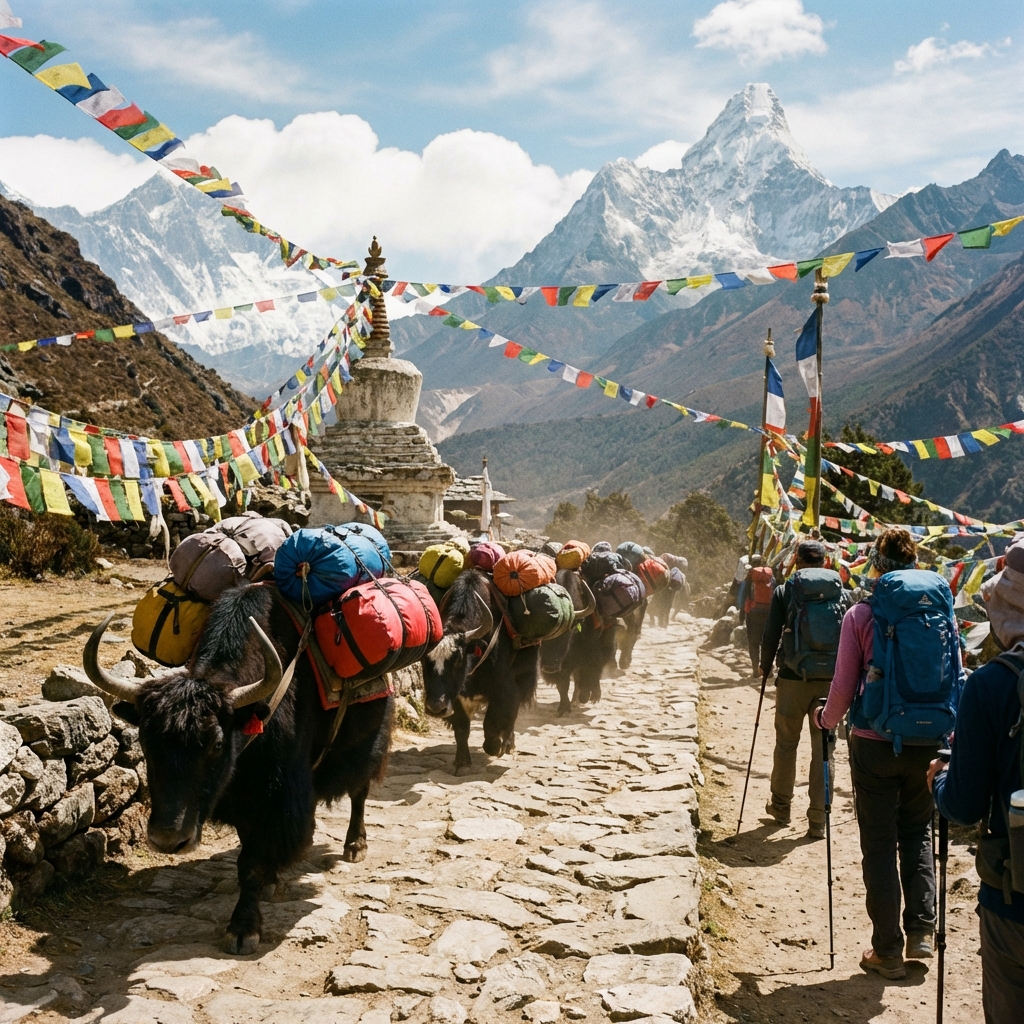
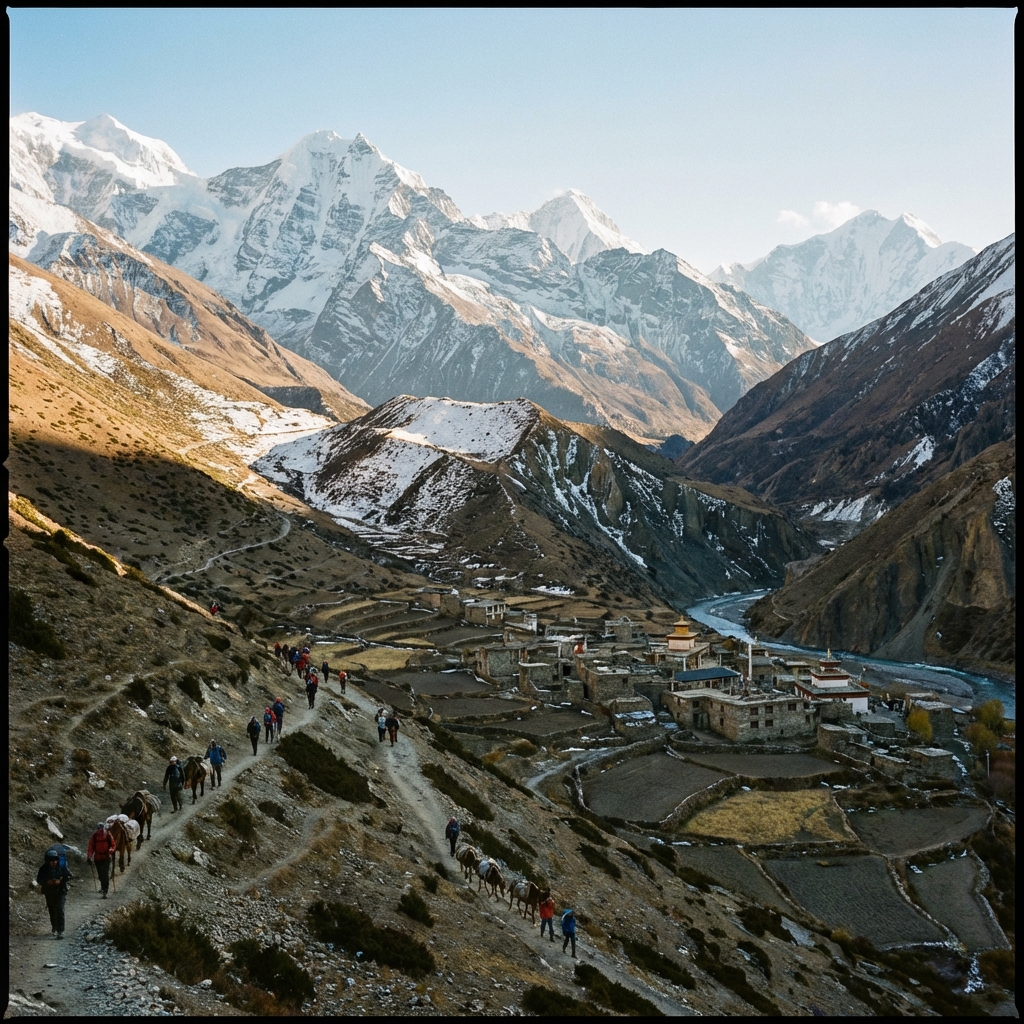
The Annapurna Base Camp 10-day itinerary is the most popular and well-balanced route to one of Nepal's most spectacular trekking destinations. This classic schedule provides adequate time for acclimatization, includes the stunning Poon Hill sunrise viewpoint, and allows you to fully experience the diverse landscapes and cultures of the Annapurna Sanctuary.
This comprehensive guide breaks down each day of the standard ABC 10-day route with detailed information on elevations, distances, walking times, trail conditions, accommodation options, costs, and everything you need to know to plan your trek successfully.
Why Choose the 10-Day ABC Itinerary?
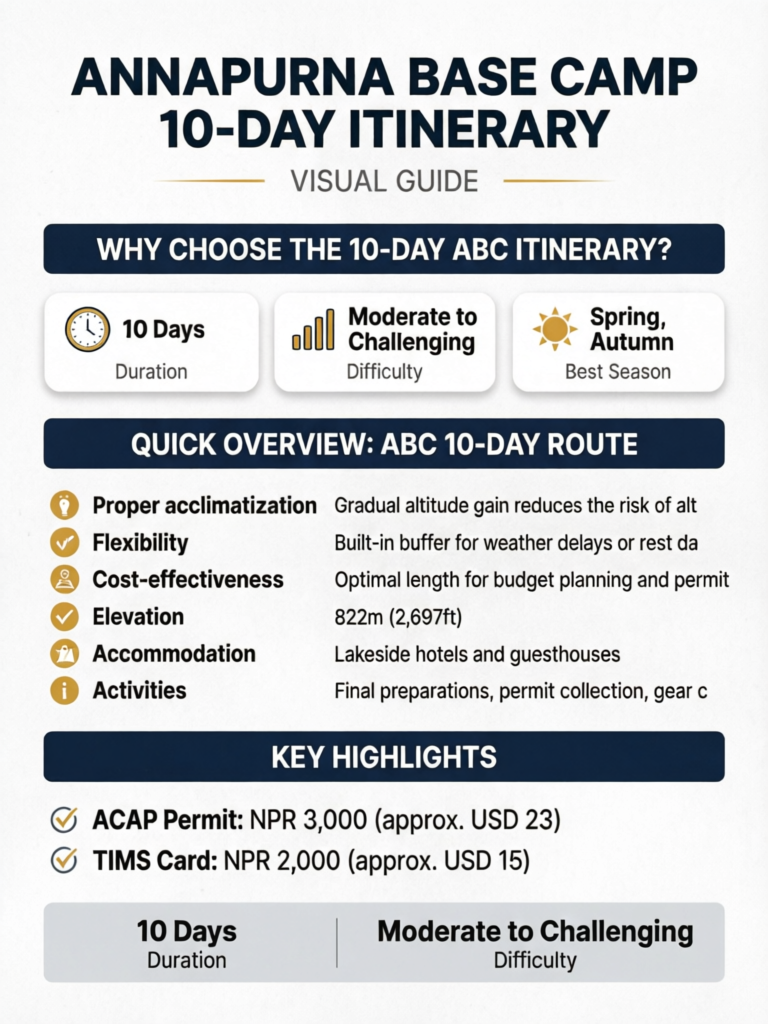
The 10-day route strikes the perfect balance between:
- Proper acclimatization: Gradual altitude gain reduces the risk of altitude sickness
- Complete experience: Includes Poon Hill, diverse ecosystems, and cultural villages
- Comfortable pace: Reasonable daily walking times (5-7 hours) suitable for most fitness levels
- Flexibility: Built-in buffer for weather delays or rest days
- Cost-effectiveness: Optimal length for budget planning and permit validity
Compared to the shorter 7-day express route, the 10-day itinerary reduces daily trekking hours and provides better altitude adaptation. Unlike the leisurely 12-day version, it maintains good momentum without unnecessary rest days.
Quick Overview: ABC 10-Day Route
Sample Itinerary
Day-by-Day Detailed Itinerary
Day 0: Pokhara - Preparation Day
Elevation: 822m (2,697ft) Accommodation: Lakeside hotels and guesthouses Activities: Final preparations, permit collection, gear check
While not technically part of the trek, spending a preparation day in Pokhara is essential for a successful ABC journey. This beautiful lakeside city serves as the gateway to the Annapurna region and offers all the facilities you need to get ready.
What to Do in Pokhara
Morning Activities:
- Collect your TIMS card and Annapurna Conservation Area Permit (ACAP) from the Tourism Board office
- Final gear shopping at the numerous trekking stores along Lakeside
- Currency exchange (carry sufficient Nepali Rupees for the trek)
- Purchase trekking essentials: water purification tablets, snacks, batteries
Afternoon Activities:
- Pack and organize your trekking backpack
- Meet your guide and porter if hiring
- Arrange transportation to Nayapul for early morning departure
- Enjoy a good meal - it's your last chance for diverse cuisine
Evening Activities:
- Early dinner to prepare for 6-7 AM departure
- Brief your guide on dietary requirements or health concerns
- Check weather forecast for the next few days
- Get a full night's rest
Where to Stay in Pokhara
Budget Options (USD 5-15/night):
- Hotel Middle Path
- New Pokhara Guest House
- Hotel Barahi
Mid-Range Options (USD 20-40/night):
- Hotel Karuna
- Hotel Mandala
- Peaceful Cottage
Comfort Options (USD 50-100/night):
- Temple Tree Resort
- Hotel Barahi
- Waterfront Resort
Costs for Day 0
- Accommodation: USD 5-100 depending on choice
- Meals: USD 15-25
- ACAP Permit: NPR 3,000 (approx. USD 23)
- TIMS Card: NPR 2,000 (approx. USD 15)
- Last-minute gear: USD 10-50
- Transportation booking: USD 15-20
Daily Total: USD 70-250
Pro Tip
Book your Pokhara to Nayapul jeep the night before. Shared jeeps (USD 6-8 per person) leave from the bus park starting at 6:30 AM. Private jeeps cost USD 70-90 but offer flexibility and comfort.
Day 1: Nayapul to Tikhedhunga
Starting Elevation: 1,070m (3,510ft) - Nayapul Ending Elevation: 1,540m (5,052ft) - Tikhedhunga Elevation Gain: +470m Distance: 11km (6.8 miles) Walking Time: 4-5 hours Difficulty: Easy to Moderate
The first day of your ABC trek is a gentle introduction to Himalayan trekking. The trail follows the Modi Khola river valley through terraced farmlands, small Gurung villages, and lush subtropical forests.
Trail Description
Nayapul to Birethanti (30 minutes)
The trek begins at Nayapul (1,070m), a bustling junction town where jeeps from Pokhara drop trekkers. After registering at the ACAP checkpoint, you descend to cross a suspension bridge over the Bhurungdi Khola.
The well-paved stone trail leads to Birethanti (1,025m), a charming village where the Modi Khola and Bhurungdi Khola rivers converge. This is the official entry point to the Annapurna Conservation Area.
Trail Characteristics:
- Wide, well-maintained stone path
- Gentle descent then flat
- Can be crowded with mule trains
- Several small shops and tea houses
Birethanti to Hille (2 hours)
From Birethanti, the trail follows the west bank of the Modi Khola through a beautiful riverside landscape. The path is relatively flat with minor ups and downs, passing through small settlements and terraced fields.
Key villages along this section:
- Sudame (1,100m) - small settlement with tea shops
- Hille (1,475m) - larger village with several lodges
Trail Characteristics:
- Mostly flat with gradual inclines
- Stone-paved path
- Scenic river views
- Occasional mule traffic
Hille to Tikhedhunga (1.5-2 hours)
The final section involves a gradual climb through terraced rice paddies and small farmsteads. The trail offers your first glimpses of snow-capped peaks if the weather is clear.
Tikhedhunga is a small village built along the river valley, known as the last comfortable stop before the challenging climb to Ulleri the next day.
Trail Characteristics:
- Gentle to moderate incline
- Stone steps in sections
- Terraced agriculture on both sides
- River sounds accompany the walk
Accommodation in Tikhedhunga
Tikhedhunga offers basic but comfortable tea houses catering to trekkers. Most lodges are concentrated along the main trail.
Recommended Tea Houses:
Peaceful Guest House
- Rooms: NPR 500-800 (USD 4-6)
- Hot shower: NPR 300 (USD 2.30)
- WiFi: NPR 300-500 per day (USD 2.30-3.80)
- Food: Standard dal bhat NPR 700-900 (USD 5.30-6.80)
- Amenities: Clean rooms, attached bathrooms available, charging stations
- Note: Popular spot, book early in high season
Hotel Sanctuary
- Rooms: NPR 500-1,000 (USD 4-7.50)
- Hot shower: NPR 300 (USD 2.30)
- WiFi: NPR 400 (USD 3)
- Food: Dal bhat NPR 800-1,000 (USD 6-7.50)
- Amenities: River view rooms, small garden area, good food
Green Hill Guest House
- Rooms: NPR 400-700 (USD 3-5.30)
- Hot shower: NPR 300 (USD 2.30)
- WiFi: Limited, NPR 500 (USD 3.80)
- Food: Basic meals NPR 600-800 (USD 4.50-6)
- Amenities: Budget-friendly, basic but clean
Highlights of Day 1
- First day excitement and energy
- Beautiful Modi Khola river valley
- Terraced farmlands with traditional agriculture
- Birethanti - gateway to Annapurna Sanctuary
- Meeting fellow trekkers
- First mountain views on clear days
What to Expect
Weather: Warm in the valley, temperatures 15-25°C during the day. Can be humid in the monsoon season.
Trail Conditions: Well-maintained, mostly flat or gentle inclines. Can be muddy after rain.
Crowds: This is one of the busiest sections, especially in peak season (October-November, March-April).
Services: Multiple tea houses, shops selling snacks and drinks, mobile phone coverage.
Daily Costs for Day 1
- Accommodation: NPR 400-1,000 (USD 3-7.50)
- Breakfast: NPR 400-600 (USD 3-4.50)
- Lunch (usually in Birethanti or Hille): NPR 600-800 (USD 4.50-6)
- Dinner: NPR 700-1,000 (USD 5.30-7.50)
- Snacks and drinks: NPR 400-600 (USD 3-4.50)
- Hot shower: NPR 300 (USD 2.30)
- WiFi: NPR 300-500 (USD 2.30-3.80)
- Device charging: NPR 200-300 (USD 1.50-2.30)
Daily Total: NPR 3,300-5,100 (USD 25-38)
Important Note
Always keep your ACAP permit and TIMS card accessible. You'll need to show them at multiple checkpoints throughout the trek. Some tea houses also require permit details for registration.
Day 2: Tikhedhunga to Ghorepani
Starting Elevation: 1,540m (5,052ft) - Tikhedhunga Ending Elevation: 2,860m (9,383ft) - Ghorepani Elevation Gain: +1,320m Distance: 11km (6.8 miles) Walking Time: 6-7 hours Difficulty: Challenging
Day 2 is considered the most physically demanding day of the entire ABC trek. The challenging climb of over 1,300 meters tests your endurance, particularly the famous 3,000+ stone steps from Tikhedhunga to Ulleri.
Trail Description
Tikhedhunga to Ulleri (2-3 hours)
This section is legendary among ABC trekkers - approximately 3,300 stone steps climbing steeply through terraced farmland. It's a relentless ascent that gains about 600 meters in just 3 kilometers.
Start early (6-7 AM) to avoid the midday heat. Take frequent short breaks rather than long stops to maintain rhythm.
Trail Characteristics:
- Stone staircase, steep and unrelenting
- Can be very hot in the sun
- Multiple tea shops along the way for breaks
- Stunning views of terraced fields
- Mule trains passing regularly
Break Spots:
- Several tea houses at the halfway point
- Beautiful views looking back at the valley
- Shaded spots under large trees
Ulleri (2,080m) is a large Magar village and a welcome sight after the tough climb. Most trekkers take a substantial break here for lunch or tea.
Ulleri to Banthanti (1.5 hours)
After Ulleri, the trail continues upward but with a more gradual gradient. The landscape transitions from farmland to oak and rhododendron forests - a welcome change providing shade.
Banthanti (2,210m) is a small settlement with a few tea houses, serving as another good rest stop.
Trail Characteristics:
- Forest trail, more gradual climb
- Cooler temperatures under tree canopy
- Muddy in sections after rain
- Bird songs and forest atmosphere
Banthanti to Nangethanti (1 hour)
The trail continues through beautiful rhododendron forests. If you're trekking in spring (March-April), you'll be rewarded with spectacular red, pink, and white rhododendron blooms.
Nangethanti (2,460m) offers basic tea houses and is sometimes used as an alternative overnight stop if arriving late.
Trail Characteristics:
- Dense forest trail
- Moderate climb
- Rhododendron tunnels
- Cooler, more comfortable hiking
Nangethanti to Ghorepani (1.5-2 hours)
The final push to Ghorepani involves continued forest walking with occasional clearings offering mountain views. The gradient eases as you approach the village.
Ghorepani (2,860m) is a large trekking village stretched along a ridge, offering the first major mountain panoramas of your trek.
Trail Characteristics:
- Mixed forest and open areas
- Moderate climbing
- First snow peak views
- Arrival at a proper mountain village
Accommodation in Ghorepani
Ghorepani is a well-developed trekking village with dozens of tea houses ranging from basic to surprisingly comfortable. Rooms are generally cold at this altitude, so request extra blankets.
Recommended Tea Houses:
Sunny Hotel
- Rooms: NPR 500-1,000 (USD 4-7.50)
- Hot shower: NPR 400 (USD 3)
- WiFi: NPR 500 (USD 3.80)
- Food: Dal bhat NPR 900-1,200 (USD 6.80-9)
- Amenities: Mountain views, dining hall with heater, reliable hot water
- Note: Popular, book in advance during peak season
Hotel Excellent View
- Rooms: NPR 800-1,200 (USD 6-9)
- Hot shower: NPR 400 (USD 3)
- WiFi: NPR 500-700 (USD 3.80-5.30)
- Food: Dal bhat NPR 1,000-1,300 (USD 7.50-10)
- Amenities: Best mountain views, heated dining room, bakery items
- Note: Premium option in Ghorepani
Trekkers Inn
- Rooms: NPR 500-800 (USD 4-6)
- Hot shower: NPR 400 (USD 3)
- WiFi: NPR 400 (USD 3)
- Food: Dal bhat NPR 900-1,100 (USD 6.80-8.30)
- Amenities: Budget-friendly, clean, good food
Snow Peak Guest House
- Rooms: NPR 600-1,000 (USD 4.50-7.50)
- Hot shower: NPR 400 (USD 3)
- WiFi: NPR 500 (USD 3.80)
- Food: Dal bhat NPR 950-1,250 (USD 7.20-9.50)
- Amenities: Mid-range comfort, friendly staff, decent WiFi
Highlights of Day 2
- Conquering the Ulleri stairs - a major achievement
- Transition from subtropical to temperate forest
- Rhododendron forests (spectacular in spring)
- First proper mountain views from Ghorepani
- Arrival at a traditional mountain village
- Preparation for Poon Hill sunrise
What to Expect
Weather: Cooler than Day 1, especially in the evening. Temperatures range from 5-15°C. Can be foggy or cloudy, obscuring mountain views.
Trail Conditions: Stone steps, forest trails, some muddy sections. The Ulleri stairs are challenging regardless of fitness level.
Crowds: Very busy route, especially the Ulleri section. You'll encounter many trekkers going both directions.
Services: Good facilities in Ghorepani including several shops, bakeries, and well-equipped tea houses.
Daily Costs for Day 2
- Accommodation: NPR 500-1,200 (USD 4-9)
- Breakfast: NPR 500-700 (USD 3.80-5.30)
- Lunch (usually in Ulleri): NPR 700-1,000 (USD 5.30-7.50)
- Dinner: NPR 900-1,300 (USD 6.80-10)
- Snacks and drinks: NPR 500-800 (USD 3.80-6)
- Hot shower: NPR 400 (USD 3)
- WiFi: NPR 500-700 (USD 3.80-5.30)
- Device charging: NPR 300-400 (USD 2.30-3)
Daily Total: NPR 4,300-6,100 (USD 32-46)
Altitude Tip
You've gained significant altitude today (1,320m). Drink plenty of water (3-4 liters), avoid alcohol, and get adequate rest. Some people experience mild headaches at this elevation - this is normal but monitor symptoms.
Day 3: Poon Hill Sunrise, Ghorepani to Tadapani
Starting Elevation: 2,860m (9,383ft) - Ghorepani Peak Elevation: 3,210m (10,531ft) - Poon Hill Ending Elevation: 2,630m (8,629ft) - Tadapani Elevation Gain/Loss: +350m / -580m Distance: 13km (8 miles) including Poon Hill Walking Time: 7-8 hours total (1 hour Poon Hill, 6-7 hours to Tadapani) Difficulty: Moderate
This is one of the most memorable days of the ABC trek, beginning with a pre-dawn hike to Poon Hill for spectacular sunrise views over the Annapurna and Dhaulagiri ranges, followed by a beautiful forest walk to Tadapani.
Poon Hill Sunrise Hike (4:30 AM - 7:00 AM)
Wake-up Call: 4:00-4:30 AM Departure: 4:30-5:00 AM Climb Duration: 45-60 minutes Sunrise Time: 6:00-6:30 AM (varies by season)
The pre-dawn hike to Poon Hill is steep but short - about 400 steps climbing 350 meters through rhododendron forest. Most trekkers use headlamps or flashlights for the early morning ascent.
Poon Hill (3,210m) - The Experience:
Poon Hill is one of the most famous viewpoints in the Himalayas, offering a 360-degree panorama of some of the world's highest peaks:
Mountain Views (from west to east):
- Dhaulagiri I (8,167m) - 7th highest mountain in the world
- Tukuche Peak (6,920m)
- Nilgiri North (7,061m)
- Annapurna I (8,091m) - 10th highest mountain in the world
- Annapurna South (7,219m)
- Hiunchuli (6,441m)
- Machapuchare (6,993m) - the sacred "Fishtail" mountain
- Annapurna II (7,937m)
- Annapurna III (7,555m)
- Annapurna IV (7,525m)
- Lamjung Himal (6,983m)
Sunrise Timeline:
- 5:45 AM: First light touches the highest peaks
- 6:00 AM: Golden hour begins, peaks glow orange and pink
- 6:15 AM: Full sunrise, spectacular illumination
- 6:30-7:00 AM: Best photography time
Facilities at Poon Hill:
- Viewing tower and platform
- Tea houses selling hot drinks and snacks
- Toilet facilities
- Mobile coverage for most networks
Costs:
- Hot tea/coffee: NPR 200-300 (USD 1.50-2.30)
- Snacks: NPR 150-300 (USD 1.15-2.30)
Photography Tips
Bring a headlamp for the climb, but turn it off at the top to preserve night vision and avoid light pollution. Use a tripod for the best sunrise shots. The golden hour (6:00-6:30 AM) offers the most dramatic colors.
Poon Hill to Tadapani Trail Description
Poon Hill to Ghorepani (45 minutes)
Descend back to Ghorepani for breakfast and to collect your bags. Most tea houses serve early breakfast (7:00-8:00 AM) to accommodate Poon Hill hikers.
Ghorepani to Deurali Pass (2 hours)
After breakfast, the trail heads east from Ghorepani through dense rhododendron and oak forest. The path is relatively flat with minor ups and downs along the ridge.
Key points:
- Beautiful forest walking with mountain glimpses through clearings
- Occasional ascents and descents
- Peaceful compared to the Ulleri route
- Rich birdlife - listen for Himalayan pheasants
Deurali Pass to Banthanti (1 hour)
The trail descends through forest to a different Banthanti village (not to be confused with the one between Ulleri and Ghorepani). This is a small settlement with a couple of tea houses.
Trail Characteristics:
- Descending through rhododendron forest
- Can be slippery after rain
- Shaded and cool
- Small streams crossing the path
Banthanti to Tadapani (2.5-3 hours)
The final section to Tadapani involves a mix of descent and gentle climbing through beautiful forest. The last 45 minutes climbs moderately to reach Tadapani village.
Tadapani (2,630m) means "far water" and sits on a ridge offering stunning views of Annapurna South, Hiunchuli, and Machapuchare (Fishtail).
Trail Characteristics:
- Mixed forest terrain
- Some climbing sections
- Mountain views as you approach Tadapani
- Well-maintained trail
Accommodation in Tadapani
Tadapani is a smaller, quieter village compared to Ghorepani, with about 10-12 tea houses stretched along the ridge. The village offers exceptional mountain views from most lodges.
Recommended Tea Houses:
Hotel Fishtail
- Rooms: NPR 600-1,000 (USD 4.50-7.50)
- Hot shower: NPR 400 (USD 3)
- WiFi: NPR 500 (USD 3.80)
- Food: Dal bhat NPR 1,000-1,300 (USD 7.50-10)
- Amenities: Best Machapuchare views, clean rooms, good food
- Note: Gets booked up early in peak season
Mountain Top Hotel
- Rooms: NPR 500-900 (USD 4-6.80)
- Hot shower: NPR 400 (USD 3)
- WiFi: NPR 500 (USD 3.80)
- Food: Dal bhat NPR 950-1,250 (USD 7.20-9.50)
- Amenities: Panoramic views, friendly staff
Paradise Guest House
- Rooms: NPR 500-800 (USD 4-6)
- Hot shower: NPR 400 (USD 3)
- WiFi: Limited, NPR 400 (USD 3)
- Food: Dal bhat NPR 900-1,200 (USD 6.80-9)
- Amenities: Budget option, basic but clean
Highlights of Day 3
- Poon Hill sunrise - one of the world's great mountain viewpoints
- Panoramic views of Annapurna and Dhaulagiri ranges
- Beautiful rhododendron forest walking
- Quieter, more peaceful trail after Ghorepani
- Tadapani's stunning mountain views
- Feeling of entering deeper into the mountains
What to Expect
Weather: Cool morning (0-5°C at Poon Hill), warming to 10-15°C during the day. Evening temperatures drop to 5-10°C.
Trail Conditions: Stone steps to Poon Hill, forest trails to Tadapani. Can be muddy and slippery in sections.
Crowds: Very crowded at Poon Hill (100+ people in peak season), quieter on the trail to Tadapani.
Services: Good facilities in both Ghorepani and Tadapani. Limited shops between villages.
Daily Costs for Day 3
- Accommodation: NPR 500-1,000 (USD 4-7.50)
- Breakfast in Ghorepani: NPR 500-700 (USD 3.80-5.30)
- Snacks at Poon Hill: NPR 200-400 (USD 1.50-3)
- Lunch on trail: NPR 800-1,100 (USD 6-8.30)
- Dinner: NPR 1,000-1,300 (USD 7.50-10)
- Snacks and drinks: NPR 500-800 (USD 3.80-6)
- Hot shower: NPR 400 (USD 3)
- WiFi: NPR 500 (USD 3.80)
- Device charging: NPR 300-400 (USD 2.30-3)
Daily Total: NPR 4,700-6,200 (USD 35-47)
Long Day Alert
This is a long day starting at 4:30 AM. You'll walk 7-8 hours total including Poon Hill. Consider arriving early at Tadapani to rest and acclimatize. Drink plenty of water throughout the day.
Day 4: Tadapani to Chhomrong
Starting Elevation: 2,630m (8,629ft) - Tadapani Ending Elevation: 2,170m (7,119ft) - Chhomrong Elevation Loss: -460m Elevation Gain: +300m (includes descents and climbs) Distance: 10km (6.2 miles) Walking Time: 5-6 hours Difficulty: Moderate
Day 4 takes you deeper into the Annapurna Sanctuary, leaving the Poon Hill route and joining the main ABC trail. This day involves significant descents and climbs through beautiful forest and traditional Gurung villages, culminating in Chhomrong, the gateway to the Sanctuary.
Trail Description
Tadapani to Bhass Kharka (1 hour)
The day begins with a descent through rhododendron forest. The trail is well-maintained with stone steps in steeper sections.
Bhass Kharka is a small tea house stop, literally meaning "grazing meadow," though it's mostly forested now.
Trail Characteristics:
- Descending through forest
- Stone steps
- Cool and shaded
- Some muddy sections
Bhass Kharka to Gurjung (1.5 hours)
Continue descending through beautiful mixed forest with occasional mountain views through gaps in the trees. The gradient is moderate, and the trail is generally good condition.
Gurjung is a small settlement - just a few houses and one or two basic tea houses.
Trail Characteristics:
- Continued forest descent
- Well-shaded path
- Pleasant walking
- Few other trekkers
Gurjung to Kimrung Khola River (1 hour)
The trail descends more steeply now to reach the valley floor where the Kimrung Khola (river) flows. This is the lowest point of the day at around 1,780 meters.
You'll cross a suspension bridge over the river - a good spot for photos and a break.
Trail Characteristics:
- Steeper descent
- Stone steps
- River sounds as you approach
- Suspension bridge crossing
Kimrung Khola to Chhomrong (2-2.5 hours)
Now comes the challenging part - a steep climb of nearly 400 meters up stone steps to reach Chhomrong. This is a tough ascent, especially after the long descent, but regular breaks and steady pace will get you there.
The climb passes through lower Chhomrong village first, then continues up to upper Chhomrong where most tea houses are located.
Trail Characteristics:
- Relentless stone staircase
- Steep climbing
- Can be hot in sunny weather
- Tea houses midway for breaks
- Spectacular views as you gain height
Chhomrong (2,170m) is the largest village you'll encounter after Ghorepani and the last major settlement before the Sanctuary. It's a beautiful traditional Gurung village built on terraced hillsides with spectacular views of Annapurna South and Machapuchare.
Accommodation in Chhomrong
Chhomrong is well-developed for tourism with 20+ tea houses offering various comfort levels. The village is split between lower and upper Chhomrong, with most accommodations in the upper section.
Recommended Tea Houses:
Hotel Chhomrong Cottage
- Rooms: NPR 600-1,200 (USD 4.50-9)
- Hot shower: NPR 400-500 (USD 3-3.80)
- WiFi: NPR 500-700 (USD 3.80-5.30)
- Food: Dal bhat NPR 1,100-1,400 (USD 8.30-10.50)
- Amenities: Best views in village, heated dining room, good menu variety
- Note: Popular, book ahead in peak season
Hotel Chhomrong Guest House
- Rooms: NPR 500-1,000 (USD 4-7.50)
- Hot shower: NPR 400 (USD 3)
- WiFi: NPR 500 (USD 3.80)
- Food: Dal bhat NPR 1,000-1,300 (USD 7.50-10)
- Amenities: Central location, reliable facilities, friendly staff
Captain Guest House
- Rooms: NPR 700-1,200 (USD 5.30-9)
- Hot shower: NPR 500 (USD 3.80)
- WiFi: NPR 600 (USD 4.50)
- Food: Dal bhat NPR 1,100-1,400 (USD 8.30-10.50)
- Amenities: Modern facilities, good bathrooms, bakery items
Excellent View Guest House
- Rooms: NPR 500-900 (USD 4-6.80)
- Hot shower: NPR 400 (USD 3)
- WiFi: NPR 500 (USD 3.80)
- Food: Dal bhat NPR 1,000-1,300 (USD 7.50-10)
- Amenities: Budget-friendly, clean, good food
Highlights of Day 4
- Leaving the Poon Hill route, fewer trekkers
- Beautiful forest walking through rhododendron and oak
- Suspension bridge over Kimrung Khola
- Challenging but rewarding climb to Chhomrong
- First close-up views of Annapurna South and Machapuchare
- Arrival at the gateway to Annapurna Sanctuary
- Traditional Gurung village culture
What to Expect
Weather: Warmer than previous days due to lower altitude. Temperatures 10-20°C during the day, 5-12°C at night.
Trail Conditions: Mixed forest trails, stone steps, some steep sections. The climb to Chhomrong is strenuous.
Crowds: Moderate. You'll see other trekkers but not as many as the Poon Hill route.
Services: Good facilities in Chhomrong including shops, bakeries, and well-equipped tea houses. This is your last chance to buy substantial supplies before entering the Sanctuary.
Daily Costs for Day 4
- Accommodation: NPR 500-1,200 (USD 4-9)
- Breakfast: NPR 600-800 (USD 4.50-6)
- Lunch on trail: NPR 800-1,100 (USD 6-8.30)
- Dinner: NPR 1,100-1,400 (USD 8.30-10.50)
- Snacks and drinks: NPR 600-900 (USD 4.50-6.80)
- Hot shower: NPR 400-500 (USD 3-3.80)
- WiFi: NPR 500-700 (USD 3.80-5.30)
- Device charging: NPR 300-500 (USD 2.30-3.80)
Daily Total: NPR 4,800-7,100 (USD 36-54)
Shopping Opportunity
Chhomrong is your last major village before the Sanctuary. Stock up on snacks, batteries, and any other supplies here. Prices increase significantly beyond this point. There's a small shop selling basic items and a bakery with treats.
Day 5: Chhomrong to Bamboo/Dovan
Starting Elevation: 2,170m (7,119ft) - Chhomrong Ending Elevation: 2,310m (Bamboo) or 2,505m (Dovan) Elevation Gain/Loss: -700m / +840m (to Bamboo) Distance: 10km (6.2 miles) Walking Time: 5-6 hours Difficulty: Moderate to Challenging
Day 5 officially enters the Annapurna Sanctuary, descending into the Chhomrong Khola valley before climbing through bamboo forests along the Modi Khola gorge. This day features dramatic landscape changes and brings you into the heart of the Sanctuary.
Trail Description
Chhomrong to Sinuwa (2-2.5 hours)
The day begins with a steep descent down stone steps from Chhomrong - about 500 meters down to the valley floor. Your knees will feel this descent, so use trekking poles if you have them and take your time on the steps.
At the bottom, you'll cross a suspension bridge over the Chhomrong Khola river, then immediately begin climbing up the other side through terraced fields and small settlements.
Sinuwa (2,360m) is a small settlement with a few tea houses perched on the hillside.
Trail Characteristics:
- Steep stone steps descending
- Suspension bridge crossing
- Moderate climb through terraces
- Mountain views from Sinuwa
Sinuwa to Kuldighar (1 hour)
From Sinuwa, the trail enters the forest and continues climbing through bamboo and rhododendron. The path is well-maintained but involves continuous uphill walking.
Kuldighar (2,540m) is a tiny settlement - literally just one or two lodges perched on the mountainside. It's a quiet, peaceful spot surrounded by forest.
Trail Characteristics:
- Forest trail, shaded
- Bamboo groves
- Moderate, steady climbing
- Bird songs and forest sounds
Kuldighar to Bamboo (1.5 hours)
The trail continues through dense bamboo forest - this is where the village gets its name. The path descends slightly then levels out, following the Modi Khola gorge.
This section is beautiful and atmospheric, with thick bamboo creating natural tunnels over the trail. Listen for the sound of the river below.
Bamboo (2,310m) is a small settlement with 3-4 basic tea houses. It's located in a narrow gorge surrounded by steep, forested mountainsides.
Trail Characteristics:
- Dense bamboo forest
- Mostly level with some ups and downs
- Atmospheric and beautiful
- Narrow trail in places
Bamboo to Dovan (Optional, 45 minutes-1 hour)
Some trekkers continue another hour uphill to Dovan (2,505m), which offers slightly better views and a few more tea house options. The choice between staying at Bamboo or Dovan depends on your energy level and accommodation preference.
The trail from Bamboo to Dovan continues uphill through bamboo and rhododendron forest, gaining about 200 meters.
Trail Characteristics:
- Uphill through forest
- Some avalanche warning signs in winter/spring
- Quiet, peaceful setting
- More open than Bamboo
Accommodation in Bamboo
Bamboo is a basic but charming stop in the gorge. Accommodations are simple but adequate, and the setting is beautiful.
Recommended Tea Houses in Bamboo:
Bamboo Guest House
- Rooms: NPR 500-800 (USD 4-6)
- Hot shower: NPR 500 (USD 3.80)
- WiFi: Limited/none
- Food: Dal bhat NPR 1,200-1,500 (USD 9-11.30)
- Amenities: Basic but clean, small dining area
- Note: Most popular option in Bamboo
Green Forest Lodge
- Rooms: NPR 500-700 (USD 4-5.30)
- Hot shower: NPR 500 (USD 3.80)
- WiFi: None
- Food: Dal bhat NPR 1,200-1,400 (USD 9-10.50)
- Amenities: Simple, friendly hosts
Accommodation in Dovan
Recommended Tea Houses in Dovan:
Dovan Guest House
- Rooms: NPR 600-900 (USD 4.50-6.80)
- Hot shower: NPR 500 (USD 3.80)
- WiFi: Limited, NPR 500 (USD 3.80)
- Food: Dal bhat NPR 1,300-1,600 (USD 10-12)
- Amenities: Slightly better facilities than Bamboo
Himalaya Guest House
- Rooms: NPR 600-800 (USD 4.50-6)
- Hot shower: NPR 500 (USD 3.80)
- WiFi: Very limited
- Food: Dal bhat NPR 1,200-1,500 (USD 9-11.30)
- Amenities: Basic, warm dining area
Highlights of Day 5
- Entering the Annapurna Sanctuary proper
- Dense bamboo forests creating natural tunnels
- Modi Khola gorge - dramatic, steep valley
- Quieter, more remote atmosphere
- Sound of the river and forest
- Feeling of wilderness and isolation
- First awareness of being in the Sanctuary
What to Expect
Weather: Cooler and more humid in the gorge. Temperatures 8-18°C during the day, 3-8°C at night. The narrow valley creates a microclimate.
Trail Conditions: Forest trails, some steep sections, bamboo tunnels. Can be muddy and damp. Leeches possible in monsoon season.
Crowds: Much quieter than previous days. You'll see other trekkers but the feeling is more remote.
Services: Very basic facilities. Tea houses offer simple menus with limited choices. No shops beyond Chhomrong. No WiFi or spotty at best. Limited phone coverage.
Avalanche Awareness: This section passes through potential avalanche zones in winter and spring (December-April). Tea house owners monitor conditions, but be aware of warning signs.
Daily Costs for Day 5
- Accommodation: NPR 500-900 (USD 4-6.80)
- Breakfast: NPR 700-900 (USD 5.30-6.80)
- Lunch on trail: NPR 900-1,200 (USD 6.80-9)
- Dinner: NPR 1,200-1,600 (USD 9-12)
- Snacks and drinks: NPR 700-1,000 (USD 5.30-7.50)
- Hot shower: NPR 500 (USD 3.80)
- WiFi: Limited/unavailable
- Device charging: NPR 400-600 (USD 3-4.50)
Daily Total: NPR 4,900-6,700 (USD 37-51)
Sanctuary Entry
You're now in the Annapurna Sanctuary proper. Facilities become more basic, prices increase with altitude, and services become limited. Phone coverage and WiFi are unreliable from here onward. Inform family you may be out of contact for 2-3 days.
Menu Planning
Food prices increase significantly inside the Sanctuary. Dal bhat is always the best value, providing unlimited refills. Stick to simple, traditional dishes rather than Western items which are expensive and take longer to prepare at altitude.
Day 6: Bamboo/Dovan to Deurali
Starting Elevation: 2,310m (Bamboo) or 2,505m (Dovan) Ending Elevation: 3,230m (10,597ft) - Deurali Elevation Gain: +920m (from Bamboo) or +725m (from Dovan) Distance: 9km (5.6 miles) Walking Time: 5-6 hours Difficulty: Moderate to Challenging
Day 6 continues ascending through the Modi Khola gorge, passing through spectacular landscapes including the narrowest section of the valley at Hinku Cave and the beautiful Himalayan Hotel area. You'll notice the vegetation changing as you gain altitude, and the mountains begin to surround you.
Trail Description
Bamboo to Dovan (45 minutes - if starting from Bamboo)
If you stayed in Bamboo, the day begins with the climb to Dovan through forest. If you stayed in Dovan, you begin directly from there.
Dovan to Himalayan Hotel (1.5 hours)
The trail continues upward through bamboo and rhododendron forest, following the Modi Khola river which becomes more powerful and loud here. The path is well-maintained with some steep sections.
Himalayan Hotel (2,920m) is a well-known stop - larger than Bamboo or Dovan with better facilities. It's situated in a more open area where the valley begins to widen slightly. This is a popular lunch stop.
Trail Characteristics:
- Uphill through forest
- Some avalanche barrier structures
- River sounds getting louder
- Cooler temperatures as you gain altitude
Himalayan Hotel to Hinku Cave (1 hour)
This section continues climbing and passes through what's known as Hinku Cave area (3,160m) - not actually a cave but an overhanging rock formation that provides shelter. In avalanche season, this serves as a safe spot.
The valley narrows dramatically in this section, with steep walls rising on both sides. It's an impressive, somewhat intimidating landscape.
Trail Characteristics:
- Narrow gorge section
- Steep valley walls
- Rock overhang area
- Avalanche warning signs in winter/spring
- Very atmospheric
Hinku Cave to Deurali (1.5-2 hours)
The final push to Deurali involves continued climbing, but the landscape opens up dramatically. The forest thins out, replaced by alpine vegetation and low shrubs.
As you approach Deurali, you'll notice the valley widening and the first really expansive mountain views appearing. The temperature drops noticeably, and you're now well into the alpine zone.
Deurali (3,230m) means "high pass" and sits at a natural amphitheater where the valley opens into the Sanctuary proper. The views from here are spectacular when clear, with mountains visible on multiple sides.
Trail Characteristics:
- Alpine environment
- Less vegetation, more rocky
- Expanding valley
- Dramatic mountain views
- Windy conditions common
- Thin air becoming noticeable
Accommodation in Deurali
Deurali has only 3-4 tea houses, all basic but adequate. The setting is spectacular but exposed to wind and weather. Rooms are cold at this altitude - request multiple blankets.
Recommended Tea Houses:
Deurali Guest House
- Rooms: NPR 700-1,000 (USD 5.30-7.50)
- Hot shower: NPR 500-600 (USD 3.80-4.50)
- WiFi: None
- Food: Dal bhat NPR 1,400-1,700 (USD 10.50-13)
- Amenities: Basic but clean, heated dining area with stove
- Note: Most reliable option
Alpine Guest House
- Rooms: NPR 700-900 (USD 5.30-6.80)
- Hot shower: NPR 500 (USD 3.80)
- WiFi: None
- Food: Dal bhat NPR 1,400-1,600 (USD 10.50-12)
- Amenities: Simple, friendly hosts, small dining area
Mountain View Lodge
- Rooms: NPR 600-900 (USD 4.50-6.80)
- Hot shower: NPR 500 (USD 3.80)
- WiFi: None
- Food: Dal bhat NPR 1,300-1,600 (USD 10-12)
- Amenities: Basic facilities, good views
Highlights of Day 6
- Himalayan Hotel - classic ABC stopping point
- Hinku Cave - narrowest part of the Modi Khola gorge
- Transition from forest to alpine zone
- Valley dramatically opening into the Sanctuary
- First expansive mountain views
- Feeling the altitude and thin air
- Approaching the heart of the Sanctuary
- Wildlife possible (Himalayan tahr, birds)
What to Expect
Weather: Significantly cooler than lower elevations. Temperatures 5-12°C during the day, -2 to 5°C at night. Can be windy. Snow possible year-round.
Trail Conditions: Mixed forest and alpine trails. Some steep sections, rocky areas. Can be icy in winter/spring. Avalanche awareness important December-April.
Altitude Effects: Many people begin feeling altitude at this elevation. Headaches, shortness of breath during exertion, and fatigue are common. Drink plenty of water.
Crowds: Moderate. You'll see other trekkers throughout the day.
Services: Very basic facilities. Simple food menus with high prices. No WiFi, no phone coverage. No shops. Limited electricity (solar panels).
Daily Costs for Day 6
- Accommodation: NPR 600-1,000 (USD 4.50-7.50)
- Breakfast: NPR 800-1,000 (USD 6-7.50)
- Lunch (usually Himalayan Hotel): NPR 1,000-1,400 (USD 7.50-10.50)
- Dinner: NPR 1,400-1,700 (USD 10.50-13)
- Snacks and drinks: NPR 800-1,200 (USD 6-9)
- Hot shower: NPR 500-600 (USD 3.80-4.50)
- Device charging: NPR 500-700 (USD 3.80-5.30)
Daily Total: NPR 5,600-7,600 (USD 42-58)
Altitude Awareness
At 3,230m, altitude effects become more noticeable. Common symptoms include mild headache, shortness of breath during exertion, and disturbed sleep. These are normal if mild. Drink 4+ liters of water daily. Avoid alcohol. Don't push too hard.
Warning signs requiring attention: severe headache not relieved by painkillers, nausea/vomiting, extreme fatigue, dizziness, confusion. If experiencing these, do not ascend higher and consider descending.
Packing for Tomorrow
Tomorrow you'll reach ABC (4,130m). Pack a daypack with essentials: warm layers, water, snacks, camera, headlamp. Many trekkers leave their main bags at Deurali and do ABC as a day trip, collecting bags on the descent. Discuss this with your tea house.
Day 7: Deurali to Annapurna Base Camp via MBC
Starting Elevation: 3,230m (10,597ft) - Deurali Intermediate: 3,700m (12,139ft) - Machhapuchhare Base Camp (MBC) Ending Elevation: 4,130m (13,549ft) - Annapurna Base Camp (ABC) Elevation Gain: +900m Distance: 8km (5 miles) Walking Time: 5-6 hours Difficulty: Challenging (due to altitude)
This is the day you've been trekking toward - reaching Annapurna Base Camp. The trail ascends through spectacular high-alpine terrain, first to Machhapuchhare Base Camp, then onward to ABC itself. The physical distance is short, but the altitude makes every step harder. The reward is standing in one of the most spectacular mountain amphitheaters on Earth.
Trail Description
Deurali to Bagar (45 minutes)
The day begins with a moderate ascent through alpine meadow. The trail is well-defined and gradually gains altitude. The landscape is open with low shrubs and grasses - the thin air is very noticeable.
Bagar (3,300m) is a tiny settlement - just 1-2 basic tea houses. It's a short stop, mostly used for quick tea breaks.
Trail Characteristics:
- Open alpine terrain
- Gradual ascent
- Rocky areas
- Mountain views expanding
- Noticeably thin air
Bagar to Machhapuchhare Base Camp/MBC (2-2.5 hours)
The trail continues upward through increasingly dramatic landscape. The valley walls rise steeply on both sides, and the mountains begin to dominate the skyline.
The path follows the Modi Khola river, now much smaller and often frozen in winter/spring. The gradient is moderate but steady - you'll need to pace yourself and take frequent breaks in the thin air.
As you approach MBC, the sacred peak of Machhapuchhare (Fishtail, 6,993m) appears directly ahead - an awe-inspiring sight. The mountain's double summit creates its distinctive "fishtail" shape.
Machhapuchhare Base Camp (3,700m) is a collection of 6-8 tea houses at the base of the sacred mountain. This is a popular lunch stop, though some trekkers choose to stay here overnight rather than push to ABC.
Trail Characteristics:
- Steady uphill through alpine zone
- Rocky moraine terrain in sections
- River following
- Expansive mountain views
- Altitude effects noticeable - slow pace required
Machhapuchhare Base Camp to Annapurna Base Camp (1.5-2 hours)
The final push to ABC is relatively short but feels long in the thin air. The trail continues through the wide valley, passing several small settlements and tea houses.
The gradient is gentle to moderate, but at this altitude, every step requires effort. Take your time, breathe deeply, and maintain a slow, steady pace.
As you round the final bend and ABC comes into view, the full glory of the Annapurna Sanctuary reveals itself - a complete 360-degree amphitheater of towering peaks.
Annapurna Base Camp (4,130m) sits at the heart of the Sanctuary, surrounded by some of the world's highest mountains. The feeling of standing here is indescribable - you're encircled by giants.
Mountain Views from ABC:
South Face:
- Hiunchuli (6,441m)
- Annapurna South (7,219m)
West Face:
- Annapurna I (8,091m) - the 10th highest mountain in the world
- The massive south face of Annapurna I is one of the most dangerous mountain faces in climbing
North Face:
- Annapurna III (7,555m)
- Gandharvachuli (6,248m)
East Face:
- Machhapuchhare (6,993m) - the sacred, unclimbed peak
- Annapurna South East ridge
Northeast:
- Tarke Kang (Glacier Dome, 7,202m)
- Gangapurna (7,455m)
Trail Characteristics:
- Gentle to moderate terrain
- Wide valley floor
- Glacial moraine
- Extremely thin air
- Altitude effects significant
- Weather can change rapidly
Accommodation at Annapurna Base Camp
ABC has approximately 8-10 tea houses, all offering similar basic facilities. Rooms are very cold at this altitude - multiple blankets are essential. Most tea houses have heated dining rooms with wood or kerosene stoves.
Recommended Tea Houses:
Annapurna Sanctuary Guest House
- Rooms: NPR 1,000-1,500 (USD 7.50-11.30)
- Hot shower: NPR 600-800 (USD 4.50-6)
- WiFi: None
- Food: Dal bhat NPR 1,800-2,200 (USD 13.50-16.50)
- Amenities: Heated dining room, decent blankets, good views
- Note: One of the more reliable options
Hotel Sanctuary
- Rooms: NPR 1,000-1,400 (USD 7.50-10.50)
- Hot shower: NPR 600-700 (USD 4.50-5.30)
- WiFi: None
- Food: Dal bhat NPR 1,700-2,100 (USD 13-16)
- Amenities: Basic but adequate, warm common area
Snowland Guest House
- Rooms: NPR 900-1,300 (USD 6.80-10)
- Hot shower: NPR 600 (USD 4.50)
- WiFi: None
- Food: Dal bhat NPR 1,700-2,000 (USD 13-15)
- Amenities: Simple facilities, friendly hosts
Machhapuchhare Guest House
- Rooms: NPR 1,000-1,500 (USD 7.50-11.30)
- Hot shower: NPR 700 (USD 5.30)
- WiFi: None
- Food: Dal bhat NPR 1,800-2,200 (USD 13.50-16.50)
- Amenities: Good dining area, multiple blankets provided
Highlights of Day 7
- Reaching Annapurna Base Camp - the goal of the trek
- 360-degree mountain amphitheater
- Standing at 4,130m surrounded by 7,000m and 8,000m peaks
- Machhapuchhare Base Camp with views of the sacred Fishtail
- Sense of achievement and awe
- Incredible photography opportunities
- Potential sunset views (stay for evening colors)
- Star-gazing at night from high altitude
What to Expect
Weather: Cold and variable. Daytime temperatures -5 to 8°C, nighttime -10 to -5°C (can be much colder). Weather changes rapidly. Snow possible any time of year. Very windy conditions common in afternoon.
Trail Conditions: Alpine and glacial moraine terrain. Well-defined trail but rocky in sections. Can be icy, especially early morning. Snow cover in winter/spring.
Altitude Effects: Significant. Nearly everyone experiences some symptoms: shortness of breath, headache, fatigue, poor sleep. This is normal at this elevation. Move slowly, breathe deeply, stay hydrated.
Crowds: Moderate to busy, especially at ABC. Most trekkers arrive by early afternoon. MBC is quieter.
Services: Very basic. Simple food menus with limited variety. No WiFi, no phone coverage. Limited electricity (solar). Water is expensive as it must be carried or melted from snow.
Daily Costs for Day 7
- Accommodation: NPR 900-1,500 (USD 6.80-11.30)
- Breakfast: NPR 1,000-1,300 (USD 7.50-10)
- Lunch at MBC: NPR 1,200-1,600 (USD 9-12)
- Dinner: NPR 1,800-2,200 (USD 13.50-16.50)
- Snacks and drinks: NPR 1,000-1,500 (USD 7.50-11.30)
- Hot shower: NPR 600-800 (USD 4.50-6)
- Device charging: NPR 600-800 (USD 4.50-6)
- Bottled/boiled water: NPR 400-600 per liter (USD 3-4.50)
Daily Total: NPR 7,500-10,300 (USD 57-78)
Altitude Warning - Critical
At 4,130m, you are at high altitude where altitude sickness is a real risk. Symptoms to monitor:
Normal at this altitude:
- Mild headache
- Shortness of breath during exertion
- Fatigue
- Poor sleep
- Reduced appetite
Warning signs - do not ascend further:
- Severe headache not relieved by painkillers
- Nausea and vomiting
- Extreme fatigue/weakness
- Dizziness/loss of balance
- Confusion or altered consciousness
- Chest tightness or persistent cough
If experiencing warning signs, descend immediately. Altitude sickness can be life-threatening. Do not stay at ABC if experiencing severe symptoms.
Maximizing Your ABC Experience
Arrival Time: Try to arrive by 1-2 PM to allow time to rest and enjoy the views before clouds potentially roll in.
Sunset: The golden hour before sunset offers spectacular lighting on the peaks. Bundle up and spend time outside.
Sunrise: Wake early (5:30-6 AM) for sunrise views. The mountains glow with incredible colors. Best photography time.
Acclimatization Walk: If feeling okay, take short walks around ABC. Movement helps acclimatization.
Hydration: Drink constantly despite not feeling thirsty. Altitude dehydrates you quickly.
Photography: Bring spare batteries as cold drains them quickly. Keep cameras warm inside your jacket.
Day 8: ABC to Bamboo (Descent)
Starting Elevation: 4,130m (13,549ft) - ABC Ending Elevation: 2,310m (7,579ft) - Bamboo Elevation Loss: -1,820m Distance: 17km (10.5 miles) Walking Time: 6-7 hours Difficulty: Moderate (long day, tough on knees)
After experiencing the majesty of Annapurna Base Camp, it's time to begin the descent. Day 8 involves retracing your steps through MBC and Deurali, then continuing all the way down to Bamboo - losing nearly 1,800 meters of elevation. While descending is physically easier on the cardiovascular system, it's challenging for knees and requires careful footing.
Trail Description
ABC to Machhapuchhare Base Camp (1-1.5 hours)
If the weather is clear, wake early for sunrise at ABC - the mountains glow with incredible colors in the early morning light. After breakfast and soaking in final views, begin the descent.
The trail back to MBC follows the same route as yesterday. Descending at this altitude is much easier on the lungs - you'll notice breathing becomes easier with every meter lost.
Trail Characteristics:
- Gradual descent
- Much easier breathing as you lose altitude
- Good views looking back at ABC
- Watch footing on rocky sections
MBC to Deurali (1.5-2 hours)
Continue descending through the high alpine zone back to Deurali. The trail is well-defined, following the Modi Khola valley downward.
Many trekkers pick up bags left at Deurali, then continue onward.
Trail Characteristics:
- Steady descent
- Moraine and alpine terrain
- Noticeably warmer as you descend
- Energy levels improving with more oxygen
Deurali to Himalayan Hotel (1.5-2 hours)
The descent continues through Hinku Cave area and down to Himalayan Hotel. This is often a lunch stop - the tea houses here serve good food and it's a welcome break.
Trail Characteristics:
- Descent through narrower gorge section
- Rocky trail, some steep sections
- Watch footing on stone steps
- Entering back into forest zone
Himalayan Hotel to Dovan (1 hour)
Continue descending through rhododendron and bamboo forest. The vegetation becomes noticeably lusher as you lose altitude.
Dovan to Bamboo (30-45 minutes)
The final section descends through beautiful bamboo forest back to Bamboo village. You'll notice the air feels thick and oxygen-rich compared to ABC - breathing is easy and energy levels are good.
Trail Characteristics:
- Forest descent
- Bamboo groves
- Lush vegetation
- Sound of river getting louder
- Much warmer temperatures
Accommodation in Bamboo
Same tea houses as Day 5 (ascending). See Day 5 for detailed descriptions.
Quick Options:
- Bamboo Guest House
- Green Forest Lodge
- Similar facilities as Day 5 ascending
Highlights of Day 8
- Final sunrise at ABC (if weather permits)
- Sense of accomplishment completing the trek to base camp
- Noticing how much easier breathing becomes while descending
- Returning to lusher, warmer environments
- Energy levels improving with more oxygen
- Covering significant distance - nearly 17km
- Sleeping at lower altitude - better rest expected
What to Expect
Weather: Warming significantly as you descend. Starting cold at ABC (5°C), ending much warmer at Bamboo (15°C).
Trail Conditions: Mostly good but watch for loose rocks and slippery sections, especially if wet. Stone steps can be hard on knees.
Physical Challenge: While cardiovascularly easier, descending is hard on knees and quadriceps. Use trekking poles if available. Take care on steps to avoid knee injury.
Crowds: You'll pass many trekkers ascending - the trail can feel busy with two-way traffic.
Services: Good facilities at Himalayan Hotel lunch stop. Basic facilities at Bamboo.
Daily Costs for Day 8
- Breakfast at ABC: NPR 1,000-1,300 (USD 7.50-10)
- Snacks/tea on trail: NPR 500-800 (USD 3.80-6)
- Lunch at Himalayan Hotel: NPR 1,000-1,400 (USD 7.50-10.50)
- Accommodation at Bamboo: NPR 500-800 (USD 4-6)
- Dinner: NPR 1,200-1,500 (USD 9-11.30)
- Snacks and drinks: NPR 600-900 (USD 4.50-6.80)
- Hot shower: NPR 500 (USD 3.80)
- Device charging: NPR 400-600 (USD 3-4.50)
Daily Total: NPR 5,700-7,800 (USD 43-59)
Knee Protection
Descending nearly 1,800m in one day is tough on knees. Tips to protect them:
- Use trekking poles to absorb impact
- Take shorter steps on descents
- Keep knees slightly bent, never locked
- Take breaks to rest leg muscles
- Consider knee supports if you have previous knee issues
- Go slowly - rushing increases injury risk
If knees are very sore, consider breaking the descent into two days by staying at Himalayan Hotel or Dovan instead of pushing to Bamboo.
Day 9: Bamboo to Jhinu Danda (Hot Springs)
Starting Elevation: 2,310m (7,579ft) - Bamboo Ending Elevation: 1,780m (5,840ft) - Jhinu Danda Elevation Loss: -530m Elevation Gain: +200m (net loss -330m) Distance: 11km (6.8 miles) Walking Time: 5-6 hours Difficulty: Moderate
Day 9 continues the descent, retracing your steps through Sinuwa and back to Chhomrong, then branching off to Jhinu Danda - home to natural hot springs where you can soak tired muscles. This is a celebratory day with the hard work done and a relaxing reward waiting.
Trail Description
Bamboo to Sinuwa (2.5-3 hours)
The morning begins with a climb back up to Sinuwa - the elevation you descended on Day 5. This is the only significant uphill of the day. The trail ascends through bamboo and rhododendron forest.
Sinuwa (2,360m) is a welcome sight - you remember it from the ascent, and it marks the beginning of mostly downhill walking for the rest of the day.
Trail Characteristics:
- Uphill through forest
- Well-shaded, cool
- Bamboo groves
- Moderate climbing
Sinuwa to Chhomrong (2 hours)
From Sinuwa, descend to the Chhomrong Khola river, cross the suspension bridge, then climb back up the stone steps to Chhomrong village - the same route as Day 4 in reverse.
Chhomrong (2,170m) is a good lunch stop. The village feels almost cosmopolitan after the basic facilities in the Sanctuary.
Trail Characteristics:
- Descent to river
- Suspension bridge crossing
- Steep stone staircase climbing to Chhomrong
- Last major climb of the trek
Chhomrong to Jhinu Danda (2-2.5 hours)
From Chhomrong, instead of retracing your steps toward Tadapani, you take a different route descending toward the Modi Khola river valley. This trail branches off from the main Chhomrong village.
The path descends through terraced fields and small settlements, offering beautiful views of the valley and mountains behind you.
Jhinu Danda (1,780m) is a small village perched on a hillside above the Modi Khola river. The village has developed specifically for trekkers wanting to access the hot springs located down by the river.
Trail Characteristics:
- Descending through terraces
- Stone steps
- Some flat sections
- Views of valley and mountains
- Warmer temperatures
Natural Hot Springs
The highlight of Jhinu Danda is the natural hot springs (locally called "Tatopani" - hot water). These geothermal springs are located about 300 meters below the village, reached by a steep 15-20 minute descent on stone steps.
Hot Springs Details:
- Location: Riverside, 300m below Jhinu village
- Temperature: 35-40°C (95-104°F)
- Facilities: Simple stone pools, changing rooms, toilets
- Opening hours: Usually 7 AM - 7 PM
- Entry fee: NPR 100-150 per person (USD 0.75-1.15)
- Best time: Sunset (5-6 PM) for magical lighting
The pools are segregated by gender with basic changing facilities. The experience of soaking in naturally heated water with mountain views is incredibly relaxing after days of trekking.
Tips for Hot Springs:
- Bring a towel and change of clothes
- Go in late afternoon for the best light and atmosphere
- Limit soaking to 20-30 minutes to avoid overheating
- Stay hydrated
- Watch your belongings - don't leave valuables unattended
- The climb back up to the village is steep - take your time
Accommodation in Jhinu Danda
Jhinu has about 8-10 tea houses, all offering similar facilities. Most have good views of the valley.
Recommended Tea Houses:
Namaste Guest House
- Rooms: NPR 500-800 (USD 4-6)
- Hot shower: NPR 300-400 (USD 2.30-3)
- WiFi: NPR 400-500 (USD 3-3.80)
- Food: Dal bhat NPR 900-1,200 (USD 6.80-9)
- Amenities: Good views, clean rooms, friendly hosts
- Note: Popular spot, near hot springs trail
Hot Spring Lodge
- Rooms: NPR 500-900 (USD 4-6.80)
- Hot shower: NPR 400 (USD 3)
- WiFi: NPR 500 (USD 3.80)
- Food: Dal bhat NPR 900-1,300 (USD 6.80-10)
- Amenities: Decent facilities, good food
Jhinu Guest House
- Rooms: NPR 400-700 (USD 3-5.30)
- Hot shower: NPR 300 (USD 2.30)
- WiFi: NPR 400 (USD 3)
- Food: Dal bhat NPR 800-1,100 (USD 6-8.30)
- Amenities: Budget option, basic but clean
Highlights of Day 9
- Final day in the mountains
- Seeing Chhomrong again - completing the Sanctuary loop
- Natural hot springs - soaking tired muscles
- Warmer temperatures and lusher vegetation
- Sense of achievement - trek nearly complete
- Celebratory atmosphere with fellow trekkers
- Beautiful valley views
- Easier breathing at lower altitude
What to Expect
Weather: Warm and pleasant. Temperatures 12-22°C during the day, 8-15°C at night.
Trail Conditions: Mostly good, some steep stone steps. Well-maintained trails.
Crowds: Moderate. Jhinu is a popular stop specifically for the hot springs.
Services: Good facilities, better food variety than in the Sanctuary. Some WiFi available. Phone coverage improving.
Daily Costs for Day 9
- Breakfast: NPR 600-800 (USD 4.50-6)
- Snacks/tea on trail: NPR 400-600 (USD 3-4.50)
- Lunch in Chhomrong: NPR 800-1,100 (USD 6-8.30)
- Accommodation: NPR 400-900 (USD 3-6.80)
- Dinner: NPR 900-1,300 (USD 6.80-10)
- Snacks and drinks: NPR 500-700 (USD 3.80-5.30)
- Hot springs entry: NPR 100-150 (USD 0.75-1.15)
- Hot shower: NPR 300-400 (USD 2.30-3)
- WiFi: NPR 400-500 (USD 3-3.80)
- Device charging: NPR 300-400 (USD 2.30-3)
Daily Total: NPR 4,800-7,050 (USD 36-53)
Hot Springs Tips
The hot springs are the perfect end to your trek. Tips for the best experience:
- Go in late afternoon (4-6 PM) for beautiful lighting and fewer crowds
- Bring a towel, swimsuit, and flip-flops
- Don't soak immediately after arriving - rest first, then go
- Limit soaking time to 20-30 minutes
- Bring water to drink while soaking
- Watch the sunset from the pools if timing works
- The climb back up is steep - take breaks
- Consider going early morning (7-8 AM) if you prefer solitude
Day 10: Jhinu Danda to Nayapul to Pokhara
Starting Elevation: 1,780m (5,840ft) - Jhinu Danda Ending Elevation: 1,070m (3,510ft) - Nayapul Final Destination: 822m (2,697ft) - Pokhara Elevation Loss: -710m (trekking) Distance: 14km (8.7 miles) trekking + 1.5 hours drive Walking Time: 5-6 hours Difficulty: Easy to Moderate
The final day of your ABC trek brings you back to Nayapul and then to Pokhara. It's a bittersweet day - the trek is ending, but you've accomplished something remarkable. The walking is easy, descending through familiar lowland landscapes back to civilization.
Trail Description
Jhinu Danda to New Bridge (1.5 hours)
The day begins with a descent from Jhinu toward the Modi Khola river. The trail follows a different route than you took going up, heading more directly toward the river valley.
New Bridge is a small settlement at a river crossing - several basic tea houses and a suspension bridge.
Trail Characteristics:
- Descending through terraces
- Stone steps
- Warmer, subtropical climate returning
- Lush vegetation
New Bridge to Syauli Bazaar (1.5 hours)
From New Bridge, the trail continues through the valley, passing through several small settlements and terraced farmlands. The path is wide and well-maintained - you'll likely encounter local villagers going about daily activities.
Syauli Bazaar is a small village with a few shops and tea houses.
Trail Characteristics:
- Mostly flat with gentle ups and downs
- Wide trail
- Terraced agriculture
- Rice paddies (green in summer, harvested in autumn)
- Warm temperatures
Syauli Bazaar to Kimche (1 hour)
The trail continues downward through agricultural lands. Kimche is where jeep roads begin - some trekkers choose to hire jeeps from here to Nayapul, though most continue walking.
Kimche to Nayapul (2-2.5 hours)
The final trekking section follows a mix of trail and jeep road downward to Nayapul. The path passes through Birethanti (where you registered on Day 1) before the final stretch to Nayapul.
Birethanti is a good lunch stop - celebrate your completion with a nice meal before the final hour to Nayapul.
At Nayapul, you'll meet your transportation to Pokhara. The trek is officially complete!
Trail Characteristics:
- Mix of trail and jeep road
- Gentle descent
- Busy with local traffic
- Warm subtropical climate
- Feeling of returning to civilization
Nayapul to Pokhara (1.5 hours drive)
Shared jeeps and private taxis run regularly from Nayapul to Pokhara. The drive takes about 1.5 hours on winding mountain roads, eventually descending to the valley where Pokhara sits beside Phewa Lake.
Transportation Options:
- Shared jeep: NPR 500-700 per person (USD 4-5.30)
- Private jeep: NPR 5,000-7,000 total (USD 38-53)
- Pre-arranged through trek company: Usually included in package
Arriving Back in Pokhara
After 10 days in the mountains, Pokhara feels luxurious. Most trekkers check into lakeside hotels, enjoy a hot shower, and celebrate with a good meal at one of the many restaurants.
Things to Do Upon Return:
- Hot shower and real bed - pure luxury
- Celebratory meal at a nice restaurant
- Sort through photos
- Send messages to friends and family
- Rest and relax
- Get laundry done
- Shopping for souvenirs
- Massage or spa treatment to soothe muscles
- Share experiences with other trekkers
Highlights of Day 10
- Completing the ABC trek - major accomplishment
- Final views of the mountains
- Descending through familiar villages (Birethanti)
- Returning to warm, subtropical lowlands
- Jeep ride back to Pokhara
- Hot shower in a real hotel
- Celebration dinner
- Reflection on the journey
What to Expect
Weather: Warm and potentially humid in the valley. Temperatures 15-28°C.
Trail Conditions: Easy walking, well-maintained trails and roads.
Crowds: Busy with both trekkers and locals. Nayapul is a transportation hub with lots of activity.
Services: Full services return quickly. Shops, restaurants, transportation, phone coverage all available.
Daily Costs for Day 10
- Breakfast: NPR 500-700 (USD 3.80-5.30)
- Snacks/tea on trail: NPR 300-500 (USD 2.30-3.80)
- Lunch in Birethanti: NPR 600-900 (USD 4.50-6.80)
- Transportation to Pokhara: NPR 500-700 shared (USD 4-5.30)
- Hotel in Pokhara: NPR 1,000-5,000+ (USD 7.50-38+) depending on choice
- Celebration dinner: NPR 1,000-2,000 (USD 7.50-15)
- Drinks/celebration: NPR 500-1,500 (USD 3.80-11.30)
Daily Total: NPR 4,400-11,300 (USD 33-85)
Post-Trek Care
After 10 days of trekking, your body needs recovery:
- Continue hydrating well
- Eat nutritious meals to replenish energy
- Rest - don't schedule intensive activities immediately
- Gentle stretching helps prevent muscle soreness
- Get a massage if muscles are very sore
- Sort and wash gear while experiences are fresh
- Download and backup photos
- Write in your journal while memories are vivid
- Tip guides and porters if you hired them (10-15% of trek cost is standard)
Alternative Itineraries: 7-Day vs 10-Day vs 12-Day
The 10-day itinerary is the most popular route, but the ABC trek can be done in different timeframes. Here's how they compare:
7-Day Express Itinerary
Who it's for: Very fit trekkers with limited time who have previous high-altitude experience.
Pros:
- Completes trek in minimum time
- Lower total cost
- Good for those with limited vacation time
Cons:
- Very long daily walking hours (7-9 hours)
- Higher risk of altitude sickness due to faster ascent
- Skips Poon Hill sunrise
- Less time to enjoy villages and scenery
- More exhausting experience
- Less flexibility for weather delays
Route:
- Day 1: Pokhara to Chhomrong (long jeep ride + trekking)
- Day 2: Chhomrong to Himalayan Hotel
- Day 3: Himalayan Hotel to ABC
- Day 4: ABC to Bamboo
- Day 5: Bamboo to Chhomrong
- Day 6: Chhomrong to Jhinu
- Day 7: Jhinu to Nayapul to Pokhara
Not Recommended Because:
- Acclimatization concerns - 7 days doesn't allow proper altitude adaptation
- Missing Poon Hill, one of the highlights
- Rushed experience with little time to appreciate surroundings
- Higher physical demand may reduce enjoyment
10-Day Standard Itinerary (This Guide)
Who it's for: Most trekkers - good fitness level, first time to altitude, wanting complete experience.
Pros:
- Proper acclimatization reducing altitude sickness risk
- Includes Poon Hill sunrise
- Reasonable daily walking hours
- Time to enjoy villages and mountain views
- Flexibility for weather or rest days
- Complete, balanced experience
- Lower altitude sickness risk
Cons:
- Requires 10 days commitment
- Higher total cost than 7-day route
- May feel rushed to some trekkers
Route: As detailed in this guide above.
Recommended Because:
- Best balance of experience, safety, and time
- Proper altitude acclimatization
- Includes all highlights
- Sustainable pace for most fitness levels
- Industry standard route
12-Day Leisurely Itinerary
Who it's for: Trekkers wanting a very relaxed pace, first-time trekkers, those with altitude concerns, photographers.
Pros:
- Very leisurely pace with short daily walking hours
- Extra acclimatization days
- More time for photography and exploration
- Can include side trips
- Very low altitude sickness risk
- Restful experience
Cons:
- Requires more vacation time
- Higher total cost
- Can feel slow to experienced trekkers
- More days exposed to weather variability
Sample Route:
- Day 0: Pokhara
- Day 1: Nayapul to Tikhedhunga
- Day 2: Tikhedhunga to Ghorepani
- Day 3: Poon Hill sunrise, rest day in Ghorepani
- Day 4: Ghorepani to Tadapani
- Day 5: Tadapani to Chhomrong
- Day 6: Chhomrong to Bamboo
- Day 7: Bamboo to Himalayan Hotel (short day for acclimatization)
- Day 8: Himalayan Hotel to Deurali/MBC
- Day 9: MBC to ABC and back to MBC (or stay at ABC)
- Day 10: MBC/ABC to Bamboo
- Day 11: Bamboo to Jhinu
- Day 12: Jhinu to Nayapul to Pokhara
Good For:
- First-time high-altitude trekkers
- Those with previous altitude issues
- Photographers wanting time for perfect shots
- People wanting a very relaxed experience
- Older trekkers or those with lower fitness levels
Which Itinerary Should You Choose?
Choose 7-Day If:
- You have very limited time
- You're very fit with high-altitude experience
- You've done multi-day treks before at similar altitudes
- You're comfortable with long daily walking hours
- You're willing to skip Poon Hill
Choose 10-Day If:
- This is your first Himalayan trek (RECOMMENDED)
- You want proper acclimatization
- You want to include Poon Hill
- You have moderate to good fitness
- You want the complete standard experience
- You value safety and comfort over speed
Choose 12-Day If:
- You want a very relaxed pace
- You have concerns about altitude
- You're a photographer wanting time for images
- You want time for rest and exploration
- This is your first multi-day trek
- You prefer shorter daily walking hours
- You have the time and budget for a longer trek
Our Recommendation: The 10-day itinerary offers the best balance for most trekkers. It provides proper acclimatization, includes all major highlights (Poon Hill and ABC), maintains reasonable daily walking hours, and allows flexibility for weather. Unless you have specific time constraints or fitness considerations, we strongly recommend the standard 10-day route.
Total Trek Costs Breakdown
Understanding the total cost of the ABC trek helps with budgeting. Here's a detailed breakdown based on the 10-day itinerary:
Permits and Entry Fees
- ACAP (Annapurna Conservation Area Permit): NPR 3,000 (USD 23)
- TIMS Card (Trekkers' Information Management System): NPR 2,000 (USD 15)
Permit Total: NPR 5,000 (USD 38)
Accommodation Costs (10 nights)
Budget Range:
- Average per night: NPR 500-700 (USD 4-5.30)
- 10 nights: NPR 5,000-7,000 (USD 38-53)
Mid-Range:
- Average per night: NPR 700-1,000 (USD 5.30-7.50)
- 10 nights: NPR 7,000-10,000 (USD 53-75)
Note: Rooms are often free if you eat at the tea house, but this is becoming less common in high season.
Food Costs (10 days)
Budget Range (Dal bhat focused):
- Daily average: NPR 2,500-3,500 (USD 19-26)
- 10 days: NPR 25,000-35,000 (USD 190-265)
Mid-Range (Varied menu):
- Daily average: NPR 3,500-5,000 (USD 26-38)
- 10 days: NPR 35,000-50,000 (USD 265-380)
Includes: 3 meals daily plus snacks, tea, and some treats.
Additional Services
Hot Showers:
- NPR 300-800 per shower (USD 2.30-6)
- 10 showers: NPR 3,000-8,000 (USD 23-60)
WiFi:
- NPR 300-700 per day (USD 2.30-5.30)
- 7 days (limited in Sanctuary): NPR 2,100-4,900 (USD 16-37)
Device Charging:
- NPR 200-800 per charge (USD 1.50-6)
- 10 charges: NPR 2,000-8,000 (USD 15-60)
Drinking Water:
- Bottled/boiled water: NPR 100-600 per liter (varies by altitude)
- 40 liters over 10 days: NPR 4,000-12,000 (USD 30-90)
- Alternative: Water purification tablets (NPR 1,500 / USD 11.30) for 10+ days
Transportation
Pokhara to Nayapul:
- Shared jeep: NPR 500-700 (USD 4-5.30)
- Private jeep: NPR 5,000-7,000 (USD 38-53)
Nayapul to Pokhara:
- Shared jeep: NPR 500-700 (USD 4-5.30)
- Private jeep: NPR 5,000-7,000 (USD 38-53)
Transportation Total: NPR 1,000-14,000 (USD 7.50-106)
Guide and Porter (Optional)
Licensed Trekking Guide:
- Daily rate: NPR 2,500-4,000 (USD 19-30)
- 10 days: NPR 25,000-40,000 (USD 190-305)
- Plus guide's expenses (food, accommodation): NPR 15,000-25,000 (USD 113-190)
- Guide Total: NPR 40,000-65,000 (USD 305-495)
Porter:
- Daily rate: NPR 1,500-2,500 (USD 11.30-19)
- 10 days: NPR 15,000-25,000 (USD 113-190)
- Plus porter's expenses: NPR 12,000-20,000 (USD 90-152)
- Porter Total: NPR 27,000-45,000 (USD 205-342)
Guide + Porter Total: NPR 67,000-110,000 (USD 510-837)
Tips: 10-15% of guide/porter costs is standard
- Guide tip: NPR 4,000-10,000 (USD 30-76)
- Porter tip: NPR 2,700-7,000 (USD 20-53)
Insurance and Tips
Tipping (for full service):
- Guide: NPR 4,000-10,000 (USD 30-76)
- Porter: NPR 2,700-7,000 (USD 20-53)
Comprehensive Travel Insurance: USD 50-150 for trip duration
- Must cover altitude up to 4,500m
- Must include helicopter evacuation
- Mandatory for this trek
Miscellaneous Costs
- Hot springs entry: NPR 100-150 (USD 0.75-1.15)
- Snacks and treats: NPR 3,000-6,000 (USD 23-45)
- Photos/souvenirs: NPR 1,000-5,000 (USD 7.50-38)
- Extra gear rental: NPR 2,000-10,000 (USD 15-76)
- Emergency buffer: NPR 5,000-10,000 (USD 38-76)
Total Cost Summary
Solo Budget Trekker (no guide/porter):
- Permits: USD 38
- Accommodation: USD 38-53
- Food: USD 190-265
- Services (showers, WiFi, charging, water): USD 84-247
- Transportation: USD 8-11
- Miscellaneous: USD 46-175
- Total: USD 404-789
Solo Mid-Range Trekker (no guide/porter):
- Permits: USD 38
- Accommodation: USD 53-75
- Food: USD 265-380
- Services: USD 120-300
- Transportation: USD 8-11
- Miscellaneous: USD 60-200
- Total: USD 544-1,004
With Guide and Porter (mid-range):
- Base mid-range costs: USD 544-1,004
- Guide and porter: USD 510-837
- Tips: USD 50-129
- Total: USD 1,104-1,970
Organized Trek Package:
- Through trekking agency: USD 800-1,500 all-inclusive
- Includes permits, guide, porter, accommodation, most meals
- Easier but less flexible
Money-Saving Tips
- Eat Dal Bhat: Unlimited refills make it the best value
- Share accommodation: Split room costs with travel partners
- Water purification: Tablets/filters cheaper than buying bottled water
- Skip WiFi in Sanctuary: Limited anyway, use offline maps
- Selective hot showers: Every other day instead of daily
- Group guide/porter: Split costs among group
- Shared transport: Use local jeeps instead of private
- Bring snacks from Pokhara: Much cheaper than buying on trail
- Limit device charging: Bring power banks charged in Pokhara
- Stay in free rooms: Commit to eating all meals at that tea house
When to Pay What
Before Trek:
- Permits (cash in Pokhara)
- Any gear purchases/rentals
- Guide/porter advance payment (often 25%)
- Insurance
During Trek:
- All food and accommodation (pay daily or at checkout)
- Services (showers, WiFi, charging)
- Snacks and drinks
- Most tea houses accept cash only
After Trek:
- Guide/porter final payment and tips
- Transportation back to Pokhara
Cash Requirements: Carry NPR 50,000-100,000 (USD 380-760) in cash for 10-day trek. ATMs in Pokhara before starting; none on the trail.
Packing List for 10-Day ABC Trek
Clothing
Upper Body:
- 3-4 moisture-wicking t-shirts (base layers)
- 1-2 long-sleeve shirts
- 1 fleece jacket (mid-layer)
- 1 down or synthetic insulated jacket (essential for ABC)
- 1 waterproof/windproof shell jacket
- 1 thermal top for sleeping
Lower Body:
- 2-3 trekking pants (quick-dry, comfortable)
- 1 pair of thermal leggings
- 1 pair of waterproof pants
- 4-5 pairs of underwear (quick-dry)
- 1 pair of shorts (optional, for lower elevations)
Head and Hands:
- 1 warm beanie/winter hat
- 1 sun hat or cap
- 1 buff/neck gaiter (versatile for wind, sun, cold)
- 1 pair of warm gloves
- 1 pair of liner gloves (optional)
- Sunglasses (100% UV protection, essential)
Feet:
- 1 pair of broken-in hiking boots (ankle support, waterproof)
- 1 pair of camp shoes/sandals (for evenings)
- 4-5 pairs of hiking socks (wool or synthetic)
- 1 pair of warm sleeping socks
Equipment
Backpack and Bags:
- 40-50L backpack with rain cover
- Daypack/summit pack 20-25L (for ABC summit day if leaving main bag)
- Dry bags/stuff sacks for organization
- Waterproof cover or pack liner
Sleeping:
- Sleeping bag rated to -10°C to -15°C (essential for ABC)
- Silk or fleece sleeping bag liner (adds warmth, hygiene)
- Pillow case (tea houses provide pillows)
Trekking Aids:
- Trekking poles (highly recommended for knee protection)
- Headlamp with extra batteries
- Water bottles: 2 x 1-liter (or hydration system)
Personal Items
Documents and Money:
- Passport with copies
- ACAP permit and TIMS card
- Travel insurance documents
- Emergency contact information
- Sufficient cash (NPR 50,000-100,000)
- Credit card (for emergencies in Pokhara)
Health and Hygiene:
- First aid kit (bandaids, blister treatment, pain relievers)
- Altitude sickness medication (Diamox - consult doctor)
- Personal medications
- Hand sanitizer
- Toilet paper and trowel
- Wet wipes/baby wipes
- Toothbrush and toothpaste
- Sunscreen SPF 50+ (high altitude sun is intense)
- Lip balm with SPF
- Small towel (quick-dry)
- Feminine hygiene products
Water and Food:
- Water purification (tablets, drops, or filter)
- Electrolyte powder/tablets
- Energy bars and snacks from home
- Multi-vitamin (altitude suppresses appetite)
Electronics
- Camera with extra batteries and memory cards
- Smartphone with offline maps
- Power bank (10,000+ mAh)
- Charging cables
- Universal adapter (though USB common)
- Headphones
- Zip-lock bags to protect electronics from moisture
Optional Items
- Book or Kindle
- Playing cards
- Journal and pen
- Binoculars (for mountain and wildlife viewing)
- Trekking umbrella (useful in rain)
- Gaiters (for snow/mud)
- Compression bags for efficient packing
- Small padlock for bags
- Earplugs (for tea house dormitories)
- Eye mask
What NOT to Bring
- Excessive clothing changes (laundry is difficult)
- Heavy items (every gram counts)
- Valuables and jewelry
- Cotton clothing (dries slowly, cold when wet)
- Too many electronics
- Hardcover books
- Hair dryer (unavailable electricity)
- Perfume/cologne
Gear You Can Rent in Pokhara
If you don't want to buy expensive gear:
- Sleeping bags: NPR 300-500/day (USD 2.30-3.80)
- Down jackets: NPR 200-400/day (USD 1.50-3)
- Trekking poles: NPR 150-300/day (USD 1.15-2.30)
- Backpacks: NPR 200-400/day (USD 1.50-3)
- Rain gear: NPR 150-300/day (USD 1.15-2.30)
Rental Total for 10 days: NPR 10,000-20,000 (USD 76-152)
Weight Guidelines
If carrying yourself: Keep pack under 10kg (22 lbs) If using porter: Maximum 20kg (44 lbs) - porters typically carry 2 trekkers' bags
Frequently Asked Questions (FAQs)
General Questions
Q1: Is 10 days enough for ABC trek?
Yes, 10 days is the ideal timeframe for the ABC trek. It provides proper acclimatization, includes the Poon Hill sunrise viewpoint, and allows reasonable daily walking hours (5-7 hours). This is the most popular and recommended duration, balancing safety, experience, and time commitment.
Q2: Can beginners do the ABC trek?
Yes, the ABC trek is suitable for beginners with good fitness levels. The trail is well-maintained, tea houses are plentiful, and the 10-day itinerary allows proper acclimatization. However, you should:
- Be able to walk 5-7 hours daily with a backpack
- Train for at least 2-3 months before the trek
- Have no serious health conditions
- Be comfortable with basic accommodation
Q3: What is the best time for ABC trek?
Best seasons:
- Autumn (September to November): Clear skies, stable weather, excellent visibility, comfortable temperatures. This is peak season.
- Spring (March to May): Beautiful rhododendron blooms, warming weather, good visibility. Second best time.
Possible but challenging:
- Winter (December to February): Very cold, snow at higher elevations, but crystal clear views and fewer crowds
- Monsoon (June to August): Heavy rain, leeches, landslide risk, obscured views. Not recommended.
Q4: How difficult is the ABC trek?
Difficulty: Moderate to challenging
Physical demands:
- Daily walking: 5-7 hours
- Elevation gain: Up to 1,320m in a single day (Day 2)
- Total elevation gain: ~3,000m
- Maximum altitude: 4,130m
Challenges:
- Ulleri stairs (Day 2): 3,300+ steps
- Altitude at ABC: Thin air, potential altitude sickness
- Long days with elevation changes
- Basic accommodation and food
Who can do it: Anyone with good general fitness, proper preparation, and no serious health issues.
Q5: Do I need a guide for ABC trek?
Not legally required, but recommended for:
- First-time trekkers in Nepal
- Those uncomfortable navigating alone
- Better cultural insights and information
- Safety in emergencies
- Support with accommodation bookings in peak season
you must trek with a licensed guide (mandatory since April 2023) if:
- You have trekking experience
- Comfortable with basic navigation
- Confident handling accommodation and logistics
- Have offline maps and this guide
The trail is well-marked and busy, making independent trekking feasible.
Altitude and Health
Q6: What altitude sickness symptoms should I watch for?
Mild symptoms (common, manageable):
- Headache
- Fatigue
- Shortness of breath during exertion
- Disturbed sleep
- Loss of appetite
Serious symptoms (descend immediately):
- Severe headache not relieved by medication
- Nausea and vomiting
- Extreme fatigue
- Loss of coordination/balance
- Confusion or altered consciousness
- Chest tightness or persistent cough
Prevention:
- Ascend gradually (10-day route helps)
- Stay hydrated (4+ liters daily)
- Avoid alcohol
- Don't over-exert
- Consider Diamox (consult doctor)
Q7: Should I take Diamox for altitude sickness?
Diamox (acetazolamide) helps prevent and reduce altitude sickness by speeding acclimatization.
Pros:
- Reduces risk of altitude sickness
- Helps breathing at night
- Speeds acclimatization
Cons:
- Side effects: tingling fingers/toes, frequent urination, carbonated drinks taste flat
- Prescription required
- Not suitable for people allergic to sulfa drugs
Recommendation: Consult your doctor before the trek. Many trekkers take Diamox preventatively starting Day 2 (125-250mg twice daily). Have it available even if not taking prophylactically.
Q8: What if I get altitude sickness?
Mild symptoms:
- Rest at current elevation
- Hydrate well
- Take pain reliever for headache
- Monitor symptoms
- Don't ascend if symptoms persist
Severe symptoms:
- Descend immediately (even 300-500m helps)
- Seek medical help
- Tea house owners can assist with evacuation arrangements
- Travel insurance should cover helicopter evacuation if necessary
Emergency contacts: Your guide (if hired) and tea house owners have emergency contact information.
Logistics
Q9: Where do I get permits for ABC trek?
In Pokhara (before starting trek):
ACAP (Annapurna Conservation Area Permit):
- Location: Nepal Tourism Board Office, Lakeside Pokhara
- Cost: NPR 3,000 (USD 23)
- Requirements: Passport, 2 photos
- Hours: 7 AM - 7 PM daily
TIMS Card (Trekkers' Information Management System):
- Location: Same office as ACAP
- Cost: NPR 2,000 (USD 15)
- Requirements: Passport, 2 photos, trek itinerary
Total time: 30-60 minutes for both permits
Alternatively: Trekking agencies can arrange permits (add USD 5-10 service fee)
Q10: How much cash should I carry?
Recommended: NPR 50,000-100,000 (USD 380-760) for 10-day trek
Why so much:
- Tea houses accept cash only (no cards/digital payment)
- ATMs only in Pokhara, none on trail
- Food and accommodation paid daily
- Services (showers, WiFi, charging) add up
- Emergency buffer needed
Denominations: Mix of NPR 100, 500, and 1,000 notes. Tea houses often can't break large bills.
Security: Keep cash in money belt or secure pocket. Don't flash large amounts.
Q11: Is WiFi available on the trek?
Yes, but limited and expensive:
Lower elevations (Tikhedhunga to Chhomrong):
- Available at most tea houses
- Cost: NPR 300-500/day (USD 2.30-3.80)
- Speed: Slow, suitable for messaging
- Reliability: Moderate
Inside Sanctuary (Bamboo to ABC):
- Very limited or none
- Cost: NPR 500-700/day if available (USD 3.80-5.30)
- Speed: Very slow, often only WhatsApp works
- Reliability: Poor, often down
Recommendation: Download offline maps, inform family you'll be out of contact for 2-3 days in the Sanctuary, don't rely on WiFi for navigation or bookings.
Q12: What about phone coverage?
NTC (Nepal Telecom): Best coverage, works up to Chhomrong consistently, spotty in Sanctuary
Ncell: Works in lower sections, unreliable above Chhomrong
Inside Sanctuary: Very limited to no coverage
Recommendation: Get NTC SIM card costs Rs 90 with data packages like 50GB/28 days for Rs 899-1,000 / USD 4-7.50 with data package). Don't rely on phone service above Chhomrong.
Food and Accommodation
Q13: What food is available on the trek?
Standard menu items (available at most tea houses):
Nepali:
- Dal bhat (lentil soup with rice) - BEST VALUE, unlimited refills
- Momo (dumplings) - steamed or fried
- Thukpa (noodle soup)
- Sherpa stew
Western:
- Pasta dishes
- Pizza (basic, expensive)
- Pancakes
- Porridge
- Eggs (fried, scrambled, omelette)
- Toast and jam
Drinks:
- Tea (milk tea, lemon tea, ginger tea)
- Coffee (instant, some tea houses have real coffee)
- Hot chocolate
- Soft drinks (expensive at altitude)
- Bottled water
Price range: NPR 600-2,200 per meal (USD 4.50-16.50) depending on dish and altitude
Recommendation: Stick to dal bhat - it's nutritious, filling, unlimited refills, and best value. Western items are expensive and not as good.
Q14: Are tea houses comfortable?
Standard tea house features:
- Private or shared room with 2 beds
- Thin mattresses with pillow and blankets
- Shared bathroom facilities
- Common dining area (usually heated)
- Basic but clean
What to expect:
- Walls: Thin plywood, can hear neighbors
- Temperature: Cold at altitude, bring sleeping bag
- Bathrooms: Shared, squat or western toilets, basic
- Showers: Hot water available for fee (bucket or shower)
- Electricity: Limited, often solar-powered, charging fees apply
- Heating: Dining rooms heated, bedrooms not
Comfort level: Basic but adequate. Don't expect hotel standards. Part of the adventure.
Q15: Can vegetarians/vegans eat well on the trek?
Yes, very well. Nepali cuisine is naturally vegetarian-friendly.
Vegetarian options:
- Dal bhat (always vegetarian)
- Vegetable momos
- Fried rice with vegetables
- Vegetable noodles/chowmein
- Potato dishes
- Porridge, pancakes
- Eggs
Vegan options:
- Dal bhat (specify no ghee/butter)
- Vegetable dishes
- Rice and lentils
- Thukpa (vegetable soup)
- Boiled potatoes
Tea house staff are familiar with dietary requirements. Just communicate clearly.
Training and Preparation
Q16: How should I train for ABC trek?
Start training 2-3 months before the trek:
Cardiovascular fitness:
- Hiking with elevation gain (best training)
- Stair climbing with weighted backpack
- Running or cycling
- 3-5 sessions per week, 45-90 minutes
Strength training:
- Leg exercises: squats, lunges, step-ups
- Core strength: planks, crunches
- 2-3 sessions per week
Endurance building:
- Long hikes on weekends (4-6 hours)
- Gradually increase pack weight to 8-10kg
- Practice walking consecutive days
Final month:
- Long hike with full pack weight
- Back-to-back day hikes to simulate trek
- Taper last week before departure
Q17: What fitness level do I need?
Minimum requirements:
- Walk 5-7 hours daily with 8-10kg pack
- Climb 1,000+ meters in a day
- Handle consecutive days of hiking
- No serious cardiovascular or respiratory conditions
Good fitness indicators:
- Can hike 15+ km with elevation gain comfortably
- Recover quickly from exertion
- No knee/joint problems
- Good general health
You don't need to be:
- An athlete or marathon runner
- Experienced in high altitude
- Ultra-fit
You do need to be:
- Generally healthy and active
- Capable of consistent moderate exertion
- Mentally prepared for physical challenge
Safety and Insurance
Q18: Is ABC trek safe?
Generally very safe, but risks exist:
Risks:
- Altitude sickness (most common serious risk)
- Slips/falls on trails
- Weather changes
- Landslides (monsoon season)
- Avalanches (winter/spring at higher elevations)
Safety measures:
- Follow proper acclimatization (10-day route)
- Trek with others or hire guide
- Check weather before departing Pokhara
- Follow tea house owner advice about conditions
- Have proper insurance
- Listen to your body
- Turn back if conditions unsafe
Medical facilities: Very basic on trail. Serious issues require helicopter evacuation to Pokhara/Kathmandu.
Q19: What insurance do I need?
Essential coverage:
- Altitude coverage: Minimum 4,500m (ABC is 4,130m)
- Helicopter evacuation: Essential - can cost USD 5,000-10,000
- Medical treatment: Emergency and hospitalization
- Repatriation: Return home if seriously ill/injured
- Trip cancellation: In case of pre-trek issues
Recommended providers:
- World Nomads
- IMG Global
- Allianz
- NRMA (Australia)
- BMC (UK climbers)
Cost: USD 50-150 for 2-week coverage
Important: Read policy carefully. Some exclude trekking above 3,000m or require guide for coverage. Ensure your chosen route is covered.
Q20: What happens if I need to be evacuated?
Helicopter evacuation process:
- Assessment: Guide or tea house owner assesses situation
- Contact: Emergency services contacted (guide has contacts)
- Insurance: Your insurance company contacted for approval
- Helicopter dispatch: Usually from Pokhara
- Pick-up: Helicopter lands at nearest suitable location (not all points accessible)
- Transport: Taken to Pokhara or Kathmandu hospital
Cost: USD 5,000-10,000 (covered by insurance if properly insured)
Landing points: Not all locations accessible by helicopter. May need to descend to evacuation point.
Your responsibility: Have insurance documents accessible, inform guide/tea house owners of health issues, keep emergency contacts updated.
Seasonal Questions
Q21: Can I trek ABC in winter (December-February)?
Yes, but with challenges:
Pros:
- Crystal clear mountain views
- Fewer crowds
- Lower accommodation prices
- Stunning snow landscapes
Cons:
- Very cold (-15°C to -20°C at ABC)
- Snow on trail, especially above Deurali
- Some tea houses closed (fewer options)
- Shorter daylight hours
- Avalanche risk in some sections
- Proper winter gear essential
Requirements for winter trekking:
- 4-season sleeping bag (-20°C rated)
- Proper winter clothing
- Experience with snow/ice
- Crampons may be needed above Deurali
- Consider guide for safety
Recommendation: Only for experienced trekkers comfortable with winter conditions. Not recommended as first Himalayan trek.
Q22: What about monsoon season (June-August)?
Not recommended for several reasons:
Cons:
- Heavy rain (daily afternoon storms)
- Leeches on lower trail sections
- Obscured mountain views (clouds)
- Landslide risk
- Trails muddy and slippery
- Higher risk of flight cancellations
Pros:
- Very few crowds
- Lush, green landscapes
- Lower prices
- Wildflowers
If you must trek in monsoon:
- Bring excellent rain gear
- Leech socks/salt for lower sections
- Be flexible with schedule
- Accept you may not see mountains clearly
- Budget extra days for weather delays
Better alternative: Choose a rain shadow trek (Upper Mustang, Dolpo) during monsoon.
Comparison Questions
Q23: ABC vs Everest Base Camp - which is better?
Both are spectacular but different:
ABC Advantages:
- Shorter duration (10 days vs 12-14 days for EBC)
- Lower maximum altitude (4,130m vs 5,364m)
- More diverse landscapes (subtropical to alpine)
- Less crowded
- Lower costs
- Includes Poon Hill viewpoint
- More intimate mountain amphitheater
- Easier acclimatization
EBC Advantages:
- Mt. Everest - highest mountain
- Sherpa culture experience
- Khumbu icefall views
- More developed trail facilities
- International trekker atmosphere
Recommendation:
- ABC for first Himalayan trek, shorter timeline, or lower budget
- EBC if you specifically want to see Everest and have more time
Q24: ABC vs Annapurna Circuit - which should I do?
ABC (this guide):
- Duration: 10 days
- Max altitude: 4,130m
- Type: Out-and-back with variation
- Highlights: Mountain amphitheater, Poon Hill, Sanctuary
- Best for: Shorter time, moderate difficulty
Annapurna Circuit:
- Duration: 14-21 days
- Max altitude: 5,416m (Thorong La Pass)
- Type: Loop/circuit
- Highlights: Thorong La Pass, diverse landscapes, cultural variety
- Best for: Longer time, more challenge
Can you do both?: Yes, combined ABC-Circuit treks are possible (21-25 days total).
Recommendation: Choose based on time available and altitude comfort. ABC is more accessible for most trekkers.
Final Preparation
Q25: What are the most common mistakes to avoid?
Top mistakes trekkers make:
- Ascending too fast: Following 7-day itinerary without altitude experience
- Inadequate training: Arriving unprepared physically
- Poor gear choices: Cotton clothing, inadequate sleeping bag
- Not drinking enough water: Leading to dehydration and altitude issues
- Carrying too much: Heavy packs cause fatigue and injury
- Skipping insurance: Hoping nothing will go wrong
- Over-packing schedules: No flexibility for weather or health
- Ignoring altitude symptoms: Pushing through warning signs
- Poor food choices: Spending too much on Western food
- Not bringing enough cash: ATMs don't exist on trail
How to avoid:
- Follow this 10-day itinerary
- Train for 2-3 months
- Pack smart with proper gear
- Hydrate constantly (4+ liters daily)
- Pack light (under 10kg personal items)
- Get comprehensive insurance
- Build in flexibility
- Descend if experiencing altitude symptoms
- Stick to dal bhat for value
- Bring NPR 50,000-100,000 cash
Essential Resources and Links
Before You Go
- Complete ABC Trekking Guide
- ABC Packing List
- Nepal Visa Information
- Pokhara Accommodation Guide
- ABC Permits and Regulations
On the Trail
Related Treks
Seasonal Guides
Training and Preparation
Cultural Information
Photography
Additional Itineraries
Final Tips for Success
Week Before Departure
- Final gear check: Lay everything out, test all equipment
- Break in boots: If new boots, wear them extensively
- Start hydrating: Increase water intake
- Light training: Don't over-train the final week
- Download offline maps: Maps.me, Google Maps offline
- Notify bank: Inform bank of Nepal travel to avoid card blocks
- Copy documents: Passport, insurance, permits - digital and physical copies
- Emergency contacts: Give itinerary to family/friends
First Day in Pokhara
- Get permits: ACAP and TIMS from Tourism Board
- Final gear check: Rent/buy anything missing
- Money: Withdraw sufficient NPR cash
- SIM card: Get NTC SIM if wanting phone coverage
- Meet guide/porter: If hired, brief them on requirements
- Transportation: Arrange Pokhara-Nayapul transport for early departure
- Rest: Good sleep before trek begins
During the Trek
- Hydrate constantly: 4-5 liters daily minimum
- Walk slowly: "Bistari bistari" (slowly slowly in Nepali)
- Listen to your body: Rest when needed, descend if altitude symptoms
- Eat well: Dal bhat gives strength for the day
- Make friends: Trek community is wonderful
- Take photos: Capture memories but also be present
- Respect culture: Follow local customs and etiquette
- Pack out trash: Leave no trace principles
- Tip appropriately: If you had good service
- Enjoy every moment: This is a once-in-a-lifetime experience for many
Mental Preparation
The ABC trek is as much mental as physical. Some days will be challenging. Remember:
- The views are worth it: Every step leads to incredible rewards
- You're not alone: Thousands have done this trek, you can too
- It's okay to struggle: Everyone finds parts difficult
- Celebrate small wins: Each day's destination is an achievement
- Stay positive: Attitude affects altitude performance
- Take breaks: There's no rush, enjoy the journey
- Trust the process: The 10-day itinerary works for a reason
After the Trek
- Rest: Your body needs recovery
- Hydrate and eat well: Replenish what you've depleted
- Process the experience: Journal, organize photos
- Share responsibly: Inspire others while respecting local communities
- Leave reviews: Help future trekkers by reviewing tea houses
- Stay in touch: Connect with trek friends
- Plan your next adventure: Nepal has many more treks waiting
Conclusion
The 10-day Annapurna Base Camp trek is one of the world's most rewarding trekking experiences. Standing at 4,130 meters surrounded by a complete amphitheater of towering Himalayan peaks is a moment that stays with you forever.
This comprehensive itinerary provides the ideal balance of proper acclimatization, complete experience including Poon Hill, and reasonable daily trekking hours suitable for most fitness levels. By following this guide, you'll be well-prepared for every aspect of your journey.
Remember that flexibility is key - weather, personal health, and trail conditions may require adjustments to this itinerary. The most important things are to:
- Ascend gradually and allow proper acclimatization
- Listen to your body and descend if experiencing serious altitude symptoms
- Stay hydrated throughout the trek
- Enjoy the journey - it's not just about reaching ABC, but about the entire experience
The Annapurna Sanctuary awaits. With proper preparation, the right mindset, and this detailed itinerary, you're ready for the adventure of a lifetime.
Namaste and happy trekking!