

If you have limited time in Nepal and want a taste of the Himalayas without committing to a two-week expedition, two treks consistently rise to the top of every recommendation list: the Mardi Himal Trek and the Poon Hill Trek. Both start from Pokhara, both sit within the Annapurna Conservation Area, and both deliver spectacular mountain views that seem disproportionate to their modest duration.
Yet these two treks offer fundamentally different experiences. Poon Hill is Nepal's most popular short trek -- a well-established, heavily trafficked route with excellent infrastructure and a famous sunrise viewpoint at 3,210m. Mardi Himal is a newer, quieter alternative that climbs significantly higher to 4,500m, passing through pristine alpine terrain with far fewer trekkers on the trail.
Choosing between them comes down to what kind of experience you prioritize: accessibility, comfort, and guaranteed logistics versus altitude, solitude, and a more adventurous atmosphere. This guide examines every dimension of both treks to help you make the right choice.
Who should read this guide:
- First-time trekkers in Nepal choosing a short introductory trek
- Travelers with 3-7 days available for trekking from Pokhara
- Experienced hikers evaluating which trek offers more challenge
- Anyone comparing the two most recommended short Annapurna treks
- Trekkers deciding whether to prioritize views, solitude, or ease of logistics
3-5 days from Pokhara
5-7 days from Pokhara
3,210m (10,531 ft) at Poon Hill viewpoint
4,500m (14,764 ft) at Mardi Himal Base Camp
Easy -- suitable for complete beginners
Moderate -- basic fitness and some hiking experience recommended
High to very high in peak season (200-400+ daily)
Low to moderate (30-80 daily in peak season)
$250-$600 total (independent to guided)
$350-$800 total (independent to guided)
Poon Hill is the easy classic; Mardi Himal is the adventurous alternative
Side-by-Side Comparison Table
| Factor | Poon Hill Trek | Mardi Himal Trek | Advantage |
|---|---|---|---|
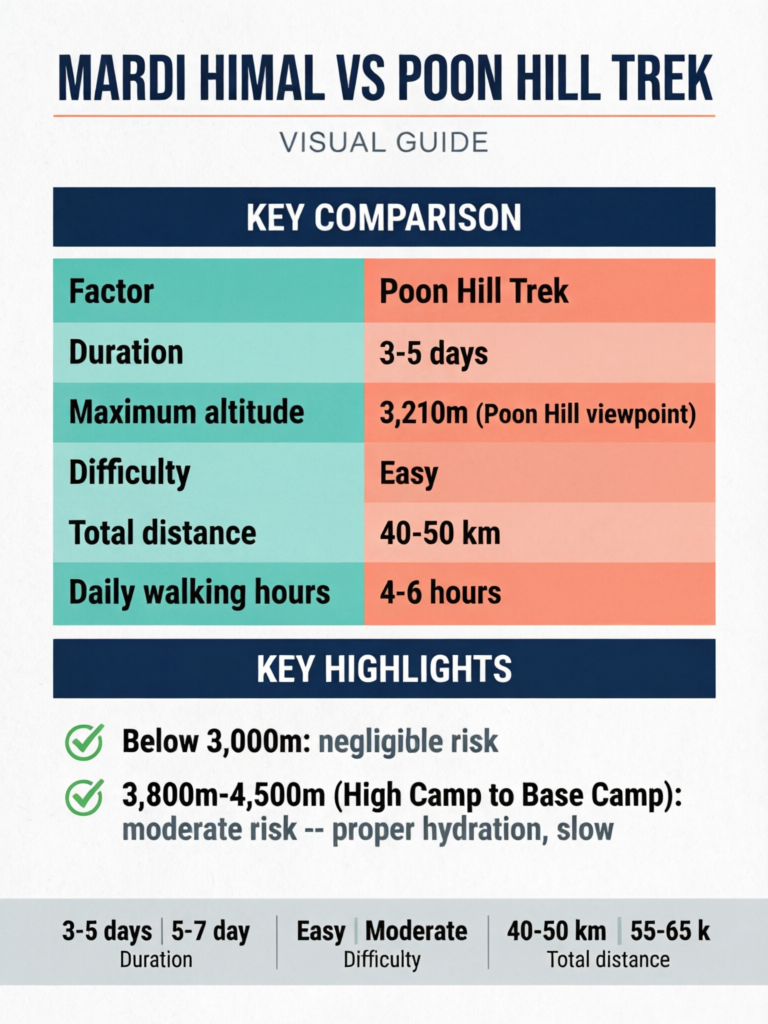
| Duration | 3-5 days | 5-7 days | Poon Hill (shorter) |
| Maximum altitude | 3,210m (Poon Hill viewpoint) | 4,500m (Mardi Himal Base Camp) | Depends on goals |
| Difficulty | Easy | Moderate | Poon Hill (easier) |
| Total distance | 40-50 km | 55-65 km | Poon Hill (shorter) |
| Daily walking hours | 4-6 hours | 5-7 hours | Poon Hill (less demanding) |
| Altitude sickness risk | Very low (below 3,500m) | Moderate (above 4,000m) | Poon Hill (safer) |
| Trail quality | Excellent -- well-maintained stone steps | Mixed -- good lower, rougher above 3,500m | Poon Hill |
| Tea house quality | Very good to excellent | Basic to good (limited above 3,500m) | Poon Hill |
| Crowds (October) | Very high (200-400+ daily) | Low to moderate (30-80 daily) | Mardi Himal |
| Mountain views | Panoramic -- Dhaulagiri, Annapurna South, Machapuchare | Close-up -- Machapuchare, Annapurna South, Hiunchuli | Mardi Himal (more intimate) |
| Sunrise experience | Famous Poon Hill sunrise (iconic) | Mardi Himal Base Camp sunrise (dramatic) | Tie (different character) |
| Cultural experience | Strong -- Gurung villages, warm hospitality | Moderate -- fewer villages above tree line | Poon Hill |
| Rhododendron forests | Spectacular (spring blooming) | Present but less extensive | Poon Hill |
| Wilderness feel | Low (popular, well-developed) | High (especially above High Camp) | Mardi Himal |
| Guide requirement | Not required (well-marked trail) | Recommended above High Camp (trail less clear) | Poon Hill (more independent-friendly) |
| Permits needed | ACAP permit ($30) + TIMS ($20) | ACAP permit ($30) + TIMS ($20) | Tie |
| Transport to trailhead | Taxi/bus to Nayapul (1.5 hrs from Pokhara) | Taxi/jeep to Kande (1 hr from Pokhara) | Tie |
| Best for | First-time trekkers, families, limited time | Adventurous trekkers wanting more altitude and solitude | Depends on trekker |
The View Comparison: Panoramic vs Intimate
Both treks deliver extraordinary Himalayan scenery, but the character of the mountain views differs substantially.
Poon Hill: The 360-Degree Panorama
The Poon Hill viewpoint at 3,210m is famous for one specific reason: it offers one of the widest Himalayan panoramas accessible from a short trek anywhere in Nepal. From the summit platform, you see:
- Dhaulagiri (8,167m) -- the world's seventh-highest mountain, dominating the western horizon
- Annapurna South (7,219m) -- massive and imposing directly north
- Annapurna I (8,091m) -- visible behind the Annapurna South ridge
- Machapuchare (6,993m) -- the iconic "Fish Tail" mountain
- Hiunchuli (6,441m) -- the dramatic peak guarding the Annapurna Sanctuary entrance
- Nilgiri (7,061m) -- towering to the northeast
- Lamjung Himal and numerous other peaks stretching across the horizon
The sunrise experience is the trek's signature moment. Arriving at the viewpoint by 5:30 AM, you watch the first rays of light strike Dhaulagiri's summit, then cascade across the entire Annapurna range. The colors shift from deep purple to pink to gold over the course of 30-40 minutes. It is genuinely spectacular, and there is a reason hundreds of thousands of trekkers have made this pilgrimage.
The downside: you share this moment with 100-300 other people during peak season. The viewpoint has a stone watchtower and railing system to manage crowds, and the atmosphere can feel more tourist attraction than wilderness experience.
Mardi Himal: The Close-Up Encounter
Mardi Himal offers a fundamentally different mountain experience. Rather than looking at peaks from a distance, you walk directly toward Machapuchare and the Annapurna massif until you are standing beneath them. At 4,500m, the mountains do not just fill the horizon -- they tower directly above you, so close you can see individual ice seracs and rock bands.
The key views from Mardi Himal Base Camp include:
- Machapuchare (6,993m) -- stunningly close, its twin summits razor-sharp against the sky
- Mardi Himal (5,587m) -- the peak's namesake, directly above you
- Annapurna South (7,219m) -- massive and unavoidable
- Hiunchuli (6,441m) -- dramatic from this angle
- Annapurna I (8,091m) -- visible from certain vantage points along the ridge
- Annapurna III (7,555m) -- appearing as you gain altitude
The sunrise from Mardi Himal High Camp or Base Camp is less photographed than Poon Hill's but arguably more dramatic. The mountains are so close that the play of light on their faces creates an immersive, almost overwhelming experience. And you share it with perhaps 10-20 other trekkers rather than hundreds.
Pro Tip
Difficulty and Fitness Comparison
Poon Hill: Genuinely Beginner-Friendly
The Poon Hill trek is one of the few Himalayan treks that genuinely lives up to the "easy" label. The altitude remains below 3,500m throughout, eliminating any meaningful altitude sickness risk for the vast majority of trekkers. The daily distances are manageable, and the trail is well-maintained with stone steps on most steep sections.
Physical demands:
- Daily elevation gain: 500-1,000m on the steepest days
- Walking hours: 4-6 per day
- Steepest section: the stone staircase climb from Tikhedhunga to Ulleri (approximately 3,300 stone steps ascending 700m)
- Total elevation gain over trek: approximately 1,700m from Nayapul to Poon Hill
Fitness requirements:
- Ability to walk 4-6 hours per day on uneven terrain
- Comfort with sustained uphill walking (stone staircases)
- Reasonable cardiovascular fitness -- regular walking or light exercise is sufficient
- No altitude experience necessary
The Tikhedhunga-to-Ulleri staircase is the most physically demanding section, and it comes on the first full trekking day. Many trekkers find this the hardest part of the entire trek. Once you reach Ghorepani, the early morning hike to Poon Hill viewpoint is a moderate 45-60 minute climb of about 400m.
Who can do Poon Hill:
- Complete beginners with reasonable fitness
- Families with children aged 8 and above
- Older trekkers (60+) with good mobility
- Trekkers recovering from injury (non-leg injuries)
- People who exercise occasionally but are not athletes
Mardi Himal: Moderate with Real Altitude Challenge
Mardi Himal is a step up from Poon Hill in every physical dimension. The trek reaches 4,500m, which introduces genuine altitude considerations. The trail above High Camp (3,580m) becomes steeper, less defined, and more exposed. The final push to Base Camp involves traversing a narrow ridge with steep drop-offs on both sides.
Physical demands:
- Daily elevation gain: 600-1,200m on the most demanding days
- Walking hours: 5-7 per day
- Steepest section: High Camp to Upper Viewpoint and on to Base Camp (900m gain over steep, exposed terrain)
- Total elevation gain: approximately 3,200m from trailhead to Base Camp
Fitness requirements:
- Ability to walk 5-7 hours per day with sustained climbing
- Good cardiovascular fitness -- regular exercise for at least 4-6 weeks before the trek
- Comfort with exposure (some narrow ridge sections above High Camp)
- Basic understanding of altitude awareness and hydration
- Mental resilience for potentially challenging trail conditions above tree line
Altitude sickness considerations:
- Below 3,000m: negligible risk
- 3,000m-3,800m (Forest Camp to High Camp): mild symptoms possible -- headache, mild fatigue
- 3,800m-4,500m (High Camp to Base Camp): moderate risk -- proper hydration, slow pace essential
- Some trekkers experience significant discomfort above 4,000m, particularly if they ascend too quickly
Altitude Awareness on Mardi Himal
Unlike Poon Hill, the Mardi Himal trek reaches altitudes where altitude sickness is a real concern. The jump from High Camp (3,580m) to Base Camp (4,500m) is 920m of elevation gain, which some itineraries attempt in a single day. If you have never been above 3,500m before, consider adding an extra acclimatization night at High Camp. The views are worth the extra day, and your body will thank you.
Who should choose Mardi Himal:
- Trekkers with some hiking experience (day hikes of 6+ hours)
- Those comfortable with basic exposure on trails
- People with at least moderate cardiovascular fitness
- Trekkers who want a physical challenge beyond a simple walk
- Those willing to manage altitude considerations
Pro Tip
The Crowd Factor: Solitude vs Social
This is where the two treks diverge most dramatically, and for many trekkers, it is the deciding factor.
Poon Hill: Nepal's Most Popular Short Trek
Poon Hill is, by a considerable margin, the most trekked short route in Nepal. During October and November peak season, the trail between Tikhedhunga and Ghorepani sees 200-400 trekkers daily. The Poon Hill sunrise viewpoint regularly hosts 150-300 people simultaneously.
What heavy traffic means in practice:
- Tea houses in Ghorepani can fill up during peak weeks -- booking ahead or arriving by 2 PM is wise
- The trail is a constant stream of trekkers going both directions, plus porters and guides
- The Poon Hill sunrise involves queuing, jostling for viewpoint positions, and selfie poles in your photographs
- Popular tea houses may have limited menu options by evening if many trekkers arrive
- Bathroom facilities at busy tea houses may have queues
This is not necessarily negative. Many trekkers enjoy the social atmosphere, the opportunity to meet people from around the world, and the energy of a popular trail. The infrastructure exists because it works well, and the tea houses along the Poon Hill route are among the best-maintained in Nepal.
Mardi Himal: The Quiet Alternative
The Mardi Himal trek was only officially opened to trekkers in 2012, and it remains significantly less trafficked than Poon Hill despite growing popularity. During peak season, you might encounter 30-80 trekkers per day on the lower sections and far fewer above High Camp.
What lighter traffic means in practice:
- Tea houses rarely fill up, even in peak season (though choice is more limited)
- Long stretches of trail where you see no other trekkers for 30-60 minutes
- The Base Camp sunrise may be shared with 5-15 people rather than hundreds
- A genuine sense of wilderness and discovery, particularly above tree line
- More personal interaction with tea house owners and staff
- Better wildlife observation opportunities (you may see Himalayan tahr, pheasants, langur monkeys)
The trade-off is that Mardi Himal's lower traffic means less developed infrastructure above High Camp. Tea houses are more basic, menu options more limited, and trail marking less reliable. Some trekkers find this charming; others find it inconvenient.
Pro Tip
Cost Comparison
Both treks are among the most affordable in Nepal, but Mardi Himal's longer duration and slightly less developed infrastructure create modest cost differences.
Detailed Cost Breakdown
| Cost Category | Poon Hill (3-5 days) | Mardi Himal (5-7 days) |
|---|---|---|
| ACAP Permit | $30 | $30 |
| TIMS Card | $20 | $20 |
| Transport (Pokhara to trailhead) | $10-15 (taxi/bus to Nayapul) | $15-25 (jeep to Kande/Australian Camp) |
| Transport (return to Pokhara) | $10-15 | $15-25 |
| Accommodation (per night) | $3-8 (free-$5 if eating at tea house) | $3-10 (free-$5 at lower; $5-10 at higher camps) |
| Food (per day) | $15-25 | $15-30 (prices increase with altitude) |
| Hot showers | $2-4 per shower | $3-5 per shower |
| WiFi | $2-3 per day | $2-5 per day (limited availability above High Camp) |
| Guide (optional) | $25-35 per day | $25-35 per day |
| Porter (optional) | $20-25 per day | $20-25 per day |
Total Budget Estimates
| Budget Level | Poon Hill (4 days) | Mardi Himal (6 days) |
|---|---|---|
| Ultra-budget (independent, minimal extras) | $250-350 | $350-500 |
| Mid-range (independent, comfortable) | $350-500 | $500-700 |
| Guided (with guide, comfortable) | $450-650 | $600-900 |
| Full package (guide + porter, all inclusive) | $500-800 | $700-1,100 |
Cost-Saving Tip
Both treks offer free or heavily discounted accommodation at tea houses if you commit to eating all meals there. This is standard practice throughout the Annapurna region. The dal bhat (lentil soup with rice and sides) is filling, nutritious, and comes with unlimited refills at most tea houses. It is the best value meal on any Nepal trek and typically costs $4-7 depending on altitude.
Best Season Comparison
Both treks share the same general seasonal patterns, but altitude differences create some nuances.
Poon Hill: Excellent Nearly Year-Round
| Season | Conditions | Crowd Level | Rating |
|---|---|---|---|
| Oct-Nov | Clear skies, perfect temperatures | Very high | Best |
| March-April | Clear skies, rhododendron bloom | High | Excellent |
| May | Warm, afternoon clouds | Moderate | Good |
| Dec-Feb | Cold mornings, clear skies, possible snow at Poon Hill | Low | Good (cold) |
| Jun-Sep | Monsoon rain, leeches, cloudy | Low | Not recommended |
Poon Hill's relatively low altitude means it is trekable in winter without extreme cold gear. Morning temperatures at Ghorepani drop to -5 to 0 degrees Celsius in December-January, but clear skies and empty trails make winter an underrated option.
Mardi Himal: More Season-Sensitive
| Season | Conditions | Crowd Level | Rating |
|---|---|---|---|
| Oct-Nov | Clear skies, cold at high camps | Moderate | Best |
| March-April | Clear skies, some snow at base camp | Low-Moderate | Excellent |
| May | Warm lower, cold upper, afternoon clouds | Low | Good |
| Dec-Feb | Very cold above 3,500m, possible trail snow/ice above High Camp | Very low | Challenging |
| Jun-Sep | Monsoon rain, leeches, trail erosion above tree line | Very low | Not recommended |
Mardi Himal's higher altitude makes winter trekking significantly more demanding. Temperatures at Base Camp (4,500m) can drop to -15 to -20 degrees Celsius in January, and snow may obscure the trail above High Camp. Winter trekking to Mardi Himal Base Camp requires proper cold-weather gear and ideally a guide familiar with winter trail conditions.
Pro Tip
Cultural Experience Comparison
Poon Hill: Rich Village Life
The Poon Hill trek passes through several substantial Gurung villages where traditional mountain culture remains vibrant. Ghorepani itself is a significant settlement with a mix of tourism infrastructure and local life. The villages of Ulleri, Hille, and Tikhedhunga offer glimpses of daily Gurung life -- stone houses with slate roofs, prayer flags, small monasteries, and terraced hillside agriculture.
The cultural highlight is the interaction with Gurung people, who are known for their warmth and hospitality. Many tea house owners are Gurung families who have operated guesthouses for generations. Conversations over tea reveal insights into mountain life, seasonal agricultural patterns, and the intersection of tourism and traditional culture.
The return route via Tadapani adds further cultural dimension, particularly if you extend to the Ghandruk village -- one of the largest and most photogenic Gurung settlements in the Annapurna region.
Mardi Himal: Transition from Village to Wilderness
Mardi Himal offers a different cultural arc. The lower sections pass through small settlements and farmland, but as you climb above tree line, the trek transitions into pure wilderness. The cultural content is front-loaded in the first two days and then gives way to an increasingly remote mountain experience.
The tea houses above Forest Camp are purpose-built for trekkers rather than being traditional village guesthouses. This means less cultural interaction but more focus on the natural environment. Some trekkers prefer this -- the wilderness immersion above High Camp is profound.
Trek Itineraries
Poon Hill: Standard 4-Day Itinerary
Day 1: Pokhara to Nayapul (drive, 1.5 hrs) then trek to Tikhedhunga (1,540m). Walking: 3-4 hours. Gentle start through farmland and small villages.
Day 2: Tikhedhunga to Ghorepani (2,860m). Walking: 5-6 hours. The famous stone staircase to Ulleri, then through beautiful rhododendron forest.
Day 3: Poon Hill sunrise (3,210m) then trek to Tadapani (2,630m). Walking: 5-6 hours. Early start for sunrise, then descent through forest.
Day 4: Tadapani to Nayapul (drive back to Pokhara). Walking: 5-6 hours. Descent through terraced farmland and villages.
Mardi Himal: Standard 6-Day Itinerary
Day 1: Pokhara to Kande (drive, 1 hr) then trek to Forest Camp (2,550m). Walking: 4-5 hours. Through rhododendron and oak forest.
Day 2: Forest Camp to Low Camp (2,990m). Walking: 3-4 hours. Continuing through dense forest with emerging mountain views.
Day 3: Low Camp to High Camp (3,580m). Walking: 4-5 hours. Transitioning above tree line, views open dramatically.
Day 4: High Camp to Mardi Himal Base Camp (4,500m) and return to High Camp. Walking: 6-8 hours. The big day -- ridge walking with exposed sections, spectacular views.
Day 5: High Camp to Siding Village (1,885m). Walking: 5-6 hours. Long descent through forest.
Day 6: Siding to Lumre (drive back to Pokhara). Walking: 2-3 hours then drive.
Mardi Himal Trail Navigation Above High Camp
The trail between High Camp and Base Camp follows a ridge that can be unclear in poor visibility. Several trekkers have become disoriented on this section, particularly when clouds roll in during the afternoon. If you are trekking independently and have limited mountain navigation experience, consider hiring a guide for this section or at minimum downloading offline GPS maps before your trek. The ridge has steep drop-offs on both sides in several places.
Accommodation Comparison
Poon Hill: Well-Established Infrastructure
Tea houses on the Poon Hill route are among the best in Nepal's trekking regions. Most offer:
- Private rooms with twin beds and blankets
- Attached or nearby Western-style toilets (some with flush toilets)
- Hot showers (gas or solar heated, $2-4)
- Common dining rooms with wood-burning stoves
- Varied menus including Nepali, Western, and continental options
- WiFi access ($2-3 per day)
- Phone charging facilities ($1-2)
Ghorepani has the widest selection, with 15-20 tea houses ranging from basic to quite comfortable. During peak season, booking ahead or arriving by early afternoon is advisable.
Mardi Himal: Basic but Improving
Accommodation on the Mardi Himal trek varies significantly with altitude:
- Forest Camp and Low Camp: Reasonable tea houses with private rooms, basic attached bathrooms, hot showers available, decent menu options
- High Camp: Several tea houses with shared rooms and basic facilities, limited menu, hot showers usually available but less reliable
- Above High Camp: One or two very basic shelters near Upper Viewpoint; no facilities at Base Camp itself (day trip from High Camp)
The tea houses on Mardi Himal have improved significantly since the trek opened, but they remain a step below Poon Hill's infrastructure. Trekkers who prioritize comfortable accommodation will prefer Poon Hill.
Pro Tip
Independent vs Guided: Which Trek Is Better for Solo Trekking?
Poon Hill: Ideal for Independent Trekking
The Poon Hill trek is one of Nepal's most independent-trekker-friendly routes. The trail is well-marked with regular signage, the tea houses are closely spaced (never more than 1-2 hours apart), and the volume of other trekkers means you are never truly alone on the trail. Navigation is straightforward -- you essentially follow a single main path with no confusing junctions.
A guide adds comfort and cultural interpretation but is not necessary for safety or navigation. Many budget-conscious trekkers complete Poon Hill independently without any issues.
Mardi Himal: Guide Recommended Above High Camp
The lower sections of Mardi Himal (to High Camp) are manageable independently for experienced hikers. The trail is reasonably well-marked, and tea houses serve as obvious waypoints.
Above High Camp, the situation changes. The trail follows an exposed ridge with multiple false paths, and in cloudy conditions, visibility can drop dramatically. The trail is not marked with the same reliability as Poon Hill, and several trekkers have needed assistance after taking wrong turns. A guide is strongly recommended for the High Camp to Base Camp section, particularly for trekkers without extensive mountain hiking experience.
Hiring a Guide for Just Part of the Trek
A cost-effective approach for Mardi Himal is to trek independently to High Camp and hire a local guide from High Camp for the Base Camp push. Some tea house owners at High Camp can arrange this for $20-30 for the day. This gives you the savings of independent trekking on the lower sections with the safety and route knowledge of a guide for the more challenging upper section.
Wildlife and Natural Environment
Poon Hill: Forest Biodiversity
The Poon Hill route passes through some of Nepal's finest rhododendron forests, which are spectacular during the spring bloom (late March to mid-April). The trail between Ghorepani and Tadapani traverses dense forest that supports:
- Himalayan tahr (wild mountain goat)
- Langur monkeys
- Danphe (Himalayan monal) -- Nepal's national bird, with iridescent plumage
- Red panda (rare, but present in the surrounding forests)
- Various pheasant species
- Numerous bird species (the area is popular with birdwatchers)
Mardi Himal: Alpine Transition
Mardi Himal's trek through multiple altitude zones offers different wildlife at different elevations:
- Forest zone (2,000-3,000m): Similar species to Poon Hill -- monkeys, birds, occasional tahr
- Alpine zone (3,000-4,000m): Himalayan tahr are more commonly sighted here, as fewer trekkers mean less disturbance
- Above tree line (4,000m+): Primarily high-altitude birds, including the yellow-billed chough and lammergeier (bearded vulture)
The quieter trails of Mardi Himal generally offer better wildlife observation opportunities than the busy Poon Hill route.
Combining Either Trek with Other Activities
Poon Hill Extensions
The Poon Hill trek connects naturally to several extensions:
- Ghandruk Village: Add 1 day to visit one of Nepal's most beautiful Gurung villages
- ABC Trek extension: Continue from Tadapani to Annapurna Base Camp (adds 5-7 days)
- Khopra Ridge: An alternative return route via Khopra Danda and Tatopani hot springs (adds 3-4 days)
Mardi Himal Extensions
Mardi Himal is more of a standalone trek, but can be combined with:
- Poon Hill: Do both treks back-to-back for a 10-12 day Annapurna short trek experience
- Pokhara activities: Paragliding, boating on Phewa Lake, zip-lining -- Pokhara offers excellent adventure activities for post-trek relaxation
- ABC Trek: Though starting from a different trailhead, you could combine Mardi Himal and ABC in a 12-15 day trip
Which Trek Is Harder?
Mardi Himal is moderately harder than Poon Hill. Mardi reaches 4,500m over 5-7 days with steeper terrain and a ridgeline approach, while Poon Hill maxes at 3,210m over 3-5 days on well-maintained trails. Poon Hill is suitable for complete beginners; Mardi Himal requires basic fitness and some hiking experience. See our best trekking boots guide for proper footwear.
Which Trek Has Better Views?
Both offer outstanding Annapurna region views, but of different character. Poon Hill delivers a famous 360-degree sunrise panorama spanning Dhaulagiri, Annapurna South, and Machapuchare from a single hilltop viewpoint. Mardi Himal provides an intimate ridgeline approach bringing you face-to-face with Machapuchare's dramatic south face at close range. Poon Hill wins for breadth; Mardi wins for intimacy and drama. Check our best time for Poon Hill and best time for Mardi Himal.
Which Trek Is Less Crowded?
Mardi Himal sees dramatically fewer trekkers: 30-80 daily in peak season versus Poon Hill's 200-400+. The Mardi Himal trail above Forest Camp feels genuinely remote, while Poon Hill's Ghorepani-Ghandruk corridor is Nepal's busiest short trek route. If solitude matters, Mardi wins decisively. See our Nepal trekking packing list for what to bring on either trek.
Choose Poon Hill If...
- You are a complete trekking beginner with no high-altitude experience
- You have limited time -- 3-4 days is enough for a satisfying experience
- Comfortable accommodation matters -- you want reliable hot showers, varied menus, and good facilities
- You enjoy a social trekking atmosphere and meeting other travelers
- You are trekking with children or older family members who need an easier trail
- Spring rhododendron blooms are a priority (late March to mid-April)
- You want to trek independently with a mandatory licensed guide and with minimal navigation concerns
- This is your introduction to Nepal trekking and you want the most accessible entry point
- Photography of wide mountain panoramas is your goal (Dhaulagiri to Annapurna range)
- You are on a tight budget and want to minimize total cost
Choose Mardi Himal If...
- You have some hiking experience and want more physical challenge
- Solitude and wilderness atmosphere matter more than comfort
- You want to reach a meaningful altitude (4,500m is a significant milestone)
- Close-up mountain views appeal more than distant panoramas
- Fewer crowds on the trail and at viewpoints is a priority
- You have 5-7 days available and want to fill them with a more immersive trek
- You have done Poon Hill already and want a different Annapurna experience
- You want to test yourself for a longer, higher trek (Mardi Himal is excellent preparation for EBC or ABC)
- You are a photographer seeking unique compositions of Machapuchare and Annapurna South
- You enjoy discovering trails that are not yet in every guidebook
The Verdict: Our Recommendation
For first-time trekkers with limited time: Choose Poon Hill. It delivers an outstanding Himalayan experience with minimal risk, excellent infrastructure, and a famous sunrise that justifies its popularity. The trek's accessibility does not diminish its beauty -- Poon Hill at sunrise is genuinely one of Nepal's great mountain moments.
For trekkers seeking adventure and altitude: Choose Mardi Himal. The extra challenge, the altitude achievement, the intimate mountain views, and the relative solitude create a more rewarding experience for those with adequate fitness. Mardi Himal feels like a "real" Himalayan trek in a way that Poon Hill's heavy infrastructure and crowds sometimes obscure.
For trekkers with 10+ days: Do both. Start with Poon Hill as a warm-up and acclimatization, then move to Mardi Himal for the altitude and adventure. This combination gives you the best of both worlds and is excellent preparation for future, longer treks like ABC or EBC.
The honest truth: Neither trek is a bad choice. Both deliver extraordinary value for the time and money invested, and both will leave you with memories that last a lifetime. The "right" choice depends entirely on your fitness level, time constraints, and what kind of mountain experience you are seeking.
One Important Caveat for Mardi Himal
If you have never been above 3,000m and are trekking independently, Mardi Himal requires more self-awareness about altitude sickness symptoms than Poon Hill. Know the signs of AMS (headache, nausea, dizziness, loss of appetite), and have a clear plan to descend if symptoms worsen. The nearest medical facility is in Pokhara, several hours away. Read our altitude sickness prevention guide before departing.
Frequently Asked Questions
Is Poon Hill trek too easy for experienced hikers?
Poon Hill is physically straightforward for experienced hikers, but "easy" does not mean "not worthwhile." The views are extraordinary regardless of your fitness level. If you want more challenge, extend the trek to include Ghandruk or combine it with the ABC trek. Alternatively, choose Mardi Himal for a more demanding experience.
Can I do Mardi Himal trek with a mandatory licensed guide?
You can trek to High Camp independently without significant difficulty. Above High Camp, the trail becomes less defined, and a guide is recommended, especially in poor visibility. Some experienced mountain hikers with GPS navigation skills complete the Base Camp section independently, but this requires confidence in route-finding on exposed terrain.
Which trek has better mountain views?
Both offer exceptional views, but of different character. Poon Hill provides a wide panoramic view of the entire Annapurna-Dhaulagiri range from a moderate distance. Mardi Himal offers close-up, intimate views of Machapuchare and Annapurna South from much nearer. Most trekkers who have done both rate Mardi Himal's views as more dramatic but Poon Hill's as more comprehensive.
How difficult are the stone steps to Poon Hill?
The stone staircase from Tikhedhunga to Ulleri (approximately 3,300 steps climbing 700m) is the most physically demanding section of the Poon Hill trek. It takes 2-3 hours for most trekkers and can be punishing on the knees and thighs. Use trekking poles, take breaks, and pace yourself. The stairs are well-maintained and not technically difficult -- just physically demanding.
Is Mardi Himal trek safe for solo female trekkers?
Yes, both treks are generally safe for solo female trekkers. The Annapurna region has an excellent safety record, and tea house staff are accustomed to solo travelers. Standard precautions apply: inform tea house staff of your plans, carry a charged phone, and consider hiring a guide for the section above High Camp on Mardi Himal. Our solo female trekking guide provides comprehensive advice.
What permits do I need for both treks?
Both treks require the same two permits: an Annapurna Conservation Area Permit (ACAP, $30 for foreigners) and a TIMS card ($20 for independent trekkers, $10 for organized groups). Both can be obtained at the Nepal Tourism Board office in Pokhara or Kathmandu, or at the ACAP checkpoint at the trailhead. Read our permits guide for detailed instructions.
Can I do Poon Hill and Mardi Himal in one trip?
Absolutely, and it is an excellent combination. The total time needed is 10-12 days. Most trekkers do Poon Hill first (4 days) and then Mardi Himal (6 days), with a rest day in Pokhara between. This progression allows gradual altitude acclimatization and gives you two contrasting Annapurna experiences.
What is the food like on both treks?
Poon Hill tea houses offer extensive menus including dal bhat, fried rice, pasta, pancakes, omelettes, soups, and momos (dumplings). Mardi Himal tea houses offer similar but more limited options, especially above High Camp where menus typically shrink to dal bhat, noodle soups, and basic fried rice. Dal bhat is the best value and nutrition on both treks -- unlimited refills are standard.
Do I need a sleeping bag for either trek?
For Poon Hill: A sleeping bag liner or light sleeping bag is sufficient from March to November. Tea houses provide blankets and quilts. In December-February, bring a sleeping bag rated to -5 degrees Celsius. For Mardi Himal: A sleeping bag rated to -10 degrees Celsius is recommended year-round for nights at High Camp, where blanket quality varies and temperatures drop significantly.
How do I get to the trailheads from Pokhara?
Poon Hill: Take a taxi or local bus from Pokhara to Nayapul (about 1.5 hours, $10-15 by taxi). The bus station and many hotels can arrange this. Mardi Himal: Take a taxi or jeep from Pokhara to Kande (about 1 hour, $15-25). Some trekkers start from Australian Camp instead, which adds a short uphill trek but offers a memorable first-night viewpoint.
Which trek is better in December or January?
Poon Hill is the better winter option. Its lower altitude means temperatures are cold but manageable, skies are typically crystal clear, and trails remain accessible. Mardi Himal becomes significantly more challenging in winter -- the trail above High Camp may be covered in snow or ice, temperatures at Base Camp can reach -20 degrees Celsius, and route-finding becomes difficult. Winter Mardi Himal is feasible for experienced winter hikers but not recommended for beginners.
Can I see Everest from either viewpoint?
No, neither Poon Hill nor Mardi Himal Base Camp offers views of Mount Everest. Both viewpoints face the Annapurna and Dhaulagiri ranges, which are in central-western Nepal. Everest is approximately 300 km to the east. For Everest views, you need to trek in the Everest region.
Is altitude sickness a concern on Poon Hill?
For the vast majority of trekkers, altitude sickness is not a concern on the Poon Hill trek. The maximum altitude of 3,210m is below the threshold where most people experience symptoms. However, individuals who are particularly altitude-sensitive may notice mild headache or fatigue at Ghorepani (2,860m). Staying hydrated and avoiding alcohol the night before the sunrise hike is sensible practice.