
2 pairs maximum (1 primary + 1 backup)
Nylon-elastane stretch woven
200-450g per pair
DWR coating, zip pockets, articulated knees
Good for budget; dedicated pants perform better
Never. Absorbs sweat, heavy, slow-drying
Works from 25°C to -5°C with proper layering
Possible but limited quality options
Trekking Pants and Shorts for Nepal: Complete Selection Guide
For trekking pants and shorts in Nepal, bring two pairs of lightweight nylon stretch-woven pants and skip dedicated shorts unless your route stays below 2,500m. Convertible (zip-off) pants double as shorts for hot lower valleys, softshell pants handle cold high passes, and packable hardshell pants stay in your bag for rain or snow. Never wear cotton or jeans. This guide covers every option for your specific route, season, and budget.
Your trekking pants are the one piece of clothing you will wear every single day of your Nepal trek. Your jacket comes on and off. Your base layers rotate. Your hat and gloves appear above 3,500m. But your pants are on from the moment you leave the tea house at 7am until you change for bed at 8pm. They need to handle everything the Himalayas throw at them: sweat-inducing uphill climbs in warm valleys, freezing wind on exposed ridgelines, unexpected rain showers, abrasive rock scrambles, and twelve hours of continuous wear without becoming uncomfortable.
Despite this demanding job description, trekking pants receive far less attention than boots, jackets, or sleeping bags in most gear discussions. The result is that many trekkers show up at Everest Base Camp or the Annapurna Circuit in the wrong pants: cotton jeans that absorb sweat and chafe, running tights that offer no protection from wind or abrasion, or heavy softshell pants designed for winter mountaineering that overheat on sunny uphill sections.
This guide will help you choose the right trekking pants for your specific route, season, and budget. We cover every fabric type worth considering, the features that matter (and the features that are marketing fluff), the convertible pants debate, altitude-specific recommendations, and exactly how many pairs you need. Whether you are a first-time trekker building your gear list from scratch or an experienced hiker refining your layering system, this is the definitive guide to pants for Nepal.
The Pants That Work and the Pants That Do Not
Before discussing what to buy, let us eliminate what should never go on a Nepal trek. This saves you from the most common mistakes we see on the trail every season.
Never Wear Cotton
This rule applies to all trekking clothing but is especially critical for pants. Cotton absorbs moisture (sweat, rain, river splashes) and holds it against your skin. Wet cotton takes 8-12 hours to dry in the humid lower valleys and even longer at altitude where humidity is lower but so is temperature. Wet pants against your skin cause chafing on the inner thighs within hours, and in cold conditions at altitude, wet cotton pants can contribute to hypothermia as the water evaporates and pulls heat from your body.
Cotton jeans, cotton cargo pants, cotton khakis: leave them all in Kathmandu. This is not gear snobbery. It is basic safety. We see cotton-wearing trekkers struggling on every major route every season.
Avoid Pure Leggings or Running Tights as Outer Layer
Athletic leggings and running tights are excellent base layers under trekking pants above 4,000m. As a standalone outer layer, they fail in several critical ways: no wind protection (the thin stretchy fabric lets cold wind straight through), no abrasion resistance (one rock scramble section and they are shredded), no pockets (where do you put your phone, trekking permit, and snacks?), and no water resistance. Save leggings for under your pants, not instead of them.
Skip Heavy Mountaineering Pants for Tea House Treks
Expedition-weight softshell or hardshell pants designed for winter mountaineering are overkill for standard tea house trekking. They weigh 400-600g, trap excessive heat during uphill sections, and are designed for temperatures and conditions far more extreme than what EBC, Annapurna, or Langtang present in peak season. You do not need pants rated for minus 30 degrees Celsius when the coldest you will experience while walking is minus 5 to minus 10 degrees Celsius, and you will be generating body heat the entire time.
The Altitude Temperature Trap
Many first-time trekkers assume high altitude means they need the warmest pants possible. The reality is more nuanced. While walking uphill at altitude, your body generates significant heat even in cold air. Most trekkers are comfortable in lightweight pants plus a thin base layer up to 5,000m during daytime hiking. The cold only becomes a pants issue during rest stops, passes in wind, and evening hours when you have stopped moving. For those situations, layering a base layer under your trekking pants, or adding wind pants, is more effective than wearing heavy pants all day and overheating on the climbs.
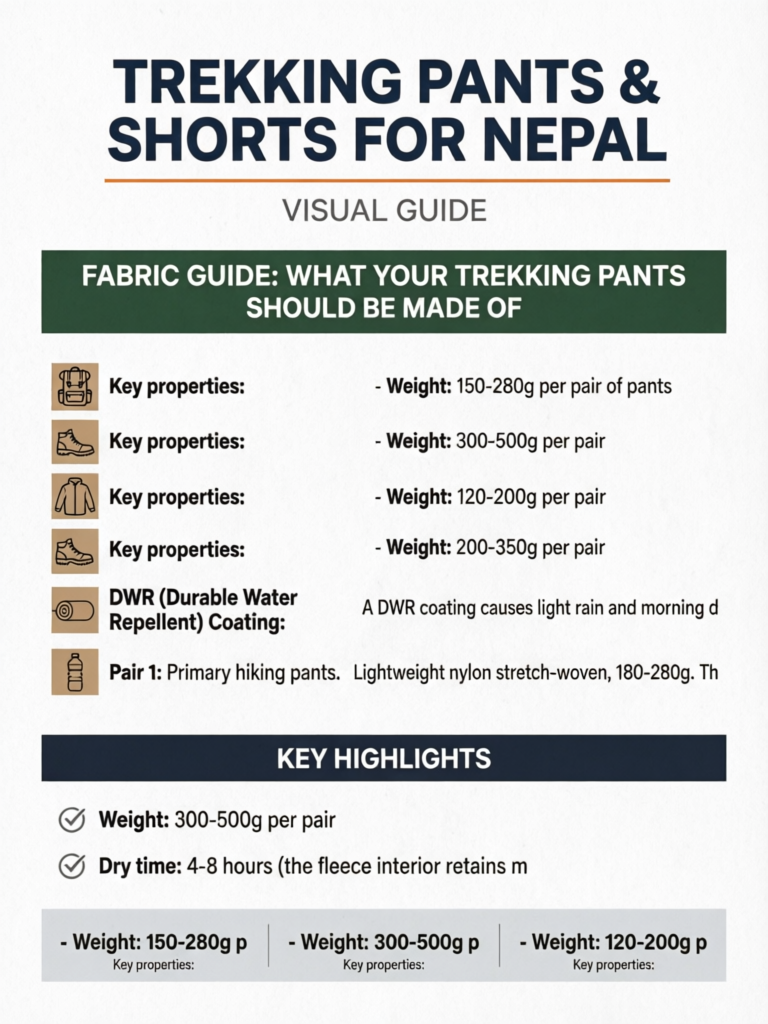
Fabric Guide: What Your Trekking Pants Should Be Made Of
The fabric of your trekking pants determines everything: weight, comfort, durability, weather resistance, and how quickly they dry after crossing a stream or getting caught in rain. Here is every fabric type worth considering, with honest assessments of each.
Nylon Stretch Woven: The Best All-Rounder
The gold standard for Nepal trekking pants. Nylon stretch woven fabric combines a nylon base (for durability and quick drying) with 3-10% elastane or spandex (for freedom of movement). The result is a fabric that moves with your body on steep ascents, resists abrasion from rock contact, dries in 2-3 hours, and weighs remarkably little.
Key properties:
- Weight: 150-280g per pair of pants
- Dry time: 2-4 hours
- Abrasion resistance: Good to excellent
- Wind resistance: Moderate (adequate for most conditions, add wind pants for extreme exposure)
- Stretch: 4-way stretch in premium versions, 2-way in budget versions
- UPF protection: Most quality nylon pants offer UPF 40-50+
- DWR availability: Many have factory DWR coating for light rain protection
Best for: All Nepal trekking. This is the default recommendation for 90% of trekkers.
Softshell Fabric: Warm and Wind-Resistant
Softshell fabric combines a woven face with a brushed fleece interior, creating a pant that blocks wind, retains warmth, and stretches for mobility. Softshell pants are warmer than nylon stretch woven and provide better wind and weather protection.
Key properties:
- Weight: 300-500g per pair
- Dry time: 4-8 hours (the fleece interior retains moisture longer)
- Abrasion resistance: Excellent
- Wind resistance: Very good to excellent
- Stretch: Typically 4-way
- Warmth: Significantly warmer than nylon alone
- DWR: Most have DWR-treated face fabric
Best for: Cold-season trekking (November-February), high-altitude routes above 5,000m, trekkers who run cold, and the Thorong La or Cho La pass days when wind and cold combine. Softshell pants overheat on warm uphill sections below 3,500m, so they are not ideal as a sole pant for routes with significant altitude variation.
Ripstop Nylon: Lightweight and Durable
Standard ripstop nylon without elastane is the lightest option. It is used in ultralight pants designed for fast-and-light trekking. The grid pattern of thicker threads in ripstop fabric prevents small tears from spreading.
Key properties:
- Weight: 120-200g per pair
- Dry time: 1-2 hours (fastest-drying option)
- Abrasion resistance: Moderate (thinner fabric is less resistant)
- Wind resistance: Low to moderate
- Stretch: None (relies on an articulated cut for mobility)
- Warmth: Minimal
Best for: Ultralight trekkers, warm-weather approaches, lower-altitude sections, and as a dedicated wind or rain pant to layer over leggings.
Polyester Blend: Budget Alternative
Polyester-based hiking pants are common in budget and mid-range options. They dry reasonably fast and resist wrinkles, but they retain body odor more aggressively than nylon and tend to feel less premium against the skin.
Key properties:
- Weight: 200-350g per pair
- Dry time: 3-5 hours
- Abrasion resistance: Moderate
- Wind resistance: Low to moderate
- Stretch: Variable (depends on elastane content)
- Odor: Retains odor more than nylon -- requires more frequent washing
Best for: Budget trekkers who want a functional pant without premium pricing. Perfectly adequate for one trek.
Features That Matter (and Features That Do Not)
Features Worth Having
DWR (Durable Water Repellent) Coating: A DWR coating causes light rain and morning dew to bead off the fabric surface rather than soaking in. This is not waterproofing -- sustained rain will eventually penetrate -- but it handles the brief showers and wet brush contact that are routine on Nepal treks. DWR degrades over time but can be reapplied at home with products like Nikwax TX.Direct.
Zippered Pockets: At minimum, two zippered front or thigh pockets for securing your phone, cash, and trekking permit. Open-top pockets are fine for around town but unreliable on trek where you bend, stretch, scramble over rocks, and invert yourself in various ways throughout the day. A zippered back pocket is a bonus for keeping a small item secure.
Articulated Knees: Pre-shaped knee sections that follow the natural bend of your leg during uphill and downhill walking. This reduces fabric bunching behind the knee (which causes chafing on long days) and improves range of motion on steep sections. Articulated knees are a hallmark of trekking-specific pants versus adapted casual pants.
Gusseted Crotch: A diamond-shaped fabric panel at the crotch that distributes stress across four seams instead of one junction point. This prevents the crotch blowout that plagues many pants during the high-stepping required on Himalayan trails. It also improves mobility for large uphill steps.
Belt Loops or Integrated Belt: Your body shape will change during a multi-week trek (most trekkers lose weight). Pants that rely on an elastic waistband alone may become loose. Belt loops with a simple webbing belt, or an integrated drawcord waistband, keep your pants secure as your waist circumference changes.
Ankle Adjustment: A drawcord, snap, or zip at the ankle allows you to cinch the pants tight over your boots to prevent debris from entering, or open them up for ventilation on warm days. This small feature makes a disproportionate difference in comfort.
Features That Are Nice but Not Essential
Thigh vents: Zippered vents on the outer thigh for temperature regulation on warm uphill sections. Helpful on routes with large altitude variation (Annapurna Circuit starts at 800m and climbs to 5,416m) but not critical. Most trekkers simply roll up pants legs.
Reinforced seat and knees: Extra fabric layers at high-wear points. Adds 30-50g of weight but extends the life of the pants significantly. Worth having if you plan to use the pants for multiple treks over years.
UPF rating: UV protection factor. At altitude, UV intensity is significantly higher than at sea level (approximately 10-12% increase per 1,000m of elevation). UPF 50+ pants block over 98% of UV radiation. However, you are also wearing sunscreen on exposed skin and your legs are covered anyway, so UPF is a bonus rather than a requirement.
Features That Do Not Matter
Zip-off leg detachment mechanism (on convertible pants): While the convertible feature itself has value (see below), the specific mechanism -- button, velcro, or zipper -- does not meaningfully affect performance. All modern mechanisms are adequate.
Number of pockets beyond four: Some pants have six or eight pockets. You will use two regularly (phone, cash/permit), one occasionally (snacks), and the rest never. Extra pockets add weight and bulk for no practical benefit.
Color: Wear whatever color you prefer. The notion that you need earth tones for trekking is outdated. Bright colors are actually safer because they make you visible in fog, on snow, and in photographs. Dark colors show dust and salt stains more visibly, which matters only aesthetically.
Convertible Pants vs Dedicated Pants vs Shorts
This is the most debated pants question in trekking forums, and it deserves a thorough, honest answer.
Convertible (Zip-Off) Pants
Convertible pants have legs that detach at the knee (or sometimes mid-thigh) via a zipper, converting from full-length pants to shorts and back again. The appeal is obvious: one garment covers both warm-weather and cool-weather conditions.
The case for convertible pants:
- Single item versatility: warm enough as pants, cool enough as shorts
- Simplifies packing: one pair instead of separate pants plus shorts
- Quick transition when moving between sun-exposed warm sections and shaded cold sections
- Budget-friendly: one good convertible pair costs less than dedicated pants plus shorts
- Works well for routes with large elevation range (Annapurna Circuit: 800m to 5,416m)
The case against convertible pants:
- The zip joint at the knee creates a pressure point that can cause discomfort during long days, especially on steep descents when the knee area is under constant flex
- Zip joints are a failure point: if the zipper breaks at 4,000m, you have shorts with no way to convert back to pants
- The knee area is stiffer and less articulated than dedicated pants due to the zipper mechanism
- Convertible pants are typically heavier than dedicated lightweight pants (30-80g heavier due to the zipper and extra fabric)
- The shorts mode often sits longer and baggier than purpose-built hiking shorts
- Keeping track of detached leg sections (where did they go in my pack?) is a minor but real annoyance
Our verdict: Convertible pants are a solid choice for budget-conscious trekkers and for routes with extreme altitude variation where you genuinely need both shorts and pants throughout the day. However, if budget and pack space allow, two pairs of dedicated lightweight trekking pants outperform one pair of convertibles in comfort, weight, and durability.
Dedicated Trekking Pants
The standard recommendation for Nepal. Two pairs of lightweight nylon stretch-woven pants give you a daily pair and a backup/wash pair. When one pair gets wet from rain or a stream crossing, you switch to the other while the first dries on your pack.
Advantages:
- Best comfort and mobility (no zip joints, optimized articulation)
- Lighter per pair than convertibles
- Better fit and aesthetics
- More durable (fewer moving parts to fail)
- Rotate between pairs for hygiene
Disadvantages:
- Two pairs weigh more than one convertible pair (but less than one convertible pair plus a separate pair of shorts)
- No shorts option for very hot lower sections
Shorts
Standalone hiking shorts are useful for the first few warm days of approach treks (Jiri to Lukla road sections, lower Annapurna Marsyangdi valley) and for rest days in lower-altitude towns. Above 3,000m, shorts are rarely appropriate: UV exposure is intense, trails pass through brush and nettles, and cold wind makes exposed legs uncomfortable.
Our recommendation: Do not bring dedicated shorts unless your route includes significant time below 2,500m. If you want a shorts option, either bring convertible pants or pack a single pair of lightweight running shorts (100g) that double as sleepwear.
Pro Tip
The two-pants system used by most experienced Nepal trekkers: one pair of lightweight nylon stretch-woven pants for daily hiking, and one pair of slightly warmer pants (softshell or heavier nylon) for cold days, pass days, and evenings. The lightweight pair handles 80% of trekking days. The warm pair comes out for Thorong La, Cho La, early-morning summit approaches, and cold tea house evenings. Total weight for both pairs: 400-650g, which is less than a single pair of heavy mountaineering pants.
How Many Pairs to Bring
The answer is two. Not one, not three. Two.
Why Not One?
One pair of pants means no backup if they get soaked in a river crossing, torn on a rock, or simply need washing after four days of continuous wear. On a 14-day trek, wearing the same pants every day without washing results in uncomfortable salt buildup, odor, and potential chafing. With one pair, a washing day means either wearing wet pants or spending hours in your sleeping bag waiting for them to dry.
Why Not Three?
Three pairs of pants means an extra 200-350g of weight that serves no purpose most of the time. Your porter or your pack does not need the burden. In the rare event that both pairs are simultaneously wet (unusual on tea house treks where you sleep under a roof), the third pair provides minimal benefit over simply wringing out the less-wet pair and wearing it.
The Ideal Two-Pair System
Pair 1: Primary hiking pants. Lightweight nylon stretch-woven, 180-280g. This is what you wear 70-80% of trekking days. Choose the most comfortable, best-fitting pair you can find.
Pair 2: Backup and cold-weather pants. Either a second identical pair (for simplicity) or a slightly warmer option like a softshell pant (300-400g) for cold days and evenings. This pair also serves as your clean backup while the primary pair dries after washing.
Total weight: 400-650g for both pairs. Less than 5% of your total pack weight.
Altitude-Specific Recommendations
A Nepal trek can cross three or four climate zones in a single day, and your legwear has a different job in each. This table summarizes what your pants need to do at each altitude band before the detailed recommendations below.
| Climate Zone | Altitude | Conditions | What Your Pants Must Do |
|---|---|---|---|
| Sub-tropical foothills | Below 2,000m | Hot, humid, strong sun, leeches in monsoon | Ventilate, dry fast, block UV |
| Temperate / alpine | 2,000-4,000m | Pleasant days, chilly evenings, strong UV | Resist wind, layer easily, stay durable |
| High alpine | 4,000-5,000m | Freezing mornings, wind, occasional snow | Insulate, block wind, take a base layer |
| Summit zone | Above 5,000m | Below freezing, wind chill, pre-dawn starts | Full wind/cold protection, shell-ready |
Below 2,500m: The Warm Approach
At the start and end of many treks -- the Jiri road approach to EBC, the lower Marsyangdi valley on the Annapurna Circuit, the approach to Langtang -- temperatures range from 15-30 degrees Celsius during the day. Humidity is high in the river valleys. You will sweat heavily on uphill sections.
Best choice: Lightweight nylon stretch-woven pants, preferably with thigh vents or easily rolled-up legs. If your route spends significant time at this altitude, this is where convertible pants earn their keep: shorts mode for the warm valley floors, pants mode when the trail enters forest shade.
Leeches in the Lower Foothills
On lower-altitude sections of Annapurna, Manaslu, and Langtang approaches -- especially during and around monsoon season (June-September) -- leeches lurk in damp grass and forest. This is the one situation where you should keep your legs covered in full-length pants rather than shorts, even on hot days. Tuck pant cuffs into your socks or cinch the ankle drawcord to deny leeches an entry point. Convertible pants in full-length mode plus gaiters are the standard defense; see our gaiters guide.
2,500-4,000m: The Transition Zone
This is where most popular treks spend the majority of their time: Namche Bazaar (3,440m), Manang (3,540m), Tengboche (3,867m). Daytime temperatures range from 5-15 degrees Celsius with sun, dropping to 0-5 degrees Celsius in shade. Mornings start cold, midday is comfortable, evenings are cold.
Best choice: Standard nylon stretch-woven pants. Add thermal base layer leggings underneath for early-morning starts and cold days. The combination of lightweight pants plus a thin merino or synthetic legging underneath handles this entire altitude band comfortably.
4,000-5,000m: The Cold Zone
At Dingboche (4,410m), Lobuche (4,940m), Thorong Phedi (4,450m), and similar high stops, daytime temperatures range from 0-8 degrees Celsius with wind. Mornings are well below freezing. You are often walking in shade on north-facing slopes.
Best choice: Lightweight pants with thermal base layer underneath during hiking. Switch to softshell pants or add wind pants for exposed ridgelines and pass approaches. At tea houses in the evening, softshell pants over a base layer provide comfortable warmth for the 3-4 hours between arrival and bedtime.
Above 5,000m: The Summit Zone
At Gorak Shep (5,164m), EBC (5,364m), Thorong La (5,416m), and any high camp or pass, temperatures range from minus 5 to minus 15 degrees Celsius during the day with wind chill and plummet further at night. You are typically walking pre-dawn in the dark.
Best choice: Thermal base layer plus softshell pants. For pass crossings in wind, add lightweight wind pants as an outer shell. This three-layer system (base layer, softshell, wind pants) handles the most extreme conditions you will encounter on standard tea house treks. If any single layer gets wet or is too warm, you remove it without being left with inadequate coverage.
The Wind Pants Secret
Lightweight nylon wind pants (100-150g, often sold as running wind pants or track warm-up pants) are one of the most useful items experienced trekkers carry. They weigh almost nothing, pack to the size of a fist, and provide dramatic wind protection when pulled over your hiking pants on exposed passes and ridgelines. The difference between lightweight pants alone and lightweight pants plus wind pants in a 40 km/h wind at 5,000m is staggering. Budget $15-25 for a pair and you will wonder how you ever trekked without them.
Trekking Pants Recommendations by Budget
Budget: $25-60
Decathlon Forclaz Trek 100 ($30-40) The best value trekking pant available. Lightweight nylon with moderate stretch, DWR coating, articulated knees, zippered pockets, and a gusseted crotch. Weight around 260g. Available at the Decathlon store on New Road in Kathmandu or purchased online before your trip. If you are buying one pair of pants for Nepal and budget matters, this is the answer.
Columbia Silver Ridge Convertible ($45-55) The most popular convertible trekking pant worldwide. Nylon ripstop with UPF 50, zippered pockets, partial elastic waistband. Weighs approximately 340g. Not the lightest or most stretchy, but reliable, widely available, and proven on thousands of treks globally. The convertible option makes it versatile for routes with large altitude variation.
Kathmandu-purchased pants ($15-30) Basic trekking pants are available in Thamel for $15-30. Quality is inconsistent. Test the stretch, check the seams, and verify the zipper quality before buying. These work for a single trek but may not survive repeated use. Avoid anything labeled as "trekking pants" that feels like cotton -- some Thamel shops sell cotton-polyester blends marketed as trekking gear.
Mid-Range: $60-120
prAna Stretch Zion / Brion ($70-85) A cult favorite among long-distance hikers. The Stretch Zion uses a nylon-spandex blend with exceptional 4-way stretch, DWR coating, and a comfortable fit that works for both hiking and casual wear. Weight around 310g. The stretch is noticeably superior to budget options, making it excellent for the high-stepping required on rocky Himalayan trails. The Brion is the slimmer-fit version of the same fabric.
Fjallraven Abisko Trekking Tights ($90-110) A hybrid between trekking pants and leggings, using Fjallraven's G-1000 Lite fabric (65% polyester, 35% cotton -- an exception to the "no cotton" rule because the blend is designed for durability and can be waxed for water resistance). Slim-fitting with excellent articulation. Weighs approximately 290g. Popular with trekkers who find traditional hiking pants too baggy. Not the fastest drying due to the cotton content, but extremely durable.
Arc'teryx Gamma LT Pant ($100-120) A lightweight softshell pant that bridges the gap between warm-weather hiking pants and cold-weather technical pants. The Fortius DW 2.0 fabric provides stretch, wind resistance, and DWR in a single layer. Weight approximately 350g. Expensive for a single pair of pants, but the versatility across a wide temperature range (5 degrees Celsius to minus 10 degrees Celsius with a base layer) makes it one of the best single-pant choices for Nepal trekking.
Premium: $120-200
Arc'teryx Sigma FL Pant ($140-160) The premium all-rounder. Lightweight softshell with 4-way stretch, articulated patterning, and wind/water resistance. Weight approximately 310g. Designed specifically for alpine trekking and mountaineering approaches. The fit is athletic without being restrictive, and the fabric breathes better than most softshell pants during uphill exertion. If you want one pair of pants that handles everything from valley floors to high passes, this is the top choice.
Outdoor Research Ferrosi Pant ($80-100) Often considered the best value in premium trekking pants. Nylon-spandex blend with wind resistance, DWR coating, and a comfortable "climbing pant" fit. Weight approximately 290g. The Ferrosi fabric has a loyal following among hikers, climbers, and trekkers for its blend of stretch, protection, and breathability. Frequently on sale for $60-80, making it a mid-range price for premium performance.
Rab Torque Pants ($120-150) Purpose-built mountain pants with Matrix stretch fabric, reinforced seat and knees, and articulated construction. Weight approximately 390g. Warmer and more robust than the options above, making them ideal as the "cold day" pant in a two-pant system. Excellent for pass days and high-altitude sections.
Pant Sizing and Fit for Trekking
Getting the Right Fit
Trekking pants need to fit differently than casual pants. Key considerations:
Waist: Should sit comfortably at your natural waist or slightly below. Allow for weight loss during the trek -- most trekkers lose 2-5 kg on a 14-day trek. An integrated belt or drawcord waistband accommodates this change.
Thighs: Roomy enough to allow unrestricted high-stepping (lifting your knee to chest height, as required on steep rock steps). If the fabric pulls tight across your thighs during this motion, the pants are too slim for trekking.
Knees: Must bend freely without the fabric bunching or pulling. Test by doing a deep squat. If the knee area resists, the pants will be uncomfortable on descents where your knees are constantly flexed.
Hem length: Should reach your ankle bone without pooling on the ground. Too-long pants catch under boot soles and fray rapidly. Too-short pants expose your ankles to sun, cold, and abrasion.
Base layer compatibility: Try the pants on over the base layer legging you plan to wear at altitude. The combination should not feel restrictive at the knee or thigh. If it does, size up one size.
Pro Tip
Try on trekking pants while wearing your trekking boots. The ankle interaction between pants and boots matters more than you might expect. Pants with a narrow ankle that does not fit over your boot shaft will ride up and expose your shin to cold and brush. Pants with a snap or drawcord ankle that adjusts to fit snugly over your boot are ideal. This small detail prevents debris entry, improves insulation, and looks better in your summit photos.
Caring for Trekking Pants on Trek
Washing on the Trail
Nylon trekking pants are among the easiest items to wash on trek. They dry quickly and require minimal special care.
Method: Hand-wash in a basin with cool or warm water and a small amount of biodegradable soap. Focus on the waistband, inner thighs, and seat -- the areas with the most sweat and body oil buildup. Rinse thoroughly. Wring firmly (nylon handles wringing well, unlike down or merino). Hang on the outside of your pack to dry during the next day's hike or on a tea house clothesline.
Frequency: Every 3-5 days for the pants you wear daily. Less frequently for your backup pair.
Drying time by material:
- Ripstop nylon: 1-2 hours in dry mountain air
- Nylon stretch woven: 2-3 hours
- Softshell: 4-8 hours (plan for a full sunny afternoon)
Maintaining DWR Coating
The DWR (Durable Water Repellent) coating on your pants degrades with washing and physical abrasion. After a few washes on trek, you may notice that water no longer beads on the fabric surface and instead soaks in. This is normal. For a single trek, the factory DWR coating is usually sufficient. For multi-trek use, reapply DWR at home using a product like Nikwax TX.Direct Wash-In.
Pro Tip
Pack your trekking pants at the very top of your duffel bag or in an easily accessible stuff sack. On multi-day treks, you will change pants at tea houses in the evening, switch to dry pants after stream crossings, and occasionally need to swap to warmer pants for pass day before dawn. Having quick access without unpacking your entire duffel saves time and frustration, especially in shared tea house rooms where space is tight.
What to Wear Trekking: The Complete Leg System
Your trekking pants do not work in isolation. They are part of a layering system that adapts to the temperature range you encounter. Here is the complete leg system for Nepal trekking:
Layer 1: Base Layer (Optional, Altitude-Dependent)
Below 3,500m: Not needed. Trekking pants alone are sufficient. 3,500-4,500m: Thin synthetic or merino leggings for morning starts and cold days. Remove once you warm up on the trail. Above 4,500m: Medium-weight thermal leggings worn under pants for most of the day. Essential for pre-dawn pass crossings and cold-weather days.
See our thermal underwear guide for base layer recommendations.
Layer 2: Trekking Pants (Always)
Your primary trekking pants, worn every day. The fabric weight should match your expected conditions: lightweight nylon for warm weather, softshell for cold days.
Layer 3: Wind Pants or Hardshell Rain Pants (Situational)
Wind pants: Ultralight nylon shell (100-150g) for exposed passes and ridgelines in strong wind. Worn over trekking pants for 30-60 minutes during exposed sections, then removed. Hardshell rain pants: Fully waterproof, windproof shell (200-350g) for sustained rain or snow. This is your emergency layer -- it stays packed until conditions demand it, then pulls on over your hiking pants and boots. See our rain gear guide for recommendations.
Why a Hardshell Pant Belongs in Your Pack Even in Dry Season
Even in peak autumn (October-November) and spring (March-May), an unexpected afternoon thunderstorm or snowfall above 4,000m is common, and getting your legs soaked at altitude is a real hypothermia risk. A lightweight waterproof hardshell pant is cheap insurance: it weighs little, packs to the size of a fist, and protects your inner pants from tearing on thorns or sharp rock.
What to look for in a hardshell pant for Nepal:
- Full-length or three-quarter side zips so you can pull them on over trekking boots without removing footwear -- critical when a storm hits on a pass.
- A waterproof-breathable membrane (Gore-Tex or equivalent) so you do not sweat out underneath; pit-style or side-zip venting helps.
- A trim packed size -- it should disappear into your daypack, not your duffel, because you need it on your back, not with the porter.
The trade-off is breathability: hardshell pants trap sweat during hard climbing, so they are not all-day wear. Treat them strictly as a deploy-when-needed shell, not a substitute for your softshell or nylon hiking pants.
The Complete Leg Kit Weight
| Item | Weight | When Used |
|---|---|---|
| Trekking pants (primary) | 200-280g | Every day |
| Trekking pants (backup/warm) | 200-400g | Alternate days, cold days |
| Base layer leggings | 120-180g | Above 3,500m mornings, cold days |
| Wind pants | 100-150g | Exposed passes and ridgelines |
| Total | 620-1,010g |
This four-item leg system weighs approximately 700-800g for most trekkers and handles every temperature and weather condition from warm valley floors to freezing high passes.
What to Buy at Home vs Buy in Kathmandu
Buy Before You Leave
Quality trekking pants from reputable brands (prAna, Arc'teryx, Outdoor Research, Rab, Fjallraven). These are your most-worn items and deserve proper fit and quality. Kathmandu shops carry limited sizing, especially for larger or taller trekkers.
Softshell pants if your route includes winter trekking or extended time above 5,000m. Technical softshell fabrics are not available in Kathmandu.
Wind pants. Ultralight nylon wind pants are uncommon in Nepal. Buy at home or go without.
Available in Kathmandu
Basic trekking pants: Adequate quality pants are available in Thamel for $15-30. They work for a single trek and are a reasonable backup pair if your primary pants are damaged. Inspect fabric, stretch, and stitching before buying.
Convertible pants: Available in Thamel for $15-25. Quality is lower than Columbia or similar brands but functional.
Thermal base layer leggings: Available in Thamel for $10-20. Quality varies. Synthetic options are generally better than the "merino" options, which are often blended with significant polyester content.
Counterfeit Branded Pants in Thamel
Thamel shops sell pants labeled as North Face, Columbia, Mammut, and other premium brands at suspiciously low prices ($20-40). These are counterfeits. The fabric quality, stitching, and DWR coating of counterfeit pants are significantly inferior to genuine versions. A pair of honest locally-made unbranded pants for $15 is a better investment than a $30 fake-branded pair that falls apart mid-trek. If you want genuine branded gear, buy before arriving in Nepal.
Frequently Asked Questions
How many pairs of trekking pants should I bring to Nepal?
Two pairs is the standard recommendation for tea house treks of any length. One primary pair for daily hiking and one backup/rotation pair for washing days, cold days, or if the primary pair gets soaked. More than two pairs is unnecessary weight. One pair is risky because you have no backup if they are damaged or wet.
Are convertible pants good for Nepal trekking?
They are a viable budget option, especially for routes with large altitude variation like the Annapurna Circuit. The ability to convert to shorts for the hot lower valley days is genuinely useful. However, dedicated trekking pants provide better comfort at the knee (no zip joint), lighter weight, and superior articulation. If you can afford two pairs of dedicated pants, they outperform a single convertible pair.
Can I trek in yoga pants or leggings?
As a base layer under trekking pants, yes -- they are excellent. As a standalone outer layer, no. Leggings provide inadequate wind protection, abrasion resistance, and pocket utility for Nepal trekking. The one exception is lightweight treks below 3,000m in warm weather where conditions are closer to gym exercise than alpine trekking.
What color trekking pants are best for Nepal?
Any color works. Lighter colors show dust less and reflect more UV, which is marginally cooler in direct sun. Darker colors hide stains and look cleaner longer. Bright colors improve visibility in fog, snow, and for group identification. Choose based on personal preference, not function.
Should I bring rain pants for Nepal trekking?
For peak autumn season (October-November), a dedicated pair of rain pants is optional. Brief showers are possible but sustained rain is uncommon. Pants with DWR coating handle light moisture. For spring trekking (March-May) and any trek that overlaps with monsoon season (June-September), lightweight rain pants are recommended. See our rain gear guide.
Do I need insulated pants for EBC?
No, not for standard tea house trekking in peak season. Lightweight nylon pants with a thermal base layer underneath handle the coldest hiking conditions on the EBC route (minus 5 to minus 10 degrees Celsius during pre-dawn walks). Insulated or expedition pants are only necessary for winter EBC attempts (December-February) or peak climbing above 5,500m.
What is the best material for trekking pants in Nepal?
Nylon stretch woven fabric with 3-10% elastane or spandex is the best all-around material. It combines quick drying (2-3 hours), good abrasion resistance, freedom of movement, and lightweight comfort. Most quality trekking pants from reputable brands use this fabric type.
Can I buy trekking pants in Kathmandu?
Yes, basic trekking pants are available in the Thamel district for $15-30. Quality is functional but inconsistent. They serve well as a single-trek backup pair. For your primary pair, buy before arriving in Nepal where you can try multiple brands, sizes, and fits in a proper store.
Are jeans okay for trekking in Nepal?
No. Cotton jeans absorb sweat and rain, take many hours to dry, chafe on long days, restrict mobility on steep terrain, and become dangerously cold when wet at altitude. Leave jeans in Kathmandu.
Do trekking pants need a belt?
A belt or built-in drawcord waistband is recommended. Most trekkers lose 2-5 kg during a 14-day trek due to caloric deficit and physical exertion. Pants that fit at the start may be loose by day 10. An adjustable waistband keeps them secure without needing to carry a heavy leather belt.
How do I dry trekking pants quickly on trek?
After washing, wring the pants firmly to remove as much water as possible. Then attach them to the outside of your backpack using carabiners, bungee cords, or simply threading them through the pack's compression straps. As you hike, the moving air and high-altitude sun dry nylon pants in 2-3 hours. Position them where they get maximum airflow and sun exposure. Avoid attaching them where they will snag on branches or rocks.
What is the difference between trekking pants and hiking pants?
In practice, they are the same thing with different marketing labels. Any pant designed for outdoor walking with features like quick-dry fabric, articulated knees, zippered pockets, and a gusseted crotch qualifies for Nepal trekking. Do not overthink the labeling.
Can I wear shorts trekking in Nepal?
Yes, but only on the warm lower sections below about 2,500m, and never in leech-prone forest during or near monsoon season. Above 3,000m, shorts are rarely appropriate: UV exposure is intense, trails pass through brush and nettles, and cold wind makes bare legs uncomfortable. Convertible (zip-off) pants give you a shorts option without packing a separate garment, which is why most Nepal trekkers skip dedicated shorts altogether.
Do I need waterproof or hardshell pants for Nepal trekking?
Carry a lightweight waterproof hardshell pant on any trek that goes above 4,000m, even in dry season. Brief afternoon storms and surprise snowfall on high passes are common in October-November and March-May, and wet legs at altitude are a hypothermia risk. Choose a packable shell with side zips so you can pull it over your boots quickly. For spring treks and anything overlapping monsoon (June-September), it moves from optional to essential.
Should I wear softshell or zip-off pants for Nepal?
Use both. Convertible (zip-off) pants are best for the warm, low-altitude first few days, where you can switch to shorts. Switch to softshell pants above roughly 3,500m, where their wind resistance and warmth outperform thin nylon on cold, exposed passes like Thorong La and Cho La. Many experienced trekkers carry one of each rather than choosing.
What pants should I wear in Kathmandu before and after the trek?
Long, lightweight trousers are the most practical choice year-round in Kathmandu -- comfortable in warm daytime temperatures and appropriate for temples and restaurants. From late December through February, evenings are cold enough to want a warm layer. Your trekking pants work fine in the city, so there is no need to pack separate casual trousers.
Final Recommendation
For the vast majority of Nepal trekkers, here is the ideal pants setup:
Primary pair: Outdoor Research Ferrosi Pant ($80-100, 290g) or Decathlon Forclaz Trek 100 ($30-40, 260g) for budget-conscious trekkers. Lightweight, stretchy, DWR-coated, and comfortable for all-day wear.
Backup pair: A second identical pair of your primary pants, or a softshell pant like the Rab Torque ($120-150, 390g) if your trek includes winter conditions or extended time above 5,000m.
Base layer: Thin synthetic or merino leggings for mornings and cold days above 3,500m. See what to wear trekking in Nepal for the complete clothing system.
Total leg system weight: 600-850g. Total cost: $60-250 depending on brand choices. This system handles every condition from warm valley floors to the summit of Thorong La in October wind.
For the bigger picture, slot your pants and shorts into the full Nepal trekking packing list and check the complete trekking gear list before you book. If you would rather travel light, you can rent gear in Kathmandu for one trek instead of buying. Once your kit is sorted, a verified local agency can handle permits, tea houses, and logistics so you can focus on the trail.