
Cash Is King on Every Nepal Trek
There are zero ATMs on any trekking trail in Nepal. No tea house accepts credit cards. No lodge has a card machine. Once you leave the last town with an ATM, every payment for the next 7-21 days—accommodation, food, hot showers, WiFi, phone charging, snacks, porter tips, and emergencies—comes from the physical cash in your money belt. Running out of money mid-trek is one of the most stressful and preventable problems trekkers face.
Money management might seem like a mundane topic compared to altitude preparation and gear selection, but getting it wrong can derail your entire trek. Every season, trekkers arrive at Namche Bazaar with insufficient Nepali Rupees, discover their international bank card doesn't work in Nepali ATMs, or find themselves unable to tip their guide and porter on the final day because they didn't plan cash requirements carefully enough.
The core challenge is straightforward: Nepal's trekking regions are cash-only economies. There is no digital payment infrastructure, no card machines, and no ATMs once you leave the gateway towns. Your financial planning must account for every possible expense over the entire trek duration, plus a safety margin for emergencies, unexpected rest days, or price increases at higher altitudes.
This guide provides everything you need to manage money effectively on your Nepal trek. We cover exact ATM locations before each major route, optimal cash amounts by trek type and duration, currency exchange strategies, international card compatibility, money security, tipping protocols, and how modern fintech solutions like Wise and Revolut can save you significant fees.
Table of Contents
- Quick Money Facts
- Understanding Nepali Currency
- Currency Exchange: Where and How
- Last ATM Locations Before Major Treks
- How Much Cash to Carry by Trek
- ATM Withdrawal Limits and Fees
- International Cards: What Works in Nepal
- Wise, Revolut & Fintech Cards
- Credit Card Acceptance
- Money Security on the Trail
- Daily Expenses Breakdown by Altitude
- Paying for Extras: WiFi, Charging, Showers
- Tipping Guide: Who, When, How Much
- Emergency Money Options
- Bargaining and Price Expectations
- Frequently Asked Questions
Quick Money Facts
Nepali Rupee (NPR/Rs/₨)
~NPR 135-140 per 1 USD
Zero (none exist)
Not accepted anywhere
NPR 70,000-100,000 ($500-750)
NPR 50,000-70,000 ($370-520)
NPR 35,000-50,000 ($250-370)
NPR 500 ($3.70) + your bank's fee
Thamel money changers (Kathmandu)
NPR 2,000-3,000/day ($15-22)
Understanding Nepali Currency
Denominations You'll Use
The Nepali Rupee (NPR) comes in both banknotes and coins, though coins are rarely used in trekking regions:
Banknotes:
- NPR 1,000: The highest denomination. Essential for large payments (permits, guide wages, hotel bills). Carry a significant portion of your cash in 1,000s for easy counting and compact storage.
- NPR 500: The workhorse denomination for daily trekking expenses. Most individual meals, room charges, and small purchases fall in the NPR 300-800 range, making 500s highly useful.
- NPR 100: Important for small purchases, tips to porters, and payments where change might be difficult. Carry 20-30 of these.
- NPR 50: Useful for small tips, snacks, bottled water, and change situations.
- NPR 20 and NPR 10: Less commonly used on trek, but handy for small snacks and occasional tips.
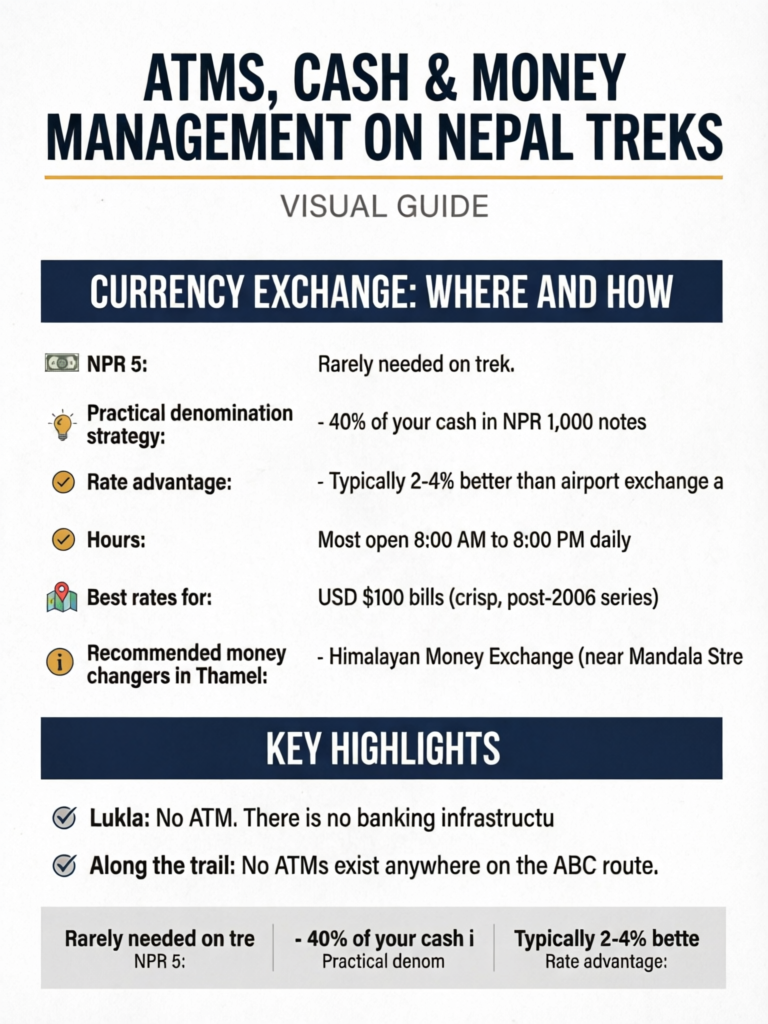
- NPR 5: Rarely needed on trek.
Practical denomination strategy:
- 40% of your cash in NPR 1,000 notes
- 30% in NPR 500 notes
- 20% in NPR 100 notes
- 10% in NPR 50 and smaller notes
Pro Tip
When withdrawing from ATMs or exchanging currency, specifically request a mix of denominations. ATMs typically dispense NPR 1,000 notes exclusively, which creates change problems at small tea houses above 3,500m. After an ATM withdrawal, visit a bank counter or larger shop to break some 1,000s into 500s and 100s. Tea house owners at higher altitudes frequently struggle to make change for large notes.
Damaged Notes
Nepali merchants and tea house owners often refuse damaged, torn, or heavily worn banknotes. This applies to Nepali Rupees and is especially strict with US Dollars used for exchange:
- Nepali Rupees: Notes with small tears along edges may be refused above 3,000m. Check your notes when withdrawing and exchange any damaged ones at a bank.
- US Dollars for exchange: Money changers in Kathmandu are extremely particular about USD condition. Bills must be post-2006 series, without tears, writing, stamps, or significant wear. Bring crisp, new $100 bills for the best exchange rates.
Currency Exchange: Where and How
Kathmandu: Best Exchange Options
Thamel Money Changers (Recommended)
The narrow streets of Thamel contain dozens of licensed money changers offering competitive rates. This is where you'll get the best exchange rates for most currencies:
- Rate advantage: Typically 2-4% better than airport exchange and 3-5% better than hotel exchange
- Hours: Most open 8:00 AM to 8:00 PM daily
- Currencies accepted: USD, EUR, GBP, AUD, CAD, JPY, CHF, and most major currencies
- Best rates for: USD $100 bills (crisp, post-2006 series)
- Process: Show passport, negotiate rate (rates are slightly negotiable for large amounts above $500), count money carefully before leaving
Recommended money changers in Thamel:
- Himalayan Money Exchange (near Mandala Street)
- Thamel Money Exchange (main Thamel street)
- Everest Money Changer (near Kathmandu Guest House)
Airport Exchange (Avoid if Possible)
Tribhuvan International Airport has exchange counters in both the international arrivals hall and the departure area:
- Rates are 3-5% worse than Thamel
- Useful only for exchanging a small amount ($50-$100) for immediate taxi and hotel needs
- Available 24 hours to match flight arrivals
- Strategy: Exchange only enough for airport-to-hotel transport (NPR 1,000-2,000) and exchange the bulk of your money in Thamel the next day
Hotel Exchange (Emergency Only)
Most tourist hotels in Thamel and Lakeside (Pokhara) offer currency exchange:
- Rates are the worst option: 5-8% below market rate
- Convenient but costly
- Use only for small emergency amounts
Bank Exchange
Nepali banks (Nabil Bank, Himalayan Bank, Standard Chartered) offer exchange services:
- Rates are between Thamel money changers and airport rates
- Require passport and may require forms
- Slower process (15-30 minutes)
- More reliable for large amounts (above $2,000)
- Hours: Sunday-Friday, 10:00 AM-3:00 PM (banks are closed Saturday)
Pokhara Exchange
For Annapurna region treks departing from Pokhara:
- Lakeside money changers: Good rates, similar to Thamel. Multiple options along Lakeside Road.
- Pokhara banks: Same options as Kathmandu but potentially slightly lower rates.
- Recommendation: Exchange in Kathmandu if passing through, or use Pokhara Lakeside money changers. Don't wait until the trek starting point—options diminish dramatically.
Indian Rupee Connection
Nepal and India share a fixed exchange rate: 1 Indian Rupee = 1.6 Nepali Rupees. Indian Rupees (up to INR 500 notes—larger denominations are not accepted) are widely accepted in Kathmandu and border towns, though not on trekking trails. If you're coming from India, you can use Indian Rupees in Kathmandu for daily expenses, but carry Nepali Rupees for the trek.
Last ATM Locations Before Major Treks
This is the most critical information in this guide. Once you pass these ATM locations, there is no way to access additional cash until you return.
Everest Base Camp Trek
Last Reliable ATMs: Kathmandu
- Kathmandu (Thamel area): Multiple ATMs from Nabil Bank, Himalayan Bank, NIC Asia Bank, Standard Chartered. These are the last fully reliable ATMs.
- Lukla: No ATM. There is no banking infrastructure in Lukla.
- Namche Bazaar: There is a small bank branch and ATM operated by Himalayan Bank. However, this ATM is frequently offline, out of cash, or experiencing connectivity issues. Do NOT count on it. Treat Kathmandu as your last reliable ATM.
- Beyond Namche: No ATMs exist anywhere between Namche Bazaar and Everest Base Camp.
Cash requirement: Plan to carry all cash for the entire EBC trek (12-16 days) from Kathmandu.
Annapurna Base Camp Trek
Last Reliable ATMs: Pokhara
- Pokhara (Lakeside): Multiple reliable ATMs from major banks. Nabil Bank and Himalayan Bank ATMs near Lakeside Road accept international cards consistently.
- Nayapul/Birethanti: No ATMs. The trek starting point has no banking infrastructure.
- Along the trail: No ATMs exist anywhere on the ABC route.
Cash requirement: Carry all cash from Pokhara for the entire ABC trek (7-12 days).
Annapurna Circuit
Last Reliable ATMs: Pokhara or Besisahar
- Pokhara: Multiple reliable ATMs (recommended—withdraw here).
- Besisahar: Small town ATMs exist but may be unreliable. If starting from Besisahar, withdraw in Pokhara as backup.
- Chame: One ATM reported but extremely unreliable—do not depend on it.
- Jomsom: Small bank branch, ATM reported but often non-functional.
- Along the high circuit: No ATMs between Besisahar and Jomsom.
Cash requirement: Carry all cash from Pokhara for the entire circuit (12-21 days). This is one of the longest treks, requiring the most cash.
Manaslu Circuit
Last Reliable ATMs: Kathmandu
- Kathmandu: Last reliable ATMs.
- Arughat/Soti Khola: No ATMs exist at the trek starting points.
- Along the entire circuit: Zero ATMs.
Cash requirement: Carry all cash from Kathmandu for the entire circuit (14-18 days), plus guide/porter wages if paying directly.
Langtang Valley Trek
Last Reliable ATMs: Kathmandu
- Kathmandu: Last reliable ATMs.
- Syabrubesi: No ATMs at the trek starting point.
- Along the valley: No ATMs.
Cash requirement: Carry all cash from Kathmandu for the entire trek (7-12 days).
Pro Tip
Always withdraw cash from two different ATMs using two different cards if possible. ATM malfunctions, card blocks, and connectivity issues are common in Nepal. Having backup cash from a separate withdrawal reduces the risk of starting your trek short on funds. Make your last ATM withdrawal the day before your trek begins, not weeks in advance when you might spend it in Kathmandu.
How Much Cash to Carry by Trek
These amounts cover on-trail expenses only (accommodation, food, extras, tips). Permits, flights, and guide/porter wages paid to agencies are assumed to be pre-paid.
Everest Base Camp (14 days on trail)
| Budget Level | Daily Budget | Total Cash Needed |
|---|---|---|
| Budget | NPR 4,000-5,000 ($30-37) | NPR 60,000-75,000 ($440-550) |
| Mid-Range | NPR 5,500-7,500 ($40-55) | NPR 80,000-110,000 ($590-810) |
| Comfortable | NPR 8,000-12,000 ($60-90) | NPR 115,000-170,000 ($850-1,260) |
Add for tips: NPR 15,000-40,000 ($110-300) for guide and porter tips.
Annapurna Base Camp (10 days on trail)
| Budget Level | Daily Budget | Total Cash Needed |
|---|---|---|
| Budget | NPR 3,500-4,500 ($26-33) | NPR 35,000-45,000 ($260-330) |
| Mid-Range | NPR 5,000-7,000 ($37-52) | NPR 50,000-70,000 ($370-520) |
| Comfortable | NPR 7,500-10,000 ($55-74) | NPR 75,000-100,000 ($550-740) |
Add for tips: NPR 12,000-30,000 ($90-220) for guide and porter tips.
Annapurna Circuit (18 days on trail)
| Budget Level | Daily Budget | Total Cash Needed |
|---|---|---|
| Budget | NPR 4,000-5,500 ($30-40) | NPR 72,000-100,000 ($530-740) |
| Mid-Range | NPR 6,000-8,000 ($44-60) | NPR 110,000-145,000 ($810-1,070) |
| Comfortable | NPR 8,500-12,000 ($63-90) | NPR 155,000-220,000 ($1,150-1,630) |
Add for tips: NPR 18,000-45,000 ($130-330) for guide and porter tips.
Manaslu Circuit (16 days on trail)
| Budget Level | Daily Budget | Total Cash Needed |
|---|---|---|
| Budget | NPR 4,500-6,000 ($33-44) | NPR 72,000-96,000 ($530-710) |
| Mid-Range | NPR 6,500-8,500 ($48-63) | NPR 104,000-136,000 ($770-1,010) |
| Comfortable | NPR 9,000-12,000 ($67-90) | NPR 144,000-192,000 ($1,070-1,420) |
Add for tips: NPR 16,000-40,000 ($120-300) for guide and porter tips.
Langtang Valley (8 days on trail)
| Budget Level | Daily Budget | Total Cash Needed |
|---|---|---|
| Budget | NPR 3,500-4,500 ($26-33) | NPR 28,000-36,000 ($210-265) |
| Mid-Range | NPR 5,000-7,000 ($37-52) | NPR 40,000-56,000 ($300-415) |
| Comfortable | NPR 7,000-10,000 ($52-74) | NPR 56,000-80,000 ($415-590) |
Add for tips: NPR 10,000-25,000 ($74-185) for guide and porter tips.
Always Add a 20% Safety Margin
The amounts above are estimates based on typical spending. Add 20% to your calculated amount for: unexpected rest days due to weather or illness, price increases at higher altitudes, emergency expenses, lost or stolen money, unplanned helicopter evacuation deposit (some situations require upfront payment), and simply wanting to enjoy treats and extras without financial stress. It's far better to return with leftover Nepali Rupees than to ration your spending at 5,000m.
ATM Withdrawal Limits and Fees
Nepali ATM Withdrawal Limits
Most Nepali ATMs impose per-transaction and daily withdrawal limits:
| Bank | Per Transaction | Daily Limit | International Card Fee |
|---|---|---|---|
| Nabil Bank | NPR 35,000 ($260) | NPR 100,000 ($740) | NPR 500 ($3.70) |
| Himalayan Bank | NPR 35,000 ($260) | NPR 100,000 ($740) | NPR 500 ($3.70) |
| Standard Chartered | NPR 50,000 ($370) | NPR 100,000 ($740) | NPR 500 ($3.70) |
| NIC Asia Bank | NPR 35,000 ($260) | NPR 100,000 ($740) | NPR 400 ($3.00) |
| Global IME Bank | NPR 35,000 ($260) | NPR 100,000 ($740) | NPR 500 ($3.70) |
Key points:
- To withdraw NPR 100,000 ($740), you'll need 2-3 separate ATM transactions
- Each transaction incurs the Nepal bank's fee (NPR 400-500) PLUS your home bank's foreign ATM fee
- Some ATMs limit you to NPR 25,000 per transaction despite official limits
- Standard Chartered ATMs generally allow the highest per-transaction amounts
Your Bank's Foreign ATM Fees
In addition to the Nepali bank's fee, your home bank charges:
- Traditional banks (Chase, BOA, HSBC): $3-5 per transaction + 2.5-3% foreign exchange markup
- Wise (TransferWise): No ATM fee up to $100-$250/month (depending on plan), then 1.75% fee. No foreign exchange markup.
- Revolut: No ATM fee up to $200-$400/month (depending on plan), then 2% fee. No foreign exchange markup on weekdays.
- Charles Schwab: No ATM fees worldwide, no foreign exchange markup. All ATM fees refunded monthly.
- Credit unions: Varies widely. Check before travel.
Minimizing ATM Fees
Strategy 1: Maximum withdrawal per visit Withdraw the maximum amount allowed per transaction (NPR 35,000-50,000) to minimize the number of fee-generating transactions. Three withdrawals of NPR 35,000 cost NPR 1,500 in Nepali bank fees; withdrawing smaller amounts more frequently costs more.
Strategy 2: Use fee-free cards Charles Schwab's debit card refunds all ATM fees worldwide, making it the best pure ATM card for international travel. Open an account before your trip (available to US residents).
Strategy 3: Exchange cash as supplement Bring USD $100 bills from home and exchange at Thamel money changers. This avoids ATM fees entirely and typically provides better exchange rates. Combine ATM withdrawals with cash exchange for the optimal approach.
International Cards: What Works in Nepal
Debit Cards
| Card Network | ATM Compatibility | Notes |
|---|---|---|
| Visa | Widely accepted | Works at most bank ATMs |
| Mastercard | Widely accepted | Works at most bank ATMs |
| Maestro | Limited | Fewer compatible ATMs |
| UnionPay | Growing | Works at Nabil Bank, some others |
| JCB | Very Limited | Few compatible ATMs |
Common ATM Problems and Solutions
Card Rejected:
- Notify your bank of Nepal travel before departure (most important step)
- Try a different ATM or bank
- Some ATMs reject cards randomly—try the same ATM again
- Ensure your PIN is 4 digits (6-digit PINs sometimes fail)
ATM Out of Cash:
- Common during peak trekking season (October-November)
- Try nearby ATMs from different banks
- Visit during morning hours when ATMs are most likely to be restocked
- Have a backup card from a different bank/network
Transaction Declined but Money Deducted:
- Known issue with Nepali ATMs—the machine errors but your account is charged
- Keep all ATM receipts
- Contact your bank immediately via phone or app
- Most banks reverse these "phantom charges" within 3-5 business days
- This is why carrying cash from home as backup is important
Pro Tip
Before leaving home, call your bank and set the highest possible daily ATM withdrawal limit for your trip dates. Also ensure your card's daily spending limit is adequate. Some banks set default international ATM limits as low as $200/day, which requires multiple days of withdrawals to accumulate enough cash for a 2-week trek. Request a temporary increase to $500-$1,000/day for your travel dates.
Wise, Revolut and Fintech Cards
Modern fintech cards offer significant advantages over traditional bank cards for Nepal travel. Here's how they compare:
Wise (formerly TransferWise)
Advantages for Nepal:
- Mid-market exchange rate: Wise uses the real exchange rate (Google rate) without markup. Traditional banks add 2-3% on top. On NPR 100,000 ($740), this saves approximately $15-22.
- Free ATM withdrawals: Up to $100-250/month (depending on plan) with no fees. Beyond the free limit, 1.75% fee applies.
- Multi-currency account: Hold and convert between 50+ currencies. Convert USD to NPR at the best available rate before withdrawing.
- Transparent fees: All fees are shown upfront before confirming transactions.
- Instant card freeze: If your card is lost or stolen, freeze it immediately via the app (when you have internet access).
Limitations:
- Free ATM limit is relatively low for trek cash needs
- Requires internet connection for app features (won't matter on trail, but useful in Kathmandu)
- Not available in all countries
Revolut
Advantages for Nepal:
- No exchange rate markup on weekday conversions (1% markup on weekends)
- Free ATM withdrawals: Up to $200-400/month depending on plan
- Disposable virtual cards: Create temporary card numbers for online transactions
- Spending analytics: Track your Nepal spending automatically
- Metal plan: Higher ATM limits ($800/month free) and travel insurance included
Limitations:
- Weekend exchange rate markup (1%) penalizes weekend withdrawals
- Customer support can be slow for urgent issues
- Some Nepali ATMs may not recognize Revolut cards (Visa-branded cards generally work better than Mastercard-branded)
Recommended Fintech Strategy
- Primary withdrawal: Wise card for ATM withdrawals (best exchange rate)
- Backup: Revolut card as ATM backup
- Cash backup: USD $200-$300 in crisp $100 bills for emergency exchange
- Traditional bank card: As final backup
Important: Do not rely solely on fintech cards. Carry at least two different cards from different providers, plus emergency USD cash. ATM compatibility issues, app problems, and account freezes (which occasionally happen with fintech cards during unusual international spending patterns) mean redundancy is essential.
Credit Card Acceptance
On the Trail: Virtually Zero
Credit card acceptance on Nepal trekking trails is effectively non-existent:
- Tea houses/lodges: Cash only at all altitudes
- Trail-side shops: Cash only
- Permit checkpoints: Permits purchased in cities before trek
- Emergency services: Cash or insurance guarantee
In Gateway Cities
Credit cards are accepted at a limited number of establishments in Kathmandu and Pokhara:
- Tourist-oriented restaurants in Thamel: Some accept Visa/Mastercard (3-5% surcharge common)
- Hotels (mid-range and above): Most accept credit cards (2-4% surcharge)
- Trekking agencies: Many accept credit cards for package payments (3-5% surcharge)
- Souvenir shops (upmarket): Some accept cards
- Supermarkets: Bhatbhateni and similar large stores accept cards
Key insight: Even where credit cards are accepted, a 3-5% surcharge is typically added, making cash payments cheaper. Use credit cards only for large purchases where carrying equivalent cash would be impractical or unsafe.
Money Security on the Trail
Carrying large amounts of cash through remote mountain regions requires sensible security practices.
Money Belt Strategy
A money belt (worn under clothing, against your body) is the standard approach for securing trekking cash:
Recommended setup:
- Money belt (primary): Carry the bulk of your cash in a slim, flat money belt worn under your base layer against your stomach or back. This contains your emergency reserve and the next few days' worth of spending money.
- Wallet/pocket (daily spending): Keep one day's estimated spending (NPR 3,000-8,000) in a regular wallet or zip pocket for easy access. Replenish from your money belt each evening in the privacy of your room.
- Emergency reserve (separate): Keep NPR 5,000-10,000 and $100 USD in a separate location—a different pocket of your backpack, inside a sock in your duffel bag, or in a hidden pocket of your jacket. This is your absolute last resort.
Security Tips
- Never count large amounts of money in public. Replenish your daily wallet in your room with the door closed.
- Vary where you keep cash. Don't put everything in one location. If one stash is lost or stolen, others remain.
- Keep a photocopy of your cards (front and back) in a separate location from the cards themselves. This speeds replacement if cards are lost.
- Record your bank's international phone number (not the number on your card, which you won't have if the card is stolen). Store it in your email, phone contacts, and written in your journal.
- Tea house rooms don't lock securely in many locations. Never leave cash visible in your room. Use your money belt even while sleeping.
Pro Tip
Create a simple cash tracking system: each morning, write down how much cash you're starting the day with. Each evening, note how much you spent and what you have remaining. This takes 30 seconds and prevents the anxiety of wondering whether you have enough for the remaining days. A small notebook dedicated to expense tracking also helps you stay within budget and provides useful data for future trekkers.
Theft Risk Assessment
Theft on Nepal trekking trails is extremely rare. The trekking community (guides, porters, tea house owners) depends on tourism and maintains a strong culture of honesty. However, sensible precautions still apply:
- Tea houses: Low risk, but don't leave valuables unattended
- Kathmandu/Pokhara: Moderate risk in crowded tourist areas (pickpockets)
- Buses/transport: Moderate risk—keep valuables on your person, not in stored luggage
- Other trekkers: Extremely low risk, but don't leave cash visible in shared dormitory rooms
Daily Expenses Breakdown by Altitude
Prices on Nepal trekking trails increase with altitude. Everything from tea to toilet paper costs more the further you are from road access, because goods must be carried in by porters or pack animals.
Price Escalation Pattern
| Item | Low Altitude (1,500-2,500m) | Mid Altitude (2,500-3,500m) | High Altitude (3,500-4,500m) | Very High (4,500m+) |
|---|---|---|---|---|
| Room (basic) | NPR 200-500 | NPR 300-800 | NPR 500-1,500 | NPR 800-2,000 |
| Dal Bhat | NPR 400-500 | NPR 500-650 | NPR 650-800 | NPR 800-1,000 |
| Fried Rice/Noodles | NPR 350-450 | NPR 450-550 | NPR 550-700 | NPR 700-900 |
| Tea/Coffee | NPR 50-80 | NPR 80-120 | NPR 120-200 | NPR 200-300 |
| Bottled Water (1L) | NPR 80-100 | NPR 100-200 | NPR 200-350 | NPR 350-500 |
| Coca-Cola/Beer | NPR 200-300 | NPR 300-500 | NPR 500-700 | NPR 700-1,000 |
| Snickers/Chocolate | NPR 150-200 | NPR 200-300 | NPR 300-450 | NPR 450-600 |
| Hot Shower | NPR 200-300 | NPR 300-500 | NPR 500-800 | NPR 800-1,200 |
| WiFi (per device/day) | NPR 200-300 | NPR 300-500 | NPR 500-800 | NPR 800-1,200 |
| Phone Charging | NPR 100-200 | NPR 200-300 | NPR 300-500 | NPR 500-700 |
Why Prices Increase with Altitude
- Porter costs: Above road access, every item is carried by porters or yaks. A porter carrying supplies to Gorak Shep (5,164m) earns significantly more than one delivering to Lukla (2,860m).
- Fuel costs: Cooking fuel (kerosene, gas canisters) becomes extremely expensive at high altitude. A gas canister that costs NPR 2,000 in Kathmandu might cost NPR 8,000-10,000 at Everest Base Camp.
- Scarcity: Fewer tea houses at high altitude means less competition and higher prices.
- Season: Peak season (October-November, March-April) prices are higher than shoulder season at all altitudes.
Paying for Extras: WiFi, Charging, Showers
WiFi Costs
Most tea houses above 2,500m charge separately for WiFi access:
- How it works: You pay for a password valid for 24 hours on one device
- Cost range: NPR 200-1,200 depending on altitude and demand
- Speed: Typically very slow—sufficient for messaging and email, inadequate for video calls or photo uploads
- Reliability: Highly variable. Signal may drop frequently, especially during peak hours (6-8 PM)
- Money-saving tip: Use your mobile data (Ncell/NTC) instead of paid WiFi where cell signal exists—it's often faster and cheaper
Phone/Device Charging
Electricity at tea houses comes from solar panels, micro-hydro, or generators:
- Below 3,000m: Usually free or NPR 100-200 per device
- 3,000-4,000m: NPR 200-400 per device
- Above 4,000m: NPR 300-700 per device
- Charging time: 2-4 hours for a phone, 4-8 hours for a large power bank
- Money-saving tip: Bring a power bank (20,000 mAh) and charge it fully at lower altitudes where charging is cheaper or free. Use the power bank to charge your phone at higher altitudes where per-charge fees are expensive.
Hot Showers
Hot showers are a luxury that becomes increasingly expensive and scarce at altitude:
- Below 3,000m: NPR 200-400, solar-heated water (afternoon showers are warmest)
- 3,000-4,000m: NPR 300-600, gas-heated or solar
- Above 4,000m: NPR 500-1,200, gas-heated only (if available)
- Above 4,500m: Often unavailable or extremely expensive
- Money-saving tip: Shower at lower altitudes where it's cheaper. Above 4,000m, wet wipes and a water basin wash are adequate and save significant money.
Tipping Guide: Who, When, How Much
Tipping is an important part of Nepal's trekking culture. Guides and porters earn modest base wages, and tips represent a significant portion of their income.
Tipping Standards (2026)
| Recipient | Recommended Tip | Notes |
|---|---|---|
| Trekking Guide | NPR 1,500-3,000/day ($11-22) | Higher for exceptional service, longer treks |
| Porter | NPR 1,000-2,000/day ($7-15) | Per porter, per trekking day |
| Assistant Guide | NPR 1,000-2,000/day ($7-15) | If your group has an assistant |
| Cook (camping trek) | NPR 1,000-1,500/day ($7-11) | Camping treks only |
| Kitchen Helper | NPR 500-1,000/day ($3.70-7) | Camping treks only |
Example calculation for EBC (14 days):
- Guide tip: 14 days x NPR 2,000 = NPR 28,000 ($207)
- Porter tip: 14 days x NPR 1,500 = NPR 21,000 ($155)
- Total tipping budget: NPR 49,000 ($363)
When and How to Tip
- Timing: Tips are given on the last day of the trek, typically after returning to the road/airport. Some trekkers tip at the farewell dinner the night before.
- Currency: Nepali Rupees strongly preferred. USD or EUR are acceptable but less useful for guides and porters.
- Envelope: Place the tip in an envelope with a thank-you note. This is a respectful and appreciated gesture.
- Group treks: Pool tips from the entire group and present them together. One person should coordinate collection and distribution.
- If you had a bad experience: Reducing or withholding tips is appropriate if the guide was genuinely negligent or unprofessional. A small tip acknowledging basic service is customary even if the experience wasn't perfect.
Pro Tip
Budget your tipping cash separately from your daily expense cash. Set aside the tip amount in a separate envelope in your money belt at the start of the trek. This prevents the common situation of arriving at the end of the trek and realizing you've spent money earmarked for tips on extra chocolate bars and hot showers. Your guide and porter have earned their tips—make sure the money is there on the final day.
Emergency Money Options
Despite careful planning, you might find yourself short on cash during a trek. Here are emergency options:
On the Trail
Borrow from other trekkers: The trekking community is generally helpful. Other trekkers may lend you cash in exchange for a bank transfer or PayPal payment when you return to connectivity. Offer to add a premium for the inconvenience.
Your guide/agency: Many trekking agencies can provide emergency cash advances on trail, deducted from your deposit or charged to your account. Ask your agency about this policy before the trek.
Reduce spending: In an emergency, minimize spending to essentials only: room and dal bhat (the cheapest filling meal). Skip hot showers, WiFi, charging, snacks, and beverages beyond tea. This can reduce daily costs to NPR 2,000-3,000 ($15-22).
In Gateway Cities
Western Union/MoneyGram: Both services operate in Kathmandu and Pokhara. Someone at home can wire money that you collect with ID. Transfer fees apply (5-10% of amount).
Bank wire transfer: If you have a Nepali bank account (unlikely for tourists) or a cooperative bank, international wire transfers can arrive within 1-3 business days. Not practical for urgent needs.
Embassy assistance: In genuine emergencies, your country's embassy in Kathmandu may provide emergency loans for citizens (must be repaid). This is a last resort.
Sell gear: Thamel's second-hand gear shops buy used trekking equipment. You can sell items you no longer need (sleeping bags, jackets, boots) for 20-40% of their value.
Bargaining and Price Expectations
When to Bargain
- Kathmandu/Pokhara shops: Bargaining is expected in tourist markets. Start at 50-60% of the asking price and negotiate from there.
- Thamel gear shops: Heavy bargaining expected. Final price should be 40-60% of initial ask.
- Taxi/rickshaw (non-metered): Always negotiate before getting in. Ask your hotel for expected fares to calibrate.
- Tour/activity bookings: Moderate bargaining possible, especially for group bookings.
When NOT to Bargain
- Tea house food and room prices: Prices are generally fixed and listed on menus. Bargaining is not culturally appropriate and may offend tea house owners who are offering hospitality in remote conditions.
- Trail services (charging, WiFi, showers): Fixed prices, no bargaining.
- Permit fees: Government-set prices, non-negotiable.
- Guide/porter wages: Established rates set by TAAN (Trekking Agencies' Association of Nepal). Bargaining down guide wages is exploitative and strongly discouraged.
Frequently Asked Questions
1. Can I use US Dollars directly on the trekking trail?
No. While US Dollars are readily exchangeable in Kathmandu and Pokhara, tea houses on trekking trails accept only Nepali Rupees. Some tea house owners in heavily touristed areas like Namche Bazaar might accept USD in an emergency, but at very unfavorable exchange rates (often 20-30% below market). Always carry sufficient Nepali Rupees for your entire trek.
2. Is there an ATM in Namche Bazaar?
There is a Himalayan Bank branch and ATM in Namche Bazaar, but it is unreliable. The ATM frequently runs out of cash during peak season, loses connectivity for days at a time, and has been known to eat cards. Treat it as a bonus if it works, not a plan. Withdraw all needed cash in Kathmandu before flying to Lukla.
3. How do I handle money if I'm trekking for 3 weeks?
For extended treks (Annapurna Circuit, Great Himalaya Trail sections), carry all cash from the start. This means potentially NPR 150,000-250,000 ($1,100-$1,850). Use a money belt with the bulk hidden on your body, daily spending cash in an accessible pocket, and an emergency reserve in a separate location in your pack. Yes, it's a lot of cash—but there's literally no alternative on remote trails.
4. What's the best way to bring money from abroad for Nepal?
The optimal strategy combines multiple methods: (1) Bring $300-$500 USD in crisp $100 bills for exchange at Thamel money changers (best rate), (2) Use a Wise or Charles Schwab debit card for ATM withdrawals (low fees), (3) Carry a backup debit card from a different bank, (4) Have a credit card for emergency hotel/agency payments in cities. This four-layer approach ensures you can access money regardless of any single method failing.
5. Should I exchange money at the airport or in Thamel?
Exchange only a small amount ($50-$100) at the airport for immediate transport needs. Exchange the bulk in Thamel where rates are 3-5% better. If you arrive late at night and need a taxi, NPR 1,500-2,000 is sufficient to reach most Thamel hotels. Exchange the rest the following morning.
6. How much should I tip my guide and porter?
Standard tipping rates in 2026: Guide NPR 1,500-3,000 per trekking day ($11-22), Porter NPR 1,000-2,000 per trekking day ($7-15). For a 14-day EBC trek, this means approximately NPR 28,000-49,000 ($207-363) total for one guide and one porter. Tips should be in Nepali Rupees, presented on the last day, ideally in an envelope. See the detailed tipping section above for more information.
7. Can I pay my trekking agency by credit card?
Many trekking agencies in Kathmandu and Pokhara accept Visa and Mastercard, but typically add a 3-5% surcharge to cover merchant processing fees. Some agencies offer a cash discount. If paying a large amount ($1,000+), paying in cash saves $30-$50 in surcharges. However, credit card payments provide dispute protection if services aren't delivered as promised—weigh the surcharge against this security benefit.
8. What happens if I lose all my money on the trail?
Immediate steps: (1) Inform your guide immediately—they may be able to advance emergency cash or contact your agency, (2) Borrow from other trekkers with a promise to repay via bank transfer, (3) Contact your embassy via satellite phone or from the nearest settlement with phone service, (4) Reduce spending to absolute minimums (room and dal bhat only). Most tea house owners will not refuse shelter and basic food to a stranded trekker, but this situation is extremely stressful and entirely preventable with proper planning.
9. Are prices negotiable at tea houses?
Generally no. Tea house prices are set by the owner and, in many conservation areas, regulated by local committees. Menus have fixed prices. Attempting to bargain food or room prices is considered culturally inappropriate and can damage the relationship between trekkers and the communities that host them. The exception is longer stays: if you plan to stay multiple nights at one tea house (during an acclimatization day, for example), politely asking about a reduced room rate for multiple nights is reasonable.
10. How do Wise and Revolut cards work at Nepali ATMs?
Both Wise and Revolut issue Visa or Mastercard-branded debit cards that function identically to traditional bank debit cards at ATMs. Insert the card, enter your 4-digit PIN, select "withdrawal," choose "savings" or "checking" (either works), and enter the amount in NPR. The key advantages are the mid-market exchange rate (no markup) and lower fees. Both apps let you monitor transactions in real-time. Ensure you have funds loaded onto the card before reaching Nepal—you need internet access to transfer money to your card balance.
11. Do I need to inform my bank before traveling to Nepal?
Yes, absolutely. Most banks have fraud detection systems that flag unusual international transactions. If you don't notify your bank, your card may be blocked after the first Nepali ATM withdrawal, leaving you without access to cash. Call your bank or use their app to: (1) Set a travel notification for Nepal with your exact travel dates, (2) Confirm your daily ATM withdrawal limit, (3) Request a temporary increase if needed, (4) Confirm your PIN works for international transactions, (5) Record the bank's international contact number.
12. Can I get a refund for unused Nepali Rupees when leaving?
Yes, but with limitations. You can re-exchange Nepali Rupees to your home currency at Kathmandu airport exchange counters or Thamel money changers. Airport exchange desks require your original exchange receipt for amounts above NPR 10,000. Exchange rates for selling NPR back are typically 3-5% worse than buying rates. The most practical approach: spend remaining Rupees on souvenirs, gear, or restaurants in Kathmandu before departure, and exchange only the final remainder.
13. Is it safe to carry large amounts of cash on the trek?
Yes, with sensible precautions. Nepal's trekking trails are remarkably safe, and theft is extremely rare. The trekking community—guides, porters, tea house families—depends entirely on tourism and maintains strong norms of honesty and hospitality. Use a money belt, distribute cash across multiple locations, keep daily spending in a separate accessible pocket, and don't count large amounts of money in public. Thousands of trekkers carry NPR 50,000-200,000 on trail every season without incident.
Related Guides
- Nepal Trekking Costs Complete Guide: Comprehensive overview of all trekking costs including permits, flights, gear, and more
- EBC Trek Cost Breakdown: Detailed budget analysis specific to the Everest Base Camp trek
- Budget Trekking Nepal: Strategies for minimizing costs without sacrificing safety or experience
This guide is independently researched and updated with current exchange rates and ATM information. Prices are based on 2026/2027 trekking season data. Exchange rates fluctuate—check current rates before your trip. Last verified: February 2026.