



You want to trek in Nepal. You are not currently fit. Maybe you have not exercised regularly in years. Maybe you have never hiked before. Maybe you tried to start training and felt overwhelmed by programs designed for people who are already active.
This plan is for you.
The 16-week beginner training plan takes you from a sedentary or minimally active starting point to genuinely trek-ready fitness. It assumes nothing about your current ability. Week 1 starts with walking. By week 16, you will be able to hike 6-8 hours with a loaded pack over mountainous terrain, which is what Nepal trekking demands.
This plan is not easy. Sixteen weeks of consistent training requires commitment, discipline, and patience. But it works. Thousands of people who describe themselves as "not fit" have completed Nepal treks ranging from Poon Hill to Everest Base Camp. The difference between those who succeed and those who struggle is preparation. This plan is your preparation.
For context on what fitness level different Nepal treks require, read the fitness requirements for Nepal trekking guide. For a general introduction to the Nepal trekking experience, see our what to expect on your first Nepal trek guide.
Before You Start: Honest Self-Assessment
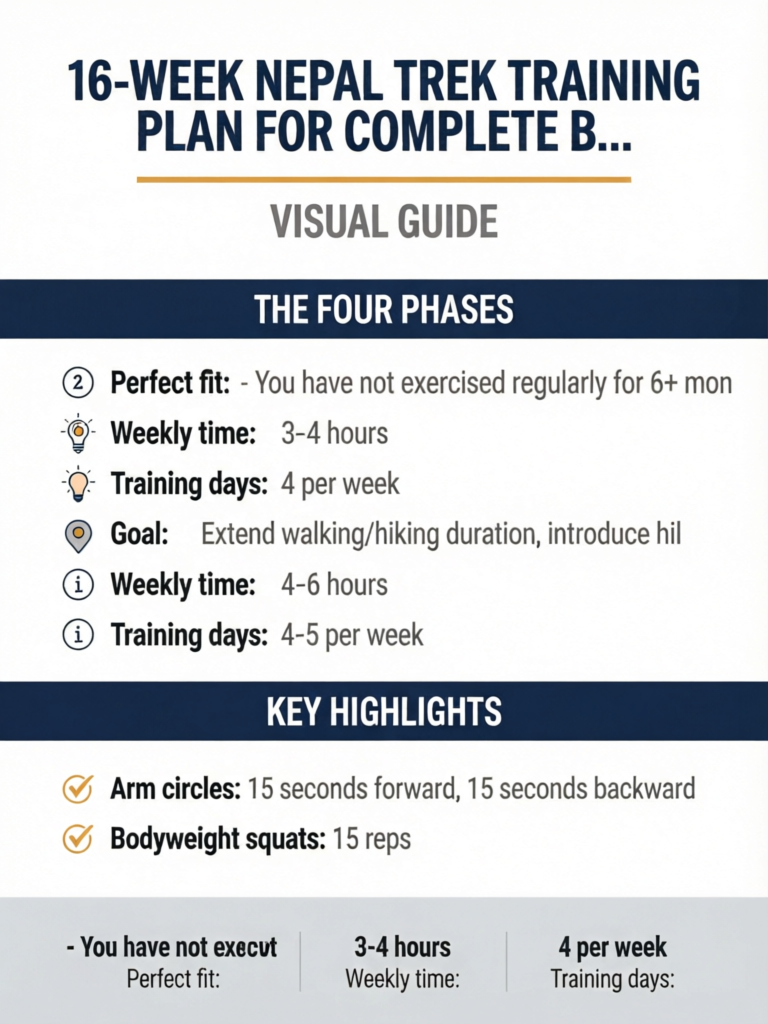
Who This Plan Is For
Perfect fit:
- You have not exercised regularly for 6+ months
- You can walk for 20-30 minutes at a comfortable pace but not much more
- You have no hiking experience
- You have a medical clearance for exercise (or no conditions requiring one)
- You have 16 weeks before your trek departure
Close fit (may need to adjust):
- You exercise occasionally (1-2 times per week at low intensity): Start at Week 3
- You walk regularly (30-60 minutes daily) but do no other exercise: Start at Week 2
- You are moderately fit but have zero hiking experience: Start at Week 5
Not the right plan:
- You already exercise 3-5 times per week at moderate intensity: Use the 8-week plan instead
- You have fewer than 12 weeks before your trek: Consult the 8-week ABC training plan or compress this plan (with trade-offs)
- You have a medical condition that restricts exercise: Consult a doctor and a sports physiotherapist for a personalized plan
Medical Clearance
If you are over 40 and have not exercised regularly, have any heart, lung, or joint conditions, take regular medication, or have any concerns about starting exercise, get a medical check-up before beginning this plan. Tell your doctor you plan to trek at altitudes up to 4,000-5,500 meters. They can screen for conditions that require attention before high-altitude activity.
Starting From Zero Is Completely Valid
There is no shame in being unfit. The only thing that matters is taking the first step. Every experienced trekker started somewhere. Many of the most dedicated and successful Nepal trekkers we know started from zero fitness and built their way up. The 16-week timeline gives your body the time it needs to adapt safely and thoroughly. Trust the process.
The Four Phases
Phase 1: Building Base Fitness (Weeks 1-4)
Goal: Establish an exercise habit, build foundational cardiovascular fitness, strengthen legs and core from baseline. Weekly time: 3-4 hours Training days: 4 per week Intensity: Low to moderate (you should be able to hold a conversation during all activities)
Phase 2: Increasing Volume (Weeks 5-8)
Goal: Extend walking/hiking duration, introduce hills and stairs, begin loaded walking, build muscular endurance. Weekly time: 4-6 hours Training days: 4-5 per week Intensity: Moderate (breathing harder but not gasping)
Phase 3: Trek-Specific Training (Weeks 9-12)
Goal: Simulate trek demands, introduce long hikes, train with full pack weight, build consecutive-day endurance. Weekly time: 6-8 hours Training days: 5-6 per week Intensity: Moderate to high (approaching trek demands)
Phase 4: Peak and Taper (Weeks 13-16)
Goal: Peak training volume in weeks 13-14, taper in weeks 15-16, arrive at trek fresh and confident. Weekly time: 7-10 hours (weeks 13-14) dropping to 3-4 hours (weeks 15-16) Training days: 5-6 (weeks 13-14) dropping to 3-4 (weeks 15-16) Intensity: High (weeks 13-14) dropping to low-moderate (weeks 15-16)
Phase 1: Building Base Fitness (Weeks 1-4)
Phase 1 is about creating the habit of regular exercise and building the foundational fitness that everything else depends on. Do not skip or rush this phase. The adaptations your body makes in these four weeks, stronger connective tissue, improved cardiovascular efficiency, increased muscular endurance, establish the base that allows you to train harder later without injury.
Week 1: Starting the Engine
| Day | Activity | Duration | Notes |
|---|---|---|---|
| Monday | Walk at comfortable pace | 20 min | Flat terrain, do not push pace |
| Tuesday | Rest | — | |
| Wednesday | Walk with gentle hills | 20 min | Slight inclines only |
| Thursday | Rest | — | |
| Friday | Walk at comfortable pace | 25 min | Slightly longer than Monday |
| Saturday | Walk exploring a park or trail | 30 min | Easy terrain, enjoy the environment |
| Sunday | Rest | — |
Weekly total: Approximately 1.5 hours. This feels easy. That is intentional. You are building the habit of scheduling and completing exercise sessions. Your body is beginning adaptation at the cellular level even if you do not feel it.
Week 2: Extending Duration
| Day | Activity | Duration | Notes |
|---|---|---|---|
| Monday | Walk at brisk pace | 25 min | Faster than comfortable, slightly breathless |
| Tuesday | Gentle strength exercises at home | 15 min | See beginner strength routine below |
| Wednesday | Walk with hills | 25 min | Seek gentle hills deliberately |
| Thursday | Rest | — | |
| Friday | Walk at comfortable pace | 30 min | Flat or gentle terrain |
| Saturday | Walk on varied terrain | 35 min | Mix of flat, gentle hills, different surfaces |
| Sunday | Rest | — |
Weekly total: Approximately 2-2.5 hours.
Week 3: Adding Structure
| Day | Activity | Duration | Notes |
|---|---|---|---|
| Monday | Brisk walk | 30 min | Include 5 min of steep hill if available |
| Tuesday | Strength routine | 20 min | Beginner strength routine (2 sets) |
| Wednesday | Walk or light cycling | 30 min | Cross-training builds different fitness aspects |
| Thursday | Rest | — | |
| Friday | Walk with purpose | 30 min | Walk to a destination 15 min away and return. Purpose creates motivation |
| Saturday | Long walk | 45 min | The longest effort so far. Easy terrain but sustained |
| Sunday | Rest or very easy walk | 0-20 min | Active recovery if energy allows |
Weekly total: Approximately 2.5-3 hours.
Week 4: Phase 1 Culmination
| Day | Activity | Duration | Notes |
|---|---|---|---|
| Monday | Brisk walk with hills | 35 min | Seek moderate hills |
| Tuesday | Strength routine | 25 min | Beginner strength routine (3 sets) |
| Wednesday | Stair climbing (introduction) | 15 min | Find stairs and walk up/down continuously. Start with just 15 min |
| Thursday | Rest | — | |
| Friday | Walk on varied terrain | 35 min | Mix surfaces and inclines |
| Saturday | Long walk | 60 min | One hour of continuous walking. This is your Phase 1 culmination test |
| Sunday | Rest | — |
Weekly total: Approximately 3-3.5 hours.
Phase 1 completion benchmark: Walk for 60 minutes at a brisk pace without needing to stop. If you can do this, proceed to Phase 2. If not, repeat weeks 3-4 until you can.
Beginner Strength Routine (Phase 1)
Perform each exercise slowly and with control. If any exercise causes joint pain (not muscle fatigue), skip it and substitute an easier version.
Lower body:
- Bodyweight squats: 8-10 reps (chair-assisted if needed: squat until you touch the chair, then stand)
- Step-ups onto a low step (15-20 cm): 8 per leg
- Standing calf raises: 12 reps
- Glute bridges: 10 reps (lying on back, knees bent, lift hips)
Core:
- Plank: 15-20 seconds (on knees if necessary)
- Dead bugs: 6 per side (lying on back, extend opposite arm and leg)
Upper body:
- Wall push-ups: 10 reps
- Arm circles: 15 seconds forward, 15 seconds backward
Rest 60-90 seconds between exercises. Perform 1 set in Week 1, 2 sets in Weeks 2-3, 3 sets in Week 4.
The Power of Consistency Over Intensity
In Phase 1, doing the workout matters more than how hard the workout is. If you complete 4 sessions per week at easy intensity, you will build more fitness than completing 2 sessions at high intensity. Your body adapts to consistent stimulus. Missing sessions breaks the adaptation chain. Aim for zero missed sessions in Phase 1, even if some sessions feel too easy.
Phase 2: Increasing Volume (Weeks 5-8)
Phase 2 introduces the specific elements of trekking fitness: hills, stairs, loaded walking, and longer sustained efforts. Your body has adapted to regular exercise in Phase 1. Now you build upon that foundation.
Week 5: Introducing Trek Elements
| Day | Activity | Duration | Notes |
|---|---|---|---|
| Monday | Brisk walk with hills | 40 min | Seek real hills, walk up strongly |
| Tuesday | Strength routine (intermediate) | 25 min | See intermediate strength routine below |
| Wednesday | Stair climbing | 20 min | Continuous, moderate pace |
| Thursday | Rest | — | |
| Friday | Walk or cycle | 35 min | Moderate effort |
| Saturday | First "hike" | 90 min | Find a trail with elevation change. Carry a small daypack (3-4 kg) with water and snacks. This is your first real hike |
| Sunday | Rest | — |
Weekly total: Approximately 4-4.5 hours.
Week 6: Building Hiking Endurance
| Day | Activity | Duration | Notes |
|---|---|---|---|
| Monday | Hill walking | 40 min | Find the steepest hill available. Walk up, walk down, repeat |
| Tuesday | Strength routine | 30 min | Intermediate strength, 3 sets |
| Wednesday | Stair climbing with pack | 25 min | Add 3-5 kg in a daypack |
| Thursday | Easy walk (active recovery) | 20 min | Flat, comfortable pace |
| Friday | Cross-training (cycle, swim, or brisk walk) | 35 min | Moderate effort |
| Saturday | Hike | 2 hours | 5 kg daypack, seek elevation change (200+ meters total gain) |
| Sunday | Rest | — |
Weekly total: Approximately 5 hours.
Week 7: Volume Increase
| Day | Activity | Duration | Notes |
|---|---|---|---|
| Monday | Interval walking | 40 min | Alternate 3 min fast, 2 min easy |
| Tuesday | Strength routine | 30 min | Intermediate strength with added resistance |
| Wednesday | Stair climbing with pack | 30 min | 5 kg pack, focus on steady breathing rhythm |
| Thursday | Easy recovery walk | 20 min | |
| Friday | Hill repeats | 35 min | Walk up a hill hard, walk down easy. Repeat 5-8 times |
| Saturday | Hike | 2.5 hours | 5-6 kg daypack, 300+ meters elevation gain |
| Sunday | Rest | — |
Weekly total: Approximately 5.5 hours.
Week 8: Phase 2 Culmination
| Day | Activity | Duration | Notes |
|---|---|---|---|
| Monday | Brisk walk with extended hill section | 45 min | Push pace on hills |
| Tuesday | Strength routine | 30 min | Intermediate strength, focus on legs |
| Wednesday | Stair climbing challenge | 35 min | Continuous stairs with 5 kg pack. This is your stair test |
| Thursday | Rest | — | |
| Friday | Walk or cycle | 40 min | Moderate effort |
| Saturday | Long hike (Phase 2 test) | 3 hours | 6-7 kg daypack, 350+ meters elevation gain. This hike tests your readiness for Phase 3 |
| Sunday | Rest | — |
Weekly total: Approximately 5.5-6 hours.
Phase 2 completion benchmarks:
- Walk briskly for 60 minutes with mild hills without distress
- Climb stairs for 25+ minutes continuously with a 5 kg pack
- Complete a 3-hour hike with a 6 kg pack and 300+ meters of elevation gain
- Perform 15 bodyweight squats and 12 lunges per leg with good form
If you meet these benchmarks, proceed to Phase 3. If not, repeat weeks 7-8.
Intermediate Strength Routine (Phase 2)
Lower body:
- Bodyweight squats: 15 reps
- Forward lunges: 10 per leg
- Step-ups onto a chair or bench (40-50 cm): 10 per leg
- Calf raises on a step (for greater range of motion): 15 reps
- Glute bridges with 3-second hold at top: 12 reps
Core:
- Plank: 30-40 seconds
- Side plank: 15-20 seconds per side
- Dead bugs: 8 per side
- Bird dogs: 8 per side
Upper body:
- Push-ups (from knees or toes depending on ability): 8-12 reps
- Bent-over rows with water bottles or light weight: 10 per arm
Perform 2-3 sets with 45-60 seconds rest between sets.
Week 5 Is the Highest Injury Risk Week
Phase 2 introduces new movements (stairs, hills, loaded walking) that your body has not experienced before. Week 5 is when the risk of overuse injury (shin splints, knee pain, hip flexor strain) is highest. If you experience sharp pain (not general muscle soreness), reduce the intensity and duration by 30% and gradually rebuild. Pain is different from discomfort. Discomfort is normal. Pain is a warning.
Get Your Hiking Boots Now
Start wearing your hiking boots for every training walk from Week 5 onward. Boots need 40-50 km of walking to break in properly. If you wait until Phase 3 to start wearing boots, you will not have enough time to break them in before your trek. Blisters from new boots on a trek are painful and preventable.
Phase 3: Trek-Specific Training (Weeks 9-12)
Phase 3 is where training directly simulates the demands of your Nepal trek. The intensity, duration, and specificity increase significantly. Your body is now conditioned for regular exercise, and Phase 3 pushes you toward trek-level fitness.
Week 9: Trek Simulation Begins
| Day | Activity | Duration | Notes |
|---|---|---|---|
| Monday | Hill walking or trail run | 45 min | Include sustained 15-20 min climb |
| Tuesday | Strength routine (advanced) | 35 min | See advanced strength routine below |
| Wednesday | Stair climbing with pack | 35 min | 7 kg pack, steady pace |
| Thursday | Easy recovery walk | 25 min | Flat, gentle pace |
| Friday | Cross-training or hill repeats | 40 min | Cycling with hill intervals or walking hill repeats |
| Saturday | Long hike | 3.5 hours | 8 kg daypack, 400+ meters elevation gain, wear full trekking gear (boots, hiking socks, layers) |
| Sunday | Easy recovery walk | 20 min | Flat terrain, first "back-to-back" practice |
Weekly total: Approximately 6-6.5 hours.
Week 10: Pushing Endurance
| Day | Activity | Duration | Notes |
|---|---|---|---|
| Monday | Sustained walk or jog | 50 min | Include 20+ min of hills |
| Tuesday | Strength routine | 40 min | Advanced strength, focus on endurance (high reps) |
| Wednesday | Stair climbing marathon | 40 min | 7-8 kg pack, practice breathing rhythm: inhale 2 steps, exhale 2 steps |
| Thursday | Rest | — | Full rest day |
| Friday | Trail walking with pack | 50 min | Varied terrain, moderate pack |
| Saturday | Long hike (duration push) | 4-4.5 hours | 8-10 kg daypack, 500+ meters elevation gain |
| Sunday | Easy 30-min walk | 30 min | Back-to-back day: walk the morning after your long hike to simulate consecutive trek days |
Weekly total: Approximately 7-7.5 hours.
Week 11: Peak Phase 3 Volume
| Day | Activity | Duration | Notes |
|---|---|---|---|
| Monday | Hill walking with pack | 50 min | 7 kg pack, sustained hill effort |
| Tuesday | Strength routine | 40 min | Advanced strength, add weighted pack for some exercises |
| Wednesday | Stair climbing | 45 min | 8 kg pack, include deliberate slow descents (training knees for downhill) |
| Thursday | Easy recovery | 25 min | Walk or gentle yoga |
| Friday | Trail walk or hill repeats | 45 min | Moderate-high effort |
| Saturday | Long hike | 5 hours | 10 kg daypack, 500-600 meters elevation gain. This is your Phase 3 peak hike |
| Sunday | Moderate walk | 40 min | Back-to-back day, carry light pack |
Weekly total: Approximately 7.5-8 hours.
Week 12: Phase 3 Completion
| Day | Activity | Duration | Notes |
|---|---|---|---|
| Monday | Moderate cardio | 45 min | Your choice: walk, cycle, or swim |
| Tuesday | Strength routine | 35 min | Maintain strength, do not increase |
| Wednesday | Stair climbing | 35 min | Moderate pack, comfortable effort |
| Thursday | Rest | — | |
| Friday | Easy walk | 30 min | Recovery week feel |
| Saturday | Hike (assessment hike) | 4 hours | 10 kg pack, 500+ meters gain. How do you feel? Assess honestly |
| Sunday | Rest | — |
Weekly total: Approximately 5.5-6 hours (intentional slight reduction before Phase 4).
Phase 3 completion benchmarks:
- Complete a 5-hour hike with 10 kg daypack and 500+ meters elevation gain
- Recover overnight and walk comfortably the next morning (back-to-back test)
- Climb stairs for 35+ minutes with 8 kg pack at steady pace
- Perform 20 squats, 15 lunges per leg, 45-second plank
- No persistent joint pain or injuries
Advanced Strength Routine (Phase 3-4)
Lower body (high-rep endurance focus):
- Squats with weight (hold water bottles, heavy book, or backpack): 20 reps
- Walking lunges: 16 steps total (8 per leg)
- Step-ups onto sturdy surface with pack: 12 per leg
- Single-leg calf raises: 12 per leg
- Wall sit: 45-60 seconds
- Single-leg glute bridges: 10 per leg
Core (stability focus):
- Plank: 45-60 seconds
- Side plank: 25-30 seconds per side
- Dead bugs: 12 per side
- Mountain climbers (slow): 16 total
- Superman holds: 20 seconds (lying face down, lift arms and legs)
Upper body (pack carrying strength):
- Push-ups: 12-15 reps
- Bent-over rows with weight: 12 per arm
- Overhead press with weight: 10 reps
- Farmer's carry (carry heavy items at sides, walk 30 seconds): 3 sets
Perform 3-4 sets with 45 seconds rest.
The Weekend Hike Is Your Most Important Session
Every week, the Saturday long hike is the single most important training session. It is the only session that truly replicates what you will do every day on the trek. If you must skip a session during the week due to time constraints, never skip the Saturday hike. Arrange your week to protect this session. Everything else supports it.
Phase 4: Peak and Taper (Weeks 13-16)
Phase 4 has two distinct halves. Weeks 13-14 are peak training: the highest volume and intensity of the entire plan. Weeks 15-16 are the taper: deliberate reduction to allow your body to consolidate fitness gains and arrive at the trek fresh.
Week 13: Peak Volume
| Day | Activity | Duration | Notes |
|---|---|---|---|
| Monday | Sustained cardio with hills | 55 min | Push effort on hill sections |
| Tuesday | Strength routine | 40 min | Advanced strength, full intensity |
| Wednesday | Stair climbing with heavy pack | 45 min | 10 kg pack, continuous |
| Thursday | Easy recovery | 25 min | Walk or gentle yoga |
| Friday | Trail walking or hill repeats | 50 min | Trek simulation effort |
| Saturday | Long hike (peak session) | 5.5-6 hours | 10 kg daypack, 600+ meters elevation gain, full trekking gear, practice trail snacking and hydration |
| Sunday | Moderate walk | 45 min | Back-to-back with pack. This simulates Day 2 of a trek |
Weekly total: Approximately 8-9 hours. This is the hardest week of the entire plan.
Week 14: Sustained Peak
| Day | Activity | Duration | Notes |
|---|---|---|---|
| Monday | Hill walking | 50 min | Moderate-high effort |
| Tuesday | Strength routine | 35 min | Maintain intensity, slightly reduced volume |
| Wednesday | Stair climbing | 40 min | 8 kg pack, focus on form and rhythm |
| Thursday | Rest | — | Full rest |
| Friday | Trail walking | 45 min | Moderate effort |
| Saturday | Long hike | 5 hours | 10 kg pack, 500+ meters gain. Last big effort before taper |
| Sunday | Easy walk | 30 min | Light pack, gentle terrain |
Weekly total: Approximately 7-7.5 hours.
Week 15: Taper Begins
| Day | Activity | Duration | Notes |
|---|---|---|---|
| Monday | Moderate walk with hills | 40 min | Reduce effort by 20-30% from peak |
| Tuesday | Strength routine (light) | 25 min | Reduce weight and volume. Maintain movement patterns |
| Wednesday | Stair climbing | 25 min | No pack or light pack. Easy effort |
| Thursday | Rest | — | |
| Friday | Easy walk | 30 min | Flat terrain, comfortable pace |
| Saturday | Hike | 3 hours | Moderate pack, enjoyable effort. Not pushing hard |
| Sunday | Rest | — |
Weekly total: Approximately 4-4.5 hours.
Week 16: Final Taper
| Day | Activity | Duration | Notes |
|---|---|---|---|
| Monday | Easy walk | 30 min | Light effort, flat or gentle hills |
| Tuesday | Very light strength | 20 min | Bodyweight only, low reps. Movement maintenance |
| Wednesday | Easy stair climbing or walking | 15 min | Just enough to move the body |
| Thursday | Rest | — | |
| Friday | Easy walk | 20 min | Shake out legs, stay loose |
| Saturday | Rest or very easy 15-min walk | 0-15 min | If trekking begins Monday, rest completely |
| Sunday | Rest | — | Final rest. Organize gear, hydrate, sleep well |
Weekly total: Approximately 2-2.5 hours.
The Taper Panic Is Normal
During weeks 15-16, you will feel like you are losing fitness. You are not. The reduced training volume feels wrong after weeks of building intensity. Your body may feel restless, and your mind may tell you to add more sessions. Resist this urge. The taper is where your body converts training stress into performance capacity. Athletes who taper properly perform 3-5% better than those who train through. For a multi-day trek, that 3-5% is the difference between enjoyment and suffering.
Nutrition Throughout the 16 Weeks
Phase 1 Nutrition (Weeks 1-4)
Priority: Clean, consistent eating. You do not need to overhaul your diet. Focus on:
- Eating three meals per day with adequate protein
- Hydrating with 2-2.5 liters of water daily
- Reducing processed food and sugar where convenient
- Not restricting calories (your body needs fuel to adapt to new exercise)
Phase 2 Nutrition (Weeks 5-8)
Priority: Supporting increased activity.
- Increase protein to 1.2-1.4 grams per kilogram of body weight daily (chicken breast, fish, eggs, beans, tofu, dairy)
- Add a post-workout snack within 60 minutes of exercise (yogurt and fruit, protein shake, nuts and banana)
- Increase water intake to 2.5-3 liters daily
- On Saturday hike days, eat a carb-rich breakfast 2 hours before starting
Phase 3 Nutrition (Weeks 9-12)
Priority: Fueling high-volume training.
- Increase protein to 1.4-1.6 grams per kilogram daily
- Ensure 50-60% of calories from carbohydrates on training days
- Practice trail nutrition during Saturday hikes: eat 200-250 calories per hour from trail mix, energy bars, dried fruit
- Monitor hydration: urine should be pale yellow throughout the day
- Add iron-rich foods (red meat, spinach, lentils) to support increased oxygen demands
Phase 4 Nutrition (Weeks 13-16)
Priority: Peak fueling and pre-trek preparation.
- Maintain Phase 3 nutrition during weeks 13-14
- During taper (weeks 15-16), slightly reduce calories to match reduced activity but do not diet
- Practice eating foods you will encounter on the trek (dal bhat, rice, noodle soup, chapati) to test your digestive tolerance
- Ensure iron and B12 levels are adequate (consider a blood test if possible)
Practice Eating What You Will Eat on the Trek
Nepal trekking food is primarily dal bhat (lentils and rice), noodle soups, fried rice, and chapati. If you are not accustomed to this cuisine, practice eating it during training. Your digestive system needs to process these foods efficiently during physically demanding days. A trekker whose stomach rebels against unfamiliar food loses energy and confidence rapidly. Find Nepali restaurants or cook dal bhat at home during Phase 3-4.
Mental Preparation: The Overlooked Training Component
Physical fitness gets you up the mountain. Mental fitness keeps you going when your body wants to stop.
Building Mental Toughness Over 16 Weeks
Weeks 1-4: Establish the habit identity. You are becoming a person who exercises regularly. Each completed session reinforces this identity. When you do not feel like training, remind yourself: "I am someone who prepares for my trek." Show up even on days you do not want to.
Weeks 5-8: Embrace discomfort. During hill walking and stair climbing, you will encounter moments when your body signals discomfort: burning legs, heavy breathing, tiredness. Practice staying in that discomfort without stopping. Not pain (always stop for pain), but discomfort. The trek will provide hours of this exact feeling. Training yourself to keep moving through it is mental training.
Weeks 9-12: Complete what you start. When your Saturday long hike reaches the 3-4 hour mark and you want to cut it short, complete the full planned duration. Finishing what you start, even when tired, builds the mental pattern you need on the trek when day 7 feels impossible but you must keep walking.
Weeks 13-16: Visualize and prepare. Spend 5-10 minutes before bed visualizing your trek. See yourself walking steadily, breathing comfortably, enjoying mountain views, eating dinner in a tea house, reaching your goal. Visualization is an established sports psychology technique. It reduces anxiety and improves performance.
Managing Trek Anxiety
It is normal to feel anxious about your first Nepal trek, especially if you started from zero fitness. Common anxieties include:
"What if I am the slowest in the group?" Pace varies significantly among trekkers. Guides are experienced at managing different speeds. Being slower is not a failure. It is simply a pace. Many "slow" trekkers enjoy the experience more because they are not rushing past the scenery.
"What if I cannot make it?" If you complete this 16-week plan, you will have the fitness for moderate Nepal treks (Poon Hill, Mardi Himal, ABC, Langtang). The plan is designed with this endpoint in mind. Trust your preparation.
"What if altitude makes me sick?" Altitude sickness is partly genetic and not fully predictable. However, fitness is the single best predictor of altitude tolerance. This plan builds the cardiovascular capacity that helps your body cope with reduced oxygen. Proper acclimatization schedules (built into all reputable itineraries) further reduce the risk.
Gear Break-In Schedule
Integrating gear into training ensures everything is tested and comfortable before the trek.
| Phase | Gear to Introduce |
|---|---|
| Weeks 1-4 | Walking shoes (any comfortable shoes you own) |
| Week 5 | Purchase and begin wearing hiking boots for all training walks |
| Week 6 | Trekking socks (wear with boots for every session) |
| Week 7 | Daypack (begin using for all hikes) |
| Week 8 | Trekking poles if you plan to use them (practice on Saturday hikes) |
| Weeks 9-10 | Full base layer and hiking pants for Saturday hikes |
| Weeks 11-12 | Test full trekking outfit including layers, hat, and gloves during at least one long hike |
| Weeks 13-14 | Peak hikes in full gear with realistic pack weight |
| Weeks 15-16 | Organize final pack, verify all gear is broken in and comfortable |
Boot Break-In Is Non-Negotiable
New hiking boots are the number one cause of blisters on Nepal treks. By the time you reach your trek, your boots should have at least 50-60 km of walking on them across varied terrain. If you start wearing them in Week 5 and hike every Saturday, you will accumulate approximately 70-90 km by Week 16. That is sufficient break-in for most quality boots.
Progress Benchmarks
Test yourself at these checkpoints to ensure you are on track.
End of Phase 1 (Week 4)
- Walk briskly for 60 minutes without stopping
- Climb stairs for 10 minutes without severe breathlessness
- Complete 10 bodyweight squats and 8 lunges per leg with good form
- No persistent pain or injuries
End of Phase 2 (Week 8)
- Complete a 3-hour hike with 6-7 kg daypack and 300+ meters elevation gain
- Climb stairs for 25 minutes with 5 kg pack
- Walk 30 minutes the morning after a long hike (back-to-back test)
- Complete 15 squats, 12 lunges per leg, 30-second plank
End of Phase 3 (Week 12)
- Complete a 5-hour hike with 10 kg daypack and 500+ meters elevation gain
- Recover overnight and walk 40+ minutes the next day comfortably
- Climb stairs for 35 minutes with 8 kg pack
- Complete 20 squats, 15 lunges per leg, 45-second plank
End of Phase 4 / Trek Ready (Week 16)
- All Phase 3 benchmarks still achievable (fitness maintained through taper)
- Feel rested, energized, and confident
- All gear broken in and comfortable
- No injuries or persistent pain
What If You Miss a Benchmark?
If you miss a benchmark at any checkpoint, do not panic. Repeat the previous 2-week block and retest. Missing a benchmark means your body needs more time at that stage, not that you are failing. The 16-week timeline has built-in buffer for exactly this scenario. Arriving at your trek 1-2 weeks later than planned but properly trained is infinitely better than arriving on schedule but undertrained.
Training Hikes: Your Most Important Sessions
How to Structure Training Hikes
Location: Find the most terrain-varied trails in your area. Hills, stairs, rocky paths, forest trails, and uneven ground all replicate trek conditions better than flat pavement.
Pace: Trek pace, not exercise pace. Walk at a speed where you can speak in full sentences but are slightly breathless. This is approximately 60-70% of your maximum heart rate. On the trek, you will maintain this pace for 5-7 hours daily.
Rest stops: Take a 5-10 minute break every 60-90 minutes, mimicking the rest pattern on a trek. Practice eating a snack and drinking water during breaks.
Navigation: If possible, hike trails you have not walked before. Route-finding and terrain reading build skills you will use on the trek.
Training Hike Progression
| Week | Duration | Pack Weight | Elevation Gain Target |
|---|---|---|---|
| 5 | 90 min | 3-4 kg | 100-150m |
| 6 | 2 hours | 5 kg | 200m |
| 7 | 2.5 hours | 5-6 kg | 300m |
| 8 | 3 hours | 6-7 kg | 350m |
| 9 | 3.5 hours | 8 kg | 400m |
| 10 | 4-4.5 hours | 8-10 kg | 500m |
| 11 | 5 hours | 10 kg | 500-600m |
| 12 | 4 hours | 10 kg | 500m |
| 13 | 5.5-6 hours | 10 kg | 600m+ |
| 14 | 5 hours | 10 kg | 500m |
| 15 | 3 hours | 7-8 kg | 300m |
| 16 | 0-1 hour | Light or none | Minimal |
Common Mistakes Beginners Make
Mistake 1: Starting Too Hard
Enthusiasm is wonderful. But starting at Week 5 intensity when your body is at Week 1 fitness leads to injury, burnout, and quitting. The first four weeks feel easy by design. Trust the progression.
Mistake 2: Skipping Strength Training
Walking alone does not build the leg strength needed for sustained trekking. Squats, lunges, and step-ups strengthen the muscles that protect your knees and power your steps. Fifteen to twenty minutes of strength work, two to three times per week, prevents the knee pain and muscle fatigue that sideline unprepared trekkers.
Mistake 3: Not Training Downhill
On the trek, you will descend thousands of meters over multiple days. Downhill walking creates eccentric muscle contractions that cause severe soreness if you have not trained for them. From Phase 2 onward, deliberately walk downhill sections slowly and with control. Your quads will thank you during the trek's descent days.
Mistake 4: Ignoring Rest Days
More training does not always mean more fitness. Your body rebuilds and strengthens during rest, not during exercise. Skipping rest days leads to overtraining, which manifests as persistent fatigue, poor sleep, mood changes, and increased injury risk. Respect the rest days in this plan.
Mistake 5: Not Eating Enough
Beginners who are simultaneously trying to lose weight and train for a trek often undereat. Your body needs fuel to adapt to training. Caloric restriction during this plan undermines your fitness development. Eat to support your training. Weight loss can be addressed at another time.
Mistake 6: Training Only on Weekdays and Skipping Weekend Hikes
Weekday training sessions build fitness components. Weekend hikes build trek fitness. The long Saturday hike is where these components combine into the specific endurance you need. Skipping weekend hikes while completing all weekday sessions leaves you with good general fitness but poor trek-specific readiness.
Frequently Asked Questions: 16-Week Beginner Training Plan
Getting Started Questions
Q: I am embarrassed about how unfit I am. Is this plan really for beginners?
Yes. Week 1 starts with 20-minute walks. If that is where you are, this is your plan. There is no judgment in starting from zero. Every person who has ever completed a Nepal trek had a starting point. Many started exactly where you are now.
Q: I am over 50. Can I still follow this plan?
Absolutely. Age affects recovery rate, not training ability. If you are over 50, add one extra rest day per week (reduce training days from 4 to 3 in Phase 1, from 5 to 4 in Phases 2-3). Extend the plan to 18-20 weeks if possible. Prioritize low-impact cross-training (cycling, swimming) over running. Add extra stretching and mobility work. Many successful Nepal trekkers are in their 50s, 60s, and beyond.
Q: Can I do this plan alongside other exercise I already do?
If you do yoga, pilates, swimming, or gentle cycling, continue these activities as additional sessions or substitute them for rest days. If you do high-intensity exercise (CrossFit, HIIT, heavy weightlifting), reduce the intensity and frequency of those activities during this plan to avoid overtraining. This plan's volume is designed to be the primary training stimulus.
Q: What if I miss a week due to illness or travel?
Resume from the week you missed, not from where you would have been. If you miss one week, repeat the previous week and then continue. If you miss two or more weeks, go back two weeks in the plan and rebuild. Do not try to "make up" missed training by doing double sessions. That path leads to injury.
Physical Questions
Q: My knees hurt after walking. Should I continue?
Stop the activity that causes pain and assess. Mild aching after a long walk that resolves within 24 hours is normal adaptation. Sharp pain during activity, pain that worsens over days, or swelling indicate a problem. See a physiotherapist before continuing. Many knee issues in beginner walkers resolve with proper strength training (particularly quad strengthening) and appropriate footwear.
Q: How much weight should I expect to lose during this plan?
This is not a weight loss plan. Some weight loss is likely if you are overweight and follow the nutrition guidelines, but the primary goal is building fitness. Typical results: 2-5 kg of weight loss over 16 weeks with possible muscle gain. If you need significant weight loss, begin a dietary plan 3-6 months before starting this training plan, then eat at maintenance during training.
Q: I have asthma. Can I still follow this plan and trek in Nepal?
Many people with well-controlled asthma trek successfully in Nepal. Discuss your plan with your doctor before starting. Carry your inhaler during all training sessions and on the trek. High altitude reduces oxygen availability, which may exacerbate asthma. Start with easier treks at lower altitudes (Poon Hill, Mardi Himal) rather than high-altitude treks (EBC) for your first experience.
Q: What if I cannot complete a Phase benchmark?
Repeat the last 2 weeks of that Phase and retest. If you still cannot meet the benchmark, your body needs more time. Add 2-4 weeks to your plan. Do not advance to the next Phase until you meet the benchmarks. The benchmarks exist to prevent you from progressing too fast and getting injured or failing on the trek.
Trek Selection Questions
Q: What treks can I do after completing this plan?
This plan prepares you for moderate Nepal treks: Poon Hill (easy-moderate), Mardi Himal (moderate), Langtang Valley (moderate), and ABC (moderate-challenging). For EBC (challenging), add 4 extra weeks of Phase 3-level training. For the Annapurna Circuit (challenging) or Manaslu Circuit (strenuous), complete this plan and then add 4-8 weeks of advanced training. See the best beginner treks in Nepal guide for recommendations.
Q: Should I do an easy trek first before a harder one?
If possible, yes. Starting with Poon Hill or Mardi Himal gives you invaluable experience: how your body responds to multi-day hiking, how altitude affects you, how to manage tea house logistics, and what gear works for you. This experience makes harder treks like EBC or ABC significantly more enjoyable and less stressful.
Q: I want to do EBC but this plan targets moderate treks. What do I do?
Complete this 16-week plan. Then add 4-6 weeks of Phase 3-level training with increased emphasis on altitude-specific preparation (longer hikes, heavier packs, higher-altitude hikes if available, stair climbing sessions exceeding 45 minutes). This brings you to approximately 20-22 weeks of total training, which is excellent preparation for EBC. Alternatively, start with this plan and then transition to an EBC-specific plan for the final weeks.
Logistics Questions
Q: Do I need a gym membership for this plan?
No. Every exercise can be done outdoors or at home. Stairs (building, stadium, park), hills (any slope in your area), a sturdy chair (for step-ups), and water bottles or books (for weight) replace all gym equipment. The most important training tool is terrain with elevation change, which is free.
Q: How do I find training hikes in a flat area?
If you live somewhere flat, stair climbing becomes your primary elevation simulator. Find buildings with accessible stairwells, parking garages with ramps, stadiums, or pedestrian overpasses. A treadmill set to maximum incline (usually 12-15%) provides sustained hill simulation. For weekend hikes, consider driving 1-2 hours to the nearest hilly terrain. Even monthly trips to real hills supplement flat-area training.
Q: Can I use a treadmill instead of outdoor walking?
Treadmills work for cardiovascular training but do not replicate outdoor terrain variability, balance demands, or weather exposure. Use a treadmill for weekday sessions if necessary, but complete Saturday hikes outdoors on varied terrain whenever possible. Set the treadmill to 5-12% incline to simulate hill walking. Never set it to flat (0%) for training purposes.
Q: When should I book my trek?
Book your trek 3-6 months before departure to secure availability, especially for peak season (October-November and March-April). Start this training plan 16 weeks before your trek departure date. If you book a trek and then start training, you have a concrete deadline that motivates consistency.
This plan prepares you for your first Nepal trek. For specific fitness benchmarks by trek, see the fitness requirements guide. For help choosing your first trek, read best beginner treks in Nepal. For a complete introduction to the Nepal trekking experience, see what to expect on your first Nepal trek.