
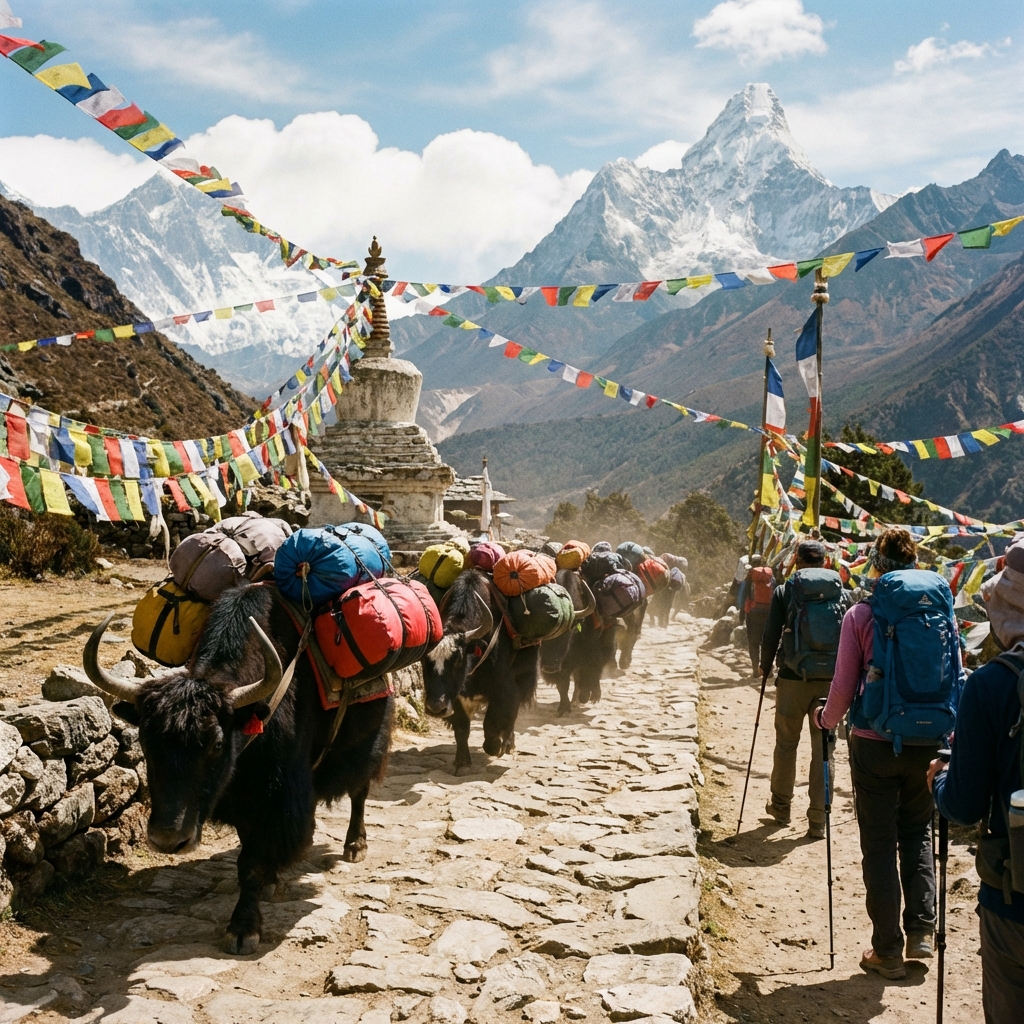
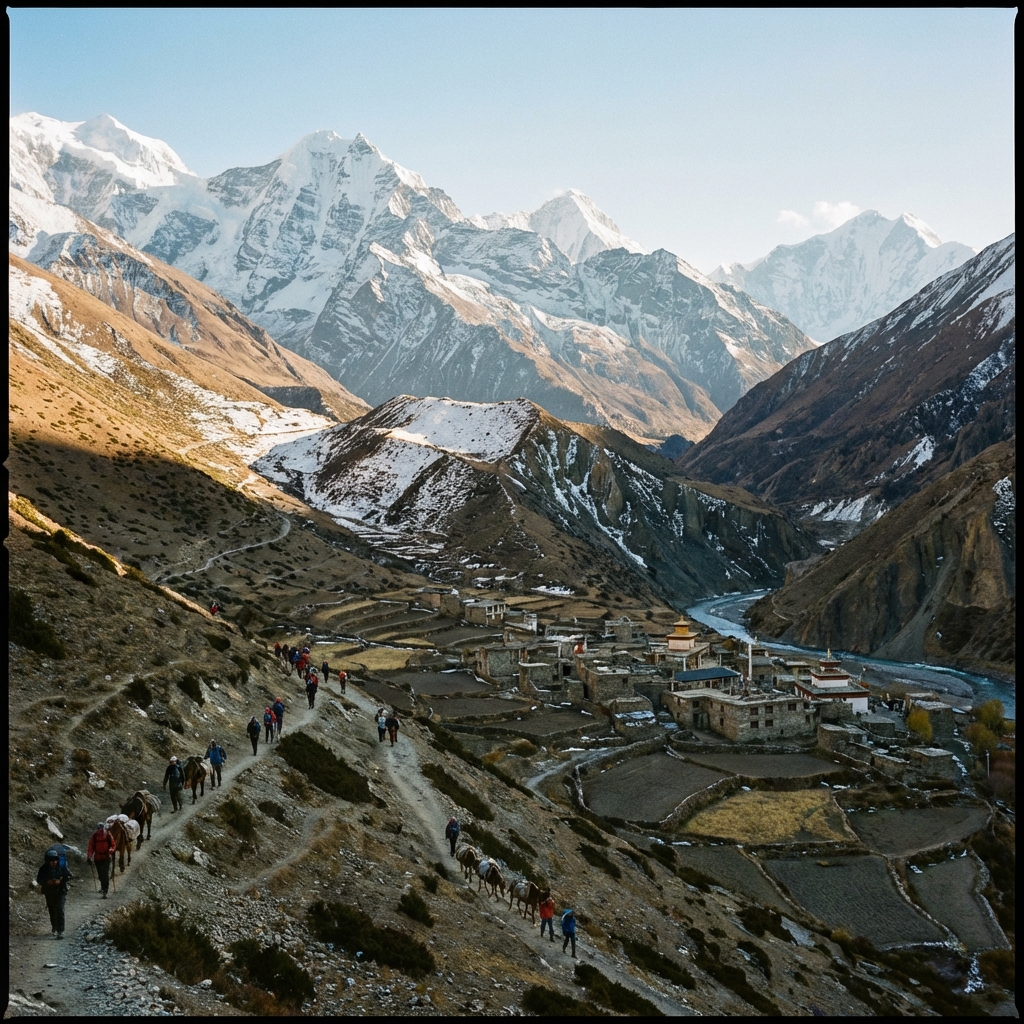
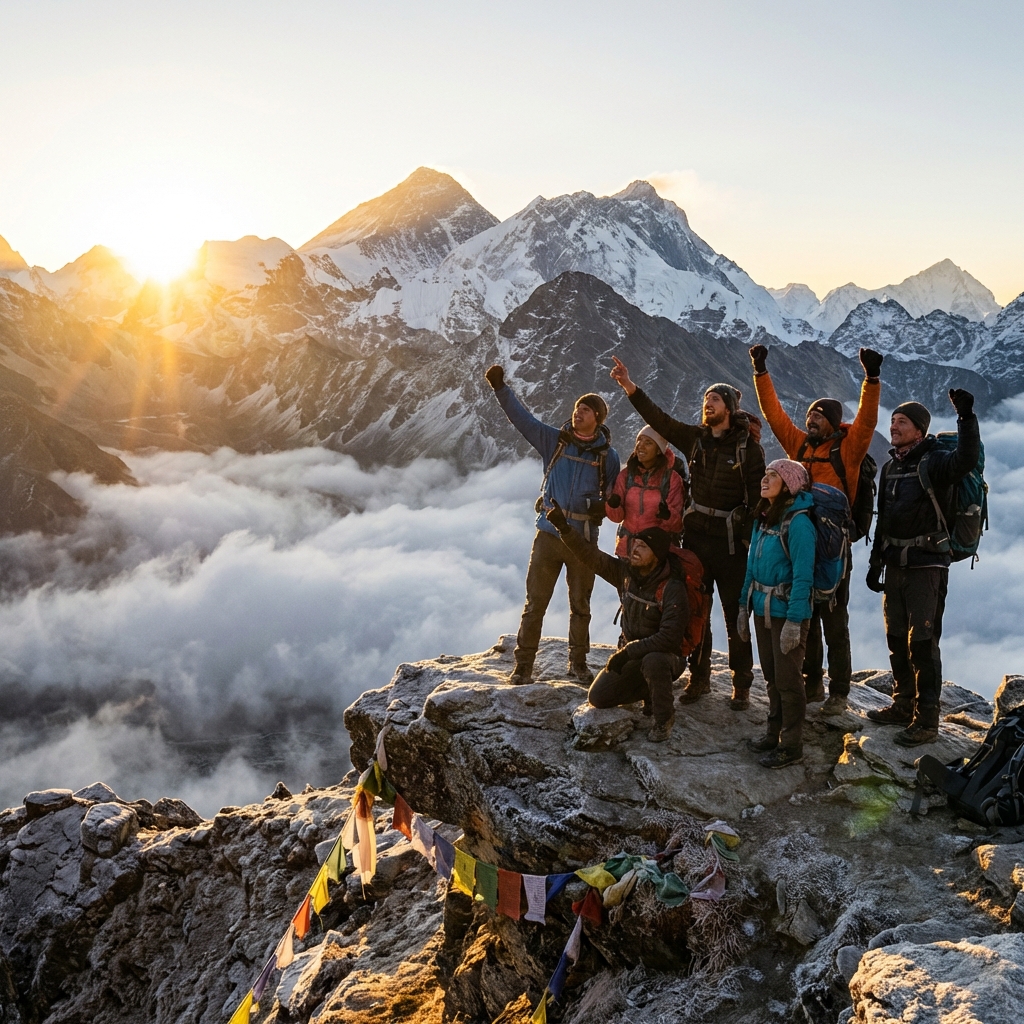
"Am I fit enough for Nepal trekking?" is the most common question we receive—and the most misunderstood.
Here's the reality: fitness requirements vary wildly depending on your chosen trek. Poon Hill demands entirely different capabilities than Everest Base Camp, which itself is worlds apart from Everest Three Passes. Yet marketing materials and uninformed advice often reduce all Nepal treks to "moderate fitness required," leaving trekkers either overconfident about their abilities or unnecessarily intimidated.
This guide eliminates the ambiguity. We'll break down exactly what fitness means in trekking context (it's not what you think), provide honest trek-specific requirements, give you testable benchmarks to assess your current fitness, and design training programs to bridge the gap between where you are and where you need to be.
What you'll learn:
- Realistic fitness requirements by trek difficulty (Easy/Moderate/Challenging/Extreme)
- Trek-specific benchmarks for EBC, ABC, Annapurna Circuit, Manaslu, and more
- Baseline fitness tests you can perform today to assess readiness
- How age affects requirements (20s vs 40s vs 60s+)
- 8-12 week training programs by target trek
- What fitness actually means: cardiovascular vs strength vs altitude adaptation
- When you're NOT fit enough (red flags to postpone)
The bottom line upfront: If you can hike 6 hours with 700+ meters elevation gain while carrying 8-10 kg without severe exhaustion, you're fit enough for most moderate Nepal treks. If you cannot, you need specific training. This guide shows you how.
Let's establish the fitness reality for your specific trek.
Understanding Trek Fitness: It's Not What You Think
Before diving into requirements, we need to redefine "fitness" in the trekking context.
The Three Components of Trekking Fitness
Trekking fitness is not gym fitness, running fitness, or sport fitness. It's a specific combination of three components:
1. Cardiovascular Endurance (Most Critical)
This is your body's ability to sustain moderate-intensity effort for extended periods (5-8 hours daily for 10-20 consecutive days). It's not about speed or intensity—it's about duration and consistency.
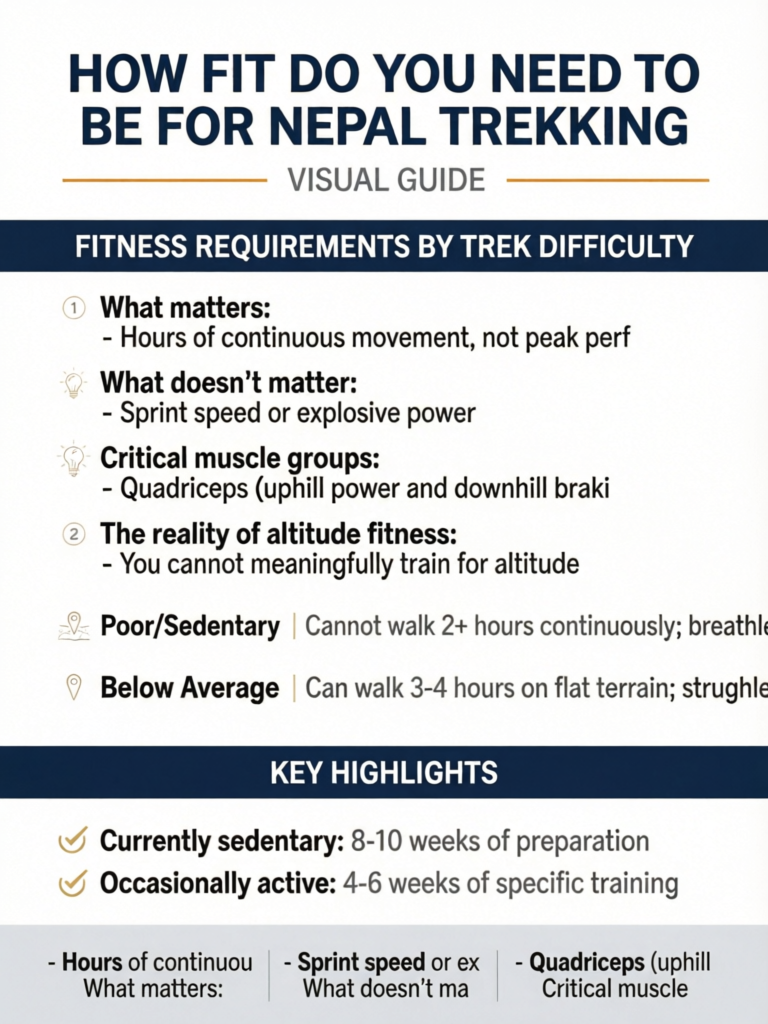
What matters:
- Hours of continuous movement, not peak performance
- Recovery ability between consecutive days
- Efficiency at moderate heart rates (60-75% max)
- Oxygen utilization at altitude
What doesn't matter:
- Sprint speed or explosive power
- Maximum heart rate capacity
- Short-duration intensity (HIIT, CrossFit bursts)
Why Marathon Runners Often Struggle
Marathon runners possess excellent cardiovascular systems but often struggle on treks because marathon fitness is optimized for 2-4 hours of high-intensity effort, not 5-8 hours of moderate continuous movement for two weeks straight. The energy systems are different.
2. Muscular Strength and Endurance (Especially Lower Body)
Your legs must handle hundreds of thousands of steps, significant elevation gain/loss daily, and uneven terrain—all while fatigued from previous days and operating in oxygen-depleted environments.
Critical muscle groups:
- Quadriceps (uphill power and downhill braking)
- Glutes (sustained uphill effort)
- Calves (endurance and stabilization)
- Hip flexors and abductors (uneven terrain)
- Core (pack weight support)
What matters:
- Muscular endurance (high repetitions) over maximum strength
- Eccentric strength (controlling downhill movement)
- Stabilizer muscle conditioning
- Joint and connective tissue resilience
3. Altitude Adaptation (Partially Trainable)
Above 3,000 meters, your body operates with reduced oxygen. This affects all systems: cardiovascular, muscular, neurological, digestive, and sleep.
The reality of altitude fitness:
- You cannot meaningfully train for altitude at sea level
- Genetic factors significantly influence altitude tolerance
- Acclimatization strategy matters more than fitness
- Poor fitness amplifies altitude effects (double challenge)
Fitness Cannot Overcome Bad Acclimatization
Being extremely fit does NOT protect against altitude sickness. In fact, fit individuals often push harder, ascend faster, and increase their AMS risk. Proper acclimatization requires patience, not power.
What "Moderate Fitness Required" Actually Means
Trek descriptions universally state "moderate fitness required." Here's what that vague phrase means in practical terms:
| Fitness Level | Real-World Capability | Trek Suitability |
|---|---|---|
| Poor/Sedentary | Cannot walk 2+ hours continuously; breathless climbing 3+ flights of stairs | Not suitable for any multi-day trek |
| Below Average | Can walk 3-4 hours on flat terrain; struggles with hills; no regular exercise | Only 3-4 day easy treks (Poon Hill with difficulty) |
| Average/"Moderate" | Can hike 5-6 hours with some hills; exercises 2-3x weekly; occasional breathlessness on steep sections | Most beginner/intermediate treks (Poon Hill, Langtang, Mardi Himal, ABC) |
| Good | Can hike 6-8 hours with significant elevation; exercises 4-5x weekly; comfortable on sustained steep sections | All standard treks including EBC, Manaslu, Annapurna Circuit |
| Excellent | Can hike 8+ hours with 1,000m+ elevation; trains specifically for endurance; strong at altitude | Advanced treks (Three Passes, technical peaks, expedition support) |
The honest translation: When a trek description says "moderate fitness required," they mean "average fitness PLUS 8-12 weeks of trek-specific training." They don't mean "show up as you are if you occasionally go to the gym."
Age and Fitness: What Actually Changes
Age affects trekking capability, but not how you might think.
Recovery time (biggest factor):
- 20s: Recover overnight from hard efforts
- 30s: May need 1-2 days to fully recover
- 40s: Often require 2-3 days for complete recovery
- 50s+: Multi-day recovery from maximum efforts
- 60s+: Week+ recovery from sustained hard efforts
Implication for trekking: Consecutive-day trekking doesn't allow full recovery at any age, but older trekkers experience cumulative fatigue more acutely. This demands better base fitness, more conservative pacing, and strict acclimatization.
What improves with age:
- Pacing discipline (younger trekkers often start too fast)
- Mental toughness and experience
- Understanding of personal limits
- Willingness to take rest days
- Better hydration/nutrition habits
What declines with age:
- Maximum cardiovascular capacity (VO2 max drops ~1% per year after 30)
- Recovery speed between efforts
- Muscle mass (sarcopenia after 40)
- Joint resilience and flexibility
- Thermoregulation efficiency
The 60+ Trekker Advantage
Trekkers over 60 who are properly trained often outperform younger, fitter individuals because they pace perfectly, listen to their bodies, prioritize acclimatization, and never ego-push through warning signs. Experience compensates for physiological decline.
Fitness Requirements by Trek Difficulty
Let's establish concrete fitness requirements for each difficulty category.
Easy Treks (Poon Hill, Ghorepani, Short Cultural Treks)
Maximum altitude: 3,000-3,500m Daily hiking time: 4-6 hours Total duration: 3-5 days Elevation gain: 300-600m per day Difficulty rating: 2-3/10
Minimum fitness requirements:
Cardiovascular:
- Can walk continuously for 4-5 hours at moderate pace
- Comfortable on gentle hills without frequent stops
- Heart rate manageable on sustained effort
Baseline test:
- Walk/hike 4-5 hours on rolling terrain without severe exhaustion
- Climb 500 meters elevation gain over 2-3 hours
- Repeat similar effort the following day (back-to-back capability)
Strength:
- Can climb 5-6 flights of stairs without stopping
- Walk downhill 45+ minutes without knee pain
- Carry 6-8 kg daypack comfortably for 4+ hours
Training required:
- Currently sedentary: 8-10 weeks of preparation
- Occasionally active: 4-6 weeks of specific training
- Regularly active: 2-4 weeks of hiking-focused training
Age considerations:
- 20s-40s: Achievable with minimal specific training if generally active
- 40s-50s: 6-8 weeks recommended even if active
- 60s+: 8-12 weeks progressive training strongly recommended
Real trekker example: "I'm 52, moderately active (gym 2x weekly, no hiking experience). Trained 6 weeks for Poon Hill: walking 4-5 hours on weekends, adding hills. Trek was challenging on Day 2 stairs but very manageable overall." —Sarah, Australia
Honest assessment: If you currently exercise 2-3 times weekly (any activity) and can walk 3+ hours without exhaustion, you can likely complete easy treks with 4-6 weeks of walking-focused preparation. If you're sedentary, commit to 8-10 weeks minimum.
Moderate Treks (Langtang Valley, Mardi Himal, Pikey Peak, ABC)
Maximum altitude: 3,500-4,500m Daily hiking time: 5-7 hours Total duration: 7-12 days Elevation gain: 400-800m per day Difficulty rating: 4-6/10
Minimum fitness requirements:
Cardiovascular:
- Can hike 6-7 hours with moderate elevation gain
- Sustained uphill effort for 2-3 hours without severe breathlessness
- Recovery between consecutive hard days (not full recovery, but functional)
Baseline test:
- Hike 6-7 hours with 600-800m elevation gain without severe exhaustion
- Repeat similar effort next day (slightly reduced performance acceptable)
- Sustain moderate pace for 10-12 consecutive days
Strength:
- Climb 8-10 flights of stairs consecutively without stopping
- Descend 600m+ elevation with weighted pack without knee pain
- Carry 8-10 kg daypack for 6+ hours comfortably
- Core strength to maintain posture with pack weight
Training required:
- Currently sedentary: 12-16 weeks minimum
- Occasionally active: 10-12 weeks
- Regularly active (non-hiking): 8-10 weeks
- Regular hikers: 6-8 weeks of increased duration/elevation
Age considerations:
- 20s-30s: 8-10 weeks training, even if regularly active
- 40s-50s: 10-12 weeks minimum; focus on recovery protocols
- 60s+: 12-16 weeks progressive build; emphasize leg strength
Trek-specific examples:
Annapurna Base Camp (ABC):
- Sustained multi-day climbing to 4,130m
- Significant descents (hard on knees/quads)
- Altitude affects final push to base camp
Fitness focus: Leg strength (especially quads for downhill), cardiovascular endurance for consecutive days, altitude exposure if possible
Langtang Valley:
- Gradual altitude gain (good for acclimatization)
- Sustained hiking days (6-7 hours common)
- Optional Tserko Ri summit (5,033m) requires excellent fitness
Fitness focus: Endurance for 7-9 consecutive trekking days, leg endurance, optional peak requires altitude tolerance
Mardi Himal:
- Steep sections throughout
- High Camp push is challenging
- Variable weather affects difficulty
Fitness focus: Quad strength for steep uphills, balance and stabilizer muscles, comfortable hiking in variable conditions
Read Mardi Himal trek details →
Real trekker example: "I'm 38, run 5k 3x weekly but no hiking. Trained 10 weeks for ABC: added weekend hikes (building to 6-7 hours), stairs with weighted pack, leg strength work. Trek was challenging but very doable. Wished I'd done more downhill training—quads were destroyed on descent." —Michael, UK
Honest assessment: Moderate treks are the sweet spot for first-time Himalayan trekkers who are willing to train properly. They're achievable for most ages and fitness levels WITH adequate preparation. They're significantly underestimated by gym-fit individuals who lack hiking endurance.
The 'Gym Fit' Trap
Many CrossFit athletes, weightlifters, and gym regulars assume their fitness translates to trekking. It doesn't. Gym fitness is typically short-duration, high-intensity effort. Trekking requires the opposite: long-duration, moderate-intensity sustained effort. Without specific hiking training, extremely "fit" people often struggle more than moderately fit hikers.
See our ABC vs EBC comparison →
Challenging Treks (EBC, Annapurna Circuit, Manaslu Circuit, Upper Mustang)
Maximum altitude: 5,000-5,550m Daily hiking time: 6-8 hours (sometimes 8-10) Total duration: 12-20 days Elevation gain: 500-1,000m per day (some days more) Difficulty rating: 6-8/10
Minimum fitness requirements:
Cardiovascular:
- Can hike 7-8 hours with significant elevation gain (800-1,000m)
- Sustain moderate effort for 12-16 consecutive days
- Maintain pace at high altitude (3,500m+) for 5+ hours
- Quick recovery (functional, not complete) overnight
Baseline test:
- Hike 7-8 hours with 900-1,000m elevation gain without severe exhaustion
- Repeat 80-90% effort the following day
- Simulate consecutive-day hiking over 3-4 day weekend with full pack weight
- Complete all three days without injury or extreme fatigue
Strength:
- Climb 12-15 flights of stairs consecutively without stopping
- Descend 1,000m+ elevation with weighted pack without knee pain or instability
- Carry 10-12 kg daypack for 7-8 hours comfortably
- Strong core to maintain posture for extended periods with pack
- Ankle/knee stability on uneven, rocky terrain
Training required:
- Currently sedentary: Not recommended without 6+ months comprehensive training
- Occasionally active: 16-20 weeks minimum
- Regularly active (non-hiking): 12-16 weeks
- Regular hikers: 10-12 weeks of increased volume/difficulty
Age considerations:
- 20s-30s: 10-12 weeks intensive training minimum
- 40s: 12-14 weeks with emphasis on recovery and strength
- 50s: 14-16 weeks; consider altitude exposure if available
- 60s+: 16-20 weeks progressive build; doctor clearance; focus on acclimatization strategy
Trek-specific examples:
Everest Base Camp (EBC):
- Duration: 12-14 days
- Max altitude: 5,364m (Kala Patthar 5,545m optional)
- Biggest challenges: Sustained altitude above 4,000m for 5+ days; long daily efforts; cumulative fatigue
- Fitness focus: Multi-day endurance, altitude tolerance, leg strength for both ascent and descent
- Success rate: 85-90% for properly trained trekkers; 60-70% for undertrained
Fitness benchmarks for EBC:
- Can hike 8 hours with 700-800m elevation gain
- Can repeat similar effort 10+ consecutive days
- Comfortable carrying 10-12 kg for 7+ hours
- Previous multi-day hiking experience helpful
Read our complete EBC training plan → See EBC 14-day itinerary →
Annapurna Circuit:
- Duration: 12-21 days (depending on variant)
- Max altitude: 5,416m (Thorong La Pass)
- Biggest challenges: Massive single-day ascent over Thorong La Pass (5,416m)+ gain to high altitude); variable terrain; longer duration
- Fitness focus: Peak-day capability (Thorong La push), recovery for long trek, diverse terrain handling
- Success rate: 90%+ due to gradual acclimatization; fitness still critical
Fitness benchmarks for Circuit:
- Can hike 9-10 hours on long days (Thorong La day)
- Strong at 4,500m+ (final approach and pass crossing)
- 14-16 day consecutive hiking capability
- Mental toughness for varied conditions
Read Annapurna Circuit details →
Manaslu Circuit:
- Duration: 14-18 days
- Max altitude: 5,160m (Larkya La Pass)
- Biggest challenges: More remote (less infrastructure); demanding pass day; steep ascents/descents
- Fitness focus: Self-sufficiency (less support), single-day peak effort (pass), technical terrain handling
- Success rate: 85-90%; slightly more demanding than Annapurna Circuit
Fitness benchmarks for Manaslu:
- All EBC benchmarks PLUS
- Comfortable with basic route-finding
- Strong enough to self-manage if guide lags
- Confident on steeper, less-maintained trails
Read Manaslu Circuit details →
Real trekker example: "I'm 44, avid cyclist (15+ hours weekly) but minimal hiking. Trained 14 weeks for EBC: added weekend hikes (building to 8-hour outings), stair climbs with pack, strength work. Trek was still brutal—cycling fitness helped cardio but legs weren't ready for consecutive-day downhills. Made it but suffered. Would add more hiking-specific training." —David, USA
Honest assessment: These treks require serious commitment. "Pretty fit" is not enough. You need trek-specific fitness: consecutive-day hiking capability, leg strength for endless ascents and punishing descents, and experience managing your body over multi-day efforts. Do not underestimate these treks. Most people who struggle aren't weak—they're improperly prepared.
The EBC Reality Check
EBC is the most popular challenging trek, leading many to assume it's "not that hard." Reality: 15-20% of trekkers turn back or helicopter out due to inadequate fitness, altitude issues, or both. It's achievable, but only with proper preparation. The scenery distracts from the difficulty in photos—don't be fooled.
Compare Everest vs Annapurna regions →
Extreme/Advanced Treks (Three Passes, Kanchenjunga, Dhaulagiri Circuit, Makalu BC)
Maximum altitude: 5,300-5,700m+ (multiple passes) Daily hiking time: 8-10+ hours (some days 12+) Total duration: 18-28 days Elevation gain: 800-1,500m per day (pass days) Difficulty rating: 8-10/10
Minimum fitness requirements:
Cardiovascular:
- Can hike 9-10+ hours with 1,000-1,500m elevation gain
- Sustain high effort for 18-25 consecutive days
- Strong cardiovascular performance above 5,000m
- Excellent recovery capabilities (able to repeat hard efforts)
Baseline test:
- Hike 9-10 hours with 1,200m+ elevation gain without extreme exhaustion
- Repeat 90% effort the following day
- Simulate 5-7 consecutive hard days without breakdown
- Perform at altitude if possible (4,000m+ exposure)
Strength:
- Elite leg strength for extended high-altitude climbing
- Can descend 1,500m+ elevation without injury
- Carry 12-15 kg for 8-10 hours comfortably
- Core strength for extended pack carrying and unstable terrain
- Upper body strength for occasional scrambling
Training required:
- Minimum: 16-20 weeks of intensive, progressive training
- Recommended: 20-24 weeks with altitude exposure if possible
- Previous experience: Multi-day trekking experience required (at least one 10+ day trek)
Age considerations:
- 20s-40s: 16-20 weeks intensive training; previous trek experience required
- 40s-50s: 20-24 weeks; doctor clearance; multiple previous treks strongly recommended
- 60s+: Generally not recommended without extensive high-altitude experience; 24+ weeks if attempted
Trek-specific examples:
Everest Three Passes:
- Duration: 18-21 days
- Max altitude: 5,545m (Kongma La)
- Passes: Kongma La (5,545m), Cho La (5,420m), Renjo La (5,360m)
- Biggest challenges: Three separate high-altitude passes; sustained time above 5,000m; technical terrain on passes
- Fitness focus: Peak-day repeated capability, altitude tolerance for extended periods, technical terrain confidence
Kanchenjunga Base Camp:
- Duration: 20-25 days
- Max altitude: 5,143m (North/South Base Camps)
- Biggest challenges: Remote (minimal infrastructure); two base camp options (more distance); sustained altitude exposure; very long trek
- Fitness focus: Expedition-level endurance, self-sufficiency, multi-week sustained effort
Makalu Base Camp:
- Duration: 18-24 days
- Max altitude: 4,870m (Base Camp), up to 6,000m+ (High Camp)
- Biggest challenges: Technical terrain, minimal infrastructure, very remote, sustained climbing
- Fitness focus: Technical trekking skills, peak fitness, expedition experience
Real trekker example: "I'm 32, experienced trekker (completed EBC, Manaslu), excellent fitness (ultrarunner). Trained 18 weeks for Three Passes: altitude simulation, back-to-back long runs, elevation-focused weekends. Trek was still incredibly demanding. Pass days required everything I had. No amount of fitness fully prepares you for 5,500m passes—acclimatization and mental toughness matter more than strength." —James, New Zealand
Honest assessment: These treks are for experienced, highly fit trekkers only. They require not just excellent fitness but previous high-altitude experience, technical terrain confidence, and the mental toughness to push through genuinely difficult days. Do not attempt as your first Nepal trek. Build experience on moderate and challenging treks first.
When Experience Matters More Than Fitness
For extreme treks, previous high-altitude experience is as important as fitness. Your body needs to have experienced 4,500m+ before you attempt 5,500m+ passes. Your mind needs to have pushed through hard days to know you can do it again. Fitness can be built in 4-6 months; high-altitude experience requires years.
Baseline Fitness Tests: Can You Do These?
Stop guessing. Here are concrete, testable benchmarks to assess your current fitness and determine your trek readiness.
The Core Trekking Fitness Tests
Perform these tests to establish your baseline. Be honest—your safety depends on accurate self-assessment.
Test 1: The Sustained Hiking Test (Most Important)
What it measures: Real-world trekking capability—sustained moderate effort over hours
How to perform:
- Find a hiking trail or park with some elevation (even gentle hills work)
- Set out for a 6-hour continuous hike at moderate pace
- Include at least 500m cumulative elevation gain (can repeat the same hill)
- Carry a backpack weighing 8-10 kg
- Take normal short breaks (5-10 min every 90 min) but no extended rests
- Track how you feel: breathing, leg fatigue, energy level
Assessment:
| Result | Fitness Level | Trek Suitability |
|---|---|---|
| Complete 6 hours comfortably; could continue if needed | Excellent | Challenging treks with additional training |
| Complete 6 hours; tired but functional afterward | Good | Moderate treks; work on duration for challenging treks |
| Complete 6 hours; very tired; need significant recovery | Fair | Easy to moderate treks with training; not ready for challenging |
| Cannot complete 6 hours continuously | Poor | Only easy 3-4 day treks; significant training needed |
| Cannot sustain 4+ hours | Very Poor | Not ready for multi-day trekking; 12+ weeks training required |
Test 2: The Elevation Gain Test
What it measures: Leg strength and cardiovascular capacity for sustained climbing
How to perform:
- Find a trail, hill, or long staircase
- Climb 700-800m elevation gain (or 140-160 floors of stairs)
- Move at steady pace (don't race, but don't dawdle)
- Time yourself
- Note breathing, leg burn, and recovery
Assessment:
| Time to Complete 700m | Fitness Level | Trek Suitability |
|---|---|---|
| Under 90 minutes comfortably | Excellent | All trek levels with appropriate training |
| 90-120 minutes, moderate effort | Good | Moderate to challenging with training |
| 120-150 minutes, hard effort | Fair | Easy to moderate treks |
| Over 150 minutes or cannot complete | Poor | Training required for any multi-day trek |
Test 3: The Back-to-Back Test
What it measures: Multi-day consecutive effort capability (critical for trekking)
How to perform:
- Complete Test 1 (6-hour hike with 500m gain and 8-10 kg pack)
- Rest overnight (normal sleep)
- Repeat the same hike the next day
- Assess performance and how you feel
Assessment:
| Day 2 Performance | Fitness Level | Trek Suitability |
|---|---|---|
| 90-100% of Day 1 capability; slight soreness but fully functional | Excellent | Ready for consecutive-day trekking |
| 75-90% of Day 1 capability; moderate soreness; slower but capable | Good | Can handle treks with training; work on recovery |
| 60-75% of Day 1 capability; significant soreness; struggle to complete | Fair | Marginal for consecutive-day treks; need endurance building |
| Under 60% of Day 1 capability; severe soreness; cannot complete similar effort | Poor | Not ready for multi-day treks; focus on recovery capacity |
Test 4: The Stair Climbing Test (Quick Assessment)
What it measures: Leg strength and basic cardiovascular fitness
How to perform:
- Find a tall building or long outdoor staircase
- Climb continuously without stopping
- Count floors (or flights of 10-12 stairs)
- Stop when you must rest or breathing becomes very labored
Assessment:
| Floors Climbed Without Stopping | Fitness Level | Trek Suitability |
|---|---|---|
| 15+ floors | Excellent | Strong baseline for all treks |
| 10-15 floors | Good | Suitable for moderate treks; work on it for challenging |
| 6-10 floors | Fair | Baseline for easy treks; significant work needed for moderate+ |
| Under 6 floors | Poor | Not ready for multi-day trekking |
Test 5: The Descent Control Test
What it measures: Quad strength, knee stability, eccentric muscle control (critical for injury prevention)
How to perform:
- Find a hill or stairs with 400-500m descent
- Descend at normal hiking pace with 8-10 kg pack
- Note knee pain, quad burn, stability, confidence on descent
Assessment:
| Result | Fitness Level | Trek Suitability |
|---|---|---|
| Comfortable descent; no knee pain; quads fatigued but functional | Excellent | Ready for descents; continue strength maintenance |
| Manageable descent; mild knee discomfort; quads very fatigued | Good | Acceptable; strengthen quads (especially eccentric training) |
| Difficult descent; knee pain; quads burning severely; wobbly | Fair | Red flag for injury risk; significant strength work needed |
| Cannot complete descent without pain or instability | Poor | NOT ready for trekking; address knee/quad issues before trekking |
When to Perform These Tests
Test yourself 12-16 weeks before your trek. This gives you sufficient time to train if you fall short. Retest at 6 weeks and 2 weeks before departure to track progress and make final readiness assessment. Don't test for the first time one week before your trek—you can't fix deficiencies that quickly.
Age-Adjusted Benchmarks
The same trek requires different baseline fitness at different ages due to recovery and physiological factors.
For ages 50+:
- Accept 10-15% longer times on elevation and distance tests
- Focus more on consecutive-day capability (Test 3) than single-day performance
- Emphasize injury prevention (descent test) over speed
- Allow 20-30% longer training period for same result
For ages 60+:
- Accept 15-25% longer times on tests
- Consecutive-day testing is the MOST important metric
- Previous multi-day hiking experience becomes critical
- Consider medical screening for cardiac health
For ages 20-30:
- Meeting baseline tests is good; exceeding them gives strong buffer
- Fast recovery allows more aggressive training
- Don't let youth substitute for specific training—you still need hiking miles
When to Consult a Doctor
If you are over 50, have any cardiac history, high blood pressure, previous altitude issues, joint problems, or are significantly overweight, get medical clearance before beginning training or attempting a trek. Better to know limitations beforehand than discover them at 4,500 meters.
Training Timelines: How Long to Get Trek-Ready
Based on your current fitness and target trek, here's how much training time you need.
8-Week Training Plan (Easy Treks: Poon Hill, Short Cultural Routes)
Starting fitness required: Can walk 3-4 hours comfortably; generally active but no specific hiking experience
Target fitness: 5-6 hour hiking capability with 500m elevation gain; comfortable carrying 6-8 kg
Weekly structure:
Weeks 1-2: Foundation Building
- 3x weekly walking/light hiking: 1.5-2 hours each
- 1x weekend hike: 3 hours on gentle trails
- 2x strength training: bodyweight squats, lunges, step-ups
- Total time: 4-5 hours/week
Weeks 3-4: Volume Increase
- 3x weekly walking/hiking: 2-2.5 hours, add hills
- 1x weekend hike: 4 hours with 300-400m elevation gain
- 2x strength training: add weights to squats/lunges, core work
- 1x stairs: 30-40 minutes stair climbing
- Total time: 6-7 hours/week
Weeks 5-6: Intensity & Duration
- 2x weekly hikes: 2-3 hours with moderate hills
- 1x weekend hike: 5-6 hours with 500m+ elevation gain and 6-8 kg pack
- 2x strength training: focus on quads, glutes, core
- 1x stairs: 45-60 minutes with light pack
- Total time: 7-9 hours/week
Weeks 7-8: Taper & Peak
- 2x weekly moderate hikes: 2-3 hours
- 1x peak weekend hike: 6 hours with 500-600m gain and full pack weight
- 1x strength maintenance
- Week 8: Reduce volume by 30-40% (taper for trek)
- Total time: Week 7: 8-9 hours; Week 8: 5-6 hours (taper)
Success indicators:
- Can comfortably hike 6 hours with 500m elevation gain
- Legs feel strong (not destroyed) after long hike
- Can repeat similar effort next day at 80%+ capability
- Confident on uphills and downhills with pack
12-Week Training Plan (Moderate Treks: Langtang, ABC, Mardi Himal)
Starting fitness required: Can hike 4-5 hours with some hills; exercise 2-3x weekly
Target fitness: 6-7 hour hiking capability with 700-800m elevation gain; strong legs; consecutive-day endurance
Weekly structure:
Weeks 1-3: Aerobic Base Building
- 3x weekly cardio: 45-60 min (hiking, cycling, swimming, rowing)
- 1x weekend hike: 3-4 hours (weeks 1-2), 4-5 hours (week 3)
- 2x strength training: legs, core, back
- Total time: 5-7 hours/week
Weeks 4-6: Volume & Elevation
- 2x weekly hikes: 2-3 hours with hills (500m+ gain)
- 1x weekly cardio: 60 min cross-training
- 1x weekend long hike: 5-6 hours with 600-700m gain, adding pack weight (start 6 kg, build to 8-10 kg)
- 2x strength training: weighted lunges, step-ups, single-leg work, core
- Total time: 7-9 hours/week
Weeks 7-9: Peak Building
- 2x weekly hikes: 2.5-3.5 hours, significant hills (600m+ gain)
- 1x weekend long hike: 6-7 hours with 700-800m gain and 8-10 kg pack
- 1x stairs: 60 min with pack
- 2x strength training: maintain intensity, focus on descents (eccentric quads)
- 1x back-to-back weekend (Week 9): Saturday 5-6 hours, Sunday 4-5 hours
- Total time: 9-11 hours/week
Weeks 10-11: Peak Testing
- 2x weekly moderate hikes: 2-3 hours
- 1x weekend peak hike: 7-8 hours with 800-900m gain and full pack (10 kg)
- 1x strength maintenance
- Week 11: Back-to-back weekend test (Sat: 6-7 hours, Sun: 5-6 hours)
- Total time: 10-12 hours/week
Week 12: Taper
- 2x light hikes: 1.5-2 hours
- 1x moderate hike: 3-4 hours
- Light strength work
- Focus on rest, hydration, nutrition
- Total time: 5-6 hours (50% reduction)
Success indicators:
- Comfortably hike 7-8 hours with 700-800m gain
- Can repeat similar effort next day at 85%+ capability
- Strong on long descents (no knee pain)
- Recovered enough to train hard again after 1-2 rest days
See our complete ABC trek details →
16-Week Training Plan (Challenging Treks: EBC, Manaslu, Annapurna Circuit)
Starting fitness required: Can hike 5-6 hours; regular exerciser; ideally some hiking experience
Target fitness: 8-9 hour hiking capability with 900-1,000m elevation gain; multi-day consecutive endurance; altitude-ready body
This is a comprehensive program—see our dedicated guide:
Complete 12-16 Week EBC Training Plan →
Summary weekly structure:
Weeks 1-4: Aerobic Base (Long, Slow Distance)
- 3-4x weekly cardio: 45-75 min moderate intensity
- 1x weekend hike: build from 4 hours to 6 hours
- 2x strength: full-body, emphasis on legs
- Total: 6-8 hours/week
Weeks 5-8: Build Volume & Elevation
- 2x weekly hill hikes: 2-3 hours with 500-700m gain
- 1x weekly cardio: 60-75 min
- 1x weekend long hike: build from 6 to 8 hours with pack weight increasing
- 2x strength: legs (weighted), core, back
- 1x stairs: 45-60 min with pack
- Total: 8-10 hours/week
Weeks 9-12: Peak Volume & Intensity
- 2x weekly hard hikes: 3-4 hours with 700-900m gain
- 1x weekend long hike: 8-9 hours with 900-1,000m gain and 10-12 kg pack
- 1x stairs: 60-75 min with pack
- 2x strength: maintain, add eccentric lowering
- Include back-to-back weekend (Week 11-12): Sat: 7-8 hours, Sun: 6-7 hours
- Total: 10-13 hours/week
Weeks 13-14: Peak Testing & Confidence
- Simulate 3-4 consecutive days of hiking (extended weekend or use vacation days)
- Each day: 6-8 hours with 600-800m elevation gain and full pack
- Assess recovery, soreness, morale, readiness
- Total: 12-15 hours during simulation; otherwise 8-10 hours/week
Weeks 15-16: Taper & Prepare
- Week 15: Reduce volume by 30-40% while maintaining some intensity
- Week 16: Reduce volume by 50%; light movement, stretching, rest
- Focus on logistics, packing, mental preparation
- Total: Week 15: 7-8 hours; Week 16: 4-5 hours
Success indicators:
- Comfortably hike 8-9 hours with 1,000m gain
- Can hike hard 3-4 consecutive days without breakdown
- Strong throughout ascents and descents
- Confidence in readiness (mental preparation complete)
The 3-Day Simulation Test
Before committing to EBC/Manaslu/Circuit, perform a 3-day simulation test at weeks 13-14. Take a long weekend, find trails, and hike hard for 3 consecutive days (6-8 hours each day with elevation and pack weight). How you feel at the end of Day 3 reveals your trek readiness better than any single-day test.
Read our complete EBC training plan with week-by-week details →
When You Don't Have Enough Time
You have 6 weeks before your trek—what can you do?
Six weeks is not ideal, but you can make significant improvements if you train aggressively and smartly.
6-Week Intensive Plan (for already-active individuals):
Reality check: This only works if you're currently active (exercise 3-4x weekly). If you're sedentary, 6 weeks is insufficient for moderate+ treks. Consider postponing or choosing an easier trek.
Weekly structure (assuming current moderate fitness):
Week 1-2: Immediate Volume Boost
- 4x weekly hikes/cardio: 1.5-2.5 hours each
- 1x weekend hike: 4-5 hours with pack
- 2x strength: legs, core (high volume)
- Total: 8-9 hours/week
Week 3-4: Intensity & Specificity
- 3x weekly hard hikes: 2-3 hours with maximum elevation available
- 1x weekend long hike: 6-7 hours with 700+ meters gain and 10 kg pack
- 2x strength: focus on quads, glutes
- 1x stairs: 60 min with pack
- Total: 10-12 hours/week
Week 5: Peak Test
- 2x moderate hikes: 2-3 hours
- 1x peak weekend: back-to-back hard days (Sat: 6-7 hours, Sun: 5-6 hours)
- 1x strength maintenance
- Total: 11-13 hours
Week 6: Taper
- 2x light hikes: 2 hours
- 1x moderate hike: 3-4 hours
- Rest, prepare
- Total: 5-6 hours
What 6 weeks CAN'T fix:
- Fundamental cardiovascular limitations (aerobic base takes 8-12 weeks)
- Connective tissue conditioning (injury risk remains higher)
- Altitude adaptation (you can't accelerate this)
- Mental confidence from long miles
What 6 weeks CAN improve:
- Leg strength (especially if you focus hard on it)
- Hiking-specific movement patterns
- Pack carrying comfort
- Mental preparation and commitment
Bottom line: Six weeks of intensive training can take you from "moderately fit" to "ready for moderate treks" but cannot take you from "sedentary" to "ready for EBC." Be realistic about your starting point and target trek difficulty.
Cardio Training for Trekking
Cardiovascular endurance is the foundation of trekking fitness. Here's how to build it.
The Best Cardio Activities for Trek Training
Not all cardio is equally beneficial for trekking. Prioritize activities that match trek demands.
Tier 1: Hiking (Best, Most Specific)
Why it's best: Identical movement patterns, identical muscle groups, identical energy systems. Hiking is trek training.
How to use it:
- 1-2x weekly "training hikes": 2-4 hours with elevation gain
- 1x weekly "long hike": build to 6-8+ hours with pack weight and elevation
- Prioritize hills and uneven terrain over flat trails
- Add pack weight progressively (start 5 kg, build to 10-12 kg)
Where to find hiking:
- Local trails, state parks, nature preserves
- Repeat the same hill/mountain multiple times (building strength)
- Urban alternatives: hilly neighborhoods, stadium stairs, parking garage ramps
If you have no hiking access: Use treadmill at maximum incline, though it's inferior to real hiking.
Tier 2: Stair Climbing (Excellent Substitute)
Why it's effective: Nearly identical to uphill hiking; builds quad/glute strength; excellent cardiovascular workout; accessible.
How to use it:
- 2-3x weekly: 30-60 minutes continuous stair climbing
- Add pack weight (start 5 kg, build to 10+ kg)
- Maintain steady pace (conversational effort)
- Include both up and down (down builds eccentric strength)
Where to find stairs:
- Tall buildings (office/apartment buildings)
- Outdoor stadium stairs
- Parking garages
- Dedicated stair-climbing machines (StairMaster) at gyms
Pro approach: Climb for time (60 minutes continuous) rather than floor count. This builds endurance better than racing up quickly.
Tier 3: Running (Good Cardio, Less Specific)
Why it helps: Builds cardiovascular base; time-efficient.
Limitations: Different movement pattern; high impact (injury risk); doesn't build hiking-specific strength; emphasizes intensity over duration.
How to use it:
- Easy/moderate pace runs: 45-75 minutes at conversational pace (not race pace)
- Trail running > road running (more hiking-like)
- Hill repeats are excellent (8-12 x 2-3 min hill climbs with recovery jogs)
Training note: Long, slow distance running (60-90 min easy pace) is more beneficial than short, fast running. You're building aerobic base, not speed.
Tier 4: Cycling (Decent Cardio, Limited Specificity)
Why it helps: Excellent cardiovascular training; leg endurance; low impact (good for recovery days or injuries).
Limitations: Seated position (different from hiking); doesn't build downhill strength; quad-dominant (less glute engagement).
How to use it:
- Long, steady rides: 2-3 hours at moderate effort
- Hill climbing: Extended climbs at seated pace
- Substitute for running if you have knee issues
Training note: Cycling is better than nothing, but hour-for-hour, hiking or stairs provide superior trek-specific benefit.
Tier 5: Rowing, Swimming, Elliptical (General Cardio)
Why they help: Build cardiovascular base; full-body engagement; low impact.
Limitations: Minimal hiking specificity; don't build leg strength for trekking; different movement patterns.
How to use them:
- Supplement other training (recovery days or bad weather alternatives)
- Long, steady efforts: 45-60 minutes moderate intensity
- Not sufficient as primary training method
How to Structure Cardio Training
The 80/20 Rule for Trekking:
Research consistently shows optimal endurance development occurs when 80% of training is at low-to-moderate intensity (conversational pace, Zone 2) and only 20% is high intensity.
For trekking, apply this:
- 80% of your training: Long, slow hikes and easy cardio at conversational pace (you can talk in full sentences without gasping)
- 20% of your training: Hill repeats, stair intervals, tempo efforts that elevate heart rate significantly
Why this matters: Trekking is a long, slow-distance endurance activity. Training too hard, too often builds the wrong energy systems and increases injury risk without improving trek performance.
Sample weekly cardio structure (12-week plan for moderate trek):
Early weeks (1-4):
- 3x moderate cardio: 45-60 min easy pace (80% efforts)
- 1x long hike: 3-5 hours easy pace (80% effort)
- Total: 80%+ of time at conversational pace
Middle weeks (5-9):
- 2x hikes with hills: 2-3 hours, some sections harder (mixed 80%/20%)
- 1x stairs or hill repeats: 45-60 min (20% effort - harder intensity)
- 1x long hike: 5-7 hours easy-to-moderate pace (80% effort)
- Total: Still 70-80% of time at moderate pace
Peak weeks (10-12):
- 2x hard hill hikes: 2-4 hours with significant climbing (mixed effort)
- 1x long hard hike: 7-8 hours with elevation and pack (80% effort with hard sections)
- 1x stairs: 60 min with pack (20% effort)
- Total: Building intensity but maintaining volume at moderate pace
Conversational Pace = Trekking Pace
You should be able to hold a conversation during 80% of your training. If you're gasping for air, you're training too hard. Trekking for 6-8 hours daily requires sustainable effort, not maximum effort. Train your body to be efficient at moderate intensity for extended durations.
Altitude Simulation (If You Have Access)
Most trekkers don't have access to high altitude for training, and that's okay—acclimatization strategy matters more than pre-trip altitude exposure. However, if you DO have options:
Altitude training options:
Best: Live/sleep at altitude (2,000m+) for weeks before trek
- If you live at altitude (Colorado, Flagstaff, etc.), you're already advantaged
- Consider spending 1-2 weeks at altitude before trek (expensive but effective)
- Effect: Natural physiological adaptation (increased red blood cells, improved oxygen efficiency)
Good: Weekend trips to high altitude
- Drive/fly to altitude destinations for training hikes
- Spend nights at 2,500m+; hike to 3,500m+ during day
- Effect: Partial acclimatization; mental confidence at altitude; testing your response
Marginal: Altitude simulation masks/tents
- Mixed scientific evidence on effectiveness
- May help with breathing efficiency
- Not a substitute for real altitude exposure
- Effect: Limited physiological benefit; possible mental benefit
Ineffective: Altitude chamber single sessions
- One-hour sessions don't create meaningful adaptation
- Adaptation requires sustained exposure (hours/days/weeks)
- Effect: Negligible for trekking purposes
Bottom line on altitude training: If you have easy access to 2,000-3,000m mountains, absolutely use them for training hikes. If you don't, focus on maximizing cardiovascular fitness and accept that acclimatization will happen on-trek. You cannot meaningfully replicate altitude effects at sea level.
Read our altitude sickness guide →
Strength Training for Trekking
Strong legs, core, and stabilizer muscles prevent injury and reduce fatigue. Here's what to focus on.
The Critical Muscle Groups
1. Quadriceps (Front Thighs)
Why they matter: Power for uphill; braking for downhill; knee stability.
Key exercises:
- Squats (bodyweight, goblet, barbell): 3-4 sets x 12-15 reps
- Step-ups (weighted): 3 sets x 10-12 reps per leg (use 12-18 inch box)
- Lunges (forward, reverse, walking): 3 sets x 10-12 reps per leg
- Eccentric descents (step down slowly from box): 3 sets x 10-12 reps per leg
Trekking-specific tip: Eccentric quad strength (controlling downhill movement) prevents knee pain. Practice slow, controlled descents from a box/step.
2. Glutes (Butt Muscles)
Why they matter: Primary uphill power; hip stability; fatigue resistance.
Key exercises:
- Hip thrusts (weighted): 3-4 sets x 12-15 reps
- Romanian deadlifts (dumbbells or barbell): 3 sets x 10-12 reps
- Single-leg deadlifts: 3 sets x 8-10 reps per leg
- Step-ups (focus on pushing through heel, not toes): 3 sets x 10-12 per leg
Trekking-specific tip: Push through your heels on step-ups to maximize glute engagement. This replicates the uphill hiking motion.
3. Calves
Why they matter: Endurance for hundreds of thousands of steps; ankle stability.
Key exercises:
- Calf raises (straight leg): 3-4 sets x 15-20 reps
- Seated calf raises: 3 sets x 15-20 reps (targets soleus muscle)
- Single-leg calf raises: 3 sets x 10-15 per leg (balance and strength)
Trekking-specific tip: High repetitions (15-20+) build endurance better than heavy weight. You need calves that won't fail after 30,000 steps.
4. Core (Abs, Obliques, Lower Back)
Why it matters: Pack weight support; balance on uneven terrain; posture maintenance for 8+ hours; injury prevention.
Key exercises:
- Planks (front and side): 3-4 sets x 45-90 seconds
- Dead bugs: 3 sets x 10-12 per side
- Bird dogs: 3 sets x 10-12 per side
- Pallof press (anti-rotation): 3 sets x 12-15 per side
- Farmers carries (heavy weights, walk): 4 sets x 45-60 seconds
Trekking-specific tip: Farmers carries with heavy dumbbells/kettlebells perfectly simulate loaded pack carrying. Walk for 60+ seconds with challenging weight.
5. Hip Stabilizers and Abductors
Why they matter: Balance on uneven terrain; prevent knee cave-in; reduce injury risk.
Key exercises:
- Side-lying leg raises: 3 sets x 15-20 per side
- Clamshells (with resistance band): 3 sets x 15-20 per side
- Single-leg balance: 3 sets x 30-60 seconds per leg (on unstable surface if possible)
- Lateral band walks: 3 sets x 15-20 steps per direction
Trekking-specific tip: Practice single-leg balance on uneven surfaces (wobble board, folded towel, pillow) to simulate trail conditions.
Sample Strength Training Workouts
Workout A: Quad and Core Dominant (2x per week)
- Squats (weighted): 4 sets x 12-15 reps
- Step-ups (weighted): 3 sets x 10-12 reps per leg
- Eccentric step-downs: 3 sets x 10-12 reps per leg
- Planks: 3 sets x 60-90 seconds
- Dead bugs: 3 sets x 10 per side
- Calf raises: 3 sets x 20 reps
Total time: 35-45 minutes
Workout B: Glutes and Posterior Chain (2x per week)
- Romanian deadlifts: 4 sets x 10-12 reps
- Hip thrusts (weighted): 4 sets x 12-15 reps
- Single-leg deadlifts: 3 sets x 8-10 reps per leg
- Side planks: 3 sets x 45-60 seconds per side
- Clamshells (banded): 3 sets x 15-20 per side
- Farmers carries: 4 sets x 60 seconds
Total time: 35-45 minutes
Workout C: Full-Body Circuit (1-2x per week, optional)
Perform 3-4 rounds of the circuit with minimal rest between exercises:
- Goblet squats: 12-15 reps
- Push-ups: 10-15 reps
- Walking lunges: 10 reps per leg
- Bent-over rows (dumbbells): 12 reps
- Plank: 60 seconds
- Single-leg deadlifts: 8 reps per leg
- Calf raises: 20 reps
Rest: 2-3 minutes between rounds Total time: 30-40 minutes
Strength Training Frequency and Progression
How often:
- Minimum effective dose: 2x per week (one quad-focused, one glute-focused)
- Optimal: 2-3x per week (alternating Workout A and B, adding C if time allows)
- Maximum: 3-4x per week (diminishing returns beyond this for trekking purposes)
When to schedule:
- Early training weeks (1-4): 2-3x weekly strength; building foundation
- Middle weeks (5-9): 2x weekly strength; hiking volume increases
- Peak weeks (10-12): 1-2x weekly strength maintenance; prioritize hiking volume
- Final 2 weeks: 1x weekly light strength; taper and rest
Progression:
- Weeks 1-2: Learn movements, moderate weight, bodyweight okay
- Weeks 3-6: Increase weight progressively, maintain 12-15 rep range
- Weeks 7-10: Peak strength phase, challenging weights while maintaining form
- Weeks 11-12: Maintenance, reduce volume slightly, maintain intensity
Pack Weight Carries Are the Most Specific Strength Exercise
Once per week, load your pack with 10-15 kg and do farmers carries or weighted step-ups. This specifically conditions your body to the exact load and movement pattern of trekking. Nothing replicates this better.
Injury Prevention Exercises
Beyond main strength work, incorporate these injury-prevention exercises:
For knee health:
- Terminal knee extensions (with band): 3 sets x 15 per leg
- VMO (inner quad) strengthening: Wall sits with ball squeeze between knees, 3 x 45-60 seconds
- Backward walking on treadmill (uphill if possible): 10-15 minutes, 2x weekly
For ankle stability:
- Single-leg balance on unstable surface: 3 sets x 45-60 seconds per leg, daily
- Ankle alphabet: Trace alphabet with foot, 2x per ankle, daily
- Resistance band ankle work: Flexion, extension, inversion, eversion, 2 sets x 15 per direction
For hip health:
- Hip flexor stretches: 2-3 minutes per side, daily
- 90/90 hip stretches: 2 minutes per side, 3x weekly
- Hip circles and mobility work: 5-10 minutes, 3x weekly
Integration: Add 10-15 minutes of injury prevention work to the end of strength sessions or as standalone mobility sessions 2-3x weekly.
What You Can and Can't Train for Altitude
Altitude is the great equalizer in Nepal trekking. Fitness helps, but altitude doesn't care about your fitness.
The Altitude Reality
What happens above 3,000 meters:
- Oxygen availability drops: At 3,000m: ~70% of sea-level oxygen; at 4,000m: ~60%; at 5,500m: ~50%
- Your body compensates: Breathing rate increases; heart rate elevates; sleep quality drops; digestion slows
- Efficiency decreases: Every task requires more effort and longer recovery
- Individual variation is massive: Genetics play a huge role in altitude tolerance
The fitness-altitude relationship:
What fitness DOES help:
- Efficient oxygen use (fit people use oxygen more efficiently)
- Stronger cardiovascular system handles increased cardiac demand
- Mental toughness to push through discomfort
- Recovery capability between hard days
- Physical reserve when altitude reduces performance
What fitness DOES NOT prevent:
- Acute Mountain Sickness (AMS)—fit people get AMS just as often as unfit
- High Altitude Cerebral Edema (HACE) or Pulmonary Edema (HAPE)
- Altitude headaches, nausea, sleep disturbances
- The fundamental physiological challenge of reduced oxygen
Fitness Is Not Altitude Immunity
You can be an Olympic athlete and still suffer severe altitude sickness if you ascend too fast. Conversely, you can be moderately fit and thrive at altitude with proper acclimatization. The key is ascent rate and acclimatization strategy, NOT fitness level.
What You CAN'T Train for Altitude (at Sea Level)
You cannot meaningfully increase red blood cell count at sea level: The physiological adaptation to altitude (increased red blood cells, improved oxygen-carrying capacity) requires sustained exposure to reduced oxygen (living at 2,000m+ for weeks/months). You cannot replicate this at sea level.
Altitude masks/simulation don't work the same way: Hypoxic training masks restrict airflow (making breathing harder) but don't reduce oxygen concentration. This strengthens breathing muscles but doesn't trigger altitude adaptation. The effect is minimal for trekking purposes.
You cannot predict your altitude response: Even if you've been to altitude before, your response can vary trek-to-trek. Previous success doesn't guarantee future success; previous struggle doesn't doom you. Each altitude exposure is individual.
What You CAN Do to Prepare for Altitude
1. Maximize cardiovascular fitness (indirectly helps)
The fitter your cardiovascular system, the more efficiently you use available oxygen. This doesn't prevent altitude sickness, but it gives you a buffer.
How: Follow the cardio training programs in this guide.
2. Practice efficient breathing
Learning to control breathing, take full breaths, and avoid hyperventilation helps at altitude.
Techniques:
- Diaphragmatic breathing: Deep belly breaths, not shallow chest breathing
- Pressure breathing: Forceful exhalation through pursed lips (increases oxygen diffusion)
- Rhythmic breathing: Coordinate breathing with steps (2 steps inhale, 3 steps exhale)
Practice: 10-15 minutes daily during training hikes and workouts.
3. Train your mental game
Altitude challenges are as much mental as physical. Discomfort, sleep deprivation, and fatigue test mental toughness.
How to build mental resilience:
- Long training hikes where you're tired but continue (simulates trek fatigue)
- Back-to-back hard days (experience cumulative fatigue)
- Early morning starts (practice starting hard efforts when tired)
- Uncomfortable conditions (rain, cold, heat—builds adaptability)
4. Educate yourself on altitude sickness
Understanding AMS symptoms, prevention, and when to descend is critical.
Key education:
- Recognize early AMS symptoms (headache, nausea, fatigue, dizziness, sleep disturbance)
- Know the prevention rules (climb high/sleep low, slow ascent, hydration)
- Understand when to descend (symptoms worsening despite rest, HACE/HAPE signs)
- Carry Diamox if recommended by doctor (discuss with physician)
Read our complete altitude sickness guide →
5. Plan proper acclimatization into your itinerary
This is the MOST important altitude preparation—choosing an itinerary with adequate acclimatization days.
Good acclimatization itinerary characteristics:
- Gradual ascent (not gaining more than 500m sleeping altitude per day above 3,000m)
- Acclimatization rest days built in (every 1,000m gain in sleeping altitude)
- "Climb high, sleep low" opportunities (hike to higher altitude during day, sleep lower)
- Buffer days for flexibility (can add extra rest if needed)
Example: Good EBC itinerary vs. rushed:
Good (14-day):
- Gradual ascent from Lukla (2,840m) to Namche (3,440m)
- Acclimatization day in Namche (hike to 3,880m, sleep at 3,440m)
- Slow progression: Namche → Tengboche (3,860m) → Dingboche (4,410m)
- Acclimatization day in Dingboche (hike to 5,000m, sleep at 4,410m)
- Slow final push: Dingboche → Lobuche (4,940m) → Gorak Shep (5,164m) → EBC (5,364m)
Rushed (10-day):
- Fast ascent from Lukla → Namche → Tengboche → Dingboche in 4 days
- No acclimatization days
- Quick push to EBC
- High AMS risk; lower success rate; miserable experience for many
Itinerary Matters More Than Fitness
Choose a longer, slower itinerary even if you're extremely fit. The extra days dramatically increase success rates, reduce AMS suffering, and let you actually enjoy the trek instead of surviving it. Speed records don't exist for good reasons.
Altitude Strategies for the Trek Itself
During your trek:
Hydration (critical):
- Drink 4-5+ liters of water daily at altitude
- Urine should be clear to pale yellow
- Dehydration amplifies AMS symptoms
Nutrition:
- Eat even when not hungry (altitude suppresses appetite)
- Carbohydrates are easiest to digest at altitude
- Avoid heavy, fatty meals (hard to digest)
- Small frequent meals > large infrequent meals
Pacing (most important):
- Slow, steady pace ("pole pole" in Swahili, "bistari bistari" in Nepali)
- Never rush at altitude, even if you feel good
- Let slower trekkers set the pace (ego is dangerous)
- Rest frequently
Sleep:
- Sleep quality drops at altitude (normal)
- Elevate head slightly (improves breathing)
- Avoid sleeping pills (suppress breathing)
- Expect night waking (very common)
Listen to your body:
- Pay attention to AMS symptoms
- Communicate with guide about how you feel
- Never hide symptoms due to embarrassment or pressure
- Descend if symptoms worsen despite rest
Learn about hiring guides and porters →
Common Fitness Mistakes Trekkers Make
Avoid these training and trek errors.
Mistake #1: Training Too Hard, Too Close to the Trek
The error: Doing your longest, hardest training hike 1-2 weeks before the trek, thinking "I need to prove I'm ready."
Why it's bad: You arrive at the trek still fatigued, possibly with overuse injuries. You haven't allowed recovery and taper.
The fix: Peak training should occur 3-4 weeks before trek departure. Final 2 weeks should be reduced volume (taper) to arrive fresh.
Taper protocol:
- 3 weeks out: Last big effort (peak test)
- 2 weeks out: 60-70% of peak volume
- 1 week out: 40-50% of peak volume, light movement only
- Trek week: Arrive fresh, rested, hungry to hike
Mistake #2: Only Training on Flat Terrain
The error: Logging lots of miles/hours but never training on hills, thinking "I'm building endurance."
Why it's bad: Flat terrain doesn't build the quad/glute strength needed for sustained climbing. You arrive with cardio but weak legs.
The fix: At least 50% of your training should include significant elevation gain. If you live in flat areas, use stairs, parking garage ramps, treadmill incline, or repeat small hills many times.
Minimum elevation training:
- Easy treks: 50%+ of training includes hills (300-500m gain)
- Moderate treks: 60%+ includes hills (500-700m gain)
- Challenging treks: 70%+ includes hills (700-1,000m gain)
Mistake #3: Ignoring Downhill Training
The error: Focusing entirely on uphill fitness and strength, neglecting downhill preparation.
Why it's bad: Downhills destroy quads and stress knees more than uphills. Poor downhill strength leads to knee injuries, severe quad soreness, and slow, painful descents.
The fix: Include downhill-specific training:
- Eccentric quad exercises (slow step-downs from box)
- Actual downhill hiking (don't just hike up and drive down)
- Weighted pack during downhills (simulates trek load)
- Build tolerance progressively (start with 300m descent, build to 800m+)
Downhill training frequency:
- 1-2x weekly dedicated downhill work
- Include downhill in every weekend long hike
Mistake #4: Never Training with a Weighted Pack
The error: Training with no pack or light pack, planning to "deal with it on the trek."
Why it's bad: Pack weight significantly changes biomechanics, stresses shoulders/back, and increases leg fatigue. You haven't adapted your body to the load.
The fix: Progressively add pack weight starting 6-8 weeks before trek:
- Weeks 1-3: 5-6 kg
- Weeks 4-6: 7-8 kg
- Weeks 7-10: 9-10 kg
- Weeks 11-12: 10-12 kg (full trek weight)
What to carry: Water bottles (easy to adjust weight), trekking gear, or weight plates/books wrapped in clothes.
Mistake #5: Overtraining and Ignoring Recovery
The error: Training hard every single day, thinking "more is better," and never taking rest days.
Why it's bad: Fitness adaptations occur during recovery, not during workouts. Overtraining leads to fatigue, injury, illness, and decreased performance.
The fix: Build rest days and easy weeks into training plan:
- Rest days: 1-2 full rest days per week (no training, just walking/stretching)
- Easy weeks: Every 3-4 weeks, reduce volume by 30-40% (recovery week)
- Listen to your body: If extremely fatigued, take extra rest rather than pushing through
Warning signs of overtraining:
- Persistent fatigue despite sleep
- Decreased performance on workouts
- Elevated resting heart rate
- Irritability, poor sleep
- Getting sick frequently
- Persistent muscle soreness
Mistake #6: Training Only in Ideal Conditions
The error: Only training in perfect weather, on groomed trails, with all comforts.
Why it's bad: Nepal trekking includes rain, cold, heat, rough trails, discomfort. Training only in ideal conditions leaves you unprepared for reality.
The fix: Intentionally train in variable conditions:
- Weather: Train in light rain, cold, heat (safely)
- Terrain: Hike on rocky, uneven trails
- Discomfort: Practice starting hikes tired, early mornings, when you don't feel like it
- Nutrition: Practice eating/drinking during long hikes (learn what works)
Mental toughness training: The ability to continue when uncomfortable is as important as fitness.
Mistake #7: Assuming Gym Fitness = Trek Fitness
The error: Being very fit in the gym (CrossFit, weightlifting, bootcamps) and assuming that translates to trekking.
Why it's bad: Gym fitness is typically short-duration, high-intensity. Trekking is long-duration, moderate-intensity. The energy systems and movement patterns are different.
The fix: Add trek-specific training even if you're gym-fit:
- Long, slow hikes (6-8 hours)
- Consecutive-day training (back-to-back efforts)
- Emphasis on endurance over intensity
- Reduce gym volume during peak training weeks (prioritize hiking)
You can be gym-fit AND trek-fit, but one doesn't automatically give you the other.
Mistake #8: Not Testing Gear During Training
The error: Buying all new gear right before the trek and not using it during training.
Why it's bad: Blisters from new boots, discomfort from untested pack, chafing from new clothes—all avoidable with proper testing.
The fix: Use ALL trek gear during final 4-6 weeks of training:
- Break in boots completely (100+ km of hiking)
- Test pack with full weight, adjust fit
- Wear trek clothing, identify chafing spots
- Use trekking poles during training (learn proper technique)
- Test headlamp, gloves, layers in real conditions
See our complete packing list →
Mistake #9: Ignoring Nutrition and Hydration Training
The error: Not practicing eating/drinking during long efforts, assuming you'll "figure it out" on trek.
Why it's bad: Altitude suppresses appetite; you need to eat/drink even when you don't want to. If you haven't practiced, you'll under-fuel and suffer.
The fix: Practice trek nutrition during training:
- Eat small amounts every 60-90 minutes during long hikes
- Drink 500-750ml per hour during efforts
- Test different foods (bars, nuts, chocolate, local options)
- Practice eating when not hungry
- Hydration discipline (timer reminders to drink)
On trek, you'll need: 3,000-4,000+ calories daily, 4-5 liters of water, eating even when exhausted/nauseated.
Mistake #10: Solo Training Only (Never Hiking with Others)
The error: All training alone, never with partners or groups.
Why it's bad: Trek pacing is often set by group. You may need to hike slower than your natural pace (frustrating) or faster (exhausting). Social dynamics affect morale.
The fix: Include some group training:
- Join local hiking groups (practice hiking at others' pace)
- Train with friends of varying fitness (practice patience and encouragement)
- Experience conversation while hiking (social energy management)
- Learn to take breaks as a group (different from solo rhythm)
Social skills matter: Trekking is as much a social experience as physical. Practice being a good hiking partner.
Learn about solo vs. guided trekking →
When You're NOT Fit Enough: Red Flags
Be honest with yourself. Here are clear signs you should postpone or choose an easier trek.
Physical Red Flags (Do NOT Trek If...)
1. You cannot complete baseline fitness tests
If you fail the core fitness tests outlined earlier (6-hour hike, 700m elevation gain, back-to-back days), you are NOT ready for moderate or challenging treks.
Action: Choose an easier trek (Poon Hill, short cultural routes) OR postpone and train for 12-16 weeks.
2. You have untreated or unstable medical conditions
Absolute contraindications for high-altitude trekking:
- Recent heart attack or cardiac event (within 6 months)
- Uncontrolled high blood pressure
- Severe respiratory conditions (COPD, severe asthma)
- Recent stroke
- Unstable diabetes
- Pregnancy (especially above 3,500m)
- Untreated sleep apnea (risk factor for altitude illness)
Action: Consult physician. Get medical clearance. Address conditions before attempting trek.
3. You have current injuries
Problematic injuries for trekking:
- Knee pain or instability (will worsen dramatically)
- Ankle sprains or weakness (re-injury risk on uneven terrain)
- Back pain with pack weight
- Untreated tendonitis (Achilles, IT band, etc.)
Action: Heal completely before trekking. Don't assume "it'll be fine." The trek will expose and amplify any weakness.
4. You are significantly overweight
Reality check: Every extra kilogram you carry is more load on joints, more cardiovascular stress, more altitude challenge.
General guideline: If your BMI is above 35, standard Nepal treks will be extremely difficult and injury risk is high.
Action: Choose easier, shorter treks OR focus first on weight loss combined with fitness training. Losing 10-15 kg while building fitness transforms trek experience.
Non-judgmental truth: People of all sizes trek successfully, but physics matters. Extra weight makes everything harder. Assess honestly.
5. You get severely out of breath climbing 3-4 flights of stairs
If you're gasping, heart racing, needing to stop after 3-4 flights of stairs, your cardiovascular fitness is insufficient for multi-day trekking.
Action: Start with a comprehensive fitness program. Consider easy treks only after 8-12 weeks of preparation. Moderate/challenging treks require 16-20 weeks minimum.
Training Red Flags (Warning Signs During Preparation)
1. Persistent injuries that don't heal
If you're constantly dealing with knee pain, tendonitis, muscle strains that recur despite rest, you're either overtraining or have underlying issues.
Action: Take 1-2 weeks complete rest. If issues persist, see a physical therapist or sports medicine doctor. Don't train through persistent pain.
2. Not progressing despite consistent training
If you've been training 6-8 weeks and your performance hasn't improved (still can't hike longer, elevation gains feel just as hard, no strength gains), something is wrong.
Possible causes:
- Overtraining (too much, too little recovery)
- Inadequate nutrition/sleep
- Underlying health issue
- Training approach isn't effective
Action: Evaluate training program, increase recovery, consult with coach or doctor if no improvement.
3. Frequent illness or persistent fatigue
Getting sick frequently during training or feeling constantly exhausted despite adequate sleep suggests compromised immune function (often from overtraining).
Action: Reduce training volume by 30-40%, prioritize sleep and nutrition, take recovery seriously. Health > training.
4. Dreading training and feeling burned out
Mental burnout is a real red flag. If you hate training, you'll hate the trek.
Action: Reassess why you want to trek. Maybe take a break and come back with renewed motivation. Or acknowledge it's not the right time and postpone.
Timeline Red Flags (Not Enough Preparation Time)
You have 4 weeks or less before a moderate or challenging trek, and you're currently sedentary:
Reality: You cannot adequately prepare in 4 weeks from a sedentary baseline. You can improve slightly, but you'll arrive under-prepared.
Action:
- Postpone the trek and reschedule for 3-4 months later
- OR change to an easier trek (Poon Hill, short cultural routes)
- If you must go: Hire porter to carry ALL weight; commit to extremely slow pace; build extra buffer days; accept high struggle probability
Exception: If you're currently active (exercise 3-4x weekly) and changing to a moderate trek, 4-6 weeks can work with intensive training.
The Honest Self-Assessment
Ask yourself these questions truthfully:
-
Can I comfortably hike 6+ hours today with minimal training?
- If no → You need 8-12 weeks minimum for moderate treks
-
Have I been consistently training for 8+ weeks?
- If no → Reconsider trek difficulty or timeline
-
Am I confident in my fitness, or am I hoping it'll be fine?
- If hoping → It probably won't be fine. Train more or choose easier option.
-
Do I have previous multi-day hiking experience?
- If no AND attempting challenging trek → This is risky. Build experience first.
-
Am I injury-free and healthy?
- If no → Address issues before committing to trek
-
Have I tested my fitness with back-to-back hard days?
- If no → You don't know your consecutive-day capability (critical for trekking)
Honesty Saves Your Trek
Every year, trekkers show up under-prepared, suffer through the trek (or don't finish), and wish they'd been honest with themselves beforehand. The mountains will expose fitness deficiencies. Better to assess honestly now and prepare properly than arrive hopeful and fail.
Age and Fitness: Specific Considerations
Age affects trekking capability and training needs. Here's age-specific guidance.
Trekkers in Their 20s-30s
Advantages:
- Fast recovery between hard efforts
- Can handle high training volume
- Physiological peak (cardiovascular, strength, flexibility)
- Bounce back quickly from mistakes (poor sleep, nutrition lapses)
Disadvantages:
- Tendency to overtrain or train too hard
- Ego-driven pacing (starting too fast on trek)
- Less experience with long-duration endurance
- May underestimate need for acclimatization
Training approach:
- You CAN handle high volume (10-13 hours weekly at peak)
- Build broad base early (aerobic foundation)
- Don't skip rest days just because you feel good (recovery still matters)
- Practice pacing discipline (slow, steady efforts)
Trek strategy:
- Your biggest risk is going too fast and getting altitude sickness
- Embrace "slow and steady" even though you could go faster
- Use youth as an advantage for recovery, not for speed
Typical training timeline:
- Easy treks: 4-6 weeks
- Moderate treks: 8-10 weeks
- Challenging treks: 10-12 weeks
Trekkers in Their 40s-50s
Advantages:
- Experience and pacing wisdom
- Better understanding of personal limits
- Mental toughness from life experience
- Discipline and consistency in training
- Patience (willing to train properly and pace conservatively)
Disadvantages:
- Slower recovery (need 2-3 days after hard efforts)
- Declining VO2 max (1% per year after 30)
- Increased injury risk (especially overuse injuries)
- Muscle mass decline (sarcopenia) without strength training
- Joint issues may emerge
Training approach:
- Prioritize recovery: 1-2 full rest days weekly, easy recovery weeks every 3-4 weeks
- Strength training is CRITICAL (preserve muscle mass, protect joints)
- Longer training timeline (add 2-4 weeks vs. younger trekkers)
- Listen to your body (don't push through pain)
- Warm-up and mobility work before training (10-15 minutes)
Trek strategy:
- Your experience is a massive advantage (better decisions, pacing, listening to body)
- Embrace slower pace and conservative acclimatization
- Focus on sustainability over single-day heroics
- Recovery strategies matter (sleep, nutrition, hydration)
Typical training timeline:
- Easy treks: 6-8 weeks
- Moderate treks: 10-12 weeks
- Challenging treks: 14-16 weeks
Trekkers in Their 60s+
Advantages:
- Extensive life experience and mental toughness
- Excellent pacing discipline
- Wisdom to prioritize acclimatization over ego
- Usually well-prepared (older trekkers take preparation seriously)
- Patience and realistic expectations
Disadvantages:
- Recovery can take a week+ after hard efforts
- VO2 max significantly lower than youth
- Muscle loss without consistent strength training
- Joint issues common (knees, hips, ankles)
- Cardiovascular screening important (cardiac risk)
- Slower adaptation to altitude
Training approach:
- Medical clearance essential: Cardiac screening, joint assessment
- Very gradual progression (never increase volume >10% per week)
- Strength training 2-3x weekly (preserve muscle mass)
- Longer timeline (16-20+ weeks for challenging treks)
- Emphasize recovery: 2 rest days weekly, frequent easy weeks
- Low-impact cross-training (cycling, swimming) to supplement hiking
- Joint health protocols (warmup, stretching, mobility work)
Trek strategy:
- Choose itineraries with EXTRA acclimatization days
- Hire porter to carry all weight (preserve energy for trekking)
- Be willing to take additional rest days or slow down
- Conservative turnaround rules (don't push through warning signs)
- Your experience and judgment are your greatest assets
Typical training timeline:
- Easy treks: 8-10 weeks
- Moderate treks: 12-16 weeks
- Challenging treks: 16-20 weeks (with doctor clearance)
Inspirational reality: Trekkers in their 60s, 70s, and even 80s successfully complete EBC, ABC, and other challenging treks every year. The key is proper preparation, conservative pacing, and leveraging experience. Age is not a barrier—lack of preparation is.
Age as an Asset
Guides often report that well-prepared trekkers over 60 have HIGHER success rates than young, fit trekkers because they pace perfectly, never ego-push, listen to acclimatization advice, and know when to rest. Your age and experience are advantages if you prepare properly.
Special Considerations for Women Trekkers
Menstrual cycle and trekking:
- Altitude can affect cycle timing and flow
- Consider this when packing supplies
- Discuss with doctor: some women use birth control to time/skip periods during trek
- Cramping and discomfort can be amplified by altitude and exertion
Pregnancy and trekking: Generally not recommended above 3,500m, especially in 2nd and 3rd trimesters. Consult OB-GYN for medical clearance for any trek.
Menopause and fitness: Hormonal changes affect muscle mass, cardiovascular efficiency, and recovery. Strength training becomes even more critical. Allow extra training time.
General fitness: Women often have excellent trekking endurance despite lower VO2 max than men. Mental toughness and pacing discipline frequently lead to better performance than raw fitness would predict.
Training with Injuries and Limitations
You can still trek with certain limitations—here's how.
Common Injury Scenarios and Modifications
Knee issues (previous injury, arthritis, instability):
Training modifications:
- Emphasize quad strengthening (especially VMO/inner quad)
- Low-impact cardio (cycling, swimming) for base fitness
- Shorter, more frequent hikes vs. long single hikes
- Use trekking poles ALWAYS (reduce knee load by 20-30%)
- Eccentric quad work (slow controlled step-downs)
Trek modifications:
- Hire porter (reduce/eliminate pack weight)
- Use trekking poles religiously
- Consider knee brace/support (test during training)
- Descend very slowly (this is where knee injuries occur)
- Choose itineraries with less steep terrain if possible
Back issues (previous injury, chronic pain):
Training modifications:
- Core strengthening is CRITICAL (support for spine)
- Reduce pack weight during training (start very light, progress slowly)
- Perfect pack fit (weight on hips, not shoulders/back)
- Strengthen posterior chain (glutes, hamstrings, back)
Trek modifications:
- Hire porter (carry minimal weight yourself)
- Use pack with excellent hip belt (weight on hips)
- Core exercises daily on trek (maintain support)
- Sleep position matters (bring small pillow for lumbar support)
Ankle weakness or previous sprains:
Training modifications:
- Ankle stability work daily (balance exercises, resistance band work)
- Strengthen peroneal muscles (ankle eversion/inversion)
- Train on uneven terrain (build proprioception)
- Ankle strengthening: calf raises, single-leg balance
Trek modifications:
- High-quality ankle-supporting boots (test thoroughly)
- Trekking poles for stability
- Consider ankle brace/tape (test during training)
- Extra caution on uneven terrain (slow down)
Cardiovascular limitations (previous cardiac event, asthma, etc.):
Medical clearance required: Absolute necessity. Discuss trek altitude, duration, and exertion with cardiologist/pulmonologist.
Training modifications:
- Longer timeline (20+ weeks)
- Very gradual progression
- Heart rate monitoring (stay within prescribed zones)
- Emphasis on sustainable effort (never pushing into red zone)
Trek modifications:
- Choose conservative itinerary (extra acclimatization days)
- Hire porter (minimize exertion)
- Heart rate monitor on trek (stay within zones)
- Know your limits and symptoms
- Willing to turn around if needed
Age-related limitations (general decline, multiple minor issues):
Training approach:
- Comprehensive approach: cardio, strength, mobility, balance
- Very gradual progression (10% rule: never increase volume >10% per week)
- Emphasize injury prevention and recovery
- Cross-training (multiple activities to avoid overuse)
Trek modifications:
- Choose easier or moderate treks (experience still amazing)
- Longer itineraries (slower pace, more rest days)
- Hire porter and guide (support system)
- No ego—embrace your pace
When Limitations Mean "Not This Trek"
Be realistic:
- If you have severe cardiac issues, extreme treks above 5,000m may not be safe
- If you have severe knee damage, 12-day EBC descent may be excruciating
- If you have significant respiratory disease, altitude may be dangerous
Alternatives:
- Choose lower-altitude treks (Annapurna foothills, cultural routes)
- Shorter treks (3-5 days vs. 12-16 days)
- Hire helicopter for descent (expensive but possible)
- Consider non-trekking Nepal experiences (cultural tours, rafting, etc.)
No shame in choosing appropriately: Completing a 5-day Poon Hill trek and loving it is far better than suffering/failing on EBC.
Real Trekker Examples: Various Fitness Levels
Here are real fitness profiles and how they fared (anonymized, composite examples from guide reports).
Example 1: The Marathon Runner Who Struggled
Profile:
- Age 32, female
- Marathon runner (3:45 finish time)
- CrossFit 3x weekly
- No hiking experience
- Training: 4 weeks of weekend hikes (not enough)
Trek: Everest Base Camp (14 days)
Result: Completed but suffered significantly
Why:
- Excellent cardiovascular fitness but no endurance for consecutive days (marathon training = 2-4 hour efforts, not 6-8 hours daily for 2 weeks)
- Zero downhill conditioning (quads destroyed by day 4)
- Paced too fast early in trek (ego from being "very fit")
- Altitude sickness at Lobuche (pushed too hard, inadequate acclimatization)
Lessons: Sport-specific fitness matters. Marathon fitness ≠ trek fitness. More hiking-specific training needed.
Example 2: The "Moderately Fit" 50-Year-Old Who Thrived
Profile:
- Age 51, male
- Recreationally active (gym 2x weekly, occasional hikes)
- Previous trekking: None
- Training: 14 weeks structured program (followed plan meticulously)
Trek: Annapurna Base Camp (10 days)
Result: Completed comfortably, loved it
Why:
- Took training seriously (14 weeks, progressive, specific)
- Built up to 8-hour training hikes with pack weight
- Tested gear thoroughly
- Paced conservatively on trek (never ego-pushed)
- Excellent acclimatization discipline (hydration, slow pace)
Lessons: Proper preparation compensates for average fitness. Experience and discipline matter more than raw athleticism.
Example 3: The Sedentary Office Worker Who Trained Hard
Profile:
- Age 44, female
- Sedentary (desk job, no exercise routine)
- Motivated (bucket list trek)
- Training: 20 weeks comprehensive program
Trek: Langtang Valley (9 days)
Result: Completed successfully, challenging but manageable
Why:
- Acknowledged low baseline and trained accordingly (20 weeks)
- Progressive training: walked daily (building base), added weekend hikes, built strength
- By week 20, could comfortably hike 7 hours with 700m gain
- Conservative trek choice (Langtang easier than EBC)
- Slow pace on trek, zero ego
Lessons: Starting point doesn't dictate outcome. Sufficient training time and dedication can transform fitness.
Example 4: The 68-Year-Old Experienced Trekker
Profile:
- Age 68, male
- Lifetime hiker (completed 20+ multi-day treks)
- Good baseline fitness (walks daily, hikes weekends)
- Training: 16 weeks, focus on strength and consecutive days
Trek: Manaslu Circuit (16 days)
Result: Completed comfortably
Why:
- Extensive previous experience (mental confidence, pacing wisdom)
- Trained specifically despite baseline fitness (took it seriously)
- Hired porter (carried minimal weight)
- Perfect pacing (slowest in group but finished strong every day)
- Excellent acclimatization (listened to body, extra rest when needed)
Lessons: Age is not a barrier with proper preparation. Experience is as valuable as youth.
Example 5: The Under-Prepared Couple Who Turned Back
Profile:
- Ages 38 and 40, couple
- "Pretty fit" (gym 2-3x weekly, no hiking)
- Training: 3 weeks of occasional walks
- Assumption: "We're fit, it'll be fine"
Trek: Everest Base Camp (14 days)
Result: Turned back at Namche Bazaar (day 3)
Why:
- Severe altitude sickness (both)
- Legs exhausted from Lukla-Namche climb (not conditioned for hiking)
- Realized they were unprepared
- Guide recommended descent (wise decision)
Lessons: "General fitness" is not trek fitness. Marketing claims of "anyone can do it" are misleading. 3 weeks is insufficient training for EBC from non-hiking baseline.
Example 6: The Overweight But Determined Trekker
Profile:
- Age 36, male
- BMI 34 (significantly overweight)
- Determined (dream trek)
- Training: 18 weeks (hiking, weight loss, strength)
Trek: ABC (10 days)
Result: Completed successfully
Why:
- Lost 12 kg during training (combination of hiking and diet)
- Built significant leg strength despite remaining overweight
- Trained with weighted pack (simulated load)
- Hired porter (carried minimal weight himself)
- Slow, steady pace on trek (no rushing)
- Mental toughness from training (knew it would be hard)
Lessons: Weight is a challenge but not an absolute barrier. Determination, preparation, and realistic pacing make it achievable.
Frequently Asked Questions
General Fitness Questions
Q: I'm generally fit but never hike. Can I do Everest Base Camp?
A: "Generally fit" (gym, CrossFit, running) is not the same as hiking fit. You CAN do EBC, but you need 12-16 weeks of hiking-specific training. Focus on long-duration hikes (6-8 hours), elevation gain (700-1,000m), consecutive-day training, and weighted pack work. Don't assume gym fitness translates automatically—it doesn't.
Q: How fit do you actually need to be for Poon Hill?
A: Poon Hill is the most accessible Nepal trek. If you can walk 4-5 hours continuously and climb 5-6 flights of stairs without severe breathlessness, you can complete Poon Hill with 4-6 weeks of preparation. It's challenging (especially Day 2 stairs) but achievable for most fitness levels.
Read our Poon Hill route guide →
Q: I'm 60 years old. Am I too old for Nepal trekking?
A: No. Age is not a barrier if you're healthy and train properly. Trekkers in their 60s, 70s, and even 80s complete challenging treks annually. Keys to success: medical clearance, 16-20 weeks training, conservative itinerary with extra acclimatization days, hiring porter, perfect pacing. Your experience and discipline often outweigh youth and speed.
Q: What's more important: cardio or strength?
A: Both are critical, but if forced to prioritize: cardiovascular endurance is #1 (trekking is primarily an aerobic activity), followed closely by leg strength (prevents injury and handles elevation). Ideal approach: 60-70% cardio training, 30-40% strength training.
Q: Can I train for a Nepal trek if I live somewhere completely flat?
A: Yes, but it's harder. Use stairs religiously (2-3x weekly for 45-60 min), set treadmill to maximum incline, drive to any hills available (even small ones—repeat them multiple times), and build extra training time into your plan. Flat-land trekkers need 2-4 extra weeks vs. those with hill access.
Training Timeline Questions
Q: How long should I train for EBC?
A: Depends on starting fitness:
- Currently sedentary: 16-20 weeks minimum (don't rush it)
- Occasionally active (2-3x weekly exercise): 12-16 weeks
- Regularly active but no hiking: 10-12 weeks
- Regular hiker: 8-10 weeks of increased volume/difficulty
See our complete EBC training plan →
Q: I have 6 weeks before my trek. Is that enough time?
A: It depends. If you're currently very active (exercise 4-5x weekly, some hiking experience) and targeting a moderate trek, 6 weeks of intensive training can work. If you're sedentary or targeting a challenging trek, 6 weeks is insufficient. Consider postponing or choosing an easier trek.
Q: What if I miss 2 weeks of training due to illness/travel?
A: If it's early in training (weeks 1-4), restart the program or add 2 weeks. If it's mid-program (weeks 5-9), pick up where you left off but reduce intensity for 1 week (ease back in). If it's final weeks (10-12), use it as extra taper/recovery (not ideal but not disastrous).
Q: Should I train right up until departure?
A: No. Taper the final 2 weeks: reduce volume by 50-70% to arrive fresh. Your last hard training should be 3 weeks before departure. Final week before trek should be light movement, rest, and preparation.
Trek-Specific Fitness Questions
Q: What fitness level for Annapurna Base Camp vs. Everest Base Camp?
A: ABC is slightly less demanding than EBC (lower maximum altitude, shorter duration). ABC requires good fitness (6-7 hour hiking capability, 700m elevation gain). EBC requires excellent fitness (7-8 hour hiking capability, 800-1,000m elevation gain, better altitude tolerance). If you're marginal for EBC, ABC is a great alternative.
Read our ABC vs. EBC comparison →
Q: How fit for Annapurna Circuit?
A: Similar to EBC. The Circuit is long (14-21 days depending on variant) with a challenging pass day (Thorong La: 5,416m). You need excellent multi-day endurance, strong cardiovascular fitness, and leg strength for the pass push. Training requirements: 12-16 weeks, similar to EBC preparation.
Read Annapurna Circuit route details →
Q: Is Manaslu harder than EBC fitness-wise?
A: Slightly. Manaslu is more remote, more rugged, with a demanding pass day (Larkya La: 5,160m). It requires all EBC fitness PLUS comfort with less infrastructure, steeper trails, and more self-reliance. Recommended for those who've done previous multi-day treks.
Read Manaslu Circuit route details →
Q: What about Three Passes—how much fitter do I need to be?
A: Significantly fitter than standard EBC. Three Passes requires peak fitness: 9-10 hour hiking capability, three separate high-altitude passes, sustained time above 5,000m, technical terrain. This is an advanced trek requiring previous high-altitude experience and excellent fitness. Training: 16-20 weeks minimum.
Read Three Passes route details →
Age-Specific Questions
Q: I'm 25 and very fit. Do I still need to train specifically for trekking?
A: Yes. Youth and fitness give you advantages (recovery, strength, endurance) but don't substitute for trek-specific preparation. You still need hiking-specific training: long duration efforts (6-8 hours), consecutive-day capability, downhill conditioning, weighted pack work. Your biggest risk is ego-pacing too fast and getting altitude sickness.
Q: I'm 70 and want to do EBC. Is this realistic?
A: Potentially, with these conditions:
- Medical clearance (cardiac, joint health)
- 20-24 weeks comprehensive training
- Previous multi-day trekking experience
- Choose 16-18 day itinerary (slower, more acclimatization)
- Hire porter and guide
- Conservative pacing and willingness to add extra rest days
- Realistic expectations (it will be hard, but achievable)
Many 70+ trekkers complete EBC successfully each year. Preparation and wisdom matter more than age.
Q: Do women need to train differently than men?
A: Training principles are the same, but considerations include:
- Women typically have lower VO2 max but excellent endurance (long-duration strength)
- Menstrual cycle may be affected by altitude and exertion (plan accordingly)
- Generally lighter bodyweight (advantage for trekking)
- Post-menopause: strength training becomes even more critical (preserve bone/muscle density)
Training emphasis: slightly more strength work (to offset lower baseline muscle mass), same cardio requirements.
Injury and Limitation Questions
Q: I have bad knees. Can I still trek in Nepal?
A: Possibly, with modifications:
- Strengthening: quad work (especially VMO) to support knee
- Use trekking poles religiously (reduce knee load 20-30%)
- Hire porter (carry minimal or no pack weight)
- Choose treks with less steep descents if possible
- Consider knee brace/support (test during training)
- Slower descent pace (this is where knee injuries occur)
If you have severe knee damage or instability, consult orthopedist before committing.
Q: I have asthma. Can I trek at altitude?
A: Many asthmatics trek successfully. Critical steps:
- Medical clearance from pulmonologist
- Discuss altitude effects on asthma
- Carry prescribed inhalers (multiple backups)
- Test exertion-induced asthma during training
- Choose conservative itinerary (extra acclimatization)
- Inform guide of condition
- Know your limits and warning signs
Well-controlled asthma is generally not a barrier. Severe or poorly-controlled asthma is higher risk.
Q: I'm significantly overweight. Should I lose weight before training?
A: If possible, yes. Every kilogram of excess weight is more stress on joints, cardiovascular system, and altitude tolerance. That said, don't let weight delay your dream indefinitely. Approach it combined:
- Begin training (walking, hiking) immediately
- Incorporate healthy eating (calorie deficit)
- Progressive training will naturally help weight loss
- Even losing 5-10 kg makes significant difference
- Choose appropriate trek for current fitness/weight
- Hire porter (reduce load stress)
Don't wait for "perfect weight"—start training now and work on both fitness and weight concurrently.
Training Method Questions
Q: Is running good training for trekking?
A: It's decent but not ideal. Running builds cardiovascular base but uses different movement patterns (no uphill/downhill emphasis), is higher impact (injury risk), and emphasizes intensity over duration. Use running as supplemental training (2-3x weekly for cardio base) but prioritize actual hiking (1-2x weekly long hikes).
Best running for trekking: long, slow runs (60-90 min easy pace) or hill repeats. Sprint/interval training is least beneficial.
Q: Should I do CrossFit or bootcamp classes for trek training?
A: They can supplement but shouldn't be primary training. CrossFit builds strength and general fitness but emphasizes short, intense efforts (opposite of trekking needs). Use them for strength/conditioning (2-3x weekly) but ADD hiking-specific training (long hikes, stairs with pack).
Don't assume CrossFit fitness = trek fitness. You still need long-duration endurance work.
Q: What about altitude masks or hypoxic training?
A: Limited benefit for trekking. Altitude masks restrict airflow but don't reduce oxygen concentration (not the same as altitude). Effect: stronger breathing muscles, but minimal altitude adaptation. Real altitude exposure (living/training at 2,000m+) is effective, but masks are marginal.
Better investment: maximize cardiovascular fitness and plan proper acclimatization.
Q: Should I take supplements or vitamins for altitude?
A: Discuss with doctor. Common supplements with some evidence:
- Iron (if deficient): helps oxygen-carrying capacity
- Ginkgo biloba: mixed evidence for AMS prevention
- Vitamin C and E: antioxidants, may help with altitude stress
- Magnesium: may help with altitude headaches
Not recommended without medical guidance:
- Testosterone/steroids (dangerous at altitude)
- Excessive vitamin supplementation (won't substitute for fitness)
Most effective "supplement": Proper acclimatization, hydration, and pacing.
Logistics and Planning Questions
Q: Should I hire a guide if I'm very fit?
A: Fitness doesn't determine guide necessity—experience and comfort with solo navigation do. Guides provide:
- Cultural knowledge
- Navigation (even on "clear" trails, junctions can be confusing)
- Emergency support
- Acclimatization advice
- Porter arrangement
- Language bridge
If you're fit but inexperienced with high-altitude trekking or Nepal, a guide is valuable regardless of fitness.
Read our guide/porter hiring guide →
Q: How much weight will a porter carry? Should I hire one even if fit?
A: Porters typically carry 15-20 kg (sometimes distributed between two trekkers). Even if you're very fit, hiring a porter:
- Reduces fatigue (more energy for enjoying trek)
- Lowers altitude stress (less exertion at high altitude)
- Provides employment (supports local economy)
- Prevents injury (lighter load = lower injury risk)
Many fit trekkers hire porters and have better experiences than carrying full packs themselves.
Q: What happens if I'm not fit enough when I arrive?
A: Honest scenarios:
- Easy treks: You'll struggle but likely complete (slower pace, more breaks)
- Moderate treks: High suffering probability; risk of not finishing; altitude sickness risk increases
- Challenging treks: Very high probability of turning back or being miserable entire time
Options on-trek if under-prepared:
- Hire porter immediately (if you didn't already)
- Slow pace drastically (be the slowest in group)
- Add extra rest/acclimatization days
- Be willing to turn around if needed
Better option: Train properly beforehand.
Q: Can I improve fitness during the trek itself?
A: Not really. Trek demands exceed recovery capacity, so you're drawing down reserves, not building fitness. You'll adapt somewhat (movement efficiency, altitude acclimatization) but won't build fundamental fitness. Arrive prepared rather than hoping the trek will "get you fit."
Medical Questions
Q: Should I see a doctor before training/trekking?
A: Yes, if:
- Over 50 years old (especially over 60)
- Any cardiac history or risk factors (high BP, high cholesterol, family history)
- Respiratory conditions (asthma, COPD, etc.)
- Previous altitude issues
- Diabetes or other chronic conditions
- Significantly overweight
- Haven't exercised in years
A sports medicine doctor or primary care physician can:
- Clear you for training and altitude
- Prescribe Diamox if appropriate (altitude medication)
- Identify risks and provide guidance
- Order cardiac stress test if warranted
Q: What is Diamox and should I take it?
A: Diamox (acetazolamide) is a medication that helps acclimatization by acidifying blood (stimulates breathing). Discuss with doctor:
Pros:
- Reduces AMS symptoms
- Speeds acclimatization
- Helpful for sleep at altitude
Cons:
- Side effects (tingling, frequent urination, altered taste)
- Not a substitute for proper acclimatization
- Doesn't prevent HACE or HAPE
Usage: Typically started 1-2 days before altitude exposure. Many trekkers use it prophylactically for EBC and higher treks.
Read altitude sickness guide →
Q: Do I need travel insurance that covers trekking?
A: Absolutely essential. Must include:
- Medical evacuation (helicopter rescue from altitude)
- Coverage up to maximum altitude of your trek
- Repatriation coverage
- Emergency medical treatment
Helicopter evacuation can cost $5,000-$15,000+. Don't trek without proper insurance.
Read our travel insurance guide →
Final Assessment: Are You Ready?
Use this final checklist to assess your readiness 2-3 weeks before your trek.
Physical Readiness Checklist
Cardiovascular:
- I can hike 7-8 hours continuously with moderate effort
- I can gain 800-1,000m elevation in a single hike without severe exhaustion
- I can repeat similar efforts on consecutive days
- My resting heart rate has decreased during training (sign of improved fitness)
Strength:
- I can climb 12-15+ flights of stairs without stopping
- I can descend 800m+ with pack without knee pain or instability
- I can carry 10-12 kg for 6+ hours comfortably
- My legs feel strong, not constantly sore
Experience:
- I've completed multiple 6-8 hour training hikes with pack and elevation
- I've tested back-to-back hard days (2-3 consecutive days of hiking)
- I've trained in variable weather conditions
- I know my limits and capabilities
Gear Readiness Checklist
- Boots are completely broken in (100+ km of hiking in them)
- Pack fits well and I've tested it with full weight
- All clothing tested during training (no chafing or discomfort)
- Trekking poles adjusted and I'm comfortable using them
- All gear on packing list acquired and tested
Mental Readiness Checklist
- I understand the trek demands and am prepared for difficulty
- I'm excited, not dreading the physical challenge
- I have realistic expectations (it will be hard but achievable)
- I'm committed to slow pacing and proper acclimatization
- I'm willing to turn around if needed (no summit fever)
Logistics Readiness Checklist
- I have appropriate travel insurance with evacuation coverage
- I've arranged guide/porter if using (or confirmed independent plan)
- I understand permit requirements and have arranged them
- I know my itinerary and acclimatization strategy
- I've consulted doctor and have medications if needed (Diamox, etc.)
Red Flags (If Any Apply, Reconsider or Modify)
- I cannot complete baseline fitness tests
- I have untreated injuries or medical conditions
- I've been sick or injured frequently during training
- I've barely trained (less than 8 weeks)
- I'm hoping "it'll be fine" rather than confident in preparation
- I feel unprepared or anxious about physical demands
Conclusion: You Can Do This
Nepal trekking is achievable for a wide range of fitness levels and ages—IF you prepare appropriately.
The keys to success:
-
Honest self-assessment: Test your current fitness, acknowledge gaps, train specifically to address them.
-
Adequate training time: Don't rush it. Give yourself 8-16 weeks depending on baseline and target trek.
-
Trek-specific training: Hiking, elevation gain, weighted pack, consecutive days. Not just "general fitness."
-
Strength work: Protect your joints, build leg strength, prevent injury.
-
Realistic expectations: It will be hard. That's okay. Hard is achievable with preparation.
-
Conservative pacing and acclimatization: Slow and steady. Listen to your body. Don't race.
-
Proper support: Hire porter/guide if helpful. Use trekking poles. Get good gear.
The mountains don't care about your excuses, but they reward preparation. Train properly, pace wisely, and the Himalayas will deliver one of the most incredible experiences of your life.
You've got this. Now go train.
Ready to start training? Check these related guides:
- Complete EBC 12-Week Training Plan →
- Best Beginner Treks for Building Experience →
- EBC vs ABC: Which Trek Is Right for You? →
- Hiring Guides and Porters in Nepal →
- Altitude Sickness: Signs and Prevention →
- Nepal Trekking Packing List →
- Best Time to Trek in Nepal →
- Everest Region Overview →
- Annapurna Region Overview →
- Langtang Region Overview →
Popular trek routes: