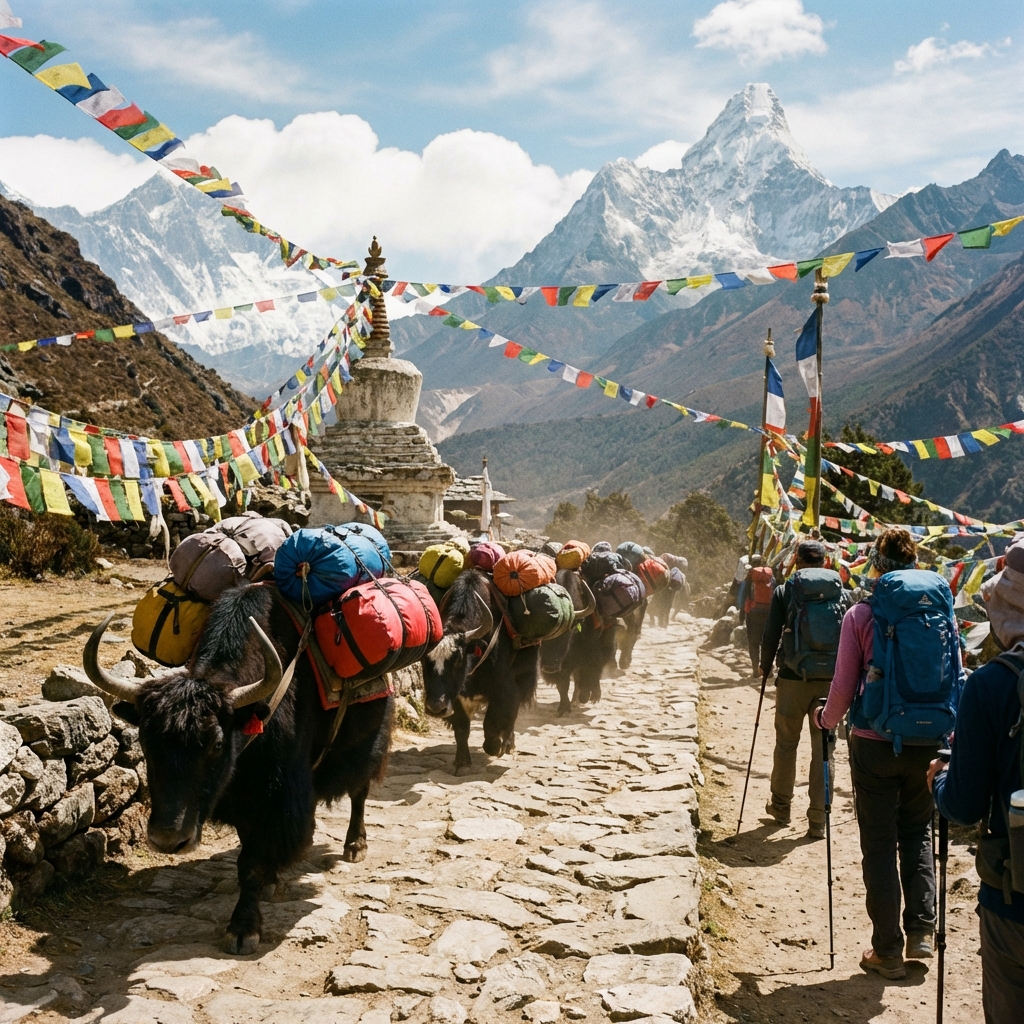
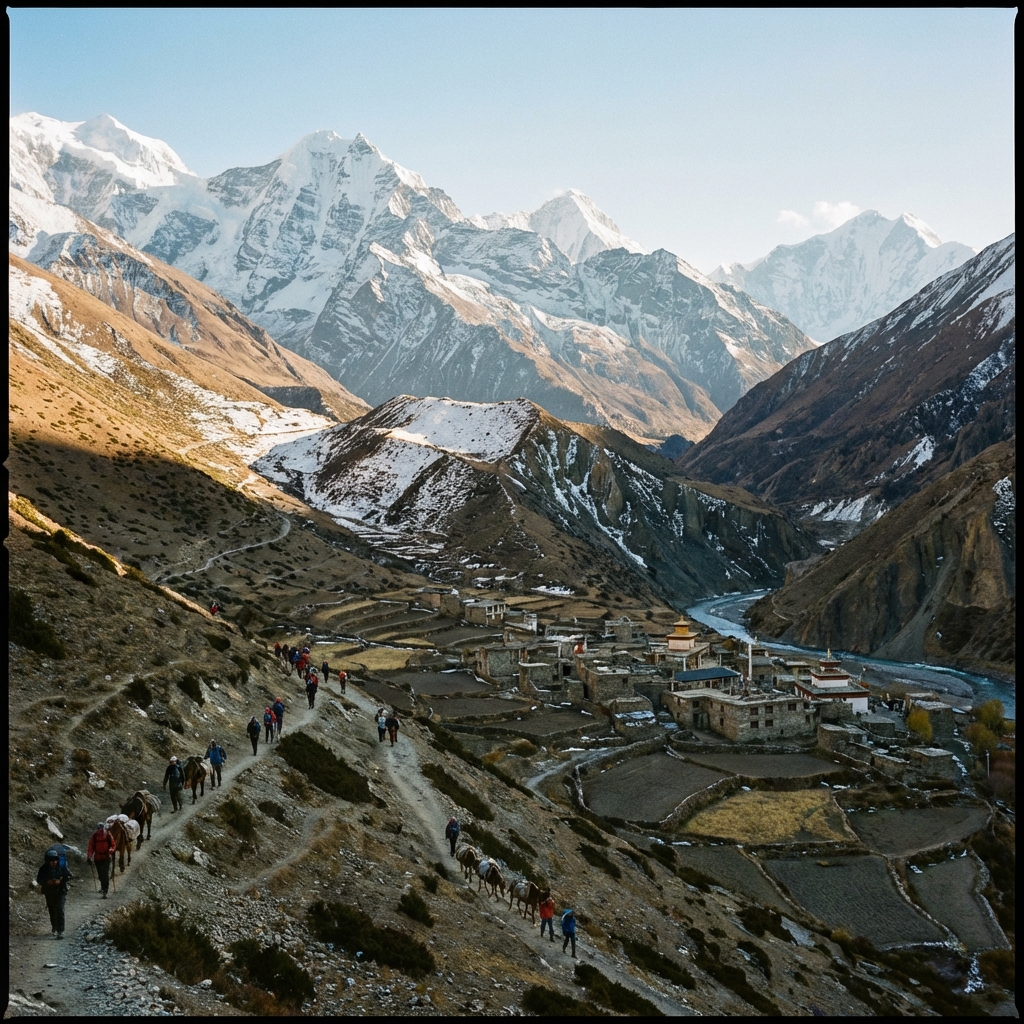
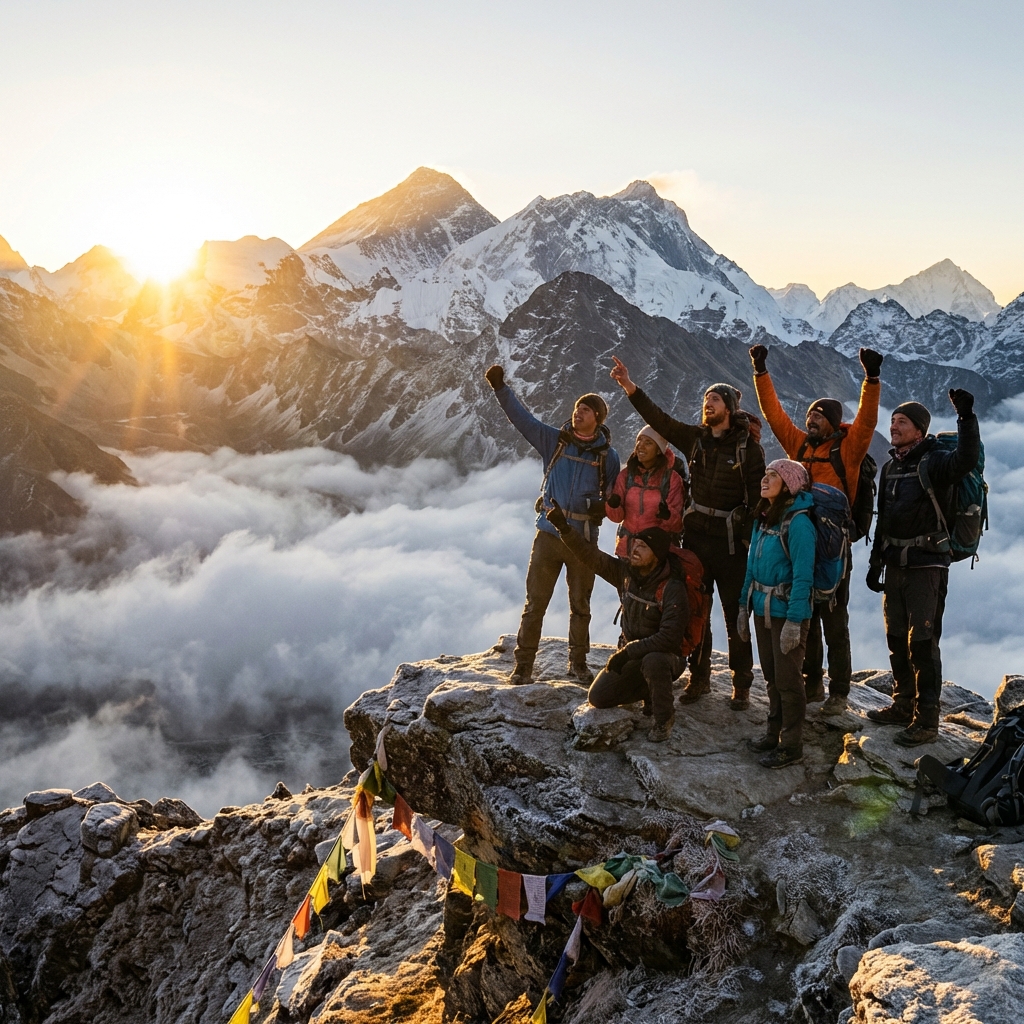
The 14-day Everest Base Camp itinerary is the gold standard for reaching the foot of the world's highest mountain. It's the sweet spot between safety and efficiency—long enough to acclimatize properly, short enough to fit most vacation schedules, and proven across thousands of successful treks.
This comprehensive guide provides detailed day-by-day breakdowns including exact elevations, trekking times, tea house options, daily costs, acclimatization strategies, and what to expect each step of the way. Whether you're booking with an agency or planning independently, this is your blueprint for the most popular EBC route.
Key highlights of the 14-day route: Two strategic acclimatization days at Namche Bazaar and Dingboche, gradual altitude gain averaging 300-400m per day, time to reach both EBC (5,364m) and Kala Patthar (5,545m), and a buffer day in Kathmandu for common Lukla flight delays.
Quick Facts: 14-Day EBC Trek
14 days (15 with departure day)
12 days on trail
5,545m (Kala Patthar)
2 rest days (Namche, Dingboche)
130km round trip
Moderate-Challenging
March-May, September-November
$35-50 per day on trail
85-90% with proper acclimatization
Sagarmatha Entry ($30) + TIMS ($20)
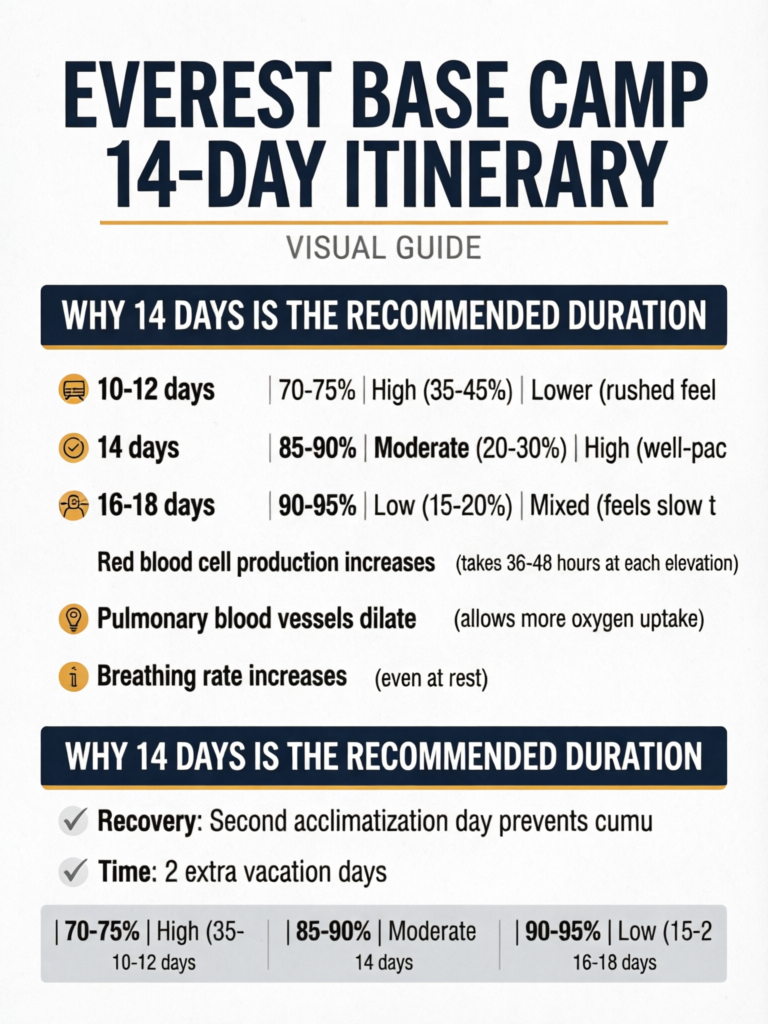
Why 14 Days is the Recommended Duration
After analyzing completion rates, AMS incidence, and trekker satisfaction across thousands of EBC treks, the 14-day itinerary emerges as optimal for most people. Here's why:
Success Rate Comparison
| Itinerary Length | Success Rate | AMS Incidence | Trekker Satisfaction |
|---|---|---|---|
| 10-12 days | 70-75% | High (35-45%) | Lower (rushed feeling) |
| 14 days | 85-90% | Moderate (20-30%) | High (well-paced) |
| 16-18 days | 90-95% | Low (15-20%) | Mixed (feels slow to some) |
The 14-day advantage:
- Two full acclimatization rest days (Namche on Day 4, Dingboche on Day 7)
- Average daily altitude gain stays within safe limits (300-400m)
- Time to complete both EBC and Kala Patthar viewpoint
- Built-in flexibility if weather causes delays
- Buffer day in Kathmandu for notorious Lukla flight issues
What Makes 14 Days "Just Right"
The 14-day route follows the "climb high, sleep low" principle while maintaining steady forward progress. You spend two nights each at Namche Bazaar (3,440m) and Dingboche (4,410m)—the two critical acclimatization checkpoints. This allows your body to produce more red blood cells and adjust to lower oxygen levels at these elevations before pushing higher.
Acclimatization Science
Your body needs 36-48 hours at each 1,000m elevation gain to produce sufficient red blood cells and adjust pulmonary blood flow. The 14-day itinerary provides exactly this timing at Namche (3,440m) and Dingboche (4,410m), which are roughly 1,000m apart. Faster itineraries skip these crucial adaptation periods.
Why Not 12 Days? Why Not 16 Days?
Understanding the trade-offs helps you decide if modifications make sense for your situation.
The 12-Day "Express" Route
What you lose:
- One acclimatization day (usually Dingboche rest day removed)
- Flexibility for weather delays
- Recovery time if you feel mild AMS symptoms
Who should consider 12 days:
- Previous high-altitude experience (4,500m+)
- Limited vacation time
- Fit, athletic individuals with strong cardiovascular health
- Willing to accept 10-15% higher AMS risk
Typical 12-day modification: Skip the Dingboche acclimatization day, combining Days 6-7 into one. This means going straight from Tengboche to Dingboche one day, then Dingboche to Lobuche the next—two consecutive days of significant altitude gain without rest.
The 16-Day "Leisure" Route
What you gain:
- Extra acclimatization time (often adding Namche extra night or Pheriche rest day)
- More relaxed daily pace
- Better photography opportunities
- Lower physical demands
Who should consider 16 days:
- First time above 4,000m
- Age 50+ (recovery takes longer)
- History of altitude sensitivity
- Prefer slower pace to enjoy villages and scenery
Typical 16-day modification: Add an extra night in Namche or add a rest day in Pheriche on the descent. Some itineraries split the Lukla-Phakding section into two shorter days.
Pro Tip
If you're torn between 14 and 16 days, book the 14-day itinerary. You can always add rest days spontaneously during the trek if you feel you need them. Most lodges have availability outside peak season. But cutting days once you're on trail is much harder if you've already paid for a 16-day package.
Overview of the 14-Day Route
The standard 14-day EBC trek follows a well-established route through the Khumbu Valley, ascending via the Dudh Kosi river valley through traditional Sherpa villages, reaching EBC and Kala Patthar at the highest point, then descending via the same route.
Route Highlights
Days 0-1: Kathmandu (Arrival & Preparation)
- Permits processing
- Gear checks and purchases
- Cultural sightseeing (optional)
Days 2-4: Lower Khumbu (2,610m to 3,440m)
- Lukla flight and start of trek
- Gentle introduction through Phakding
- Significant climb to Namche Bazaar
- First acclimatization day with hike to Everest View Hotel
Days 5-7: Middle Khumbu (3,440m to 4,410m)
- Spectacular traverse to Tengboche Monastery
- Climb through rhododendron forests to Dingboche
- Second acclimatization day with Nangkartshang Peak hike
Days 8-10: Upper Khumbu (4,410m to 5,545m)
- Final push to Lobuche and Gorak Shep
- Afternoon hike to Everest Base Camp (5,364m)
- Pre-dawn climb to Kala Patthar (5,545m) for sunrise
- Begin descent to Pheriche
Days 11-13: Descent (4,371m to 2,840m)
- Rapid descent to Namche, then Lukla
- Flight back to Kathmandu
Day 14: Buffer Day
- Accounts for Lukla flight delays (very common)
- Kathmandu exploration if flight goes smoothly
Complete Day-by-Day Breakdown
Day 0: Arrive in Kathmandu (1,400m)
Activities: Airport transfer, hotel check-in, trip briefing with agency (if guided)
What to expect: Kathmandu's Tribhuvan International Airport is chaotic but straightforward. Most trekkers stay in Thamel, the tourist district, which is 30-45 minutes from the airport depending on traffic. Your hotel or agency should arrange pickup.
Evening priorities:
- Attend trek briefing (if guided)
- Review your gear checklist
- Confirm Lukla flight time for tomorrow (usually 6-8am departure)
- Get to bed early (4am wake-up common)
Accommodation: Hotel in Thamel district Cost: Included in trek package or $215-50 if booking independently
Lukla Flight Timing
Lukla flights operate early morning (6am-10am) when weather is most stable. You'll need to be at the airport 5am or earlier. Some agencies have you fly from Ramechhap (4-5 hour drive from Kathmandu) during peak season to avoid Kathmandu airport congestion. Confirm this detail with your agency.
Day 1: Kathmandu Preparation & Sightseeing (1,400m)
Activities: Permit collection, final gear purchases, optional sightseeing
Permit processing: If trekking independently, visit the Nepal Tourism Board office in Bhrikutimandap to obtain your Sagarmatha National Park Entry Permit ($30 for SAARC nationals, $50 for others) and TIMS card ($20). Bring passport photos and photocopies. If with an agency, they handle this.
Gear shopping: Thamel has dozens of trekking shops selling both authentic and knockoff gear. Bargain aggressively—start at 40% of asking price. Essential items often purchased in Kathmandu:
- Down jacket (rent or buy: $30-80)
- Sleeping bag (rent: $1-2/day)
- Trekking poles ($15-40)
- Water purification tablets
- Snacks for the trail
Optional sightseaks: Swayambhunath (Monkey Temple), Pashupatinath Temple, Boudhanath Stupa. All three can be visited in 4-5 hours with taxi.
Accommodation: Hotel in Thamel Cost: $15-50 depending on hotel choice
Pro Tip
Don't over-buy in Kathmandu. Namche Bazaar has excellent gear shops (Khumbu Mountaineering, Sherpa Adventure Gear) with high-quality items at similar prices. If you realize you forgot something, you can purchase it there. However, above Namche, gear availability drops significantly and prices increase.
Day 2: Fly to Lukla (2,840m), Trek to Phakding (2,610m) — 3-4 hours
Starting elevation: 1,400m (Kathmandu) Ending elevation: 2,610m (Phakding) Elevation gain: +1,440m (flight) then -230m (trek) Distance: 8.3km Trekking time: 3-4 hours Terrain: Well-maintained trail, mostly downhill, few stone staircases
Morning: The Lukla flight is an experience itself. The 35-minute flight on a 12-16 seat Twin Otter or Dornier aircraft offers stunning Himalayan views. Lukla's Tenzing-Hillary Airport (renamed from Lukla Airport) has a 527-meter runway on a mountain slope—it's thrilling but safe (pilots are highly experienced).
Lukla village: After landing, your guide will arrange porter assignments, final gear checks, and breakfast. Lukla sits at 2,840m—you've just jumped from 1,400m, so take it easy today. The first day is deliberately short to allow initial altitude adjustment.
Trek to Phakding: The trail descends gently through Chaurikharka and Ghat villages, following the Dudh Kosi river valley. You'll cross several suspension bridges and pass mani stones (carved Buddhist prayer stones). The walking is easy—consider it a warmup day.
What you'll see:
- First views of Kongde Ri (6,187m) and Kusum Kanguru (6,367m)
- Traditional Sherpa villages with colorful prayer flags
- Yak trains carrying supplies up the valley
- Dozens of other trekkers (EBC route is busy from Day 1)
Tea house options in Phakding:
- Khumbu Lodge ($8-10/night) - Clean rooms, good dal bhat
- Sherpa Guide Lodge ($8-12/night) - Hot showers, WiFi available
- Mountain Nest Lodge ($10-15/night) - Newer facility, better mattresses
Daily costs:
- Accommodation: $8-15
- Meals: $15-20 (breakfast $4-5, lunch $6-8, dinner $6-8)
- Hot shower: $3-5
- WiFi: $3-5/day or free with meal purchase
- Phone charging: $1-2
- Total: $30-40
Photography opportunities:
- Lukla airport runway (if you're brave)
- Suspension bridges over turquoise Dudh Kosi river
- Sunset over Kongde Ri from Phakding
Why Sleep Lower Than Lukla?
Some trekkers wonder why we descend from Lukla (2,840m) to Phakding (2,610m) on Day 2. The answer is acclimatization strategy: after the sudden 1,440m altitude gain via flight, sleeping 230m lower helps your body adjust more gradually. The "climb high, sleep low" principle starts immediately.
Day 3: Phakding to Namche Bazaar (3,440m) — 6-7 hours
Starting elevation: 2,610m Ending elevation: 3,440m Elevation gain: +830m Distance: 10.4km Trekking time: 6-7 hours Terrain: Steep ascent final 2 hours, multiple suspension bridges, stone staircases
Why this is the hardest day so far: The climb from the Dudh Kosi river (2,805m) to Namche Bazaar involves a relentless 635m ascent over 2 hours. It's the first truly challenging day, and you're not yet acclimatized. Take it slow—this is not a race.
Morning section (3-4 hours to Jorsale):
- Cross several dramatic suspension bridges
- Pass through Monjo village (entry checkpoint for Sagarmatha National Park—show permits)
- High, exposed bridge over the Dudh Kosi gorge
- Arrive at Jorsale (2,740m) for lunch
Afternoon section (2-3 hours to Namche):
- Cross final bridge over confluence of Dudh Kosi and Bhote Kosi rivers
- Begin steep ascent through pine forest
- First possible views of Everest (8,849m) and Lhotse (8,516m) from clearing
- Arrive at Namche Bazaar, the "Gateway to Everest"
Namche Bazaar: This is the largest settlement in Khumbu, with 1,500+ residents, dozens of lodges, restaurants, bakeries, gear shops, ATMs (not always working), pharmacies, and even a Starbucks knockoff. It's built in a horseshoe shape on a steep hillside with stunning views.
Tea house options in Namche Bazaar:
- Khumbu Lodge (lower Namche) - $10-15/night, good budget option
- Namche Nest - $15-20/night, excellent bakery attached
- Tashi Delek Lodge - $12-18/night, central location
- Hotel Himalayan Lodge - $20-30/night, hot showers more reliable
- Panorama Lodge (upper Namche) - $15-25/night, amazing views
Daily costs:
- Accommodation: $10-25
- Meals: $20-25 (prices higher in Namche)
- Hot shower: $4-6
- WiFi: $5/day or free with meals
- Phone charging: $2
- Total: $40-60
Evening in Namche:
- Walk around the market area
- Visit Irish Bar or Sherpa Barista for coffee
- Check out gear shops if you need anything
- Early dinner and early bed (acclimatization rest day tomorrow)
Pro Tip
On the final ascent to Namche, take the left fork when the trail splits—it's slightly longer but has better views and is less steep. The right fork (direct route) is steeper and more crowded with porter traffic. Most guides take the left fork.
Day 4: Namche Bazaar Acclimatization Day — Everest View Hotel Hike
Starting/ending elevation: 3,440m Hike elevation: 3,880m (Everest View Hotel) Elevation gain: +440m (hike), -440m (return) Distance: 5-6km round trip Trekking time: 3-4 hours Terrain: Moderate uphill, well-marked trail
Why rest days aren't really rest: The acclimatization hikes are crucial. You climb 300-500m higher than your sleeping elevation, then return. This "climb high, sleep low" approach triggers red blood cell production while minimizing altitude sickness risk.
Classic acclimatization hike route:
- Start after breakfast (8-9am)
- Climb switchbacks above Namche through Syangboche
- Visit Everest View Hotel (3,880m)—world's highest placed hotel, excellent photo spot
- Optional extension to Khumjung village (3,790m) to see Hillary School and monastery with "yeti scalp"
- Return to Namche for lunch
- Afternoon rest
Alternative acclimatization options:
- Hike to Thame village (3,800m) - 4-5 hours round trip, less crowded
- Visit Namche Museum (3,440m) - Learn Sherpa culture and mountaineering history
- Hike to Khunde village (3,840m) - See Hillary Hospital
What you'll see from Everest View Hotel:
- Mount Everest (8,849m)
- Lhotse (8,516m)
- Ama Dablam (6,812m)
- Thamserku (6,623m)
- Panoramic Khumbu valley views
How your body feels today:
- Morning: Possible mild headache (normal)
- Afternoon: Headache should reduce after descending
- Evening: Should feel stronger and hungrier than yesterday
Daily costs:
- Accommodation: $10-25 (second night Namche)
- Meals: $20-25
- Coffee at Everest View Hotel: $5-8
- Total: $35-60
Listen to Your Body
If you have a severe headache, nausea, or dizziness that doesn't improve after descending from the acclimatization hike, these are red flags. Consult your guide or lodge owner. Mild headache is normal; persistent symptoms are not. Do not ignore warning signs—altitude sickness can escalate quickly above 3,000m.
Day 5: Namche to Tengboche (3,860m) — 5-6 hours
Starting elevation: 3,440m Ending elevation: 3,860m Elevation gain: +420m (net), +780m total with descent Distance: 10km Trekking time: 5-6 hours Terrain: Descend then ascend pattern, forested trail, moderate difficulty
Trail profile: This day involves descending 360m to Phunki Thenga (3,250m), then climbing 610m to Tengboche—a classic Himalayan "down then up" day. The final ascent through rhododendron forest is beautiful, especially in March-April when flowers bloom.
Morning section (2-3 hours to Phunki Thenga):
- Traverse hillside with spectacular Ama Dablam views
- Pass through Kyangjuma and Sanasa villages
- Descend steeply to Phunki Thenga for lunch
Afternoon section (2-3 hours to Tengboche):
- Cross bridge over Imja Khola river
- Steep climb through rhododendron and fir forest
- Arrive at Tengboche (also spelled Thyangboche)
Tengboche Monastery: This is the spiritual heart of the Khumbu region. The monastery sits on a ridge with 360-degree mountain views, including close-up vistas of Ama Dablam. Evening prayer ceremonies (3-4pm) are open to visitors—respectful attendance is encouraged.
What you'll see:
- Ama Dablam (6,812m) dominates the skyline
- Everest visible to the north
- Lhotse (8,516m) and Nuptse (7,861m)
- Monastery's ornate interior (if open)
Tea house options in Tengboche:
- Tashi Delek Lodge - $12-20/night
- Hotel Tashi Delek - $15-25/night, best location
- Rivendell Lodge - $12-18/night
Note: Tengboche has limited lodges (only 5-6), so in peak season, you might need to stay in Deboche (15 minutes below) or Pangboche (30 minutes ahead).
Daily costs:
- Accommodation: $12-25
- Meals: $20-28 (prices increasing with altitude)
- Hot shower: $5-7
- WiFi: $5-7/day
- Phone charging: $2-3
- Total: $45-65
Evening priorities:
- Attend 3pm monastery ceremony if energy allows
- Early dinner (5-6pm)
- Organize gear for tomorrow
- Bed by 8pm (high altitude sleep is lighter)
Pro Tip
Tengboche is at 3,860m—420m higher than Namche where you just spent two nights. Some people feel breathless or have mild headaches tonight. This is normal after the first significant altitude gain post-acclimatization. Drink extra water, walk slowly, and the symptoms should resolve within a few hours. If they worsen overnight, inform your guide in the morning.
Day 6: Tengboche to Dingboche (4,410m) — 5-6 hours
Starting elevation: 3,860m Ending elevation: 4,410m Elevation gain: +550m (net), +680m with ups and downs Distance: 11km Trekking time: 5-6 hours Terrain: Moderate climbs, alpine meadows, increasingly barren landscape
Landscape transition: Today you leave the forested zone and enter the alpine desert. Trees disappear, replaced by low shrubs, grasses, and rocky terrain. The air feels thinner—you're now above 4,000m for the first time.
Morning section (2.5-3 hours to Pangboche):
- Descend through birch and rhododendron forest
- Cross bridge over Imja Khola
- Pass through Deboche and Pangboche villages
- Optional 15-minute detour to Pangboche Monastery (oldest in Khumbu)
Afternoon section (2-3 hours to Dingboche):
- Gradual climb through Somare village
- Trail splits: right to Dingboche, left to Pheriche (we go right)
- Enter wide Imja Valley with massive peaks on both sides
- Arrive at Dingboche
Dingboche village: This large settlement sits in a wide valley surrounded by stone-walled fields (used to protect crops from wind and yaks). It's one of the highest permanent settlements in the world. The views are spectacular—Lhotse, Ama Dablam, and Island Peak visible.
Tea house options in Dingboche:
- Bright Star Lodge - $12-18/night, friendly owners
- Good Luck Lodge - $15-20/night
- Hotel Snow Lion - $15-25/night, good bakery
- Himalayan Lodge - $12-20/night
- Hotel Dingboche Resort - $20-30/night, best hot showers
Daily costs:
- Accommodation: $12-25
- Meals: $25-30 (prices climbing with altitude)
- Hot shower: $6-8
- WiFi: $6-8/day
- Phone charging: $3
- Total: $50-70
Afternoon in Dingboche:
- Walk around the village stone walls
- Visit the memorial stupas for climbers who died on Everest (sobering reminder)
- Hydrate aggressively (aim for 4-5 liters of fluid today)
- Early dinner and rest (big acclimatization hike tomorrow)
Dingboche vs Pheriche
The trail splits after Pangboche—right goes to Dingboche, left goes to Pheriche. Both are at similar elevations (4,410m vs 4,371m) and are equally good acclimatization spots. Most 14-day itineraries go to Dingboche on ascent because it has more lodges and better views. Both routes converge at Dughla/Thukla on Day 8.
Day 7: Dingboche Acclimatization Day — Nangkartshang Peak Hike
Starting/ending elevation: 4,410m Hike elevation: 5,100m (Nangkartshang Peak) or 5,150m (Nagarjun Hill) Elevation gain: +690-740m (hike), -690-740m (return) Distance: 8-10km round trip Trekking time: 4-5 hours Terrain: Steep but non-technical, scree and rocky trail
The second crucial rest day: This acclimatization hike is tougher than the Namche one. You'll climb nearly 700m to cross the 5,000m threshold for the first time. This prepares your body for Lobuche (4,940m) tomorrow and EBC (5,364m) the day after.
Route options:
Option 1: Nangkartshang Peak (5,100m) - Most popular
- Start after breakfast (7-8am)
- Climb steeply behind Dingboche
- Reach summit ridge (5,100m) in 2-2.5 hours
- Panoramic views: Makalu (8,485m), Lhotse, Ama Dablam, Island Peak
- Descend to Dingboche for lunch (1.5-2 hours down)
Option 2: Chukhung Valley (4,730m)
- Hike east toward Chukhung village
- Options to climb Chukhung Ri (5,550m) if feeling strong
- Good alternative if weather is poor for Nangkartshang
How you'll feel:
- First hour: Lungs working hard, legs okay
- At 5,000m: Short of breath with any exertion, need frequent breaks
- At summit: Lightheaded, breathless, but exhilarated
- After descending: Headache should clear, appetite returns
What you'll see:
- Six of the world's fourteen 8,000m peaks visible
- Island Peak (6,189m) looks climbable (it is, with proper training)
- Lhotse's massive south face
- Imja Glacier
Daily costs:
- Accommodation: $12-25 (second night Dingboche)
- Meals: $25-30
- Hot chocolate at summit: Priceless
- Total: $45-60
Pro Tip
Start the acclimatization hike early (7-8am) for three reasons: (1) Morning light is best for photography, (2) Afternoon winds pick up above 5,000m and make the hike less pleasant, (3) You want to be back down by 2pm for lunch and rest before the dinner rush. If you start at 10am, you'll still be climbing at noon when winds intensify.
Day 8: Dingboche to Lobuche (4,940m) — 5-6 hours
Starting elevation: 4,410m Ending elevation: 4,940m Elevation gain: +530m Distance: 8.5km Trekking time: 5-6 hours Terrain: Rocky, moraine trail, gradually ascending
Entering the death zone approach: Today you climb above the vegetation line entirely. It's rocky, barren, and beautiful in a stark way. You'll pass memorials to climbers who died on Everest—a somber reminder of the mountain's power.
Morning section (2-3 hours to Dughla):
- Gentle climb through Dingboche valley
- Pass summer yak pastures (empty in fall/spring)
- Arrive at Dughla (4,620m) for tea break
Afternoon section (2-3 hours to Lobuche):
- Steep climb from Dughla to memorial area (4,830m)
- Pass dozens of stone memorials and chortens for deceased climbers
- Follow moraine of Khumbu Glacier
- Arrive at Lobuche
Lobuche village: This is a small settlement with 10-12 lodges, all basic. Lobuche exists purely to serve trekkers—there's no permanent population. At 4,940m, this is the highest you'll sleep on the standard itinerary before EBC day.
What you'll see:
- Memorial chortens for Scott Fischer, Babu Chiri Sherpa, and dozens of other climbers
- Khumbu Glacier moraine (massive river of ice hidden under rocks)
- Nuptse (7,861m) dominates the view ahead
- Pumori (7,161m) visible to the north
Tea house options in Lobuche:
- All lodges are basic and similar ($15-25/night)
- Eco Lodge Lobuche - Slightly better rooms
- Oxygen Lobuche - Has altitude chamber (PAC)
- Buddha Lodge - Budget option
Note: Don't expect luxury. Rooms are cold, toilets are outside, hot showers are rare/expensive. This is about location, not comfort.
Daily costs:
- Accommodation: $15-25
- Meals: $30-40 (highest prices yet)
- Hot water bottle: $5-8 (highly recommended)
- WiFi: $8-10/day (slow and unreliable)
- Phone charging: $4-5
- Total: $60-85
Evening priorities:
- Hydrate constantly (dehydration is a major AMS contributor)
- Light dinner (your appetite is suppressed at this altitude)
- Organize gear for tomorrow's big day
- Sleep with upper body slightly elevated (helps breathing)
Expect a Rough Night
Sleeping at 4,940m is difficult even for well-acclimatized trekkers. You'll likely experience periodic breathing (Cheyne-Stokes respiration)—your breathing pauses for 10-15 seconds, then you gasp awake. This is normal above 4,500m. You might also wake up with a headache. Drink water, take ibuprofen if needed, and try to rest even if you can't sleep deeply. The night passes.
Day 9: Lobuche to Gorak Shep (5,164m), Afternoon Hike to EBC (5,364m) — 7-8 hours
Starting elevation: 4,940m Midpoint elevation: 5,164m (Gorak Shep) Ending elevation: 5,364m (EBC), return to 5,164m Elevation gain: +224m to Gorak Shep, +200m to EBC Distance: 13km total (3km to GS, 4km to EBC, return) Trekking time: 7-8 hours total Terrain: Rocky glacier moraine, some ice sections
This is it—the day you've been training for. Today you reach Everest Base Camp, the foot of the world's highest mountain. It's a long day (7-8 hours total trekking), but the achievement is extraordinary.
Morning section (2-3 hours to Gorak Shep):
- Start early after breakfast (7-8am)
- Follow moraine of Khumbu Glacier
- Rocky, uneven trail with frequent ups and downs
- Pass frozen ponds and glacial debris
- Arrive at Gorak Shep for lunch and lodge drop-off
Gorak Shep: This is the last settlement before EBC. It sits on a frozen lakebed at 5,164m. There are 6-7 lodges here. You'll drop your main pack, have lunch, rest 1-2 hours, then continue to EBC with a light daypack.
Afternoon section (3-4 hours to EBC and back):
- Leave Gorak Shep at 2-3pm (most groups)
- Follow Khumbu Glacier moraine
- Rocky, undulating trail with some ice patches
- Arrive at Everest Base Camp (5,364m)
At Everest Base Camp: Here's what surprises most trekkers: you can't see Everest summit from Base Camp. It's hidden behind the Nuptse-Lhotse ridge. What you do see:
- Khumbu Icefall (the technical climbing starts here)
- Nuptse (7,861m) rising directly above
- Dozens of colorful expedition tents (in spring season)
- Prayer flags and stone cairns
- The realization: this is where summitters begin their climb
Spring vs Fall EBC experience:
- Spring (March-May): Base Camp is bustling with expedition teams, helicopters, activity
- Fall (September-November): Base Camp is nearly empty—just trekkers and stone markers
Photography opportunities:
- EBC stone marker with prayer flags
- Khumbu Icefall with seracs and crevasses
- Your exhausted, exhilarated face
- Panoramic Khumbu Glacier views
Return to Gorak Shep for the night:
- 2 hours hiking back (easier, mostly downhill)
- Arrive by 6-7pm
- Dinner, early bed (you're waking at 4am tomorrow for Kala Patthar)
Daily costs:
- Accommodation: $15-30 (Gorak Shep)
- Meals: $35-45 (highest prices on route)
- Hot water bottle: $8-10 (essential—nights are freezing)
- WiFi: $10-12/day (barely works)
- Phone charging: $5-6
- Snacks on trail: $5-10
- Total: $80-110
Pro Tip
Pack light for the EBC hike—just bring water, snacks, camera, and warm layers. Leave your main pack at the lodge in Gorak Shep. The trail has many ups and downs over moraine, and every kilogram feels like five at this altitude. Also, start the EBC hike by 2pm at the latest—you need to be back before dark (sunset is 5:30-6pm).
Managing Expectations at EBC
Many trekkers feel underwhelmed at Base Camp because: (1) You can't see Everest summit, (2) It's just a rocky area with tents or stones, (3) You're exhausted and just want to get back. This is normal. The magic moment comes tomorrow morning at Kala Patthar when you see the summit at sunrise. Base Camp is about the achievement, not the view.
Day 10: Gorak Shep to Kala Patthar Sunrise (5,545m), Descend to Pheriche (4,371m) — 7-8 hours
Starting elevation: 5,164m Highest point: 5,545m (Kala Patthar) Ending elevation: 4,371m (Pheriche) Elevation gain: +381m to Kala Patthar Elevation loss: -1,174m to Pheriche Distance: 15km total Trekking time: 7-8 hours total Terrain: Steep ascent to KP, then long descent
The hardest morning of the trek: You'll wake at 4am, hike 1.5-2 hours in darkness to Kala Patthar's summit, and watch sunrise illuminate Everest. It's freezing (-15°C to -25°C), your lungs burn, every step is slow. But the view makes it all worthwhile.
Pre-dawn ascent (1.5-2 hours to Kala Patthar):
- Wake at 4am
- Quick breakfast or just tea
- Start hiking by 4:30am with headlamps
- Steep, switchbacking trail
- 381m elevation gain at 5,000m+ is extremely difficult
- Arrive at Kala Patthar summit by 6-6:30am
Kala Patthar sunrise (5,545m): This is the highest point on the entire trek and offers the best view of Everest you'll get without climbing. You're now 3,304m above the Khumbu Glacier and have unobstructed views of:
- Mount Everest (8,849m) summit—finally visible
- South Col (7,906m) where Camp 4 sits
- Lhotse (8,516m) and Nuptse (7,861m)
- Pumori (7,161m) directly behind you
- Changtse (7,543m) in Tibet
- The entire Khumbu region spread below
Sunrise experience:
- First light hits Everest at 5:45-6:15am (varies by season)
- The summit glows orange-pink (alpenglow)
- Everyone is crying, laughing, hugging, or silent
- Temperature: -15°C to -25°C with wind chill
- Stay 20-40 minutes for photos
Descent (5-6 hours to Pheriche):
- Return to Gorak Shep (1 hour down)
- Quick breakfast at lodge
- Pack up and start descent
- Retrace route through Lobuche (maybe stop for lunch)
- Descend past Dughla memorials
- Take left fork to Pheriche (instead of right to Dingboche)
- Arrive at Pheriche by 4-5pm
Pheriche village: At 4,371m, this is 793m lower than Gorak Shep. You'll feel like you can breathe again. Pheriche has the Himalayan Rescue Association (HRA) clinic, where doctors give daily talks on altitude sickness (free, highly recommended).
Tea house options in Pheriche:
- Himalayan Lodge - $12-18/night
- Tashi Delek Lodge - $12-20/night
- Panorama Lodge - $15-20/night
Daily costs:
- Accommodation: $12-20 (Pheriche)
- Meals: $25-30
- Hot shower: $5-7 (finally available again)
- Total: $50-65
Evening in Pheriche:
- You're exhausted but exhilarated
- Attend HRA clinic talk at 3pm if you have energy
- Celebrate with hot shower and good meal
- Best sleep you've had in 3 days (lower altitude = better rest)
Don't Skip the Descent
Some itineraries suggest sleeping at Gorak Shep again after Kala Patthar. This is a mistake. After 2 nights above 4,900m and reaching 5,545m, your body needs lower altitude. Descending to Pheriche (4,371m) significantly reduces AMS risk and allows better sleep. Yes, it's a long day, but it's mostly downhill after Kala Patthar, and you'll be running on adrenaline.
Day 11: Pheriche to Namche Bazaar (3,440m) — 6-7 hours
Starting elevation: 4,371m Ending elevation: 3,440m Elevation loss: -931m Distance: 15km Trekking time: 6-7 hours Terrain: Mostly downhill, some flat sections, easy walking
The fast descent begins: After spending 4 days above 4,000m, you're now descending rapidly. Today you drop nearly 1,000m back to Namche. Your body will thank you—headaches vanish, appetite returns, energy rebounds.
Morning section (3-4 hours to Tengboche):
- Retrace route through Somare and Pangboche
- Stop at Tengboche for lunch (maybe visit monastery again)
- The descent feels easy after days of uphill
Afternoon section (2-3 hours to Namche):
- Pass through Phunki Thenga
- Climb back up to Namche (yes, uphill, but feels easier at this altitude)
- Arrive at Namche by 4-5pm
Why Namche instead of lower? Some itineraries go straight to Lukla today, but that's too much (would be 9-10 hours). Breaking it into two days (Namche today, Lukla tomorrow) is more comfortable and allows time to enjoy Namche's amenities.
Namche celebration:
- First proper hot shower in 5 days
- Real pizza, burgers, bakery items
- WiFi that actually works
- Beers at Irish Bar (alcohol hits hard after altitude)
- Shopping for souvenirs
Daily costs:
- Accommodation: $10-25 (Namche)
- Meals: $25-35 (you'll eat a lot—appetite is back)
- Hot shower: $5-6
- WiFi: $5
- Celebration beers: $8-15
- Total: $60-90
Pro Tip
Don't drink alcohol until you're below 3,000m. Yes, Namche has bars, but alcohol at 3,440m significantly increases dehydration and can trigger mild AMS symptoms even on descent. If you must drink, have one beer with food, and drink twice as much water.
Day 12: Namche to Lukla (2,840m) — 6-7 hours
Starting elevation: 3,440m Ending elevation: 2,840m Elevation loss: -600m Distance: 18.5km Trekking time: 6-7 hours Terrain: Mostly downhill, some uphill sections, stone staircases
The final trekking day: It's bittersweet. You're exhausted and ready to finish, but also sad the adventure is ending. The trek to Lukla retraces your Day 2-3 route in reverse.
Trail breakdown:
- Namche to Jorsale: 2 hours (downhill)
- Jorsale to Phakding: 1.5 hours (gentle descent)
- Phakding to Lukla: 3-4 hours (uphill—saving the hardest section for last)
Lukla arrival: You'll arrive by 3-4pm. Check into a lodge (many choices), confirm your flight time for tomorrow, and celebrate. Most groups have a celebration dinner with their guides and porters tonight, sharing photos and exchanging contact information.
Tea house options in Lukla:
- Everest Summit Lodge - $10-15/night
- Lakeside Lodge - $12-20/night
- Hotel Himalaya - $15-25/night
Daily costs:
- Accommodation: $10-25 (Lukla)
- Meals: $20-30
- Celebration dinner with crew: $30-50 (if treating your guide/porter)
- Hot shower: $4-5
- WiFi: $5
- Total: $70-110 (including crew tips/dinner)
Evening priorities:
- Confirm flight time (check with your lodge—flights are posted nightly)
- Pack everything tonight (early departure tomorrow)
- Tip your guide and porters (if you haven't already)
- Celebrate the achievement
Tipping Guidelines
Tipping is expected and constitutes a significant portion of guide/porter income. Standard rates: Guide: $8-15/day total for the trek; Porter: $5-10/day total. For a 14-day trek, plan to tip your guide $100-200 and porter (if you had one) $70-150. Adjust based on service quality and group size. Tip in Nepali rupees, not USD.
Day 13: Fly Lukla to Kathmandu
Morning: Wake at 4-5am (flight time usually 6:30-9am). Lukla flights operate early when weather is stable. All trekkers sit in the tiny terminal waiting for their flight to be called. Flights are often delayed or cancelled due to weather—this is why Day 14 is a buffer.
If your flight operates:
- 35-minute scenic flight back to Kathmandu
- Arrive at Tribhuvan International Airport
- Transfer to hotel in Thamel
- Hot shower, sleep, laundry, sightseeing
- Celebration dinner
If your flight is cancelled:
- You'll stay another night in Lukla (frustrating but common)
- Flights usually resume the next morning
- This is why you book flexible return tickets and have Day 14 as buffer
Daily costs:
- Lukla accommodation (if delayed): $10-25
- Meals in Lukla or Kathmandu: $15-25
- Hotel in Kathmandu: $20-60
- Celebration dinner: $15-40
- Total: $50-100
Day 14: Buffer Day in Kathmandu
Purpose: This day accounts for Lukla flight delays, which happen 30-40% of the time in peak season due to weather. If your Day 13 flight operated smoothly, you have an extra day in Kathmandu for rest, sightseeing, or shopping.
If you're already in Kathmandu:
- Sleep late (finally)
- Visit sites you missed on Day 1
- Souvenir shopping in Thamel
- Organize photos and update social media
- Recovery massage ($15-30)
- Pizza, burgers, steaks (real food after 2 weeks of dal bhat)
If you're still in Lukla:
- Hopefully fly out today
- Most delayed flights operate within 24 hours
- In rare cases (2-3 day weather closures), consider helicopter evacuation ($500-800 per seat) if you have a flight to catch
Daily costs:
- Hotel in Kathmandu: $20-60
- Meals: $20-40
- Activities: $20-50
- Total: $60-150
Day 15: Depart Nepal
Morning: Transfer to airport (arrive 3 hours early for international flights). Depart Kathmandu with incredible memories, 1,000+ photos, and a sense of achievement that will last forever.
Post-trek priorities back home:
- See doctor if you have persistent cough (Khumbu cough is common)
- Organize and backup photos
- Share experience with friends/family
- Start planning your next Himalayan adventure
Altitude Profile: Visualizing the 14-Day Route
Acclimatization Strategy: Why Two Rest Days Work
The 14-day itinerary incorporates two full acclimatization days—Day 4 in Namche and Day 7 in Dingboche. This isn't arbitrary; it's based on decades of trekking medicine research.
The Science of Acclimatization
At altitude, your body undergoes several physiological changes:
- Red blood cell production increases (takes 36-48 hours at each elevation)
- Pulmonary blood vessels dilate (allows more oxygen uptake)
- Breathing rate increases (even at rest)
- Fluid balance shifts (you urinate more, need more water intake)
These adaptations don't happen instantly. Your body needs time at each elevation threshold to adjust before climbing higher.
Why Namche (Day 4) and Dingboche (Day 7)?
Namche (3,440m): This is the first major elevation gain from the lowlands. You've climbed from 1,400m to 3,440m in 2 days (via flight and trek). Your body needs 2 nights here to:
- Adjust to 50% oxygen availability (vs sea level)
- Begin red blood cell production
- Reset fluid balance
Dingboche (4,410m): This is roughly 1,000m higher than Namche. You've now entered the zone where AMS risk increases significantly. Two nights here allow:
- Continued red blood cell production
- Pulmonary vessel adaptation to lower oxygen
- Recognition of any AMS symptoms before going higher
The "Climb High, Sleep Low" Principle
On both rest days, you don't actually rest—you hike higher than your sleeping elevation, then return. This triggers red blood cell production without the risk of sleeping at that higher elevation.
- Namche rest day: Hike to 3,880m (Everest View Hotel), sleep at 3,440m
- Dingboche rest day: Hike to 5,100m (Nangkartshang), sleep at 4,410m
This approach optimizes acclimatization while minimizing overnight AMS risk.
Altitude Gain Rules of Thumb
The 14-day itinerary follows these established guidelines:
| Rule | 14-Day EBC Adherence |
|---|---|
| Don't ascend more than 500m sleeping elevation per day above 3,000m | ✓ Mostly followed (one exception: Namche to Tengboche is 420m but includes accl day) |
| Take rest day every 1,000m elevation gain | ✓ Rest at Namche (3,440m) and Dingboche (4,410m) |
| Sleep lower than the highest point reached | ✓ Day 4 and 7 accl hikes; Day 10 descend to Pheriche |
| Descend if symptoms worsen | ✓ Schedule allows flexibility |
Acclimatization Is Individual
No two people acclimatize at the same rate. Age, fitness, genetics, and previous altitude exposure all play roles. The 14-day itinerary works for 85-90% of people, but some will need extra rest days, and a few can go faster. Listen to your body, not your ego. If you're struggling at Namche, add an extra day. If you're struggling at Dingboche, consider ending the trek—it gets much harder above 5,000m.
Alternative Route Options
The standard 14-day EBC itinerary is flexible. Here are common variations that add 1-3 days and significant adventure.
Gokyo Lakes Side Trip (+2-3 days)
When to add: After Namche acclimatization day
The Gokyo Lakes route diverges from the standard EBC route at Namche, heading west through the Gokyo Valley instead of continuing to Tengboche. You can:
Option 1: Replace EBC with Gokyo
- Takes same time (14 days total)
- Climb Gokyo Ri (5,357m) instead of Kala Patthar
- See turquoise glacial lakes
- Less crowded than EBC
- Miss the "I went to Base Camp" bragging rights
Option 2: Do both via Cho La Pass
- Add 2-3 days (16-17 day itinerary)
- Trek to Gokyo first, cross Cho La Pass (5,420m), then continue to EBC
- Requires good fitness and clear weather
- Most scenic variation but significantly harder
- Cross one of the three high passes (Everest Three Passes trek)
Chukhung Valley & Island Peak Base Camp (+1-2 days)
When to add: After Dingboche acclimatization day
Instead of going directly to Lobuche on Day 8, detour east to Chukhung village (4,730m). From there you can:
- Hike to Chukhung Ri (5,550m) for stunning Lhotse views
- Trek to Island Peak Base Camp (5,200m)
- Return to Dingboche and rejoin standard route to Lobuche
This adds 1-2 days but provides excellent acclimatization and takes you to less-traveled areas.
Helicopter Return from Gorak Shep
For those short on time:
- Complete Days 1-9 as normal (reach EBC)
- On Day 10, after Kala Patthar sunrise, helicopter from Gorak Shep to Lukla
- Saves 2-3 trekking days
- Cost: $500-800 per person (shared helicopter)
- Environmentally questionable, but increasingly popular
Jiri to EBC Classic Route (+7-9 days)
For purists:
- Start from Jiri (1,905m) instead of flying to Lukla
- This is the route Edmund Hillary and Tenzing Norgay used in 1953
- Adds 7-9 days of trekking through beautiful mid-hills
- Total trip: 21-23 days
- Far less crowded first week
- Better acclimatization (gradual ascent from 1,905m)
Pro Tip
If you're considering alternatives, discuss with your agency before booking. Adding Gokyo or Cho La requires different permits (if going through Cho La), more experienced guides, and different lodge bookings. These can't be arranged spontaneously on trail in peak season.
Tea House Recommendations by Location
Here's a detailed breakdown of the best lodges at each stop, with pricing, amenities, and booking strategies.
Phakding (2,610m) - Night 1
| Lodge Name | Price Range | Amenities | Notes |
|---|---|---|---|
| Khumbu Lodge | $8-10 | WiFi, hot shower ($4), good food | Budget favorite |
| Sherpa Guide Lodge | $8-12 | WiFi, hot shower, charging | Popular with guides |
| Mountain Nest Lodge | $10-15 | Newer, better mattresses | Worth the extra cost |
Booking strategy: Phakding has 15+ lodges. In peak season, arrive by 3pm to get choice of rooms. Solo trekkers should book ahead if traveling in October.
Namche Bazaar (3,440m) - Nights 2-3
| Lodge Name | Price Range | Amenities | Notes |
|---|---|---|---|
| Khumbu Lodge | $10-15 | Central location, WiFi | Gets booked fast |
| Namche Nest | $15-20 | Excellent bakery, hot water | Best breakfast |
| Tashi Delek Lodge | $12-18 | Central, good restaurant | Always busy |
| Panorama Lodge | $15-25 | Upper Namche, amazing views | Steep climb to get there |
| Hotel Himalayan | $20-30 | Best facilities in Namche | Reliable hot showers |
Booking strategy: Namche has 50+ lodges. Arrive by 2-3pm in peak season. Lodge owners meet trekkers on the trail approaching Namche to recruit them—this is normal and acceptable. Going with them doesn't obligate you to stay, but they'll carry your bag to their lodge for you to see it.
Tengboche (3,860m) - Night 4
| Lodge Name | Price Range | Amenities | Notes |
|---|---|---|---|
| Tashi Delek Lodge | $12-20 | Next to monastery | Premium location |
| Hotel Tashi Delek | $15-25 | Slightly better rooms | Same family, different building |
| Rivendell Lodge | $12-18 | Good food | Tolkien fans love the name |
Booking strategy: Only 5-6 lodges in Tengboche proper. If full, stay in Deboche (15 min below) or Pangboche (30 min ahead). Peak season (Oct 15-Nov 5) often requires staying in Pangboche.
Dingboche (4,410m) - Nights 5-6
| Lodge Name | Price Range | Amenities | Notes |
|---|---|---|---|
| Bright Star Lodge | $12-18 | Friendly family, clean | Excellent dal bhat |
| Good Luck Lodge | $15-20 | Good bakery items | Live up to the name |
| Hotel Snow Lion | $15-25 | Bakery, good food | Popular with agencies |
| Himalayan Lodge | $12-20 | Basic but clean | Budget option |
Booking strategy: Dingboche is large (20+ lodges). You'll find space even in peak season. Lodge owners aggressively recruit on the trail from Pangboche—this is normal.
Lobuche (4,940m) - Night 7
| Lodge Name | Price Range | Amenities | Notes |
|---|---|---|---|
| All lodges similar | $15-25 | Basic, cold, outside toilets | Don't expect comfort |
| Eco Lodge Lobuche | $20-30 | Slightly better | Has PAC (altitude chamber) |
| Oxygen Lobuche | $20-30 | Altitude chamber | Good for AMS concerns |
Booking strategy: All Lobuche lodges are equally basic. Focus on booking early in the day (arrive by 2-3pm) to get a room on the sunny side of the building—these are marginally warmer.
Gorak Shep (5,164m) - Night 8
| Lodge Name | Price Range | Amenities | Notes |
|---|---|---|---|
| All lodges similar | $15-30 | Very basic, freezing | Highest lodges on trek |
Booking strategy: Arrive early (before 2pm) to secure a room. Some groups book ahead via guide's satellite phone. The dining halls are where everyone congregates—rooms are just for sleeping.
Pheriche (4,371m) - Night 9
| Lodge Name | Price Range | Amenities | Notes |
|---|---|---|---|
| Himalayan Lodge | $12-18 | Clean, good food | Near HRA clinic |
| Tashi Delek Lodge | $12-20 | Standard | Always reliable |
| Panorama Lodge | $15-20 | Good views | Upper part of village |
Booking strategy: After sleeping high at Gorak Shep, any room at Pheriche will feel like luxury. Arrive by 4-5pm (after descending from Kala Patthar), and you'll have options.
General Tea House Strategies
- Arrive early: Lodges fill up 3-5pm in peak season. Earlier arrival = better room choices
- Lodge-hopping is bad form: Pick a lodge and eat all meals there. Rooms are cheap/free; lodges make money on food
- Negotiate at shoulder season: In March/June or late November, you can bargain on room rates
- WiFi is sold separately: Usually $5-10/day or free with meal purchases
- Charging costs add up: $1-5 per device depending on altitude. Bring a power bank
- Hot showers waste resources: At high altitude, heating water is expensive and environmentally costly. Shower in Namche and Pheriche; use wet wipes elsewhere
Tea House Code of Conduct
Tea houses operate on a "room is cheap, food is profit" model. The unwritten rule: if you stay at a lodge, you eat all meals there. Don't stay at Lodge A and eat at Lodge B—this is considered very rude and may get you blacklisted from lodges. The community is small and word spreads.
Daily Costs Breakdown: What to Actually Budget
The 14-day EBC trek costs $800-1,500 for accommodation and food on trail, depending on your choices. Here's the detailed breakdown.
Cost Per Day by Location
| Location | Accommodation | Breakfast | Lunch | Dinner | Hot Shower | WiFi | Charging | Daily Total |
|---|---|---|---|---|---|---|---|---|
| Phakding | $8-15 | $4-6 | $6-8 | $6-8 | $3-5 | $3-5 | $1-2 | $31-49 |
| Namche | $10-25 | $5-7 | $8-12 | $8-12 | $4-6 | $5 | $2 | $42-69 |
| Tengboche | $12-25 | $5-7 | $8-12 | $8-12 | $5-7 | $5-7 | $2-3 | $45-73 |
| Dingboche | $12-25 | $6-8 | $10-14 | $10-14 | $6-8 | $6-8 | $3 | $53-80 |
| Lobuche | $15-25 | $7-10 | $12-16 | $12-16 | $8-12 | $8-10 | $4-5 | $66-104 |
| Gorak Shep | $15-30 | $8-12 | $15-20 | $15-20 | N/A | $10-12 | $5-6 | $68-100 |
| Pheriche | $12-20 | $6-8 | $10-14 | $10-14 | $5-7 | $6-8 | $3 | $52-74 |
Total Trek Budget (Days 2-12)
Budget Trekker ($25-$40 /day):
- Stay basic lodges, no hot showers above Namche
- Dal bhat for all meals (most filling, best value)
- No WiFi or minimal charging
- No alcohol or snacks
- 11 days = $385-440
Standard Trekker ($50-60/day):
- Mid-range lodges, hot showers in Namche and Pheriche
- Mix of dal bhat and Western food
- WiFi at lower elevations
- Some device charging
- Occasional snacks/hot chocolate
- 11 days = $550-660
Comfort Trekker ($70-90/day):
- Best available lodges
- Hot showers whenever available (environmental impact be damned)
- Western food preferences
- WiFi and charging everywhere
- Snacks, chocolate, energy bars
- Beer/alcohol in Namche
- 11 days = $770-990
Additional Costs Beyond Daily Budget
Don't forget these expenses:
| Item | Cost |
|---|---|
| Lukla flights (roundtrip) | $215-400 |
| Permits (Sagarmatha + TIMS) | $50 |
| Kathmandu hotels (3 nights) | $45-180 |
| Kathmandu meals (3 days) | $60-120 |
| Gear rental (if needed) | $50-150 |
| Guide tip | $100-200 |
| Porter tip (if used) | $70-150 |
| Emergency fund | $100-200 |
| Total additional | $825-1,550 |
Grand Total Budget
Budget Independent Trek: $1,260-2,040 Standard Guided Trek: $1,375-2,210 Comfort Trek: $1,595-2,540
These figures assume independent trekking. Guided agency packages cost $1,200-2,500 all-inclusive depending on agency and service level.
Pro Tip
Bring cash in small bills (NPR 100, 500, 1000 notes). ATMs exist in Namche but often don't work. No ATMs above Namche. I recommend carrying 100,000-150,000 NPR ($750-1,100 USD) in cash for the trek. It sounds like a lot, but costs add up, and you have no other payment options above Phakding.
Where Costs Increase Most
Altitude pricing: Every 500m higher = roughly 15-20% price increase for the same item
Examples:
- Dal bhat: $6 in Phakding → $8 in Namche → $12 in Dingboche → $18 in Gorak Shep
- Snickers bar: $2 in Namche → $3 in Dingboche → $5 in Gorak Shep
- Bottle of water: $1 in Phakding → $2 in Namche → $5 in Gorak Shep
Why? Everything above Lukla is carried by porters, yaks, or helicopters. The higher you go, the fewer porters want to carry, so wages increase, which increases prices.
Money-Saving Strategies
- Always order dal bhat: Unlimited refills, most calories per dollar
- Treat water chemically: Buying bottled water adds $50+ to your trek cost
- Shower in Namche only: Wet wipes for the rest
- Bring power bank: Saves $30-50 in charging fees
- Download maps/books: WiFi is expensive and slow
- Bring snacks from Kathmandu: Trail mix, energy bars, chocolate bought in Thamel costs 40-50% less than on trail
Packing for 14 Days: What You Actually Need
You'll be living out of a 50-60L backpack (or duffel if you hire a porter) for two weeks. Here's what to bring and what to leave behind.
The 14-Day Packing Reality
You'll wear the same 2-3 outfits the entire trek. This is normal. Everyone is dirty. No one cares. Pack for versatility and layering, not variety.
Essential Clothing (What You'll Actually Wear)
Base layers:
- 2 thermal tops (wear one, spare one)
- 2 thermal bottoms (same rotation)
- 4-5 underwear (wool or synthetic, not cotton)
- 3-4 pairs wool socks (wear two pairs at high altitude)
Mid layers:
- 1 fleece jacket
- 1 down jacket (critical above 4,000m)
- 2 trekking shirts (1 long sleeve, 1 short sleeve)
- 2 trekking pants (1 worn, 1 spare—many people bring 1 and just wash it)
Outer layers:
- 1 waterproof jacket (hard shell)
- 1 waterproof pants (you might not need these if trekking dry season)
- 1 warm hat (beanie)
- 1 sun hat (wide brim)
- 1 buff/neck gaiter
- 1 pair liner gloves
- 1 pair insulated gloves/mittens (for Kala Patthar morning)
Footwear:
- 1 pair broken-in trekking boots
- 1 pair camp shoes (Crocs, sandals, or light sneakers for evenings)
- Gaiters (optional, useful in snow)
Gear Essentials
The critical items:
- 50-60L backpack (or 70-80L duffel if hiring porter)
- Sleeping bag (rated -10°C minimum, -20°C better)
- Trekking poles (massively reduce knee strain, especially descending)
- Headlamp with spare batteries
- Sunglasses (Category 4 UV protection—snow blindness is real)
- Water bottles (2x 1L) or hydration bladder
- Water purification (tablets, filter, or SteriPen)
- Power bank (20,000mAh minimum)
- Personal first aid kit
- Toiletries (travel size)
- Sunscreen SPF 50+ (UV is intense at altitude)
- Lip balm with SPF
- Quick-dry towel (small)
- Wet wipes (you'll use these instead of showering)
- Toilet paper (lodges often run out)
- Hand sanitizer
Nice to have:
- Camera + extra batteries
- Book or Kindle
- Journal and pen
- Playing cards (for lodge downtime)
- Earplugs (lodges are noisy—thin walls, snorers)
- Eye mask (for Kala Patthar 4am wake-up)
- Buff/face mask (wind protection)
What NOT to Bring
These items add weight without value:
- More than 2 spare outfits
- Heavy camera equipment (your phone is fine)
- Laptop or tablet
- Multiple books (bring one or use Kindle)
- Cotton anything (doesn't dry, terrible at altitude)
- Hair dryer
- Excessive toiletries
- Perfume/cologne
Laundry Options on Trail
Lower altitude (Lukla to Namche): Lodges offer laundry service ($5-10 per load). Clothes dry in 1-2 days.
Mid altitude (Tengboche to Dingboche): Lodges still offer laundry, but drying takes 2-3 days due to cold and humidity. Not recommended.
High altitude (Lobuche to Gorak Shep): No laundry services. Clothes won't dry due to cold. Use wet wipes.
Strategy: Wash clothes in Namche on Day 3, wear them on Day 4 acclimatization day, and they'll be dry by Day 5 departure.
Resupply Possibilities
Namche Bazaar is your last chance to buy quality gear. After Namche:
- Tengboche: Very limited—basic snacks only
- Dingboche: Some snacks and basic supplies
- Lobuche/Gorak Shep: Candy bars and instant noodles only
What you can buy in Namche:
- Down jackets ($30-80)
- Sleeping bags (rent $2/day)
- Trekking poles ($15-40)
- Sunglasses ($10-30)
- Gloves, hats, buffs ($5-20)
- Snacks and energy bars (expensive but available)
- Toiletries (limited selection)
Pro Tip
Rent heavy items (down jacket, sleeping bag) in Kathmandu instead of buying, especially if you won't use them after this trek. Rental costs $1-3/day ($15-45 for the full trek), while buying costs $50-200. Many shops offer rental with deposit—you get the deposit back when you return the item.
Porter vs Carrying Your Own Pack
Carrying your own pack:
- Weight limit: 8-10kg (18-22 lbs) maximum
- Requires good physical conditioning
- More flexibility (can stop/start when you want)
- Cheaper (no porter fee)
Hiring a porter:
- They carry up to 20-25kg (44-55 lbs) for two trekkers
- You carry only a daypack (3-4kg)
- Cost: $20-$30 /day
- Provides employment to local communities
- Much easier, especially for older trekkers or those with knee issues
Recommendation: If you're over 50, have any knee/back issues, or aren't an experienced backpacker, hire a porter. The $300-400 cost is worth it for the reduced physical strain and injury risk.
Physical Demands by Day: What to Expect
Not all days are created equal. Here's how each day ranks in difficulty.
Difficulty Ratings (1-10 scale, 10 = hardest)
| Day | Route | Difficulty | Why |
|---|---|---|---|
| Day 2 | Lukla → Phakding | 2/10 | Short, mostly downhill, warmup day |
| Day 3 | Phakding → Namche | 7/10 | Long climb, first big altitude gain, steep |
| Day 4 | Namche rest day | 4/10 | Moderate acclimatization hike, optional difficulty |
| Day 5 | Namche → Tengboche | 6/10 | Down then up profile, moderate distance |
| Day 6 | Tengboche → Dingboche | 6/10 | Gradual climb, altitude starting to affect breathing |
| Day 7 | Dingboche rest day | 7/10 | Steep acclimatization hike to 5,100m, challenging at altitude |
| Day 8 | Dingboche → Lobuche | 7/10 | Altitude makes this harder than profile suggests |
| Day 9 | Lobuche → GS → EBC | 9/10 | Longest day, highest altitude so far, 7-8 hours total |
| Day 10 | Kala Patthar → Pheriche | 10/10 | 4am wake-up, steep KP climb, then long descent—brutal but achievable |
| Day 11 | Pheriche → Namche | 4/10 | Long but mostly downhill, feels easy after altitude |
| Day 12 | Namche → Lukla | 5/10 | Distance is long, final climb to Lukla is annoying but doable |
The Three Hardest Days
Day 10 (Kala Patthar) — 10/10:
- 4am wake-up at 5,164m
- Climb 381m to 5,545m in darkness
- Sub-zero temperatures (-15°C to -25°C)
- Every step feels like three
- Then descend 1,174m to Pheriche
- Total: 7-8 hours with minimal sleep the night before
Why it's hardest: Altitude, cold, sleep deprivation, and distance combine to create the most challenging day. About 10-15% of trekkers can't make it to the Kala Patthar summit due to exhaustion, AMS, or cold.
Day 9 (EBC Day) — 9/10:
- 7-8 hours of trekking total
- Highest altitude reached so far (5,364m)
- Rocky, uneven moraine trail
- Sleeping at 5,164m afterward (terrible sleep)
Why it's hard: Long day at very high altitude with difficult terrain. The return from EBC to Gorak Shep feels endless.
Day 3 (Namche Climb) — 7/10:
- 635m climb in final 2 hours
- First big altitude gain (to 3,440m)
- Not yet acclimatized
- Heavy pack if carrying your own
Why it's hard: The sustained uphill in the afternoon, combined with lack of acclimatization, makes this the first "reality check" of the trek.
The Three Easiest Days
Day 2 (Phakding) — 2/10: Short, mostly downhill, gentle introduction.
Day 11 (Namche descent) — 4/10: Long but easy downhill, altitude no longer an issue.
Day 4 (Namche rest day) — 4/10: Flexible difficulty, you control the pace and distance.
Recovery Days
Day 4 (Namche rest): Allows physical and mental recovery after the Namche climb. Most people feel great on Day 5.
Day 7 (Dingboche rest): Critical for altitude adjustment. Though the acclimatization hike is tough, you're sleeping at the same elevation two nights in a row, which aids recovery.
Day 13-14 (Kathmandu buffer): Full recovery. Sleep, eat, relax. Your body will thank you.
Training for EBC
The best training for EBC is long-distance hiking with elevation gain while carrying a pack. If you can comfortably hike 6-7 hours with 10kg pack and 800m+ elevation gain 2-3 times per week for 2-3 months before your trek, you're well prepared. Cardio fitness (running, cycling) helps but doesn't replace hiking-specific preparation.
Weather Considerations: What to Expect
Weather varies dramatically by season and elevation. Here's what to prepare for on the 14-day EBC trek.
Temperature by Elevation (March-May)
| Location | Elevation | Day Temp | Night Temp |
|---|---|---|---|
| Lukla | 2,840m | 10-15°C | 2-5°C |
| Namche | 3,440m | 8-12°C | 0-3°C |
| Tengboche | 3,860m | 6-10°C | -2-1°C |
| Dingboche | 4,410m | 4-8°C | -5 to -2°C |
| Lobuche | 4,940m | 2-6°C | -10 to -5°C |
| Gorak Shep | 5,164m | 0-4°C | -15 to -10°C |
| Kala Patthar | 5,545m | -5 to 0°C | -20 to -15°C |
Temperature by Elevation (September-November)
| Location | Elevation | Day Temp | Night Temp |
|---|---|---|---|
| Lukla | 2,840m | 8-13°C | 0-3°C |
| Namche | 3,440m | 6-10°C | -2-1°C |
| Tengboche | 3,860m | 4-8°C | -4 to -1°C |
| Dingboche | 4,410m | 2-6°C | -8 to -4°C |
| Lobuche | 4,940m | 0-4°C | -12 to -8°C |
| Gorak Shep | 5,164m | -2 to 2°C | -18 to -12°C |
| Kala Patthar | 5,545m | -8 to -2°C | -25 to -18°C |
Precipitation by Season
Spring (March-May):
- Mostly clear mornings, possible afternoon clouds
- Occasional rain at lower elevations
- Snow possible above 4,500m
- Best visibility: March and early April
- Warmer than autumn but dustier views
Autumn (September-November):
- Clearest skies of the year (September-October)
- Rare precipitation
- Cold nights, especially November
- Best photography season
- Most crowded season
Monsoon (June-August):
- Not recommended
- Daily rain below 4,000m
- Leeches on trail
- Clouds obscure mountain views
- Flight delays/cancellations common
Winter (December-February):
- Very cold, especially nights
- Possible snow closures at high passes
- Some lodges closed
- Fewer trekkers (peaceful but challenging)
- Crystal clear views on clear days
Daily Weather Patterns
Morning (6am-11am):
- Clearest skies
- Best mountain views
- Calm winds
- Best for photography
Afternoon (12pm-5pm):
- Clouds build up
- Winds increase above 4,500m
- Warmest temperatures
- Mountains often obscured
Evening (6pm-10pm):
- Temperatures drop rapidly
- Winds calm down
- Clear again (good for stargazing)
Night (11pm-5am):
- Coldest temperatures
- Clear skies
- Zero wind
- Frost/ice everywhere above 4,000m
Pro Tip
This daily pattern is why you wake at 4am for Kala Patthar—sunrise (6-6:30am) offers calm winds, clear skies, and the best light on Everest. By 10am, clouds roll in and views deteriorate. The same logic applies to photography throughout the trek: mornings are magic hour.
What to Pack for Weather
Layers are everything:
- Morning: Base layer + fleece + down + wind shell
- Midday: Just base layer (when sun is out)
- Evening: Add back fleece and down
- Night in lodge: Thermal layers + sleeping bag
Weather-specific items:
- Waterproof jacket (spring season has occasional rain)
- Waterproof pants (optional in autumn, recommended spring)
- Down jacket rated to -15°C minimum
- Warm hat and buff (wind protection)
- Gloves: liner gloves for day + insulated gloves for Kala Patthar
Sample Trek Schedules by Season
Timing affects weather, crowds, views, and experience. Here are optimal schedules for each season.
Spring Season (March-May)
Best dates: March 15 - May 15
Pros:
- Warmer temperatures (5-10°C warmer than autumn)
- Rhododendrons bloom (March-April)
- Longer days (sunrise 6am, sunset 6:30pm)
- Lodges fully open and staffed
Cons:
- More precipitation than autumn
- Dustier views (pre-monsoon haze)
- Afternoon clouds common
- Expensive (second-highest season pricing)
Sample March 20 departure schedule:
- March 18: Arrive Kathmandu
- March 19: Permits, gear prep
- March 20: Fly to Lukla, trek to Phakding
- March 21: Trek to Namche
- March 22-23: Namche acclimatization
- March 24: Trek to Tengboche
- March 25: Trek to Dingboche
- March 26-27: Dingboche acclimatization
- March 28: Trek to Lobuche
- March 29: Trek to EBC
- March 30: Kala Patthar, descend to Pheriche
- March 31: Trek to Namche
- April 1: Trek to Lukla
- April 2: Fly to Kathmandu (buffer day)
- April 3: Depart Kathmandu
Weather on this schedule:
- Warm days (10-15°C at mid elevations)
- Cold nights above 4,500m (-10 to -15°C)
- Possible snow flurries at Lobuche/Gorak Shep
- Clear mornings, cloudy afternoons
- Rhododendrons in bloom Namche-Tengboche
Autumn Season (September-November)
Best dates: September 25 - November 20
Pros:
- Clearest skies of the year
- Best mountain views
- Stable weather (low precipitation)
- Post-monsoon freshness (clean air)
- Comfortable temperatures (warmer than winter)
Cons:
- Crowded (peak season)
- Lodge availability tight October 5-25
- Higher prices
- Requires advance booking
Sample October 10 departure schedule:
- October 8: Arrive Kathmandu
- October 9: Permits, gear prep
- October 10: Fly to Lukla, trek to Phakding
- October 11: Trek to Namche
- October 12-13: Namche acclimatization
- October 14: Trek to Tengboche
- October 15: Trek to Dingboche
- October 16-17: Dingboche acclimatization
- October 18: Trek to Lobuche
- October 19: Trek to EBC
- October 20: Kala Patthar, descend to Pheriche
- October 21: Trek to Namche
- October 22: Trek to Lukla
- October 23: Fly to Kathmandu (buffer day)
- October 24: Depart Kathmandu
Weather on this schedule:
- Perfect temperatures (8-12°C at mid elevations)
- Cold nights above 4,500m (-12 to -18°C)
- 90%+ clear sky probability
- Calm winds most days
- Best photography lighting
October Crowds
October 10-25 is peak season—expect 200-300 trekkers per day arriving in Namche. Lodges fill up early. If trekking independently during this window, start hiking by 7am and arrive at your destination by 2pm to secure rooms. Better yet, book guided trek where agency pre-reserves rooms.
Timing Differences: What Changes
| Factor | Spring (March-May) | Autumn (Sep-Nov) |
|---|---|---|
| Temperature | 5-10°C warmer | Colder, especially November |
| Precipitation | Occasional rain/snow | Very rare |
| Visibility | Good but hazy | Exceptional |
| Crowds | Moderate | High (October) |
| Prices | High | Highest |
| Rhododendrons | Blooming (March-April) | Not blooming |
| Lodge availability | Good | Tight in October |
| Flight delays | Moderate risk | Low risk |
| Wildlife | More active | Less active |
12-Day vs 14-Day vs 16-Day Comparison
Understanding the trade-offs helps you decide if modifications make sense for your situation.
| Trek | Duration | Max Altitude | Difficulty | Best For | Cost |
|---|---|---|---|---|---|
| 12-Day Express | 12 days | 5,545m | Challenging | Experienced trekkers, limited time | $1,100-1,800 |
| 14-Day Standard | 14 days | 5,545m | Moderate-Challenging | Most trekkers, balanced pacing | $1,260-2,040 |
| 16-Day Leisure | 16 days | 5,545m | Moderate | First-timers, older trekkers, cautious | $1,400-2,200 |
What You Gain with 14 Days (vs 12)
- Safety: 10-15% lower AMS incidence
- Success rate: 85-90% vs 70-75%
- Flexibility: Buffer for weather delays
- Enjoyment: Time to actually experience villages, not just pass through
- Recovery: Second acclimatization day prevents cumulative fatigue
What You Lose with 14 Days (vs 12)
- Time: 2 extra vacation days
- Cost: ~$100-150 additional (2 extra days of food/lodging)
- Momentum: Some trekkers prefer constant forward motion
What You Gain with 16 Days (vs 14)
- Safety: Even lower AMS risk (15-20% incidence)
- Success rate: 90-95%
- Comfort: More leisurely pace, less daily strain
- Exploration: Time for side trips (Khumjung, Thame, extra photography)
- Age-friendly: Better for 50+ trekkers or those with joint issues
What You Lose with 16 Days (vs 14)
- Time: 2 more vacation days
- Cost: ~$100-150 more
- Pace: Can feel slow to younger, fit trekkers
Who Should Choose 12 Days
- Previous altitude experience (4,500m+)
- Age under 40 with excellent fitness
- Strong cardiovascular health
- Limited vacation time (can't extend)
- Willing to turn back if AMS symptoms appear
Typical 12-day modification:
- Skip Dingboche acclimatization day (Day 7)
- Go straight from Tengboche to Dingboche to Lobuche in 3 consecutive days
- This means altitude gains of +550m, +530m on consecutive days at 4,000m+
Who Should Choose 14 Days
- Most trekkers (this is the "Goldilocks" itinerary)
- First time above 4,000m
- Age 25-60 with average fitness
- Want proven acclimatization schedule
- 2-3 weeks vacation available
This is the recommended choice for 80% of EBC trekkers.
Who Should Choose 16 Days
- Age 50+ (recovery takes longer with age)
- History of altitude sensitivity
- Prefer leisurely pace and village immersion
- Want maximum safety margin
- Have 3+ weeks vacation
Typical 16-day additions:
- Extra night in Namche (3 nights total)
- Rest day in Pheriche on descent
- Split Namche to Lukla into shorter days
Pro Tip
If you're on the fence between 14 and 16 days, book the 14-day itinerary. You can always add spontaneous rest days if you feel you need them (lodges usually have space outside peak October). But shortening a 16-day itinerary after paying for it is difficult and frustrating.
Itinerary Flexibility: Where You Can (and Can't) Adjust
The 14-day route allows some modifications. Here's what's flexible and what's fixed.
Fixed Elements (Don't Change These)
1. Lukla flights (Days 2 and 13)
- Weather-dependent, can't be guaranteed
- Must book roundtrip ($215-400)
- No road alternative (5-7 days walk from Jiri)
2. Two acclimatization days (Days 4 and 7)
- Medically necessary for 85%+ success rate
- Skipping risks AMS, possible evacuation
- Location matters: Namche and Dingboche are optimal
3. Minimum time above 4,000m
- Need at least 6 days between Dingboche and return to Namche
- Faster = dangerous altitude gain rate
- Slower = better but requires extra days
Flexible Elements (Can Adjust)
1. Kathmandu days (Days 0-1)
- Can reduce to 1 day if arriving early and permits are ready
- Can extend for sightseeing or jet lag recovery
2. Lower Khumbu (Days 2-3)
- Some itineraries combine Lukla-Phakding-Namche into 1 long day (not recommended—too much altitude gain)
- Can add extra day at Phakding or Monjo (unnecessary but comfortable)
3. Descent speed (Days 11-12)
- Can descend faster: Pheriche to Lukla in 1 day (9-10 hours, brutal but possible)
- Can descend slower: Add night in Tengboche or Khumjung
4. Buffer day (Day 14)
- Can eliminate if you have flexible return flights
- Can add more buffer (2 days) if very worried about delays
Agency vs Independent Flexibility
Guided agency trek:
- Fixed itinerary (you paid for 14 days, you get 14 days)
- Can't easily skip days
- Can add rest days but may cost extra
- Guide makes final decisions on pacing
Independent trek:
- Full flexibility day-to-day
- Can add rest days spontaneously (pay lodge directly)
- Can speed up or slow down based on how you feel
- You make all decisions (with no expert advice)
When to Modify the Standard Route
Add a rest day if:
- Severe headache that doesn't improve with rest
- Nausea or vomiting at altitude
- Persistent fatigue that's getting worse
- Poor sleep for 2+ nights in a row
- Anyone in your group showing AMS signs
Speed up (carefully) if:
- You've done 4,500m+ altitude before with no issues
- You're feeling strong and energetic at Namche and Dingboche
- Weather window is closing (monsoon approaching)
- You have mandatory flight home with no flexibility
Add side trips if:
- Feeling great after acclimatization days
- Have extra time (17-21 day itinerary)
- Want to see Gokyo Lakes or Three Passes
- Interested in climbing Island Peak (6,189m)
When NOT to Modify
Do NOT speed up the itinerary if anyone in your group shows these red-flag AMS symptoms:
- Severe headache unrelieved by ibuprofen
- Vomiting more than once
- Confusion or loss of coordination (ataxia)
- Shortness of breath at rest
- Persistent cough with pink/frothy sputum
These indicate HAPE (High Altitude Pulmonary Edema) or HACE (High Altitude Cerebral Edema), both life-threatening. Descend immediately and seek medical help.
Success Rate on 14-Day Route
The 14-day itinerary has the highest success rate of standard EBC routes. Here are the statistics.
Overall Success Rates by Itinerary
| Itinerary | Reach EBC | Reach Kala Patthar | AMS Incidence | Evacuation Rate |
|---|---|---|---|---|
| 10-11 day | 70-75% | 65-70% | 40-50% | 8-12% |
| 12-13 day | 80-85% | 75-80% | 30-40% | 5-8% |
| 14-15 day | 85-90% | 80-85% | 20-30% | 2-4% |
| 16-18 day | 90-95% | 85-92% | 15-20% | 1-2% |
Data compiled from Nepal Tourism Board, Himalayan Rescue Association, and 30+ trekking agencies (2023-2026 seasons)
Why the 14-Day Route Has 85-90% Success Rate
- Two full acclimatization days at Namche and Dingboche
- Gradual altitude gain averaging 300-400m per day
- Strategic rest-then-push timing (rest before hardest sections)
- Buffer day allows flexibility for minor AMS symptoms
- Proven track record refined over 30+ years
Factors That Improve Individual Success
You're more likely to succeed if you:
- Are under age 50
- Have previous altitude experience (3,500m+)
- Train for 2-3 months before trek (cardio + hiking)
- Stay hydrated (4+ liters/day)
- Ascend slowly (listen to guide, don't race ahead)
- Sleep well at lower elevations (Namche, Dingboche)
- Avoid alcohol above 3,000m
- Take Diamox (acetazolamide) prophylactically if recommended by doctor
Factors That Decrease Success
You're more likely to struggle if you:
- Have history of altitude sickness
- Are significantly overweight (BMI 30+)
- Smoke or vape
- Have respiratory conditions (asthma, COPD)
- Arrive in Kathmandu and fly to Lukla next day (no altitude adjustment)
- Rush the itinerary or skip acclimatization days
- Dehydrate (less than 2-3 liters/day)
- Ignore mild AMS symptoms and keep ascending
Altitude Sickness Incidence: What to Expect
Mild AMS (headache, fatigue, nausea):
- 60-70% of trekkers experience this at some point
- Usually resolves with rest, hydration, ibuprofen
- Not dangerous if you rest and don't ascend
Moderate AMS:
- 20-30% experience persistent symptoms
- Requires extended rest or descent of 300-500m
- Usually resolves within 24 hours at lower elevation
Severe AMS (HAPE/HACE):
- 2-4% on 14-day itinerary
- Requires immediate descent and evacuation
- Life-threatening if ignored
Turnaround Statistics
Where people turn back:
- At Namche (Day 3-4): 5-8% turn back here due to early AMS or realizing difficulty
- At Dingboche (Day 6-7): 3-5% turn back due to AMS symptoms that don't resolve
- At Lobuche (Day 8): 2-3% turn back (severe altitude symptoms, too risky to continue)
- At EBC (Day 9): 1-2% reach EBC but can't continue to Kala Patthar the next morning
Total who don't complete the full itinerary: 10-15%
This isn't failure—it's smart decision-making. Descending when your body tells you to is success in itself.
Pro Tip
If you turn back at Dingboche (4,410m) or Lobuche (4,940m), you've still had an incredible Himalayan experience. You've seen Ama Dablam, Lhotse, stayed in traditional Sherpa villages, and tested your limits. Don't let "summit fever" for EBC risk your health. There's always next time, and you can train/prepare better for it.
Frequently Asked Questions: 14-Day EBC Itinerary
Related Planning Resources
- Everest Base Camp Complete Guide
- EBC vs ABC: Which Trek is Right for You?
- Altitude Sickness: Signs and Turnaround Rules
- Best Time to Trek Everest Region
- Everest Khumbu Region Guide
- Nepal Trekking Permits Explained
- Nepal Trekking Packing List
- How to Choose a Trekking Agency
- Independent vs Guided Trekking
- Travel Insurance for Nepal Trekking
- Budget Trekking in Nepal
- Gokyo Lakes Trek Guide
- Everest Three Passes Trek
- Lukla Flight Guide
- Namche Bazaar Village Guide
Final Thoughts: Is the 14-Day Itinerary Right for You?
The 14-day Everest Base Camp itinerary is the most popular EBC route for good reason: it balances safety, pacing, and experience better than any alternative. With an 85-90% success rate, two strategic acclimatization days, and enough time to truly experience Sherpa culture and Himalayan grandeur, it's the Goldilocks option—not too fast, not too slow, just right.
Choose the 14-day route if:
- This is your first trek above 4,000m
- You want the highest success rate without excessive days
- You have 2.5-3 weeks of vacation time
- You want the proven, standard itinerary used by 70% of trekkers
- You're age 25-60 with average to good fitness
Consider alternatives if:
- You have extensive altitude experience (4,500m+) → Try 12-day route
- You're over 60 or have altitude sensitivity history → Choose 16-day route
- You want to add Gokyo or Three Passes → Plan 17-21 days
- You're extremely fit and time-limited → Helicopter return saves 2 days
Whatever you choose, the journey to Everest Base Camp will be one of the most memorable experiences of your life. The Khumbu region offers not just mountains, but culture, community, and a profound sense of achievement that stays with you forever.
Train well, acclimatize properly, listen to your body, and enjoy every moment of the 14-day journey to the foot of the world's highest mountain.
Namaste, and safe trekking!
Ready to Trek to Everest Base Camp?
Book your 14-day EBC trek with experienced local guides who know the route, respect acclimatization schedules, and prioritize your safety and success.
Sources:
This comprehensive guide was researched using data from:
- Mosaic Adventure - 14 Days EBC Trek Itinerary
- Nepal Everest Base Camp - EBC Trek Guide
- Earth Trekkers - EBC Itinerary Day-by-Day Guide
- Nepal Trekking Routes - EBC Trek Itinerary
- Skyhook Adventure - EBC Tea Houses Guide
- Sherpa Expedition - EBC Budget Breakdown
- Ascend Hikes - EBC Trek Cost 2025
- Haven Holidays Nepal - Acclimatization Guide
- Nepal Tourism Board Statistics 2026/2027
- Himalayan Rescue Association Clinical Data 2023-2024
- Khumbu Lodge Network Price Surveys 2026/2027