



Independent vs Guided Trekking in Nepal: The Complete 2026 Decision Guide
Every trekker planning a Nepal adventure faces this fundamental question: should I trek independently or hire a guide? It's not just about cost—it's about safety, experience quality, legal requirements, and personal trekking style. This decision impacts everything from your daily budget to your security in emergencies, from cultural interactions to navigation challenges.
The answer became more complex in 2026 when Nepal implemented new regulations requiring guides for solo trekkers in most regions. What was once a straightforward choice between freedom and support now involves understanding current rules, regional variations, and enforcement realities.
This comprehensive guide cuts through the confusion. We examine the 2024 mandatory guide rule and its actual enforcement, compare costs in detail, analyze safety considerations with real statistics, and provide a decision framework based on your experience level, trek choice, and personal priorities. Whether you're considering Everest Base Camp, Annapurna Circuit, or remote restricted areas, you'll understand exactly what independent versus guided trekking means for your specific situation.
Official but largely unenforced on popular routes
$20-40 per day (permits, food, accommodation)
$50-150 per day (full service with guide/porter)
Manaslu, Upper Mustang, Dolpo, all restricted areas
Everest region, though regulations unclear for others
$25-$35 /day licensed guide, $20-30/day porter-guide
Table of Contents
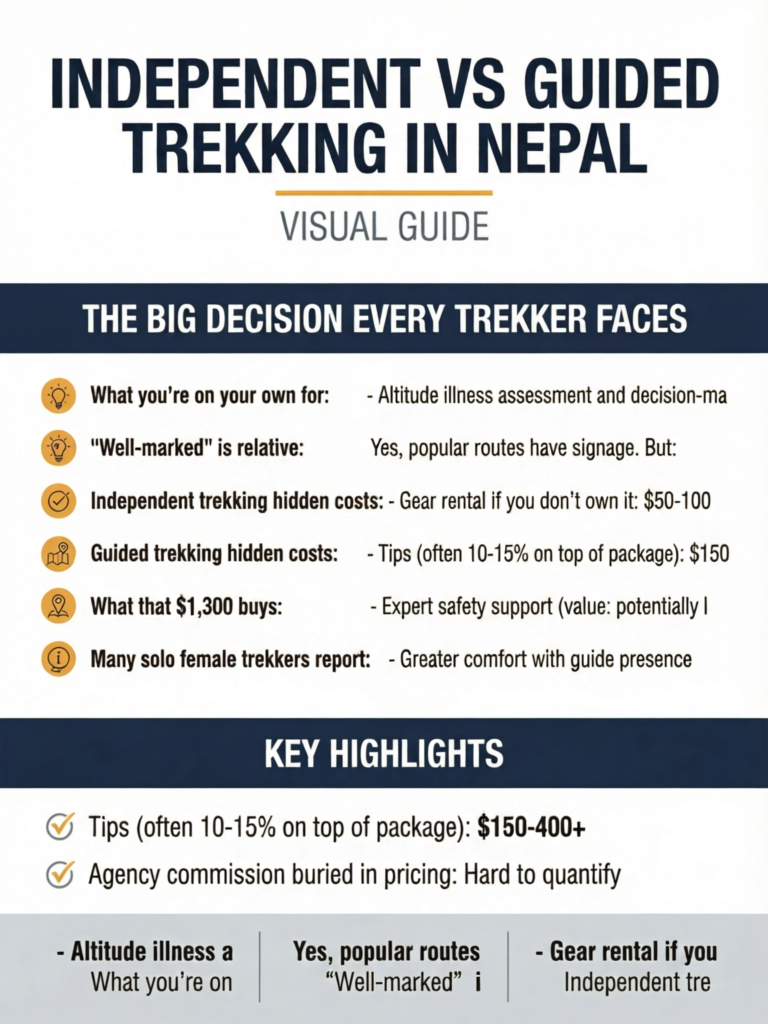
- The Big Decision Every Trekker Faces
- [Understanding the 2024 Mandatory Guide Rule](# understanding-the-2026-mandatory-guide-rule)
- Treks Where Guides Are Required
- Treks Where Independent Is Possible
- Independent Trekking: The Complete Picture
- Guided Trekking: The Complete Picture
- Cost Comparison: The Real Numbers
- Safety Considerations: Statistics and Realities
- Hybrid Options: The Middle Ground
- When You Should Hire a Guide
- When Independent Might Work
- Skills Needed for Independent Trekking
- Guide Types and Costs Explained
- How to Hire a Good Guide
- Insurance Implications
- Solo Female Trekkers: Special Considerations
- Tea House Booking: Independent vs Guided
- The Verdict: Decision Framework
- Frequently Asked Questions
The Big Decision Every Trekker Faces
You've booked your flights to Kathmandu. You've researched which trek to attempt. Now comes the question that defines your entire experience: do you hire a guide and porter, or do you trek independently?
Why This Decision Matters
This isn't just about money. Yes, hiring a guide and porter can double or triple your daily costs. But this decision also determines:
- Your safety margin in emergencies - When altitude sickness strikes at 4,500m, will you recognize the symptoms and make the right call?
- Your cultural experience - Will you understand the Buddhist prayer wheels you're spinning, or walk past them ignorantly?
- Your navigation confidence - When the trail forks and signage is unclear, what happens?
- Your logistical burden - Who books accommodations when teahouses fill up during peak season?
- Your social experience - Will you trek in the solitude you crave, or with the companionship you need?
- Your legal compliance - Are you even allowed to trek with a mandatory licensed guide on your chosen route?
The Traditional Arguments
For decades, the independent vs guided debate followed predictable lines:
Independent trekkers valued freedom, flexibility, cost savings, and the challenge of self-reliance. They argued that Nepal's popular routes are well-marked, teahouses plentiful, and fellow trekkers common enough that true isolation rarely occurs.
Guided trekkers prioritized safety, cultural insight, convenience, and supporting local employment. They argued that guides provide emergency expertise, navigate efficiently, handle logistics, and enrich the experience with local knowledge.
Both sides had valid points. The choice came down to personal priorities, experience level, and risk tolerance.
What Changed in 2026
In April 2026, Nepal's government implemented a rule requiring all foreign trekkers to hire licensed guides. The stated reasons: safety concerns following several high-profile trekker deaths, better emergency response coordination, and economic support for local guides.
The rule changed the debate fundamentally. The question shifted from "Should I hire a guide?" to "Am I legally required to hire a guide, and if so, is it actually enforced?"
The answer, as we'll explore, is complicated.
Regulation vs Reality Gap
Nepal's 2024 mandatory guide rule exists officially, but enforcement varies dramatically by region and remains inconsistent even on routes where it supposedly applies. This guide examines both the official regulations and the on-the-ground reality as of January 2026.
# Understanding the 2026 Mandatory Guide Rule
What the Official Rule Says
On April 1, 2024, Nepal's Tourism Board implemented a regulation requiring all foreign trekkers to be accompanied by a licensed guide or porter-guide. The rule applies to most trekking regions with specific stated goals:
Official objectives:
- Improve trekker safety - Guides can recognize altitude sickness, navigate dangerous sections, and coordinate emergency response
- Reduce missing persons incidents - Several solo trekkers disappeared in 2023, causing expensive search operations
- Support local employment - Channeling tourist spending to Nepali guides and porters
- Better tracking - Guides report trekker movements through checkpoint systems
How it was supposed to work:
- TIMS (Trekkers' Information Management System) cards would require guide registration
- Checkpoints would verify guide presence
- Trekkers caught with a mandatory licensed guides face fines (reportedly $120 USD)
- Green TIMS cards (for independent trekkers) would no longer be issued
The Enforcement Reality
Here's what actually happened:
The mandatory guide rule has NOT been consistently enforced on popular trekking routes. Multiple sources from late 2024 and early 2025 confirm:
-
Annapurna region: Independent trekkers continue to trek with a mandatory licensed guides or fines. TAAN (Trekking Agencies Association of Nepal) did not establish checkpoints to enforce the rule. Police checkpoints allow trekkers through with a mandatory licensed guide verification.
-
Everest region: The Solukhumbu district (Everest area) explicitly refused to comply with the directive and continues allowing trekkers with a mandatory licensed guides. You can still trek to Everest Base Camp, Gokyo Lakes, and the Three Passes independently using just the regional permit.
-
Langtang region: Reports indicate independent trekking continues without enforcement, though the official rule technically applies.
Why the enforcement gap?
Several factors contribute to inconsistent enforcement:
- Local resistance: Communities in trekking regions worried the rule would reduce visitor numbers and opposed strict enforcement
- Economic concerns: During post-COVID recovery, authorities avoided measures that might deter tourists
- Logistical challenges: Enforcing the rule requires checkpoint staffing and coordination that hasn't materialized
- Political pressure: International trekking communities and tourism advocates pushed back against the restriction
What This Means for Your Planning
The uncomfortable truth: As of January 2026, you can likely trek independently on popular routes (EBC, ABC, Annapurna Circuit, Langtang) without facing penalties, despite the official rule.
But this creates uncertainty:
- Regulations could be enforced suddenly without warning
- Enforcement may vary by season (stricter during accidents or incidents)
- Future years may see tighter implementation
- Insurance and permit implications remain unclear
Our recommendation: Understand both the official requirements and actual enforcement, then make an informed decision based on your risk tolerance. This guide provides information for both scenarios.
Pro Tip
Check current enforcement status 2-4 weeks before your trek by consulting recent trip reports on forums like r/Nepal, TrekkingPartners Facebook groups, or contacting agencies for latest checkpoint information. Enforcement status can change seasonally.
Treks Where Guides Are Required
Certain treks in Nepal have ALWAYS required guides, independent of the 2026 rule. These requirements are actively enforced, and you cannot obtain the necessary permits without agency coordination.
Mandatory Guide Treks (Strictly Enforced)
Manaslu Circuit
Why guides required: Restricted area permit regulations mandate minimum 2-person groups with a licensed guide.
Enforcement: Checkpoints at Jagat, Deng, and Larkya La actively verify permits and guide presence. You will be turned back without proper documentation.
Permit requirements:
- Manaslu Restricted Area Permit: $100 (Sep-Nov) or $75 (Dec-Aug)
- Manaslu Conservation Area Permit: $30
- TIMS card: NPR 2,000
- Must be processed through registered agency
Can you find a trekking partner and share guide costs? Yes. Many agencies maintain lists of solo trekkers seeking partners for Manaslu. The 2-person minimum can be satisfied by pairing up strangers.
For complete information, see our Manaslu Circuit Guide.
No Exceptions for Manaslu
Unlike some regions where enforcement is lax, Manaslu checkpoints consistently enforce guide and permit requirements. Do not attempt this trek without proper arrangements through a licensed agency.
Upper Mustang
Why guides required: Restricted area with $500 permit fee, cultural sensitivity, and border proximity to Tibet.
Enforcement: Strict. The checkpoint at Kagbeni (entry to Upper Mustang) verifies permits, guide presence, and liaison officer in some cases.
Requirements:
- Restricted Area Permit: USD 50/day (no minimum days), $50/day additional
- Minimum 2 persons
- Liaison officer required
- Must book through registered agency
Why it's worth it: Upper Mustang offers access to the former Kingdom of Lo, medieval Tibetan culture, and landscapes found nowhere else. The high permit fee deliberately limits numbers to protect this fragile region.
See our Upper Mustang Trek Guide for full planning details.
Upper Dolpo
Why guides required: One of Earth's most remote regions, extreme altitude, and limited infrastructure require professional support.
Requirements:
- Restricted Area Permit: USD 50/day (no minimum days)
- Minimum 2 persons
- Liaison officer required
- Fully supported camping trek (no teahouses in upper regions)
Reality check: This is a 21-25 day expedition-style trek. Even experienced mountaineers don't attempt Upper Dolpo independently due to logistics, not regulations.
Other Restricted Areas Requiring Guides
- Kanchenjunga (North & South): Restricted permit ($20/week) + guide required
- Nar Phu Valley: Restricted permit ($100 Sep-Nov) + guide required
- Tsum Valley: Restricted permit ($35 first week) + guide required
- Humla/Simikot region: Permit and guide requirements vary by specific route
Why These Rules Make Sense
Unlike the controversial 2026 rule for popular routes, the guide requirements for restricted areas serve legitimate purposes:
- Cultural protection: These areas contain fragile traditional cultures. Guided groups with liaison officers ensure cultural sensitivity.
- Environmental preservation: Limited visitor numbers through high fees and guide requirements reduce environmental impact.
- Border security: Many restricted areas border Tibet. Government oversight through guides and liaison officers addresses security concerns.
- Genuine safety needs: Areas like Upper Dolpo have no rescue infrastructure. Guide support isn't bureaucracy—it's survival insurance.
Pro Tip
If you want the independence of solo trekking but must have a guide for permits, hire a porter-guide and maintain autonomy over your daily schedule. Many guides, especially for restricted areas, understand this dynamic and allow you considerable flexibility.
Treks Where Independent Is Possible
Despite the 2026 rule, several major treks remain practically accessible for independent trekkers as of January 2026. Here's the current status:
Everest Region (Khumbu)
Official status: The Khumbu region (Solukhumbu district) explicitly opted out of the mandatory guide rule.
Current reality: You can trek to Everest Base Camp, Gokyo Lakes, and Three Passes with a mandatory licensed guide using only the regional permits.
Permits needed:
- Khumbu Pasang Lhamu Rural Municipality Permit: NPR 2,000 (~$15)
- Sagarmatha National Park Permit: $30
- NO TIMS card required for Khumbu-only treks
Why it's different: The Khumbu region's economy depends heavily on independent trekker spending at local teahouses. Local authorities resisted the guide mandate to protect this economic model.
Navigation difficulty: Moderate. The trail to EBC is well-marked and heavily trafficked. Other trekkers are nearly always visible. That said, sections like the Cho La pass or Renjo La require careful navigation.
Safety considerations:
- Well-developed rescue infrastructure (helicopter evac accessible)
- Teahouses every 2-3 hours of walking
- Other trekkers common even in shoulder season
- Altitude remains the primary risk (guide or no guide)
See our complete Everest Base Camp Guide and Gokyo Lakes Guide.
Annapurna Region (ABC, Circuit, Poon Hill)
Official status: Technically subject to the 2024 mandatory guide rule.
Current reality: Enforcement remains non-existent as of January 2026. Independent trekkers continue with a mandatory licensed guides or fines.
Permits needed:
- TIMS card: NPR 2,000 (still available despite rule)
- ACAP (Annapurna Conservation Area Permit): $30
Routes where independent is practical:
- Annapurna Base Camp (7-10 days)
- Annapurna Circuit (12-18 days)
- Poon Hill (3-5 days)
- Mardi Himal (5-7 days)
Navigation difficulty: Easy to moderate. The ABC and Circuit trails are extremely well-marked. Poon Hill is almost impossible to get lost on. Mardi Himal requires slightly more attention but remains straightforward.
What could change: The Annapurna Rural Municipality officially supports the guide requirement, even if enforcement hasn't materialized. This could change with political shifts or safety incidents.
Langtang Region
Official status: Technically subject to mandatory guide rule.
Current reality: Independent trekking continues without enforcement.
Permits needed:
- TIMS card: NPR 2,000
- Langtang National Park Permit: $30
Routes:
- Langtang Valley (7-10 days)
- Gosaikunda Lakes (7-10 days)
- Helambu Circuit (5-7 days)
Special safety consideration: The Langtang Valley was devastated by the 2015 earthquake, with the village of Langtang almost entirely destroyed. The valley has been rebuilt, but the area's geological instability is a real concern. Several solo trekkers have gone missing in Langtang in recent years—more than other popular regions.
Our recommendation: Langtang's disappearances make it the one popular route where safety arguments for guides carry significant weight, regardless of legal requirements.
Lower Dolpo and Other Open Areas
Routes that remain open for independent trekking:
- Lower Dolpo to Phoksundo Lake (requires only standard permits)
- Pikey Peak
- Helambu
- Tamang Heritage Trail
These routes don't fall under restricted area permits and see minimal guide rule enforcement.
Independent Trekking Status by Region (January 2026)
| Name | Official Rule | Enforcement | Permits | Difficulty |
|---|---|---|---|---|
| Everest/Khumbu | Exempt from mandatory guide rule | None - independent trekking fully permitted | Municipality + National Park only | Moderate navigation, well-marked |
| Annapurna Region | Guide required (official) | Not enforced - independent continues | TIMS + ACAP | Easy to moderate navigation |
| Langtang | Guide required (official) | Not enforced - but safety concerns high | TIMS + National Park | Moderate navigation |
| Manaslu | Guide required (restricted area) | Strictly enforced at all checkpoints | Restricted permit via agency only | N/A - must have guide |
Independent Trekking: The Complete Picture
The Pros of Going Independent
1. Complete Flexibility and Freedom
Set your own pace: Start walking when you want, stop when you're tired, take photos without feeling like you're holding up a group. If a viewpoint deserves an hour, you take an hour.
Change plans spontaneously: Met other trekkers heading to a side valley? You can join them. Feeling stronger than expected? Push to the next village. Need an extra acclimatization day? Take it without rearranging group logistics.
Choose your stops: Stay in the teahouse with the best mountain views, not the one your guide has a commission arrangement with. Leave busy villages for quieter locations.
Real trekker example: "I initially planned 12 days for EBC but felt great and wanted to add Gokyo Lakes via Cho La. As an independent trekker, I just extended my trek by 4 days. No rearranging guides, no extra fees, just went for it." - Sarah K., Australia
2. Significant Cost Savings
Daily savings of $20-40 when comparing basic independent costs to budget guided treks, $50-100+ when comparing to premium guided services.
- No guide fees ($25-$35 /day)
- No porter fees ($20-$30 /day)
- No agency markup (15-25% on top of costs)
- Choose budget teahouses instead of pre-booked premium lodges
- No tipping expectations
Example 14-day EBC trek:
- Independent: $280-560 total (permits, food, accommodation)
- Guided (budget): $700-1,050
- Guided (mid-range): $1,200-1,800
- Guided (premium): $2,000-3,000+
See detailed cost breakdown in Cost Comparison section.
3. Personal Challenge and Achievement
For many trekkers, the self-reliance aspect IS the experience:
- Navigating successfully with maps and trail signs
- Making your own decisions about acclimatization
- Booking your own accommodation in a foreign language
- Problem-solving when things don't go as planned
- The sense of accomplishment knowing you did it yourself
"Anyone can follow a guide to EBC. Figuring it out yourself, navigating, managing altitude, making decisions—that's the real trek." - Common sentiment in independent trekking communities
4. Authentic Cultural Interactions
Guides can paradoxically create barriers:
When you have a guide handling all interactions, you become passive. Independent trekkers often report richer cultural exchanges because they MUST engage:
- Negotiating room prices teaches you Nepali numbers
- Ordering food leads to conversations about local cuisine
- Asking directions leads to unexpected invitations for tea
- You're forced out of your comfort zone into genuine connection
That said: Experienced guides also facilitate deep cultural experiences through their knowledge and relationships. This pro is nuanced.
5. Solitude and Introspection
If you're trekking for headspace, solitude, or personal reflection, having a constant companion changes the experience fundamentally.
Some trekkers specifically seek the meditative quality of solo walking in the mountains. The silence, the rhythm of footsteps, the internal dialogue—these elements can be diluted when you're making conversation with a guide for 6-8 hours daily.
The Cons of Going Independent
1. Safety Risks and No Emergency Expertise
Altitude sickness kills—and you might not recognize the symptoms in yourself:
Acute Mountain Sickness (AMS) can progress to life-threatening HAPE (High Altitude Pulmonary Edema) or HACE (High Altitude Cerebral Edema) within hours. Guides trained in altitude illness recognition can identify symptoms trekkers often dismiss or rationalize.
Real incident: A solo trekker at Lobuche (4,940m) ignored headache and nausea as "normal altitude stuff," continued to Gorak Shep, and collapsed from HACE. Other trekkers initiated rescue, but the trekker lost two days to the misdiagnosis a guide would have caught immediately.
What you're on your own for:
- Altitude illness assessment and decision-making
- First aid for injuries (twisted ankles, cuts, falls)
- Weather assessment and route safety
- Emergency communication and rescue coordination
- Medical problem diagnosis
See Safety Considerations for detailed statistics.
2. Navigation Challenges and Getting Lost
"Well-marked" is relative:
Yes, popular routes have signage. But:
- Signs get damaged, removed, or buried in snow
- Trail forks aren't always clearly marked
- Weather can reduce visibility to meters
- Alternate routes and shortcuts create confusion
- Different trails merge and diverge
Where navigation becomes real work:
- High passes in poor weather (Thorong La, Cho La, Renjo La)
- Less-traveled side routes
- Early/late season when trails aren't trafficked
- Areas affected by landslides or route changes
3. Language Barriers
English proficiency in teahouses is good but limited:
- Basic transactions work fine
- Complex questions about routes, conditions, weather become difficult
- Medical issues are hard to communicate
- Cultural misunderstandings happen more easily
- Permit and checkpoint explanations can be confusing
Guides translate, explain, and bridge cultural gaps you won't even realize exist.
4. Solo Permit and Rule Uncertainty
The 2026 rule creates legal ambiguity:
Even though enforcement is lax, you're technically violating official regulations on most routes. This creates:
- Uncertainty about potential fines
- Insurance claim complications if something goes wrong
- Possible permit invalidation
- Rule changes that could catch you mid-trek
5. No Altitude Sickness Monitoring
You can't accurately assess your own altitude illness:
This bears repeating because it's the most significant independent trekking risk. Altitude affects judgment—the very symptom (impaired decision-making) prevents you from recognizing you have it.
Guides provide external assessment: monitoring your symptoms, comparing to their experience with hundreds of trekkers, making descent calls when you're too compromised to make them yourself.
6. Logistical Burden and Time Costs
Everything takes longer when you do it yourself:
- Finding and booking accommodation during peak season
- Deciphering menus and ordering food
- Navigating permit requirements and checkpoints
- Route planning and daily logistics
- Researching conditions and weather
Some trekkers love this challenge. Others find it exhausting and wish they could just focus on walking.
The Independence Paradox
Independent trekking saves money but demands more from you—time, mental energy, risk tolerance, and skill. It's not simply "the cheap option." It's a different style of trekking that suits certain personalities and situations better than others.
Guided Trekking: The Complete Picture
The Pros of Hiring a Guide
1. Safety and Expert Emergency Support
This is the primary argument for guides—and it's legitimate:
Licensed trekking guides undergo training in:
- Altitude illness recognition and treatment
- First aid and emergency response
- Weather assessment and route safety
- Emergency communication and rescue coordination
What this means in practice:
When you develop a headache, mild nausea, and fatigue at 4,500m, is it:
- Normal altitude adjustment (rest and continue tomorrow)?
- Early AMS (monitor closely, don't ascend)?
- Developing HACE (descend immediately)?
Guides make these assessments hundreds of times per season. They know the subtle differences that determine the right response.
Real rescue scenario: On the Annapurna Circuit, a guided group's porter-guide noticed a trekker's unusual speech patterns and stumbling gait. The trekker insisted she was "just tired." The guide recognized HACE symptoms, immediately arranged a horse down to lower elevation, and likely prevented a fatal outcome. The trekker thought she was fine—altitude had already impaired her judgment.
2. Cultural Knowledge and Deeper Experience
Good guides transform your trek from hiking to cultural immersion:
- Explain the significance of Buddhist prayer wheels, mani walls, and monasteries
- Translate local customs and etiquette
- Introduce you to village communities as an individual, not just another trekker
- Share mountain stories, local history, and regional knowledge
- Help you understand what you're seeing, not just see it
"Without my guide Dawa, I would have walked right past the monastery at Tengboche without understanding what I was looking at. He explained the Buddhist murals, introduced me to a monk, and turned a building into a spiritual experience." - Michael R., USA
3. Altitude Monitoring and Acclimatization Guidance
Guides actively manage your acclimatization schedule:
- Recommend appropriate acclimatization rest days
- Adjust pace to optimize altitude adaptation
- Monitor your symptoms throughout the trek
- Make ascent/descent decisions based on experience
- Understand individual variation (what's normal for you vs warning signs)
This active management versus passive "follow the itinerary" makes a measurable safety difference.
4. Hassle-Free Logistics
Guides handle everything that independent trekkers do themselves:
- Book accommodations (crucial during peak season when teahouses fill)
- Arrange permits and checkpoint navigation
- Order meals and communicate preferences
- Manage daily schedule and pacing
- Handle any problems that arise
You wake up, eat breakfast, walk, arrive at a pre-booked teahouse, eat dinner, sleep, repeat. Zero logistical burden.
Who this matters most for:
- First-time Nepal trekkers
- People with limited time who want to maximize trekking versus logistics
- Trekkers uncomfortable with language barriers
- Anyone who finds planning stressful
5. Social Aspect and Companionship
For solo travelers, guides provide companionship:
Long days of walking alone can be isolating. Guides offer:
- Conversation and social interaction
- Local perspective on life in Nepal
- Shared meals and experience
- Someone to celebrate summit success with
- Companionship without the commitment of formal trekking partners
The quality varies: Some guides become friends. Others are purely professional. Chemistry matters—discuss expectations when hiring.
6. Navigation Confidence
You never worry about getting lost:
Guides know the trails intimately. They navigate in fog, snow, and darkness. They know alternate routes, shortcut options, and where NOT to go.
This mental freedom lets you focus on enjoying the trek instead of constantly checking maps, apps, and signage.
7. Local Economic Support
Your guide fees directly support Nepali families:
Tourism provides livelihoods for thousands of Nepali guides, porters, and their families. Hiring guides channels money to local communities more directly than permit fees alone.
Many trekkers view this as ethical trekking—ensuring tourism benefits the people whose mountains you're visiting.
The Cons of Hiring a Guide
1. Significantly Higher Costs
This is the primary barrier to guided trekking:
Adding guide and porter fees increases daily costs by $40-80 or more:
- Licensed guide: $20-$30 /day
- Porter: $15-25/day
- Porter-guide: $20-30/day
- Agency markup: 15-25% on package costs
- Tips expected: 10-15% of total trek cost
For a 14-day trek:
- Guide only: +$350-560
- Guide + porter: +$560-910
- Full service agency: +$1,000-2,000+
Budget trekkers find these costs prohibitive. Even well-funded trekkers may question the value versus their priorities.
2. Less Flexibility and Fixed Itineraries
Guided treks follow predetermined schedules:
- Pre-booked accommodations at specific stops
- Fixed daily distances
- Group timeline constraints (if joining group trek)
- Limited spontaneous deviation
- Difficult to extend/shorten mid-trek
"I felt great and wanted to add an extra loop, but my guide's schedule didn't allow it. I was locked into the itinerary I'd booked." - Common complaint in guided trek feedback
3. Potential for Group Dynamics Issues
If joining a group trek:
- Varied fitness levels slow the group to the slowest member
- Personality conflicts with other group members
- Fixed stops regardless of your pace preference
- Social obligations when you might want solitude
Even with private guides, you're never truly alone—which some trekkers specifically don't want.
4. Variable Guide Quality
"Licensed guide" doesn't guarantee quality:
- Training standards vary
- Experience levels range from first season to 20+ years
- English proficiency varies
- Cultural knowledge depth differs
- Personal compatibility is unpredictable
Bad guide experiences include:
- Rushing trekkers too fast (to finish early)
- Commission-based teahouse selection (not best lodges)
- Poor English limiting communication
- Lack of altitude illness knowledge despite certification
- Pressure to buy from shops with kickback arrangements
See How to Hire a Good Guide for vetting strategies.
5. Loss of Personal Challenge
The self-reliance element disappears:
For trekkers who value the personal growth aspect of solo navigation, decision-making, and self-sufficiency, guides remove the challenge they specifically sought.
"I wanted to prove to myself I could do it alone. Hiring a guide would have defeated the purpose." - Solo trekker perspective
6. Language and Cultural Filtering
Guides can create dependency:
When guides handle all interactions, you may miss opportunities for direct cultural engagement. Everything gets filtered through your guide's translation and interpretation.
Some independent trekkers argue this creates a bubble that insulates you from authentic experience.
The Guided Sweet Spot
The best guided experiences combine professional support with personal freedom. Discuss expectations upfront: you want safety expertise and cultural knowledge, but NOT micromanagement of your daily schedule. Many guides adapt to this middle ground if you communicate clearly.
Cost Comparison: The Real Numbers
Let's break down actual costs with specific examples. All costs are per person, in USD, for 2026.
Independent Trekking: Daily Cost Breakdown
Budget Independent (Everest Base Camp, 14 days)
Pre-trek fixed costs:
- Sagarmatha National Park permit: $30
- Khumbu Municipality permit: $15
- Subtotal: $45
Daily costs on trail:
- Accommodation: $3-5/night (basic room)
- Breakfast: $3-5
- Lunch: $4-6
- Dinner: $5-8
- Snacks/tea: $3-5
- Charging devices: $2-3/day
- Hot shower: $2-3 (optional)
- WiFi: $2-3/day (optional)
- Daily total: $24-40
14-day trek total costs:
- Permits: $45
- 14 days on trail: $336-560
- Kathmandu buffer meals/accommodation: $40-60
- Total: $420-665
Mid-Range Independent (Annapurna Circuit, 16 days)
Pre-trek fixed costs:
- TIMS card: $15
- ACAP permit: $30
- Subtotal: $45
Daily costs on trail:
- Accommodation: $5-8/night
- Meals: $15-22/day
- Extras (shower, charging, WiFi): $5-8/day
- Daily total: $25-38
16-day trek total:
- Permits: $45
- 16 days on trail: $400-608
- Transportation (Kathmandu-Pokhara-trailhead): $40-60
- Total: $485-713
Guided Trekking: Daily Cost Breakdown
Budget Guided (Local Agency, EBC, 14 days)
Package typically includes:
- All permits
- Guide ($25/day)
- Porter ($20/day)
- Accommodation (pre-booked teahouses)
- Meals (breakfast, lunch, dinner)
- Transportation (Kathmandu-Lukla flights)
Typical package price: $1,100-1,400
Additional costs:
- Guide tip: $215-150
- Porter tip: $80-100
- Personal extras (WiFi, charging, shower): $50-80
- Snacks and drinks: $40-60
- Total: $1,370-1,790
Mid-Range Guided (Reputable Agency, EBC, 14 days)
Enhanced package includes:
- All budget package elements
- Better teahouse selection
- Emergency oxygen/medication kit
- Satellite communication device
- Better guide (more experienced)
- Pre-trek Kathmandu accommodation
Typical package price: $1,600-2,100
Additional costs:
- Tips: $200-250
- Personal extras: $80-120
- Total: $1,880-2,470
Premium Guided (High-End Agency, EBC, 14 days)
Premium package:
- Best available teahouses
- Senior guide + assistant guide
- Porter for each trekker
- Luxury Kathmandu hotels
- Comprehensive insurance
- Emergency evacuation coordination
- All meals including snacks
- WiFi and charging included
Package price: $2,800-4,000
Additional costs:
- Tips: $300-400
- Minimal extras (most included)
- Total: $3,100-4,400
Side-by-Side Cost Comparison
14-Day Everest Base Camp Trek: Independent vs Guided Costs
| Category | Permits | Accommodation | Meals | Guide | Porter | Extras | Total |
|---|---|---|---|---|---|---|---|
| Independent (Budget) | $45 | $42-70 (14 nights × $3-5) | $168-266 (14 days × $12-19) | $0 | $0 | $50-100 | $420-665 |
| Guided (Budget Agency) | Included | Included | Included | Included ($25/day) | Included ($20/day) | $270-390 (tips + personal) | $1,370-1,790 |
| Guided (Mid-Range) | Included | Included (better lodges) | Included | Included (experienced) | Included | $280-370 (tips + minimal) | $1,880-2,470 |
| Savings (Independent vs Budget Guided) | - | - | - | - | - | - | Save $950-1,125 (59-63%) |
Hidden Costs to Consider
Independent trekking hidden costs:
- Gear rental if you don't own it: $50-100
- Extra buffer days for logistics: $30-50/day
- Potential rescue costs if not insured properly: $3,000-5,000+
- Time costs handling permits and logistics: 1-2 days
Guided trekking hidden costs:
- Tips (often 10-15% on top of package): $150-400+
- Personal items still cost money (WiFi, shower, charging): $50-120
- Upgrading guide/porter arrangements mid-trek: Variable
- Agency commission buried in pricing: Hard to quantify
The Value Equation
Cost alone doesn't tell the whole story:
Independent at $500 vs Guided at $1,800 = $1,300 difference
What that $1,300 buys:
- Expert safety support (value: potentially lifesaving)
- Cultural knowledge enrichment (value: subjective)
- Logistical convenience (value: time + stress reduction)
- Emergency response expertise (value: insurance against worst-case)
- Local employment support (value: ethical satisfaction)
What independent saves you:
- $1,300 cash (value: objective, can fund additional travel)
- Personal freedom and flexibility (value: subjective)
- Self-reliance challenge (value: personal growth)
The "right" choice depends on which values matter more to you.
Pro Tip
Budget trekkers: Consider the hybrid option of hiring just a porter-guide ($25-$40 /day = $280-420 for 14 days). You get safety support and local employment benefit at a much lower cost than full guided packages, while maintaining significant independence.
Safety Considerations: Statistics and Realities
Safety is the most serious argument in the independent vs guided debate. Let's examine the actual data, not anecdotes.
Trekking Accident Statistics in Nepal
Annual trekker numbers and incidents (2023 data):
- Total foreign trekkers: ~196,000
- Reported deaths: 15-20 annually (average)
- Serious injuries requiring evacuation: 200-300
- Missing persons: 5-10 annually
- Altitude-related evacuations: 150-200
Death rate: Approximately 0.01% (1 in 10,000 trekkers)
For context: This is comparable to or lower than risks in many adventure activities. Scuba diving, backcountry skiing, and even marathon running have similar or higher fatality rates.
Primary Causes of Trekking Deaths
Analysis of trekking fatalities 2018-2023:
- Altitude illness (HAPE/HACE): 35-40% of deaths
- Falls/accidents: 25-30%
- Heart attack/medical: 15-20%
- Avalanche/natural disasters: 10-15%
- Hypothermia/exposure: 5-10%
- Other (including missing): <5%
Would a Guide Have Prevented These Deaths?
Altitude illness deaths: Guide helps: Yes, significantly. Guides recognize early symptoms trekkers often dismiss and enforce descent decisions trekkers resist.
Real example: Of 7 HACE deaths in 2022-2023, 6 were independent trekkers who continued ascending despite symptoms. The 7th was in a guided group but ignored guide advice to descend.
Fall/accident deaths: Guide helps: Partially. Guides navigate safer routes and prevent poor decisions in dangerous conditions. But falls also happen to guided groups on exposed sections.
Medical emergencies (heart attack, etc.): Guide helps: Partially. Guides can provide first aid and coordinate rescue faster, but underlying medical conditions affect both guided and independent trekkers.
Avalanche/natural disasters: Guide helps: Minimally. These are mostly random events, though guides may avoid dangerous areas or timing.
Missing Persons: The Langtang Problem
Langtang Valley has disproportionate missing persons incidents:
From 2018-2023, Langtang accounted for 60% of Nepal's missing trekker cases, despite representing only 8% of total trekkers.
Why?
- Post-earthquake geological instability
- Avalanche-prone sections
- Less-trafficked trails allow solo trekkers to go missing unnoticed
- Route variations and shortcuts create navigation confusion
Missing persons breakdown:
- Solo independent trekkers: 75% of cases
- Small informal groups: 20%
- Guided groups: 5%
Interpretation: This data suggests guides significantly reduce disappearance risk, particularly in geologically unstable areas.
Altitude Illness: The Self-Assessment Problem
The core safety issue with independent trekking is altitude illness self-diagnosis:
Research shows:
- 75% of trekkers experience some AMS symptoms above 3,500m
- 20-30% continue ascending despite symptoms
- Self-assessment accuracy for AMS severity: 40-60% (poor)
- Guide assessment accuracy: 75-85% (much better)
Why self-assessment fails:
Altitude impairs judgment—the very symptom that makes you unable to recognize you're impaired. It's similar to drunk driving: you don't think you're too impaired to drive because you're impaired.
Case study: Independent trekker at Dingboche (4,410m) experienced headache, nausea, and difficulty sleeping but attributed it to "normal altitude stuff." Continued to Lobuche (4,940m) next day where symptoms worsened. Other trekkers convinced him to descend, averting likely HAPE.
A guide would have enforced rest day at Dingboche or turned back immediately, preventing the escalation.
Rescue and Evacuation Realities
**helicopter rescue costs $1,800-$5,000 depending on location (EBC to Lukla $1,800-$2,500, EBC to Kathmandu $4,500-$5,000)
- Lobuche to Kathmandu: $5,000-6,000
- Manaslu region: $6,000-8,000
- Remote areas: $10,000+
Insurance considerations:
Most trekking insurance requires:
- Coverage specifically for high-altitude trekking (up to your maximum elevation)
- Helicopter evacuation coverage
- Some policies require you follow local regulations (guide requirement creates grey area)
Guides in emergency situations:
Guides coordinate rescue operations:
- Radio/satellite communication to rescue services
- First aid while waiting for evacuation
- Stabilization and assessment
- Local language communication with rescue services
Independent trekkers must handle this themselves or rely on nearby trekkers for help.
Risk Factors That Increase Danger for Independent Trekkers
You face higher risk if:
- First time at high altitude (no experience recognizing personal AMS symptoms)
- Trekking alone (no external assessment of symptoms or behavior)
- Aggressive itinerary (rapid ascent increases altitude illness risk)
- Shoulder/off-season (fewer other trekkers around for help)
- Remote routes (less-trafficked trails, limited rescue access)
- Pre-existing medical conditions
You face lower risk if:
- Experienced with altitude (know your body's responses)
- Conservative acclimatization schedule
- Peak season trekking (other trekkers always nearby)
- Popular routes (EBC, ABC main trails)
- Good altitude illness knowledge
- Satellite communication device
The Honest Safety Assessment
Guides meaningfully reduce certain risks:
- Altitude illness progression (significant reduction)
- Getting lost/navigation errors (moderate reduction)
- Weather-related poor decisions (moderate reduction)
- Emergency response time (significant improvement)
Guides don't eliminate risks:
- Falls and accidents still happen
- Avalanches affect guided and independent trekkers
- Medical emergencies occur regardless
- Altitude illness can progress rapidly even with guide support
The statistical reality: You're statistically safer with a guide. The question is whether that safety improvement justifies the cost and trade-offs for your specific situation.
High-Risk Scenario
Solo independent trekking in Langtang, shoulder season, with aggressive ascent schedule = highest risk profile. Missing persons data shows this combination is genuinely dangerous. Strongly consider a guide for this specific scenario.
Pro Tip
If trekking independently, invest in a satellite communication device (Garmin inReach, SPOT): $15-20/day rental or $300-400 purchase. It provides emergency SOS capability that partially bridges the rescue coordination gap guides offer.
Hybrid Options: The Middle Ground
You don't have to choose between completely independent or fully guided. Several hybrid approaches offer compromise solutions.
Option 1: Hire a Guide Only (No Porter)
What it means: You hire a licensed guide to accompany you but carry your own pack (or use porter services separately).
Costs:
- Licensed guide: $25-40/day
- You handle your own accommodation booking and food (or guide assists)
- 14-day trek: $350-560 guide cost only
Pros:
- Safety expertise and altitude monitoring
- Cultural knowledge and navigation
- Significant cost savings vs full package
- More flexibility than agency packages
Cons:
- Still carrying your pack (physical burden)
- You handle logistics or negotiate with guide
- Guide may have less incentive without agency support
Best for:
- Experienced trekkers who want safety net but not full service
- Budget-conscious travelers prioritizing safety over comfort
- Those confident in fitness but concerned about altitude
Option 2: Hire a Porter-Guide Only
What it means: Porter-guides are licensed to both carry loads AND provide basic guiding. They're not as experienced as senior guides but handle both roles.
Costs:
- Porter-guide: $20-30/day
- 14-day trek: $280-420 total
Pros:
- Your pack is carried (frees you up)
- Basic safety oversight and navigation
- Lowest-cost option that still provides support
- Local employment benefit
Cons:
- Less experience than dedicated guides
- May have limited English
- Cultural knowledge varies
- Safety expertise adequate but not expert-level
Best for:
- Solo trekkers required to have guide by regulation
- Budget travelers wanting porter support
- Those prioritizing pack-carrying over extensive guiding
Option 3: Guide for Difficult Sections Only
What it means: Trek independently on easy sections, hire guide for challenging portions.
Example (Annapurna Circuit):
- Trek independently: Besisahar to Manang (easy, well-marked)
- Hire guide: Manang to Thorong La to Muktinath (high altitude, challenging pass)
- Trek independently: Muktinath to Jomsom to Pokhara (downhill, easy)
Costs:
- Guide for 4-5 days only: $100-200
- Significant savings vs full trek guide
Pros:
- Cost efficiency (pay only for difficult sections)
- Independence where it's safe and manageable
- Expert support for riskiest portions
- Flexibility maintained
Cons:
- Logistics of arranging guide mid-trek
- Guide may not be available on short notice
- You miss relationship-building with guide
Best for:
- Experienced trekkers confident on standard trails
- Those specifically concerned about high passes or technical sections
- Budget optimization while maintaining safety margin
Option 4: Join Existing Group to Share Costs
What it means: Find other solo trekkers and share the cost of one guide and/or porters.
Costs:
- Split guide cost 2-3 ways: $25-$35 /day per person
- Split porter costs similarly
- 14-day trek: $112-280 per person for guide
Pros:
- Dramatic cost reduction through sharing
- Social aspect (built-in trekking partners)
- Professional guide support at budget prices
- Satisfies permit requirements if guides mandated
Cons:
- Must find compatible trekking partners
- Group dynamics and pace compromises
- Less flexibility than solo
- Coordination required
How to find partners:
- Trekking partner Facebook groups
- Hostel notice boards in Kathmandu/Pokhara
- Online forums (r/Nepal, Lonely Planet Thorn Tree)
- Ask agencies to connect solo trekkers
Best for:
- Solo travelers open to companions
- Budget-focused trekkers needing guide requirement compliance
- Social trekkers who prefer groups anyway
Option 5: Agency Package for Logistics, Independent for Daily Trekking
What it means: Book an agency to handle permits, transportation, and accommodations, but trek without daily guide accompaniment.
Costs:
- Logistics-only package: $400-700 for 14-day trek
- Less than full guided but more than pure independent
Pros:
- Permit hassles eliminated
- Accommodations pre-booked (crucial peak season)
- Transportation arranged
- You still trek independently day-to-day
Cons:
- Limited flexibility (pre-booked accommodations)
- No safety support on trail
- May not satisfy guide requirement regulations
Best for:
- First-time Nepal visitors overwhelmed by logistics
- Peak season trekkers worried about accommodation availability
- Those wanting convenience without constant guide presence
Which Hybrid Option Makes Sense?
Hybrid Options Comparison
| Option | Cost14 Days | Safety | Flexibility | Best For |
|---|---|---|---|---|
| Guide Only (No Porter) | $350-560 | High - expert guidance | Moderate | Experienced, fitness-confident, altitude-concerned |
| Porter-Guide Only | $280-420 | Moderate - basic guidance | Moderate-High | Budget solo trekkers, regulation compliance |
| Guide for Sections | $100-200 | High where employed | High | Experienced, tactical safety investment |
| Share Guide Costs | $112-280 | High (full guide) | Low-Moderate | Social, budget-conscious |
| Logistics Package | $400-700 | None on trail | Low (pre-booked) | First-timers, peak season, convenience-focused |
Pro Tip
The porter-guide option offers the best value for regulation compliance. You get both pack-carrying and basic guiding for less than hiring guide + porter separately, and you satisfy mandatory guide rules where they apply.
When You Should Hire a Guide
Certain situations strongly favor hiring a guide, regardless of cost considerations or regulations. Here's when a guide makes sense:
1. First Time at High Altitude
If you've never been above 3,000-4,000m, you don't know how your body responds to altitude.
Altitude illness affects people unpredictably:
- Fitness doesn't predict susceptibility
- Age doesn't reliably correlate
- Previous low-altitude trekking doesn't prepare you
- Symptoms vary individually
Without altitude experience, you can't distinguish:
- Normal acclimatization (uncomfortable but safe)
- Early AMS (monitor and slow down)
- Dangerous progression (descend immediately)
Guides have seen thousands of trekkers at altitude and recognize the patterns.
First-time high-altitude trekkers should hire guides for:
- EBC (5,364m) at Kala Patthar)
- ABC (4,130m base camp, 4,210m viewpoint)
- Thorong La on Annapurna Circuit (5,416m)
- Any trek above 4,500m
2. Solo Female Trekkers (Context-Dependent)
Nepal is generally safe for solo female travelers, BUT:
Certain routes and situations create additional considerations:
- Remote trails with few other trekkers
- Shoulder season when you might go hours without seeing others
- Cultural dynamics in conservative villages
- Potential harassment (rare but not zero)
Many solo female trekkers report:
- Greater comfort with guide presence
- Protection from unwanted attention
- Cultural bridging in male-dominated mountain communities
- Peace of mind for family/friends at home
When guides make extra sense for solo females:
- Off-season treks
- Remote routes (Makalu, Dolpo, Kanchenjunga)
- First time in Nepal
- Comfort level with isolation
See Solo Female Trekkers section for detailed analysis.
3. Limited Time / High-Value Trek
If this is a once-in-a-lifetime trip with limited time:
Guides maximize your experience value:
- No wasted time on logistics
- Optimal pacing for acclimatization (no trial and error)
- Cultural insights you'd miss independently
- Assurance you'll complete the trek successfully
Example: Two-week vacation, expensive flights, significant time investment to reach Nepal. Spending $1,200 on a guide for 14 days adds 30% to trip cost but dramatically increases success probability and experience quality.
Risk/reward calculation shifts: The cost of NOT having a guide (potential altitude emergency, getting lost, failing to complete trek) becomes unacceptable.
4. Aggressive or Challenging Itinerary
Certain trek profiles significantly benefit from guide expertise:
High passes in variable weather:
- Thorong La (Annapurna Circuit)
- Cho La, Renjo La (EBC region)
- Larkya La (Manaslu Circuit)
Guides know weather patterns, safe passage times, and bailout options.
Rapid ascent schedules: If your itinerary gains altitude faster than conservative acclimatization suggests, guide monitoring becomes critical.
Remote or technical routes:
- Upper Dolpo
- Makalu Base Camp
- Kanchenjunga
- Great Himalaya Trail sections
These aren't casual teahouse treks—guide support is prudent regardless of regulations.
5. Pre-Existing Medical Conditions
If you have any medical conditions that complicate altitude:
- Heart conditions
- Lung/respiratory issues
- History of severe AMS/HAPE/HACE
- Diabetes
- Other chronic conditions
Guides provide external monitoring and emergency coordination that could be lifesaving.
Consult your doctor AND hire experienced guide.
6. Traveling with Children or Elderly
Kids and older adults require extra safety oversight:
Children may not communicate symptoms clearly. Elderly trekkers face higher cardiac risk. Both benefit from experienced assessment and conservative pace management.
7. You Want Deep Cultural Learning
If cultural immersion is your primary goal, not just scenery:
Expert guides transform your trek into cultural education:
- Buddhist philosophy and practices
- Local history and folklore
- Mountain community lifestyles
- Language instruction
- Cultural etiquette guidance
you must trek with a licensed guide (mandatory since April 2023) for exercise and views. For cultural depth, guides are invaluable.
8. Peak Season When Accommodations Are Scarce
During October and late March-April:
Teahouses fill completely on popular routes. Independent trekkers may arrive to find no beds available, forcing long extra walking days or sleeping in dining halls.
Guides pre-book accommodations, guaranteeing rooms. This logistical security alone can justify guide costs during peak season.
9. You're Risk-Averse by Nature
Some people prioritize security over independence:
If you're the type who:
- Prefers comprehensive insurance
- Values professional expertise
- Feels anxious about uncertainties
- Wants backup plans for everything
Guides provide peace of mind worth more than money saved. There's no shame in prioritizing security—know yourself and trek accordingly.
The Guide Makes Sense Checklist
Consider hiring a guide if you answer YES to 3 or more:
- First time above 4,000m
- Solo female trekker on remote route
- Limited time, high-stakes trip
- Challenging itinerary (high passes, rapid ascent)
- Medical conditions
- Traveling with children/elderly
- Cultural learning is priority
- Peak season trekking
- Risk-averse personality
When Independent Might Work
On the flip side, certain situations favor independent trekking when regulations allow. Here's when going guideless makes sense:
1. Experienced High-Altitude Trekker
If you've successfully trekked above 4,000m multiple times:
- You know your personal altitude response
- You recognize your AMS symptoms
- You've practiced acclimatization strategies
- You trust your decision-making at altitude
Experience gives you:
- Self-assessment accuracy
- Confidence in navigation
- Cultural familiarity with Nepal (if you've been before)
- Logistics competence
Still requires: Conservative itinerary, appropriate gear, emergency communication device, and honest self-assessment.
2. Budget-Constrained Travelers
If guide costs genuinely prevent the trek:
For many travelers, $1,000-1,500 guide costs mean the difference between trekking and not trekking. If the choice is "independent trek" or "no trek," independent makes sense (where legally allowed and safety-appropriate).
Budget-conscious strategies:
- Choose routes still permitting independent trekking (Everest region)
- Trek shoulder season for lower costs
- Invest in satellite communicator for safety margin
- Join with trekking partners to reduce per-person risk
3. Seeking Solitude and Personal Challenge
If the internal journey is your primary motivation:
Some trekkers specifically seek:
- Solo meditation and reflection
- Personal growth through self-reliance
- Pride in self-sufficient achievement
- Freedom from social obligations
For these trekkers, a guide fundamentally changes the experience they came for.
Valid priority—just ensure:
- Route choice matches skill level
- Safety margins are adequate
- You're honest about experience vs ego
4. Very Conservative Acclimatization Schedule
If your itinerary includes:
- Extra acclimatization days beyond standard
- Slow ascent rates
- Bailout flexibility built in
- Peak season with many other trekkers around
Conservative pacing dramatically reduces altitude illness risk, partially offsetting the safety benefit guides provide.
Example: 16-day itinerary for a trek typically done in 12 days, with two full rest days at Namche and Dingboche, reduces altitude risk significantly.
5. Trekking in a Small Private Group
If you're trekking with 2-3 experienced friends:
Group safety is significantly better than solo:
- External assessment of each other's symptoms
- Shared navigation and decision-making
- Emotional support and companionship
- Distributed emergency response capability
Still recommend: At least one group member with wilderness first aid training and altitude illness knowledge.
6. Popular Routes in Peak Season
Certain routes at certain times have traffic density approaching "highway" levels:
- EBC main trail in October
- ABC trail in March-April
- Poon Hill year-round
You're never truly alone. Other trekkers are visible ahead and behind. Teahouses every 2-3 hours. Helicopter evacuation access throughout.
This doesn't eliminate all risk but reduces isolation danger significantly.
7. You're a Navigation Enthusiast
If you genuinely enjoy:
- Map reading and route finding
- GPS navigation and tracking
- Wayfinding challenges
Independent trekking provides the navigation challenges you specifically seek (and have skills for).
8. Flexible Schedule Allowing Turnback Options
If you can afford to:
- Turn back if conditions worsen
- Take extra rest days without schedule pressure
- Abandon trek midway if necessary
Flexibility creates safety margins. Guides sometimes create schedule pressure (they have next client booked); independence lets you prioritize safety over completion.
9. Strong Medical Knowledge
If you're a medical professional or have extensive wilderness medicine training:
- Wilderness First Responder certified
- Medical background
- Altitude illness education
You possess some of the safety expertise guides provide. (Still doesn't replace local knowledge and language capability, but closes the safety gap.)
The Independent Makes Sense Checklist
Consider independent trekking if you answer YES to 4 or more (and regulations allow):
- Multiple successful high-altitude treks completed
- Budget constraints make guided unaffordable
- Seeking solitude/personal challenge specifically
- Very conservative acclimatization schedule
- Trekking with experienced group of 2-3
- Popular route in peak season
- Navigation skills and enthusiasm
- Flexible schedule (no completion pressure)
- Medical knowledge/wilderness first aid
This is the first half of the comprehensive guide. Should I continue with the remaining sections?
Do You Legally Need a Guide to Trek in Nepal?
Since April 2023, Nepal officially requires all foreign trekkers to hire a licensed guide for treks in national parks, conservation areas, and restricted regions. However, enforcement varies significantly. Restricted areas (Manaslu, Upper Mustang, Dolpo) are strictly enforced. Popular teahouse routes like EBC and ABC have inconsistent enforcement. Regardless of enforcement, a guide significantly improves safety, cultural experience, and trip quality.
Frequently Asked Questions
How much does an independent trek cost vs a guided trek in Nepal?
Independent trekking costs $20-40 per day (permits, food, accommodation). Guided trekking costs $50-150 per day depending on service level. For a 14-day EBC trek, independent costs approximately $800-1,200 while guided costs $1,500-2,500.
Can I trek solo in the Everest region?
The mandatory guide rule officially applies, but enforcement in the Everest region is inconsistent. You can technically still obtain permits and trek, though doing so is against current regulations. For safety and compliance, hiring a licensed guide is recommended.
What is a porter-guide and is it a good option?
A porter-guide combines guiding and load-carrying duties at a lower cost ($20-30/day) than a separate guide ($25-35/day) plus porter ($15-20/day). It is a good budget option for experienced trekkers on well-marked routes.
Is independent trekking safer or more dangerous?
Statistically, guided trekkers have lower rates of altitude sickness complications because guides monitor symptoms and enforce acclimatization schedules. Independent trekkers face higher risk if they lack altitude experience.
Do I need to book through an agency for guided trekking?
For restricted areas, yes -- permits can only be obtained through licensed agencies. For popular routes, you can hire freelance guides directly in Kathmandu or Pokhara, though agency backup provides better emergency support.