



Hiring a guide or porter for your Nepal trek is about more than just convenience—it's about supporting local communities, ensuring your safety, and practicing responsible tourism. This comprehensive guide covers everything you need to know about ethically hiring trekking guides and porters in Nepal, from understanding different roles to ensuring fair treatment and compensation.
Whether you're planning your first trek to Everest Base Camp or exploring the Annapurna Circuit, understanding how to hire and treat guides and porters ethically will enhance your experience while making a positive impact on Nepal's mountain communities.
Quick Navigation
- [2026 Guide Requirement Update](# 2026-guide-requirement-update)
- Guide vs Porter vs Porter-Guide
- Do You Need a Guide?
- Guide Qualifications
- How to Hire Independently
- Fair Wages & Compensation
- Porter Ethics & Welfare
- Tipping Guidelines
- Insurance Requirements
- FAQs
Introduction: Supporting Local Communities Through Ethical Hiring
Trekking in Nepal provides critical income for thousands of mountain families. Guides and porters are the backbone of Nepal's trekking industry, and how you hire and treat them has a direct impact on their livelihoods, families, and communities.
The ethical hiring of guides and porters matters because:
- Economic Impact: Tourism wages support entire villages in remote mountain regions
- Safety: Properly trained and equipped guides and porters ensure safer trekking experiences
- Cultural Exchange: Local guides provide authentic insights into Nepali culture, traditions, and mountain life
- Sustainability: Fair treatment ensures the long-term viability of Nepal's trekking industry
- Community Development: Your hiring decisions directly affect education, healthcare, and living standards in mountain communities
This guide will help you navigate the process of hiring guides and porters while ensuring you contribute positively to Nepal's mountain communities.
Impact of Ethical Hiring
When you hire ethically, pay fair wages, ensure proper equipment and insurance, and treat guides and porters with respect, you're not just supporting one individual—you're supporting their entire family and contributing to the sustainable development of mountain communities.
2026 Guide Requirement Update: Mandatory Guide Rule
In a significant regulatory change, Nepal banned solo trekking for foreigners effective April 1, 2023. This policy requires all foreign trekkers to hire licensed guides for trekking in national parks, conservation areas, and restricted regions.
What the Rule Means
Who Must Hire a Guide:
- All non-Nepali citizens trekking in any National Park, Conservation Area, or Restricted Area
- Must hire a licensed trekking guide or porter-guide through a government-registered trekking agency
- Nepali citizens are exempt from this requirement
Affected Areas: This regulation effectively impacts almost all popular trekking routes, including:
- Annapurna Circuit and Annapurna Base Camp
- Everest Base Camp and Three Passes Trek
- Langtang Valley
- Manaslu Circuit
- Upper Mustang and Dolpo regions
- All restricted area treks
Official Policy vs Ground Reality
While the mandatory guide rule is official government policy, enforcement varies significantly by region and season:
Strict Enforcement:
- Restricted areas (Upper Mustang, Dolpo, Manaslu)
- Some popular Annapurna region checkpoints
- During peak trekking seasons
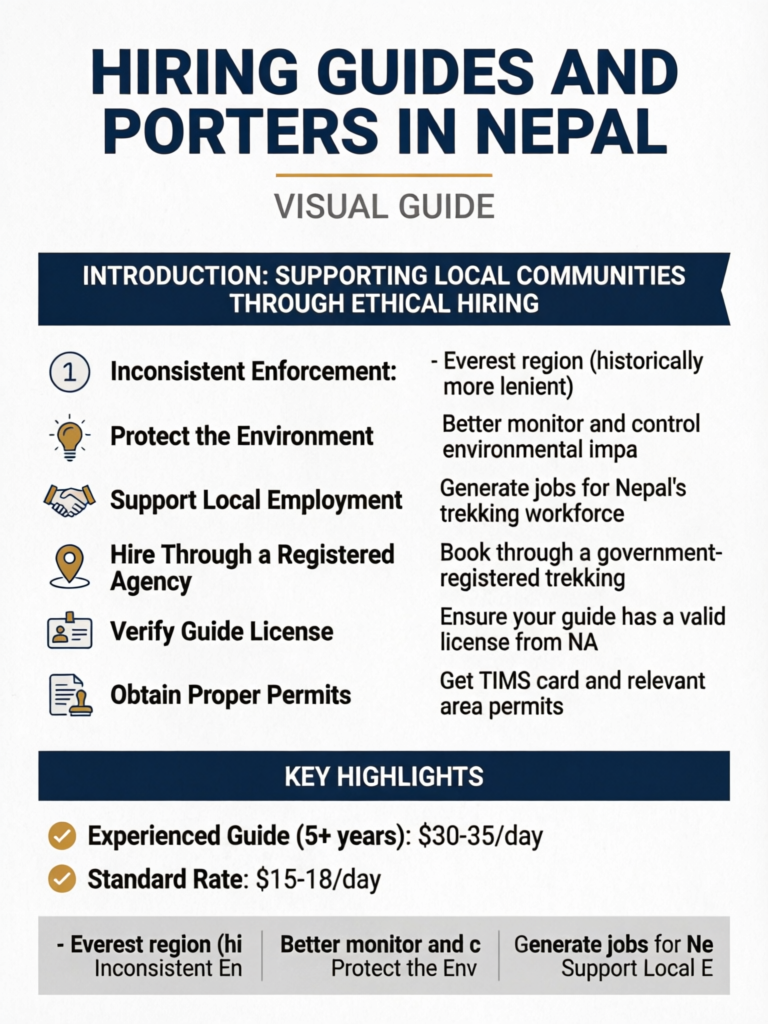
Inconsistent Enforcement:
- Everest region (historically more lenient)
- Off-season trekking
- Remote checkpoints with limited staffing
Current Enforcement Status
Recent reports from late 2026 and early 2025 indicate that many trekkers in the Annapurna region have trekked independently without issues, with checkpoints not actively enforcing the guide requirement. However, this can change, and policies may be enforced more strictly during peak seasons or in response to safety incidents.
Why the Rule Was Implemented
The Nepal government introduced this regulation to:
- Enhance Trekker Safety: Reduce accidents, altitude sickness deaths, and rescue operations
- Protect the Environment: Better monitor and control environmental impacts
- Support Local Employment: Generate jobs for Nepal's trekking workforce
- Improve Revenue: Ensure all trekkers contribute economically through formal channels
- Emergency Response: Better tracking of trekkers for search and rescue operations
How to Comply
To comply with the mandatory guide requirement:
- Hire Through a Registered Agency: Book through a government-registered trekking company
- Verify Guide License: Ensure your guide has a valid license from NATHM or TAAN
- Obtain Proper Permits: Get TIMS card and relevant area permits
- Carry Documentation: Keep guide contract, permits, and insurance proof accessible
- Be Prepared for Checkpoints: Have documents ready at permit checkpoints
Compliance Strategy
Even if you prefer independent trekking, hiring a licensed guide ensures compliance, enhances safety, provides cultural insights, and supports local communities. Consider it an investment in both your experience and Nepal's mountain economy.
Risks of Non-Compliance
Trekking with a mandatory licensed guide where required may result in fines, permit revocation, forced return to the trailhead, or being barred from completing your trek. Additionally, you may face challenges with rescue operations or insurance claims if you're not in compliance with regulations.
Guide vs Porter vs Porter-Guide: Understanding the Roles
Understanding the differences between guides, porters, and porter-guides is essential for hiring the right support for your trek.
Role Comparison Table
| Aspect | Trekking Guide | Porter | Porter-Guide (Sherpa) |
|---|---|---|---|
| Primary Function | Navigation, safety, cultural interpretation | Carrying loads | Both carrying and guiding |
| Training Required | Yes - certified by NATHM/TAAN | No formal requirement | Basic guide training |
| License Required | Yes - government-issued | No | Yes - basic guide license |
| English Proficiency | Good to excellent | Limited to none | Basic to moderate |
| Load Carrying | Personal gear only (5-10kg) | Client gear (20-25kg max) | Lighter loads (10-15kg) |
| Route Knowledge | Extensive | Basic | Moderate |
| First Aid Training | Required certification | Usually none | Basic training |
| Altitude Expertise | Trained in altitude sickness recognition | No formal training | Basic knowledge |
| Cultural Interpretation | Extensive | Limited | Moderate |
| Emergency Management | Trained and experienced | Not qualified | Basic capability |
| Daily Cost (USD) | $25-40 | $15-20 | $20-30 |
| Best For | Solo trekkers, first-timers, technical routes | Carrying heavy loads, budget travelers | Budget-conscious trekkers on easier routes |
The Sherpa Distinction
Important Note on "Sherpa":
Sherpa vs sherpa
Sherpa (capitalized) refers to an ethnic group from the Solu-Khumbu region of Nepal, renowned for their mountaineering expertise but not exclusively employed in trekking.
sherpa (lowercase) has become a designation for trek or expedition workers who perform hybrid guide-porter duties, regardless of their ethnic background. Many "sherpas" are actually from Rai, Tamang, or other ethnic groups.
The term "Sherpa" should be used respectfully to acknowledge the ethnic identity, while "porter-guide" is more accurate for describing the job role.
Trekking Guide Role: What Guides Actually Do
A licensed trekking guide is a trained professional who manages all aspects of your trek. Here's what a qualified guide provides:
1. Navigation and Route Planning
Daily Route Management:
- Plan each day's trekking route based on weather, trail conditions, and group ability
- Navigate trails, junctions, and potentially confusing route sections
- Adjust itinerary for altitude acclimatization or unexpected conditions
- Know alternative routes if trails are blocked or dangerous
Trail Knowledge:
- Intimate familiarity with trail conditions, seasonal changes, and hazards
- Information on tea house locations, facilities, and quality
- Knowledge of water sources, rest stops, and scenic viewpoints
- Understanding of local trail etiquette and customs
Navigation Value
Even well-marked trails can become confusing in fog, snow, or at complex junctions. A guide's route knowledge can prevent getting lost, which is a serious safety risk in remote mountains.
2. Altitude Sickness Monitoring and Prevention
Health Surveillance:
- Monitor trekkers for symptoms of Acute Mountain Sickness (AMS)
- Recognize early warning signs of High Altitude Pulmonary Edema (HAPE) and High Altitude Cerebral Edema (HACE)
- Make critical decisions about ascending, resting, or descending
- Know when to administer medications or arrange emergency evacuation
Acclimatization Management:
- Plan proper acclimatization days and rest stops
- Ensure appropriate ascent rates (maximum 300-500m elevation gain per day above 3,000m)
- Monitor hydration, rest, and symptom development
- Implement "climb high, sleep low" strategies
Life-Saving Expertise
Altitude sickness kills trekkers every year in Nepal. A trained guide can recognize symptoms early and make decisions that literally save lives. This alone justifies the cost of hiring a qualified guide.
3. Cultural Interpretation and Local Insights
Cultural Bridge:
- Explain Buddhist and Hindu customs, monasteries, and religious practices
- Introduce local communities and facilitate authentic interactions
- Translate languages and help with communication
- Share stories, legends, and local history
Enhanced Experience:
- Arrange monastery visits and blessings from lamas
- Explain prayer flags, mani stones, and stupas
- Introduce local foods and customs
- Provide insights into mountain community life
The cultural knowledge guides provide transforms a trek from just walking in mountains to a deep cultural immersion.
4. Emergency Management and Crisis Response
Emergency Capabilities:
- Administer first aid for injuries, altitude sickness, or illness
- Arrange helicopter evacuation if needed
- Coordinate with rescue services and medical facilities
- Make critical safety decisions in emergencies
Communication:
- Contact rescue services via phone or radio
- Communicate with hotels, agencies, and family if needed
- Navigate Nepal's emergency response systems
- Arrange emergency supplies or medical assistance
5. Language Assistance and Practical Support
Communication Support:
- Translate with tea house owners, porters, and locals
- Negotiate prices and arrange accommodations
- Explain menus, cultural norms, and local practices
- Handle disputes or misunderstandings
Logistics Management:
- Book tea house accommodations
- Arrange meals and special dietary needs
- Handle permit checkpoints and documentation
- Manage porter coordination if applicable
Porter Role: Load Carriers of the Himalayas
Porters are the hardworking backbone of Nepal's trekking industry, carrying heavy loads that make comfortable trekking possible.
What Porters Do
Primary Responsibilities:
- Carry trekker gear, sleeping bags, extra clothing, and equipment
- Transport loads between tea houses or campsites
- Walk at their own pace (often faster than trekkers)
- Manage their own accommodation and meals (though you should provide both)
What Porters Do NOT Do:
- Navigate routes or provide route guidance
- Monitor altitude sickness or provide medical assistance
- Speak English or translate
- Make safety decisions or manage emergencies
- Provide cultural interpretation
Load Carrying Capacity
Recommended Maximum Weight:
According to International Porter Protection Group (IPPG) standards:
- Maximum 25kg (55 lbs) total load including porter's personal gear
- Client gear should not exceed 20kg (44 lbs)
- Adjust for altitude, trail difficulty, and porter's physical capability
Overloading is Exploitation
Nepal's government standard is 35kg, but this is widely considered excessive and dangerous. Many porters carry 40-60kg to maximize income, leading to serious injuries and even deaths. Never allow a porter to carry more than 25kg total weight. This is a critical ethical responsibility.
Porter Safety and Welfare Concerns
Critical Welfare Issues:
Porters face significant risks:
- Hypothermia from inadequate clothing at high altitudes
- Altitude sickness without recognition or treatment
- Injuries from excessive loads
- Inadequate shelter and food
- Lack of insurance or medical care
Your Responsibility:
- Limit weight to safe levels (20-25kg maximum)
- Provide or ensure proper clothing for high altitude
- Arrange same-standard accommodation and meals
- Verify insurance coverage
- Treat porters with dignity and respect
Ethical Porter Treatment
Treating porters well means: reasonable loads, proper equipment, good food and shelter, fair wages, insurance, and respectful treatment. Porters remember kind clients and will go above and beyond when treated well.
Porter-Guide (Sherpa) Role: The Hybrid Option
Porter-guides offer a middle-ground option, combining elements of both guiding and load-carrying at a more budget-friendly price point.
What Porter-Guides Provide
Dual Function:
- Carry lighter loads (10-15kg of client gear)
- Provide basic route guidance and navigation
- Offer limited cultural insights and translation
- Basic English communication ability
- Some knowledge of altitude and safety
Training and Qualifications
Porter-guides typically have:
- Basic guide training (shorter than full guide certification)
- Government-issued basic guide license
- Moderate English language skills
- Several years of trekking experience
- Basic first aid knowledge
When Porter-Guides Work Well
Best Suited For:
- Budget-conscious trekkers on easier routes
- Well-marked trails (Annapurna Base Camp, Poon Hill)
- Trekkers who need some guidance but not extensive expertise
- Those who want both load-carrying and basic guiding
Not Recommended For:
- First-time high-altitude trekkers
- Technical or challenging routes (Three Passes, Manaslu Circuit)
- Trekkers with no mountain experience
- Situations requiring extensive emergency management capability
Limitations to Understand
Porter-guides are not substitutes for fully licensed guides on challenging treks:
- Limited emergency response training
- Less English proficiency for complex communication
- Reduced cultural and historical knowledge
- Not qualified for technical route sections
Porter-Guide Sweet Spot
For established routes like Annapurna Base Camp, Langtang Valley, or Poon Hill, a porter-guide can be an excellent compromise between budget and support, especially if you have some trekking experience.
Do You Need a Guide? Honest Assessment
Despite the mandatory guide rule, let's honestly assess when guides add genuine value versus when they're primarily regulatory requirements.
You Should Definitely Hire a Guide If:
1. First-Time High-Altitude Trekker
- No experience above 3,000-4,000m
- Unfamiliar with altitude sickness symptoms
- Want expert monitoring and safety
2. Challenging or Technical Routes
- Three Passes Trek, Manaslu Circuit, Upper Mustang
- Routes with glacier crossings or technical sections
- Remote areas with limited infrastructure
3. Cultural Immersion Priority
- Want deep cultural insights and local interactions
- Interested in Buddhism, local customs, and history
- Desire authentic experiences beyond just walking
4. Solo Trekkers
- Trekking alone for safety and companionship
- Want someone to handle logistics
- Peace of mind for safety
5. Limited Nepali/English
- Communication barriers with locals
- Need translation assistance
- Want help navigating logistics
A Guide Adds Moderate Value If:
- Trekking popular, well-marked routes (EBC, ABC)
- Some high-altitude experience but want extra safety
- Prefer convenience of someone handling logistics
- Want companionship and cultural insights
Guides May Be Primarily Regulatory If:
- Very experienced high-altitude trekker
- Highly self-sufficient and prepared
- Trekking well-established trails
- Prefer complete independence
Honest Reality
For experienced trekkers on established routes like Everest Base Camp, a guide's primary value may be regulatory compliance, companionship, and cultural insights rather than essential safety. However, even experienced trekkers benefit from local knowledge, emergency support, and the peace of mind a guide provides.
The Community Support Argument
Even if you don't "need" a guide for safety, hiring one:
- Provides critical income to mountain communities
- Ensures compliance with regulations
- Supports sustainable tourism
- Enriches your cultural experience
- Contributes to local economies
Bottom line: Whether mandatory or not, hiring a guide supports Nepal's mountain communities and almost always enhances your trekking experience.
Do You Need a Porter? When to Hire
Unlike guides, porters are never mandatory, but they can significantly improve your trekking experience.
You Should Hire a Porter If:
1. Trekking with Heavy Gear
- Carrying camera equipment, laptops, or extra gear
- Cold-season trekking requiring extensive warm clothing
- Multi-week treks with significant supplies
2. Physical Limitations or Concerns
- Recovering from injury or have joint issues
- Want to conserve energy for altitude challenges
- Older trekkers who want to enjoy scenery without heavy loads
3. Focusing on Photography or Experience
- Carrying professional camera gear
- Want to focus on scenery, not suffering under a heavy pack
- Prefer to trek light and enjoy the journey
4. Supporting Local Employment
- Want to directly contribute to mountain communities
- Understand the economic impact of porter employment
- Can afford the additional cost
When You Might Not Need a Porter:
- Young, fit trekkers comfortable with 8-10kg packs
- Minimalist packers with ultralight gear
- Very tight budgets
- Trekking short, easier routes (Poon Hill, short Langtang treks)
The Ethical Hiring Argument
Porters provide critical income for some of Nepal's poorest communities:
- Most porters come from lower-altitude ethnic groups (Rai, Tamang, Magar)
- Porter work supports entire families in subsistence farming communities
- Trekking season wages fund education, healthcare, and home improvements
By hiring a porter ethically (fair wages, reasonable loads, proper treatment), you're making a tangible positive impact on mountain communities.
Porter Employment Impact
A single porter earning $15-20/day during a 10-15 day trek can earn $200-300—several months of income for rural families. This money pays for children's education, medical care, and home improvements, creating ripple effects throughout communities.
Guide Qualifications: What to Look For
Not all "guides" are equally qualified. Understanding guide qualifications helps you hire competent, professional guides.
Government Licensing and Training
Official Guide Certification:
Nepal's guides must be trained and licensed by:
- NATHM (Nepal Academy of Tourism and Hotel Management)
- TAAN (Trekking Agencies Association of Nepal)
- Nepal Tourism Board
Training Levels
1. Basic Trekking Guide
- 15-day basic guide training course
- Basic navigation and route knowledge
- Limited first aid training
- Basic English communication
- Suitable for easier, well-marked routes
2. Advanced Trekking Guide
- 30-45 day advanced training course
- Comprehensive first aid and wilderness medicine
- Advanced altitude sickness recognition and management
- Better English proficiency
- Emergency response training
- Suitable for most trekking routes
3. Mountaineering Guide
- Extensive training including technical climbing
- Glacier travel, rope work, ice climbing
- Advanced rescue techniques
- Required for high passes and technical routes
Language Skills
English Proficiency Levels:
- Basic: Simple communication, limited vocabulary
- Intermediate: Conversational English, can explain culture and handle logistics
- Advanced: Fluent English, complex discussions, detailed cultural interpretation
Language Assessment
When interviewing guides, have an actual conversation. Ask about their experience, routes, and altitude sickness management. This reveals both English ability and knowledge depth.
First Aid and Emergency Certification
Essential Certifications:
- Wilderness First Aid (WFA) or Wilderness First Responder (WFR)
- High Altitude Medicine training
- CPR certification
- Oxygen administration training
Verify Certifications:
- Ask to see certificates (photos are fine)
- Check expiration dates
- Confirm training source
Years of Experience
Experience Matters:
- 1-3 years: Entry-level, suitable for easier routes with another experienced trekker
- 4-7 years: Solid experience, good for most routes
- 8+ years: Highly experienced, excellent for any route including technical treks
- 15+ years: Expert-level, invaluable knowledge and safety
Route-Specific Experience: Ask specifically about experience on YOUR intended route:
- How many times have they done this trek?
- What seasons have they guided it?
- What challenges does this route present?
What to Verify
Before Hiring, Check:
- License: Valid government-issued guide license with photo ID
- Training Certificates: NATHM or TAAN training completion
- First Aid: Current first aid certification
- Insurance: Confirm they have insurance (or you'll provide it)
- References: Contact information for previous clients
- Language: Actual conversation to assess English proficiency
Unlicensed Guide Risks
Hiring unlicensed guides can result in: poor safety decisions, lack of insurance coverage, difficulty with authorities if problems arise, and supporting illegal practices that undermine professional guides who invested in training.
How to Hire Independently: Step-by-Step Guide
Hiring guides and porters independently (outside of agency packages) can save money and create more direct economic impact, but requires more research and effort.
Where to Find Guides in Kathmandu and Pokhara
1. TAAN Office (Trekking Agencies Association of Nepal)
- Kathmandu: Maligaon, Kathmandu
- Official source for licensed guides
- Can connect you with freelance guides and verify credentials
- Most reliable option for finding qualified guides
2. Thamel (Kathmandu Tourist District)
- Many guides and trekking agencies clustered in Thamel
- Freelance guides may approach you on the street
- Verify credentials carefully if approached
- Visit established trekking agency offices for referrals
3. Pokhara Lakeside
- Similar to Thamel, many guides available
- TAAN office in Pokhara can provide referrals
- Trekking shops and hotels often know guides
4. Online Platforms and Social Media
- Facebook groups: "Nepal Trekking," "Trekking in Nepal," etc.
- Independent guide websites
- TripAdvisor forums
- Couchsurfing Nepal community
5. Hotel and Guesthouse Recommendations
- Reputable hotels often have trusted guide relationships
- Ask for specific guide names and contact info
- Verify credentials independently
Interview Questions to Ask
Essential Questions:
Experience and Qualifications:
- How long have you been working as a guide?
- How many times have you guided [specific route]?
- What training and certifications do you have?
- Can I see your guide license and first aid certification?
- What languages do you speak, and how fluently?
Route-Specific Knowledge: 6. What's the most challenging part of this trek? 7. How do you handle altitude sickness symptoms? 8. What's your acclimatization strategy for this route? 9. What time of year is best for this trek, and why? 10. What are common mistakes trekkers make on this route?
Logistics and Terms: 11. What's your daily rate? What does it include? 12. Who pays for your food, accommodation, and permits? 13. Do you have insurance? What does it cover? 14. What happens if I need to cut the trek short? 15. Can you provide references from previous clients?
Emergency and Safety: 16. What's your emergency response plan for altitude sickness? 17. Have you ever had to arrange emergency evacuations? 18. How do you communicate in emergencies (phone coverage, satellite)? 19. What safety equipment do you carry?
Reference Check
Always ask for and actually contact 2-3 previous client references. Ask about the guide's English proficiency, safety awareness, cultural knowledge, and how they handled challenges. This is the best way to verify quality.
Reference Checking
How to Check References:
- Get Contact Info: Ask for email addresses or WhatsApp numbers of 2-3 recent clients
- Verify Recency: References should be from the past 6-12 months
- Ask Specific Questions:
- How was communication and English proficiency?
- Did the guide demonstrate good safety awareness?
- How did they handle challenges or emergencies?
- Would you hire this guide again?
- Any concerns or weaknesses?
Red Flags:
- Guide refuses to provide references
- References are all several years old
- Can't reach references (fake contacts)
- Vague or overly generic responses
Agreements and Contracts
Written Agreement Essentials:
Even informal hiring should have a written agreement covering:
1. Basic Information:
- Guide/porter name, license number, contact info
- Your name and contact info
- Trek route and dates
- Daily rate and payment schedule
2. Included Services:
- Daily wage amount (USD or NPR)
- Who pays for guide's food, accommodation, permits, insurance
- What gear/equipment you'll provide (if any)
- Any rest days or travel days included
3. Payment Terms:
- Total estimated cost
- When payment is made (50% upfront, 50% at completion is common)
- Currency (USD or NPR)
- What happens with early termination
4. Responsibilities:
- Guide responsibilities (navigation, safety, permits, etc.)
- Your responsibilities (equipment, insurance if agreed, etc.)
- Emergency procedures
- Cancellation policy
5. Insurance:
- Confirmation of guide/porter insurance coverage
- Who arranged it and coverage details
- Emergency contact information
Contract Template
Type up a simple contract on your phone or laptop, covering the essentials above. Both parties sign it (photo with phone is fine). This protects both you and the guide/porter, ensures clear expectations, and provides documentation if any issues arise.
Negotiating Rates
How to Negotiate Fairly:
- Know Market Rates: Research current rates ($25-40/day guides, $15-20/day porters)
- Don't Undercut: Paying fair wages is essential for ethical hiring
- Consider Experience: More experienced guides deserve higher wages
- All-Inclusive vs Daily Rate: Clarify if food, accommodation, insurance are included or extra
- Long Trek Discounts: For 15+ day treks, slight daily rate reduction may be reasonable
- Respect the Work: Guides and porters do demanding, risky work—compensate fairly
Race to the Bottom
Aggressively negotiating lowest possible rates harms the entire industry, undercuts professional guides, and forces guides/porters to cut corners on safety, equipment, or overload themselves with multiple clients. Pay fair wages.
Agency vs Independent Hiring: Pros and Cons
Choosing between hiring through a trekking agency or independently involves tradeoffs in cost, convenience, and control.
Hiring Through a Trekking Agency
Pros:
- Convenience: Agency handles all logistics, permits, guide arrangements
- Reliability: Established agencies vet guides and have quality standards
- Insurance: Agencies typically include guide/porter insurance
- Accountability: Recourse if guides don't perform or issues arise
- Emergency Support: Agency provides backup support if problems occur
- Permits Included: Agency handles TIMS cards and area permits
- Less Research: Don't need to vet guides yourself
Cons:
- Higher Cost: Agencies add markup (often 20-40%) to guide daily rates
- Less Personal Connection: May feel more transactional
- Commission Structure: Guides may receive less of what you pay
- Less Flexibility: Harder to customize itinerary on-the-fly
- Agency Dependency: Rely on agency for problem resolution
Best For:
- First-time trekkers to Nepal
- Those who prefer convenience and peace of mind
- Trekkers without time for extensive research
- Groups wanting comprehensive packages
Hiring Independently
Pros:
- Lower Cost: 20-40% cheaper by eliminating agency markup
- Direct Impact: Your money goes directly to the guide/porter
- Personal Connection: Build direct relationship with guide
- Flexibility: Easier to customize itinerary and pace
- Authenticity: Can feel more genuine and less commercial
Cons:
- More Research: Must vet guides yourself, verify credentials
- More Responsibility: You handle permits, insurance, agreements
- Less Recourse: If guide doesn't perform, harder to resolve
- No Backup: If guide gets sick or quits, you're on your own
- Permit Hassle: Must arrange TIMS and permits yourself
Best For:
- Experienced trekkers familiar with Nepal
- Budget-conscious travelers
- Those who value direct community impact
- Trekkers with time for research and vetting
Cost Comparison Example: 12-Day Everest Base Camp Trek
| Item | Agency Package | Independent Hiring | Savings |
|---|---|---|---|
| Guide (12 days @ $30/day) | Included in package | $360 | - |
| Porter (12 days @ $18/day) | Included in package | $216 | - |
| Guide food/accommodation | Included | $180 | - |
| Porter food/accommodation | Included | $144 | - |
| TIMS card | Included | $20 | - |
| Sagarmatha NP Permit | Included | NPR 3,000 (~$23) | - |
| Insurance (guide & porter) | Included | $40 | - |
| Agency Total | $1,800-2,200 | - | - |
| Independent Total | - | $983 | $817-1,217 |
Cost Analysis
Independent hiring can save $800-1,200+ on a typical 12-day trek, but requires more effort, research, and accepting more responsibility. For many trekkers, the convenience and peace of mind of an agency is worth the premium.
Liability and Insurance Considerations
Agency Advantages:
- Agencies carry liability insurance
- If guide is injured or causes injury, agency insurance covers it
- Professional recourse if something goes wrong
Independent Hiring:
- You're responsible for ensuring guide/porter insurance
- No agency liability coverage
- Must handle disputes or issues directly
- Travel insurance should cover guide-related issues
Hybrid Approach
For first-time trekkers, consider an agency package. For second or third treks, try independent hiring on easier routes. This balances learning Nepal's systems with eventual cost savings and direct community impact.
Fair Wages & Compensation: 2026 Rates
Paying fair wages is the foundation of ethical hiring. Here are current market rates and what they should include.
2026 Daily Wage Standards
Trekking Guide:
- Standard Rate: $25-30/day
- Experienced Guide (5+ years): $30-35/day
- Expert Guide (10+ years, technical routes): $35-40/day
- Language Premium: Guides fluent in multiple languages may charge $5-10/day more
Porter:
- Standard Rate: $15-18/day
- High Altitude (above 4,500m): $18-20/day
- Heavy/Technical Routes: $20-22/day
Porter-Guide:
- Standard Rate: $20-25/day
- Experienced Porter-Guide: $25-30/day
Regional Variations
Everest Region:
- Guides: $30-40/day (higher due to altitude and demand)
- Porters: $18-22/day
Annapurna Region:
- Guides: $25-35/day
- Porters: $15-20/day
Langtang Region:
- Guides: $25-30/day
- Porters: $15-18/day
Remote/Restricted Areas (Manaslu, Upper Mustang, Dolpo):
- Guides: $35-45/day (specialized permits and expertise required)
- Porters: $20-25/day
What's Included in Daily Wage
Daily wage should cover:
- Guide/porter's labor and expertise
- Their time and physical effort
Daily wage does NOT typically include:
- Food (you pay for their meals)
- Accommodation (you pay for their lodging)
- Permits (you pay for their permits)
- Insurance (you must provide or verify coverage)
- Transportation to/from trailhead
- Equipment (though you may need to provide gear for high-altitude porters)
Food and Accommodation
Standard Practice:
- You pay for guide/porter meals at the same tea houses where you eat
- You pay for guide/porter accommodation at the same tea houses where you stay
- Guides typically eat dal bhat (rice and lentils) - the most economical and filling option
- Accommodation is usually dormitory-style or basic rooms
Cost Expectations:
- Meals: $5-8/day per person at lower altitudes, $8-12/day at higher altitudes
- Accommodation: $3-5/night per person (often free with meal purchase)
Equal Treatment
Treat guides and porters as equals. They should eat in the same dining rooms, stay in the same tea houses, and be treated with the same respect as clients. This is both ethical and creates better relationships.
Transportation and Permits
Additional Costs to Budget:
Transportation:
- If hiring in Kathmandu for a trek starting elsewhere (e.g., Lukla flight), you pay for guide/porter transport
- Round-trip flights or bus tickets to/from trailhead
- Budget: $215-350 depending on location (Lukla flights vs bus to Besisahar)
Permits:
- TIMS card for guide/porter: ~NPR 1,000-2,000 ($8-15)
- National Park or Conservation Area permits: Often free or discounted for Nepali guides/porters
Total Cost Example: 12-Day Annapurna Base Camp Trek
| Item | Cost |
|---|---|
| Guide wage (12 days @ $215/day) | $336 |
| Guide food (12 days @ $7/day) | $84 |
| Guide accommodation (12 days @ $4/night) | $48 |
| Guide TIMS card | $10 |
| Guide bus to Pokhara & to trailhead | $30 |
| Total Guide Cost | $508 |
| Porter wage (12 days @ $25-$35 /day) | $204 |
| Porter food (12 days @ $7/day) | $84 |
| Porter accommodation (12 days @ $4/night) | $48 |
| Porter TIMS card | $10 |
| Porter bus to Pokhara & to trailhead | $30 |
| Total Porter Cost | $376 |
| Grand Total (Guide + Porter) | $884 |
Budget Planning
When budgeting for guide/porter costs, calculate daily wage × trek days, then add 50-60% for food, accommodation, permits, and transport. This prevents underestimating actual costs.
Payment Schedule
Recommended Payment Structure:
Option 1: 50/50 Split
- 50% paid upfront before trek starts
- 50% paid at trek completion
- Most common and balanced approach
Option 2: 30/70 Split
- 30% paid upfront
- 70% paid at completion
- Favors clients who want more assurance
Option 3: Daily Payment
- Less common but sometimes used
- Payment every 2-3 days
- Can be cumbersome
What NOT to Do:
- Never pay 100% upfront (no incentive to perform well)
- Never pay 100% at completion (guide has no security)
Payment Disputes
Always get a written agreement on payment terms. Without clear agreement, disputes about what was included or owed are common and can ruin relationships and experiences.
Porter Ethics & Welfare: IPPG Standards
The treatment of porters is one of the most important ethical considerations in Nepal trekking. The International Porter Protection Group (IPPG) established standards that all trekkers should follow.
The IPPG and Porter Welfare
About IPPG: The International Porter Protection Group was formed in 1997 to improve working conditions for porters in the tourism industry. While IPPG officially ceased operations in 2020, their standards remain the gold standard for ethical porter treatment.
Why Porter Welfare Matters:
Every year, porters die unnecessarily in Nepal's mountains from:
- Hypothermia due to inadequate clothing
- Altitude sickness without recognition or treatment
- Injuries from excessive loads
- Lack of medical care and insurance
Your hiring decisions directly impact porter safety and welfare.
Maximum Weight Limits
IPPG Standards:
- Maximum 25kg (55 lbs) total load including porter's personal gear
- Client gear should not exceed 20kg (44 lbs)
- Weight limits should be reduced for altitude, difficult terrain, and individual porter capacity
Nepal Government Standard:
- Official limit: 35kg (77 lbs)
- This is widely considered excessive and dangerous
- Most porters carry 40-60kg in practice to maximize income
Weight Limit Enforcement
You are responsible for enforcing reasonable weight limits. Porters will often agree to carry dangerous loads because they need the income. It's your ethical responsibility to limit loads to 20-25kg maximum, regardless of what porters say they can carry.
How to Enforce Weight Limits:
- Weigh Bags: Use a luggage scale to verify weight before departure
- Pack Strategically: Distribute weight between your porter and yourself
- Limit Gear: Don't over-pack; bring only essentials
- Monitor Load: Check periodically that porter hasn't added items for other clients
- Be Firm: If porter insists they can carry more, politely but firmly refuse
Proper Clothing and Equipment
Essential Porter Equipment:
Low Altitude (below 3,000m):
- Sturdy shoes (trekking boots or quality sandals)
- Warm clothing layer
- Rain protection
High Altitude (above 3,000m):
- Insulated jacket (down or synthetic)
- Warm hat and gloves
- Quality trekking boots
- Sunglasses
- Sleeping bag rated for temperatures
- Rain gear
Equipment Responsibility
If your trek goes above 3,000m and your porter doesn't have adequate warm clothing, you must provide it. This can be rental gear, purchased items, or borrowed equipment. Porter safety is non-negotiable.
How to Ensure Proper Equipment:
- Ask Before Trek: Verify what clothing/gear porter has
- Inspect Equipment: Actually look at their jacket, shoes, sleeping bag
- Provide If Lacking: Rent or purchase necessary items in Kathmandu/Pokhara
- Trekking Agency Responsibility: If hiring through agency, agency should provide gear
- Budget Accordingly: Factor equipment costs into hiring budget
Accommodation and Meals
Equal Treatment Standard:
Porters should receive:
- Same standard accommodation as you (same tea house, proper room or dormitory)
- Three full meals per day (breakfast, lunch, dinner)
- Hot drinks (tea, coffee)
- Shelter from elements every night
What This Looks Like:
- Porter eats in the tea house dining room (not outside or in kitchen)
- Porter sleeps in a room or dormitory (not outside, not in unheated storage)
- Porter has access to hot food and drinks
- Porter is treated as part of the trekking party, not as a servant
Accommodation Exploitation
Some tea houses or agencies try to make porters sleep in kitchens, storage areas, or outside to save money. This is unacceptable and potentially deadly at high altitudes. Insist on proper accommodation and be willing to pay for it.
Insurance Coverage
Mandatory Insurance:
All porters must have insurance covering:
- Medical treatment for illness or injury
- Emergency helicopter evacuation
- Accidental death or permanent disability
- Lost income due to injury
Who Provides Insurance:
- Trekking agencies: Should provide insurance for all porters (verify this)
- Independent hiring: You must arrange and pay for insurance
- Porter's own: Some experienced porters have their own insurance (verify coverage)
How to Verify Insurance:
- Ask for Insurance Certificate: Request copy or photo of insurance document
- Verify Coverage Details: Check that it includes medical, evacuation, and death/disability
- Check Validity Dates: Ensure insurance covers your trek dates
- Emergency Contact: Get insurance company emergency contact number
- Keep Copy: Keep photo/copy of insurance documents during trek
Insurance Costs:
- Short-term trekking insurance for porters: $30-50 for 15-20 days
- Usually purchased in Kathmandu before trek
Insurance Non-Negotiable
Never trek with a porter who doesn't have insurance. If they're injured or develop altitude sickness, you're morally and potentially legally responsible for medical costs, evacuation ($5,000-15,000), and compensation. Insurance is essential.
Fair Treatment and Respect
Respectful Treatment Means:
- Human Dignity: Treat porters as equals, not servants or pack animals
- Respect: Use names, say thank you, acknowledge their work
- Inclusion: Include porters in decisions when appropriate (pace, rest stops)
- Privacy: Respect their personal space and rest time
- Communication: Speak directly to porters (if language barrier, through guide)
What Disrespectful Treatment Looks Like:
- Referring to porter as "the porter" instead of by name
- Expecting porter to carry unreasonable loads
- Not providing adequate food, shelter, or equipment
- Treating porter as inferior
- Ignoring porter's health or wellbeing concerns
Building Relationships
Many trekkers develop genuine friendships with porters. Learn their names, ask about their families, share meals, and show interest in their lives. This creates meaningful connections and shows respect for their essential work.
How to Verify Ethical Treatment
IPPG Checklist for Ethical Porter Treatment:
Use this checklist to ensure you're treating porters ethically:
- Weight Limit: Load is 20-25kg maximum (verified with scale)
- Proper Clothing: Porter has adequate warm clothing for altitude
- Footwear: Porter has sturdy, appropriate footwear
- Sleeping Gear: Porter has sleeping bag rated for temperatures (if camping or high altitude)
- Insurance: Porter has valid insurance covering medical, evacuation, death/disability
- Accommodation: Porter stays in proper rooms/dormitories at tea houses
- Meals: Porter receives three full meals daily, same standard as clients
- Fair Wages: Porter is paid fair daily rate for region and altitude
- Respect: Porter is treated with dignity and respect
- Safety: Porter's safety and health are prioritized equally with clients
- Emergency Plan: Clear plan for what happens if porter gets sick/injured
- Payment: Porter receives agreed wages on schedule
If you can check all these boxes, you're practicing ethical porter hiring.
What You Should Provide: Employer Responsibilities
As the employer of guides and porters, you have specific responsibilities beyond just paying wages.
For Trekking Guides
What You Must Provide:
1. Fair Daily Wage
- $25-40/day depending on experience and route
- Paid on agreed schedule (typically 50% upfront, 50% at completion)
2. Meals
- Three full meals daily at tea houses
- Same food options available to you
- Hot drinks (tea, coffee)
3. Accommodation
- Room or bed at same tea houses where you stay
- Proper indoor shelter every night
4. Permits
- TIMS card for guide
- National Park or Conservation Area permit if required
5. Insurance (if not already covered)
- Verify guide has insurance or provide it
- Medical, evacuation, and liability coverage
6. Transportation
- Round-trip transport to/from trailhead if trek starts far from where guide is based
- Flights or bus tickets as needed
What You're NOT Expected to Provide:
- Guide's personal trekking gear (they bring their own)
- Gifts or bonuses (though appreciated)
- Extra amenities like alcohol
For Porters
What You Must Provide:
1. Fair Daily Wage
- $15-20/day depending on altitude and route
- Paid on agreed schedule
2. Meals
- Three full meals daily at tea houses
- Same standard as what you eat
- Hot drinks
3. Accommodation
- Proper room or dormitory at tea houses
- Never outside, kitchens, or unheated storage
4. Permits
- TIMS card for porter
- Any required area permits
5. Insurance
- Medical, evacuation, death/disability coverage
- Verify porter has it or provide it
6. Transportation
- Round-trip transport to/from trailhead
7. Proper Equipment for High Altitude
- If trek goes above 3,000m and porter lacks proper clothing:
- Insulated jacket
- Warm hat and gloves
- Sleeping bag (if needed)
- Sunglasses
- Can be rental, purchased, or borrowed gear
Equipment Rental in Kathmandu
Thamel in Kathmandu has numerous shops renting trekking gear. You can rent a down jacket for $1-2/day, sleeping bag for $1/day, and other gear affordably. Budget $20-40 to properly equip a porter for high altitude if needed.
Emergency Provisions
Emergency Preparedness:
You should have clear agreements about:
Medical Emergencies:
- Who pays for medical treatment if guide/porter gets sick or injured (insurance should cover)
- Evacuation procedures and costs (insurance should cover)
- What happens to trek if guide/porter must descend
Early Termination:
- What happens if you need to end trek early (porter/guide still entitled to payment for days worked)
- What happens if guide/porter quits or can't continue (partial payment, replacement arrangements)
Natural Disasters or Closures:
- How you handle landslides, weather, or trail closures
- Who pays for extended accommodation if stranded
Insurance Covers Most Emergencies
Proper insurance for guides and porters covers most medical emergencies, evacuations, and injuries. This is why verifying insurance is so critical—it protects both them and you from catastrophic costs.
Tipping Guidelines: How Much and When
Tipping is an important part of guide and porter compensation in Nepal. While tips are mandatory since April 2023, they're expected and form a significant portion of income.
Tipping Standards by Role
Trekking Guide:
Daily Tipping:
- Budget: $5-7/day
- Standard: $7-10/day
- Excellent Service: $10-15/day
Percentage-Based:
- 10-15% of total trek cost (guide wage + food + accommodation + permits)
- For $600 total guide costs, tip $60-90
Lump Sum for Longer Treks:
- For 20-30 day treks: $150-250 total tip
Porter:
Daily Tipping:
- Budget: $25-$35 /day
- Standard: $5-7/day
- Excellent Service: $7-10/day
Percentage-Based:
- 10-12% of total porter costs
- For $400 total porter costs, tip $40-48
Porter-Guide:
Daily Tipping:
- Budget: $20-$30 /day
- Standard: $6-8/day
- Excellent Service: $8-12/day
Percentage-Based:
- 10-13% of total costs
When to Tip
Best Practices:
End of Trek:
- Most common and traditional
- Tip on final day after completing trek
- Allows you to assess overall service quality
Mid-Trek Partial Tip:
- For very long treks (20+ days), some trekkers give partial tip halfway
- Shows appreciation and builds goodwill
- Still give main tip at end
Never Tip Before Trek:
- Don't tip upfront or before trek begins
- Undermines incentive for good service
How to Tip
Currency:
- Nepali Rupees (NPR): Preferred, especially for smaller amounts
- US Dollars (USD): Acceptable, often preferred for larger tips ($50+)
- Other Currencies: Generally not ideal unless guide specifically requests
Presentation:
- Envelope: Put cash in envelope with thank-you note (shows respect)
- Private: Give tips privately, not in front of other clients or porters
- Both Hands: Present envelope with both hands (traditional Nepali respect gesture)
- Thank You: Express verbal appreciation along with tip
Tipping Ceremony
On the final evening, gather your guide and porter, thank them sincerely for their service, and present tips in envelopes. This creates a memorable moment and shows respect for their work. Many trekkers take photos with guides and porters during this time.
Cultural Considerations
Nepali Tipping Culture:
Not Customary Traditionally:
- Tipping is not traditional in Nepali culture for most services
- Tourism industry has created tipping expectations for guides and porters
Shows Appreciation:
- Tips demonstrate satisfaction and appreciation
- Guides and porters remember generous clients
Part of Income:
- Guides and porters work only 5-6 months per year (trekking seasons)
- Tips supplement relatively low daily wages
- Income from trekking season must support families year-round
No Expectation of Large Tips:
- Nepalis are generally not expecting extravagant tips
- Fair, appropriate tips are appreciated
- Generosity is remembered and appreciated
Group Tipping
For Group Treks:
Pooled Tipping:
- Group members contribute to collective tip
- Appropriate for large groups with shared guides/porters
Suggested Structure:
- Lead Guide: $15-20/day from group pool
- Assistant Guides: $10-15/day each
- Porters: $8-10/day each
- Divide total by number of trekkers to determine individual contributions
Example: 8-Person Group, 12-Day Trek:
- Lead Guide: $200 total tip ($25/person)
- 2 Assistant Guides: $150 each total ($38/person)
- 4 Porters: $100 each total ($50/person)
- Total per trekker: $113 for tips
Tipping Calculation Tool
Simple Formula:
For Guides:
- Calculate total guide costs (wage + food + accommodation + permits + transport)
- Multiply by 0.12 (12%)
- Adjust up or down based on service quality
For Porters:
- Calculate total porter costs
- Multiply by 0.10 (10%)
- Adjust based on service quality
Example:
- Guide total costs: $550
- 12% tip: $66
- Round to $70 for excellent service
When Service is Poor
If Service is Unsatisfactory:
You're not obligated to tip generously if service is genuinely poor:
Appropriate Responses:
- Reduce tip to reflect poor service (e.g., 5-7% instead of 12%)
- Provide smaller tip ($3-5/day instead of $7-10/day)
- Explain constructively why tip is smaller (helps guide improve)
What Constitutes Poor Service:
- Safety negligence
- Unprofessional behavior
- Failure to provide agreed services
- Dishonesty or deceit
What's NOT Poor Service:
- Language difficulties (if clearly communicated upfront)
- Cultural differences in communication styles
- Weather or circumstances beyond guide's control
Constructive Feedback
If service is poor, consider providing constructive feedback along with a reduced tip. This helps guides understand areas for improvement and is more valuable than simply withholding tips without explanation.
Insurance Requirements: Mandatory Coverage
Insurance for guides and porters is mandatory and critical. Never trek with support staff who lack proper insurance.
Why Insurance is Mandatory
Legal Requirements:
- Nepal Tourism Board requires trekking agencies to insure all staff
- Guides and porters cannot work legally without insurance
Ethical Responsibilities:
- Guides and porters face serious risks (altitude sickness, injuries, accidents)
- Medical treatment and evacuation are expensive
- Without insurance, you may be liable for costs
Financial Protection:
- Helicopter evacuation: $5,000-15,000
- Hospital treatment in Kathmandu: $500-5,000+
- Compensation for death or permanent disability: $10,000-50,000+
What Coverage Must Include
Minimum Required Coverage:
1. Medical Treatment
- Coverage for illness or injury during trek
- Hospital treatment in Nepal
- Medication and medical supplies
2. Emergency Evacuation
- Helicopter rescue from mountains
- Ground transportation to hospital
- Medical evacuation to Kathmandu
3. Accidental Death
- Compensation to family if guide/porter dies during trek
- Minimum coverage: $10,000-20,000
4. Permanent Disability
- Compensation if guide/porter suffers permanent injury
- Loss of income protection
5. Lost Income
- Compensation for inability to work due to trekking-related injury
How to Verify Insurance
Verification Steps:
1. Request Certificate
- Ask for insurance certificate or policy document
- Should be official document from insurance company
- Photo or copy is acceptable
2. Check Coverage Details
- Verify coverage includes medical, evacuation, death, disability
- Check coverage amounts (minimum $20,000-30,000 recommended)
3. Verify Dates
- Insurance must be valid for dates of your trek
- Check policy start and end dates
4. Confirm Insurance Company
- Legitimate Nepali insurance providers include:
- Nepal Insurance Company
- National Life Insurance
- Himalayan General Insurance
- Asian Life Insurance
5. Get Emergency Contact
- Insurance company emergency phone number
- Policy number
- Keep this information during trek
Fake Insurance Certificates
Some guides or agencies provide fake insurance documents. Verify by calling insurance company to confirm policy number and coverage. This extra step can save you from liability if something goes wrong.
Who Provides Insurance
Trekking Agencies:
- Should provide insurance for all guides and porters they employ
- Verify that agency includes insurance (some cheap agencies skip this)
- Ask to see certificates before trek begins
Independent Guide Hiring:
- Guides may have their own personal insurance (verify coverage)
- If not, you must purchase insurance for them
- Cost: $30-50 for 15-20 day trek
Porter Hiring:
- Porters rarely have personal insurance
- You must purchase insurance if hiring independently
- Never skip this—porter accidents and altitude sickness are common
How to Purchase Insurance for Guides/Porters
In Kathmandu:
1. Through Trekking Agencies
- Many agencies sell short-term trekking insurance for guides/porters
- Visit agency in Thamel, provide trek dates and coverage needed
- Cost: $30-50 for standard trek
2. Insurance Company Offices
- Visit insurance company offices directly (Himalayan General Insurance, Nepal Insurance Company)
- Bring guide/porter identification and trek details
- Purchase short-term policy
3. Online Options
- Some Nepali insurance companies offer online purchase
- Less common but becoming available
Budget for Insurance
When budgeting for independent guide/porter hiring, add $40-60 per person for insurance. This is non-negotiable and should be factored into your total trekking budget from the start.
What to Do in Emergency
If Guide or Porter is Injured or Ill:
1. Assess Severity
- Determine if evacuation is needed or if descent/rest is sufficient
- Use guide's judgment (if guide is injured, you must make call)
2. Contact Insurance Company
- Call emergency number on insurance certificate
- Provide policy number, location, and nature of emergency
- Insurance company coordinates evacuation if approved
3. Arrange Evacuation if Needed
- Helicopter rescue typically requires insurance pre-approval
- In life-threatening emergencies, evacuate first, sort insurance later
- Keep all receipts and documentation
4. Document Everything
- Photos of insurance certificate and policy number
- Receipts for all medical expenses
- Written account of incident
- Witness statements if relevant
5. Follow Insurance Procedures
- Insurance company will have claim procedures
- Submit all documentation for reimbursement
- Keep copies of everything
Common Hiring Mistakes: What to Avoid
Even well-intentioned trekkers make mistakes when hiring guides and porters. Here are the most common pitfalls and how to avoid them.
1. Hiring Unqualified Guides
The Mistake: Hiring someone who claims to be a guide but lacks proper training, licensing, or experience.
Why It Happens:
- Cheaper rates offered by unlicensed guides
- Approached by "guides" on the street in Thamel
- Assuming anyone from mountain regions is a qualified guide
The Consequences:
- Poor safety decisions and altitude sickness mismanagement
- Getting lost or taking wrong routes
- No insurance coverage if something goes wrong
- Legal issues if authorities check licenses
How to Avoid:
- Always verify government-issued guide license
- Check NATHM or TAAN certification
- Ask for and contact references
- Don't hire street touts without verification
2. Underpaying Porters
The Mistake: Paying below fair market rates to save money.
Why It Happens:
- Aggressive negotiation to minimize costs
- Not understanding fair wage standards
- Agencies or guides taking commission and underpaying porters
The Consequences:
- Exploitation of vulnerable workers
- Forces porters to take multiple clients or excessive loads
- Perpetuates poverty in mountain communities
- Poor service quality
How to Avoid:
- Pay fair rates: $15-20/day for porters, $25-40/day for guides
- Research current market rates before hiring
- If hiring through agency, ask what porters actually receive
Fair Wages Benefit Everyone
Paying fair wages creates better relationships, better service, and supports sustainable tourism. Guides and porters remember and recommend generous clients, creating positive cycles.
3. Overloading Porters
The Mistake: Allowing porters to carry more than 20-25kg total weight.
Why It Happens:
- Not weighing bags before departure
- Porters agree to carry more to maximize income
- Assuming "they know their limits"
- Not understanding safety implications
The Consequences:
- Serious injuries to porters (back, knee, joint damage)
- Increased altitude sickness risk
- Potential death from exhaustion or hypothermia
- Moral and potentially legal liability
How to Avoid:
- Weigh all bags before trek (use luggage scale)
- Strictly enforce 20-25kg maximum
- Be firm even if porter says they can carry more
- Distribute weight between you and porter
Porter Injuries Are Common
Porters suffer severe injuries from overloading every trekking season. As the employer, you're responsible for preventing this. No amount of money saved is worth a porter's permanent injury or death.
4. No Insurance
The Mistake: Trekking with guides or porters who don't have insurance coverage.
Why It Happens:
- Assuming agency has arranged insurance (many don't)
- Not verifying insurance certificates
- Trying to save money by skipping insurance
- Guides/porters claiming they "don't need it"
The Consequences:
- You're liable for medical costs, evacuation ($5,000-15,000), and compensation
- Porter families left without support if death or injury occurs
- Legal liability in Nepal
- Moral weight of uninsured worker's injury
How to Avoid:
- Always verify insurance certificates before trek
- Budget $40-60 per guide/porter for insurance if hiring independently
- Never accept "I don't need insurance" as an answer
- Call insurance company to confirm policy is real
5. Unclear Expectations and No Contract
The Mistake: Verbal agreements without written contracts or clear expectations.
Why It Happens:
- Trusting verbal agreements
- Not wanting to seem distrustful
- Rushing to start trek without paperwork
- Cultural or language barriers
The Consequences:
- Disputes over what's included (meals, accommodation, tips)
- Disagreements about payment amounts
- Confusion about responsibilities
- No recourse if problems arise
How to Avoid:
- Always create written agreement (simple contract is fine)
- Specify: daily wage, what's included, payment schedule, responsibilities
- Both parties sign contract
- Keep copy accessible during trek
Contract Template
Type a simple contract on your phone covering: names, dates, route, daily wage, who pays for food/accommodation/permits/insurance, payment schedule (50% upfront, 50% at completion), and signatures. This takes 10 minutes and prevents countless disputes.
6. Not Providing Proper Equipment
The Mistake: Failing to ensure porters have adequate clothing and equipment for high-altitude trekking.
Why It Happens:
- Assuming porters come prepared
- Not checking equipment before departure
- Not budgeting for equipment rental or purchase
- Agencies cutting costs by not providing gear
The Consequences:
- Hypothermia and frostbite for porters
- Altitude sickness from inadequate protection
- Potential death from cold exposure
- Moral and legal liability
How to Avoid:
- Inspect porter's clothing and equipment before trek
- For high-altitude treks (3,000m+), ensure porter has:
- Insulated jacket
- Warm hat and gloves
- Quality footwear
- Sleeping bag
- Sunglasses
- Rent or purchase missing items in Kathmandu/Pokhara (budget $20-40)
7. Treating Guides/Porters as Servants
The Mistake: Treating guides and porters as inferior rather than as equals.
Why It Happens:
- Cultural misunderstandings about "service" roles
- Paying for service creates sense of entitlement
- Not learning names or seeing them as individuals
- Unconscious class or racial biases
The Consequences:
- Poor relationships and resentful service
- Perpetuates exploitation and inequality
- Diminished cultural exchange and learning
- Missed opportunity for meaningful connections
How to Avoid:
- Learn and use guides' and porters' names
- Eat together and include them in conversations
- Show genuine interest in their lives and families
- Treat them with same respect you'd want
Friendship Changes Everything
Many trekkers develop lifelong friendships with guides and porters. Treating them as equals creates richer experiences, meaningful cultural exchange, and human connections that last far beyond the trek.
Red Flags When Hiring: Warning Signs
Recognizing warning signs can help you avoid problematic guides, porters, or agencies.
Red Flag #1: No License or Certification
Warning Sign:
- Guide can't produce government-issued license
- Makes excuses ("forgot it," "it's being renewed")
- Offers to show "license later"
- Claims license isn't necessary
Why It Matters: Licensed guides have training in safety, first aid, and altitude management. Unlicensed guides lack these critical skills.
What to Do: Don't hire. Insist on seeing valid license before any agreement.
Red Flag #2: Too Cheap
Warning Sign:
- Rates significantly below market ($15/day guide, $8/day porter)
- Agency package far cheaper than competitors
- "Special discount" that seems too good to be true
Why It Matters: Unrealistically low prices indicate:
- Unlicensed or inexperienced guides
- No insurance for staff
- Exploitation of guides/porters (agency takes commission, underpays workers)
- Cutting corners on safety or service
What to Do: Be suspicious of prices 20-30% below market rates. Pay fair rates to ensure quality and ethical treatment.
You Get What You Pay For
In trekking, unusually cheap prices almost always mean someone is being exploited (guides/porters), safety is compromised (no insurance, unqualified guides), or both. Fair prices protect everyone.
Red Flag #3: Poor or No Equipment
Warning Sign:
- Porter has inadequate clothing for altitude (thin jacket, sandals)
- Guide lacks basic safety equipment (first aid kit, phone)
- No sleeping bag for high-altitude porter
- Worn-out or dangerous footwear
Why It Matters: Inadequate equipment leads to hypothermia, injuries, and inability to handle emergencies.
What to Do: Inspect equipment before departure. Provide or rent missing items. Never start trek with poorly equipped staff.
Red Flag #4: No References
Warning Sign:
- Guide refuses to provide references
- References are all years old
- Can't reach references (fake contact info)
- Vague responses when asked about previous clients
Why It Matters: Legitimate guides are happy to provide recent client references. Refusal suggests poor past performance or dishonesty.
What to Do: Insist on 2-3 recent references (within past 6-12 months). Actually contact them before hiring.
Red Flag #5: Pressure Tactics
Warning Sign:
- High-pressure sales ("must decide now")
- Creates artificial urgency ("trek starts tomorrow")
- Won't let you think or compare options
- Dismisses your questions or concerns
- Gets aggressive or pushy
Why It Matters: Legitimate guides and agencies are confident in their service and comfortable with you taking time to decide.
What to Do: Walk away from high-pressure situations. Good guides won't pressure you.
Trust Your Instincts
If something feels off—too cheap, too pushy, too vague—trust that feeling. There are hundreds of qualified, ethical guides in Nepal. Don't settle for one that raises concerns.
Red Flag #6: No Insurance
Warning Sign:
- Can't produce insurance certificate
- Says insurance isn't necessary
- Promises to "get insurance later"
- Certificate looks fake or unprofessional
Why It Matters: Insurance is mandatory by law and critical for safety. No insurance means you're liable for all medical costs, evacuation, and compensation.
What to Do: Never hire guides or porters without verified insurance. Call insurance company to confirm policy is real.
Red Flag #7: Poor Communication
Warning Sign:
- Vague answers to specific questions
- Avoids direct questions about qualifications
- English proficiency much worse than claimed
- Doesn't seem knowledgeable about trek route
Why It Matters: Communication is essential for safety, cultural exchange, and logistics. Poor communication indicates either dishonesty or inadequate qualifications.
What to Do: Have substantive conversation before hiring. Ask about altitude sickness symptoms, emergency procedures, route challenges. Assess both English and knowledge.
Red Flag #8: Agency Has No Office
Warning Sign:
- Agency operates only from street or hotel lobby
- No physical office address
- Not registered with TAAN
- No online presence or reviews
Why It Matters: Legitimate agencies have physical offices, TAAN registration, and established reputations. No office suggests informal or fly-by-night operation.
What to Do: Visit actual agency office. Verify TAAN registration. Check online reviews.
Where to Find Guides and Porters
Knowing where to find qualified guides and porters helps you hire ethically and efficiently.
TAAN Office (Trekking Agencies Association of Nepal)
Most Reliable Source:
Kathmandu TAAN Office:
- Location: Maligaon, Kathmandu
- Services: Guide referrals, license verification, complaint resolution
- Why Use TAAN: Official organization ensures guides are licensed and registered
Pokhara TAAN Office:
- Similar services in Pokhara for treks starting from Annapurna region
How to Use TAAN:
- Visit office in person
- Explain trek route, dates, and requirements
- TAAN can connect you with available licensed guides
- Verify guide credentials through TAAN
TAAN Verification
TAAN can verify guide licenses, check if guides are in good standing, and provide recourse if problems arise. Using TAAN adds accountability and ensures you're hiring legitimate guides.
Trekking Agencies in Kathmandu and Pokhara
Thamel (Kathmandu):
- Hundreds of trekking agencies concentrated in Thamel tourist district
- Visit multiple agencies to compare prices and guides
- Established agencies: Nepal Trekking Agency, Himalayan Guides Nepal, and many others
Lakeside (Pokhara):
- Similar concentration of trekking agencies
- Good for Annapurna region treks
How to Evaluate Agencies:
- Check online reviews (TripAdvisor, Google Reviews)
- Visit physical office
- Verify TAAN registration
- Ask to meet guide before committing
- Get everything in writing
Online Platforms
Facebook Groups:
- "Nepal Trekking"
- "Trekking in Nepal"
- "Annapurna Circuit Trekkers"
- Independent guides often advertise here
Websites:
- IndependentTrekkingGuideNepal.com
- Various guide personal websites
- Booking platforms (though commission fees apply)
Pros and Cons:
- Pros: Connect directly with guides, often cheaper, read reviews
- Cons: Must verify credentials yourself, less accountability
Social Media Vetting
When hiring through Facebook or online, check guide's profile thoroughly. Look for: years of activity (not brand new account), photos from actual treks, client testimonials, professional presentation. Ask for references and actually contact them.
Hotel and Guesthouse Recommendations
Reputable Hotels: Many established hotels in Kathmandu and Pokhara have relationships with trusted guides and can make recommendations.
How to Use This Resource:
- Ask hotel staff for guide recommendations
- Get specific names and contact information
- Verify credentials independently (don't rely solely on hotel recommendation)
- Check if hotel gets commission (may inflate cost)
Street Approaches in Thamel
Reality: Freelance guides and touts will approach you on Thamel streets offering guide services.
Approach with Caution:
- Some are legitimate licensed guides seeking clients
- Others are unlicensed or inexperienced
- Verify credentials carefully before hiring
Best Practices:
- Ask for license and first aid certification
- Get references and actually contact them
- Meet at agency office or TAAN office to verify
- Don't feel pressured to hire on the spot
Street Hiring Risks
While some street guides are legitimate, many are not. Unlicensed guides, fake credentials, and scams are common. Always verify credentials through TAAN or agency offices before hiring anyone who approaches you on the street.
Trailhead Hiring (Lukla, Jiri, Besisahar)
Hiring at Trailheads: Guides and porters gather at trailheads (Lukla for Everest, Besisahar for Annapurna) seeking clients.
Pros:
- Last-minute hiring possible
- Can meet and assess guide in person
- Competitive pricing
Cons:
- Limited time to vet credentials
- Most qualified guides are pre-booked
- Less selection during peak season
- Risk of hiring unqualified guides out of necessity
Best Practice: Hire in advance in Kathmandu or Pokhara. Trailhead hiring should be backup option only.
Contract Essentials: What to Include
A written contract protects both you and your guide/porter by establishing clear expectations and terms.
Why Contracts Matter
Benefits of Written Agreements:
- Prevents misunderstandings about wages, inclusions, responsibilities
- Provides legal recourse if disputes arise
- Shows professionalism and respect
- Clarifies expectations for both parties
- Documents insurance and payment terms
Even Simple Contracts Work: You don't need formal legal contracts. A simple typed or handwritten agreement covering key terms is sufficient.
Essential Contract Elements
1. Basic Information
TREKKING GUIDE/PORTER AGREEMENT

Guide/Porter Name: [Full Name]
License Number: [Guide License #]
Contact: [Phone/Email]

Client Name: [Your Name]
Contact: [Your Phone/Email]

Trek Route: [e.g., Everest Base Camp Trek]
Start Date: [Date]
End Date: [Date]
Total Days: [Number]
2. Compensation Terms
Daily Wage: $[Amount] USD per day
Total Wage: $[Daily Wage × Days]

Payment Schedule:
- 50% ($[Amount]) paid on [Date] before trek starts
- 50% ($[Amount]) paid on [Date] at trek completion

Currency: [USD or NPR]
3. Included Services and Responsibilities
Client Responsibilities:
- Provide/pay for guide's meals (3 per day)
- Provide/pay for guide's accommodation
- Provide/pay for guide's permits (TIMS, National Park)
- Provide/pay for guide's insurance [or verify existing insurance]
- Provide transportation to/from trailhead
- [For porters: Provide warm clothing if trekking above 3,000m]

Guide/Porter Responsibilities:
- Navigate route and ensure client safety
- Monitor altitude sickness and health
- Arrange tea house accommodations
- Provide cultural interpretation and translation
- [For guides: Carry personal gear only (5-10kg)]
- [For porters: Carry client gear (maximum 20-25kg)]
- Manage emergencies and coordinate rescue if needed
4. Insurance Verification
Insurance:
Guide/Porter has insurance coverage through [Insurance Company Name]
Policy Number: [Number]
Coverage: Medical, Evacuation, Death/Disability
Valid Dates: [Start] to [End]
Emergency Contact: [Insurance Company Phone Number]

[Attach copy of insurance certificate]
5. Equipment (For Porters)
Equipment Provided by Client:
- Insulated jacket (rental/purchase)
- Sleeping bag (rental)
- [List any other gear provided]

Equipment Porter Provides:
- Footwear
- Base layers
- [List porter's personal gear]
6. Cancellation and Early Termination
Cancellation Policy:
- If client cancels before trek: [50% upfront payment retained, or full refund if 7+ days notice]
- If guide/porter cancels: [Full refund, or replacement guide arranged]
- If trek ends early: [Payment for days worked, prorated]

Weather/Emergency Termination:
- If trek ends due to weather, natural disaster, or medical emergency beyond either party's control: [Payment for days worked]
7. Tipping (Optional to Include)
Tipping:
Tips are discretionary and not included in above wages. Customary tip range: [Guide: $7-10/day, Porter: $5-7/day] based on service quality.
8. Signatures
Both parties agree to terms above:

Guide/Porter Signature: _________________ Date: _______
Client Signature: _________________ Date: _______
Photo Documentation
After both parties sign, take photos of the contract with your phone. Share the photo with the guide/porter so both have copies. This prevents lost documents and ensures both parties can reference terms.
Sample Contract Template
TREKKING GUIDE AGREEMENT
This agreement is made on January 30, 2025 between:
Guide: Ram Sherpa, License #12345, Phone: +977-98XXXXXXXX Client: John Smith, Phone: +1-555-XXXX, Email: [email protected]
Trek Details:
- Route: Everest Base Camp Trek
- Start Date: March 15, 2025
- End Date: March 27, 2025
- Total Days: 12 days
Compensation:
- Daily Wage: $30 USD per day
- Total Wage: $360 USD
- Payment: 50% ($180) on March 14, 2025; 50% ($180) on March 27, 2025
Client Provides:
- 3 meals per day for guide
- Accommodation (tea house rooms)
- TIMS card and Sagarmatha National Park permit
- Round-trip flight Kathmandu-Lukla-Kathmandu
- Insurance verification (guide's existing policy confirmed)
Guide Provides:
- Route navigation and safety management
- Altitude sickness monitoring
- Cultural interpretation and translation
- Tea house booking
- Emergency response and coordination
- Carries personal gear only (max 10kg)
Insurance: Guide has insurance through Himalayan General Insurance Policy # ABC123, valid Feb 1 - Apr 30, 2026 Coverage: Medical, Evacuation, Death/Disability Emergency: +977-1-XXXXXXX
Cancellation:
- Client cancellation 7+ days before: Full refund
- Client cancellation <7 days: 50% upfront retained
- Early termination: Payment for days worked
Agreed:
Guide Signature: _____________ Date: _______ Client Signature: _____________ Date: _______
Language Considerations
Language proficiency significantly impacts your trekking experience and guide selection.
English Proficiency Levels
Basic English:
- Simple vocabulary (food, directions, numbers)
- Limited conversation ability
- Can handle basic logistics
- Struggles with complex topics
Suitable For:
- Experienced trekkers who don't need extensive cultural interpretation
- Those comfortable with limited communication
- Budget options
Intermediate English:
- Conversational fluency
- Can explain culture, religion, local life
- Discusses altitude sickness symptoms
- Handles tea house negotiations
Suitable For:
- Most trekkers
- Those wanting cultural insights
- First-time high-altitude trekkers
Advanced/Fluent English:
- Complex discussions
- Detailed cultural and historical interpretation
- Nuanced conversation
- Can explain medical and safety concepts clearly
Suitable For:
- Trekkers prioritizing deep cultural exchange
- Those wanting extensive learning
- Complex or technical routes requiring detailed communication
Communication Importance
Why Language Matters:
Safety:
- Discussing altitude sickness symptoms requires clear communication
- Emergency situations need quick, accurate information exchange
- Understanding weather and trail conditions is critical
Cultural Exchange:
- Language enables learning about Buddhism, local customs, traditions
- Facilitates interactions with local communities
- Allows meaningful conversations about Nepali life and culture
Logistics:
- Coordinating accommodations, meals, permits
- Handling unexpected situations
- Making itinerary adjustments
Language Assessment
During guide interviews, have actual conversations. Discuss altitude sickness symptoms, emergency procedures, cultural topics. This reveals both language ability and knowledge depth better than just asking "Do you speak English?"
What If English is Limited?
Strategies for Language Barriers:
1. Hire Higher English Proficiency: Pay slightly more for guides with better English (worth it for enhanced experience)
2. Use Translation Apps: Google Translate or similar apps can bridge gaps
3. Learn Basic Nepali: Learning key Nepali phrases shows respect and helps basic communication:
- Namaste (Hello/Goodbye)
- Dhanyabad (Thank you)
- Kati ho? (How much?)
- Ramro (Good)
- Tato paani (Hot water)
4. Set Clear Expectations: Accept that limited English means limited cultural interpretation
5. Visual Communication: Maps, gestures, photos help when words fail
Other Languages
Common Languages Among Guides:
Beyond English and Nepali, many guides speak:
- Hindi: Common, especially for guides working with Indian clients
- Tibetan: Especially Sherpa guides from Khumbu region
- Chinese: Growing number of guides speak Mandarin
- Japanese: Some guides specialize in Japanese-speaking clients
- French, German, Spanish: Rare but some guides have learned these
Hiring Non-English Speaking Guides: If you speak languages other than English (Hindi, Chinese, Japanese), ask agencies specifically for guides fluent in your language.
Language Premium
Guides fluent in multiple languages or rare languages (Japanese, Chinese, European languages) often charge $5-10/day premium. This specialized skill is valuable and worth paying for if it matches your language needs.
Female Guides and Porters
The number of female guides and porters in Nepal is growing, offering important opportunities for women and trekkers alike.
Growing Availability
Women in Trekking:
Historically, guiding and porter work has been male-dominated in Nepal. However, the past decade has seen significant growth in female guides and porters:
Female Guide Organizations:
- 3 Sisters Adventure Trekking: All-female guide company
- Empowering Women of Nepal (EWN): Trains and employs female guides
- Female Guide Training Programs: Increasing numbers of women completing guide training
Statistics:
- Female guides now represent approximately 5-10% of licensed guides (growing annually)
- Concentrated in more accessible routes (Annapurna region, Langtang)
- Less common in Everest region and restricted areas
Women-Specific Guiding
Advantages of Female Guides:
For Female Solo Trekkers:
- Increased comfort and safety for solo women travelers
- Shared understanding of women-specific concerns
- Less attention or harassment from local communities
- Easier to discuss health or personal issues
Cultural Insights:
- Female guides can facilitate interactions with Nepali women
- Access to women's spaces and perspectives
- Different insights into family life and gender roles in Nepal
Supporting Women's Empowerment:
- Hiring female guides supports women's economic independence
- Breaks down gender barriers in male-dominated industry
- Provides role models for young Nepali women
Empowering Women Through Tourism
Hiring female guides directly contributes to women's empowerment in Nepal. Guide work provides income, independence, and challenges traditional gender roles, creating positive change for women and their families.
How to Find Female Guides
Organizations Specializing in Female Guides:
1. 3 Sisters Adventure Trekking
- Pioneering all-female guide company
- Based in Pokhara
- Excellent reputation for Annapurna region treks
2. Empowering Women of Nepal (EWN)
- Social enterprise training and employing women
- Kathmandu-based
- Various trek routes
3. Female-Owned Trekking Agencies
- Several trekking agencies owned and operated by women
- Ask TAAN office for recommendations
4. Request Female Guides from Standard Agencies
- Many standard agencies employ female guides
- Specifically request female guide when booking
- May require advance notice as female guides are fewer
Female Porters
Rarer but Available:
Female porters are less common than female guides but are available:
Where to Find:
- Some agencies specifically employ female porters
- More common in Annapurna and Langtang regions
- Request specifically when booking
Challenges:
- Physical demands of porter work are significant
- Cultural barriers to women doing heavy labor
- Less training and support infrastructure
Supporting Female Porters:
- Ensure reasonable loads (20kg maximum for female porters)
- Provide proper equipment and clothing
- Same fair wages and treatment as male porters
Advance Booking for Female Guides
Female guides are fewer and often booked in advance, especially during peak seasons. If you want to hire a female guide, book 2-4 weeks ahead rather than trying to find one last-minute in Kathmandu.
Gender Considerations
Respectful Hiring:
Whether hiring male or female guides/porters:
- Hire based on qualifications, experience, and compatibility
- Pay equal wages for equal work (no gender-based discrimination)
- Treat all guides and porters with equal respect and professionalism
- Support women's entry into the industry without tokenizing them
Cultural Context:
- Nepal is becoming more progressive about women in trekking industry
- In some traditional communities, female guides may face challenges
- Supporting female guides helps normalize women's work in tourism
Building Good Relationships
The relationship between trekkers and guides/porters significantly impacts the trekking experience for everyone.
Respect and Communication
Foundation of Good Relationships:
Mutual Respect:
- Recognize guides and porters as skilled professionals, not servants
- Value their expertise, knowledge, and hard work
- Treat them as equals and companions
Clear Communication:
- Discuss expectations upfront (pace, rest stops, photography stops)
- Be honest about your fitness level and concerns
- Ask questions and listen to advice
- Speak directly to guides and porters (learn their names)
Cultural Sensitivity:
- Learn about Nepali culture and customs
- Respect religious sites and practices
- Ask before photographing people or religious sites
- Be open to different communication styles
Names Matter
One of the simplest ways to show respect is learning and using guides' and porters' names. Don't refer to them as "the guide" or "the porter"—they're individuals with names, families, and stories. This small gesture creates meaningful connection.
Reasonable Expectations
What's Reasonable to Expect:
From Guides:
- Safe navigation and route management
- Monitoring your health and altitude sickness
- Cultural interpretation and translation
- Tea house arrangements and logistics
- Emergency response capability
What's Unreasonable:
- Carrying your daypack (guides carry personal gear only)
- Perfect English or knowledge of every topic
- Miracle cures for altitude sickness
- Control over weather, trail conditions, or circumstances beyond their control
From Porters:
- Carrying your gear within weight limits (20-25kg)
- Getting gear to tea houses each day
- Managing their own food and accommodation (which you pay for)
What's Unreasonable:
- Carrying excessive weight (30kg+)
- Providing guide services (they're not trained)
- Working in dangerous conditions without proper equipment
Cultural Sensitivity in Practice
Respectful Behaviors:
Religious Sites:
- Remove shoes when entering monasteries
- Walk clockwise around stupas and mani walls
- Ask permission before photographing inside monasteries
- Don't touch religious artifacts
- Follow guide's instructions at religious sites
Social Interactions:
- Use both hands when giving or receiving items (shows respect)
- Don't touch people's heads (sacred in Buddhism/Hinduism)
- Dress modestly in villages (cover shoulders and knees)
- Ask permission before photographing people
- Be patient with different concepts of time
Eating Together:
- Eat with right hand only (left hand considered unclean)
- Don't waste food (especially rice, which is sacred)
- Try local foods guide recommends
- Share meals and conversations with guides and porters
Cultural Learning
Ask your guide to teach you about customs, traditions, and proper behavior. Guides appreciate genuine interest in their culture and enjoy sharing knowledge. This creates engaging conversations and deeper cultural understanding.
Shared Experiences
Creating Connection:
Meal Times:
- Invite guides and porters to eat with you
- Share food and try each other's meals
- Use meal times for conversation and storytelling
Photography:
- Take photos of guides and porters with you
- Share photos with them (WhatsApp, email)
- Ask them to photograph you (includes them in experience)
Rest Stops:
- Don't treat guides/porters as invisible during breaks
- Include them in conversations
- Share snacks and drinks
Evening Time:
- Spend time together in tea house common areas
- Play cards or games together
- Share stories about families and lives
Post-Trek Connection:
- Exchange contact information (WhatsApp, email)
- Send photos after trek
- Leave reviews or recommendations
- Stay in touch if you developed genuine friendship
Lifelong Friendships
Many trekkers maintain friendships with guides and porters years after treks, exchanging messages about families, returning for future treks, and staying connected. These relationships are among the most meaningful aspects of Nepal trekking.
Gratitude and Appreciation
Showing Appreciation:
During Trek:
- Say thank you regularly
- Acknowledge difficult work and challenges
- Compliment good work and helpfulness
- Show patience when things are difficult
At Trek End:
- Express sincere gratitude verbally
- Write thank-you note with tip
- Take group photos together
- Offer to write recommendation or review
After Trek:
- Send photos from trek
- Leave positive reviews (TripAdvisor, agency sites)
- Refer friends to guides
- Send update messages about your life
The relationships you build with guides and porters often become the most memorable and meaningful parts of Nepal trekking experiences.
What to Do If Problems Arise
Despite best planning, sometimes issues occur. Knowing how to handle problems protects everyone involved.
Common Problems and Solutions
Problem 1: Guide's English is Much Worse Than Claimed
Solution:
- Address early (first day or two)
- Discuss with guide directly (they may improve with practice)
- Use translation apps to bridge gaps
- If critical safety issue, request replacement through agency
- If independent hire, may need to accept limitation or part ways (pay for days worked)
Problem 2: Porter is Carrying Too Much Weight
Solution:
- Weigh bags immediately
- Remove items to get under 25kg limit
- Carry some items yourself or hire second porter
- Be firm—porter's safety is non-negotiable
Problem 3: Guide/Porter Gets Sick or Injured
Solution:
- Prioritize their health and safety
- Descend if needed for their health
- Contact insurance company for medical coverage
- Arrange replacement if available and appropriate
- Pay for days worked even if trek must end early
Problem 4: Personality Conflict or Poor Chemistry
Solution:
- Try to address respectfully through conversation
- Consider if cultural differences are causing misunderstanding
- For agency hires, request replacement
- For independent hires, may need to part ways professionally (pay for days worked)
Problem 5: Guide Makes Unsafe Decisions
Solution:
- Trust your instincts about safety
- Voice concerns directly
- If guide dismisses serious safety concerns, you have authority to make safety decisions
- For dangerous situations, contact agency or TAAN
- You can end trek early if safety is compromised
Safety Comes First
If guide is making decisions that feel unsafe (pushing too hard, ignoring altitude sickness symptoms, taking dangerous routes), trust your judgment. You have the right and responsibility to prioritize safety, even if it means disagreeing with guide or ending trek early.
Dispute Resolution
For Agency-Booked Treks:
Step 1: Discuss with Guide/Porter
- Try to resolve issues directly and respectfully
- Many problems stem from miscommunication
Step 2: Contact Agency
- Call or message agency office
- Explain situation and request solution
- Agency should provide replacement or resolution
Step 3: Document Everything
- Take photos, save messages, write down timeline
- Keep receipts and documentation
- This protects you if disputes continue
Step 4: TAAN Complaint (if unresolved)
- Visit TAAN office or submit written complaint
- TAAN can mediate disputes and investigate complaints
- Serious issues (safety violations, exploitation) may result in license suspension
For Independent Hires:
Step 1: Reference Written Agreement
- Review contract to clarify what was agreed
- Discuss terms and expectations
Step 2: Attempt Direct Resolution
- Negotiate professionally
- Find compromise if possible
Step 3: TAAN or Nepal Tourism Board
- File complaint with TAAN
- For serious safety or legal issues, may involve Nepal Tourism Board or police
Step 4: Cut Losses if Necessary
- Pay for days worked
- Part ways professionally
- Find replacement if possible
Written Contracts Prevent Disputes
Most disputes stem from unclear expectations. Having written contract with specific terms (wages, what's included, responsibilities) prevents the majority of conflicts. Spend 15 minutes creating clear agreement at start of trek to avoid days of frustration later.
TAAN Complaints
How to File Complaint:
Kathmandu TAAN Office:
- Visit office in person (Maligaon, Kathmandu)
- Bring documentation (contract, photos, insurance certificates)
- Explain issue and desired resolution
Written Complaint:
- Submit written complaint via email or letter
- Include all relevant details: dates, names, license numbers, specific issues
- Attach supporting documentation
What TAAN Can Do:
- Mediate disputes between trekkers and guides/agencies
- Investigate serious complaints
- Suspend or revoke licenses for serious violations
- Provide recourse for exploited trekkers or workers
Grounds for Complaints:
- Unlicensed guides operating illegally
- Safety violations or negligence
- Exploitation of porters (overloading, no insurance, poor treatment)
- Fraud or deception
- Contract violations
Replacing Guide or Porter Mid-Trek
When Replacement May Be Needed:
- Guide or porter becomes seriously ill or injured
- Irreconcilable conflicts or safety concerns
- Guide or porter quits or refuses to continue
How to Arrange Replacement:
Through Agency:
- Contact agency immediately
- Agency should arrange replacement guide/porter
- May involve delays while replacement travels to your location
Independent Hire:
- More challenging to replace mid-trek
- May find replacement at larger towns (Namche Bazaar, Manang, Lukla)
- Use tea house owner connections to find available guides/porters
- Verify credentials even in emergency situations
Payment Considerations:
- Pay original guide/porter for days worked
- Pay transportation costs for them to return
- New guide/porter negotiates fresh terms
Continuing with a mandatory licensed guide/Porter:
- May not be legal (mandatory guide rule)
- Only consider on easy, well-marked routes with experience
- Understand risks and legal implications
Mid-Trek Challenges
Replacing guides or porters mid-trek is difficult, especially in remote areas. It can involve delays, additional costs, and logistical challenges. Try to resolve issues if at all possible rather than replacing mid-trek.
Frequently Asked Questions
General Hiring Questions
Q1: Is it mandatory to hire a guide in Nepal?
Yes, as of April 1, 2023, all foreign trekkers must hire a licensed guide for treks in national parks, conservation areas, and restricted regions. Solo trekking is banned for foreigners. However, enforcement varies by region and season. Read more in [2026 Guide Requirement Update](# 2026-guide-requirement-update).
Q2: How much does it cost to hire a guide in Nepal?
Trekking guides cost $25-$35 /day depending on experience and route, plus their food ($7-10/day), accommodation ($3-5/night), permits ($10-20), and transportation. Total cost for 12-day trek: approximately $450-650 for a guide.
Q3: How much does it cost to hire a porter?
Porters cost $20-$30 /day plus food ($7-10/day), accommodation ($3-5/night), permits, and transportation. Total for 12-day trek: approximately $350-450.
Q4: What's the difference between a guide and a porter?
Guides are licensed professionals trained in navigation, altitude sickness, first aid, and cultural interpretation. They carry only personal gear (5-10kg). Porters carry client gear (20-25kg max) but don't provide guiding services. See Guide vs Porter vs Porter-Guide.
Q5: Can I hire a guide independently or must I use an agency?
You can hire guides independently by contacting them directly in Kathmandu or Pokhara. This is often 20-40% cheaper than agency packages but requires more research, vetting, and responsibility. See How to Hire Independently.
Guide Qualifications
Q6: How do I verify a guide is licensed?
Ask to see their government-issued guide license with photo ID, issued by NATHM or TAAN. Verify the license by contacting TAAN office or checking the license number. Legitimate guides are happy to show credentials.
Q7: What training do guides have?
Licensed guides complete 15-45 day training courses covering first aid, altitude sickness, navigation, cultural knowledge, and language skills. Advanced guides have wilderness medicine certifications. See Guide Qualifications.
Q8: How important is English proficiency?
English proficiency significantly impacts cultural exchange and safety communication. Assess language during interviews by discussing altitude sickness symptoms and emergency procedures. See Language Considerations.
Q9: Do guides have first aid training?
Licensed guides should have Wilderness First Aid (WFA) or Wilderness First Responder (WFR) certification. Ask to see certificates and verify they're current (not expired).
Q10: How many years of experience should my guide have?
For popular routes, 4-7 years is solid experience. For technical or remote routes, look for 8+ years. Ask specifically about experience on your intended route.
Porter Ethics
Q11: What's the maximum weight a porter should carry?
IPPG standards recommend 25kg (55 lbs) total maximum, including porter's personal gear. Client gear should not exceed 20-25kg. This is critical for porter safety and should never be exceeded. See Porter Ethics & Welfare.
Q12: What equipment should I provide for porters?
For high-altitude treks (above 3,000m), ensure porters have insulated jacket, warm hat, gloves, quality footwear, sleeping bag, and sunglasses. If porter lacks these, you must rent or purchase them. Budget $20-40 for equipment rental in Kathmandu.
Q13: Do porters need insurance?
Yes, insurance is mandatory. Porters must have coverage for medical treatment, emergency evacuation, and accidental death/disability. You must verify insurance or purchase it (cost: $30-50 for typical trek).
Q14: Should porters eat and sleep at the same standard as me?
Yes. Porters should eat at the same tea houses (in dining rooms, not outside), receive three full meals daily, and sleep in proper rooms or dormitories—never in kitchens, storage areas, or outside.
Q15: How do I ensure I'm treating porters ethically?
Use the IPPG checklist: verify weight limits (20-25kg max), ensure proper clothing and equipment, provide equal food and accommodation, verify insurance, pay fair wages, and treat with respect and dignity.
Wages and Tipping
Q16: What are fair wages for guides and porters in 2026?
Guides: $25-40/day; Porters: $15-20/day; Porter-guides: $20-30/day. Rates vary by experience and region. See Fair Wages & Compensation.
Q17: What's included in the daily wage?
Daily wage covers labor only. You additionally pay for their food, accommodation, permits, insurance (if not already covered), and transportation. Calculate total cost as: (daily wage × days) + food + accommodation + permits + transport + insurance.
Q18: How much should I tip guides and porters?
Guide: $8-$15 /day or 10-15% of total guide costs. Porter: $3-5/day or 10% of total porter costs. Adjust based on service quality. See Tipping Guidelines.
Q19: When should I pay guides and porters?
Standard practice: 50% upfront before trek, 50% at completion. This protects both parties. Never pay 100% upfront or 100% at completion only.
Q20: Should I tip in USD or Nepali Rupees?
Either is acceptable. NPR is often preferred for smaller tips; USD for larger amounts ($50+). Put tips in envelope with thank-you note and present on final day.
Logistics and Hiring
Q21: Where can I find guides in Kathmandu?
TAAN office (Maligaon), trekking agencies in Thamel, hotel recommendations, or online platforms. TAAN is most reliable for verifying credentials and finding licensed guides. See Where to Find Guides and Porters.
Q22: Can I hire guides at the trailhead (Lukla, Besisahar)?
Yes, but this is risky. Most qualified guides are pre-booked, limited time to vet credentials, and you may hire unqualified guides out of necessity. Always better to hire in advance in Kathmandu or Pokhara.
Q23: Should I hire through an agency or independently?
Agency: More convenient, includes permits and insurance, more accountability, but 20-40% more expensive. Independent: Cheaper, direct community impact, but more research and responsibility required. See Agency vs Independent Hiring.
Q24: What should a hiring contract include?
Names, dates, route, daily wage, payment schedule, who pays for food/accommodation/permits/insurance, responsibilities, cancellation policy, and signatures. See Contract Essentials.
Q25: Can I hire female guides?
Yes. Female guides are available, especially through organizations like 3 Sisters Adventure Trekking and Empowering Women of Nepal. Book in advance as female guides are fewer and often booked during peak season. See Female Guides & Porters.
Problems and Safety
Q26: What if my guide or porter gets sick?
Prioritize their health and safety, descend if necessary, contact insurance company for medical coverage, and arrange replacement if possible. Pay for days worked even if trek must end early.
Q27: What if I have problems with my guide or porter?
For agency hires, contact agency for resolution. For independent hires, try direct discussion first. If unresolved, file complaint with TAAN office. Document everything (photos, messages, timeline).
Q28: Can I replace my guide or porter mid-trek?
Possible but challenging, especially in remote areas. Contact agency (if agency hire) for replacement. For independent hire, may find replacement in larger towns (Namche, Manang). Pay original guide/porter for days worked.
Q29: What if my guide makes unsafe decisions?
Trust your instincts. Voice concerns directly. If guide dismisses serious safety concerns (altitude sickness symptoms, dangerous weather), you have authority to make safety decisions including ending trek early.
Q30: What should I do if I see porter exploitation?
If you witness porters carrying excessive loads (30kg+), lacking proper equipment, or being mistreated, report to TAAN office with details (agency name, location, date, specifics). Photos help but approach sensitively.
Conclusion: The Impact of Ethical Hiring
Hiring guides and porters ethically is one of the most important responsibilities trekkers have in Nepal. Your hiring decisions ripple through mountain communities, affecting families, education, health care, and sustainable development.
What Ethical Hiring Looks Like:
- Fair Wages: Paying $25-40/day for guides, $15-20/day for porters
- Reasonable Loads: Strictly enforcing 20-25kg maximum weight for porters
- Proper Equipment: Ensuring adequate warm clothing for high altitude
- Equal Treatment: Providing same standard meals and accommodation
- Mandatory Insurance: Verifying medical, evacuation, and death/disability coverage
- Respectful Relationships: Treating guides and porters as equals and companions
- Clear Agreements: Creating written contracts with specific terms
- Generous Tipping: Showing appreciation through appropriate tips
The Broader Impact:
When you hire ethically:
- Support Families: Guide and porter wages support entire families, fund education, improve homes, and provide healthcare
- Sustainable Tourism: Fair treatment ensures long-term viability of trekking industry
- Community Development: Income from trekking builds schools, health posts, and infrastructure in remote regions
- Break Exploitation Cycles: Refusing to underpay or overload creates pressure for industry-wide improvements
- Cultural Preservation: Fair tourism supports communities to maintain traditional ways of life while benefiting from tourism
- Personal Relationships: Ethical treatment creates meaningful friendships and cultural exchange
Your Responsibility:
As trekkers, we have immense privilege to explore Nepal's mountains. With that privilege comes responsibility—to treat the people who make our treks possible with fairness, respect, and dignity.
The extra money spent on fair wages, proper equipment, and insurance is minimal in the context of overall trek costs, but it makes enormous difference in the lives of guides, porters, and their families.
Final Thoughts:
Hiring guides and porters is not just a regulatory requirement or logistical necessity—it's an opportunity to directly support Nepal's mountain communities and create meaningful human connections.
When you return home from Nepal, the memories that last longest are often not the spectacular mountain views or reaching base camps, but the relationships built with guides and porters—the conversations over dal bhat, the shared laughter during difficult climbs, the cultural insights, and the friendships that continue long after you've left the mountains.
Hire ethically. Treat people well. Pay fair wages. Support Nepal's mountain communities.
Namaste, and trek responsibly.
Related Guides
- How to Choose a Trekking Agency in Nepal
- Independent vs Guided Trekking in Nepal
- Travel Insurance for Nepal Trekking
- Budget Trekking in Nepal Guide
- Best Beginner Treks in Nepal
Data Sources: