
You have 8 weeks before your Annapurna Base Camp trek. That is enough time to transform your fitness from "generally active" to genuinely trek-ready, but only if you follow a structured plan that targets the specific demands of the ABC trail.
The Annapurna Base Camp trek involves 7-10 days of consecutive hiking, daily elevation gains of 500-1,200 meters, stone staircases that seem to never end, and altitudes reaching 4,130 meters where your body operates at roughly 60-65% of sea-level capacity. General gym fitness alone will not prepare you for this. You need endurance that lasts 5-7 hours per day, legs that can absorb thousands of descending steps, and cardiovascular capacity to maintain a steady pace while breathing thinner air.
This plan is designed for people who are already moderately active. If you currently exercise 2-3 times per week, can walk briskly for 60 minutes, and can climb 5-6 flights of stairs without stopping, this 8-week plan will get you ABC-ready. If you are starting from a completely sedentary base, you should consider the 16-week beginner training plan instead.
For a deeper understanding of what the ABC trek demands physically, review our fitness requirements for Nepal trekking guide before starting this plan.
Understanding What ABC Demands From Your Body
Before laying out the weekly plan, you need to understand exactly what the ABC trek will ask of your body. This understanding shapes every training decision.
The ABC Physical Profile
Daily hiking hours: 5-7 hours of continuous walking, with brief rest stops every 60-90 minutes. Some days extend to 8 hours when combined with lunch breaks.
Elevation profile: The ABC trek is a relentless mix of steep ascents and descents. Unlike the Everest region where trails follow river valleys with gradual gains, the Annapurna approach features the infamous stone staircases between villages, particularly between Ghorepani and Tadapani, and the brutal climb from Dovan to Machapuchare Base Camp.
Cumulative elevation gain: Approximately 4,500-5,500 meters of total ascent over the trek, depending on your itinerary.
Terrain: Stone steps, rocky trails, forest paths, occasional river crossings, and glacier moraine near base camp. The variety of terrain demands ankle stability and adaptable foot placement.
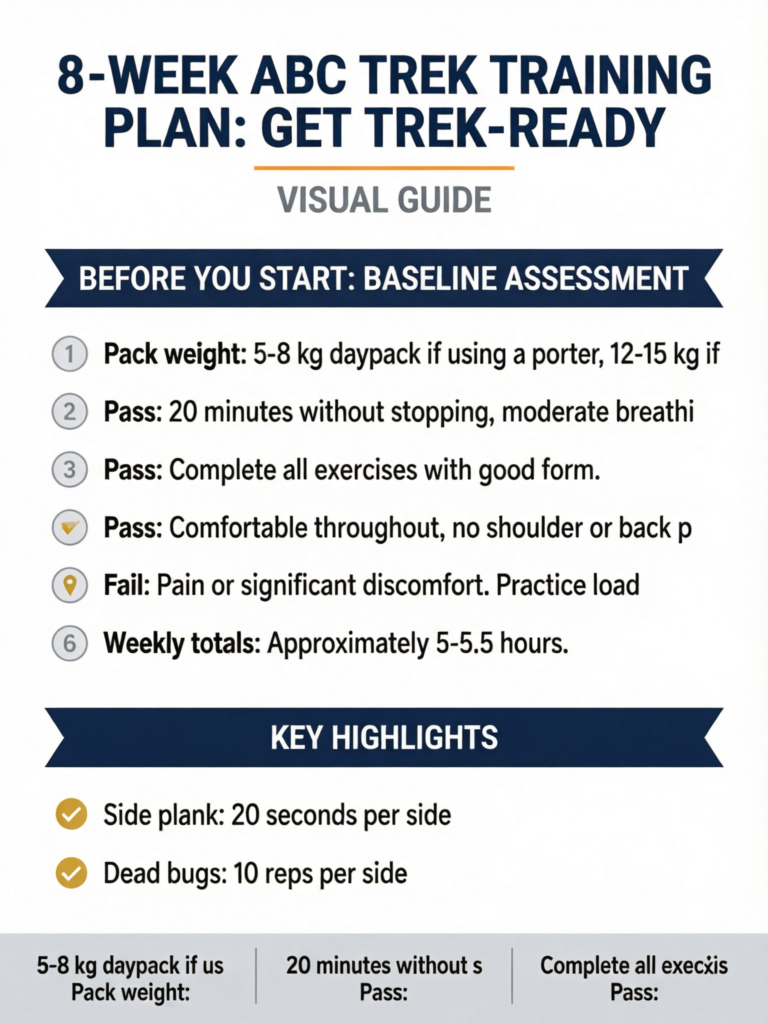
Pack weight: 5-8 kg daypack if using a porter, 12-15 kg if carrying your own gear.
Altitude: Maximum of 4,130 meters at Annapurna Base Camp. While not extreme by Himalayan standards, it is high enough to cause altitude sickness in unprepared trekkers. Reduced oxygen at this altitude increases cardiovascular demand by 30-40%.
The Three Fitness Pillars for ABC
1. Cardiovascular Endurance (50% of training focus) Your heart and lungs must sustain moderate effort for 5-7 hours daily, for multiple consecutive days. This is not about speed. It is about duration and recovery.
2. Lower Body Strength and Endurance (35% of training focus) Quadriceps, glutes, calves, and hip stabilizers must handle thousands of steps up and down, day after day. Downhill sections are harder on your body than uphill, causing eccentric muscle loading that creates severe soreness if you are not conditioned for it.
3. Core Strength and Stability (15% of training focus) Your core supports pack weight, maintains balance on uneven terrain, and protects your lower back during long hours of loaded walking.
The Staircase Factor
The ABC trail is nicknamed "the stairmaster trek" by experienced guides. Between Nayapul and Ghorepani alone, you will climb approximately 3,000 stone steps. Training on stairs is the single most specific exercise you can do for this trek. If you have access to a tall building, a stadium, or an outdoor staircase, use it heavily in your training.
Before You Start: Baseline Assessment
Complete these four tests before beginning the plan. Record your results and retest at week 4 and week 8 to track progress.
Test 1: The 60-Minute Walk Test
Walk briskly (5.5-6.5 km/h pace) on flat terrain for 60 minutes without stopping. Note your heart rate at the end if you have a monitor, or rate your perceived exertion on a 1-10 scale.
Pass: Complete 60 minutes with perceived exertion of 5/10 or less. Fail: Unable to complete, or exertion above 7/10. Add 2 weeks of base walking before starting this plan.
Test 2: The Stair Climb Test
Climb stairs continuously for 20 minutes at a steady pace (not racing). A single flight is fine if you walk back down and repeat.
Pass: 20 minutes without stopping, moderate breathing. Fail: Must stop multiple times, severe breathlessness. Focus heavily on stair work in weeks 1-4.
Test 3: The Bodyweight Strength Test
Complete: 20 bodyweight squats, 15 lunges per leg, 30-second wall sit, 30-second plank.
Pass: Complete all exercises with good form. Fail: Cannot complete the circuit. Integrate additional strength work in weeks 1-3.
Test 4: The Loaded Carry Test
Walk for 30 minutes wearing a daypack loaded with 5 kg.
Pass: Comfortable throughout, no shoulder or back pain. Fail: Pain or significant discomfort. Practice loaded walking 2-3 times per week from day one.
Adjusting the Plan to Your Baseline
If you passed all four tests comfortably, follow the plan as written. If you failed 1-2 tests, focus extra attention on those areas in weeks 1-3. If you failed 3-4 tests, this plan may be too aggressive. Consider starting with the 16-week beginner plan or extending this plan by adding two preparatory weeks of base fitness building before Week 1.
The 8-Week ABC Training Plan
Week 1: Foundation Building
Goal: Establish training habit, assess current capacity, begin building base endurance.
| Day | Workout | Duration | Details |
|---|---|---|---|
| Monday | Brisk walk or light jog | 40 min | Flat terrain, conversational pace |
| Tuesday | Strength circuit | 30 min | See strength workout A below |
| Wednesday | Stair climbing | 25 min | Continuous, moderate pace |
| Thursday | Rest or gentle yoga | 20 min | Active recovery |
| Friday | Cycling or elliptical | 35 min | Moderate intensity, steady state |
| Saturday | Hike or long walk | 90 min | Undulating terrain if available, 3-5 kg daypack |
| Sunday | Rest | — | Full rest day |
Weekly totals: Approximately 4-5 hours of training. Perceived exertion should remain at 4-5/10 throughout.
Week 2: Building Consistency
Goal: Increase duration slightly, introduce hill walking, continue building strength base.
| Day | Workout | Duration | Details |
|---|---|---|---|
| Monday | Running or brisk walk | 45 min | Include 10 min of gentle hills if possible |
| Tuesday | Strength circuit | 35 min | Strength workout A with added sets |
| Wednesday | Stair climbing | 30 min | Add 5 min from Week 1, carry 3 kg daypack |
| Thursday | Rest or easy walk | 20 min | Active recovery |
| Friday | Cycling or cross-trainer | 40 min | Moderate intensity with hill intervals |
| Saturday | Hike | 2 hours | Hilly terrain, 5 kg daypack |
| Sunday | Rest | — | Full rest day |
Weekly totals: Approximately 5-5.5 hours.
Week 3: Introducing Intensity
Goal: Begin pushing cardiovascular limits, introduce eccentric loading (downhill training), increase hiking duration.
| Day | Workout | Duration | Details |
|---|---|---|---|
| Monday | Interval walk/run | 45 min | Alternate 3 min hard, 2 min easy |
| Tuesday | Strength circuit | 40 min | Strength workout B (see below) |
| Wednesday | Stair climbing (up and down focus) | 35 min | Deliberate slow descents to train knees |
| Thursday | Easy jog or swim | 30 min | Low intensity recovery cardio |
| Friday | Hill repeats | 40 min | Find a steep hill, walk up hard, walk down controlled. Repeat 6-8 times |
| Saturday | Hike | 2.5 hours | 6-7 kg daypack, seek elevation gain of 300+ meters |
| Sunday | Rest | — | Full rest day |
Weekly totals: Approximately 5.5-6 hours.
Train the Downhill
Most people focus on uphill training and neglect downhill conditioning. On the ABC trek, the descent days (particularly from base camp back to Bamboo) are when knee pain and quad soreness peak. Deliberately train downhill walking: find slopes and stairs, load your pack, and practice slow, controlled descents. Your future self will thank you around day 7 of the trek.
Week 4: Building Volume
Goal: Significant jump in training volume. Weekend hike becomes the priority session. Introduce back-to-back training days.
| Day | Workout | Duration | Details |
|---|---|---|---|
| Monday | Run or brisk walk | 50 min | Sustained moderate effort |
| Tuesday | Strength circuit | 40 min | Strength workout B with added weight |
| Wednesday | Stair climbing with pack | 40 min | 5 kg pack, continuous climbing |
| Thursday | Active recovery | 25 min | Easy walk, stretching, foam rolling |
| Friday | Hill walking or trail hike | 60 min | Moderate-steep terrain |
| Saturday | Long hike | 3-3.5 hours | 7-8 kg daypack, 400+ meters elevation gain |
| Sunday | Easy walk | 30 min | Flat, recovery pace. This back-to-back simulates consecutive trek days |
Weekly totals: Approximately 6-6.5 hours.
Week 4 checkpoint: Retest the baseline assessments. You should see measurable improvement in all four tests.
Week 5: Trek-Specific Focus Begins
Goal: Training shifts to directly replicate ABC demands. Longer sustained efforts, heavier pack, more elevation.
| Day | Workout | Duration | Details |
|---|---|---|---|
| Monday | Sustained run or walk | 55 min | Include 20 min of hills |
| Tuesday | Strength circuit | 45 min | Strength workout C (see below) |
| Wednesday | Stair climbing with pack | 45 min | 7 kg pack, practice breathing rhythm |
| Thursday | Cross-training | 35 min | Cycling, swimming, or elliptical |
| Friday | Hill repeats | 45 min | Steeper hill, 8-10 repeats, walk down slowly |
| Saturday | Long hike | 4 hours | 8-10 kg daypack, seek 500+ meters elevation gain |
| Sunday | Rest | — | Full rest, prioritize sleep and nutrition |
Weekly totals: Approximately 6.5-7.5 hours.
Week 6: Peak Volume Week
Goal: Highest training volume of the plan. Push endurance boundaries. Introduce altitude simulation if possible.
| Day | Workout | Duration | Details |
|---|---|---|---|
| Monday | Long run or walk | 60 min | Include sustained hill section |
| Tuesday | Strength circuit | 45 min | Strength workout C, heavy emphasis on legs |
| Wednesday | Stair climbing marathon | 50 min | Continuous stair climbing with 7-8 kg pack |
| Thursday | Easy recovery cardio | 30 min | Gentle cycling or swimming |
| Friday | Trek simulation | 60 min | Walk with full daypack weight, varied terrain |
| Saturday | Long hike (peak session) | 5-6 hours | Full daypack (10 kg), 600+ meters elevation gain, practice trek pace |
| Sunday | Easy walk | 40 min | Back-to-back day simulation, flat terrain |
Weekly totals: Approximately 7.5-9 hours. This is the hardest week. Expect fatigue.
Listen to Your Body in Week 6
Week 6 is the peak volume week. If you experience sharp joint pain (not general muscle soreness), persistent fatigue that does not improve with rest, or illness, reduce the volume by 20-30%. Arriving at your trek injured is worse than arriving slightly undertrained. Soreness is normal. Pain is a warning.
Week 7: Taper Begins
Goal: Reduce volume by 25-30% while maintaining intensity. Allow body to recover and strengthen from the peak training block.
| Day | Workout | Duration | Details |
|---|---|---|---|
| Monday | Run or brisk walk | 45 min | Moderate effort, include hills |
| Tuesday | Strength circuit | 35 min | Reduce weight slightly, maintain form |
| Wednesday | Stair climbing | 35 min | Moderate pack, controlled effort |
| Thursday | Rest | — | Full rest |
| Friday | Hill walking | 40 min | Moderate terrain, moderate pack |
| Saturday | Hike | 3-3.5 hours | Moderate pack, enjoy the hike, do not push hard |
| Sunday | Rest | — | Full rest |
Weekly totals: Approximately 5-5.5 hours.
Week 8: Final Taper and Preparation
Goal: Arrive at your trek fresh, confident, and rested. Maintain fitness without creating fatigue.
| Day | Workout | Duration | Details |
|---|---|---|---|
| Monday | Easy run or walk | 35 min | Light effort, flat or gentle hills |
| Tuesday | Light strength circuit | 25 min | Bodyweight only, maintenance |
| Wednesday | Easy stair climbing | 20 min | No pack, gentle effort |
| Thursday | Rest | — | Full rest |
| Friday | Easy walk | 30 min | Flat terrain, shake out legs |
| Saturday | Rest or very easy 20-min walk | 0-20 min | If trekking starts Monday, rest completely |
| Sunday | Rest | — | Full rest, organize gear, hydrate well |
Weekly totals: Approximately 2-3 hours. This reduced volume is intentional and critical for performance.
The Taper Is Not Laziness
Many motivated people panic during the taper and try to cram in extra training. This is counterproductive. Your fitness improvements from weeks 1-6 need 10-14 days to fully integrate. The taper allows your muscles to repair, glycogen stores to maximize, and fatigue to dissipate. Trust the process. You will arrive at ABC feeling stronger during the taper than you did during peak training.
Strength Workout Details
Strength Workout A (Weeks 1-3)
Perform 2-3 sets of each exercise with 60 seconds rest between sets.
Lower body:
- Bodyweight squats: 15 reps
- Forward lunges: 12 reps per leg
- Calf raises: 20 reps (on a step for greater range)
- Glute bridges: 15 reps
- Wall sit: 30 seconds
Core:
- Plank: 30-45 seconds
- Side plank: 20 seconds per side
- Dead bugs: 10 reps per side
Upper body (for pack carrying):
- Push-ups: 10-15 reps (modify on knees if needed)
- Bent-over rows (with water bottles or light dumbbells): 12 reps
Strength Workout B (Weeks 3-5)
Perform 3 sets of each exercise with 45 seconds rest.
Lower body:
- Goblet squats (with weight or heavy water bottle): 15 reps
- Reverse lunges: 12 reps per leg
- Step-ups onto a bench or sturdy chair: 12 reps per leg
- Single-leg calf raises: 15 reps per leg
- Bulgarian split squats: 10 reps per leg
- Wall sit: 45 seconds
Core:
- Plank: 45-60 seconds
- Side plank with hip dip: 12 per side
- Mountain climbers: 20 reps
- Bird dogs: 10 per side
Upper body:
- Push-ups: 15 reps
- Renegade rows or bent-over rows: 12 reps per arm
- Overhead press (with weight): 12 reps
Strength Workout C (Weeks 5-7)
Perform 3-4 sets of each exercise with 45 seconds rest.
Lower body (high-rep endurance focus):
- Weighted squats: 20 reps
- Walking lunges: 20 steps total
- Step-ups with weighted pack: 15 per leg
- Single-leg Romanian deadlifts: 12 per leg
- Box jumps or explosive step-ups: 10 reps
- Wall sit with pack: 60 seconds
Core (stability focus):
- Plank with pack on back: 45-60 seconds
- Woodchoppers: 12 per side
- Dead bugs: 15 per side
- Pallof press or resistance band rotation: 10 per side
Upper body:
- Push-ups: 20 reps
- Rows: 15 reps per arm
- Shoulder press: 12 reps
- Farmer's carry: 30-second walks with heavy weights
No Gym? No Problem
Every exercise in this plan can be performed without a gym. Use water bottles, a loaded backpack, or household items for resistance. Stairs in your home or a local building replace the stair climber. Hills in your neighborhood replace the treadmill incline. A sturdy chair replaces a gym bench. The ABC trek itself requires zero gym equipment to complete, and your training does not need it either.
Training Without a Gym: The Outdoor-Only Plan
If you have no gym access or prefer outdoor training, here is how to structure each week using only outdoor resources.
Essential Outdoor Training Resources
Stairs: Any building with 4+ flights of stairs, a public stadium, or a hillside staircase.
Hills: A 10-30 minute hill of moderate-to-steep grade. Even a 5-minute hill works if you repeat it.
Trails: Any natural walking trail, ideally with elevation change. Even a flat trail works for long walks.
Your backpack: Loaded with water bottles, books, or sand to simulate pack weight.
Sample Outdoor-Only Week (Week 5 Example)
| Day | Workout | Duration |
|---|---|---|
| Monday | Hill repeats with loaded pack (7 kg). Walk up briskly, descend slowly. 8-10 repeats | 50 min |
| Tuesday | Bodyweight strength circuit in a park. Squats, lunges, step-ups on a bench, push-ups, plank holds | 45 min |
| Wednesday | Stair climbing session at a local building or stadium. Continuous up-and-down with 5 kg pack | 45 min |
| Thursday | Easy flat walk for recovery | 30 min |
| Friday | Trail run or fast-paced walk on varied terrain | 45 min |
| Saturday | Long hike on the most challenging terrain available. Full 8-10 kg pack, 500+ meters elevation gain target | 4-5 hours |
| Sunday | Rest | — |
Altitude Simulation Tips
The ABC trek reaches 4,130 meters. While you cannot fully simulate altitude at sea level, you can prepare your body to cope better.
Elevation Masks
Elevation training masks restrict airflow but do not replicate altitude. They train respiratory muscles (which has some benefit) but do not simulate the reduced oxygen partial pressure of actual altitude. Use them only as a supplementary tool, never as a primary altitude preparation method.
Breath Control Training
Practice nasal-only breathing during easy cardio sessions. This restricts oxygen intake mildly and trains efficient breathing patterns. Start with 10-minute segments of nasal breathing during walks and gradually extend.
High-Altitude Training If Available
If you live near mountains, incorporate weekend hikes at 2,000-3,000 meters. Even a single hike above 2,500 meters gives your body a preview of altitude's effects.
Hypoxic Training Facilities
Some cities have altitude training centers with hypoxic chambers. If accessible and affordable, 3-4 sessions in weeks 5-7 provide a mild advantage for altitude acclimatization. This is beneficial but not essential.
The Best Altitude Prep Is Cardiovascular Fitness
Research consistently shows that the strongest predictor of altitude tolerance is baseline cardiovascular fitness. A person with an excellent aerobic base acclimatizes faster and suffers less than someone with poor cardio fitness, regardless of altitude pre-exposure. Your best altitude preparation is the cardiovascular training in this plan.
Nutrition During Training
Your training demands additional calories, protein, and hydration. Poor nutrition undermines training adaptations.
Daily Nutrition Guidelines During the 8-Week Plan
Calories: Increase intake by 200-500 calories on training days, particularly on long hike days. You should not be in a caloric deficit during this plan.
Protein: Consume 1.4-1.8 grams per kilogram of body weight daily. Distribute protein across 3-4 meals. Post-workout protein (within 60 minutes) accelerates recovery.
Carbohydrates: Carbs fuel endurance exercise. Ensure 50-60% of training-day calories come from carbohydrates. Whole grains, fruits, and vegetables are ideal sources.
Hydration: Drink 2.5-3.5 liters of water daily. On long hike training days, consume 500-750 ml per hour of hiking. Monitor urine color: pale yellow indicates adequate hydration.
Iron: Altitude increases red blood cell production, which requires iron. Ensure adequate iron intake through red meat, spinach, lentils, or supplementation (consult a doctor before supplementing iron).
Pre-Long Hike Nutrition
The night before your Saturday long hike, eat a carbohydrate-rich dinner. Morning of the hike, eat 2-3 hours before starting: oatmeal, toast, banana, and peanut butter are excellent choices. During the hike, consume 200-300 calories per hour through trail mix, energy bars, or fruit.
Recovery Nutrition
Within 30-60 minutes of completing a workout, consume a combination of protein and carbohydrates. A protein shake with banana, yogurt with granola, or a turkey sandwich all work well. This recovery window maximizes muscle repair and glycogen replenishment.
How to Know You Are Ready
By the end of Week 7, you should be able to meet these benchmarks. If you can, you are ABC-ready.
The ABC Readiness Checklist
Cardiovascular readiness:
- Walk or hike for 5-6 hours continuously without exhaustion
- Recover overnight from a strenuous hike and feel capable of repeating it the next day
- Climb stairs for 30+ minutes with moderate breathing (not gasping)
Strength readiness:
- Complete a 4-hour hike with 10 kg daypack without significant shoulder, back, or knee pain
- Descend a steep trail for 45+ minutes without severe quad burning or knee instability
- Perform 25 bodyweight squats and 20 lunges per leg without significant difficulty
Mental readiness:
- Completed at least one hike of 4+ hours where you felt tired but pushed through
- Comfortable with the idea of hiking 5-7 hours daily for 7-10 consecutive days
- Have a realistic understanding of what the trek involves (read the ABC 10-day itinerary)
Practical readiness:
- Broken in your hiking boots with at least 30-40 km of walking
- Tested your daypack loaded with full weight for at least 3 training hikes
- Practiced walking with trekking poles if you plan to use them
Red Flags: Signs You Need More Time
Do not proceed with the trek if by Week 7 you cannot hike for 3+ hours without severe fatigue, experience persistent joint pain during training, cannot complete the stair test for 20 minutes, or have been unable to train consistently due to injury or illness. Postponing a trek is always better than attempting it unprepared. Many agencies allow date changes with advance notice.
Training for the ABC Fast-Track (7-Day Itinerary)
If you are following the 7-day fast-track ABC itinerary, your training needs increase. The shorter itinerary demands longer daily hiking hours (7-9 hours on some days) and faster elevation gain, giving your body less time to acclimatize.
Adjustments for the 7-Day Itinerary
Increase Saturday hike targets by 20%: If the standard plan calls for a 4-hour hike, aim for 5 hours.
Add a second long hike day: In weeks 5-7, add a 2-3 hour hike on Sundays to simulate the relentless daily walking of the fast-track schedule.
Increase stair climbing intensity: Add 10 minutes to each stair session and increase pack weight by 2 kg.
Practice back-to-back hard days: In weeks 5 and 6, complete demanding workouts on consecutive days (Saturday and Sunday) to simulate the no-rest nature of the 7-day plan.
Common Training Mistakes to Avoid
Mistake 1: Running Too Much, Hiking Too Little
Running builds cardiovascular fitness but does not replicate hiking mechanics. The motion, muscle engagement, and energy systems differ significantly. Running should complement, not replace, hiking and stair climbing in your training.
Mistake 2: Ignoring Downhill Training
Ascending is cardiovascularly demanding. Descending is muscularly destructive. The eccentric loading of downhill walking causes delayed onset muscle soreness (DOMS) that compounds over trek days. If you do not train downhill specifically, your quads and knees will suffer badly by day 3 of the trek.
Mistake 3: Skipping the Taper
Training adaptations occur during rest, not during exercise. Exercise is the stimulus; recovery is the adaptation. The taper in weeks 7-8 is when your body consolidates all the fitness gains from weeks 1-6. Skipping or shortening the taper means arriving at the trek with fatigue instead of freshness.
Mistake 4: Not Breaking in Boots
New hiking boots cause blisters, hot spots, and foot pain. Your boots need a minimum of 40-50 km of walking before the trek, including at least 2-3 long hikes on varied terrain. Train in the boots you will trek in.
Mistake 5: Training Only on Flat Terrain
If you live in a flat area, you must create elevation through stair climbing, parking garage ramps, or treadmill incline. Flat walking, regardless of duration, does not prepare your muscles for the sustained ascending and descending of the ABC trail.
Mistake 6: Neglecting Core Training
A weak core leads to poor posture under pack weight, lower back pain, and inefficient energy transfer during hiking. Core training does not need to be extensive, but 15-20 minutes of focused core work twice per week makes a meaningful difference.
Training With Medical Considerations
Knee Issues
If you have pre-existing knee concerns, add these to your plan:
- Wall sits: Build isometric quad strength that protects the knee joint
- Lateral band walks: Strengthen hip abductors that stabilize knee tracking
- Single-leg balance exercises: Improve proprioception and stabilizer strength
- Consider trekking poles from the start of training (not just the trek)
- Consult a physiotherapist about knee-specific preparation
Back Problems
If you have lower back issues:
- Emphasize core strength training throughout the plan
- Practice carrying your loaded pack for progressively longer durations
- Use a pack with a proper hip belt that transfers weight to your hips
- Include daily mobility work: cat-cow stretches, hip flexor stretches, and gentle spinal rotations
Asthma or Respiratory Conditions
If you have respiratory conditions:
- Practice breathing techniques during all cardio sessions
- Include nasal breathing exercises
- Bring medication and discuss altitude with your doctor
- Test exercise at moderate intensity to understand your limits
- Altitude reduces oxygen availability, which compounds respiratory challenges
Gear Break-In Schedule
Integrate gear testing into your training to avoid surprises on the trek.
| Weeks | Gear to Break In |
|---|---|
| 1-2 | Start wearing trekking boots for all training walks |
| 3-4 | Add trekking socks (wear them with boots for every session) |
| 5-6 | Use your actual daypack with realistic weight for all Saturday hikes |
| 7-8 | Wear your full trekking outfit (layers, hat, gloves if applicable) during at least one long hike |
Mental Preparation
Physical training is half the battle. Mental resilience determines whether you enjoy the trek or endure it.
Building Mental Toughness During Training
Practice discomfort tolerance: During your long Saturday hikes, resist the urge to stop at the first sign of tiredness. Push through moderate discomfort (not pain) to build the mental patterns you will need on the trek when tired legs must keep walking.
Embrace bad weather training: Rain, cold, heat. Train through it. The ABC trek does not offer weather cancellation days. Training in unpleasant conditions builds mental resilience and teaches you that discomfort is temporary.
Visualization: Spend 5-10 minutes before bed visualizing yourself on the trek. See yourself hiking steadily, breathing comfortably, enjoying the mountain views. This is not pseudoscience: sports psychology research consistently shows that visualization improves performance and reduces anxiety.
Set process goals, not outcome goals: Instead of "I will reach base camp," focus on "I will maintain a steady pace for each day." Process goals keep you focused on what you can control.
The Two-Minute Rule for Tough Moments
When you want to stop during training (or on the trek itself), commit to just two more minutes. When those two minutes pass, commit to two more. This cognitive trick breaks overwhelming effort into manageable segments. Most people find that the urge to quit passes within 5-10 minutes if they keep moving.
Frequently Asked Questions: ABC Trek Training
Training Plan Questions
Q: I only have 6 weeks. Can I compress this plan?
Yes, but with compromises. Combine weeks 1-2 into a single week and weeks 3-4 into another. You will still need the full taper in weeks 7-8 (now your weeks 5-6). The compressed plan works if you are already moderately fit. If you are starting from low fitness, 6 weeks is genuinely insufficient for safe ABC preparation.
Q: Can I substitute cycling for hiking in the training plan?
Cycling builds excellent cardiovascular fitness and leg strength but does not replicate the impact loading, balance demands, or eccentric muscle work of hiking. Use cycling as supplementary cardio (2-3 sessions per week maximum), but ensure at least one long hike and two stair sessions per week remain in your plan.
Q: How important is the long Saturday hike? Can I skip it?
The Saturday long hike is the most important session of the week. It is the only training activity that truly simulates a trek day. Skipping it occasionally is acceptable, but skipping it regularly undermines your entire preparation. Prioritize this session above all others.
Q: I feel exhausted after Week 6. Is something wrong?
No. Week 6 is the peak volume week and fatigue is expected. If you feel wiped out entering Week 7, trust the taper. The reduced training volume in weeks 7-8 will restore your energy. If fatigue persists beyond the first few days of Week 7, you may have overtrained. Take an extra rest day and reduce Week 7 volume further.
Q: Should I train every day?
No. Rest days are essential for adaptation. Your muscles repair and strengthen during rest, not during exercise. One to two full rest days per week should be non-negotiable. More is acceptable during weeks 1-3 as your body adapts to the training load.
Fitness and Physical Questions
Q: I am 50+ years old. Do I need to modify this plan?
Increase rest days from 1-2 to 2-3 per week, particularly in weeks 4-6. Extend the plan to 9-10 weeks if possible by adding more gradual progression in weeks 1-4. Focus more on joint-friendly exercises (swimming, cycling for cardio instead of running) and add extra stretching and mobility work. The ABC trek is absolutely achievable at 50+, but recovery takes longer and injury prevention is paramount.
Q: What if I have never hiked before?
The training hikes are part of learning how to hike. Start your Saturday long walks on flat terrain and progressively seek more challenging trails. Learn proper foot placement, pacing (slow and steady beats fast and exhausted), and pole usage if applicable. Consider joining a local hiking group for your first few training hikes to learn from experienced hikers.
Q: My knees hurt after training. Should I push through?
Never push through sharp or acute joint pain. Mild muscle soreness is normal and expected. Sharp pain, swelling, or persistent aching in joints (especially knees) indicates potential injury. Rest for 3-5 days, ice the affected joint, and resume with reduced intensity. If pain persists beyond a week, consult a physiotherapist before continuing. Knee pain during descent is extremely common and often indicates weak quadriceps or poor technique. Strengthen your quads and practice slow, controlled descents with slightly bent knees.
Q: How much weight should I lose before the trek?
This plan is not a weight loss program. Do not restrict calories during training. However, if you are significantly overweight, the cardiovascular and joint demands of the trek increase substantially. Every additional kilogram above a healthy weight is a kilogram your legs carry up thousands of stone steps. If weight loss is a goal, begin a moderate caloric deficit 3-4 months before starting this plan, then eat at maintenance during the 8-week training period.
Altitude and Trek-Specific Questions
Q: Do I need altitude training for ABC?
Formal altitude training is not necessary for ABC. The maximum elevation is 4,130 meters, which is manageable for most healthy, well-conditioned trekkers. Strong cardiovascular fitness is the best altitude preparation. If you have access to high-altitude hiking and can incorporate it into training, it provides a mild advantage but is not required.
Q: How does this plan compare to training for EBC?
The ABC and EBC treks have similar cardiovascular demands, but EBC reaches higher altitude (5,364m vs 4,130m) and involves more total trekking days. This plan is sufficient for ABC. For EBC, you would need either a 10-12 week plan or higher weekly training volumes. See the EBC training plan for comparison.
Q: What is the hardest day of the ABC trek?
Most trekkers find the climb from Deurali (3,230m) to Annapurna Base Camp (4,130m) via Machapuchare Base Camp (3,700m) to be the most demanding day. It involves 900 meters of ascent at altitude, across rocky moraine terrain, over 5-7 hours. The second hardest is typically the descent from Ghorepani to Tadapani, which involves relentless stone staircase descending that destroys unprepared quadriceps.
Q: Can I train for ABC and lose altitude anxiety at the same time?
Altitude anxiety is common and legitimate. The best cure is preparation and education. This training plan builds physical confidence. Combine it with research: read the ABC 10-day itinerary day-by-day, understand acclimatization, and know the symptoms of altitude sickness and how they are managed. Knowledge reduces anxiety. Physical fitness reduces physical risk. Together, they make the trek enjoyable rather than frightening.
Q: What happens if I get sick or injured during training and miss weeks?
If you miss one week, extend the plan by one week by repeating the week you missed. If you miss two or more weeks, restart from the week corresponding to your current fitness (likely 1-2 weeks back from where you stopped). If you miss four or more weeks, consider postponing the trek. Resuming intense training after extended absence increases injury risk dramatically.
Q: Should I take Diamox (acetazolamide) even though ABC is below 5,000m?
Discuss this with your doctor. Many trekkers use Diamox prophylactically for ABC, particularly if they have a history of altitude sensitivity. The drug assists acclimatization but has side effects (tingling, increased urination, altered taste). It is not a substitute for proper acclimatization and fitness. Your training plan does far more for your altitude performance than any medication.
This training plan is designed for the Annapurna Base Camp trek. For general fitness requirements across all Nepal treks, see our comprehensive fitness requirements guide. For a longer preparation period, consider the 16-week beginner training plan.