
Acclimatization Guide for Nepal Trekking: Why Rest Days Save Lives
Acclimatization for Nepal trekking means ascending no more than 300-500m in sleeping altitude per day above 3,000m, taking a rest day for every 1,000m gained, climbing high and sleeping low, and never going higher with altitude-sickness symptoms. Follow these rules and serious altitude illness becomes largely preventable, even on high-pass treks like Thorong La (5,416m) or Larkya La (5,160m).
Every year, the Himalayan Rescue Association treats over 1,000 trekkers for altitude-related illness in their clinics at Pheriche (4,371m) and Manang (3,540m). Their data reveals a consistent pattern: the overwhelming majority of serious altitude illness cases -- and virtually all altitude-related deaths -- involve trekkers who ascended too quickly, skipped acclimatization days, or ignored early warning symptoms. Tragically, the great majority of altitude-related deaths in Nepal occur in people who continued ascending despite having symptoms of altitude sickness.
Acclimatization is not optional. It is not a suggestion. It is the single most important factor in determining whether your Nepal trek will be a life-changing adventure or a medical emergency. This guide explains the science of altitude adaptation, provides the specific rules that keep trekkers safe, outlines trek-specific acclimatization schedules, and addresses the most common mistakes that put trekkers at risk.
2,500m (8,200 ft)
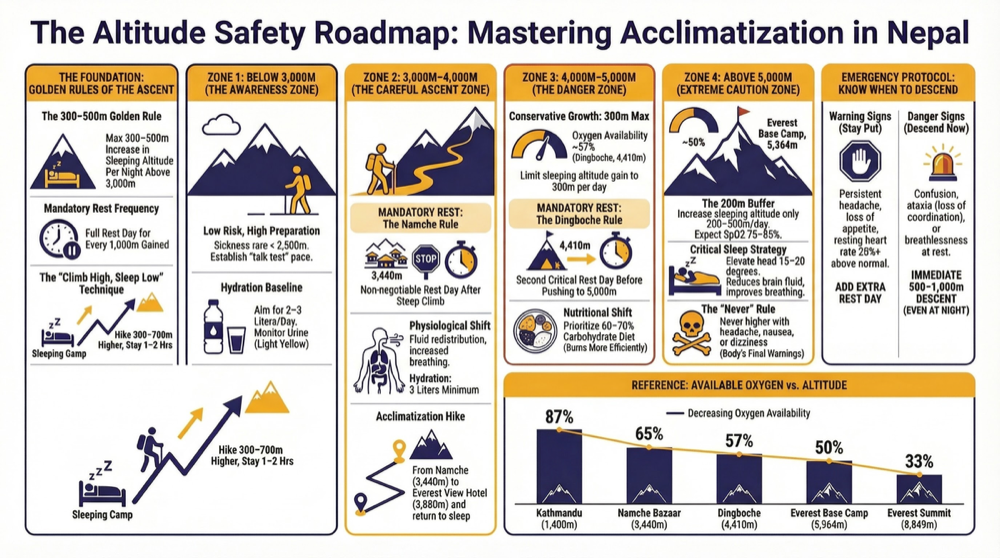
Max 300-500m gain per day above 3,000m
Every 1,000m of altitude gained
Climb high, sleep low
3-4 liters/day above 3,000m
50-85% incidence above 4,500m
10-25% incidence (mild)
Never ascend with AMS symptoms
What Is Acclimatization?
Acclimatization is the process by which your body adapts to reduced oxygen availability at high altitude. At sea level, the atmosphere contains approximately 21% oxygen at a pressure of 760 mmHg. This percentage remains constant at altitude, but the atmospheric pressure decreases, meaning each breath contains fewer oxygen molecules.
| Altitude | Atmospheric Pressure | Available Oxygen (vs Sea Level) |
|---|---|---|
| Sea Level (0m) | 760 mmHg | 100% |
| Kathmandu (1,400m) | 660 mmHg | 87% |
| Namche Bazaar (3,440m) | 494 mmHg | 65% |
| Dingboche (4,410m) | 436 mmHg | 57% |
| Everest Base Camp (5,364m) | 383 mmHg | 50% |
| Summit of Everest (8,849m) | 253 mmHg | 33% |
At Everest Base Camp, you breathe air with only half the oxygen available at sea level. Your body must make profound physiological changes to function in this environment, and these changes take time.
The Science of Acclimatization: What Your Body Does
When you ascend to altitude, your body initiates a cascade of adaptations that unfold over hours, days, and weeks. Understanding these changes helps you appreciate why time at altitude is non-negotiable.
Immediate Response (Hours)
Increased Breathing Rate (Hypoxic Ventilatory Response)
- Your body detects reduced oxygen and immediately increases breathing rate and depth
- Heart rate increases to circulate more blood and deliver more oxygen to tissues
- This is the most immediate defense mechanism
- Individual variation in this response partly explains why some people acclimatize better than others
Short-Term Adaptation (1-3 Days)
Fluid Redistribution
- Your body redistributes fluids, initially causing mild swelling (facial puffiness, ring tightness)
- Kidneys increase urine output to reduce blood volume and concentrate oxygen-carrying capacity
- This is why hydration is so critical -- your body is deliberately shedding fluid
Blood Chemistry Changes
- Blood becomes more alkaline from hyperventilation (respiratory alkalosis)
- Kidneys compensate by excreting bicarbonate, normalizing pH
- This process takes 1-3 days and is the core of initial acclimatization
- Diamox accelerates this specific process (see our Diamox guide)
Medium-Term Adaptation (3-10 Days)
Red Blood Cell Production
- The kidneys produce erythropoietin (EPO) in response to low oxygen
- EPO stimulates bone marrow to produce more red blood cells
- More red blood cells = more hemoglobin = more oxygen-carrying capacity
- This process takes days to begin and weeks to complete
- After 1-2 weeks at altitude, hemoglobin levels increase measurably
Muscle and Tissue Changes
- Muscles increase capillary density (more blood vessels = better oxygen delivery)
- Cells increase mitochondrial efficiency (better use of available oxygen)
- These changes continue for weeks and explain why longer stays improve altitude tolerance
Long-Term Adaptation (Weeks to Months)
- Significantly elevated red blood cell count
- Permanent (while at altitude) cardiovascular adaptations
- Improved cellular oxygen utilization
- These long-term changes are what allow Sherpa communities to live and work at extreme altitudes
Why Fitness Does NOT Predict Acclimatization
A common misconception is that physically fit people acclimatize better. Research consistently shows no correlation between aerobic fitness and acclimatization rate. Ultra-marathon runners get altitude sickness at the same rate as sedentary office workers. Acclimatization is primarily determined by genetics (hypoxic ventilatory response), prior altitude exposure, and ascent rate -- not fitness level. Being fit helps you handle the physical demands of trekking, but it does not protect against altitude illness.
Why Acclimatization Is Non-Negotiable: The Statistics
The difference between proper and improper acclimatization is stark:
AMS (Acute Mountain Sickness) Incidence
| Scenario | AMS Rate | Severe AMS Rate |
|---|---|---|
| Rapid ascent to 4,500m (no acclimatization) | 50-85% | 15-25% |
| Standard ascent with proper acclimatization days | 10-25% | 2-5% |
| Conservative ascent with extra rest days | 5-15% | 1-2% |
| Proper acclimatization + prophylactic Diamox | 5-10% | Less than 1% |
Evacuation Statistics
- Nepal averages 300-500 altitude-related helicopter evacuations per year
- The vast majority involve trekkers who ascended too quickly
- Cost: $3,000-8,000+ per evacuation (see our helicopter rescue guide)
- Most evacuations could have been prevented with proper acclimatization
Fatal Outcomes
- 4-6 trekkers die from altitude illness in Nepal annually
- Nearly all cases involve continued ascent despite symptoms
- Altitude deaths are almost entirely preventable with proper knowledge and behavior
The Golden Rules of Acclimatization
These rules are endorsed by the Wilderness Medical Society, International Society for Mountain Medicine, and the Himalayan Rescue Association. They are the foundation of safe altitude trekking.
Rule 1: Limit Sleeping Altitude Gain to 300-500m Per Day Above 3,000m
This is the most important rule. Above 3,000m (9,800 ft), your sleeping altitude (where you spend the night) should increase by no more than 300-500 meters per day.
Example on EBC trek:
- Namche (3,440m) to Tengboche (3,870m) = 430m gain. Acceptable.
- Tengboche (3,870m) to Dingboche (4,410m) = 540m gain. Acceptable but at the upper limit.
- Dingboche (4,410m) to Lobuche (4,940m) = 530m gain. At the upper limit -- this is why many itineraries include a rest day at Dingboche.
The rule is about SLEEPING altitude, not maximum altitude during the day. You can hike higher during the day and descend to sleep (climb high, sleep low), and this actually accelerates acclimatization.
Rule 2: Take a Rest Day Every 1,000m of Altitude Gained
For every 1,000 meters of altitude gained above 3,000m, schedule a rest day. This gives your body time to complete the physiological adaptations described above.
In practice on a standard EBC itinerary:
- Rest day at Namche Bazaar (3,440m) after ascending from Lukla (2,860m) -- approximately 580m gained
- Rest day at Dingboche (4,410m) after ascending from Namche -- approximately 970m gained over several days
- Some itineraries add an optional rest day at Lobuche (4,940m)
Key principle: These rest days are NOT wasted time. They are among the most productive days of your trek, as your body makes critical adaptations that enable safe ascent to even higher altitudes.
Rule 3: "Climb High, Sleep Low"
This technique is the most effective acclimatization strategy beyond simple slow ascent. The principle is straightforward: during rest days (and even regular trekking days), hike to a higher altitude during the day, then descend to sleep at a lower altitude.
How it works:
- Exposure to higher altitude stimulates acclimatization adaptations
- Sleeping at lower altitude allows rest and recovery in a relatively oxygen-rich environment
- The combination accelerates acclimatization beyond what rest alone provides
Classic examples in Nepal:
Namche Rest Day (EBC Trek):
- Sleep at Namche Bazaar (3,440m)
- Day hike to the Everest View Hotel at Syangboche (3,880m) or to Khumjung (3,790m)
- Gain: 350-440m during the day, return to 3,440m to sleep
- Duration: 3-5 hours round trip
- Bonus: Spectacular first views of Everest, Ama Dablam, and Lhotse
Dingboche Rest Day (EBC Trek):
- Sleep at Dingboche (4,410m)
- Day hike to Nagarjun Hill (5,100m) or toward Chhukung (4,730m)
- Gain: 320-690m during the day, return to 4,410m to sleep
- Duration: 3-6 hours round trip
- Bonus: Stunning views of Island Peak, Ama Dablam, and Lhotse wall
Manang Rest Day (Annapurna Circuit):
- Sleep at Manang (3,540m)
- Day hike to Ice Lake (4,600m) or Gangapurna Lake (3,580m) and above
- Gain: Up to 1,060m during the day, return to 3,540m to sleep
- Duration: 4-7 hours for Ice Lake
- Bonus: Spectacular glacial lake views
Pro Tip
On rest days, aim to hike 300-700m above your sleeping altitude. The hike does not need to be strenuous -- a steady, moderate pace is ideal. Walk for 2-4 hours up, have tea or a snack at the high point, and return to your lodge. This combination of physical activity and altitude exposure is the most effective acclimatization technique available, and it doubles as some of the most scenic hiking on the entire trek.
Rule 4: Never Ascend With Symptoms
If you have ANY symptoms of Acute Mountain Sickness, do NOT go higher. This is the rule that saves lives. Symptoms of AMS include:
- Headache (the cardinal symptom)
- Nausea or vomiting
- Dizziness or lightheadedness
- Fatigue beyond normal tiredness
- Poor sleep or insomnia
- Loss of appetite
What to do if you have symptoms:
- Stop ascending immediately. Stay at your current altitude.
- Rest for 24 hours. Monitor symptoms closely.
- If symptoms improve after 24 hours: Continue ascending with extra caution.
- If symptoms persist or worsen: Descend 500-1,000m immediately. This is not optional.
- If symptoms are severe (confusion, loss of coordination, severe breathlessness at rest): Descend immediately. Do not wait. These are signs of HACE or HAPE.
See our complete altitude sickness signs and turnaround rules for detailed symptom recognition.
Optimal Ascent Rates by Altitude Zone
Below 2,500m: No Restrictions
At altitudes below 2,500m (8,200 ft), altitude sickness is extremely rare. You can ascend as quickly as your fitness allows. This covers most of Kathmandu (1,400m), Pokhara (820m), and the lower sections of most trek approaches.
2,500-3,000m: Awareness Zone
Most people tolerate these altitudes well, but some individuals with high sensitivity may begin to feel mild effects. Sleep quality may be slightly reduced. Awareness of symptoms begins here.
3,000-4,000m: Careful Ascent Zone
- Maximum sleeping altitude gain: 400-500m per day
- Rest day after every 1,000m gained
- Climb high, sleep low when possible
- Begin monitoring for AMS symptoms
- Most trekkers begin to notice altitude: mild breathlessness on exertion, slightly interrupted sleep
- Hydration critical: aim for 3 liters/day minimum
4,000-5,000m: Conservative Ascent Zone
- Maximum sleeping altitude gain: 300-400m per day
- Rest day after every 800-1,000m gained
- Climb high, sleep low essential
- AMS symptoms common: headache, mild nausea, fatigue
- Hydration: 3-4 liters/day
- Carbohydrate-rich diet recommended
- Consider prophylactic Diamox if not already taking it
Above 5,000m: Extreme Caution Zone
- Maximum sleeping altitude gain: 200-300m per day
- Rest/acclimatization day before every significant push
- Oxygen saturation drops significantly (typically 75-85% SpO2 at rest)
- Almost everyone experiences some AMS symptoms
- Cold compounds altitude effects
- Sleep quality significantly impaired
- Critical to monitor for HACE/HAPE signs
Trek-Specific Acclimatization Schedules
Everest Base Camp: Standard 14-Day Acclimatization Plan
The standard EBC itinerary is well-designed for acclimatization, with built-in rest days at the right locations.
| Day | Start | End | Altitude Gain | Notes |
|---|---|---|---|---|
| 1 | Kathmandu | Lukla (2,860m) | Flight to altitude | Fly and short walk to settle in |
| 2 | Lukla | Phakding (2,610m) | -250m (descent) | Easy warm-up day |
| 3 | Phakding | Namche (3,440m) | +830m | Hard day; steep climb into Namche |
| 4 | Namche | Rest Day | 0 (day hike +400m) | Critical rest day. Hike to Everest View Hotel (3,880m) |
| 5 | Namche | Tengboche (3,870m) | +430m | Moderate day through forests |
| 6 | Tengboche | Dingboche (4,410m) | +540m | Into the alpine zone |
| 7 | Dingboche | Rest Day | 0 (day hike +500m) | Critical rest day. Hike toward Nagarjun Hill (5,100m) |
| 8 | Dingboche | Lobuche (4,940m) | +530m | Entering extreme altitude zone |
| 9 | Lobuche | Gorak Shep (5,164m) | +224m | Short day, high altitude |
| 10 | Gorak Shep | EBC (5,364m) & back | +200m (return to GS) | Base camp visit; sleep at Gorak Shep |
| 11 | Gorak Shep | Kala Patthar (5,545m) & descend | +479m then descend | Pre-dawn summit, then descend to Pheriche (4,280m) |
| 12-14 | Descend | Lukla | Losing altitude | Rapid descent with minimal altitude risk |
Critical acclimatization points:
- Day 4 (Namche rest day): This is arguably the most important single day of the trek. Skipping it is the most common mistake. The 580m gain from Lukla via Phakding needs this day for your body to adapt. The day hike to Syangboche/Everest View Hotel provides climb-high-sleep-low stimulus.
- Day 7 (Dingboche rest day): The second critical rest day. You have gained approximately 1,000m above Namche over 2 days. The day hike toward Nagarjun Hill exposes you to 5,000m+ for the first time.
- Optional Day 8.5 (Lobuche rest): Some conservative itineraries add a rest day at Lobuche. This is wise for trekkers who felt any symptoms at Dingboche.
Read our complete EBC 14-day itinerary for detailed daily descriptions.
Never Skip the Namche Rest Day
The single most common acclimatization mistake on the EBC trek is skipping the rest day at Namche Bazaar to "save time." Namche is where your body first adapts to significant altitude (3,440m). Skipping this day dramatically increases your risk of developing AMS at Dingboche (4,410m) or higher, potentially forcing you to abandon your trek entirely or requiring evacuation. One extra day at Namche is infinitely better than a helicopter ride down from Lobuche.
Annapurna Base Camp: Natural Acclimatization Plan
The ABC trek has a more forgiving altitude profile, with a maximum of 4,130m and a gradual approach that provides natural acclimatization.
| Day | Start | End | Altitude | Notes |
|---|---|---|---|---|
| 1 | Nayapul | Tikhedhunga (1,540m) | Start | Low altitude, warm-up |
| 2 | Tikhedhunga | Ghorepani (2,870m) | +1,330m | Big climb, but still moderate altitude |
| 3 | Ghorepani | Poon Hill (3,210m) sunrise, then Tadapani (2,630m) | +340m then -580m | Climb high, sleep low |
| 4 | Tadapani | Chhomrong (2,170m) | -460m | Descent; body continues adjusting |
| 5 | Chhomrong | Dovan (2,580m) | +410m | Gradual re-ascent |
| 6 | Dovan | Deurali (3,230m) | +650m | Entering altitude zone |
| 7 | Deurali | ABC (4,130m) | +900m via MBC | Big altitude day; no rest day typical |
| 8-10 | Descend | Nayapul | Losing altitude | Rapid descent |
Key point: The ABC trek's natural up-down profile (ascending to Ghorepani, descending to Chhomrong, then re-ascending to ABC) provides inadvertent climb-high-sleep-low acclimatization. Most trekkers tolerate the final push to 4,130m well because of this pattern. However, some trekkers experience mild AMS at ABC or MBC -- if you do, descend to Deurali and rest.
Read our complete ABC 10-day itinerary.
Manaslu Circuit: Acclimatization Before Larkya La
The Manaslu Circuit's key acclimatization challenge is preparing for Larkya La (5,160m).
| Day | Location | Altitude | Notes |
|---|---|---|---|
| 8-9 | Samagaon | 3,530m | Rest day essential. Day hike toward Manaslu Base Camp (4,400m) |
| 10 | Samdo | 3,860m | Short day, more acclimatization |
| 11 | Samdo rest day | 3,860m | Day hike toward Tibetan border (4,200m+) |
| 12 | Dharamsala/Larkya BC | 4,460m | High camp before pass |
| 13 | Cross Larkya La | 5,160m | Early start, long day, descend to Bimtang (3,720m) |
Critical point: The rest day at Samagaon and/or Samdo is essential before the Larkya La crossing. Trekkers who skip these rest days frequently develop AMS on the pass day, which is dangerous given the remote location and long exposure above 5,000m.
Three Passes Trek: Multiple Acclimatization Stops
The Three Passes Trek is one of Nepal's most altitude-demanding standard treks, crossing three passes above 5,300m in rapid succession.
Essential acclimatization stops:
- Namche rest day (3,440m): Standard EBC rest day
- Dingboche/Chhukung rest day (4,410-4,730m): Before Kongma La (5,535m)
- Lobuche rest day (4,940m): Between Kongma La and Cho La
- Gokyo rest day (4,790m): Before Renjo La (5,360m) and after Cho La
This trek requires a minimum of 18-21 days. Shorter itineraries that cut rest days are unsafe.
Acclimatizing for High Mountain Passes
High passes are where altitude illness most often turns serious, because you cross above 5,000m and cannot easily stop to rest mid-crossing. The acclimatization rule for any high pass is the same: arrive at the high camp already adapted, never on the back of a fast ascent.
| High Pass | Altitude | Trek | Acclimatization Before Crossing |
|---|---|---|---|
| Thorong La | 5,416m | Annapurna Circuit | Rest/acclimatization days at Manang (3,540m); sleep at Thorong Phedi or High Camp |
| Larkya La | 5,160m | Manaslu Circuit | Rest days at Samagaon (3,530m) and Samdo (3,860m) |
| Cho La | 5,420m | Everest Three Passes / Gokyo-EBC | Acclimatize via Namche, Dingboche, and Gokyo first |
| Kongma La | 5,535m | Everest Three Passes | Rest day at Chhukung (4,730m) before the crossing |
| Renjo La | 5,360m | Everest Three Passes | Acclimatize at Gokyo (4,790m) before crossing |
Why passes are dangerous: the high point is reached only briefly, but the approach camp (Thorong Phedi 4,540m, Dharamsala 4,460m, Chhukung 4,730m) sits high enough that an under-acclimatized trekker can develop AMS, HACE, or HAPE overnight before the crossing even begins. The Larkya La and Thorong La crossings are also long days — 6 to 9 hours of effort, much of it above 4,500m — so you cross with little reserve.
High-Pass Golden Rule
Never attempt a high pass if you have symptoms at the camp below it. A headache, nausea, or poor sleep at Thorong Phedi or Dharamsala is your body telling you to wait or descend, not to push over the pass. Crossings such as Thorong La and Larkya La put you hours from the nearest help; the safe move is always to turn around and descend, not to "get it over with."
If you are researching famous Himalayan passes more broadly, note that some high passes outside Nepal — such as Baralacha La (4,890m) on the Manali-Leh highway in India — are crossed by vehicle in a single day with no acclimatization, which is exactly why travellers there frequently fall ill. On foot in Nepal you have the opposite advantage: you can build adaptation over days, so use it.
See our detailed guides to the Thorong La pass, Larkya La pass, Cho La pass, and Kongma La pass for stage-by-stage crossing plans.
Pre-Acclimatization: What to Do Before You Arrive
Acclimatization happens on the trail, but smart preparation in the weeks before improves how your body copes once you start gaining altitude.
- Build cardiovascular fitness 2-3 months out. Fitness does not speed acclimatization, but it lets you trek at the slow, conversational pace that does aid adaptation, and it leaves energy in reserve on long days. Running, cycling, stair climbing, and hill hikes are ideal. See our cardiovascular fitness for trekking guide.
- Spend time at elevation if you can. A few days at 2,000-3,000m in the weeks before your trek (or arriving in Kathmandu and adding a day at Nagarkot, 2,195m) gives modest pre-acclimatization that fades over weeks but still helps.
- Arrive rested and hydrated. Long flights dehydrate you, and poor sleep and dehydration are among the few altitude-illness risk factors fully within your control. Arrive a day or two early to recover from jet lag before the trek starts.
- Discuss Diamox with your doctor. If you have had altitude sickness before or are attempting a high-pass trek, ask about prophylactic acetazolamide. See our Diamox guide.
- Plan an itinerary with real rest days. The single biggest acclimatization decision happens before you leave home: choosing a trek schedule with built-in rest days rather than a compressed one.
What to Do on Rest Days
Rest days are often misunderstood. "Rest" does not mean lying in bed all day -- in fact, complete inactivity is counterproductive. Here is how to maximize acclimatization on rest days.
Do: Active Acclimatization
-
Take an acclimatization hike: Walk 300-700m above your sleeping altitude, spend 1-2 hours at the high point, then descend. This is the single most effective rest day activity.
-
Stay well hydrated: Drink 3-4 liters of water, tea, or electrolyte drinks throughout the day. Your kidneys are working hard to adjust blood chemistry.
-
Eat carbohydrate-rich food: Your body burns carbohydrates more efficiently at altitude than fats or proteins. Dal bhat (rice and lentils) is ideal -- carbohydrate-dense, easy to digest, and available everywhere.
-
Walk around the village: Even a gentle stroll through Namche Bazaar or Dingboche keeps your body active and engaged without exhaustion.
-
Attend HRA lectures: The Himalayan Rescue Association offers free altitude sickness lectures at their clinics in Pheriche and Manang. These are excellent educational sessions.
Do Not: Common Rest Day Mistakes
-
Lie in bed all day: Complete inactivity slows acclimatization. Mild activity stimulates the adaptations you need.
-
Drink alcohol: Rest days in Namche or Manang may feel like a chance to celebrate at a bar. Alcohol impairs acclimatization, causes dehydration, and disrupts the sleep quality that is essential for adaptation.
-
Take sleeping pills: Sleeping at altitude is difficult, and the temptation to take sleeping pills is real. However, sleeping pills suppress the respiratory drive at the exact time when your body needs to breathe more. This can cause dangerous drops in blood oxygen levels during sleep.
-
Skip meals: Appetite loss is common at altitude, but your body needs fuel for acclimatization. Eat even when not hungry. Choose easily digestible carbohydrates.
-
Push a hard hike: The acclimatization day hike should be moderate, not exhausting. This is not the day to prove your fitness. Walk at 50-60% of your maximum pace.
Pro Tip
The Namche Bazaar rest day is a perfect opportunity to explore the town: visit the Sherpa Culture Museum, browse the Saturday market (if your timing aligns), walk up to the Everest View Hotel for tea with spectacular views, and attend the HRA altitude lecture at 3pm. This active but relaxed day provides excellent acclimatization while being one of the most culturally rich days of the entire EBC trek.
Signs You Need More Acclimatization Time
Your body communicates its adaptation status through clear signals. Learning to read these signals is a critical skill.
Warning Signs: Add Another Rest Day
- Persistent headache that does not resolve with 1 liter of water and 500mg paracetamol within 2 hours
- Poor sleep quality beyond the normal altitude-related sleep disruption (waking repeatedly, unable to fall asleep)
- Reduced appetite lasting more than 24 hours
- Unusual fatigue beyond what the day's hiking should produce
- Mild nausea or feeling "off"
- Resting heart rate 20%+ above your normal (monitor with a pulse oximeter or fitness watch)
- Oxygen saturation below 80% at rest (if you carry a pulse oximeter)
If you experience any of these, stay at your current altitude for an additional day. Take an easy acclimatization hike if you feel up to it, hydrate aggressively, and reassess the following morning.
Danger Signs: Descend Immediately
- Confusion, disorientation, or altered mental state (signs of HACE)
- Loss of coordination -- unable to walk a straight line (ataxia, a hallmark of HACE)
- Severe, unrelenting headache not responsive to medication and rest
- Persistent vomiting preventing food and water intake
- Breathlessness at rest (not during exercise -- at rest, sitting or lying down) -- signs of HAPE
- Gurgling or crackling sounds when breathing (pulmonary edema)
- Blue or grey coloring of lips, fingernails (cyanosis)
These are medical emergencies. Descend 500-1,000m immediately. Do not wait for morning. Do not wait for symptoms to improve. Descend now, even at night with headlamps if necessary. Alert your guide, notify fellow trekkers, and consider calling for helicopter rescue. For detailed emergency protocols, see our altitude sickness prevention and treatment guide.
Factors That Affect Your Acclimatization
Understanding what helps and hinders acclimatization allows you to maximize your adaptation.
Factors You Can Control
Ascent Rate (Most Important)
- The single biggest factor in your control
- Slower ascent = better acclimatization = safer trek
- Following the 300-500m/day rule above 3,000m is the most effective strategy
Hydration
- Dehydration directly impairs acclimatization
- Target: 3-4 liters per day above 3,000m
- Urine should be light yellow (clear means over-hydrating; dark yellow means dehydrated)
- Water, tea, and electrolyte drinks all count
- Coffee and alcohol are net dehydrating
Nutrition
- Carbohydrate-rich diet recommended (60-70% of calories from carbs)
- Dal bhat is the ideal altitude food: rice provides carbohydrates, lentils provide protein
- Avoid heavy fatty meals that are harder to digest at altitude
- Eat even when appetite is reduced; small frequent meals if necessary
Sleep
- Quality sleep is essential for acclimatization
- Elevate your head slightly (fold clothes under pillow end of sleeping bag)
- Avoid sleeping pills (they suppress breathing)
- Earplugs help if lodgemates snore
- Accept that sleep above 4,000m will be lighter and more interrupted than normal
Alcohol and Drug Avoidance
- Alcohol impairs acclimatization, dehydrates, and disrupts sleep
- Sleeping pills suppress respiratory drive
- Some anti-nausea medications (promethazine) can also suppress breathing
Physical Activity Level
- Moderate activity aids acclimatization
- Over-exertion hinders it
- Trek at a pace where you can hold a conversation (the "talk test")
- If you are too breathless to speak a full sentence, slow down
Factors You Cannot Control
Genetics
- Your hypoxic ventilatory response (how strongly your body reacts to low oxygen) is largely genetic
- This explains why two equally fit people at the same altitude may respond very differently
- Prior altitude experience gives you some indication of your genetic susceptibility
- There is no reliable predictor before your first high-altitude experience
Age
- Contrary to popular belief, older trekkers do NOT necessarily acclimatize worse than younger ones
- Some studies suggest older trekkers acclimatize better, possibly because they tend to ascend more slowly and conservatively
- Children under 10 may be less able to communicate symptoms, requiring extra vigilance
Prior Altitude Experience
- Previous exposure to high altitude provides some acclimatization benefit that persists for weeks to months
- Trekkers who were at altitude within the previous 2-3 months may acclimatize faster
- This is NOT a guarantee of success on subsequent trips
Sex
- No significant difference in AMS incidence between men and women
- Menstrual cycle phase does not appear to affect acclimatization
- Both sexes should follow identical acclimatization protocols
Hydration: The Critical Role Water Plays at Altitude
Hydration deserves its own section because it is both critically important and commonly neglected.
Why You Need More Water at Altitude
-
Increased respiration: You breathe faster and deeper at altitude, losing more moisture with each exhalation. At 4,000m, you may lose 1 liter of water per day through breathing alone.
-
Lower humidity: Mountain air is significantly drier than low-altitude air, increasing evaporative water loss from skin and lungs.
-
Diuresis: Your kidneys work overtime to adjust blood chemistry, producing more urine (especially in the first few days and if taking Diamox).
-
Exercise demands: Trekking 5-8 hours per day in a dry environment requires significant fluid replacement.
Hydration Guidelines
| Altitude | Daily Water Intake Target | Notes |
|---|---|---|
| Below 2,500m | 2-3 liters | Standard trekking hydration |
| 2,500-3,500m | 3-3.5 liters | Increase intake proactively |
| 3,500-4,500m | 3.5-4 liters | Drink even when not thirsty |
| Above 4,500m | 4+ liters | Critical; actively schedule drinking |
Practical Hydration Tips
- Start each day with a full water bottle and drink before you feel thirsty
- Monitor urine color: Light yellow is ideal. Clear means you are over-hydrating (can wash out electrolytes). Dark yellow means drink more.
- Tea counts: Nepal's omnipresent "milk tea" or "lemon tea" provides hydration with warmth. Drink several cups daily.
- Avoid buying bottled water: Purify your own using tablets, SteriPEN, or a filter. Saves money and reduces plastic waste.
- Keep water accessible: Use a hydration bladder or keep a bottle in an easily reachable pocket. If getting water requires removing your pack, you will drink less.
- Warm water at night: Ask lodges to fill your bottle with warm water before bed. It provides warmth in your sleeping bag and drinking water if you wake thirsty.
Nutrition for Acclimatization
Why Carbohydrates Matter at Altitude
At high altitude, your body preferentially burns carbohydrates for energy because carbohydrate metabolism requires less oxygen than fat metabolism. Studies show that a carbohydrate-rich diet at altitude:
- Improves oxygen efficiency by up to 10%
- Reduces symptoms of AMS
- Maintains energy levels better than fat or protein-heavy diets
- Is easier to digest (a significant advantage when appetite is reduced)
Recommended Diet at Altitude
- 60-70% carbohydrates: Rice, bread, pasta, potatoes, chapati, porridge
- 15-20% protein: Lentils, eggs, beans, minimal meat
- 10-15% fat: Natural fats in cooking, nuts, cheese
- Dal bhat is the perfect altitude food: a complete meal of rice (carbs), lentils (protein), vegetables (micronutrients), and pickles (sodium replacement)
Eating When You Have No Appetite
Appetite loss is extremely common above 4,000m. Forcing yourself to eat is important:
- Eat small, frequent meals rather than three large ones
- Carry snacks (granola bars, nuts, dried fruit) for between-meal energy
- Soup is often more palatable than solid food when appetite is poor
- Sweet tea provides quick energy and hydration
- Avoid heavy, greasy food that is hard to digest
Sleeping at Altitude: Tips for Better Rest
Sleep quality deteriorates significantly at altitude, affecting both acclimatization quality and daily energy. Here are strategies for better altitude sleep.
Why Sleep Is Difficult at Altitude
- Periodic breathing (Cheyne-Stokes respiration): Your breathing speeds up, slows down, and may stop momentarily in a cyclic pattern. This is normal at altitude but can be disturbing. It wakes you (and your roommates) repeatedly.
- Reduced oxygen: Lower oxygen levels make sleep lighter and less restorative.
- Cold: Subzero temperatures in unheated rooms make comfortable sleep challenging without proper gear.
- Full bladder: Increased urine production (especially on Diamox) means midnight bathroom trips.
Strategies for Better Sleep
- Elevate your head 15-20 degrees: Use extra clothes under the head end of your sleeping pad. This reduces fluid buildup in the brain and improves breathing.
- Use a sleeping bag rated 5-10 degrees below expected temperatures: Being warm is essential for sleep. Cold = poor sleep = poor acclimatization.
- Wear warm socks and a hat to bed: Most heat loss occurs from extremities and head.
- Avoid caffeine after noon: The stimulant effect is amplified at altitude.
- Do NOT take sleeping pills: They suppress breathing, potentially causing dangerous oxygen drops during sleep. Diamox actually IMPROVES sleep at altitude by reducing periodic breathing.
- Accept lighter sleep as normal: Waking 2-4 times per night above 4,000m is typical. Do not panic or assume something is wrong.
- Earplugs: Lodge walls are thin and other trekkers snore. Earplugs dramatically improve sleep quality.
Common Acclimatization Mistakes
Mistake 1: Skipping Rest Days to "Save Time"
This is the most dangerous and most common mistake. Trekkers on tight schedules eliminate rest days at Namche or Dingboche, thinking their fitness will compensate. It does not. The result is frequently forced evacuation or trek abandonment at higher altitude -- costing MORE time (and money) than the extra rest day would have.
Mistake 2: Racing Ahead of Your Group
Competitive trekkers sometimes push ahead of their group to prove they are the fittest. Speed of ascent is the primary risk factor for AMS. Walking faster does not help you acclimatize faster; it makes you more likely to get sick.
Mistake 3: Ignoring Mild Symptoms
"It is just a headache." "I did not sleep well." "I feel a bit nauseous, but it will pass." These rationalizations precede almost every altitude emergency. Mild AMS is your body telling you it needs more time. Listen to it.
Mistake 4: Taking Sleeping Pills
Mentioned above but worth repeating. Sleeping pills suppress the respiratory drive that your body desperately needs to maintain at altitude. Multiple altitude fatalities have involved trekkers who took sleeping medication.
Mistake 5: Ascending When Symptomatic
The cardinal rule: never go higher with symptoms of AMS. If you have a headache plus any one of nausea, dizziness, fatigue, or poor sleep, stay put. If symptoms worsen, descend. This rule is simple, absolute, and saves lives.
Mistake 6: Drinking Alcohol to Help Sleep
Alcohol is a respiratory depressant. It impairs sleep quality despite making you feel drowsy. It dehydrates. It interferes with acclimatization at every level. Save the celebration beer for Kathmandu after your trek.
Mistake 7: Not Drinking Enough Water
Dehydration directly worsens AMS symptoms and slows acclimatization. Many trekkers do not drink enough because water is cold, bathrooms are unpleasant, or they simply forget. Make hydration a conscious, deliberate practice.
Frequently Asked Questions
How many rest days do I need for Everest Base Camp?
The standard 14-day EBC itinerary includes 2 mandatory rest days: one at Namche Bazaar (3,440m) and one at Dingboche (4,410m). Some conservative itineraries add a third rest day at Lobuche (4,940m). At minimum, never skip the Namche and Dingboche rest days. For first-time altitude trekkers, a 16-day itinerary with an extra rest day is a worthwhile investment.
Does physical fitness help with acclimatization?
No. Research consistently shows no correlation between aerobic fitness and acclimatization speed. Fitness helps with the physical demands of trekking (steep climbs, long days, carrying weight), but it does not protect against altitude sickness. Ultra-fit individuals who assume their fitness protects them often take more risks and suffer accordingly.
Can I acclimatize faster by training at altitude before my trek?
Yes, somewhat. Spending time at moderate altitude (2,000-3,000m) in the weeks before your trek provides some pre-acclimatization. Some trekkers spend a few days hiking in the Kathmandu Valley or visiting Nagarkot (2,195m) before starting their trek. This helps but does not eliminate the need for proper acclimatization during the trek.
What is a pulse oximeter and should I carry one?
A pulse oximeter is a small device that clips on your finger and measures blood oxygen saturation (SpO2) and heart rate. Many experienced trekkers carry one. Normal SpO2 at sea level is 95-100%. At altitude, readings drop: 85-90% at 4,000m and 75-85% at 5,000m+ are typical. A sudden or unusual drop may indicate AMS. However, pulse oximeter readings should not be used in isolation -- how you feel matters more than the number. Cost: $15-30 for a basic device.
How does "climb high, sleep low" work in practice?
On rest days, hike 300-700m above your sleeping altitude during the day, then return to sleep at the lower altitude. For example, on a Namche rest day (sleeping at 3,440m), hike up to the Everest View Hotel at 3,880m, spend an hour enjoying the view, then return to Namche. This exposes your body to higher altitude stress while allowing recovery at a lower, more oxygen-rich sleeping altitude.
What should I do if I get altitude sick despite proper acclimatization?
First, stop ascending. Stay at your current altitude and rest. Hydrate aggressively (3-4 liters). Take 500mg paracetamol or 400mg ibuprofen for headache. If symptoms improve within 24 hours, cautiously continue. If symptoms persist, descend 500-1,000m. If symptoms are severe (confusion, loss of coordination, breathlessness at rest), descend immediately and seek medical help. See our altitude sickness treatment guide.
Does Diamox replace the need for rest days?
Absolutely not. Diamox accelerates acclimatization but does not eliminate the need for rest days. Think of Diamox as a supplement to proper acclimatization, not a replacement. Trekkers taking Diamox still follow the same ascent rates and rest day schedules as everyone else.
Is it normal to feel breathless at altitude?
Yes, breathlessness during exertion is completely normal at altitude. At 5,000m, you have only 50% of sea-level oxygen. Expect to walk slower, breathe harder, and take more breaks. The key distinction is: breathlessness during exertion is normal; breathlessness AT REST is a warning sign of HAPE and requires immediate medical attention and descent.
Can I acclimatize by spending time in Kathmandu before my trek?
Kathmandu sits at 1,400m, which provides minimal acclimatization benefit compared to sea level but does not prepare you for 5,000m. More useful is spending 1-2 days hiking at 2,000-2,500m (Nagarkot, Dhulikhel, or Shivapuri) before your high-altitude trek begins. This does help but does not replace on-trek acclimatization.
What is the ideal trekking pace for acclimatization?
The "talk test" is the simplest guide: walk at a pace where you can comfortably hold a conversation. If you are too breathless to speak a full sentence, slow down. Nepalese guides often say "bistarai, bistarai" (slowly, slowly) -- this is wisdom, not weakness. The trail is not a race, and the trekkers who finish successfully are those who respect their body's pace.
How do I acclimatize for a high pass like Thorong La or Larkya La?
Arrive at the pass already adapted. For Thorong La (5,416m), take rest and acclimatization hikes at Manang (3,540m) before sleeping at Thorong Phedi or High Camp. For Larkya La (5,160m), use rest days at Samagaon (3,530m) and Samdo (3,860m). Never start a pass crossing with any AMS symptom at the camp below it -- crossings are long days far from help, so descend instead of pushing over.
How many acclimatization days do I really need?
It depends on the trek's highest sleeping altitude. As a rule, schedule one rest day for every 1,000m gained above 3,000m. Everest Base Camp needs at least 2 (Namche and Dingboche); the Annapurna Circuit needs acclimatization days at Manang before Thorong La; the Three Passes trek needs 4 or more across 18-21 days. When in doubt, add a day -- it is far cheaper than an evacuation.
Why do people get altitude sick crossing high passes by road?
High passes crossed by vehicle in a single day -- such as Baralacha La (4,890m) on the India side of the Himalaya -- give the body no time to adapt, which is why road travellers fall ill so often. Trekking in Nepal is safer precisely because you gain altitude on foot over days. Use that built-in advantage by following the ascent-rate and rest-day rules rather than rushing.
Final Thoughts: Patience Is Your Greatest Altitude Ally
The Himalayas reward patience. Rushing through a trek to save a day or two is a false economy when the consequence may be AMS, evacuation, or worse. Every veteran Nepal trekker and Sherpa guide will tell you the same thing: the mountains are not going anywhere. Take your time.
The acclimatization rules are simple: ascend slowly, take rest days, climb high and sleep low, drink water, eat carbohydrates, and listen to your body. Following these rules does not guarantee you will avoid all altitude discomfort -- some headache and fatigue is normal above 4,000m -- but it dramatically reduces the risk of serious illness and makes the difference between a successful, enjoyable trek and a dangerous one.
Your rest days are not wasted days. They are the days your body builds the capacity to stand on Kala Patthar at sunrise, gaze at Everest from 5,545m, and feel the elation of having earned that view safely.
- Altitude Sickness Prevention and Treatment
- Altitude Sickness Signs and Turnaround Rules
- Diamox Guide for Nepal Trekking
- HAPE and HACE Emergency Guide
- Helicopter Rescue in Nepal
- Acclimatization Day Activities and Hikes
- Pulse Oximeter and Altitude Monitoring
- EBC 14-Day Itinerary with Acclimatization Schedule
Trek with a schedule built for safe acclimatization
A verified local agency can plan an itinerary with the rest days and high-pass acclimatization stops that keep you safe above 3,000m. Ask us to match you with one.