
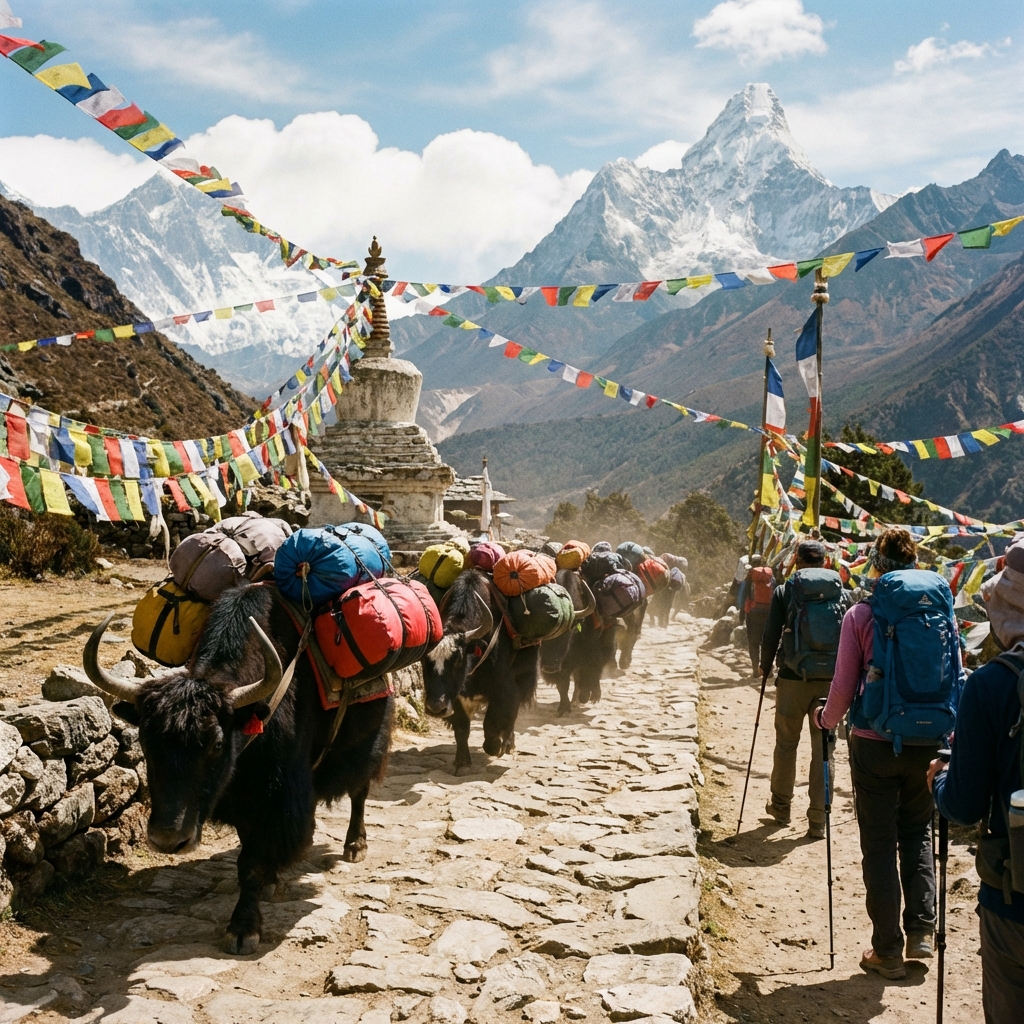
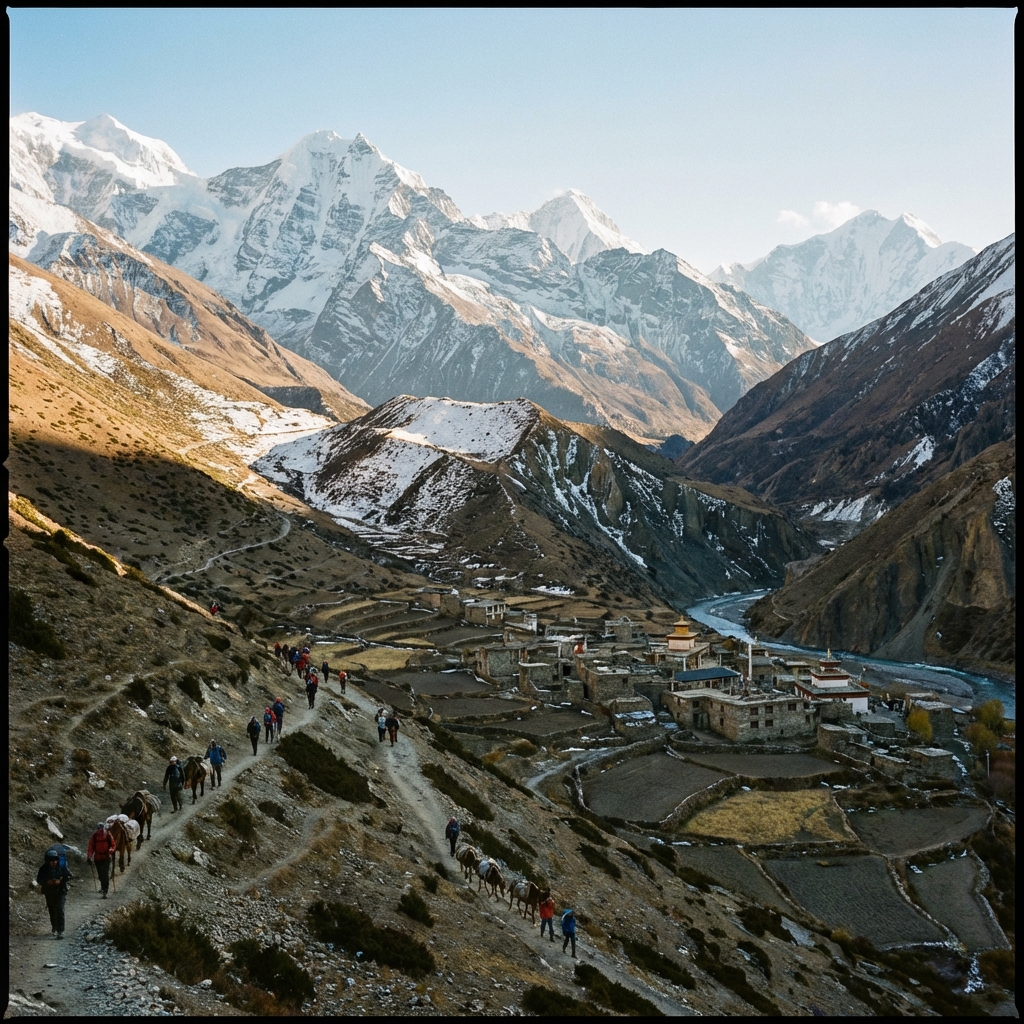
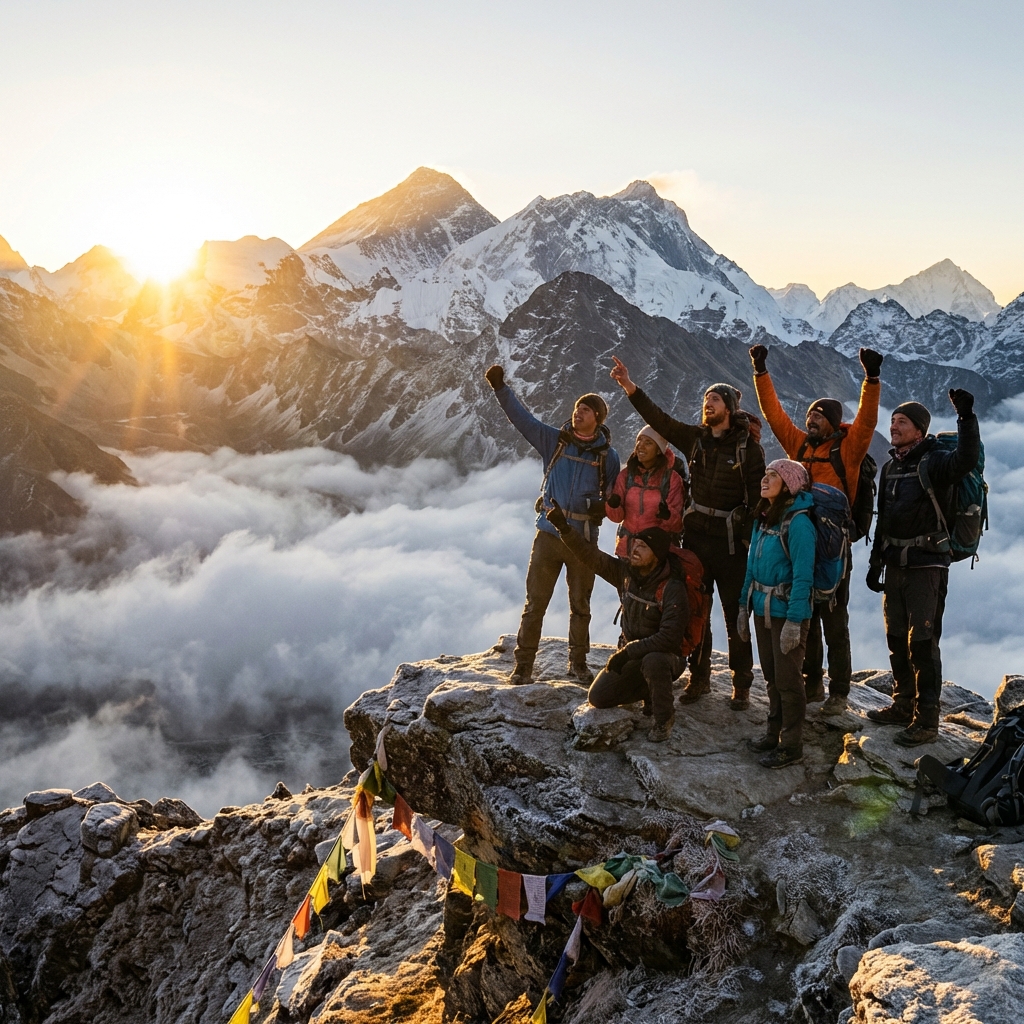
Not everyone has two weeks for the standard 10-day Annapurna Base Camp itinerary. Work schedules, limited vacation days, multi-destination trips, or simply the desire for an athletic challenge drive many trekkers to consider a compressed timeline. The 7-day fast track itinerary to Annapurna Base Camp is the answer—a demanding but achievable schedule that takes fit, experienced trekkers from Pokhara to the 4,130-meter amphitheater surrounded by Annapurna I (8,091m), Machapuchare (6,993m), and Hiunchuli (6,441m) and back again in just one week.
This is not a trek for beginners. The 7-day itinerary compresses the standard schedule by approximately 30 percent, requiring longer daily walking hours, bigger altitude gains on critical days, and significantly less acclimatization buffer. It demands prior trekking experience, excellent physical fitness, and the discipline to monitor your body for altitude symptoms while maintaining a brisk pace.
But for the right trekker, this itinerary delivers the full ABC experience—the iconic sunrise over the Annapurna massif, the dramatic ascent through the Modi Khola gorge, the transition from subtropical forest to alpine wilderness—in a timeframe that fits modern work-life realities. And because you are spending fewer days on the trail, the total cost is lower.
This guide provides a complete day-by-day breakdown, altitude profiles, acclimatization guidance, packing tips for fast trekking, cost estimates, and everything you need to decide whether the 7-day ABC fast track is right for you.
7 trekking days (Pokhara to Pokhara)
4,130m (13,549 ft) at Annapurna Base Camp
Approximately 75-85 km round trip
Challenging (compressed schedule)
High - able to trek 6-8 hours daily
October-November, March-April
ACAP permit + TIMS card
$350-600 total (budget to mid-range)
Who Should Attempt the 7-Day Itinerary
The 7-day ABC fast track is designed for a specific type of trekker. Be honest with yourself about whether you fit the profile.
Ideal Candidates
- Experienced trekkers with at least one previous multi-day high-altitude trek (above 3,500m)
- Physically fit with the ability to comfortably trek 6 to 8 hours per day with a pack
- Good altitude history - You have been above 4,000m before without significant symptoms
- Regular cardiovascular fitness - You exercise at least 3 to 4 times per week
- Comfortable with uncertainty - You understand the risks and can make smart decisions about turning back if needed
- Mentally prepared for long days and early starts
Who Should NOT Attempt This Itinerary
This Itinerary Is Not for Everyone
Do not attempt the 7-day fast track if any of the following apply:
- First-time trekkers with no multi-day hiking experience
- No previous altitude exposure above 3,000m
- Anyone with known altitude sensitivity (previous AMS, HACE, or HAPE)
- Trekkers over 50 without demonstrated strong fitness (age itself is not a barrier, but fitness must compensate)
- Anyone recovering from illness or injury
- Trekkers who are not comfortable with the possibility of turning back short of the goal
If any of these describe you, choose the 10-day standard itinerary instead. There is no shame in taking the safer, more comfortable route. You will see the same mountains, the same sunrise, and the same stunning scenery with a much lower risk of altitude problems.
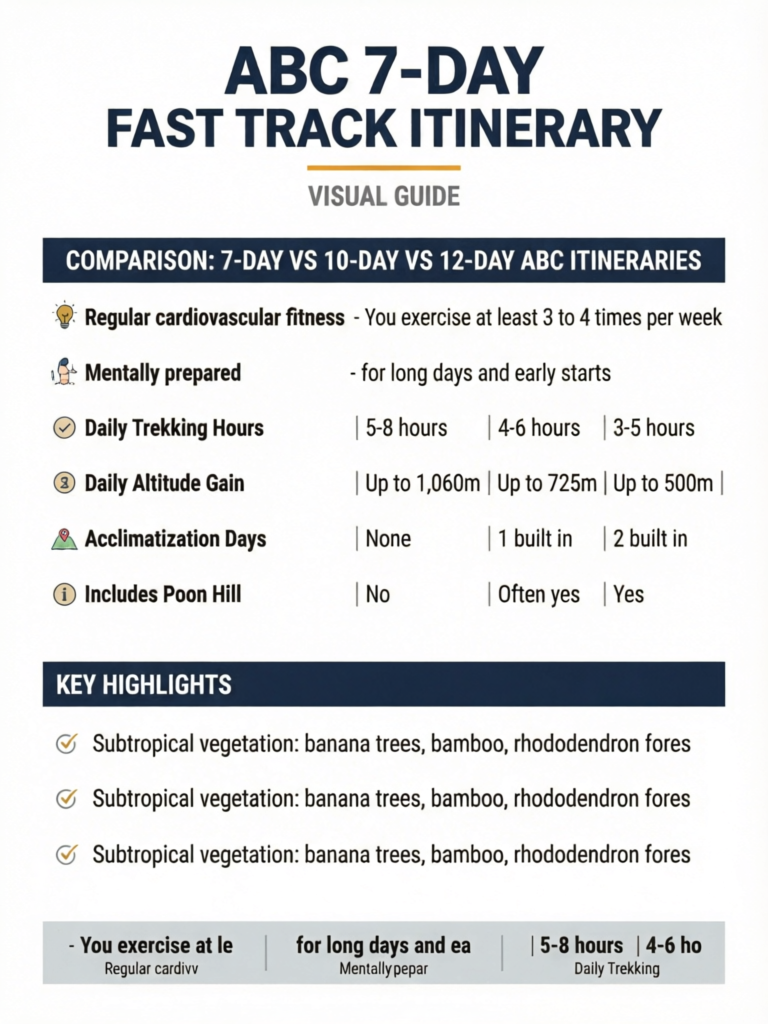
Comparison: 7-Day vs 10-Day vs 12-Day ABC Itineraries
Understanding how the compressed timeline compares to the standard and extended options helps you make an informed choice.
| Feature | 7-Day Fast Track | 10-Day Standard | 12-Day Relaxed |
|---|---|---|---|
| Daily Trekking Hours | 5-8 hours | 4-6 hours | 3-5 hours |
| Daily Altitude Gain | Up to 1,060m | Up to 725m | Up to 500m |
| Acclimatization Days | None | 1 built in | 2 built in |
| Includes Poon Hill | No | Often yes | Yes |
| AMS Risk | Moderate-High | Low-Moderate | Low |
| Fitness Required | High | Moderate | Low-Moderate |
| Cost (Approx.) | $350-600 | $500-800 | $600-950 |
| Best For | Fit, experienced trekkers | Most trekkers | Beginners, seniors, families |
| Sunrise at ABC | Yes | Yes | Yes |
Pro Tip
The 7-day itinerary skips Poon Hill and the Ghorepani section that the standard 10-day route includes. This is a meaningful trade-off: Poon Hill offers one of the best sunrise panoramas in Nepal, with views of Dhaulagiri, Annapurna South, and Machapuchare. If this viewpoint is important to you, the 10-day itinerary is the better choice. If reaching ABC in the shortest time is your priority, the 7-day route delivers.
Day-by-Day Detailed Itinerary
Day 1: Pokhara to Nayapul to Ghandruk (1,940m)
Drive: Pokhara (822m) to Nayapul (1,070m) - 1.5 to 2 hours by jeep Trek: Nayapul to Ghandruk (1,940m) - 3 to 4 hours Altitude Gain: 870m Trail Condition: Well-maintained stone steps, some paved sections, gradual ascent through villages
This first day eases you into the trek with a drive from Pokhara to the trailhead at Nayapul, followed by an afternoon trek to the beautiful Gurung village of Ghandruk. The drive takes you through the lush lowlands of the Pokhara valley, passing rice paddies and small settlements before reaching Nayapul, the official starting point of the ABC trek.
The trail from Nayapul to Ghandruk ascends gradually through terraced farmland, crossing the Modi Khola river and climbing through small villages. The path is well-established with stone steps and is straightforward to navigate. Ghandruk itself is one of the most picturesque villages in the Annapurna region, a traditional Gurung settlement with stone houses, narrow lanes, and spectacular views of Annapurna South and Machapuchare (Fishtail Peak).
What to expect:
- Subtropical vegetation: banana trees, bamboo, rhododendron forests
- Terraced rice paddies in the lower sections
- First views of Machapuchare and Annapurna South
- Traditional Gurung culture and architecture in Ghandruk
- Good tea house accommodation with hot showers and charging facilities
Accommodation: Ghandruk has numerous well-established tea houses ranging from basic to comfortable. Rooms cost NPR 500 to 1,500. Most have attached bathrooms at this altitude.
Start Time Matters
Aim to leave Pokhara by 7:00 AM to reach Nayapul by 9:00 AM and arrive in Ghandruk by early afternoon. This gives you time to rest, explore the village, and get a solid night's sleep before the more demanding days ahead. Do not rush this first day—your body is adjusting, and arriving rested matters more than arriving early.
Day 2: Ghandruk to Chhomrong (2,170m)
Trek: Ghandruk (1,940m) to Chhomrong (2,170m) - 5 to 6 hours Altitude Gain: Net 230m (but with significant descent and re-ascent) Trail Condition: Undulating terrain with steep descents and ascents, stone steps
Do not let the modest net altitude gain fool you. Day 2 involves a significant descent from Ghandruk down to the Kimrong Khola river valley (approximately 1,700m), followed by a steep ascent up to Chhomrong (2,170m). The cumulative elevation change (descent plus ascent) is approximately 700 to 800 meters, making this a more demanding day than the numbers suggest.
The trail passes through beautiful rhododendron forests (spectacular in spring), crosses the Kimrong Khola on a suspension bridge, and then climbs the infamous stone staircase to Chhomrong—approximately 2,000 stone steps carved into the mountainside. This staircase is one of the most memorable (and dreaded) sections of the entire ABC trek.
Chhomrong is the last major village before entering the Annapurna Sanctuary. It has excellent tea house facilities, a small health post, and stunning views of Annapurna South and Machapuchare. This is your last opportunity to stock up on supplies, charge devices reliably, and enjoy relatively luxurious accommodation.
What to expect:
- The infamous Chhomrong stone staircase (going up today is better than going down later)
- Spectacular views of Machapuchare and Annapurna South
- Well-stocked tea houses and small shops
- Last reliable phone charging before higher elevations
- Last hot showers until the descent
Accommodation: Chhomrong has some of the best tea houses on the ABC route. NPR 500 to 2,000 per room. Many offer hot showers, WiFi, and diverse menus.
Pro Tip
Stock up on snacks, hand sanitizer, and any last-minute supplies in Chhomrong. While tea houses exist at every stop ahead, the selection narrows significantly. Buy a jar of peanut butter, some chocolate bars, and extra ORS packets if you have not already. See our food safety guide for what to eat at altitude.
Day 3: Chhomrong to Deurali (3,230m)
Trek: Chhomrong (2,170m) to Deurali (3,230m) - 6 to 7 hours Altitude Gain: 1,060m Trail Condition: Steep descent to Chhomrong Khola, then sustained ascent through bamboo forest and alpine terrain
Day 3 is the biggest altitude gain day of the entire trek and the day that separates the 7-day itinerary from the more gradual 10-day schedule. On the standard route, this section is split across two days, with an overnight stop at Bamboo (2,310m) or Dovan (2,505m). On the fast track, you push through to Deurali, gaining over 1,000 meters of altitude in a single day.
The day begins with a descent from Chhomrong to the Chhomrong Khola river, dropping approximately 400 meters before climbing steadily through a series of small settlements: Sinuwa, Bamboo, Dovan, and Himalaya Hotel. The trail passes through dense bamboo forest (the bamboo zone, 2,000 to 2,500m), transitions to rhododendron and oak forest, and emerges into the more sparse alpine vegetation approaching Deurali.
This is the day to monitor yourself carefully for altitude symptoms. A gain of 1,060 meters in one day exceeds the recommended guideline of 300 to 500 meters per day above 3,000m. Drink at least 3 to 4 liters of water, eat well despite potentially reduced appetite, and honestly assess how you feel upon reaching Deurali.
What to expect:
- Long, sustained climbing through changing vegetation zones
- Beautiful bamboo forest in the lower section
- Increasingly narrow Modi Khola gorge
- Possible cloud and mist in the afternoon
- Basic tea house accommodation at Deurali (no hot showers, limited charging)
Accommodation: Deurali has several basic tea houses. Rooms are simple (NPR 500 to 1,000) with shared bathrooms. Expect cold temperatures after dark. Your sleeping bag becomes essential from this point.
Critical Altitude Gain Day
Day 3 is the riskiest day of the 7-day itinerary in terms of altitude. You are gaining over 1,000 meters and sleeping at 3,230m for the first time. Watch for AMS symptoms: headache, nausea, dizziness, loss of appetite, and difficulty sleeping. Mild headache is common and manageable with paracetamol and hydration. If symptoms are moderate or worsen overnight, do NOT continue to higher altitude. Descend to Bamboo (2,310m) and reassess. For comprehensive altitude safety guidance, see our acclimatization guide.
Day 4: Deurali to Annapurna Base Camp (4,130m) via Machhapuchhre Base Camp (3,700m)
Trek: Deurali (3,230m) to MBC (3,700m) to ABC (4,130m) - 5 to 6 hours Altitude Gain: 900m Trail Condition: Gradual ascent through moraine and glacial terrain, well-marked path
Day 4 is the summit day—the day you reach Annapurna Base Camp. The trail from Deurali ascends through increasingly barren terrain, leaving the tree line behind and entering the dramatic moonscape of the Annapurna Sanctuary. You will pass through Machhapuchhre Base Camp (MBC) at 3,700m, where many trekkers stop for tea or a quick lunch before the final 2 to 3 hour push to ABC.
The approach to ABC is one of the most dramatic in all of Himalayan trekking. The valley opens into an enormous amphitheater surrounded by peaks exceeding 7,000 and 8,000 meters. Annapurna I (8,091m), the world's tenth highest peak and statistically the most dangerous of the 8,000-meter mountains, towers above. Machapuchare's impossibly steep fishtail summit dominates the eastern skyline. Annapurna III, Gangapurna, and Hiunchuli complete the ring of giants.
Aim to arrive at ABC by early afternoon. Afternoon clouds often roll in, obscuring the views. The real spectacle is the following morning's sunrise, so arriving with enough time to rest, eat, hydrate, and prepare for an early wake-up is essential.
What to expect:
- Dramatic transition from forest to barren glacial terrain
- MBC as a rest and lunch stop
- The final approach to ABC with expanding mountain panorama
- ABC tea houses with basic but adequate facilities
- Cold temperatures (well below freezing overnight)
- Possible mild AMS symptoms (headache, breathlessness)
Accommodation: ABC has several tea houses. Rooms are basic (NPR 500 to 1,500), beds have mattresses but are cold. Dining halls are heated by gas or wood stoves in the evening. There is no phone charging above MBC on some trips (carry a power bank).
The Sunrise:
Set your alarm for approximately 5:00 to 5:30 AM (check with your lodge owner for exact time based on season). The sunrise over the Annapurna amphitheater is the defining moment of this trek. The first light hits the summit of Annapurna I, turning it gold against a dark blue sky, then slowly descends the face of the mountain while simultaneously illuminating Machapuchare and the surrounding peaks. It is one of the most spectacular natural displays in the Himalaya, and you will want to be outside, camera ready, well before the light arrives.
Pro Tip
Sleep fully dressed in your base layers with your down jacket ready to throw on. When your alarm goes off at 5 AM in a room that might be negative 10 degrees Celsius, you want to be out the door in 2 minutes, not fumbling with frozen zippers. Fill your water bottle the night before and keep it inside your sleeping bag to prevent freezing.
Day 5: ABC Sunrise, Descend to Bamboo (2,310m)
Trek: ABC (4,130m) to Bamboo (2,310m) - 6 to 7 hours Altitude Loss: 1,820m Trail Condition: Same trail in reverse, steep descent sections
After experiencing the sunrise at ABC, have breakfast, take your final photographs, and begin the long descent. Day 5 is the longest and most physically demanding day of the trek—not because of altitude gain, but because of the sheer volume of downhill. Descending 1,820 meters in a single day is hard on your knees, ankles, and quadriceps.
You will retrace your steps through MBC, Deurali, Himalaya Hotel, Dovan, and down to Bamboo. The descent that took you parts of two days to climb is compressed into one long day going down. The saving grace is that downhill is faster, the air is thicker and easier to breathe as you lose altitude, and any mild AMS symptoms from the night at ABC will resolve as you descend.
What to expect:
- Early morning sunrise at ABC (the highlight of the entire trek)
- Long, sustained descent through changing vegetation zones
- Return of forest, birdsong, and warmth as you lose altitude
- Significant knee strain—use trekking poles and take them seriously
- Arrival at Bamboo in late afternoon
- Much warmer temperatures than ABC
Knee Protection Tips:
- Use trekking poles on every downhill section (they reduce knee impact by up to 25 percent)
- Take smaller steps on steep descents rather than long strides
- Keep your knees slightly bent, never locked
- Tighten your boot laces to prevent toe jamming
- Consider wearing a knee brace if you have a history of knee issues
Accommodation: Bamboo has several tea houses with basic to moderate facilities. After the sparse conditions at ABC and Deurali, the relative comfort feels luxurious. Hot showers may be available.
Day 6: Bamboo to Jhinu Danda (1,780m)
Trek: Bamboo (2,310m) to Jhinu Danda (1,780m) - 5 to 6 hours Altitude Loss/Gain: Net descent of 530m, but with significant ups and downs Trail Condition: Forest trails, stone steps, one major ascent back to Chhomrong area before descending to Jhinu
Day 6 takes you back through the now-familiar terrain, climbing back to the Chhomrong area (with those stone steps again, this time going down) before descending to Jhinu Danda. The trail is well-known from your ascent, though seeing it from the opposite direction reveals new perspectives.
The reward at the end of Day 6 is one of the trek's great pleasures: the natural hot springs at Jhinu Danda. After five days of cold water washes (or no washes), limited comfort, and intense physical effort, soaking in naturally heated mineral water beside the Modi Khola river is an experience that borders on spiritual.
What to expect:
- Descending the Chhomrong stone staircase (harder going down than up)
- Increasingly lush, warm forest
- Arrival at Jhinu Danda in the afternoon
- Natural hot springs (NPR 100 to 200 entry fee)
- Relaxed atmosphere among trekkers celebrating completed treks
- Good tea house accommodation with hot showers
Accommodation: Jhinu Danda has well-established tea houses. NPR 500 to 1,500 per room. The village is compact and pleasant, perched above the river with the hot springs a 15 to 20 minute walk below.
The Jhinu Hot Springs
The natural hot springs at Jhinu Danda are one of the great rewards of the ABC trek. Two stone pools fed by naturally heated mineral water sit beside the Modi Khola river. The temperature is perfect after days of cold mountain air: warm enough to soak away muscle soreness, cool enough to stay in comfortably. Bring a towel and swimwear. The springs are most enjoyable in late afternoon when the post-trek crowd is relaxed and celebratory. If the springs are too crowded, some tea houses have their own heated bathing facilities.
Day 7: Jhinu Danda to Nayapul to Pokhara
Trek: Jhinu Danda (1,780m) to Nayapul (1,070m) - 3 to 4 hours Drive: Nayapul to Pokhara (822m) - 1.5 to 2 hours Altitude Loss: 710m (trek section) Trail Condition: Gentle descent through villages and farmland, paved road sections near Nayapul
The final day is the easiest and most relaxed of the trek. A gentle morning descent through villages and terraced farmland brings you to Nayapul, where your driver or a local bus returns you to Pokhara. The trail is straightforward, the altitude is comfortable, and the sense of accomplishment carries you through effortlessly.
You should reach Nayapul by late morning, and be back in Pokhara by early afternoon. This leaves time for a celebratory lunch at a lakeside restaurant, a hot shower at your hotel, and an evening of reflection on what you have just accomplished.
What to expect:
- Easy, relaxed walking through lower villages
- Rice paddies, farmland, and subtropical vegetation
- Views of the Annapurna range behind you
- Arrival at Nayapul and transport back to Pokhara
- Arrival in Pokhara by early to mid-afternoon
Altitude Profile
Understanding the altitude trajectory of the 7-day itinerary helps you prepare mentally and physically for the daily demands.
| Day | Start Elevation | End Elevation | Altitude Change | Hours |
|---|---|---|---|---|
| Day 1 | 1,070m (Nayapul) | 1,940m (Ghandruk) | +870m | 3-4 |
| Day 2 | 1,940m (Ghandruk) | 2,170m (Chhomrong) | +230m net | 5-6 |
| Day 3 | 2,170m (Chhomrong) | 3,230m (Deurali) | +1,060m | 6-7 |
| Day 4 | 3,230m (Deurali) | 4,130m (ABC) | +900m | 5-6 |
| Day 5 | 4,130m (ABC) | 2,310m (Bamboo) | -1,820m | 6-7 |
| Day 6 | 2,310m (Bamboo) | 1,780m (Jhinu Danda) | -530m net | 5-6 |
| Day 7 | 1,780m (Jhinu Danda) | 1,070m (Nayapul) | -710m | 3-4 |
Critical observation: Days 3 and 4 involve the most aggressive altitude gains—1,060m and 900m respectively. On the standard 10-day itinerary, Day 3's gain is split across two days. This compression is the primary trade-off of the fast track schedule and the main source of increased AMS risk.
Acclimatization Concerns and Risk Management
The 7-day itinerary's biggest weakness is minimal acclimatization time. Here is how to manage that risk.
Understanding the Risk
The standard guideline for altitude acclimatization is: above 3,000m, do not increase your sleeping altitude by more than 300 to 500 meters per day, and include a rest day every 1,000 meters of gain. The 7-day itinerary violates both of these guidelines on Days 3 and 4.
This does not mean the itinerary is impossible or irresponsible. Many fit trekkers complete it every season without issues. But it does mean you are accepting a higher statistical risk of AMS compared to the standard schedule.
Signs You Are Going Too Fast
Watch for these symptoms throughout the trek, particularly on Days 3, 4, and the night at ABC:
Mild AMS (common, manageable):
- Headache (usually responds to paracetamol and hydration)
- Mild nausea
- Decreased appetite
- Difficulty sleeping
- Fatigue beyond normal trekking tiredness
Moderate AMS (warning signs - consider stopping or descending):
- Persistent headache not responding to medication
- Vomiting
- Significant loss of coordination
- Increasing fatigue and lethargy
- Breathlessness at rest
Severe AMS / HACE / HAPE (medical emergency - descend immediately):
- Confusion or altered mental state
- Inability to walk in a straight line (ataxia)
- Persistent, severe vomiting
- Gurgling or crackling when breathing
- Blue lips or fingernails
- Extreme breathlessness at rest
The Golden Rule of Altitude
If your symptoms are getting worse at the same altitude, do NOT ascend. If your symptoms are getting worse despite rest, DESCEND. This rule supersedes any itinerary, any deadline, and any desire to reach ABC. Altitude sickness can kill, and descent is always the cure. See our comprehensive acclimatization guide for detailed information.
When to Add an Extra Day
Build flexibility into your 7-day plan. If any of the following occur, add an extra day rather than pushing through:
- Moderate AMS symptoms at Deurali on the night of Day 3
- Persistent headache that does not resolve with hydration and paracetamol
- Vomiting or inability to eat
- Extreme fatigue beyond normal trek tiredness
- Gut feeling that something is not right
If you add a rest day at Deurali (3,230m) before proceeding to ABC, your trek becomes 8 days. This is still shorter than the standard 10-day schedule and gives your body a critical extra 24 hours to adjust.
Pre-Trek Acclimatization Strategies
- Arrive in Pokhara 2 to 3 days early and do day hikes to moderate elevations
- Stay hydrated from the moment you arrive in Nepal
- Avoid alcohol for 48 hours before and during the trek
- Consider Diamox (Acetazolamide) as a preventive measure (125mg twice daily, starting the day before you ascend above 3,000m). Consult your doctor before your trip
- Get adequate sleep in the days before the trek begins
- Do not take sleeping pills on the trek (they can mask altitude symptoms)
What to Carry: Packing for Speed
The 7-day itinerary benefits from a lighter pack. Less weight means faster movement, less fatigue, and more comfortable long days.
Essential Items (Do Not Skip)
- Trekking poles - Non-negotiable for long descent days
- Down jacket - Essential for ABC and Deurali nights
- Sleeping bag rated to minus 10 degrees Celsius
- Rain gear - Weather changes rapidly
- Water purification system (SteriPen or tablets)
- First aid kit including Diamox, paracetamol, Imodium, ORS packets
- Sun protection - Sunscreen, sunglasses, hat
- Headlamp with spare batteries
- Hand sanitizer
- Snacks for between meals (nuts, energy bars, chocolate)
Weight Target
Aim for a personal pack weight of 6 to 8 kilograms if carrying your own gear, or 3 to 4 kilograms of day pack if using a porter. Every kilogram matters when you are walking 6 to 8 hours per day. See our complete ABC packing checklist and prioritize ruthlessly.
Pro Tip
If you are debating whether to bring something, leave it. For a 7-day trek, you can wash clothes once (Chhomrong on the way down, or Jhinu Danda) and wear items multiple times. Two sets of trekking clothes, one set of evening/sleep clothes, and your altitude layers are sufficient. Anything beyond that is extra weight slowing you down.
Key Trail Sections Described
The Stone Staircase to Chhomrong
Approximately 2,000 stone steps carved into the mountainside, ascending from the Kimrong Khola valley to Chhomrong village. Going up (Day 2) is a cardiovascular challenge. Going down (Day 6) is a knee test. Take your time, use trekking poles, and remember that this staircase has been climbed by everyone from 8-year-old children to 70-year-old grandparents. You can do it.
The Bamboo Forest
Between Sinuwa (2,360m) and Bamboo (2,310m), the trail passes through a dense bamboo forest that feels like a different world. The light filters through towering bamboo culms, the air is humid and warm, and the sound of birdsong replaces the mountain wind. This section is particularly beautiful in the morning mist.
The Modi Khola Gorge
Between Bamboo and Deurali, the trail follows the Modi Khola river upstream through an increasingly narrow gorge. The valley walls close in, waterfalls cascade from the cliffs above, and the river thunders through boulders below. This section is dramatic and atmospheric, especially when clouds move through the gorge.
MBC to ABC: The Final Approach
The 2 to 3 hour walk from Machhapuchhre Base Camp to Annapurna Base Camp is the grand finale. The trail crosses moraine and glacial debris as the valley opens into the enormous Annapurna Sanctuary amphitheater. With each step, more of the surrounding peaks come into view until you are standing in the center of a 360-degree ring of some of the highest mountains on Earth. It is a moment that photographs cannot fully capture.
Weather Considerations
Best Seasons
- Autumn (October-November): The best weather, clearest skies, most popular season. Expect cold but dry conditions at ABC. See our seasons overview
- Spring (March-April): Warmer than autumn, rhododendrons in bloom below 3,000m, but more afternoon cloud and haze. Still excellent
Afternoon Clouds at ABC
A critical weather pattern for ABC trekkers: clouds typically build throughout the morning and often engulf the amphitheater by early to mid-afternoon. This means:
- Sunrise is the highlight - The morning hours before 9 AM typically offer the clearest views
- Arrive at ABC by early afternoon to catch possible clear views before clouds arrive
- The sunrise next morning is far more important than afternoon arrival views
Temperature Expectations
| Location | Day (Sunny) | Night (Clear Sky) |
|---|---|---|
| Ghandruk (1,940m) | 15-22 degrees C | 5-10 degrees C |
| Chhomrong (2,170m) | 12-20 degrees C | 3-8 degrees C |
| Deurali (3,230m) | 5-12 degrees C | -5 to 0 degrees C |
| ABC (4,130m) | 0-8 degrees C | -10 to -20 degrees C |
Accommodation Notes by Village
| Village | Altitude | Room Quality | Hot Shower | Phone Charging | WiFi |
|---|---|---|---|---|---|
| Ghandruk | 1,940m | Good | Yes | Yes | Some lodges |
| Chhomrong | 2,170m | Good | Yes | Yes | Some lodges |
| Deurali | 3,230m | Basic | No | Limited/expensive | No |
| ABC | 4,130m | Basic | No | Limited/expensive | No |
| Bamboo | 2,310m | Moderate | Sometimes | Yes | Rarely |
| Jhinu Danda | 1,780m | Good | Yes | Yes | Some lodges |
Cost Estimate for the 7-Day Trek
Budget Breakdown
| Category | Cost Range (NPR) | Cost Range (USD) |
|---|---|---|
| ACAP Permit | 3,000 | $23 |
| TIMS Card | 2,000 | $15 |
| Accommodation (7 nights) | 3,500-10,500 | $27-80 |
| Food (7 days) | 14,000-21,000 | $107-160 |
| Transport (Pokhara-Nayapul return) | 3,000-5,000 | $23-38 |
| Hot Springs (Jhinu) | 100-200 | $1-2 |
| Miscellaneous (charging, hot water) | 2,000-5,000 | $15-38 |
| Total (Solo, No Guide/Porter) | 27,600-44,700 | $211-333 |
With Guide and Porter
| Service | Cost (USD) |
|---|---|
| Trekking Guide (7 days) | $175-250 |
| Porter (7 days) | $120-175 |
| Guide meals and accommodation | Often included in agency package |
| Total with Guide + Porter | $500-750 |
For a detailed cost analysis including comparison with the 10-day itinerary, see our ABC trek cost breakdown. For permit details, see the ACAP permit guide.
To find the right agency for your fast-track ABC trek, see our guide to the best trekking agencies for Annapurna Base Camp.
Frequently Asked Questions
Is 7 days enough for the Annapurna Base Camp trek?
Seven days is sufficient for fit, experienced trekkers. It compresses the standard 10-day schedule by approximately 30 percent, requiring longer daily walks and faster altitude gain. The itinerary is physically demanding but achievable for those with good fitness and prior altitude experience. It is not recommended for first-time trekkers or those without prior high-altitude experience.
How fit do I need to be for the 7-day ABC trek?
You should be able to comfortably hike 6 to 8 hours per day with a pack for consecutive days. Regular cardiovascular exercise (running, cycling, stair climbing) 3 to 4 times per week for at least 2 to 3 months before the trek is recommended. Prior altitude experience above 3,500m is strongly advised. See our fitness requirements guide for training plans.
What is the altitude sickness risk on the 7-day itinerary?
The risk is moderate to high, primarily because Day 3 involves gaining over 1,000 meters of altitude and Days 3-4 exceed recommended daily altitude gain guidelines. Approximately 30 to 50 percent of trekkers on this schedule experience mild AMS symptoms (headache, mild nausea). Serious AMS is less common but possible. Carrying Diamox, monitoring symptoms carefully, and being willing to add an extra day or descend are essential risk management strategies.
Can I do the ABC trek in fewer than 7 days?
Some extremely fit trekkers have completed the ABC trek in 5 or even 4 days, but this is not recommended due to dangerous altitude gain rates and the high risk of serious AMS. Seven days is the shortest schedule that provides any reasonable acclimatization buffer. Going faster serves your ego, not your safety.
Do I need a guide for the 7-day ABC trek?
A guide is not legally required for the ABC trek, but is strongly recommended for the 7-day fast track. A guide provides altitude sickness monitoring, route knowledge, tea house recommendations, emergency response capability, and local communication that are especially valuable on a compressed schedule where margin for error is smaller. See our guide to hiring guides and porters.
What if I cannot finish in 7 days?
Build flexibility into your plans. If altitude symptoms, injury, or weather force you to slow down, adding one or two extra days is the smart decision. Do not risk your health or safety to meet an arbitrary schedule. Many trekkers who start with a 7-day plan end up completing it in 8 or 9 days, and this is perfectly fine.
Is the 7-day itinerary cheaper than the 10-day itinerary?
Yes. Fewer days on the trail means fewer nights of accommodation and fewer meals purchased. The savings are typically $100 to $200 compared to the 10-day schedule. However, the 7-day itinerary also skips Poon Hill and some scenic villages, so you are paying less but also seeing slightly less.
When is the best time for the 7-day ABC fast track?
October and November offer the best weather conditions: clear skies, dry trails, and stable temperatures. March and April are also excellent, with warmer temperatures and rhododendron blooms. Avoid the monsoon season (June to September) and deep winter (December to February) for the fast track itinerary, as adverse weather increases risk when you have no buffer days.
Should I take Diamox for the 7-day itinerary?
Many travel medicine specialists recommend prophylactic Diamox (Acetazolamide, 125mg twice daily) for itineraries with aggressive altitude gain like the 7-day schedule. Diamox accelerates acclimatization and reduces AMS symptoms. Consult your travel doctor before the trip, and ideally take a test dose at home to check for side effects (tingling in fingers and toes, increased urination, altered taste of carbonated drinks are common and harmless).
Can I trek the 7-day ABC route solo?
Technically yes—the trail is well-marked and solo trekking with a mandatory licensed guide is banned in all protected areas since April 2023. You must hire a licensed guide through a registered agency for ABC route. However, for a fast-track itinerary with increased altitude risk, solo trekking is less advisable. If you do trek solo, inform tea house owners of your itinerary, carry a working phone with emergency numbers, and consider hiring at least a guide (without a porter) for safety.
What is the hardest day on the 7-day ABC itinerary?
Day 3 (Chhomrong to Deurali) is the most physically demanding, with over 1,000 meters of altitude gain across 6 to 7 hours. Day 5 (ABC to Bamboo) is the longest in terms of altitude loss (1,820 meters of descent) and is extremely hard on the knees. Both days require mental toughness and physical preparation.
How does the 7-day route compare to the 10-day route in terms of scenery?
The scenery from Ghandruk to ABC and back is identical—you see the same mountains, forests, villages, and landscapes. The main difference is that the 7-day route skips the Poon Hill and Ghorepani section that the 10-day route typically includes. This means you miss the famous Poon Hill sunrise panorama, but you still experience the ABC sunrise, which many trekkers consider even more spectacular.
The 7-day ABC fast track is a calculated trade-off between time and comfort, speed and safety, efficiency and experience. For the right trekker—fit, experienced, altitude-aware, and willing to push through long days—it delivers the full magic of Annapurna Base Camp in half the vacation time. But it demands respect for the mountains, honest self-assessment, and the wisdom to slow down or turn back if your body says no.
For the standard schedule, see our 10-day ABC itinerary. For cost planning, see the ABC cost breakdown. For permit information, see the ACAP permit guide.