
The Complete Guide to Trekking Poles for Nepal Trekking
If you're planning a trek in Nepal, one of the most debated gear decisions you'll face is whether to bring trekking poles. After witnessing thousands of trekkers navigate everything from the stone staircases of the Everest Base Camp trek to the high passes of the Annapurna Circuit, the evidence is clear: trekking poles aren't just helpful—they can be the difference between enjoying your trek and suffering through it with damaged knees.
This comprehensive guide covers everything you need to know about trekking poles for Nepal, from the biomechanics of how they reduce knee impact by 25-30% to specific model recommendations that work best in Himalayan conditions. Whether you're considering the classic Black Diamond Trail Ergo telescoping poles or the ultralight Black Diamond Distance Carbon Z folding models, you'll find detailed comparisons, proper technique tutorials, and honest advice about when poles are essential versus when they're just extra weight.
25-30%
Pair of poles
$1-2/day
Aluminum
90° elbow
Downhill descents
Black Diamond Trail Ergo
Leki Micro Vario Carbon
Why Trekking Poles Matter in Nepal: The Science of Knee Protection
Nepal's trekking routes present a unique challenge that differs significantly from typical hiking environments. The combination of extreme elevation changes, rocky terrain, long daily distances, and high altitude creates conditions where your knees take an extraordinary beating—unless you use trekking poles correctly.
The Biomechanics of Knee Impact Reduction
Multiple peer-reviewed studies have quantified the protective effect of trekking poles on knee joints during descents. The most comprehensive research, published in the Journal of Sports Medicine, found that properly used trekking poles reduce the compressive force on knee joints by 25-30% during downhill hiking. On Nepal's notorious stone staircases—particularly the descent from Namche Bazaar to Lukla or the endless steps down from Poon Hill—this reduction translates to thousands of pounds less cumulative force on your knees over the course of a multi-day trek.
The mechanism is straightforward: each time you plant a trekking pole ahead of you on a descent, you transfer a portion of your body weight through your arms and shoulders rather than letting your lead leg absorb the full impact. When descending with proper technique (which we'll cover in detail later), you essentially create four points of contact with the ground instead of two, distributing impact forces across a larger biomechanical system.
Calculate Your Potential Knee Savings
For a typical 12-day Everest Base Camp trek, you'll descend approximately 8,000-10,000 meters total elevation. At an average of 1.5 meters per step descent, that's roughly 6,000 downhill steps. If you weigh 70kg (154 lbs), and each step without poles generates approximately 2x your body weight in impact force (140kg), you're looking at 840,000 kg of cumulative force on your knees. With trekking poles reducing this by 25%, you save your knees from absorbing 210,000 kg (463,000 lbs) of impact force. For trekkers with existing knee issues, this difference is genuinely transformative.
Nepal-Specific Terrain Challenges
Beyond the general benefits of trekking poles, Nepal's trails present specific challenges where poles become essential tools:
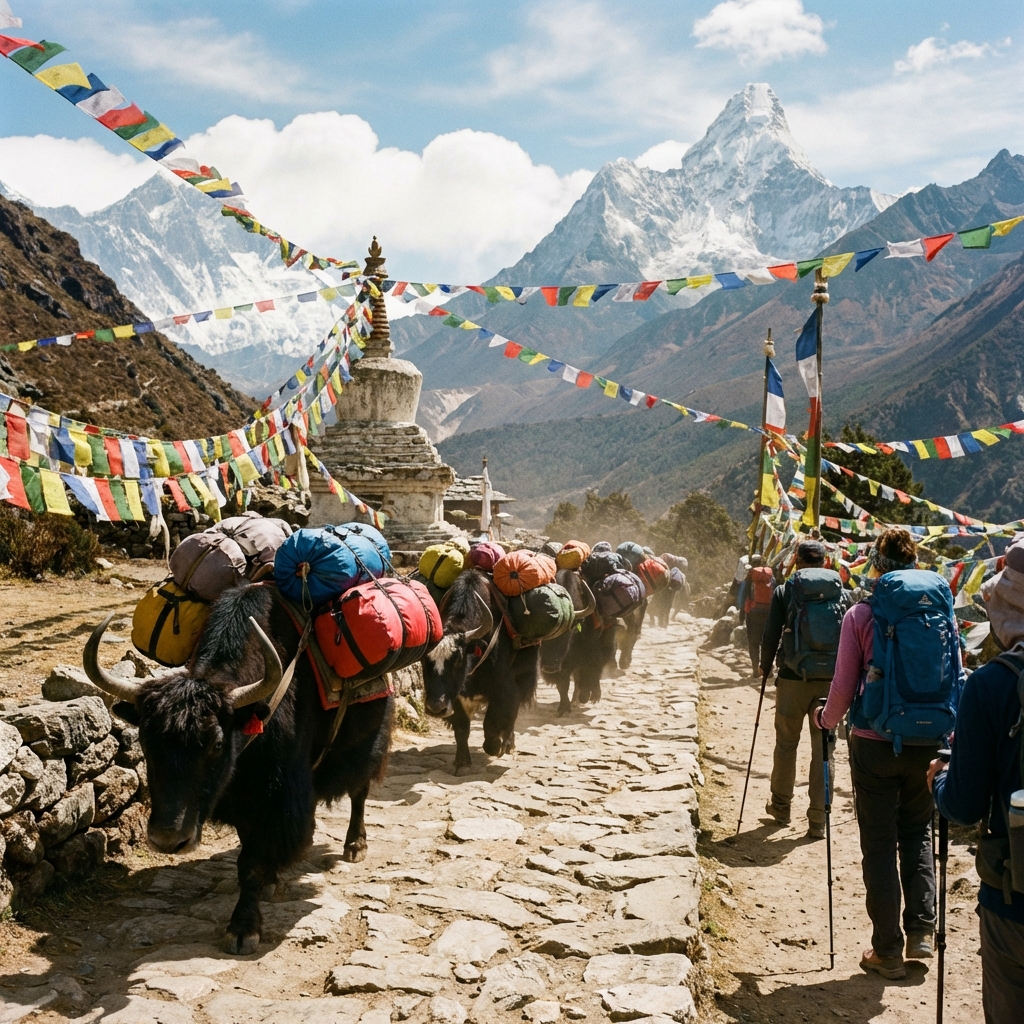
Stone Staircases: The Sherpa-built stone staircases throughout the Khumbu and Annapurna regions are marvels of mountain engineering, but they're brutal on knees during descents. Unlike natural trails where you can choose your line and vary your stride, these staircases force you into repetitive downward stepping with significant drop per step. Trekking poles transform these descents from knee-destroying ordeals into manageable challenges.
River Crossings: Nepal's trails include numerous river crossings on narrow suspension bridges, log bridges, and sometimes rock-hopping. Trekking poles provide critical balance points, especially when bridges are swaying or rocks are wet. The Everest Base Camp trek includes several challenging suspension bridge crossings where poles significantly improve stability.
High Pass Crossings: Passes like Thorong La (5,416m), Cho La (5,420m), and Renjo La (5,360m) often involve scrambling over loose scree, navigating steep snowfields, and maintaining balance in thin air where your coordination is compromised. Trekking poles provide essential stability during these high-altitude challenges covered in our high altitude trekking guide.
Monsoon Season Conditions: During Nepal's monsoon season (June-September), trails become muddy, slippery, and challenging. Even in the rain shadow areas like Upper Mustang, afternoon showers create treacherous footing. Poles with proper tips (we'll discuss tip types later) provide secure purchase on slick surfaces.
Altitude-Related Balance Issues: As you ascend above 3,500-4,000 meters, even well-acclimatized trekkers experience subtle balance and coordination deficits due to lower oxygen levels. Trekking poles compensate for this diminished proprioception, helping you maintain stability when your body's natural balance systems are compromised.
When Trekking Poles Are Essential vs. Optional
Not every trek in Nepal requires trekking poles, and there are specific situations where they're either essential equipment or merely nice-to-have accessories. Understanding these distinctions helps you make informed decisions about whether to invest in quality poles, rent basic ones, or skip them entirely.
Essential Use Cases: When You Absolutely Need Poles
Downhill Descents Over 1,000 Meters: Any day that includes more than 1,000 meters of descent makes trekking poles essential, not optional. The classic example is the return from Everest Base Camp, where you descend from Gorak Shep (5,164m) back to Pheriche (4,371m) in a single day—a knee-crushing 800+ meter descent after already trekking to EBC and back. Similarly, the descent from Thorong La to Muktinath on the Annapurna Circuit drops 1,600 meters in one brutal afternoon.
Trekkers Over 45-50 Years Old: The cumulative wear on knee cartilage by middle age means that impact absorption becomes increasingly important. If you're over 45, consider trekking poles non-negotiable for any multi-day Nepal trek, regardless of current knee health. Preventing damage is vastly easier than recovering from it at altitude.
Pre-Existing Knee Issues: If you have any history of knee problems—previous injuries, arthritis, patellofemoral pain, meniscus issues—trekking poles transition from "highly recommended" to "absolutely essential." Many trekkers with knee conditions who wouldn't normally need poles at lower altitudes find them crucial in Nepal's demanding environment.
High Altitude Treks Above 4,500 Meters: At extreme altitudes, your balance, coordination, and judgment are all compromised by hypoxia. The Everest Base Camp trek, Gokyo Lakes trek, and high passes on the Annapurna Circuit all benefit enormously from the stability trekking poles provide when your body isn't functioning optimally.
Solo Trekkers: If you're trekking without a partner who could assist if you twist an ankle or strain a knee, trekking poles provide both injury prevention and a crucial backup stability system. They're effectively insurance against becoming immobilized far from help.
Heavy Pack Loads: If you're carrying your own gear rather than using porter services, and your pack weighs over 12-15kg, trekking poles help distribute that load and reduce the compressive force on your spine and knees. This is particularly relevant for camping treks or treks in remote regions where you need to carry extra supplies.
Optional but Beneficial: When Poles Help but Aren't Critical
Moderate Treks with Gradual Elevation Changes: Shorter treks like Poon Hill or the lower sections of the Langtang Valley trek can be completed comfortably without poles if you're young, fit, and have healthy knees. However, poles still provide benefits and many trekkers appreciate having them.
River Crossing Assistance: While poles help significantly with balance on suspension bridges and river crossings, most trekkers can manage these obstacles without poles if they're careful and take their time. That said, the psychological comfort of having poles during sketchy crossings is valuable.
Uphill Assistance: Poles can help with rhythm and provide something to push against during long uphill sections, but this benefit is relatively minor compared to their downhill protective effects. Some trekkers prefer to stow their poles during ascents.
Wildlife Encounters: In lower-elevation trekking regions, poles can serve as a deterrent for aggressive dogs around villages or, very rarely, for wildlife concerns. This is a minor benefit but occasionally appreciated.
When NOT to Use Trekking Poles
Steep Scrambling Sections: On genuinely steep terrain requiring hands-on scrambling—like portions of the Three Passes Trek over Kongma La or technical sections approaching Mera Peak base camp—stow your poles and use your hands. Poles become liabilities when you need full hand mobility for climbing.
Very Steep Ascents: On extremely steep uphill sections, particularly stone staircases where you're pulling yourself up, poles can actually slow you down and disrupt your rhythm. Many experienced trekkers collapse or stow their poles for steep ascents and deploy them only for descents.
Photography and Rest Stops: This seems obvious, but it's worth stating: when you stop for photos, snacks, or rest, take the loops off your wrists and set poles aside. Trying to use a camera or eat while poles dangle from your wrists is awkward and increases the chance of dropping equipment.
Tea House Floors and Lodges: Always remove poles when entering tea houses, lodges, and monasteries. The carbide tips can damage wooden floors, and pole tips collect mud and debris that shouldn't be tracked indoors. Switch to rubber tip covers or leave poles outside.
Types of Trekking Poles: Telescoping vs. Folding
The fundamental design choice in trekking poles is between telescoping models (poles that slide in and out like a telescope) and folding models (poles that collapse accordion-style using cord tension). Each design offers distinct advantages and disadvantages for Nepal trekking.
Telescoping vs. Folding Trekking Poles for Nepal
| Name | Pros | Cons | Best For |
|---|---|---|---|
| Telescoping Poles | Infinitely adjustable heightSimple, reliable mechanismEasy to repair in fieldGenerally less expensiveBetter for varying terrainCan be used as tent/tarp poles | Longer when collapsed (55-65cm)Harder to pack in luggageSlower to deploy/stowLocks can freeze or fail | Trekkers who want versatility, reliability, and the ability to make frequent height adjustments |
| Folding Poles | Very compact when collapsed (35-40cm)Easy to pack in luggage/backpackQuick deployment (seconds)No locks to fail or freezeLighter weight (often carbon) | Fixed or limited height adjustmentMore complex mechanismDifficult to repair if cord breaksGenerally more expensiveCan't use as tent poles | Ultralight trekkers, those flying with carry-on only, or trekkers who frequently stow/deploy poles |
Telescoping Poles: The Classic Choice
Telescoping poles have been the standard design for decades and remain the most popular choice for Nepal trekking. These poles feature two or three sections that slide inside each other and lock in place using various mechanisms (twist-lock, lever-lock, or external clamp).
Advantages for Nepal Trekking:
The primary benefit of telescoping poles is infinite adjustability. Nepal's terrain often requires height changes throughout the day—shortening poles for steep uphills, lengthening them for descents, or adjusting for traverses across slopes. With telescoping poles, you can fine-tune your height to the exact centimeter for optimal biomechanics.
Telescoping designs are mechanically simple and field-repairable. If a twist-lock becomes sticky or a lever-lock spring weakens, these are usually fixable with basic tools. In a worst-case scenario on a remote trek, you can secure a malfunctioning lock with duct tape and still have a functional pole. This reliability matters when you're days from the nearest gear shop.
The collapsed length of telescoping poles (typically 55-65cm) is still manageable for international travel, especially for checked baggage. They're long enough to be strapped to the outside of a trekking backpack during ascents when you want them accessible but not in hand.
Disadvantages:
The main drawback is packability. At 60+ centimeters collapsed, telescoping poles don't fit easily in carry-on luggage or standard backpacks. If you're traveling carry-on only to Nepal (not recommended for extended treks anyway, given the need for proper gear), telescoping poles require checking a bag.
Locking mechanisms can occasionally fail, particularly in Nepal's extreme temperature variations. Twist-locks can freeze when metal contracts at high altitude, and lever-locks can become loose after extended use. Quality models minimize these issues, but they remain a consideration.
Folding Poles: The Ultralight Option
Folding poles represent the newer technology in pole design. They collapse to roughly 35-40cm using an internal cord system similar to tent poles, making them highly packable. When you want to use them, you simply unfold the sections and the cord tension locks them rigid.
Advantages for Nepal Trekking:
The collapsed length of folding poles is genuinely game-changing for travel. At 35-40cm, they fit inside most 50-65L trekking backpacks, making them easy to stow during scrambling sections or while navigating crowded villages. For trekkers who fly carry-on only for shorter Nepal treks like Poon Hill, folding poles can slip into luggage where telescoping poles cannot.
Deployment speed is remarkable. You can unfold and be using folding poles in literally 5-10 seconds, whereas telescoping poles require 30-60 seconds of adjusting and locking sections. When you frequently transition between using and stowing poles—common on varied terrain—this speed advantage adds up.
Folding poles have no locks to fail or freeze. The cord tension system is unaffected by temperature, altitude, or dust. This mechanical simplicity provides reliability in harsh Himalayan conditions.
Disadvantages:
Height adjustability is limited or nonexistent on folding poles. Many models come in fixed sizes (you choose your size at purchase), while others offer only 10-15cm of adjustment via a small telescoping section. If you want to significantly shorten your poles for steep uphills, folding poles don't accommodate this.
The internal cord system, while generally reliable, is difficult to repair in the field if it breaks. Unlike a stuck twist-lock that you can work around, a snapped cord renders a folding pole useless. Replacement cords are available, but restringing requires bringing the pole home.
Folding poles are typically more expensive than comparable telescoping models, often $50-100+ more for similar materials and weight.
Which Design is Right for Your Nepal Trek?
Choose telescoping poles if:
- You want maximum height adjustability for varied terrain
- You prefer proven, simple technology
- You're on a budget ($70-160 range)
- You might use poles as tent/tarp supports for camping treks
- You're checking luggage anyway for a long trek
Choose folding poles if:
- Packability is a top priority
- You frequently stow/deploy poles while trekking
- You're willing to pay premium for ultralight and compact design
- You know your proper pole height and don't need frequent adjustments
- You might travel carry-on only
For most trekkers doing classic Nepal routes like Everest Base Camp or Annapurna Circuit, telescoping poles offer the best combination of versatility, reliability, and value. For ultralight enthusiasts or those doing shorter treks, folding poles' packability advantages may justify the premium cost.
Material Considerations: Aluminum vs. Carbon Fiber
After deciding between telescoping and folding designs, the next critical choice is pole material. The vast majority of trekking poles use either aluminum alloy or carbon fiber, each offering distinct performance characteristics crucial for Nepal's demanding environment.
Aluminum Poles: Durable and Dependable
Aluminum poles, typically made from 7075 aluminum alloy, have been the standard for decades and remain the most popular choice for Nepal trekking.
Advantages in Himalayan Conditions:
Cold Weather Performance: Aluminum maintains its strength and flexibility across the extreme temperature range you'll experience in Nepal, from warm valleys at 2,000m to frigid high passes at 5,400m where morning temperatures can drop to -15°C to -20°C. The material doesn't become brittle in cold, ensuring consistent performance regardless of conditions.
Durability and Bend-Don't-Break Characteristic: When aluminum poles are overstressed—such as when you catch a tip between rocks and fall, or when you plant a pole poorly and put sideways force on it—they bend rather than shatter. A bent aluminum pole can often be straightened enough to remain functional, or at worst, you can shorten it by collapsing the bent section and continue using it. This failure mode is far preferable to carbon fiber's catastrophic shattering.
Impact Resistance: The rocky terrain of Nepal trails means your poles will inevitably strike rocks, bounce off stone staircases, and endure impacts. Aluminum handles these impacts without damage, developing cosmetic scratches and dings but maintaining structural integrity.
Value: Aluminum poles are generally 20-40% less expensive than comparable carbon fiber models, making them accessible for budget-conscious trekkers or those who want to invest saved money in other crucial gear like a quality sleeping bag for our trekking gear guide.
Disadvantages:
Weight: Aluminum poles weigh approximately 450-550 grams per pair, compared to 300-400 grams for carbon fiber. This 150-200 gram difference (roughly 5-7 ounces) per pair is noticeable, especially on long trekking days. However, the weight difference is less significant than marketing might suggest—it's equivalent to about half a water bottle.
Vibration Transmission: Aluminum transmits more impact vibration up the pole to your hands and arms compared to carbon fiber's damping properties. On trails with extensive rock impacts, this can lead to minor hand discomfort over time, though proper grip technique largely mitigates this.
Carbon Fiber Poles: Lightweight Performance
Carbon fiber poles represent the premium segment of the trekking pole market, offering weight savings and vibration damping at a cost premium.
Advantages:
Weight Savings: At 300-400 grams per pair, quality carbon fiber poles are significantly lighter than aluminum alternatives. For ultralight trekkers counting every gram, or for older trekkers for whom arm fatigue is a concern on long days, this weight reduction is meaningful.
Vibration Damping: Carbon fiber naturally dampens impact vibrations, resulting in more comfortable poles on rocky terrain. Your hands and arms experience less stress over thousands of pole plants per day.
Stiffness and Energy Return: Carbon fiber offers superior stiffness for its weight, meaning less flex when you push hard on poles. Some trekkers appreciate the crisp, direct feel of carbon poles compared to the slight flex in aluminum.
Disadvantages for Nepal:
Brittle Failure Mode: The critical disadvantage of carbon fiber for Nepal trekking is how it fails. Unlike aluminum's gradual bending, carbon fiber shatters catastrophically when overstressed or impacted at the wrong angle. A pole planted sideways against a rock, a fall with body weight torquing the pole, or even a hard strike against stone can cause sudden, complete failure. When a carbon pole shatters at 4,500 meters on the Annapurna Circuit, you're left with an unusable pole and no repair options.
Temperature Concerns: While quality carbon fiber maintains strength in cold better than cheap carbon, some carbon poles have shown increased brittleness at extreme cold temperatures (-20°C and below) experienced on high passes in late season or winter treks.
Impact Damage: Carbon fiber can develop internal damage from impacts that isn't visible externally. A pole that looks fine might have internal delamination or cracking that leads to sudden failure later. This hidden damage issue is particularly concerning on multi-week treks where poles endure constant abuse.
Cost: Premium carbon fiber poles run $180-230, versus $70-160 for comparable aluminum models—a significant investment that's harder to justify if there's risk of catastrophic failure far from replacement options.
Stone Compatibility: Nepal's stone staircases and rocky trails create constant hard impacts that carbon fiber handles less well than aluminum. The jarring rock strikes that cause cosmetic scratches on aluminum can crack or weaken carbon fiber.
The Aluminum Advantage for Multi-Week Nepal Treks
After extensive testing and user feedback from Nepal trekking guides, the consensus is clear: for multi-week Himalayan treks, aluminum poles are the superior choice for most trekkers. The weight penalty is minimal (about 170 grams per pair), but the durability advantage is enormous. Multiple trekking guide services in Nepal have switched entirely to aluminum poles for client use after experiencing too many catastrophic carbon fiber failures at altitude. Unless you're an experienced ultralight trekker who understands and accepts the failure risks, choose aluminum for Nepal.
Hybrid and Specialty Materials
Some premium poles use hybrid construction—carbon fiber upper sections for weight savings combined with aluminum lower sections for durability where impacts occur. These designs attempt to capture benefits of both materials but are rare in the market and typically very expensive ($200+).
Titanium poles exist but are extremely rare and prohibitively expensive. They offer similar weight to aluminum with superior strength, but the cost ($300+) makes them impractical for most trekkers.
Grip Materials: Cork vs. Foam vs. Rubber
The grip is your primary interface with trekking poles, and grip material significantly affects comfort during 6-8 hour trekking days. The three main grip materials—cork, foam, and rubber—each perform differently in Nepal's varied conditions.
Cork Grips: The Premium Choice
Cork grips are molded from natural or compressed cork and are found on most mid-range to premium trekking poles ($100+).
Advantages:
- Superior moisture management: Cork absorbs hand sweat without becoming slippery
- Molds to your hand shape over time for personalized comfort
- Natural antimicrobial properties reduce odor buildup
- Comfortable in both warm valleys and cold high altitude
- Natural insulation prevents hands from getting cold through the grip
- Durable—quality cork grips last for years of heavy use
Disadvantages:
- More expensive than foam or rubber
- Can dry out and crack if not occasionally conditioned (rare with modern materials)
- Slightly less grippy than rubber when wet with rain (though still functional)
For multi-week Nepal treks involving extensive daily use, cork grips are worth the investment. The moisture-wicking properties make a genuine difference when your hands are sweating during uphill slogs in the Khumbu valley, and the natural insulation helps during cold morning starts at high altitude.
Foam Grips: The Budget-Friendly Middle Ground
EVA foam grips are common on budget to mid-range poles ($50-120) and offer decent performance for the cost.
Advantages:
- Soft and comfortable immediately (no break-in period)
- Good moisture absorption
- Lightweight
- Inexpensive to replace if damaged
- Provides some insulation in cold
Disadvantages:
- Less durable than cork—can compress, tear, or deteriorate faster
- Absorbs moisture but dries slowly, becoming damp and clammy on multi-day treks
- Can develop odor over time from sweat absorption
- Doesn't mold to hand shape like cork
Foam grips work adequately for shorter Nepal treks (7-10 days) or for budget-conscious trekkers, but for extended treks like the Annapurna Circuit or Manaslu Circuit, the durability and moisture management issues become more noticeable.
Rubber Grips: Basic Functionality
Rubber grips are found primarily on budget poles under $60 and rental poles in Kathmandu.
Advantages:
- Very grippy even when wet
- Durable and easy to clean
- Inexpensive
- Waterproof (doesn't absorb moisture)
Disadvantages:
- Uncomfortable in cold—rubber gets cold and transfers that cold to your hands
- Becomes slippery when sweaty (rubber + hand sweat = poor grip)
- No moisture wicking—sweat pools between hand and grip
- Hard texture less comfortable for extended use
- No insulation properties
Rubber grips are acceptable for rental poles used on short treks, but not recommended for poles you're purchasing for serious Nepal trekking. The cold transfer issue is particularly problematic during early morning starts at altitude, and the sweat slipperiness becomes annoying on long days.
Extended Grips
Regardless of grip material, look for poles with extended foam grips below the main handle. These 15-20cm foam extensions allow you to "choke down" on the poles when traversing steep slopes without having to adjust pole length. On Nepal's many contouring trails—where one pole is on the uphill side and one on the downhill side—extended grips let you grip lower on the uphill pole for better balance. This feature is found on most mid-range and premium poles and is genuinely useful.
Tips and Baskets: Critical Components for Nepal Terrain
The tips and baskets (the small discs above the tips) are the business end of trekking poles and require careful consideration for Nepal's varied terrain.
Carbide Tips: The Standard for Rocky Terrain
Virtually all quality trekking poles come with carbide (tungsten carbide) tips as standard. These extremely hard, pointed tips excel on Nepal's predominant terrain types:
Rocky Trails and Stone Staircases: Carbide tips bite into small crevices in rock surfaces, providing secure purchase on the endless stone staircases of the Khumbu and Annapurna regions. The hard material resists wear from constant rock contact that would quickly dull softer metals.
Ice and Hard Snow: On high passes where you encounter hard-packed snow or ice—common early morning conditions on Thorong La, Cho La, or Renjo La—carbide tips penetrate the surface for secure placement. This is crucial for safety when crossing exposed sections.
Longevity: Quality carbide tips last for thousands of kilometers of trekking. Even with heavy use on abrasive Himalayan rock, they maintain their point and effectiveness.
Considerations:
- Carbide tips are very hard and can damage wooden floors in tea houses and lodges
- They click loudly on stone surfaces (annoying in crowded areas)
- Can slip on smooth, polished rock surfaces when hit at the wrong angle
Rubber Tip Covers Are Essential for Tea Houses
Always carry rubber tip covers (usually included with poles) and use them when entering tea houses, lodges, monasteries, and museums. Beyond protecting floors, this is basic trekking etiquette in Nepal. Many lodges have signs requesting pole removal or tip covers, and respecting these requests is part of being a responsible trekker. Attach the rubber covers to the pole straps with a small cord so you don't lose them—replacements aren't available on the trail. Check our trekking etiquette guide for more cultural considerations.
Rubber Tip Covers: Multi-Purpose Protection
The removable rubber tips that come with most poles serve several purposes:
Floor Protection: Primary use is protecting tea house floors and lodge decks from carbide tip damage.
Noise Reduction: Rubber tips dramatically reduce the clicking noise of carbide on stone, making for quieter trekking in populated areas.
Improved Traction on Smooth Surfaces: On polished stone, smooth rock slabs, or wooden bridges, rubber tips can provide better grip than carbide.
Disadvantages:
- Wear out relatively quickly (100-200km on abrasive terrain)
- Can slip on mud or wet surfaces
- Less effective on ice or hard snow
- Fall off if not secured properly
Most trekkers use carbide tips for 90% of trekking and switch to rubber covers only when entering buildings or on specific surfaces where rubber performs better.
Baskets: Size Matters for Terrain Type
Trekking pole baskets are the small discs that sit just above the tip. They prevent the pole from sinking too deep into soft ground and provide surface area on snow. Most poles come with small "trekking baskets" (roughly 4-5cm diameter), with larger "snow baskets" (8-10cm) available as accessories.
Small Trekking Baskets (Standard): Perfect for Nepal's typical trails with rock, dirt, and light mud. They provide enough surface area to prevent excessive sinking without catching on rocks or vegetation. For most classic Nepal treks done in peak season (March-May, September-November), standard baskets are ideal.
Large Snow Baskets: Necessary only for spring treks on high passes with deep snow, or for winter trekking. The larger surface area prevents poles from plunging deep into soft snow. However, large baskets catch on rocks and are annoying on non-snow terrain.
Best Practice: Bring standard trekking baskets for most Nepal trekking. If you're doing a spring trek (March-April) on routes with high passes like the Three Passes Trek, consider bringing snow baskets as an accessory to swap on for pass days. Some poles have quick-release basket systems that make swapping easy.
Proper Trekking Pole Technique for Nepal Terrain
Owning quality trekking poles means nothing if you don't use them correctly. Proper technique is what delivers the 25-30% knee impact reduction and stability benefits—poor technique can actually increase injury risk or provide minimal benefit.
Height Adjustment: The Foundation of Proper Technique
Flat Ground Setting: The standard recommendation is to adjust pole height so your elbow forms a 90-degree angle when you're standing upright on flat ground with the pole tip on the ground. This puts your forearm parallel to the ground. For most people, this translates to poles set at roughly 63-68% of your height (e.g., 170cm tall = 107-116cm pole height).
Uphill Adjustments: For sustained uphill sections, shorten poles by 5-10cm. This prevents you from reaching too high, which disrupts balance and rhythm. Shorter poles on uphills let you maintain a more efficient posture and push down on the grips rather than pulling up.
Downhill Adjustments: For steep descents, lengthen poles by 5-10cm. Longer poles let you plant further ahead, transferring more weight to the poles and reducing impact on your lead leg. This is where poles provide maximum knee protection benefit.
Traversing Slopes: On contouring trails across steep slopes (very common in Nepal), use one longer pole on the downhill side and one shorter pole on the uphill side, or simply grip lower on the uphill pole using the extended foam grip. This maintains level balance across uneven terrain.
Many trekkers on Nepal's varied terrain adjust pole length 3-5 times per day as trails transition between climbs, descents, and traverses. This is completely normal and worth the minor inconvenience for optimal performance.
Planting and Pushing: The Core Technique
The Plant: Plant the pole tip at or slightly behind your front foot as it lands, not far ahead. Many beginners make the mistake of planting poles too far forward, which disrupts balance and provides minimal benefit. The pole should be angled slightly backward (toward you), not vertical or forward-leaning.
The Push: As you step forward with the opposite leg, push down and slightly back on the planted pole, transferring weight through your arm and shoulder. This pushing motion is what reduces the impact on your legs—you're essentially vaulting slightly off each pole plant.
The Rhythm: Establish a consistent rhythm: right pole plants as left foot lands, left pole plants as right foot lands. This opposite-side coordination becomes automatic after 15-20 minutes and creates an efficient, flowing gait. Maintaining rhythm is particularly helpful at altitude where focus and coordination are compromised.
Descent Technique: Maximizing Knee Protection
Descents are where proper pole technique matters most for protecting your knees:
Double Plant Technique for Steep Descents: On very steep descents (like the infamous descent from Namche Bazaar to Monjo), plant both poles together, slightly ahead and wider than shoulder width apart. Step down with both feet between the planted poles, using the poles to control your descent speed and absorb impact. This technique provides maximum stability and knee protection but is slower—appropriate for very steep or exposed sections.
Alternating Plant for Moderate Descents: For standard descents, use the normal alternating rhythm but emphasize pushing down firmly on each pole as you step. Think of each pole plant as actively supporting 20-30% of your body weight during that step.
Looking Ahead: Plan your pole plants 2-3 steps in advance by looking at the trail ahead, not directly at your feet. This prevents getting into awkward positions where you can't plant poles effectively.
Avoiding Dependence: While poles dramatically help on descents, don't become so dependent that you can't descend safely without them. Practice occasionally descending short sections without poles to maintain your natural balance and leg strength.
Ascent Technique: Rhythm and Push
Poles provide less dramatic benefits on ascents than descents, but proper technique still helps:
Short Strides: Use poles to encourage short, efficient strides rather than long, exhausting steps. Plant poles in rhythm with short steps, maintaining steady forward progress rather than explosive efforts.
Push, Don't Pull: Focus on pushing down on planted poles rather than pulling up on them. Pushing engages your larger shoulder and back muscles more effectively than pulling with arms.
Breathing Rhythm: At altitude, coordinate pole plants with breathing rhythm. Some trekkers use a pattern like: breathe-step-plant, breathe-step-plant, creating a meditative rhythm that helps with altitude adaptation discussed in our altitude sickness guide.
Consider Stowing on Very Steep Ascents: On extremely steep ascents where you're using hands to pull yourself up on rocks or chains, collapse and stow poles on your pack. They become impediments rather than aids in these situations.
River Crossings and Suspension Bridges
Nepal's trails involve numerous water crossings and suspension bridges where poles provide crucial stability:
Suspension Bridges: Plant poles firmly on the bridge deck, not out to the sides where they could catch on railings or cables. Take shorter steps than normal and use poles to dampen the bridge's swaying motion. On very narrow bridges, some trekkers prefer to collapse poles and hold them horizontally for balance, or stow them entirely for short crossings.
Rock Hopping: When crossing rivers via stepping stones, use poles to test stability of each rock before committing your weight, and to provide balance points. Plant poles on stable rocks or the river bottom (if shallow enough), never on moss-covered surfaces.
Log Bridges: On log bridges, plant one pole on the log ahead of you and one on solid ground if possible. Move slowly and deliberately, using poles to maintain three-point contact (two feet and one pole, or one foot and two poles).
Practice Before Your Trek
If you're new to trekking poles, don't wait until Day 1 in Nepal to learn proper technique. Practice for at least 3-4 hikes before your trek, including on downhill terrain if possible. The awkward coordination phase lasts 1-2 hours of use, and it's better to get through that at home rather than on your first day trekking to Namche Bazaar. Practice adjusting pole length while wearing gloves (you'll do this at altitude), and practice the opposite-side rhythm until it's automatic. This preparation is part of proper trek preparation.
Wrist Straps: The Controversial Component
Trekking pole wrist straps generate surprising debate in the trekking community, with strong advocates on both sides. Understanding the arguments helps you make an informed decision for Nepal trekking.
The Case for Using Wrist Straps
Energy Efficiency: Properly used wrist straps allow you to push down on poles without gripping tightly. The strap supports your hand weight, and you press down through the strap rather than gripping the handle. This reduces hand and forearm fatigue over thousands of pole plants per day.
Preventing Dropped Poles: On technical terrain or when crossing obstacles, straps prevent accidentally dropping poles. This is particularly valuable on exposed sections where a dropped pole might slide down a steep slope, or on suspension bridges where you don't want to fumble and drop equipment.
Proper Technique: If you're using poles correctly by pushing down rather than pulling up, the straps become the primary load-bearing interface. You should be able to barely grip the handle while the strap does the work.
The Case Against Using Wrist Straps
Fall and Injury Risk: The primary argument against straps is that they can cause injuries in falls. If you catch a pole tip and fall forward while strapped in, the pole can't release from your hand naturally. This can result in thumb injuries, wrist sprains, or shoulder dislocations as the pole levers against your trapped hand. This risk increases on technical terrain, snow/ice, or when crossing obstacles.
Speed and Flexibility: Without straps, you can quickly release poles to use hands for other purposes—grabbing a handhold, catching yourself in a stumble, or taking photos. With straps, there's a constant process of removing and reinstalling hands from loops.
Reduced Circulation: Tight straps can reduce circulation to hands at altitude, contributing to cold fingers—a real concern on high passes in cold weather.
The Middle Ground: Conditional Strap Use
The practical approach for Nepal trekking is to use straps conditionally based on terrain:
Use Straps:
- On long, stable descent sections where poles are doing heavy work
- On well-maintained trails with good footing
- When you want to reduce hand fatigue on easy terrain
- When crossing bridges where dropped poles would be problematic
Don't Use Straps:
- On technical terrain with scrambling or hands-on climbing
- When crossing steep, exposed sections
- On snow, ice, or very slippery conditions
- When you frequently need hands for photography or other tasks
Proper Strap Technique If You Use Them:
The correct way to use wrist straps is from below: put your hand up through the bottom of the loop, then grip down over the strap. This positioning allows the strap to support your weight when you push down, rather than just preventing drops. Many trekkers use straps incorrectly by simply sliding hands into the loops from above, which provides minimal benefit.
Adjust strap tension so there's no gap between strap and wrist when pole is planted, but loose enough for comfort. Too tight restricts circulation; too loose provides no support benefit.
Specific Trekking Pole Models Recommended for Nepal
After covering the technical aspects, let's examine specific trekking pole models that perform well in Nepal's demanding conditions, organized by price range and design type.
Top Trekking Pole Recommendations for Nepal
| Name | Price | Specs | Pros | Cons | Best For |
|---|---|---|---|---|---|
| Black Diamond Trail Ergo Cork (Telescoping) | $70-90 | Aluminum, 3-section telescoping, 100-140cm adjustment, 510g/pair, cork grips | Excellent value for performanceProven reliability over yearsCork grips comfortable for long treksFlickLock mechanism easy even with glovesWidely available replacement partsComfortable ergo grip design | Slightly heavier than premium modelsStandard baskets only (snow baskets sold separately)Collapsed length 64cm (harder to pack) | Budget-conscious trekkers who want proven, reliable performance for multi-week Nepal treks |
| Leki Makalu (Telescoping) | $140-160 | Aluminum, 3-section telescoping, 110-145cm adjustment, 480g/pair, cork grips | Comfortable Aergon grip with extended foamSpeedLock 2 mechanism very secureExcellent build qualityAdjustable strap systemGood vibration dampingProven durability | Higher price pointCollapsed length 67cmReplacement parts expensive | Trekkers who want premium telescoping poles with maximum comfort for extensive Nepal trekking |
| Black Diamond Distance Carbon Z (Folding) | $180-200 | Carbon fiber, 3-section folding, fixed length (order by size), 340g/pair, foam grips | Very light at 340g/pairCompact 37cm collapsedFast deployment (seconds)No locks to failFits in pack easily | Fixed length (must order correct size)Carbon fiber brittleness concernsCannot be used as tent polesDifficult field repair if cord breaksFoam grips less durable than cork | Experienced ultralight trekkers who prioritize weight savings and packability over adjustability |
| Leki Micro Vario Carbon (Folding) | $200-230 | Carbon fiber, folding with limited telescoping, 110-130cm adjustment, 360g/pair, cork grips | Lightest adjustable poles availableCompact 40cm collapsedCork grips (rare on folding poles)Some height adjustabilityPremium build qualitySpeed Lock system for adjustment | Highest price pointLimited 20cm adjustment rangeCarbon fiber durability concernsComplex mechanismExpensive replacement parts | Well-funded trekkers who want the absolute best in ultralight folding poles with some adjustability |
| REI Co-op Trailmade (Telescoping) | $60-80 | Aluminum, 3-section telescoping, 94-140cm adjustment, 540g/pair, cork grips | Excellent budget valueCork grips at budget priceReliable twist-lock mechanismGood warranty through REIAdequate performance | Heavier than premium modelsTwist-locks can stick over timeBasic design without advanced featuresLess comfortable grips than premium poles | First-time Nepal trekkers on tight budgets, or those who want functional poles without premium investment |
| Cascade Mountain Tech Carbon Fiber (Telescoping) | $35-50 | Carbon fiber, 3-section telescoping, 100-135cm adjustment, 420g/pair, cork grips | Incredibly low price for carbon fiberCork gripsAdequate for occasional useVery light | Quality control inconsistentLower-grade carbon fiber (breaks more easily)Basic lever locks can failNot recommended for extended Nepal treksPoor resale value | Casual trekkers doing short (5-7 day) treks who want to try carbon fiber at minimal cost, with awareness of durability limitations |
Budget Category ($50-90): Functional Performance
For trekkers on limited budgets or those new to trekking poles, the Black Diamond Trail Ergo Cork ($70-90) represents the best value in this category. These aluminum telescoping poles provide genuinely reliable performance for multi-week Nepal treks at a very reasonable price. The cork grips are a significant upgrade over the foam or rubber found on cheaper poles, and the FlickLock (lever-lock) mechanism is easy to operate even with gloves at altitude. Thousands of trekkers have successfully completed Everest Base Camp, Annapurna Circuit, and other major treks with these poles.
The REI Co-op Trailmade ($60-80) is another solid budget option if you have access to REI. They're slightly heavier than the Black Diamonds but offer good warranty support and adequate performance.
Avoid: Ultra-budget poles under $40 (often sold on Amazon) typically use lower-quality aluminum, unreliable locking mechanisms, and uncomfortable grips. While they might survive a short trek, the false economy becomes apparent when locks fail or poles bend on Day 3 of a 14-day trek.
Mid-Range Category ($100-180): Quality and Comfort
The Leki Makalu ($140-160) telescoping poles are the gold standard in this category. Leki's long history of pole manufacturing shows in the refined comfort of the Aergon grip, the reliability of the SpeedLock 2 mechanism, and overall build quality that justifies the price premium. For trekkers planning multiple Nepal treks or who simply want excellent poles that will last for years, the Makalu is an outstanding investment.
The Black Diamond Distance Carbon Z ($180-200) enters the mid-range from the folding pole category. These ultra-packable, ultralight poles excel for trekkers who prioritize weight and packability. However, the fixed-length design and carbon fiber durability concerns mean they're not the best choice for first-time Nepal trekkers or those who want maximum versatility.
Premium Category ($180-230): Ultimate Performance
The Leki Micro Vario Carbon ($200-230) represents the pinnacle of trekking pole design: folding convenience with some adjustability, carbon fiber lightness, and cork grips. At 360 grams per pair with 20cm of height adjustment, these poles successfully combine benefits that are usually mutually exclusive. For serious trekkers doing multiple high-altitude treks who can afford the investment, these poles are genuinely excellent.
However, it's worth stating clearly: for most trekkers doing a single Nepal trek or occasional trekking, the premium pole category doesn't provide proportional benefits over mid-range options. The performance difference between $160 Leki Makalu and $220 Leki Micro Vario Carbon is much smaller than the $60 price difference suggests.
The Value Sweet Spot
For most Nepal trekkers, the optimal value lies in the $70-160 range with aluminum telescoping poles. The Black Diamond Trail Ergo Cork at $70-90 delivers 90% of the performance of poles costing 2-3x more, while the Leki Makalu at $140-160 provides refined comfort and durability for those willing to invest moderately more.
Single Pole vs. Pair of Poles
While some trekkers successfully use a single pole in certain environments, Nepal's terrain and challenges make a pair of poles strongly recommended—bordering on essential.
Why a Single Pole Isn't Sufficient for Nepal
Asymmetric Loading: Using only one pole means impact reduction occurs only on one side of your body with each step cycle. Over days and weeks, this asymmetric loading can actually create imbalances and contribute to injuries on the unsupported side.
Balance Limitations: Nepal's trails frequently involve technical sections, river crossings, and steep traverses where two-point external support (two poles) provides dramatically better stability than single-point support.
Descents: The 25-30% knee impact reduction documented in studies applies to using two poles with proper technique. A single pole reduces impact only on one side and provides less overall benefit.
River Crossings and Bridges: Crossing Nepal's suspension bridges and river crossings is significantly safer and more comfortable with two poles for balance.
High Altitude Stability: At altitude where balance and coordination are compromised, two poles provide crucial redundant stability. If you plant one pole poorly or it slips, you still have the other for balance.
When a Single Pole Might Suffice
The only Nepal trekking contexts where a single pole is arguably adequate:
- Very short, easy treks like Poon Hill for young, fit trekkers with no knee issues
- Carrying items in one hand (though this is generally discouraged)
- Temporary use if one pole breaks (emergency fallback)
Even in these limited cases, two poles remain superior. The weight and bulk of a second pole is minimal, while the functional benefits are substantial.
Pole Pairing and Matching
If you're buying poles, purchase them as a matched pair (usually they're sold this way). Mismatched poles with different lengths, grips, or mechanisms create awkward coordination issues.
Some trekkers ask about using one telescoping and one folding pole to get "best of both worlds"—this is inadvisable. The different deployment methods, adjustment systems, and feel create more problems than benefits.
Renting vs. Buying Trekking Poles in Kathmandu
Many trekkers arriving in Nepal face the decision of whether to bring poles from home or rent them in Kathmandu. Understanding the rental market helps you make an informed choice.
Rental Market in Kathmandu
Trekking gear rental shops are concentrated in the Thamel district of Kathmandu, with dozens of shops offering similar equipment and pricing. Trekking poles are widely available for rent.
Typical Rental Costs:
- Basic aluminum telescoping poles: $1-2 per day
- Mid-range poles: $2-3 per day
- "Premium" poles: $3-5 per day (though truly premium models are rare in rentals)
For a typical 12-14 day trek, rental costs total $12-28 for basic poles, or $36-70 for premium rentals.
Rental Pole Quality: The reality of Kathmandu rental poles is that quality is highly variable and generally mediocre:
- Most rental poles are budget Chinese-manufactured models, not name brands
- Locking mechanisms are often worn from heavy use and may be unreliable
- Grips are typically basic foam or rubber, rarely cork
- Carbide tips may be worn down or damaged
- Pole sections may be bent or misaligned from previous users
- Adjustment markings often worn off, making length setting difficult
Inspection is Critical: If you rent poles in Kathmandu, thoroughly inspect before accepting:
- Extend fully and check all locking mechanisms function smoothly
- Check that pole sections aren't bent
- Verify tips are intact and sharp
- Ensure straps aren't damaged
- Test that poles collapse and extend through full range
Don't accept the first pair offered—ask to see several options and choose the best condition pair available.
The Case for Buying Rather Than Renting
Quality Control: Purchasing your own poles ensures you get a known-quality product rather than gambling on rental condition.
Cost-Effectiveness for Multiple Treks: If you plan multiple treks in Nepal or elsewhere, buying poles for $70-160 quickly becomes more economical than renting at $1-3/day. Even a single 14-day trek costs $14-42 in rentals—20-50% of the purchase price of quality poles that you'll own forever.
Proper Fit and Adjustment: Your own poles can be adjusted to your exact height and preferences, and you can practice with them before your trek. Rental poles may not adjust to your ideal height range.
Familiarity and Confidence: Knowing your equipment and having experience with your specific poles increases confidence and effectiveness, particularly valuable for first-time Nepal trekkers.
No Return Deadline Stress: With rental poles, you must return them to Kathmandu after your trek. If your itinerary changes—extending your trek, adding extra days, or dealing with weather delays—rental extensions become complicated. Your own poles eliminate this logistical concern.
Travel Insurance Considerations: Some travel insurance policies provide better coverage for owned equipment versus rentals. Check your policy, but owned gear may be better protected against loss, theft, or damage.
The Case for Renting
International Travel Convenience: Not bringing poles means one less thing to pack and potentially simplify airport security. However, trekking poles are allowed in checked baggage, so this benefit is minimal.
Trying Before Major Investment: If you've never used trekking poles and want to test whether you actually like using them before investing in quality poles, renting for your first Nepal trek makes sense.
Very Infrequent Trekking: If this is genuinely a once-in-a-lifetime trek and you'll never use poles again, renting is economical.
Luggage Weight/Space Constraints: If you're traveling carry-on only or have extreme luggage limitations (rare for serious Nepal trekking), renting eliminates poles from your packing list.
The Practical Recommendation
For most trekkers doing serious Nepal treks (10+ days, high altitude, significant elevation change), buying quality poles before your trip is worth the investment. Spend $70-160 on Black Diamond Trail Ergo Cork or Leki Makalu telescoping aluminum poles, practice with them on training hikes, and bring them to Nepal. The performance, reliability, and confidence benefits vastly outweigh the modest cost.
Renting makes sense primarily for:
- Trekkers doing very short treks (5-7 days) who are uncertain about poles
- Those testing poles before committing to purchase
- Genuinely once-in-a-lifetime trekkers who'll never trek again
If you do rent, budget extra time for finding good-condition poles, understand they'll be lower quality than owned poles, and inspect carefully before accepting.
Packing and Traveling with Trekking Poles
Getting your trekking poles to Nepal and managing them throughout your trek requires some planning, particularly regarding air travel regulations and on-trail storage.
Air Travel with Trekking Poles
Checked Baggage: Trekking poles must be packed in checked baggage for flights—they're prohibited in carry-on luggage because they're classified as potential weapons. This is a universal rule across all airlines and airports.
Packing Method:
- If bringing only poles (no other checked gear), consider a lightweight pole bag or simply bundle poles with straps and check them as-is. Many airlines allow sporting equipment with minimal fees.
- For typical Nepal treks, you'll have a large backpack or duffel as checked baggage. Strap poles to the outside of your bag with compression straps, or if you have a top-loading backpack, telescoping poles can sometimes fit diagonally inside.
- Folding poles (collapsed to 35-40cm) can fit inside most trekking packs, making them easier to pack as checked baggage.
Airline Policies: Most airlines don't charge extra for trekking poles as they're under size/weight limits, but confirm your specific airline's sporting equipment policy. Some budget carriers have strict baggage policies that might incur fees.
Damage Risk: Poles are durable and rarely damaged during checked baggage handling. If you're concerned, wrap pole tips in bubble wrap or cloth to protect against scratches. The carbide tips are hard enough that they won't be damaged by normal handling.
Managing Poles During Your Trek
Attaching to Pack: Most trekking backpacks have dedicated pole attachment points—elasticized loops or straps near the bottom of the pack. When not using poles (ascending very steep sections, scrambling, or while at lodges), collapse them to minimum length and attach to your pack so they're accessible but not dangling awkwardly.
Lodge and Tea House Storage: At lodges and tea houses, either:
- Leave poles in your room (safe—theft is extremely rare in Nepal trekking lodges)
- Stand them in a corner of the dining room with other trekkers' poles (common practice)
- Some lodges have designated pole storage areas near entrances
Always remove rubber tip covers when storing poles to allow any moisture to dry, preventing internal corrosion.
Flight Risk: If you're taking the dramatic flight between Kathmandu and Lukla (or other mountain airfields), your main backpack is typically weight-limited to 10-15kg. Poles add roughly 500g, which is rarely a problem, but be aware of weight limits. Some trekkers carry poles separately on mountain flights rather than including them in weighed baggage.
Shock Absorption: Necessary Feature or Marketing Gimmick?
Some trekking poles feature internal shock absorption systems (springs or dampeners) that compress when you plant the pole, theoretically reducing impact on arms and shoulders. Are these systems valuable for Nepal trekking?
How Shock Absorption Works
Anti-shock poles contain a spring mechanism inside the upper pole section that compresses under downward force, absorbing some impact. The system typically can be locked off (deactivated) or left active depending on preference.
The Case Against Shock Absorption for Nepal
Added Weight: Shock absorption mechanisms add 50-100 grams per pair versus non-shock poles. For ultralight trekkers counting grams, this is wasted weight.
Reduced Efficiency: When you push down on a shock-absorbing pole, some of your effort goes into compressing the spring rather than transferring force to the ground. This makes poles feel "mushy" and less direct, particularly on uphills where you want solid purchase.
Mechanical Complexity: More components mean more potential failure points. Shock systems can wear out, fail at altitude, or malfunction, leaving you with poles that don't work properly.
Minimal Benefit with Proper Technique: If you're using proper technique (planting poles behind you and pushing, not jabbing down ahead of you), the impact forces are manageable without shock absorption. The 25-30% knee impact reduction studies were done with standard poles, not shock-absorbing poles.
Cold Weather Performance: Some shock mechanisms become stiff or fail in extreme cold encountered on Nepal high passes, creating unreliable performance when you need gear to work perfectly.
Skip the Shock Absorption
After extensive testing and feedback from Nepal trekking guides and experienced trekkers, the consensus is clear: shock absorption systems are unnecessary for Nepal trekking and add weight and complexity without proportional benefits. Save money and weight by choosing poles without shock absorption. Use the money saved to invest in better grip material (cork vs foam) or lighter overall pole weight—these features provide more genuine value than shock systems.
When Shock Absorption Might Help
The only contexts where shock absorption provides genuine benefit:
- Trekkers with specific arm, elbow, or shoulder injuries who benefit from reduced vibration transmission
- Very hard, jarring terrain (though Nepal's trails rarely exceed what standard poles handle)
- Personal preference—some people simply like the feel of shock-absorbing poles
For 95% of Nepal trekkers, non-shock poles are the better choice.
Maintenance and Care of Trekking Poles
Proper maintenance extends pole lifespan and ensures reliability when you need them most. Nepal's dusty trails, temperature extremes, and high usage demand attention to upkeep.
During Your Trek
Daily Wipe-Down: At the end of each trekking day, wipe poles clean of dust and dirt, particularly around locking mechanisms. Use a damp cloth or bandana. Dust infiltration is the primary cause of locking mechanism failure.
Extend Fully at Lodges: Each night at your lodge, fully extend poles and loosen locking mechanisms slightly to allow sections to air out. This prevents moisture accumulation inside pole sections that can lead to corrosion or freezing of sections together.
Check Locking Mechanisms: Before each trekking day, test that all locks function properly. Tighten loose lever-locks or adjust twist-locks if they're slipping. Catching a failing lock at the lodge is vastly better than discovering it fails mid-trek.
Inspect Tips and Baskets: Check that carbide tips remain sharp and intact, baskets are secure, and rubber tip covers haven't been lost. Tighten any loose baskets.
Post-Trek Deep Cleaning
After your trek, give poles thorough maintenance:
Disassemble and Clean:
- Fully extend and unlock all sections
- Separate pole sections completely
- Wipe down all exterior surfaces with damp cloth
- Use compressed air or a pipe cleaner to remove dust from locking mechanisms
- Rinse pole sections with clean water (particularly important if you trekked during monsoon season when mud accumulates inside sections)
- Dry thoroughly before reassembling
Locking Mechanism Maintenance:
- For lever-locks (FlickLock, SpeedLock), check that all screws are tight. Use appropriate screwdriver to gently snug any loose hardware.
- For twist-locks, disassemble expander mechanism if possible and clean any grit. Some twist-locks are not user-serviceable—consult manufacturer instructions.
- Apply tiny amount of silicone spray to locking mechanisms (not WD-40 or oil, which attracts dust)
Grip Care:
- Cork grips: Wipe with barely damp cloth. If grips have become very dry, apply tiny amount of cork conditioner or beeswax.
- Foam grips: Wash with mild soap and water, rinse thoroughly, air dry
- Rubber grips: Wipe clean with damp cloth
Strap Maintenance:
- Hand-wash straps with mild soap if they're dirty or smelly
- Check strap attachment points for wear or damage
- Rinse thoroughly and air dry
Long-Term Storage
Storage Position: Store poles extended to 2/3 length, not fully collapsed. This reduces stress on internal components and prevents sections from becoming stuck together during long storage periods.
Dry Location: Store in a cool, dry location away from direct sunlight. Avoid damp basements (corrosion risk) or hot attics (can damage grip materials).
Periodic Checks: Every few months during storage, extend poles fully and check mechanism function. This prevents sections from seizing together during long storage.
When to Replace Components or Poles
Carbide Tips: Last for thousands of kilometers but eventually wear down. Replace when tips are notably rounded or flat rather than pointed. Replacement tips cost $5-15 per pair.
Baskets: Replace if they crack or break. Spares are inexpensive ($5-10 per pair) and worth carrying for long treks.
Grips: Cork and foam grips eventually wear out with heavy use. Replacement grips are available ($15-30) but installation can be tricky—some trekkers upgrade to this as a DIY project.
Pole Sections: If pole sections become bent or damaged, some manufacturers sell replacement sections. However, extensive damage often justifies replacing the entire pole.
Locking Mechanisms: Failed locks on quality poles can sometimes be repaired under warranty or serviced by the manufacturer. On budget poles, failed locks usually mean it's time for new poles.
Quality poles like Black Diamond Trail Ergo Cork or Leki Makalu typically last 500-1,000+ hours of trekking with proper maintenance—potentially decades for recreational trekkers.
Frequently Asked Questions About Trekking Poles in Nepal
Related Resources and Further Reading
- Everest Base Camp Trek: Complete Guide
- Annapurna Circuit Trek: Full Itinerary and Guide
- Three Passes Trek: Everest Region's Ultimate Challenge
- Gokyo Lakes Trek: Alternative Everest Region Route
- Langtang Valley Trek: Close to Kathmandu
- Poon Hill Trek: Short Annapurna Introduction
- Manaslu Circuit Trek: Remote and Challenging
- Best Trekking Boots for Nepal: Complete Buyer's Guide
- Sleeping Bag Guide for Nepal Trekking
- Backpack Selection for Nepal: Size and Features Guide
- Layering System for Nepal Trekking
- Water Purification for Nepal Trekking
- Trekking Insurance for Nepal: What You Need
- Packing List for Nepal Trekking: Complete Checklist
- Photography Gear for Nepal Trekking
- Power and Electronics Guide for Nepal Treks
- First Aid Kit for Nepal Trekking
Conclusion: Making Your Trekking Pole Decision
Trekking poles represent one of the most impactful gear investments you can make for Nepal trekking. The documented 25-30% reduction in knee impact force during descents isn't marketing hype—it's biomechanical reality that translates to less pain, less damage, and more enjoyment of your trek. When you're descending 1,600 meters from Thorong La to Muktinath, or navigating the endless stone staircases from Namche Bazaar to Lukla, properly used trekking poles make a genuine difference between suffering through the descent and managing it comfortably.
For most Nepal trekkers, the optimal choice is clear: invest in a quality pair of aluminum telescoping poles in the $70-160 range. The Black Diamond Trail Ergo Cork at $70-90 delivers exceptional value with cork grips, reliable FlickLock mechanisms, and proven durability. If budget allows, the Leki Makalu at $140-160 provides refined comfort and premium build quality that justifies the investment for serious or repeat trekkers.
Telescoping designs offer the infinite height adjustability crucial for Nepal's varied terrain—shortening for uphills, lengthening for descents, adjusting for traverses. Aluminum provides the durability and bend-don't-break failure mode essential when your poles are striking rocks thousands of times per day for weeks. Cork grips offer moisture management and comfort that makes them worth the modest premium over foam.
If you're an experienced ultralight trekker who values packability above all else and understands the limitations, folding carbon fiber poles like the Black Diamond Distance Carbon Z or Leki Micro Vario Carbon are excellent—but recognize you're paying $180-230 for specialized equipment with brittleness risks and limited adjustability.
Skip the ultra-budget poles under $50, skip the shock absorption feature, skip the single pole approach. Bring rubber tip covers and use them religiously in tea houses. Practice proper technique before your trek so coordination is automatic when you're tired and at altitude. Adjust pole length as terrain changes throughout your trekking day.
Whether you're planning the classic Everest Base Camp trek, the challenging Annapurna Circuit with its brutal Thorong La descent, or any of Nepal's other spectacular high-altitude routes, quality trekking poles used with proper technique will protect your knees, improve your stability, and increase your confidence. They're not just accessories—they're essential equipment that can transform your Nepal trekking experience from an exercise in endurance to an adventure you'll remember for a lifetime.
Your knees will thank you with every step down those stone staircases.
This guide is maintained by Nepal trekking experts with decades of combined experience on Himalayan trails. Information is current as of February 2026. For questions about specific pole models, technique, or recommendations for your planned trek, consult our gear consultation service or join discussions in our Nepal trekking community forum.