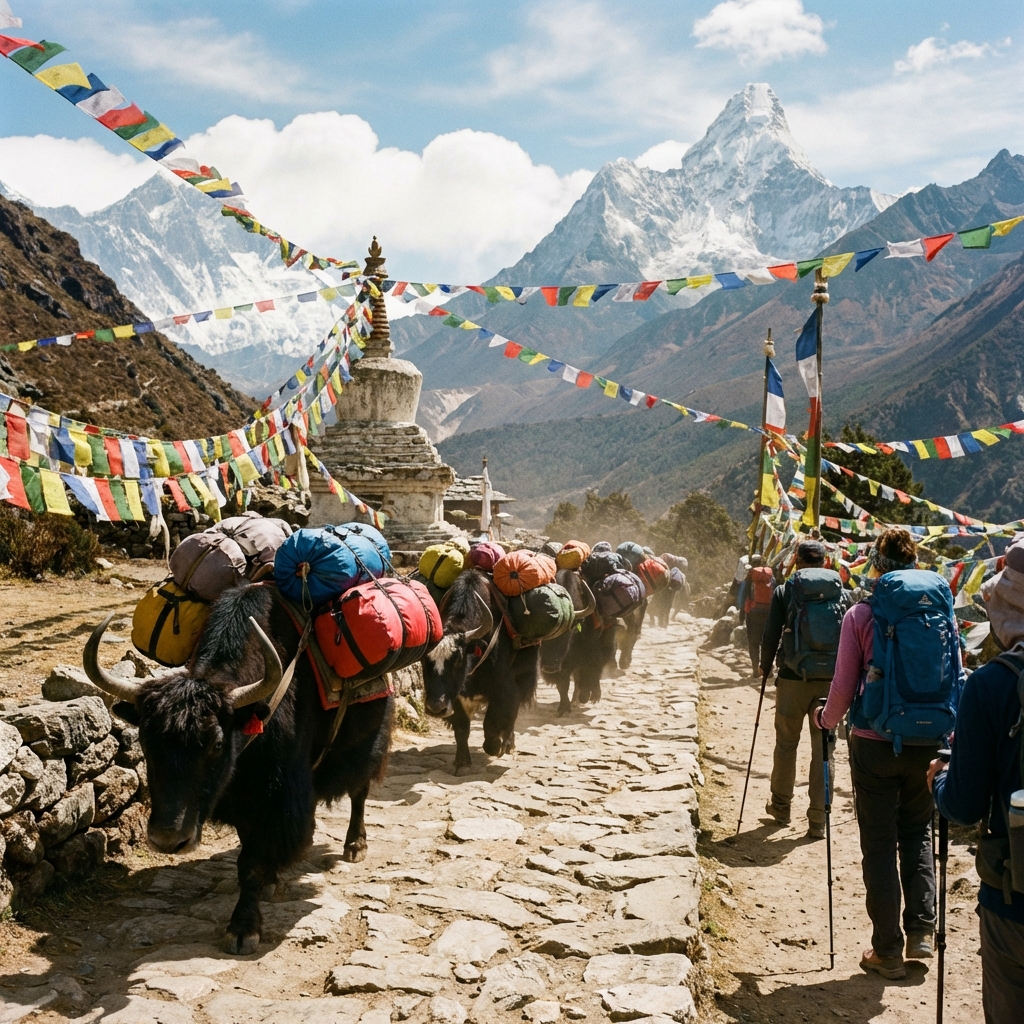
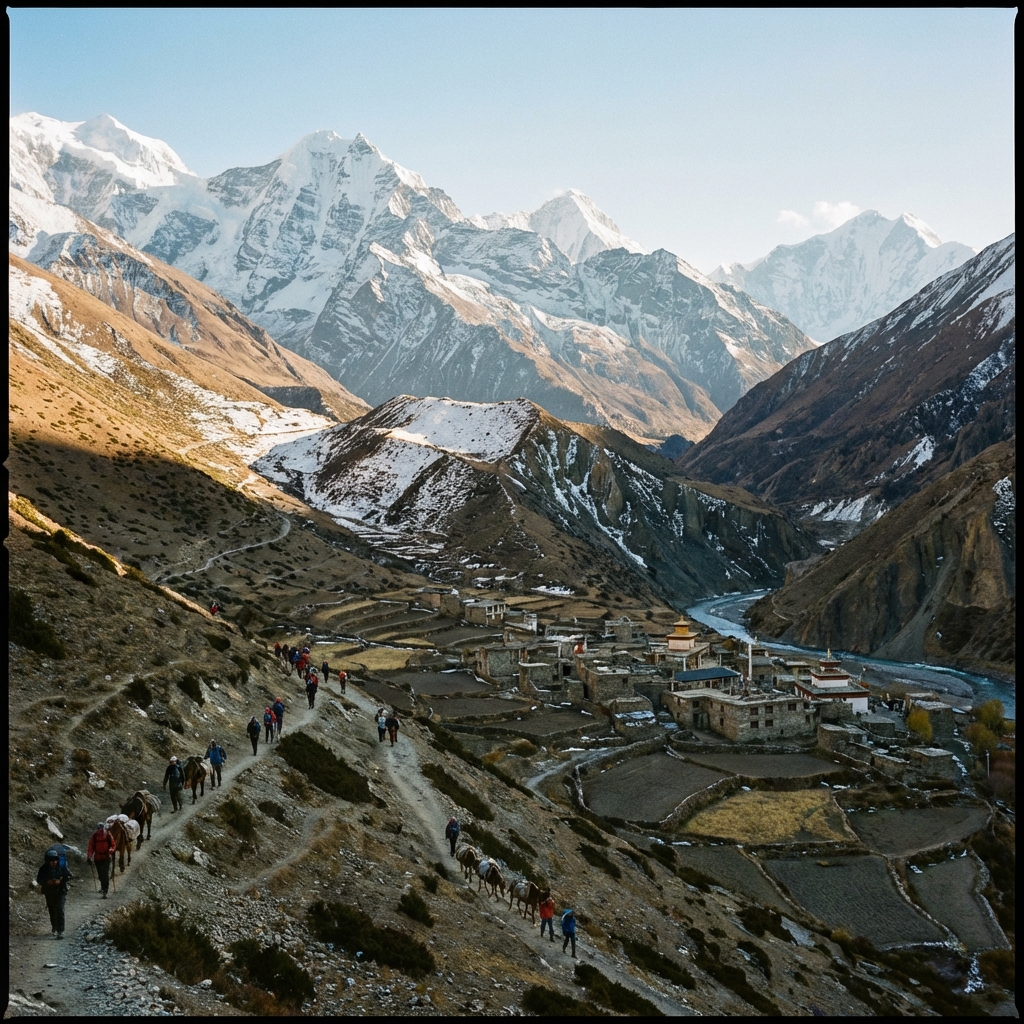
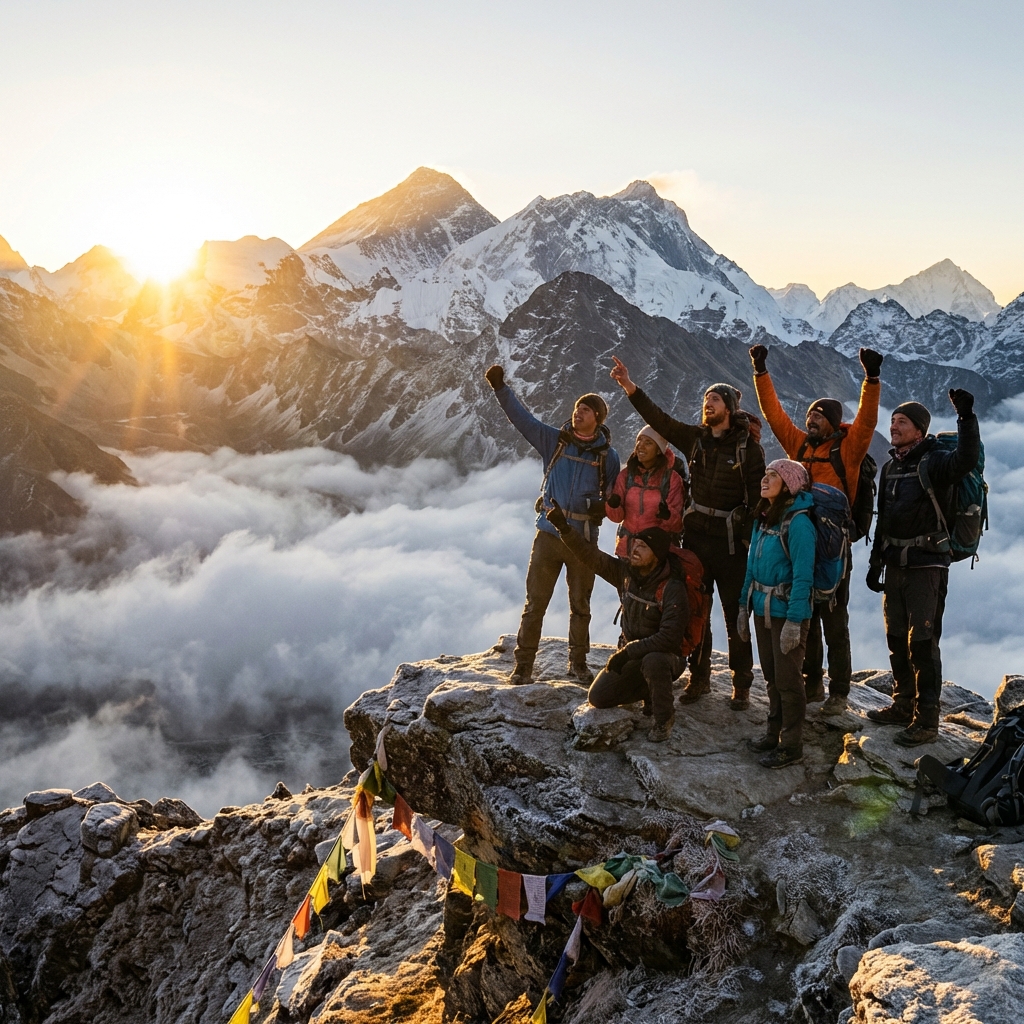
When you're trekking at high altitude in the Himalayas, a quality down jacket isn't just comfort—it's survival gear. After working with thousands of trekkers heading to Everest Base Camp, Annapurna Circuit, and Langtang Valley, we've learned exactly what works and what doesn't when it comes to staying warm at 5,000+ meters.
This comprehensive guide covers everything you need to know about selecting, buying, renting, and caring for down jackets specifically for Nepal trekking conditions. Whether you're planning your first trek to ABC or attempting the challenging Three Passes Trek, understanding down insulation is critical to your success and safety.
Why You Absolutely Need a Down Jacket in Nepal
Temperature Reality at Altitude
Many first-time trekkers underestimate how cold it gets in the Himalayas, even during the popular October trekking season. While daytime hiking temperatures can be pleasant at 10-15°C, evenings and early mornings are a different story entirely.
At 3,500m (typical for places like Namche Bazaar), temperatures drop to 0-5°C at night even in peak season. By the time you reach 4,500m elevations like Lobuche or Manang, you're looking at -10 to -15°C regularly, with wind chill pushing it even lower.
During the spring season (March-May) and autumn season (September-November), which are the best times to trek in Nepal, nighttime temperatures at altitude remain well below freezing. Winter trekking in December-February sees temperatures plummet to -20°C or lower at high camps.
When You'll Actually Wear Your Down Jacket
Understanding when you'll need your down jacket helps you appreciate why it's non-negotiable:
Every Evening (5pm-9pm): Once the sun disappears behind the mountains, temperatures plummet within 30 minutes. You'll throw on your down jacket for dinner, socializing in the tea house, and any evening activities. This happens on 90% of trek days above 3,000m.
Early Mornings (4am-7am): Pre-sunrise starts for high passes like Thorong La or Cho La Pass mean starting in darkness when temperatures are at their lowest. Your down jacket bridges the gap until hiking warms you up.
High Pass Crossings: Even during the day, passes above 5,000m like Renjo La or Kongma La are windy and cold. Many trekkers keep their down jacket on over base layers while crossing.
Tea House Breaks: Quick 10-15 minute breaks cool you down rapidly at altitude. Having your down jacket accessible means staying comfortable during these stops.
Emergency Warmth: If weather deteriorates, you get altitude sick and move slowly, or need to wait for delayed group members, your down jacket becomes critical safety equipment.
Sleeping: Many trekkers use their down jacket as an extra sleeping bag layer at high-altitude tea houses where temperatures inside rooms can drop to -10°C or lower, especially on treks like the Gokyo Lakes trek.
The 3,000m Rule
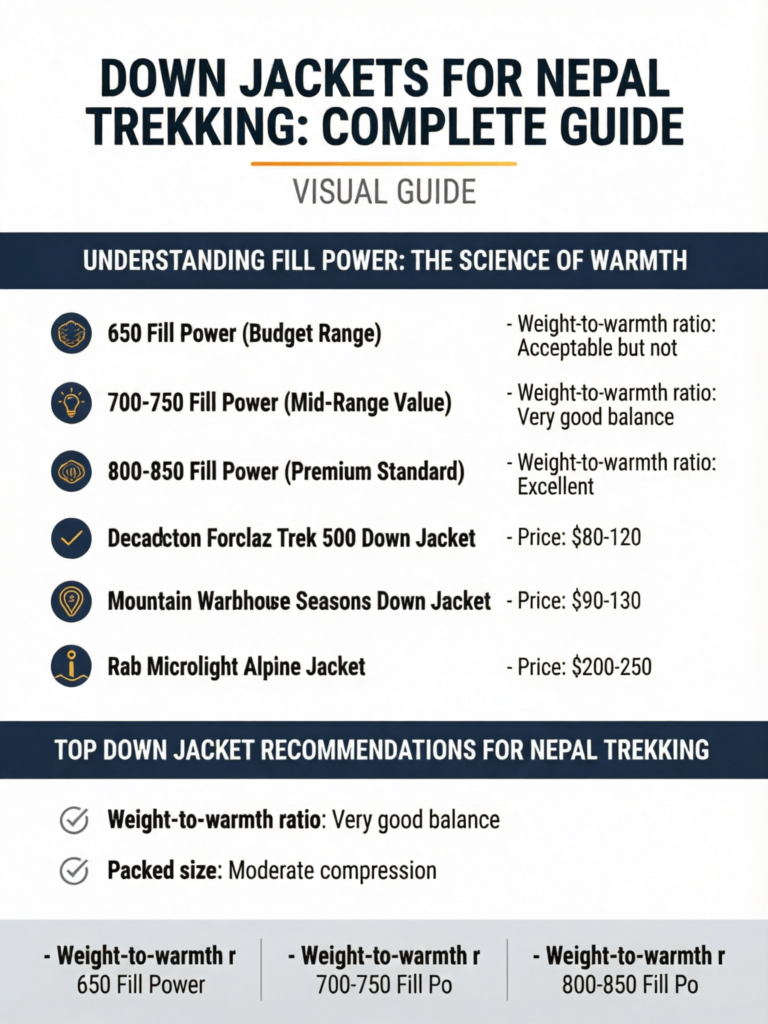
Understanding Fill Power: The Science of Warmth
Fill power is the most important specification when evaluating down jackets, yet it's also the most misunderstood. Let's break down exactly what it means and why it matters for Nepal trekking.
What is Fill Power?
Fill power (FP) measures the loft—or fluffiness—of down insulation. Technically, it's the number of cubic inches that one ounce of down occupies when allowed to fully expand. Higher fill power means the down clusters are larger, trap more air, and provide better insulation for the same weight.
A 650FP jacket needs more down by weight to achieve the same warmth as an 800FP jacket, making it heavier and bulkier. Conversely, an 800FP jacket can be lighter and more compressible while providing equal warmth.
Fill Power Categories for Nepal Trekking
650 Fill Power (Budget Range)
- Weight-to-warmth ratio: Acceptable but not optimal
- Packed size: Larger, takes up more backpack space
- Warmth: Good for 3,000-4,500m in moderate conditions
- Durability: Often uses heavier fabrics that withstand wear
- Cost: $80-150
- Best for: Single trek, casual trekkers, tight budgets
- Example conditions: Poon Hill, lower Annapurna Circuit, Langtang Valley base sections
700-750 Fill Power (Mid-Range Value)
- Weight-to-warmth ratio: Very good balance
- Packed size: Moderate compression
- Warmth: Suitable for 3,000-5,000m in most seasons
- Durability: Good quality with reasonable longevity
- Cost: $150-250
- Best for: Regular trekkers, multi-season use
- Example conditions: Full Annapurna Circuit, Everest Base Camp standard route, Manaslu Circuit
800-850 Fill Power (Premium Standard)
- Weight-to-warmth ratio: Excellent
- Packed size: Highly compressible
- Warmth: Handles 3,000-5,500m in all standard trekking conditions
- Durability: May use lighter fabrics requiring more care
- Cost: $250-400
- Best for: Serious trekkers, weight-conscious hikers, multi-trek investment
- Example conditions: All standard Nepal treks including Three Passes, high camps, shoulder seasons
900-1000 Fill Power (Ultralight Premium)
- Weight-to-warmth ratio: Maximum efficiency
- Packed size: Extremely compressible
- Warmth: Exceptional for weight, handles extreme cold
- Durability: Requires careful handling, delicate fabrics
- Cost: $400-550
- Best for: Ultralight enthusiasts, mountaineering, extreme conditions
- Example conditions: Winter trekking, 6,000m peaks, extended expeditions, Island Peak, Mera Peak
The Fill Power Sweet Spot for Nepal
For most trekkers doing standard Nepal routes like EBC or Annapurna Circuit, 800 fill power represents the sweet spot. It offers excellent warmth-to-weight ratio without the extreme cost or delicacy of 900+ FP down.
However, budget-conscious trekkers can absolutely succeed with 650-700FP jackets—you'll just carry a bit more weight. If you're doing a single trek and don't plan extensive future use, the cost savings of lower fill power may outweigh the weight penalty.
For expedition climbers or those attempting winter treks, Tsum Valley in winter, or technical peaks, the investment in 900+ FP down pays dividends in reduced pack weight and superior warmth.
Fill Power vs. Fill Weight: Both Matter
Here's where many trekkers get confused: fill power tells you the quality of the down, but fill weight tells you how much down is actually in the jacket. A 900FP jacket with only 100g of down will be less warm than a 650FP jacket with 200g of down.
For Nepal trekking, look for:
- Lightweight jackets: 100-150g fill weight, 800+ FP (good for 3,000-4,500m, layering)
- Mid-weight jackets: 150-250g fill weight, 700-850 FP (standard Nepal trekking, 3,000-5,500m)
- Expedition jackets: 250-400g fill weight, 800-1000 FP (extreme cold, high altitude, winter)
Most trekkers will be perfectly served by a mid-weight jacket in the 800FP range with approximately 150-200g of down fill.
Down vs. Synthetic Insulation for Nepal
This debate continues in outdoor circles, but for Nepal specifically, down insulation has clear advantages that make it the overwhelming choice of experienced Himalayan trekkers.
Why Down Dominates in the Himalayas
Dry Climate Advantage: The primary weakness of down—losing insulation when wet—is largely irrelevant in Nepal's Himalayas. The high-altitude environment during trekking seasons (September-May) is extremely dry. You're far more likely to deal with dust and dryness than prolonged rain at altitude.
During the monsoon season (June-August), most trekking routes are closed or extremely risky anyway. The rain shadow effect in places like Upper Mustang and the Everest region means precipitation is limited even when it does occur.
Superior Warmth-to-Weight Ratio: Down provides approximately 1.5-2x the warmth of synthetic insulation for the same weight. When you're carrying everything on your back for 10-20 days, this difference is substantial. A typical 800FP down jacket weighs 350-450g; an equivalent synthetic jacket weighs 600-800g.
Compressibility: Down compresses to roughly half the packed size of synthetic insulation. Your backpack space is precious on multi-week treks where you're also carrying sleeping bag, trekking poles, water purification, and other essentials.
Longevity: Quality down jackets maintain their loft and performance for 10-15 years with proper care. Synthetic insulation degrades with each compression cycle, typically losing effectiveness after 3-5 years of regular use.
Comfort: Down feels softer, more natural, and more comfortable against skin. The loft creates better air circulation, reducing clamminess during variable activity levels.
When Synthetic Makes Sense
Despite down's advantages, synthetic insulation has its place:
Budget Constraints: Synthetic jackets cost 30-50% less than equivalent down jackets. If you're doing one trek and have a tight budget, synthetic can work.
Monsoon Trekking: If you're trekking during monsoon season in areas that get wet (lower elevations, certain regions), synthetic maintains warmth when damp.
High Exertion Activities: For very active pursuits where you'll sweat significantly, synthetic dries faster and handles moisture better.
Minimal Care Requirements: Synthetic is easier to wash and care for, requiring less specialized treatment.
Ethical Concerns: Some trekkers prefer to avoid down due to animal welfare considerations. Modern synthetic insulation has improved significantly in recent years.
The Verdict for Standard Nepal Treks
For the vast majority of trekkers doing standard routes like Everest Base Camp, Annapurna Circuit, Langtang Valley, or Manaslu Circuit, down insulation is the clear winner. The dry climate, weight considerations, and temperature extremes all favor down.
Synthetic makes sense primarily for ultra-budget scenarios or unusual circumstances like deliberate monsoon trekking. Even then, many experienced guides recommend saving up for down rather than compromising with synthetic for Himalayan conditions.
Down vs. Synthetic for Nepal Trekking
| Name | Pros | Cons | Best For |
|---|---|---|---|
| 800FP Down Jacket | Superior warmth-to-weight ratio (350-450g)Highly compressible (small pack size)Excellent for dry Himalayan climateLasts 10-15 years with careMore comfortable feelBetter at extreme cold (-15°C+) | Higher cost ($250-400)Loses insulation when wetRequires careful washingMore delicate fabricsEthical considerations for some | Standard Nepal treks (EBC, ABC, Annapurna Circuit), dry season trekking, multi-year use, weight-conscious trekkers |
| Synthetic Insulated Jacket | Lower cost ($100-200)Maintains warmth when wetEasy care and washingDries quicklyNo animal productsMore durable outer fabrics | Heavier (600-800g for equivalent warmth)Bulkier packed sizeDegrades faster (3-5 years)Less effective at extreme coldDoesn't compress as well | Monsoon trekking, very tight budgets, single-use scenarios, high-moisture environments, ethical preferences |
Top Down Jacket Recommendations for Nepal Trekking
After testing dozens of jackets across multiple Himalayan treks and consulting with professional guides and gear shops in Kathmandu, these are our top recommendations across different price points.
Budget Category ($80-150): Best Value Options
Decathlon Forclaz Trek 500 Down Jacket
- Price: $80-120
- Fill power: 650FP duck down
- Fill weight: 180g
- Total weight: 520g
- Temperature rating: Comfort to -5°C
- Features: Basic hood, two hand pockets, internal pocket
- Sizing: Runs slightly large, size down for layering fit
- Durability: Heavy-duty 20D shell, very durable
- Availability: Decathlon stores worldwide, online shipping
- Best for: Single trek, budget-conscious, casual trekkers
The Forclaz 500 punches above its weight class. While the 650FP down and heavier weight put it firmly in budget territory, the construction quality is excellent. The 20D ripstop shell is more durable than many premium jackets, making it ideal for the rough-and-tumble tea house environment.
This jacket has successfully been worn on countless Everest Base Camp treks and Annapurna Circuit journeys. The hood is basic but functional, and the fit accommodates layering well. At this price point, it's hard to find better value.
Downsides: Heavy (520g), not very compressible, basic features, duck down (not goose down), no water-resistant treatment.
Mountain Warehouse Seasons Down Jacket
- Price: $90-130
- Fill power: 600FP down
- Fill weight: 200g
- Total weight: 580g
- Temperature rating: Comfort to -8°C
- Features: Fixed hood, elasticated cuffs, two pockets
- Best for: Extreme budget, rental alternative
Slightly lower fill power than the Decathlon but more fill weight, making it warmer overall. The trade-off is even more bulk and weight. Solid choice if Decathlon isn't available in your region.
Mid-Range Category ($200-300): Premium Performance
Rab Microlight Alpine Jacket
- Price: $200-250
- Fill power: 700FP R.D.S. certified goose down
- Fill weight: 147g
- Total weight: 415g
- Temperature rating: Comfort to -7°C
- Features: Insulated hood, down-filled collar, two hand pockets, one internal pocket, helmet compatible hood
- Shell fabric: Pertex Quantum ripstop (water-resistant)
- Sizing: Trim athletic fit, consider sizing up for layering
- Durability: Excellent, reinforced high-wear areas
- Availability: Worldwide outdoor retailers, excellent warranty
- Best for: Regular trekkers, multi-season use, quality investment
The Rab Microlight Alpine is a legendary jacket in the Himalayan trekking community. It offers the perfect balance of weight, warmth, features, and price. The 700FP down with 147g fill provides excellent warmth for its weight class, and the Pertex Quantum shell has good water resistance for light precipitation.
The hood is particularly well-designed—deep enough for a trekking hat underneath and helmet-compatible for mountaineering use. The fit is trim but accommodates a fleece layer comfortably. This jacket is equally at home on the Annapurna Circuit as it is on alpine climbing routes.
Rab's build quality is exceptional. These jackets regularly last 10+ years of heavy use. The company's warranty support is excellent, and repairs are reasonably priced.
Mountain Equipment Lightline Jacket
- Price: $250-300
- Fill power: 800FP goose down
- Fill weight: 130g
- Total weight: 385g
- Temperature rating: Comfort to -5°C
- Features: Down-filled hood, two hand pockets, internal security pocket
- Shell: DRILITE Loft 20D (highly water-resistant)
- Best for: Weight-conscious trekkers, multi-use jacket
A step up in fill power gives this jacket excellent warmth-to-weight ratio. The DRILITE Loft shell has better water resistance than most down jackets. Slightly less fill weight than the Rab means it's better as a layering piece or for milder conditions, but it shines for shoulder season trekking.
Premium Category ($280-420): Top-Tier Performance
Patagonia Down Sweater Hoody
- Price: $280-320
- Fill power: 800FP recycled down
- Fill weight: 164g
- Total weight: 399g
- Temperature rating: Comfort to -8°C
- Features: Insulated hood, zippered hand pockets, internal chest pocket, stuff sack included
- Shell: NetPlus 100% recycled fishing nets fabric with DWR
- Sizing: Generous fit, excellent for layering
- Durability: Very good, reinforced shoulders and elbows
- Sustainability: Fully traceable recycled down, recycled shell fabric
- Availability: Global, excellent warranty and repair program
- Best for: Environmentally-conscious trekkers, excellent all-rounder, proven reliability
The Patagonia Down Sweater is probably the most popular down jacket on Nepal treks, and for good reason. The combination of 800FP down, generous fit for layering, and bullet-proof reliability makes it a go-to choice. You'll see this jacket at every tea house from Namche Bazaar to Gorak Shep.
The recycled down performs identically to virgin down but comes with better environmental credentials. The NetPlus shell fabric made from recycled fishing nets is a unique touch. The DWR treatment provides decent water resistance for light snow or brief moisture exposure.
Fit is on the generous side, which most trekkers appreciate for layering over fleece. The hood is well-designed and comfortable under a trekking hat. The internal chest pocket is perfect for phone or camera batteries that need to stay warm.
Patagonia's repair program is legendary. If your jacket gets damaged on trek, they'll repair it for free or minimal cost. This long-term value proposition makes the higher initial cost more palatable.
Arc'teryx Cerium LT Hoody
- Price: $380-420
- Fill power: 850FP European goose down
- Fill weight: 117g down + Coreloft synthetic in moisture-prone areas
- Total weight: 305g
- Temperature rating: Comfort to -5°C
- Features: Down-filled StormHood, two hand pockets, internal security pocket
- Shell: Arato 10D nylon (highly compressible, fragile)
- Sizing: Trim athletic fit, size up for layering
- Durability: Good but requires care (delicate shell)
- Best for: Weight fanatics, technical use, experienced users
The Cerium LT is the choice of ultralight enthusiasts and professional guides who know how to care for delicate gear. At 305g, it's remarkably light while still providing legitimate warmth. The 850FP down is supplemented by Coreloft synthetic insulation in areas prone to moisture (underarms, shoulders) for better moisture management.
The StormHood is helmet-compatible and exceptionally well-designed. The entire jacket packs down to the size of a water bottle, making it perfect for limited backpack space on challenging treks like the Three Passes Trek.
Critical caveat: The 10D shell is delicate. This is not a jacket for rough use, sitting on rocks, or careless stuffing. It requires careful handling and proper storage. For experienced trekkers who will baby their gear, it's brilliant. For first-timers or rough-and-tumble users, consider something more durable.
Rab Neutrino Pro Jacket
- Price: $340-380
- Fill power: 800FP goose down
- Fill weight: 223g
- Total weight: 610g
- Temperature rating: Comfort to -12°C
- Features: Fully adjustable insulated hood, three external pockets, two internal pockets
- Shell: Pertex Quantum Pro (excellent weather resistance)
- Best for: Winter trekking, extreme cold, expedition use
This is expedition-grade warmth in a trekking-weight package. The 223g of 800FP down makes this one of the warmest jackets in the trekking category. Perfect for winter Everest Base Camp or attempting 6,000m peaks like Island Peak or Mera Peak.
Ultralight/Expedition Category ($400-550): Maximum Performance
Montbell Plasma 1000 Down Jacket
- Price: $420-500
- Fill power: 1000FP goose down
- Fill weight: 92g
- Total weight: 210g (!)
- Temperature rating: Comfort to -3°C (designed for layering)
- Features: Hood, two hand pockets
- Shell: Ballistic Airlight 7D nylon (extremely delicate)
- Sizing: Japanese fit (runs small), definitely size up
- Durability: Poor—this is delicate gear requiring expert care
- Best for: Ultralight experts, layering piece for extreme conditions, experienced mountaineers
The Montbell Plasma 1000 is a technical masterpiece and an exercise in compromise. At 210g, it's lighter than most fleece jackets while providing serious insulation thanks to 1000FP down. The warmth-to-weight ratio is unmatched in the trekking world.
However, this jacket requires expert handling. The 7D shell is tissue-paper thin and will snag, tear, and puncture easily. It's designed for careful mountaineering use, not rough tea house living. You'll need to baby this jacket constantly.
The Japanese sizing runs very small—most Western trekkers need to size up 1-2 sizes. The fit is trim even then, limiting layering options.
Best use case: Carrying as a backup layer for extreme cold on technical climbs, or as a primary layer for experienced ultralight trekkers who know how to care for delicate gear and won't be sitting on rough benches in tea houses.
Feathered Friends Eos Down Jacket
- Price: $475-550
- Fill power: 900FP goose down
- Fill weight: 142g
- Total weight: 340g
- Temperature rating: Comfort to -7°C
- Features: Hood, two hand pockets, internal pocket
- Customization: Made to order with custom sizing options
- Best for: Perfect fit enthusiasts, long-term investment, superior down quality
Feathered Friends is a small US manufacturer known for exceptional down quality and craftsmanship. Their 900FP down is certified to actually meet or exceed the advertised fill power (many manufacturers' down tests below advertised FP). The custom sizing ensures perfect fit for layering.
Price is premium, but you're getting a jacket that will last 15-20 years with proper care. Popular with professional guides and serious mountaineers.
The Guide's Secret: Rental Jackets Are Actually Good
Hooded vs. Non-Hooded: Do You Need a Hood?
This is one of the most common questions from first-time trekkers, and the answer is nuanced based on your specific trek and conditions.
The Case for Hooded Down Jackets
High Pass Protection: If you're crossing any pass above 4,500m—Thorong La (5,416m), Cho La Pass (5,420m), Renjo La, Kongma La—a hood becomes nearly essential. Wind at these elevations can be brutal, and head/neck heat loss is significant.
Early Morning Starts: Pre-dawn starts for high passes or summit attempts mean starting in temperatures of -15 to -20°C. A down-insulated hood provides warmth that a beanie alone cannot match.
Versatility: A hooded jacket can be worn with or without the hood deployed. A non-hooded jacket gives you no options when conditions deteriorate.
Sleeping Layer: Many trekkers use their down jacket hood while sleeping in cold tea houses, reducing the need for a separate balaclava or heavy beanie.
Weight Difference: The hood adds only 30-60g to jacket weight—minimal in exchange for the warmth and versatility provided.
Layering Efficiency: A down hood layers better under a hardshell or rain jacket hood than trying to layer hats and hoods together.
The Case for Non-Hooded Jackets
Lower Elevation Treks: If you're doing Poon Hill, Ghorepani, or other treks that stay below 4,000m, a hood may be overkill. A good beanie suffices.
Beanie Preference: Some trekkers simply prefer a beanie and don't like hoods restricting head movement or peripheral vision.
Slight Weight Savings: For ultralight enthusiasts counting every gram, the 30-60g hood weight might matter.
Cost Savings: Non-hooded jackets are typically $20-40 cheaper than hooded versions.
Fit Over Technical Helmets: Ironically, technical mountaineers sometimes prefer non-hooded jackets because they layer better under helmets without bulk.
The Verdict for Nepal Trekking
Get the hood. For the vast majority of Nepal treks—Everest Base Camp, Annapurna Circuit, Manaslu Circuit, Langtang, Three Passes—a hooded down jacket is the right choice.
The minimal weight penalty and small cost increase are vastly outweighed by the warmth, versatility, and safety margin a hood provides. You may not need it 90% of the time, but when you do need it—crossing a windy pass, during an unexpected cold snap, sleeping in an unheated room at 4,500m—you'll be incredibly grateful it's there.
The only scenarios where non-hooded makes sense:
- Lower elevation treks below 3,500m with no passes
- You're bringing a separate insulated hood/balaclava for specific reasons
- You already own a quality non-hooded jacket and don't want to buy new
For first-time buyers specifically for Nepal, spend the extra $30 and get the hood.
Buy vs. Rent in Kathmandu: The Complete Analysis
One of the biggest decisions for Nepal trekkers is whether to purchase a down jacket at home or rent one upon arrival in Kathmandu. Both options have merit depending on your circumstances.
Renting Down Jackets in Kathmandu
Cost Analysis:
- Daily rental rate: $2-3 per day
- Weekly rate: $12-18 per week
- Monthly rate: $50-80 per month (negotiable)
- Deposit: $100-200 (refundable)
- Typical trek duration: 12-18 days
- Total rental cost for typical EBC trek: $24-54
Quality and Selection: Kathmandu's Thamel district has dozens of rental shops stocking thousands of jackets. Quality varies dramatically:
Top-tier shops (North Face stores, Mountain Shop, Shona's Alpine Rental):
- Genuine North Face, Mountain Hardware, Feathered Friends brands
- 700-800FP down jackets in good condition
- Well-maintained, recently cleaned
- Full size range including women's specific
- Higher deposit requirements ($200-300)
- Cost: $3-4/day
Mid-tier shops (most shops along Thamel streets):
- Mix of genuine and questionable brands
- 600-700FP down, acceptable condition
- May have minor issues (broken zippers, small tears, compressed down)
- Good size selection
- Standard deposits ($100-150)
- Cost: $2-3/day
Budget shops:
- Questionable quality, unknown brands
- Often 500-600FP down, heavily used
- May have hygiene concerns
- Limited sizing
- Low deposits ($50-100)
- Cost: $1-2/day
- Not recommended for high-altitude treks
Advantages of Renting:
-
Cost savings for single treks: If you're doing one Nepal trek and don't anticipate using a down jacket at home, renting saves $150-400 compared to purchasing quality gear.
-
No packing/travel hassle: Down jackets take up significant luggage space and add weight. Renting means you pack lighter from home.
-
Try before you buy: Renting lets you experience what fill power and features you actually need. Many trekkers rent on their first trip, then purchase specific gear for subsequent treks based on learned preferences.
-
No long-term storage: Quality down jackets require proper storage (hung, not compressed). Renting eliminates this hassle.
-
Flexibility: If weather is warmer than expected, you've only spent $30-50. If you bought a $300 jacket you don't need, that stings more.
-
Support local economy: Rental fees directly support Kathmandu businesses and guides.
Disadvantages of Renting:
-
Hygiene concerns: You're wearing something dozens of other trekkers have worn and sweated in. Shops clean jackets, but standards vary. Bring a thin base layer or neck gaiter to minimize skin contact.
-
Fit may be imperfect: You get what's available in your approximate size, not a perfect fit. This can affect layering and comfort.
-
Unknown condition: Fill may be compressed from years of use, reducing effective warmth. Zippers may be temperamental. Shell may have damage you don't notice initially.
-
Deposit lock-up: Your $150-250 deposit is tied up for the duration of your trek.
-
Limited selection: Popular sizes (medium, large) may be picked over during peak season. You might not get your preferred color or style.
-
Damage responsibility: If you damage the jacket on trek, you may forfeit part or all of your deposit. Tea house benches, rocky trails, and porter handling can cause wear.
-
No use before/after trek: If you're doing additional activities in Nepal outside your main trek, you can't use the jacket (or pay additional rental days).
Buying a Down Jacket for Nepal
Advantages of Buying:
-
Perfect fit: You choose exactly the right size and style for your body and layering preferences.
-
Known quality: You control the fill power, brand, features, and condition. No surprises on trail.
-
Multi-use value: If you'll do multiple treks, ski, winter camp, or live in a cold climate, a down jacket has year-round value at home.
-
Familiarity: You can test your jacket at home, understand its warmth level, and know exactly what you're working with before you're at 5,000m.
-
Hygiene: It's yours and only yours.
-
Warranty and repairs: Purchased jackets come with manufacturer warranties and repair programs.
-
Pre-trek use: You can wear it on the plane, during Kathmandu mornings (surprisingly cold in winter), and for any pre/post-trek activities.
-
Emotional comfort: There's psychological value in having your own trusted gear in challenging conditions.
Disadvantages of Buying:
-
Upfront cost: $200-400 for quality gear that you may only use for 15 days in Nepal.
-
Luggage space: A down jacket (even compressed) takes up valuable backpack or luggage space during travel.
-
Luggage weight: Airlines increasingly enforce weight limits. A 400-600g jacket adds to this.
-
May buy wrong specification: Without experience, you might buy too warm, too cold, wrong fit, or features you don't actually need.
-
Long-term storage responsibility: Down jackets need proper storage to maintain loft over years.
The Financial Breakdown
Let's run realistic numbers for different scenarios:
Scenario 1: One-time trekker, single EBC trek
- Rental: $40 for 15 days
- Purchase: $280 (Patagonia Down Sweater)
- Winner: Rental saves $240
Scenario 2: Annual trekker (2 Nepal treks over 3 years)
- Rental: $80 total ($40 x 2 treks)
- Purchase: $280
- Winner: Rental saves $200 (but close)
Scenario 3: Dedicated trekker (4+ Nepal treks, plus home use)
- Rental: $160+ ($40 x 4 treks)
- Purchase: $280
- Winner: Purchase saves $120+ and provides home use value
Scenario 4: Trekker in cold climate (regular winter use at home)
- Rental: $40 for trek + need to buy jacket for home use anyway
- Purchase: $280 (serves both purposes)
- Winner: Purchase by far
My Recommendation Based on Your Situation
Rent if you:
- Are doing a single Nepal trek with no plans to return
- Don't need a down jacket at home (warm climate, don't winter camp/ski)
- Have tight budget and need to save every dollar
- Want to travel ultra-light
- Are testing whether you enjoy high-altitude trekking before investing in gear
Buy if you:
- Plan multiple Nepal treks (even if 2-3 years apart)
- Live in cold climate or winter camp/ski/snowshoe at home
- Have hygiene concerns or prefer your own gear
- Want perfect fit and known quality
- Can afford the upfront investment
- Are doing technical climbs or winter treks where gear reliability is critical
My personal recommendation for most first-time EBC or Annapurna Circuit trekkers: Rent in Kathmandu from a top-tier shop. The cost savings are significant, the quality from good shops is genuinely good, and you'll learn exactly what you want if you decide to purchase for future treks.
If you become a multi-trek enthusiast or discover you love winter mountaineering, invest in your own quality jacket. The Patagonia Down Sweater or Rab Microlight Alpine will serve you for a decade of adventures.
Kathmandu Rental Pro Tips
Women-Specific Down Jackets: Do They Matter?
The outdoor industry's evolution toward proper women's-specific designs has been one of the most positive developments for female trekkers. For down jackets specifically, the differences are substantial and worth understanding.
Key Differences in Women's Down Jackets
Fit and Cut:
- Narrower shoulders to match typical female frame
- Tapered waist with more pronounced hip flare
- Shorter torso length (1-2 inches shorter than men's equivalent)
- Longer sleeves relative to torso (women typically have longer arms proportionally)
- Adjusted armscye (armhole) placement for better range of motion
Insulation Distribution:
- More down in core/torso area
- Adjusted distribution in chest area
- Sometimes less insulation in arms (where women typically need less)
- Focus on maintaining warmth in vital organs
Hood Design:
- Slightly smaller overall volume
- Better fit for smaller head sizes
- Designed to accommodate ponytails in many models
Features:
- Zippered pockets placed to avoid chest carry systems (breast pockets higher)
- Hem length options to avoid interference with harness or hip belt
Do You Actually Need Women's Specific?
You probably need women's specific if:
- You're 5'7" or shorter (men's small will likely be too long in torso)
- You have a pronounced waist-to-hip ratio difference
- You find men's jackets gap at the waist or bunch at shoulders
- You have smaller frame shoulders
- You're petite and swim in men's small sizes
You might prefer unisex/men's if:
- You're 5'8" or taller with athletic build
- You prefer looser fit for extensive layering
- You have broader shoulders or straight torso
- You want maximum room for thick layers underneath
- Available women's sizes don't accommodate your layering needs
Top Women's Specific Down Jackets for Nepal
Patagonia Women's Down Sweater Hoody
- Price: $280-320
- Fill: 800FP recycled down
- Weight: 368g
- Fit: True to size, generous for layering
- Best for: All-around Nepal trekking, excellent reputation
The women's version of the ubiquitous Down Sweater features more tapered waist, adjusted sleeve length, and different color options. Fit is still generous enough for layering a fleece underneath. This is the most commonly seen women's jacket on Nepal treks for good reason—it simply works.
Arc'teryx Women's Cerium LT Hoody
- Price: $380-420
- Fill: 850FP down + Coreloft synthetic
- Weight: 265g
- Fit: Trim athletic fit, size up for layering
- Best for: Weight-conscious trekkers, technical use
Exceptionally light with proper women's-specific cut. The trim fit means you may need to size up if you plan to layer over thicker fleece. Perfect for Three Passes Trek where pack weight matters.
Rab Women's Microlight Alpine Jacket
- Price: $200-250
- Fill: 700FP R.D.S. down
- Weight: 390g
- Fit: Trim but accommodates layering
- Best for: Multi-season reliability, excellent value
Rab's women's cut is particularly well-designed for layering. The hip-length cut works well with harness or backpack hipbelt. Proven reliability across thousands of Nepal treks.
Mountain Equipment Women's Lightline Jacket
- Price: $250-300
- Fill: 800FP down
- Weight: 355g
- Fit: True to size
- Best for: High warmth-to-weight ratio
Less well-known but excellent quality. The women's version features thoughtful design touches like internal security pocket placement and hood adjustment that works with ponytails.
Montbell Women's Plasma 1000
- Price: $420-500
- Fill: 1000FP down
- Weight: 189g
- Fit: Japanese sizing (runs very small, size up)
- Best for: Ultralight enthusiasts, experienced users
The lightest option that still provides meaningful warmth. Requires careful sizing—most Western women need to size up 1-2 sizes from their normal size. Delicate and requires expert care.
Rental Considerations for Women
Kathmandu rental shops have improved women's selection dramatically in recent years. Top shops like North Face, Shona's Alpine Rental, and larger Thamel outfitters now stock dedicated women's jackets from major brands.
What to look for when renting:
- Specifically ask for women's cut, not just small men's sizes
- Check that sleeve length works with your arm length
- Verify the jacket doesn't gap at waist when zipped
- Ensure hood fits your head without being overly loose
- Bring your fleece layer to test layering fit
Reality check: During peak season (October-November, March-April), women's sizes in popular ranges (S, M) may be limited. Visiting rental shops 3-4 days before your trek starts gives you better selection.
Many petite women successfully use men's XS or S sizes, particularly from brands like Montbell that run smaller. The fit won't be optimized, but for a 15-day rental, it's workable if properly sized women's jackets aren't available.
Layering Your Down Jacket: The Complete System
A down jacket doesn't work in isolation—it's part of a layering system that needs to work together seamlessly. Understanding how to layer effectively means the difference between comfortable trekking and suffering through cold evenings.
The Three-Layer System for Nepal Trekking
Base Layer (Moisture Management)
- Purpose: Wicks sweat, provides first layer of warmth
- Material: Merino wool (160-200gsm) or synthetic (polyester)
- Examples: Icebreaker 200, Smartwool, Patagonia Capilene
- Weight: 150-250g
- For Nepal: Merino preferred for multi-day wear without washing
Mid Layer (Primary Insulation During Activity)
- Purpose: Main warmth during hiking, breathable insulation
- Material: Fleece (200-300 weight) or synthetic insulation
- Examples: Patagonia R1, Arc'teryx Delta LT, Rab Power Stretch
- Weight: 300-450g
- For Nepal: Fleece is more versatile than puffy mid-layers
Outer Insulation Layer (Stationary Warmth)
- Purpose: Maximum warmth for evenings, stops, camps
- Material: Down jacket (this guide's focus)
- Fill: 700-850FP, 150-250g fill weight
- Weight: 350-500g
- For Nepal: This is what you wear at tea houses and during breaks
Shell Layer (Weather Protection - as needed)
- Purpose: Wind and precipitation protection
- Material: Waterproof-breathable or windproof soft shell
- Examples: Arc'teryx Beta, Patagonia Torrentshell, Outdoor Research Helium
- Weight: 250-400g
- For Nepal: Mostly for high passes and unexpected weather
How to Actually Layer in Nepal Conditions
Morning Start (4am-6am, -10 to -5°C):
- Base layer
- Light fleece OR down jacket (not both initially)
- Shell if windy
- Start moving quickly to generate heat
- Remove down within 15-30 minutes as you warm up
Hiking (6am-4pm, 5 to 15°C at lower elevations):
- Base layer only in sun at lower elevations
- Add fleece when shaded, windy, or at higher altitude
- Down jacket stays in pack, easily accessible
- Shell if rain/snow
High Pass Approach (above 4,800m, often windy):
- Base layer
- Fleece
- Down jacket (if very cold or slow pace)
- Shell over down if windy/precipitating
Afternoon Arrival at Tea House (3pm-5pm):
- Still warm from hiking
- Base layer + fleece usually sufficient
- Down jacket ready for when sun disappears
Evening at Tea House (5pm-9pm, -5 to -15°C):
- Base layer
- Fleece
- Down jacket over both
- This is prime down jacket time—you'll wear it 100% of evenings above 4,000m
Sleeping in Cold Tea House (9pm-6am, -10 to -20°C inside room):
- Sleep in base layer + fleece inside sleeping bag
- Down jacket either:
- Worn in sleeping bag if very cold
- Placed over top of sleeping bag as extra insulation
- Stuffed in stuff sack as pillow (if warm enough)
Common Layering Mistakes to Avoid
Mistake #1: Starting hikes with down jacket on Within 20 minutes of uphill hiking, you'll be sweating profusely. Sweat + down = disaster. Start cold, warm up while moving. Your fleece is the hiking layer; down is the stopping layer.
Mistake #2: Wearing base layer + down with nothing between This creates too much temperature gap. Add your fleece as the middle layer for better temperature regulation and protection of your down from body moisture.
Mistake #3: Shell over down in dry cold conditions Unless it's precipitating or extremely windy, wearing a shell over your down just reduces breathability and creates clamminess. Down works best with air circulation.
Mistake #4: Keeping down jacket in bottom of pack Your down jacket needs to be accessible. When you stop for breaks, you need it within 2 minutes. Keep it in top of pack or lashed to outside.
Mistake #5: Not adjusting layers quickly enough Temperature changes rapidly at altitude. When you stop moving, put on down immediately. When you start moving, take it off before you sweat. Don't tough it out—adjust proactively.
Layering for Different Trek Intensities
Easy Days (gradual ascent, short distance): You'll generate less heat, so you might wear fleece + down earlier in the day, especially at higher elevations.
Hard Days (steep climbs, long distance): You'll generate tons of heat. You might hike in just base layer even at 4,500m on sunny days. Down jacket only for extended breaks and evening.
Acclimatization Days (minimal activity): You'll be wearing down jacket more because you're not generating heat through exertion. These are high-wear days for your jacket.
Summit/Pass Days (very early starts, extreme cold, then strenuous climbing): Most complex layering. Start with everything, strip to base layer during climb, add everything back at summit, manage layers carefully on descent.
The Guide's Layering Secret
When to Wear Your Down Jacket: Situation-Specific Guide
Understanding exactly when to deploy your down jacket helps you manage body temperature, conserve energy, and stay comfortable throughout your trek.
Daily Trek Schedule Breakdown
Pre-Dawn Start (4:00am - 5:30am)
- Situation: Leaving tea house for high pass crossing
- Temperature: -15 to -10°C typical
- Wear down? Maybe, depends on your cold tolerance
- Strategy: Start with base + fleece + shell, down in pack. Only add down if you're moving very slowly or waiting for group. Remove down after 20-30 minutes of hiking.
- Treks where this matters: Thorong La, Cho La Pass, all high passes
Morning Hiking (6:00am - 12:00pm)
- Situation: Active uphill trekking
- Temperature: -5 to +10°C depending on sun exposure
- Wear down? No, almost never
- Strategy: Base layer + fleece maximum. Down stays packed and accessible.
- Exception: Very gradual terrain at extreme altitude (above 5,200m) where you're moving slowly
Lunch Break (12:00pm - 1:00pm)
- Situation: 30-60 minute stop at tea house or trail location
- Temperature: 5 to 15°C, but you've cooled from hiking
- Wear down? Above 4,000m, yes. Below 4,000m, fleece usually sufficient.
- Strategy: Put down on immediately upon stopping. Remove before resuming hiking.
Afternoon Hiking (1:00pm - 4:00pm)
- Situation: Active trekking, but often in shadow as sun moves
- Temperature: 5 to 10°C
- Wear down? No
- Strategy: Fleece layer adjusts based on sun/shade. Down remains packed.
Arrival at Tea House (3:00pm - 5:00pm)
- Situation: Just arrived, still warm from hiking, settling into room
- Temperature: 5 to 10°C outside, similar inside unheated tea house
- Wear down? Not yet
- Strategy: Fleece layer while unpacking, organizing. Down will be needed soon.
Late Afternoon/Early Evening (5:00pm - 7:00pm)
- Situation: Socializing, reading, relaxing as sun sets
- Temperature: Drops to 0 to -5°C, -10°C at high tea houses
- Wear down? Yes, absolutely
- Strategy: Put down jacket on as soon as sun disappears or you feel slight chill. This is prime down time.
Dinner (6:00pm - 8:00pm)
- Situation: Eating in dining room, often around stove (if available)
- Temperature: -5 to -10°C, slightly warmer near stove
- Wear down? Yes, 100% of the time above 3,500m
- Strategy: Keep jacket on through dinner. May unzip if very warm near stove.
- Note: This is where 80% of down jacket wear occurs
Evening Social Time (8:00pm - 9:30pm)
- Situation: Playing cards, chatting, planning next day
- Temperature: -10 to -15°C, colder as fires/stoves die down
- Wear down? Yes
- Strategy: Jacket stays on until you head to bed
Sleeping Prep (9:30pm - 10:30pm)
- Situation: In your room, getting ready for bed
- Temperature: -10 to -20°C inside unheated rooms at high altitude
- Wear down? Yes, until you're in sleeping bag
- Strategy: Keep jacket on while brushing teeth, organizing gear, getting into sleep clothes. Use as needed in/on sleeping bag.
Situation-Specific Scenarios
Photography Stops You've stopped moving and are standing still for 5-15 minutes setting up shots. Above 4,000m, put down jacket on. Your body temperature drops rapidly when stationary, and you'll get chilled quickly. Remove before resuming hiking.
Waiting for Slow Group Members When you're standing around waiting for others to catch up, your body cools fast. Down jacket goes on, especially if you've been sweating. This prevents the chill-sweat combination that leads to dangerous cooling.
Water Breaks Quick 5-minute water breaks generally don't require down jacket below 4,500m if you're staying in the sun. Above 4,500m or in wind, even short breaks benefit from throwing on the down.
Bathroom Breaks Tea house bathrooms are often outside and extremely cold, especially at night. Keep down jacket on or grab it for nighttime trips. The 2-minute exposure at -15°C isn't worth the discomfort of leaving it behind.
Early Morning Packing Your room is freezing. Wear your down jacket while packing up your gear and getting ready. Remove it before starting your hike.
Altitude Sickness Slowdown If you're feeling effects of altitude and moving slower than normal, you're generating less body heat. You may need your down jacket even while hiking at reduced pace above 4,500m.
Weather Deterioration If weather turns—cloud cover, wind, snow—you may need down jacket even during active hiking above 4,800m. Always have it accessible in top of pack.
Porter/Horse Transport If you're being carried or riding (due to injury or altitude sickness), you're not generating heat. Down jacket is essential even during midday.
Elevation-Based Guidelines
2,500m - 3,500m (Lukla, Namche, Ghandruk)
- Daytime hiking: Rarely need down
- Lunch breaks: Usually fleece sufficient
- Evenings: Down jacket starting around 6pm
- Sleeping: May need down in sleeping bag in peak winter
3,500m - 4,500m (Tengboche, Dingboche, Manang)
- Daytime hiking: Never need down while moving
- Lunch breaks: Down jacket for breaks 30+ minutes
- Evenings: Down jacket from 5pm onwards, 100% usage
- Sleeping: Down jacket often worn or used as supplemental layer
4,500m - 5,500m (Lobuche, Gorak Shep, Thorong Phedi)
- Daytime hiking: Still rarely need while moving briskly
- Lunch breaks: Always use down for any break 10+ minutes
- Evenings: Down jacket from 4pm onwards, absolutely essential
- Sleeping: Down jacket essential as part of sleeping system
- Early mornings: May start hike with down, remove after 20-30 minutes
Above 5,500m (Pass crossings, summit attempts)
- Highly variable based on exertion level
- May need down even while moving if pace is very slow
- Essential for any stops
- Critical safety equipment at this elevation
Down Jacket Usage by Trek Elevation Profile
| Name | Pros | Cons | Best For |
|---|---|---|---|
| Poon Hill Trek (max 3,210m) | Down jacket needed only eveningsFleece sufficient for most situationsCan potentially skip down for budget trips | Still gets cold at night (0 to -5°C)December-February requires down | Lower-altitude trekkers, warmer seasons, budget-conscious travelers willing to layer fleece |
| Everest Base Camp (max 5,364m) | Down jacket essentialUsed 60-70% of trek time in eveningsCritical for safety above 4,500m | Heavy if you bring wrong jacketTakes pack space | All EBC trekkers—this is non-negotiable essential gear |
| Annapurna Circuit (max 5,416m) | Down jacket absolutely essentialUsed extensively above ManangCritical for Thorong La crossing | May feel heavy on hot lower sectionsUnused days 1-5 at lower elevations | All Annapurna Circuit trekkers, especially important Manang onwards |
| Three Passes Trek (max 5,545m) | Down jacket critical safety equipmentUsed daily above 4,000mEssential for three pass crossings | Weight matters on this challenging trekNeed high-quality reliable jacket | All Three Passes trekkers—invest in quality, focus on weight-to-warmth ratio |
Care, Washing, and Storage of Your Down Jacket
A quality down jacket that costs $250-400 deserves proper care to last 10-15 years. Proper maintenance also ensures it performs optimally when you need it most at altitude.
During Your Trek: Daily Care
Storage in Tea Houses: Never leave your down jacket compressed in its stuff sack overnight. When you arrive at your tea house room:
- Remove jacket from stuff sack
- Hang on available hooks or lay flat on bed
- Allow it to fully loft and air out
- This prevents down from staying compressed and losing loft over time
Avoiding Damage: Tea house environments are rough on gear:
- Don't sit directly on rocky benches while wearing jacket—sharp edges can puncture shells
- Keep away from open flames and cooking areas (down is flammable, shells melt)
- Avoid snagging on rough wood beams, nails, or splinters common in tea houses
- Don't use jacket as pillow while compressed (lay it flat if using as pillow)
Managing Moisture: Down's main weakness is moisture. Even in dry Himalayan air:
- Don't wear your down while hiking and sweating
- If jacket gets damp from precipitation, hang to air-dry in your room
- Never pack away a damp down jacket—this promotes mold and down clumping
- If caught in snow, shake off excess before it melts and penetrates
Spot Cleaning: Tea house meals often involve dal bhat splatter and greasy soups:
- Wipe spills immediately with damp cloth
- Use minimal water and dab, don't rub
- Allow area to air dry completely
- Save deep cleaning for after trek
Sun Exposure: Brief sun exposure while hanging to air out is fine and helpful for drying. Extended direct sun exposure (hours) can degrade shell fabrics over time. Hang in shaded but airy locations when possible.
Washing Your Down Jacket: Step-by-Step
Down jackets need washing far less frequently than you think. Wash only when:
- Visibly dirty with stains
- Smells strongly even when dry
- Down is clumping significantly
- Shell has lost its DWR (water beads no longer form)
Frequency: Most trekkers need to wash after 1-2 Nepal treks, or every 20-30 days of use.
Washing Instructions:
What you need:
- Down-specific wash (Nikwax Down Wash, Grangers Down Wash, or similar)
- Front-loading washing machine (top-loaders with agitators damage jackets)
- 2-3 clean tennis balls or dryer balls
- Low-heat dryer access OR several days for air drying
Process:
-
Pre-wash inspection:
- Close all zippers
- Check pockets are empty
- Inspect for tears/damage (repair before washing if needed)
- Turn jacket inside-out to protect outer shell
-
Washing:
- Use down-specific detergent (regular detergent strips oils from down)
- Run warm water (30°C/85°F maximum)
- Use minimal detergent (half the normal amount)
- Run gentle/delicate cycle
- Add extra rinse cycle to remove all soap residue
- Soap residue prevents down from lofting properly
-
Initial drying:
- Gently squeeze (never wring) excess water
- Support jacket when moving it—wet down is heavy and can tear baffles
- Lay flat on clean towel and roll to absorb more water
-
Machine drying (preferred method):
- Place in dryer with 2-3 tennis balls (breaks up clumps)
- Use LOW heat only (high heat damages down and melts shell)
- Run for 2-3 hours, checking every 30 minutes
- Remove and manually break up any clumps you feel
- Return to dryer
- Jacket is fully dry when no clumps remain and it's fully lofted
- This can take 3-4 hours total—don't rush it
-
Air drying (alternative method):
- Lay jacket flat on drying rack in warm, dry location
- Flip every 3-4 hours
- Manually break up clumps each time you flip
- This takes 2-4 days depending on humidity
- Jacket must be COMPLETELY dry before storage
Critical warnings:
- Dry cleaning chemicals damage down—never dry clean down jackets
- Wet down smells musty—this is normal, smell disappears when fully dry
- Inadequately dried down will mold—take your time
- If down clumps won't break up, it's not dry yet—keep drying
Restoring DWR (Water Repellent)
After washing or extended use, the DWR treatment on your shell fabric will degrade. You'll notice water no longer beads up but instead soaks into fabric.
Restoring DWR:
- Wash jacket first (DWR won't work on dirty fabric)
- While jacket is still damp, apply DWR treatment:
- Spray-on: Nikwax TX Direct Spray, Grangers Performance Repel
- Wash-in: Nikwax TX Direct Wash-In (easier but uses more product)
- Follow product instructions for application
- Tumble dry on low heat—heat activates the DWR
- DWR should last 20-40 days of use before needing reapplication
Long-Term Storage
Between treks (months of storage):
DON'T:
- Store compressed in stuff sack (causes permanent down compression)
- Store in damp basement or garage (promotes mold)
- Store in airtight plastic bags (traps moisture)
- Fold tightly (creates permanent crease lines)
DO:
- Hang on wide hanger in closet (allows down to loft)
- Store in breathable cotton or mesh storage bag (allows air circulation)
- Keep in cool, dry location
- Ensure jacket is 100% dry before storage
- Store away from direct sunlight
For years-long storage: Some manufacturers recommend storing in large mesh bags rather than hanging to prevent weight stress on shoulders. Either method works if jacket is dry and can loft.
Repairs and Maintenance
Small holes/tears:
- Repair immediately with Tenacious Tape or similar patch
- Prevents down from escaping and hole from enlarging
- Patches work remarkably well and don't significantly impact performance
Broken zippers:
- Often repairable by replacing slider ($5-15 at outdoor stores)
- Main zipper failures may require manufacturer repair
- Zipper lubricant (like Zipper Ease) prevents future issues
Delaminating baffles:
- If you see down moving between baffles, internal construction is failing
- This requires professional repair or replacement
- Patagonia, Rab, Arc'teryx all offer repair services
Significant down loss:
- If jacket is noticeably less warm and feels thin in areas
- Can be recharged with new down by professional repair services
- Cost: $50-100 typically
- Extends jacket life by many years
Most quality manufacturers (Patagonia particularly) offer free or low-cost repairs. Before discarding an expensive jacket for minor damage, check the manufacturer's repair program.
The Post-Trek Refresh Ritual
Alternatives and Supplementary Options
While a down jacket is the standard choice for Nepal trekking, several alternative approaches and supplementary pieces deserve consideration based on your specific circumstances.
Synthetic Insulated Jackets
We covered down vs. synthetic earlier, but specific synthetic models worth considering:
Patagonia Nano Puff Hoody
- Price: $250-280
- Insulation: 60g PrimaLoft Gold
- Weight: 340g
- Best for: Monsoon trekking, active use, budget alternative
The Nano Puff is nearly as popular as down jackets on Nepal treks. It handles moisture better than down and costs less. The trade-off is reduced warmth-to-weight ratio and bulkier pack size.
Arc'teryx Atom LT Hoody
- Price: $300-340
- Insulation: Coreloft Compact 60g
- Weight: 375g
- Best for: Active mountain use, breathable insulation
More breathable than the Nano Puff, making it better for high-exertion activities. Many guides prefer this for active guiding work where they're constantly moving.
Down Vests: The Ultralight Option
Down vests eliminate sleeve insulation, saving approximately 100-150g of weight. This matters for ultralight trekkers but comes with trade-offs.
Advantages of vests:
- Lighter (250-300g vs. 400-500g)
- More packable
- Better arm mobility
- Cheaper ($150-200)
- Can layer under shell jacket more easily
Disadvantages:
- Arms get cold (obviously)
- Can't stuff hands in pockets when cold
- Less versatile for camp/tea house wear
- Not suitable for extreme cold
Verdict: Vests work for experienced trekkers who understand their limitations and have backup warm layers. For most first-time Nepal trekkers, the full jacket is the better choice. Arms get surprisingly cold at altitude, especially during evening tea house time.
Down Pants/Trousers
For extreme cold, expedition climbers, or winter trekkers, down pants are valuable supplementary insulation.
When you might need down pants:
- Winter Everest Base Camp (December-February)
- 6,000m peaks (Island Peak, Mera Peak, Lobuche Peak)
- Extended time above 5,500m
- Particularly cold-sensitive individuals
- Photography/nature observation that involves long stationary periods
When you don't need them:
- Standard autumn/spring EBC or Annapurna Circuit treks
- Any trek during normal trekking seasons
- Most trekkers with proper base layer + fleece pants
Recommended models:
- Western Mountaineering Flash Pants ($280-320, 850FP, 230g)
- Montbell Plasma 1000 Down Pants ($220-280, 1000FP, 160g)
- Feathered Friends Helios ($350-400, 900FP, 250g)
Alternative: Many trekkers successfully use fleece pants or insulated synthetic pants (like Patagonia Nano Puff pants) instead of down. These are more versatile and handle tea house roughness better.
Synthetic Hoodies/Fleece as Down Alternative
Some trekkers attempt to substitute heavyweight fleece for down jackets. This can work but has significant limitations.
Heavyweight fleece (300+ weight):
- Examples: Patagonia R2, Rab Alpha Flash
- Weight: 450-600g
- Warmth: Acceptable to 0°C, inadequate below
- Pack size: Large, not very compressible
The reality: Even heavy fleece doesn't match down's warmth at high altitude cold. You'll need both fleece (for active insulation) AND down (for static warmth) on standard Nepal treks above 4,000m.
Attempting to substitute heavy fleece for down saves money but adds weight and reduces warmth. Not recommended unless doing very low-altitude treks (under 3,500m).
Insulated Parkas for Expedition Use
For technical climbing or extreme cold exposure, full expedition parkas provide even more warmth than standard down jackets.
Examples:
- Canada Goose Snow Mantra ($1,000+, 625FP, massive warmth)
- Arc'teryx Ceres SV ($850-950, 850FP, expedition-grade)
- Mountain Equipment Annapurna ($500-600, 800FP, proven Himalayan use)
- Rab Neutrino Endurance ($450-500, 800FP, durable expedition jacket)
Who needs these:
- Mountaineers attempting 7,000m+ peaks
- Winter camping above 5,500m
- Expedition support staff stationary at base camps
- Extreme cold sensitivity or medical conditions
Who doesn't: Standard trekkers on tea house routes, even in winter. These jackets are overkill, heavy, bulky, and expensive for standard trekking.
Heated Jackets/Electric Options
Battery-powered heated jackets have improved significantly but remain impractical for multi-week Nepal treks.
Why they don't work:
- Battery life insufficient (3-6 hours per charge)
- Charging infrastructure unreliable in tea houses
- Heavy with battery packs
- Expensive ($300-500)
- Battery performance degrades in cold
- One more thing to charge and manage
Better solution: Invest in quality passive insulation (down jacket) that works without power requirements.
Frequently Asked Questions
Related Resources and Further Reading
Final Recommendations: Your Down Jacket Decision
After 10,000+ words covering every aspect of down jackets for Nepal trekking, here's the distilled wisdom for your specific situation.
For First-Time EBC/Annapurna Circuit Trekkers
Best approach: Rent a quality 700-800FP jacket in Kathmandu from a top-tier shop ($40-60 total cost). This gives you proven gear without the upfront investment. Visit shops in Thamel 2-3 days before departure for best selection.
If buying: Patagonia Down Sweater Hoody ($280-320, 800FP) or Rab Microlight Alpine ($200-250, 700FP). Both offer proven reliability, excellent warmth, and will last for future adventures.
For Budget-Conscious Trekkers
Ultra-budget: Rent in Kathmandu ($40-60 for entire trek)
Budget purchase: Decathlon Forclaz Trek 500 ($80-120, 650FP). Heavy and bulky, but genuinely warm and durable enough for 1-2 Nepal treks.
Best value purchase: Rab Microlight Alpine ($200-250, 700FP). The sweet spot of cost, performance, and longevity.
For Weight-Conscious Trekkers
Best choice: Arc'teryx Cerium LT ($380-420, 850FP, 305g) or Mountain Equipment Lightline ($250-300, 800FP, 385g). Maximum warmth-to-weight ratio without entering ultralight-delicate territory.
Ultralight option: Montbell Plasma 1000 ($420-500, 1000FP, 210g) if you're experienced with delicate gear and need absolute minimum weight.
For Regular/Multi-Trek Trekkers
Investment pick: Patagonia Down Sweater ($280-320) for its proven reliability, excellent warranty/repair program, and 10-15 year lifespan. This jacket will serve you on dozens of adventures.
Alternative: Feathered Friends Eos ($475-550, 900FP) for ultimate quality and custom sizing if you're committed to serious mountain pursuits for years to come.
For Winter/Extreme Cold Trekking
Recommended: Rab Neutrino Pro ($340-380, 800FP, 223g fill) or Arc'teryx Thorium AR ($450-500, 750FP, heavy fill) for temperatures consistently below -15°C.
Consider: Down pants as supplemental insulation for extended time above 5,000m or winter conditions.
The Universal Truth
Whatever you choose, prioritize these factors in order:
- Adequate warmth (minimum 700FP, 150g+ fill for standard treks)
- Proper fit (room for base + fleece layer underneath)
- Hood inclusion (nearly always worth it for Nepal)
- Known quality (buy reputable brands or rent from top-tier shops)
- Weight (important but secondary to warmth and fit)
Your down jacket isn't just comfort equipment—it's safety gear that may determine whether you summit that pass, sleep comfortably at 5,000m, or need to descend due to cold. Invest appropriately for your specific trek and conditions.
The Himalayas are unforgiving to those with inadequate gear, but incredibly rewarding for those properly equipped. Choose your down jacket wisely, care for it properly, and it will keep you warm through some of the most spectacular mountain experiences on Earth.
Namaste, and trek safely.