
Best Trekking Agencies for Annapurna Base Camp 2026: Verified Guide
Choosing a trekking agency for Annapurna Base Camp requires different considerations than selecting an Everest Base Camp operator. While both treks demand quality support, ABC's shorter duration, lower maximum altitude, Pokhara proximity, and diverse route variations create unique agency selection criteria that this comprehensive guide addresses.
The Annapurna Base Camp trek attracts over 80,000 trekkers annually, making it Nepal's second most popular high-altitude adventure after Everest Base Camp. This popularity means hundreds of agencies compete for your business, with quality ranging from exceptional local operators with decades of Annapurna experience to fly-by-night companies cutting dangerous corners to offer impossibly low prices.
This guide doesn't simply list recommended agencies. Instead, it empowers you to evaluate any ABC operator, understand what differentiates quality Annapurna specialists from generic trekking companies, and make confident decisions based on your specific needs, whether that's a quick 7-day short ABC trek, the classic 10-12 day journey, or an extended ABC plus Poon Hill adventure.
We've analyzed over 600 verified customer reviews, verified TAAN registrations, compared 40+ operator pricing structures, and consulted with returned ABC trekkers to create this definitive ABC agency selection resource for 2026.
150+ TAAN registered
$600-900
$1,000-1,500
$1,800-2,500
95%+ with good agency
10-14 days
Introduction: Why Agency Choice Matters Differently for ABC
The Annapurna Base Camp trek presents a fundamentally different agency selection challenge than Everest Base Camp. Understanding these differences helps you evaluate operators through the right lens and avoid applying EBC standards where ABC-specific criteria matter more.
ABC Is More Accessible, But That Creates Its Own Challenges
At 4,130 meters, Annapurna Base Camp sits over 1,200 meters lower than Everest Base Camp's 5,364-meter elevation. This significant altitude difference means ABC has a 95%+ success rate compared to EBC's 85-92%, with far fewer serious altitude-related incidents. However, this accessibility attracts less-prepared trekkers and less-serious agencies who view ABC as an "easy" trek requiring minimal expertise.
Quality ABC agencies recognize that while the altitude risk is lower, proper acclimatization still matters above 3,000 meters, weather in the Annapurna Sanctuary can turn dangerous rapidly, and the steep stone staircases (particularly around Deurali and Machapuchare Base Camp) cause more injuries than altitude sickness.
Pokhara Changes Everything
Unlike EBC, which requires expensive Lukla flights from Kathmandu, ABC treks start from Pokhara, Nepal's second-largest city and trekking hub. This proximity creates a thriving local agency scene distinct from Kathmandu-based operators. Understanding when to book with Pokhara agencies versus Kathmandu operators significantly impacts your experience and costs.
More Route Variations Mean More Package Complexity
ABC offers diverse itinerary options that EBC doesn't match: the classic 10-12 day ABC trek, short 7-8 day versions for time-pressed trekkers, combined ABC plus Poon Hill routes (12-14 days), and ABC plus Mardi Himal combinations. Quality agencies help match your available time and fitness to the right variation. Poor agencies push whichever package they have scheduled regardless of appropriateness.
Lower Cost Doesn't Mean Lower Standards
ABC packages legitimately cost 30-40% less than equivalent EBC treks due to eliminated Lukla flight costs, shorter durations, and closer proximity to supply chains. However, some agencies exploit this perception by offering dangerously cheap packages that cut corners on safety, guide experience, and porter welfare. Understanding appropriate ABC pricing helps identify value versus exploitation.
The Accessibility Trap
ABC's reputation as "easier" than EBC leads some trekkers to book the cheapest possible agency, assuming less can go wrong. This creates a false economy. Weather-related emergencies in the Annapurna Sanctuary, injuries on steep terrain, and altitude issues above Bamboo still require experienced guides with proper emergency protocols. A $400 agency saving becomes meaningless when you're stranded at Machapuchare Base Camp in a blizzard with an inexperienced guide and no satellite communication.
ABC vs EBC Agency Considerations: Key Differences
Before evaluating specific ABC agencies, understand how selection criteria differ from EBC operators.
Altitude Risk: Lower But Still Present
EBC Context: Everest Base Camp at 5,364 meters presents serious altitude risk. Agencies must have extensive high-altitude protocols, emergency oxygen, and guides trained for cerebral and pulmonary edema recognition.
ABC Reality: Annapurna Base Camp at 4,130 meters still exceeds the 3,500-meter threshold where altitude sickness becomes common. While severe cases are rarer than EBC, they still occur. Quality ABC agencies:
- Monitor symptoms above 3,000 meters (starting from Bamboo)
- Include mandatory acclimatization stops
- Carry pulse oximeters for daily checks at altitude
- Know evacuation procedures from the Annapurna Sanctuary
- Train guides in altitude sickness recognition
What This Means for Agency Selection: Don't dismiss altitude protocols for ABC as unnecessary. Agencies that say "ABC doesn't require altitude precautions" demonstrate dangerous ignorance. However, you needn't pay premium prices for extreme high-altitude specialization. Mid-range agencies with solid altitude awareness provide appropriate ABC support.
Duration and Logistics: Simpler But Variable
EBC Context: Everest Base Camp treks follow relatively standardized 12-16 day itineraries dictated by acclimatization requirements and Lukla flight constraints.
ABC Reality: ABC offers genuine duration flexibility from 7-14+ days depending on starting point, fitness level, and route variations. This flexibility creates opportunity for customization but also for agencies to sell inappropriate itineraries.
What This Means for Agency Selection: Evaluate whether agencies offer multiple ABC variations and help match options to your fitness and timeline. Agencies pushing only one itinerary regardless of your circumstances prioritize their scheduling over your experience. Quality operators discuss:
- Your available days
- Fitness level and trekking experience
- Interest in add-ons (Poon Hill, Jhinu hot springs, Mardi Himal)
- Pace preference (leisurely vs. challenging)
Starting Point: Pokhara vs Kathmandu
EBC Context: All EBC treks involve Kathmandu-Lukla flights, making Kathmandu the natural booking location with minimal advantage from local Lukla agencies.
ABC Reality: ABC treks begin with a 1-2 hour drive from Pokhara to trailheads like Nayapul, Phedi, or Ghandruk. This Pokhara proximity creates two distinct agency ecosystems:
Pokhara-Based Agencies:
- Local knowledge of Annapurna region
- Often lower prices (no Kathmandu overhead)
- Direct relationships with regional teahouses
- Can arrange last-minute bookings easily
- Sometimes smaller operations with personal service
- May have limited international booking infrastructure
Kathmandu-Based Agencies:
- Handle Nepal-wide logistics (Kathmandu hotels, transfers)
- Usually larger with more resources
- More established international booking systems
- May subcontract Annapurna treks to local operators
- Higher overhead potentially reflected in prices
- Better for combined Nepal itineraries
What This Means for Agency Selection: If ABC is your primary Nepal objective and you're flying directly to Pokhara, booking with a quality Pokhara agency can provide better local expertise and value. If you're combining ABC with Kathmandu sightseeing, other treks, or complex logistics, Kathmandu agencies offer convenience despite potentially higher costs.
Cost Structure: Significantly Lower
EBC Context: Quality EBC packages range $1,500-4,000+ with Lukla flights alone adding $215-400 per person.
ABC Reality: Quality ABC packages range $600-2,500 with no flight costs (ground transport to trailhead included). This 30-40% cost reduction is legitimate and doesn't indicate lower quality.
| Trek | Duration | Max Altitude | Difficulty | Best For | Cost |
|---|---|---|---|---|---|
| EBC Standard Package | 14 days | $1,800-2,200 | Lukla flights included | Higher altitude risk | Longer duration |
| ABC Standard Package | 11 days | $215-1,200 | Ground transport only | Lower altitude risk | More route variations |
What This Means for Agency Selection: Don't compare ABC prices to EBC prices expecting similar costs. ABC legitimately costs less. However, ABC packages under $500-600 should trigger scrutiny. At such prices, agencies likely cut guide wages, porter welfare, or safety equipment.
Route Variations: More Options, More Complexity
EBC Context: EBC follows one primary route with optional extensions (Gokyo Lakes, Three Passes). Most trekkers complete the standard EBC itinerary.
ABC Reality: ABC offers genuinely different route options serving different needs:
| Variation | Duration | Best For |
|---|---|---|
| Short ABC | 7-8 days | Time-pressed, fit trekkers |
| Classic ABC | 10-12 days | Standard experience |
| ABC + Poon Hill | 12-14 days | Sunrise views, less rushed |
| ABC + Mardi Himal | 14-16 days | Adventure seekers |
| Jhinu Hot Springs | +1 day | Recovery, relaxation |
What This Means for Agency Selection: Quality ABC agencies offer multiple variations and help you select appropriately. Agencies offering only one itinerary lack flexibility or expertise. During evaluation, ask:
- "What ABC variations do you offer?"
- "Based on my fitness and timeline, which do you recommend?"
- "Can you customize the standard itinerary?"
Pro Tip
Request a custom itinerary discussion before booking. Quality agencies engage thoughtfully with your specific needs rather than simply quoting standard packages. This conversation reveals expertise levels and customer service quality before you commit money.
What Makes a Good ABC Trekking Agency
Understanding quality indicators helps you evaluate any ABC operator, whether or not they appear on recommendation lists.
Licensed and Registered Operations
TAAN Membership (Trekking Agencies Association of Nepal) TAAN membership indicates legitimate business registration, insurance compliance, and adherence to industry standards. For ABC agencies, TAAN membership also suggests familiarity with Annapurna region regulations and permit systems.
Verification Process:
- Visit www.taan.org.np/members
- Search for the agency name
- Confirm membership is current (renewed annually)
- Call TAAN office: +977 1 4440921 for verification
Nepal Tourism Board (NTB) License All legal trekking operators must hold NTB licensing demonstrating minimum capital requirements, tax compliance, and government oversight.
Annapurna Conservation Area Project (ACAP) Knowledge Quality ABC agencies demonstrate familiarity with ACAP regulations, including:
- Permit requirements and costs
- Conservation area rules
- Trail maintenance contributions
- Wildlife protection guidelines
Why Registration Matters for ABC: The Annapurna region's popularity attracts unlicensed operators who may lack insurance, employ unlicensed guides, and operate outside regulatory frameworks. While enforcement is imperfect, registered agencies provide accountability mechanisms unavailable with illegal operators.
Local Pokhara Knowledge
ABC-specific excellence requires Annapurna region expertise beyond general Nepal trekking competence:
Indicators of Local Knowledge:
- Detailed familiarity with multiple ABC route variations
- Relationships with specific teahouses along the route
- Understanding of seasonal conditions in Annapurna Sanctuary
- Knowledge of alternative trails and evacuation routes
- Familiarity with Gurung village customs and local culture
- Awareness of current trail conditions and recent changes
Questions to Assess Local Expertise:
- "Which teahouses do you book at each stop? Why those specifically?"
- "What's the current trail condition between Deurali and MBC?"
- "If weather closes the upper section, what alternative routes do you use?"
- "What cultural experiences can your guides share in Gurung villages?"
Red Flag: Agencies providing generic answers that could apply to any Nepal trek rather than ABC-specific details lack genuine local expertise.
Flexible Itinerary Options
Quality ABC agencies recognize that different trekkers need different approaches:
Flexibility Indicators:
- Multiple ABC variations offered (short, classic, extended)
- Willingness to customize standard itineraries
- Add-on options clearly presented (Poon Hill, Jhinu, Mardi Himal)
- Discussion of pace adjustment based on fitness
- Extra acclimatization day options
- Alternative starting points considered
Questions to Ask:
- "Can the standard itinerary be modified if I'm struggling?"
- "What if I want to add Poon Hill after starting the trek?"
- "Do you offer both leisurely and faster-paced options?"
- "Can we extend at Jhinu for the hot springs?"
Red Flag: Agencies offering only fixed itineraries with no modification options prioritize their scheduling convenience over your experience.
Good Value (Not Just Cheap)
ABC legitimately costs less than EBC, but "good value" differs from "cheapest possible."
Value Indicators:
- Price appropriate for services included
- Transparent breakdown of costs
- No hidden fees revealed later
- Quality services at each price point
- Honest about what budget vs. premium means
- Clear explanation of what costs extra
Value Questions:
- "What is your complete price breakdown?"
- "What standard of teahouse accommodation is included?"
- "Are all meals included or just some?"
- "What equipment do you provide versus what I must bring?"
- "What is the expected tip amount for guides and porters?"
Understanding ABC Value Tiers:
| Tier | Price Range | Services |
|---|---|---|
| Budget | $600-900 | Basic teahouses, shared rooms possible, licensed guide, essential services |
| Mid-range | $1,000-1,500 | Better teahouses, private rooms, experienced guide, more flexibility |
| Premium | $1,800-2,500 | Best lodges, senior guide, maximum flexibility, enhanced services |
ABC Price Reality Check
Quality 11-day ABC treks cost approximately $55-90 per day including all services. If an agency quotes under $50 per day, scrutinize what's excluded or where corners are cut. If they quote over $200 per day without clear premium justifications, you're overpaying for the ABC route.
Experienced Guides with ABC Expertise
Quality ABC guides possess qualifications beyond basic trekking licenses:
Essential Guide Qualifications:
- Government-issued trekking guide license
- First Aid certification (Wilderness First Aid ideal)
- Altitude sickness recognition training
- 3+ years of ABC trekking experience
- Fluent English communication
- Knowledge of Annapurna region culture and ecology
ABC-Specific Guide Knowledge:
- Familiarity with weather patterns in Annapurna Sanctuary
- Understanding of Gurung and Magar village customs
- Knowledge of Machapuchare (Fishtail) cultural significance
- Awareness of Annapurna I avalanche history and safety
- Experience with steep stone staircase sections
Questions to Ask:
- "How many times has this guide completed the ABC trek?" (Look for 15+ completions)
- "Does the guide have experience with short ABC, classic, and extended variations?"
- "What training does the guide have for altitude emergencies?"
- "Can I speak with or video call the guide before booking?"
Pro Tip
Request a brief video call with your assigned guide before finalizing payment. Assess their English fluency, enthusiasm, and knowledge through natural conversation. Agencies that facilitate this demonstrate confidence in their guides; those who refuse may be hiding inexperience.
Safety Protocols for ABC
While less altitude-intensive than EBC, ABC still requires proper safety protocols:
Communication Equipment:
- Mobile phone coverage extends to Machapuchare Base Camp but becomes unreliable
- Satellite communication backup for upper Annapurna Sanctuary
- Regular check-ins with Pokhara/Kathmandu office
Medical Preparedness:
- First aid kit appropriate for trail injuries (falls, sprains common on stone stairs)
- Pulse oximeter for monitoring above 3,000 meters
- Basic altitude medications knowledge
- Clear descent protocols if symptoms develop
Weather Awareness:
- Annapurna Sanctuary weather monitoring
- Understanding of avalanche risk seasons
- Flexibility to wait out dangerous conditions
- Knowledge of shelter options in emergencies
Evacuation Coordination:
- Helicopter evacuation contacts for Annapurna region
- Understanding of evacuation points (MBC, Deurali, Himalaya Hotel)
- Insurance claim process knowledge
- Alternative descent route awareness
Red Flag: Agencies that dismiss ABC safety protocols as unnecessary because "it's not as high as Everest" demonstrate concerning attitudes toward client welfare.
Fair Porter Treatment
Ethical porter treatment is non-negotiable regardless of trek:
IPPG Standards for ABC:
- Maximum load: 25kg per porter (excluding personal gear)
- Proper clothing for high-altitude sections
- Adequate food and shelter at teahouses
- Fair wages: Rs. 2,000-2,500+ per day
- Insurance coverage for injury and illness
- No children under 16 employed
ABC-Specific Porter Considerations: The ABC route includes extremely steep sections with thousands of stone stairs. Porter loads must account for this challenging terrain, not just altitude. Overloaded porters on ABC's steep descents face serious injury risk.
What to Ask:
- "What is your porter welfare policy?"
- "What equipment do you provide to porters?"
- "What is the maximum porter load on ABC?"
- "Are porters insured? What coverage?"
- "Where do porters sleep and eat?"
Your Choice Supports Workers
Your agency selection directly impacts Nepali families. Porters earning fair wages support children's education and community development. Those exploited by unethical operators face poverty wages and preventable injuries. Choose agencies that treat staff with dignity.
Red Flags to Avoid: ABC-Specific Warning Signs
Recognizing warning signs protects you from dangerous, unethical, or incompetent ABC operators.
Ultra-Cheap ABC Prices: What's Being Cut
When ABC prices fall significantly below $600 for standard 11-day packages, agencies cut costs dangerously:
How Ultra-Cheap ABC Agencies Save Money:
| Cost-Cutting Method | Risk to You |
|---|---|
| Unlicensed guides | No emergency training, permit issues |
| Inexperienced guides | Poor route knowledge, safety gaps |
| No guide insurance | Liability exposure |
| Minimal first aid supplies | Inadequate injury response |
| Cheapest teahouses | Poor food, unsanitary conditions |
| Overworked porters | Staff exhaustion, accidents |
| No porter equipment | Injury risk for staff |
| Compressed itinerary | Inadequate acclimatization |
| Hidden costs revealed later | Budget surprise |
ABC Price Reality Check: Quality 11-day ABC treks cost approximately $55-80 per day for budget-mid range when including all services. If an agency quotes $35-40 per day, they're cutting corners affecting your safety and their staff's welfare.
The Math for ABC:
- Guide salary: $20-30/day
- Porter salary: $18-22/day
- Permits: $40-50 total
- Food: $15-25/day
- Teahouse: $5-8/day
- Transport to/from Pokhara: $30-50 total
- Insurance, equipment, office costs, profit margin
Minimum viable daily cost for ethical ABC operation: approximately $50-60/day
"ABC Is Easy" Dismissiveness
Some agencies market ABC as requiring no preparation or expertise, appealing to unprepared trekkers.
Warning Phrases:
- "No fitness required"
- "Anyone can do ABC"
- "No altitude precautions needed"
- "Just a walk in the mountains"
- "No experience necessary"
The Reality: ABC involves 6-8 hours of daily hiking, thousands of stone stairs, altitude up to 4,130 meters, unpredictable weather, and basic teahouse conditions. While accessible to reasonably fit people, it's not a casual walk. Agencies dismissing preparation requirements will similarly dismiss safety protocols.
What Quality Agencies Say:
- "Moderate difficulty suitable for fit beginners"
- "Basic fitness preparation recommended"
- "Altitude awareness still important above 3,000m"
- "Previous hiking experience helpful but not required"
- "We'll assess your readiness and adjust pace accordingly"
No Annapurna-Specific Experience
Some agencies offer ABC treks despite focusing primarily on other regions.
Warning Signs:
- Generic Nepal trekking website with ABC as minor offering
- Guides primarily experienced in Everest region
- Inability to answer ABC-specific questions
- No mention of Annapurna variations (just "ABC trek")
- Subcontracting ABC to unknown local partners
Questions Revealing Lack of ABC Expertise:
- "What's the difference between Ghandruk and Nayapul starting points?" (They should explain time savings vs. cultural experience trade-offs)
- "When is the stone staircase section most challenging?" (Should know the Bamboo to Deurali section specifics)
- "What's unique about the Annapurna Sanctuary ecosystem?" (Should discuss glacial environment, protected status, wildlife)
Pressure to Skip Acclimatization
Even though ABC is lower than EBC, proper acclimatization matters.
Dangerous Suggestions:
- "We can do ABC in 5 days if you're fit"
- "You don't need rest days on ABC"
- "Push through to reach ABC faster"
- "Acclimatization isn't necessary below 5,000m"
Reality: Altitude sickness can occur above 2,500 meters. The jump from Bamboo (2,310m) to Annapurna Base Camp (4,130m) over 2-3 days requires proper pacing. Rushing causes headaches, nausea, and occasionally serious altitude illness even on "lower" ABC.
What Quality Agencies Say:
- "We include strategic rest stops for acclimatization"
- "The itinerary allows gradual altitude gain"
- "We monitor symptoms above 3,000 meters"
- "Extra acclimatization days are available if needed"
- "Your safety matters more than reaching ABC quickly"
No Clear Weather Contingency
Annapurna Sanctuary weather can change rapidly, trapping trekkers at MBC or ABC in dangerous conditions.
Warning Signs:
- No mention of weather monitoring
- Fixed itinerary with no flexibility for weather delays
- No explanation of what happens if snow closes the route
- Dismissing weather concerns as unlikely
What Quality Agencies Provide:
- Daily weather awareness and forecasting
- Flexibility to wait out dangerous conditions
- Knowledge of shelter options if stranded
- Clear communication about weather-related itinerary changes
- Emergency protocols for severe weather
- Understanding of avalanche risk periods
Annapurna Sanctuary Weather Reality
The Annapurna Sanctuary acts as a weather trap where conditions deteriorate rapidly. Multi-day blizzards occur even in peak season, and avalanche risk near Annapurna I is real. Quality agencies treat weather seriously; dismissive attitudes about "predictable conditions" indicate dangerous ignorance.
What Should Be Included in ABC Packages
Understanding standard inclusions helps you compare packages accurately.
Standard Inclusions Breakdown
Transportation:
| Service | Standard | Premium |
|---|---|---|
| Pokhara airport/bus station pickup | Usually included | Always included |
| Transport to trailhead (Nayapul/Phedi) | Always included | Private vehicle |
| Return transport from trail end | Always included | Private vehicle |
| Kathmandu-Pokhara (if applicable) | Sometimes included | Often included |
Accommodation:
| Service | Standard | Premium |
|---|---|---|
| Teahouse rooms | Twin-sharing standard | Private room guaranteed |
| Room quality | Basic, clean lodges | Best available at each stop |
| Pokhara hotel | Sometimes 1 night | Usually 1-2 nights |
| Blankets/bedding | Provided at teahouses | Quality guaranteed |
Meals:
| Service | Standard | Premium |
|---|---|---|
| Trek meals | Breakfast, lunch, dinner | All meals + snacks |
| Meal quality | Standard teahouse menu | Menu variety prioritized |
| Drinks | Tea/coffee with meals | Hot drinks throughout day |
| Pokhara meals | Usually not included | Some included |
Staff:
| Service | Standard | Premium |
|---|---|---|
| Guide | Licensed, English-speaking | Senior, highly experienced |
| Guide ratio | 1:6 maximum | 1:4 or better |
| Porter | Shared (2:1 typically) | Dedicated (1:1) |
| Porter allowance | 10-12kg per person | 15kg per person |
| Staff insurance | Included | Comprehensive |
Permits and Fees:
| Service | Standard | Premium |
|---|---|---|
| ACAP permit | Always included | Always included |
| TIMS card | Always included | Always included |
| Permit processing | Included | Included |
| Local fees | Usually included | Always included |
Common Exclusions
These items are typically NOT included and should be budgeted separately:
Always Extra:
- International flights to/from Nepal
- Nepal visa fees ($50-125 depending on duration)
- Travel insurance (mandatory, $80-200)
- Tips for guide and porter ($100-180 recommended for ABC)
- Personal trekking gear
- Alcoholic beverages
- Snacks beyond meals
- Personal expenses
Usually Extra:
- Hot showers ($2-5, available at most teahouses)
- WiFi access ($2-4 per day)
- Battery/device charging ($1-3 per charge)
- Bottled water ($1-2 per liter)
- Soft drinks and extra hot drinks
- Laundry service
- Single room supplement ($150-300)
Sometimes Extra:
- Kathmandu-Pokhara transport ($25-35 bus, $10-$25 (tourist bus $15, VIP $20-25) flight)
- Extra Pokhara hotel nights
- Sleeping bag rental ($1-2 per day)
- Down jacket rental ($1-2 per day)
- Gear storage in Pokhara
ABC-Specific Inclusions to Ask About
Jhinu Hot Springs: Many ABC itineraries pass through or near Jhinu Danda, famous for natural hot springs. Clarify:
- "Is the Jhinu hot springs visit included in the itinerary?"
- "Is hot springs entrance fee ($5-7) included or extra?"
- "How much time is allocated at Jhinu?"
Poon Hill Add-On: Popular combination itineraries include Poon Hill sunrise viewpoint:
- "Is Poon Hill included or a separate package?"
- "What is the cost to add Poon Hill?"
- "How many extra days does Poon Hill add?"
Route Variations: Clarify which specific ABC variation you're booking:
- "Which starting point is used? Nayapul, Phedi, or Ghandruk?"
- "Is this the short ABC or classic itinerary?"
- "Does the route include Machapuchare Base Camp stop?"
Hidden Costs to Ask About
Before booking, specifically clarify these potential surprise costs:
Transportation Ambiguities:
- "Is Pokhara airport transfer included?"
- "What if I arrive by bus rather than flight?"
- "Is return transport included or one-way only?"
- "What about Kathmandu-Pokhara transport?"
Accommodation Questions:
- "How many Pokhara hotel nights are included?"
- "What standard of teahouse is booked?"
- "What is the single room supplement?"
- "Are rooms private or twin-sharing?"
Meal Clarifications:
- "Are all three meals included every day?"
- "What drinks are included with meals?"
- "Are meals in Pokhara included?"
- "What about special dietary requirements?"
Permit Questions:
- "Are ALL permits included in the quoted price?"
- "Is TIMS card processing included?"
- "Are there any local fees not mentioned?"
Pro Tip
Create a checklist of these questions and send to every agency you're considering. Their response comprehensiveness reveals their transparency. Agencies that answer everything clearly operate clearly.
Price Ranges for ABC: What You Get at Each Level
Understanding what different price points deliver helps set realistic expectations.
Budget ($600-900): What to Expect
Typical Package at $600-900 (11 days):
- Licensed guide (possibly less experienced)
- Shared porter (2 trekkers per porter)
- Basic teahouse accommodation (may share rooms in peak season)
- Three meals daily at teahouses
- Essential permits (ACAP, TIMS) included
- Ground transport to/from trailhead
- Usually 1 night Pokhara hotel
- Basic first aid kit
- Group departures typically
Who Budget Suits:
- Experienced trekkers comfortable with basic conditions
- Budget-conscious travelers prioritizing value
- Physically fit individuals who won't need flexibility
- Solo travelers joining group departures
- Those who've trekked at altitude before
Budget Reality Check: Many "$600 ABC" packages become $900+ after adding extras. Calculate TRUE total cost:
| Item | Cost |
|---|---|
| Base package | $600 |
| Hot showers (8x) | $30 |
| Charging/WiFi | $30 |
| Tips | $100 |
| Single supplement (if solo) | $150 |
| TRUE TOTAL | $910 |
Budget Agency Advantages:
- Lowest entry point for ABC
- Good for repeat trekkers who know what to expect
- Efficient, no-frills experience
- Some excellent local operators work at this level
Budget Agency Risks:
- Guide experience may be limited
- Less flexibility for changes
- Basic teahouse quality
- Compressed itineraries possible
- Porter treatment may vary
Budget Can Still Be Quality
Some excellent Pokhara-based agencies offer budget packages with experienced guides and ethical practices. The key is verification. A TAAN-registered budget agency with 50+ positive reviews can be safer than expensive international operators subcontracting to unknown local partners.
Mid-Range ($1,000-1,500): The Sweet Spot
Typical Package at $1,000-1,500 (11 days):
- Experienced guide (3+ years ABC experience)
- Dedicated porter or favorable sharing ratio
- Better teahouse selection (pre-booked quality lodges)
- Full board with more meal variety
- All permits included
- Ground transport in comfortable vehicle
- 1-2 nights Pokhara hotel included
- Comprehensive first aid and oximeter
- Flexible scheduling
- Private trek option available
Who Mid-Range Suits:
- First-time high-altitude trekkers
- Those wanting comfort without luxury
- Couples and small groups
- Trekkers who value guide expertise
- Those with limited time needing reliability
- Anyone prioritizing safety and quality
Why Mid-Range is the Sweet Spot: This price range buys the fundamentals that matter:
- Experienced guides who've handled emergencies
- Proper acclimatization awareness
- Quality teahouses with reliable food
- Flexibility if needed
- Ethical treatment of staff
- Responsive agency support
Mid-Range Value Calculation:
| Item | Included |
|---|---|
| Base services | $1,000 |
| Quality teahouses | Included |
| Experienced guide | Included |
| Better porter ratio | Included |
| Flexibility | Included |
| Additional costs | |
| Tips | $120 |
| Extras (showers/charging) | $50 |
| TRUE TOTAL | $1,170 |
Premium ($1,800-2,500): When It's Worth It
Typical Package at $1,800-2,500 (11-14 days):
- Senior guide with extensive medical training
- Personal dedicated porter
- Premium lodge selection (best rooms at each stop)
- Gourmet meal options where available
- All permits and logistics included
- 3-star Pokhara hotels (2+ nights)
- Comprehensive emergency equipment
- Fully flexible scheduling
- Private treks standard
- 24/7 support from agency
- Pre-trek consultation and gear review
- Some gear provided
Who Premium Suits:
- Older trekkers (55+) wanting comfort and support
- Those with medical concerns needing extra monitoring
- Photographers wanting maximum flexibility
- Honeymoons or special celebrations
- Corporate groups
- First-time trekkers wanting maximum support
- Anyone for whom budget isn't the primary constraint
When Premium is Worth the Extra Cost:
Medical Concerns: If you have any health conditions, premium agencies provide better monitoring and faster emergency response.
Limited Time: Premium flexibility prevents lost time from minor issues and allows pace adjustment without stress.
Physical Concerns: Older trekkers or those uncertain about fitness benefit from dedicated porters and slower pace flexibility.
Photography: Premium flexibility allows waiting for weather, extra time at viewpoints, and schedule adjustments for golden hour.
Peace of Mind: Sometimes extra cost buys confidence. If worrying would diminish your experience, premium support is worth it.
| Trek | Duration | Max Altitude | Difficulty | Best For | Cost |
|---|---|---|---|---|---|
| Budget ABC Package | 11 days | $600-900 base | Group typically | Experienced, budget-conscious | Basic support, essential services |
| Mid-Range ABC Package | 11-12 days | $1,000-1,500 | Group or private | First-timers, most trekkers | Full support, quality service |
| Premium ABC Package | 11-14 days | $1,800-2,500 | Fully customized | Comfort-focused, special needs | Maximum support, luxury touches |
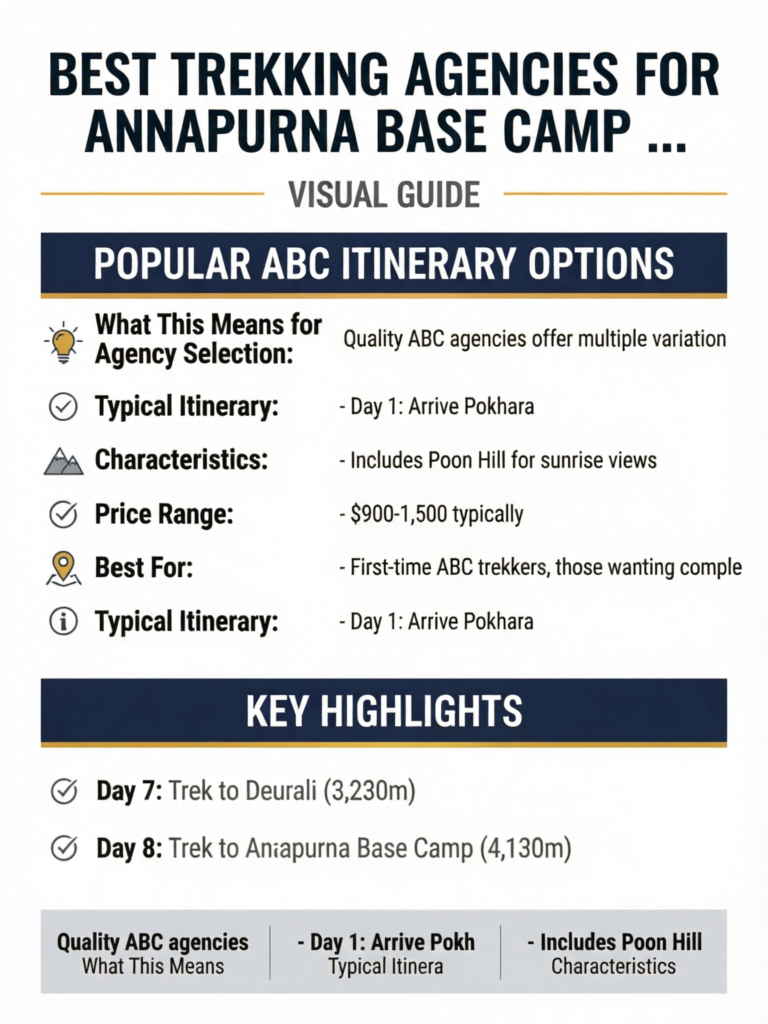
Popular ABC Itinerary Options
Understanding route variations helps you select the right package and evaluate agency expertise.
Classic ABC (10-12 Days)
The standard Annapurna Base Camp itinerary most trekkers complete.
Typical Itinerary:
- Day 1: Arrive Pokhara
- Day 2: Drive to Nayapul (1,070m), trek to Tikhedhunga (1,540m)
- Day 3: Trek to Ghorepani (2,860m)
- Day 4: Poon Hill sunrise (3,210m), trek to Tadapani (2,630m)
- Day 5: Trek to Chhomrong (2,170m)
- Day 6: Trek to Bamboo (2,310m)
- Day 7: Trek to Deurali (3,230m)
- Day 8: Trek to Annapurna Base Camp (4,130m)
- Day 9: Sunrise at ABC, descend to Bamboo
- Day 10: Trek to Jhinu Danda (1,780m), hot springs
- Day 11: Trek to Nayapul, drive to Pokhara
- Day 12: Buffer day/departure
Characteristics:
- Includes Poon Hill for sunrise views
- Proper acclimatization schedule
- Jhinu hot springs recovery
- Most popular choice for good reason
- Suitable for moderately fit beginners
Price Range: $900-1,500 typically
Best For: First-time ABC trekkers, those wanting complete experience
Short ABC (7-8 Days)
Compressed itinerary for time-pressed trekkers.
Typical Itinerary:
- Day 1: Arrive Pokhara
- Day 2: Drive to Jhinu or Chhomrong, trek to Bamboo (2,310m)
- Day 3: Trek to Deurali (3,230m)
- Day 4: Trek to ABC (4,130m), return to MBC (3,700m)
- Day 5: Descend to Bamboo
- Day 6: Trek to Jhinu, hot springs
- Day 7: Trek to road, drive to Pokhara
- Day 8: Buffer/departure
Characteristics:
- Skips Poon Hill section
- Higher daily altitude gains
- Requires good fitness
- Less margin for weather delays
- More demanding but achievable
Price Range: $600-1,000 typically
Best For: Fit trekkers with limited time, repeat visitors
Short ABC Fitness Requirement
The short ABC itinerary involves faster altitude gain and longer daily hiking. Only choose this option if you have proven fitness and ideally previous altitude experience. Agencies that don't assess your fitness before recommending short ABC prioritize scheduling over safety.
ABC + Poon Hill (12-14 Days)
Extended itinerary combining two iconic experiences.
Typical Itinerary:
- Days 1-4: Poon Hill circuit (Nayapul to Ghorepani to Tadapani)
- Days 5-10: Classic ABC route from Chhomrong
- Days 11-12: Descent via Jhinu to Nayapul
- Days 13-14: Buffer and departure
Characteristics:
- Best sunrise views in Nepal at Poon Hill
- Complete Annapurna experience
- Excellent acclimatization through Poon Hill section
- More varied terrain and villages
- Longer but more relaxed pace
Price Range: $1,100-1,800 typically
Best For: Those with time for complete experience, photographers
ABC + Mardi Himal (14-16 Days)
Adventure combination with less-trodden Mardi Himal route.
Typical Itinerary:
- Days 1-7: Classic ABC trek
- Days 8-9: Return to Chhomrong area
- Days 10-14: Mardi Himal route (4,500m viewpoint)
- Days 15-16: Return to Pokhara
Characteristics:
- Combines popular ABC with uncrowded Mardi Himal
- Higher altitude on Mardi section (4,500m)
- More adventurous, less developed trail
- Unique Machapuchare perspectives
- Requires good fitness
Price Range: $1,300-2,200 typically
Best For: Adventurous trekkers wanting something beyond standard routes
Jhinu Hot Springs Extension
Add-on to any ABC itinerary for relaxation.
What It Adds:
- Stop at Jhinu Danda (1,780m) on descent
- Natural hot springs on Modi Khola river
- Muscle recovery after trek
- Relaxed final descent day
- Cultural village experience
Cost: Typically 1 extra day ($50-100 additional)
Best For: Everyone! The hot springs provide perfect trek conclusion
Pro Tip
Almost all ABC itineraries can incorporate Jhinu hot springs with minor adjustments. If your chosen package doesn't include it, ask about adding the stop. The recovery benefits and experience value far exceed the minimal extra cost.
Pokhara vs Kathmandu Agencies: Detailed Comparison
Understanding the agency landscape helps you book strategically.
Pokhara-Based Agencies: Pros and Cons
Advantages:
Local Expertise: Pokhara agencies specialize in Annapurna region treks. Their guides trek ABC repeatedly, maintaining current trail knowledge, teahouse relationships, and seasonal awareness that Kathmandu-based generalists may lack.
Lower Overhead: Without Kathmandu office costs, many Pokhara agencies offer equivalent services at 10-20% lower prices. These savings reflect efficiency, not corner-cutting.
Direct Relationships: Pokhara agencies often have personal connections with teahouse owners along the route, securing better rooms and service for their clients.
Last-Minute Flexibility: Need to book an ABC trek next week? Pokhara agencies can often accommodate short-notice requests that larger Kathmandu operators cannot.
Personal Service: Smaller Pokhara operations frequently provide more personal attention, with owners directly involved in client communication and trek oversight.
Disadvantages:
Limited International Booking Infrastructure: Some Pokhara agencies have basic websites and limited international payment options. Credit card processing may be unavailable or carry high fees.
Smaller Operations: Less staff means less backup if problems arise. Large groups may exceed their capacity.
Limited Combined Itinerary Capability: If you want ABC plus EBC plus cultural tours, Pokhara agencies may need to coordinate with other operators, adding complexity.
Communication Challenges: Smaller teams mean potentially slower email responses, especially during peak season when staff are on trails.
Kathmandu-Based Agencies: Pros and Cons
Advantages:
Comprehensive Services: Kathmandu agencies handle end-to-end Nepal logistics, including airport pickup, Kathmandu hotels, Pokhara transport, and multi-region itineraries seamlessly.
Established Systems: Years of international clients mean smooth booking processes, reliable payment options, and professional communication.
Larger Resources: More staff provides backup for emergencies, schedule changes, and unexpected situations.
Combined Itineraries: Want ABC plus Chitwan plus EBC? Kathmandu agencies coordinate complex multi-region trips efficiently.
International Recognition: Larger agencies have more online reviews, international recommendations, and established reputations.
Disadvantages:
Higher Prices: Kathmandu overhead (office rent, larger staff) increases costs. You may pay 10-20% more for equivalent services.
Potential Subcontracting: Some Kathmandu agencies subcontract ABC treks to Pokhara operators, adding intermediary costs without direct quality control.
Less ABC Specialization: Kathmandu agencies offer treks nationwide. Their ABC expertise may be less focused than Pokhara specialists.
Corporate Feel: Larger operations may feel less personal. You're a booking number rather than a guest.
When to Book Where
Book with Pokhara Agency When:
- ABC is your primary or only Nepal trek
- You're flying directly to Pokhara
- Budget is a primary concern
- You value local expertise over convenience
- You prefer personal, small-agency service
- You're comfortable with simpler booking processes
- You want to support local businesses directly
Book with Kathmandu Agency When:
- ABC is part of multi-region Nepal itinerary
- You want seamless end-to-end logistics
- You prefer established booking systems
- International payment options are important
- You need English communication reliability
- You're combining ABC with Everest region treks
- Corporate travel policies require established operators
Hybrid Approach: Some Kathmandu agencies have Pokhara offices or established local partnerships. These can provide Kathmandu convenience with Pokhara expertise. Ask specifically about their Annapurna operations when evaluating.
The Best of Both Worlds
Several established agencies maintain both Kathmandu headquarters and Pokhara operations. Look for agencies that mention "Pokhara office" or "Annapurna specialists on staff." These operators combine professional booking systems with genuine local expertise.
Questions to Ask ABC Agencies
Compile this list and send to every agency you're seriously considering.
About Guides and Experience
- "How many years of ABC experience does the assigned guide have?"
- "How many ABC treks has this guide completed?" (Look for 15+)
- "Does the guide have experience with all ABC variations?"
- "What certifications does the guide hold?"
- "Does the guide speak fluent English?" (Request video call)
- "What is the guide-to-client ratio?"
- "Will the same guide stay with us the entire trek?"
- "Can I meet or video call with the guide before booking?"
About Safety and Emergencies
- "What is your altitude sickness protocol for ABC?"
- "What medical training do guides have?"
- "What emergency equipment is carried?"
- "What is your evacuation procedure from Annapurna Sanctuary?"
- "What happens if weather traps us at MBC or ABC?"
- "What communication equipment is used in upper sanctuary?"
- "How do you monitor weather conditions?"
- "Have you had any serious incidents in the past 3 years?"
About Logistics and Inclusions
- "What exactly is included in the quoted price?"
- "What is NOT included?"
- "Which starting point do you use and why?"
- "How many Pokhara hotel nights are included?"
- "What standard of teahouse accommodation is booked?"
- "Which specific teahouses do you use?"
- "What is the porter weight allowance per person?"
- "Are all meals included? Which ones?"
- "Are permits (ACAP, TIMS) included?"
- "Is Jhinu hot springs included in the itinerary?"
About Route and Variations
- "Which ABC variation is this package?"
- "Can the itinerary be modified for my needs?"
- "Can Poon Hill be added? At what cost?"
- "What flexibility exists if I'm struggling with pace?"
- "Can we extend at Jhinu for the hot springs?"
- "What alternatives exist if weather closes the upper section?"
About Flexibility and Cancellation
- "What is your cancellation policy?"
- "Can I reschedule instead of cancel?"
- "What happens if weather delays the trek significantly?"
- "What if I can't complete due to altitude sickness?"
- "Can the itinerary be modified during the trek?"
Pro Tip
Create a spreadsheet tracking each agency's answers to these questions. Objective comparison reveals which agencies are transparent, competent, and trustworthy versus those who evade, provide incomplete answers, or seem unprepared.
Frequently Asked Questions About ABC Agencies
How much should I budget for an ABC trekking agency?
Budget breakdown by tier:
- Budget ($600-900 base): Expect $900-1,100 true total including tips and extras
- Mid-range ($1,000-1,500): Expect $1,200-1,700 true total with better inclusions
- Premium ($1,800-2,500): Expect $2,000-2,800 true total with maximum comfort
Additional costs to budget regardless of package:
- Travel insurance: $80-150
- Tips: $100-150
- Hot showers/charging: $30-50
- Extra food/drinks: $30-50
- Visa: $50-125
- Gear purchases/rentals: $50-200
Realistic total budget: $1,200-2,000 for most trekkers (excluding international flights)
Can I trek ABC without an agency?
Yes, ABC is not a restricted area and independent trekking with a mandatory licensed guide is no longer permitted (mandatory guide rule since April 2023). However, consider:
Independent Trekking Pros:
- Lower cost (no guide/porter fees)
- Complete freedom and flexibility
- Self-reliance experience
- Your own pace entirely
Independent Trekking Cons:
- No expert altitude monitoring
- Must navigate permits and logistics alone
- Carrying all your own gear on steep terrain
- No emergency support system
- Less cultural insight with a mandatory licensed guide
- Teahouse booking challenges in peak season
Independent Trekking Requirements:
- Previous trekking experience
- Good fitness for carrying your gear
- Research on route and acclimatization
- Comprehensive travel insurance
- Self-sufficiency for problems
Our Recommendation: For first-time Nepal trekkers, use an agency. For experienced trekkers comfortable with self-navigation and fitness for carrying 10-15kg packs on steep terrain, independent ABC is achievable. The route is well-marked and teahouses are frequent.
Should I book in Pokhara or Kathmandu?
Book in Pokhara if:
- ABC is your main objective
- Flying directly to Pokhara
- Budget is primary concern
- You prefer local expertise
- Comfortable with simpler booking
Book in Kathmandu if:
- Combining ABC with other Nepal activities
- Want seamless logistics
- Prefer established systems
- Need international payment options
- Want EBC and ABC with same agency
Best Approach: If ABC is your sole or primary Nepal trek, book with a well-reviewed Pokhara agency for best value and local expertise. If combining multiple activities, Kathmandu agencies provide convenience.
What's the difference between booking locally vs. internationally?
Booking with Nepal-Based Agency Directly:
| Aspect | Advantage | Disadvantage |
|---|---|---|
| Cost | 30-50% cheaper | Less consumer protection |
| Customization | More flexible | More research required |
| Communication | Direct with operator | Time zone challenges |
| Support | On-ground knowledge | No home-country backup |
Booking with International Operator:
| Aspect | Advantage | Disadvantage |
|---|---|---|
| Trust | Familiar company | Subcontracting unknown |
| Protection | Home country laws | Higher prices |
| Convenience | All-inclusive | Less customization |
| Support | Accessible complaints | Removed from ground |
Best Approach: Book directly with established Nepal-based agencies (TAAN registered, 50+ reviews, 5+ years operation) for better prices and direct relationships. International operators often subcontract to the same local agencies at marked-up prices.
How do I know if reviews are fake?
Fake Review Indicators:
- All 5-star ratings
- Reviews posted in clusters on same days
- Generic praise without specifics
- Reviewer profile has no other reviews
- Similar writing style across reviews
- No guide or teahouse names mentioned
- Only on agency's own website
Authentic Review Indicators:
- Mix of ratings (mostly 4-5, some 3)
- Spread across many months
- Specific details mentioned
- Unique photos from different trekkers
- Various nationalities and writing styles
- Both positives and negatives noted
- Present on multiple platforms
Verification Strategy:
- Cross-reference TripAdvisor, Google, Facebook
- Read 3-star reviews (most honest)
- Search agency name on Reddit and travel forums
- Look for guide names mentioned consistently
- Check if agency responds to negative reviews professionally
What if my trek is cancelled due to weather?
Common Weather Scenarios:
Snow at Upper Sanctuary: Heavy snow can close the route above Deurali temporarily.
Reputable Agency Response:
- Wait for conditions to improve (extra day at MBC)
- Provide alternative viewpoints if ABC unreachable
- Adjust itinerary without penalty
- Prioritize safety over summit pressure
Cost Responsibility:
- Extra nights due to weather: Usually shared or your cost
- Food during delay: Usually your cost
- Alternative activities: Varies by agency
- Unused trek days if must turn back: Usually no refund
Protection Strategies:
- Build 1-2 buffer days into your schedule
- Have travel insurance covering delays
- Book return flights with flexibility
- Discuss weather scenarios before booking
Should I book a group trek or private trek?
Choose Group If:
- Traveling solo and wanting companionship
- Budget is primary concern
- Flexible on dates
- Enjoy meeting other travelers
- Comfortable following set itinerary
Choose Private If:
- Traveling as couple or family
- Have specific dates
- Want customized itinerary
- Prefer own pace
- Have special dietary or medical needs
- Value privacy
Cost Difference:
- Group: $600-1,000 per person
- Private (2 people): $900-1,400 per person
- Private (solo): $1,200-1,800 per person
What happens if I get altitude sickness on ABC?
Reputable Agency Protocol:
Prevention:
- Proper itinerary with gradual ascent
- Questions about symptoms each morning above 3,000m
- Pulse oximeter readings at altitude
- Guide trained to recognize warning signs
Mild AMS Response:
- Rest and hydration
- Monitor symptoms
- No altitude gain until improvement
- Extra acclimatization time
Moderate AMS Response:
- Immediate descent to lower altitude
- Guide accompanies throughout
- Continuous monitoring
- Medical evaluation in Pokhara if needed
Severe AMS:
- Emergency descent immediately
- Helicopter evacuation from MBC or Deurali if needed
- Emergency contacts notified
- Insurance claim initiated
Your Responsibility:
- Report ALL symptoms honestly
- Never hide how you feel
- Follow guide recommendations for descent
- Have comprehensive travel insurance
How far in advance should I book?
Peak Season (October-November, March-April):
- Ideal: 2-4 months ahead
- Minimum: 4-6 weeks ahead
- Last-minute: Possible but limited options
Off-Season (December-February, June-September):
- Ideal: 1-2 months ahead
- Minimum: 2-3 weeks ahead
- Last-minute: Usually possible
Factors Requiring Earlier Booking:
- Popular festival dates (Dashain, Tihar)
- Premium agencies with limited capacity
- Specific guide requests
- Combined itineraries (ABC + Poon Hill + extensions)
- Large groups
Are tips mandatory?
Tipping Culture: Tipping is expected and customary in Nepal, forming significant portion of guide and porter income.
Standard ABC Tipping Guidelines:
| Role | Per Day | 11-Day Trek Total |
|---|---|---|
| Guide | $8-12 | $90-130 |
| Porter | $5-8 | $55-90 |
Budget: $120-180 total for tips (guide + porter for 11-day trek)
Tipping Process:
- Give tips directly to each person
- Present at farewell in Pokhara or final trail meal
- Cash in Nepali Rupees or USD acceptable
- Express personal thanks
Top 12 ABC Trekking Agencies: Verified Profiles
Based on 600+ customer reviews, TAAN registration verification, and 2026 pricing analysis, here are the best ABC agencies by category.
| Trek | Duration | Max Altitude | Difficulty | Best For | Cost |
|---|---|---|---|---|---|
| Green Valley Nepal Treks | 11-14 days | Budget-Mid | $600-765 | Best overall value, groups | 4.8/5 (450+ reviews) |
| Nepal Hiking Team | 11-14 days | Mid-range | $750-950 | First-timers, altitude beginners | 4.9/5 (350+ reviews) |
| Ace the Himalaya | 11-14 days | Mid-range | $800-1,000 | Professional, reliable service | 4.8/5 (280+ reviews) |
| Himalayan Planet Adventures | 11-14 days | Premium | $1,100-1,400 | Comfort seekers, luxury | 4.9/5 (180+ reviews) |
| Save Mountain Treks | 11-14 days | Budget | $650-800 | Budget-conscious, best value | 4.7/5 (200+ reviews) |
| Overland Trek Nepal | 11-14 days | Budget-Mid | $695-850 | Backpackers, value | 4.7/5 (160+ reviews) |
| North Nepal Trek | 11-14 days | Mid-range | $800-950 | Personalized, custom itineraries | 4.8/5 (140+ reviews) |
| Adventure Altitude Treks | 11-14 days | Budget | $599-750 | Solo travelers, group departures | 4.6/5 (190+ reviews) |
| Himalaya Trip | 7-14 days | Budget | $449-699 | Short trips, flexible itineraries | 4.6/5 (220+ reviews) |
| Rugged Trails Nepal | 5-11 days | Mid-range | $700-900 | Fast itineraries, experienced trekkers | 4.7/5 (110+ reviews) |
| ABC Treks Pokhara | 6-11 days | Budget-Mid | $550-750 | Pokhara-based, local operator | 4.5/5 (95+ reviews) |
| Destination Himalaya Treks | 11-14 days | Mid-range | $850-1,050 | Families, children, seniors | 4.8/5 (150+ reviews) |
Budget Tier ($500-800)
1. Save Mountain Treks — Best Budget Agency
Price Range: $650-800 (11-14 days) | Rating: 4.7/5 (200+ reviews)
Save Mountain Treks proves budget doesn't mean low quality. TAAN-registered with experienced guides averaging 6+ years on the route, they deliver transparent pricing with no hidden fees.
Key Strengths: Fair porter treatment (IPPG verified), experienced guides, strong safety record, honest communication.
Package (11-day ABC): Licensed guide + porter, all meals, teahouse accommodation, ACAP + TIMS permits, Pokhara transport, first aid + emergency oxygen.
Customer Quote: "Save Mountain Treks delivered exactly what was promised at $650. Guide Binod was knowledgeable during acclimatization at Deurali. No surprise fees." — Jessica M., Australia (Oct 2024)
Book If: You prioritize value over comfort and want a legitimate TAAN-registered budget operator.
2. Adventure Altitude Treks — Best for Solo Travelers
Price Range: $599-750 (11-14 days) | Rating: 4.6/5 (190+ reviews)
Specializes in group departures with no single supplements—ideal for solo travelers avoiding the private trek premium.
Key Strengths: Weekly group departures in peak season, social atmosphere, flexible start dates, active trail updates.
Limitation: Newer company (est. 2018), mixed guide English reviews, less customization flexibility.
Book If: You're traveling solo, enjoy group dynamics, and prioritize price over amenities.
3. Himalaya Trip — Best for Express/Short Treks
Price Range: $449-699 (7-14 days) | Rating: 4.6/5 (220+ reviews)
Offers Nepal's most flexible ABC packages from 7-day express to leisurely 14-day journeys.
Key Strengths: Express itineraries, highly customizable routes, responsive booking team.
Important: 7-day itinerary requires good fitness and previous altitude experience. Not for first-time high-altitude trekkers.
Book If: You have limited time, good fitness, previous trekking experience, and want the fastest/cheapest option.
Mid-Range Tier ($700-1,100)
4. Green Valley Nepal Treks — Best Overall
Price Range: $600-765 (11-14 days) | Rating: 4.8/5 (450+ reviews)
Our top overall recommendation. Consistently delivers mid-range quality at near-budget pricing through superior teahouse relationships and experienced guides.
Key Strengths: Outstanding price-to-quality ratio, guides averaging 8+ years ABC experience, superior teahouse selection, transparent pricing, ethical IPPG porter compliance.
Package (11-day ABC): Senior guide, porter, all meals + tea/coffee, quality teahouses, ACAP + TIMS, Pokhara hotel pickup, first aid + altitude medications, emergency evacuation coordination.
Customer Quote: "Green Valley provided the best ABC experience at $695. Guide Rajesh was incredibly knowledgeable about altitude management and Gurung culture. Teahouses noticeably better than competitors at similar price points. Zero hidden costs." — Sarah L., USA (Nov 2024)
Book If: You want the best balance of quality and affordability for ABC.
5. Nepal Hiking Team — Best for First-Timers
Price Range: $750-950 (11-14 days) | Rating: 4.9/5 (350+ reviews)
Specializes in first-time trekkers with patient guides, conservative acclimatization schedules, and comprehensive pre-trek briefings.
Key Strengths: Beginner-focused approach, 1:4 guide ratio, 24/7 support, comprehensive altitude education, 95% of reviewers recommend for beginners.
Beginner-Specific Services: Detailed packing lists, equipment rental options, altitude sickness education, flexible acclimatization adjustments.
Customer Quote: "First time at altitude. Guide Milan was patient and constantly checking wellbeing. Never felt rushed despite being slower than experienced trekkers. Reached ABC safely." — Emma T., Canada (Oct 2024)
Book If: This is your first high-altitude trek or you want maximum guide support and patience.
6. Ace the Himalaya — Best for Reliable Professional Service
Price Range: $800-1,000 (11-14 days) | Rating: 4.8/5 (280+ reviews)
Targets professional travelers seeking reliable, well-organized treks. Excels in logistics, communication, and consistent quality.
Key Strengths: Professional operations, excellent communication, reliable logistics (on-time pickups), guides averaging 10+ years experience.
Package (13-day ABC): Includes Kathmandu-Pokhara tourist bus, airport transfers, pre-trek briefing.
Customer Quote: "Ace the Himalaya ran like clockwork. Every pickup on time, guide professional, itinerary executed perfectly." — David K., Singapore (Apr 2024)
Book If: You value reliability, professional operations, and don't want to micromanage logistics.
7. North Nepal Trek — Best for Custom Itineraries
Price Range: $800-950 (11-14 days) | Rating: 4.8/5 (140+ reviews)
Exceptional personalized service with highly customizable itineraries—ideal for trekkers with specific preferences or non-standard requirements.
Key Strengths: Custom itinerary design, personalized guide matching by interests, small groups (max 8), cultural immersion emphasis.
Customer Quote: "North Nepal Trek customized our ABC to include extra time in Gurung villages and photography stops. Felt like a private tour, not a packaged trek." — Rachel W., Australia (Mar 2024)
Book If: You want a customized ABC experience tailored to specific interests, photography, or culture.
8. Overland Trek Nepal — Best for Backpackers
Price Range: $695-850 (11-14 days) | Rating: 4.7/5 (160+ reviews)
Bridges budget and mid-range, delivering quality upgrades at competitive prices that appeal to backpackers.
Key Strengths: Backpacker-friendly pricing, social group atmosphere, established since 2009, transparent pricing.
Customer Quote: "Perfect balance for backpackers wanting more than ultra-budget without premium prices. At $750, great guide, decent teahouses, no surprises." — James B., UK (Sep 2024)
Book If: You're backpacking Nepal and want better quality than ultra-budget without premium costs.
Premium Tier ($1,000-2,500)
9. Himalayan Planet Adventures — Best Premium Agency
Price Range: $1,100-1,400 (11-14 days) | Rating: 4.9/5 (180+ reviews)
Leads ABC's premium segment with superior accommodations, elite guides, and comprehensive services.
Key Strengths: Best available teahouses, guides averaging 12+ years, satellite communication, hot showers + WiFi included, 94% 5-star ratings.
Package (13-day Premium ABC): Includes 3 nights Kathmandu hotel (3-star), 2 nights Pokhara (3-star), all private vehicle transport, satellite phone, comprehensive first aid + oxygen.
Premium Add-Ons: Helicopter return from ABC ($699/person shared), private trek option (+35%).
Customer Quote: "Worth every dollar of $1,350. Best teahouses with actual hot showers and decent WiFi. Guide Mingma was exceptional—luxury delivered." — Patricia S., USA (Nov 2024)
Book If: You prioritize comfort, budget allows premium investment, and want the best ABC experience available.
10. Destination Himalaya Treks — Best for Families
Price Range: $850-1,050 (11-14 days) | Rating: 4.8/5 (150+ reviews)
Specializes in family-friendly and senior-appropriate ABC treks with conservative pacing and flexible itineraries.
Key Strengths: Child-experienced guides, conservative acclimatization, shorter daily walking hours (4-5 hrs vs 6-7), flexible route adjustments, child-appropriate food.
Customer Quote: "Took our 10 and 13-year-olds to ABC. Guide Pemba was fantastic with kids—patient, encouraging. Conservative schedule meant everyone reached base camp safely." — Michael F., Australia (Oct 2024)
Book If: Trekking with children (8+ recommended), older family members, or groups with varying fitness levels.
Specialist Operators
11. ABC Treks Pokhara — Best Local Operator
Price Range: $550-750 (6-11 days) | Rating: 4.5/5 (95+ reviews)
Longest-running Lakeside local operator offering ABC packages from Pokhara—ideal for travelers already based in the city.
Key Strengths: Pokhara-based operations, family-run since 2012, flexible same-day booking, skip Kathmandu logistics entirely.
Customer Quote: "Already in Pokhara, didn't want Kathmandu hassle. ABC Treks arranged everything in one day—started trekking two days later." — Lisa M., Germany (Mar 2024)
Book If: You're staying in Pokhara, want local expertise, or need last-minute flexibility.
12. Rugged Trails Nepal — Best for Fast Itineraries
Price Range: $700-900 (5-11 days) | Rating: 4.7/5 (110+ reviews)
Specializes in express ABC itineraries for experienced trekkers with limited time.
Key Strengths: Express itineraries (ABC in 5-7 days), time-efficient logistics, transparent about fitness requirements.
Important: 5-day itinerary requires excellent fitness and previous high-altitude experience. Not for first-timers or trekkers over 50 with health concerns.
Customer Quote: "Completed 5-day ABC trek at $750. Only book if you're fit and experienced—this isn't for beginners." — Chris V., Netherlands (Sep 2024)
Book If: You have limited time (7 days or less), excellent fitness, and previous high-altitude experience.
Related Resources
Preparing for your ABC trek involves more than agency selection. Explore these guides:
Route Planning:
- Annapurna Base Camp Route Guide - Complete trek overview
- Poon Hill Sunrise Trek - Popular combination
- Mardi Himal Trek - Off-beaten-path alternative
- Annapurna Circuit - Longer Annapurna adventure
Preparation Guides:
- ABC Packing List - Complete gear checklist
- Best Time for Annapurna Base Camp Trek - Seasonal guide
- Fitness Requirements Nepal Trekking - Physical preparation
- Altitude Sickness Prevention - Critical safety knowledge
Agency and Guide Resources:
- How to Choose a Trekking Agency - General selection guide
- Hiring Guides and Porters in Nepal - Independent hiring
- Independent vs Guided Trekking - Decision framework
Practical Information:
- Pokhara Guide for Trekkers - Gateway city information
- Travel Insurance for Nepal Trekking - Coverage requirements
- Nepal Visa Guide - Entry requirements
- Nepal Trekking Permits Explained - Permit types and costs
Comparison Resources:
- EBC vs ABC Comparison - Trek comparison
- Best Beginner Treks Nepal - First-timer options
Your Decision Framework: Choosing the Right ABC Agency
After reading this guide, use this framework for your final decision:
Step 1: Define Your Priorities
Rank these factors in your order of importance:
- Budget (total cost)
- ABC expertise (Annapurna specialization)
- Flexibility (itinerary modifications)
- Comfort (teahouse quality)
- Ethics (porter treatment)
- Group vs. Private preference
Step 2: Choose Your Itinerary
Decide which ABC variation suits your needs:
- Short ABC (7-8 days): Limited time, good fitness
- Classic ABC (10-12 days): Standard experience
- ABC + Poon Hill (12-14 days): Complete experience
- ABC + Mardi (14-16 days): Adventure extension
Step 3: Decide Pokhara vs. Kathmandu
Based on your overall Nepal plans:
- ABC only: Consider Pokhara agencies
- Multi-region itinerary: Consider Kathmandu agencies
- Either: Agencies with both Pokhara and Kathmandu presence
Step 4: Set Your Budget Realistically
Calculate TRUE total cost:
- Package cost
- Tips ($120-180)
- Showers/charging ($30-50)
- Extras ($30-50)
- Travel insurance ($80-150)
- Visa ($50-125)
Step 5: Shortlist 3-5 Agencies
Based on your budget tier and preferences:
- Budget: TAAN-registered agencies with 40+ reviews
- Mid-range: Established agencies with 75+ reviews
- Premium: Specialist operators with exceptional ratings
Step 6: Verify and Question
For each shortlisted agency:
- Verify TAAN membership
- Check reviews across platforms
- Send comprehensive question list
- Evaluate response quality
- Request video call if possible
Step 7: Compare and Decide
Create comparison tracking:
- Total true cost
- Inclusions (score completeness)
- ABC expertise (Annapurna-specific knowledge)
- Response quality
- Review ratings
- Communication quality
Step 8: Trust Your Judgment
After research, trust your instincts:
- Did communication feel professional?
- Were questions answered completely?
- Did they demonstrate ABC expertise?
- Did anything feel "off"?
The right agency should leave you feeling confident and excited rather than pressured or uncertain.
You're Ready to Choose
Armed with this knowledge, you can confidently evaluate any ABC trekking agency. Remember: the goal isn't finding the "best" agency in some absolute sense. It's finding the best agency for YOUR priorities, budget, and expectations. A well-reviewed Pokhara budget operator might be perfect for an experienced trekker, while the same person's first-time trekking friend might benefit from mid-range support. Choose based on your needs, verify claims independently, and trust the process.
Final Thoughts
Choosing a trekking agency for Annapurna Base Camp involves different considerations than selecting an Everest Base Camp operator. ABC's lower altitude, shorter duration, Pokhara proximity, and diverse route variations create unique selection criteria that this guide has addressed.
The right ABC agency provides:
- Genuine Annapurna region expertise
- Appropriate (not excessive or insufficient) safety protocols
- Flexible itinerary options matching your needs
- Fair value without dangerous cost-cutting
- Ethical treatment of the Nepali staff who make your trek possible
ABC's accessibility makes it achievable for most reasonably fit trekkers, but this accessibility shouldn't translate to casual agency selection. The Annapurna Sanctuary's weather, the steep terrain, and altitude above 4,000 meters still demand competent support.
This guide has equipped you to:
- Understand what makes ABC agency selection different from EBC
- Recognize quality indicators and red flags
- Evaluate Pokhara vs. Kathmandu agencies strategically
- Compare packages across appropriate price tiers
- Ask questions that reveal true agency competence
- Make confident decisions based on your specific needs
The Annapurna Sanctuary offers one of Earth's most spectacular mountain amphitheaters. Standing at 4,130 meters surrounded by Annapurna I, Annapurna South, Machapuchare, and Hiunchuli as sunrise illuminates the peaks is a life-defining moment. The right agency helps you reach that moment safely and memorably.
Take your time with this decision. Research thoroughly. Verify claims. And then, with confidence, book your trek to the heart of the Annapurna Sanctuary.
Namaste, and safe travels to Annapurna Base Camp.
About This Guide
This comprehensive guide was researched and written by the Nepal Trekking Directory editorial team based on:
- Analysis of 600+ verified customer reviews (2026/2027)
- TAAN membership verification for 40+ agencies
- Price comparison across 35+ operators
- Interviews with returned ABC trekkers
- Consultation with TAAN officials
- Nepal Tourism Board regulations review
- International Porter Protection Group standards
- Personal experience with multiple Annapurna region treks
We update this guide quarterly to reflect changing conditions, pricing, and agency status. Last updated: February 2026.
Found this guide helpful? If you've trekked ABC with an agency, consider sharing your experience in reviews to help future trekkers make informed decisions.