



The Annapurna Base Camp trek costs between $800 and $3,500+ per person depending on your choices regarding guided vs independent trekking, accommodation quality, season timing, and gear ownership. This comprehensive breakdown reveals exactly where your money goes, what you can't avoid paying, where you can save, and the value differences between budget and premium options.
ABC is significantly more budget-friendly than Everest Base Camp primarily because there's no expensive Lukla flight required—you access the trail from Pokhara via affordable road transport. Combined with shorter duration (7-12 days vs 12-14 days) and lower maximum altitude (4,130m vs 5,364m), ABC offers one of Nepal's best value-for-experience trekking options.
This guide provides verified 2026 pricing across all cost categories, compares budget/mid-range/premium tiers, reveals hidden expenses most guides don't mention, and offers 15+ proven money-saving strategies. Whether you have $800 or $3,500 to spend, you'll learn how to allocate your budget for the best possible ABC experience.
Quick Cost Summary: What You'll Actually Pay
$800-1,200 (10 days)
$1,200-1,800 (10 days)
$2,000-2,800 (10-12 days)
$3,000-4,500+ (12 days)
$25-40 (budget) to $80+ (premium)
$15-50 (bus/jeep)
$40-60
$25-$35 /day
7-12 days on trail
$80-250 (2-3 days)
Why ABC Costs Less Than EBC
Before diving into the breakdown, understand why ABC is Nepal's most budget-friendly classic trek:
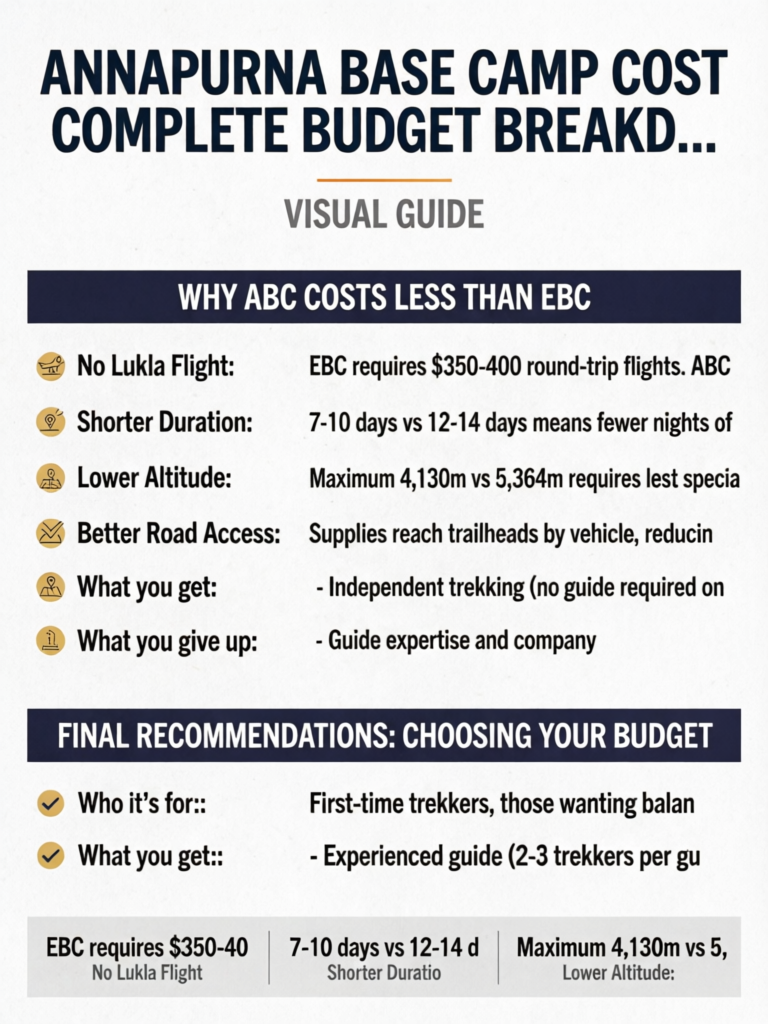
No Lukla Flight: EBC requires $215-400 round-trip flights. ABC starts with a $15-50 bus/jeep ride from Pokhara.
Shorter Duration: 7-10 days vs 12-14 days means fewer nights of accommodation and food.
Lower Altitude: Maximum 4,130m vs 5,364m requires less specialized gear and lower altitude-related risks.
Guide Not Required: Unlike EBC (where guides became mandatory in 2026), ABC allows independent trekking.
Better Road Access: Supplies reach trailheads by vehicle, reducing porter-carry costs that inflate prices at altitude.
Result: ABC costs 40-60% less than EBC while delivering equally stunning Himalayan scenery.
Understanding the Three-Tier Cost Structure
ABC costs break down into three distinct experience tiers, each offering different value propositions. Here's what separates them:
Budget Tier: $800-1,200
Who it's for: Budget-conscious travelers, students, backpackers, experienced trekkers comfortable with basic facilities.
What you get:
- Independent trekking (a licensed guide is mandatory (since April 2023) for ABC)
- Basic teahouse rooms (shared bathrooms)
- Dal bhat for 2 meals daily, simple breakfast
- Limited hot showers (2-3 total)
- Carry your own backpack
- Local bus transport Pokhara to trailhead
- Budget guesthouse in Pokhara
What you give up:
- Guide expertise and company
- Route planning assistance
- Better lodge selection
- Food variety beyond dal bhat
- Regular hot showers
- Porter service
- Agency backup support
| Trek | Duration | Max Altitude | Difficulty | Best For | Cost |
|---|---|---|---|---|---|
| Budget Independent | 7-10 days | 4,130m (ABC) | Moderate | Experienced budget travelers | $800-1,200 |
| Mid-Range Guided | 10 days | 4,130m (ABC) | Moderate | First-timers, balanced budget | $1,200-1,800 |
| Premium Package | 10-12 days | 4,130m (ABC) | Moderate | Comfort-focused travelers | $2,000-2,800 |
Mid-Range Tier: $1,200-1,800
Who it's for: First-time trekkers, those wanting balance between cost and comfort, travelers who value guide expertise.
What you get:
- Experienced guide (2-3 trekkers per guide)
- Better quality teahouses (some private bathrooms)
- Full menu choice, mix of local and western food
- Hot showers every 2-3 days
- Porter for main backpack
- Private jeep or tourist bus to trailhead
- Mid-range Pokhara hotel (2 nights)
- Emergency communication equipment
- Some itinerary flexibility
What you give up compared to premium:
- Private guide
- Best lodge rooms
- Daily hot showers
- Helicopter backup
- Pre-trek luxury hotel
- Extensive pre-departure support
Premium/Luxury Tier: $2,000-3,500+
Who it's for: First-timers prioritizing comfort, older trekkers (50+), those with limited vacation time, travelers who want everything handled.
What you get:
- Private or small group (2-3 max) guide
- Best available lodges
- Private bathrooms where available
- Full menu choice, dietary accommodations
- Daily hot showers where available
- Personal porter for all gear
- Private vehicle transfers
- International-standard agency
- Satellite phone for emergencies
- Comprehensive trip insurance assistance
- 4-star Pokhara resort
- Complete gear rental if needed
- Poon Hill sunrise extension option
The value proposition: Peace of mind, maximum comfort, expert guidance, and comprehensive backup systems.
Complete Cost Breakdown: Every Expense Explained
1. Guided Package Costs (Most Popular Option)
Most first-time trekkers book all-inclusive guided packages, which bundle most expenses. Here's what packages typically include and cost:
Budget Agency Package: $700-1,000
Included:
- Transport Pokhara-trailhead (both ways)
- ACAP and TIMS permits
- Shared guide (3-4 trekkers per guide)
- 7-9 nights teahouse accommodation
- 3 meals daily (limited menu choice)
- Shared porter for group gear
Not included:
- Travel insurance
- International flights to/from Nepal
- Nepal visa ($50)
- Kathmandu/Pokhara accommodation (pre/post trek)
- Personal gear and equipment
- Hot showers ($2-4 each)
- Battery charging ($1-3 per charge)
- WiFi ($2-4/day)
- Drinks (tea, coffee, bottled water)
- Snacks and desserts
- Tips for guide and porter ($100-150 recommended)
- Emergency evacuation costs
Budget Package Warning
Budget packages under $700 should raise red flags. These often use unlicensed guides, skip proper insurance, or add hidden costs once you're on the trail. Legitimate budget packages cost $700-1,000 minimum.
Mid-Range Agency Package: $1,100-1,600
Included (everything in budget plus):
- Better guide qualifications (English fluency, first aid certified)
- Smaller guide-to-trekker ratio (2-3:1)
- Porter for individual backpacks
- Better teahouse selection
- Some meals with menu flexibility
- 1 welcome dinner in Pokhara
- 2 nights Pokhara hotel (3-star)
- Agency support phone line
- Optional Poon Hill extension
Not included:
- Same exclusions as budget tier
- Premium lodge upgrades
- Alcohol
- Personal expenses
Premium/Luxury Package: $1,800-3,000+
Included (everything in mid-range plus):
- Private guide or very small group (max 2-3)
- Senior guide with 10+ years experience
- Personal porter for all gear
- Best available lodges
- Full menu choice, dietary accommodations
- Private vehicle transfers throughout
- 2-3 nights 4-star Pokhara resort
- Satellite phone or GPS tracker
- Comprehensive insurance assistance
- Pre-departure consultation calls
- Gear rental package option
- Poon Hill sunrise included
- Jhinu Danda hot springs visit
Luxury add-ons available ($300-1,500 extra):
- Helicopter return from ABC ($800-1,200)
- 5-star hotels in Pokhara/Kathmandu
- Extended Mardi Himal combination
- Photography/videography service
Pro Tip
Mid-range packages ($1,100-1,600) offer the best value for most first-time trekkers. You get experienced guides, proper support, and comfortable conditions without paying for amenities that don't exist at altitude anyway.
2. Independent Trekking Costs (DIY Option)
Unlike EBC, ABC allows completely independent trekking with a mandatory licensed guides or porters. This is the most budget-friendly approach.
Total Independent Cost: $600-1,000 (7-10 days)
Breakdown:
| Category | Budget Approach | Cost Range |
|---|---|---|
| Permits & Fees | Self-obtained in Pokhara | $40-60 |
| Transport | Local bus to Nayapul/Kimche | $15-30 round trip |
| Accommodation | Budget teahouses, 7-9 nights | $25-60 ($3-7/night) |
| Food | Dal bhat focus, 8-10 days | $160-250 ($20-25/day) |
| Hot Showers | 2-3 total | $6-12 |
| Charging | 4-5 charges | $8-15 |
| WiFi | Minimal or skip | $0-15 |
| Snacks/Treats | Occasional | $20-40 |
| Pokhara Expenses | Budget hotel, local food | $50-100 (2-3 days) |
| Contingency | Weather delays, extras | $50-100 |
| TOTAL | $574-882 |
Add if hiring guide independently:
- Guide ($20-30/day × 8 days): $160-240
- Guide tip: $80-120
- New total with guide: $814-1,242
How to arrange independently:
-
Get permits yourself: Visit ACAP office in Pokhara (near Tourist Bus Park) for ACAP permit ($30) and TIMS ($10-20). Takes 30-60 minutes.
-
Take local bus: Pokhara to Nayapul ($3-5) or Kimche ($5-8). Buses depart from Baglung Bus Park early morning.
-
Walk to teahouses directly: No advance bookings needed except peak October. Choose budget rooms, negotiate if multiple rooms needed.
-
Navigation: Trail is well-marked. Download Maps.me offline before starting. Follow the crowds.
Independent vs Package: The Math
Independent trekking saves $400-800 vs mid-range packages. However, you lose guide expertise, don't get pre-arranged accommodation, and handle all logistics personally. Worth it for experienced trekkers comfortable with self-navigation; consider guides for first-time Nepal visitors.
3. Transport Costs: ABC's Big Advantage
Unlike EBC's mandatory $350-400 Lukla flights, ABC starts with affordable ground transport from Pokhara.
Pokhara to Trailhead Options
Local Bus: $3-8 each way
- Pokhara to Nayapul: $3-5 (1.5 hours)
- Pokhara to Kimche: $5-8 (2 hours, skips first day of walking)
- Departs: 6:00-7:00 AM from Baglung Bus Park
- Returns: Catch return bus from Nayapul by 4:00 PM
Private Jeep: $40-80 per vehicle (one way)
- Seats 4-6 passengers
- Split cost: $10-20 per person
- Door-to-door pickup from hotel
- More comfortable, flexible timing
- Recommended for groups
Tourist Bus: $15-25 per person
- Comfortable, tourist-oriented
- Fixed schedule
- Some agencies include in package
Taxi: $50-100 per vehicle
- Most expensive option
- Fastest and most convenient
- Worth it for small groups
Total transport budget:
- Ultra-budget (local bus): $6-16 round trip
- Standard (jeep shared): $20-40 round trip
- Comfortable (private vehicle): $80-160 round trip
Comparison to EBC: ABC transport costs $6-160 vs EBC's mandatory $350-400 flights. This single difference accounts for most of ABC's cost advantage.
4. Permits and Fees: $40-60 Total
All ABC trekkers need two permits:
ACAP (Annapurna Conservation Area Permit): $30
- Where to get: ACAP office in Pokhara (near Tourist Bus Park) or Kathmandu Tourism Board
- Processing time: 15-30 minutes
- Required documents: Passport, 2 passport photos
- Validity: Single entry, entire trek duration
- Purpose: Funds conservation, trail maintenance, community projects
TIMS Card (Trekkers' Information Management System): $10-20
- Individual trekkers (no agency): $20
- Agency-organized trekkers: $10 or free (depends on agency)
- Where to get: Same offices as ACAP
- Required for: Immigration tracking, emergency contact database
Total permits cost: $40-50 typical ($30 ACAP + $10-20 TIMS)
Pro Tip
Bring four passport photos from home or Pokhara. Needed for permits. Photo booths available near permit offices ($3-5 for 8 photos) but bringing your own saves time.
5. Accommodation Costs: $3-15 Per Night
Teahouse rooms on the ABC route are among Nepal's most affordable. Lodges keep prices low to ensure trekkers eat meals there.
Altitude-Based Pricing
| Location Range | Altitude | Room Cost | Notes |
|---|---|---|---|
| Nayapul-Ghandruk | 1,000-1,940m | $3-5/night | Good facilities, competition |
| Ghandruk-Chhomrong | 1,940-2,170m | $3-6/night | Larger village, many options |
| Chhomrong-Bamboo | 2,170-2,310m | $5-7/night | Transition zone |
| Bamboo-Deurali | 2,310-3,230m | $6-10/night | Higher altitude, limited lodges |
| Deurali-ABC | 3,230-4,130m | $8-15/night | Highest, coldest, most basic |
What you get for $5-8/night (typical):
- Twin room with 2 beds
- Mattress, pillow, blankets
- Shared bathrooms (squat or western toilets)
- No heating
- No electricity outlets (pay for charging)
- No hot water (pay for shower)
Important realities:
-
Eat where you sleep: Every teahouse requires guests to order meals. Room revenue doesn't cover costs—food does.
-
Peak season (October): Room prices can jump 20-30% when lodges are full. Arrive before 2 PM.
-
Above Chhomrong: Facilities become more basic. Don't expect upgrades even at higher prices.
The Dal Bhat Strategy
Order dal bhat for lunch and dinner wherever you sleep. Lodges offer unlimited refills, making it the most economical meal. Room + 2 dal bhat meals = $18-30 total daily spend at most altitudes.
Accommodation Cost for Full Trek
Budget approach (8 nights):
- Nayapul-Chhomrong (3 nights): $12-18
- Chhomrong-Deurali (2 nights): $12-20
- Deurali-ABC-return (3 nights): $24-45
- Total: $48-83
Mid-range approach (9 nights):
- Better lodges where available: $70-120 total
Premium approach (10 nights):
- Best lodges, early booking: $100-150 total
Even premium accommodation costs less than one night in a Pokhara 4-star hotel. Accommodation is not where you'll break the budget on ABC.
6. Food and Drink Costs: $20-35 Per Day
Food costs vary based on altitude and menu choices.
Menu Pricing by Altitude
Lower sections (Nayapul-Chhomrong):
- Dal bhat: $5-7
- Fried rice/noodles: $4-6
- Eggs (2): $2-3
- Toast with jam: $1.50-2.50
- Vegetable curry: $4-6
- Momos (dumplings): $4-6
- Tea/coffee: $1-1.50
- Bottled water (1L): $1-1.50
Middle sections (Chhomrong-Deurali):
- Dal bhat: $7-9
- Fried rice/noodles: $5-7
- Eggs (2): $3-4
- Breakfast items: $3-5
- Momos: $5-7
- Tea/coffee: $1.50-2.50
- Bottled water (1L): $2-3
High sections (Deurali-ABC):
- Dal bhat: $9-12
- Fried rice/noodles: $7-10
- Eggs (2): $4-5
- Pizza: $10-14
- Chocolate bars: $2-3
- Tea/coffee: $2-3
- Bottled water (1L): $2.50-4
Why Food Costs Increase at Altitude
Every food item above Chhomrong is carried by porters. A 30kg porter load earning $20/day means each kilo of supplies costs transport money. At ABC (4,130m), items travel 2-3 days from road access.
Daily Food Budget Examples
Ultra-budget ($15-18/day):
- Breakfast: Toast and tea ($3-4)
- Lunch: Dal bhat ($6-8)
- Dinner: Dal bhat ($6-8)
- Total: $15-20
Standard budget ($22-28/day):
- Breakfast: Porridge or eggs with toast and coffee ($4-6)
- Lunch: Dal bhat ($6-9)
- Dinner: Dal bhat ($6-9)
- Snacks: 1 chocolate bar ($2-3)
- Drinks: 1L bottled water, extra tea ($3-4)
- Total: $21-31
Comfortable budget ($30-40/day):
- Breakfast: Western breakfast ($6-8)
- Lunch: Fried rice or noodles ($5-8)
- Dinner: Varied dishes ($7-10)
- Snacks: Chocolate, cookies ($4-6)
- Drinks: Multiple drinks ($4-6)
- Total: $26-38
Food Budget for Full Trek (9 days)
- Ultra-budget: $135-180 (dal bhat focus)
- Standard budget: $200-280 (dal bhat plus treats)
- Comfortable: $270-360 (menu variety)
- Premium: $400-500+ (unlimited choices)
Pro Tip
Bring high-calorie snacks from Pokhara: trail mix, energy bars, chocolate, dried fruit. Costs 1/3 of on-trail pricing. Pack 1-2kg for the trek. Saves $30-50.
7. Guide and Porter Costs (If Hiring Independently)
Unlike EBC, guides and porters are optional on ABC. Many trekkers go independently. But if you want support, here's pricing:
Licensed Guide Costs
Daily rates:
- Budget freelance guide: $25-$35 /day
- Mid-level experienced guide: $25-35/day
- Senior guide (10+ years): $35-45/day
8-day trek total:
- Budget guide: $160-200
- Mid-level guide: $200-280
- Senior guide: $280-360
What guide costs include:
- Guide's own food and accommodation
- Route planning and pacing
- Cultural and environmental information
- Basic first aid if needed
- Translation assistance
- Permit assistance
Porter Costs
Daily rates:
- Standard porter: $25-$35 /day
- Porter-guide (dual role): $25-30/day
8-day trek total:
- Standard porter: $144-176
- Porter-guide: $200-240
Porter capacity:
- Maximum 20-25kg (2 trekkers' main bags)
- You carry daypack with essentials
Sharing costs:
- One guide for 2-3 trekkers: $50-90 per person for trek
- One porter for 2 trekkers: $72-88 per person for trek
Guide + Porter Combined
If hiring both independently:
- Guide ($25/day) + Porter ($20/day) = $45/day
- 8 days = $360
- Split between 2 trekkers = $180 per person
- Add tips: $80-120
- Total per person with guide/porter: $260-300
Do You Need a Guide for ABC?
ABC's trail is well-marked and heavily trafficked. Experienced trekkers comfortable with self-navigation can go independently. First-time Nepal trekkers, solo women travelers, and those wanting cultural insights benefit from guides. Read our independent vs guided trekking guide for detailed comparison.
8. Gear and Equipment: $150-800
ABC's lower altitude (max 4,130m) requires less specialized gear than EBC.
Essential Gear Costs (If Buying New)
| Item | Budget | Mid-Range | Premium |
|---|---|---|---|
| Down jacket | $60-100 | $120-200 | $250-400 |
| Sleeping bag (-10°C rated) | $60-100 | $120-200 | $250-400 |
| Waterproof jacket | $50-80 | $100-180 | $200-350 |
| Waterproof pants | $30-50 | $60-100 | $120-200 |
| Trekking boots | $60-100 | $120-180 | $200-350 |
| Base layers (2 sets) | $30-50 | $60-100 | $120-180 |
| Fleece/midlayer | $25-40 | $50-80 | $100-150 |
| Trekking poles | $20-35 | $40-70 | $80-130 |
| Backpack (40-50L) | $40-70 | $80-130 | $150-250 |
| Headlamp | $12-20 | $25-45 | $50-80 |
| Sunglasses (UV) | $15-30 | $40-80 | $100-200 |
| Accessories | $40-60 | $60-90 | $100-150 |
| TOTAL | $442-735 | $875-1,453 | $1,728-2,840 |
ABC vs EBC gear difference: ABC needs -10°C sleeping bag vs EBC's -15°C to -20°C. Lighter insulation acceptable. Save $50-150 on sleeping bag alone.
Gear Rental in Pokhara/Kathmandu
Many shops rent trekking gear. Significant savings for one-time trekkers.
Rental rates (per item, full trek ~10 days):
- Down jacket: $15-25
- Sleeping bag: $15-25
- Waterproof jacket: $12-20
- Trekking poles: $8-12
- Backpack: $10-18
Total rental package cost: $60-100 for 5 core items
Rent if:
- First trek, unsure about future trekking
- Limited budget
- Don't want to transport gear internationally
- Traveling light
Buy if:
- Plan multiple treks
- Prefer familiar, broken-in gear
- Hygiene preference (sleeping bags especially)
Pro Tip
Buy your own boots (comfort and break-in critical), rent everything else. Boots need proper fit and break-in time. This hybrid approach costs $100-150 owned + $45-75 rental = $145-225 total.
9. Travel Insurance: $80-250 (Essential)
Travel insurance is essential even for ABC's moderate altitude.
What You Need
Mandatory coverage:
- Medical treatment in Nepal
- Medical evacuation/helicopter rescue
- Emergency repatriation
Highly recommended: 4. Trip cancellation/interruption 5. Lost/stolen baggage 6. Flight delays
Insurance Costs by Provider
Budget options ($80-120 for 2 weeks):
- World Nomads (Standard): $90-120
- Safety Wing: $80-110
- True Traveller: $85-115
Mid-range ($120-180):
- World Nomads (Explorer): $130-160
- Travel Guard: $120-150
Premium ($180-300):
- IMG Global: $180-250
- Comprehensive policies: $200-300
Insurance Details for ABC
Standard travel insurance covers ABC's altitude (4,130m) without special riders—unlike EBC which requires 6,000m coverage. Still verify your policy covers "trekking" activities and helicopter evacuation before purchasing.
10. Hidden Costs Most Guides Don't Mention
These "extras" can add $80-180 to your total trek cost.
Battery Charging: $1-3 Per Charge
Pricing by altitude:
- Lower elevations: $1-1.50 per device
- Chhomrong-Deurali: $1.50-2.50 per device
- Deurali-ABC: $2-3 per device
Trek total if charging every other day:
- Phone: 5 charges × $2 average = $10
- Camera: 5 charges × $2 = $10
- Total: $20
Money-saving: Bring 10,000-20,000 mAh power bank. Charge 2-3 times total instead of daily.
Hot Showers: $2-4 Each
Pricing:
- Lower elevations: $2-3
- Higher elevations: $3-4
Trek total:
- Daily showers: 8 nights × $3 = $24
- Every 2-3 days: 3-4 showers × $3 = $9-12
Recommendation: 3-4 showers total trek. At Chhomrong, MBC, and Chhomrong on return. Baby wipes for other days.
WiFi: $2-4 Per Day
Pricing: $2-4/day at most lodges
Quality: Slow, often unreliable, messaging works but video doesn't
Trek total:
- Daily WiFi: 8 days × $3 = $24
- Skip entirely: $0
Alternative: Nepal SIM card with data ($15-20) works until Chhomrong. Better value than lodge WiFi.
Snacks and Treats: $20-60
Typical items:
- Chocolate bars: $2-3 at altitude
- Pringles: $3-4 per can
- Cookies: $2-3 per pack
- Hot chocolate: $2-3 per cup
Strategy: Buy snacks in Pokhara before trek. 1/3 the price.
Hot Springs at Jhinu Danda: $5-10
Many ABC itineraries include Jhinu Danda hot springs on descent.
- Entry fee: $5-10 (includes basic facilities)
- Time needed: 2-3 hours
- Worth it: Yes! Perfect post-trek recovery
Nepal Visa: $50
Often forgotten in trek budgets.
Costs:
- 15 days: $30
- 30 days: $50
- 90 days: $125
For ABC: 30-day visa ($50) sufficient for most trips.
Pokhara Accommodation and Food: $25-80 Per Day
Budget:
- Guesthouse: $8-15/night
- Local food: $10-15/day
- Total: $18-30/day
Mid-range:
- 3-star hotel: $25-40/night
- Tourist restaurants: $15-25/day
- Total: $40-65/day
Typical Pokhara stay: 2-3 days (1 day before trek for permits, 1-2 days after for buffer/relaxation)
Tips for Guide and Porter: $100-180
Recommended amounts:
- Guide: $8-12 per day trekked
- Porter: $6-10 per day trekked
- 8-day trek totals:
- Guide: $64-96
- Porter: $48-80
- Both: $112-176
11. Season-Based Price Variations
Trek costs change 10-20% depending on season.
Peak Season (Oct-Nov, Mar-Apr)
What costs more:
- Teahouse rooms: +15-25% (if available)
- Guide rates: +10-15%
- Package tours: +15-20%
Total impact: $100-200 extra on $1,200 base budget
Shoulder Season (Sep, Dec, early May)
What costs less:
- Standard pricing or small discounts
- Better room availability
- Guide rates negotiable
Total savings: $50-100 vs peak season
Off-Season (Jun-Aug, Jan-Feb)
What costs less:
- Teahouse rooms: 15-25% discounts
- Guide rates: 10-15% negotiable
- Package tours: 15-25% off
Challenges:
- Monsoon (Jun-Aug): Heavy rain, leeches, clouds block views
- Winter (Jan-Feb): Cold, some high sections snow-covered, fewer lodges open
Total savings: $150-250 vs peak season, but weather compromises significant
Best Value Window
Late September or early December offer the sweet spot: shoulder season pricing, good weather (80% clear days), and moderate crowds.
Budget vs Premium: Side-by-Side Comparison
Detailed Tier Comparison Table
| Element | Budget ($800-1,200) | Mid-Range ($1,200-1,800) | Premium ($2,000-2,800) |
|---|---|---|---|
| Guide | None or shared | Shared (2-3 trekkers) | Private or pair |
| Porter | Carry own bag | Shared porter | Personal porter |
| Teahouses | Basic rooms | Better quality | Best available |
| Meals | Dal bhat focus | Full menu choice | Unlimited choice |
| Hot showers | 2-3 total | Every 2-3 days | Daily where available |
| Charging | Pay per use | Pay per use | Mostly included |
| Pokhara hotel | Budget guesthouse | 3-star, 2 nights | 4-star resort, 2-3 nights |
| Transport | Local bus | Private jeep | Private vehicle |
| Permits | Self-obtained | Agency arranged | All arranged |
| Insurance | Self-arranged | Self-arranged | Assistance provided |
| Flexibility | Your pace | Some flexibility | Fully flexible |
What You Actually Notice
Budget tier sacrifices:
- Navigate entirely on your own
- Carry 8-12kg backpack all day
- Limited food variety
- Basic facilities throughout
- No backup if problems arise
Mid-range improvements that matter:
- Guide handles logistics and translation
- Porter service preserves energy
- Better food maintains morale
- Agency backup for emergencies
Premium benefits:
- Complete attention to your needs
- Best available comfort at every stop
- Everything handled for you
- Maximum flexibility
Pro Tip
The $1,200-1,800 mid-range tier offers optimal value for first-time trekkers. You get professional support and adequate comfort without paying for amenities that barely exist at altitude anyway.
Money-Saving Strategies: 15+ Proven Methods
1. Trek Independently (Save $400-700)
ABC allows solo trekking. Navigate yourself, save guide costs.
2. Share Guide/Porter (Save $150-250)
Trek with 2-3 others, split costs 3 ways.
3. Trek in Shoulder Season (Save $100-200)
September or December: lower prices, fewer crowds, good weather.
4. Take Local Bus (Save $30-50)
$5 bus vs $40 jeep from Pokhara.
5. Rent Core Gear (Save $200-400)
Rent down jacket, sleeping bag, rain gear. Buy only boots.
6. Dal Bhat Power Hour (Save $80-120)
Dal bhat for lunch and dinner. Unlimited refills.
7. Bring Snacks from Pokhara (Save $30-50)
Pack chocolate, energy bars, trail mix. 1/3 altitude prices.
8. Skip WiFi, Use SIM Card (Save $20-30)
Nepal SIM + data ($15) beats lodge WiFi ($3/day × 8 days).
9. Limit Hot Showers (Save $15-20)
3 strategic showers instead of daily.
10. Bring Power Bank (Save $15-25)
20,000mAh eliminates most charging fees.
11. Obtain Permits Yourself (Save $10-20)
Visit ACAP office in Pokhara. Takes 30 minutes.
12. Bring Water Purification (Save $20-30)
Tablets or filter bottle instead of buying bottled.
13. Stay in Lakeside Guesthouses (Save $40-80)
Budget Pokhara accommodation vs hotels.
14. Buy Gear End-of-Season Sales (Save $100-200)
Purchase at home, plan 6-12 months ahead.
15. Group Package Discount (Save $100-200 per person)
Book as group of 4-6 for 10-15% agency discounts.
Total potential savings combining strategies: $400-800 off typical $1,400 trek.
Payment Methods and Cash Requirements
How Much Cash to Carry
Recommended cash for 10-day trek:
Budget trekker (independent): $350-450 NPR equivalent
- Covers accommodation, food, permits, extras, contingency
Mid-range trekker (package booked): $200-300
- Covers extras, snacks, drinks, tips, emergencies
Why cash matters:
- No ATMs after Chhomrong
- Credit cards not accepted on trail
- Last reliable ATM in Pokhara
Where to Get Nepali Rupees
Best exchange rates:
- ATMs in Pokhara (Lakeside area)
- Money changers in Lakeside
- Banks: Slightly worse rates
Recommended strategy:
- Withdraw 40,000-60,000 rupees ($300-450) in Pokhara before trek
- Keep in money belt
- Carry small bills (500 and 100 rupee notes)
Tipping Guidelines
Guide Tipping
Standard rates:
- Budget/shared guide: $8-$15 per day
- Private guide: $10-12 per day
- 8-day trek: $48-96 total
Porter Tipping
Standard rates:
- Standard porter: $5-8 per day
- 8-day trek: $40-64 total
Combined Total
- Guide + porter tips: $88-160 total
- Per person if sharing: $44-80
Cost Calculator: Build Your ABC Budget
Step 1: Choose Style
- Budget independent: Base $600
- Mid-range package: Base $1,100
- Premium package: Base $2,000
Step 2: Add Transport
- Local bus: +$10
- Shared jeep: +$30
- Private vehicle: +$100
Step 3: Add Permits
- Standard: +$50
Step 4: Add Pokhara (2-3 days)
- Budget: +$60
- Mid-range: +$150
- Premium: +$300
Step 5: Add Gear
- Own everything: +$0
- Rent core items: +$80
- Buy budget tier: +$450
Step 6: Add Insurance
- Budget policy: +$90
- Mid-range: +$130
Step 7: Add Personal Spending
- Minimal: +$40
- Moderate: +$100
- Unlimited: +$200
Step 8: Add Tips (if using guide/porter)
- Budget tier: +$100
- Mid-range: +$130
- Premium: +$160
Step 9: Add Contingency
- Weather delays, emergencies: +$80-150
Example Total Budgets
Example 1: Ultra-Budget Independent
- Base independent: $600
- Transport (bus): $10
- Permits: $50
- Pokhara (budget): $60
- Gear (rent): $80
- Insurance: $90
- Extras (minimal): $40
- Contingency: $80
- TOTAL: $1,010
Example 2: First-Timer Mid-Range
- Base package: $1,100
- Transport (included)
- Permits (included)
- Pokhara: $150
- Gear (rent core): $80
- Insurance: $130
- Extras (moderate): $100
- Tips: $130
- Contingency: $120
- TOTAL: $1,810
Example 3: Premium Comfort
- Base package: $2,000
- Transport (included)
- Permits (included)
- Pokhara (premium): $300
- Gear (own or included): $0
- Insurance: $150
- Extras (unlimited): $200
- Tips: $160
- Contingency: $150
- TOTAL: $2,960
Frequently Asked Questions
General Cost Questions
1. How much does ABC trek cost in total? $800-3,500+ depending on style. Most first-timers spend $1,200-1,800 for mid-range packages.
2. Why is ABC cheaper than EBC? No mandatory Lukla flight ($215-400 savings), shorter duration, lower altitude requiring less gear, and mandatory guides.
3. Can I do ABC for under $800? Possible for experienced independent trekkers with own gear: permits ($50), transport ($10), 8 days food/accommodation ($400-500), extras ($100) = $560-660. Add contingency for $700-800 minimum.
4. Is ABC worth the cost? Absolutely. ABC offers world-class Himalayan scenery—Annapurna I, Machapuchare, and the Annapurna Sanctuary amphitheater—for one of Nepal's lowest costs. Exceptional value.
Package vs Independent
5. Do I need a guide for ABC? Not legally required. Trail is well-marked and heavily trafficked. Experienced trekkers navigate independently. First-timers benefit from guide expertise.
6. What's included in typical ABC packages? Transport, permits, guide, accommodation, meals. Excludes: insurance, gear, personal expenses, tips, hot showers, WiFi, charging.
7. Can I book packages in Pokhara? Yes, Lakeside has 30+ agencies. Peak season may have limited availability. Better to book 2-4 weeks ahead.
Food and Accommodation
8. How much for food per day? $15-20 (ultra-budget dal bhat), $22-28 (standard), $30-40 (comfortable variety).
9. Do I need to book teahouses in advance? Only necessary peak October. Otherwise walk in and choose rooms.
10. Are hot showers worth paying for? 2-3 strategic showers worth it for morale. Daily showers unnecessary and expensive.
Guide and Porter
11. How much do guides cost? $25-$35 /day plus their food/accommodation (included in rate). 8 days = $160-240 plus $64-96 tip.
12. Should I hire a porter? Helpful but not essential on ABC (lower altitude than EBC). Consider if you prefer lighter pack or have knee issues.
13. Can I share a guide? Yes. Find trek partners in Pokhara or online forums. Split costs 2-3 ways.
Gear
14. What gear is essential for ABC? Down jacket (-10°C rated), sleeping bag (-10°C), waterproof layers, broken-in boots, headlamp, sunglasses.
15. Can I rent gear in Pokhara? Yes, many shops in Lakeside. $60-100 for full rental package.
Related Guides and Resources
- ABC 10-Day Itinerary: The Recommended Route
- Best Time for ABC Trek
- Budget Trekking Nepal: Complete Guide
- Independent vs Guided Trekking in Nepal
- Hiring Guides and Porters in Nepal
- Travel Insurance for Nepal Trekking
- How to Choose a Trekking Agency
- EBC vs ABC Comparison
- Tea House Trekking Explained
- Dal Bhat Trekking Guide
- Annapurna Base Camp Trek Route Overview
- Annapurna Region Complete Guide
- Best ABC Trekking Agencies
- Poon Hill Trek Guide
Final Recommendations: Choosing Your Budget
If You Have $800-1,200 (Budget Tier)
Your approach:
- Trek independently (no guide)
- Carry own backpack
- Local bus transport
- Dal bhat focus for meals
- Basic teahouses
- Skip most extras
- Shoulder season
Best for: Experienced trekkers, students, backpackers, flexible schedules.
If You Have $1,200-1,800 (Mid-Range Tier) - RECOMMENDED
Your approach:
- Book reputable mid-range agency
- Guide and porter service
- Private jeep transport
- Menu flexibility
- Better teahouses
- Some hot showers and treats
Best for: First-time Nepal trekkers, balanced budgets, those wanting professional support.
If You Have $2,000-3,500+ (Premium Tier)
Your approach:
- Premium agency with private guide
- Best lodges throughout
- All services included
- Poon Hill extension
- Hot springs visit
- Full flexibility
Best for: Comfort-focused travelers, limited vacation time, those who want everything handled.
Ready to Trek to Annapurna Base Camp?
Compare verified trekking agencies, read authentic reviews, and book your ABC adventure with confidence. Get instant quotes from budget, mid-range, and premium operators.
Final thoughts: ABC is Nepal's best-value classic trek. Without the expensive Lukla flight and at lower altitude, you can experience world-class Himalayan scenery for $215-1,800 in most cases. The memories of sunrise at ABC, surrounded by 8,000m peaks, staying in cozy teahouses, and walking through rhododendron forests—these are worth every rupee invested.
Budget consciously, spend wisely, and trek safely. The Annapurna Sanctuary awaits.