
"Dal bhat power, 24 hour!" If you've researched Nepal trekking or spoken to anyone who's completed a Himalayan trek, you've heard this phrase. It's printed on t-shirts in Kathmandu, shouted jovially in tea house dining rooms, and becomes the daily refrain of trekkers who discover Nepal's ultimate superfood: dal bhat.
This unassuming plate of rice and lentils is far more than a meal—it's the fuel that powers millions of Nepalis through agricultural labor, carries trekkers to Everest Base Camp, and provides complete nutrition at altitudes where Western food becomes scarce. While tourists often start their trek sampling pizza, pasta, and fried rice, virtually all eventually convert to the dal bhat religion—and for compelling reasons that go far beyond cost.
This comprehensive guide reveals everything about dal bhat: what it contains, why it's nutritionally perfect for trekking, how the unlimited refills system works, regional variations across Nepal's trekking regions, costs from low to high altitude, cultural etiquette, and the practical wisdom that makes this humble meal the smartest choice on the trail.
Whether you're planning your first trek and wondering what to eat, curious about Nepali food culture, or want to understand why experienced trekkers swear by this dish, this guide provides the complete picture of Nepal's trekking superfood.
What Is Dal Bhat? Components Explained
Dal bhat is deceptively simple yet nutritionally brilliant. The name literally translates to "lentils and rice," but the complete meal is a carefully balanced combination of complementary foods that together create complete nutrition.
The Core Components
Lentil soup (protein)
Steamed rice (carbs)
Vegetable curry
Pickle/chutney
$5-10 unlimited
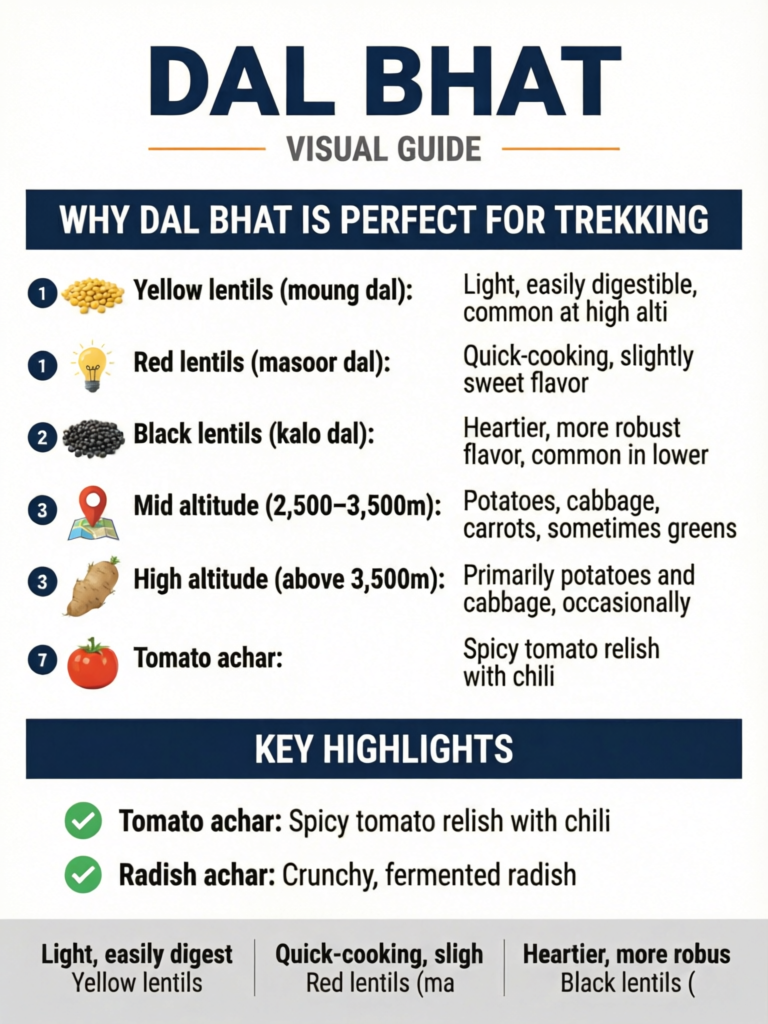
Dal (Lentil Soup): The dal is a soupy lentil curry that forms the protein foundation of the meal. Different lentils create different flavors and textures:
- Yellow lentils (moong dal): Light, easily digestible, common at high altitude
- Red lentils (masoor dal): Quick-cooking, slightly sweet flavor
- Black lentils (kalo dal): Heartier, more robust flavor, common in lower regions
- Mixed lentils: Best flavor and nutrition, common in well-stocked tea houses
The dal is seasoned with turmeric (antibacterial properties), cumin, garlic, ginger, onions, and sometimes tomatoes. It's cooked to a soup-like consistency specifically so it can be mixed with rice. The warm, spiced soup helps with digestion at altitude and provides hydration along with nutrition.
Bhat (Steamed Rice): The bhat is simple white rice, steamed or boiled until fluffy. This provides the carbohydrate energy base that fuels your trekking. At lower altitudes, you might get basmati or jasmine rice. Higher up, you'll typically get standard white rice that's still excellent quality.
The rice isn't just filler—it's your primary energy source. On a full trekking day burning 3,000-5,000 calories, you need serious carbohydrate intake. The beauty of dal bhat is the rice is unlimited, so you can fuel appropriately for your exertion level.
Tarkari (Vegetable Curry): The tarkari is a mildly spiced vegetable curry that varies by season and altitude:
- Low altitude (below 2,500m): Fresh vegetables like cauliflower, potatoes, beans, carrots, spinach, pumpkin
- Mid altitude (2,500-3,500m): Potatoes, cabbage, carrots, sometimes greens
- High altitude (above 3,500m): Primarily potatoes and cabbage, occasionally carrots
The vegetables provide fiber, vitamins, minerals, and additional complex carbohydrates. Even at high altitude where fresh produce is limited, the tarkari ensures you're getting more than just rice and lentils.
Achar (Pickle/Chutney): The achar is often the most flavorful component—a spicy, tangy pickle or chutney that adds intense flavor:
- Tomato achar: Spicy tomato relish with chili
- Radish achar: Crunchy, fermented radish
- Gundruk: Fermented leafy green pickle (traditional Nepali)
- Sesame seed chutney: Nutty, protein-rich
- Mango pickle: Sweet and spicy (lower altitudes)
The achar serves multiple purposes: intense flavor makes plain rice exciting, the spices stimulate appetite at altitude, and fermented varieties provide probiotics for digestive health.
Optional Additions:
Beyond the core components, dal bhat often includes:
- Papad (papadum): Crispy lentil flatbread, adds crunch and protein
- Curd/yogurt: Cooling, probiotic, aids digestion
- Meat curry: Chicken, buffalo, or goat (costs extra $2-4)
- Egg: Fried or boiled egg (extra $1-2)
- Extra vegetables: Seasonal additions
- Saag: Sautéed spinach or other greens
The complete dal bhat plate is visually distinctive: a mound of rice in the center, dal poured over or beside it, tarkari in one section, achar in small portions, and optional additions around the edges. It's typically served on a round stainless steel plate (thali) with a stainless steel cup for the dal.
Why Dal Bhat Is Perfect for Trekking
Experienced trekkers don't eat dal bhat daily just because it's available—they eat it because it's nutritionally and practically superior to alternatives for sustained mountain performance.
Complete Protein from Rice + Lentils
The combination of rice and lentils creates a complete protein profile with all essential amino acids. Neither rice nor lentils alone contains complete protein, but combined they complement each other perfectly:
- Lentils: High in lysine, low in methionine
- Rice: Low in lysine, high in methionine
- Combined: Complete amino acid profile
This matters during multi-day treks when your body is breaking down and rebuilding muscle tissue daily. Unlike Western meals that often rely on meat for protein, dal bhat provides complete protein in a plant-based, easily digestible form that works at altitude where heavy foods often cause discomfort.
The Unlimited Refills Strategy
The unlimited refills system transforms dal bhat from a meal into a fueling strategy:
Pro Tip
Refills Strategy for Different Trek Days:
- Light day (3-4 hours): 1.5 plates (initial serving + half refill)
- Standard day (5-6 hours): 2-2.5 plates (initial + 1-1.5 refills)
- Hard day (7+ hours): 3+ plates (as much as needed)
- Rest day: 1 plate (lighter appetite)
When you order dal bhat, the initial plate costs $5-10 depending on altitude, but refills of rice, dal, tarkari, and often achar are unlimited at no extra cost. This means:
- Pre-trek breakfast: Load up before a big climb
- Post-trek dinner: Refuel completely after burning 3,000+ calories
- No arbitrary portion limits: Your appetite determines intake, not the menu price
Seasoned trekkers measure exertion by dal bhat servings: "Today was a three dal bhat day" means a seriously demanding climb. This flexible fueling matches energy expenditure in a way fixed-portion Western meals cannot.
Consistent Everywhere
Every tea house on every major trekking route serves dal bhat. While Western food availability varies by altitude and region, dal bhat is guaranteed from Lukla to Gorak Shep, from Besisahar to Thorong La, from Syabrubesi to Kyanjin Gompa.
This consistency provides:
- Meal planning simplicity: Never wonder if food will be available
- Familiar nutrition: Your body adapts to consistent fuel
- No menu anxiety: At altitude when appetite is low, simple familiar options help
- Cultural immersion: Eating what locals eat connects you to place
Affordable at Every Altitude
$2-4
$4-6
$6-8
$8-12
$10-15
Dal bhat remains the most economical meal at every altitude. Compare to alternatives:
- Dal bhat: $8 with unlimited refills at 4,000m
- Fried rice: $10 for single portion
- Pasta: $12-15 for single portion
- Pizza: $15-20 for single portion
- Meat dishes: $12-18 for single portion
When you're trekking 12-15 days and eating 2-3 meals daily, choosing dal bhat over Western food can save $200-300 on the trek—the difference between budget and mid-range trekking.
Easily Digestible
At altitude, digestion becomes sluggish as your body redirects resources to handling low oxygen. Heavy, fatty, dairy-heavy Western foods often cause discomfort. Dal bhat is:
- Light on digestion: Simple ingredients, minimal fats
- Warm and comforting: Soup-like dal aids digestion
- Spiced for digestion: Turmeric, cumin, ginger all support digestive function
- High-fiber: Keeps systems moving despite reduced activity
Trekkers who eat pizza and pasta for the first few days often report bloating, slow digestion, and feeling heavy. Those who eat dal bhat report feeling light, energized, and comfortable—crucial when you're climbing 800 vertical meters the next morning.
Optimal Carb-Loading for Energy
Trekking is primarily aerobic exercise sustained for hours. Your body preferentially burns carbohydrates for this type of activity. Dal bhat provides:
- Complex carbs from rice: Sustained energy release
- Additional carbs from vegetables: Fiber-rich energy
- Moderate protein from lentils: Muscle repair without excess
- Minimal fat: Won't slow digestion or feel heavy
A typical dal bhat serving with one refill provides 1,000-1,500 calories, 70-80% from carbohydrates—exactly the macronutrient profile ideal for endurance activity. Compare this to pasta with cheese sauce (high fat), pizza (high fat, heavy), or meat dishes (high protein/fat, low carb), and dal bhat's superiority for mountain performance becomes clear.
Food Safety Reliability
Dal bhat is freshly cooked, served hot, and uses simple ingredients with minimal contamination risk:
- Cooked to order: Rice and lentils boiled, killing bacteria
- Served hot: Temperature kills pathogens
- Minimal handling: Simple preparation reduces contamination points
- No raw components: Unlike salads which may have water contamination
Food safety is crucial when you're days from evacuation. Dal bhat's simplicity and freshness make it the safest choice at altitude.
The Unlimited Refills System: How It Works
The unlimited refills system is central to dal bhat's value but confuses first-time trekkers. Understanding the cultural and practical aspects ensures you fuel properly.
How the System Works
When you order dal bhat, you pay a set price for the complete meal. This includes:
- Initial serving: Full plate with all components
- Unlimited refills of: Rice (bhat), dal, tarkari, usually achar
- Single serving of: Papad, curd, special items
What you do:
- Finish your initial plate
- Hold up your plate or gesture to the tea house staff
- They'll bring more rice, ladle more dal, add more tarkari
- Repeat as many times as needed
- No additional charge
What's NOT unlimited:
- Meat curry (if ordered separately)
- Eggs (if ordered separately)
- Extra special items like cheese
- Beverages
- Desserts
The refill process is informal and friendly. You don't need to ask permission or apologize—taking multiple refills is expected and encouraged. Tea house owners know trekkers burn serious calories; they want you to eat enough.
Cultural Significance
The unlimited serving tradition has deep roots in Nepali culture:
Hospitality tradition: In Nepali culture, ensuring guests are fully fed is a core hospitality value. Running out of food or leaving guests hungry brings shame to the host. The unlimited system extends this cultural value to commercial tea houses.
Communal dining: Dal bhat is traditionally eaten communally, with shared serving bowls from which people refill. Tea house dining maintains this communal spirit—you eat alongside other trekkers, guides, porters, and sometimes lodge owners, all refilling from the same pots.
Local eating patterns: Nepalis traditionally eat two large dal bhat meals daily (mid-morning and evening), with these meals providing the entire day's energy. The portion size seems large to Western eyes, but it's normal for people doing physical labor who won't eat again for 6-8 hours.
Practical economics: For tea house owners, rice and lentils are the cheapest foods to provide. Offering unlimited refills of these staples costs little while allowing them to charge more than they could for a single small portion. Everyone benefits.
Cost Implications
Understanding the economics helps you appreciate the value:
$2-3
1.5 servings
$3-5
$5-10
$2-5
At low altitude (below 2,500m):
- Rice costs $0.50-1/kg
- Lentils cost $1-2/kg
- Vegetables cost $0.50-1/kg
- Total food cost for generous serving: $1-2
- Price charged: $4-6
- Margin: $2-4
At high altitude (above 4,000m):
- All food is porter-carried or helicopter-delivered
- Rice costs $3-5/kg delivered
- Lentils cost $4-6/kg delivered
- Vegetables cost $2-4/kg delivered
- Total food cost for generous serving: $4-6
- Price charged: $10-15
- Margin: $5-9
Even at high altitude, the unlimited refills system works because most trekkers take 1-2 refills maximum due to reduced appetite. A few trekkers taking 3-4 refills is balanced by others taking none. The lodge's average cost remains manageable.
When and How to Ask for More
Timing your refills:
- Too early: Asking for a refill before finishing your first serving looks odd
- Appropriate: When you've finished the rice, most of the dal, and most vegetables
- Acceptable: Even if you've left some dal/vegetables but need more rice
Non-verbal signals:
- Hold up your empty plate
- Make eye contact with staff
- Point to your plate
- Slightly raise the plate toward the kitchen
Verbal requests:
- "Excuse me, may I have more rice?" (English)
- "Bhat pugyo?" (Nepali: "Is rice available?")
- Simply "More, please?"
How much to take:
Pro Tip
Start with moderate first refill. It's easy to get a second refill if still hungry. Taking huge portions and not finishing wastes food and creates kitchen burden at altitude where washing dishes requires heating water carried from streams.
Refill etiquette:
- Don't be shy—refills are expected
- Take reasonable portions
- Finish what you take
- You can request specific items: "Just rice, please" or "More dal, please"
- Thank the staff when they bring refills
For guides/porters: If trekking with a guide or porter, they eat the same meal. Some lodges serve staff in a separate area; others have everyone eat together. Guides/porters are equally entitled to refills—don't feel awkward if they take multiple servings.
Dal Bhat at Different Altitudes
Dal bhat's components, quality, and taste change as you climb. Understanding these variations helps set expectations and explains price increases.
Low Altitude (Below 2,500m): Maximum Variety
Locations: Lukla (2,860m), Phakding (2,610m), Monjo (2,835m), Besisahar (760m), Syabrubesi (1,460m), Pokhara (820m), Kathmandu (1,400m)
Dal bhat characteristics:
- Fresh vegetables: Cauliflower, green beans, fresh spinach, tomatoes, pumpkin, eggplant
- Meat options widely available: Fresh chicken, buffalo, goat
- Varied lentils: Mixed lentils, black dal, red dal combinations
- Multiple achar varieties: Fresh chutneys, multiple pickle options
- Best quality rice: Often basmati or jasmine
- Additional items common: Fresh curd, multiple papad varieties, fresh lime
Taste profile: Rich, complex, fresh flavors. This is dal bhat at its best—what Nepalis eat daily in villages and cities. The vegetables are crisp, the achar is vibrant, and you can taste the freshness of all ingredients.
Cost: $4-6 in tea houses, $2-4 in local restaurants
Why it's best here: Roadhead access means daily delivery of fresh produce. Lodges have refrigeration or at minimum cool storage. There's no supply constraint, so cooks can be creative with vegetables and seasonings.
Mid Altitude (2,500-3,500m): Standard Quality
Locations: Namche Bazaar (3,440m), Tengboche (3,860m - upper range), Dingboche (4,410m - transition), Manang (3,519m), Langtang village (3,430m)
Dal bhat characteristics:
- Standard vegetables: Potatoes, cabbage, carrots dominate; occasional cauliflower or beans
- Fewer meat options: Usually chicken or buffalo; may be frozen
- Standard lentils: Yellow or red dal, occasionally mixed
- Fewer achar varieties: 1-2 types, usually tomato and one other
- Good quality rice: Standard white rice, occasionally aged
- Basic additions: Papad, sometimes curd
Taste profile: Still delicious but more straightforward. Vegetables are simpler, achar less complex. The fundamental dal bhat experience remains excellent—you're still getting complete nutrition and full refills.
Cost: $6-8
Why it differs: These areas receive porter-carried or occasional helicopter supplies. Fresh produce availability decreases, so lodges rely on vegetables that store well (potatoes, cabbage, carrots). Quality remains high but variety decreases.
High Altitude (3,500-5,000m): Simplified but Good
Locations: Lobuche (4,940m), Gorak Shep (5,164m), Thorong Phedi (4,450m), Kyanjin Gompa (3,870m), Gokyo (4,790m)
Dal bhat characteristics:
- Potato-heavy tarkari: Potatoes are 70-80% of vegetables; small amount of cabbage or carrots
- Limited meat: Often unavailable or very expensive
- Simple dal: Yellow lentil dal, thinner consistency
- Basic achar: Often just tomato achar, sometimes none
- Standard rice: May be slightly undercooked due to altitude boiling point issues
- Minimal additions: Papad sometimes unavailable
Taste profile: Simpler, more austere. The dal may taste blander, vegetables are mostly potatoes, rice may be slightly hard. But it's still hot, filling, and provides needed calories. At this altitude, your appetite is reduced anyway.
Cost: $8-12, sometimes $15 at highest points
Why it's different: Everything is porter-carried, often for days. Fresh produce is nearly impossible. Water boils at lower temperatures (84-86°C vs 100°C at sea level), making cooking more difficult. Fuel costs are extreme, so lodges minimize cooking time.
The reality: At high altitude, you're not eating dal bhat for gourmet experience—you're eating it for reliable fuel. Even simplified dal bhat is superior to most alternatives here, which face the same supply and cooking challenges.
Taste Changes as You Climb
Objective changes:
- Vegetables become less varied (unavoidable supply issue)
- Rice may be harder (water boiling point issue)
- Dal may be thinner (water content, fuel conservation)
- Achar becomes less complex (fewer ingredients available)
- Portions may be slightly smaller (though still refillable)
Subjective changes:
- Your taste perception decreases at altitude (physiological response to hypoxia)
- Appetite suppression makes everything less appealing (normal altitude response)
- Fatigue affects enjoyment of food
- Cold temperatures make hot food more valued regardless of complexity
The surprising constant: Despite these changes, dal bhat remains remarkably consistent compared to Western food. A pizza at 5,000m is dramatically inferior to a pizza at 2,000m. Dal bhat at 5,000m is simpler than at 2,000m but still fundamentally the same meal, still hot and fresh, still providing complete nutrition.
Pro Tip
Many trekkers report craving dal bhat by the time they reach high altitude. While it seemed boring at low altitude when options abounded, at 4,500m when you're cold, tired, and suffering appetite loss, a plate of hot dal bhat with unlimited refills becomes profoundly satisfying.
Nutritional Breakdown: Why Trekkers Need This
Understanding dal bhat's nutritional profile reveals why it outperforms Western food for sustained mountain activity.
Calorie Content
600-800 calories
1,000-1,400 calories
1,400-2,000 calories
+200-300 calories
3,000-5,000 calories
Breaking down a standard serving:
- Rice (300g): ~400 calories
- Dal (200ml): ~180 calories
- Tarkari (100g): ~60-80 calories
- Achar (30g): ~20-30 calories
- Papad (1 piece): ~30 calories
- Total: ~690-720 calories
This is your initial serving. With one refill of similar size, you're at 1,200-1,400 calories from a single meal.
Daily calorie math:
- Breakfast dal bhat: 1,000 calories
- Lunch (snacks, tea, biscuits): 500 calories
- Dinner dal bhat with 2 refills: 1,800 calories
- Total: 3,300 calories
This covers a standard trekking day. On harder days, you add more refills at breakfast/dinner, plus more lunch calories.
Macronutrient Profile
Typical dal bhat macros (single serving):
- Carbohydrates: 120-140g (65-70% of calories)
- Protein: 20-25g (12-15% of calories)
- Fat: 8-12g (10-15% of calories)
- Fiber: 10-15g
Why this profile is ideal for trekking:
High carbohydrate: Trekking is sustained aerobic activity. Your body preferentially burns carbohydrates for this type of exercise. The high carb content provides:
- Immediate energy from simple carbs in rice
- Sustained energy from complex carbs in lentils and vegetables
- Glycogen replenishment for next day's trekking
- Brain fuel (brain runs primarily on glucose)
Moderate protein: The 20-25g of protein per serving is sufficient for muscle repair without excess. At altitude, protein digestion is harder, so moderate amounts are ideal. The complete protein from rice+lentils means all essential amino acids are present.
Low fat: Fat digestion is slowest and most difficult at altitude. The low fat content means:
- Faster digestion
- Less feeling of heaviness
- More calories available from digestible carbs
- Reduced nausea risk
Compare to typical Western trekking meals:
Spaghetti with meat sauce:
- Carbs: 60-65%
- Protein: 20%
- Fat: 15-20%
- Higher fat, slower digestion
Pizza:
- Carbs: 45-50%
- Protein: 15%
- Fat: 35-40%
- Very high fat, heavy, slow digestion
Fried rice:
- Carbs: 55-60%
- Protein: 10-12%
- Fat: 25-30%
- High fat from frying oil
Dal bhat's macronutrient profile is objectively superior for mountain performance.
Micronutrients and Complete Nutrition
Beyond macros, dal bhat provides comprehensive micronutrition:
From lentils:
- Iron: Essential for oxygen transport (critical at altitude)
- Folate (B9): Red blood cell production
- Thiamine (B1): Energy metabolism
- Potassium: Electrolyte balance, muscle function
- Magnesium: Muscle function, energy production
- Zinc: Immune function
From rice:
- Manganese: Metabolism, bone health
- Selenium: Antioxidant
- B vitamins: Energy metabolism
- Niacin (B3): Energy production
From vegetables:
- Vitamin A: From carrots, greens (immune function, eye health)
- Vitamin C: From cabbage, occasional tomatoes (immune function, collagen)
- Vitamin K: From greens (blood clotting, bone health)
- Additional fiber: Digestive health
- Various minerals: Potassium, calcium, phosphorus
From achar/spices:
- Turmeric (curcumin): Anti-inflammatory, digestive aid
- Ginger: Anti-nausea, digestive aid, circulation
- Garlic: Antibacterial, immune support
- Cumin: Digestive aid, iron content
This micronutrient density matters over multi-week treks. A diet of pasta, pizza, and fried rice provides calories but limited micronutrition. Dal bhat provides comprehensive nutrition daily.
Why This Matters at Altitude
Altitude stresses:
- Increased red blood cell production (needs iron, B vitamins, folate)
- Increased oxidative stress (needs antioxidants)
- Dehydration tendency (needs electrolytes)
- Immune system challenge (needs vitamins A, C, zinc)
- Digestive sluggishness (needs fiber, digestive aids)
Dal bhat addresses all these stresses. The complete nutrition supports your body's altitude adaptation while providing sustained energy for daily climbing.
Comparison to Western food at altitude:
A trekker eating primarily Western food typically gets:
- Adequate calories
- Adequate protein
- Excess fat (harder to digest)
- Limited fiber (constipation risk)
- Minimal micronutrients beyond fortified flour
- No digestive support from spices
A trekker eating primarily dal bhat gets:
- Adequate calories
- Complete protein
- Moderate fat (easy digestion)
- High fiber (digestive regularity)
- Comprehensive micronutrients
- Digestive support from traditional spices
The difference becomes apparent over 10-15 days. Western food eaters often report: feeling heavy, digestive issues, lower energy, taking longer to recover each evening. Dal bhat eaters report: feeling light, steady energy, good digestion, faster recovery.
Dal Bhat vs Western Food on Trek
The choice between dal bhat and Western food isn't just preference—it's a decision that impacts your budget, energy, and trekking experience.
Cost Comparison
$6-8 unlimited
$9-12 fixed
$12-15 fixed
$15-20 fixed
$6-12
Daily cost comparison (3 meals):
All dal bhat:
- Breakfast dal bhat: $7
- Lunch (snacks/tea): $5
- Dinner dal bhat: $7
- Total: $19/day
Mixed (typical beginner pattern):
- Breakfast (pancakes, eggs, toast): $10
- Lunch (fried rice): $11
- Dinner (pasta): $14
- Total: $35/day
All Western:
- Breakfast (pancakes, eggs, bacon, coffee): $12
- Lunch (pizza): $18
- Dinner (meat pasta with cheese): $18
- Total: $48/day
Over 12-day trek:
- All dal bhat: $228
- Mixed approach: $420
- All Western: $576
- Savings (dal bhat vs mixed): $192
- Savings (dal bhat vs Western): $348
This $192-348 saved on food alone represents:
- Entire Everest Base Camp permit cost
- Round-trip Kathmandu-Pokhara flight
- 4-5 nights Kathmandu hotel
- Significant portion of total trek budget
For budget trekkers targeting $105+ for foreigners /day, choosing Western food makes the budget impossible. Even mid-range trekkers benefit from dal bhat savings.
Energy and Performance Comparison
Dal bhat advantages:
- Sustained energy release: Complex carbs from rice and lentils provide 3-4 hours sustained energy vs 1-2 hours from simple carb Western foods
- No energy crashes: Balanced macros prevent blood sugar spikes and crashes
- Digestible at altitude: Light, low-fat meal digests easily even at 4,000m+
- Volume control: Unlimited refills let you match intake to exertion
- Consistent fuel: Your body adapts to regular dal bhat, optimizing energy use
Western food disadvantages:
- Heavy digestion: High-fat pasta, pizza, fried rice sit heavy at altitude
- Fixed portions: Can't adjust intake to exertion level
- Blood sugar volatility: Simple carbs (white bread, pasta sauce sugars) cause crashes
- Appetite suppression: Heavy foods suppress appetite, leading to under-fueling
- Reduced performance: Many trekkers report sluggishness after heavy Western meals
Real trekker patterns:
Days 1-3: Excitement about menu variety, ordering pizza, pasta, burgers Days 4-6: Starting to feel heavy, digestive discomfort, switching to lighter options Days 7-8: Converting to primarily dal bhat Days 9+: Dal bhat for most meals, occasional Western food as treat
The pattern is remarkably consistent. Experienced trekkers start on dal bhat immediately, knowing it performs better.
Availability Comparison
Dal bhat: Available everywhere, every tea house, every altitude, every region, always fresh Fried rice: Available most places, quality varies significantly Noodle soup: Available most places, relatively consistent Pasta: Available mid-altitude and below, quality poor at high altitude Pizza: Available low-mid altitude only, quality poor above 3,500m Burgers: Available low altitude only, usually poor quality Steaks/Western meat: Rare, expensive, quality questionable
At high altitude (4,500m+), the menu might list 20 Western options, but:
- They're made from limited ingredients
- Quality is poor due to supply constraints
- Cooking is difficult (low boiling point)
- Prices are extreme ($15-25)
- Portions are small to manage costs
Meanwhile, dal bhat remains consistent, hot, fresh, and refillable for $10-12.
Fuel Efficiency for Lodges
Understanding lodge economics reveals another dal bhat advantage:
Dal bhat cooking:
- Single large pot of rice (serves 10-20 people)
- Single large pot of dal (serves 10-20 people)
- Single pot of tarkari (serves 10-20 people)
- Minimal fuel use, cooked once for all guests
Western food cooking:
- Individual orders requiring separate preparation
- Each pasta dish requires boiling water
- Each fried rice requires wok time
- Each pizza requires oven heating
- Much higher fuel consumption
At altitude, fuel (kerosene, gas) is expensive—carried by porter or helicopter like all supplies. Lodges save significant fuel costs when guests eat dal bhat. This is why many lodges offer "free" accommodation if you eat dal bhat dinner and breakfast—the accommodation cost is offset by fuel savings and bulk rice/lentil economics.
Some lodges explicitly charge more for rooms if you order Western food because they're losing money on fuel and time. Understanding this dynamic makes dal bhat not just a smart choice for you but also supportive of the lodge's economics in harsh mountain conditions.
The Verdict
Dal bhat wins on:
- Cost (dramatically cheaper)
- Energy performance (sustained, clean energy)
- Digestibility (light, fast digestion)
- Availability (consistent everywhere)
- Nutritional completeness (comprehensive nutrition)
- Cultural experience (eating local food)
- Sustainability (lower fuel use, less waste)
Western food wins on:
- Variety (if you tire of dal bhat)
- Comfort food psychology (familiar tastes)
- Specific cravings (occasionally you just want pizza)
For 80-90% of meals, dal bhat is objectively superior. Save Western food for occasional treats or when you genuinely need psychological variety—but make dal bhat your foundation.
Regional Variations: How Dal Bhat Differs Across Nepal
While dal bhat is consistent in concept, regional variations reflect local culture, agricultural patterns, and ethnic cooking traditions.
Everest Region (Khumbu)
Ethnic influence: Sherpa culture, Tibetan Buddhist traditions
Dal bhat characteristics:
- Hearty preparations: Sherpas work at high altitude; portions are generous
- Potato-heavy tarkari: Khumbu grows excellent potatoes; they dominate vegetable curries
- Gundruk common: Fermented leafy green pickle is traditional Sherpa preservation method
- Yak butter tea pairing: Often served alongside for additional calories
- Tibetan influences: Sometimes includes momo or Tibetan bread as sides
- Thukpa variation: In some lodges, Sherpa-style noodle soup competes with dal bhat
Taste profile: Robust, filling, less spicy than lower regions. The dal is often milder to accommodate Western trekkers but authentic Sherpa dal bhat has more ginger and garlic.
Cultural note: Sherpa communities traditionally ate less rice (expensive to transport) and more wheat, barley, and potatoes. Dal bhat in the Khumbu is partially adapted to trekker demand but reflects Sherpa hospitality and generous portions.
Annapurna Region
Ethnic influence: Gurung culture, Thakali cuisine, ethnic diversity
Dal bhat characteristics:
- Thakali influences: The Thakali people are renowned cooks; expect excellent dal bhat
- Varied vegetables: Annapurna region produces diverse vegetables; tarkari is more complex
- Buckwheat alternatives: Some lodges offer buckwheat (fapar) in place of rice
- Mustard greens: Saag (sautéed mustard or spinach greens) is more common here
- Local pickles: Bamboo shoot pickle, radish pickle, creative achar variations
- Organic ingredients: Many Annapurna villages practice organic farming
Taste profile: Often considered the best dal bhat in Nepal. Thakali cooking has specific techniques—dal is carefully spiced, rice is perfectly fluffy, vegetables are fresh and flavorful.
Cultural note: Thakali people historically controlled the salt trade route between Tibet and lowland Nepal. Their cuisine developed as sophisticated hospitality for traders. Modern Thakali-run lodges maintain this culinary tradition.
Gurung vs Sherpa Preparations
Gurung preparation (Annapurna):
- More vegetables in tarkari (Gurung are agricultural people)
- More varied lentils (easier lowland access)
- Spicier achar (chili tolerance)
- Fresh herbs common (cilantro, fenugreek)
- Fermented bamboo shoot pickle specialty
Sherpa preparation (Everest):
- Potato-dominant tarkari (high altitude agriculture)
- Simpler lentil preparations (supply constraints)
- Gundruk pickle specialty
- Less fresh herbs (altitude limitations)
- Butter/ghee more common (Tibetan influence)
Both are excellent, just different. Gurung preparation tends toward variety and complexity; Sherpa preparation toward heartiness and high-calorie density.
Langtang Region
Ethnic influence: Tamang culture, Tibetan influences
Dal bhat characteristics:
- Similar to Khumbu: Tamang and Sherpa cuisines share Tibetan roots
- Cheese additions: Langtang produces yak cheese; sometimes added to tarkari
- Herder influences: High-calorie preparations for people working outdoors in cold
- Local pickles: Distinct Tamang pickle varieties
Taste profile: Hearty like Sherpa dal bhat but with unique Tamang touches. Some lodges run by Tamang families offer exceptional regional variations.
Manaslu Region
Ethnic influence: Nubri culture (Tibetan Buddhist), Gurung in lower regions
Dal bhat characteristics:
- Transition zone: Lower regions similar to Annapurna; upper regions similar to Everest
- Less refined: Fewer trekkers means less menu standardization
- More authentic: You're more likely to eat what the lodge family eats
Taste profile: Variable—can be the best or most basic depending on lodge and altitude.
Lower Regions (Chitwan, Pokhara, Kathmandu Valley)
Ethnic influence: Chhetri, Brahmin, Newar cultures
Dal bhat characteristics:
- Most authentic: This is everyday Nepali dal bhat, not adapted for trekkers
- Maximum variety: Access to all vegetables, multiple lentil types, complex achar
- Meat common: Chicken, buffalo, goat curries widely available and affordable
- Regional specialties: Newar communities (Kathmandu Valley) add unique items like bara (lentil pancake), buffalo meat
- Spicier: Not moderated for Western palates
Taste profile: This is dal bhat at its best—complex, flavorful, diverse. Eating dal bhat in Kathmandu or Pokhara before/after your trek shows you what the mountain version is aspiring to.
Regional Recommendations
For best dal bhat experience:
- Annapurna Circuit/ABC: Thakali lodges between Tatopani and Manang
- Everest Base Camp: Sherpa family lodges in Namche, Tengboche
- Langtang Valley: Tamang family lodges in Langtang village
- Pre/post trek: Newari restaurants in Kathmandu (Dal Bhat Ghar, local bhanchha ghar restaurants)
Pro Tip
Ask lodge owners about family recipes or regional specialties. Some lodges make their grandmother's pickle recipe or use traditional spice blends. Showing interest in regional food culture often results in extra-special dal bhat preparation.
How to Eat Dal Bhat: Etiquette and Technique
Dal bhat has traditional eating methods and cultural etiquette. While lodges don't expect trekkers to follow all customs, understanding them deepens your cultural experience.
The Hand-Eating Tradition
Traditional method: Nepalis traditionally eat dal bhat with their right hand, no utensils. This isn't primitive—it's a sophisticated technique:
- Right hand only: Left hand is considered unclean (used for washing)
- Fingers, not palm: Use fingertips and first knuckle, keep palm clean
- Mix before eating: Combine rice, dal, tarkari, achar with fingers
- Form small balls: Gather mixed food into compact balls
- Push with thumb: Use thumb to push food ball into mouth
- Lick fingers at end: Final lick cleans fingers
Why hand-eating:
- Better mixing: Fingers mix dal and rice more thoroughly than fork
- Temperature sensing: Fingers feel food temperature, preventing mouth burns
- Cultural connection: Tactile connection to food is valued
- Practical: No utensils to wash (water conservation in mountains)
For trekkers:
Most lodges provide spoon and fork. You're welcome to use them—no one expects Westerners to eat by hand. However, trying the hand method can be fun:
- Use your right hand only
- Mix everything together first
- Start with small amounts until you get the technique
- Don't worry about messiness—it's expected while learning
- Lodges provide hand-washing stations
Some trekkers enjoy eating by hand for cultural immersion. Others prefer utensils. Both are completely acceptable.
Mixing Technique
Whether eating by hand or with utensils, proper mixing is key to enjoying dal bhat:
The proper mix:
- Start with rice: Scoop rice to one side of your plate
- Add dal: Pour dal over the rice (about 1:2 dal-to-rice ratio)
- Add tarkari: Take vegetables, place on the side or mix in
- Add achar: Small amount (it's intense!), mix throughout or keep separate for flavor bursts
- Mix thoroughly: Combine until rice is evenly coated with dal
- Adjust: Add more dal if too dry, more rice if too soupy
Common mistakes:
- Taking too much achar (it's spicy—start small!)
- Not mixing enough (plain rice + separate dal is less enjoyable than mixed)
- Drowning rice in dal (should coat rice, not be soup)
- Forgetting vegetables (they add essential flavor and texture)
Advanced mixing:
- Mix some portions, leave some separate for texture variety
- Create "flavor zones" with different tarkari-achar combinations
- Save some curd for cooling effect between spicy bites
Eating Etiquette
Before eating:
- Wait until everyone is served (especially if eating with locals)
- Say "Subha khana" (good eating) or "Ramro khana" if you know it
- Wash hands thoroughly if eating by hand
During eating:
- Eat at comfortable pace (no rush, but don't dawdle)
- Don't talk while chewing if eating with hands (respectful)
- It's fine to eat quietly—Nepali meals are often quiet affairs
- OK to ask for refills whenever ready
Regarding portions:
- Take reasonable refills (don't waste food)
- OK to leave food on plate if full (but try to estimate portions)
- Finish what you take if possible
- Don't mix different rounds on plate (finish first serving before refilling)
After eating:
- Place utensils together on plate when finished
- Thank the lodge staff ("Dhanyabaad" = thank you)
- If eating by hand, wash hands at washing station
- Some lodges bring hand-washing water to table after meal
Asking for Refills
Non-verbal methods:
- Hold up empty/nearly-empty plate
- Make eye contact with server
- Slight gesture toward kitchen
- Point to empty sections of plate
Verbal methods:
- "Excuse me, may I have more rice please?"
- "Another serving, please?"
- "Can I have more?" (gesture toward dal or tarkari)
- "Alik bhat dinuhunna?" (Nepali: "Will you give me a little rice?")
What to specify:
- "More rice, please" (most common)
- "More dal, please"
- "More vegetables, please"
- "Just rice this time"
- "Small portion, please"
Refill timing:
- Wait until you've eaten most of your current serving
- Don't call for refills while staff is busy serving other guests
- Be patient—tea houses at altitude may be understaffed
- Making eye contact when staff is available is most effective
How many refills:
- Most trekkers take 1-2 refills
- 3+ refills is fine if you're genuinely hungry
- Taking multiple small refills is better than one huge refill you can't finish
- Your appetite is your guide—there's no wrong answer
Pro Tip
If you're particularly hungry after a hard day, tell the server when ordering: "I'm very hungry—please bring a big portion." This helps them gauge initial serving size and manage kitchen workflow.
Common Additions and Upgrades
While basic dal bhat is complete, various additions can enhance the meal or add variety over long treks.
Meat Curry Options
Chicken curry:
- Cost: $2-4 extra
- Availability: Most altitudes up to 4,000m
- Preparation: Usually bone-in pieces in curry sauce
- Taste: Mild to medium spicy, often similar to tarkari with chicken added
- Worth it? If you eat meat and want protein boost, yes. Chicken is relatively fresh up to mid-altitudes.
Buffalo (water buffalo) curry:
- Cost: $2-4 extra
- Availability: Low to mid altitudes
- Preparation: Tougher meat, slow-cooked in spicy sauce
- Taste: Stronger flavor than chicken, chewier
- Worth it? Authentic local meat option; buffalo is commonly eaten in Nepal
Goat curry:
- Cost: $3-5 extra
- Availability: Mainly low altitudes, rare on trail
- Preparation: Bone-in pieces, often very spicy
- Taste: Rich, gamey flavor
- Worth it? If you enjoy goat, it's authentic. Quality varies significantly.
Egg additions:
- Cost: $1-2 per egg
- Availability: Most altitudes
- Preparation: Usually fried or boiled, served on side
- Worth it? Good protein boost for vegetarians, affordable
High altitude meat reality: Above 4,000m, meat is often frozen (sometimes for weeks), expensive, and preparation is difficult. The meat curry might be unappetizing compared to low altitude. Most experienced trekkers skip meat at high altitude.
Papad (Crispy Lentil Flatbread)
Papad is a thin, crispy disc made from lentil flour, typically fried or roasted:
- Texture: Crunchy, breaks easily
- Flavor: Mildly spiced, sometimes with black pepper or cumin
- Purpose: Adds textural contrast to soft dal bhat
- Eating method: Break into pieces, eat as cracker or crumble over rice
- Availability: Included in most dal bhat servings, especially low-mid altitude
Papad is delightful—the crunch against soft rice and soupy dal creates perfect textural variety. It also adds protein (lentil flour) and is easy to digest.
Fresh Vegetable Additions
Some lodges offer seasonal vegetables as extras:
Fresh greens (saag):
- Sautéed spinach, mustard greens, or fiddlehead ferns
- Rich in iron, vitamins
- Often included in dal bhat, sometimes available as extra portion
Fresh salad:
- Typically cucumbers, tomatoes, onions
- Available low altitude only
- Caution: Raw vegetables carry water contamination risk; many trekkers avoid salads on trail
Cauliflower, beans, other vegetables:
- Sometimes available as extra tarkari portion
- More common in Annapurna region with better agricultural access
Timur (Sichuan Pepper)
Timur is a Himalayan spice that creates a numbing, tingling sensation:
- Appearance: Small round seeds, reddish-brown
- Flavor: Citrusy, creates numbing sensation on tongue (not hot spicy)
- Use: Ground and sprinkled on dal, tarkari, or achar
- Availability: More common in higher altitude regions where it grows wild
- Experience: Unique—if offered, try it! It's a distinctive Himalayan flavor.
Timur isn't standard in dal bhat but some lodges offer it as a condiment. It's unusual and worth trying for the sensory experience.
Curd (Yogurt)
Fresh curd is a common dal bhat addition:
- Type: Plain yogurt, often homemade by lodge
- Purpose: Cooling effect, aids digestion, probiotic benefits
- Eating method: Eat separately as palate cleanser or mix with rice
- Availability: Low to mid altitude (difficult to keep fresh at high altitude)
- Cost: Often included, sometimes $1-2 extra
Curd is particularly valuable if the meal is spicy—the dairy fats neutralize capsaicin better than water.
Ghee (Clarified Butter)
Some lodges offer ghee as a topping:
- Use: Drizzled over hot rice or dal
- Effect: Adds richness, calories, traditional flavor
- Availability: More common in Sherpa/Tibetan cultural areas
- Worth it? Adds significant calories; if you're cold and need energy, yes. If watching fat intake, skip it.
Dhindo Alternative
In some regions, lodges offer dhindo as an alternative to rice:
- What it is: Thick porridge made from buckwheat, millet, or cornmeal
- Texture: Very thick, dense, sticky
- Traditional context: Staple food in high altitude communities before rice availability
- Eating method: Usually eaten by hand, formed into balls, dipped in dal
- Availability: Manaslu, Langtang, some Annapurna lodges
Dhindo is more filling than rice, extremely traditional, and an interesting cultural experience. It's less common now but worth trying if offered.
Dal Bhat Costs by Region and Altitude
Understanding price progression helps budget planning and explains why costs increase dramatically at altitude.
Low Altitude Costs (Below 2,500m)
$2-4
$4-6
$4-6
$6-10
$2-6
Locations: Kathmandu, Pokhara, Besisahar, Jiri, Syabrubesi, Phaplu
Why costs are lowest:
- Road access means daily fresh supplies
- Fuel is cheapest (no porter costs)
- Competition between many restaurants
- Local economies with lower general prices
- Rice/lentils purchased in bulk at market prices
What you get:
- Largest portions
- Best quality rice
- Maximum vegetable variety
- Multiple achar options
- Fresh meat if ordered
- Often includes curd, papad, and extras
Where to find best value:
- Local bhanchha ghar (cooking houses) catering to Nepalis: $2-3
- Tourist district restaurants: $4-5
- Hotel restaurants: $5-6
Pre-trek strategy: Eat multiple dal bhat meals in Kathmandu/Pokhara before your trek. Experience the dish at its best, adjust your appetite to portion sizes, and familiarize yourself with flavors so you know what to expect on trail.
Mid Altitude Costs (2,500-3,500m)
$6-8
$8-12
$7-9
$8-10
$7-9
Locations: Namche Bazaar (3,440m), Manang (3,519m), Langtang village (3,430m), Ghorepani (2,874m), Chomrong (2,170m but higher supply chain)
Why costs increase:
- No road access; all supplies porter-carried
- Porter wages are significant cost component
- Fuel must be carried (expensive)
- Fewer lodges means less competition
- Longer supply chains (1-3 days from roadhead)
Cost breakdown (owner perspective):
- Rice delivered cost: $2-3/kg
- Lentils delivered cost: $2-4/kg
- Vegetables delivered cost: $1-3/kg
- Fuel costs: High (kerosene carried by porter)
- Labor: Porter fees, cooking staff
- Lodge overhead: Maintenance, permits, etc.
What you get:
- Good quality rice
- Standard lentil preparation
- Potato-cabbage-carrot vegetables
- 1-2 achar varieties
- Unlimited refills
- Usually includes papad
Value assessment: $6-8 is fair pricing considering logistics. At these altitudes, you're paying for the porter labor to carry your food for days, not just the food ingredients.
High Altitude Costs (3,500-5,000m)
$8-12
$10-15
$12-15
$15-20
$15-18
Locations: Dingboche (4,410m), Lobuche (4,940m), Gorak Shep (5,164m), Thorong Phedi (4,450m), Gokyo (4,790m), High Camp locations
Why costs are highest:
- Everything is porter-carried for 3-6+ days from roadhead
- Extreme fuel costs (kerosene extremely expensive at altitude)
- Harsh conditions increase overhead (building maintenance, heating)
- Limited lodges means limited competition
- Yak/helicopter delivery adds costs for some supplies
- Water must often be carried or melted from snow/ice
Cost breakdown (owner perspective):
- Rice delivered cost: $4-6/kg
- Lentils delivered cost: $4-7/kg
- Potatoes delivered cost: $2-4/kg
- Fuel: Extremely expensive
- Porter fees: High (altitude wages increase)
- Helicopter delivery: $500-2,000 per flight, shared across supplies
- Risk: Harsh weather, short season
What you get:
- Adequate rice (may be slightly undercooked)
- Simple dal (thinner, less complex)
- Potato-heavy tarkari (limited vegetables)
- Basic achar (1 variety, sometimes none)
- Unlimited refills (though initial portions may be smaller)
- Papad less common
Value assessment: $10-15 seems expensive for simple rice and lentils, but considering a porter carried it on his back for 5 days through mountain terrain, earning $20-$30 /day wage, the pricing is actually remarkably reasonable. You're not paying for food—you're paying for the superhuman logistics that deliver it to 5,000m.
Pro Tip
At high altitude, the unlimited refills are especially valuable. While the initial portion might look small (portion control for kitchen efficiency), you can refill multiple times. A $12 dal bhat with three refills is actually 2,400-3,000 calories—excellent value even at altitude pricing.
Why Prices Increase: The Economics
Porter wages and load capacity:
- Porter carries ~30kg maximum safe load
- Porter wage: $15-25/day depending on region and altitude
- Higher altitude = higher wage (altitude difficulty)
- Example: 30kg rice = ~$0.50-1/kg just in porter wages for 5-day carry
Fuel economics:
- Kerosene at roadhead: $1-2/liter
- Kerosene at 4,000m: $4-6/liter (porter-carried)
- Kerosene at 5,000m: $6-10/liter (long carry)
- Cooking 20 dal bhat meals requires ~2-3 liters kerosene = $12-30 in fuel costs alone
Helicopter delivery:
- Used by some lodges for heavy/bulky items
- $500-2,000 per flight depending on altitude
- Load capacity: ~500-800kg
- Splits cost across all supplies but adds $1-4/kg to everything
Seasonal constraints:
- Trekking season is 6-8 months maximum
- Lodge must earn entire year's income in this period
- Off-season building maintenance is expensive at altitude
- All costs must be recouped in limited operating season
Competition (or lack thereof):
- Low altitude: 10-20 lodges in each village
- High altitude: Often 2-5 lodges total
- Less competition = less price pressure
- But also: similar costs for all lodges = similar pricing
Understanding these economics helps appreciate that lodge owners aren't price-gouging—they're covering legitimate costs of operating at extreme altitude in harsh conditions.
Regional Price Variations
Annapurna Circuit:
- Generally slightly cheaper than Everest at equivalent altitudes
- Better road access to some regions (Besisahar, Jomsom)
- More lodges = more competition
Everest Base Camp:
- Highest prices at equivalent altitudes
- No road beyond Lukla (already at 2,860m)
- Everything flown to Lukla ($250-500/person flight means cargo is expensive)
- Very popular route = lodges can charge slight premium
Langtang:
- Middle-range pricing
- Road to Syabrubesi (2025) improves supply chain
- Fewer trekkers = less economy of scale for lodges
- But also: less competition for supplies
Manaslu:
- Similar to Everest pricing
- Very remote supply chains
- Fewer trekkers means supplies are ordered less frequently
- Less infrastructure = higher costs
Money-Saving Strategies
Eat dal bhat for all main meals: You knew this was coming. It's the single biggest money-saver. Switching from Western food to dal bhat saves $6-12 per day.
Eat large portions at lower altitudes: When dal bhat is $5-6, eat huge portions. Your body stores glycogen and energy for higher up where food is expensive and appetite decreases.
Take maximum refills: You've already paid for unlimited refills—take them! Getting three refills for $10 is $3.30/serving—incredibly cost-effective.
Skip the meat: Meat adds $2-4 to every meal. Unless you're specifically craving it, vegetarian dal bhat is complete nutrition.
Bundle accommodation: Many lodges offer free or cheap rooms ($2-3) if you eat dinner and breakfast dal bhat. This is tremendous value and common practice.
Avoid high altitude "special" items: Hot chocolate for $5, coffee for $4, snickers bar for $6—these add up fast. Stick to simple tea ($2-3) and dal bhat.
"Dal Bhat Power 24 Hour" Philosophy
The slogan "dal bhat power 24 hour" appears on t-shirts, lodge signs, and in trekker conversations across Nepal. It's more than marketing—it reflects genuine truth about the meal's sustained energy properties.
Cultural Meaning and Origins
Nepali work culture: Nepali farmers, porters, and laborers traditionally eat two large meals daily—mid-morning (around 10am) and evening (around 7pm). A single large dal bhat provides energy for 6-8 hours of heavy physical work. The "24 hour" reference reflects eating dal bhat twice and being fueled for the entire day and night.
Agricultural rhythms: Nepalis wake early (5-6am), work fields for 2-3 hours, eat first dal bhat, work until afternoon, rest during hottest hours, eat second dal bhat, do evening chores. This pattern has existed for generations, proving dal bhat's capacity to fuel sustained labor.
Porters on trek: Porters carrying 30kg+ loads uphill for 6-8 hours daily eat dal bhat twice and maintain extraordinary physical performance. Trekkers notice: the porter carrying their pack, eating the same dal bhat, seems to have unlimited energy. This reinforces the "power" concept.
Sherpa mountaineering: High-altitude porters, Sherpas on Everest expeditions, and mountain workers rely heavily on dal bhat for caloric density and reliable nutrition. The fact that people performing superhuman physical feats at extreme altitude eat primarily dal bhat speaks to its efficacy.
Trekker Adoption and Cultural Exchange
The conversion process:
Day 1-2: Western trekkers try various menu items, excited by options Day 3-5: Starting to feel heavy, digestive issues, comparing notes with other trekkers Day 5-7: Notice the guides and porters eating dal bhat, looking energetic Day 7: Try dal bhat for the first time or return to it Day 8-10: Converted—eating dal bhat almost every meal Day 10+: Actively promoting it to newcomers: "Just eat dal bhat, trust me!"
This pattern is remarkably consistent. By trek's end, most trekkers become dal bhat evangelists.
The t-shirt phenomenon: "Dal Bhat Power 24 Hour" t-shirts are sold in Kathmandu, Pokhara, Namche Bazaar, and Manang. Buying one becomes a badge of trekking authenticity—you've discovered the secret, you're in on the knowledge, you've been initiated into the mountain food wisdom.
Social media spread: #dalbhatpower is common on Instagram/Facebook posts from Nepal. Trekkers photograph their dal bhat plates, post about "another dal bhat day," and spread the gospel to friends planning future treks. This has created genuine international awareness of the dish.
Energy for Long Days
The science behind "24 hour power":
Complex carbohydrate energy: Rice provides glucose that enters bloodstream gradually over 2-4 hours. Lentils provide additional complex carbs with fiber that slow digestion further, extending energy release to 4-6 hours. Combined with vegetable fiber, a single dal bhat provides steady energy for 6-8 hours without crashes.
Protein for sustained performance: The 20-25g protein per serving supports muscle function during sustained exercise. Unlike high-protein diets that can feel heavy, this moderate protein level provides support without digestive burden.
Micronutrient support: B vitamins from lentils support energy metabolism. Iron supports oxygen transport (critical at altitude). Potassium and magnesium support muscle function and prevent cramping on long days.
Hydration component: The soupy dal provides significant fluid intake. Combined with trekking ritual of drinking tea with meals, dal bhat includes built-in hydration—crucial in mountains where dehydration is constant risk.
Psychological component: The ritual of eating dal bhat becomes comforting. Your body and mind associate the meal with good trekking days, creating positive reinforcement. The familiar tastes and portions help maintain appetite at altitude when novel foods might seem unappealing.
Real Trekker Testimonials
"I didn't believe the hype until day 5 when I ate pasta and felt sick all evening. Next morning I had dal bhat and hiked from Namche to Tengboche feeling great. Dal bhat for every meal after that."
"My porter was eating dal bhat twice a day and carrying 30kg uphill while I struggled with my 6kg daypack. I switched to dal bhat and genuinely felt stronger. Maybe psychological, maybe real, but I became a believer."
"On our Annapurna Circuit trek, the days I ate Western food I felt sluggish by 2pm. Days I ate dal bhat for breakfast I had energy all day. By Manang I was 100% dal bhat."
These testimonials from trekker forums, blogs, and conversations are remarkably consistent. The dal bhat power philosophy isn't marketing hype—it's lived experience validated by thousands of trekkers annually.
Philosophy vs Reality
The philosophy is true for:
- Fueling sustained trekking days (6-8 hours walking)
- Maintaining energy at altitude where heavy foods fail
- Providing complete nutrition over multi-day treks
- Cost-effective fueling strategy
- Cultural immersion and authentic experience
The philosophy is exaggerated in:
- Literally providing 24 hours of energy (you'll need 2-3 meals daily like normal)
- Being superior to all other foods always (variety is psychologically valuable)
- Working identically for everyone (individual digestion varies)
- Being the only food trekkers should eat (some variety is healthy)
The truth lies in the middle: dal bhat is genuinely excellent trekking fuel that performs better than most alternatives for most people in most mountain situations. The "24 hour power" is poetic exaggeration of real sustained energy benefits. Taking the slogan literally misses the point; understanding the underlying truth reveals why it's become the trekker's anthem.
Vegetarian and Vegan Dal Bhat: The Perfect Plant-Based Option
One of dal bhat's greatest advantages for vegetarian and vegan trekkers is that the standard meal is already plant-based, requiring no special requests or menu modifications.
Standard Dal Bhat Is Vegetarian
Core components:
- Dal: Lentils (plant-based protein)
- Bhat: Rice (plant-based carbs)
- Tarkari: Vegetables (plant-based nutrients)
- Achar: Pickles (plant-based condiments)
- Papad: Lentil flatbread (plant-based)
The default assumption: In Nepal, when you order "dal bhat," the default is vegetarian. The lodge only asks, "With meat?" as an extra option. Unlike Western restaurants where "vegetarian" requires special ordering, in Nepal vegetarian is standard.
Why this matters:
- No awkward explanations needed
- No special ordering
- No risk of meat contamination
- Consistent availability everywhere
- No premium pricing (vegetarian isn't special)
- Guides and porters often eat vegetarian too
Vegan Considerations
Most dal bhat is vegan, but a few items require attention:
Typically vegan:
- Dal: Lentils cooked in oil with spices
- Bhat: Plain steamed rice
- Tarkari: Vegetables cooked in oil
- Achar: Most pickles are vegan
- Papad: Usually vegan (lentil flour)
Sometimes not vegan:
- Ghee: Some lodges use ghee (clarified butter) in dal or for cooking. Ask: "Ghee cha?" (Is there ghee?) or "Oil matra?" (Only oil?)
- Curd: Yogurt is dairy—skip this
- Butter on rice: Rarely done but possible at high altitude
How to ensure vegan: When ordering, say: "I don't eat dairy. Please make with oil only, no ghee, no butter, no curd."
In Nepali: "Ma dudh khanna sakdina. Oil matra, ghee chaina, curd chaina."
Most lodge owners immediately understand. Cooking without ghee is normal (it's more expensive than oil), so this isn't a difficult request. At altitude where ghee is precious and expensive, most dal bhat is already made with oil.
Regional vegan reliability:
- Annapurna/Langtang: Very easy, oil cooking is standard
- Everest region: Slightly more ghee use (Tibetan tradition), but easy to request oil-only
- All regions: Once you establish you're vegan with a lodge, they remember for subsequent meals
Nutritional Completeness for Plant-Based Trekkers
Dal bhat is nutritionally ideal for vegetarian/vegan athletes:
Complete protein: Rice + lentils = all essential amino acids. No need for meat, eggs, or dairy to get complete protein.
Sufficient protein quantity: 20-25g per serving is adequate for endurance activity. With 2-3 meals daily, you're getting 40-75g protein—sufficient for trekking (even high exertion days).
Iron from lentils: Lentils are high in iron. Combine with vitamin C from vegetables and you're supporting oxygen transport for altitude adaptation.
Carbohydrate density: Plant-based endurance athletes need high carbs. Dal bhat delivers 120-140g carbs per serving—exactly what you need.
Micronutrient diversity: B vitamins from lentils, minerals from vegetables, spices providing antioxidants—comprehensive plant-based nutrition.
Digestibility: No heavy animal proteins means easier digestion at altitude where digestive efficiency decreases.
Vegan Supplement Considerations
While dal bhat is nutritionally complete, long treks (15+ days) might benefit from:
Vitamin B12: Not present in plant foods. Bring sublingual B12 supplements if trekking for extended periods.
Omega-3: Lentils provide omega-3 but in limited amounts. Consider bringing omega-3 supplements (algae-based for vegans).
Vitamin D: High altitude provides sun exposure, but if trekking in cloudy seasons or always wearing sun protection, consider vitamin D supplements.
These aren't mandatory for 10-15 day treks but wise for longer expeditions.
Comparative Advantage Over Meat-Eaters
Vegetarian/vegan trekkers actually have advantages:
Lower cost: Never paying $2-4 meat curry upcharges saves $40-80 on a 2-week trek.
Better digestion: Heavy meat often causes digestive issues at altitude. Plant-based trekkers avoid this entirely.
Consistent options: While meat availability decreases at altitude, vegetarian dal bhat is consistent everywhere.
Cultural alignment: Many Nepalis are vegetarian (Hindu/Buddhist traditions). Eating vegetarian aligns with local culture.
Environmental consciousness: Choosing plant-based aligns with conservation ethics important in fragile mountain environments.
Common Questions from Vegetarian Trekkers
"Will I get enough protein?" Yes. Rice + lentils provide complete protein, and with unlimited refills you can eat as much as needed. Trekking is endurance activity, not strength training—your protein needs are moderate (0.8-1.2g/kg body weight), easily met by dal bhat.
"Can I get vegan food at high altitude?" Yes. High altitude food is simpler, often naturally vegan due to limited fresh dairy. Just confirm no ghee.
"Will I be the only vegetarian?" Absolutely not. Many trekkers eat vegetarian dal bhat for cost/ethics/digestion reasons. Guides and porters often eat vegetarian. You'll blend in completely.
"What about protein shakes or bars?" Unnecessary unless you have specific athletic goals. Dal bhat provides sufficient protein for trekking. Protein bars/shakes are expensive, heavy to carry, and generate plastic waste in the mountains.
"Can I be vegan for the entire trek?" Easily. Dal bhat twice daily, tea (without milk—order "black tea" or "lemon tea"), and fruit/crackers for snacks = complete vegan trek with zero difficulty.
For vegetarian and especially vegan trekkers, Nepal is a dream destination. The default food culture is already plant-based, no one questions your choices, costs are low, and nutrition is complete. Dal bhat is your perfect trekking fuel.
First-Timer Tips: Getting Dal Bhat Right
Your first dal bhat experience sets the tone. These tips help first-timers navigate the meal successfully.
How Much to Take Initially
First serving strategy:
Pro Tip
For your first dal bhat, take a moderate portion of everything. Don't pile rice high or take maximum vegetables. Remember: you can refill anything, so start conservatively and see how your appetite responds.
Recommended first portions:
- Rice: About 1.5 cups worth (palm-sized mound)
- Dal: Ladle over rice until it coats most grains
- Tarkari: 3-4 spoonfuls
- Achar: ONE small spoonful (it's intense!)
- Papad: Take the piece served
- Curd (if provided): Small portion on side
Why start moderate:
- You don't know how the spice will affect you
- You don't know your appetite at altitude yet
- Easier to refill than to waste food
- Lets you gauge portion sizes for future meals
After finishing first portion:
- Assess hunger: Still hungry? Refill.
- Assess spice: Too spicy? Take less achar next round.
- Assess fullness: Pleasantly satisfied? Stop here.
- Assess energy: After 30 minutes, do you feel energized or sluggish?
Don't Be Shy About Refills
Western cultural programming makes many trekkers uncomfortable asking for refills:
"I don't want to seem greedy." "Maybe refills aren't really unlimited?" "I don't want to bother the staff." "What if they judge me for eating a lot?"
The reality:
- Lodge owners EXPECT refills
- Taking 2-3 refills is completely normal
- Many Nepalis take multiple refills—it's standard practice
- Staff prefer you're satisfied over you leaving hungry
- You paid for unlimited refills—take them!
Mental reframe: You're not asking for charity or extras. Unlimited refills are included in the price. Taking refills is using the service you paid for, like using hotel wifi or shower—it's yours to use.
If you're still hesitant: Watch the guides, porters, and other trekkers. You'll see everyone taking refills casually. It's normal meal behavior in Nepal.
Navigating Spice Levels
Spice reality in Nepal: Lodge food is typically mild to medium by Nepali standards but can be spicy for unaccustomed palates. The main spicy component is the achar (pickle).
Spice navigation strategy:
Meal 1: Take tiny amount of achar, taste separately from rice to assess heat level
Too spicy for you: Mix very small amounts into rice, or skip achar entirely and just eat dal-rice-tarkari (still delicious)
Right spice level: Continue with that amount of achar
Too mild: Ask if they have spicier achar, or request chili powder to add
Handling excessive spice:
- Curd/yogurt neutralizes spice (dairy fats bind capsaicin)
- More rice dilutes spice
- Don't drink water immediately (spreads capsaicin)
- Breathe through nose, not mouth
- Spice tolerance builds over days—it gets easier
Requesting spice level:
- "Not too spicy, please" = They'll make it mild
- "Medium spicy" = Standard Nepali preparation for tourists
- "Nepali spicy" = Authentic local spice level (be cautious!)
Most lodges automatically prepare tourist-friendly spice levels. If you want authentic Nepali spicing, you usually have to specifically request it.
Optimal Combinations
The classic mix:
- Rice base (largest portion)
- Dal poured over and mixed throughout
- Tarkari mixed in or eaten alternating with rice-dal
- Achar mixed in small amounts or taken separately for flavor bursts
- Papad broken and eaten as crispy element or crumbled over rice
Alternative eating styles:
Separate sections: Keep rice, dal, tarkari, achar in separate zones on plate. Take forkfuls that combine different elements. This maintains distinct flavors.
Full mix: Thoroughly mix everything into homogeneous rice mixture. This creates consistent flavor throughout but loses textural variety.
Progressive mixing: Start with rice-dal only, eat half. Then mix in vegetables and achar. This provides flavor progression through the meal.
The palate cleanser: Alternate spicy bites (rice with achar) with cooling bites (rice with curd or plain rice). This prevents spice fatigue.
Experiment: There's no wrong way to eat dal bhat. Try different combinations and find what you enjoy most.
First-Time Psychological Barriers
"It looks like simple peasant food." Reframe: Simple doesn't mean inferior. The nutritional science behind rice+lentils is sophisticated. Generations of people doing extreme physical labor rely on this meal because it works.
"I paid $X to trek Nepal; I should eat nice food." Reframe: Dal bhat IS the nice food. It's what locals eat because it's genuinely better for mountain performance. Expensive imported pasta is inferior nutrition despite higher price.
"I want authentic cultural experience BUT variety." Reality: You can have both. Eat dal bhat for 80% of meals (authentic, cost-effective, best performance). Eat Western food 20% of time for psychological variety. This balances immersion with comfort.
"What if I don't like it?" Contingency: Dal bhat varies by lodge. If your first experience isn't great, try a different lodge before concluding you dislike it. Also: taste perception changes at altitude—something bland at 3,000m might taste perfect at 4,500m when everything else tastes metallic.
How to Order Your First Dal Bhat
The simple order: "One dal bhat, please."
That's it. The staff will bring complete meal.
Clarifying questions they might ask:
- "With meat?" → "No, just vegetarian" or "Yes, chicken please"
- "Big or normal?" → "Normal, please" (you can refill)
Optional specifications:
- "Not too spicy, please"
- "No curd, please" (if vegan)
- "Extra vegetables if possible"
Avoid over-complicating: First-timers sometimes over-explain or request modifications. Dal bhat is standardized—trust the system. Order simply, taste what arrives, adjust in future meals.
Timeline:
- Order: Takes 1-2 minutes
- Wait: 15-30 minutes (fresh cooked)
- Eating: 20-30 minutes average
- Refills: Come whenever you request
Don't order dal bhat 10 minutes before you need to leave. Budget 45-60 minutes for the complete meal experience.
Dal Bhat vs Other Trek Foods: The Comparison
How does dal bhat stack up against other tea house menu staples?
Dal Bhat vs Fried Rice
Fried rice characteristics:
- Carb-heavy (rice fried in oil)
- Usually includes vegetables, sometimes egg or meat
- Single fixed portion (no refills)
- Cost: $8-14 depending on altitude
Performance comparison:
| Factor | Dal Bhat | Fried Rice |
|---|---|---|
| Energy sustained | 4-6 hours | 2-3 hours |
| Protein content | 20-25g | 8-12g (without egg/meat) |
| Fat content | Low (10-15g) | High (25-35g) |
| Digestibility | Excellent | Moderate (oily) |
| Refills | Unlimited | None |
| Cost value | Excellent | Poor |
When fried rice wins:
- Quick meal needed (arrives faster than dal bhat)
- Craving something different
- Occasional variety
When dal bhat wins:
- Daily fueling (sustained energy better)
- Budget consciousness
- Maximum caloric intake needed
- Better digestion at altitude
Verdict: Dal bhat is superior for regular trekking fuel. Fried rice is acceptable as occasional variety.
Dal Bhat vs Noodles/Pasta
Noodle/pasta characteristics:
- Simple carbs (white flour noodles/pasta)
- Sauce varies (tomato, cheese, vegetables)
- Single portion (no refills)
- Cost: $10-18 depending on altitude and sauce complexity
Performance comparison:
| Factor | Dal Bhat | Pasta/Noodles |
|---|---|---|
| Energy sustained | 4-6 hours | 2-3 hours (simple carbs) |
| Protein content | 20-25g | 5-10g (unless meat added) |
| Nutrition | Complete | Limited (refined carbs only) |
| Digestibility | Excellent | Poor at altitude (heavy sauces) |
| Altitude cooking | Easy | Difficult (water boiling issues) |
When pasta/noodles win:
- Comfort food craving
- Familiar Western taste
- Occasional mental break from dal bhat
When dal bhat wins:
- Daily performance
- Complete nutrition
- Cost effectiveness
- Better digestion
- Consistent quality at all altitudes
Altitude reality: Pasta at 4,500m is often disappointing—undercooked noodles (water boiling point issue) with watery sauce. Dal bhat at 4,500m is still excellent because the cooking method (steaming rice, boiling lentils) works at any altitude.
Verdict: Pasta is comfort food for occasional treats. Dal bhat is functional food for mountain performance.
Dal Bhat vs Momos
Momo characteristics:
- Steamed dumplings with vegetable or meat filling
- Delicious, popular across Nepal
- Served with spicy dipping sauce
- Portion: 8-10 pieces typically
- Cost: $7-12
- No refills
Performance comparison:
| Factor | Dal Bhat | Momos |
|---|---|---|
| Calories per serving | 600-800 | 400-600 |
| Portion flexibility | Unlimited refills | Fixed portion |
| Protein content | 20-25g | 15-20g |
| Carbohydrates | Very high (rice) | Moderate (flour wrapper) |
| Satiation | High | Moderate |
| Cost value | Excellent | Moderate |
When momos win:
- They're delicious (subjective but widely agreed)
- Excellent lunch option
- Good snack/light meal
- Cultural experience (different from dal bhat)
When dal bhat wins:
- Main meal fueling
- Post-trek refueling (unlimited refills let you fully recover)
- Budget consciousness
- Sustained energy needs
The momo place in trek diet: Momos are excellent for lunch or occasional dinner variety. Many trekkers adopt pattern: dal bhat for breakfast and dinner (maximum fueling), momos or other options for lunch (lighter, easier, variety).
Verdict: Momos are a valuable addition to trek diet but don't replace dal bhat for main meal fueling.
Dal Bhat vs Pizza
Pizza characteristics:
- Western comfort food
- High fat, high carb
- Available low-mid altitude only
- Quality varies dramatically
- Cost: $15-22 (very expensive at altitude)
- Small to medium size, no refills
Performance comparison:
| Factor | Dal Bhat | Pizza |
|---|---|---|
| Digestion speed | 2-3 hours | 4-6 hours (very slow) |
| Altitude performance | Excellent | Poor (heavy, fatty) |
| Nutrition | Complete | Poor (fat, refined carbs, limited nutrients) |
| Cost value | Excellent | Terrible |
| Quality at altitude | Consistent | Extremely variable |
Pizza reality on trek: Below 3,000m: Pizza can be quite good, especially in tourist areas with real pizza ovens. Worth trying.
3,000-4,000m: Pizza quality declines. Often made in pans, not ovens. Cheese may be fake or low quality. Still edible but not impressive.
Above 4,000m: Pizza is usually disappointing—tough crust, minimal cheese, expensive ($18-22), tiny size.
When pizza wins:
- Massive Western food craving
- First or last night of trek (celebration)
- Low altitude where quality is good
When dal bhat wins:
- Daily fueling (pizza is too heavy)
- Budget (pizza costs 2-3x dal bhat)
- Digestion (pizza sits like a rock at altitude)
- Mid-high altitude (pizza quality is poor)
- Sustained performance
Common trekker experience: "I was so excited to order pizza at 4,200m. It cost $20, took 90 minutes, was the size of my hand, and tasted like cardboard with spray cheese. Meanwhile my friend's dal bhat was hot, delicious, unlimited refills, and cost $8. I learned my lesson."
Verdict: Pizza is a low-altitude treat at best. Dal bhat is superior in every practical way for trekking.
The Overall Hierarchy
Optimal trek diet:
Breakfast: Dal bhat (65% of time), eggs/porridge/pancakes (35% of time for variety)
Lunch: Varied—momos, noodle soup, fried rice, snacks (lighter meals), occasional dal bhat
Dinner: Dal bhat (80% of time), Western food (20% of time for mental variety)
This pattern provides:
- Maximum performance from dal bhat foundation
- Adequate psychological variety
- Cost effectiveness
- Complete nutrition
- Cultural immersion
Foods to minimize:
- Pizza (expensive, heavy, poor value)
- Heavy pasta with cream sauces (digestive issues)
- Fried foods (hard to digest at altitude)
- Fake Western food at high altitude (disappointing, expensive)
Foods that complement dal bhat well:
- Momos (lunch variety)
- Tibetan bread (breakfast variety)
- Noodle soup (light lunch)
- Porridge (breakfast variety)
- Fresh fruit (snacks, low altitude)
Why Dal Bhat Wins Overall
- Performance: Sustained energy, complete nutrition, excellent digestibility
- Economics: Costs 40-60% less than Western alternatives
- Reliability: Consistent quality everywhere, every altitude
- Cultural: Authentic local experience
- Practical: Unlimited refills match exertion to intake
- Proven: Generations of mountain workers and modern trekkers validate it
While variety is psychologically valuable, the data overwhelmingly supports dal bhat as the primary trekking fuel with occasional alternatives for mental variety.
Food Safety and Dal Bhat: The Safest Choice
Food safety is crucial on multi-day treks far from medical facilities. Dal bhat is among the safest options available.
Why Dal Bhat Is Food-Safe
Freshly cooked: Dal bhat is made fresh for each meal service. Rice is steamed, lentils are boiled, vegetables are cooked. Nothing is prepared hours in advance and left sitting.
Served hot: The meal arrives hot (60-70°C+). This temperature kills most bacterial pathogens that might have survived cooking or contaminated food during plating.
Simple ingredients: Fewer ingredients = fewer contamination points. Dal bhat uses rice, lentils, vegetables, spices—all cooked thoroughly. Compare to complex Western dishes with multiple raw and cooked components.
No raw components: Unlike salads (raw vegetables washed in potentially contaminated water) or sandwiches (uncooked bread, raw vegetables), everything in dal bhat is cooked.
Minimal handling: Rice is steamed in large pot, served. Dal is boiled in large pot, ladled. Vegetables are cooked in large pot, served. The food goes from cooking vessel to your plate with minimal handling.
Traditional food safety: These cooking methods evolved over centuries in regions without refrigeration. The survival of these methods proves their food safety efficacy.
Compared to Western Food Safety
Pizza risks:
- Cheese may be stored improperly
- Toppings may not reach safe temperature in center
- Dough may be prepared in advance and stored inadequately
- Reheated pizza is common (reheating risks)
Pasta risks:
- Cream sauces with dairy (spoilage risk)
- Meat sauces (undercooked meat risk)
- Stored and reheated (bacterial growth risk)
- Complex sauces (more contamination points)
Fried rice risks:
- Made from leftover rice (rice is high-risk for Bacillus cereus if stored warm)
- Egg added (if undercooked, Salmonella risk)
- High handling (wok cooking involves much handling)
Dal bhat risks:
- Minimal (properly cooked rice and lentils are very safe)
- Main risk is post-cooking contamination (unwashed hands serving)
- Hot serving temperature mitigates even this risk
Water Safety in Dal Bhat
Dal (lentil soup): Boiled for 30-60 minutes. Any water-borne pathogens are killed. Dal is actually safer than drinking water because it's been boiled longer.
Rice: Steamed or boiled. Water is brought to boil (even at altitude, boiling kills pathogens). Rice absorbs the water or water is drained. Either way, pathogens are eliminated.
Tarkari: Cooked in oil or water. Vegetables are cooked thoroughly, eliminating surface contamination from washing water.
Your drink with meal: This is actually the highest risk component. Tea (boiled water) is safe. Coffee (boiled water) is safe. Bottled water is usually safe. Filtered water at lodges is usually safe but depends on filter quality.
General Trek Food Safety
Safest options:
- Dal bhat: Freshly cooked, hot, simple
- Boiled eggs: Fully cooked, sealed package (eggshell)
- Tibetan bread: Freshly fried, hot
- Noodle soup: Boiled thoroughly
- Freshly cooked momos: Steamed hot
- Hot porridge: Boiled thoroughly
Moderate risk:
- Fried rice: Risk from leftover rice, depends on lodge practices
- Pizza: Quality and cooking temperature varies
- Meat dishes: Depends on meat freshness and cooking
- Pasta: Depends on sauce ingredients and preparation
Higher risk:
- Salads: Raw vegetables, water contamination risk
- Uncooked fruit (if not peelable): Surface contamination
- Cold sandwiches: Uncooked components, handling
- Dairy products at altitude: Storage temperature issues
- Leftover food: Reheating doesn't always reach safe temperature
Practical Food Safety Tips
Choose dal bhat when:
- You're at high altitude (other foods may be stored inadequately)
- Lodge seems basic (simpler food = safer)
- You're feeling vulnerable (tired, early altitude symptoms)
- You've had any digestive upset (stick with proven safe option)
Additional safety practices:
- Wash hands before eating (every lodge has washing station)
- Use hand sanitizer if water seems questionable
- Avoid raw vegetables at altitude (water quality uncertain)
- Stick to hot foods and boiled drinks
- Peel fruit yourself (apples, oranges, bananas are safe if you peel)
- Avoid ice in drinks (ice is made from water of uncertain quality)
If you get sick: Despite best practices, sometimes trekkers get digestive illness. If it happens:
- Switch to plain dal bhat, plain rice, or porridge
- Drink rehydration salts (available at lodges/shops)
- Avoid dairy, fried foods, raw vegetables
- Rest for a day if needed
- Seek medical help if severe (high fever, blood in stool, inability to hydrate)
Dal bhat's simplicity and cooking methods make it the safest option, especially at altitude where food storage and complex cooking are challenging.
When Dal Bhat Gets Boring: Variety Strategies
Even the biggest dal bhat advocate eventually craves variety. This is normal, expected, and manageable.
The Boredom Pattern
Typical timeline:
Days 1-4: Dal bhat is novel, interesting, you're excited about authentic food Days 5-8: Dal bhat is routine but still enjoyable, you appreciate the consistency Days 9-11: Dal bhat is boring, every plate looks identical, you start dreaming of other foods Days 12+: Dal bhat boredom peaks, you promise yourself to never eat it again after the trek
Then: You return home, and within a week you're craving dal bhat and searching for Nepali restaurants.
This pattern is universal. The boredom is psychological, not physiological—your body is performing excellently on dal bhat; your mind wants variety.
Variety Strategies Within Dal Bhat
Before abandoning dal bhat completely, try these variations:
Request extra vegetables: "Can I have extra vegetables, please?" Some lodges will add a double portion of tarkari for $1-2. This changes the meal balance and adds volume of the most variable component.
Add an egg: An egg on top of dal bhat ($1-2) adds richness and changes flavor profile significantly. Fried egg, boiled egg, or egg curry all work.
Try meat curry: If you eat meat and haven't added it yet, chicken or buffalo curry ($2-4) substantially changes the meal experience.
Ask about regional specialties: "Do you have any special pickles?" or "Do you have local vegetables?" Sometimes lodges have items not on the menu—special achar, seasonal vegetables, regional preparations.
Request different lentils: "Can I have black dal instead of yellow dal?" Some lodges have multiple lentil varieties. The flavor difference is significant.
Combine with other items: Order dal bhat plus a side of Tibetan bread or momos. Mix the items together or alternate. This provides variety within the meal.
Strategic Western Food Integration
Smart Western food choices:
Breakfast variation: Alternate dal bhat breakfast with porridge, pancakes, eggs and Tibetan bread. Breakfast variety is easiest because you're at low altitude (more options) and fresh from sleep (higher appetite for novelty).
Lunch variety: Reserve lunch for non-dal bhat options. Try momos, fried rice, noodle soup, sandwiches. This breaks the day into two dal bhat meals (breakfast and dinner) with variety at lunch.
Dinner treats: Every 3-4 days, have Western food for dinner. Budget for this: if dal bhat costs $8 and pasta costs $14, you're spending an extra $6 for psychological relief. Over 12 days, that's $18-24—worthwhile investment in mental wellbeing.
Snack variety: Between meals, focus on variety—different teas, biscuits, chocolate, fruit. This provides small novel experiences without displacing dal bhat's nutritional benefits.
Mental Game Strategies
Reframe your perspective:
From: "I'm stuck eating the same boring thing every day" To: "I'm eating consistent fuel that's working perfectly for my body"
From: "I can't wait until this trek ends so I can eat real food" To: "This simplified diet is teaching me how little variety I actually need"
From: "Everyone at home is eating amazing food while I eat rice and lentils" To: "I'm eating authentic Nepali food in the Himalayas—an experience most people never have"
Mindful eating: Practice noticing differences between dal bhat servings:
- This lodge's dal is more garlicky
- This rice is particularly fluffy
- This achar is more sour than yesterday's
- This tarkari has a vegetable I haven't seen before
By paying attention, you'll realize there IS variety within dal bhat—your mind was just ignoring it.
Comparison to home: Most people eat 6-8 meal types on repeat at home (your rotation of home-cooked meals, takeout, and restaurants). You probably have a breakfast routine, lunch routine, and dinner rotation. Dal bhat is actually similar in repetition to normal life, just more obvious because it's the same name. You're not really eating the same thing every day—every lodge's dal bhat is slightly different.
Supplement Options
Non-meal food experiences:
Tea variety:
- Lemon tea (different from milk tea)
- Ginger tea (warming, digestive)
- Mint tea (refreshing)
- Masala tea (spiced)
- Hot lemon (vitamin C)
- Tibetan butter tea (cultural experience)
Changing your tea order creates novelty without impacting nutrition or budget significantly.
Snack exploration:
- Local biscuits (different brands each time)
- Tibetan bread with jam
- Popcorn (many lodges make it)
- Peanuts or roasted soybeans
- Chapati with peanut butter
- Seasonal fruit (apples, oranges at low altitude)
Dessert occasionally:
- Apple pie (surprisingly good in apple-growing regions)
- Pancakes with honey (sweet variation)
- Fried dough (sel roti)
These small additions create food variety without requiring you to abandon dal bhat for main meals.
What Experienced Trekkers Do
First-time trekkers: Fight dal bhat boredom, waste money on disappointing Western food at high altitude, feel frustrated
Experienced trekkers: Expect dal bhat boredom, plan for strategic variety at appropriate times, accept it as part of the trek experience
Ultra-experienced trekkers: Eat dal bhat without even thinking about it, view it as fuel not entertainment, find the simplicity meditative
The Post-Trek Paradox
The strangest phenomenon: After swearing off dal bhat by trek's end, most trekkers find themselves craving it within days of returning home.
Why? Your body adapted to optimal fuel. Your digestive system adjusted to simple, clean food. Back in the developed world eating complex processed foods, you might feel sluggish and realize how good dal bhat felt.
Many returned trekkers seek out Nepali restaurants specifically to order dal bhat—this time appreciating it without the boredom of forced repetition.
The lesson: Dal bhat boredom is temporary psychological phenomenon, not a statement about the food's quality or suitability. Push through with strategic variety, knowing the boredom will pass and may even reverse after the trek.
Dal Bhat in Kathmandu and Pokhara: Pre and Post-Trek
Experiencing dal bhat in Kathmandu or Pokhara before/after your trek provides context and appreciation.
Where to Eat Dal Bhat in Cities
Local bhanchha ghar (cooking houses): These are simple restaurants catering to Nepalis, serving authentic home-style dal bhat:
- Cost: $2-4
- Quality: Excellent (this is how locals eat)
- Experience: No English menu, point at dal bhat or say "dal bhat" and they bring it
- Location: Every neighborhood has multiple options
- Authenticity: Maximum—you're eating exactly what Nepalis eat
Tourist district restaurants: Thamel (Kathmandu) and Lakeside (Pokhara) have many restaurants serving dal bhat:
- Cost: $4-7
- Quality: Good, though often slightly adapted for Western palates (less spicy)
- Experience: English menus, English-speaking staff, comfortable seating
- Location: Easy to find in tourist areas
Specialty Newari or Thakali restaurants: These serve regional dal bhat specialties:
- Cost: $5-8
- Quality: Excellent—these are cultural specialty restaurants
- Experience: Cultural immersion, often traditional decor, cultural information
- Location: Scattered throughout cities
Recommended specific restaurants:
Kathmandu:
- Dal Bhat Ghar (Thamel): Literally "dal bhat house"—their specialty
- Newari Kitchen: Traditional Newari-style dal bhat
- Bhanchha Ghar: Upscale traditional Nepali food
- Any local bhanchha ghar in non-tourist areas
Pokhara:
- Moondance Restaurant: Good dal bhat with mountain views
- OR2K: Middle Eastern place but surprisingly good dal bhat
- Local restaurants near the bus park: Authentic, cheap
Pre-Trek Dal Bhat Strategy
Why eat dal bhat before trekking:
- Familiarization: Learn the flavors, textures, components before you're exhausted on trail
- Appetite calibration: Understand portion sizes while you have full appetite
- Spice tolerance: Build tolerance while you have access to comfortable bathrooms
- Appreciation: Experience dal bhat at its best (city versions have more variety and complexity than mountain versions)
- Decision making: Decide if you like it before committing to eating it for 2 weeks
Recommended pre-trek plan:
3-4 days before trek: Try dal bhat at a local bhanchha ghar (authentic, basic version)
2 days before trek: Try dal bhat at a specialty restaurant (best possible version)
1 day before trek: Decide your trek strategy—if you loved it, plan to eat it frequently; if ambivalent, plan mixed approach
This approach prevents the shock of first encountering dal bhat when you're exhausted at 3,000m and everything tastes different due to altitude.
Post-Trek Dal Bhat Experience
Why dal bhat tastes different after your trek:
- Appreciation: After eating simple mountain dal bhat, city versions taste incredibly flavorful
- Vegetable variety: The abundance of vegetables in city dal bhat is striking
- Spice complexity: Complex spice blends are more noticeable
- Quality rice: Good rice is appreciated after eating sometimes-undercooked mountain rice
- Fresh ingredients: Everything tastes vibrant and fresh
Common post-trek experience: "The dal bhat in Kathmandu was the best meal of my life. I couldn't believe how good it tasted—the vegetables, the flavors, everything. I understood what I'd been eating a simplified version of for two weeks."
Recommended post-trek plan:
First day after trek: Rest, eat comfort food (whatever you're craving)
Second day after trek: Go to a high-quality Nepali restaurant and order dal bhat—experience it properly prepared with all traditional components
This creates a bookend experience: Start with excellent dal bhat to understand the standard, experience simplified trek versions, return to excellent dal bhat to appreciate the difference.
City Dal Bhat as Cultural Experience
What makes city dal bhat special:
Complete traditional service:
- Served on brass thali (traditional round plate)
- Multiple achar varieties
- Fresh curd
- Papad
- Occasional additional items (sel roti, extra vegetables)
- Proper traditional presentation
Regional specialties:
- Newari dal bhat includes bara (lentil pancake) and special pickles
- Thakali dal bhat includes buckwheat, distinctive spices
- Maithili/Terai dal bhat includes fresh greens, mustard oil
Social experience:
- In city restaurants, you can observe Nepali families eating dal bhat
- See traditional eating methods
- Witness the social aspects (conversation, sharing, tea afterward)
Educational opportunity:
- Restaurant staff can explain components
- You can ask about regional variations
- Some restaurants have descriptions of ingredients and cultural significance
Learning to Make Dal Bhat
Some Kathmandu and Pokhara cooking classes include dal bhat:
Recommended classes:
- Nepal Cooking School (Thamel, Kathmandu)
- Moondance Restaurant cooking class (Pokhara)
- Local women's cooperatives (various locations)
What you learn:
- Dal preparation (tempering spices, cooking lentils)
- Perfect rice cooking
- Tarkari variations
- Achar preparation (this is the complex part!)
- Spice blending
Worth it? If you fell in love with dal bhat on trek and want to recreate it at home, yes. The class typically costs $20-30 and includes meal, recipe, and cultural context.
Taking Dal Bhat Home
Ingredients available for purchase:
What you can easily find at home:
- Lentils (any variety)
- Rice (basmati or standard white)
- Common spices (turmeric, cumin, coriander, garlic, ginger)
- Vegetables (adapt to local seasonal options)
What's harder to find:
- Timur (Sichuan pepper) - buy in Kathmandu
- Gundruk (fermented greens) - buy in Kathmandu
- Exact spice blends - buy prepared masala mixes
Recreating at home: Dal bhat is simple to make at home. The challenge isn't technique (it's straightforward cooking) but rather recreating the context—after a hard day's physical activity, at altitude, with appetite heightened by exertion. Home dal bhat tastes good but doesn't create the same satisfaction as mountain dal bhat after 8 hours of trekking.
Many trekkers make dal bhat at home occasionally as a nostalgia meal—triggering memories of the trek more than being everyday food.
Making Friends Over Dal Bhat: Dining Room Culture
Dal bhat isn't just food—it's the social center of tea house life.
Communal Dining Room Experience
Physical setup: Most tea houses have a central dining room with:
- Long tables or multiple small tables
- Central bukhari (wood stove) providing heat
- Bench seating along walls
- Kitchen visible or adjacent
- Gear hanging to dry
- Prayer flags, Buddhist imagery, family photos
Who's there:
- International trekkers (from many countries)
- Nepali guides and porters
- Lodge owners and staff
- Occasionally: locals passing through, expedition members
The atmosphere:
- Warm (from bukhari) despite cold outside
- Conversational—everyone talks across tables
- Relaxed—people linger for hours after eating
- Multilingual—English, Nepali, plus German/French/Korean/Japanese often spoken
- Communal—shared space creates instant community
Dal Bhat as Social Connector
Shared experience: Everyone is eating dal bhat (or considering it). This creates instant conversation topics:
"Is this your first dal bhat?" "How many refills did you take?" "Have you tried the achar yet?" "The dal is really good here."
Guides and porters: In many lodges, guides and porters eat in the same dining room. While some lodges have separate porter seating areas, it's common for everyone to share space. This breaks down barriers—you're all eating the same food, in the same room, after completing the same trail.
Conversations start naturally: "Where are you from?" "What trek are you doing?" "How was the trail today?" "How are you handling the altitude?"
Dal bhat provides 45-60 minutes of sitting together, creating time for conversations to develop beyond superficial greetings.
The Multiple Refills Social Dynamic
Refill timing creates interaction:
Someone stands to get a refill → Others comment "Going for round two?" → Discussion of how hard the day was → Sharing trail conditions and experiences → Natural conversation development
The unlimited refills mean people eat at different paces, stand up at different times, interact with staff at different moments—this staggered rhythm keeps the dining room dynamic and conversational rather than everyone eating simultaneously in silence and leaving.
Refill competition (friendly): "That's your third plate? The trail must have been brutal today!" "I only managed two—I'm impressed!"
This light teasing creates camaraderie. Everyone understands: taking many refills means you worked hard, which garners respect.
Cross-Cultural Exchange
Food becomes cultural bridge:
Westerners learn from Nepalis:
- How to eat by hand (if curious)
- Names of components (dal, bhat, tarkari, achar)
- Spice tolerance strategies
- Regional variations
- Cultural food significance
Nepalis learn from Westerners:
- Why Western food is so different
- What people eat in various countries
- Why tourists are excited about "simple" food
- Cross-cultural food perspectives
Everyone learns from each other: Korean trekkers share kimchi (similar to achar), German trekkers discuss their bread culture, Israeli trekkers discuss hummus and lentils, Japanese trekkers discuss rice varieties—dal bhat becomes springboard for global food conversations.
Guide and Porter Interactions
Breaking down hierarchies:
In Western guided treks, guides often eat separately from clients. But when everyone eats dal bhat in the same dining room:
- Physical proximity encourages conversation
- Shared meal creates equality
- Guides share trail knowledge informally
- Clients learn cultural perspectives
- Relationships deepen beyond transactional guide-client dynamic
Porter visibility:
Porters carrying massive loads while eating the same simple dal bhat creates powerful respect. Western trekkers often don't understand porter work until they see a porter eat two large dal bhat servings (4-5 plates worth) after carrying 30kg uphill for 8 hours—then the physical reality becomes clear.
This visibility often leads to:
- Tipping appreciation increasing
- Conversations about porter life
- Understanding of why dal bhat works (real-world proof)
- Cultural humility
Long Evenings and Deep Conversations
No phone/internet: At altitude, wifi is often unavailable or prohibitively expensive ($5-10/hour). With no phones to scroll, people actually talk.
Hours of shared time: After eating, most people remain in the dining room (it's the only warm space):
- Playing cards
- Reading
- Writing journals
- Talking
Conversations that start over dal bhat extend into evening, deepening from small talk to meaningful exchanges:
- Why people quit jobs to trek
- Life philosophy discussions
- Cross-cultural perspectives
- Travel stories
- Future plans
- Personal challenges
Many trekkers report making genuine friendships in tea house dining rooms—friends they stay in contact with for years.
The Post-Trek Connection
Shared food, shared memory:
Years later, trekkers connect on social media or meet again and the conversation immediately includes: "Remember that dal bhat at [specific lodge]?" or "Remember when you took four refills after Thorong La?"
The shared food experience creates shared reference points that sustain post-trek friendships.
Dining Room Etiquette
To participate well in tea house dining culture:
Be present: Put away phone/book occasionally, be available for conversation Be inclusive: Talk to people at other tables, not just your trekking group Show interest: Ask guides and porters about their lives (if they're open to conversation) Share information: Trail conditions, lodge recommendations, where you're from Respect space: Some people want quiet—read the room Thank staff: Lodge staff work incredibly hard—verbal appreciation goes far
Dal bhat isn't just sustenance—it's the social glue of trekking culture. The communal dining room, shared meals, extended eating time, and unlimited refills create social space where strangers become friends, cultural exchange happens naturally, and the trekking community forms.
Frequently Asked Questions: Dal Bhat
1. What does dal bhat taste like? Mild to moderate spiced comfort food. The dal tastes like savory lentil soup with turmeric and cumin. Rice is plain. Vegetables taste like mild curry. Achar is tangy and spicy. Overall: warm, comforting, slightly spicy, not overwhelming.
2. Is dal bhat really unlimited refills? Yes. Rice, dal, tarkari, and usually achar are unlimited. You pay once and can refill as many times as you want. Only special additions (meat, eggs, extra papad) cost more.
3. How spicy is dal bhat? Mild to medium by Nepali standards but can be spicy if you're unaccustomed to spices. The achar (pickle) is the spiciest part. You can request "not too spicy" or avoid the achar if sensitive.
4. Can I get dal bhat everywhere on the trek? Yes. Every tea house on every major trekking route serves dal bhat, from low altitude to the highest tea houses (5,000m+).
5. Is dal bhat vegetarian? Vegan? Standard dal bhat is vegetarian. Most is vegan (made with oil), though some lodges use ghee (clarified butter). Ask for "oil only" if vegan. Meat curry is optional extra.
6. How much does dal bhat cost?
- Low altitude: $4-6
- Mid altitude: $6-8
- High altitude: $8-12
- Very high altitude (4,500m+): $10-15
7. Will I get sick of eating dal bhat every day? Probably by day 9-10 you'll crave variety. This is normal. Strategic variety (occasional Western food, different tea, snacks) helps. Most trekkers find it worthwhile despite occasional boredom.
8. Is dal bhat safe to eat? Very safe. Freshly cooked, served hot, simple ingredients, thoroughly cooked components. Much safer than salads, complex Western food, or cold items.
9. How many calories are in dal bhat? 600-800 calories per serving. With 1-2 refills, 1,000-1,400 calories. With 3 refills, 1,600-2,000 calories. Varies based on portion size and additions.
10. Do I eat dal bhat with my hands? Traditionally yes (right hand only), but lodges provide spoons and forks. You can eat however you're comfortable.
11. What if I don't like dal bhat? Try it at 2-3 different lodges before concluding you dislike it—quality varies. If you genuinely don't like it, every lodge also serves fried rice, noodles, momos, pasta, and other options. You won't starve.
12. Can children eat dal bhat? Yes. It's mild, nutritious, and most kids handle it well. You can request less spicy versions. Many Nepali children eat dal bhat daily from toddler age.
13. Does dal bhat provide enough protein for trekking? Yes. The rice+lentils combination provides 20-25g complete protein per serving. With 2-3 servings daily, you're getting 40-75g protein—adequate for trekking.
14. Can I lose weight eating dal bhat? Unlikely during trekking—you're burning 3,000-5,000 calories daily and dal bhat is carb-dense. Post-trek, if you recreate dal bhat at home with appropriate portions, it's healthy for weight management (high fiber, complete nutrition, low fat).
15. How long does dal bhat take to arrive after ordering? 15-30 minutes typically, since it's cooked fresh. At busy times or high altitude (understaffed lodges), 30-45 minutes. Don't order if you need to leave in 10 minutes.
16. Can I get dal bhat for breakfast? Yes. Many lodges serve it for breakfast. It's less common than eggs/porridge/pancakes for tourists, but Nepalis often eat dal bhat for breakfast. Excellent pre-trek fuel.
17. What's the difference between dal bhat in Everest vs Annapurna? Annapurna (especially Thakali-run lodges) often has more vegetable variety and complex flavors. Everest (Sherpa-run lodges) tends toward heartier, potato-heavy versions. Both are excellent, just slightly different styles.
18. Can I request specific vegetables in my dal bhat? You can ask, but vegetable availability depends on what the lodge has (especially at altitude). Most lodges serve one standard tarkari for all guests. Occasionally they might accommodate special requests at low altitude.
19. Is it rude to not finish dal bhat? Not rude, but try to take appropriate portions to minimize waste. Taking small initial portions and refilling is better than taking huge portions and leaving food.
20. Can I order dal bhat to share? Dal bhat is priced per person, and with unlimited refills, there's no reason to share. Each person should order their own plate. Lodges may not appreciate sharing (they lose income).
21. What's the "dal bhat power 24 hour" origin? Traditional Nepali saying reflecting that two dal bhat meals (morning and evening) provide energy for 24 hours of physical work. Adopted by trekkers as recognition of dal bhat's sustained energy.
22. Should I tip after eating dal bhat? Tipping isn't mandatory in Nepal but is appreciated. If the meal was excellent or service was great, 10-15% tip or rounding up the bill is generous. Many trekkers include daily tipping in their budget.
Final Thoughts: Embracing Dal Bhat Power
Dal bhat is more than Nepal's national dish—it's the foundation of trekking nutrition, cultural immersion, and shared mountain experience. While pizza and pasta have their moments, no meal matches dal bhat's combination of performance, value, safety, and cultural significance.
Your relationship with dal bhat will evolve over your trek: from curious newcomer to daily reliance to occasional boredom to eventual appreciation. This journey mirrors the trek itself—initial excitement, sustained challenge, mental perseverance, and ultimate satisfaction.
The "dal bhat power 24 hour" philosophy isn't empty slogan. It represents centuries of mountain people fueling extraordinary physical achievements with simple, accessible ingredients. When you're standing at Everest Base Camp, having climbed 5,000 vertical meters over 10 days, sustained primarily by rice and lentils, you'll understand: sometimes the most powerful fuel comes in the humblest package.
Eat dal bhat. Take refills. Embrace the simplicity. Your body will thank you when you're hiking strong while others who ate expensive Western food struggle with sluggish digestion and depleted energy.
Dal bhat power, 24 hour—there's truth in every word.
Related Guides
Looking to plan your Nepal trek? These comprehensive guides provide everything you need:
Trek Planning:
- Budget Trekking Nepal: Complete Guide to Trekking on $25-$40 /Day
- Independent vs Guided Trekking: Which is Right for You?
- Best Beginner Treks Nepal
- Solo Trekking Nepal Safety Guide
Region Guides:
Practical Information:
- Nepal Trekking Permits Explained
- Altitude Sickness: Signs and Turnaround Rules
- Nepal Trekking Packing List
- Travel Insurance for Nepal Trekking
Specific Trek Comparisons:
Sources: