
The Annapurna Circuit is one of the world's greatest long-distance treks. It is also one of the most variable in difficulty, with some days that feel like a gentle countryside walk and one day (Thorong La Pass) that ranks among the hardest single-day efforts in Himalayan trekking.
This variability is what makes the Circuit uniquely challenging to assess. Unlike the Everest Base Camp trek where difficulty increases steadily with altitude, the Annapurna Circuit delivers difficulty in waves: easy road walking, moderate trail hiking, punishing altitude gain, extreme pass crossing, and then rapid descent. Understanding this pattern is essential for deciding whether the Circuit is right for you and for preparing properly.
This guide gives you the unfiltered difficulty analysis, day by day, with specific attention to the sections that break unprepared trekkers and the sections that are easier than you might expect.
The Annapurna Circuit Difficulty Profile: A Unique Pattern
The Annapurna Circuit has a fundamentally different difficulty pattern than most Himalayan treks. Understanding this pattern prevents the most common mistake trekkers make: assuming that the first few days predict the overall difficulty.
The Difficulty Wave Pattern
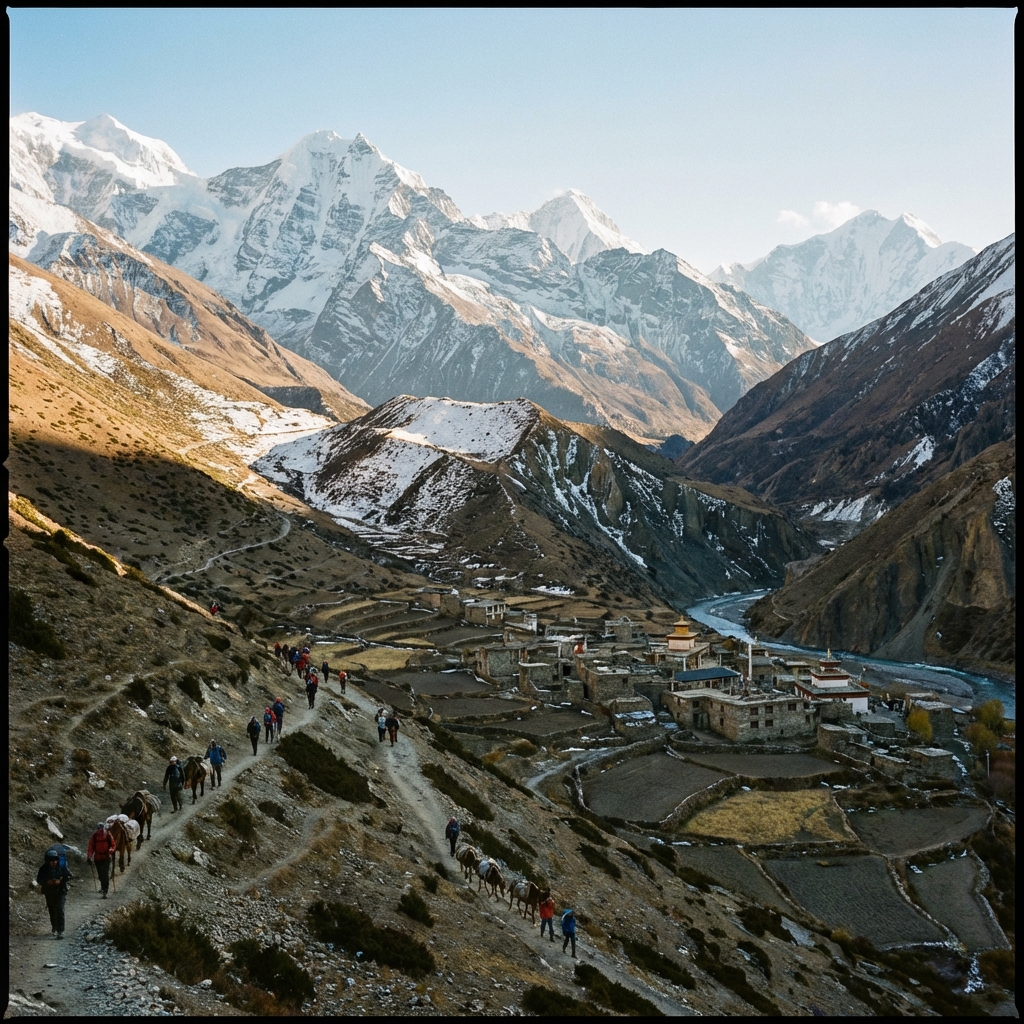
Days 1-4 (Low Altitude, Easy to Moderate): Elevation 800-2,670m. Walking through rice paddies, subtropical forest, and Gurung villages. The trail is largely flat or gently ascending. Some sections follow vehicular roads. Physical demands are low. The biggest challenge is heat at lower elevations.
Days 5-8 (Mid Altitude, Moderate): Elevation 2,670-3,540m. Entering the Marsyangdi and Manang valleys. Trail steepens, altitude effects begin, scenery transitions from subtropical to alpine. Physical demands increase gradually. Acclimatization days in Manang provide recovery.
Days 9-11 (High Altitude, Challenging): Elevation 3,540-4,450m. The approach to Thorong La. Altitude effects are pronounced. Trails become rougher. Wind and cold increase. Sleep quality degrades. This is where the real work begins.
Day 12 (Thorong La Pass, Extreme): Elevation 4,450m to 5,416m and down to 3,800m. The crux day. Everything has been building to this. A 970-meter ascent followed by a 1,600-meter descent in a single day, at extreme altitude, often in wind and cold. This is where the Circuit earns its reputation.
Days 13-16 (Descent, Moderate to Easy): Elevation 3,800m down to 800m. Rapid descent through Muktinath, Jomsom, and the Kali Gandaki valley. Physical demands shift from cardiovascular (altitude) to musculoskeletal (impact of prolonged descent). The trek winds down.
The Road Factor: It Changes Everything
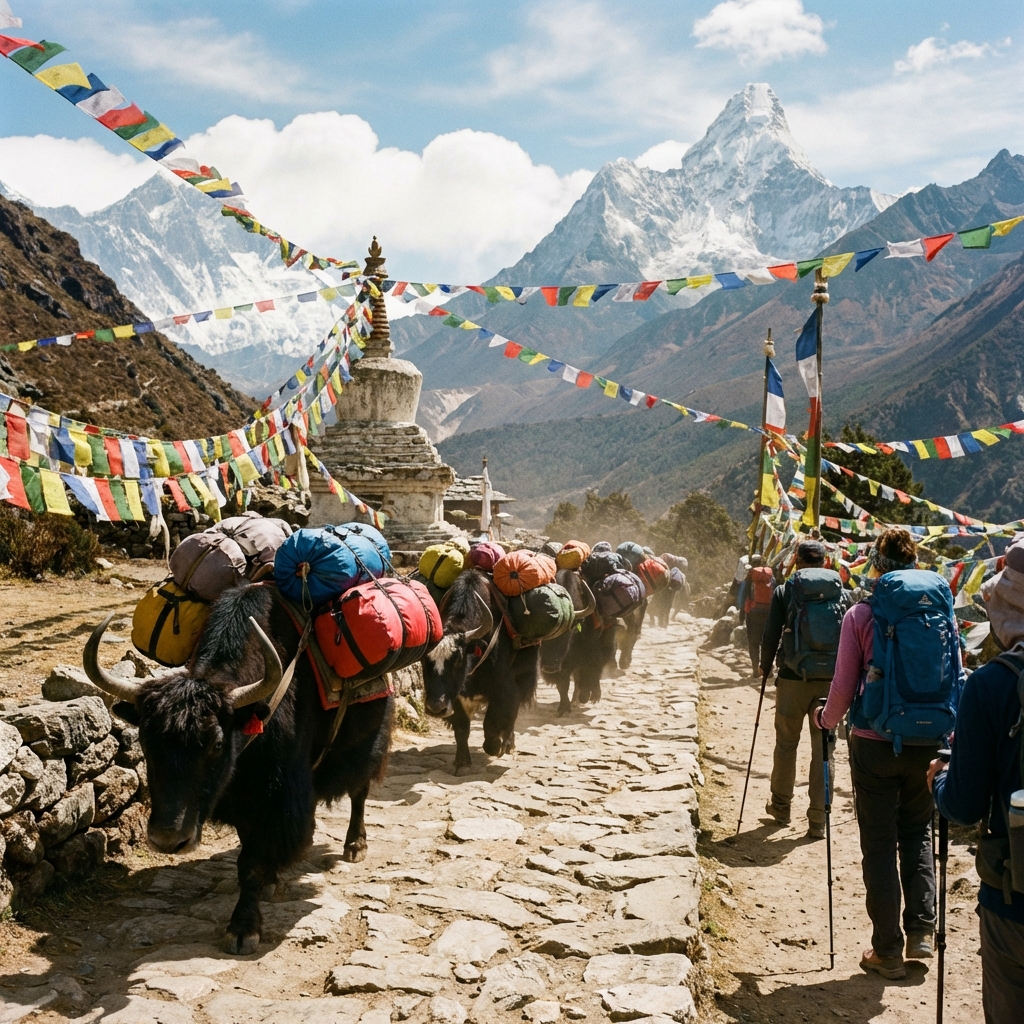
Road construction has transformed the lower sections of the Annapurna Circuit. Where trekkers once walked through remote villages, jeep roads now connect Besisahar to Chame (and beyond). Many trekkers now skip the lower road sections by taking a jeep to Chame or Dharapani, reducing the trek from 18-21 days to 12-15 days. This eliminates the easiest sections but also the most culturally immersive. The road sections are not dangerous, but walking on gravel roads with passing jeeps is dusty, noisy, and less enjoyable than trails. Decide in advance whether you will walk or drive the lower sections. See the 15-day itinerary for the most popular compromise.
Day-by-Day Difficulty Breakdown
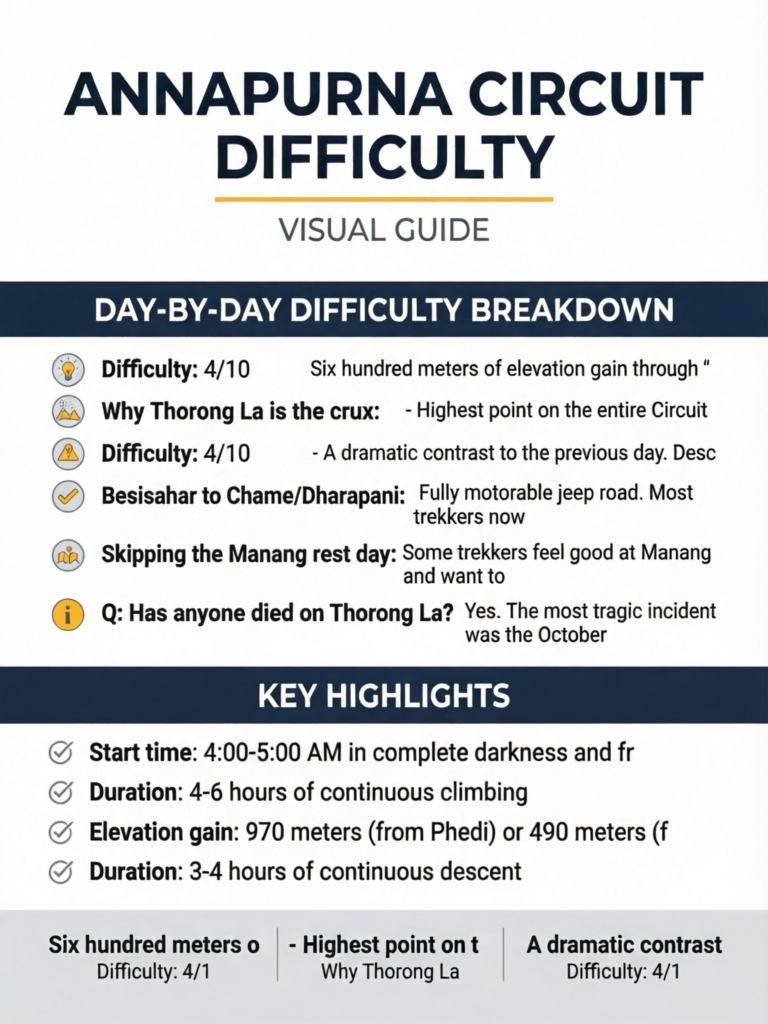
This breakdown follows a standard 15-day itinerary starting from Dharapani (after a jeep ride from Besisahar). Difficulty is rated 1-10 for each day.
Day 1: Dharapani to Chame (2,670m to 2,710m)
Difficulty: 3/10 A gentle introduction following the Marsyangdi River valley. The trail passes through pine forests with views of Annapurna II and Lamjung Himal. Walking time: 5-6 hours. Mostly flat with gentle undulations. No altitude concerns at this elevation.
Day 2: Chame to Upper Pisang (2,710m to 3,310m)
Difficulty: 4/10 Six hundred meters of elevation gain through apple orchards and pine forest. The first significant climb of the trek. Walking time: 5-6 hours. Altitude is not yet a factor, but the sustained uphill effort tests legs and lungs. The view of Annapurna II from Upper Pisang is worth the climb.
Day 3: Upper Pisang to Manang (3,310m to 3,540m)
Difficulty: 4/10 A relatively easy day with options. The high route through Ghyaru and Ngawal offers spectacular views but adds 200 meters of climbing. The low route follows the valley floor on a wider trail. Walking time: 5-7 hours depending on route. Some trekkers feel the first mild altitude effects at Manang.
Day 4: Manang Acclimatization Day
Difficulty: 3/10 A critical rest day for acclimatization before the push to Thorong La. Optional hikes to Ice Lake (4,600m, strenuous), Gangapurna Lake (short and easy), or Praken Gompa (moderate). Walking time: 2-5 hours depending on chosen activity. This day should not be skipped. Proper acclimatization in Manang significantly increases Thorong La success rates.
Day 5: Manang to Yak Kharka (3,540m to 4,018m)
Difficulty: 5/10 The altitude begins to make itself felt. Nearly 500 meters of elevation gain through increasingly barren landscape. Walking time: 4-5 hours. The trail is straightforward but the thinner air makes uphill sections harder than they look. Wind often picks up in the afternoon. Temperatures drop noticeably compared to Manang.
Day 6: Yak Kharka to Thorong Phedi (4,018m to 4,450m)
Difficulty: 6/10 Another 430 meters of altitude gain into a stark, rocky landscape. Walking time: 3-4 hours (short day to conserve energy for Thorong La). Despite the short distance, the altitude makes every incline feel strenuous. Sleep at Thorong Phedi is typically poor: the altitude, cold, and anxiety about the next day combine to disrupt rest. Some trekkers opt to continue to Thorong High Camp (4,925m) to reduce the next day's climb, but sleeping at this altitude is even more difficult.
The Thorong Phedi Decision
At Thorong Phedi, you must decide: stay here (4,450m) or push to Thorong High Camp (4,925m). Staying at Phedi means a longer but less extreme morning climb. Pushing to High Camp means a shorter climb to the pass but sleeping nearly 500 meters higher, which significantly worsens sleep quality and increases AMS risk. Most guides recommend staying at Phedi unless weather forecasts suggest an early departure is essential. Neither option is easy.
Day 7: Thorong La Pass Day - Thorong Phedi to Muktinath (4,450m to 5,416m to 3,800m)
Difficulty: 10/10 (The Crux Day)
This is the defining day of the Annapurna Circuit. Everything before has been preparation for this.
The morning ascent (4,450m to 5,416m):
- Start time: 4:00-5:00 AM in complete darkness and freezing temperatures
- Duration: 4-6 hours of continuous climbing
- Elevation gain: 970 meters (from Phedi) or 490 meters (from High Camp)
- Conditions: Often below minus 15 Celsius with wind. Trail is rocky and steep in sections, with false summits that test morale
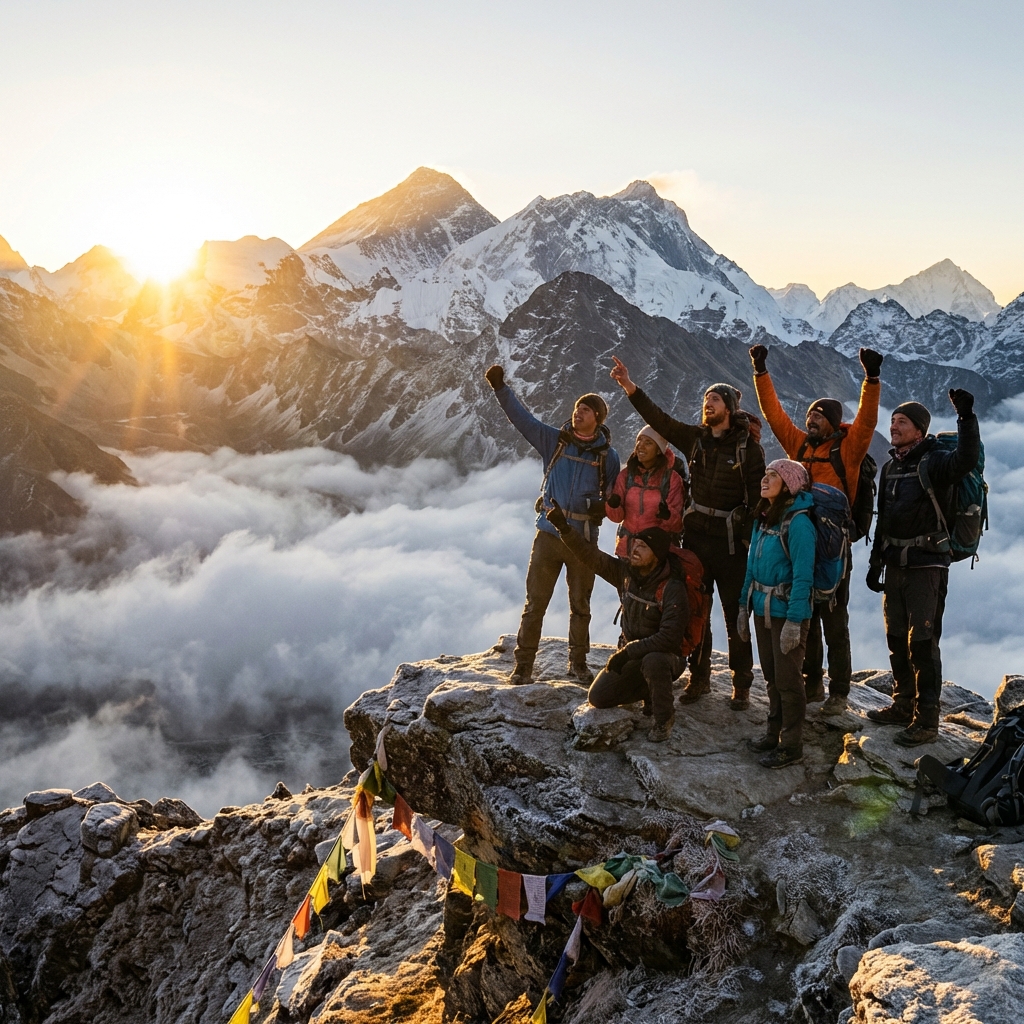
- At the pass: Brief celebration, photographs, prayer flags. Conditions are usually too cold and windy for extended stops
- Physical experience: Labored breathing, slow pace (50-100 meters between rests above 5,000m), heavy legs, possible headache and nausea
The afternoon descent (5,416m to 3,800m):
- Duration: 3-4 hours of continuous descent
- Elevation loss: 1,616 meters (massive for a single descent)
- Conditions: Initially steep and loose. Knee and quad strain is severe
- The descent is harder on the body than the ascent. The 1,600-meter drop destroys unprepared knees
- Arriving in Muktinath feels like arriving in a different world: warmer, lower, breathable
Why Thorong La is the crux:
- Highest point on the entire Circuit
- Longest single-day effort (8-12 hours total)
- Combines extreme altitude with massive elevation change
- Weather window is narrow (afternoon winds and clouds make late crossings dangerous)
- No bailout option once you commit (above 5,000m on the climb, the only way out is over or back)
- Accumulated fatigue from 6+ previous trekking days
- Sleep deprivation from the night at Thorong Phedi
Day 8: Muktinath to Jomsom (3,800m to 2,720m)
Difficulty: 4/10 A dramatic contrast to the previous day. Descending through the sacred town of Muktinath into the Kali Gandaki valley. Walking time: 5-6 hours. The trail is wide and well-maintained. Altitude is no longer a concern. The primary challenge is the famous Kali Gandaki wind, which blows strongly up the valley most afternoons and can make progress difficult and unpleasant. Start early to avoid the worst of it.
Day 9: Jomsom to Tatopani (2,720m to 1,190m)
Difficulty: 5/10 Most trekkers take a jeep or bus from Jomsom to Tatopani (or at least to Ghasa) because this section follows a dusty road through the Kali Gandaki gorge. Walking takes 2 full days. The road walking is not technically difficult but is monotonous and dusty. If walking, the 1,530-meter descent is punishing on the knees. Tatopani's hot springs are a legendary reward.
Days 10-12: Tatopani to Ghorepani to Poon Hill to Nayapul
Difficulty: 6/10 If continuing on foot (rather than taking transport), the climb from Tatopani (1,190m) to Ghorepani (2,860m) is a brutal 1,670-meter ascent in a single day, mostly on stone staircases. This section is physically one of the hardest days of the Circuit despite the relatively low altitude, because the climb is relentless and steep. The Poon Hill sunrise viewpoint adds a pre-dawn 300-meter climb. The descent from Ghorepani to Nayapul completes the Circuit.
The Hidden Hard Day
Most Annapurna Circuit difficulty discussions focus on Thorong La, and rightfully so. But the climb from Tatopani to Ghorepani is surprisingly brutal. After days at altitude where your lungs limited you, this low-altitude staircase assault is where your legs revolt. Your lungs work fine at 1,500-2,800 meters, but your quads and calves are exhausted from two weeks of hiking. Many trekkers describe this as the second hardest day of the entire Circuit.
Thorong La: The Detailed Breakdown
Since Thorong La is the crux of the entire Circuit, it deserves a deeper analysis.
Physical Requirements for Thorong La
Cardiovascular: You must sustain 4-6 hours of continuous uphill effort at extreme altitude where oxygen is roughly 50% of sea level. Your heart rate will be elevated for the entire ascent. If you cannot climb stairs for 45 minutes at sea level without distress, Thorong La will be extremely difficult.
Muscular endurance: The descent (1,616 meters) requires quad and knee resilience that far exceeds any other day on the Circuit. If you have not trained specifically for downhill endurance, the descent will cause severe pain and potential injury.
Mental toughness: The pre-dawn start, darkness, extreme cold, false summits, and altitude-impaired cognition require sustained mental focus. Many trekkers describe a point above 5,000 meters where they had to actively talk themselves into each step.
Success Rate on Thorong La
In peak season (October-November and March-April): 85-90% of trekkers who reach Thorong Phedi successfully cross the pass.
The 10-15% who do not cross typically turn back due to:
- Severe AMS symptoms (50% of turnarounds)
- Extreme weather conditions (30% of turnarounds)
- Physical exhaustion (15% of turnarounds)
- Fear or anxiety (5% of turnarounds)
Off-season: Success rates drop to 60-75% due to snow conditions. In winter, the pass can be impassable for days or weeks.
When to Bail Out on Thorong La
Turning back is the correct decision if:
- You have severe headache that does not respond to medication
- You experience ataxia (inability to walk in a straight line)
- You have confusion or altered consciousness
- You are vomiting repeatedly
- You have a persistent cough with pink or frothy sputum
- Weather conditions deteriorate rapidly (whiteout, extreme wind, heavy snow)
- Your guide recommends turning back (guides have experience reading conditions and symptoms)
Turning back is NOT necessary for:
- Mild headache that responds to ibuprofen or paracetamol
- Mild nausea without vomiting
- Fatigue (everyone is exhausted)
- Slow pace (there is no rush as long as you keep moving forward before conditions deteriorate)
- Cold hands or feet (adjust layers and keep moving)
For comprehensive altitude sickness guidance, read the acclimatization guide.
The Thorong La Weather Window
Thorong La has a narrow weather window most days. Mornings are typically calm and clear. By noon, clouds roll in. By early afternoon, winds can reach 50-80 km/h on the pass. This is why the 4:00-5:00 AM start is non-negotiable, not optional. Trekkers who start late risk being caught in deteriorating conditions above 5,000 meters with no shelter. Your guide will set the departure time. Trust their judgment.
The Road Factor: How It Changes Difficulty
The Annapurna Circuit has undergone dramatic changes since road construction began in the 2000s. Understanding the road's impact on difficulty is essential for planning.
Current Road Status (2026)
Besisahar to Chame/Dharapani: Fully motorable jeep road. Most trekkers now take a jeep to Dharapani or Chame to skip the road walking. This eliminates 3-4 days of relatively easy (but dusty and noisy) walking.
Jomsom to Beni/Nayapul: Fully motorable road through the Kali Gandaki valley. Many trekkers take transport from Jomsom to Tatopani or Beni, skipping 2-3 days of road walking on the descent side.
Manang to Thorong Phedi: No road. Pure trekking trail. This section retains its original character.
Impact on difficulty assessment: The road sections are the easiest parts of the Circuit. Removing them (by taking transport) means the remaining walking is proportionally harder, because you are left with the mid-altitude to high-altitude sections that demand more fitness and altitude tolerance. A trekker who walks the full Circuit from Besisahar has easier average daily difficulty but a longer overall trek. A trekker who starts at Chame has a shorter but harder-per-day experience.
Trail vs. Road Walking Comparison
| Factor | Trail Sections | Road Sections |
|---|---|---|
| Terrain | Varied, natural, uneven | Flat, gravel/dirt, predictable |
| Scenery | Immersive, close to nature | Villages and valleys, distant views |
| Physical demand | Moderate to high | Low to moderate |
| Dust exposure | Minimal | High (passing vehicles) |
| Cultural experience | Higher (remote villages) | Lower (connected towns) |
| Navigation | Requires trail awareness | Follow the road |
Annapurna Circuit vs. EBC: Difficulty Comparison
This is one of the most common questions from trekkers choosing between the two classic Himalayan routes.
Direct Comparison
| Factor | Annapurna Circuit | EBC Trek |
|---|---|---|
| Maximum altitude | 5,416m (Thorong La) | 5,364m (EBC) / 5,545m (Kala Patthar) |
| Days above 4,000m | 3-5 days | 6-8 days |
| Total duration | 12-18 days | 12-14 days |
| Hardest single day | Thorong La (10/10) | EBC + Kala Patthar day (9/10) |
| Average daily difficulty | 4.5/10 | 5.5/10 |
| Cumulative altitude exposure | Lower (fewer days at extreme altitude) | Higher (more sustained high altitude) |
| Trail condition | Variable (roads + trails) | Consistent (well-maintained trails) |
| Rescue accessibility | Moderate (helicopter from most points) | Good (helicopter readily available) |
The Verdict
EBC is harder overall because it sustains high altitude for more consecutive days, creating greater cumulative stress. The Annapurna Circuit is harder for one specific day (Thorong La), but the rest of the trek includes lower-altitude sections that provide recovery.
However, the Annapurna Circuit is longer, which creates its own challenge. Two weeks of continuous hiking, regardless of altitude, is physically and mentally demanding. The Circuit also has more variable terrain and conditions, requiring greater adaptability.
Choose the Circuit if: You handle single intense days well but want lower sustained altitude exposure. You enjoy variety and can commit to a longer trek.
Choose EBC if: You prefer a shorter overall commitment and do not mind sustained high altitude. You want a more consistent daily difficulty level.
The Acclimatization Advantage
The Annapurna Circuit has a built-in acclimatization advantage that EBC does not. The Circuit's gradual approach from 800m to 5,416m over 12+ days provides excellent natural acclimatization. EBC's approach is faster (Lukla starts at 2,860m) and reaches extreme altitude sooner. This means AMS rates are actually lower on the Annapurna Circuit despite the higher maximum altitude. The slower, lower start helps your body adjust more gradually.
Acclimatization Requirements
The Non-Negotiable Acclimatization Schedule
Manang rest day: Spend a full day in Manang (3,540m) before proceeding higher. Use this day for a hike to higher elevation and return. This is arguably the most important single day on the Circuit for ensuring Thorong La success.
Ascent rate above Manang: Do not gain more than 500 meters of sleeping altitude per day above Manang. The standard itinerary (Manang to Yak Kharka to Thorong Phedi) respects this guideline.
Signs to add an extra acclimatization day:
- Persistent headache at Manang that worsens overnight
- Difficulty sleeping beyond normal altitude disruption
- Nausea or loss of appetite more severe than mild
- Dizziness or lightheadedness during activity
- Oxygen saturation consistently below 80% if using a pulse oximeter
Common Acclimatization Mistakes on the Circuit
Skipping the Manang rest day: Some trekkers feel good at Manang and want to push on. This is the most common and dangerous mistake. Acclimatization benefits are not immediately apparent. The rest day at Manang creates physiological adaptations that manifest 2-3 days later when you need them most.
Climbing too high on acclimatization hikes: When hiking above Manang for acclimatization, do not ascend more than 1,000 meters above your sleeping altitude. Going to Ice Lake (4,600m) from Manang (3,540m) is at the upper limit. Ensure you feel well before attempting it.
Using Thorong High Camp without adequate preparation: Some trekkers who feel fine at Thorong Phedi (4,450m) push to High Camp (4,925m) to "save time" the next morning. This 475-meter gain in sleeping altitude violates acclimatization guidelines and increases AMS risk. Only use High Camp if you have been acclimatizing well and feel completely symptom-free at Phedi.
Physical vs. Altitude Challenge: Understanding the Split
The Annapurna Circuit presents two distinct types of difficulty that affect different people differently.
The Physical Challenge (Legs, Lungs, Endurance)
Who struggles most: Sedentary individuals, those with no hiking experience, overweight trekkers, people who have not trained specifically for multi-day hiking.
Where it hits hardest: The stone staircases of the lower circuit (if walking from Besisahar), the climb from Tatopani to Ghorepani, the sustained hiking day after day without full recovery.
How to mitigate: 8-12 weeks of structured training focused on hiking endurance, stair climbing, and loaded pack walking. See the fitness requirements guide.
The Altitude Challenge (Oxygen, Acclimatization, AMS)
Who struggles most: Genetically susceptible individuals (unpredictable), fast ascenders, those who ignore acclimatization protocols, people who have had AMS on previous high-altitude experiences.
Where it hits hardest: Above Yak Kharka (4,018m), particularly at Thorong Phedi and during the Thorong La crossing.
How to mitigate: Conservative itinerary with adequate acclimatization days, Diamox if recommended by a doctor, knowledge of AMS symptoms and response protocols, willingness to descend if symptomatic.
The Double Challenge Days
Days 6-7 (Yak Kharka to Thorong Phedi to Muktinath via Thorong La) combine both challenges simultaneously: extreme altitude with extreme physical demand. This is why adequate training AND adequate acclimatization are both necessary. Being fit does not prevent altitude sickness. Being acclimatized does not compensate for weak legs. You need both.
Who Should Attempt the Annapurna Circuit
Well-Suited Candidates
- Moderately fit adults who can commit to a longer trek (12-18 days)
- People who enjoy variety in terrain, culture, and landscape
- Those who have completed multi-day hikes (3+ consecutive days)
- Trekkers who can handle one extremely demanding day (Thorong La)
- Individuals who acclimatize reasonably well (no history of severe AMS)
Candidates Who Need Extra Preparation
- First-time trekkers (achievable but requires thorough preparation)
- Those over 60 (absolutely possible with medical clearance and conservative pacing)
- People with mild knee issues (the Thorong La descent and Tatopani-Ghorepani staircase are knee-intensive)
- Individuals who have not been above 3,000 meters before (the altitude will be a new experience)
Who Should Consider a Different Trek
- People with severe altitude sickness history who cannot use Diamox
- Those unable to commit to 12+ days (shorter treks like Poon Hill or Mardi Himal better suit limited time)
- Individuals with serious knee conditions that preclude sustained descent (the 1,616-meter descent from Thorong La is non-negotiable)
- Trekkers who are uncomfortable with one very hard day followed by easy days (if you prefer consistent moderate difficulty, EBC may be better suited)
Frequently Asked Questions: Annapurna Circuit Difficulty
General Difficulty Questions
Q: How hard is the Annapurna Circuit compared to normal hiking?
The Circuit includes a wide range of difficulty. Days 1-4 are comparable to moderate day hikes in any mountain region. Days 5-8 are comparable to strenuous mountain hiking at elevation. Day 7 (Thorong La) is comparable to summiting a mountain peak in terms of effort, altitude, and conditions. The Circuit is significantly harder than any sea-level multi-day hike due to the altitude factor.
Q: What is the single hardest moment on the entire Circuit?
The final 200 meters of ascent to Thorong La (from approximately 5,200m to 5,416m). You have been climbing for 3-5 hours, it is freezing cold, the altitude leaves you gasping after 10-20 steps, and false summits repeatedly trick your eyes into thinking the top is near. When you finally see the prayer flags at the pass, the relief is overwhelming.
Q: Can I skip Thorong La and still do the Circuit?
Technically, you can trek to Manang and return the way you came, or take transport from Manang to Jomsom via a long road detour. However, crossing Thorong La is the essence of the Circuit experience. Without it, you are doing two separate out-and-back treks rather than a circuit. If Thorong La concerns you, consider the Thorong La pass guide for detailed preparation advice.
Q: I am scared of Thorong La. Is my fear justified?
Respect, not fear, is the appropriate response. Thorong La is genuinely difficult and demands preparation, but it is crossed by thousands of trekkers every season. With adequate fitness, proper acclimatization, experienced guidance, and appropriate gear, the risk is manageable. Fear becomes a problem only if it prevents you from preparing properly or causes panic at altitude, which impairs judgment.
Q: Is the Annapurna Circuit getting easier or harder over time?
In some ways easier: road construction has made the lower sections accessible by vehicle, lodges have improved, helicopter rescue is more available, weather forecasting is better. In some ways harder: climate change has made weather less predictable, some trail sections have deteriorated due to construction and landslides, and the classic "full circuit" experience requires more effort to preserve against road encroachment.
Physical Preparation Questions
Q: How should I train for the Annapurna Circuit?
Focus on three areas: cardiovascular endurance (sustained 5-7 hour efforts), lower body strength (stair climbing, squats, lunges), and loaded pack walking. A minimum of 8 weeks of structured training is recommended. For specific preparation, the training principles in our fitness requirements guide apply directly to the Circuit.
Q: Do I need to be able to run to complete the Circuit?
No. The Circuit is walking, not running. However, running builds cardiovascular fitness efficiently and is valuable in training. If you dislike running, hiking, cycling, swimming, and stair climbing all build the endurance required. The key is sustained moderate-intensity effort for extended periods.
Q: My biggest concern is my knees. How bad is the descent from Thorong La?
The descent from Thorong La to Muktinath (1,616 meters of elevation loss) is one of the most knee-intensive descents on any popular Himalayan trek. The trail is steep, rocky, and unforgiving on the upper sections. Trekking poles are essential, not optional, for this descent. Strong quadriceps protect the knee joint by absorbing impact before it reaches the joint surface. If you have chronic knee issues, consult a physiotherapist, strengthen your quads extensively, and consider a neoprene knee support or brace.
Q: How much weight will I carry on the Circuit?
With a porter: 5-8 kg daypack containing water, snacks, rain gear, camera, and layers. Without a porter: 12-18 kg full pack with all gear. The full pack significantly increases difficulty, particularly on the Thorong La day. We strongly recommend using a porter for the Circuit unless you are an experienced backpacker.
Altitude and Weather Questions
Q: When is the best time to do the Annapurna Circuit?
October-November offers the best combination of stable weather, clear views, and comfortable temperatures. March-April is the second-best window with rhododendron blooms at lower elevations but more variable weather. See the best time for Annapurna Circuit guide for detailed seasonal analysis.
Q: Has anyone died on Thorong La?
Yes. The most tragic incident was the October 2014 blizzard and avalanche that killed 43 people in the Annapurna region, including trekkers on and near Thorong La. This disaster was caused by an unseasonal cyclone that brought extreme snowfall. It led to significant improvements in weather forecasting, warning systems, and rescue protocols. Under normal conditions with proper guidance, Thorong La fatalities are extremely rare but not zero. Respect the mountain.
Q: What if weather closes Thorong La during my trek?
Weather closures are possible, particularly during unseasonal snowfall or extreme wind events. If the pass is closed, you have several options: wait 1-2 days at Thorong Phedi for conditions to improve, turn back to Manang and take alternative transport to Jomsom, or end the trek at Manang. Flexible itineraries with buffer days reduce the impact of weather delays.
Q: Do I need crampons or ice axes for Thorong La?
In peak season (October-November and March-April), no. The trail is clear of snow in normal conditions. In early spring (March) or late autumn (late November), light snow is possible on the upper sections, but crampons are not required. In winter (December-February), microspikes or light crampons may be necessary. Your guide will advise based on current conditions.
For the full itinerary, see our Annapurna Circuit 15-day guide. For detailed Thorong La preparation, read the Thorong La pass guide. For fitness preparation, see the fitness requirements guide.