
Best Lodges & Hotels in Everest Region: Complete 2026 Accommodation Guide
Planning your Everest Base Camp trek or Everest region adventure? Finding the right accommodation can make or break your high-altitude experience. This comprehensive guide covers everything from luxury lodge chains like Yeti Mountain Home to budget-friendly teahouses, with specific recommendations for every village along the classic EBC route and alternative trails.
After years of trekking in the Everest region and staying at dozens of lodges from Lukla to Gorak Shep, I've compiled this detailed guide to help you choose the perfect accommodation for your trek. Whether you're looking for heated rooms with mountain views, reliable WiFi for remote work, or simply the cleanest budget option, you'll find specific recommendations with real prices, facilities, and booking information.
Understanding Everest Region Accommodation
The Everest Base Camp trek and surrounding routes have evolved dramatically over the past two decades. What was once a network of basic Sherpa homes offering simple accommodation has transformed into a sophisticated trekking infrastructure with options ranging from rustic teahouses to surprisingly luxurious mountain lodges.
The Three Tiers of Everest Lodges
Budget Teahouses ($10-25/night): These are the traditional mountain lodges run by local Sherpa families. Rooms are basic—typically a wooden bed with a thin mattress, pillow, and blankets. Bathrooms are shared, often squat toilets, and the dining room has a central bukhari (wood stove) where trekkers gather. Don't expect privacy, soundproofing, or creature comforts, but you'll get authentic cultural immersion and the warmth of Sherpa hospitality.
Mid-Range Lodges ($30-60/night): This category has exploded in recent years as competition has driven quality improvements. These lodges offer private bathrooms (Western toilets), better mattresses, some insulation, and cleaner facilities overall. Many have solar-powered hot showers, charging stations, and more diverse menus. The dining areas are more comfortable, sometimes with cushioned benches and better heating systems.
Luxury Lodges ($80-180/night): Led by the Yeti Mountain Home chain and Everest Summit Lodges, these properties offer a completely different experience. Think wooden floors, quality bedding, heated rooms, private bathrooms with reliable hot water, Western-style toilets, reading lights, and panoramic mountain views from rooms or private balconies. Dining includes multi-course meals with wine lists, and common areas feature libraries, charging stations, and comfortable seating.
Pro Tip
What "Luxury" Really Means at Altitude: Even the most expensive Everest lodges can't replicate five-star hotel conditions at 3,500-4,500 meters. Water pressure is low, heating is limited (diesel is expensive to fly in), and WiFi is satellite-based and slow. "Luxury" here means clean sheets, a warm room, reliable hot shower, and quality food—things you'd take for granted at sea level but are genuinely impressive at 4,000 meters.
Peak Season vs Off-Season Booking
October-November (Autumn Peak Season): This is when Everest lodges are at maximum capacity. The weather is stable, skies are clear, and thousands of trekkers converge on the same trail. If you want to stay at specific lodges—especially Yeti Mountain Home properties or popular Namche hotels—book 3-6 months in advance. Walk-in bookings are risky; you might end up sharing a dormitory or sleeping in a dining hall.
March-April-May (Spring Peak Season): Slightly less crowded than autumn, but still busy. Booking 2-3 months ahead is advisable, particularly for the higher-altitude lodges where options are limited. The rhododendron forests are blooming, making the lower elevations spectacular.
December-February (Winter): Many lodges at higher altitudes close entirely due to extreme cold and lack of customers. Namche and below remain open, and you'll have your pick of accommodations, but above Tengboche, options are severely limited. If you're winter trekking, confirm lodge operations in advance.
June-September (Monsoon): Low season with heavy rain at lower elevations. Lodges are open but quiet. Great for budget travelers who can handle the leeches and clouds, but mountain views are inconsistent. No advance booking needed.
Luxury Lodge Chains: Yeti Mountain Home & Everest Summit Lodges
Yeti Mountain Home: The Gold Standard
Yeti Mountain Home revolutionized Everest trekking when they opened their first property in 2003. They now operate five lodges strategically positioned along the EBC route, offering an upscale alternative to teahouse trekking without sacrificing the authentic mountain experience.
The Yeti Mountain Home Philosophy: Each lodge is built using traditional Sherpa architecture with modern comforts discreetly integrated. Stone walls, wooden beams, and slate roofs blend into the mountain landscape. Inside, you'll find heated rooms (diesel generators provide electricity), private bathrooms with flush toilets and hot showers, comfortable beds with quality bedding, and dining rooms serving international cuisine alongside Sherpa specialties.
Yeti Mountain Home Lukla ($120-150/night)
Location: Lukla village, steps from Tenzing-Hillary Airport Altitude: 2,840 meters Rooms: 12 twin/double rooms with private bathrooms Best For: First or last night on the EBC trek, altitude acclimatization
Lukla Yeti Mountain Home is where many trekkers begin or end their Everest journey. The lodge sits above the main Lukla bazaar, offering quieter surroundings than the airport-adjacent hotels. Rooms feature wooden floors, comfortable beds with duvets, reading lights, and large windows with mountain views.
The dining room serves an impressive menu given the altitude—everything from traditional dal bhat and momos to pasta, steaks, and even apple pie. There's a full bar with beer, wine, and spirits. The WiFi is reliable by Everest standards ($8/day), and there's a charging station in the common area.
Booking: Book directly through Yeti Mountain Home website or through trekking agencies. Peak season requires 3-4 months advance booking.
What Sets It Apart: After a long day flying into Lukla or before your early morning flight out, the heated rooms and hot showers are genuinely luxurious. The breakfast spread is the best you'll find in Lukla.
Pro Tip
Flight Delay Strategy: Lukla flights are frequently delayed or cancelled due to weather. If you're staying at Yeti Mountain Home Lukla and your flight is postponed, they're usually flexible about extending your stay (subject to availability). Book your last night here rather than earlier in the trek to avoid losing your reservation if you're delayed getting down.
Yeti Mountain Home Phakding ($120-140/night)
Location: Phakding village, first day's trek from Lukla Altitude: 2,610 meters Rooms: 10 twin/double rooms with private bathrooms Best For: Gentle first day acclimatization, older trekkers
Phakding is often skipped by younger, faster trekkers who push on to Namche on day one, but this is actually a smart acclimatization strategy. Yeti Mountain Home Phakding is the nicest lodge in the village by a considerable margin.
The location is spectacular—perched on a hillside overlooking the Dudh Koshi River with views up the valley toward Thamserku and Kusum Kanguru. Rooms are similar to the Lukla property but slightly smaller. The dining room has a library corner with books about Sherpa culture and Himalayan mountaineering.
What Sets It Apart: The peaceful setting. While other Phakding lodges are clustered near the noisy trail, this property feels removed from the trekking highway. The terraced gardens are lovely in spring.
Booking Tip: Often easier to book than Namche Yeti Mountain Home, making it a good luxury alternative if the Namche property is full.
Yeti Mountain Home Monjo ($130-150/night)
Location: Monjo village, just before Sagarmatha National Park entry Altitude: 2,835 meters Rooms: 8 twin/double rooms with private bathrooms Best For: Breaking the Lukla-Namche climb into easier stages
This is the smallest Yeti Mountain Home property and the most intimate. Monjo sits in a beautiful location where the valley narrows before the steep climb to Namche. The lodge overlooks the confluence of two rivers, with suspension bridges crossing below.
Rooms here are particularly cozy, with some featuring small balconies (request when booking). The dining room is wood-paneled with a central bukhari supplementing the diesel heating. The cook here is known for excellent Sherpa stew and fresh-baked bread.
Strategic Use: Many trekkers underestimate the Lukla-to-Namche day and suffer on the steep final climb. Staying at Monjo lets you tackle Namche fresh in the morning, which also helps acclimatization.
What Sets It Apart: The intimate atmosphere and stunning river valley location. Excellent spot for photography, especially at dawn.
Yeti Mountain Home Namche ($140-170/night)
Location: Upper Namche Bazaar, above the main village Altitude: 3,440 meters Rooms: 14 twin/double rooms plus 2 suites with private bathrooms Best For: Acclimatization days, base for side trips, luxury trekking
This is the flagship Yeti Mountain Home property and arguably the best lodge in the entire Everest region. The location is unbeatable—perched on the hillside above Namche with panoramic views of Kongde Ri, Thamserku, and on clear days, the Everest massif.
Rooms are the most spacious in the Yeti chain, with large windows, comfortable seating areas, and the best heating systems. The two suites ($200-220/night) have separate sitting areas and bathtubs—yes, actual bathtubs at 3,440 meters. The dining room features floor-to-ceiling windows with those spectacular views, a full bar, and the most extensive menu in Namche.
The lodge has a drying room (essential at this altitude), a library with comfortable chairs, and even a small spa offering massages ($40-60) to ease your trekking muscles. WiFi is reliable and included in some packages.
Booking: This property requires the furthest advance booking—4-6 months for October peak season. It's popular not just with trekkers but also with helicopter day-trippers from Kathmandu who come up for lunch.
Strategic Use for Acclimatization: Namche is where everyone spends an acclimatization day. Staying at Yeti Mountain Home makes that rest day genuinely restorative. Take the Everest View Hotel hike, visit the Sherpa Museum and market, then return to a hot shower and heated room.
Pro Tip
The Acclimatization Upgrade: Even if you're budgeting carefully and staying at teahouses for the rest of your trek, consider splurging for your Namche acclimatization nights at Yeti Mountain Home. Good sleep is crucial for acclimatization, and the heated rooms and comfortable beds make a real difference at 3,440 meters where many trekkers first feel altitude effects.
Yeti Mountain Home Kongde ($160-180/night)
Location: Kongde village, above Namche on alternative route Altitude: 4,250 meters Rooms: 8 twin/double rooms with private bathrooms Best For: Alternative to EBC route, spectacular views, serious photographers
This is the highest and most remote Yeti Mountain Home property. Kongde isn't on the main EBC route—it's reached by a steep 3-hour climb from Namche, making it less crowded and more exclusive. The trade-off is worth it: the views from Kongde are simply extraordinary.
From this vantage point, you get panoramic vistas of Everest, Lhotse, Ama Dablam, Thamserku, and Kongde Ri. The lodge is positioned to catch both sunrise and sunset on the peaks. Many photography tour groups specifically stay here for the light.
Rooms are smaller than the Namche property, reflecting the construction challenges at this altitude, but they maintain the Yeti standards of comfort. The dining room has huge windows maximizing the views.
Using Kongde in Your Itinerary: This works brilliantly for Gokyo Lakes trek itineraries or as a side trip during Namche acclimatization. The standard route is: Namche → climb to Kongde (stay 1-2 nights) → descend to Phortse Thanga → continue to Dole and Gokyo.
What Sets It Apart: The views. Seriously, the mountain panoramas from Kongde Yeti Mountain Home are the best you'll get from any lodge in the region. If you're on a luxury trek and have the time, this is worth the detour.
Everest Summit Lodges: The Boutique Alternative
Everest Summit Lodges operates a smaller chain of upscale properties, competing directly with Yeti Mountain Home but with a slightly different approach. They emphasize boutique design, cultural immersion, and sustainable practices.
Everest Summit Lodge Lukla ($100-130/night)
Located in central Lukla, this property is newer than Yeti Mountain Home Lukla and targets a slightly younger, more design-conscious clientele. The rooms have contemporary mountain decor—think exposed stone walls, modern bathrooms with rainfall showers, and Tibetan artwork.
The lodge has a rooftop terrace with 360-degree mountain views, a bar serving craft beers (yes, craft beer in Lukla—they fly it in from Kathmandu breweries), and a wood-fired pizza oven.
Best For: Trekkers who want luxury but prefer a more modern aesthetic than Yeti's traditional approach.
Everest Summit Lodge Thamel ($110-140/night)
Located in Monjo village (confusingly named "Thamel" after the Kathmandu neighborhood), this lodge sits right at the Sagarmatha National Park entrance. The architecture incorporates traditional Sherpa elements with contemporary comfort.
The lodge has a large terraced garden, perfect for afternoon sun. Rooms are heated, and bathrooms feature instant hot water heaters (more reliable than solar at this altitude during winter).
What Sets It Apart: The garden setting is unique. Most lodges at this altitude don't have significant outdoor space.
Everest Summit Lodge Mende ($140-160/night)
This is the flagship property, located in Namche Bazaar. While not quite as luxurious as Yeti Mountain Home Namche, it's still far above standard teahouses and often has availability when Yeti is fully booked.
The lodge features 12 rooms with private bathrooms, a library lounge with a fireplace, and a dining room serving fusion cuisine—traditional Sherpa dishes alongside international options with creative presentation.
Best For: Trekkers seeking luxury in Namche with a more intimate atmosphere than the larger Yeti property.
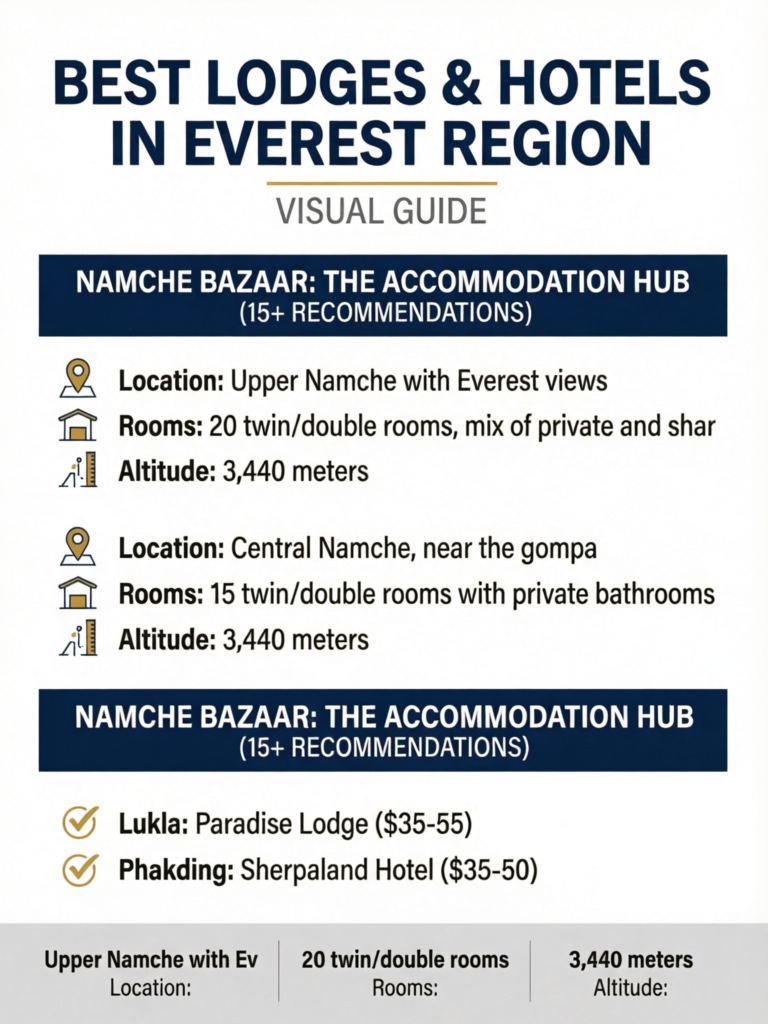
Namche Bazaar: The Accommodation Hub (15+ Recommendations)
Namche Bazaar is the Sherpa capital and the largest settlement on the EBC route. With 40+ lodges ranging from basic teahouses to luxury hotels, Namche offers the widest selection of accommodation in the Everest region. Most trekkers spend 2-3 nights here for acclimatization, making your lodge choice particularly important.
Luxury Options in Namche ($60-170/night)
Hotel Everest View (Namche Branch) ($80-120/night)
Location: Upper Namche with Everest views Rooms: 20 twin/double rooms, mix of private and shared bathrooms Altitude: 3,440 meters
Not to be confused with the famous Everest View Hotel above Namche, this is the Namche town branch. It's one of the oldest established hotels in Namche and has maintained high standards through continuous upgrades.
Rooms with private bathrooms are spacious with wooden floors, quality beds, and effective heating (included in room price during peak season). The windows are large, and corner rooms get spectacular morning light on the mountains.
The dining room serves an extensive menu—the buff steak and apple pie are particularly popular. There's a bakery attached serving fresh bread and pastries. WiFi is $5/day and reasonably fast.
Best For: Trekkers wanting luxury without Yeti Mountain Home prices. Excellent for couples celebrating anniversaries or birthdays on the trek.
Booking: Direct via email ([email protected]) or through trekking agencies. Book 2-3 months ahead for October.
Namche Hotel & Lodge ($70-100/night)
Location: Central Namche, near the gompa Rooms: 15 twin/double rooms with private bathrooms Altitude: 3,440 meters
This modern lodge opened in 2019 and brought contemporary hotel standards to Namche. The building has better insulation than most older lodges, making rooms noticeably warmer. All rooms have private bathrooms with Western toilets and hot showers (solar-powered with backup heating).
The highlight is the rooftop restaurant with floor-to-ceiling glass walls offering 180-degree mountain views. You can eat breakfast while watching the sunrise on Thamserku and Kongde Ri.
Facilities include a drying room, luggage storage, a small library, and charging stations in every room. The WiFi ($6/day) is among the fastest in Namche because they invested in premium satellite service.
Best For: Comfort-focused trekkers, digital nomads who need reliable WiFi, families.
What Sets It Apart: The insulation and warmth. At 3,440 meters, this makes a significant difference to sleep quality.
Khumbu Lodge ($60-90/night)
Location: Upper Namche with panoramic views Rooms: 12 rooms, mix of private and shared bathrooms Altitude: 3,440 meters
A long-established Namche favorite run by the same Sherpa family for over 30 years. The lodge has a loyal following of repeat trekkers who appreciate the family atmosphere and reliable quality.
Rooms are traditional in style—wooden walls, simple furnishings, but scrupulously clean. Those with private bathrooms ($80-90) are worth the premium. The bukhari-heated dining room is the social heart, where the family often joins guests in the evenings, sharing stories about Namche life and Sherpa culture.
The dal bhat here is exceptional—the family's grandmother still oversees the kitchen. The apple pancakes are legendary among EBC trekkers.
Best For: Trekkers who value authentic cultural experience and home-style hospitality over modern amenities.
Booking: Email [email protected] or book through trekking agencies. Popular with European trekking groups.
Mid-Range Namche Options ($30-60/night)
Panorama Lodge & Restaurant ($40-60/night)
Location: Upper Namche, near the museum Rooms: 14 rooms, private and shared bathrooms available Altitude: 3,440 meters
Excellent value in the mid-range category. Rooms with private bathrooms ($55-60) have Western toilets and solar hot showers. The shared bathroom rooms ($40-45) are clean and the facilities are well-maintained.
The name isn't an exaggeration—the panorama from the dining room windows and outdoor terrace is spectacular. Kongde Ri, Thamserku, and Kusum Kanguru dominate the view.
The restaurant serves good food at reasonable prices. The pizza (yes, pizza at 3,440m) is surprisingly good, and the lemon ginger honey tea is perfect after a cold acclimatization hike.
Best For: Value-conscious trekkers who still want comfort and views. Good option for groups.
What Sets It Apart: The view-to-price ratio. You're getting Yeti Mountain Home views at one-third the price.
Namche Nest ($35-55/night)
Location: Central Namche near the market Rooms: 10 rooms, mostly with private bathrooms Altitude: 3,440 meters
A newer lodge (opened 2020) targeting the mid-range market with modern amenities. All rooms have thick mattresses (a luxury at altitude where many lodges have wafer-thin foam), reading lights, and power outlets.
Private bathroom rooms include hot showers (solar) and Western toilets. The bathrooms are small but efficiently designed and clean. The shared bathrooms are also excellent—some of the cleanest on the EBC route.
The dining room is cozy rather than spacious, which makes it feel warm and social. Good menu with large portions. The lodge offers laundry service ($8/kg), rare in Namche.
Best For: Solo trekkers and couples who prioritize cleanliness and a good night's sleep.
Tashi Delek Lodge ($35-50/night)
Location: Lower Namche near the trail to Tengboche Rooms: 12 rooms, mix of private and shared bathrooms Altitude: 3,440 meters
This family-run lodge has been operating for over 20 years and maintains consistent quality. The owner, Ang Phurba, is a former Everest climbing Sherpa who summited three times, and he's a wonderful storyteller if you catch him in the dining room in the evening.
Rooms are basic but adequate—wooden walls, simple beds, warm blankets. Private bathroom rooms have squat toilets (which are actually more hygienic than Western toilets that are poorly maintained) and bucket hot showers ($4 extra).
The dining room has a powerful bukhari, and it's one of the warmest common spaces in Namche. The dal bhat and thukpa are excellent.
Best For: Budget-conscious trekkers who want reliability and don't need luxury. Excellent for cultural immersion.
What Sets It Apart: Ang Phurba's Everest stories and the family's warmth. Many trekkers return here year after year specifically for the hospitality.
Himalayan Lodge ($30-50/night)
Location: Central Namche Rooms: 15 rooms, mostly shared bathrooms Altitude: 3,440 meters
A solid budget-to-mid-range option with very clean facilities. The lodge underwent renovation in 2021, upgrading bathrooms and adding insulation.
Most rooms share bathrooms, but the facilities are excellent with hot showers (solar, $5 extra) and Western toilets. A few rooms have private bathrooms ($50) which book out quickly.
The dining room is one of the largest in Namche, making it popular for group trekkers. The menu is extensive, and portions are generous. Good vegetarian options.
WiFi is available for $5/day. There's a charging station in the dining room (small fee).
Best For: Groups, trekkers on a moderate budget who want cleanliness and good food.
Budget Namche Options ($15-35/night)
Shangrila Guest House ($20-35/night)
Location: Lower Namche Rooms: 10 rooms, shared bathrooms Altitude: 3,440 meters
One of the better budget options in Namche. Rooms are small and simple—a bed, a blanket, a window—but clean. Walls are thin (you'll hear your neighbors), but at this price point that's expected.
Shared bathrooms are basic but maintained. Hot showers are solar-powered ($5) and available most afternoons. Squat toilets.
The dining room has a bukhari (heating costs $8/room/night extra—worth it in the evenings). The dal bhat is good and affordable ($7-8).
Best For: Solo budget trekkers, younger backpackers, anyone doing teahouse trekking who just needs a clean place to sleep.
Tibet Guest House ($18-30/night)
Location: Upper Namche Rooms: 8 rooms, shared bathrooms Altitude: 3,440 meters
A no-frills budget option run by a Tibetan refugee family. Accommodations are very basic—thin mattresses, communal bathrooms, limited hot water—but the family's hospitality makes up for it.
The dining room serves excellent Tibetan specialties: thentuk (hand-pulled noodle soup), tsampa porridge, and Tibetan bread with yak butter. The chai is the best in Namche.
Best For: Budget travelers who prioritize cultural authenticity over comfort. Good for solo trekkers who want a social atmosphere.
What Sets It Apart: The Tibetan food and the family's stories about crossing the Himalaya from Tibet.
Sherpa Guest House ($15-28/night)
Location: Central Namche Rooms: 12 rooms, shared bathrooms Altitude: 3,440 meters
The cheapest reliable option in Namche. Rooms are tiny—just big enough for a bed and your backpack—but clean. Bring your sleeping bag for extra warmth as blankets are thin.
Shared bathrooms are basic but functional. Hot water availability is limited (best in early afternoon when solar panels are charged). Squat toilets only.
The dining room is small and gets crowded, but the stove keeps it warm. Simple menu focused on Nepali staples. The dal bhat is $6-7, very affordable by Namche standards.
Best For: Serious budget trekkers, through-hikers on the Three Passes Trek watching every rupee.
Pro Tip
Namche Accommodation Strategy: Even if you're budgeting, consider upgrading to mid-range for your Namche nights. You'll be here 2-3 nights for acclimatization, and good sleep makes a significant difference. The $20-30 extra per night buys a private bathroom, better bed, and reliable hot shower—all crucial for recovering from the steep Lukla-Namche climb and preparing for higher altitudes ahead.
Best Namche Lodges for Specific Needs
Best for Families: Namche Hotel & Lodge
The modern facilities, clean private bathrooms, and spacious dining room make this ideal for families with children. The staff is experienced with family groups and can prepare kid-friendly meals.
Best for Solo Travelers: Tashi Delek Lodge
The social dining room atmosphere and Ang Phurba's storytelling create perfect conditions for meeting other trekkers. Solo travelers consistently report making friends here.
Best for WiFi/Remote Work: Namche Hotel & Lodge
The fastest, most reliable WiFi in Namche ($6/day), plus power outlets in rooms and a quiet corner of the dining room for working. Several digital nomads have stayed here while trekking.
Best Views: Panorama Lodge & Restaurant
The mountain panoramas from the terrace are extraordinary, rivaling Yeti Mountain Home views at a fraction of the price.
Best Cultural Immersion: Tashi Delek Lodge or Tibet Guest House
Both offer authentic family-run hospitality with strong cultural elements—Sherpa climbing culture at Tashi Delek, Tibetan refugee culture at Tibet Guest House.
Lukla: Gateway Hotels for First & Last Nights
Lukla is where most EBC treks begin and end, making accommodation choice important. You'll want somewhere reliable for your first night (to rest after the flight and prepare for trekking) and your last night (to ensure you make your early morning flight).
Luxury Lukla Options ($50-150/night)
Yeti Mountain Home Lukla ($120-150/night)
Covered in detail above in the luxury chains section. This is unquestionably the best accommodation in Lukla.
Best For: First and last nights when you want maximum comfort, flight delay flexibility, and peace of mind.
Everest Summit Lodge Lukla ($100-130/night)
Also covered above. The second-best option in Lukla with a more contemporary feel.
Best For: Trekkers who prefer modern design, the rooftop terrace, and craft beer.
Hotel Everest View - Lukla ($70-100/night)
Location: Central Lukla Rooms: 15 rooms with private bathrooms Altitude: 2,840 meters
Part of the same ownership as the Namche branch but a bit more basic. Clean, comfortable rooms with hot showers and Western toilets. The beds are good quality—important after your flight from Kathmandu.
Dining room serves a solid menu. The breakfast is substantial, preparing you well for the trek ahead. WiFi is available ($5/day).
Best For: Trekkers wanting comfort without luxury prices. Good middle ground between Yeti and budget teahouses.
Booking: Email [email protected] or book through agencies.
Mid-Range Lukla Options ($30-70/night)
Sherpa Guide Lodge ($40-60/night)
Location: Upper Lukla, quieter than airport area Rooms: 12 rooms, mix of private and shared bathrooms Altitude: 2,840 meters
Run by a family of trekking guides, this lodge understands what trekkers need. Rooms are clean and comfortable. Those with private bathrooms ($55-60) are worth it for the first/last night.
The dining room is warm and social. The menu focuses on substantial meals for trekkers—big portions of pasta, fried rice, dal bhat. The breakfast sets (eggs, toast, porridge, fruit, tea/coffee) are excellent value at $6-7.
WiFi is available ($4/day), and there's a drying room which is useful if you're trekking in monsoon.
Best For: Budget-conscious trekkers who still want reliability and comfort. Good for groups.
What Sets It Apart: The family's guiding experience means they give excellent advice about your upcoming trek. Many guests hire guides from the family.
Paradise Lodge ($35-55/night)
Location: Central Lukla Rooms: 14 rooms, mostly with private bathrooms Altitude: 2,840 meters
A newer lodge (2018) with modern facilities. All rooms have private bathrooms with hot showers and Western toilets. The beds are comfortable with thick mattresses.
The lodge has a rooftop terrace with mountain views—nice for afternoon sun if your flight was early and you have time to kill. The dining room serves good food with an extensive menu.
Best For: Mid-range trekkers who want modern, clean facilities. Good first-night choice to ease into mountain accommodation.
Lukla Resort ($40-60/night)
Location: Lower Lukla Rooms: 10 rooms with private bathrooms Altitude: 2,840 meters
The word "resort" is generous, but this is a comfortable mid-range lodge. Rooms are clean and adequately sized. Bathrooms have Western toilets and reliable hot showers.
The dining room has large windows with valley views. Good menu including some Western breakfast options (real coffee, though expensive at $5).
Best For: Trekkers wanting a comfortable first night without luxury prices.
Budget Lukla Options ($15-35/night)
Numbur Cheese Circuit Lodge ($20-35/night)
Location: Central Lukla Rooms: 8 rooms, shared bathrooms Altitude: 2,840 meters
A clean budget option with basic but adequate facilities. Rooms are small but the beds are decent. Shared bathrooms are kept clean, with hot water available in the afternoons ($4 for hot shower).
The dining room is cozy with a good bukhari. The lodge name references the nearby cheese factory, and they serve cheese products—the cheese omelete is excellent.
Best For: Budget trekkers who need a reliable place for their first/last night in Lukla.
Sherpa Home Lodge ($18-30/night)
Location: Upper Lukla Rooms: 10 rooms, shared bathrooms Altitude: 2,840 meters
A traditional family-run lodge offering authentic Sherpa hospitality. Accommodations are basic but clean. The family is welcoming and the atmosphere is warm.
The dining room serves excellent home-style Nepali and Sherpa food. The dal bhat is some of the best you'll have on the trek.
Best For: Budget trekkers who prioritize cultural experience and don't mind basic facilities.
Pro Tip
Lukla Flight Strategy: Book a lodge within easy walking distance of the airport for your last night. Early morning flights (typically 6:00-8:00 AM) mean you need to be at the airport by 5:30 AM. Being able to walk there in 5-10 minutes rather than 20-30 minutes makes those early mornings much easier. Yeti Mountain Home Lukla, Hotel Everest View, and Paradise Lodge are all well-positioned.
Phakding: The Gentle First Stop
Phakding sits between Lukla and Namche at 2,610 meters, making it a popular first-night stop for trekkers who want to ease into altitude gradually. It's also where many trekkers stay if Namche lodges are fully booked.
Phakding Lodge Recommendations
Yeti Mountain Home Phakding ($120-140/night)
Covered in the luxury section above. Far and away the best option in Phakding.
Sherpaland Hotel ($35-50/night)
Location: Central Phakding Rooms: 12 rooms, mix of private and shared bathrooms Altitude: 2,610 meters
A solid mid-range option with clean facilities. Rooms with private bathrooms have hot showers (solar) and Western toilets. The beds are comfortable.
The dining room is large and warm with a powerful bukhari. Good menu with large portions—the yak steak is popular. WiFi available for $4/day.
Best For: Mid-range trekkers, groups, those breaking Lukla-Namche into two days.
Namaste Lodge ($25-40/night)
Location: Phakding village center Rooms: 10 rooms, shared bathrooms Altitude: 2,610 meters
A budget-friendly option run by a friendly Sherpa family. Rooms are basic but clean. Shared bathrooms are well-maintained with hot water available in afternoons ($3 for shower).
The dining room serves excellent dal bhat and momos. The apple pie is surprisingly good.
Best For: Budget trekkers who want a clean, safe place with good food.
Monjo: National Park Entry Point
Monjo sits at 2,835 meters just before the Sagarmatha National Park checkpoint. It's a strategic overnight stop for breaking up the Lukla-Namche climb.
Monjo Lodge Recommendations
Yeti Mountain Home Monjo ($130-150/night)
Covered in luxury section above. The best option in Monjo by far.
Everest Summit Lodge Thamel ($110-140/night)
Covered in luxury section above. Second-best choice in Monjo.
Monjo Guest House ($30-45/night)
Location: Central Monjo near park checkpoint Rooms: 10 rooms, mix of private and shared bathrooms Altitude: 2,835 meters
A reliable mid-range option. Rooms are clean and basic. Those with private bathrooms ($40-45) have solar hot showers and squat toilets.
The dining room has nice valley views. Decent menu with fair prices. The breakfast sets are good value.
Best For: Mid-range trekkers, those wanting to avoid crowds by stopping before Namche.
Tengboche: Monastery & Mountains
Tengboche sits at 3,860 meters with an iconic monastery and stunning views of Everest, Lhotse, Nuptse, and Ama Dablam. Most trekkers spend one night here, and accommodation is limited to 5-6 operating lodges.
Tengboche Lodge Recommendations
Tashi Delek Lodge & Guest House Tengboche ($30-50/night)
Location: Near monastery Rooms: 8 rooms, shared bathrooms Altitude: 3,860 meters
The best option in Tengboche, though that's relative—all Tengboche lodges are basic due to the monastery's restrictions on commercial development. Rooms are small and simple but clean.
Shared bathrooms have squat toilets and limited hot water (solar, weather-dependent). Hot bucket showers are $5.
The dining room has spectacular Ama Dablam views from the windows. The bukhari keeps it reasonably warm. Good menu with fair prices.
Best For: Trekkers understanding that Tengboche is about the location and monastery, not luxury accommodation.
What Sets It Apart: The closest lodge to the monastery, making it easy to attend morning prayers (5:00 AM in peak season—magical experience).
Hotel Tashi Delek Tengboche ($25-45/night)
Location: Below the monastery Rooms: 10 rooms, shared bathrooms Altitude: 3,860 meters
Similar to the above lodge—basic, clean, functional. The main difference is location slightly below the monastery proper.
Rooms are simple with thin walls. Shared bathrooms are basic but maintained. Hot water is limited.
The dining room is cozy and the food is decent. The yak cheese momos are a specialty.
Best For: Trekkers wanting Tengboche monastery access without needing luxury.
Himalaya Hotel & Lodge ($25-40/night)
Location: Central Tengboche Rooms: 8 rooms, shared bathrooms Altitude: 3,860 meters
Another basic but reliable Tengboche option. Rooms are adequate—a bed, blankets, a window. Shared bathrooms have squat toilets and very limited hot water.
The dining room has a good bukhari (heating is extra, $10-15/room). Simple menu focused on warm, substantial meals. The dal bhat and thukpa are good.
Best For: Budget trekkers who understand altitude accommodation limitations.
Pro Tip
Tengboche Altitude Reality: At 3,860 meters, comfort declines noticeably. All Tengboche lodges are basic, and hot water is unreliable due to solar power inconsistency at this altitude and exposure. Bring hand sanitizer and wet wipes. The spectacular sunrise on Ama Dablam from your lodge window is worth the basic conditions.
Dingboche: Acclimatization Village
Dingboche at 4,410 meters is the second major acclimatization stop after Namche. Most trekkers spend 2 nights here, making lodge selection important. The village has better options than Tengboche despite being higher.
Dingboche Lodge Recommendations
Good Luck Hotel & Lodge ($35-55/night)
Location: Upper Dingboche Rooms: 10 rooms, mix of private and shared bathrooms Altitude: 4,410 meters
The best lodge in Dingboche with surprisingly good facilities for this altitude. Rooms with private bathrooms ($50-55) have Western toilets and hot showers (heated water, not solar—more reliable at this altitude).
The dining room is well-heated with a powerful bukhari (heating included in room price during peak season). Large windows offer excellent views of Island Peak and the Lhotse-Nuptse wall.
The menu is extensive for this altitude, and the cook is skilled. The apple pie and brownies are famous among EBC trekkers. WiFi available for $6/day.
Best For: Trekkers wanting maximum comfort at 4,410 meters. Worth paying for given you'll spend 2 nights here.
What Sets It Apart: The heated water system for showers—much more reliable than solar at this altitude and exposure.
Snow Lion Lodge ($30-50/night)
Location: Central Dingboche Rooms: 12 rooms, mix of private and shared bathrooms Altitude: 4,410 meters
A solid choice with clean, basic facilities. Rooms are small but adequate. Private bathroom rooms ($45-50) have squat toilets and bucket hot water showers ($5).
The dining room is warm and social—one of the best atmospheres in Dingboche. The bukhari is powerful and the room fills with trekkers sharing stories. Good menu with fair prices.
Best For: Mid-range trekkers who want reliability and a social atmosphere for acclimatization days.
Hotel Himalaya Dingboche ($25-45/night)
Location: Lower Dingboche Rooms: 10 rooms, mostly shared bathrooms Altitude: 4,410 meters
A mid-range option with basic but clean facilities. Most rooms share bathrooms, which are well-maintained with squat toilets. Hot water is limited (solar, weather-dependent).
The dining room has good views and a decent bukhari. The menu is simple but the food is well-prepared. The dal bhat is excellent—important for maintaining energy at altitude.
Best For: Budget-to-mid-range trekkers who prioritize cleanliness and good food.
Chhukhung Resort ($30-45/night)
Location: Edge of Dingboche Rooms: 8 rooms, shared bathrooms Altitude: 4,410 meters
Despite the "resort" name, this is a mid-range teahouse. Rooms are basic but clean. Shared bathrooms are adequate with limited hot water.
The main advantage is the location—at the edge of the village with unobstructed valley and mountain views. The dining room windows frame Island Peak beautifully.
Best For: Photographers and trekkers who prioritize views and quieter location over central village convenience.
Best Dingboche Lodges by Need
Best Overall: Good Luck Hotel & Lodge—the facilities justify the price at this altitude.
Best Value: Snow Lion Lodge—excellent balance of price, comfort, and atmosphere.
Best for Solo Travelers: Snow Lion Lodge—the social dining room makes meeting other trekkers easy.
Best Views: Chhukhung Resort—the edge-of-village location provides unobstructed vistas.
Pro Tip
Dingboche Acclimatization Strategy: Book the best lodge you can afford for your Dingboche nights. You'll be here 2 days to acclimatize to 4,410 meters before pushing to Lobuche and Gorak Shep. Good sleep is critical for acclimatization—splurge for a private bathroom and heated room at Good Luck Hotel if possible. The $20-30 extra per night is worth it for better rest and recovery.
Lobuche: The High Camp
Lobuche sits at 4,940 meters, just one day below Gorak Shep and Everest Base Camp. Accommodation is basic at this altitude—oxygen levels are about half of sea level, making everything more difficult, including maintaining lodge facilities.
Lobuche Lodge Recommendations
Oxygen Hotel & Lodge ($30-45/night)
Location: Central Lobuche Rooms: 8 rooms, shared bathrooms Altitude: 4,940 meters
The best option in Lobuche, though "best" is relative at nearly 5,000 meters. Rooms are tiny—just a bed and narrow space around it—but clean. Bring your sleeping bag for extra warmth.
Shared bathrooms have squat toilets. Hot water is extremely limited and unreliable. Most trekkers skip showering at this altitude anyway.
The dining room has a bukhari (heating costs extra, $15/room—worth it). The menu is simple and prices are high due to porter costs, but the food is adequate. Focus on warm, carbohydrate-rich meals.
Best For: Anyone staying in Lobuche—this is as good as it gets at 4,940 meters.
What Sets It Apart: Slightly better insulation than other Lobuche lodges, making rooms marginally warmer.
Himalayan Lodge Lobuche ($25-40/night)
Location: Lower Lobuche Rooms: 6 rooms, shared bathrooms Altitude: 4,940 meters
Basic, cold, but functional. Rooms are minimal—a bed and blankets. Walls are thin and you'll hear everything from neighboring rooms and the dining hall below.
Shared bathrooms are very basic with squat toilets and no hot water. Bring wet wipes.
The dining room is small but the bukhari keeps it tolerably warm. Simple menu—dal bhat, thukpa, fried rice. Everything tastes bland at this altitude anyway.
Best For: Budget trekkers or anyone who can't get into Oxygen Lodge.
Alpine Lodge ($25-35/night)
Location: Upper Lobuche Rooms: 6 rooms, shared bathrooms Altitude: 4,940 meters
The cheapest option in Lobuche. Expect very basic conditions—cold rooms, thin walls, minimal facilities. Shared bathrooms have squat toilets only.
The dining room is small and gets crowded. Basic menu with high prices due to altitude.
Best For: Extreme budget trekkers or those who just need a place to sleep before Gorak Shep.
Pro Tip
Lobuche Survival Tips: At 4,940 meters, don't expect comfort. Bring a sleeping bag even though lodges provide blankets—you'll need both. Hydrate extensively before bed to help with altitude. Skip the shower—conserve your energy for Gorak Shep and EBC tomorrow. Eat a substantial dinner even if appetite is low. Consider bringing hand warmers for the sleeping bag. Most importantly, if you feel seriously unwell (severe headache, nausea, disorientation), descend immediately—don't wait until morning.
Gorak Shep: The Highest Settlement
Gorak Shep at 5,164 meters is the highest settlement on the standard EBC trek and your base for reaching Everest Base Camp and climbing Kala Patthar. Only 6-7 lodges operate here, and conditions are harsh—this is higher than any point in the continental United States or European Alps.
Gorak Shep Lodge Recommendations
Himalayan Lodge Gorak Shep ($30-45/night)
Location: Central Gorak Shep Rooms: 6 rooms, shared bathrooms Altitude: 5,164 meters
The marginally best option in Gorak Shep. Rooms are tiny cubicles—barely enough space for a bed. Walls are paper-thin plywood. Bring your sleeping bag and all your warm layers for bed.
Shared bathrooms have squat toilets only. No running water, no hot water. Bring toilet paper, wet wipes, and hand sanitizer.
The dining room is heated with a bukhari (heating for rooms costs $20/room—still worth it at this altitude). The menu is extremely limited and expensive—dal bhat $10-12, fried rice $12-15. Everything arrives frozen and is prepared at altitude where water boils at 82°C, so nothing cooks properly. Expect undercooked rice and mushy pasta.
Best For: Anyone staying at Gorak Shep—options are extremely limited.
What Sets It Apart: Slightly newer construction means marginally better insulation than the oldest lodges.
Snow Land Lodge ($30-40/night)
Location: Edge of Gorak Shep Rooms: 5 rooms, shared bathrooms Altitude: 5,164 meters
Nearly identical to Himalayan Lodge—tiny rooms, shared squat toilets, no running water, minimal heat. The main difference is location at the edge of the settlement with views toward the Khumbu Glacier.
The dining room is small and gets very crowded during peak season. Same limited menu and high prices.
Best For: Overflow when Himalayan Lodge is full, or trekkers who want the edge-of-settlement location.
Gorak Shep Lodge ($25-40/night)
Location: Central Gorak Shep Rooms: 6 rooms, shared bathrooms Altitude: 5,164 meters
The original Gorak Shep lodge, now one of the older buildings. Facilities are very basic—cold rooms, communal squat toilets, no water facilities beyond buckets.
The dining room bukhari struggles to heat the space adequately. Limited menu, high prices.
Best For: Overflow accommodation or extreme budget trekkers.
Gorak Shep Survival Guide
Altitude Reality: At 5,164 meters, oxygen saturation typically drops to 80-85% even in healthy individuals. Headaches are common, sleep is difficult, and appetite often disappears. Many trekkers sleep poorly at Gorak Shep regardless of lodge quality.
Booking Strategy: During peak season (October-November, March-April), lodges fill completely. Have your guide/porter book ahead from Lobuche if possible, or arrive early (by 1:00-2:00 PM). If all lodges are full, you may sleep in a dining hall or share a room with strangers.
Health Priority: Lodge quality is irrelevant if you're suffering from altitude sickness. Watch for severe symptoms: debilitating headache, ataxia (loss of coordination), confusion, extreme nausea. These require immediate descent—don't wait until morning. Mild symptoms (headache, reduced appetite, slight nausea) are normal and manageable with rest, hydration, and pain relief.
One Night Only: Don't stay multiple nights at Gorak Shep unless absolutely necessary for weather delays. One night is enough to visit EBC and climb Kala Patthar, then descend to Pheriche (4,371m) or Dingboche (4,410m) for better sleep and recovery.
Pro Tip
Gorak Shep Timing Strategy: The standard approach is to arrive at Gorak Shep around midday, drop your pack, have lunch, then hike to Everest Base Camp (2-3 hours round trip). Return to the lodge, rest, have dinner, sleep. Wake at 4:00-4:30 AM the next morning to climb Kala Patthar for sunrise on Everest. Return to lodge, breakfast, then descend to lower altitude. This maximizes limited time while minimizing exposure to 5,164 meters. Alternative: Some trekkers do Kala Patthar on arrival day and skip EBC, or do EBC one day and climb Kala Patthar the next morning from Lobuche. Discuss options with your guide based on your acclimatization and energy levels.
Pheriche: Alternative Acclimatization Stop
Pheriche (4,371m) is the alternative acclimatization village to Dingboche, sitting in the main Khumbu valley rather than the Imja valley. Some trekkers stay here instead of Dingboche, while others stay here on the descent.
Pheriche Lodge Recommendations
Himalayan Rescue Association Aid Post & Lodge ($30-40/night)
Location: Central Pheriche Rooms: 8 rooms, shared bathrooms Altitude: 4,371 meters
The unique feature here is proximity to the Himalayan Rescue Association (HRA) medical clinic, which provides free altitude sickness consultations during trekking season. The lodge itself is basic but clean.
Rooms are simple with shared bathrooms (squat toilets, limited hot water). The dining room has a bukhari and serves standard trekking fare.
Best For: Trekkers concerned about altitude sickness who want immediate access to medical advice. Also good for descent lodging when recovering from high altitude.
Namaste Lodge Pheriche ($25-40/night)
Location: Lower Pheriche Rooms: 10 rooms, shared bathrooms Altitude: 4,371 meters
A reliable mid-range option with clean facilities. Rooms are basic but adequate. Shared bathrooms are well-maintained.
The dining room is warm and social. Decent menu with fair prices for this altitude. Good dal bhat.
Best For: Trekkers taking the Pheriche route instead of Dingboche, or anyone descending from Lobuche/Gorak Shep.
Gokyo Village: The Alternative Route
Gokyo at 4,790 meters is the main village on the Gokyo Lakes trek, offering spectacular lake and mountain scenery. It's less crowded than the EBC route and has some surprisingly good lodges.
Gokyo Lodge Recommendations
Gokyo Resort ($35-50/night)
Location: Upper Gokyo with lake views Rooms: 10 rooms, mix of private and shared bathrooms Altitude: 4,790 meters
The best lodge in Gokyo with excellent facilities for this altitude. Rooms with private bathrooms ($45-50) have Western toilets and heated water showers.
The dining room has spectacular views of the third Gokyo Lake and Cho Oyu. The menu is surprisingly extensive, and the cook is skilled. WiFi available ($6/day).
Best For: Gokyo Lakes trekkers who want maximum comfort at high altitude. Worth booking ahead during peak season.
Gokyo Lake Hotel & Lodge ($30-45/night)
Location: Central Gokyo Rooms: 8 rooms, shared bathrooms Altitude: 4,790 meters
A solid mid-range option with clean facilities and good service. Rooms are basic but adequate. Shared bathrooms are well-maintained.
The dining room is warm and has lake views. Good menu with fair prices. The apple pie is excellent.
Best For: Mid-range Gokyo trekkers, those on the Three Passes Trek stopping at Gokyo.
Booking Strategies & Advance Reservations
When to Book
Peak Season (October-November, March-April):
- Luxury lodges: 3-6 months ahead
- Mid-range lodges in Namche/Dingboche: 2-3 months ahead
- Budget teahouses: 2-4 weeks ahead, or walk-in for lower villages
- High-altitude lodges (Lobuche, Gorak Shep): Book from the previous village
Shoulder Season (Late September, Early December, February, Early June):
- Luxury lodges: 1-2 months ahead
- Mid-range: 2-4 weeks ahead
- Budget: Walk-in usually fine
Off Season (December-January, June-August):
- Walk-in for everything except luxury chains
- Confirm high-altitude lodges are open (many close in deep winter)
How to Book
Direct Booking:
- Email lodges directly (email addresses provided throughout this guide)
- Many lodges now have WhatsApp numbers for booking
- Advantages: Build rapport, potentially get better rooms, avoid middleman fees
- Disadvantages: Time-consuming for multi-lodge itineraries, some don't respond quickly
Through Trekking Agencies:
- Most Kathmandu agencies handle lodge bookings as part of trek packages
- Advantages: One-stop booking for entire trek, agency handles issues, guaranteed rooms
- Disadvantages: Agencies often use affiliated lodges which may not be the best options, less flexibility
Yeti Mountain Home Specific:
- Book through their website (yetimountainhome.com) or authorized agents
- They require partial prepayment during peak season
- Book 4-6 months ahead for October
Walk-In Strategy:
- Viable for budget/mid-range below Tengboche during non-peak times
- Above Tengboche and during peak season, have backup options
- Arrive early (by 1:00-2:00 PM) to secure better choices
Deposit & Payment
Most lodges don't require deposits except:
- Yeti Mountain Home and Everest Summit Lodges (25-50% deposit)
- Peak season Namche/Dingboche mid-range lodges (sometimes requested)
Payment is typically on departure in Nepali rupees or USD cash. Some higher-end lodges accept credit cards but add 3-5% fees.
Cancellation Policies
Teahouses: Generally flexible, no cancellation fees if you notify them Luxury chains: Deposits may be non-refundable within 30 days of arrival Weather delays: Most lodges are understanding about delays due to Lukla flight issues
Pro Tip
The Flexible Booking Strategy: For budget/mid-range lodges, consider booking only your first night (Lukla), acclimatization nights (Namche, Dingboche), and last night (Lukla) in advance. Let your guide book 1-2 days ahead as you trek, allowing flexibility for pace changes, altitude issues, or weather. This works during shoulder season but is risky in peak season when lodges fill up.
What "Luxury" Really Means at Altitude
It's crucial to calibrate expectations for high-altitude accommodation. Even the most expensive Everest lodges operate under severe constraints.
The Challenges of High-Altitude Hospitality
Water: Everything above Namche depends on springs, streams, or snowmelt. Water must be purified, heated, and distributed using limited electricity. "Reliable hot water" means you can probably shower once per stay, not multiple times daily.
Electricity: Most lodges above 3,500m use solar panels with battery backup. Electricity is limited and expensive. Charging devices costs extra because power is precious. Lights may be low-wattage LEDs or even kerosene lamps.
Heating: The higher you go, the colder it gets and the more expensive heating becomes. Diesel for generators must be portered in, costing $10-15/liter at high altitude. "Heated rooms" usually means 1-2 hours of heating in the evening, not 24/7 warmth.
Food: All supplies above Lukla arrive on porter backs or yak trains. A potato at Gorak Shep has been carried for 5-6 days. Prices reflect this—a plate of fried rice that costs $4 in Lukla costs $12 at Gorak Shep. Variety decreases with altitude as only non-perishable or hardy items survive the journey.
Insulation: Even "luxury" lodges at 4,000m+ struggle with insulation. Wooden walls provide minimal thermal protection. Windows are often single-pane. Expect rooms to be cold, especially at night when heating is off.
What You CAN Expect from Luxury Lodges
Yeti Mountain Home Standard:
- Clean, quality bedding changed regularly
- Private bathrooms with Western toilets that flush
- Hot showers that actually work (solar or heated water)
- Rooms heated for 1-2 hours evening and morning
- Quality mattresses and pillows (vastly better than teahouse thin foam)
- Reading lights with reliable power
- Well-cooked, diverse menu with quality ingredients
- Attentive service and cleanliness
- WiFi that mostly works
- Common areas comfortable for socializing or working
- Mountain views from rooms or dining areas
Everest Summit Lodges Standard:
- Similar to above with more contemporary design
- Slightly better WiFi in some properties
- Fusion cuisine approach
- Design-forward common spaces
What Even Luxury Lodges Can't Provide
- 24/7 hot water
- Constant heating
- Strong water pressure
- Fast WiFi (it's satellite-based and weather-dependent)
- Soundproofing (you'll hear neighbors)
- Bathtubs (except Namche Yeti suites)
- Elevators (you'll climb stairs with altitude-depleted oxygen)
- Room service
- Laundry service (some lodges offer it, but drying takes days at altitude)
The real luxury at altitude isn't marble bathrooms or room service—it's reliability, cleanliness, warmth, and the ability to sleep well and recover for the next day's trekking.
Budget vs Mid-Range vs Luxury: Detailed Comparison
Budget Trekking ($10-25/night lodging)
Total Accommodation Cost (12-14 nights EBC trek): $150-350
What You Get:
- Shared bathrooms (squat toilets)
- Thin mattresses on wooden beds
- Communal bukhari heating in dining room only
- Basic dal bhat and noodle dishes
- No WiFi or expensive WiFi ($5-10/day)
- Shared charging stations (small fee)
- Hot water very limited (bucket showers $3-5)
Best For:
- Budget backpackers and through-hikers
- Younger trekkers who don't mind basic conditions
- Those prioritizing authentic cultural experience
- Trekkers comfortable with rustic facilities
Trade-offs:
- Cold nights (bring good sleeping bag)
- Shared bathrooms can be unpleasant, especially at altitude
- Thin walls = noise from neighbors and dining hall
- Sleep quality may suffer, affecting acclimatization
- Limited menu diversity
Budget Lodge Recommendations by Village:
- Lukla: Sherpa Home Lodge ($18-30)
- Namche: Sherpa Guest House ($15-28)
- Tengboche: Himalaya Hotel ($25-40)
- Dingboche: Snow Lion Lodge ($30-50) - worth slight budget stretch
- Lobuche: Alpine Lodge ($25-35)
- Gorak Shep: Gorak Shep Lodge ($25-40)
Budget Trekking Tips:
- Bring a quality sleeping bag rated to -15°C
- Pack wet wipes and hand sanitizer
- Bring earplugs for noise
- Consider budget lodges at low altitude but upgrade for acclimatization nights (Namche, Dingboche)
- Eat dal bhat—it's the best value and unlimited refills
- Bring snacks from Kathmandu to supplement limited menus at altitude
Mid-Range Trekking ($30-60/night lodging)
Total Accommodation Cost (12-14 nights EBC trek): $400-800
What You Get:
- Mix of private and shared bathrooms (private available at lower altitudes)
- Better mattresses and bedding
- Room heating available for fee or included
- More diverse menus with better-quality food
- WiFi available ($4-8/day)
- Charging in rooms or dedicated stations
- Solar hot showers (lower altitudes) or bucket showers included
Best For:
- Most trekkers balancing comfort and cost
- Older trekkers needing better sleep quality
- Couples and families
- Those who can afford some comfort without luxury budget
- Trekkers prioritizing good food and cleanliness
Trade-offs:
- Private bathrooms not guaranteed above 4,000m
- Heating still costs extra in most places
- Hot water still unreliable at high altitude
- Not as luxurious as Yeti chain but 2-3x the price of budget
Mid-Range Lodge Recommendations by Village:
- Lukla: Paradise Lodge ($35-55)
- Phakding: Sherpaland Hotel ($35-50)
- Namche: Panorama Lodge ($40-60)
- Tengboche: Tashi Delek Lodge ($30-50)
- Dingboche: Good Luck Hotel ($35-55)
- Pheriche: Namaste Lodge ($25-40)
- Lobuche: Oxygen Lodge ($30-45)
- Gorak Shep: Himalayan Lodge ($30-45)
Mid-Range Trekking Tips:
- Request private bathrooms when booking (limited at high altitude)
- Pay for room heating—worth it for sleep quality
- WiFi is marginal value above Namche (save your money)
- The mid-range sweet spot is Namche and Dingboche—splurge there
- Bring a sleeping bag even though blankets are provided
- Take advantage of better menus—nutrition matters at altitude
Luxury Trekking ($80-180/night lodging)
Total Accommodation Cost (12-14 nights, Yeti Mountain Home route): $1,400-2,200
What You Get:
- Private bathrooms with Western toilets in all rooms
- Quality bedding and mattresses
- Heated rooms (included or minimal extra fee)
- Heated water showers that actually work
- Extensive menus with quality ingredients
- Wine and beer lists
- WiFi included or reasonable rates
- Charging in rooms
- Comfortable common areas with libraries, lounges
- Attentive service
- Quiet, well-maintained facilities
Best For:
- Trekkers with comfortable budgets prioritizing quality
- Older trekkers or those with health concerns needing good rest
- Couples on special trips (honeymoons, anniversaries)
- Business travelers or digital nomads needing WiFi
- Those who want mountain trekking without roughing it
- Photography tours wanting comfort base for shooting
Trade-offs:
- 5-10x cost of budget lodging
- Still can't eliminate altitude challenges
- Limited to Yeti Mountain Home/Everest Summit Lodges route
- Requires advance booking
- May feel isolated from authentic teahouse experience
Luxury Lodge Route (Yeti Mountain Home):
- Day 1: Lukla → Phakding (Yeti Mountain Home Phakding, $120-140)
- Day 2: Phakding → Namche (Yeti Mountain Home Namche, $140-170)
- Day 3-4: Acclimatization in Namche (Yeti Mountain Home Namche)
- Day 5: Namche → Tengboche → Dingboche (Good Luck Hotel, $35-55—no Yeti property higher)
- Day 6-7: Acclimatization in Dingboche (Good Luck Hotel)
- Day 8: Dingboche → Lobuche (Oxygen Lodge, $30-45)
- Day 9: Lobuche → Gorak Shep → EBC → Gorak Shep (Himalayan Lodge, $30-45)
- Day 10: Gorak Shep → Kala Patthar → Pheriche (Namaste Lodge, $25-40)
- Day 11: Pheriche → Namche (Yeti Mountain Home Namche, $140-170)
- Day 12: Namche → Lukla (Yeti Mountain Home Lukla, $120-150)
Luxury Trekking Tips:
- Book Yeti Mountain Home properties 4-6 months ahead for October
- The luxury experience ends above Namche—calibrate expectations
- Consider luxury for acclimatization nights (Namche, Dingboche) and budget between
- The Kongde Yeti property is worth a detour for photographers
- Request rooms with best views when booking
- Take advantage of libraries and lounges during rest days
- The wine selection at Namche Yeti is surprisingly good—enjoy it while you can
Pro Tip
The Hybrid Strategy: Many experienced trekkers mix budgets strategically. Stay luxury at Namche and Dingboche (acclimatization nights where good sleep matters most), mid-range at Lukla first/last night (shower after trek, comfort before flight), and budget at Tengboche, Lobuche, and Gorak Shep (you're only there one night, altitude makes comfort difficult anyway, and savings are significant). This approach balances comfort where it matters most with overall budget.
Best Lodges for Specific Traveler Types
Best Lodges for Families
Families trekking to EBC (usually stopping at Tengboche or Namche rather than going all the way) need larger rooms, private bathrooms, and staff experienced with children.
Top Picks:
- Yeti Mountain Home Namche - Spacious rooms, can arrange adjoining rooms, kid-friendly menu, safe facilities
- Namche Hotel & Lodge - Modern bathrooms kids can use easily, warm rooms, flexible kitchen for picky eaters
- Hotel Everest View Namche - Family rooms available, experienced with family groups, safe common areas
- Sherpaland Hotel Phakding - Gentle altitude, safe riverside setting, family-run warmth, simple but kid-friendly menu
Family Trekking Tips:
- Book rooms with private bathrooms—essential with kids
- Stick to lodges with Western toilets (kids struggle with squat toilets)
- Request rooms away from dining hall noise for better kids' sleep
- Lodges with terraces or safe outdoor spaces are valuable for energetic kids
- Don't go above Namche with young children (under 10) due to altitude risks
Best Lodges for Solo Travelers
Solo trekkers often prioritize social atmospheres, safety, and meeting other trekkers.
Top Picks:
- Tashi Delek Lodge Namche - Legendary social dining room, Ang Phurba's storytelling attracts guests, easy to meet other trekkers
- Snow Lion Lodge Dingboche - Warm communal atmosphere, bukhari brings everyone together, popular with solo trekkers
- Sherpa Guide Lodge Lukla - Social dining room, guide family connects guests, good mix of solo and group trekkers
- Gokyo Resort - Less crowded than EBC route, intimate atmosphere, guests bond over alternative trek choice
Solo Trekking Lodge Tips:
- Arrive at dining hall for dinner (6:30-7:30 PM typically) when it's social
- Sit at communal tables rather than alone if lodge layout allows
- Budget lodges are often more social than luxury (shared spaces bring people together)
- Ask lodge owners to introduce you to other solo trekkers
- Namche and Dingboche have the best social scenes due to acclimatization days
Best Lodges for WiFi & Remote Work
Digital nomads and remote workers trekking while working need reliable WiFi, power for charging, and quiet work spaces.
Top Picks:
- Namche Hotel & Lodge - Fastest WiFi in Namche, outlets in rooms, quiet corners for working
- Yeti Mountain Home Namche - Reliable satellite WiFi, lounge areas suitable for working, included in some packages
- Hotel Everest View Namche - Good WiFi, comfortable dining area for daytime working, reliable electricity
- Good Luck Hotel Dingboche - Surprisingly decent WiFi for altitude, quiet atmosphere
WiFi Reality Check:
- Above Namche, WiFi becomes unreliable and expensive ($6-8/day for slow satellite)
- Best WiFi hours: early morning (6-8 AM) and afternoon (2-5 PM)
- Don't expect video calls above 3,500m—even WhatsApp calls can be choppy
- Download work offline in Kathmandu before trek
- Namche has the best infrastructure—plan 3-4 day stay for serious work sessions
- Bring portable power banks (20,000+ mAh) as outlets may be limited
Best Lodges for Photographers
Photography tour groups and serious photographers need lodges with spectacular views, good early-morning access, and comfortable spaces for gear management.
Top Picks:
- Yeti Mountain Home Kongde - Unparalleled mountain panoramas, best sunrise/sunset views in region
- Panorama Lodge Namche - Name says it all, spectacular views at value price
- Chhukhung Resort Dingboche - Edge-of-village location, unobstructed valley and peak views, quiet
- Gokyo Resort - Gokyo Lake and Cho Oyu views, famous photography location
Photography Lodge Features:
- East-facing rooms for sunrise on peaks
- Unobstructed views from rooms or terraces
- Secure storage for gear
- Early breakfast availability (for pre-sunrise Kala Patthar climbs)
- Drying rooms for gear caught in weather
Best Lodges for Older Trekkers (60+)
Older trekkers prioritize comfort, reliable facilities, good beds for recovery, and safety.
Top Picks:
- Yeti Mountain Home chain - Reliable comfort, quality beds, clean bathrooms, warm rooms aid recovery
- Good Luck Hotel Dingboche - Best facilities at 4,410m, heated water, comfortable beds
- Hotel Everest View Namche - Established quality, experienced staff, no surprises
- Paradise Lodge Lukla - Good first-night choice after flight, modern bathrooms, comfortable
Older Trekker Lodge Strategy:
- Splurge for luxury or top mid-range—sleep quality directly affects altitude adaptation
- Private bathrooms essential (nighttime bathroom trips at altitude are exhausting)
- Heated rooms justify the cost (recovery is harder with age)
- Stay at lower villages longer (Phakding, Namche extra night) for gradual acclimatization
- Book ahead to ensure room availability—older trekkers typically can't easily switch lodges mid-trek
Best Lodges for Women Solo Trekkers
Women trekking alone often prioritize safety, secure rooms, and trustworthy management.
Top Picks:
- Yeti Mountain Home chain - Professional management, secure facilities, staff vetted and trained
- Namche Hotel & Lodge - Modern locks, safe atmosphere, professional operation
- Tashi Delek Lodge Namche - Family-run warmth, experienced with solo women trekkers, protective atmosphere
- Sherpaland Hotel Phakding - Family-run, safe, welcoming to solo women
Safety Considerations:
- Request rooms with good locks on doors
- Choose lodges with family management over male-only staff
- Lodges on main routes (EBC, Gokyo) are very safe—off-route lodges less so
- Join other trekkers for high-altitude sections (Dingboche to Gorak Shep) if possible
- Trust your instincts—if a lodge feels unsafe, move on
Village-by-Village Top 5 Recommendations
Lukla Top 5
- Yeti Mountain Home Lukla ($120-150) - Best overall
- Everest Summit Lodge Lukla ($100-130) - Modern luxury
- Hotel Everest View Lukla ($70-100) - Mid-range comfort
- Paradise Lodge ($35-55) - Best value
- Sherpa Guide Lodge ($40-60) - Budget-friendly reliability
Phakding Top 3
- Yeti Mountain Home Phakding ($120-140) - Luxury in peaceful setting
- Sherpaland Hotel ($35-50) - Best mid-range
- Namaste Lodge ($25-40) - Budget option
Monjo Top 3
- Yeti Mountain Home Monjo ($130-150) - Best luxury
- Everest Summit Lodge Thamel ($110-140) - Boutique alternative
- Monjo Guest House ($30-45) - Decent mid-range
Namche Bazaar Top 5
- Yeti Mountain Home Namche ($140-170) - Flagship luxury property
- Namche Hotel & Lodge ($70-100) - Best modern mid-range
- Panorama Lodge ($40-60) - Best value for views
- Tashi Delek Lodge ($35-50) - Best for culture and social atmosphere
- Khumbu Lodge ($60-90) - Traditional quality
Tengboche Top 3
- Tashi Delek Lodge & Guest House ($30-50) - Closest to monastery
- Hotel Tashi Delek ($25-45) - Reliable alternative
- Himalaya Hotel ($25-40) - Budget option
Dingboche Top 5
- Good Luck Hotel ($35-55) - Best facilities at 4,410m
- Snow Lion Lodge ($30-50) - Best atmosphere and value
- Hotel Himalaya Dingboche ($25-45) - Solid mid-range
- Chhukhung Resort ($30-45) - Best views
- Alpine Lodge Dingboche ($25-40) - Decent budget
Lobuche Top 3
- Oxygen Hotel ($30-45) - Best of limited options
- Himalayan Lodge Lobuche ($25-40) - Adequate alternative
- Alpine Lodge ($25-35) - Cheapest option
Gorak Shep Top 3
- Himalayan Lodge Gorak Shep ($30-45) - Marginally best
- Snow Land Lodge ($30-40) - Decent alternative
- Gorak Shep Lodge ($25-40) - Budget option
Gokyo Top 3
- Gokyo Resort ($35-50) - Best facilities and views
- Gokyo Lake Hotel ($30-45) - Good mid-range
- Namaste Lodge Gokyo ($25-40) - Budget choice
Facilities Deep Dive: What to Expect
WiFi in the Everest Region
Lukla-Namche (2,800-3,440m):
- Quality: Good to very good
- Speed: 1-5 Mbps typically
- Cost: $4-8 per day
- Reliability: 70-90% uptime
- Best for: Email, WhatsApp, social media, basic browsing
- Video calls: Possible during off-peak hours, often choppy
Tengboche-Dingboche (3,860-4,410m):
- Quality: Moderate
- Speed: 0.5-2 Mbps
- Cost: $5-8 per day
- Reliability: 50-70% uptime
- Best for: Messaging, email, very basic browsing
- Video calls: Difficult, rarely successful
Lobuche-Gorak Shep (4,940-5,164m):
- Quality: Poor to non-existent
- Speed: 0.1-0.5 Mbps when available
- Cost: $8-10 per day
- Reliability: 30-50% uptime
- Best for: Messaging apps if you're patient
- Video calls: Forget it
WiFi Tips:
- Buy WiFi packages for specific needs, not daily
- Download offline maps, books, movies before trek
- WhatsApp works better than other messaging apps
- Early morning (6-8 AM) has best speeds (fewer users)
- Weather affects satellite WiFi—cloudy days = poor connection
Hot Showers Across Altitudes
Lukla-Namche:
- Availability: Good in mid-range+ lodges
- System: Solar or heated water
- Cost: $3-5, often included in mid-range+
- Quality: Decent pressure, actually hot
- Best time: Afternoon for solar systems (panels charged)
Tengboche-Dingboche:
- Availability: Limited
- System: Mostly solar with backup bucket
- Cost: $5-7
- Quality: Low pressure, lukewarm at best
- Best time: Sunny afternoons only
- Reality: Many trekkers skip showering here
Lobuche-Gorak Shep:
- Availability: Essentially none
- System: Bucket only, if anything
- Cost: $10+ for hot bucket
- Quality: Not worth the cost or energy expenditure
- Best practice: Wet wipes and hand sanitizer, wait until descent
Shower Strategy:
- Shower in Lukla before trek starts
- Shower in Namche during acclimatization days
- Consider skipping above Namche (altitude + cold = illness risk)
- Bring wet wipes for daily hygiene
- Shower in Lukla on last night before flight
- Don't shower day before high-altitude push (staying warm matters more)
Heating Systems Explained
Bukhari (Wood Stove):
- Found in dining rooms at all lodges
- Burns wood or yak dung
- Creates warm communal gathering spot
- Rooms remain cold unless you pay for room heating
- Effective but requires constant fuel feeding
Diesel Generators:
- Used by luxury lodges (Yeti Mountain Home)
- Provides electricity for electric heaters in rooms
- Limited hours (typically evening 6-10 PM, morning 6-8 AM)
- Expensive to operate at altitude (diesel is portered in)
- Effective for room warming
Solar Panels:
- Common for basic electricity at mid-range lodges
- Powers lights and occasional heating
- Weather dependent (cloudy days = limited power)
- Rarely sufficient for significant room heating
Room Heating Costs:
- Namche: $5-10/night (often included in luxury lodges)
- Dingboche: $10-15/night
- Lobuche: $15-20/night
- Gorak Shep: $20+/night (if available at all)
Heating Strategy:
- Always pay for heating in Namche and Dingboche (sleep quality matters for acclimatization)
- Bring a quality sleeping bag even when paying for heat (backup when heating shuts off at night)
- Layer sleeping clothes
- Hot water bottle strategy: Buy bottled water, drink it with dinner, refill with hot water, sleep with it
- Room heating typically runs 2-3 hours max—time it for right before sleep
Bathroom Facilities Guide
Private Bathrooms with Western Toilets:
- Available: Luxury lodges throughout, mid-range Lukla-Namche, rare above 4,000m
- Quality: Good at luxury lodges, variable at mid-range
- Flushing: Reliable at luxury lodges, often manual bucket-flush elsewhere
- Toilet paper: Bring your own always (lodge supplies unreliable)
- Water pressure: Low even at best facilities
Private Bathrooms with Squat Toilets:
- Available: Some mid-range lodges, common at budget lodges
- Quality: Variable, can be very clean or quite dirty
- Actually more hygienic than poorly maintained Western toilets
- Difficult for older trekkers or those with knee issues
- Toilet paper: Bring your own
Shared Bathrooms:
- Available: Budget lodges throughout, only option at Lobuche/Gorak Shep
- Quality: Highly variable—some excellent, some terrible
- Cleanliness: Depends on lodge management and season (worse in peak when overused)
- Peak season challenges: Lines for bathrooms, especially morning
- Night trips: Challenging at altitude (bring headlamp, dress warmly)
High Altitude Bathroom Reality (Lobuche, Gorak Shep):
- Squat toilets only
- Often frozen in mornings
- No running water (bucket for flushing)
- Toilet paper scarce
- Outdoor facilities common
- Odor significant (waste management is difficult)
- Lines during peak season
Bathroom Survival Kit:
- Toilet paper (full roll)
- Wet wipes (multiple packs)
- Hand sanitizer (large bottle)
- Headlamp (nighttime bathroom trips)
- Pee bottle for night use at high altitude (seriously—avoid going outside at 5,000m at 2 AM)
Charging & Electricity
Lukla-Namche:
- Availability: Good, most lodges have electricity most of day
- Outlets: Available in luxury lodge rooms, common areas at mid-range/budget
- Cost: Free in luxury lodge rooms, $2-5 per device elsewhere
- Charging time: Can fully charge devices
- Power outages: Occasional
Tengboche-Dingboche:
- Availability: Limited to specific hours (usually evening)
- Outlets: Common areas only in most lodges
- Cost: $2-$7 per device
- Charging time: May not reach full charge depending on lodge power
- Power outages: Common
Lobuche-Gorak Shep:
- Availability: Very limited, specific hours only
- Outlets: Dining room only, limited number
- Cost: $5-10 per device
- Charging time: Slow, may not fully charge
- Power outages: Frequent
Charging Strategy:
- Bring multiple portable power banks (20,000+ mAh each)
- Charge everything in Kathmandu and Lukla before trek
- Charge fully during Namche acclimatization days
- Minimize device use above Namche
- Airplane mode saves battery significantly
- Prioritize charging: phone (emergency communication), camera batteries, headlamp
- Share chargers with other trekkers to split costs
Food Quality & Menu Diversity
Lukla-Namche:
- Menu pages: 5-10 pages with 100+ items
- Cuisines: Nepali, Tibetan, Indian, Chinese, Italian, Continental
- Quality: Good at mid-range+, excellent at luxury lodges
- Specialties: Dal bhat, momos, pizza, pasta, yak steak, apple pie
- Portions: Generous
- Prices: $5-12 for main dishes
- Breakfast options: Extensive—eggs, pancakes, porridge, toast, muesli, fruit
Tengboche-Dingboche:
- Menu pages: 3-5 pages, 50-80 items
- Cuisines: Nepali, Tibetan, simplified Western
- Quality: Decent but cooking challenges at altitude (water boils at lower temp)
- Specialties: Dal bhat, thukpa, fried rice, soups
- Portions: Moderate
- Prices: $8-12 main dishes
- Breakfast: Standard options (eggs, pancakes, porridge)
Lobuche-Gorak Shep:
- Menu pages: 1-2 pages, 20-30 items
- Cuisines: Basic Nepali and simple carbs
- Quality: Poor—everything is undercooked (water boils at 82°C at 5,000m), flavors muted
- Specialties: Dal bhat, noodle soup, fried rice
- Portions: Small to moderate
- Prices: $10-15 main dishes (expensive due to porter costs)
- Breakfast: Minimal—porridge, tea, maybe eggs
Food Safety at Altitude:
- Stick to cooked foods (no salads above Namche)
- Dal bhat is safest (boiled and served hot)
- Avoid meat above Dingboche (refrigeration is limited)
- Yak cheese is safe (fermented)
- Bottled water only (or purified—bring tablets/filter)
- Avoid ice cream/dairy above Namche
Eating Strategy for Acclimatization:
- Carbohydrates help—rice, pasta, potatoes, bread
- Hydration crucial—soup, tea, lemon honey ginger tea
- Small frequent meals better than large meals at altitude
- Dal bhat offers unlimited refills (best value and calories)
- Avoid alcohol above 3,000m (worsens altitude sickness)
- Garlic soup is traditional altitude remedy (actually helps some people)
Peak Season Booking: The October Rush
October is unquestionably peak season for Everest trekking—post-monsoon weather brings clear skies, stable conditions, and warm days. It's also when every trekker wants to be there, creating significant booking pressure.
October Booking Timeline
6 Months Before (April):
- Yeti Mountain Home Namche and Kongde properties book out
- Everest Summit Lodges start filling
- Top Namche mid-range lodges (Panorama, Namche Hotel & Lodge) get booked by groups
4 Months Before (June):
- Remaining Yeti Mountain Home properties fill
- Good Luck Hotel Dingboche books heavily
- Hotel Everest View properties get reserved
2 Months Before (August):
- Most mid-range Namche lodges fully booked
- Dingboche mid-range lodges heavily booked
- Even budget lodges in Namche start booking up
1 Month Before (September):
- Limited availability anywhere
- High-altitude lodges (Lobuche, Gorak Shep) should be pre-booked by guides
- Walk-in risky even for budget lodges
Walk-In Reality in October
If you arrive in October without bookings:
Lukla: Usually can find something, but might not have choice of lodge. Arrive very early (first flights get better selection).
Namche: Extremely difficult. Top lodges completely full. May end up in overflow accommodation (dining hall beds, dormitories). Consider staying in Khumjung or Khunde (villages above Namche, 20-minute walk).
Dingboche: Very challenging. All good mid-range lodges full. Budget lodges overflowing. Might share rooms with strangers or sleep in dining areas.
Lobuche/Gorak Shep: Nearly impossible without advance booking by guide. Expect to share rooms, pay premium prices, and have very little choice.
The Guide Advantage
Having a guide during October peak season provides massive advantage for accommodation:
- Guides book 1-2 days ahead via phone as you trek
- Guides have relationships with lodges and can secure rooms
- Groups with guides get priority over walk-in independent trekkers
- Guides know alternative lodges and can reroute if needed
If you're doing independent trek in October, seriously consider hiring a guide just for the accommodation booking capability.
Alternative Peak Season Strategies
Late September: Weather is nearly as good as October, but 30-40% fewer trekkers. Booking 1-2 months ahead usually sufficient.
Early November: First half of November still has excellent weather. Second half gets colder but still clear. Less crowded than October. Booking 1-2 months ahead usually works.
April-May (Spring Season): Second peak season with great weather. Slightly less crowded than October. Rhododendrons bloom (beautiful low elevations). Book 2-3 months ahead.
What to Look for When Choosing Lodges
Red Flags (Avoid These Lodges)
Dirty common areas: If dining room or entrance is dirty, rooms will be worse Aggressive touts: Lodges that aggressively solicit business often have quality issues Empty during peak season: If every other lodge is full but one has rooms, there's probably a reason Very cheap outliers: If one lodge is dramatically cheaper than comparable lodges, quality suffers Poor food prep hygiene: Visible dirty kitchen or food handling = stomach problems Rooms facing north (no sun): Cold, damp rooms that never warm up Proximity to noisy areas: Lodges right next to helicopter pads or main trail = poor sleep Outdoor bathrooms only at high altitude: Dangerous and miserable at night in cold No reviews or references: In the connected age, good lodges have online presence
Green Flags (Seek These Features)
Clean entrance and common areas: Good first impression usually reflects overall quality Recommendations from other trekkers: Word of mouth is most reliable Family-run with visible family presence: Usually better hospitality and care South or east-facing rooms: Sun exposure = warmer, drier rooms Visible solar panels: Shows investment in guest comfort Well-maintained exterior: Fresh paint, good repairs = pride in business Friendly but not aggressive staff: Genuine hospitality vs desperate sales pitch Clear pricing: Honest upfront pricing indicates transparent business practices Drying room: Shows understanding of trekker needs Clean bukhari area: Well-maintained stove = warm, comfortable dining time Guest book with recent entries: Real trekkers praising the lodge = good sign
Questions to Ask Before Booking
For Private Bathroom Rooms:
- Western toilet or squat?
- Hot shower included or extra charge?
- What hours is hot water available?
- Solar or heated water?
For Heating:
- What type of heating (bukhari, diesel, electric)?
- What hours is heating available?
- Is heating included or extra charge?
For High Altitude Lodges (Above 4,000m):
- Do you have availability for [specific date]?
- What are backup options if you're full?
- Do you provide oxygen (emergency)?
- How far to nearest medical post?
For Peak Season:
- Do you accept advance bookings?
- Is deposit required?
- What is cancellation policy?
- What if I'm delayed due to Lukla flight cancellation?
For Groups:
- Can you accommodate [number] people?
- Can we get rooms near each other?
- Group rates available?
- Can you handle dietary restrictions (vegetarian, vegan, allergies)?
Related Resources & Internal Links
- Everest Base Camp Trek Complete Guide
- Namche Bazaar Complete Village Guide
- Everest Region Overview
- Gokyo Lakes Trek Guide
- Three Passes Trek Guide
- Namche Bazaar Day Hikes & Acclimatization
- Everest Base Camp Trek Packing List
- Everest Base Camp Trek Cost Breakdown
- Lukla Village Guide
- Dingboche Village Guide
- Tengboche Monastery & Village Guide
- Luxury Trekking in Nepal
- Everest Region Altitude Sickness Prevention
- Best Time to Trek Everest Base Camp
- Everest Base Camp Trek Difficulty
- Hiring Guides and Porters for Everest Trek
- Everest Base Camp Trek Permits 2026
- Gokyo Village Guide
- Sherpa Culture and Traditions
- Photography Guide for Everest Base Camp Trek
- Everest Region Wildlife and Flora
- Kala Patthar Climbing Guide
- EBC Trek Training Guide
- Everest Region Solo Trekking Guide
- Everest Base Camp with Kids
- Helicopter Tours to Everest Base Camp
Final Thoughts: Choosing the Right Accommodation for Your Trek
The lodges you choose for your Everest Base Camp trek significantly impact your overall experience. This isn't just about comfort—it's about acclimatization, energy recovery, and enjoying one of the world's great trekking adventures rather than suffering through it.
The Investment Perspective
Think of lodge accommodation as an investment in your trek's success. Saving $20 per night on lodging might seem smart, but if poor sleep at 4,400 meters leads to altitude sickness requiring helicopter evacuation ($4,000-8,000), it's a false economy. Similarly, if cold, uncomfortable nights sap your energy and enjoyment, you've compromised the experience you traveled thousands of miles to have.
Conversely, spending $150/night for luxury lodges throughout may not be necessary—strategic upgrades at key villages (Namche, Dingboche) can provide the recovery benefits without the full luxury price tag.
The Altitude-Comfort Trade-off
As you climb higher, comfort becomes both more expensive and less attainable. A $50 room in Namche offers far more comfort than a $50 room in Gorak Shep. At extreme altitude (5,000m+), even luxury approaches basic—because maintaining comfort at that elevation is simply impossible with current technology and infrastructure.
This reality means your accommodation budget should be weighted toward lower-elevation villages where investment in comfort yields better returns. Splurging for Yeti Mountain Home in Namche makes sense. Paying premium prices at Gorak Shep for marginally better suffering doesn't.
The Cultural Experience Factor
Budget and mid-range family-run lodges offer cultural immersion that luxury chains can't replicate. Sharing dal bhat in the kitchen with the lodge family, hearing Sherpa stories by the bukhari, meeting three generations of a family that's lived in these mountains for centuries—these experiences are valuable and genuine at teahouses.
Balance comfort with connection. Perhaps luxury at Namche Yeti Mountain Home, but family-run Tashi Delek Lodge also in Namche, or budget teahouse at Tengboche where the real attraction is the monastery, not the lodge.
My Personal Recommendations
After extensive Everest trekking, here's what I'd book for a balanced approach:
Luxury Budget ($1,600-2,000 for 12 nights):
- Lukla: Yeti Mountain Home ($150)
- Namche (3 nights): Yeti Mountain Home ($450-500)
- Tengboche: Tashi Delek Lodge ($40)
- Dingboche (2 nights): Good Luck Hotel ($100)
- Lobuche: Oxygen Lodge ($40)
- Gorak Shep: Himalayan Lodge ($40)
- Pheriche: Namaste Lodge ($35)
- Namche: Yeti Mountain Home ($160)
- Lukla: Yeti Mountain Home ($150)
Mid-Range Budget ($500-700 for 12 nights):
- Lukla: Paradise Lodge ($50)
- Namche (3 nights): Panorama Lodge or Namche Hotel & Lodge ($150-180)
- Tengboche: Tashi Delek Lodge ($40)
- Dingboche (2 nights): Good Luck Hotel ($100)
- Lobuche: Oxygen Lodge ($40)
- Gorak Shep: Himalayan Lodge ($40)
- Pheriche: Namaste Lodge ($35)
- Namche: Panorama Lodge ($55)
- Lukla: Paradise Lodge ($50)
Budget Approach ($250-400 for 12 nights):
- Lukla: Sherpa Home Lodge ($25)
- Namche (3 nights): Tashi Delek Lodge or Sherpa Guest House ($90-120)
- Tengboche: Himalaya Hotel ($35)
- Dingboche (2 nights): Snow Lion Lodge or Alpine Lodge ($60-80)
- Lobuche: Alpine Lodge ($30)
- Gorak Shep: Gorak Shep Lodge ($30)
- Pheriche: Namaste Lodge ($30)
- Namche: Sherpa Guest House ($25)
- Lukla: Sherpa Home Lodge ($25)
All three approaches get you to Everest Base Camp. The luxury approach maximizes comfort and recovery. The mid-range approach balances comfort with cost. The budget approach prioritizes affordability and authentic experience. Your choice depends on personal priorities, budget, age, fitness level, and what constitutes "success" for your trek.
Book Smart, Trek Happy
Whichever lodges you choose, book thoughtfully:
- Consider your acclimatization nights most carefully (Namche, Dingboche)
- Don't skip advance booking for peak season
- Read recent reviews when available
- Ask questions before committing
- Build flexibility into your itinerary for weather and altitude adjustments
- Remember that the mountains and the journey matter far more than the lodges
The lodges are your base, your refuge, your recovery space. Choose ones that support your trek without breaking the bank, and you'll return with incredible memories of both the mountains and the mountain hospitality that makes Everest region trekking so special.
This guide was last updated January 2026. Lodge prices, facilities, and availability change—always confirm current details when booking. Have lodge recommendations or recent experiences? Share them to help future trekkers make informed choices.