Everest Base Camp Packing List 2026: Complete Gear Guide for 5,364m Altitude
Every year, thousands of trekkers arrive at Lukla only to discover they've made critical packing mistakes—bringing three fleeces instead of one good down jacket, packing cotton t-shirts that turn into sweat-soaked ice at altitude, or carrying 15 kg when 8 kg would suffice. The Everest Base Camp trek demands altitude-specific gear choices that directly impact your comfort, safety, and success at reaching 5,364 meters.
This comprehensive packing guide eliminates guesswork with field-tested recommendations covering every item you'll carry from Lukla to Base Camp. Unlike generic checklists, we provide specific product examples (Osprey Aether 55L vs Gregory Baltoro 65L), temperature ratings tested at actual EBC altitudes (-20°C nights at Gorak Shep), seasonal packing variations (October's cold vs May's warmth), and budget-conscious alternatives for every category.
Whether you're buying premium gear in your home country or renting equipment in Kathmandu's Thamel district, this guide helps you pack smart, pack light, and pack right for 12-16 days above 4,000 meters. Combined with proper EBC training preparation and understanding fitness requirements, your packing strategy becomes the foundation for a successful trek.
Understanding EBC's Unique Packing Challenges
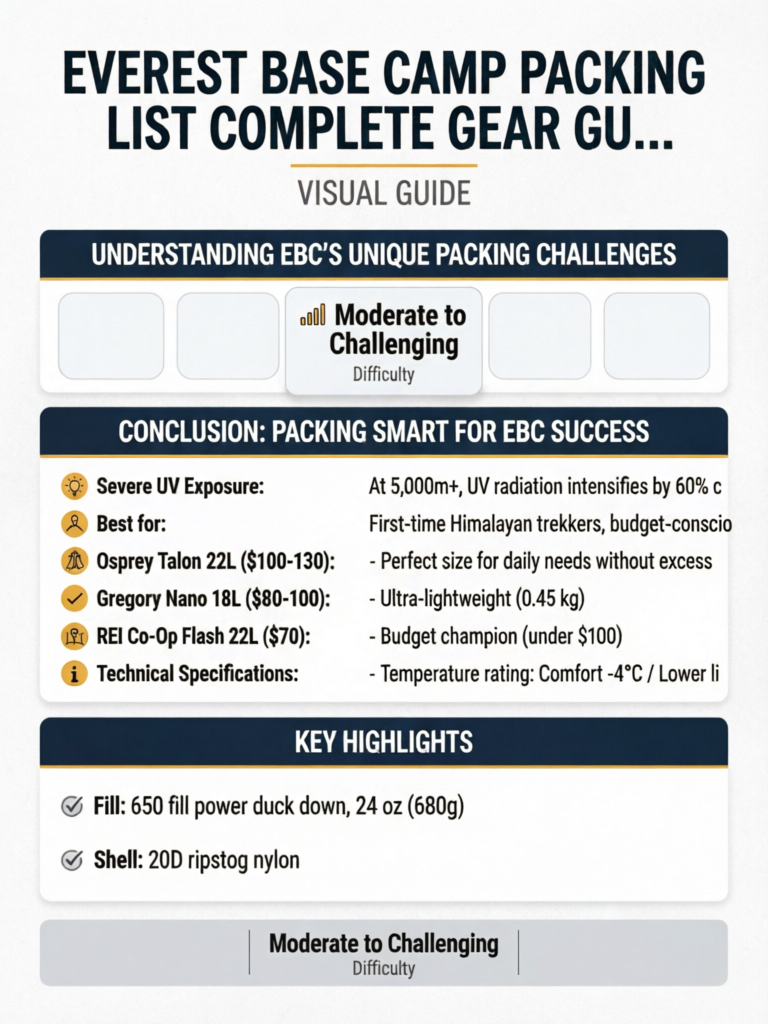
5,364m (Everest Base Camp)
5,164m (Gorak Shep)
-20°C to +15°C (depending on altitude/season)
12-16 days
4 distinct climate zones: 2,860m to 5,364m
15 kg maximum (most trekkers aim for 10-12 kg)
10 kg checked baggage (strictly enforced)
6-8 days (cold weather gear essential)
Excellent in Kathmandu, limited above Namche
Limited above 3,440m; plan for 5-7 days of clothing
60% more intense than sea level
50% of sea level (affects exertion levels)
Why EBC Packing Differs from Other Treks
The Everest Base Camp trek presents unique packing challenges that distinguish it from lower-altitude Himalayan routes like Annapurna Base Camp or beginner-friendly treks:
Extreme Temperature Variation: You'll experience 1,400m Kathmandu humidity (25°C+) and -20°C nights at Gorak Shep (5,164m) within the same week. No single clothing system handles both—understanding the proper layering strategy becomes critical for comfort and safety.
Extended High-Altitude Exposure: Unlike Annapurna Base Camp (1-2 days above 4,000m), EBC keeps you at extreme altitude for 6-8 consecutive days. Your sleeping bag, down jacket, and base layers work harder and longer. This extended exposure means equipment failures have serious consequences—there's no quick descent to warmer elevations.
Weight Sensitivity at Altitude: Carrying an extra 3 kg feels manageable at 2,000m but becomes exhausting at 5,000m where oxygen levels drop to 50% of sea level. Every unnecessary item compounds fatigue and increases altitude sickness risk. This is why experienced trekkers obsess over pack weight—it's not about bragging rights, it's about summit success.
Limited Resupply Options: Above Namche Bazaar (3,440m), gear availability diminishes dramatically. Forgotten essentials cost 200-300% more than Kathmandu prices, and many specialized items simply aren't available. You can't count on buying what you forgot—you must pack comprehensively from the start.
Severe UV Exposure: At 5,000m+, UV radiation intensifies by 60% compared to sea level. Standard sunglasses (Category 2-3) and SPF 30 sunscreen prove inadequate—you need Category 4 glacier glasses and SPF 50+ glacier cream. Trekkers regularly suffer serious sunburn, snow blindness, and long-term skin damage from underestimating Himalayan UV intensity.
Multi-Week Duration: Unlike weekend hikes, you'll live in these clothes for two weeks with minimal laundry access. Odor control, moisture management, and durability become paramount. What works for a 3-day backpacking trip fails spectacularly on a 14-day high-altitude expedition.
Pro Tip
The #1 packing mistake experienced guides see: trekkers bringing too many clothes and not enough critical items (headlamp batteries, water purification, comprehensive first aid). You'll wear the same trekking outfit 3-4 days straight—but you absolutely need backup headlamp batteries when your primary dies at 4 AM before the Kala Patthar climb. Pack fewer clothes, more critical backup systems.
The Four Climate Zones You'll Navigate
Understanding EBC's distinct climate zones helps you pack appropriate gear for each altitude band:
Zone 1: Lukla to Namche Bazaar (2,860m - 3,440m)
- Temperature: 10-20°C daytime, 5-10°C nighttime
- Climate: Humid, forest environment, potential rain
- What you'll wear: Base layers + light fleece, rain gear accessible
- Sleeping: 0°C to -5°C rated bag sufficient
Zone 2: Namche to Tengboche (3,440m - 3,860m)
- Temperature: 5-15°C daytime, 0-5°C nighttime
- Climate: Transitional, less humidity, stronger sun
- What you'll wear: Adding mid-layer fleece during breaks
- Sleeping: -5°C to -10°C rated bag needed
Zone 3: Tengboche to Lobuche (3,860m - 4,940m)
- Temperature: 0-10°C daytime, -5°C to -15°C nighttime
- Climate: Alpine desert, intense sun, cold winds, minimal precipitation
- What you'll wear: Full layering system, down jacket for evenings
- Sleeping: -10°C to -15°C rated bag minimum
Zone 4: Lobuche to Everest Base Camp (5,364m) - 5,364m)
- Temperature: -5°C to +5°C daytime, -15°C to -25°C nighttime
- Climate: Extreme alpine, fierce winds, minimal moisture, brutal UV
- What you'll wear: Everything you brought, wind protection critical
- Sleeping: -15°C to -20°C rated bag essential (colder in winter months)
This zone progression explains why single-layer systems fail. You need gear versatility to handle 40°C temperature variation across the trek.
The Big 3: Backpack, Sleeping Bag, and Boots
These three items constitute your most important gear decisions and your largest investments. Get these right, and the rest follows easily. Get them wrong, and no amount of other equipment compensates for uncomfortable boots, inadequate warmth, or poor load distribution.
Backpacks: Size, Features, and Specific Models
Your backpack choice depends entirely on whether you're hiring porter support or trekking self-supported.
Understanding Backpack Size Requirements
With Porter Support (80% of Trekkers):
- 30-40L daypack: Carries daily essentials while porter handles your main duffel
- What you carry: 3L water, snacks, camera gear, extra layers, first aid, valuables, electronics
- Typical weight: 4-6 kg
- Advantage: Dramatically reduces fatigue and altitude sickness risk
- Cost: $20-25/day ($280-350 for 14-day trek)
Without Porter (Self-Supported):
- 50-65L backpack: Carries everything for 12-16 days
- What you carry: All clothing, sleeping bag, toiletries, first aid, daily essentials
- Typical weight: 10-15 kg (experienced ultralight packers can achieve 8-9 kg)
- Advantage: Complete independence, lower daily costs
- Challenge: Significantly more physically demanding, especially above 4,500m
Pro Tip
Porter support costs $20-25/day but transforms your trek experience fundamentally. Porters carry 15 kg in a duffel bag, allowing you to hike with just a light daypack. This significantly reduces fatigue and altitude sickness risk—exhaustion is a primary AMS trigger. For most first-time EBC trekkers, porter support is money exceptionally well spent. The cost difference over 14 days ($280-350) is minimal compared to your total trek investment, and the physical benefit is enormous.
Premium Self-Supported Pack: Gregory Baltoro 65L ($320-350)
Why experienced trekkers choose it:
- Response A3 suspension system excels with heavy loads (12+ kg) through dynamic weight transfer
- Enormous hipbelt pockets (passport, snacks, phone, camera accessible without removing pack)
- Adjustable torso length accommodates different body sizes (measure before buying)
- Three dorsal panel pockets plus three top lid pockets (superior organization vs competitors)
- Ventilated back panel reduces sweat accumulation (critical when working hard uphill)
- Dual-density foam hipbelt distributes weight exceptionally well
Technical Specifications:
- Capacity: 65L (also available in 55L and 75L)
- Weight: 2.13 kg (M size) / 2.22 kg (L size)
- Load capacity: Up to 23 kg comfortably (though you shouldn't carry this much to EBC)
- Available sizes: XS, S, M, L (torso measurement determines size, not height)
- Frame: Internal aluminum stays, heat-moldable to your back shape
- Hipbelt range: S (66-89cm), M (76-102cm), L (86-114cm)
Best for: Self-supported trekkers, those carrying extensive camera gear, trekkers planning multiple Himalayan trips, photographers who need excellent organization
Downside: No included rain cover (sold separately for $30), heavier than ultralight alternatives, premium price point
Real trekker feedback: "The hipbelt pockets alone justified the cost—I could grab my phone, snacks, or hand warmers while walking without stopping. At altitude where every stop feels like you're losing momentum, this was invaluable." —Sarah M., completed EBC October 2026
Premium Alternative: Osprey Aether 55L ($290-310)
Why it's popular:
- $30-40 less expensive than Baltoro with 90% of features
- Included rain cover (Baltoro doesn't include one)
- Top-lid converts to functional 10L daypack with hipbelt (extremely useful in Namche/Kathmandu)
- Anti-Gravity suspension distributes weight excellently with mesh back panel
- Slightly lighter than Baltoro (2.02 kg for M size)
- Stow-on-the-Go trekking pole attachment works smoothly
- Dual access (top-loading + front panel zipper)
Technical Specifications:
- Capacity: 55L (also available in 65L and 70L versions)
- Weight: 2.02 kg (M size) / 2.09 kg (L size)
- Load capacity: Up to 20 kg comfortably
- Available sizes: S, M, L
- Torso range: S (41-48cm), M (46-53cm), L (51-58cm)
- Hipbelt range: S (69-97cm), M (76-107cm), L (86-122cm)
Best for: Budget-conscious trekkers, those who value integrated rain cover, trekkers who want convertible daypack feature, first-time Himalayan trekkers
Downside: Mesh back panel can be cold in early morning starts, slightly less organization than Baltoro, some users report hipbelt comfort issues with loads over 15 kg
Comparison Table:
| Name | Price | Weight | Capacity | Rain Cover | Best Feature | Hipbelt Pockets | Ideal For |
|---|---|---|---|---|---|---|---|
| Gregory Baltoro 65L | $320-350 | 2.13 kg | 65L | Not included ($30 extra) | Superior organization (6 pockets) | Huge dual pockets | Heavy loads, long expeditions, photographers |
| Osprey Aether 55L | $290-310 | 2.02 kg | 55L | Included | Convertible daypack lid | Standard zippered | Value seekers, moderate loads, first-timers |
| Deuter Aircontact Lite 50+10L | $210-240 | 2.35 kg | 60L | Included | Bombproof durability | Single zippered | Budget trekkers, durability focus |
| REI Co-op Traverse 60L | $199 | 1.93 kg | 60L | Included | Best value for money | Basic open pockets | First-time trekkers, tight budgets |
Budget Options: $150-220 Range
Deuter Aircontact Lite 50+10L ($210-240):
- Proven durability used by Nepali guides and commercial expeditions
- Simple, reliable design without unnecessary features (fewer things to break)
- Expandable to 60L with adjustable top lid compression
- Heavier but absolutely bombproof construction
- Excellent value for durability-focused trekkers
- VariQuick back system for torso adjustment
- ActiveFit shoulder straps distribute weight well
Best for: Trekkers who prioritize durability over weight savings, those rough on gear, budget-conscious buyers wanting something that lasts multiple trips
REI Co-op Traverse 60L ($199):
- Excellent value for occasional trekkers (may only do EBC once)
- Comfortable suspension for loads up to 18 kg
- Included rain cover with attachment loop
- REI's satisfaction guarantee (1-year return policy, no questions asked)
- Surprisingly good ventilation for price point
- Multiple gear loops for external attachment
Best for: First-time Himalayan trekkers, budget-conscious buyers, REI members (dividend benefits), trekkers who appreciate easy return policy
Kathmandu Rental Option ($2-3/day = $28-42 total):
- Local brands (often copies of major brands with variable quality)
- Adequate for single trek if thoroughly inspected
- Inspection checklist: Check all zippers (open/close smoothly), hipbelt padding (not compressed), frame integrity (no cracks), shoulder strap stitching (no fraying), buckles (all functional)
- No warranty or long-term reliability
- Often heavily used with compromised waterproofing
- May smell musty (air out thoroughly before use)
Rental recommendation: Only rent if budget extremely tight or you're certain this is a one-time trek. The $28-42 savings compared to the REI Traverse ($199) doesn't justify the reliability risk for most trekkers.
Daypack Recommendations (With Porter Support)
Osprey Talon 22L ($100-130):
- Perfect size for daily needs without excess bulk
- Lightweight (0.59 kg) yet durable
- Reservoir sleeve for 2.5L hydration bladder
- Stow-on-the-Go poles attachment works brilliantly
- Integrated rain cover (essential feature)
- Dual stretch mesh side pockets for water bottles
- Zippered hipbelt pocket for phone/snacks
Best for: Trekkers with porter support, those who prefer minimal carrying weight, hydration bladder users
Gregory Nano 18L ($80-100):
- Ultra-lightweight (0.45 kg)
- Hydration compatible with reservoir sleeve
- Dual-density foam shoulder straps (comfortable for hours)
- Front stretch pocket perfect for rain jacket/fleece
- Attachment points for ice axe/trekking poles
- Budget-friendly without sacrificing quality
Best for: Minimalist packers, weight-conscious trekkers, those on tighter budgets
REI Co-op Flash 22L ($70):
- Budget champion (under $100)
- Weighs only 0.37 kg (incredibly light)
- Packs into own pocket (bring as backup or for side trips)
- Basic but functional for EBC needs
- No frills but reliable construction
- Good option if you want backup daypack in Kathmandu
Best for: Ultra-budget trekkers, those wanting collapsible backup, minimalists
Daypack Size Reality Check
Don't oversize your daypack. Many trekkers bring 30-35L daypacks and fill them unnecessarily. A 22L daypack carries everything you need daily: 2-3L water, camera gear, extra layers, snacks, first aid, sunscreen, and electronics. The smaller capacity forces you to pack only essentials, reducing unnecessary weight on your shoulders. Remember: your porter carries the bulk. Your daypack should feel light all day.
Sleeping Bags: Temperature Ratings That Actually Work
Your sleeping bag rating is not negotiable at EBC altitudes. This is where budget cuts can have serious consequences—inadequate warmth ruins sleep, prevents recovery, and increases altitude sickness susceptibility.
Understanding Temperature Ratings
Sleeping bags use three rating standards:
Comfort Rating: Temperature at which a "standard cold sleeper" (typically modeled on average woman) sleeps comfortably. This is your realistic temperature target.
Lower Limit Rating: Temperature at which a "standard warm sleeper" (typically modeled on average man) sleeps comfortably. Most men should use this as their target.
Extreme Rating: Survival temperature. You'll be miserably cold and at risk of hypothermia. Ignore this rating for trip planning.
For EBC, you need:
- October/November: -15°C comfort / -20°C lower limit
- March/April/May: -10°C comfort / -15°C lower limit
- December/January/February: -20°C comfort / -25°C lower limit (winter trekking)
Tea houses provide blankets, but these are typically thin and of unknown cleanliness. Never rely on tea house blankets for warmth—consider them supplemental insulation only.
Pro Tip
Temperature ratings are tested in controlled labs with standard sleeping pads and no wind. Real conditions at Gorak Shep (5,164m): drafty tea houses, altitude-induced sleep disturbance, personal variability. Always choose a bag rated 5°C colder than the expected minimum temperature. A too-warm bag can be vented (unzip it); a too-cold bag cannot be made warmer. The difference between sleeping poorly at altitude and sleeping well often determines summit success.
Premium Down Option: Western Mountaineering UltraLite (-18°C / 0°F) ($485-525)
Why it's worth the investment:
- 850+ fill power goose down (exceptional warmth-to-weight ratio)
- Weighs only 1.02 kg yet handles -18°C confidently
- Compresses to 6L stuff sack (easy packing)
- Differential cut (inner layer larger than outer) eliminates cold spots
- Continuous baffles prevent down migration
- Full-length YKK #5 zipper (robust, won't snag)
- Draft collar and draft tube eliminate heat loss
- Made in USA with lifetime warranty
Technical Specifications:
- Temperature rating: Comfort -7°C / Lower limit -18°C / Extreme -38°C
- Fill: 850+ fill power goose down, 16 oz (454g)
- Total weight: 1.02 kg
- Packed size: 17cm × 25cm
- Shell: 100% nylon taffeta, DWR treated
- Length options: 5'6", 6'0", 6'6"
Best for: Multi-season trekkers, those planning multiple Himalayan trips (Manaslu, Three Passes, Annapurna Circuit), cold sleepers, quality-focused buyers, lightweight enthusiasts
Downside: Premium price ($485-525), requires careful handling (down loses insulation when wet), needs proper storage (loose, not compressed)
Long-term value: Cost per use over 10 years of trekking makes this cheaper than multiple budget bags. Many owners report 15+ years of use with proper care.
Premium Alternative: Feathered Friends Swallow YF (-20°C) ($449-479)
Why experienced trekkers love it:
- 900 fill power down (among the highest available)
- -20°C lower limit rating (perfect for EBC)
- Weighs 1.08 kg (incredibly light for warmth provided)
- Continuous baffles (no cold spots anywhere)
- Offset differential cut (down stays in place)
- Made in Seattle with lifetime warranty
- YKK #5 zipper with draft tube
Technical Specifications:
- Temperature rating: Comfort -9°C / Lower limit -20°C / Extreme -42°C
- Fill: 900 fill power goose down, 18 oz (510g)
- Total weight: 1.08 kg
- Shell: 10D Pertex Quantum (extremely lightweight yet durable)
- Available sizes: Short, Regular, Long
Best for: Cold sleepers, winter trekkers (December-February), those wanting maximum warmth with minimum weight, quality-focused buyers
Comparison:
| Name | Price | Weight | Temp Rating | Fill Power | Best Feature | Ideal For |
|---|---|---|---|---|---|---|
| Western Mountaineering UltraLite | $485-525 | 1.02 kg | -7°C comfort / -18°C lower | 850+ down | Exceptional compression, lifetime warranty | Multi-trip investment, warm sleepers |
| Feathered Friends Swallow YF | $449-479 | 1.08 kg | -9°C comfort / -20°C lower | 900 down | Warmest for weight, premium down | Cold sleepers, winter trekking |
| Mountain Hardwear Bishop Pass | $340-380 | 1.36 kg | -12°C comfort / -18°C lower | 650 down | Budget-friendly down option | First-time trekkers, budget-conscious |
| Marmot Trestles Elite 0°F | $280-320 | 1.87 kg | -7°C comfort / -18°C lower | 650 down | Affordable, reliable warmth | Occasional trekkers, value seekers |
Synthetic Alternative: REI Co-op Magma Trail Quilt 15°F ($229-259)
Why synthetic makes sense for some trekkers:
- Continues insulating even when damp (critical in monsoon/spring)
- Less expensive than equivalent down bags
- Easier care (machine washable)
- Dries much faster than down if wet
- No ethical concerns about animal products
- Better for humid/wet trekking conditions
Technical Specifications:
- Temperature rating: Comfort -4°C / Lower limit -9°C
- Insulation: 133g/m² HL-ThermoDRY synthetic
- Weight: 1.22 kg (quilt style reduces weight)
- Packed size: 23cm × 28cm (larger than down equivalent)
- Shell: 20D ripstop nylon with DWR
Important limitation: This bag is rated to -9°C lower limit, which is marginal for peak season EBC (October/November). You'd need to combine with sleeping bag liner and extra blankets. Better suited for spring trekking (April/May) when temperatures stay above -10°C.
Best for: Spring/autumn shoulder season trekkers, those trekking in wet conditions, budget-conscious buyers, ethical vegetarians/vegans
Budget Down Option: Mountain Hardwear Bishop Pass 15°F ($340-380)
The budget down compromise:
- 650 fill power down (lower than premium bags but adequate)
- Comfort rating -12°C / Lower limit -18°C (suitable for October/November)
- Weight: 1.36 kg (heavier than premium options but acceptable)
- Solid construction from reputable brand
- Better value than cheap no-name bags
- Thermal Q insulation in footbox (synthetic reinforcement where moisture accumulates)
Technical Specifications:
- Fill: 650 fill power duck down, 24 oz (680g)
- Shell: 20D ripstop nylon
- Lining: 20D ripstop nylon
- EN temperature tested: -12°C comfort / -18°C lower
- Weight: 1.36 kg
- Available lengths: Regular, Long
Best for: First-time Himalayan trekkers, those on moderate budgets ($300-400 range), trekkers planning 1-2 multi-day treks
Realistic assessment: This bag gets you there for less money. You'll carry 300-400g more weight than premium bags, but for a one-time EBC trek, that's an acceptable trade-off for $140-180 savings.
Kathmandu Rental Reality ($2-3/day = $28-42 total)
Rental bag quality varies dramatically:
- Good rentals: North Face, Mountain Hardwear, Marmot bags rated to -15°C or colder, well-maintained
- Mediocre rentals: Chinese knockoffs with dubious temperature ratings, compressed down (reduced loft), questionable cleanliness
- Poor rentals: Thin bags inadequate for altitude, musty smell, broken zippers, severely compressed down
Rental inspection checklist:
- Check temperature rating tag (insist on -15°C minimum for October/November)
- Fluff the bag and check loft (should expand to 15-20cm thickness)
- Check zipper operation (full length, no catching)
- Smell test (musty = poorly stored/cleaned)
- Check shell for tears or holes
- Verify draft collar and draft tube present
Rental recommendation: Sleeping bag rental makes sense for budget trekkers ($28-42 vs $340-525 purchase). HOWEVER, rental quality directly affects your sleep, recovery, and summit success. If renting, go to reputable shops (Shona's Alpine Rental, Himalayan Wonders, Mountain Mart in Thamel), pay the premium rate ($3/day vs $2/day), and insist on inspecting multiple bags before choosing.
Sleeping Bag Rental Risk
Poor sleep at altitude compounds AMS risk, reduces recovery, and makes summiting significantly harder. If you rent a marginal sleeping bag to save $20-30 over two weeks, you risk your entire trek investment (flights, permits, guide, porters = $2,000-4,000). Many trekkers who rented inadequate bags report this as their biggest regret. Consider renting a premium bag ($3/day) or buying a quality bag if you plan any future high-altitude trekking.
Essential Sleeping Bag Accessories
Sleeping Bag Liner ($30-80):
- Silk liner: Adds 3-5°C warmth, weighs 150-200g, packs tiny, feel luxurious
- Fleece liner: Adds 8-12°C warmth, weighs 400-500g, bulkier, cheaper
- Recommendation: Sea to Summit Thermolite Reactor liner ($55-75), adds 8°C, weighs 310g, machine washable
Compression Stuff Sack ($25-45):
- Reduces packed size by 40-50%
- Use for transport only (never long-term storage)
- Essential for fitting bag in backpack
- Recommendation: eVent compression sack (waterproof and breathable)
Sleeping Pad ($50-200):
- Tea houses provide thin foam mattresses (R-value 1-2, inadequate)
- You need supplemental insulation from cold floor
- Budget: Therm-a-Rest Z-Lite SOL (closed-cell foam, $50, R-value 2.6, indestructible)
- Premium: Therm-a-Rest NeoAir XLite (inflatable, $200, R-value 4.2, very warm and comfortable)
- Recommendation: Bring at least R-value 3.0+ pad for adequate insulation
Combined R-value: Tea house mattress (1.5) + your pad (3.0) = 4.5 total (adequate for -15°C nights)
Footwear: Boots vs Trail Runners vs Approach Shoes
Footwear generates more debate than any other EBC gear choice. The traditional recommendation (heavy leather boots) conflicts with modern ultralight approaches (trail runners). The truth: your optimal choice depends on experience, pack weight, and terrain preferences.
Understanding EBC's Terrain Requirements
What you'll encounter:
- 130km total distance (round trip Lukla to EBC to Lukla)
- Stone stairs (thousands of uneven steps, hard on knees)
- Rocky moraine (unstable footing, ankle-twisting potential)
- Stream crossings (wet rocks, slippery surfaces)
- Snow/ice patches above 4,500m (especially early morning, winter months)
- Glacier terrain near EBC (rough, uneven, potential ice)
- Steep ascents and descents (significant gravitational stress)
Footwear must provide:
- Ankle support for heavy packs and unstable terrain
- Waterproofing for stream crossings and snow
- Insulation for -20°C morning temperatures
- Traction on wet rocks, ice, and loose gravel
- Durability for 130km of rocky trails
- Comfort for 6-8 hours daily hiking
Option 1: Traditional Trekking Boots (Recommended for 80% of Trekkers)
Scarpa Zodiac Plus GTX ($290-320):
- Full-grain leather upper (extremely durable, excellent support)
- Gore-Tex waterproofing (guaranteed dry feet)
- High-cut ankle design (superior support with heavy pack)
- Vibram sole with aggressive tread (excellent traction)
- Insulated version available (Zodiac Plus GTX Insulated, add 200g Primaloft)
- Proven on thousands of EBC treks
Technical Specifications:
- Weight: 820g per boot (M size 42)
- Waterproofing: Gore-Tex Performance Comfort
- Upper: 2.0mm full-grain leather
- Sole: Vibram Vertical Pro with Impact Brake System
- Insulation: Optional Primaloft (insulated version)
- Lacing: Traditional laces to toe (secure fit)
Best for: First-time Himalayan trekkers, those carrying heavier packs (12+ kg), cold-sensitive feet, trekkers wanting maximum support and protection
Breaking in period: 50-80km walking before EBC (critical—never trek in new boots)
Lowa Renegade GTX Mid ($265-295):
- Popular alternative to Scarpa (slightly lighter, similar support)
- Nubuck leather upper with synthetic reinforcements
- Gore-Tex waterproofing
- Lighter weight (750g per boot)
- Monowrap frame construction (excellent stability)
- Very popular in European trekking market
Best for: Trekkers wanting slightly lighter boots without sacrificing support, those with narrower feet (Lowa tends to run narrow)
Salomon Quest 4D 3 GTX ($240-270):
- Modern design with reduced weight (780g per boot)
- Sensifit technology (wraps foot for secure hold)
- Advanced Chassis for stability
- Contagrip sole (excellent wet traction)
- Good value for features provided
- Popular with younger trekkers
Best for: Trekkers prioritizing modern technology, those wanting lighter traditional boots, value-conscious buyers
| Name | Price | Weight | Material | Waterproofing | Support | Best Feature | Ideal For |
|---|---|---|---|---|---|---|---|
| Scarpa Zodiac Plus GTX | $290-320 | 820g per boot | Full-grain leather | Gore-Tex | Excellent (rigid) | Maximum durability and support | First-timers, heavy packs |
| Lowa Renegade GTX Mid | $265-295 | 750g per boot | Nubuck leather + synthetic | Gore-Tex | Excellent (moderate flex) | Lighter with great support | Balanced support and weight |
| Salomon Quest 4D 3 GTX | $240-270 | 780g per boot | Synthetic + nubuck | Gore-Tex | Very good (modern chassis) | Modern tech, great value | Tech-focused, value seekers |
| Altra Lone Peak 6 (Trail Runners) | $140-160 | 300g per shoe | Mesh + synthetic | Water-resistant (not waterproof) | Minimal (relies on foot strength) | Ultralight, natural foot shape | Experienced ultralight trekkers |
Option 2: Trail Runners (For Experienced Ultralight Trekkers)
The ultralight argument:
- Dramatically lighter (300-400g per shoe vs 750-850g per boot)
- Faster hiking pace (less weight = less fatigue)
- Better breathability (feet stay drier from sweat)
- Quicker drying if wet
- More natural foot movement
- Less knee stress (lighter weight = less impact)
The ultralight reality check:
- Requires strong ankles (no boot support)
- Requires lighter pack weight (under 10 kg ideally)
- Requires previous trail running experience (technique matters)
- Provides no insulation (cold feet in mornings above 4,500m)
- Wears out faster (may need replacement after EBC)
- Feet get wet more easily (most are water-resistant, not waterproof)
Altra Lone Peak 6 ($140-160):
- Zero-drop platform (natural foot position)
- Wide toe box (accommodates swelling at altitude)
- TrailClaw outsole (excellent traction)
- Quick-dry mesh upper
- Gaiter trap (keeps debris out)
- Popular with thru-hikers and ultralight trekkers
Hoka One One Speedgoat 5 ($155-180):
- Maximum cushioning (reduces fatigue on stone stairs)
- Vibram Megagrip outsole (exceptional traction)
- Wider platform (stability on uneven terrain)
- Moderate drop (4mm)
- Excellent for trekkers with knee issues
Important: If choosing trail runners for EBC, bring insulated booties for camp wear (your feet will be cold in thin runners at altitude). Also pack waterproof socks (SealSkinz, Rocky Gore-Tex) for stream crossings and wet conditions.
Pro Tip
Trail runners on EBC are not for beginners. This approach requires: (1) Strong ankles from trail running experience, (2) Light pack under 10 kg, (3) Willingness to have cold/wet feet sometimes, (4) Good footwork on uneven terrain, (5) Porter support (not carrying full pack). If you're unsure, choose boots. The weight penalty is small compared to the risk of ankle injury or cold feet at altitude.
Option 3: Approach Shoes (Middle Ground)
La Sportiva TX4 Mid GTX ($199-229):
- Mid-height (ankle support without full boot weight)
- Gore-Tex waterproofing
- Weight: 550g per shoe (lighter than boots, more supportive than trail runners)
- Vibram Megagrip sole
- Rock climbing zone at toe (useful for scrambling)
- Good compromise option
Best for: Experienced trekkers wanting less weight than boots but more support than trail runners, those with strong ankles, trekkers who've used approach shoes before
Limitation: Less insulation than full boots (cold feet in early mornings), less rigid support (harder with heavy packs over 12 kg)
Gaiters: Essential or Optional?
When you need gaiters:
- Winter trekking (snow above 4,500m)
- Spring trekking (wet, muddy conditions)
- Using trail runners or approach shoes (debris protection)
When you can skip gaiters:
- Autumn peak season (October/November) with stable weather
- Using high-cut boots with snug fit
- Trekking during dry conditions
Recommendation: Outdoor Research Crocodile Gaiters ($65-85)
- Full waterproof protection
- Durable Cordura fabric
- Front zipper (easy on/off over boots)
- Secure instep strap
- Used by mountaineers worldwide
Budget alternative: Lightweight trail gaiters ($25-35) adequate for debris protection if not dealing with deep snow
Footwear Accessories
Merino Wool Socks ($18-30 per pair, bring 4-5 pairs):
- Darn Tough Vermont ($25-30): Lifetime guarantee, excellent durability, perfect cushioning
- Smartwool PhD Outdoor ($20-28): Great fit, good cushioning, widely available
- Icebreaker Hike+ ($18-24): Budget merino option, good quality
Sock system: Wear one pair, have one drying, keep three clean pairs in reserve. Bring 4-5 pairs total.
Liner Socks ($12-18 per pair, optional but recommended):
- Thin synthetic liner worn under wool sock
- Reduces friction and blister formation
- Wicks moisture away from skin
- Recommended for trekkers prone to blisters
Camp Shoes ($20-60):
- Essential for tea house evenings and mornings
- Gives feet a break from hiking boots
- Options: Crocs ($25-40), down booties ($50-80), slides ($20-30)
- Premium: Western Mountaineering down booties ($75-95) - extremely warm, pack small
- Budget: Crocs Classic clogs ($25-40) - durable, easy to slip on, not insulated but adequate with warm socks
Complete Clothing System: Layering for 2,860m to 5,364m
Proper clothing for EBC follows the proven three-layer system: base layer (moisture management), mid layer (insulation), outer layer (weather protection). Understanding this system is covered comprehensively in our what to wear trekking Nepal guide.
Base Layers: The Foundation
Base layers manage moisture by wicking sweat away from skin. This keeps you dry, which keeps you warm. Cotton retains moisture and makes you cold—NEVER wear cotton base layers at altitude.
Upper Body Base Layers
Quantity needed: 2-3 long-sleeve base layer tops
Option 1: Merino Wool (Premium)
Icebreaker 200 Oasis Long Sleeve Crew ($90-110):
- 200g/m² merino wool (midweight—perfect for EBC)
- Odor resistance (wear 3-5 days between washes)
- Natural temperature regulation
- Comfortable against skin
- Flatlock seams (no chafing)
- Available in men's and women's specific fits
Smartwool Intraknit Merino 200 ($120-140):
- Advanced knit construction (breathable zones where you sweat most)
- 200g/m² merino
- Body-mapped ventilation
- Slightly more expensive but exceptional comfort
- Athletic cut (good for active trekking)
Budget merino: Minus33 Merino Wool Base Layer ($60-75)
- 100% merino wool
- Less refined than Icebreaker/Smartwool but functional
- Good entry point to merino
- Heavier weight but durable
Option 2: Synthetic (Budget-Friendly)
Patagonia Capilene Midweight ($69-89):
- 100% polyester with Polygiene odor control
- Excellent moisture wicking
- Dries very quickly (2-3 hours)
- Less expensive than merino
- Very durable
- HeiQ Fresh odor treatment helps (though not as effective as merino's natural odor resistance)
REI Co-op Midweight Base Layer ($45-60):
- Budget synthetic option
- Polyester blend with some spandex (stretch comfort)
- Good moisture management
- Available in crew and half-zip versions
- Great value for occasional trekkers
Recommendation: Bring 2 base layer tops minimum. Many trekkers bring 3 (wear one, have one drying, keep one clean). Merino justifies cost for odor resistance—you'll wear the same base layer 3-4 days without smell. Synthetic works but retains odor faster.
Lower Body Base Layers
Quantity needed: 1-2 base layer bottoms (thermal leggings/long underwear)
Smartwool Intraknit Merino 200 Bottom ($120-130):
- Same advanced construction as upper
- Body-mapped zones
- Comfortable waistband
- Gusseted crotch (full range of motion)
Icebreaker 260 Tech Leggings ($100-120):
- Heavier weight (260g/m²) for extra warmth
- Gusseted construction
- Flatlock seams throughout
- Can double as sleep layer
Patagonia Capilene Thermal Weight Bottoms ($99-119):
- Synthetic option
- Grid fleece interior (excellent warmth and wicking)
- Dries quickly
- Durable construction
- Odor treatment
Budget option: REI Co-op Midweight Base Layer Bottom ($50-65)
Recommendation: One pair is usually sufficient. You'll wear these under your trekking pants during cold mornings and evenings. Many trekkers also sleep in base layer bottoms. Bring two pairs if you want rotation or plan to sleep in them.
Mid Layers: Adjustable Warmth
Mid layers provide insulation. You'll add and remove these throughout the day as temperature changes.
Fleece Jacket
Quantity needed: 1 midweight fleece (200-weight)
Patagonia R1 Pullover Hoody ($169-189):
- Classic midlayer used by climbers and trekkers worldwide
- Polartec Power Grid fleece (excellent warmth-to-weight)
- Highly breathable (doesn't trap sweat)
- Athletic fit (layers well under shell)
- Hoody adds warmth without bulk
- Thumb loops keep sleeves in place
Arc'teryx Delta LT Jacket ($129-159):
- Polartec Classic fleece
- Trim fit (layers exceptionally well)
- No hood (some prefer this for layering)
- Excellent quality construction
- Very durable
REI Co-op Trailmade Fleece Jacket ($70-90):
- Budget fleece option
- Polyester fleece construction
- Full-zip (better temperature regulation than pullover)
- Zippered hand pockets
- Good value for occasional use
Recommendation: Full-zip vs pullover is personal preference. Full-zip offers better temperature control (partial unzip when warm). Pullover with hoody adds head warmth option. Either works well for EBC.
Down Jacket (Essential Above 3,500m)
Quantity needed: 1 down jacket (essential, non-negotiable)
This is your evening warmth at altitude. You'll rarely wear it while actively trekking (too warm), but it's critical for camp comfort and emergency warmth.
Patagonia Down Sweater ($279-329):
- 800-fill-power goose down
- DWR finish (water-resistant shell)
- Compressible (packs into own pocket)
- Warm enough for EBC evenings (combine with fleece for extreme cold)
- Excellent durability
- Lifetime warranty
Arc'teryx Cerium LT Hoody ($379-429):
- 850-fill-power goose down
- Coreloft synthetic in moisture-prone areas (armpits, shoulders)
- Down Composite Mapping (down where dry, synthetic where wet)
- Extremely warm for weight (340g for medium)
- Premium construction
- Expensive but exceptional quality
Mountain Hardwear Ghost Whisperer/2 ($380-420):
- 800-fill-power goose down
- Incredibly lightweight (223g for medium)
- Ultralight 7D shell fabric
- Very compressible
- Best warmth-to-weight ratio available
- Delicate shell requires careful handling
Budget option: REI Co-op 650 Down Jacket 2.0 ($149-179)
- 650-fill-power down (less loft than premium options)
- Heavier (510g for medium) but functional
- DWR shell
- Excellent value for money
- Good for one-time EBC trekkers
Kathmandu rental: Down jackets are commonly rented ($2-3/day)
- North Face, Mountain Hardwear, Rab brands available
- Usually 650-800 fill power
- Inspect for:
- Full loft (fluff it up and check thickness)
- No down leaking (check seams)
- Functional zippers
- Clean, odor-free
- Rental makes sense if budget tight (saves $150-400)
Down Jacket Usage Pattern
Typical EBC day: Start hiking at 7-8 AM without down jacket (base layer + fleece sufficient). Trek gets warm by 10 AM. Sun sets around 5 PM, temperature drops rapidly. Put on down jacket at 5-6 PM, keep it on until bedtime. Wear it again next morning before sunrise (especially for early Kala Patthar climb at 4-5 AM). You wear your down jacket maybe 4-6 hours daily, but those hours are critical for comfort. It's the difference between miserable shivering and comfortable evenings.
Outer Layers: Weather Protection
Waterproof Rain Jacket (Hardshell)
Quantity needed: 1 waterproof jacket (essential)
Arc'teryx Beta AR Jacket ($575-650):
- Gore-Tex Pro (most durable waterproof fabric available)
- Helmet-compatible hood (fits over winter hat)
- Pit zips for ventilation (critical feature)
- Extremely durable (handles abrasion from pack straps)
- Articulated arms (excellent range of motion)
- Premium price but exceptional longevity
Outdoor Research Interstellar Jacket ($300-349):
- AscentShell fabric (highly breathable waterproof)
- Better breathability than Gore-Tex (less internal condensation)
- Pit zips included
- More affordable than Arc'teryx
- Good hood design
- Excellent value for performance
REI Co-op XeroDry GTX Jacket ($199-229):
- Gore-Tex Paclite Plus (lightweight waterproof)
- Budget-friendly
- Pit zips included
- Adjustable hood
- Good value for occasional use
- Less durable than premium options but adequate for single trek
Recommendation: Pit zips are non-negotiable. When hiking uphill in rain gear, you generate tremendous heat. Pit zips allow heat dump without removing jacket. This single feature justifies paying extra.
Rain Pants
Quantity needed: 1 pair waterproof pants (essential)
Outdoor Research Helium Rain Pants ($120-149):
- Full side zips (pull on over boots without removing them)
- Packable (minimal space in pack)
- Elastic waist with drawcord
- Reinforced cuffs (resist abrasion from boots)
Marmot PreCip Eco Full-Zip Pants ($100-125):
- Full side zips
- Budget-friendly
- Recycled materials
- Adequate waterproofing
- Good value
Recommendation: Full side zips are essential. When sudden rain starts, you need to pull these on over boots without stopping to remove them. Quarter zips or no zips are extremely frustrating in actual use.
Trekking Pants and Shorts
Quantity needed: 1-2 trekking pants, 1 trekking shorts (optional)
Prana Stretch Zion Pants ($89-99):
- Nylon/spandex blend (excellent stretch)
- Water-resistant (DWR finish)
- Multiple pockets (passport-sized security pocket)
- Durable construction
- Available in straight and slim fits
- Extremely popular with trekkers worldwide
Outdoor Research Ferrosi Pants ($89-109):
- Soft-shell fabric (light water resistance, high breathability)
- Movement-mirroring stretch
- Slim fit (layers well)
- Lightweight (284g)
- Packable
Women's specific: Prana Halle Pants ($85-95)
- Best-selling women's trekking pant
- Mid-rise fit
- Stretch fabric
- Roll-up leg snaps (convert to capri)
- UPF 50+ sun protection
Shorts option: Many trekkers bring convertible pants/shorts or separate trekking shorts for lower elevations (Lukla to Namche). Above Namche, you'll primarily wear long pants due to cold and cultural considerations.
Underwear and Sports Bras
Quantity needed: 4-5 pairs underwear, 2-3 sports bras (women)
ExOfficio Give-N-Go Underwear ($26-32 per pair):
- Quick-dry synthetic
- Odor-resistant treatment
- Can wash in sink and dry overnight
- Extremely popular with travelers
- Available in boxer brief and brief styles
Sports bras: High-support, moisture-wicking essential
- Moving Comfort Juno ($60-70): High support, comfortable straps
- Patagonia Switchback ($59-69): Medium support, versatile
- REI Co-op Active Pursuits ($35-45): Budget option, good support
Accessories: Head, Hands, Neck
Head Protection
Sun hat (below 4,000m):
- Wide brim for sun protection
- Breathable material
- Chin strap (prevents wind loss)
- Outdoor Research Sombriolet Sun Hat ($35-45)
Warm beanie (above 3,500m):
- Merino wool or synthetic
- Covers ears completely
- Smartwool Beanie ($30-40)
- Patagonia Better Sweater Beanie ($35-45)
Balaclava (optional, recommended for winter/summit push):
- Full head and neck coverage
- Windproof fabric
- Outdoor Research Alpine Onset Balaclava ($35-45)
Hand Protection
Lightweight gloves (lower altitudes):
- Liner gloves for cool mornings
- OR PL 100 Sensor Gloves ($35-45)
- Touch-screen compatible
Midweight gloves (primary gloves):
- Insulated, wind-resistant
- OR Stormtracker Gloves ($50-65)
Heavyweight mittens (above 4,500m, summit day):
- Maximum warmth for extreme cold
- Black Diamond Mercury Mitts ($70-90)
- OR Alti Mitts ($80-100)
Recommendation: Bring 2-3 glove options. Mornings at 5,000m require heavy gloves/mittens. Midday at 3,000m you may not need gloves at all. Layering hand protection works like body layering.
Neck Protection
Buff or neck gaiter:
- Multifunctional (neck warmer, face mask, headband)
- Merino wool version recommended
- Buff Original ($25-30)
- Smartwool Merino 250 Neck Gaiter ($35-45)
Seasonal Packing Variations
October/November (Peak Autumn Season)
Conditions:
- Daytime: 5-15°C at altitude, sunny, low precipitation
- Nighttime: -10°C to -20°C above 4,500m
- Weather: Stable, clear skies, minimal rain/snow
Packing adjustments:
- Full cold weather gear essential (down jacket, warm sleeping bag, heavy gloves)
- Rain gear less critical but still bring it (occasional storms)
- Sun protection critical (intense UV, clear skies)
March/April/May (Spring Season)
Conditions:
- Daytime: 10-20°C at altitude, variable weather
- Nighttime: -5°C to -15°C above 4,500m (warmer than autumn)
- Weather: Less stable, afternoon clouds common, occasional precipitation
Packing adjustments:
- Slightly lighter sleeping bag acceptable (-10°C to -15°C comfort rating)
- Rain gear more critical (higher precipitation chance)
- Still need down jacket but conditions generally warmer
December/January/February (Winter Season)
Conditions:
- Daytime: 0-10°C at altitude, very cold
- Nighttime: -15°C to -25°C above 4,500m (extreme cold)
- Weather: Stable but bitterly cold, heavy snow possible
Packing adjustments:
- Warmest sleeping bag needed (-20°C to -25°C comfort rating)
- Heaviest down jacket
- Expedition-weight gloves/mittens essential
- Insulated boots (standard boots inadequate)
- Face protection critical (balaclava, goggles)
Winter trekking: Only for experienced cold-weather trekkers. Most tea houses close above Tengboche. Consider this advanced trekking.
Technical Gear and Accessories
Trekking Poles
Necessity level: Highly recommended (80% of trekkers use them)
Benefits:
- Reduce knee stress by 25% on descents (thousands of stone steps)
- Improve stability on uneven terrain
- Reduce ankle injury risk
- Help with river crossings
- Useful for testing snow depth
- Reduce overall fatigue
Black Diamond Trail Ergo Cork ($140-160 per pair):
- Cork grip (comfortable, absorbs sweat, stays warm in cold)
- FlickLock adjustment (secure, easy to adjust)
- Carbide tip with removable rubber boot
- Collapsible (pack easier for flights)
- Interchangeable basket options
LEKI Makalu FX Carbon ($180-200 per pair):
- Carbon fiber (lighter than aluminum)
- Cork grip
- SpeedLock 2 adjustment
- Excellent durability
- Premium option
Budget option: REI Co-op Trailmade Trekking Poles ($80-100 per pair)
- Aluminum construction
- Cork grip
- FlickLock-style adjustment
- Excellent value
- Adequate for most trekkers
Rental option: Available in Kathmandu ($0.50-1/day = $7-14 total)
- Often Chinese-made copies of major brands
- Functional but less reliable
- Check: secure locking mechanism, intact tips, comfortable grips
- Good rental option if budget tight
Pole tips: Rubber tip covers reduce noise on stone trails (culturally appreciated), protect carbide tips on rock. Bring snow baskets if trekking in winter.
Headlamp
Necessity level: Essential (non-negotiable)
Usage:
- Tea houses have limited electricity (3-4 hours evening charging)
- Early morning starts (Kala Patthar summit: 4-5 AM start in darkness)
- Night bathroom trips (tea houses have outdoor toilets)
- Emergency situations
- Reading in sleeping bag
Petzl Actik Core ($70-90):
- 450 lumens (very bright)
- Rechargeable battery + compatible with AAA batteries (backup power)
- Multiple brightness modes
- Red light mode (preserves night vision)
- IPX4 water resistance
Black Diamond Spot 400 ($50-60):
- 400 lumens
- Uses 4 AAA batteries (easier to find replacements)
- PowerTap technology (instant brightness adjustment)
- Waterproof (IPX8)
- Excellent value
Critical: Bring extra batteries (AAAs or backup battery pack). Battery performance degrades significantly in cold. Keep batteries warm (sleep with them in sleeping bag).
Recommendation: Headlamp with red light mode preferred for tea house use (less disruptive to roommates).
Water Bottles and Hydration
Daily water need: 3-4 liters (altitude increases dehydration)
Option 1: Nalgene Wide-Mouth Bottles (2 × 1L = $20-30 total)
- Indestructible
- Can fill with hot water for sleeping bag warmth
- Wide mouth easier to fill from taps/streams
- Clear plastic shows water level
- BPA-free
Option 2: Insulated bottles (1-2 bottles)
- Hydroflask 32 oz ($40-50): Keeps water from freezing in cold
- Prevents freezing at night (bring bottle into sleeping bag)
- Heavier than Nalgene
Option 3: Hydration bladder (2-3L)
- Platypus Hoser 3L ($35-45)
- Convenient drinking while trekking
- Problem: Hose freezes above 4,500m (blow water back into bladder after drinking)
- Many trekkers start with bladder, switch to bottles above Dingboche
Water purification:
SteriPEN Ultra ($100-120):
- UV purification
- Rechargeable battery
- Purifies 1L in 90 seconds
- Effective against bacteria, viruses, protozoa
- Requires clear water (doesn't filter sediment)
Sawyer Squeeze Filter ($35-45):
- Physical filtration
- Attaches to standard water bottles or bladder
- Lighter than SteriPEN
- No batteries needed
- Doesn't kill viruses (less critical in Nepal)
Aquatabs purification tablets ($10-15 for 50 tablets):
- Chemical purification
- Lightweight backup
- 30-minute wait time
- Slight chlorine taste
Recommendation: Bring two purification methods (SteriPEN + Aquatabs as backup, or Sawyer + Aquatabs). Tea houses sell "safe drinking water" ($1-2/liter, increasingly expensive at altitude) but purification gives independence and saves money.
Electronics and Power
Phone/Camera:
- Essential for photos, GPS, communication
- Keep in jacket pocket during cold (batteries die quickly in freezing temperatures)
- Airplane mode conserves battery
Portable power bank:
- 20,000-30,000 mAh capacity
- Anker PowerCore 20100 ($40-50)
- Charge in Kathmandu and Namche (extended charging available)
- Above Namche: Limited charging ($2-5 per device per charge)
Charging strategy:
- Charge everything in Kathmandu before departure
- Charge in Namche during acclimatization day (extended electricity)
- Ration power bank use above Namche
- Tea houses offer charging ($2-5 per device) with limited electricity hours (usually 5-9 PM)
Adapter plugs:
- Nepal uses Type C, Type D, and Type M plugs (230V)
- Universal travel adapter recommended
- Many tea houses have multiple plug types available
Camera:
- Bring extra batteries (cold reduces capacity)
- SD card: 64-128 GB (lots of photos)
- Keep camera in inner jacket pocket until use (temperature shock can fog lens)
Personal Hygiene and Toiletries
Minimalist approach recommended (weight and space matter)
Essential items:
- Small quick-dry towel (PackTowl Personal or similar, $15-25)
- Toothbrush and toothpaste (small sizes)
- Biodegradable soap (Dr. Bronner's, multi-use, $8-12)
- Hand sanitizer (alcohol-based, essential for frequent hand cleaning)
- Toilet paper (bring full roll, tea houses sometimes run out)
- Wet wipes (baby wipes work, freshen up when no shower available)
- Sunscreen SPF 50+ (Neutrogena Sport Face SPF 70, $12-15)
- Lip balm SPF 30+ (Aquaphor Lip Repair, $4-6)
- Small mirror (useful for checking sunburn, applying glacier cream)
Women's specific:
- Menstrual cup or tampons (disposal difficult on trail)
- Female urination device for outdoor situations (optional)
Shower reality:
- Lower altitudes (Lukla-Namche): Hot showers available ($3-5)
- Higher altitudes (above Namche): Hot showers rare or very expensive ($5-10)
- Many trekkers don't shower for 5-7 days (wet wipes substitute)
- Water is precious at altitude (showering not prioritized)
First Aid and Medications
Pre-made kit: Adventure Medical Kits Mountain Series ($40-90)
Custom kit essentials:
- Blister treatment (Compeed patches, moleskin)
- Ibuprofen/acetaminophen (pain relief, anti-inflammatory)
- Diamox/Acetazolamide (altitude sickness prevention, 250mg tablets)
- Antibiotic (Azithromycin for gastrointestinal issues)
- Anti-diarrheal (Imodium)
- Rehydration salts (oral rehydration solution)
- Bandages and gauze
- Medical tape
- Antiseptic wipes
- Tweezers (splinters, ticks)
- Nail clippers (ingrown toenails happen)
- Thermometer (monitoring for hypothermia/AMS)
Altitude medication: Consult doctor before trek. Many trekkers carry Diamox as preventive measure. Dexamethasone for emergency AMS treatment (descend, don't rely on medication alone).
Prescription medications: Bring 2x what you need (backup for loss/delays)
More details in our comprehensive EBC health guide and travel insurance requirements.
Sun Protection
UV intensity at altitude is extreme. Serious sunburn and snow blindness are common among under-prepared trekkers.
Sunglasses:
- Category 4 glacier glasses essential (blocks 92-97% light)
- Julbo Vermont Classic ($160-200): Legendary mountaineering glasses, leather side shields
- Oakley Clifden ($200-250): Modern glacier glasses, excellent coverage
- Budget: Generic Category 4 climbing glasses ($40-60)
- Side shields essential (blocks reflected UV from snow/rock)
Sunscreen:
- SPF 50+ minimum (SPF 70-100 better)
- Apply every 2 hours in full sun
- Don't skimp (liberal application necessary)
- Face, neck, ears, backs of hands critical areas
- Neutrogena Sport Face SPF 70+ ($12-15)
Lip protection:
- SPF 30+ lip balm
- Apply hourly in full sun
- Aquaphor Lip Repair SPF 30 ($4-6)
Glacier cream:
- Thick, high SPF cream for extreme conditions
- Dermatone SPF 30 Zinc Oxide ($8-12)
Neck gaiter/buff:
- Protects neck from sun exposure
- Can cover face in wind/dust
What to Buy vs What to Rent in Kathmandu
Kathmandu's Thamel district has extensive rental options. Strategic renting saves money without compromising safety.
Recommended to Rent
Sleeping bag: $2-3/day ($28-42 total)
- Savings: $200-400 vs purchasing
- Condition: Inspect carefully (loft, cleanliness, temperature rating)
- Recommendation: Rent from reputable shops (Shona's Alpine Rental, Himalayan Wonders)
Down jacket: $2-3/day ($28-42 total)
- Savings: $150-300 vs purchasing
- Condition: Check for full loft, no down leakage, functional zippers
- Consideration: If planning multiple treks, purchasing makes sense
Large backpack (if using porter): $2/day ($28 total)
- Savings: $100-200 vs purchasing
- Note: Porter carries this; quality less critical than backpack you carry daily
Trekking poles: $0.50-1/day ($7-14 total)
- Savings: $60-120 vs purchasing
- Condition: Check locking mechanisms, tips, grips
Total rental savings: $300-800 for these four items
Recommended to Purchase (Don't Rent)
Boots/footwear:
- Why: Fit is critical, breaking in required, blisters from poor-fitting rentals ruin treks
- Exception: If you have properly fitting boots at home, obviously bring them
Daypack (if using porter):
- Why: You carry this every day; comfort critical
- Note: Can rent if budget extremely tight, but comfort suffers
Base layers, socks, underwear:
- Why: Hygiene, proper fit, moisture management
- Note: These are reasonably priced and useful beyond EBC
Sunglasses:
- Why: Eye protection is non-negotiable; rental quality variable
- Cost: Category 4 glacier glasses available in Kathmandu ($40-80) if you don't bring from home
Headlamp:
- Why: Essential safety item; battery/reliability critical
- Cost: Inexpensive enough to purchase ($30-50 for decent model)
Buying Gear in Kathmandu
Authentic vs Counterfeit:
- Thamel has both genuine and fake North Face, Mountain Hardwear, etc.
- Genuine: Higher prices, authorized retailers, proper tags
- Counterfeit: 50-70% cheaper, quality variable (some surprisingly good, some terrible)
What to buy authentic:
- Items where failure is serious (sleeping bags, rain jackets, boots)
What counterfeit can work:
- Fleece layers, trekking pants, basic accessories
- Inspect quality carefully (stitching, zippers, fabric weight)
Reputable Kathmandu shops:
- Shona's Alpine Rental (genuine gear)
- Himalayan Wonders (mix of genuine and quality copies)
- Mountain Mart (rental and sales)
- Sherpa Adventure Gear (quality local brand)
Common Overpacking Mistakes
After analyzing packs of hundreds of trekkers, these are the most common overpacking errors:
Bringing Too Many Clothes
Mistake: Packing 5-7 trekking outfits for 14 days
Reality: You wear the same base layer and trekking pants for 3-4 days straight. Laundry is limited. More clothes = unnecessary weight.
Correct approach: 2-3 base layer tops, 1-2 trekking pants, 4-5 pairs socks, 4-5 underwear
Multiple Mid-Layers
Mistake: Bringing 2-3 fleece jackets or multiple insulated jackets
Reality: One good fleece + one down jacket handles all conditions when combined with proper layering.
Correct approach: One 200-weight fleece, one 800-fill down jacket
Excessive Toiletries
Mistake: Full-size shampoo, conditioner, body wash, face wash, etc.
Reality: You'll shower rarely above 3,500m. Wet wipes substitute. Minimal hygiene works.
Correct approach: Small Dr. Bronner's bottle (multi-use), toothbrush/toothpaste, wet wipes, hand sanitizer
Too Much Electronics
Mistake: Laptop, tablet, e-reader, camera, drone, multiple charging cables
Reality: Phone handles most needs. Electricity is limited/expensive. Extra electronics add weight and worry.
Correct approach: Phone + camera (if serious photographer), one power bank, minimal cables
Books and Entertainment
Mistake: 2-3 physical books, cards, games
Reality: You're exhausted after trekking. Entertainment is talking with other trekkers, sleep, and scenery. E-books on phone suffice.
Correct approach: Phone for e-reading, one deck of cards (shared with group)
Excessive Food and Snacks
Mistake: Bringing 2+ kg of snacks from home
Reality: Tea houses provide meals. Energy bars available in Namche. Unnecessary weight.
Correct approach: Small snacks for flights/first day (buy more in Namche if desired)
Weight Optimization Strategies
Target weights:
- With porter: 4-6 kg daypack
- Self-supported: 10-12 kg total pack weight (experienced ultralight: 8-9 kg)
Reduce Clothing Weight
- Choose merino wool (wear multiple days, need fewer items)
- Downgrade to 200-weight fleece (300-weight too heavy)
- Single-wall rain jacket (no need for heavy expedition shells)
Reduce Big 3 Weight
- Premium sleeping bags (800-900 fill) weigh 300-400g less than budget bags
- Premium down jackets weigh significantly less
- Carbon trekking poles vs aluminum saves 100-150g
Share Weight with Trekking Partners
- One first aid kit (not one per person)
- One guidebook (not multiples)
- Share sunscreen, toiletries where practical
Eliminate Luxury Items
- Camp chair: No (you're in tea houses)
- Pillow: No (stuff sack filled with clothes works)
- Full towel: No (use small quick-dry towel)
- Extra shoes beyond boots + camp shoes: No
Female-Specific Packing Considerations
Clothing Fit and Cultural Considerations
Sports bras: Bring 2-3 high-quality moisture-wicking bras. Wire bras uncomfortable under pack straps.
Female-specific pants: Women's pants fit better (higher rise, different proportions)
- Prana Halle Pants (most popular women's option)
- REI Sahara Pants
- Arc'teryx Gamma LT Pants
Cultural dress: Nepal is conservative. Shoulders and knees should be covered in villages. Tank tops acceptable while trekking but bring something to cover up in villages.
Pee rag: Small bandana for urination (toilet paper in short supply, reduces waste)
Female urination device: Freshette, pStyle, etc. (optional but appreciated by some for outdoor situations)
Hygiene Products
Menstrual management:
- Menstrual cup preferred (Diva Cup, Lunette)
- No waste disposal issues
- Works for full trek duration
- Can rinse with boiled water
- Tampons as alternative
- Bring more than needed
- Pack out all waste (burning in tea house stoves not acceptable)
- Period may change at altitude (sometimes skips, sometimes early)
Moisture-wicking underwear:
- ExOfficio Give-N-Go (quick dry, multiple pairs)
- Avoid cotton at all costs
Safety Considerations
Trekking solo as woman:
- EBC is very safe for solo female trekkers
- Tea houses have separate rooms or curtained sections
- Consider door wedge for room security
- Headlamp for night bathroom trips essential
More comprehensive information in our solo female trekking Nepal guide.
Budget vs Premium: Complete Gear Cost Breakdown
Budget Trekker Packing List ($800-1,200 total)
Assumes strategic rental and budget purchases:
- Boots: $200-250 (budget brand or sales)
- Sleeping bag: $30-40 (rental)
- Backpack: $150-200 (budget brand)
- Down jacket: $30-40 (rental) OR $150 (budget purchase)
- Base layers: $100-150 (synthetic alternatives)
- Mid-layer fleece: $70-90 (budget brand)
- Rain jacket/pants: $200-250 (budget waterproof)
- Trekking poles: $10-15 (rental) OR $80-100 (purchase)
- Headlamp: $30-50 (basic functional model)
- Accessories: $100-150 (socks, gloves, hat, sunglasses, etc.)
Total: $900-1,200 (with strategic rentals), $1,200-1,500 (all purchases)
Budget approach: Rent sleeping bag, down jacket, trekking poles. Buy boots (fit critical), rain gear (reliability matters), base layers. Purchase budget brands where acceptable.
Premium Trekker Packing List ($2,500-3,500 total)
Assumes quality purchases for multi-year use:
- Boots: $280-320 (Scarpa Zodiac Plus GTX)
- Sleeping bag: $450-525 (Western Mountaineering UltraLite)
- Backpack: $290-350 (Osprey Aether or Gregory Baltoro)
- Down jacket: $280-430 (Patagonia Down Sweater or Arc'teryx Cerium)
- Base layers: $300-400 (Icebreaker/Smartwool merino)
- Mid-layer fleece: $130-190 (Patagonia R1)
- Rain jacket/pants: $400-550 (Arc'teryx Beta AR + OR pants)
- Trekking poles: $140-200 (Black Diamond Trail or LEKI)
- Headlamp: $70-90 (Petzl Actik Core)
- Accessories: $250-350 (premium socks, gloves, Julbo sunglasses, etc.)
Total: $2,600-3,400
Premium approach: Buy everything. Amortize cost over multiple treks. Gear lasts 5-15 years with proper care. Superior performance, comfort, and reliability.
Mid-Range Sweet Spot ($1,500-2,000 total)
Most recommended approach for first-time Himalayan trekkers:
- Purchase: Boots ($240-280), backpack ($200-300), base layers ($150-200), rain jacket ($250-350)
- Rent: Sleeping bag ($30-40), down jacket ($30-40)
- Budget on: Accessories, trekking poles ($80-100), mid-layer ($80-100)
Strategy: Buy items where fit/reliability critical. Rent expensive items usable on single trek. Budget-buy accessories.
Total: $1,600-2,000 (optimal value-to-performance ratio)
Sample Packing Lists by Trek Type
List 1: October/November Peak Season with Porter Support
Base Layers:
- 2× long-sleeve merino base layers (Icebreaker 200)
- 1× base layer bottom (Smartwool 200)
- 4× merino wool socks (Darn Tough)
- 4× moisture-wicking underwear
- 2× sports bras (women)
Mid Layers:
- 1× fleece jacket (Patagonia R1 or REI budget option)
- 1× down jacket (800-fill minimum, rental acceptable)
Outer Layers:
- 1× waterproof rain jacket with pit zips
- 1× rain pants with full side zips
Trekking Clothes:
- 1× trekking pants (Prana Stretch Zion)
- 1× trekking shorts (optional, for lower elevations)
Footwear:
- Trekking boots (broken in)
- 4-5 pairs trekking socks
- Camp shoes (Crocs or down booties)
Accessories:
- Sun hat
- Warm beanie
- Lightweight gloves
- Insulated gloves/mittens
- Neck gaiter/buff
- Category 4 sunglasses
- Headlamp with extra batteries
Gear:
- 30-35L daypack
- Trekking poles
- 2× 1L water bottles
- Water purification
- Sleeping bag liner (tea house sleeping bag rental or personal bag)
Personal:
- Toiletries (minimal)
- First aid kit
- Sunscreen SPF 50+
- Lip balm SPF 30+
- Phone + power bank
- Camera (optional)
Total pack weight: 4-5 kg daypack
List 2: Self-Supported April/May Spring Trek
Same as above, plus:
Additional items when self-supported:
- 50-65L backpack (carries everything)
- Sleeping bag (-10°C to -15°C rated, spring is warmer)
- Sleeping pad (R-value 3.0+)
- All toiletries
- More substantial first aid kit
- Full electronics and charging
- Additional backup clothing
- Heavier total load
Seasonal adjustments for spring:
- More rain gear emphasis (spring has more precipitation)
- Slightly lighter sleeping bag (temperatures warmer than October)
- More sunscreen (longer daylight, strong sun)
Total pack weight: 10-12 kg (aim for 10 kg or less)
List 3: Budget Trekker with Maximum Rentals
Rent in Kathmandu:
- Sleeping bag ($2-3/day)
- Down jacket ($2-3/day)
- Trekking poles ($0.50-1/day)
- Large duffel bag for porter ($1-2/day)
Bring from home:
- Boots (fit critical, don't rent)
- Daypack 30-35L
- Base layers (hygiene, buy budget synthetic)
- Rain jacket and pants (reliability matters)
- Socks and underwear
- Headlamp
- Accessories (hat, gloves, sunglasses)
Buy in Kathmandu if needed:
- Fleece jacket ($20-40 counterfeit)
- Trekking pants ($15-30 counterfeit)
- Backup gloves/accessories
Budget approach minimizes upfront cost while maintaining safety.
Final Packing Tips
Breaking In Boots
- Walk 50-80 km in boots before EBC
- Wear with trekking socks you'll use
- Hike with loaded pack (simulate trek weight)
- Identify hot spots early, address with different lacing or moleskin
- Never trek in brand-new boots (guaranteed blisters)
Testing Your Pack
- Do 2-3 training hikes with full trek load
- Adjust pack fit (hipbelt, shoulder straps, load lifters)
- Identify uncomfortable pressure points
- Practice packing system (know where everything is)
- Time yourself packing (should take 10-15 minutes)
Packing Organization
- Stuff sacks by category: Sleeping bag, clothes, toiletries, electronics
- Color coding: Red stuff sack = sleeping gear, blue = clothes, etc.
- Waterproofing: Pack liner or large trash bag inside pack
- Accessibility: Frequent-use items on top (rain jacket, snacks, water)
- Compression: Compress sleeping bag and down jacket
Luggage for Kathmandu
- Main backpack (your trek pack)
- Small duffel or day bag for Kathmandu storage
- Leave non-trek items at hotel in Kathmandu (free storage standard)
- Pack Kathmandu clothes separately (you'll be very happy to change into clean city clothes post-trek)
Last-Minute Kathmandu Purchases
Items easily bought in Kathmandu if forgotten:
- Trekking poles (rental or purchase)
- Sunscreen (available but more expensive than home)
- Snacks and energy bars
- Water purification tablets
- Small accessories (gloves, hats, socks)
Items difficult/expensive in Kathmandu:
- Prescription medications
- Specific prescription glasses/contacts
- Specialized camera gear
- High-end electronics
- Specific boot sizes
What NOT to Bring (Save Weight and Space)
Definitely leave these at home:
- ❌ Hair dryer (no power, weight)
- ❌ Full-size towel (heavy, slow drying)
- ❌ Cotton clothing (dangerous at altitude)
- ❌ Jeans (heavy, don't dry, uncomfortable)
- ❌ Laptop (unnecessary weight, limited charging)
- ❌ Pillow (tea houses provide, or stuff sack works)
- ❌ Camp chair (tea houses have seating)
- ❌ Extra shoes (boots + camp shoes sufficient)
- ❌ Excessive toiletries (minimal needed)
- ❌ Jewelry (security risk, no need)
- ❌ Drone (permit required, hassle)
- ❌ Multiple books (phone e-reader works)
Pre-Trek Weight Check
Before leaving for Kathmandu, weigh your packed backpack. Self-supported trekkers should target 10-12 kg maximum (lighter is better). With porter support, your daypack should be 4-6 kg. If you're over these weights, you're overpacking—revisit your gear and remove unnecessary items. Every kilogram matters at altitude.
- Everest Base Camp 14-Day Itinerary
- EBC Training Plan: 12-Week Program
- Complete EBC Cost Breakdown
- What to Wear Trekking in Nepal
- Hiring Guides and Porters in Nepal
- EBC with a mandatory licensed guide: Independent Trekking
- Budget Trekking in Nepal
- Best Budget Trekking Agencies
- Lukla Flight Guide: Everything You Need to Know
- Travel Insurance for Nepal Trekking
- EBC vs ABC: Which Trek is Right for You?
- Fitness Requirements for Nepal Trekking
- Solo Female Trekking in Nepal
- Nepal Visa Guide for Trekkers
- Everest Base Camp Accommodation Guide
- How Long Does EBC Take?
- Nepal Money, ATMs and Currency Guide
- Nepal SIM Cards and WiFi for Trekking
- What to Expect on Your First Nepal Trek
- Everest Base Camp Helicopter Return Options
- Solo Trekking Nepal: Complete Safety Guide
- Independent vs Guided Trekking
- Dal Bhat: The Ultimate Trekking Fuel
- Best Beginner Treks in Nepal
- Everest vs Annapurna Region Comparison
Conclusion: Packing Smart for EBC Success
Your packing choices directly impact your Everest Base Camp experience. The difference between comfort and misery at 5,364 meters often comes down to proper gear selection—an adequate sleeping bag vs a marginal one, broken-in boots vs new boots, strategic layering vs cotton t-shirts.
The key insights for successful EBC packing:
Prioritize the Big 3: Your backpack, sleeping bag, and boots constitute 70% of your comfort. Invest money and attention here first. Everything else is secondary.
Layer, don't bulk: The three-layer system (base, mid, outer) handles all conditions from Kathmandu's humidity to Gorak Shep's -20°C nights. Multiple bulky items can't match a well-designed layering strategy.
Rent strategically: Sleeping bags and down jackets are expensive single-use items for most trekkers. Kathmandu rentals ($2-3/day) save $300-800 without compromising safety—if you inspect quality carefully.
Test everything: Your first night in a Himalayan tea house at 4,000m is the wrong time to discover your boots cause blisters, your pack doesn't fit, or your sleeping bag is inadequate. Test all gear on multiple training hikes with full trek load.
Pack light, pack smart: The most common mistake is overpacking clothes and underpacking critical backup systems. You need fewer outfits, more batteries, more first aid, more water purification capacity. Every kilogram matters at altitude where oxygen is 50% of sea level.
Don't skimp on safety: Inadequate sun protection (Category 4 glasses), marginal sleeping bags, unreliable headlamps, insufficient first aid—these aren't areas for budget cuts. Your health and safety justify investment.
Know your trek type: October vs May, with porter vs self-supported, budget vs premium—these choices determine your specific packing list. Use this guide's detailed recommendations for your situation.
The Everest Base Camp trek is achievable for properly prepared trekkers. Altitude will challenge you, stone stairs will test your knees, cold nights will be uncomfortable. But with thoughtful gear selection, strategic packing, and proper preparation, you'll stand at the base of the world's highest mountain having enjoyed the journey, not just survived it.
Pair your packing strategy with proper physical training, understanding of altitude challenges, knowledge of tea house systems, and realistic cost budgeting. The trekkers who succeed at EBC prepare comprehensively—gear is just one piece of that preparation, but it's a critical piece you can control entirely before leaving home.
Pack smart. Trek safe. Stand at Base Camp knowing you brought exactly what you needed, nothing you didn't, and made choices that prioritized experience over convenience.