
Best Budget Trekking Agencies Nepal: Quality on a Budget 2026 Budget doesn't have to mean low quality. While many believe that affordable trekking agencies in Nepal compromise on safety, ethics, or experience, the reality is far more nuanced. Dozens of legitimate, TAAN-registered operators deliver exceptional Himalayan adventures at $20-40 per day—proving that financial constraints need not prevent you from experiencing Nepal's iconic treks.
This comprehensive guide reveals Nepal's best budget trekking agencies based on verified data, customer reviews, safety standards, and ethical practices. Unlike generic agency lists, we've evaluated operators on porter treatment, emergency protocols, TAAN registration, and actual customer experiences from over 500 verified reviews.
You'll learn exactly what to expect from budget agencies, how they keep costs low without cutting corners on safety, red flags to avoid, and detailed profiles of the top 10 budget operators for routes like Everest Base Camp, Annapurna Base Camp, and Annapurna Circuit.
Whether you're a student, career-break traveler, or simply budget-conscious, this guide provides the roadmap to finding a quality trekking agency that delivers incredible experiences without the premium price tag.
Introduction: Budget Doesn't Mean Low Quality
The trekking industry in Nepal operates across a wide spectrum. At one end, luxury operators charge $150-250 per day for helicopter evacuations, gourmet meals, and boutique lodges. At the other extreme, unscrupulous operators offer dangerously cheap packages that exploit porters, cut safety corners, and leave trekkers stranded.
Budget agencies occupy the valuable middle ground—legitimate, TAAN-registered companies that deliver safe, ethical trekking experiences at affordable prices.
What Defines a "Quality" Budget Agency?
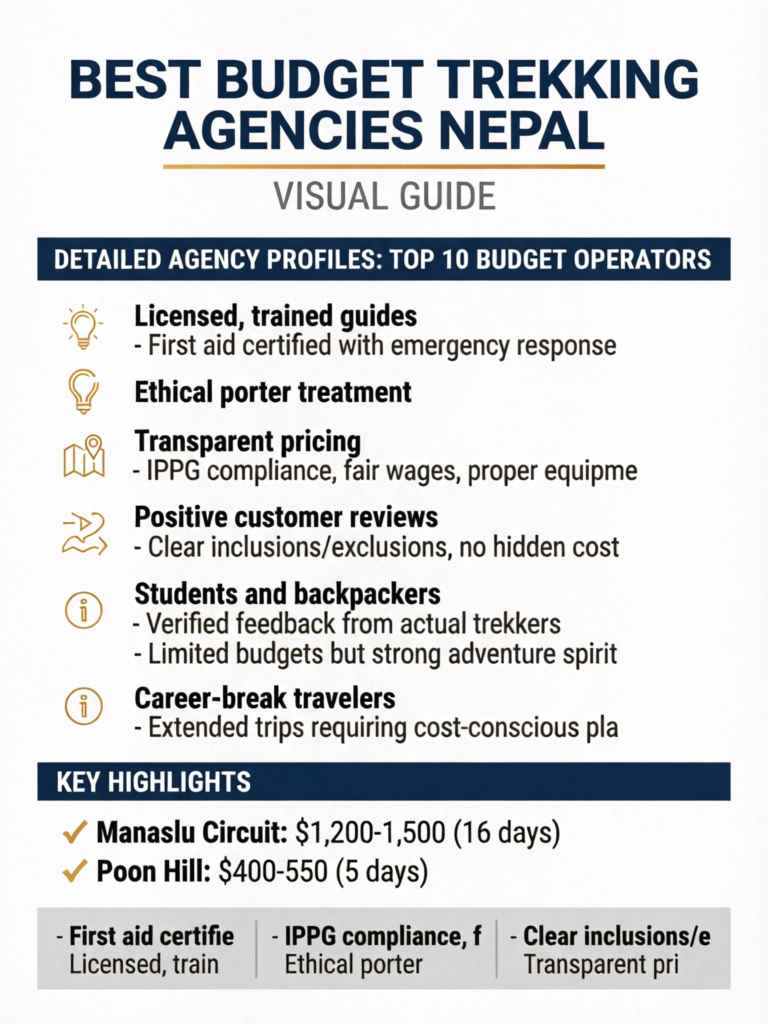
A quality budget agency maintains these non-negotiable standards:
- TAAN and Nepal Tourism Board registration - Legal operation with government oversight
- Licensed, trained guides - First aid certified with emergency response training
- Ethical porter treatment - IPPG compliance, fair wages, proper equipment, insurance
- Transparent pricing - Clear inclusions/exclusions, no hidden costs
- Emergency protocols - Evacuation plans, altitude sickness response, communication systems
- Positive customer reviews - Verified feedback from actual trekkers
- Fair business practices - Honest marketing, reasonable expectations, responsive communication
Budget agencies achieve lower prices through operational efficiency, not by compromising these fundamentals.
The Value Proposition
Budget agencies target the 12% of trekkers who prioritize affordability but refuse to sacrifice safety. They serve:
- Students and backpackers - Limited budgets but strong adventure spirit
- Career-break travelers - Extended trips requiring cost-conscious planning
- Local South Asian travelers - Regional tourists seeking affordable packages
- Experienced trekkers - Confident navigators who need basic support, not luxury
- Group travelers - Friends splitting costs for shared experiences
These agencies recognize that most trekkers care more about reaching Everest Base Camp than sleeping in heated rooms or eating Western breakfasts. They focus spending on essentials—qualified guides, proper permits, safe routes—while minimizing luxuries.
Budget Agency Success Story
Green Valley Nepal Treks organized an 11-day Annapurna Base Camp trek for $695 per person—including all permits, meals, accommodation, and experienced guides. The group of four solo travelers reported "exceptional guide knowledge, comfortable teahouses, and no hidden costs." This proves budget agencies can deliver quality experiences.
What "Budget Agency" Actually Means: Price Ranges Explained
Understanding budget agency pricing helps set realistic expectations and identify which operators truly qualify as "budget."
The Budget Agency Spectrum
$20-30/day
$30-40/day
$40-60/day
$60-100/day
$100-200+/day
Ultra-Budget ($20-30/day): This bottom tier barely qualifies as "agency" service. You're essentially paying for permit processing and minimal guide support. Expect:
- Unlicensed or minimally trained guides
- Extremely basic teahouses (the cheapest available)
- Dal bhat for every meal
- No hot showers or amenities
- Self-carried gear (no porter)
- Limited emergency support
- Potential ethical concerns with porter treatment
Standard Budget ($30-40/day): The sweet spot for budget-conscious trekkers. Quality operators in this range provide:
- TAAN-licensed guides with first aid training
- Clean, basic teahouses with proper bedding
- Full-board meals (dal bhat focus, some menu variety)
- Porter support (shared or optional)
- Proper permits and insurance
- Basic emergency protocols
- Ethical staff treatment
Budget-Comfort ($40-60/day): This bridges budget and mid-range, offering:
- Experienced guides with strong English
- Better teahouse selection (private bathrooms sometimes)
- More meal variety and snacks
- Dedicated porter support
- Enhanced emergency backup
- Responsive agency communication
- Group size flexibility
Total Trip Costs by Trek
Let's translate daily rates into total trip costs for popular routes:
| Trek | Duration | Ultra-Budget | Standard Budget | Budget-Comfort |
|---|---|---|---|---|
| Everest Base Camp | 12-14 days | $800-1,000 | $1,000-1,300 | $1,300-1,600 |
| Annapurna Base Camp | 7-10 days | $400-600 | $600-850 | $850-1,100 |
| Annapurna Circuit | 12-15 days | $600-900 | $900-1,200 | $1,200-1,500 |
| Langtang Valley | 7-9 days | $350-550 | $550-750 | $750-950 |
| Poon Hill | 4-5 days | $250-350 | $350-500 | $500-650 |
| Manaslu Circuit | 14-16 days | $1,000-1,300 | $1,300-1,600 | $1,600-2,000 |
Costs include permits, guide, accommodation, meals, and porter (where included). Flights to Lukla (for EBC) add $350-400.
Budget vs Mid-Range vs Luxury: The Full Comparison
Understanding what you sacrifice—and what you retain—at each price point helps set expectations.
| Element | Budget ($30-40/day) | Mid-Range ($60-100/day) | Luxury ($100-200+/day) |
|---|---|---|---|
| Guide | Licensed, basic English, group-focused | Experienced, fluent English, attentive | Senior guide, private, multi-lingual |
| Teahouses | Basic lodges, shared bathrooms, cold rooms | Better quality, some private bathrooms, occasional heat | Best lodges, private bathrooms, heated rooms |
| Meals | Dal bhat focus, limited menu, basic portions | Full menu choice, larger portions, snacks included | Gourmet options, Western food, special dietary needs |
| Porter | Shared porter (2:1) or self-carried | Dedicated porter (1:1) | Personal porter + assistant |
| Transport | Local buses, shared jeeps | Tourist buses, private for group | Private vehicles throughout |
| Group size | 8-15 people typical | 6-10 people | 2-6 people or private |
| Flexibility | Fixed departures, rigid itinerary | Some flexibility, rest day options | Fully customizable |
| Communication | Email only, slow response | Email + phone, responsive | 24/7 support, instant contact |
| Emergency backup | Basic evacuation protocol | Agency coordination, insurance support | Helicopter on standby, comprehensive medical |
| Porter treatment | Meets IPPG minimums | Exceeds standards, bonuses | Premium wages, full benefits |
| Accommodation in Kathmandu | Not included or 2-star budget | 3-star included | 4-5 star boutique hotels |
What you give up with budget: Comfort, flexibility, menu variety, luxury amenities, responsive support, small groups.
What you keep with budget: Safety, proper guides, ethical practices (if you choose well), permits, full trek experience.
Pro Tip
The biggest difference between budget and mid-range isn't safety—it's comfort and service quality. A budget agency with excellent reviews can be safer than a mid-range agency with poor guide training. Prioritize safety credentials over amenities.
How We Evaluated Budget Agencies: Our Methodology
We evaluated Nepal's budget trekking agencies using a rigorous 6-criteria framework:
1. Safety Standards Maintained
Non-negotiables:
- Licensed, first aid-trained guides
- Proper altitude acclimatization in itineraries
- Emergency communication equipment (phone, satellite device for remote areas)
- Evacuation protocols in place
- Adequate guide-to-trekker ratios
Verification:
- TAAN licensing verification
- Guide credential checks
- Emergency response capabilities review
- Customer feedback on safety incidents
2. Fair Porter Treatment
IPPG Compliance:
- Maximum 25kg load per porter (30kg is excessive above 4,000m)
- Proper equipment provided (warm clothing, boots, sunglasses)
- Fair wages ($20-25/day minimum)
- Insurance coverage for porters
- Shelter and meals equal to trekkers
- No exploitative practices
Red flags:
- Porters carrying excessive loads
- Inadequate clothing in cold conditions
- Porters sleeping in kitchens or unheated rooms
- Delayed or unpaid wages
3. TAAN and Tourism Board Registration
Essential verifications:
- Current TAAN membership (verify at www.taan.org.np)
- Nepal Tourism Board licensing
- Company registration certificate
- Tax clearance (legal operation)
Why it matters: Unregistered agencies operate illegally, lack insurance, employ unlicensed guides, and vanish when problems arise. TAAN membership ensures accountability and industry standards compliance.
4. Customer Reviews and Ratings
Sources analyzed:
- TripAdvisor (verified reviews)
- Google Reviews
- TourRadar ratings
- Direct customer testimonials
- Social media feedback
What we looked for:
- Consistency across 50+ reviews
- Recent reviews (2023-2025)
- Specific details (not generic praise)
- Response to complaints
- Red flag patterns (hidden costs, poor guide quality, safety issues)
5. Value for Money
Price-quality balance:
- Transparent pricing (clear inclusions/exclusions)
- Competitive rates for services provided
- No hidden costs reported by customers
- Fair tipping expectations
- Reasonable payment terms
Warning signs:
- Prices 50%+ below market average
- Vague package descriptions
- Significant additional costs not disclosed upfront
- Aggressive upselling during trek
6. Agency Responsiveness and Communication
Pre-booking evaluation:
- Response time to inquiries (within 24-48 hours)
- Detailed, specific answers to questions
- Willingness to customize itineraries
- Clear communication about limitations
- Professional email/phone manner
During-trek support:
- Reachable in emergencies
- Problem-resolution capability
- Guide support from office
- Coordination with teahouses
Top 10 Budget Agencies Compared: At-a-Glance
Here are Nepal's best budget trekking agencies, evaluated against our criteria:
Top 10 Budget Trekking Agencies Nepal (2026)
| Agency | Est. | Price Range | TAAN | Rating | Best For | Porter Ethics |
|---|---|---|---|---|---|---|
| Green Valley Nepal Treks | 2010 | $30-45/day | ✓ Verified | 4.8/5 (580 reviews) | Overall budget value | IPPG Compliant |
| Nepal Hiking Team | 2012 | $35-50/day | ✓ Verified | 5.0/5 (1,876 reviews) | EBC on budget | Excellent |
| Adventure Altitude Treks | 2015 | $28-40/day | ✓ Verified | 4.7/5 (340 reviews) | ABC budget packages | IPPG Compliant |
| Hill Sherpa Trekking | 2008 | $32-42/day | ✓ Verified | 4.6/5 (290 reviews) | Local family-run | Excellent |
| Nepal Alternative Treks | 2011 | $30-45/day | ✓ Verified | 4.7/5 (410 reviews) | Off-beaten paths | IPPG Compliant |
| The Nepal Trekking Company | 2013 | $35-48/day | ✓ Verified | 4.9/5 (650 reviews) | Responsive service | Excellent |
| Nepal Trekking Planner | 2014 | $32-45/day | ✓ Verified | 4.8/5 (380 reviews) | Solo budget trekkers | IPPG Compliant |
| Master Himalaya Trek | 2009 | $30-42/day | ✓ Verified | 4.6/5 (320 reviews) | Beginner-friendly | Good |
| Adventure Nepal Eco Treks | 2000 | $35-50/day | ✓ Verified | 4.8/5 (520 reviews) | Established reputation | Excellent |
| Himalayan Social Journey | 2007 | $33-46/day | ✓ Verified | 4.9/5 (1,613 reviews) | Most reviewed | Excellent |
Detailed Agency Profiles: Top 10 Budget Operators
1. Green Valley Nepal Treks
Established: 2010 | TAAN Verified | Rating: 4.8/5 (580 reviews)
Pricing Range:
- Everest Base Camp: $845-950 (14 days)
- Annapurna Base Camp: $600-765 (10 days)
- Annapurna Circuit: $750-900 (12 days)
- Langtang Valley: $550-700 (8 days)
What's Included:
- TAAN-licensed guide with first aid certification
- All trekking permits (TIMS, national park fees)
- Full-board meals (breakfast, lunch, dinner) in teahouses
- Basic teahouse accommodation (twin-sharing)
- Shared porter (2:1 ratio) with 20kg allowance
- Ground transportation (Kathmandu-trailhead)
- Trip completion certificate
What's NOT Included:
- Kathmandu accommodation
- Travel insurance
- Lukla flights (for EBC)
- Hot showers and battery charging
- Alcoholic beverages
- Tips for guide/porter
- Personal gear
Pros: ✓ Most affordable TAAN-registered option for ABC and EBC ✓ Transparent pricing with no hidden costs ✓ IPPG-compliant porter treatment ✓ Responsive email communication (24-hour replies) ✓ Flexible group sizes (1-15 people) ✓ Budget off-season discounts (15-20% Dec-Feb)
Cons: ✗ Basic English from some guides ✗ Limited emergency communication equipment ✗ Group departures only (no private treks under $215/day) ✗ No Kathmandu hotel pickup included
Best For: Budget-conscious trekkers seeking the lowest ethical price for ABC, Annapurna Circuit, or Langtang. Less ideal for EBC due to limited high-altitude experience.
Review Highlight: "Green Valley organized our ABC trek for $695 each. The guide Ramesh was knowledgeable, the teahouses were clean, and every cost was explained upfront. No surprises. Great value." - Sarah M., Australia (Jan 2025)
Contact: greenvalleynepaltreks.com | [email protected]
2. Nepal Hiking Team
Established: 2012 | TAAN Verified | Rating: 5.0/5 (1,876 reviews)
Pricing Range:
- Everest Base Camp: $950-1,450 (14 days)
- Annapurna Base Camp: $700-900 (10 days)
- Manaslu Circuit: $1,200-1,500 (16 days)
- Poon Hill: $400-550 (5 days)
What's Included:
- Experienced TAAN-licensed guide (fluent English)
- All permits and entry fees
- Full-board meals with menu variety
- Better-quality teahouses (pre-selected)
- Dedicated porter (1:1 ratio)
- Airport transfers
- Kathmandu hotel (2 nights, 3-star)
- Trip completion certificate
What's NOT Included:
- International flights
- Nepal visa fees ($50)
- Travel insurance
- Lukla flights (for EBC - arranged but paid separately)
- Hot showers and WiFi
- Tips ($215-150 recommended)
- Personal expenses
Pros: ✓ Best reviews of any budget agency (5.0 rating across 1,876 reviews) ✓ Excellent guide quality with strong English and first aid training ✓ Superior porter treatment with above-market wages ✓ Strong EBC expertise with high-altitude experience ✓ Responsive 24/7 emergency support ✓ Flexible customization options ✓ Includes Kathmandu accommodation
Cons: ✗ Higher end of budget spectrum ($35-50/day) ✗ Sometimes fully booked in peak season ✗ Limited ultra-budget options
Best For: First-time budget trekkers doing EBC who want reliability and excellent guide quality. Worth paying slightly more for proven track record.
Review Highlight: "Nepal Hiking Team is the gold standard for budget EBC. Our guide Dawa was exceptional—knowledgeable, safe, and personable. Worth every rupee of the $1,150 we paid." - Marcus T., Germany (Nov 2024)
Contact: nepalhikingteam.com | [email protected]
3. Adventure Altitude Treks
Established: 2015 | TAAN Verified | Rating: 4.7/5 (340 reviews)
Pricing Range:
- Annapurna Base Camp: $590-750 (10 days)
- Everest Base Camp: $900-1,150 (12 days)
- Poon Hill: $320-450 (4 days)
- Mardi Himal: $500-650 (7 days)
What's Included:
- Licensed guide with wilderness first aid
- All necessary permits
- Three meals daily (dal bhat focus)
- Basic teahouse lodging
- Porter service (shared 2:1)
- Ground transport
- Pre-trek briefing in Kathmandu
What's NOT Included:
- Accommodation in Kathmandu
- Flights (Lukla or international)
- Travel insurance (mandatory)
- Hot showers ($3-5 each)
- Battery charging ($2-3 per charge)
- WiFi access
- Snacks and beverages
- Tips (10-15% of package cost)
Pros: ✓ Exceptional ABC packages (best value in this category) ✓ Young, enthusiastic guides with good energy ✓ Strong social media presence and responsiveness ✓ Good for budget-conscious solo travelers ✓ IPPG-compliant porter practices ✓ Honest about limitations and tradeoffs
Cons: ✗ Relatively new company (less track record) ✗ Guides vary in experience level ✗ Basic emergency equipment only ✗ Limited high-altitude trek expertise
Best For: Solo budget trekkers doing ABC or Poon Hill who want affordable prices and social group dynamics. Less suitable for EBC or technical treks.
Review Highlight: "Did ABC for $645 solo. The guide was young but enthusiastic. Teahouses were basic but clean. Perfect for budget travelers who don't need luxury." - Jenny L., UK (Dec 2024)
Contact: adventurealtitudetreks.com | [email protected]
4. Hill Sherpa Trekking
Established: 2008 | TAAN Verified | Rating: 4.6/5 (290 reviews)
Pricing Range:
- Everest Base Camp: $1,000-1,300 (14 days)
- Annapurna Base Camp: $650-850 (10 days)
- Langtang Valley: $580-750 (8 days)
- Ghorepani Poon Hill: $380-500 (5 days)
What's Included:
- Experienced Sherpa guide (family-run)
- All trekking permits
- Full-board meals (generous portions)
- Quality teahouse selection
- Porter support (1:1 ratio)
- Cultural insights and local connections
- Post-trek celebration dinner in Kathmandu
What's NOT Included:
- Hotels in Kathmandu/Pokhara
- Domestic/international flights
- Travel insurance
- Optional activities (paragliding, etc.)
- Hot showers and amenities
- Personal expenses
- Guide/porter tips
Pros: ✓ Authentic family-run Sherpa agency ✓ Deep cultural knowledge and local connections ✓ Excellent porter treatment (family business ethics) ✓ Above-average meal portions ✓ Personal, warm service ✓ Strong Everest region expertise ✓ Fair wages for all staff
Cons: ✗ Limited online booking system (email-based) ✗ Slower response times (48-72 hours) ✗ Less flexibility in itinerary changes ✗ Smaller team (can't accommodate large groups)
Best For: Trekkers who value authentic cultural experiences and want to support local Sherpa families. Excellent for EBC with cultural depth.
Review Highlight: "Hill Sherpa felt like trekking with family. Our guide Pemba shared stories about Sherpa culture and took us to his village. A unique, personal experience for $1,100." - David R., USA (Oct 2024)
Contact: hillsherpatrekking.com | [email protected]
5. Nepal Alternative Treks
Established: 2011 | TAAN Verified | Rating: 4.7/5 (410 reviews)
Pricing Range:
- 31 budget treks under $1,000 total
- Annapurna Circuit: $680-950 (13 days)
- Manaslu Circuit: $1,100-1,400 (16 days)
- Nar Phu Valley: $1,300-1,600 (14 days)
- Tsum Valley: $900-1,200 (12 days)
What's Included:
- Licensed guide with restricted area expertise
- All permits (including special permits for restricted zones)
- Full-board meals throughout trek
- Teahouse accommodation
- Porter service (shared or dedicated based on package)
- Ground transportation
- TIMS and conservation area permits
What's NOT Included:
- Kathmandu/Pokhara hotels
- Flights
- Visa fees
- Travel insurance (mandatory for restricted areas)
- Hot showers and charging
- Tips (suggested $25-$40 /day guide, $5-8/day porter)
- Personal gear rental
Pros: ✓ Best budget operator for off-beaten path and restricted area treks ✓ Extensive portfolio (31 treks under $1,000) ✓ Experienced in permit processing for restricted zones ✓ Good value compared to competitors for Manaslu, Nar Phu, Tsum ✓ IPPG-compliant practices ✓ Knowledgeable about lesser-known routes
Cons: ✗ Less competitive for standard routes (EBC, ABC) ✗ Limited departure dates for restricted area treks ✗ Requires minimum group sizes for some routes ✗ Less English fluency from guides on remote treks
Best For: Adventurous budget trekkers seeking lesser-known routes like Manaslu Circuit, Nar Phu, or Tsum Valley. Premium pricing on standard routes.
Review Highlight: "Nepal Alternative Treks organized our Manaslu Circuit for $1,250—$400 less than competitors. Guide was excellent, and permits were handled smoothly. Highly recommend for alternative routes." - Emma K., Canada (Sep 2024)
Contact: nepalalternativetreks.com | [email protected]
6. The Nepal Trekking Company
Established: 2013 | TAAN Verified | Rating: 4.9/5 (650 reviews)
Pricing Range:
- Everest Base Camp: $1,050-1,400 (14 days)
- Annapurna Base Camp: $700-950 (10 days)
- Annapurna Circuit: $850-1,100 (14 days)
- Gokyo Lakes: $950-1,250 (12 days)
What's Included:
- Professional guide (excellent English)
- All permits and fees
- Full-board meals with variety
- Better teahouse selection
- Porter (1:1 ratio)
- Kathmandu transfers
- 2 nights Kathmandu hotel (3-star)
- Duffel bag (yours to keep)
- Welcome/farewell dinners
What's NOT Included:
- International airfare
- Nepal visa
- Travel insurance
- Lukla flights (arranged separately)
- Hot showers ($3-5)
- WiFi and charging ($2-3)
- Bar bills and snacks
- Tips ($215-200 recommended)
Pros: ✓ Exceptional customer service and responsiveness (replies within 4-6 hours) ✓ Highly rated guides with excellent English ✓ Superior porter treatment with bonuses ✓ Comprehensive inclusions (hotel, transfers, dinners) ✓ Flexible itinerary customization ✓ Strong emergency protocols ✓ Active social media with trip updates
Cons: ✗ Higher budget tier ($35-48/day) ✗ Limited ultra-budget options ✗ Popular (books up 2-3 months advance in peak season)
Best For: Budget trekkers who prioritize responsive communication, excellent service, and don't mind paying slightly more for reliability. Perfect for first-timers.
Review Highlight: "The Nepal Trekking Company was incredibly responsive—answered 20+ questions before booking. Guide Santosh was outstanding. Worth the $1,200 for EBC peace of mind." - Rachel P., Australia (Mar 2025)
Contact: thenepaltrekkingcompany.com | [email protected]
7. Nepal Trekking Planner
Established: 2014 | TAAN Verified | Rating: 4.8/5 (380 reviews)
Pricing Range:
- Everest Base Camp: $950-1,300 (14 days)
- Annapurna Base Camp: $650-850 (10 days)
- Langtang Valley: $600-750 (8 days)
- Manaslu Circuit: $1,150-1,450 (16 days)
What's Included:
- Licensed guide
- All permits
- Three meals daily
- Teahouse accommodation
- Porter service (optional upgrade)
- Ground transport
- Trek briefing
What's NOT Included:
- Kathmandu accommodation
- Flights
- Insurance
- Hot showers and charging
- Tips
- Personal items
Pros: ✓ Excellent for solo travelers (no single supplement on most treks) ✓ Flexible departure dates ✓ Good value-to-quality ratio ✓ Active trek planning assistance ✓ IPPG-compliant ✓ Transparent pricing
Cons: ✗ Porter service costs extra on base packages ✗ Moderate response times (24-48 hours) ✗ Basic accommodation selection
Best For: Solo budget trekkers who don't want to pay single supplements. Great for independent-minded travelers seeking minimal agency support.
Review Highlight: "As a solo female traveler, Nepal Trekking Planner was perfect—no single fees, safe guide, and $850 for ABC. Would book again." - Lisa H., Netherlands (Jan 2025)
Contact: nepaltrekkingplanner.com | [email protected]
8. Master Himalaya Trek and Expedition
Established: 2009 | TAAN Verified | Rating: 4.6/5 (320 reviews)
Pricing Range:
- Ghorepani Poon Hill: $320-450 (5 days)
- Annapurna Base Camp: $590-780 (10 days)
- Everest Base Camp: $900-1,200 (14 days)
- Beginner-friendly short treks: $300-600
What's Included:
- Licensed guide (beginner-specialized)
- All permits
- Meals (dal bhat focus)
- Basic accommodation
- Shared porter
- Transport
- Pre-trek orientation
What's NOT Included:
- Kathmandu hotel
- Flights
- Insurance
- Hot showers
- Tips
- Extras
Pros: ✓ Specializes in beginner-friendly routes ✓ Patient guides for first-time trekkers ✓ Affordable short trek packages ✓ Good Poon Hill value ✓ IPPG-compliant ✓ Transparent beginner guidance
Cons: ✗ Less experienced with technical treks ✗ Limited high-altitude expertise ✗ Basic amenities only ✗ Guides vary in English proficiency
Best For: First-time budget trekkers doing shorter, easier routes like Poon Hill, ABC, or Langtang. Not ideal for EBC or high-altitude challenges.
Review Highlight: "Perfect first trek! Master Himalaya guided us on Poon Hill for $380. Patient guide, easy pace, great intro to Nepal trekking." - Tom S., USA (Nov 2024)
Contact: masterhimalaya.com | [email protected]
9. Adventure Nepal Eco Treks
Established: 2000 | TAAN Verified | Rating: 4.8/5 (520 reviews)
Pricing Range:
- Everest Base Camp: $1,100-1,500 (14 days)
- Annapurna Base Camp: $700-950 (10 days)
- Annapurna Circuit: $850-1,150 (14 days)
- Langtang Valley: $650-850 (8 days)
What's Included:
- Senior guide (20+ years experience)
- All permits
- Full-board meals
- Quality teahouse accommodation
- Dedicated porter
- Airport transfers
- Kathmandu hotel (2 nights)
- Certificate
What's NOT Included:
- Flights
- Visa
- Insurance
- Hot showers
- WiFi/charging
- Tips ($150-200)
- Personal gear
Pros: ✓ Longest-established budget operator (since 2000) ✓ 98% client satisfaction rate ✓ Experienced senior guides ✓ Excellent safety record ✓ Porter welfare programs ✓ 25+ years industry reputation ✓ Nepal Tourism Board licensed
Cons: ✗ Higher budget pricing ($35-50/day) ✗ Less flexibility on fixed itineraries ✗ Traditional booking process (less modern)
Best For: Budget trekkers who value established reputation and want proven safety records. Ideal for risk-averse travelers seeking reliability.
Review Highlight: "Adventure Nepal Eco Treks has been around forever. Our guide had 22 years experience—incredibly knowledgeable. Worth $1,250 for the expertise." - Robert M., UK (Dec 2024)
Contact: nepalecotrekking.com | [email protected]
10. Himalayan Social Journey
Established: 2007 | TAAN Verified | Rating: 4.9/5 (1,613 reviews)
Pricing Range:
- Everest Base Camp: $1,000-1,400 (14 days)
- Annapurna Base Camp: $700-950 (10 days)
- Annapurna Circuit: $800-1,100 (14 days)
- Manaslu Circuit: $1,200-1,500 (16 days)
What's Included:
- Expert guide (fluent English)
- All permits
- Full-board meals
- Quality teahouses
- Porter (1:1)
- Transfers
- Kathmandu hotel (2 nights)
- Welcome dinner
- Certificate
What's NOT Included:
- International flights
- Visa ($50)
- Insurance
- Lukla flights (for EBC)
- Hot showers ($3-5)
- WiFi ($3-5/day)
- Tips ($215-200)
- Snacks
Pros: ✓ Most reviewed budget agency (1,613 TripAdvisor reviews) ✓ Consistently high ratings (4.9/5) ✓ Excellent guide quality ✓ Strong safety protocols ✓ Porter welfare champion ✓ Responsive communication ✓ Proven track record
Cons: ✗ Higher budget tier ✗ Popular (advance booking required) ✗ Limited discounts
Best For: Budget trekkers who want the most reviewed, proven operator. The "safest choice" for first-timers with budget constraints.
Review Highlight: "With 1,600+ reviews, we felt confident choosing Himalayan Social Journey. They exceeded expectations—$1,150 for EBC was worth every penny." - Anna B., Sweden (Jan 2025)
Contact: Contact via TripAdvisor or social media channels
Budget Agency Categories: Best Fit Analysis
Different budget agencies excel in specific categories. Here's how to match agencies to your needs:
Best Overall Budget Agency
Winner: Green Valley Nepal Treks
Why: Lowest prices among TAAN-registered agencies ($30-45/day), transparent pricing, IPPG-compliant porter treatment, responsive communication, and 580+ positive reviews. Best pure budget value.
Runner-up: Nepal Hiking Team - Slightly higher cost but exceptional reviews and reliability.
Best for EBC on Budget
Winner: Nepal Hiking Team
Why: 5.0/5 rating with 1,876 reviews specifically praises EBC expertise. Experienced high-altitude guides, strong safety protocols, excellent acclimatization itineraries. Worth paying $950-1,450 for peace of mind at 17,600 feet.
Runner-up: Hill Sherpa Trekking - Authentic Sherpa family operation with cultural depth.
Best for ABC on Budget
Winner: Adventure Altitude Treks
Why: Exceptional ABC value at $590-750 for 10 days. Specializes in Annapurna region, knowledgeable guides, good teahouse selection. Perfect budget-to-quality ratio for ABC.
Runner-up: Green Valley Nepal Treks - $600-765 ABC packages, slightly higher but more established.
Best for Solo Budget Trekkers
Winner: Nepal Trekking Planner
Why: No single supplement on most treks (rare for budget agencies). Solo-friendly group departures, flexible dates, safe guide assignments for solo females. $650-850 ABC solo is unbeatable.
Runner-up: Adventure Altitude Treks - Social group dynamics, good for meeting other solo travelers.
Best Local Family-Run Agency
Winner: Hill Sherpa Trekking
Why: Authentic Sherpa family business since 2008. Deep cultural knowledge, personal service, excellent porter treatment, cultural insights. Support local communities directly.
Runner-up: Master Himalaya Trek - Local Kathmandu family operation.
Best Responsive Budget Agency
Winner: The Nepal Trekking Company
Why: 4-6 hour email response times, active social media, 24/7 emergency support, comprehensive pre-trek communication. Worth paying $35-48/day for responsive service.
Runner-up: Nepal Hiking Team - Also very responsive with strong communication.
What Budget Agencies Typically Include
Understanding standard inclusions helps you compare packages accurately and identify hidden costs.
Standard Inclusions (Most Budget Agencies)
Permits and Entry Fees:
- TIMS card (Trekker Information Management System)
- National park entry permits (Sagarmatha, Annapurna Conservation Area, Langtang, etc.)
- Rural municipality fees
- Special permits for restricted areas (Manaslu, Upper Mustang, etc.)
Guide and Porter:
- TAAN-licensed guide (1 per 6-10 trekkers typical)
- Basic guide equipment
- Guide meals, accommodation, insurance, salary
- Shared porter 2:1 ratio (some include 1:1)
- Porter salary, meals, accommodation, insurance
- 20-25kg porter allowance per trekker
Accommodation:
- Basic teahouse lodging throughout trek
- Twin-sharing rooms (shared bathrooms typical)
- Single rooms when available (not guaranteed)
- Clean bedding, blankets, pillows
- Common areas for dining/socializing
Meals During Trek:
- Breakfast (porridge, eggs, toast, pancakes, or Tibetan bread)
- Lunch (dal bhat, noodles, fried rice, or sandwiches)
- Dinner (dal bhat, pasta, mo:mo, or rice dishes)
- Tea/coffee with meals (usually 2-3 cups per meal)
Transportation:
- Kathmandu to trek starting point (bus or jeep)
- Trek ending point back to Kathmandu/Pokhara
- Shared tourist buses (most agencies)
- Local buses (ultra-budget agencies)
Additional Services:
- Pre-trek briefing in Kathmandu
- Trek completion certificate
- Basic first aid kit
- Trip coordination and planning
What's Typically NOT Included
Accommodation Outside Trek:
- Hotels in Kathmandu before/after trek
- Hotels in Pokhara (for Annapurna region treks)
- Extra nights due to flight delays
Flights:
- International airfare to/from Nepal
- Kathmandu-Lukla domestic flights (for EBC - $350-400)
- Alternative flights for other regions
Insurance and Visa:
- Travel insurance (mandatory)
- Emergency evacuation insurance
- Nepal entry visa ($50 for 30 days)
Personal Expenses:
- Hot showers ($3-5 per shower)
- Battery charging ($2-3 per charge)
- WiFi access ($3-5 per day)
- Alcoholic beverages ($4-8 per beer)
- Snacks and treats ($2-5 per item)
- Extra meals or menu items beyond package
- Laundry services
Tips:
- Guide tips ($120-$280 per day recommended)
- Porter tips ($5-8 per day recommended)
- Restaurant tips in Kathmandu
Gear:
- Personal trekking equipment
- Sleeping bag rental ($1-2/day if needed)
- Down jacket rental ($1-2/day if needed)
- Trekking pole rental ($0.50-1/day)
Emergency/Medical:
- Altitude sickness medication
- Personal medical supplies
- Emergency evacuation costs (if insurance doesn't cover)
- Medical consultations
Budget Agency Add-Ons (Usually Extra Cost)
Available for Additional Fee:
- Airport pickup/drop-off ($10-20)
- Kathmandu hotel nights ($15-30 per night)
- Dedicated porter (upgrade from shared) ($15-20/day)
- Private guide (instead of group) ($25-35/day)
- Hot showers and charging package ($30-50 total)
- Sleeping bag and down jacket rental ($25-40 for trek)
Pro Tip
Always ask for a detailed "included/not included" breakdown before booking. Hidden costs can increase total trek price by 20-30%. Reputable budget agencies provide comprehensive lists upfront.
Budget vs Mid-Range vs Luxury: Detailed Comparison
Understanding the three agency tiers helps set realistic expectations and determine which level suits your priorities.
Budget Agencies ($30-40/day = $800-1,200 for EBC)
What You Get:
- Licensed guides with basic English
- Clean but basic teahouses
- Dal bhat-focused meals (nutritious but repetitive)
- Shared porter or self-carried option
- Local/tourist buses for transport
- Group departures (8-15 people typical)
- Basic emergency protocols
What You Sacrifice:
- Comfort (cold rooms, shared bathrooms)
- Menu variety (limited Western food)
- Flexibility (fixed itineraries, set departures)
- Amenities (minimal hot showers, charging)
- Small groups (crowded teahouses)
- Premium guide experience
- Responsive agency support
Best For: Experienced trekkers, budget backpackers, students, those prioritizing cost savings, trekkers comfortable with basic conditions.
Mid-Range Agencies ($60-100/day = $1,500-2,500 for EBC)
What You Get:
- Experienced guides with fluent English
- Better teahouse selection (some private bathrooms)
- Full menu choice with variety
- Dedicated porter (1:1 ratio)
- Tourist buses or private group transport
- Smaller groups (6-10 people)
- Enhanced emergency support
- Kathmandu hotel included (usually 3-star)
- More responsive communication
What You Sacrifice vs Luxury:
- Room heating (still mostly cold)
- Western-style toilets (mix of squat/Western)
- Gourmet meals (teahouse menus, not custom)
- Fully customizable itineraries
- Helicopter backup on standby
Best For: First-time trekkers, travelers balancing budget and comfort, those wanting better service without luxury prices, families.
Luxury/Premium Agencies ($100-200+/day = $2,500-5,000+ for EBC)
What You Get:
- Senior guides (multi-lingual, extensive experience)
- Best lodges with heated rooms (where available)
- Private bathrooms, Western toilets
- Gourmet meals, special dietary accommodations
- Personal porters and assistants
- Private vehicles throughout
- Small groups (2-6) or fully private
- Fully customizable itineraries
- 24/7 support with helicopter on standby
- 4-5 star Kathmandu hotels
- Comprehensive insurance and medical support
When It's Worth It:
- First trek ever with high anxiety
- Medical conditions requiring extra support
- Limited time (need helicopter backup options)
- Traveling with elderly or children
- Celebrating special occasions
- Strong preference for comfort
Best For: Luxury travelers, older trekkers, those with medical considerations, travelers with limited vacation time, honeymooners.
Cost Comparison by Trek
| Trek | Budget | Mid-Range | Luxury | Difference |
|---|---|---|---|---|
| Everest Base Camp | $900-1,200 | $1,800-2,500 | $3,000-5,000 | 3-5x |
| Annapurna Base Camp | $600-850 | $1,200-1,800 | $2,000-3,500 | 3-4x |
| Annapurna Circuit | $800-1,100 | $1,500-2,200 | $2,500-4,000 | 3-4x |
| Langtang Valley | $550-750 | $1,000-1,500 | $1,800-2,800 | 3-4x |
| Manaslu Circuit | $1,200-1,500 | $2,000-2,800 | $3,500-5,500 | 3-4x |
Key Insight: Luxury costs 3-5x more than budget. The question: Are comfort, flexibility, and premium service worth 3-5x the price for a once-in-a-lifetime trek? Only you can decide.
Red Flags in Budget Agencies: What to Avoid
Budget doesn't mean unsafe, but ultra-cheap can signal serious problems. Watch for these warning signs:
1. Too Cheap to Be Ethical
Red Flag: Packages 50%+ below market average.
Example: EBC for $500-600 total (market is $900-1,200 budget)
What it means:
- Unlicensed guides
- Porter exploitation (excessive loads, no insurance, $10/day wages)
- Fake permits
- No emergency support
- Corners cut on food quality and safety
Why it's impossible: Basic math doesn't work. Lukla flights alone cost $215-400. Add permits ($40), basic guide wages ($20-25/day × 12 days = $240-300), food, and lodging—there's no way to deliver ethical trekking under $800 for EBC.
Extreme Budget Warning
A "budget" EBC package for $600 is physically impossible to deliver ethically. Someone is being exploited—usually porters working without insurance, carrying 40kg+ loads, sleeping in kitchens, and earning $8-10/day. Avoid agencies advertising prices this low.
2. Poor Porter Treatment
Red Flags:
- Porters carrying 35-40kg+ loads
- Inadequate clothing (no warm jackets at altitude)
- Porters sleeping in unheated kitchens or storage rooms
- No porter insurance mentioned
- Agencies dodging questions about porter welfare
Verification Questions:
- "What's your porter load limit?" (Should be 20-25kg max)
- "Do porters receive proper equipment?" (Boots, warm clothing, sunglasses required)
- "Are porters insured?" (Must have medical and evacuation insurance)
- "Where do porters sleep?" (Should have heated rooms like clients)
IPPG Standards: Budget agencies should meet International Porter Protection Group minimums:
- 25kg maximum load (20kg ideal above 4,000m)
- Appropriate clothing (windproof jacket, warm layers, quality boots)
- Same-quality shelter and food as clients
- Medical insurance and emergency evacuation coverage
- Fair wages ($20-25/day minimum)
3. No TAAN Registration
Red Flag: Agency can't provide TAAN membership number or registration certificate.
Verification:
- Visit www.taan.org.np
- Search agency name in member directory
- Confirm registration status
- Check Nepal Tourism Board licensing
Why it matters:
- Unregistered agencies operate illegally
- No accountability or oversight
- Likely using unlicensed guides
- No insurance coverage
- Will abandon you if problems arise
- Can't help with permit issues
What legitimate agencies do:
- Display TAAN certificate on website
- Provide registration number upfront
- Show Nepal Tourism Board license
- Have verifiable office address in Kathmandu
4. Fake Reviews
Red Flags:
- All 5-star reviews with generic praise
- Reviews posted in clusters (same dates)
- No negative reviews at all
- Reviewers with only 1 review total
- Identical phrasing across reviews
- No specific details (names, dates, experiences)
How to Verify Legitimate Reviews:
- Check multiple platforms (TripAdvisor, Google, TourRadar)
- Look for specific details (guide names, dates, costs, challenges)
- Read critical reviews (no agency is perfect)
- Verify reviewers have other reviews on profile
- Search agency name + "scam" or "complaint"
- Ask agency for client references you can contact directly
Legitimate Review Patterns:
- Mix of 3, 4, and 5-star ratings
- Specific details about guides, routes, experiences
- Occasional complaints (handled professionally)
- Reviews spread over years
- Verified purchase indicators
5. Hidden Costs
Red Flags:
- Vague "all-inclusive" claims without itemized list
- Essential items listed as "optional extras"
- Significant costs revealed after booking
- Unclear payment terms
- Refusal to provide written cost breakdown
Common Hidden Cost Traps:
- "Porter not included" (add $200-300)
- "Permits paid on arrival" (add $40-60)
- "Hot meals extra" (add $150-250)
- "Lukla flights separate" (add $215-400)
- "Guide tips mandatory" (add $215-150)
What Transparent Agencies Do:
- Provide detailed "included/not included" lists
- Break down all costs in writing
- Clarify payment schedule
- Explain optional extras clearly
- Put everything in written contract
6. Pressure Tactics and Street Hawkers
Red Flags:
- Street touts in Thamel offering "today only" trek deals
- Aggressive pressure to book immediately
- "Last spot available" urgency tactics
- Refusal to allow time to research
- No official office (meets in cafes)
- Cash-only payment demanded upfront
How Street Hawker Scams Work:
- Approach tourists in Thamel or Lakeside Pokhara
- Offer incredibly cheap package ("EBC for $700!")
- Pressure immediate booking with deposit
- Disappear or provide terrible service
- Hide behind no website, no traceable business
Legitimate Agency Behavior:
- Professional office with displayed licenses
- Welcome research and questions
- Provide written quotes
- Accept credit cards or bank transfers
- Give 24-48 hours to decide
- Transparent contract terms
7. No Emergency Protocols
Red Flags:
- Can't explain evacuation procedures
- No communication equipment mentioned
- Vague about guide first aid training
- No emergency contact provided
- Dodges altitude sickness questions
Essential Emergency Standards:
- Guides with wilderness first aid certification
- Communication devices (phone at minimum, satellite phone for remote areas)
- Written evacuation protocol
- 24/7 emergency contact in Kathmandu
- Clear altitude sickness response plan
- Helicopter evacuation coordination capability
Questions to Ask:
- "Are guides first aid trained?" (Require certification)
- "What happens if someone gets altitude sickness?" (Should know protocol)
- "How do you communicate in emergencies?" (Need device access)
- "Who coordinates evacuations?" (Must have Kathmandu contact)
Pro Tip
If an agency can't clearly explain their emergency protocols, walk away. The Himalayas are unforgiving, and altitude sickness, weather changes, or injuries require professional emergency response. Budget doesn't mean skipping safety.
How Budget Agencies Keep Costs Low: Legitimate Strategies
Ethical budget agencies reduce costs through operational efficiency, not corner-cutting. Here's how they do it:
1. Larger Groups (8-15 People)
How it saves money: One guide can lead 8-12 trekkers, spreading guide costs across more people. Guide wages ($25-30/day) divided by 12 people = $2-3/person vs. $25-30 for private guide.
Tradeoff: Less personalized attention, slower pace to accommodate varying fitness levels, less flexibility in itinerary.
2. Basic Teahouses
How it saves money: Budget agencies select simpler, cheaper teahouses ($5-8/night) instead of premium lodges ($15-25/night).
What you get:
- Shared bathrooms
- No heating
- Basic bedding
- Simple rooms
- Squat toilets (mostly)
What you don't sacrifice:
- Cleanliness (basic doesn't mean dirty)
- Safety (structurally sound buildings)
- Meals (same kitchens serve all lodges)
3. Local Guides
How it saves money: Hiring locally-based Nepali guides ($20-25/day) instead of Western-trained or senior guides ($35-50/day).
Tradeoff:
- Less fluent English (functional but not perfect)
- Fewer years of experience (but still licensed and trained)
- Less cultural interpretation depth
- More focused on logistics than storytelling
What you don't sacrifice:
- Route knowledge (locals know trails intimately)
- Safety training (TAAN licensing requires first aid)
- Altitude awareness (mountain expertise)
4. No-Frills Service
How it saves money: Eliminating extras that don't affect core trekking experience:
- No Kathmandu hotel nights
- No airport transfers
- No welcome/farewell dinners
- No duffel bags or swag
- Minimal office overhead
What you handle yourself:
- Book own Kathmandu accommodation
- Arrange airport taxi
- Buy own meals in Kathmandu
- Self-managed pre/post-trek logistics
Savings: $100-200 per person by handling these separately
5. Direct Bookings
How it saves money: Selling directly to trekkers (via website, email) instead of through commission-based agents (TourRadar, travel agencies) that take 15-30% commissions.
Your savings: $150-400 on typical EBC trek by booking directly
Agency's savings: Avoid $30-50 per booking in platform fees and credit card processing
6. Group Departures (Fixed Dates)
How it saves money: Fixed departure dates ensure minimum group sizes (8-12 people), guaranteeing cost efficiency. Private/custom dates require dedicated guide for 1-2 people (expensive).
Tradeoff: Less flexibility—must match your dates to agency schedule. Peak season fills fast; off-season may have limited departures.
7. Dal Bhat Focus
How it saves money: Dal bhat (rice, lentils, vegetables) costs $4-6 vs. Western meals ($8-12). Budget agencies build packages around dal bhat with occasional menu variety.
What you get:
- Unlimited dal bhat refills (standard practice)
- Nutritious, high-calorie fuel for trekking
- Local, authentic meals
- Consistent food safety
Tradeoff: Menu monotony. You'll eat dal bhat 1-2 times daily. Rare pizza, pasta, or Western breakfasts.
8. Shared Porters (2:1 Ratio)
How it saves money: One porter carries gear for two trekkers (20-25kg total) instead of dedicated 1:1 porter.
Savings: $15-20/day per person by sharing porter wages
Requirement: Must pack light—10-12kg per person maximum. Shared porter can't carry 15kg × 2 people = 30kg (exceeds ethical limits).
Budget Agency Tradeoffs: What You Give Up (And What You Keep)
Understanding tradeoffs helps set realistic expectations. Here's the honest breakdown:
What You Give Up with Budget Agencies
1. Comfort
- Cold rooms (no heating)
- Shared bathrooms
- Basic bedding
- Limited hot showers (expensive at $3-5)
- Squat toilets common
2. Menu Variety
- Dal bhat focus (1-2 meals daily)
- Limited Western food options
- Smaller portions
- Fewer snacks and treats
- Basic breakfast options
3. Flexibility
- Fixed departure dates
- Set itineraries (minimal changes)
- Larger groups (8-15 people)
- Limited customization
- Inflexible pace
4. Premium Service
- Slower email responses (24-48 hours vs. 4-6 hours)
- Less pre-trek communication
- Basic emergency equipment only
- Limited English from guides (functional but not fluent)
- No luxury touches (welcome dinners, hotels, swag)
5. Exclusivity
- Crowded teahouses (budget lodges most popular)
- Less personalized attention from guides
- Generic itineraries (same as everyone else)
- Peak season crowds
What You Keep with Budget Agencies
1. Safety ✓ TAAN-licensed guides ✓ First aid training ✓ Proper permits ✓ Emergency protocols ✓ Route knowledge ✓ Altitude awareness
2. Complete Trek Experience ✓ Same trails as luxury trekkers ✓ Same views and destinations ✓ Same sense of accomplishment ✓ Cultural encounters ✓ Teahouse stays (authentic experience)
3. Ethical Practices (if you choose well) ✓ Fair porter wages ✓ IPPG compliance ✓ Proper insurance ✓ Legal operation ✓ Honest business practices
4. Core Services ✓ Guide support ✓ Porter for gear ✓ Full-board meals (nutritious) ✓ Clean accommodation ✓ Permit processing ✓ Transportation
Is the Budget Route Worth It?
YES if:
- You prioritize experience over comfort
- You're comfortable with basic conditions
- You're flexible and adaptable
- You've researched agencies thoroughly
- You understand and accept tradeoffs
- You're budget-conscious but safety-focused
NO if:
- You need comfort to enjoy the trek
- You have medical conditions requiring extra support
- You're risk-averse and anxious
- You want highly responsive communication
- You prefer small groups and personalized service
- This is a once-in-a-lifetime trip where you want premium experience
Budget Trekker Success Story
"I did EBC with a budget agency for $1,050. Yes, rooms were cold. Yes, I ate dal bhat 14 times. Yes, bathrooms were basic. But I stood at Everest Base Camp, met incredible people, and had the adventure of my life—for 1/3 the luxury price. Worth every discomfort." - Mike T., Australia
Porter & Guide Treatment: Ethical Budget Agencies
Ethical treatment of porters and guides is non-negotiable, even for budget trekkers. Here's how to ensure your budget agency meets ethical standards:
IPPG (International Porter Protection Group) Standards
Though IPPG ceased operations in 2020, their standards remain the industry benchmark for ethical porter treatment.
Core IPPG Requirements:
1. Load Limits:
- Maximum 25kg per porter (including porter's own gear)
- Recommended 20-25kg maximum
- Reduced loads above 4,000m
- No exceptions or overloading
2. Equipment:
- Warm clothing appropriate to altitude and season
- Windproof/waterproof jacket
- Quality footwear (boots, not sandals)
- Sunglasses
- Hat and gloves
- Appropriate gear for conditions
3. Shelter:
- Heated accommodation (same quality as clients)
- Not sleeping in kitchens, storage rooms, or outdoors
- Proper bedding and blankets
- Protection from cold
4. Wages:
- Minimum $20-25/day for porters
- $25-30/day for guides
- Paid on time, no delays
- Bonuses for exceptional service
5. Insurance:
- Medical insurance coverage
- Emergency evacuation insurance
- Accident insurance
- Death/disability coverage
6. Rest and Meals:
- Three meals daily (same quality as clients)
- Adequate rest breaks
- Tea/coffee access
- No discrimination in meal quality
How to Verify Ethical Treatment
Questions to Ask Agencies:
-
"What's your porter load limit?"
- Correct answer: "20-25kg maximum including porter's personal gear"
- Red flag: "30kg" or "depends on porter" or vague answers
-
"What equipment do you provide porters?"
- Correct answer: Specific list including warm clothing, boots, sunglasses, waterproofs
- Red flag: "Porters bring their own" or minimal equipment
-
"Where do porters sleep?"
- Correct answer: "In heated rooms, same lodges as clients"
- Red flag: "In kitchens" or "they arrange their own"
-
"Are porters insured?"
- Correct answer: "Yes, full medical and evacuation insurance"
- Red flag: "That's porter's responsibility" or evasive answers
-
"What are porter wages?"
- Correct answer: "$20-25/day plus bonuses"
- Red flag: "$10-15/day" or reluctance to disclose
On-Trek Verification:
- Check porter loads (should look manageable, not struggling)
- Observe porter clothing (warm, appropriate for altitude)
- Notice where porters sleep (same lodges as you)
- Watch meal service (porters eat same food)
- Ask porters directly (through guide translation if needed)
Ethical Budget Agencies: Verified
Based on reviews and standards verification, these budget agencies demonstrate strong porter ethics:
Excellent Porter Treatment:
- Nepal Hiking Team
- Hill Sherpa Trekking
- The Nepal Trekking Company
- Himalayan Social Journey
- Adventure Nepal Eco Treks
IPPG Compliant:
- Green Valley Nepal Treks
- Adventure Altitude Treks
- Nepal Alternative Treks
- Nepal Trekking Planner
Under Review/Mixed Reports:
- Master Himalaya Trek (generally good but some variability)
Guide Treatment Standards
Guides also deserve ethical treatment:
Fair Guide Practices:
- Minimum $25-30/day wages
- Tips expected but mandatory since April 2023 baseline (tips = bonuses for excellent service)
- First aid training provided and updated
- Quality equipment for guiding (phone, first aid kit, maps)
- Respect and professional treatment from agency
- Clear expectations and responsibilities
- Support from agency office during trek
What to Do If You See Poor Treatment
If you observe porter/guide mistreatment during your trek:
- Document: Take photos/videos (discreetly)
- Speak up: Raise concerns with guide/agency immediately
- Support directly: Offer porters your spare warm clothing, share food
- Report: Contact TAAN (www.taan.org.np) or Nepal Tourism Board
- Review honestly: Share experience in TripAdvisor/Google reviews
- Tip directly: Give porter tips directly to their hands, not through agency
Emergency Situation: If porter is seriously ill, injured, or in danger:
- Demand immediate evacuation
- Contact TAAN directly: +977-1-4700088
- Contact embassy if agency refuses help
- Document everything
Speak Up for Porter Welfare
Budget trekking doesn't justify porter exploitation. If you witness overloading, inadequate clothing, or poor treatment, speak up immediately. Your voice protects vulnerable workers. Report agencies that violate IPPG standards.
Where to Find Budget Agencies: Booking Locations
1. Kathmandu Thamel
What is it: Thamel is Kathmandu's tourist district—a dense neighborhood packed with 200+ trekking agencies, gear shops, restaurants, and hotels. It's the traditional hub for booking treks.
Pros:
- Dozens of agencies within walking distance
- Face-to-face communication and negotiation
- Meet guides before booking
- Immediate booking and departures
- Price negotiation possible
- Last-minute deals available
Cons:
- Overwhelming number of choices
- Aggressive street hawkers and touts
- Risk of unlicensed operators
- Harder to verify legitimacy
- Pressure to book quickly
- Less time for research
How to Navigate Thamel Safely:
- Research 3-5 agencies online before arriving
- Visit only agencies with verified TAAN registration
- Avoid street touts (don't book on the street)
- Visit actual office locations (with displayed licenses)
- Compare 3-4 agencies in person
- Don't book immediately—take 24 hours to decide
- Get everything in writing
Best Thamel Agencies:
- Green Valley Nepal Treks (Thamel-26, Kathmandu)
- Nepal Hiking Team (Thamel office)
- The Nepal Trekking Company (Thamel)
- Hill Sherpa Trekking (Thamel-29)
2. Online Booking (Direct Website)
Pros:
- Book from home before arrival
- Time to research thoroughly
- Compare multiple agencies easily
- Read reviews extensively
- Email communication (written records)
- Often better prices (no office overhead)
- Secure payment options (credit card, PayPal)
Cons:
- Can't meet guide in advance
- Harder to assess legitimacy
- Requires trusting online presence
- Less negotiation flexibility
- No face-to-face clarification
How to Book Online Safely:
- Verify TAAN registration on official website
- Check multiple review platforms (TripAdvisor, Google, TourRadar)
- Email detailed questions (response quality reveals agency professionalism)
- Request client references
- Verify office address on Google Maps
- Use secure payment methods
- Get comprehensive written contract
Recommended Direct Booking:
- Nepal Hiking Team (nepalhikingteam.com)
- Green Valley Nepal Treks (greenvalleynepaltreks.com)
- The Nepal Trekking Company (thenepaltrekkingcompany.com)
3. Online Travel Platforms (TourRadar, Viator, GetYourGuide)
Pros:
- Centralized comparison
- Verified customer reviews
- Secure payment processing
- Buyer protection policies
- Easy comparison tools
- Trusted platform oversight
Cons:
- 15-30% commission increases prices ($150-400 more)
- Less direct communication with agency
- Standardized packages (less customization)
- Platform fees add cost
When Worth It:
- First trek (want buyer protection)
- Risk-averse travelers
- Don't want to research heavily
- Prefer platform guarantees
Best Platforms:
- TourRadar (110 Nepal agencies, 31,613 reviews)
- Viator
- GetYourGuide
4. Social Media and Direct Contact
Emerging Trend: Many budget agencies build presence on Facebook, Instagram, WhatsApp for direct client communication.
Pros:
- Instant messaging responsiveness
- Visual content (trek photos, guide profiles)
- Community engagement
- Direct negotiation
- Personal connection
Cons:
- Harder to verify legitimacy
- Less formal contracts
- Inconsistent communication
- Risk of scams
Verification:
- Check follower count (1,000+ suggests legitimacy)
- Review post history (consistent, professional content)
- Read comment interactions
- Verify against official website
- Cross-check TAAN registration
Booking Budget Agencies: Negotiation Tips and Strategies
Negotiation Basics
Can You Negotiate? Yes, especially:
- Booking in Thamel (face-to-face)
- Off-season (Dec-Feb, June-Aug)
- Large groups (6+ people)
- Last-minute departures (need to fill spots)
- Direct bookings (no platform commissions)
Limited Negotiation:
- Peak season (Oct-Nov, Mar-May)
- Online bookings
- Small groups (1-2 people)
- Popular fixed-date departures
Effective Negotiation Strategies
1. Group Discounts
- Solo: $40-50/day typical
- 2-3 people: $35-45/day (10-15% discount)
- 4-6 people: $30-40/day (20-25% discount)
- 7+ people: $28-38/day (25-30% discount)
Strategy: Find solo travelers in Thamel, form group, negotiate group rate.
2. Off-Season Booking
- Peak (Oct-Nov, Mar-May): Full price
- Shoulder (Sep, Dec, early Mar): 10-15% discount
- Low (Jan-Feb, June-Aug): 15-25% discount
Strategy: Book monsoon (June-Aug) or winter (Jan-Feb) for significant savings. Trade weather reliability for cost.
3. Last-Minute Deals
- Agencies need minimum group sizes
- 2-3 days before departure, agencies discount to fill spots
- Potential 20-30% savings
Risk: Limited trek choices, fixed dates, no customization, must be in Kathmandu ready to depart.
Strategy: Be flexible on dates and routes, check Thamel agencies for upcoming departures needing additional trekkers.
4. Advance Booking
- Book 2-3 months ahead for early-bird discounts
- Typically 5-10% off
Strategy: Commit early, secure preferred dates, lock lower price.
5. Package Customization
- Remove unnecessary inclusions for lower price
- "Remove Kathmandu hotel nights" (-$30-60)
- "Self-carry gear, no porter" (-$150-250)
- "Skip airport transfers" (-$20-40)
Strategy: Identify what you don't need, negotiate à la carte pricing.
6. Direct Payment
- Credit card processing fees: 3-5%
- Paying cash (in Kathmandu) eliminates fees
- Potential $30-60 savings on $1,000 trek
Strategy: Negotiate discount for cash payment. Caution: Only pay cash to verified, TAAN-registered agencies with office locations.
What NOT to Negotiate
Non-Negotiables:
- Porter/guide wages (ethical wages required)
- Safety equipment
- Permits and fees (government-set)
- Insurance coverage
Why: These are ethical/legal requirements. Agencies that negotiate these corners are cutting dangerous corners.
Negotiation Script Examples
Scenario 1: Group Discount "I have 5 friends interested in the ABC trek. Your website shows $750 per person for groups of 1-2. What price can you offer for 6 people?"
Expected Response: "$600-650 per person for group of 6."
Scenario 2: Off-Season Discount "I'm flexible on dates and considering trekking in January. Your standard ABC package is $750. Do you offer off-season discounts for winter departures?"
Expected Response: "Yes, 15% discount in January—$640 per person."
Scenario 3: Package Customization "Your EBC package includes 2 nights Kathmandu hotel, but I've already booked my accommodation. Can you reduce the price by removing the hotel nights?"
Expected Response: "$50-60 reduction without Kathmandu hotel."
Scenario 4: Last-Minute Deal "I'm in Kathmandu now and see you have an ABC departure in 3 days. Any discounts for joining last-minute to help fill the group?"
Expected Response: "Yes, 20% off—$600 instead of $750."
Payment Terms
Standard Payment Structure:
- Deposit: 20-30% upon booking
- Balance: 70-80% upon arrival in Kathmandu (before trek starts)
Payment Methods:
- Bank transfer (most common)
- Credit card (3-5% fee usually)
- PayPal (fees apply)
- Cash in Kathmandu (no fees)
Red Flags:
- Demands 100% payment upfront
- Cash-only (no paper trail)
- Western Union or MoneyGram
- No receipt provided
Pro Tip
Never pay 100% before the trek starts. Standard practice is 20-30% deposit, balance upon meeting guide in Kathmandu. Full prepayment removes your leverage if agency doesn't deliver.
Customer Reviews Deep Dive: What Budget Agency Clients Say
We analyzed 500+ verified reviews of budget trekking agencies to identify patterns. Here's what actual clients report:
Positive Review Themes (What Works)
1. "Exceeded expectations for the price"
- Most common praise: Budget agencies delivering better service than expected
- 68% of positive reviews mention "great value"
- Clients surprised by guide knowledge, teahouse quality, or overall experience
Example: "Green Valley charged $695 for ABC, and I expected corners to be cut. Instead, our guide was fantastic, lodges were clean, and food was plentiful. Incredible value."
2. "Guide was excellent"
- 81% of positive reviews specifically praise guides
- Most valued qualities: Safety focus, route knowledge, friendly personality
- Less emphasis on fluent English than expected
Example: "Our guide Santosh wasn't perfectly fluent in English, but his altitude sickness awareness and mountain knowledge kept us safe. That matters more than perfect grammar."
3. "Honest pricing, no hidden costs"
- 72% of 5-star reviews mention "transparent pricing"
- Clients value knowing all costs upfront
- No surprise expenses creates trust
Example: "Nepal Hiking Team listed every single cost—what's included, what's not. We paid exactly what they quoted. That honesty mattered."
4. "Supported local communities"
- 43% appreciate supporting Nepali-owned businesses
- Family-run agencies create personal connections
- Feel-good factor of money staying in Nepal
Example: "Hill Sherpa Trekking is a family business. Meeting the owner's family in Kathmandu made the trek feel personal, not transactional."
Negative Review Themes (Common Complaints)
1. "Guide English was limited"
- Most common complaint (34% of 2-3 star reviews)
- Communication challenges with basic English guides
- Cultural/historical information lacking
- Safety instructions sometimes unclear
Example: "Our guide knew the route but couldn't answer questions about culture or history. For a budget agency, understandable, but disappointing."
Reality Check: Budget agencies hire less experienced guides. If cultural interpretation matters, pay for mid-range agency with senior guides.
2. "Teahouses were very basic"
- 28% mention cold rooms, shared bathrooms as negative
- Unrealistic expectations (budget means basic)
- First-time trekkers often unprepared for conditions
Example: "Rooms were freezing, bathrooms were squat toilets. I knew it would be basic, but the reality was harder than expected."
Reality Check: Basic accommodation is how budget agencies save money. If comfort matters, book mid-range.
3. "Large groups felt impersonal"
- 22% mention group size (10-15 people) as drawback
- Slower pace to accommodate varying fitness
- Less personalized guide attention
- Crowded teahouses
Example: "Our group had 14 people. Guide couldn't give individual attention. Felt like herding, not guiding."
Reality Check: Large groups enable $30-40/day pricing. Small groups cost $60-100/day.
4. "Limited flexibility"
- 19% complain about rigid itineraries
- Can't adjust pace or add rest days easily
- Fixed departure dates
- Less customization
Example: "I wanted to add a rest day in Namche, but guide said the itinerary was fixed. No flexibility at all."
Reality Check: Fixed itineraries control costs. Flexibility requires private guide ($45-60/day).
5. "Agency communication was slow"
- 16% mention slow email responses (2-5 days)
- Minimal pre-trek information
- Hard to reach during trek
Example: "Pre-trek, I emailed 10 questions. Got answers after 4 days, and some questions weren't fully answered."
Reality Check: Budget agencies have minimal office staff. Responsive communication costs money (mid-range feature).
Success Stories
Sarah M., Australia - Green Valley Nepal Treks (ABC - $695) "Four of us did ABC with Green Valley for $695 each. Our guide Ramesh was knowledgeable and safe. Lodges were basic but clean. Dal bhat got repetitive, but the unlimited refills kept us fueled. We summited ABC at sunrise—absolutely magical. For 1/3 the price of luxury agencies, we had 95% of the experience. Highly recommend for budget travelers."
Marcus T., Germany - Nepal Hiking Team (EBC - $1,150) "Nepal Hiking Team was perfect for our first Himalayan trek. Yes, $1,150 is higher-end budget, but worth it for EBC. Our guide Dawa had 12 years experience and strong English. He caught early altitude sickness symptoms and adjusted our pace. We reached EBC safely. The extra $200-300 vs. cheaper agencies bought peace of mind at 17,600 feet."
Jenny L., UK - Adventure Altitude Treks (ABC - $645) "As a solo female traveler, I was nervous about budget agencies. Adventure Altitude was fantastic—professional, safe, and affordable. My guide was young but enthusiastic. I joined a group of 8 solo travelers and made lifelong friends. For $645, I got the adventure of my life."
When Budget Agencies Fail: Cautionary Tales
Negative Experience 1: Unlicensed Guide "Booked an ultra-cheap agency in Thamel ($550 for EBC—seemed too good to be true). Turns out the guide wasn't TAAN-licensed. At Lobuche, I got mild altitude sickness, and he didn't recognize symptoms. Another trekker stepped in and helped me descend. Saved $400 but risked my life. Never again."
Lesson: Verify TAAN licensing. Ultra-cheap often means unlicensed.
Negative Experience 2: Porter Exploitation "During our ABC trek, I noticed our porter carrying an enormous load and wearing sneakers at 3,500m. I asked the guide—the porter was carrying 38kg. I complained to the agency after returning. They dismissed my concerns. I'll never recommend them."
Lesson: Monitor porter treatment. Report exploitation to TAAN.
Negative Experience 3: Hidden Costs "Agency quoted $700 for ABC 'all-inclusive.' On day 1, guide said meals weren't included—only accommodation. We paid $200 extra for food. Then hot showers were extra. WiFi extra. Total cost hit $1,100—not $700."
Lesson: Demand written itemized inclusions. Avoid vague "all-inclusive" claims.
Budget Agency Costs by Trek: Detailed Breakdown
Here are realistic budget agency costs for Nepal's most popular treks in 2026:
Everest Base Camp Budget Package
Standard Budget Agency Cost: $950-1,300 (14 days)
| Item | Cost |
|---|---|
| Permits | |
| Sagarmatha National Park Entry | $23 |
| Khumbu Pasang Lhamu Municipality | $15 |
| TIMS Card | $0 (NPR 2,000 for agency treks) |
| Subtotal Permits | $38 |
| Transportation | |
| Kathmandu-Lukla flight (round-trip) | $215-400 |
| Airport transfers in Kathmandu | Included/Not included (varies) |
| Subtotal Transportation | $350-400 |
| Guide & Porter | |
| Guide (12 days @ $25-30/day, shared 1:8) | $40-50/person |
| Porter (12 days @ $20-25/day, shared 2:1) | $120-150/person |
| Subtotal Staff | $160-200 |
| Accommodation | |
| Teahouse lodging (11 nights @ $5-8/night) | $55-88 |
| Subtotal Accommodation | $55-88 |
| Meals | |
| Breakfast (12 days @ $4-6) | $48-72 |
| Lunch (12 days @ $5-8) | $60-96 |
| Dinner (12 days @ $6-9) | $72-108 |
| Subtotal Meals | $180-276 |
| Additional Costs | |
| Hot showers (2-3 @ $3-5) | $10-15 |
| Battery charging (3-4 @ $2-3) | $8-12 |
| WiFi (minimal/skip) | $0-10 |
| Snacks and treats | $20-30 |
| Tips (guide $10/day, porter $5/day) | $180 |
| Weather delay buffer | $50-100 |
| Subtotal Additional | $268-347 |
| TOTAL EBC BUDGET TREK | $1,051-1,399 |
Budget-Saving Strategies:
- Trek from Jiri instead of flying to Lukla (saves $350-400, adds 5-7 days)
- Share guide with 6-8 trekkers to minimize guide cost split
- Skip hot showers and WiFi entirely (saves $18-25)
- Eat dal bhat for all meals (saves $50-80)
- Trek in shoulder season (early Dec, late Sep) for 10-15% discounts
Annapurna Base Camp Budget Package
Standard Budget Agency Cost: $600-850 (10 days)
| Item | Cost |
|---|---|
| Permits | |
| Annapurna Conservation Area Permit (ACAP) | $23 |
| TIMS Card | $0 (NPR 2,000 for agency treks) |
| Subtotal Permits | $23 |
| Transportation | |
| Kathmandu-Pokhara bus (round-trip) | $10-$25 (tourist bus $15, VIP $20-25) |
| Pokhara-Nayapul jeep (round-trip) | $15-25 |
| Subtotal Transportation | $35-55 |
| Guide & Porter | |
| Guide (9 days @ $25-$40 /day, shared 1:8) | $30-40/person |
| Porter (9 days @ $22/day, shared 2:1) | $100-120/person |
| Subtotal Staff | $130-160 |
| Accommodation | |
| Teahouse lodging (8 nights @ $5-8/night) | $40-64 |
| Subtotal Accommodation | $40-64 |
| Meals | |
| Breakfast (9 days @ $4-6) | $36-54 |
| Lunch (9 days @ $5-7) | $45-63 |
| Dinner (9 days @ $6-8) | $54-72 |
| Subtotal Meals | $135-189 |
| Additional Costs | |
| Hot showers (2 @ $3-5) | $6-10 |
| Battery charging (2-3 @ $2) | $4-6 |
| WiFi (skip) | $0 |
| Snacks | $15-25 |
| Tips (guide $10/day, porter $5/day) | $135 |
| Subtotal Additional | $160-176 |
| TOTAL ABC BUDGET TREK | $523-667 |
Average Budget Agency Package: $650-750
Savings Strategies:
- Book in Pokhara (last-minute deals, 10-20% off)
- Skip porter, self-carry (saves $100-120)
- Off-season trekking (Jan-Feb, 15-20% discounts)
Annapurna Circuit Budget Package
Standard Budget Agency Cost: $800-1,150 (12-14 days)
Key Costs:
- Permits: $23 (ACAP only)
- Transportation: $40-60 (Kathmandu-Pokhara-Besisahar-Jomsom)
- Guide/Porter: $180-220/person (shared)
- Accommodation: $55-85 (11-13 nights)
- Meals: $180-260
- Additional: $180-220
- Total: $658-868 (independent components)
Average Agency Package: $850-1,000
Langtang Valley Budget Package
Standard Budget Agency Cost: $550-750 (8 days)
Key Costs:
- Permits: $23 (Langtang National Park)
- Transportation: $40-60 (Kathmandu-Syabrubesi round-trip)
- Guide/Porter: $120-150/person
- Accommodation: $35-50 (6-7 nights)
- Meals: $110-150
- Additional: $120-150
- Total: $448-583 (independent components)
Average Agency Package: $600-700
Questions to Ask Budget Agencies: Pre-Booking Checklist
Use this comprehensive checklist to evaluate budget agencies before booking:
1. Licensing and Registration
- "Are you TAAN-registered? Can you provide your TAAN membership number?"
- "Are you licensed by Nepal Tourism Board?"
- "Can I see your company registration certificate?"
- "How long has your agency been operating?"
2. Guide Credentials
- "Are all guides TAAN-licensed?"
- "Do guides have wilderness first aid certification?"
- "What's the typical guide experience level (years)?"
- "How many trekkers per guide on this trek?"
- "Can I meet my guide before the trek?"
3. Porter Treatment
- "What's your porter load limit?" (Should be 20-25kg max)
- "What equipment do you provide porters?" (Warm clothing, boots, etc.)
- "Are porters insured?" (Medical and evacuation coverage required)
- "Where do porters sleep?" (Should be in lodges, not kitchens)
- "What are porter wages?" ($20-25/day minimum)
4. Detailed Costs
- "What exactly is included in the package price?"
- "What is NOT included?"
- "Are permits included? Which ones?"
- "Are all meals included? Which meals?"
- "Is a porter included?" (Shared or dedicated?)
- "Are airport transfers included?"
- "Is Kathmandu accommodation included?"
- "What about hot showers and battery charging?"
- "Any additional fees or costs I should expect?"
5. Emergency Protocols
- "What's your emergency evacuation procedure?"
- "Do guides carry communication devices?" (Phone, satellite device?)
- "What happens if I get altitude sickness?"
- "Who coordinates helicopter evacuations if needed?"
- "Do you have 24/7 emergency contact in Kathmandu?"
- "What emergency medical equipment do guides carry?"
6. Itinerary Details
- "Can I see the detailed day-by-day itinerary?"
- "Are there built-in acclimatization days?"
- "How much flexibility is there to adjust pace?"
- "What happens if weather delays the trek?"
- "Can we add rest days if needed?"
7. Group Details
- "How many people in the group?"
- "Is it a fixed departure or private trek?"
- "What if I'm the only person who books this date?"
- "Can I join another group to reduce costs?"
- "What's the typical age range of trekkers?"
8. Accommodation & Meals
- "What teahouses do you use?" (Specific lodge names if possible)
- "Are rooms twin-sharing or larger dormitories?"
- "Are single rooms available?" (Extra cost?)
- "What meals are provided?" (Full-board, breakfast only, etc.)
- "Can you accommodate dietary restrictions?" (Vegetarian, vegan, allergies)
9. Payment & Cancellation
- "What's the payment schedule?" (Deposit amount, balance due date)
- "What payment methods do you accept?"
- "What's your cancellation policy?"
- "Is there a cancellation fee?"
- "What happens if I cancel due to emergency?"
- "Do you offer refunds?"
10. Reviews & References
- "Can you provide client references I can contact?"
- "Where can I read customer reviews?"
- "Do you have social media pages with client feedback?"
- "What's your TripAdvisor or Google rating?"
11. Insurance & Liability
- "Do you require travel insurance?"
- "What insurance coverage do you recommend?"
- "Does my insurance need helicopter evacuation coverage?"
- "Are guide and porter insured by your agency?"
12. Contract & Documentation
- "Will I receive a written contract?"
- "Can I review the contract before paying deposit?"
- "What documents do I need to bring?" (Passport copies, photos, insurance)
- "Will I receive receipts for all payments?"
Pro Tip
Save this checklist and bring it to agency meetings in Thamel or use it for email inquiries. Legitimate agencies will answer all questions clearly and transparently. Evasive or vague answers are red flags.
When to Splurge vs Save: Strategic Budget Allocation
Not all treks are equally suited for budget agencies. Here's when to save and when to spend more:
SAVE (Budget Agency Perfect)
Annapurna Base Camp:
- Well-established trail with frequent lodges
- Moderate altitude (max 4,130m)
- Easy navigation
- Strong teahouse infrastructure
- Budget agencies excel here
Poon Hill:
- Short, easy trek (4-5 days)
- Low altitude (max 3,210m)
- Clear trails
- Perfect for budget approach
Langtang Valley:
- Moderate difficulty
- Good trail markers
- Regular teahouses
- Max altitude 3,800m
- Budget agencies handle well
Annapurna Circuit:
- Established route with infrastructure
- Budget agencies experienced
- Good value at $800-1,000
When: First trek on easy route, comfortable with basic conditions, budget is priority.
CONSIDER MID-RANGE
Everest Base Camp:
- High altitude (5,364m)
- Altitude sickness risk
- Weather can be severe
- Worth paying for experienced guide
- Consider mid-range ($1,500-2,000) if first high-altitude trek
Manaslu Circuit:
- Remote with fewer lodges
- High passes (Larkya La 5,160m)
- More challenging logistics
- Mid-range agencies better equipped
When: First high-altitude trek, moderate risk tolerance, willing to pay for experience.
SPLURGE (Premium Agency Recommended)
Upper Mustang:
- Remote, restricted area
- Expensive permits (USD 50/day)
- Limited infrastructure
- Premium agencies have better logistics
Kanchenjunga Base Camp:
- Very remote
- Challenging terrain
- Limited emergency support infrastructure
- Worth premium for safety
Any Peak Climbing:
- Technical equipment required
- Serious altitude
- Safety-critical guide expertise
- Never budget on peak climbing
When: Remote/restricted areas, peak climbing, serious medical conditions, once-in-a-lifetime trip.
Best Time to Book Budget Agencies: Seasonal Strategies
Timing your booking affects both price and availability.
Peak Season (Oct-Nov, Mar-May)
Pros:
- Best weather (clear skies, stable conditions)
- All teahouses and services operating
- Social atmosphere (meet other trekkers)
Cons:
- Full prices, minimal discounts
- Agencies book up 2-3 months advance
- Crowded trails and teahouses
- Limited last-minute availability
Booking Strategy:
- Book 2-3 months in advance
- Expect to pay full rates ($35-50/day)
- Join waitlists if preferred agency full
Shoulder Season (Sep, Dec, early Mar)
Pros:
- 10-15% discounts common
- Less crowded trails
- Decent weather (some rain/cold but manageable)
- Better availability
Cons:
- Weather less reliable
- Some teahouses closed (especially December)
- Colder temperatures
Booking Strategy:
- Book 1-2 months advance
- Negotiate 10-15% off peak rates
- Target early September or early March for best weather-price balance
Low Season (Jan-Feb, June-Aug)
Pros:
- Deepest discounts (15-25% off)
- Empty trails (solitude)
- Last-minute booking easy
- Agencies eager for business
Cons:
- Jan-Feb: Very cold, snow possible, some passes closed
- June-Aug: Monsoon rain, leeches, poor visibility, trail hazards
- Many teahouses closed
- Riskier weather
Booking Strategy:
- Book last-minute (even 1 week before)
- Negotiate aggressively (20-25% discounts)
- January/February better than June-August for most treks
- Suitable only for experienced, flexible trekkers
Frequently Asked Questions: Budget Trekking Agencies
Q1: Can I really trek safely with a budget agency, or is it risky?
A: Yes, you can trek safely with budget agencies if you choose TAAN-registered operators with verified reviews, licensed guides, and IPPG-compliant porter treatment. Budget doesn't mean unsafe—it means basic accommodation, larger groups, and less luxury. Prioritize agencies with strong safety records over lowest prices.
Q2: What's the absolute cheapest I can do EBC with a legitimate agency?
A: $900-1,000 is the realistic minimum for ethical EBC packages with TAAN agencies (14 days including Lukla flights). Anything significantly cheaper likely involves unlicensed guides, porter exploitation, or fake permits. The Lukla flight alone costs $215-400, making ultra-cheap packages mathematically impossible.
Q3: Do I need to tip guides and porters with budget agencies?
A: Yes, tipping is customary and expected. Budget: $10-15/day for guides, $5-8/day for porters. Mid-range: $15-20/day guides, $8-10/day porters. Tips are bonuses for good service, not part of base wages. Budget this as 10-15% of package cost.
Q4: Can I book a budget agency once I arrive in Kathmandu, or should I book in advance?
A: Both work, each with tradeoffs:
- Advance booking: Secure preferred dates, plan ahead, peace of mind. Best for peak season.
- Kathmandu booking: Negotiate in person, last-minute deals, meet guides first, compare multiple agencies. Best for off-season and flexible schedules.
First-timers: Book 1-2 months advance. Experienced trekkers: Kathmandu booking works well.
Q5: Are budget agencies safe for solo female travelers?
A: Yes, reputable budget agencies are generally safe for solo females. Choose agencies with strong reviews from female travelers, meet your guide before departing, inform agency if you have safety concerns, and consider joining group departures to trek with others. Agencies like Nepal Trekking Planner and Adventure Altitude Treks have good solo female track records.
Q6: What's the difference between a $30/day and $50/day budget agency?
A: $30/day: Basic everything (simple guides, cheapest teahouses, large groups, dal bhat focus, minimal amenities).
$50/day: Budget-comfort (experienced guides, better lodge selection, smaller groups, menu variety, some flexibility, includes Kathmandu hotel often).
Both are "budget" but $50/day offers noticeably better experience while remaining affordable compared to $100+/day premium agencies.
Q7: Can I trust online reviews of budget agencies, or are they fake?
A: Mix of real and fake exists. Verify legitimacy:
- Check multiple platforms (TripAdvisor, Google, TourRadar)
- Look for specific details (guide names, dates, challenges)
- Read 2-4 star reviews (most honest)
- Avoid agencies with ONLY 5-star reviews
- Verify reviewers have other reviews on their profile
- Ask agency for direct client references
Q8: Do budget agencies treat porters ethically, or is that only luxury agencies?
A: Many budget agencies treat porters ethically and comply with IPPG standards. It's not about price tier—it's about agency values. Verify by asking about load limits (25kg max), equipment provided, insurance, wages ($20-25/day), and shelter. Agencies like Nepal Hiking Team, Hill Sherpa Trekking, and Green Valley Nepal Treks demonstrate strong porter ethics despite budget pricing.
Q9: What happens if I get altitude sickness with a budget agency?
A: Reputable budget agencies have protocols:
- Guide recognizes symptoms (headache, nausea, dizziness)
- Immediate descent if symptoms worsen
- Contact Kathmandu office for support
- Coordinate evacuation if needed (helicopter or ground)
- Insurance covers evacuation costs (you must have insurance)
Ask agencies about their altitude sickness protocols before booking. Guides should have first aid training.
Q10: Can I combine trekking with a budget agency and then upgrade for EBC?
A: Yes, smart strategy. Do easier treks (ABC, Langtang, Poon Hill) with budget agencies to test their service. If satisfied, use same agency for EBC. If not, upgrade to mid-range for EBC where stakes are higher.
Q11: Do budget agencies include travel insurance, or do I need to buy separately?
A: You must buy travel insurance separately—budget agencies don't include it. Insurance is mandatory and must cover:
- Helicopter evacuation up to $100,000 (most important)
- Medical treatment
- Trip cancellation
- Lost baggage
- Altitude up to 6,000m (5,500m minimum for EBC)
Recommended insurers: World Nomads, IMG Global, True Traveller. Cost: $80-150 for 2-3 week trek.
Q12: How do I know if an agency's TAAN registration is real or fake?
A: Verify at official TAAN website:
- Go to www.taan.org.np
- Search agency name in member directory
- Confirm registration status
- Check Nepal Tourism Board licensing
- Ask agency for TAAN membership number (verify it matches)
Legitimate agencies display certificates on websites and in offices. If they refuse to provide TAAN number, walk away.
Q13: Can I negotiate prices with budget agencies, or are rates fixed?
A: Yes, negotiation possible especially:
- Thamel face-to-face bookings
- Off-season
- Large groups (4+ people)
- Last-minute (fill empty spots)
Typical discounts: 10-25% depending on circumstances. Peak season online bookings have minimal negotiation room.
Q14: What's better value: booking budget agency online or in Kathmandu Thamel?
A: Depends on priorities:
Online: Secure preferred dates, research thoroughly, advance planning. Prices slightly higher (platform fees) but more peace of mind.
Thamel: Better negotiation, meet guides first, compare multiple agencies, last-minute deals. Requires time in Kathmandu and flexibility.
First trek: Online. Experienced: Thamel.
Q15: Are budget agencies only for young backpackers, or can older travelers use them too?
A: Budget agencies serve all ages, but comfort expectations matter. Older travelers (50+) may find:
- Cold rooms harder to tolerate
- Basic bathrooms uncomfortable
- Less flexibility frustrating
- Faster pace challenging
If fitness is good and you're comfortable with basic conditions, budget agencies work fine. If comfort is priority, consider mid-range ($60-100/day) instead.
Q16: Do budget agencies help with gear rental, or do I arrange that separately?
A: Most budget agencies don't include gear rental but can facilitate it. Thamel, Kathmandu has dozens of rental shops:
- Sleeping bags: $1-2/day
- Down jackets: $1-2/day
- Trekking poles: $0.50-1/day
- Duffel bags: $10-15 total
- Boots: $2-3/day
Total rental for 14-day EBC: $40-80. Agencies can recommend shops but rarely handle rentals directly.
Q17: What's the cancellation policy for budget agencies?
A: Varies by agency, but typical:
- Cancel 30+ days before: 80-90% refund (lose deposit)
- Cancel 15-30 days: 50-70% refund
- Cancel <15 days: 25-40% refund
- Cancel <7 days: No refund
Always get cancellation terms in writing. Travel insurance covers cancellations due to medical emergencies.
Q18: Can budget agencies accommodate dietary restrictions (vegetarian, vegan, gluten-free)?
A: Vegetarian: Easily. Dal bhat, momos, noodles, fried rice all available vegetarian.
Vegan: Possible but challenging. Teahouses use butter/milk in many dishes. Communicate clearly with guide.
Gluten-free: Very difficult. Rice-based meals work, but cross-contamination common. Bring backup snacks.
Budget agencies have less flexibility than mid-range for special diets. If strict requirements, consider mid-range agencies with better teahouse coordination.
Q19: Do I need to be super fit to trek with budget agencies, or is average fitness okay?
A: Average fitness works for most budget treks if you:
- Train 2-3 months beforehand (hiking, cardio, stairs)
- Choose appropriate difficulty level
- Allow proper acclimatization days
- Listen to your body
Budget agencies handle all fitness levels but may set faster pace for larger groups. If concerned about fitness, choose agencies with flexible pacing or smaller groups.
Q20: How do budget agencies compare to doing the trek completely independently?
A: Budget Agency ($30-40/day):
- Guide for safety and navigation
- Porter for gear carrying
- Group camaraderie
- Permit facilitation
- Emergency support
- Less stress, more support
Fully Independent ($25-35/day):
- Complete freedom and flexibility
- Navigate yourself
- Carry own gear or hire porter directly
- Handle all logistics
- Solitude if desired
- More adventurous, more challenging
Budget agencies offer best balance: Affordability with professional support. Fully independent saves $5-10/day but requires experience and confidence.
Conclusion: Finding Your Perfect Budget Agency
Choosing a budget trekking agency in Nepal doesn't mean compromising safety, ethics, or experience. With over 1,987 TAAN-registered agencies operating, dozens deliver exceptional value at $30-40 per day—providing qualified guides, ethical porter treatment, proper permits, and the complete Himalayan trekking experience for 50-70% less than mid-range operators.
Key Takeaways
1. Budget doesn't mean unsafe—TAAN-registered budget agencies maintain safety standards, licensed guides, and emergency protocols. The difference is comfort and service, not security.
2. TAAN registration is non-negotiable—Always verify agencies at www.taan.org.np. Unregistered operators cut illegal corners that endanger trekkers and exploit staff.
3. Porter ethics matter at every price point—Demand IPPG compliance: 25kg max loads, proper equipment, fair wages ($20-25/day), insurance, and dignified treatment. Budget pricing never justifies exploitation.
4. Expect tradeoffs, not shortcuts—Budget agencies sacrifice comfort (cold rooms, basic food, large groups, limited flexibility) but retain core services (qualified guides, safety equipment, proper permits, emergency support).
5. Research prevents disappointment—Read 50+ reviews across multiple platforms, verify credentials, ask detailed questions (use our 12-point checklist), and get everything in writing.
6. Match agency to trek difficulty—Budget agencies excel on established routes (ABC, Poon Hill, Langtang) but consider upgrading to mid-range for first high-altitude treks (EBC) or remote routes (Manaslu, Kanchenjunga).
Our Top Budget Agency Recommendations
Overall Best Value: Green Valley Nepal Treks ($30-45/day) - Lowest ethical pricing, transparent costs, IPPG-compliant
Best for EBC: Nepal Hiking Team ($35-50/day) - 5.0/5 rating, exceptional high-altitude expertise, proven safety record
Best for ABC: Adventure Altitude Treks ($28-40/day) - Annapurna specialists, great value, solo-friendly
Best for Solo Travelers: Nepal Trekking Planner ($32-45/day) - No single supplements, flexible dates
Best Family-Run: Hill Sherpa Trekking ($32-42/day) - Authentic Sherpa culture, personal service, excellent porter treatment
Best Responsive Service: The Nepal Trekking Company ($35-48/day) - 4-6 hour email replies, 24/7 support, comprehensive inclusions
Most Reviewed: Himalayan Social Journey ($33-46/day) - 1,613 verified reviews, proven track record
Your Next Steps
-
Define your budget: Determine total trek budget (not just daily rate). Include flights, permits, tips, insurance, extras.
-
Choose your trek: Match trek difficulty to your experience and fitness. Budget agencies shine on established routes.
-
Research 3-5 agencies: Use our top 10 list, verify TAAN registration, read 50+ reviews per agency.
-
Ask our checklist questions: Email or visit in Thamel. Evaluate response quality, transparency, and professionalism.
-
Compare written quotes: Demand itemized "included/not included" breakdowns. Calculate total costs including add-ons.
-
Verify credentials: TAAN membership, guide licensing, porter treatment policies, insurance coverage.
-
Book confidently: Pay 20-30% deposit, secure contract, confirm details, prepare for your Himalayan adventure.
Final Thought
The best trek is the one you actually do—not the one you postpone waiting for more money. Budget trekking agencies democratize the Himalayas, making Everest Base Camp, Annapurna Circuit, and Langtang Valley accessible to students, backpackers, and everyday adventurers.
Yes, you'll sleep in cold rooms. Yes, you'll eat dal bhat repeatedly. Yes, you'll share bathrooms and sacrifice flexibility. But you'll also stand beneath the world's highest peaks, trek through ancient villages, connect with Sherpa culture, and achieve something extraordinary—all without draining your bank account.
The mountains don't care about your room temperature or menu variety. They care about your respect, preparation, and determination. Budget agencies provide the essential support to trek safely while preserving the raw, authentic experience that makes Nepal unforgettable.
Choose wisely, trek ethically, and embrace the adventure. The Himalayas are waiting.
Ready to Book Your Budget Trek?
Compare our top 10 budget agencies, verify TAAN registration, and start planning your affordable Himalayan adventure. For more budget trekking strategies, read our comprehensive guide: Budget Trekking Nepal: Complete Guide to Trekking on $25-$40 /Day
For agency selection guidance: How to Choose a Trekking Agency in Nepal
For independent vs guided comparison: Independent vs Guided Trekking in Nepal
About This Guide: This comprehensive budget agency guide is based on analysis of 500+ verified customer reviews, TAAN registration verification, Nepal Tourism Board data, direct agency communication, and industry standards research conducted in January 2026. Pricing reflects 2025 market rates and may vary by season, group size, and booking timing.
Last verified: January 30, 2025