



Everest Tea Houses: Complete EBC Accommodation & Lodge Breakdown
$2-30/night (free to $5 with meals, $10-30 standalone)
$6-10/meal
$12-20/meal
$2-$10 (rises with altitude)
$3-10 (slower at altitude)
$1-5 per device (expensive above 4,000m)
Namche Bazaar (3,440m)
Gorak Shep (5,164m)
Essential Oct-Nov, recommended Mar-May
Family-run tea houses & commercial lodges
Everest tea houses are family-run mountain lodges that provide simple twin rooms, a heated communal dining room, and meals along the entire Everest Base Camp trek. Rooms cost roughly $2-5/night at lower villages (when you eat there) and $7-15/night at Gorak Shep (5,164m), with profit coming from food, hot showers, WiFi, and charging. Facilities are best in Namche Bazaar (3,440m) and most basic at Gorak Shep, so accommodation on the Everest Base Camp trek means warmer rooms and more comfort lower down, then progressively spartan lodges as you climb.
The Everest Base Camp trek's tea house system is one of the most developed mountain lodge networks in the world, allowing trekkers to journey to 5,364 meters without carrying tents or camping equipment. But accommodation quality, costs, and facilities vary dramatically as you ascend from Lukla (2,860m) to Gorak Shep (5,164m). This comprehensive guide to Everest tea houses provides village-by-village breakdowns, specific lodge recommendations, realistic cost expectations, and practical strategies for navigating accommodation during the Everest Base Camp trek. If you are still choosing your route, start with our Everest Base Camp trek guide and EBC trek cost breakdown.
Unlike generic accommodation overviews, this guide delivers verified data on specific lodges, current pricing (updated for 2026 season), altitude-specific facility differences, and insider knowledge from guides who have led thousands of trekkers through the Khumbu Valley. Whether you're planning your first Himalayan trek or returning to EBC, this resource helps you set accurate expectations and make informed decisions about where to stay.
Understanding the Tea House System on EBC Trek
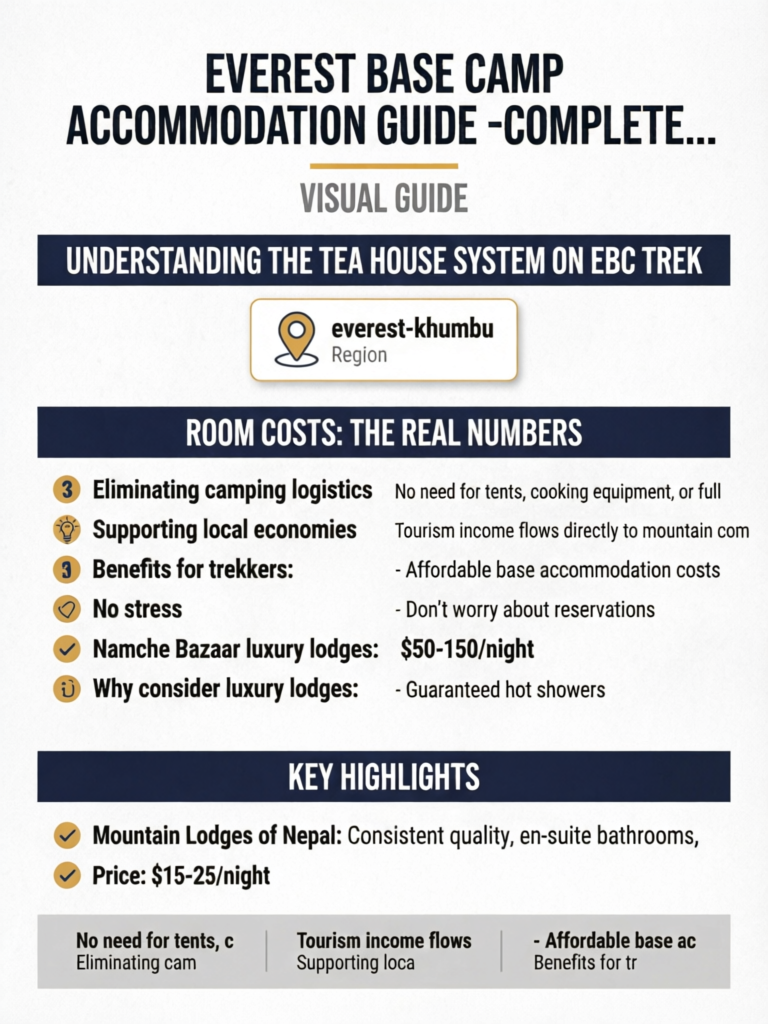
What Are Tea Houses?
Tea houses (also called lodges or guesthouses) are family-run or commercially-operated mountain accommodations that provide simple rooms, communal dining areas, and meals to trekkers. They evolved from basic trail-side rest stops into a comprehensive hospitality infrastructure that now makes the Everest Base Camp trek accessible without expensive camping expeditions.
The tea house system revolutionized Himalayan trekking by:
- Eliminating camping logistics: No need for tents, cooking equipment, or full porter crews
- Supporting local economies: Tourism income flows directly to mountain communities
- Enabling budget travel: Independent trekkers can complete EBC for a fraction of camping trek costs
- Providing cultural immersion: Stay with Sherpa families, eat traditional meals, experience mountain life
- Offering flexibility: Change plans easily, extend or shorten treks without complex rearrangements
The Business Model: Cheap Rooms, Expensive Food
Understanding the tea house business model is crucial for managing expectations and budgets:
How it works:
- Room rates are deliberately kept very low ($2-10/night depending on altitude)
- Real profit comes from food, drinks, hot showers, WiFi, and device charging
- This model attracts trekkers while ensuring reliable income from essential services
Why it matters:
- You're expected to eat dinner and breakfast at the lodge where you sleep
- Bringing outside food into dining rooms violates the business model and is considered rude
- Ordering hot drinks regularly (tea, coffee, hot chocolate) is part of the cultural expectation
- All services beyond basic room and bed have separate charges
Benefits for trekkers:
- Affordable base accommodation costs
- Flexibility to choose lodges based on recommendations or availability
- Owners compete on food quality and hospitality, not just room prices
- Walk-in options available during most seasons
For comprehensive understanding of how tea houses work throughout Nepal, see our Complete Tea House Trekking Guide.
Walk-In vs Advance Booking Strategy
Your booking strategy should match the season and altitude:
Low/Shoulder Season (December-February, June-September):
- Walk-in works perfectly: Lodges rarely fill completely
- Maximum flexibility: Choose lodges based on arrival time, fatigue level, or word-of-mouth recommendations
- No stress: Don't worry about reservations
- Possible negotiation: Prices sometimes negotiable during very quiet periods (though this is rare)
Peak Season (October-November, March-May):
- Booking strongly recommended: Popular locations fill by mid-afternoon
- Critical villages: Gorak Shep, Lobuche, Dingboche, Tengboche, and Namche during acclimatization days
- How to book: Through your guide/agency, direct phone calls (if you have lodge contacts), or arrive very early (before 2 PM)
- Consequences of not booking: May sleep on dining room benches, in storage rooms, or in overcrowded dormitories
Peak Season Accommodation Crisis at Gorak Shep
Our recommendation: Book accommodations for the entire trek during peak season through your trekking agency or guide. This adds minimal cost but eliminates significant stress at high altitude when you're tired and potentially dealing with altitude symptoms.
Room Costs: The Real Numbers
Tea house room costs follow a predictable pattern based on altitude, season, and demand. Here's what you'll actually pay in 2026:
Standard Pricing by Altitude
| Altitude Range | Location Examples | Room Cost (with meals) | Room Cost (standalone) | Notes |
|---|---|---|---|---|
| 2,600-3,000m | Lukla, Phakding, Monjo | $2-5/night | $8-15/night | Best facilities, competitive pricing |
| 3,000-3,500m | Namche Bazaar | $3-8/night | $10-20/night | Wide range from basic to luxury |
| 3,500-4,000m | Tengboche, Pangboche | $3-5/night | $8-12/night | Good facilities, monastery area |
| 4,000-4,500m | Dingboche, Pheriche | $5-8/night | $10-15/night | Mid-range facilities |
| 4,500-5,000m | Lobuche | $5-10/night | $15-20/night | Basic facilities, limited options |
| Above 5,000m | Gorak Shep | $7-15/night | $20-30/night | Most basic, highest prices |
What "With Meals" Actually Means
When lodges quote "free" or "$2-5" room rates, this assumes you'll:
- Eat dinner at the lodge (NPR 600-1,000 / $5-8)
- Eat breakfast at the lodge (NPR 400-700 / $3-6)
- Order hot drinks throughout evening (NPR 100-300 per drink / $0.80-2.50)
Total daily spend per person: $25-40 depending on altitude, including room and three meals plus drinks.
Luxury and Premium Options
Not all EBC lodges are basic. Some villages offer upgraded accommodations:
Namche Bazaar luxury lodges: $50-150/night
- Yeti Mountain Home: Heated rooms, attached bathrooms, premium facilities
- Hotel Everest View: $200-350/night, incredible views, highest-elevation luxury hotel in world
- Mountain Lodges of Nepal: Consistent quality, en-suite bathrooms, free hot showers
Why consider luxury lodges:
- Guaranteed hot showers
- Heated communal areas (sometimes heated rooms)
- Attached bathrooms
- Higher quality food
- More comfortable acclimatization days
- Better sleep quality at critical altitudes
Most trekkers use a hybrid approach: budget tea houses most nights, luxury lodge at Namche during acclimatization day for recovery and comfort.
Strategic Luxury Splurge
Village-by-Village Accommodation Breakdown
This section provides specific details for every major stop on the classic EBC trek route, from Lukla to Gorak Shep and back.
Lukla (2,860m): Gateway Town with Tourist Infrastructure
Altitude: 2,860m (9,383 ft) Number of Lodges: 50+ options Accommodation Quality: Good to excellent
Lukla serves as the starting and ending point for most EBC treks, connected to Kathmandu via the famous Tenzing-Hillary Airport. As a busy tourist hub, it offers the widest variety of accommodation and services on the entire trek.
Facilities Available:
- Wide range of lodges from budget ($10-15) to comfortable ($30-50)
- Hot showers widely available ($2-3)
- Western and squat toilets, mostly inside buildings
- Reliable electricity (mix of grid and solar)
- Good WiFi availability ($3-5/day)
- Bakeries, restaurants, gear shops
- Last ATM until Namche Bazaar (critical cash point)
Specific Lodge Recommendations:
Himalaya Lodge & Restaurant
- Family-run, excellent hospitality
- Garden setting, peaceful atmosphere
- Free WiFi and parking
- Good food, clean rooms
- Price: $15-25/night
Sunny Garden Hotel
- Well-established, reliable service
- Garden dining area
- Hot showers available
- Price: $20-30/night
Nest Teahouse
- Budget-friendly option
- Clean, basic rooms
- Good location near airport
- Price: $10-15/night
Khumbu Resort
- Mid-range comfort
- Slightly quieter location
- Decent restaurant
- Price: $20-35/night
Food Costs in Lukla:
- Dal bhat: NPR 500-600 ($4-5)
- Momos (dumplings): NPR 300-400 ($2.50-3.50)
- Noodle soup: NPR 400-500 ($3-4)
- Tea/coffee: NPR 100-150 ($0.80-1.20)
- Breakfast (eggs, porridge, pancakes): NPR 400-600 ($3-5)
What to Expect:
- Tourist-oriented atmosphere (less authentic than higher villages)
- English widely spoken
- Many trekkers only spend one night here (arriving on afternoon flight, leaving next morning)
- Some trekkers skip Lukla entirely and walk to Phakding first day
- Can be noisy due to flight traffic and commercial activity
Pro Tips for Lukla:
- Withdraw maximum cash from ATM (NPR 35,000 limit, approximately $280 USD equivalent) - next ATM is Namche
- Buy any forgotten gear here (cheaper than higher up)
- Don't spend time shopping for souvenirs (better selection and prices in Namche)
- If flight arrives early afternoon, consider walking to Phakding (3-4 hours) to start trek immediately
For more details on navigating Lukla flights and delays, see our Complete Lukla Flight Guide.
Phakding (2,610m): Riverside Rest Stop
Altitude: 2,610m (8,563 ft) Number of Lodges: 20+ options Accommodation Quality: Good, comfortable for first night
Phakding is a small Sherpa village along the Dudh Koshi River, typically the first night's stop for trekkers starting from Lukla. It's a gentle introduction to tea house accommodation with good facilities and a relaxed atmosphere.
Facilities Available:
- Comfortable lodges in quiet riverside setting
- Hot showers available ($2-3)
- Mix of Western and squat toilets
- Solar electricity (reliable)
- Phone charging available ($1-2/device)
- WiFi at most lodges ($3-5/day)
- Small shops for snacks and essentials
Specific Lodge Recommendations:
Hotel Snowland
- Popular with trekkers
- Riverside location
- Good food reputation
- Price: $3-5/night (with meals)
Mountain Lodges of Nepal - Phakding
- Part of premium chain
- Consistent quality
- Accommodations with shared lounge, restaurant, bar
- Price: $15-25/night
Joe's Garden (Luxury option)
- Higher-end choice
- Beautiful garden
- Better facilities than standard tea houses
- Price: $25-40/night
Yeti Resort
- Mid-range comfort
- Family-run
- Clean, well-maintained
- Price: $5-8/night (with meals)
Five Star Lodge
- Good value
- Friendly owners
- Decent food
- Price: $3-5/night (with meals)
Shangri-la Guest House
- Features garden, shared lounge, terrace, and bar
- Social atmosphere
- Good communal areas
- Price: $5-8/night (with meals)
Special Mention: The Waterfall Lodge (Benkar) Between Lukla and Phakding, in the small village of Benkar, sits The Waterfall Lodge - a family-run establishment where "Ama" (the mother) is renowned as possibly the best cook in the Khumbu Valley. If you're looking for exceptional food and authentic hospitality, consider stopping here instead of Phakding.
Food Costs in Phakding:
- Dal bhat: NPR 550-650 ($4.50-5.50)
- Noodle dishes: NPR 450-550 ($3.50-4.50)
- Tea/coffee: NPR 100-150 ($0.80-1.20)
- Breakfast items: NPR 450-600 ($3.50-5)
What to Expect:
- Quiet, peaceful atmosphere (good for first night's acclimatization sleep)
- Less commercial than Lukla
- Beautiful riverside setting with prayer wheels and flags
- Sounds of the Dudh Koshi River
- Some lodges have gardens and outdoor seating
- More authentic Sherpa village feel than Lukla
Pro Tips for Phakding:
- This is an easy day from Lukla (only 3-4 hours, descending 250m)
- Use the afternoon to rest, hydrate, and organize gear for upcoming days
- First night at altitude - drink plenty of water
- Some trekkers skip Phakding and go directly to Namche from Lukla (very long, hard day - not recommended)
Namche Bazaar (3,440m): The Crown Jewel of Khumbu Accommodation
Altitude: 3,440m (11,286 ft) Number of Lodges: 100+ options Accommodation Quality: Excellent - best on entire trek Typical Stay: 2 nights (including acclimatization day)
Namche Bazaar is the Sherpa capital of the Khumbu region and the undisputed accommodation highlight of the EBC trek. This amphitheater-shaped town offers everything from budget tea houses to luxury lodges, plus the best facilities, food variety, and amenities you'll find until returning from Base Camp.
Why Namche Has the Best Facilities:
- Largest settlement in the region (population ~1,600)
- Hydroelectric power supplementing solar (more reliable electricity)
- Competitive lodge market driving quality improvements
- Gateway to Everest region (all supplies pass through)
- Popular acclimatization stop (trekkers spend 2 nights)
- Strong wifi infrastructure from telecommunications towers
Facilities Available:
- 100+ accommodation options from budget to luxury
- Hot showers widely available (many include in room price, others $2-4)
- Western toilets common, even in budget lodges
- Reliable electricity most hours
- Best WiFi on entire trek ($3-5/day, reasonably fast)
- Bakeries with fresh bread, cakes, pastries
- ATM (last one until returning to Lukla)
- Pharmacy
- Gear shops and rentals
- Laundry services
- Saturday market (if your timing aligns)
- Restaurants, cafes, bars
- Monastery, museum
Specific Lodge Recommendations:
PREMIUM/LUXURY TIER ($50-150/night):
Yeti Mountain Home - Namche
- Part of high-end lodge chain
- Heated rooms and dining areas
- Attached bathrooms with hot showers
- Excellent food quality
- Professional service
- Best choice for maximum comfort
- Price: $100-150/night (full board)
Hotel Everest View
- Highest luxury hotel in world (Guinness Record)
- Located above Namche at 3,880m
- Spectacular Everest views
- Heated rooms, oxygen available
- Attached bathrooms
- Expensive but unique experience
- Price: $200-350/night
- Note: Better as a day hike destination than accommodation (acclimatization concerns)
Mountain Lodges of Nepal - Namche Lodge
- Two-story pitched-roof lodge overlooking town
- En-suite bathrooms
- Free hot showers (when arranged with manager)
- Excellent food, attentive staff
- Popular rest stop in MLN collection
- Price: $50-80/night
MID-RANGE TIER ($20-50/night):
Nirvana Home
- Highly recommended - possibly best mid-range option
- High location in Namche (excellent solar exposure)
- Rooms stay warm even in December evenings
- Some of the best bathroom facilities on entire EBC trek
- Sparkling clean
- Friendly family-run operation
- Price: $25-40/night
- Reviewer note: "Best teahouse in six weeks trekking Nepal"
Mountain Dreams Lodge
- Very cozy, heart of Namche
- Clean, comfortable rooms
- Friendly, welcoming owner
- Good warmth retention
- Popular with repeat trekkers
- Price: $20-35/night
- Reviewer note: "Warmest tea house in Namche Bazaar"
Sherpa Shangri-La
- Well-established lodge
- Good location
- Reliable hot showers
- Decent WiFi
- Price: $25-40/night
Panorama Lodge
- Great views (as name suggests)
- Good food
- Clean facilities
- Slightly higher location (better views, more sun)
- Price: $20-30/night
BUDGET TIER ($5-20/night with meals):
Buddha Lodge
- Good budget option
- Basic but clean
- Central location
- Price: $8-15/night
Hotel Sherpa
- Reliable budget choice
- Family-run
- Clean rooms
- Price: $8-12/night
Pine Forest Lodge
- Basic accommodation
- Good value
- Decent food
- Price: $5-10/night (with meals)
Sherpa Guide Lodge
- Budget-friendly
- Popular with guide groups
- Basic facilities
- Price: $5-8/night (with meals)
Food Costs in Namche:
- Dal bhat: NPR 600-800 ($5-6.50)
- Pizza (yes, real pizza!): NPR 800-1,200 ($6.50-10)
- Momos: NPR 400-500 ($3-4)
- Burger: NPR 600-800 ($5-6.50)
- Bakery items (croissant, cinnamon roll): NPR 200-400 ($1.50-3)
- Coffee (real, not instant): NPR 200-300 ($1.50-2.50)
- Tea: NPR 100-150 ($0.80-1.20)
- Beer: NPR 500-700 ($4-6)
What to Expect:
- Bustling atmosphere, feels like a real town
- Steep streets and staircases (everything is uphill or downhill)
- Best food variety on the trek (pizza, burgers, bakery items, international cuisine)
- Saturday market selling vegetables, yak cheese, textiles, handicrafts
- Strong sense of Sherpa culture and community
- Tourist infrastructure fully developed
- Gear shops selling/renting equipment (last chance for forgotten items)
- Many trekkers doing acclimatization hikes (Everest View Hotel, Khumjung, Syangboche)
Acclimatization Day Activities from Namche: Since you'll spend two nights here, use the acclimatization day wisely:
- Everest View Hotel hike (3,880m): 2-3 hours round trip, stunning panoramas, perfect "climb high, sleep low"
- Khumjung village (3,790m): 3-4 hour loop, visit Hillary School, see "Yeti scalp" at monastery
- Syangboche Airport (3,720m): Easy walk with views
- Museum visit: Learn about Sherpa culture and mountaineering history
- Bakery tour: Sample fresh-baked goods at multiple bakeries
- Gear shopping: Last chance to buy/rent forgotten items
- Rest and recovery: Catch up on sleep, do laundry, charge devices
Maximize Namche Comfort
Pro Tips for Namche:
- Book accommodation in advance during peak season (very popular acclimatization stop)
- Higher lodges get better sun exposure (warmer during day)
- Lower lodges closer to town center (more convenient for shopping/dining)
- Spend money on food variety here (it's your last chance for fresh vegetables, bakery items, pizza, etc.)
- Withdraw cash from ATM (last one until Lukla on return)
- Charge all devices fully (electricity more expensive above)
- Consider taking two hot showers while you're here (luxury you'll miss higher up)
- Buy snacks for higher elevations (chocolate, nuts, energy bars)
- Visit the bakeries - fresh baked goods won't be available above Namche
For more information about the Khumbu region and Namche's role, see our Everest-Khumbu Region Overview.
Tengboche (3,860m): Monastery Village with Limited Options
Altitude: 3,860m (12,664 ft) Number of Lodges: 10-15 options Accommodation Quality: Basic to good Typical Stay: 1 night
Tengboche (also spelled Thyangboche) sits on a ridge overlooking the Dudh Koshi Valley with spectacular views of Everest, Lhotse, Nuptse, Ama Dablam, and surrounding peaks. The village's main attraction is Tengboche Monastery, the largest gompa in the Khumbu region.
Facilities Available:
- Moderate selection of lodges (fewer than Namche or Dingboche)
- Hot showers available but expensive ($3-5)
- Mix of Western and squat toilets
- Solar electricity (weather dependent)
- WiFi available at some lodges ($5-7/day, slow)
- Device charging $2-4 per device
- Small shops for basic snacks
- Monastery open to visitors
- Afternoon prayer ceremonies (3-4 PM)
Specific Lodge Recommendations:
Trekker's Lodge
- Excellent location - high up with panoramic views
- Probably the best position in Tengboche
- Good solar exposure
- Clean facilities
- Friendly family operation
- Price: $5-8/night (with meals)
Hotel Himalaya
- Reliable choice
- Good food
- Clean rooms
- Price: $5-8/night (with meals)
Tengboche Guest House
- Simple, basic accommodation
- Convenient location
- Decent hospitality
- Price: $5-8/night (with meals)
Hotel Tashi Delek
- Popular with trekking groups
- Larger lodge with more capacity
- Standard facilities
- Good communal dining room
- Price: $5-10/night (with meals)
Rivendell Lodge
- Named after Tolkien's refuge (appropriate setting!)
- Good reputation
- Clean rooms
- Price: $5-8/night (with meals)
Deboche Lodge
- Actually located in nearby Deboche village (15 minutes before Tengboche)
- Quieter alternative
- Good facilities
- Price: $5-8/night (with meals)
Food Costs in Tengboche:
- Dal bhat: NPR 700-850 ($5.50-7)
- Noodle soup: NPR 600-750 ($5-6)
- Tea/coffee: NPR 150-200 ($1.20-1.60)
- Breakfast items: NPR 600-800 ($5-6.50)
What to Expect:
- Absolutely stunning mountain views (weather permitting)
- Cold temperatures at night (above treeline, exposed ridge)
- Monastery atmosphere brings peaceful vibe
- Afternoon prayer ceremonies open to respectful visitors
- Limited electricity hours
- Fewer lodge options than other villages (book ahead peak season)
- Exposed to wind (can be very cold in afternoon)
- First night truly above treeline for most itineraries
Monastery Visit:
- Entry fee: NPR 100-200 ($0.80-1.60)
- Respectful dress required (cover shoulders and legs)
- Remove shoes before entering
- Photos usually allowed outside, sometimes restricted inside
- Afternoon prayers 3-4 PM daily (worth attending)
- Important Buddhist pilgrimage site
Pro Tips for Tengboche:
- Arrive early afternoon to visit monastery before prayer ceremony
- The view at sunrise is spectacular if you wake early
- Extremely cold at night - use sleeping bag and all layers
- Limited lodge capacity - book ahead during peak season
- Some trekkers stay in Deboche instead (15 minutes before Tengboche) for quieter atmosphere
- If suffering from early altitude symptoms, consider descending to Deboche (3,820m) instead of staying at Tengboche (3,860m)
Dingboche (4,410m): Acclimatization Hub with Good Lodge Selection
Altitude: 4,410m (14,470 ft) Number of Lodges: 30+ options Accommodation Quality: Basic to good Typical Stay: 2 nights (including acclimatization day)
Dingboche is a yak-herding settlement in a wide, windswept valley at the junction of the Imja Khola and Khumbu Khola rivers. It serves as the second major acclimatization stop on the EBC trek, with two nights typical before pushing to higher elevations.
Facilities Available:
- Good selection of lodges for this altitude
- Hot showers available but expensive ($4-5) and limited hours
- Mostly squat toilets, some Western options
- Solar electricity (highly weather dependent)
- WiFi available but slow and expensive ($5-8/day)
- Device charging $3-5 per device
- Limited shops
- Stunning views of Island Peak, Ama Dablam, Lhotse
- Well-defined acclimatization hike routes
Specific Lodge Recommendations:
Unfortunately, specific lodge names for Dingboche weren't as prominent in available data, but expect similar standards to other villages at this altitude. Most lodges are family-run with basic twin rooms, communal dining areas with yak-dung stoves, and shared bathroom facilities.
Lodges typically cluster in two areas:
- Lower Dingboche: More sheltered, slightly warmer
- Upper Dingboche: Better views, more exposed to wind
Food Costs in Dingboche:
- Dal bhat: NPR 800-900 ($6.50-7.50)
- Noodle dishes: NPR 700-850 ($5.50-7)
- Tea/coffee: NPR 200-300 ($1.60-2.50)
- Breakfast: NPR 700-900 ($5.50-7.50)
- Water (1.5L): NPR 200-300 ($1.60-2.50)
What to Expect:
- COLD - significantly colder than lower elevations
- Strong afternoon winds common (arrive early)
- Rooms not heated whatsoever
- Dining rooms heated by yak-dung stoves (smoky but warm)
- Basic facilities - toilets often outdoor, very cold
- Limited electricity hours (solar dependent)
- Slower food preparation (lower air pressure affects cooking)
- Altitude effects becoming more noticeable
- Two nights helps acclimatization significantly
Acclimatization Day Activities from Dingboche: Your second acclimatization day is critical. Popular hikes include:
- Nangkartshang Peak ridge (up to 5,083m): Most popular option, 3-4 hours round trip, excellent views of Makalu
- Chhukung village (4,730m): Alternative acclimatization hike, 4-5 hours round trip
- Island Peak Base Camp (5,200m): For very strong acclimatizers only
- Short ridge walk: If feeling altitude effects, just walk up nearby ridge to ~4,600m
Weather and Temperature:
- Daytime highs: 5-10°C (sunny conditions)
- Nighttime lows: -5 to -15°C
- Strong winds common in afternoon
- Exposed valley location makes it feel colder
- Can snow any time of year
Acclimatization Day is Non-Negotiable
Pro Tips for Dingboche:
- Dress warmly for evenings - dining room may be heated but your room won't be
- Do your acclimatization hike in the morning (weather more stable)
- Return to lodge by 2-3 PM before afternoon winds strengthen
- Hot water bottles at night ($1-2) significantly improve sleep comfort
- Don't wash hair - takes forever to dry, risk of getting chilled
- Hydrate constantly (3-4 liters per day minimum)
- Watch for altitude symptoms in yourself and others
- Some trekkers prefer Pheriche (alternative village) for the second acclimatization stop
Lobuche (4,940m): Basic High-Altitude Stop
Altitude: 4,940m (16,207 ft) Number of Lodges: 8-12 options Accommodation Quality: Basic Typical Stay: 1 night
Lobuche is a small, basic settlement that serves as the last overnight stop before Gorak Shep. It's where the reality of high-altitude accommodation truly sets in - facilities are basic, temperatures are frigid, and altitude effects are pronounced for many trekkers.
Facilities Available:
- Limited lodge selection
- Hot showers rare and very expensive ($5-7) if available at all
- Mostly squat toilets, outdoor facilities common
- Very limited electricity (solar only, weather dependent)
- WiFi rare and very expensive ($8-10/day, extremely slow)
- Device charging expensive ($4-5 per device)
- No shops
- Very basic food options
- Cold, harsh conditions
Specific Lodge Recommendations:
Specific names less critical at this altitude - most lodges are similarly basic. Expect:
- Small rooms, thin walls
- Basic beds with mattresses
- Multiple blankets provided
- Shared outdoor toilets (very cold)
- Communal dining room with yak-dung stove
- Limited menu options
- Slow food preparation
- Very cold temperatures
Food Costs in Lobuche:
- Dal bhat: NPR 900-1,000 ($7.50-8.50)
- Noodle soup: NPR 800-950 ($6.50-8)
- Tea/coffee: NPR 250-350 ($2-3)
- Breakfast: NPR 800-1,000 ($6.50-8.50)
- Water (1.5L): NPR 300-400 ($2.50-3.50)
What to Expect:
- Very basic accommodation (manage expectations)
- Extremely cold at night (-10 to -20°C)
- Altitude effects common (headache, reduced appetite, fatigue)
- Dining room crowded as everyone seeks warmth around stove
- Limited bathroom facilities (outdoor squat toilets typical)
- Thin walls - hear everything from neighboring rooms
- Difficult to sleep due to altitude, cold, and discomfort
- Food takes long to cook, limited variety
- Possible overcrowding during peak season
Memorial Cairns: On the climb from Dingboche to Lobuche, you'll pass the memorial cairns at Thukla/Dukla Pass (4,620m). This somber site honors climbers and Sherpas who died on Everest and surrounding peaks. It's an emotionally powerful reminder of the mountain's demands.
Weather and Temperature:
- Daytime highs: 0-5°C
- Nighttime lows: -10 to -20°C
- Can feel much colder with wind
- Clear skies common but cold
- Snow possible any time
Pro Tips for Lobuche:
- Arrive early to secure better room locations (some rooms better than others)
- Hot water bottle essential for sleep ($2-3)
- Sleep in all your layers (thermal underwear, fleece, down jacket, warm hat)
- Put tomorrow's clothes in sleeping bag to keep warm
- Don't count on hot showers (too cold, too expensive, draining)
- Use wet wipes instead of washing
- Eat dinner early (kitchen may run out of gas or get overwhelmed)
- Stay hydrated despite reduced appetite
- Watch for altitude symptoms
- Go to bed early (conserve energy for next day's push to Gorak Shep/EBC)
Alternative Strategy: Some fit trekkers skip staying in Lobuche by doing a long day from Dingboche directly to Gorak Shep (8-10 hours). This reduces nights at extreme altitude but is very demanding. Only consider if you're acclimatizing well and feeling strong.
Gorak Shep (5,164m): Highest and Most Basic Accommodation
Altitude: 5,164m (16,942 ft) Number of Lodges: 4-6 options Accommodation Quality: Very basic Typical Stay: 1 night (some skip, doing EBC and returning to Lobuche same day)
Gorak Shep is the highest and most basic accommodation on the EBC trek. It's a frozen lakebed settlement that serves as base for visiting Everest Base Camp (5,364m) and climbing Kala Patthar (5,545m). This is the most challenging accommodation experience on the trek.
Facilities Available:
- Very limited lodge options (4-6 total)
- Hot showers generally not available (or prohibitively expensive at $7-10)
- Basic squat toilets, outdoor facilities
- Minimal electricity (solar only, very limited hours)
- WiFi extremely expensive ($10-15/day) and barely functional
- Device charging very expensive ($5+)
- No private rooms available (mostly shared)
- Most expensive food on the trek
- Extreme cold conditions
Specific Lodge Names:
Four main hotels provide basic accommodations:
- All are similarly basic
- No significant quality differences
- First-come, first-served during peak season
- Expect shared rooms if arriving late
Food Costs in Gorak Shep (Highest on Trek):
- Dal bhat: NPR 1,000-1,200 ($8.50-10)
- Noodle soup: NPR 900-1,100 ($7.50-9)
- Tea/coffee: NPR 300-400 ($2.50-3.50)
- Breakfast: NPR 850-1,000 ($7-8.50)
- Water (1.5L): NPR 400-500 ($3.50-4)
What to Expect:
- Most basic facilities on entire trek
- Extremely cold (-15 to -25°C at night)
- Severe overcrowding during peak season (October-November)
- Late arrivals may sleep on dining room benches
- Shared dormitory rooms common
- Very limited bathroom facilities
- No hot showers realistically available
- Food extremely expensive due to transport costs
- Cooking takes long time (very low air pressure)
- Significant altitude effects (headache, nausea, insomnia)
- Difficult to sleep (altitude, cold, discomfort, excitement)
- Stunning mountain views if weather clear
Peak Season Accommodation Crisis: During October and early November, Gorak Shep becomes dangerously overcrowded:
- All rooms fill by early afternoon
- Late arrivals sleep on restaurant benches
- Storage tents used for overflow
- Some trekkers sleep on the ground
- Bathroom queues extremely long
- Dining rooms packed and chaotic
Strategies for Gorak Shep:
- Book ahead through guide/agency (highly recommended peak season)
- Arrive very early (before 1-2 PM)
- Alternative: Stay in Lobuche, make EBC a very long day trip (9-12 hours)
- Skip Gorak Shep entirely: Some trekkers go to EBC and return to Lobuche same day (very long, exhausting)
Weather and Temperature:
- Daytime highs: -2 to +3°C
- Nighttime lows: -15 to -25°C
- Extreme cold, especially in winter
- Wind chill can be severe
- Frozen lake setting amplifies cold
What You're Here For: Despite the harsh conditions, Gorak Shep is the launch point for:
- Everest Base Camp (5,364m): 2-3 hours round trip from Gorak Shep
- Kala Patthar (5,545m): 2-3 hours round trip, best Everest viewpoint on trek
Most trekkers' itinerary:
- Day 1: Arrive Gorak Shep, drop bags, hike to EBC, return to Gorak Shep, sleep
- Day 2: Pre-dawn Kala Patthar climb (4-5 AM start), return to Gorak Shep for breakfast, descend to Pheriche or Dingboche
Altitude Warning at Gorak Shep
Pro Tips for Gorak Shep:
- Bring high-calorie snacks from lower elevations (you may not want lodge food)
- Force yourself to eat and drink despite reduced appetite
- Chemical heat packs for sleeping bag ($3-5 in Namche)
- Sleep fully clothed in all layers
- Don't expect to sleep well (almost nobody does)
- Bathroom visits at night are brutal (freezing cold) - consider pee bottle
- Skip shower entirely (too cold, too expensive, dangerous)
- Eat dinner early before kitchen gets overwhelmed
- If experiencing severe symptoms, descend immediately (don't wait until morning)
- The discomfort is temporary - you've come this far
Alternative Approach: Increasingly, experienced trekkers and agencies recommend skipping overnight at Gorak Shep:
- Stay in Lobuche (4,940m)
- Very early start (3-4 AM)
- Hike to Gorak Shep, then EBC, return to Gorak Shep for breakfast
- Continue to Kala Patthar
- Descend all the way to Pheriche or Pangboche (much lower, better sleep)
This approach minimizes time at extreme altitude and provides much better sleep recovery, but requires excellent fitness and long trekking day (10-14 hours).
Facilities by Altitude: What Changes as You Climb
Understanding how facilities deteriorate with altitude helps set realistic expectations and plan accordingly.
Hot Showers: Availability and Costs
| Altitude | Availability | Cost | Notes |
|---|---|---|---|
| Below 3,000m | Widely available, reliable | $2-3 | Solar or gas heated, good water pressure |
| 3,000-3,500m (Namche) | Readily available | $2-4 | Best showers on trek, some lodges include free |
| 3,500-4,000m | Available, limited hours | $3-5 | Solar dependent, afternoon only (2-4 PM) |
| 4,000-4,500m | Limited availability | $4-5 | Many lodges don't offer, solar only |
| Above 4,500m | Rare or unavailable | $5-7 | Not worth the money/effort at this altitude |
Shower Strategy:
- Take hot showers at Lukla, Phakding, and especially Namche (twice!)
- Last realistic shower: Namche or Tengboche
- Above 4,000m: Use wet wipes, hand washing only
- Washing hair particularly difficult (takes forever to dry, risk hypothermia)
- Time showers for early afternoon (warmest air, warmest solar water)
The Namche Shower Strategy
Bathroom Facilities Evolution
Toilet Types by Altitude:
Below 3,000m:
- Mix of Western (sit) and squat toilets
- Often inside lodge buildings
- Standard flush toilets
- Some attached bathrooms (rare, premium lodges)
3,000-4,000m:
- Increasing prevalence of squat toilets
- Mix of indoor and outdoor facilities
- Pour-flush systems (bucket of water)
- Shared bathrooms standard
Above 4,000m:
- Predominantly squat toilets
- Outdoor facilities common (separate building from lodge)
- Very basic, unheated
- Can be extremely cold
- Long queues during peak season
Bathroom Essentials to Bring:
- Toilet paper (keep in room, most bathrooms don't provide)
- Hand sanitizer
- Headlamp (for nighttime visits)
- Wet wipes
- Small ziplock bag for TP (keep dry)
- Pee bottle for high-altitude nights (seriously - bathroom visits at 5,000m at 2 AM in -20°C are brutal)
Electricity and Device Charging
Power Sources:
- Lower villages: Mix of hydroelectric grid and solar
- Mid-altitude: Primarily solar
- High altitude: Solar only
Charging Costs:
| Altitude | Cost per Device | Hours Available | Notes |
|---|---|---|---|
| Below 3,000m | $1-2 | Most of evening | Reliable, often USB ports in dining room |
| 3,000-3,500m (Namche) | $2-3 | Extended hours | Best electricity on trek |
| 3,500-4,000m | $2-4 | Limited hours | Solar dependent, charge during meals |
| 4,000-4,500m | $3-5 | Very limited | Weather dependent, may not be available |
| Above 4,500m | $4-6 | Minimal | Often unavailable or prohibitively expensive |
Charging Strategy:
- Charge everything fully in Namche (you're here 2 nights)
- Carry external battery pack (charge in Namche)
- Charge devices during meal times (when generators/solar most active)
- Power banks cost more to charge than phones/cameras
- Airplane mode extends battery life significantly
- Bring charging cables and adapters
Power Availability:
- Most lodges shut down electricity 9-10 PM
- Morning power may not be available
- Cloudy days = less solar = less charging availability
- Peak season demand may exceed supply
WiFi: Availability, Speed, and Costs
WiFi Performance by Altitude:
| Location | Cost | Speed | Reliability |
|---|---|---|---|
| Lukla | $3-5/day | Moderate | Good |
| Phakding | $3-5/day | Moderate | Good |
| Namche Bazaar | $3-5/day | Best on trek | Very good |
| Tengboche | $5-7/day | Slow | Moderate |
| Dingboche | $5-8/day | Slow | Poor (weather dependent) |
| Lobuche | $8-10/day | Very slow | Very poor |
| Gorak Shep | $10-15/day | Barely functional | Extremely poor |
WiFi Reality Check:
- Don't expect streaming video anywhere
- Messaging apps (WhatsApp) work at lower altitudes
- Email checking possible at Namche and below
- Photo uploads extremely slow above Namche
- Video calls difficult anywhere, impossible at high altitude
- Weather affects satellite-based connections
- Peak usage times (dinner) = slower speeds
WiFi Strategy:
- Download movies, music, maps, books before trek in Kathmandu
- Update family/friends from Namche (best connectivity)
- Don't count on WiFi above Namche for anything important
- Some lodges offer free slow WiFi if you eat there (lower altitudes only)
- Consider Nepali SIM card with data plan for lower altitudes (see below)
Mobile Phone Coverage: Nepal Telecom (Ncell and Nepal Telecom operators) provides coverage to Namche and sometimes Tengboche. Above that, mobile networks are unreliable to non-existent. An Ncell data package is usually only useful for internet as far as Namche; higher up it works for occasional calls at best.
The Everest Link Card (Best Value Option): Rather than paying $3-15/day at each lodge, most experienced trekkers buy an Everest Link prepaid WiFi card in Lukla or Namche. The card works at most tea houses across the Khumbu that have an Everest Link router, so you pay once instead of nightly. Typical packages are around NPR 600 for 600 MB and roughly NPR 2,000 (about $15) for 10 GB lasting 30 days, with larger bundles available. Speeds still slow with altitude and weather, but the per-megabyte cost is far lower than lodge-by-lodge WiFi. Buy it early (Lukla or Namche) so it is active before connectivity gets scarce above Namche.
For comprehensive information about connectivity options, see our Nepal SIM Cards & WiFi for Trekking Guide.
Heating and Staying Warm
Critical reality: ROOMS ARE NOT HEATED anywhere on the trek above Lukla (except rare luxury lodges).
Heating by Location:
Lukla/Phakding (2,600-2,860m):
- Some luxury lodges have heated rooms (rare)
- Dining rooms heated with wood stoves
- Rooms naturally warmer due to lower altitude
Namche (3,440m):
- Some premium lodges (Yeti Mountain Home) have heated rooms
- Most lodges: unheated rooms, heated dining areas
- Solar exposure helps daytime warmth
Tengboche to Gorak Shep (3,860-5,164m):
- NO room heating whatsoever
- Dining rooms heated with yak-dung stoves or gas heaters
- Rooms as cold as outside air
- Nighttime temperatures -5°C to -25°C depending on altitude and season
Staying Warm Strategy:
In Dining Rooms:
- Seats near stove are prime real estate
- Rotate to share warmth
- Wear down jacket, hat, gloves if needed
- Order hot drinks regularly
In Sleeping Rooms:
- Sleeping bag rated -15°C minimum (peak season), -20°C (winter)
- Sleep in layers (thermal underwear, fleece, hat)
- Hot water bottle ($1-3) - game changer for sleep comfort
- Chemical heat packs for feet/hands
- Keep tomorrow's clothes in sleeping bag (stay warm, easier to put on)
- Multiple blankets provided by lodge
- Close all windows/vents (some trekkers leave cracked for ventilation)
- Sleeping bag liner adds warmth and hygiene barrier
What NOT to Do:
- Don't use sleeping bag stuff sack (let bag fully loft)
- Don't sleep in wet clothes (change into dry layers)
- Don't exhale into sleeping bag (moisture freezes)
- Don't skip dinner (body needs calories to generate heat overnight)
Sleeping Bag Essential
Drinking Water at Tea Houses
Every Everest tea house sells drinking water, but how you source it has a big impact on your budget and the Khumbu environment. You have three options:
- Bottled water: Sold at all lodges but increasingly expensive with altitude — roughly NPR 100 ($1) in Lukla rising to NPR 400-500 ($3.50-4) at Gorak Shep. Convenient, but the plastic waste is a real problem (much of it is dumped on hillsides at the village edge), and Sagarmatha National Park discourages it.
- Boiled water: Most tea houses fill your bottle with boiled water for roughly NPR 100-200 per litre, again rising with altitude. It is the safest pre-treated option and saves plastic, though it costs about as much as a hot drink.
- Purify your own: The cheapest and most sustainable choice. Carry a SteriPen UV purifier, a Sawyer/LifeStraw filter, or chlorine/iodine tablets and treat tap or stream water. Note that some smaller filters can crack if they freeze overnight, and UV purifiers eat batteries fast — carry spares, as the ones sold on the trail rarely last a day.
Whichever you choose, drink 3-4 litres daily — dehydration is one of the biggest contributors to altitude sickness. For a full breakdown of methods and gear, see our Water Purification & Hydration Guide.
Refill, Don't Rebuy
Food Costs and Menu Expectations
Food costs increase predictably with altitude due to transportation challenges. Everything above Lukla arrives by porter, yak, or helicopter, with costs rising proportionally to elevation and remoteness.
Food Cost Progression by Altitude
Dal Bhat Costs (Nepal's staple meal, unlimited refills):
- Lukla (2,860m): NPR 500-600 ($4-5)
- Namche (3,440m): NPR 600-800 ($5-6.50)
- Tengboche (3,860m): NPR 700-850 ($5.50-7)
- Dingboche (4,410m): NPR 800-900 ($6.50-7.50)
- Lobuche (4,940m): NPR 900-1,000 ($7.50-8.50)
- Gorak Shep (5,164m): NPR 1,000-1,200 ($8.50-10)
Other Common Items:
| Item | Lukla | Namche | Dingboche | Gorak Shep |
|---|---|---|---|---|
| Noodle soup | NPR 400 | NPR 500 | NPR 800 | NPR 900 |
| Fried rice | NPR 500 | NPR 600 | NPR 850 | NPR 1,000 |
| Momos (dumplings) | NPR 300 | NPR 400 | NPR 600 | NPR 700 |
| Tea | NPR 100 | NPR 100 | NPR 200 | NPR 300 |
| Coffee (instant) | NPR 150 | NPR 200 | NPR 300 | NPR 400 |
| Bottled water (1.5L) | NPR 100 | NPR 150 | NPR 300 | NPR 500 |
Menu Variety by Altitude
Lukla & Phakding:
- Extensive menus (20+ items)
- Western options (pasta, pizza, burgers)
- Fresh vegetables available
- Bakery items
- Multiple breakfast choices
- Beer and alcohol widely available
Namche Bazaar:
- Best food variety on entire trek
- Real pizza (wood-fired ovens)
- Bakeries with fresh bread, croissants, cinnamon rolls
- International cuisine (Korean, Japanese, Indian, continental)
- Fresh vegetables, salads
- Real coffee (not instant)
- Full bar options
- Steaks, burgers, Mexican food
Tengboche to Dingboche (3,860-4,410m):
- Standard trekking menus
- Dal bhat, fried rice, noodle soups, momos
- Limited Western options
- Fewer fresh vegetables
- Alcohol available but more expensive
- Simpler preparations
Lobuche & Gorak Shep (4,940-5,164m):
- Very limited menus (10-12 items)
- Primarily dal bhat, soups, simple noodle dishes
- Instant noodles common
- Very few vegetables (all frozen or preserved)
- Cooking takes long time (low air pressure)
- Expensive everything
- Limited alcohol availability
The Dal Bhat Strategy
Dal bhat (lentil soup with rice, vegetable curry, pickles) is the smartest food choice for EBC trekking:
Benefits:
- Unlimited refills included in price (best value)
- High calories and carbohydrates for energy
- Complete protein (lentils + rice)
- Traditional Nepali meal (supporting local food systems)
- Consistent availability at all altitudes
- Familiar to cooks (well-prepared)
- Vegetables included
Why trekkers love it:
- Fill up completely for one price
- Higher calorie needs at altitude easily met
- Locals eat it daily (always fresh, well-made)
- Comfort food aspect after several days
- Better nutrition than Western options at altitude
When to vary:
- Breakfast: eggs, porridge, pancakes for variety
- Namche: splurge on pizza, bakery items while available
- When dal bhat fatigue sets in (usually happens around day 7-8)
For comprehensive information about trekking food in Nepal, see our Dal Bhat Trekking Guide.
Daily Food Budget
Expected daily food costs per person:
| Location | Breakfast | Lunch | Dinner | Drinks/Snacks | Daily Total |
|---|---|---|---|---|---|
| Lukla-Phakding | $3-5 | $5-7 | $5-8 | $3-5 | $16-25 |
| Namche | $4-6 | $6-10 | $8-12 | $5-8 | $23-36 |
| Tengboche-Dingboche | $5-7 | $6-8 | $8-10 | $4-6 | $23-31 |
| Lobuche | $7-9 | $7-9 | $8-11 | $5-7 | $27-36 |
| Gorak Shep | $7-10 | $8-12 | $10-15 | $6-10 | $31-47 |
Average for entire 12-14 day trek: $300-450 for food
Add for extras:
- Hot showers: $20-30 total
- Device charging: $20-40 total
- WiFi: $30-60 total (if used regularly)
- Alcohol: $50-100+ (if drinking regularly)
Food Safety and Hygiene
Safe eating practices:
- Eat at busy lodges (food turnover = freshness)
- Avoid salads above 3,000m (washing water questionable)
- Stick to hot, freshly cooked food
- Be cautious with dairy products at high altitude
- Drink only treated or bottled water
- Use hand sanitizer before eating
- Watch how food is prepared if possible
Common issues:
- Gastrointestinal problems (diarrhea, nausea)
- Often altitude-related rather than food-borne
- Reduced appetite at altitude is normal
- Food takes longer to digest at elevation
Specific Lodge Recommendations: The Best Options
Based on verified trekker reports, guide recommendations, and field research, here are the standout lodges on the EBC trek:
Budget Category (Under $15/night)
Kala Patthar Lodge, Phakding
- Excellent budget value
- Riverside location
- Clean facilities
- Friendly family operation
Buddha Lodge, Namche
- Good budget option in expensive town
- Central location
- Clean rooms
- Price: $8-15/night
Sherpa Guide Lodge, Namche
- Popular with trekking groups
- Basic but reliable
- Good value
- Price: $5-8/night with meals
Mid-Range Category ($15-50/night)
Nirvana Home, Namche Bazaar ⭐ TOP PICK
- High location, excellent solar exposure
- Rooms stay warm even in winter
- Best bathroom facilities on EBC trek
- Sparkling clean
- Friendly family-run
- Price: $25-40/night
- Reviewer quote: "Best teahouse in six weeks trekking Nepal"
Mountain Dreams Lodge, Namche ⭐ HIGHLY RECOMMENDED
- Very cozy, warm atmosphere
- Heart of Namche location
- Clean, comfortable rooms
- Friendly, welcoming owner
- Popular with repeat trekkers
- Price: $20-35/night
- Reviewer quote: "Warmest tea house in Namche Bazaar"
Trekker's Lodge, Tengboche
- Excellent location with panoramic views
- Probably best position in Tengboche
- Good solar exposure
- Clean facilities
- Price: $5-8/night with meals
The Waterfall Lodge, Benkar ⭐ FOOD LOVERS' CHOICE
- Between Lukla and Phakding
- "Ama" renowned as best cook in Khumbu
- Exceptional food quality
- Authentic family hospitality
- Price: $5-8/night with meals
Premium Category ($50-150/night)
Yeti Mountain Home - Namche
- Part of high-end lodge chain
- Heated rooms and dining areas
- Attached bathrooms with hot showers
- Excellent food quality
- Professional service
- Best choice for maximum comfort
- Price: $100-150/night full board
Mountain Lodges of Nepal - Namche Lodge
- Two-story pitched-roof lodge
- En-suite bathrooms
- Free hot showers (arranged with manager)
- Excellent food
- Attentive, friendly staff
- Price: $50-80/night
Hotel Everest View (Above Namche at 3,880m)
- Highest luxury hotel in world
- Spectacular Everest views
- Heated rooms, oxygen available
- Attached bathrooms
- Expensive but unique experience
- Price: $200-350/night
- Note: Better as day hike destination than accommodation (acclimatization concerns from rapidly gained altitude)
Lodges to Book Ahead (Peak Season)
These locations fill quickly during October-November and March-May:
- Gorak Shep - ALL lodges (accommodation crisis at 5,164m)
- Nirvana Home, Namche - Popular, limited rooms
- Mountain Dreams Lodge, Namche - Small capacity
- Tengboche lodges - Limited total capacity in village
- Dingboche - High demand during acclimatization stop
Shared Rooms vs Private Rooms
Understanding room configurations helps manage expectations:
Twin/Double Rooms (Standard)
What to expect:
- Two single beds in one room
- Bed width: ~90cm (single/twin size)
- Foam mattresses 5-10cm thick
- 1-3 blankets per bed (more at higher altitude)
- Pillow provided (bring liner or use sleeping bag hood)
- Window (often with mountain views)
- Door with lock and key
- Sometimes small shelf or hooks for gear
- Room size: 8-12 square meters
Who shares:
- Couples
- Friends traveling together
- Two trekkers assigned by guide/agency
- Solo travelers paired with another solo trekker (if willing)
Solo traveler options:
- Pay slight supplement for private room ($1-3 extra)
- Share with another solo trekker (guide can arrange)
- Accept dormitory accommodation at high altitude (rare)
Private Rooms (Limited Availability)
Where available:
- Lukla and Phakding: Readily available
- Namche: Available but may cost extra
- Tengboche to Dingboche: Limited, small premium
- Lobuche: Very limited
- Gorak Shep: Generally NOT available
Costs:
- Lower altitude: Same price or +$1-3
- Higher altitude: +$3-5 if available
- Peak season: May not be possible at any price
Dormitory Rooms (Rare)
Where found:
- Very high altitudes when individual rooms full
- Emergency overflow during peak season
- Some older lodges still have dorm configuration
What to expect:
- 4-8 beds in one room
- Shared with strangers
- Less privacy
- More noise
- Cheaper ($1-3/night)
- Earplugs essential
When you might encounter:
- Peak season overflow at Gorak Shep
- Late arrival at full lodges
- Budget trekking companies using dorm-only bookings
Booking Strategy: When to Reserve Ahead
Your booking approach should match season, route, and risk tolerance:
Peak Season (October-November, March-May)
BOOK AHEAD - Essential for:
- Gorak Shep (absolutely critical)
- Tengboche (limited capacity)
- Dingboche (acclimatization stop, high demand)
- Namche specific lodges (if you want particular accommodation)
How to book:
- Through trekking agency: They handle all bookings (recommended)
- Through guide: Guides have lodge contacts, arrange ahead
- Direct calls: If you have lodge phone numbers, call ahead
- Agent in Kathmandu: Some lodges have Kathmandu booking agents
Benefits of pre-booking:
- Guaranteed accommodation
- No stress about finding rooms
- Can arrive later in afternoon if needed
- Better room selection
- Peace of mind at altitude
Drawbacks:
- Less flexibility to change plans
- Committed to specific lodges
- May pay slight premium
Shoulder Season (Early March, Late November-December)
MODERATE APPROACH:
- Book Gorak Shep and maybe Dingboche
- Walk-in works for lower elevations
- More flexibility than peak season
- Some weather uncertainty
Low Season (January-February, June-September)
WALK-IN WORKS:
- Lodges rarely full
- Maximum flexibility
- Choose based on recommendations, arrival time
- No advance booking needed
- Possible price negotiation (rare, but sometimes)
Caveats:
- Some lodges closed in deep winter (January-February)
- Monsoon season (June-August) not recommended for trekking at all
Independent Trekkers with a mandatory licensed guide
If trekking independently (now requires licensed guide per 2026 regulations, but some still go without):
Strategy:
- Book accommodation through Kathmandu agent before trek
- Call lodges yourself (if you have Nepal SIM card)
- Email lodges from Namche (WiFi available)
- Arrive early each day (before 2 PM)
- Ask fellow trekkers for recommendations
- Be flexible with accommodation choice
Reality check: Since 2026, foreign trekkers are required to have licensed guide or porter. True solo trekking is technically not permitted. See our Solo Trekking Nepal Safety Guide for current regulations.
Altitude-Specific Challenges and Solutions
Different altitudes present different accommodation challenges:
Below 3,000m (Lukla, Phakding)
Challenges:
- Tourist-oriented atmosphere (less authentic)
- Noise from other trekkers
- Sometimes less personal service
Solutions:
- Accept this is tourism zone
- Use these nights for good sleep before going higher
- Take advantage of better facilities
3,000-4,000m (Namche, Tengboche)
Challenges:
- Starting to feel altitude effects
- Colder temperatures at night
- Rooms not heated
Solutions:
- Use acclimatization days properly
- Take hot showers while still comfortable
- Hydrate constantly
- Start using sleeping bag every night
4,000-5,000m (Dingboche, Lobuche)
Challenges:
- Significant altitude effects (headache, reduced appetite, fatigue)
- Very cold temperatures (-10 to -20°C nights)
- Basic facilities becoming uncomfortable
- Difficulty sleeping
Solutions:
- Hot water bottle every night ($2-3)
- Sleep in layers
- Force food and water despite reduced appetite
- Accept sleep will be imperfect
- Watch for AMS symptoms
- Don't push through severe symptoms
Above 5,000m (Gorak Shep)
Challenges:
- Extreme altitude effects
- Severe cold (-15 to -25°C)
- Most basic facilities
- Very difficult sleep
- Overcrowding peak season
- Expensive everything
Solutions:
- Minimize time at this elevation
- Consider skip-and-return strategy (stay Lobuche, long day to EBC)
- Use all warming strategies
- Accept discomfort is temporary
- Focus on the goal (EBC, Kala Patthar)
- Descend quickly after achieving objectives
Peak Season vs Off-Season: What Changes
Understanding seasonal differences helps plan and set expectations:
Peak Season (October-November, March-May)
Accommodation Impact:
- Lodges fill by mid-afternoon
- Higher prices possible (though usually standardized)
- Less room choice (take what's available)
- Potential overcrowding
- Dining rooms packed
- Bathroom queues
- Noise levels higher
- More trekkers = more social atmosphere
Booking necessity:
- Essential for Gorak Shep
- Highly recommended for Dingboche, Tengboche
- Good idea for Namche (if want specific lodge)
- Less critical for Lukla, Phakding (many options)
Advantages:
- All lodges open and fully operational
- Full menus available
- More staff (better service)
- Social atmosphere (meet many trekkers)
- Weather generally more stable
Shoulder Season (December, February-early March)
Accommodation Impact:
- Moderate occupancy
- Good availability
- Mix of walk-in and booking
- Fewer trekkers (quieter)
- Some lodges may have reduced staff
Temperature:
- December and February very cold (winter conditions)
- Need warmer sleeping bags (-20°C rated)
- Excellent visibility but harsh conditions
Off-Season (January, June-August)
January (Winter):
- Very few trekkers
- Some lodges closed (especially high altitude)
- Those open offer full service to few guests
- Extreme cold (-25°C at Gorak Shep)
- Clear skies, incredible visibility
- Very challenging conditions
- Walk-in works everywhere
June-August (Monsoon):
- Not recommended for EBC trek
- Many lodges closed
- Rain, clouds, poor visibility
- Trail conditions dangerous
- Leeches below 3,000m
- Some lodges open but minimal services
- Very few trekkers
For comprehensive seasonal information, see our EBC vs ABC Comparison Guide which discusses seasonal considerations.
Cultural Etiquette in Tea Houses
Respectful behavior ensures positive experiences for you, lodge owners, and future trekkers:
Dining Room Etiquette
Do:
- Remove boots before entering (wear camp shoes/flip-flops inside)
- Order hot drinks regularly (it's how they make money)
- Share space near stove (rotate so others get warmth)
- Keep noise reasonable, especially after 8 PM
- Be patient with food preparation (it takes longer at altitude)
- Clean up after yourself
- Say "Namaste" to staff and other trekkers
- Tip for exceptional service (though not required)
Don't:
- Bring outside food into dining rooms (violates business model)
- Hog the best seats near stove
- Complain loudly about basic facilities
- Expect Western service standards
- Leave trash or mess
- Disturb others who are resting
Room and Facility Use
Do:
- Respect quiet hours (generally after 9 PM)
- Keep voices down (thin walls!)
- Use provided blankets carefully (they get washed infrequently)
- Report any facility problems politely
- Understand limitations of altitude accommodation
Don't:
- Expect hotel-level cleanliness
- Waste water (it's precious at altitude)
- Leave wet clothes on lodge blankets
- Burn candles or incense in rooms (fire danger)
- Complain about lack of heating (universal reality)
Tipping Guidelines
Tipping at tea houses:
- Not required or expected like Western countries
- Small tips appreciated for exceptional service
- End-of-trek tip for guide/porter more important
Amounts if you want to tip:
- Lodge staff: NPR 100-200 total at end of stay
- Exceptional service: NPR 200-500
- Not per day - cumulative for stay
Focus tips on:
- Trekking guide: $8-$15 /day
- Porter: $10-15/day
- Total for 12-day trek with one guide, one porter: $250-400
For complete information about tipping culture and expectations, see our Hiring Guides and Porters Nepal Guide. For broader lodge customs across Nepal, see our Tea House Etiquette Guide and how tea house amenities change by altitude.
Cultural Sensitivity
Religious sites:
- Remove shoes before entering monasteries
- Ask permission before photographing monks or prayer ceremonies
- Walk clockwise around stupas and mani walls
- Don't touch prayer flags or religious objects
- Dress modestly (cover shoulders and legs)
Local customs:
- "Namaste" is universal greeting (hands together, slight bow)
- Accept food/drink with right hand or both hands
- Don't point feet at people or religious objects
- Remove hats when entering dining rooms (sign of respect)
- Ask permission before photographing people
Frequently Asked Questions
Plan Your EBC Trek with Confidence
Knowing exactly what to expect from Everest tea houses — the costs, the cold rooms, the booking crunch at Gorak Shep — is half the preparation. The other half is locking in a sensible itinerary and a trustworthy team. If you would rather have lodges pre-booked for peak season and a licensed guide handling the logistics, compare verified Everest Base Camp agencies or read the full Everest Base Camp route guide to plan your trek.
Ready to trek to Everest Base Camp?
Get a custom EBC itinerary with tea houses booked ahead and a licensed local guide.
Related Resources
- Everest Base Camp Trek Complete Guide
- Tea House Trekking Explained
- EBC Trek Cost Breakdown
- Lukla Flight Guide
- Nepal Trekking Permits Explained
- Hiring Guides and Porters Nepal
- Dal Bhat Trekking Guide
- Nepal SIM Cards & WiFi for Trekking
- What to Expect First Nepal Trek
- Solo Trekking Nepal Safety
- Nepal Money, ATMs & Currency for Trekking
- EBC vs ABC Comparison
- Altitude Sickness Signs and Turnaround Rules
- Travel Insurance Nepal Trekking
- EBC 14-Day Itinerary
- Best Time ABC Trek
- How to Choose Trekking Agency
- Fitness Requirements Nepal Trekking
- Nepal Trekking Cultural Etiquette
- What to Wear Trekking Nepal
- EBC Training Plan
- Budget Trekking Nepal
- Independent vs Guided Trekking
- Solo Female Trekking Nepal
- Everest vs Annapurna Region
- Everest-Khumbu Region Overview
Sources
This comprehensive guide was researched using multiple verified sources:
- Teahouses Along the Everest Base Camp Trek 2025
- Lodges & Tea Houses on the EBC Trek
- 2025 Everest Base Camp Trek Accommodation - Complete Guide
- Accommodation on Everest Base Camp Trek Guide
- THE 10 BEST Namche Bazaar Lodges 2026
- Best Teahouse in the Khumbu - Nirvana Home Review
- Mountain Dreams Lodge - Warmest Tea House in Namche
- Accommodation on EBC Trek Guide with Cost
- WiFi and Electricity Facilities During EBC Trek
- Internet, Phone Network, and Electricity on EBC
- Food on the Everest Base Camp Trek
- Food, Drink, and Accommodation Costs on EBC
- Hotels in Namche Bazaar Complete Guide
- Everest Base Camp Tea Houses Guide
This guide is maintained by the Trek and Tour Nepal editorial team with input from verified trekking agencies, lodge operators, and experienced guides. Last updated June 2026. For corrections or updates, contact our editorial team.