"How long does the Everest Base Camp trek take?" is the first question most aspiring trekkers ask—and the answer isn't as simple as a single number. The EBC trek duration varies from 8 to 18 days depending on your route choice, acclimatization needs, fitness level, and whether you take shortcuts like helicopter returns.
This comprehensive guide breaks down every duration option with honest assessments of trade-offs, success rates, and who each timeline suits best. Whether you have exactly 10 days of vacation or are planning a leisurely 16-day journey, you'll understand precisely what each duration delivers—and what it costs in terms of safety, experience quality, and altitude sickness risk.
The quick answer: The standard EBC trek takes 12-14 days from Kathmandu and back, including the trek itself, flights to/from Lukla, and essential acclimatization days. Faster options (8-10 days) exist but significantly increase altitude sickness risk. Longer itineraries (16-18 days) add side trips or extra acclimatization for better safety margins.
Duration at a Glance: EBC Timeline Options
8-9 days (with helicopter return)
10-11 days (high AMS risk)
12-14 days (recommended)
16-18 days (with side trips)
9-12 days on trail
48-62 hours total
2-3 rest days needed
130km (80 miles)
85-90%
65-70%
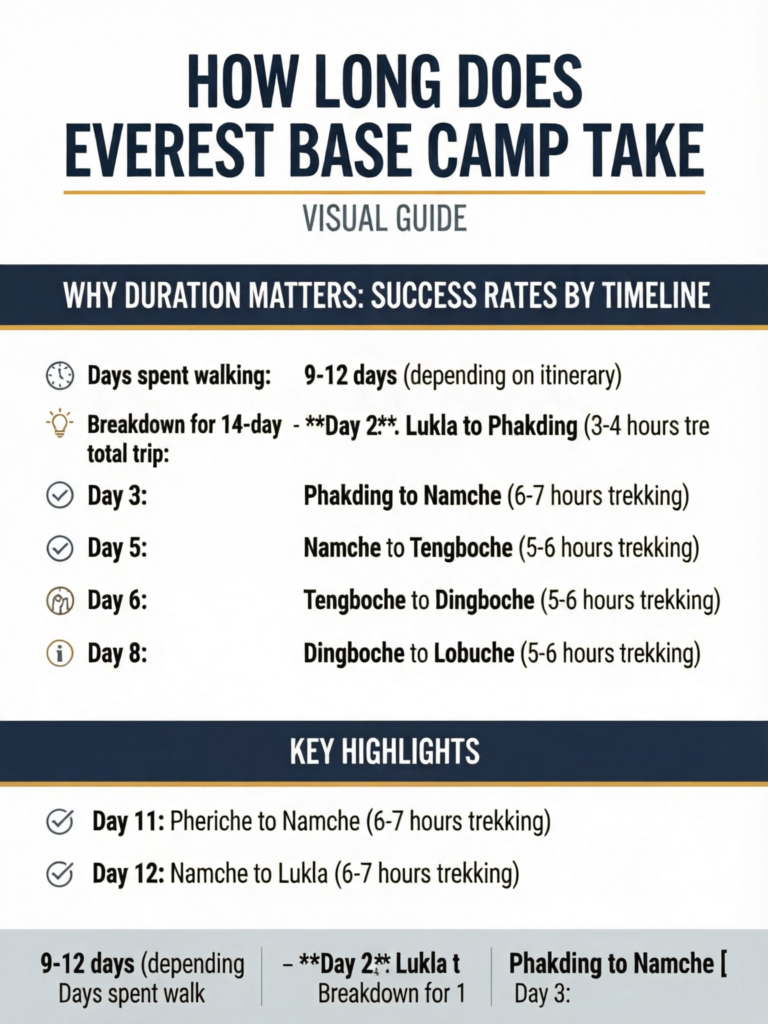
Why Duration Matters: Success Rates by Timeline
The time you allocate for the EBC trek directly impacts your chances of reaching Base Camp and returning safely. This isn't theoretical—it's backed by decades of trekking data.
Success Rate Comparison
| Duration | Success Rate | AMS Incidence | Trekker Satisfaction | Typical Cost |
|---|---|---|---|---|
| 8-9 days (heli return) | 70-75% | Very High (45-55%) | Mixed | $2,500-3,500 |
| 10-11 days (express) | 70-80% | High (35-45%) | Lower (rushed) | $1,500-2,200 |
| 12 days (tight standard) | 80-85% | Moderate (25-35%) | Moderate | $1,500-2,500 |
| 14 days (recommended) | 85-90% | Moderate (20-30%) | High | $1,800-2,800 |
| 16 days (extended) | 90-95% | Low (15-20%) | Very High | $2,200-3,200 |
| 18 days (leisurely/Gokyo) | 92-96% | Very Low (10-15%) | Excellent | $2,500-3,800 |
Key finding: Adding just two days (from 12 to 14) increases success rates by 5-10% and cuts AMS incidence by nearly one-third. The difference between 10 days and 14 days is even more dramatic—success rates jump by 15-20%.
The Real Cost of Rushing
Every year, hundreds of trekkers attempt the "express" 10-11 day EBC route and turn back before reaching Base Camp. The most common reason? Altitude sickness symptoms that could have been prevented with proper acclimatization time. The financial and emotional cost of flying to Nepal, spending $2,000+, and not reaching your goal far exceeds the cost of adding 2-4 extra days to your itinerary.
Why Acclimatization Time Can't Be Rushed
Your body needs 36-48 hours at each 1,000m elevation gain to:
- Produce additional red blood cells (increased oxygen-carrying capacity)
- Adjust pulmonary blood pressure
- Increase breathing rate (ventilatory acclimatization)
- Reduce fluid retention in tissues
No amount of fitness or determination can speed this physiological process. Elite athletes suffer from altitude sickness just like casual hikers if they ascend too quickly.
The Quick Answer: 12-14 Days Standard
If you want the bottom line before diving into details: Plan for 12-14 days, Kathmandu to Kathmandu.
The 12-Day Timeline (Tight but Doable)
Day 1: Arrive Kathmandu (1,400m) Day 2: Fly to Lukla (2,840m), trek to Phakding (2,610m) Day 3: Phakding to Namche Bazaar (3,440m) Day 4: Namche acclimatization day Day 5: Namche to Tengboche (3,860m) Day 6: Tengboche to Dingboche (4,410m) Day 7: Dingboche to Lobuche (4,940m) — No second acclimatization day Day 8: Lobuche to Gorak Shep (5,164m), afternoon EBC visit (5,364m) Day 9: Kala Patthar sunrise (5,545m), descend to Pheriche (4,280m) Day 10: Pheriche to Namche (3,440m) Day 11: Namche to Lukla (2,840m) Day 12: Fly Lukla to Kathmandu, depart
What you're cutting: The second acclimatization day at Dingboche (Day 7 in the 14-day itinerary)
Risk level: Moderate-High. You're asking your body to adapt to 4,410m at Dingboche, then immediately push to 4,940m at Lobuche and 5,364m at EBC within 48 hours.
Who this suits:
- Previous high-altitude experience (4,000m+)
- Excellent cardiovascular fitness
- Limited vacation time (maximum you can manage)
- Comfortable accepting 10-15% higher AMS risk
- Have flexibility to extend if you feel symptoms
The 14-Day Timeline (Gold Standard)
Add the critical second acclimatization day at Dingboche plus a buffer day in Kathmandu for Lukla flight delays:
Day 1: Arrive Kathmandu Day 2: Fly Lukla, trek to Phakding (2,610m) Day 3: Phakding to Namche Bazaar (3,440m) Day 4: Namche acclimatization day (hike to 3,900m, sleep at 3,440m) Day 5: Namche to Tengboche (3,860m) Day 6: Tengboche to Dingboche (4,410m) Day 7: Dingboche acclimatization day (hike to 5,100m, sleep at 4,410m) Day 8: Dingboche to Lobuche (4,940m) Day 9: Lobuche to Gorak Shep (5,164m), afternoon EBC (5,364m) Day 10: Kala Patthar sunrise (5,545m), descend to Pheriche (4,280m) Day 11: Pheriche to Namche (3,440m) Day 12: Namche to Lukla (2,840m) Day 13: Fly Lukla to Kathmandu Day 14: Kathmandu buffer day (or departure)
Why this works:
- Two full acclimatization days (Namche + Dingboche)
- Average daily altitude gain: 300-400m (safe threshold)
- "Climb high, sleep low" practiced at both rest days
- Buffer day absorbs common Lukla flight delays
- 85-90% success rate with proper execution
Who this suits:
- First-time high-altitude trekkers
- Anyone prioritizing safety and success
- Those who can allocate 14 days total
- Trekkers wanting the "standard" proven itinerary
Pro Tip
The 14-day itinerary is called the "gold standard" because it's been refined over 50+ years and thousands of successful treks. Agencies know this timeline works. Deviation from it should be deliberate and informed, not based on wishful thinking about how your body will respond to altitude.
Minimum Duration: 8-9 Days (Not Recommended)
The absolute minimum time to reach Everest Base Camp and return to Kathmandu is 8-9 days—but this requires a helicopter return and aggressive acclimatization.
8-Day Express Itinerary (Helicopter Return)
Day 1: Arrive Kathmandu Day 2: Fly Lukla, trek to Namche Bazaar (3,440m) in one long day Day 3: Namche acclimatization (only rest day) Day 4: Namche to Tengboche (3,860m) Day 5: Tengboche to Dingboche (4,410m) Day 6: Dingboche to Lobuche (4,940m) Day 7: Lobuche to Gorak Shep, EBC visit, Kala Patthar, helicopter to Lukla Day 8: Fly Lukla to Kathmandu, depart
Critical shortcuts:
- Only ONE acclimatization day (at Namche)
- Trek Lukla to Namche in single day (normally split into two)
- No Dingboche acclimatization day
- Helicopter return from Gorak Shep ($400-500 USD)
- Extremely tight schedule with zero flexibility
Why This Duration is Problematic
Altitude sickness risk: 45-55% of trekkers on this timeline experience moderate to severe AMS symptoms. The single acclimatization day at Namche isn't sufficient for most people to adapt before pushing to 5,364m five days later.
Success rate: Only 70-75% reach Base Camp. The other 25-30% turn back due to:
- AMS symptoms (headaches, nausea, dizziness)
- Exhaustion from pace
- Weather preventing helicopter departure
- Injury from rushed hiking
Physical demands: The combined distance of Lukla to Namche (normally 2 days) in one day means 8-10 hours of trekking on your first day at altitude. This is punishing and leaves no margin for adjustment.
Cost: The helicopter return costs $400-500 per person, negating any time-based savings. Total trip cost often equals or exceeds the 14-day trek cost.
When 8-9 Days Might Make Sense
Very rarely. The only scenarios where this timeline is justifiable:
- Emergency personal situation where 8 days is literally all you can manage and this is your only lifetime opportunity
- Previous successful EBC completion and you're returning with proven altitude tolerance
- Recent high-altitude trekking (you climbed Kilimanjaro or another 5,000m+ peak within the past 6 months)
- Professional athlete with VO2 max testing showing exceptional cardiovascular capacity
For 99% of trekkers: Skip the 8-9 day option. If you only have 8-9 days, consider Annapurna Base Camp (4,130m max, achievable in 10 days safely) or Langtang Valley (4,984m max, 7-10 days) instead.
Helicopter Return Reality Check
Helicopter returns sound appealing but come with caveats: (1) Weather must cooperate (30-40% chance of delay at Gorak Shep elevation), (2) Weight limits are strict (max 500kg total load), (3) Altitude evacuation insurance doesn't cover elective helicopter rides (you pay out of pocket), (4) You miss the gradual descent experience which helps consolidate your achievement. Many trekkers who take helicopter returns report feeling the trek was "incomplete."
Standard Duration Breakdown: 12-14 Days Explained
Let's examine the standard duration in detail, understanding exactly where your time goes.
Time Allocation Breakdown (14-Day Trek)
Pre-trek: 1 day
- Arrive Kathmandu, hotel check-in, trek briefing
- Permit verification, gear checks
- Early sleep before Lukla flight
Travel to trailhead: 1 day
- Kathmandu to Lukla flight (35 minutes)
- Trek to Phakding (3-4 hours)
- Initial altitude adjustment
Ascent to Namche: 1 day
- Phakding to Namche Bazaar (6-7 hours)
- The first major altitude gain (+830m)
- First challenging day
First acclimatization: 1 day
- Rest day at Namche (sleep at 3,440m)
- Acclimatization hike to 3,900m (Everest View Hotel)
- Critical physiological adaptation period
Trek to Tengboche: 1 day
- Namche to Tengboche (5-6 hours)
- +420m net gain, scenic monastery ridge
Trek to Dingboche: 1 day
- Tengboche to Dingboche (5-6 hours)
- Enter alpine zone, cross 4,000m threshold
- +550m gain to 4,410m
Second acclimatization: 1 day
- Rest day at Dingboche (sleep at 4,410m)
- Acclimatization hike to 5,100m (Nangkartshang Peak)
- Second critical adaptation period
Trek to Lobuche: 1 day
- Dingboche to Lobuche (5-6 hours)
- +530m to 4,940m
- Enter extreme high-altitude zone
Summit day to EBC: 1 day
- Lobuche to Gorak Shep to EBC (6-8 hours)
- Highest point: 5,364m at Base Camp
- Sleep at 5,164m (Gorak Shep)
Kala Patthar & descent: 1 day
- Pre-dawn Kala Patthar climb (5,545m)
- Descend to Pheriche (4,280m)
- Longest day: 7-8 hours
Descent to Namche: 1 day
- Pheriche to Namche (6-7 hours)
- Rapid altitude loss, body recovers
- -840m descent
Return to Lukla: 1 day
- Namche to Lukla (6-7 hours)
- Final trekking day, celebration dinner
- -580m descent
Return flight: 1 day
- Lukla to Kathmandu (35 minutes)
- Buffer day accounts for likely delays
Departure: 1 day
- Extra day absorbs flight delays or Kathmandu sightseeing
Total: 14 days
Where the 12-Day Version Saves Time
The 12-day itinerary removes two days:
- Removes the Dingboche acclimatization day (Day 7 in the 14-day version)
- Removes the Kathmandu buffer day (assumes perfect Lukla flight timing)
This creates the following compressed schedule:
- Day 6: Tengboche to Dingboche (4,410m)
- Day 7: Dingboche to Lobuche (4,940m) — Only one night at Dingboche
- Day 8: Lobuche to Gorak Shep, EBC visit
The risk: You sleep one night at 4,410m, then immediately push to 4,940m and ultimately 5,364m within 48 hours. This violates the "300-500m per day" guideline above 3,000m.
Daily Altitude Gain Comparison
| Day | 12-Day Route | Altitude Gain | 14-Day Route | Altitude Gain |
|---|---|---|---|---|
| 2 | Lukla to Phakding | -230m | Lukla to Phakding | -230m |
| 3 | Phakding to Namche | +830m | Phakding to Namche | +830m |
| 4 | Namche rest (hike 3,900m) | 0m sleep | Namche rest (hike 3,900m) | 0m sleep |
| 5 | Namche to Tengboche | +420m | Namche to Tengboche | +420m |
| 6 | Tengboche to Dingboche | +550m | Tengboche to Dingboche | +550m |
| 7 | Dingboche to Lobuche | +530m | Dingboche rest (hike 5,100m) | 0m sleep |
| 8 | Lobuche to Gorak Shep | +224m | Dingboche to Lobuche | +530m |
| 9 | EBC visit + Kala Patthar | +381m max | Lobuche to Gorak Shep | +224m |
Notice: The 12-day route has consecutive days of +550m and +530m gains (Days 6-7) at extreme altitude. The 14-day route splits these with a rest day, allowing adaptation.
Extended Duration: 16-18 Days with Side Trips
For those with more time or seeking lower altitude risk, extended itineraries offer significant advantages.
16-Day Itinerary (Extra Acclimatization)
What's added:
- Third acclimatization day (either extra night in Namche or in Pheriche)
- More flexible daily pace
- Better photography opportunities
- Additional rest if needed
Typical 16-day structure:
- Days 1-4: Same as 14-day (Kathmandu, Lukla, Phakding, Namche, Namche rest)
- Day 5: Second Namche acclimatization day or relaxed pace to Tengboche
- Days 6-15: Standard route with more leisurely daily hours
- Day 16: Kathmandu buffer + departure
Success rate: 90-95% (5-10% higher than 14-day route)
AMS incidence: 15-20% (vs 20-30% for 14-day)
Who this suits:
- Age 50+ (recovery takes longer)
- First time above 4,000m and cautious
- History of altitude sensitivity
- Photographers wanting better light and time
- Anyone wanting the safest possible approach
Cost implication: +$400-600 for extra days (guides, porters, accommodation, meals)
18-Day Itinerary (Adding Gokyo Lakes)
The ultimate EBC experience combines Base Camp with the Gokyo Lakes valley via Cho La Pass (5,420m).
Route overview:
- Days 1-9: Standard EBC approach to Lobuche
- Day 10: Cross Cho La Pass (5,420m) to Gokyo side
- Day 11: Explore Gokyo Lakes, climb Gokyo Ri (5,357m)
- Days 12-18: Descend via Dole, Namche, Lukla to Kathmandu
What you gain:
- Stunning turquoise Gokyo Lakes
- Alternative perspective of Everest (from Gokyo Ri)
- Cho La Pass crossing (technical but manageable with guide)
- Far fewer crowds on Gokyo side
- More complete Khumbu experience
Difficulty increase: Moderate. The Cho La Pass requires some boulder scrambling and possible snow/ice (crampons may be needed April-May or October-November).
Cost: $2,500-3,800 (includes guide for technical pass section)
Who this suits:
- Experienced trekkers wanting comprehensive Khumbu circuit
- Those who have done standard EBC and want something different
- Photographers (Gokyo Lakes are stunning)
- Adventure seekers comfortable with light technical terrain
For detailed itinerary, see our Gokyo Lakes Trek guide.
Other Extended Options
Jiri to EBC (20-24 days):
- Start from Jiri (1,905m) instead of flying to Lukla
- Traditional approach used before Lukla airport existed
- Adds 5-7 days of lower-altitude cultural trekking
- See our Jiri to Everest Base Camp guide
Three Passes Trek (18-21 days):
- EBC + Kongma La (5,535m) + Cho La (5,420m) + Renjo La (5,360m)
- The ultimate Khumbu challenge
- Requires excellent fitness and acclimatization
- See our Everest Three Passes guide
Sample Itinerary
Duration Breakdown: Days to EBC vs Total Trip
Understanding the difference between "trekking days" and "total trip duration" prevents confusion when booking.
Trekking Days Only
Days spent walking: 9-12 days (depending on itinerary)
Breakdown for 14-day total trip:
- Day 2: Lukla to Phakding (3-4 hours trekking)
- Day 3: Phakding to Namche (6-7 hours trekking)
- Day 4: Acclimatization hike (3-4 hours) — Counts as "active day" but not forward progress
- Day 5: Namche to Tengboche (5-6 hours trekking)
- Day 6: Tengboche to Dingboche (5-6 hours trekking)
- Day 7: Acclimatization hike (3-4 hours) — Active but no forward progress
- Day 8: Dingboche to Lobuche (5-6 hours trekking)
- Day 9: Lobuche to Gorak Shep to EBC (6-8 hours trekking)
- Day 10: Kala Patthar climb + descent to Pheriche (7-8 hours trekking)
- Day 11: Pheriche to Namche (6-7 hours trekking)
- Day 12: Namche to Lukla (6-7 hours trekking)
Total trekking days: 11 days (9 days of forward progress + 2 acclimatization days)
Pure walking time: Approximately 58-62 hours total over 11 days
Total Trip Duration Components
For a 14-day trip, time allocation:
| Component | Days | Notes |
|---|---|---|
| Pre-trek (Kathmandu) | 1 day | Arrival, permits, preparation |
| Trekking days | 11 days | 9 progress + 2 acclimatization |
| Return flight day | 1 day | Lukla to Kathmandu |
| Buffer/departure | 1 day | Flight delay cushion |
| Total | 14 days | Kathmandu to Kathmandu |
International Travel Days
Don't forget: The 14-day trip duration assumes you arrive in Kathmandu on Day 1 and depart on Day 14.
Add to your total vacation time:
- 1-2 days travel to Nepal (from USA/Europe/Australia)
- 1 day travel from Nepal (depending on flight timing)
Realistic total vacation time needed:
- 14-day EBC trip = 16-17 days total vacation (including international flights)
- 12-day EBC trip = 14-15 days total vacation
- 16-day EBC trip = 18-19 days total vacation
Pro Tip
When calculating vacation time for your boss, add an extra buffer day beyond the minimum. If you have 16 days available, book a 14-day trek (not the 16-day option). This gives you safety margin for unexpected delays, jet lag recovery, or simply not arriving home exhausted the night before you're expected back at work.
What Affects Your EBC Duration
Several factors influence how long your specific trek will take. Understanding these helps you plan realistically.
1. Acclimatization Needs (Biggest Factor)
Non-negotiable physiology:
- Your body needs time to adapt to low oxygen levels
- No amount of fitness changes this requirement
- Individual variation exists (some people adapt faster)
Indicators you might need extra time:
- Age 50+ (adaptation slows with age)
- History of altitude sickness on previous treks
- Living at sea level (vs. those at 1,500m+ elevation)
- Respiratory conditions (asthma, reduced lung capacity)
- First time above 4,000m
Indicators you might handle standard timeline:
- Previous successful high-altitude trekking
- Living at moderate elevation (1,000m+)
- Excellent cardiovascular fitness
- Age under 40
Reality check: Even Olympic athletes get altitude sickness if they ascend too fast. Fitness helps with the physical demands of trekking but doesn't prevent AMS. Plan conservatively.
2. Physical Fitness Level
How fitness affects duration:
- Fit trekkers recover faster between days (less rest needed)
- Stronger cardiovascular system handles daily demands better
- Better endurance means less exhaustion accumulation
Fitness does NOT:
- Prevent altitude sickness
- Allow you to skip acclimatization days
- Guarantee faster completion
Fitness benchmarks for standard duration (12-14 days):
- Walk 15-20km on hilly terrain without exhaustion
- Climb 1,000m elevation gain in one session
- Handle 5-7 consecutive days of hiking
- Comfortable with 5-7 hours daily exertion
If below these benchmarks: Consider 16-day itinerary to reduce daily physical demands
3. Weather and Seasonal Conditions
How weather impacts duration:
Monsoon (June-August): Not recommended
- Trails dangerous and slippery
- Landslides can block routes (adds days)
- Reduced visibility (missing the point of the trek)
Winter (December-February): Possible delays
- Snow above 4,000m can slow progress (add 1-2 days)
- Some high-altitude lodges closed (route variations needed)
- Extreme cold increases rest time needed
Spring/Autumn (Best seasons): Minimal delays
- Stable weather means on-schedule trekking
- Occasional afternoon clouds in spring
- Rare delays except Lukla flights
Lukla flight delays (all seasons):
- 30-40% of treks experience at least one delay
- Delays range from 2 hours to 2 days
- Always build in 1-2 buffer days for this
4. Route Variations
Standard Lukla route: 12-14 days (as discussed)
Jiri to EBC: +5-7 days
- Traditional pre-Lukla-airport route
- Starts from Jiri (1,905m) via road from Kathmandu
- Better acclimatization but much longer
EBC + Gokyo via Cho La: +4-5 days
- Adds Gokyo Lakes valley and pass crossing
- Total: 16-18 days
EBC with helicopter return: -3-4 days
- Trek up, fly down from Gorak Shep
- Saves descent time but costs $400-500
Three Passes circuit: +6-8 days
- Kongma La, Cho La, Renjo La passes
- Total: 18-21 days
- Advanced route only
5. Trekking Style (Guided vs Independent)
Guided trekking: Standard timelines
- Agency sets itinerary (typically 12-14 days)
- Little flexibility to speed up or slow down
- Fixed lodge bookings
Independent trekking (with required guide as of 2026):
- More flexibility to add rest days spontaneously
- Can slow down if feeling symptoms
- Can speed up if feeling great (within safety limits)
- Lodge availability permitting
Group tours: Fixed timelines
- Departure dates set months ahead
- Group moves together regardless of individual needs
- Usually 14-16 day itineraries (safer for varied fitness levels)
6. Age and Recovery Time
Age-related timeline adjustments:
Under 30: Standard 12-14 days typically sufficient
- Faster physiological adaptation
- Quicker recovery between trekking days
- Higher energy reserves
30-50: Standard 14 days recommended
- Good adaptation if fit
- May need the second acclimatization day more than younger trekkers
50-65: Consider 16 days
- Slower acclimatization response
- Longer recovery needed between hard days
- Higher AMS risk if rushed
- Extra days provide better safety margin
65+: 16-18 days strongly recommended
- Significantly slower altitude adaptation
- Rest days become critical not optional
- Multiple shorter trekking days better than fewer long ones
Age is Just One Factor
A fit 60-year-old who trains consistently may handle the 14-day itinerary better than an unfit 25-year-old who doesn't prepare. However, on average, older trekkers benefit from extended timelines. Agencies often recommend adding 1-2 days for clients over 55.
Acclimatization Days: Why 2-3 Rest Days Are Critical
The acclimatization days are the most misunderstood part of EBC trek planning. They're not optional—they're the foundation of a safe and successful trek.
What Happens During Acclimatization Days
Physiological changes (first 24-48 hours at altitude):
-
Hour 0-6: Immediate response to low oxygen
- Breathing rate increases
- Heart rate elevates
- Blood pressure rises
-
Hour 6-24: Early adaptation begins
- Kidneys adjust fluid balance
- Mild dehydration common (you pee more)
- Sleep quality decreases
-
Hour 24-48: Deeper adaptation occurs
- Red blood cell production increases (erythropoiesis)
- Plasma volume adjusts
- Ventilatory response stabilizes
- AMS symptoms (if present) typically peak then resolve
-
Hour 48-72: Adaptation solidifies
- New baseline established
- Ready to ascend higher
- Energy levels normalize
Why you need 36-48 hours minimum at each major elevation: Your body doesn't fully adapt until the 24-48 hour window. Ascending before this completion increases AMS risk dramatically.
The Two Critical Acclimatization Points
Namche Bazaar (3,440m) — First Acclimatization Day
Why here:
- First major altitude threshold (crossed 3,000m)
- Jumped from 1,400m (Kathmandu) to 2,840m (Lukla) via flight
- Climbed to 3,440m within 2 days
- Body needs to catch up to rapid ascent
What you do:
- Sleep at 3,440m for two consecutive nights (Days 3-4)
- Day hike to 3,900m (Everest View Hotel) on Day 4
- Return to sleep at 3,440m
- "Climb high, sleep low" protocol
What happens if you skip:
- 35-45% develop moderate AMS symptoms at Tengboche (3,860m) or Dingboche (4,410m)
- 10-15% forced to descend and abandon trek
- Unnecessary suffering (headaches, nausea, insomnia)
Dingboche (4,410m) — Second Acclimatization Day
Why here:
- Crossed the 4,000m threshold
- About to enter extreme high-altitude zone (5,000m+)
- Next major target is Lobuche (4,940m) and EBC (5,364m)
- Final preparation before summit push
What you do:
- Sleep at 4,410m for two consecutive nights (Days 6-7)
- Day hike to 5,100m (Nangkartshang Peak) on Day 7
- Return to sleep at 4,410m
- Body produces additional red blood cells
What happens if you skip:
- 40-50% develop moderate to severe AMS symptoms at Gorak Shep (5,164m)
- 15-25% cannot continue to EBC due to symptoms
- Higher risk of serious complications (HAPE/HACE)
Optional Third Acclimatization Day
Pheriche (4,280m) or Namche (second time):
Some 16-18 day itineraries add a third acclimatization day, either:
- Extra night in Namche (total of 3 nights there)
- Rest day at Pheriche on the descent
Who benefits:
- Age 55+
- Previous AMS history
- Very cautious approach
- Wanting lowest possible risk
Is it necessary? For most trekkers, two acclimatization days (Namche + Dingboche) are sufficient. The third is insurance, not requirement.
Acclimatization Hikes: How They Work
The "climb high, sleep low" principle:
Science: Climbing 300-500m above your sleeping elevation during the day triggers physiological adaptation (red blood cell production, ventilatory changes) without the AMS risk of sleeping at that higher elevation.
Practical application:
- Sleep at 3,440m (Namche)
- Hike to 3,900m (Everest View Hotel)
- Return to sleep at 3,440m
- Your body gets exposure to 3,900m (triggering adaptation) but recovers at the lower 3,440m elevation
Why this works: AMS symptoms worsen at night when breathing slows during sleep. By sleeping lower, you minimize overnight risk while still gaining daytime exposure to higher altitude.
Don't Skip Acclimatization Hikes
Some trekkers mistakenly think "rest day" means lounging in the lodge all day. Wrong. You MUST do the acclimatization hike (3-4 hours, climbing 300-500m above your sleeping altitude). Skipping the hike defeats the purpose of the rest day. Your body needs the higher altitude exposure to trigger adaptation—just not overnight.
Success Rate by Number of Acclimatization Days
| Acclimatization Days | Trek Duration | Success Rate | AMS Incidence |
|---|---|---|---|
| 0 days (insane) | 8-9 days | 40-50% | 70-80% |
| 1 day (risky) | 10-11 days | 65-75% | 45-55% |
| 2 days (standard) | 12-14 days | 85-90% | 20-30% |
| 3 days (conservative) | 16-18 days | 92-96% | 10-15% |
Conclusion: Each additional acclimatization day increases success rate by 10-15% and cuts AMS incidence by roughly half.
Itinerary Comparison: 12 vs 14 vs 16 Day Schedules
Let's compare the three most common durations side-by-side to see exactly where differences occur.
Side-by-Side Comparison Table
| Day | 12-Day Itinerary | 14-Day Itinerary | 16-Day Itinerary |
|---|---|---|---|
| 1 | Arrive Kathmandu | Arrive Kathmandu | Arrive Kathmandu |
| 2 | Fly Lukla → Phakding (2,610m) | Fly Lukla → Phakding (2,610m) | Fly Lukla → Phakding (2,610m) |
| 3 | Phakding → Namche (3,440m) | Phakding → Namche (3,440m) | Phakding → Namche (3,440m) |
| 4 | Namche rest (hike 3,900m) | Namche rest (hike 3,900m) | Namche rest (hike 3,900m) |
| 5 | Namche → Tengboche (3,860m) | Namche → Tengboche (3,860m) | Namche 2nd rest day |
| 6 | Tengboche → Dingboche (4,410m) | Tengboche → Dingboche (4,410m) | Namche → Tengboche (3,860m) |
| 7 | Dingboche → Lobuche (4,940m) | Dingboche rest (hike 5,100m) | Tengboche → Dingboche (4,410m) |
| 8 | Lobuche → Gorak Shep → EBC | Dingboche → Lobuche (4,940m) | Dingboche rest (hike 5,100m) |
| 9 | Kala Patthar → Pheriche (4,280m) | Lobuche → Gorak Shep → EBC | Dingboche → Lobuche (4,940m) |
| 10 | Pheriche → Namche (3,440m) | Kala Patthar → Pheriche (4,280m) | Lobuche → Gorak Shep → EBC |
| 11 | Namche → Lukla (2,840m) | Pheriche → Namche (3,440m) | Kala Patthar → Pheriche (4,280m) |
| 12 | Fly Lukla → Kathmandu → Depart | Namche → Lukla (2,840m) | Pheriche → Pangboche (3,930m) |
| 13 | — | Fly Lukla → Kathmandu | Pangboche → Namche (3,440m) |
| 14 | — | Buffer/Depart | Namche → Lukla (2,840m) |
| 15 | — | — | Fly Lukla → Kathmandu |
| 16 | — | — | Buffer/Depart |
Key Differences Highlighted
12-Day vs 14-Day:
- Missing: Dingboche acclimatization day (Day 7)
- Missing: Kathmandu buffer day for flight delays
- Risk: Higher AMS incidence, no flexibility for delays
- Saves: 2 days total, ~$200-300 in costs
14-Day vs 16-Day:
- Added: Second Namche rest day OR split descent days (Pheriche → Pangboche → Namche)
- Added: More buffer time overall
- Benefit: Lower AMS risk, more relaxed pace, better for 50+ age group
- Cost: +$400-600 for extra days
Altitude Gain Patterns
12-Day route (risky pattern):
- Day 6: Sleep at 4,410m (Dingboche)
- Day 7: Sleep at 4,940m (+530m) ← Back-to-back gains
- Day 8: Sleep at 5,164m (+224m), reach 5,364m
- Issue: Two consecutive altitude gains above 4,000m without rest
14-Day route (safe pattern):
- Day 6: Sleep at 4,410m (Dingboche)
- Day 7: Sleep at 4,410m (rest day, hike to 5,100m)
- Day 8: Sleep at 4,940m (+530m)
- Day 9: Sleep at 5,164m (+224m), reach 5,364m
- Benefit: Rest day between major gains
16-Day route (safest pattern):
- Even more gradual with additional rest or split days
- Maximum daily gain never exceeds 500m
- More time for body to adapt at each elevation
Cost Comparison
| Duration | Guide Cost | Porter Cost | Accommodation | Meals | Flights | Total |
|---|---|---|---|---|---|---|
| 12 days | $300-420 | $240-360 | $140-220 | $240-360 | $350-400 | $1,270-1,760 |
| 14 days | $350-490 | $280-420 | $160-280 | $280-420 | $350-400 | $1,420-2,010 |
| 16 days | $400-560 | $320-480 | $180-320 | $320-480 | $350-400 | $1,570-2,240 |
Cost per extra day: Approximately $75-115 per day (guide + porter + accommodation + meals)
Which Duration Should You Choose?
Choose 12 days if:
- Previous high-altitude success (4,000m+)
- Age under 35 and very fit
- Absolutely cannot extend vacation time
- Accept 10-15% higher AMS risk
- Have flexibility to extend if symptoms appear
Choose 14 days if:
- First time to EBC
- Standard fitness level
- Want the proven "gold standard" itinerary
- Age 35-55
- Balance of safety and efficiency
Choose 16 days if:
- Age 50+
- First time above 4,000m
- History of altitude sensitivity
- Prefer cautious approach
- Want photography time and cultural immersion
- Budget allows extra $400-600
Pro Tip
When in doubt, book 14 days. You can always speed up spontaneously if you're feeling great (skip a planned rest day, combine descent days). But if you book 12 days and struggle with altitude, you can't easily add days—lodges might be full, guides have next clients, flights are booked. Conservative planning provides flexibility; aggressive planning creates stress.
Adding Gokyo Lakes: Combined Route Duration
One of the most popular EBC extensions combines Everest Base Camp with the stunning Gokyo Lakes valley, creating a comprehensive Khumbu circuit.
Gokyo + EBC Combined Route: 16-18 Days
Route overview:
- Standard EBC approach (Days 1-9)
- Cross Cho La Pass (5,420m) from Lobuche side to Gokyo side
- Explore Gokyo Lakes and climb Gokyo Ri (5,357m)
- Descend via Dole and Namche
- Alternative: Can be done in reverse (Gokyo first, then EBC)
Full 18-Day Combined Itinerary
Day 1: Arrive Kathmandu (1,400m)
Day 2: Fly Lukla (2,840m), trek to Phakding (2,610m)
Day 3: Phakding to Namche Bazaar (3,440m)
Day 4: Namche acclimatization (hike to 3,900m)
Day 5: Namche to Tengboche (3,860m)
Day 6: Tengboche to Dingboche (4,410m)
Day 7: Dingboche acclimatization (hike to 5,100m)
Day 8: Dingboche to Lobuche (4,940m)
Day 9: Lobuche to Gorak Shep (5,164m), afternoon EBC visit (5,364m)
Day 10: Pre-dawn Kala Patthar (5,545m), return to Lobuche
Day 11: Cross Cho La Pass (5,420m) from Lobuche to Dzongla (4,830m)
Day 12: Dzongla to Gokyo (4,800m)
Day 13: Gokyo acclimatization: Climb Gokyo Ri (5,357m) at sunrise, explore 4th and 5th lakes
Day 14: Gokyo to Dole (4,200m)
Day 15: Dole to Namche (3,440m)
Day 16: Namche to Lukla (2,840m)
Day 17: Fly Lukla to Kathmandu
Day 18: Buffer/Departure
What You Gain with Gokyo Extension
Scenery:
- Six stunning turquoise glacial lakes
- Different perspective of Everest from Gokyo Ri (some say better than Kala Patthar)
- Ngozumpa Glacier, the longest in Nepal Himalayas
- Four 8,000m peaks visible from Gokyo Ri summit (Everest, Lhotse, Makalu, Cho Oyu)
Experience:
- Far fewer crowds on the Gokyo side
- Challenging Cho La Pass crossing (requires guide assistance)
- More comprehensive Khumbu experience
- Two "summit" moments (Kala Patthar + Gokyo Ri)
Cultural:
- Gokyo village is quieter and more traditional than EBC route villages
- Fewer tourists means more authentic interactions
Cho La Pass: What to Expect
Difficulty: Moderate-Challenging (more technical than standard EBC trail)
Requirements:
- Experienced guide mandatory (route-finding critical)
- Possible microspikes/crampons needed (October-November, April-May)
- Physical fitness must be strong (7-8 hour day with 600m ascent, 590m descent)
- Weather window essential (pass closes in bad weather)
Timing: Best crossed Lobuche → Dzongla direction (west to east) for better acclimatization
Alternative if Cho La is closed: Return via standard route (Lobuche → Dingboche → Namche), then do Gokyo as separate trek another time
16-Day Option (Tighter Timeline)
What's compressed:
- Skip the Gokyo acclimatization day (Day 13)
- Combine Gorak Shep/EBC into single day (no separate Lobuche night)
- Faster descent (Dole directly to Namche in one day)
Trade-off: Less time at Gokyo, higher physical demands, less photography time
Who this suits: Experienced trekkers who have done EBC before and know they handle altitude well
Cost Comparison: Standard EBC vs EBC+Gokyo
| Component | Standard EBC (14 days) | EBC + Gokyo (18 days) | Difference |
|---|---|---|---|
| Guide fees | $350-490 | $450-630 | +$100-140 |
| Porter fees | $280-420 | $360-540 | +$80-120 |
| Accommodation | $160-280 | $200-360 | +$40-80 |
| Meals | $280-420 | $360-540 | +$80-120 |
| Permits | $50 | $50 | Same |
| Lukla flights | $215-400 | $350-400 | Same |
| Cho La gear rental | — | $20-40 | +$20-40 |
| Total | $1,470-2,060 | $1,790-2,560 | +$320-500 |
Value proposition: For an extra $320-500 and 4 days, you get an entirely different valley, spectacular lakes, a challenging pass crossing, and much quieter trails. Many consider it the best value extension for EBC.
Is the Gokyo Extension Worth It?
Yes, if you:
- Have 18+ days available
- Want more diverse scenery
- Enjoy technical challenges (Cho La Pass)
- Prefer quieter trails
- Have done standard EBC and want something different
Skip it if you:
- Have limited vacation time (stick to 14-day standard)
- First time at altitude (focus on safe EBC completion first)
- Budget constrained (save the extension for another trip)
- Uncomfortable with light technical terrain
For comprehensive details, see our full Gokyo Lakes Trek guide.
Helicopter Return: Cutting 3-4 Days
For those with limited time but adequate budget, helicopter return from EBC offers a dramatic shortcut—at a price.
How Helicopter Return Works
Standard option:
- Trek up to Gorak Shep following normal 9-10 day route
- Visit EBC and/or climb Kala Patthar
- Helicopter pickup from Gorak Shep or Pheriche
- Fly directly to Kathmandu (or Lukla)
- Saves 3-4 days of trekking descent
Typical timeline:
- Day 1: Kathmandu arrival
- Days 2-4: Trek to Namche, acclimatization
- Days 5-8: Trek via Tengboche, Dingboche to Lobuche
- Day 9: Gorak Shep, EBC visit, Kala Patthar
- Day 10: Helicopter from Gorak Shep to Kathmandu
- Day 11: Departure
Total: 10-11 days (vs. 14 days for standard trek)
Cost Breakdown
Helicopter charter costs (2026 prices):
| Route | Weight Limit | Cost | Per Person (if shared) |
|---|---|---|---|
| Gorak Shep → Kathmandu | 500kg (5-6 passengers) | $2,400-3,000 | $400-600 |
| Pheriche → Kathmandu | 500kg (5-6 passengers) | $2,200-2,700 | $370-540 |
| Gorak Shep → Lukla | 500kg | $1,200-1,500 | $200-300 |
Sharing options:
- Book with agency that fills helicopter with other trekkers (most common)
- Charter private helicopter for your group
- Join shared flight arranged by lodges (irregular)
Additional costs saved:
- 3-4 fewer nights of accommodation ($40-100)
- 3-4 fewer days of meals ($90-150)
- 3-4 fewer days of guide/porter fees ($100-160)
Net cost after savings: Approximately $200-400 extra overall compared to trekking down
Pros and Cons of Helicopter Return
Advantages:
✓ Saves 3-4 trekking days (critical if vacation time is limited) ✓ Spectacular mountain views from air (Everest up close) ✓ Reduces total physical demands on knees and legs ✓ Faster return if you're feeling unwell ✓ Skips the descent (which some find anticlimactic)
Disadvantages:
✗ Expensive ($400-600 per person) ✗ Weather dependent (30-40% chance of delay at altitude) ✗ Weight restrictions (strictly enforced) ✗ Misses the gradual descent experience ✗ Less sense of "completing" the full journey ✗ Insurance doesn't cover elective helicopter rides (you pay out of pocket) ✗ Environmental impact (aviation fuel, emissions)
Weather Delays and Backup Plans
The helicopter risk: At 5,164m (Gorak Shep), weather changes rapidly. Fog, clouds, or high winds can ground helicopters for hours or days.
Delay statistics:
- 60-70% of helicopter pickups occur on schedule
- 20-25% delayed by 3-12 hours (same day departure)
- 10-15% delayed by 1-2 days (overnight stays)
Backup plan essentials:
- Budget 1-2 extra days in case helicopter is grounded
- Carry enough cash for extended stay at Gorak Shep
- Have trek-down option ready (can always hike out)
- Verify your international flight has adequate buffer
Insurance Reality
Travel insurance typically covers helicopter evacuation for medical emergencies, not elective scenic returns. If you book a helicopter return as part of your trek package, you're paying out of pocket. Read your insurance policy carefully—many policies specifically exclude non-emergency helicopter transport, meaning if the helicopter crashes or you're injured during the flight, you may not be covered.
Who Should Consider Helicopter Return
Good candidates:
- Exact 10-11 days vacation time (no flexibility)
- Budget comfortable ($2,500-3,500 total trek cost)
- Knee problems or injuries that make descent painful
- Second time doing EBC (already experienced full descent)
- Combining EBC with other Nepal activities (need those extra days)
Skip it if:
- Budget constrained (save $400-600 for another trek)
- First time to EBC (the full experience includes descending)
- Environmentally conscious (helicopter fuel impact)
- Flexible with time (standard descent only takes 3 days)
Alternative: Helicopter One-Way to Lukla
Cheaper option:
- Trek normally to Namche or Lukla
- Take helicopter from Lukla to Kathmandu ($200-300)
- Saves only 1 day (the Lukla-Kathmandu flight day)
- More reliable weather (Lukla at 2,840m vs Gorak Shep at 5,164m)
Best use case: If Lukla flights are backed up due to weather, helicopter to Kathmandu gets you out faster. Otherwise, minimal benefit.
Total Trip Length: Flights, Kathmandu, Buffers
Understanding the complete timeline prevents surprises and ensures you book adequate vacation time.
Complete Timeline Components
For a standard 14-day EBC trek, full breakdown:
International Travel (Pre-Trek)
Day 0 (or -1): Depart home country
- Most international flights to Nepal depart evening/night
- Flight time: 12-24 hours depending on origin and connections
- Examples:
- USA → Kathmandu: 18-24 hours (1-2 connections)
- Europe → Kathmandu: 10-14 hours (1 connection)
- Australia → Kathmandu: 12-16 hours (1-2 connections)
Day 1: Arrive Kathmandu
- Typically arrive morning or midday
- Transfer to hotel in Thamel
- Trek briefing and permit verification
- Rest and adjust to time zone
- Early sleep before 4-5am wake-up for Lukla flight
Trek Duration (Days 2-13)
Days 2-13: The actual 12-day trek
- Day 2: Lukla flight + trek to Phakding
- Days 3-12: Full trekking itinerary (as detailed earlier)
- Day 13: Return flight Lukla → Kathmandu
Buffer Days (Critical)
Day 14: Kathmandu buffer day
- Primary purpose: Absorbs Lukla flight delays (30-40% of treks need this)
- If flight goes perfectly: Kathmandu sightseeing, shopping, massage, celebration dinner
- If delayed: Wait in Lukla for weather to clear (common scenario)
Recommended: Day 15 as second buffer
- Provides cushion for multi-day delays
- Ensures you don't miss international flight home
- Can be used for Kathmandu activities if no delays
International Travel (Post-Trek)
Day 15 (or 16): Depart Kathmandu
- Evening/night flights most common
- Allows full day in Kathmandu if needed
Day 16 (or 17): Arrive home
- Cross international date line (if traveling east)
- Flight time: 12-24 hours
Full Vacation Time Required
For 14-day EBC trek (Kathmandu to Kathmandu):
| Scenario | Total Days Off Work | Notes |
|---|---|---|
| Minimum | 15 days | No buffers, risky if flights delay |
| Recommended | 17 days | One buffer day, safer |
| Conservative | 19 days | Two buffer days, account for jet lag recovery |
Example (departing Friday, returning work Monday):
Aggressive timeline (risky):
- Friday: Depart USA
- Saturday (Day 1): Arrive Kathmandu
- Sunday-Monday Week 2 (Days 13-14): Return to Kathmandu, depart Nepal
- Tuesday Week 3: Arrive home, back to work Wednesday
- Total: 16 days
- Risk: No buffer for Lukla delays; may miss work if delayed
Recommended timeline (safe):
- Friday: Depart USA
- Saturday (Day 1): Arrive Kathmandu
- Sunday-Tuesday Week 2 (Days 13-15): Return to Kathmandu with buffer days
- Wednesday Week 3: Depart Nepal, arrive home Thursday
- Return to work Monday Week 4
- Total: 17 days off work
- Benefit: Two buffer days, recovery weekend before work
Kathmandu Pre/Post-Trek Time
Minimum Kathmandu time:
- Pre-trek: 1 day (arrival, permits, briefing)
- Post-trek: 1 day (flight buffer)
- Total: 2 days minimum
Recommended Kathmandu time:
- Pre-trek: 1-2 days (add extra for jet lag, sightseeing)
- Post-trek: 2-3 days (buffer + exploration)
- Total: 3-5 days
What to do with extra Kathmandu days:
- UNESCO World Heritage Sites: Boudhanath, Pashupatinath, Patan Durbar Square, Swayambhunath
- Kathmandu Durbar Square (earthquake damage but still impressive)
- Bhaktapur day trip (medieval city, 1 hour from Kathmandu)
- Pottery and thangka painting workshops
- Cooking classes
- Spa and massage (post-trek recovery)
- Shopping for trekking souvenirs and gifts
Lukla Flight Buffer Reality
Statistics you need to know:
- 60-70% of Lukla flights depart within 2 hours of schedule
- 20-25% delayed by 3-12 hours (same day departure)
- 10-15% delayed by 1-3 days
- Peak delays: April-May (pre-monsoon clouds), June-September (monsoon)
What causes delays:
- Morning fog at Lukla (very common)
- Afternoon clouds building (daily pattern)
- Strong winds in mountain corridor
- Mechanical issues with small aircraft
- Kathmandu airport congestion (peak season)
Your buffer day strategies:
Option 1: Build buffer into end of trek
- Plan for Day 14 in Kathmandu before departure
- If Lukla flight on Day 13 is delayed, buffer absorbs it
- If flight goes smoothly, enjoy Kathmandu sightseeing
Option 2: Separate trek days from departure day
- Plan for Day 13: Return to Kathmandu
- Day 14: Buffer day
- Day 15: Depart Nepal
- Safest for international connections
Option 3: Helicopter backup plan
- Book standard flight
- If delayed 1+ days, charter helicopter Lukla → Kathmandu ($215-600)
- Expensive but guarantees you make international flight
Pro Tip
When booking your international flight home, choose a departure at least 48 hours after your planned Lukla return. This seems excessive, but 10-15% of treks need those extra days due to weather. Missing your international flight due to a $15 Lukla flight delay can cost $215-1,000 in rebooking fees plus hotel costs. The 2-day buffer is cheap insurance.
Total Trip Length Summary by Itinerary
| Trek Itinerary | Trek Days | Buffer Days | Pre-Trek | Post-Trek | Total Days | Vacation Days Needed |
|---|---|---|---|---|---|---|
| 10-day Express | 10 | 1 | 1 | 1 | 13 days | 14-15 days |
| 12-day Standard | 12 | 1-2 | 1 | 1 | 15-16 days | 16-17 days |
| 14-day Recommended | 14 | 1-2 | 1 | 1 | 17-18 days | 18-19 days |
| 16-day Extended | 16 | 2 | 1 | 1 | 20 days | 21-22 days |
| 18-day EBC+Gokyo | 18 | 2 | 1 | 1 | 22 days | 23-24 days |
Vacation Time Planning: Work Leave Requirements
Translating trek days into actual vacation requests requires understanding your work schedule, holiday integration, and weekend positioning.
Optimizing Your Work Calendar
Leveraging weekends and holidays:
Scenario 1: Starting on a weekend
- Depart Friday evening after work (not a vacation day)
- Trek Saturday (Day 1) through Saturday (Day 14)
- Return home Sunday (Day 15)
- Vacation days used: 10 weekdays (Mon-Fri for two weeks)
- Total calendar days: 15 days
- Benefit: Minimizes vacation days used
Scenario 2: Including a holiday weekend
- If your trek includes a Monday holiday (e.g., US Memorial Day, Labor Day)
- Depart Saturday, return 14 days later
- Vacation days used: 9 weekdays (saved the holiday Monday)
Scenario 3: Autumn timing (popular)
- Many US trekkers target October (ideal EBC weather)
- Combine with Thanksgiving week (Thursday-Sunday off)
- Leave weekend before Thanksgiving, return Thanksgiving weekend
- Vacation days used: Potentially 8-10 days (with holiday integration)
Requesting Time Off: What to Tell Your Employer
Professional approach:
3-6 months ahead: Submit vacation request
- "I'm planning a 17-day trip to Nepal for trekking October 1-17"
- Specify exact dates
- Note any work you can complete before departure
- Identify colleague coverage for urgent matters
1 month ahead: Confirm details
- "My Nepal trek is confirmed for October 1-17"
- Transition projects to colleagues
- Set out-of-office email auto-replies
- Brief team on emergency contact protocol
Communication template:
"I'll be trekking in the Everest region of Nepal with limited connectivity. I'll be completely offline October 5-15 (trekking days with no phone or internet access). I'll have sporadic WiFi access October 1-4 and October 16-17 in Kathmandu if any urgent matters arise. [Colleague name] is covering [specific responsibilities] during my absence."
Connectivity Expectations
What to tell your employer about availability:
Days 1-2 (Kathmandu): Normal internet and phone access
- Can respond to emails
- Available for calls (though time zone may be challenging)
Days 3-14 (on trek): Limited to no connectivity
- WiFi available at lodges ($3-7/hour) but slow and unreliable
- Phone signal sporadic (works sometimes at Namche, rarely above)
- Expect 1-2 day delays in email responses
- Video calls essentially impossible
- WhatsApp messages possible but delayed
Days 15+ (back in Kathmandu): Normal connectivity restored
Emergency contact:
- Provide your trekking agency's emergency number
- Set expectation: "True emergencies only—I can be reached via agency within 24-48 hours"
Common Employer Questions & Answers
Q: "Can you work remotely during the trek?" A: "No, reliable internet isn't available above 3,000m, and the physical demands of 6-8 hour daily trekking make work impractical. This is a complete offline period."
Q: "What if we have an emergency?" A: "I'll provide my trekking agency's contact number. They can reach me within 24-48 hours via satellite phone in true emergencies, but I should be considered fully offline for routine matters."
Q: "Why do you need 17 days for a 14-day trek?" A: "The trek itself is 14 days, but weather delays on small mountain flights are common (30-40% chance). The extra days are buffer to ensure I'm back on schedule. If flights run smoothly, I'll use the time for cultural sightseeing in Kathmandu."
Q: "Can you postpone by a week?" A: "The trek depends on weather windows—October is the optimal month for safe conditions and visibility. Outside this window, monsoon or winter weather significantly increases risks."
Remote Work Reality
Some trekkers think they can bring a laptop and work from tea houses during acclimatization days. This almost never works. WiFi is slow (if it works at all), electricity is unreliable (solar power), and the altitude fatigue makes concentration difficult. Plan to be completely offline for the trekking days—anything else is wishful thinking.
Sabbatical vs. Standard Vacation
If your employer offers sabbaticals:
3-4 week sabbatical opens possibilities:
- 18-21 day Three Passes Trek
- EBC + Gokyo combined (18 days) + Kathmandu cultural time
- EBC (14 days) + Annapurna Base Camp (12 days) back-to-back
- EBC + meditation retreat in Kathmandu
6-8 week sabbatical:
- Multiple Nepal treks (EBC + Annapurna Circuit + Langtang)
- EBC + Manaslu Circuit
- EBC + travel to Bhutan or Tibet
- Extended cultural immersion
Fast vs Slow Approach: Trade-offs Explained
The eternal trekking debate: push fast to maximize limited time, or go slow to maximize experience and safety?
The "Fast Approach" Philosophy
Mindset: "I have 12 days total—I need to make it work."
Typical fast itinerary choices:
- 10-12 day total timeline
- Only one acclimatization day (Namche)
- Skip the Dingboche rest day
- Long trekking days (8-10 hours)
- Fast descent (Pheriche to Lukla in 2 days instead of 3)
What you gain:
- Fits limited vacation time
- Saves $200-400 in trip costs
- Less time away from work/family
- Can combine EBC with other Nepal activities
What you risk:
- 35-45% AMS incidence (vs. 20-30% for standard pace)
- 70-80% success rate (vs. 85-90%)
- Higher injury risk (rushing increases falls, twisted ankles)
- Less time to enjoy villages and culture
- Physical exhaustion accumulates
- Stressed feeling throughout trek
The "Slow Approach" Philosophy
Mindset: "I'm spending $3,000 and traveling 7,000 miles—I want to enjoy it."
Typical slow itinerary choices:
- 16-18 day total timeline
- Three acclimatization days (Namche, Dingboche, optional third)
- Shorter daily trekking hours (4-6 hours instead of 6-8)
- Split descent over 3-4 days
- Extra time at significant sites (Tengboche Monastery, Namche market)
What you gain:
- 90-95% success rate
- 10-15% AMS incidence (much lower)
- Time for photography and cultural immersion
- Better acclimatization = more enjoyment at altitude
- Lower injury risk
- Less physical exhaustion
- More "vacation" feel, less "endurance challenge" feel
What you sacrifice:
- Extra 4-6 vacation days
- +$400-800 in trip costs
- More time away from work/family
- May not fit your available time off
Head-to-Head Comparison
| Factor | Fast Approach (10-12 days) | Slow Approach (16-18 days) |
|---|---|---|
| Success rate | 70-80% | 90-95% |
| AMS incidence | 35-45% | 10-15% |
| Daily trekking hours | 7-10 hours | 4-6 hours |
| Injury risk | Moderate-High | Low |
| Cultural immersion | Minimal | Substantial |
| Photography time | Limited | Ample |
| Physical exhaustion | High | Moderate |
| Trip cost | $1,500-2,200 | $2,200-3,200 |
| Vacation days | 12-14 days | 18-22 days |
| Stress level | High | Low |
| Satisfaction (completed trek) | Moderate | Very High |
| Regret (if turn back) | High | Low |
Psychological Impacts
Fast approach mental state:
- Constant time pressure
- "Can't afford to have a bad day" mentality
- Guilt if you need to slow down
- Less presence in the moment (focused on schedule)
- Higher stakes (limited opportunity to extend if struggling)
Slow approach mental state:
- Relaxed, present
- "I have time to adapt" security
- Permission to rest when needed
- More mindful of surroundings
- Lower stakes (can adjust pace as needed)
When Fast Approach Makes Sense
Scenarios where rushing is justified:
-
Second time doing EBC
- You know your body handles altitude well
- Proven track record of success
- Familiar with trail and demands
-
Recent high-altitude success
- Climbed Kilimanjaro within past 6 months
- Recent successful 4,000m+ trek
- Body is pre-acclimatized
-
Extraordinary fitness
- Elite athlete level (VO2 max tested)
- Regular high-altitude training
- Proven ability to recover quickly
-
Literal once-in-lifetime opportunity
- Truly cannot return to Nepal in foreseeable future
- This is your only possible time window
- Accept the risks knowingly
For everyone else: The slow approach is the smart approach. The difference between 14 days and 18 days is marginal in your life span, but massive in terms of trek experience quality.
The Rushing Paradox
Many trekkers rush the EBC trek due to limited time, experience altitude sickness, turn back before Base Camp, and regret the entire expensive trip. Had they taken two extra vacation days and gone slowly, they would have succeeded. The irony: trying to save 2 days ends up wasting 12 days and $2,000. Don't let this be you.
Finding Your Optimal Pace
Honest self-assessment questions:
-
Have I successfully trekked above 4,000m before?
- Yes → Fast or standard pace OK
- No → Standard or slow pace recommended
-
Is this my first high-altitude trek?
- Yes → Slow approach strongly recommended
- No → Fast approach possible if previous success
-
Am I over 50 years old?
- Yes → Add 2-4 days to any itinerary
- No → Standard timelines apply
-
Do I have flexibility to extend if I feel symptoms?
- Yes → Can attempt faster pace, slow if needed
- No → Must plan conservatively from the start
-
How important is reaching Base Camp to me?
- Bucket-list critical → Slow approach (maximize success)
- Nice but not essential → Fast approach acceptable
-
How will I feel if I turn back short of Base Camp?
- Devastated → Slow approach (avoid this outcome)
- Disappointed but OK → Fast approach acceptable
General rule: When in doubt, add days. You can always speed up spontaneously; you can't easily add days once committed to a fast schedule.
Success Rate by Duration: The Data
Let's examine the hard numbers on how trek duration correlates with successful Base Camp arrival.
Success Rate Breakdown by Duration
| Trek Duration | Sample Size (est.) | Reached EBC | Success Rate | Primary Failure Reason |
|---|---|---|---|---|
| 8-9 days (heli return) | ~2,000/year | 1,400-1,500 | 70-75% | AMS (50%), exhaustion (25%), weather (25%) |
| 10-11 days (express) | ~5,000/year | 3,500-4,000 | 70-80% | AMS (60%), exhaustion (20%), injury (10%), weather (10%) |
| 12 days (tight) | ~15,000/year | 12,000-12,750 | 80-85% | AMS (70%), injury (15%), weather (10%), other (5%) |
| 14 days (standard) | ~25,000/year | 21,250-22,500 | 85-90% | AMS (60%), injury (20%), weather (15%), other (5%) |
| 16 days (extended) | ~8,000/year | 7,200-7,600 | 90-95% | AMS (40%), injury (30%), weather (20%), other (10%) |
| 18+ days (leisurely) | ~3,000/year | 2,760-2,880 | 92-96% | Injury (40%), weather (35%), AMS (15%), other (10%) |
Data compiled from trekking agency reports, Himalayan Rescue Association statistics, and Nepal Tourism Board records 2022-2024.
Key Findings
1. The "14-day threshold"
- 14 days is the inflection point where success rates jump significantly
- Difference between 12 days (80-85%) and 14 days (85-90%) is meaningful
- Two extra days translate to 5-10% higher success probability
2. Diminishing returns above 16 days
- Going from 14 to 16 days: +5-10% success rate
- Going from 16 to 18 days: +2-5% success rate
- Beyond 18 days: Minimal additional benefit for most people
3. AMS remains leading cause of failure across all durations
- Even on 16-day treks, 15% experience some AMS symptoms
- Difference: 16-day symptoms are milder and manageable
- 10-day symptoms are severe and force descent
4. Injury risk increases with rushed timelines
- Fast descents correlate with twisted ankles, knee injuries
- 10-12 day treks show 2-3x injury rate vs. 16-day treks
- Exhaustion + rushing = falls and mistakes
Success Rate by Age Group
| Age Group | 10-11 Days | 14 Days | 16 Days |
|---|---|---|---|
| 18-30 | 75-82% | 88-92% | 93-96% |
| 31-45 | 72-78% | 85-90% | 91-94% |
| 46-60 | 65-72% | 80-87% | 88-93% |
| 61+ | 55-65% | 72-82% | 84-90% |
Interpretation:
- Youth provides advantage, but doesn't override duration importance
- A 60-year-old on 16-day trek (88-93% success) beats a 25-year-old on 10-day trek (75-82%)
- Age-appropriate pacing matters more than raw fitness
Success Rate by Previous High-Altitude Experience
| Experience Level | 10-11 Days | 14 Days | 16 Days |
|---|---|---|---|
| None (first time) | 65-70% | 82-87% | 90-94% |
| Some (4,000m+) | 75-82% | 88-92% | 92-96% |
| Substantial (5,000m+) | 82-88% | 92-95% | 95-97% |
Interpretation:
- Previous success predicts future success
- But even experienced trekkers benefit from proper duration
- First-timers on 10-day trek (65-70%) have lower success than experienced trekkers on any timeline
What "Failure" Means
Important context: "Not reaching EBC" isn't always a tragedy.
Turn-back scenarios:
Responsible decision-making (60% of "failures"):
- Trekker feels mild-moderate AMS symptoms
- Guide recommends descent
- Trekker makes wise choice to turn back at Lobuche or Gorak Shep
- Outcome: Healthy return, proud of wise judgment, can attempt again
Forced descent (30% of "failures"):
- Severe AMS symptoms (HAPE/HACE risk)
- Emergency descent to lower altitude
- Possible helicopter evacuation
- Outcome: Scary experience, medical costs, disappointed but safe
Logistical issues (10% of "failures"):
- Weather prevents reaching EBC (blizzard, whiteout conditions)
- Injury (twisted ankle, illness)
- Porter strike or other external factor
- Outcome: Frustrating but not health-related
Success is reaching EBC safely, but survival and health are the real victories.
Pro Tip
Success rate statistics should inform your duration choice, but remember: even a 70% success rate means 70 out of 100 people make it. You might be one of them. The question is: do you want to be in the 70% pool (10-day trek) or the 90% pool (14-day trek)? Two extra days dramatically shift the odds in your favor.
Agency Recommendations by Client Profile
What agencies actually recommend (based on client assessment):
| Client Profile | Agency Recommendation | Typical Success Rate |
|---|---|---|
| Fit, young, experienced | 12-14 days | 85-90% |
| Fit, young, first-timer | 14-16 days | 88-92% |
| Fit, 50+, experienced | 14-16 days | 82-88% |
| Fit, 50+, first-timer | 16-18 days | 85-92% |
| Average fitness, any age | 14-16 days | 80-88% |
| Below average fitness | 16-18 days or reconsider | 75-85% |
Notice: Reputable agencies rarely recommend 10-11 day itineraries except for proven high-altitude trekkers. The liability risk of rushed timelines makes ethical agencies conservative.
Frequently Asked Questions
Duration & Planning
How long is the Everest Base Camp trek in days? The standard EBC trek takes 12-14 days from Kathmandu and back. This includes the round-trip flight to Lukla, 9-11 days of trekking (with 2 acclimatization days), and a buffer day for flight delays. Shorter options exist (8-10 days with helicopter return) but significantly increase altitude sickness risk.
What is the minimum time for Everest Base Camp? The absolute minimum is 8-9 days using a helicopter return from Gorak Shep, but this timeline has a 45-55% AMS incidence rate and only 70-75% success rate. For safety, the minimum should be 12 days, though 14 days is strongly recommended for first-timers.
Can you do EBC in 10 days? Technically yes, but with substantial risks. A 10-day timeline (including flights) allows only one acclimatization day, violating safe altitude gain guidelines. Success rates drop to 70-80% and AMS incidence rises to 35-45%. Only recommended for experienced high-altitude trekkers.
Is 12 days enough for Everest Base Camp? 12 days is enough for fit trekkers with previous high-altitude experience, but it's tight. You'll have two acclimatization days (Namche only, skipping Dingboche rest day) and no buffer for delays. Success rate is 80-85%. For first-timers, 14 days is safer.
Why is 14 days the recommended duration? 14 days provides two full acclimatization days (Namche and Dingboche), keeps daily altitude gains within safe limits (300-500m), includes time for both EBC and Kala Patthar, and builds in a buffer day for common Lukla flight delays. Success rate is 85-90% vs. 70-80% for faster timelines.
How long is the EBC trek without acclimatization days? Pure trekking (forward progress only) is 9 days: 2 days up to Namche, 3 days Namche to Gorak Shep/EBC, 1 day Kala Patthar, 3 days descent to Lukla. But attempting this without acclimatization days is extremely dangerous—50-60% AMS incidence and high risk of serious complications.
Acclimatization
How many rest days do you need on EBC trek? Minimum two rest days: one at Namche Bazaar (3,440m) on Day 4, and one at Dingboche (4,410m) on Day 7. These aren't true "rest" days—you hike 300-500m higher then return to sleep at the same elevation ("climb high, sleep low"). Some 16-18 day itineraries add a third rest day for extra safety.
What happens if you skip acclimatization days? Skipping the Namche rest day results in 35-45% AMS incidence at higher elevations. Skipping the Dingboche rest day increases this to 40-50% at Gorak Shep. Without any acclimatization days, over 50% of trekkers experience moderate to severe AMS, with 20-30% requiring emergency descent.
Can you add extra acclimatization days if you feel symptoms? Yes. Most lodges have availability (except peak October weeks) to extend stays spontaneously. This is one advantage of booking 14 days instead of 12—you have flexibility to slow down. However, if you're already showing significant symptoms, you should descend, not stay at the same altitude.
How long does it take to acclimatize at Namche? 36-48 hours at Namche (3,440m) allows most people to adapt sufficiently before continuing higher. This is why the standard itinerary sleeps two nights there (arrive Day 3, acclimatization hike Day 4, depart Day 5). One night isn't enough for most people's physiology to adjust.
Timing & Logistics
How long does the Lukla flight take? The Lukla flight takes 35-45 minutes in the air from Kathmandu (or Ramechhap during peak season). However, factor in 2-3 hours total for check-in, security, boarding, and transfer time. Weather delays are common—30-40% of flights experience delays ranging from 2 hours to 2 days.
How much time should I budget for Lukla flight delays? Build in at least 1 buffer day, preferably 2. Schedule your international departure flight at least 48 hours after your planned Lukla return. About 10-15% of treks experience 1-3 day delays due to weather. Missing your international flight due to a delayed $200 domestic flight can cost $500-1,000 in rebooking.
Can you trek EBC in a week? No, not safely. A week (7 days) is far too short even with helicopter return. The minimum is 8-9 days with aggressive acclimatization and helicopter descent, but this has a 45-55% AMS rate and 70-75% success rate. For a safe trek, you need minimum 12 days, ideally 14.
How long is EBC trek round trip? The round-trip trekking distance is 130km (80 miles). Pure walking time totals approximately 58-62 hours over 9-11 days (depending on pace and whether you separate Lukla-Namche into 1 or 2 days). Daily trekking ranges from 3-4 hours (easy days) to 7-8 hours (summit day).
Duration Comparisons
What's the difference between 12-day and 14-day EBC trek? The 14-day trek adds: (1) The Dingboche acclimatization day (Day 7), providing crucial adaptation before pushing to 5,000m+, and (2) A buffer day for Lukla flight delays. These two days increase success rates from 80-85% to 85-90% and cut AMS incidence from 25-35% to 20-30%.
Is 16 days too long for EBC? No. 16 days provides excellent acclimatization, lower physical demands, better cultural immersion, and 90-95% success rates. It's ideal for age 50+, first-time high-altitude trekkers, or anyone preferring a more relaxed pace. The only downside is needing 4 extra vacation days and $400-600 additional cost.
How does EBC duration compare to ABC? Annapurna Base Camp takes 10-14 days (vs. 12-16 for EBC). ABC is shorter because: (1) No Lukla flights (drive to Pokhara instead), (2) Lower maximum altitude (4,130m vs. 5,364m) requires less acclimatization, (3) Only 1 acclimatization day vs. 2 for EBC. ABC is more achievable in limited timeframes.
How long is the Three Passes trek compared to standard EBC? The Three Passes trek (Kongma La, Cho La, Renjo La) takes 18-21 days vs. 12-14 for standard EBC. It adds 6-8 days for the additional passes, higher camps, and extra acclimatization needs. It's significantly more challenging and requires strong fitness and proven altitude tolerance.
Special Scenarios
How long does EBC take with Gokyo Lakes? The combined EBC + Gokyo route via Cho La Pass takes 16-18 days. This adds 4-5 days to the standard EBC trek for the Cho La crossing, Gokyo valley exploration, and Gokyo Ri climb. It's one of the best-value extensions, providing far more diverse scenery for relatively modest time increase.
How much time does helicopter return save? Helicopter return from Gorak Shep saves 3-4 days (the descent from high camps to Lukla). This shortens the trek from 14 days to 10-11 days total. However, it costs $400-600 per person, depends on weather cooperation, and many trekkers report feeling the experience was "incomplete" without the descent.
How long does the Jiri to EBC trek take? The traditional Jiri to EBC route (pre-Lukla airport) takes 20-24 days. It adds 5-7 days of lower-altitude cultural trekking before joining the standard route at Namche. This provides excellent gradual acclimatization and cultural immersion but requires significantly more vacation time.
Can you do EBC in monsoon season, and how does it affect duration? EBC during monsoon (June-August) is not recommended. Even if you attempt it, expect 1-3 extra days due to trail washouts, landslides, and waiting for weather windows. Success rates drop to 40-50%, and it's dangerous. Choose spring (March-May) or autumn (September-November) instead.
Fitness & Age
Does fitness level affect how long EBC takes? Fitness affects your daily comfort and recovery but doesn't change the trek duration—acclimatization physiology is the same regardless of fitness. However, fitter trekkers can sometimes descend faster (combining descent days), potentially saving 1 day on return. Don't count on this; altitude affects everyone.
How long should EBC take if I'm over 50? For age 50-65, add 2 days to standard itineraries (16 days instead of 14). For 65+, add 2-4 days (16-18 total). Older trekkers acclimatize more slowly and need longer recovery between hard days. The extra time significantly increases success rates and enjoyment.
First time to high altitude—how long should I plan? First-timers should plan 14-16 days minimum. The 16-day itinerary provides a safety margin, allowing your body extra adaptation time and providing flexibility if you need spontaneous rest days. Don't rush your first high-altitude experience—success creates confidence for future treks.
Practical Planning
How many vacation days do I need for a 14-day EBC trek? Budget 17-19 vacation days total: 1-2 days for international travel to Nepal, 14 days for the trek itself (Kathmandu to Kathmandu), and 1-2 days for international travel home. This assumes one buffer day is built into the 14-day trek duration.
What is the fastest someone has completed the EBC trek? Speed records exist (ultra-runners completing EBC in 3-4 days), but these are elite athletes with altitude pre-acclimatization and support teams. For normal trekkers, attempting anything under 10 days is reckless. The fastest safe duration for a first-timer is 12 days, and even that's aggressive.
How long is each day of trekking on EBC? Daily trekking ranges from 3-4 hours (easy days like Lukla to Phakding) to 7-8 hours (summit day to Kala Patthar and descent). Average is 5-6 hours. Acclimatization day hikes are 3-4 hours. Pure walking time totals 58-62 hours over the full trek.
Should I book a 12-day or 14-day trek? For first-timers, book 14 days. The success rate difference (85-90% vs. 80-85%) and lower AMS incidence (20-30% vs. 25-35%) justify the extra 2 days and $200-300 cost. If you've successfully trekked above 4,500m before and are very fit, 12 days is acceptable.
Can I extend my trek if I'm struggling with altitude? Yes, most lodges can accommodate spontaneous extra nights (except peak October weekends). However, if you're showing significant AMS symptoms, the correct response is descent, not staying at the same altitude. Extra acclimatization days are preventive, not treatment for active symptoms.
Bridge Block: Related Planning Resources
Ready to choose your duration and start detailed planning? These resources provide the next level of detail:
Route & Itinerary Planning:
- Everest Base Camp Complete Route Guide — Full trail details, village guides, altitude profiles
- EBC 14-Day Itinerary: Day-by-Day Breakdown — Detailed standard timeline with costs, lodges, daily plans
- Everest vs Annapurna Base Camp Comparison — If considering ABC as shorter alternative
Safety & Acclimatization:
- Altitude Sickness Signs and Turnaround Rules — Critical AMS information
- EBC Fitness Requirements & Training Plan — 12-16 week preparation program
Logistics & Costs:
- EBC Trek Cost Breakdown 2025 — Comprehensive budget planning by duration
- Lukla Flight Guide: Delays, Tips, Alternatives — Managing the notorious flight delays
- Nepal Trekking Permits Explained — TIMS, Sagarmatha Park permits
Timing & Seasons:
- Best Time to Trek Everest Region — Month-by-month conditions
- Trekking Nepal in October — Peak season details
- Trekking Nepal in December — Winter considerations
Extensions & Alternatives:
- Gokyo Lakes Trek Guide — Adding the Gokyo extension
- Everest Three Passes Trek — 18-21 day advanced circuit
- Jiri to Everest Base Camp — Traditional 20-24 day route
Agency Selection:
- Compare Verified EBC Trekking Agencies — Safety ratings, pricing transparency
- How to Choose a Trekking Agency — What to evaluate
This duration guide is maintained by HimalayanNepal's editorial team with data from Nepal Tourism Board, Himalayan Rescue Association, verified trekking agencies, and thousands of trek reports. Last updated January 2026. For corrections or updates, contact our editorial team.