



Trekking Nepal in October: The Complete Peak Season Guide
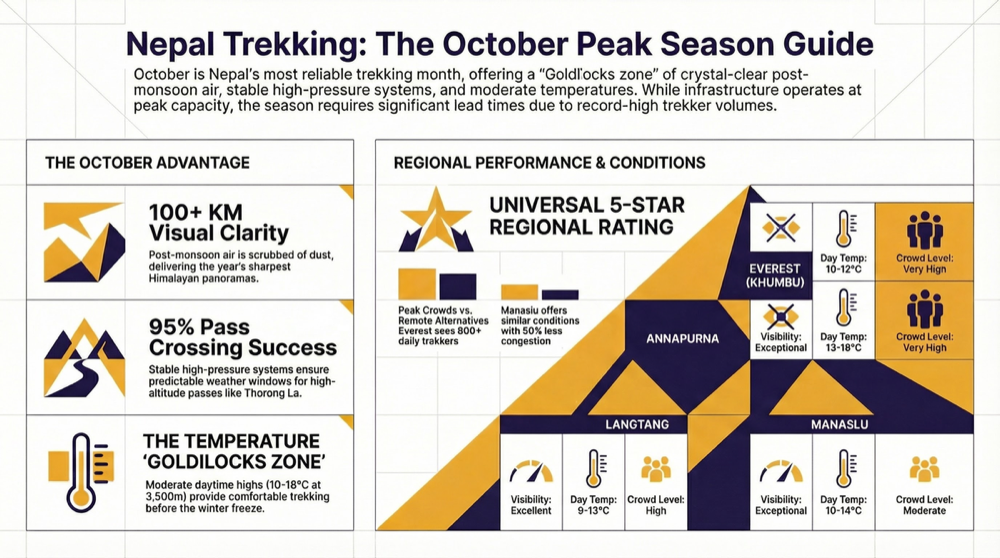
Trekking Nepal in October is the best of the year for weather: post-monsoon skies give 100+ km visibility, daytime temperatures stay comfortable (10-16°C at trekking altitude), and rain is minimal. The trade-off is peak crowds, premium prices, and a 4-5 month booking lead. Book early and almost every route is excellent.
October is unquestionably Nepal's most popular trekking month—and for excellent reasons. Post-monsoon skies deliver crystal-clear mountain views extending 100+ kilometers, stable high-pressure systems bring the year's most predictable weather, temperatures remain comfortable across all elevations, and the entire trekking infrastructure operates at peak capacity. This is the month when Nepal's Himalayas reveal themselves in their full glory.
But October's popularity comes with significant tradeoffs: very high crowds (especially during Nepal's biggest festivals), premium pricing across all services, fully booked teahouses requiring advance reservations, and oversubscribed flights to mountain airports. Understanding October's unique characteristics—both advantages and challenges—is essential for planning a successful trek during this peak period.
This comprehensive guide provides detailed weather data across altitude zones and regions, crowd management strategies for busy trails, festival timing and cultural context, route-specific recommendations, booking timelines, packing considerations for October conditions, and honest comparisons with neighboring months to help you decide if October truly fits your priorities.
Excellent (Peak Season)
Best of the year
Exceptional (100+ km)
Very High (100% peak)
Premium (highest of year)
Dashain & Tihar (Oct 1-25)
4-5 months essential
All major treks excellent
Why October Is Peak Trekking Season: The Compelling Advantages
October's status as Nepal's busiest trekking month isn't arbitrary—it represents the convergence of multiple favorable conditions that create the year's most reliable trekking environment.
1. Post-Monsoon Air Clarity: Exceptional Visibility
The monsoon (June-August) washes massive amounts of dust, pollution, and particulates from the atmosphere. By October, the air is exceptionally clean, delivering visibility that frequently exceeds 100 kilometers on clear mornings. From viewpoints like Kala Patthar (Everest), Poon Hill (Annapurna), and Tserko Ri (Langtang), you can see dozens of peaks stretching across the horizon in crystalline detail.
Photography Impact: October's clarity creates the year's best conditions for mountain photography. Peaks appear sharp and well-defined rather than hazy or obscured. Early morning "golden hour" light is particularly dramatic against fresh post-monsoon snow on summits.
2. Weather Stability: Minimal Precipitation Risk
October sits firmly within Nepal's autumn dry season, characterized by stable high-pressure systems that dominate for days or weeks at a time. Monthly precipitation averages just 15-35mm across major trekking regions—some of the lowest of the year.
Practical Benefit: You can plan itineraries with confidence that weather won't force rest days or route changes. High passes remain accessible, visibility is predictable for flight days, and gear stays dry.
3. Comfortable Temperature Balance
October temperatures hit a "Goldilocks zone"—warm enough to trek comfortably during the day, cool enough to sleep well at night, not yet cold enough to require extreme cold-weather gear (like late November or winter).
Day-Night Cycle: Expect pleasant 10-16°C daytime temperatures at mid-elevations (3,000-4,000m), dropping to manageable 0-5°C overnight. Even high camps (5,000m+) remain tolerable with proper sleeping bags rated to -15°C.
4. Full Infrastructure Operation
By October, every teahouse, every trail, every service operates at full capacity. Lodges that close in winter are open, menu selections are complete, hot showers function reliably, and support services (porters, guides, helicopter rescue) work at peak efficiency.
Social Atmosphere: Peak crowds create a vibrant trail community. You'll meet fellow trekkers from dozens of countries, share experiences at communal dining tables, and benefit from the energy of a bustling trekking season.
5. Fresh Snow on Peaks, Dry Trails Below
Late monsoon snows dust the high peaks white, creating stunning contrast against blue skies, while lower trails (below 4,500m) remain completely dry and easy to navigate.
Visual Appeal: This combination—snow-capped summits above, green valleys below—creates Nepal's most photogenic landscapes.
Pro Tip
The last week of October (Oct 24-31) often represents optimal timing: Dashain and Tihar festivals have concluded (reducing domestic tourism surges), weather remains excellent, crowds thin by 20-30%, but all services continue operating fully. This window offers peak October conditions with slightly more breathing room on trails.
October Weather Breakdown: Detailed Conditions by Altitude
Understanding how conditions vary by elevation helps you prepare appropriately and set realistic expectations for your specific trek.
Lower Elevations (1,000-2,500m)
Representative Locations: Pokhara, Lukla, Jiri, Besisahar, lower Langtang
Daytime Temperatures: 15-22°C (59-72°F) Nighttime Temperatures: 8-14°C (46-57°F) Conditions: Warm and pleasant, occasionally hot in direct sun. Light layers sufficient.
What This Means:
- Mornings start cool; by mid-morning, you'll be hiking in a t-shirt
- Evenings comfortable without heavy insulation
- Sleeping bags rated to 0°C sufficient for these elevations
- Sun protection critical—strong UV at altitude even when temperatures are moderate
Mid Elevations (2,500-4,000m)
Representative Locations: Namche Bazaar (3,440m), Manang (3,540m), Ghorepani (2,870m), Kyanjin Gompa (3,870m)
Daytime Temperatures: 10-16°C (50-61°F) Nighttime Temperatures: 2-8°C (36-46°F) Conditions: Comfortable trekking temperatures, cool evenings, light frost possible at higher end.
What This Means:
- Layering system essential: base layer, fleece, light down jacket
- Evenings require insulation; lodges have heating (yak dung stoves) but rooms are unheated
- Sleeping bags rated to -5°C to -10°C recommended
- Most trekking occurs in this zone—conditions are highly favorable
High Elevations (4,000-5,000m)
Representative Locations: Dingboche (4,410m), Lobuche (4,940m), Thorong High Camp (4,925m), Gokyo (4,790m)
Daytime Temperatures: 5-12°C (41-54°F) Nighttime Temperatures: -5 to 3°C (23-37°F) Conditions: Cool days, cold nights, possible light snow.
What This Means:
- Multiple insulation layers required: base layers, fleece, down jacket
- Mornings cold until sun hits; afternoons pleasant; evenings cold again quickly
- Sleeping bags rated to -15°C recommended for comfort
- Acclimatization critical at these elevations
- October remains very manageable compared to winter (Nov-Feb)
Extreme High Elevations (5,000m+)
Representative Locations: Gorak Shep (5,164m), Kala Patthar (5,545m), Thorong La Pass (5,416m), Larkya La Pass (5,160m)
Daytime Temperatures: 0-8°C (32-46°F) Nighttime Temperatures: -10 to -3°C (14-27°F) Conditions: Cold throughout day, very cold nights, possible snow.
What This Means:
- Full winter trekking kit: insulated down jacket, expedition gloves, warm hat
- Sleeping bags rated to -15°C to -20°C essential
- Water bottles freeze overnight; keep in sleeping bag
- October offers the warmest conditions for these elevations outside May
- Still cold, but significantly warmer than November-April
| Month | High | Low | Conditions | Crowds | Notes |
|---|---|---|---|---|---|
| Lower (1,000-2,500m)Best | 15-22°C | 8-14°C | Very Low (10-20mm) | High | Warm days, comfortable nights, perfect conditions |
| Mid (2,500-4,000m)Best | 10-16°C | 2-8°C | Very Low (15-25mm) | Very High | Ideal trekking temps, manageable nights |
| High (4,000-5,000m)Best | 5-12°C | -5 to 3°C | Low (20-35mm) | High | Cool but comfortable, cold nights |
| Extreme (5,000m+)Best | 0-8°C | -10 to -3°C | Low (25-40mm) | High | Cold but manageable with proper gear |
October Weather by Region: Regional Variations
While October offers excellent conditions across Nepal, each major trekking region has slightly different characteristics.
Everest Region (Khumbu)
Overall Rating: Excellent ★★★★★
October Conditions:
- Visibility: Exceptional—clear views of Everest, Lhotse, Ama Dablam, Makalu
- Precipitation: Very low (20-30mm monthly)
- Temperature Range: Lukla 14-16°C days, Namche 10-12°C days, Gorak Shep 2-6°C days
- Night Temperatures: Lukla 4-7°C, Namche 0-3°C, Gorak Shep -10 to -6°C
- Crowd Level: Very High (peak season)
- Trail Conditions: Excellent, dry, well-maintained
- Pass Accessibility: All passes open and safe
Best Routes in October:
- Everest Base Camp — Peak conditions, very crowded
- Gokyo Lakes — Stunning clarity, 30% fewer people than EBC
- Three Passes Trek — Challenging but ideal conditions
- Everest View Trek — Shorter option with excellent visibility
Booking Lead Time: 4-5 months for Lukla flights and popular lodges
Annapurna Region
Overall Rating: Excellent ★★★★★
October Conditions:
- Visibility: Exceptional—Dhaulagiri, Annapurna massif, Machapuchare sharp and clear
- Precipitation: Very low (15-30mm monthly)
- Temperature Range: Ghorepani 13-16°C days, Manang 10-14°C days, High Camp 2-8°C days
- Night Temperatures: Ghorepani 4-8°C, Manang 1-5°C, High Camp -8 to -3°C
- Crowd Level: Very High (especially Poon Hill and ABC routes)
- Trail Conditions: Excellent throughout
- Thorong La Pass: Ideal conditions for crossing
Best Routes in October:
- Annapurna Circuit — Classic, perfect for Thorong La
- Annapurna Base Camp — Very popular, very crowded
- Poon Hill — Shorter trek, sunrise views spectacular
- Mardi Himal — Less crowded alternative to ABC
- Khopra Ridge — Off-beaten, excellent conditions
Booking Lead Time: 2-3 months for popular routes; Poon Hill and ABC require reservations
Langtang Region
Overall Rating: Excellent ★★★★★
October Conditions:
- Visibility: Excellent—Langtang Lirung, Ganesh Himal, Tibetan peaks clear
- Precipitation: Low (20-35mm monthly)
- Temperature Range: Lama Hotel 12-15°C days, Kyanjin 9-13°C days, Tserko Ri 3-7°C days
- Night Temperatures: Lama Hotel 3-7°C, Kyanjin 0-4°C, high camps -6 to 0°C
- Crowd Level: High (but less than Everest/Annapurna)
- Trail Conditions: Excellent, rebuilt post-2015 earthquake
- Accessibility: Easy from Kathmandu (7-8 hour drive)
Best Routes in October:
- Langtang Valley — Classic route, manageable crowds
- Gosainkunda — Sacred lakes, excellent conditions
- Tamang Heritage Trail — Cultural route, fewer crowds
- Langtang-Gosainkunda Loop — Combined route
Booking Lead Time: 1-2 months sufficient; walk-up trekking possible early October
Manaslu Region
Overall Rating: Excellent ★★★★★
October Conditions:
- Visibility: Exceptional—Manaslu massif, Himalchuli crystal clear
- Precipitation: Low (20-35mm monthly)
- Temperature Range: Samagaon 10-14°C days, Samdo 8-12°C days, Larkya La -2 to 4°C
- Night Temperatures: Samagaon 0-4°C, Samdo -3 to 1°C, Dharamsala -10 to -5°C
- Crowd Level: High (but 50% less than Everest/Annapurna)
- Trail Conditions: Excellent for Larkya La crossing
- Permit Requirements: Restricted area permit required
Best Routes in October:
- Manaslu Circuit — Perfect conditions for pass crossing
- Tsum Valley extension — Cultural side valley, remote
Booking Lead Time: 2-3 months for permits and logistics
Upper Mustang (Rain Shadow)
Overall Rating: Excellent ★★★★★
October Conditions:
- Visibility: Excellent—arid landscapes, Tibetan plateau views
- Precipitation: Very low (10-20mm monthly) — rain shadow protected
- Temperature Range: Lo Manthang 12-16°C days, 0-5°C nights
- Crowd Level: Moderate (restricted permits limit numbers)
- Trail Conditions: Dry, dusty, excellent
- Cultural Festivals: Tiji festival sometimes falls in May (not October)
Best Routes in October:
- Upper Mustang — Excellent conditions, cooler than summer
- Lower Mustang (Jomsom to Muktinath) — Part of Annapurna Circuit
Booking Lead Time: 3-4 months for restricted area permits
| Month | High | Low | Conditions | Crowds | Notes |
|---|---|---|---|---|---|
| Everest RegionBest | 10-12°C (Namche) | 0-3°C | Very Low | Very High | Peak season, exceptional visibility, very crowded |
| Annapurna RegionBest | 13-16°C (Ghorepani) | 4-8°C | Very Low | Very High | Perfect for all routes, festival crowds |
| Langtang RegionBest | 9-13°C (Kyanjin) | 0-4°C | Low | High | Less crowded than EBC/ABC, excellent weather |
| Manaslu RegionBest | 10-14°C (Samagaon) | 0-4°C | Low | High | Ideal for Larkya La, fewer crowds than Everest |
| Upper MustangBest | 12-16°C | 0-5°C | Very Low | Moderate | Cooling from summer heat, dry and clear |
Best Treks for October: Detailed Route Analysis
October's stable weather and excellent visibility make virtually all Nepal treks viable. Here's detailed analysis of the most popular routes—and for a quick ranked shortlist, see our guide to the best treks to do in October in Nepal.
1. Everest Base Camp Trek — The Iconic Experience
Duration: 12-14 days Max Altitude: 5,545m (Kala Patthar) Difficulty: Moderate to Challenging October Rating: ★★★★★ (Excellent but crowded)
Why October Is Perfect:
- Exceptional Everest views from Kala Patthar—100+ km visibility common
- Stable weather for the critical high-altitude days
- All teahouses fully operational
- Ama Dablam, Lhotse, Nuptse appear in stunning clarity
October Challenges:
- Very crowded—500-800 trekkers/day starting from Lukla
- Lodges in Namche, Tengboche, Dingboche, Lobuche book out weeks ahead
- Lukla flights oversubscribed—delays common
- Premium pricing throughout
Crowd Management:
- Book lodges 3-4 months ahead
- Consider Gokyo alternative route (30% fewer people)
- Start trekking days very early (5:30am) to reach lodges before crowds
- Add extra acclimatization days to break from main trekker flow
October-Specific Tips:
- Bring sleeping bag rated to -15°C for Gorak Shep nights
- Book Lukla flights with 1-2 buffer days in Kathmandu
- Expect communal dining halls to be packed—embrace social atmosphere
- Weather windows for Kala Patthar are excellent—don't skip it
Detailed Guide: Everest Base Camp Complete Guide
2. Annapurna Circuit — Thorong La in Peak Condition
Duration: 12-18 days Max Altitude: 5,416m (Thorong La Pass) Difficulty: Moderate to Challenging October Rating: ★★★★★ (Perfect conditions)
Why October Is Perfect:
- Thorong La Pass in ideal condition—minimal snow, clear weather windows
- Full teahouse chain operational on both sides
- Dramatic north-south contrast: dry Tibetan landscapes to lush southern valleys
- Perfect temperatures for high-altitude pass crossing
October Challenges:
- Very high crowds, especially Manang to Thorong High Camp section
- Jeep roads now reach parts of the circuit (less remote feeling)
- Teahouses at Thorong High Camp fill completely—book ahead
- Festival period sees domestic tourists join international trekkers
Crossing Thorong La in October:
- Success rate: 95%+ (excellent conditions)
- Typical crossing day: Start 3-4am, summit pass by 8-9am, descend to Muktinath by 2-3pm
- Weather windows: Usually clear mornings, possible afternoon clouds
- Snow: Minimal to none in early October, light dustings possible late month
October-Specific Tips:
- Counter-clockwise direction standard (Besisahar to Jomsom)
- Book Thorong High Camp bed in advance—critical
- Carry extra snacks for pass day (lodges at pass may be crowded)
- Afternoon arrival in Manang perfect for acclimatization hikes
Detailed Guide: Annapurna Circuit Complete Guide
3. Annapurna Base Camp — Crystal Clear Amphitheater
Duration: 7-10 days Max Altitude: 4,130m (ABC) Difficulty: Moderate October Rating: ★★★★★ (Stunning but very crowded)
Why October Is Perfect:
- The ABC amphitheater views are at their most spectacular
- Annapurna South, Hiunchuli, Machapuchare appear incredibly close and sharp
- Moderate altitude makes October's cool nights very manageable
- Modi Khola valley trail in excellent condition
October Challenges:
- One of Nepal's most crowded treks in October
- Single-route in/out means you'll see same trekkers repeatedly
- Lodges fill quickly—especially at Sinuwa, Deurali, MBC, ABC
- Can feel congested at ABC itself (small area, many trekkers)
October-Specific Tips:
- Book popular lodges ahead, especially ABC and MBC
- Consider adding Mardi Himal or Khopra Ridge for less-crowded alternative
- Sunrise at ABC is magical—worth the cold wake-up
- Bamboo to Deurali section can be chilly in shade—layer appropriately
Less-Crowded Alternatives:
- Mardi Himal Trek — 40% fewer crowds, equally stunning views
- Khopra Ridge — Off-beaten, community lodges, excellent views
Detailed Guide: Annapurna Base Camp Complete Guide
4. Manaslu Circuit — Remote Alternative to Annapurna
Duration: 14-18 days Max Altitude: 5,160m (Larkya La Pass) Difficulty: Challenging October Rating: ★★★★★ (Perfect for pass crossing)
Why October Is Perfect:
- Larkya La Pass in optimal condition—stable weather, minimal snow
- Dramatic landscapes transition from Hindu lowlands to Tibetan highlands
- Significantly fewer crowds than Everest or Annapurna (50% less)
- Post-monsoon clarity makes the massive Manaslu massif incredibly impressive
October Challenges:
- Restricted area permit required (adds cost and logistics)
- Must trek with registered guide (solo not permitted)
- Teahouse availability more limited than Everest/Annapurna
- Some sections feel less developed (part of the appeal)
Larkya La in October:
- Success rate: 90-95% (excellent conditions)
- Pass crossing day: Long (8-10 hours), start 3-4am
- Views from pass: Himlung, Cheo Himal, Kang Guru—spectacular
- Snow conditions: Typically minimal early Oct, possible light cover late Oct
October-Specific Tips:
- Book with reputable agency 2-3 months ahead for permit processing
- Carry high-energy snacks for long pass day
- Sleeping bag rated to -15°C essential for Dharamsala (pre-pass camp)
- October offers best weather window for this challenging pass
Detailed Guide: Manaslu Circuit Complete Guide
5. Three Passes Trek — Ultimate Everest Challenge
Duration: 18-21 days Max Altitude: 5,545m (Kongma La Pass) Difficulty: Very Challenging October Rating: ★★★★☆ (Excellent conditions, serious undertaking)
Why October Works:
- All three passes (Kongma La 5,535m, Cho La 5,420m, Renjo La 5,360m) in good condition
- Extended time above 4,500m benefits from October's stable weather
- Combines EBC, Gokyo, and remote valleys in one epic trek
- Excellent visibility for the constantly changing perspectives of Everest, Lhotse, Makalu
October Challenges:
- Long trek requires significant time commitment
- Altitude exposure is extreme—proper acclimatization essential
- Some sections remote with limited teahouse options
- Physical demands significant—need strong fitness
Pass Conditions in October:
- Kongma La: Usually clear, some sections steep and rocky
- Cho La: Glacier crossing requires care, crampons sometimes helpful
- Renjo La: Most straightforward of the three, excellent views
October-Specific Tips:
- Build in 2-3 contingency days for weather or fatigue
- Sleeping bag rated to -20°C for high camps
- Some trekkers hire porter to carry extra gear for extended duration
- October's weather stability critical for this multi-pass route
Detailed Guide: Three Passes Trek Complete Guide
6. Langtang Valley — Accessible Excellence
Duration: 7-10 days Max Altitude: 4,984m (Tserko Ri) Difficulty: Moderate October Rating: ★★★★★ (Excellent alternative to crowded routes)
Why October Is Perfect:
- Close to Kathmandu (7-8 hour drive vs. Lukla flight uncertainty)
- Significantly less crowded than Everest or Annapurna
- Langtang Lirung, Ganesh Himal, Tibetan peaks spectacular in October clarity
- Moderate altitude makes October nights very comfortable
October Advantages:
- Trail rebuilt post-2015 earthquake—excellent condition
- Good lodge availability—less advance booking required
- October weather perfect for Kyanjin Gompa acclimatization hikes
- Cultural Tamang villages add non-mountain interest
October-Specific Tips:
- Tserko Ri sunrise viewpoint: Magical in October clear skies
- Less crowded than EBC/ABC but still busy in October
- Bring sleeping bag rated to -10°C for Kyanjin Gompa
- Can extend with Gosainkunda add-on for longer trek
Detailed Guide: Langtang Valley Complete Guide
7. Gokyo Lakes — Pristine Alternative to EBC
Duration: 12-14 days Max Altitude: 5,357m (Gokyo Ri) Difficulty: Moderate to Challenging October Rating: ★★★★★ (Pristine clarity, fewer crowds)
Why October Is Perfect:
- Gokyo Lakes (especially 3rd lake) appear deep turquoise against snow peaks
- Gokyo Ri viewpoint offers arguably better Everest panorama than Kala Patthar
- 30-40% fewer trekkers than standard EBC route
- Same region as EBC but quieter, more serene
October Highlights:
- Fourth and Fifth Lakes accessible in October (frozen in winter)
- Cho La Pass option to connect to EBC route in excellent condition
- Ngozumpa Glacier (world's longest Himalayan glacier) impressive
- October clarity makes the "four 8,000m peaks" view from Gokyo Ri stunning
October-Specific Tips:
- Some lodges at Gokyo close earlier than EBC route (late November)
- Gokyo Ri sunrise requires -15°C sleeping bag (very cold morning)
- Can combine with EBC via Cho La for extended trek
- October offers best visibility for the famous panorama
Detailed Guide: Gokyo Lakes Complete Guide
| Trek | Duration | Max Altitude | Difficulty | Best For | Cost |
|---|---|---|---|---|---|
| Everest Base Camp | 12-14 days | 5,545m | Moderate-Challenging | Iconic Everest experience, expedition atmosphere | $1,200-2,500 |
| Annapurna Circuit | 12-18 days | 5,416m | Moderate-Challenging | Diverse landscapes, Thorong La crossing | $900-1,800 |
| Annapurna Base Camp | 7-10 days | 4,130m | Moderate | Shorter trek, amphitheater views | $600-1,200 |
| Manaslu Circuit | 14-18 days | 5,160m | Challenging | Remote alternative, fewer crowds | $1,400-2,800 |
| Three Passes | 18-21 days | 5,545m | Very Challenging | Ultimate Everest challenge, serious trekkers | $1,800-3,500 |
| Langtang Valley | 7-10 days | 4,984m | Moderate | Accessible from Kathmandu, less crowded | $500-1,000 |
| Gokyo Lakes | 12-14 days | 5,357m | Moderate-Challenging | Pristine lakes, better Everest views, fewer crowds | $1,200-2,400 |
Crowd Levels in October: What to Realistically Expect
October is Nepal's busiest trekking month. Understanding crowd dynamics helps you manage expectations and plan strategies for a better experience.
The Numbers: How Crowded Is "Crowded"?
Peak Daily Trekker Volumes (October):
- Everest Base Camp route: 500-800 trekkers/day starting from Lukla
- Annapurna Circuit: 300-500 trekkers/day starting from Besisahar
- Annapurna Base Camp: 400-600 trekkers/day starting from Birethanti
- Langtang Valley: 150-250 trekkers/day starting from Syabrubesi
- Manaslu Circuit: 100-200 trekkers/day (restricted permits limit numbers)
What These Numbers Mean:
- Popular lodges at key stops (Namche, Tengboche, Manang, Ghorepani) host 100-200 trekkers nightly
- Dining halls fill quickly in evenings
- Trail sections can feel like highways during peak hours (8am-11am, 2pm-4pm)
- Viewpoint sunrise spots (Kala Patthar, Poon Hill, Gokyo Ri) crowded with dozens of trekkers
Festival Impact: Dashain and Tihar
Dashain (Usually Early-Mid October):
- Nepal's biggest festival, equivalent to Christmas in importance
- 2026 Dates: Approximately October 3-16 (main day Vijaya Dashami: October 12)
- Impact: Domestic tourism surges dramatically—Nepali families trek together
- International + domestic trekkers combine for peak crowds
Tihar (Usually Mid-Late October):
- Festival of lights, second-biggest celebration
- 2026 Dates: Approximately November 8-12 (Tihar shifts later in 2026, so most of October falls between the two festivals)
- Impact: Continued domestic tourism, slightly less intense than Dashain
- Beautiful to experience cultural celebrations on trail
Festival Period Strategy:
- Avoid October 1-15 if crowds are your primary concern
- OR embrace the cultural experience—festivals add vibrant atmosphere
- Late October (Oct 24-31) sees crowds thin 20-30% post-festivals
Crowd Density by Location
Most Crowded October Locations:
- Namche Bazaar (Everest) — Saturday markets plus trekker hub
- Ghorepani/Poon Hill (Annapurna) — Sunrise viewpoint packed
- Manang (Annapurna) — Acclimatization stop, everyone stops
- Annapurna Base Camp — Small area, many trekkers
- Gorak Shep/Lobuche (Everest) — Final EBC approach
Moderately Crowded:
- Langtang Valley — Busy but manageable
- Gokyo Lakes — Fewer than main EBC route
- Manaslu Circuit — Restricted permits limit numbers
Least Crowded (Relatively):
- Khopra Ridge, Mohare Danda — Community lodges, off-beaten
- Upper Mustang — Expensive permits deter casual trekkers
- Makalu Base Camp — Remote, difficult access
- Kanchenjunga region — Very remote
Managing October Crowds: Practical Strategies
1. Book Everything in Advance
- Lukla flights: 4-5 months ahead
- Popular lodges: 3-4 months ahead (Namche, Tengboche, Manang, Ghorepani)
- Trekking agency/guide: 3-4 months ahead
- Permits: Can be done closer, but early avoids stress
2. Choose Alternative Routes
- Gokyo Lakes instead of Everest Base Camp (30% fewer crowds)
- Mardi Himal instead of Annapurna Base Camp (40% fewer crowds)
- Manaslu Circuit instead of Annapurna Circuit (50% fewer crowds)
- Langtang instead of Everest (60% fewer crowds than peak EBC dates)
3. Strategic Timing Within October
- Avoid: October 1-15 (Dashain peak)
- Better: October 16-23 (post-Dashain, pre-late-Tihar)
- Best: October 24-31 (festivals over, weather still excellent, 20-30% fewer people)
4. Start Trekking Days Very Early
- Depart lodges at 5:30-6:00am (vs. typical 7-8am)
- Reach next lodge by 11am-12pm (vs. 2-3pm)
- Benefits: Cooler temperatures, quieter trails, first choice of beds, better bathroom access
5. Add Strategic Rest Days
- Extra acclimatization days break you from main trekker flow
- Staying an extra night at less-popular villages (e.g., Dole instead of Namche) spreads out crowds
- Slower pace means you leapfrog different groups daily
6. Trek Less-Popular Directions
- Annapurna Circuit counter-clockwise (standard) vs. clockwise (10% fewer people)
- EBC via Jiri approach (adds 3-4 days, filters out time-constrained trekkers)
- Langtang loop via Gosainkunda (extends trek, fewer people on upper sections)
7. Embrace the Social Atmosphere
- October's crowds create vibrant community feel
- Meet trekkers from 30+ countries
- Share experiences, tips, stories over dal bhat
- Many people make lifelong friends on October treks
- If you want solitude, choose different months (March, late November)
The October Social Experience
Many trekkers specifically choose October BECAUSE of the social atmosphere. Communal dining halls buzz with conversation, trails have constant friendly "Namaste" exchanges, and lodges feel like international gatherings. If this appeals to you, October's crowds are a feature, not a bug. If you prefer solitude and quiet mountain reflection, choose March or late November instead.
Cost Implications: Peak Season Pricing
October's popularity comes with premium pricing across all services. Understanding cost structures helps budget appropriately.
Price Increases vs. Low Season
Compared to December-February (Low Season):
- Teahouse accommodation: +30-50% (rooms that cost $3-5 in winter cost $5-8 in October)
- Food prices: +20-30% (dal bhat $5-7 in October vs. $4-5 in winter)
- Guide/porter rates: +25-40% (guides $20-$30 /day in October vs. $18-22 in winter)
- Agency packages: +30-50% overall
- Lukla flights: Similar official prices, but less discounting available
Compared to Shoulder Season (March, September):
- Teahouse accommodation: +15-25%
- Food prices: +10-15%
- Guide/porter rates: +15-25%
- Agency packages: +20-35%
October Pricing Breakdown
Budget Trek (Independent, Basic Teahouses):
- Daily teahouse cost: $15-25/day (room + meals)
- Guide (optional): $25-$40 /day
- Porter (optional): $18-22/day
- Permits: $50-90 (depending on route)
- Lukla flight (if Everest): $180-220 one-way
- Total 14-day EBC estimate: $1,200-1,800
Mid-Range Trek (Agency Package, Standard Service):
- All-inclusive package: $100-150/day
- Includes: guide, porter, accommodation, permits, most meals
- Excludes: flights, drinks, tips, gear
- Total 14-day EBC estimate: $1,800-2,500
Premium Trek (Luxury Lodges, Full Service):
- High-end agency package: $200-350/day
- Includes: premium lodges, comprehensive meals, helicopter options, satellite phones
- Total 14-day EBC estimate: $3,500-5,500
Hidden October Costs
Flight Delays:
- Lukla flights more likely to delay due to high demand (weather is good, but volume is high)
- Buffer days in Kathmandu: +$40-100/day
- Possible helicopter rescue if stuck: $3,000-5,000 (insurance covers this)
Lodge Booking Pressure:
- Popular lodges may ask for advance payment/deposits
- Some lodges charge premium for best rooms (with attached bath, view)
- Showing up without bookings may force you to inferior rooms or need to walk further
Food and Drink Markups:
- Prices increase with altitude (a Coke that's $2 in Kathmandu is $5-7 at Gorak Shep)
- October sees less negotiation flexibility than low season
- Boiled/purified water: $1-4/liter depending on altitude
October Value vs. Budget Months
Is October Worth the Premium?
YES, if you prioritize:
- Guaranteed excellent weather (worth paying for reliability)
- Clear mountain views (October's visibility is unmatched)
- Fully operational infrastructure (all lodges open, all services available)
- Don't mind crowds and social atmosphere
MAYBE NOT, if:
- Budget is primary concern (December-February offer 30-50% savings)
- You prefer solitude (March, late November offer better value with fewer crowds)
- You have complete schedule flexibility (can gamble on shoulder season weather)
Budget Savings: Late October
October 25-31 often sees slight price softening as the peak festival period ends. Some agencies offer 10-15% discounts for late October departures, and teahouse owners are slightly more negotiable. You still get excellent October weather but with marginal cost savings and notably fewer crowds.
Booking Timeline: How Far in Advance for October?
October's popularity requires earlier booking than any other month. Here's a detailed timeline for successful planning.
5-6 Months Before Trek (April-May for October Trek)
Action Items:
- Research routes and finalize your specific trek
- Compare trekking agencies if using one
- Start requesting quotes and proposals
- Book international flights to Nepal (prices increase closer to peak season)
Why This Early:
- Best agency selection and pricing
- More flight options and better prices
- Reduces planning stress
4-5 Months Before Trek (May-June for October Trek)
Critical Action Items:
- Book Lukla/Jomsom flights (if applicable) — MOST CRITICAL
- Confirm trekking agency and pay deposit
- Book any Kathmandu hotels
- Purchase travel insurance with trek coverage
Why This Is Critical:
- Lukla flights fill completely 4-5 months ahead for October
- Popular agencies book up
- Insurance purchase should be early in case of cancellation needs
Lukla Flight Booking: October Lukla flights are notoriously difficult. There are only 6-8 flights daily (weather permitting), each carrying 15-18 people. In October, demand far exceeds supply.
Strategies:
- Book through your trekking agency (they have block bookings)
- Consider Ramechhap alternative airport (less crowded than Kathmandu-Lukla direct)
- Build in 2-3 buffer days in Kathmandu for potential delays
- Some agencies include helicopter backup in premium packages
3-4 Months Before Trek (June-July for October Trek)
Action Items:
- Lodge reservations for popular stops (agency handles this, or DIY trekkers contact lodges)
- Finalize gear list and start acquiring/renting equipment
- Apply for Nepal visa (can be done on arrival, but e-visa is easier)
- Book any pre/post-trek activities (Chitwan safari, Pokhara paragliding)
Key Lodge Reservations:
- Namche Bazaar (Everest)
- Tengboche, Dingboche, Lobuche, Gorak Shep (Everest)
- Manang, Thorong High Camp (Annapurna Circuit)
- Ghorepani (Poon Hill)
- Annapurna Base Camp and Machapuchare Base Camp (ABC trek)
2-3 Months Before Trek (July-August for October Trek)
Action Items:
- Obtain trekking permits (TIMS, National Park, restricted area if applicable)
- Finalize packing list and acquire remaining gear
- Begin physical training/fitness preparation (if not already)
- Research and understand altitude sickness prevention
- Download offline maps (Maps.me, Gaia GPS)
1 Month Before Trek (September for October Trek)
Action Items:
- Reconfirm all bookings (flights, agency, lodges)
- Final gear check and test packing
- Get any required vaccinations
- Arrange travel money (USD cash for Nepal, ATMs in Kathmandu/Pokhara)
- Share itinerary with family/friends
1-2 Weeks Before Trek (Late September for October Trek)
Action Items:
- Check weather forecasts (general patterns, not daily predictions)
- Reconfirm Lukla flights 72 hours before
- Pack and weigh luggage
- Arrange airport transfers in Nepal
- Final fitness tune-up (but avoid injury!)
Day of Arrival in Nepal
Action Items:
- Meet trekking agency representative (if using agency)
- Gear check and final equipment rental if needed
- Permit finalization and documentation
- Brief rest, acclimatize to Kathmandu's 1,400m altitude
- Attend pre-trek briefing (if with agency)
Contingency Planning for October
Build in Buffer Days:
- Kathmandu arrival: 1-2 days before trek start
- Kathmandu departure: 1-2 days after trek end
- On-trek contingency: 1 extra day for weather/delays
Why Buffers Matter:
- Lukla flights can delay 1-3 days even in October (heavy booking, occasional weather)
- Missing international return flight due to Lukla delay is expensive
- Buffer days reduce stress and allow flexibility
Pro Tip
The Golden Rule for October Bookings: Whatever advice you read for booking timelines in other months, add 1-2 months for October. If a shoulder season trek says "book 2 months ahead," make it 3-4 months for October. The popularity premium is real, and early booking is the single most important factor for October success.
Dashain & Tihar Festivals: Cultural Considerations
October's timing coincides with Nepal's two biggest annual festivals, creating unique cultural experiences and practical implications for trekkers. For exact dates across the year, see our Nepal festivals and trekking calendar.
Dashain Festival (Usually Early-Mid October)
2026 Dashain Dates: Approximately October 3-16 (main day Vijaya Dashami: October 12)
What Is Dashain:
- Nepal's biggest and most important festival
- Celebrates victory of good over evil (Goddess Durga over demon Mahishasura)
- 15-day festival with key celebrations in days 7-10
- Equivalent to Christmas in cultural importance
- Family reunions, feasts, blessings from elders, animal sacrifices (goats, buffaloes)
Dashain Impact on Trekking:
Crowds:
- Domestic tourism surges—Nepali families trek together
- Popular routes see 30-50% increase in trekkers during Dashain week
- International + domestic trekkers combine for peak crowds
- Namche, Ghorepani, Manang, ABC extremely busy
Cultural Atmosphere:
- Lodges decorate with marigold garlands and colored powders
- Traditional music and celebrations in villages
- Trekkers receive tika (red blessing mark) and blessings
- Festive atmosphere in dining halls
- Special festival meals (meat dishes, sel roti, sweets)
Service Implications:
- Some shops/businesses in Kathmandu close for 3-5 days
- Teahouses on trails remain open (trekking is popular Dashain activity)
- Some guides/porters take 2-3 days off to celebrate with families
- Flight schedules fully booked
Cultural Etiquette During Dashain:
- Accept tika blessings from lodge owners (red mark on forehead)
- Respect animal sacrifice traditions (don't photograph without asking)
- Wish people "Happy Dashain"
- Join communal celebrations if invited
- Understand that some services may be slower during festival days
Tihar Festival (Usually Mid-Late October)
2026 Tihar Dates: Approximately November 8-12 (5 days). Note: in 2026 Tihar falls in early November, so October sits in the gap between Dashain and Tihar—an unusually good year for trekkers wanting strong weather with a brief crowd lull after Dashain.
What Is Tihar:
- Festival of lights, similar to Diwali
- Honors different animals over 5 days: crows, dogs, cows, oxen, brothers
- Houses and lodges decorated with oil lamps (diyas) and marigolds
- Incredibly photogenic with nighttime lamp displays
- More relaxed atmosphere than Dashain
Tihar Impact on Trekking:
Crowds:
- Continued domestic tourism, though less intense than Dashain
- International crowds still high (October peak continues)
- Overall slightly better than Dashain week but still very busy
Cultural Atmosphere:
- Evening lamp displays create magical ambiance in villages
- Dog worship day (Kukur Tihar) means dogs get garlands and special food
- Girls perform traditional Bhailo songs house-to-house
- Rangoli (colored powder) designs at lodge entrances
- Beautiful cultural photographic opportunities
Service Implications:
- Minimal disruptions (less than Dashain)
- Most services operate normally
- Festive atmosphere enhances trek experience
Should You Trek During Festivals?
TREK DURING FESTIVALS IF:
- You want immersive cultural experiences
- You don't mind very high crowds (embrace them!)
- You value vibrant, social atmosphere
- You've booked well in advance (essential)
- You're interested in Nepali culture beyond mountains
- You appreciate festival celebrations
AVOID FESTIVALS IF:
- Crowds are your primary concern
- You prefer quieter, introspective trekking
- You didn't book early enough (last-minute October during festivals = very difficult)
- You have tight schedule without buffer days
- You prioritize solitude over social experiences
Best Compromise:
- Trek late October (Oct 24-31) — festivals over, crowds thin, weather excellent
- Trek early October (Oct 1-5) — before peak Dashain crowds
- Choose less-popular routes (Manaslu, Langtang, Gokyo) — festivals still happen but with fewer people
Experiencing Festivals on Trail
If you DO trek during Dashain or Tihar, embrace it fully. Accept blessings, join celebrations, try festival foods, and engage with the cultural experience. Many trekkers report that festival-time treks are their most memorable specifically because of the cultural immersion. The crowds are significant, but the trade-off is witnessing Nepal's most important traditions in mountain villages—something unique and special.
What to Pack: October-Specific Gear Guide
October's conditions—cool days, cold nights, excellent weather—require specific gear considerations.
Layering System for October
Base Layers:
- Merino wool or synthetic long-sleeve top (2x)
- Merino wool or synthetic long underwear bottoms (2x)
- Regular hiking shirts for lower elevations (2x)
- Hiking pants: 2 pairs (convertible zip-off useful)
Mid Layers:
- Fleece jacket or pullover (medium weight)
- Down or synthetic insulated jacket (essential for evenings, high camps)
- Soft-shell jacket (wind/water resistant, breathable)
Outer Layers:
- Waterproof hardshell jacket (rain rare in October, but possible)
- Waterproof hardshell pants (more for wind at altitude)
- Down vest (optional, but useful for evenings)
October-Specific Notes:
- October is dry, so waterproofing less critical than monsoon
- Focus on warmth for mornings/evenings and high camps
- Wind protection important at high elevations
Sleeping System
Sleeping Bag:
- Rating: -10°C to -15°C comfort rating (essential)
- For extreme high camps (Gorak Shep, Thorong High Camp): -15°C to -20°C ideal
- Synthetic vs. down: Down better weight/warmth ratio (but useless if wet)
Why This Matters: Teahouse beds provide thin mattresses and possibly a blanket, but you need your own sleeping bag. October nights at high camps regularly drop to -10°C. An inadequate sleeping bag = miserable nights.
Sleeping Bag Liner:
- Silk or fleece liner adds 5-10°C warmth
- Keeps sleeping bag cleaner
- Can use alone at lower elevations
Footwear
Trekking Boots:
- Sturdy, ankle-support hiking boots (waterproof)
- Well broken-in BEFORE trek (blisters ruin treks)
- October trails are dry, so heavy mountaineering boots unnecessary
Camp Shoes:
- Down booties or insulated slippers for lodge evenings
- Crocs or sandals for bathroom trips
- Your feet will thank you
Socks:
- Merino wool hiking socks: 4-5 pairs
- Liner socks (optional, reduces blisters)
- Warm socks for sleeping
Accessories
Head:
- Warm beanie/hat (essential for high camps)
- Sun hat or cap (strong UV even in October)
- Buff or neck gaiter (multi-purpose)
- Sunglasses: Category 3-4 glacier glasses (critical at altitude)
Hands:
- Light gloves for trekking (mornings)
- Insulated gloves or mittens for high camps (essential)
- Glove liners (optional)
October-Specific:
- You WILL need warm hat and gloves for early mornings and high camps
- Sunglasses are non-negotiable (intense UV reflection off snow)
Trekking Equipment
Essential:
- Trekking poles (2x recommended, save knees on descents)
- Headlamp with extra batteries (cold drains batteries faster)
- Water bottles or hydration system: 2-3 liters capacity
- Water purification (tablets, filter, or SteriPEN)
- Daypack 30-40L
October Considerations:
- Water bottles freeze at high camps—keep in sleeping bag overnight
- Headlamp critical for early starts (Kala Patthar, Thorong La predawn)
Personal Items
Toiletries:
- Toothbrush, toothpaste, biodegradable soap
- Sunscreen SPF 50+ (reapply frequently)
- Lip balm with SPF (lips crack easily at altitude)
- Wet wipes (showers limited at high elevations)
- Hand sanitizer
- Toilet paper (teahouses provide, but bring backup)
First Aid:
- Altitude sickness medication (Diamox)
- Pain relievers (ibuprofen, paracetamol)
- Blister treatment (Compeed, moleskin)
- Digestive aids (Imodium, electrolytes)
- Personal prescription medications
October-Specific:
- Sunscreen critical (UV intense even when cool)
- Chapped lips common in dry October air
- Altitude sickness medication essential for high treks
Electronics
Recommended:
- Camera and extra batteries (cold drains quickly)
- Phone with offline maps downloaded
- Power bank 10,000-20,000 mAh
- Universal power adapter (for Kathmandu/Pokhara)
- Headphones (for rest days)
Charging Strategy:
- Lodges charge $2-5 per device per charge (increases with altitude)
- Solar chargers work but are slow
- Bring charging cables and protect from cold
What NOT to Bring
Leave at Home:
- Heavy books (bring Kindle if you read)
- Excessive clothing changes (you'll wear same clothes repeatedly)
- Cotton clothing (dries slowly, loses warmth when wet)
- Unnecessary electronics
- Valuable jewelry
- Hairdryer, straightener (no power for these at altitude)
Gear Rental in Nepal
Available in Kathmandu/Pokhara:
- Sleeping bags: $1-2/day
- Down jackets: $1-2/day
- Trekking poles: $0.50-1/day
- Boots: $1-2/day (not recommended—break-in issues)
Rental Considerations:
- Cheaper than buying if you won't use gear after trek
- Quality variable—inspect carefully
- Sleeping bags especially useful to rent (saves luggage space)
- Require deposit (passport copy + cash)
October Sleeping Bag Reality
A -5°C sleeping bag will NOT be sufficient for October high camps. At Gorak Shep in October, nighttime temperatures of -10°C are common. You'll be cold, sleep poorly, and potentially risk hypothermia. Rent or bring a -15°C minimum sleeping bag. This is not optional for high-altitude October treks.
Day-by-Day Weather Progression: Early vs Late October
October isn't uniform—conditions evolve throughout the month. Understanding these differences helps with precise timing.
Early October (October 1-10)
Weather Characteristics:
- Temperatures: Warmest part of October (slightly warmer than late October)
- Precipitation: Very low, though slightly higher than late October
- Visibility: Excellent, occasionally very slight afternoon clouds
- Trail conditions: Dry and excellent
- Snow on peaks: Moderately fresh from late monsoon
Advantages:
- Warmest October temperatures (especially beneficial for cold-sensitive trekkers)
- Slightly greener vegetation (monsoon rains more recent)
- Early in peak season (some availability flexibility if you didn't book early)
Challenges:
- Dashain festival (Sep 29 - Oct 8) creates peak crowds
- Highest domestic tourism volume
- Lodges, flights maximally booked
- Prices at absolute peak
Best For:
- Trekkers who booked very early and secured reservations
- Those wanting to experience Dashain celebrations
- People comfortable with maximum crowds
- Those prioritizing warmest October temperatures
Mid October (October 11-20)
Weather Characteristics:
- Temperatures: Cooling slightly from early October
- Precipitation: Very low, driest period
- Visibility: Excellent to exceptional
- Trail conditions: Perfect
- Snow on peaks: Fresh and photogenic
Advantages:
- Weather at peak stability
- Dashain crowds clearing slightly
- Still full services and infrastructure
- Visibility often at yearly peak
Challenges:
- Still very crowded (international trekkers at peak)
- In years when Tihar falls in late October, a second domestic-crowd surge appears (in 2026 Tihar shifts to early November)
- Prices remain at premium
- Nights noticeably colder than early October
Best For:
- First-time October trekkers
- Photography enthusiasts (exceptional visibility)
- Those wanting peak conditions without Dashain crowds
- Traditional "best" October window
Late October (October 21-31)
Weather Characteristics:
- Temperatures: Noticeably cooler, especially nights
- Precipitation: Very low (driest period)
- Visibility: Excellent (among the best of the year)
- Trail conditions: Perfect
- Snow on peaks: Accumulating at highest elevations
Advantages:
- Crowds thin 20-30% post-Tihar (after Oct 22)
- Prices may soften slightly
- Weather still excellent
- More lodge availability
- Feels more serene than peak-peak October
Challenges:
- Colder nights (10-15% colder than early October)
- Some high-altitude lodges begin preparing for winter
- Slightly shorter daylight hours
- Transition toward November cold
Best For:
- Trekkers wanting October weather with fewer crowds
- Budget-conscious trekkers (slight savings possible)
- Those who booked later and missed early October slots
- People comfortable with colder nights
Temperature Progression Through October
| Location | Early Oct (1-10) | Mid Oct (11-20) | Late Oct (21-31) |
|---|---|---|---|
| Lukla (2,860m) | Days 15-17°C, Nights 5-8°C | Days 14-16°C, Nights 4-7°C | Days 13-15°C, Nights 3-6°C |
| Namche (3,440m) | Days 11-13°C, Nights 1-4°C | Days 10-12°C, Nights 0-3°C | Days 9-11°C, Nights -1 to 2°C |
| Gorak Shep (5,164m) | Days 4-7°C, Nights -7 to -5°C | Days 2-6°C, Nights -8 to -6°C | Days 1-5°C, Nights -10 to -7°C |
Cooling Rate: Approximately 0.5-1°C per week through October
Precipitation Patterns
October is very dry overall, but slight variations exist:
Early October: 20-30mm monthly average (lingering monsoon moisture) Mid October: 15-25mm monthly average (driest period) Late October: 10-20mm monthly average (very dry, winter approaching)
Practical Impact: All periods are dry enough that rain is not a major concern. Late October is marginally drier.
Visibility and Photography
Best Photography Windows in October:
- October 15-25: Absolute peak visibility, post-monsoon clarity maintained, fresh snow
- October 5-14: Excellent, though very slight afternoon haze possible
- October 26-31: Excellent, transitioning toward November's crisp cold air
Morning vs. Afternoon:
- Mornings: 90-95% clear throughout October
- Afternoons: 70-85% clear (slight cloud buildup possible, especially early October)
Crowd Progression
Relative Crowd Levels (100 = Peak):
- October 1-5: 95% (Dashain beginning)
- October 6-10: 100% (Dashain peak)
- October 11-15: 95% (post-Dashain, international peak)
- October 16-20: 90% (Tihar approaching)
- October 21-25: 75% (post-Tihar decline)
- October 26-31: 60% (late season thinning)
Pro Tip
If you have flexibility within October, October 24-30 represents a sweet spot: festivals concluded, crowds reduced 20-30%, weather still excellent, prices may be slightly negotiable, but infrastructure remains fully operational. You lose marginal warmth (1-2°C cooler than early October) but gain significantly better crowd dynamics.
October vs September vs November: Should You Choose October?
October doesn't exist in isolation—understanding how it compares to neighboring months helps determine if October truly fits your priorities.
October vs. September
September Advantages Over October:
- 30-40% fewer crowds (especially early September)
- 15-25% lower prices
- Easier booking (less advance planning needed)
- Greener landscapes (recent monsoon rainfall)
- Slightly warmer temperatures
October Advantages Over September:
- More stable weather (September still has monsoon tail risk)
- Better visibility (September early month can be hazy/cloudy)
- All trails guaranteed open (September early month may have monsoon damage)
- Drier trail conditions (September can have muddy sections)
- Peak infrastructure operation
When to Choose September:
- You're booking last-minute (1-2 months out)
- You prioritize budget and crowd avoidance
- You're comfortable with 10-20% weather risk
- You trek mid-late September (Sept 15-30)
When to Choose October:
- You want maximum weather reliability
- You're planning 4+ months ahead
- You don't mind crowds and premium pricing
- First-time Nepal trekker wanting guaranteed conditions
October vs. November
November Advantages Over October:
- 30-50% fewer crowds (especially mid-late November)
- 15-25% lower prices
- Easier booking
- Exceptional visibility (equals or exceeds October)
- Very dry conditions (November is driest month)
October Advantages Over November:
- Warmer temperatures (5-8°C warmer than November)
- Less extreme cold at high camps
- Full infrastructure operational through month
- Festival cultural experiences
When to Choose November:
- You handle cold well and have proper gear
- You prioritize crowd avoidance
- You want best-value peak-season month
- You trek early-mid November (Nov 1-20)
When to Choose October:
- You're cold-sensitive or concerned about extreme cold
- You want warmest autumn conditions
- You want to experience Nepali festivals
- You're less concerned about crowds
Three-Month Comparison Table
| Month | High | Low | Conditions | Crowds | Notes |
|---|---|---|---|---|---|
| September (Mid-Late)Best | 12-14°C (mid-elev) | 3-6°C | Moderate early, Low late | Moderate | Good value, improving weather, fewer crowds than Oct |
| October (All Month)Best | 10-12°C (mid-elev) | 0-3°C | Very Low | Very High | Peak season, best visibility, premium prices, crowded |
| November (Early-Mid)Best | 6-10°C (mid-elev) | -4 to 0°C | Very Low | High early, Moderate mid | Excellent conditions, cold nights, crowds thinning |
Decision Framework: Which Month for You?
Choose SEPTEMBER if:
- Budget is primary concern
- You're booking within 2 months of departure
- You're comfortable with 10-15% weather uncertainty
- You want 30-40% fewer crowds than October
- You trek September 15-30
Choose OCTOBER if:
- Weather reliability is top priority
- You're booking 4+ months ahead
- You want guaranteed excellent visibility
- You're comfortable with crowds and premium pricing
- You want to experience Dashain/Tihar festivals
- First-time Nepal trekker
Choose NOVEMBER if:
- You handle cold well
- You want fewer crowds than October
- You prioritize value (better than October prices)
- You want exceptional visibility
- You trek November 1-20
- You're an experienced trekker comfortable with cold
The Honest October Assessment
October offers the most reliable conditions but at highest cost (money and crowds). If you need guaranteed good weather and have booked early, October is excellent. If you're flexible, cold-tolerant, or budget-conscious, September (late) or November (early-mid) offer 80-90% of October's weather quality at significantly lower costs and crowds. October is "best" for specific priorities, not universally best for everyone.
Tea House Availability: Fully Operational Infrastructure
October represents peak operational efficiency across Nepal's trekking infrastructure. Understanding what this means helps set expectations.
Lodge Availability
Major Routes (EBC, ABC, Annapurna Circuit, Langtang):
- 100% of lodges open
- Full menu selections available
- Hot showers functional (paid, $3-5)
- Heating (yak dung stoves) in dining halls
- Wi-Fi available at most lodges ($3-5/day)
- Charging stations operational ($2-5 per device)
Remote Routes (Manaslu, Upper Mustang, Makalu):
- Nearly all lodges open
- Menus slightly more limited than major routes
- Facilities functional but more basic
- Wi-Fi spotty or unavailable
Very High Altitude (Above 5,000m):
- Basic lodges open (Gorak Shep, Thorong High Camp, Larkya La camps)
- Expect dormitory-style sleeping
- Limited menu (dal bhat, noodles, tea)
- No hot showers
- Minimal heating
Accommodation Standards in October
Typical Room:
- Twin beds with thin mattresses
- Pillow provided (bring sleeping bag)
- Shared bathroom (toilet, sink)
- No heating in rooms (cold nights)
- Windows (sometimes drafty)
Upgrade Options (Popular Lodges):
- Attached bathroom (+$5-10/night)
- "Deluxe" rooms with thicker mattresses (+$3-5)
- Views of mountains (+$2-5)
October Booking Pressure:
- Popular lodges fully booked months ahead
- Walk-up trekkers may get less desirable rooms
- "Full" lodges sometimes find space for emergencies (overflow in dining halls)
Food Availability and Pricing
Standard Menu Items:
- Dal bhat (rice, lentils, vegetables): $5-12 (increases with altitude)
- Noodle soups: $5-10
- Fried rice/noodles: $6-12
- Pizza (yes, really): $8-15
- Western breakfast (eggs, toast): $5-10
- Hot drinks (tea, coffee): $1-4
October Pricing Notes:
- 20-30% higher than low season
- Altitude markup: Prices double from Lukla to Gorak Shep
- Less negotiation room than shoulder seasons
- Group ordering sometimes gets slight discounts
Dietary Accommodations:
- Vegetarian: No problem (dal bhat is naturally vegetarian)
- Vegan: Possible with some planning (dal bhat without ghee)
- Gluten-free: Limited options (rice-based meals work)
- Western food: Available at popular stops, quality variable
Services and Amenities
Hot Showers:
- Lower elevations (below 3,500m): $3-5, solar or gas-heated
- Mid elevations (3,500-4,500m): $5-7, gas-heated
- High elevations (4,500m+): Often unavailable or $7-10
October Reality: Hot water actually hot in October (unlike winter). Solar showers work well in October sun.
Charging:
- Lower elevations: $2-3 per device
- Mid elevations: $3-5 per device
- High elevations: $5-7 per device
- Bring power bank to minimize costs
Wi-Fi:
- Lower elevations: $3-5/day, decent speed
- Mid elevations: $3-5/day, slow speed
- High elevations: $5-7/day, very slow or unavailable
October Functionality: October's good weather means solar panels work well; power more reliable than winter.
Heating:
- Dining halls: Yak dung stoves (communal warmth)
- Rooms: None (bring warm sleeping bag)
- October nights cold but manageable with -15°C bag
Lodge Etiquette in October
Eat Where You Sleep:
- Lodges make profit from food, not accommodation
- Expected to eat dinner and breakfast where you sleep
- Helps ensure room availability
Respect Peak Season Pressure:
- Lodges are very busy in October
- Service may be slower than off-season
- Be patient with staff
- Share tables with other trekkers (normal)
Booking Deposits:
- Some popular lodges require deposit to hold reservation
- Confirm cancellation policies
- Keep confirmation messages
October Lodge Strategy
In October, the "eat where you sleep" rule is especially important. Lodges are packed, and showing up just for a room (having eaten elsewhere) may result in no bed. Book ahead for popular stops, arrive early (by 11am-12pm if possible), and commit to eating at your chosen lodge. The lodge owner will appreciate it and ensure you're taken care of.
Flight Reliability: Lukla and Domestic Flights in October
October weather is excellent for trekking, but flight dynamics to mountain airports like Lukla remain complex.
Lukla Flight Situation in October
Weather Reliability:
- October has GOOD flight weather (post-monsoon stability)
- 70-85% of scheduled Lukla flights operate successfully
- Better than monsoon (June-Aug: 40-60% success rate)
- Better than winter fog (Dec-Feb: 60-70% success rate)
- But still not 100% reliable
Causes of October Delays:
- Volume, not weather: October demand far exceeds capacity
- Morning fog: Occasional early morning fog (clears by 9-10am)
- Wind: High winds at Lukla (high Himalayan valley) can ground flights
- Domino effect: One delay cascades throughout day's schedule
October-Specific Challenges:
- 6-8 flights daily, 15-18 passengers each = ~120 seats/day
- October demand: 500-800 trekkers/day starting EBC
- Simple math: Demand >> Supply
- Delays more about overbooking than weather
Ramechhap Alternative (October 2026)
What Is Ramechhap:
- Alternative airport 132km (4-5 hours drive) from Kathmandu
- Used during peak season (October, April-May) to relieve Kathmandu airport congestion
- Most Lukla flights operate from Ramechhap in October
October 2026 Expectation:
- Likely mandatory for October flights (as in previous years)
- Trekkers must drive to Ramechhap (usually 3-4am departure from Kathmandu)
- Flight Ramechhap-Lukla (35 minutes)
- Less convenient but MORE RELIABLE than Kathmandu-Lukla
Ramechhap Logistics:
- Agency includes transport in package
- Independent trekkers: Local bus ($5-7) or private jeep ($80-120)
- Early morning departure (3-4am) to catch morning flights
- Basic facilities at Ramechhap (tea shops, waiting areas)
Managing October Flight Risk
Buffer Days:
- Build in 1-2 buffer days BEFORE trek in Kathmandu
- Build in 1-2 buffer days AFTER trek before international departure
- October flights reliable enough that 1 day each direction usually sufficient
Helicopter Backup:
- Premium agencies include helicopter backup
- Cost if paying yourself: $500-700 per person (shared) or $3,000-5,000 (private)
- Weather in October usually allows helicopter flights
- Consider if you have non-flexible international flights
Flexible Itineraries:
- Don't book international departure same day as Lukla return
- Ideally: Land in Kathmandu, 1 rest day, fly to Lukla
- Finish trek, 1-2 rest days, international departure
- October's good weather makes this less critical than monsoon, but still wise
Alternative Routes:
- Jiri to EBC: Adds 3-4 days, no Lukla flight needed
- Only feasible if you have time flexibility
- October makes this trek pleasant (not viable in monsoon)
Other Domestic Flights (October)
Pokhara Flights (for Annapurna region):
- Very reliable in October (30-minute flight, easier airport)
- 90-95% on-time rate
- Can also drive Kathmandu-Pokhara (6-7 hours, comfortable tourist buses)
Jomsom Flights (for Upper Mustang, Annapurna Circuit):
- Moderate reliability (60-70% on-time)
- Morning wind in Jomsom valley causes delays
- October generally good but wind-dependent
- Backup: Drive Jomsom-Pokhara (10-12 hours, rough road)
Lukla Return Flight:
- Same challenges as arrival
- Slightly more stressful (trying to catch international flights)
- Walk-down option exists (Lukla to Jiri, 3-4 days) if completely stuck
October Flight Reality Check
October's weather is excellent, but Lukla flights still delay 15-30% of the time due to overbooking and volume. This is NOT a failure of planning—it's the reality of mountain aviation. Insurance should cover accommodation costs during delays. Don't schedule tight international connections. Accept that Lukla flight delays are possible even in perfect October weather.
Photography in October: Best Light and Conditions
October offers the year's premier photography conditions for Nepal's mountains. Here's how to maximize your imagery.
Why October Is Photographer's Paradise
1. Exceptional Visibility:
- Post-monsoon air is clean (dust, pollution washed out)
- 100+ km visibility common on clear mornings
- Peaks appear sharp, well-defined, not hazy
- Full mountain ranges visible from viewpoints
2. Optimal Lighting:
- Clear skies create dramatic sunrise/sunset light
- "Golden hour" is intense and colorful
- Blue skies provide stunning contrast with white peaks
- Alpenglow (pink peaks at dawn/dusk) spectacular
3. Fresh Snow on Peaks:
- Late monsoon snow dusts summits white
- Contrast between snow-peaks and valleys perfect
- Glaciers and icefalls well-defined
- October snow is fresh, not dirty/melted
4. Green Valleys Below:
- Recent monsoon rains keep lower valleys green
- Contrast: white peaks, green valleys, blue sky
- Colorful prayer flags vibrant
- Rhododendron leaves still green (blooms are spring)
5. Stable Weather:
- Predictable morning clear periods
- Can plan for specific viewpoint sunrise/sunset shoots
- Weather doesn't change suddenly (unlike monsoon)
Best Photography Locations in October
Everest Region:
- Kala Patthar Sunrise (5,545m): Everest, Nuptse, Pumori in golden light
- Tengboche Monastery: Ama Dablam framed by monastery
- Namche viewpoint: Sunset over Kongde Ri, Thamserku
- Gokyo Ri (5,357m): Four 8,000m peaks (Everest, Lhotse, Makalu, Cho Oyu)
- Ama Dablam Base Camp: Close-up of "Matterhorn of Himalayas"
Annapurna Region:
- Poon Hill Sunrise (3,210m): Panorama of Dhaulagiri, Annapurna range
- Annapurna Base Camp: 360° amphitheater of peaks
- Thorong La Pass (5,416m): Tibetan landscape, prayer flags
- Manang Valley: Annapurna III, Gangapurna, glaciers
- Machapuchare Base Camp: Close-up of sacred "Fishtail" peak
Langtang Region:
- Kyanjin Ri (4,773m): Langtang Lirung, Tibetan peaks
- Tserko Ri (4,984m): 360° panorama, Tibetan plateau views
- Langtang Valley: Valley shots with yak herds, peaks above
Photography Tips for October
Sunrise/Sunset Timing:
- Sunrise: 6:00-6:30am (varies by elevation)
- Sunset: 5:00-5:30pm
- Golden hour: 30-60 minutes after sunrise, before sunset
- Alpenglow: 15-30 minutes before sunrise, after sunset
Camera Settings:
- Sunrise/sunset: f/8-11, ISO 400-800, expose for highlights
- Midday: f/11-16, ISO 100-400, watch for harsh shadows
- Stars (October's clear nights): f/2.8-4, ISO 1600-3200, 15-30sec exposure
Gear Recommendations:
- Wide-angle lens (16-35mm) for landscapes
- Telephoto (70-200mm) for peak close-ups
- Polarizing filter (reduces haze, darkens skies)
- ND filter (for water/cloud movement in bright October sun)
- Sturdy tripod (sunrise/sunset, long exposures)
Cold Weather Camera Care:
- Batteries drain faster in cold—bring 2-3 spares
- Keep spare batteries warm (jacket pocket, against body)
- Condensation risk: Gradual temperature changes when entering warm lodges
- Protect camera from altitude dust and wind
Drone Considerations:
- Drones generally NOT permitted in national parks (Sagarmatha, Annapurna)
- Special permits possible but difficult
- Battery drain severe in cold, at altitude
- Many trekkers report Nepal authorities confiscating drones
October Photography Challenges
High Contrast:
- Bright snow peaks vs. dark valleys
- Use graduated ND filter or HDR bracketing
- Expose for highlights (peaks), lift shadows in editing
Harsh Midday Sun:
- October sun is strong at altitude
- Shoot early morning/late afternoon for best light
- Midday: Focus on details, textures, people
Dust and Altitude:
- Lens changes risk dust on sensor
- Bring sensor cleaning kit
- One body with versatile zoom (24-105mm) minimizes changes
Crowd Management:
- Popular viewpoints (Poon Hill, Kala Patthar) packed at sunrise
- Arrive 30-45 minutes early to secure position
- Accept that you'll have 20-50 people around you
- Use people creatively in composition (scale, adventure vibe)
Cultural Photography Etiquette
Always Ask Permission:
- Especially for portraits
- Monks, elderly locals, children—ask first
- Some monasteries prohibit interior photography
Respect Religious Sites:
- Remove shoes before entering temples
- No flash inside monasteries
- Clockwise circumambulation of mani walls, stupas
Cultural Sensitivity:
- Don't photograph sacred ceremonies without permission
- Animal sacrifice during Dashain—be respectful, ask before shooting
- Prayer flag photos fine, but don't hang on them
Pro Tip
The 10 days after Dashain (approximately October 10-20) offer the best combination for photography: Festival decorations still present in villages (marigolds, rangoli), trails slightly less crowded than Dashain peak, weather at absolute best, and fresh snow from any late monsoon storms perfectly photogenic. This is when October delivers its most iconic Nepal mountain imagery.
Altitude Considerations: Weather and AMS in October
October's excellent weather doesn't eliminate altitude sickness risk. Understanding how October conditions affect acclimatization helps trek safely.
Altitude Sickness Basics
What Is AMS (Acute Mountain Sickness):
- Body's response to lower oxygen levels at altitude
- Symptoms: Headache, nausea, fatigue, dizziness, loss of appetite
- Onset: Usually above 2,500m, worsens above 3,500m
- Risk: Everyone is susceptible regardless of fitness
October-Specific Factors:
- Good weather can tempt trekkers to ascend too quickly
- Comfortable temperatures don't reduce altitude risk
- Clear skies mean higher UV (sun exposure adds to fatigue)
How October Weather Affects Acclimatization
Advantages:
- Stable weather allows predictable acclimatization schedules
- Rest days don't mean stuck in tent during storms
- Can plan "climb high, sleep low" hikes confidently
- Clear conditions make it easy to monitor for symptoms
Challenges:
- Excellent conditions tempt rushing itinerary
- Cold nights at altitude (even in October) stress body
- UV exposure higher in October's clear skies
- Dry air increases dehydration
Acclimatization Strategy for October
Standard Altitude Gain:
- Above 3,000m: Limit sleeping elevation gain to 300-500m/day
- Build in rest days every 3-4 days above 3,500m
- "Climb high, sleep low" on rest days
Critical Acclimatization Stops:
Everest Base Camp Trek:
- Namche Bazaar (3,440m): 2 nights minimum
- Dingboche or Pangboche (4,410m / 3,985m): 2 nights minimum
- Consider extra day at Namche or Dingboche
Annapurna Circuit:
- Manang (3,540m): 2-3 nights minimum
- Critical before Thorong La crossing
- "Climb high" day hikes: Gangapurna Lake, Ice Lake
October Advantage: Weather is so good that rest days are pleasant—hike to viewpoints, visit monasteries, enjoy village atmosphere.
Symptoms and Warning Signs
Mild AMS (Common, Manageable):
- Mild headache
- Slight nausea
- Fatigue
- Loss of appetite
- Difficulty sleeping
Action: Rest, hydrate, light activity, monitor. Usually resolves in 12-24 hours.
Moderate AMS (Concerning, Requires Action):
- Severe headache despite medication
- Persistent vomiting
- Increased fatigue
- Shortness of breath at rest
- Confusion, disorientation
Action: Stop ascending. Rest 1-2 days. If no improvement, descend 300-500m.
Severe AMS / HACE / HAPE (Life-Threatening, Descend Immediately):
- Extreme fatigue, cannot walk straight
- Confusion, irrational behavior
- Severe breathlessness at rest (HAPE)
- Coughing up pink frothy sputum (HAPE)
- Loss of consciousness
Action: Descend immediately, even at night. Helicopter evacuation if necessary. October's good weather makes helicopter rescue reliable.
October-Specific Altitude Tips
Hydration:
- Dry October air increases water needs
- Drink 3-4 liters daily
- Urine should be clear/pale yellow
- Dehydration mimics or worsens AMS
Sun Protection:
- October's clear skies = intense UV
- UV intensity doubles every 1,000m gain
- Wear sunscreen, sunglasses, hat
- Sunburn fatigue compounds altitude stress
Sleep Quality:
- Cold October nights affect sleep
- Poor sleep worsens AMS symptoms
- Warm sleeping bag critical (-15°C rating)
- Consider sleeping pill (consult doctor)
Diamox (Acetazolamide):
- Medication that aids acclimatization
- Typical dose: 125-250mg twice daily
- Start 1 day before altitude gain
- Consult doctor before trip
- October conditions don't eliminate need for Diamox if you typically use it
Listen to Your Body:
- October's excellent weather tempts "powering through"
- AMS doesn't care about weather—body needs time
- "Climb high, sleep low" works even on perfect October days
- If in doubt, rest or descend
Evacuation in October
Helicopter Rescue:
- Very reliable in October (good weather, high visibility)
- Cost: $3,000-5,000 (insurance covers)
- Usually arrives within 2-4 hours of call
- October's stable weather means high success rate
Insurance Requirements:
- Ensure policy covers up to 6,000m altitude
- Helicopter evacuation coverage essential
- Keep policy details accessible
- Agencies require proof of insurance
October Weather Doesn't Prevent AMS
October's excellent weather can create false confidence. Altitude sickness is NOT weather-dependent—it's physiology. Even on a perfect blue-sky October day at 5,000m, your body needs time to acclimatize. Don't let great conditions tempt you to skip rest days or rush your ascent. More trekkers experience AMS in October than other months simply because more people are trekking—don't become a statistic.
Avoiding Crowds: Strategies and Alternative Routes
If October's crowds concern you but you're committed to an October trek, several strategies can mitigate the congestion.
Strategy 1: Choose Less-Popular Routes
Instead of Everest Base Camp, Consider:
- Gokyo Lakes: Same region, 30-40% fewer people
- Pikey Peak: Lower Everest region, excellent views, very few trekkers
- Jiri to EBC: Classic approach, adds 3-4 days, filters out time-constrained trekkers
Instead of Annapurna Base Camp, Consider:
- Mardi Himal: Similar views, 40-50% fewer crowds
- Khopra Ridge: Community lodges, off-beaten, 60% fewer people
- Mohare Danda: Eco-lodges, very quiet, excellent Annapurna views
Instead of Annapurna Circuit, Consider:
- Manaslu Circuit: Similar experience, 50% fewer crowds
- Annapurna Circuit clockwise: Non-standard direction, 10-15% fewer people
Other October Alternatives:
- Langtang Valley: Always less crowded than Everest/Annapurna
- Upper Mustang: Restricted permits limit numbers
- Makalu Base Camp: Remote, few trekkers
- Kanchenjunga: Very remote, serious trekkers only
Strategy 2: Trek Counter to Main Flow
Annapurna Circuit Clockwise:
- Standard is counter-clockwise (Besisahar to Jomsom)
- Clockwise means you encounter trekkers going opposite direction
- Feels less crowded as you don't follow same groups daily
- Downside: Higher risk for altitude sickness (ascend Thorong La from west)
EBC via Gokyo First:
- Start with Gokyo, cross Cho La, descend via EBC route
- Most trekkers do opposite direction
- You encounter people going opposite way
Strategy 3: Start Trekking Days Very Early
Wake Early, Depart Early:
- 5:00am wake, 5:30-6:00am departure (vs. typical 7-8am)
- Reach next lodge by 11am-12pm (vs. 2-3pm)
- Quieter trails (most trekkers sleep in)
- First choice of beds and rooms
- Less crowded dining halls at lunch
Benefits:
- Cooler morning temperatures for hiking
- Better photography light
- More personal experience on trails
- Lodges less chaotic when you arrive
Strategy 4: Add Extra Rest/Acclimatization Days
Strategic Extra Days:
- Extra night at less-popular villages breaks trekker flow
- You leapfrog different groups each day
- Acclimatization benefits (rest days recommended anyway)
- Explore villages at leisurely pace
Examples:
- Namche: Stay 3 nights instead of 2 (most people do 2)
- Dingboche: Add extra rest day for side hikes
- Manang: 3 nights instead of 2
- Ghorepani: Extra night for repeat Poon Hill sunrise
Strategy 5: Book Less-Popular Lodges
Popular Lodges to Avoid:
- Namche: Panorama Lodge, Khumbu Lodge, Everest Summit (always full)
- Tengboche: Monastary Lodge (huge, always packed)
- Ghorepani: Very large lodges near Poon Hill trail
Quieter Alternatives:
- Namche: Stay slightly outside center, smaller family lodges
- Skip Tengboche, stay at Deboche or Pangboche (quieter, similar views)
- Ghorepani: Stay at Tadapani or Deurali instead
Strategy 6: Extend Your Trek
Longer Routes Filter Crowds:
- Three Passes Trek: 18-21 days (vs. 12-14 for standard EBC)
- Jiri to EBC: 17-19 days (vs. 12-14 via Lukla)
- Extended Manaslu with Tsum Valley: 20-24 days
- Annapurna Circuit + side valleys: 18-21 days
Why This Works:
- Time-constrained trekkers (majority) can't do longer routes
- Filters out casual trekkers on 2-week vacations
- Those who commit to longer treks are often more serious, respectful trekkers
Strategy 7: Trek Late October
October 24-31 Advantages:
- Dashain and Tihar festivals over
- Domestic tourism returns to normal
- International crowds thin 20-30%
- Prices may be slightly negotiable
- Weather still excellent
Tradeoff:
- 1-2°C colder than early October
- Shorter daylight hours
- Some high-altitude lodges preparing for winter
Strategy 8: Embrace and Enjoy the Crowds
Mindset Shift:
- October crowds create vibrant, social atmosphere
- Meet trekkers from 30+ countries
- Share experiences, tips, stories
- Make lifelong friends
- Communal dining halls full of energy
- Solo trekkers easily find companions
Cultural Experience:
- Busy lodges feel like international gathering
- Diversity of trekkers (age, nationality, background)
- Festival period adds cultural richness
- Part of the "October experience"
Pro Tip
If crowds are your absolute dealbreaker, don't trek in October. Choose March (40% fewer crowds), late September (30% fewer), or November (starts crowded, thins quickly). October will always be busy—that's the nature of peak season. If you trek October, accept and embrace the social atmosphere. Trying to avoid crowds in October is swimming upstream.
Last-Minute October Treks: Availability and Feasibility
Can you book an October trek at the last minute? The honest answer: It's difficult, risky, but sometimes possible with compromises.
Last-Minute Defined
2-4 Weeks Before: Very last-minute 1-2 Months Before: Late booking 2-3 Months Before: Cutting it close 4+ Months Before: Recommended October booking window
What You'll Face Booking Last-Minute (1-2 Months Out)
Lukla Flights:
- Likely fully booked for desired dates
- May need to adjust trek dates by 5-7 days
- Ramechhap slots might be available (less desirable times)
- Helicopter option: $500-700/person (shared), often available
- OR: Jiri approach (no flight needed, adds 3-4 days)
Popular Lodges:
- Namche, Tengboche, Manang, Ghorepani: Likely fully booked
- Will get rooms, but at less desirable lodges
- May share dormitory-style rooms
- Less choice in bed selection
Trekking Agencies:
- Popular agencies likely fully booked
- Smaller agencies may have availability
- Quality variable—vet carefully
- May pay premium for last-minute booking
Permits:
- Usually not a problem (can obtain quickly)
- Exception: Restricted areas (Manaslu, Upper Mustang) take time
Last-Minute Strategies
1. Be Flexible on Dates:
- Early October (Oct 1-5): Slightly better availability than Oct 6-15 (Dashain peak)
- Late October (Oct 24-31): Best availability for last-minute
2. Choose Less-Popular Routes:
- Langtang: Less advance booking needed
- Gokyo: Easier than EBC
- Mardi Himal: Easier than ABC
- Manaslu: Harder (permits take time)
3. Consider Helicopter for Lukla:
- More expensive ($500-700/person shared) but often available
- Faster (20 minutes vs. 35 minutes in small plane)
- Less schedule-dependent
4. Drive Instead of Fly:
- Annapurna routes: Drive to Pokhara (6-7 hours), start trekking
- Langtang: Drive to Syabrubesi (7-8 hours)
- Avoids flight booking issues
5. Join Group Tour:
- Some agencies have scheduled group departures with unsold spots
- Can join last-minute
- Less flexibility, but handles logistics
6. Go Independent:
- Skip agency entirely
- Walk-up to teahouses
- Accept less desirable rooms
- More flexible, requires confidence
Independent Walk-Up Trekking in October
Is It Possible? Yes, but with significant compromises.
What to Expect:
- Will find beds (teahouses almost always accommodate everyone)
- Beds may be dormitory-style, shared, less private
- May arrive to find "full" and be given dining hall floor (rare but possible)
- Less choice in food (eat what's available)
- More stressful than pre-booked
Routes Where Walk-Up Works Better:
- Langtang Valley: Less crowded, more availability
- Gokyo Lakes: Easier than main EBC route
- Mardi Himal: Fewer lodges but fewer trekkers
Routes Where Walk-Up Is Risky:
- EBC during Dashain (Oct 6-15): Very difficult
- ABC: Very crowded, limited lodge options
- Thorong High Camp (Annapurna Circuit): Critical to book this one stop
What You Cannot Do Last-Minute
Impossible Last-Minute (Don't Even Try):
- Manaslu Circuit (restricted permit takes 2-3 weeks minimum)
- Upper Mustang (restricted permit, expensive, needs advance planning)
- Lukla flights during peak Dashain (Oct 6-15): Absolutely full
Very Difficult:
- EBC trek starting Oct 6-15 with lodge reservations
- Annapurna Circuit with Thorong High Camp booking
- Premium agency packages (fully booked months ahead)
Last-Minute Booking Timeline
If You Have 1 Month:
- Week 1: Contact 5-10 agencies, get quotes, check Lukla flight availability
- Week 2: Book agency (if using) or plan independent, apply for permits
- Week 3: Book international flights, purchase insurance, gear prep
- Week 4: Final arrangements, pack, depart
If You Have 2 Weeks:
- Days 1-3: Rapid agency contact, check flights, accept helicopter if needed
- Days 4-7: Book what you can, accept compromises, permits rush
- Days 8-14: Gear acquisition, pack, depart
If You Have 1 Week:
- Extremely difficult
- Best option: Join scheduled group tour with cancellations
- OR: Choose route not requiring flights (Annapurna drive-in, Langtang)
- Accept significant compromises
Last-Minute October Reality
Last-minute October treks ARE possible, but you'll pay premium prices, get less desirable accommodations, have limited route choices, and experience significantly more stress than those who booked 4+ months ahead. If you're reading this in August for an October trek, you're late but not hopeless. If you're reading in late September for October, prepare for challenges. October rewards early planners.
October in Different Regions: Region-by-Region Breakdown
October's overall excellence applies across Nepal, but each region has unique characteristics.
Everest/Khumbu Region in October
Weather: Excellent ★★★★★ Crowds: Very High ★★☆☆☆ Value: Low (premium prices) ★★☆☆☆ Overall October Rating: ★★★★☆
Specifics:
- Coldest nights among major regions (high altitude)
- Most crowded region in October
- Best visibility of year
- Requires Lukla flight (booking challenge)
- Sherpa culture + Dashain creates unique atmosphere
Best For:
- First-time Nepal trekkers wanting iconic experience
- Those who booked 4+ months ahead
- Everest summit aspirations (need to see Base Camp)
- Comfortable with premium pricing
Tips:
- Book Lukla flights immediately (4-5 months ahead)
- Consider Gokyo alternative for fewer crowds
- Sleeping bag -15°C to -20°C essential
- October offers best Everest visibility of year
Annapurna Region in October
Weather: Excellent ★★★★★ Crowds: Very High ★★☆☆☆ Value: Medium ★★★☆☆ Overall October Rating: ★★★★★
Specifics:
- Warmer than Everest (lower max altitude)
- More route variety (Circuit, ABC, Poon Hill, Mardi, Khopra)
- Accessible by drive (no flight stress)
- Very crowded, especially Poon Hill and ABC
Best For:
- Trekkers wanting variety
- Those avoiding flight logistics
- Shorter treks (Poon Hill 4-5 days)
- Thorong La crossing (October ideal)
Tips:
- Poon Hill extremely crowded at sunrise—arrive early or skip
- Mardi Himal quieter alternative to ABC
- October perfect for Thorong La Pass crossing
- Book Thorong High Camp bed in advance
Langtang Region in October
Weather: Excellent ★★★★★ Crowds: High (but less than EBC/ABC) ★★★☆☆ Value: Good ★★★★☆ Overall October Rating: ★★★★★
Specifics:
- Close to Kathmandu (7-8 hour drive)
- Rebuilt post-2015 earthquake
- Less crowded than Everest/Annapurna
- Moderate altitude (easier acclimatization)
Best For:
- Trekkers wanting fewer crowds
- Those with limited time (close to Kathmandu)
- Avoiding flight logistics
- Value-conscious (less premium pricing pressure)
Tips:
- Tserko Ri sunrise viewpoint: October clarity spectacular
- Walk-up trekking more feasible than EBC
- Gosainkunda extension possible
- Less international crowd = more authentic feel
Manaslu Region in October
Weather: Excellent ★★★★★ Crowds: High (but 50% less than EBC) ★★★★☆ Value: Medium (restricted permit costs) ★★★☆☆ Overall October Rating: ★★★★☆
Specifics:
- Restricted area (guide required, restricted-area permit from $100/week in autumn, plus conservation fees)
- Significantly less crowded than Everest/Annapurna
- October perfect for Larkya La Pass
- More remote feeling
Best For:
- Experienced trekkers
- Those wanting "Annapurna Circuit feel" with fewer crowds
- Strong hikers (Larkya La is challenging)
- Those who can book 2-3 months ahead (permit processing)
Tips:
- Book agency 2-3 months ahead for permits
- Larkya La crossing success rate 90-95% in October
- Less developed than Everest/Annapurna (part of appeal)
- Sleeping bag -15°C essential
Upper Mustang in October
Weather: Excellent ★★★★★ Crowds: Moderate (permits limit numbers) ★★★★☆ Value: Low (expensive permits) ★★☆☆☆ Overall October Rating: ★★★★☆
Specifics:
- Restricted area ($500 permit for 10 days)
- Rain shadow (dry year-round, October cooler than summer)
- Tibetan culture, walled city of Lo Manthang
- Expensive but unique
Best For:
- Cultural trekkers (less focus on mountains)
- Those wanting unique, less-crowded experience
- Photography (desert landscapes, Tibetan culture)
- Budget-flexible trekkers
Tips:
- October cooler than summer heat (more pleasant)
- Permits expensive but control crowds
- Requires guide and agency
- Jomsom flight access (moderate reliability)
Remote Regions in October
Makalu, Kanchenjunga, Dolpo:
- Weather: Excellent
- Crowds: Very Low
- Access: Difficult (long drives or multiple flights)
- Cost: High (remote = expensive logistics)
Best For:
- Experienced, adventurous trekkers
- Those seeking true wilderness
- Multi-week availability
- Significant budget
| Month | High | Low | Conditions | Crowds | Notes |
|---|---|---|---|---|---|
| Everest RegionBest | Excellent weather | Very High crowds | Premium pricing | High altitude cold | Iconic, crowded, expensive, worth it for many |
| Annapurna RegionBest | Excellent weather | Very High crowds | Medium pricing | Accessible, diverse | Most variety, very popular, warmer than Everest |
| Langtang RegionBest | Excellent weather | High crowds | Good value | Close to KTM | Best October value, less crowded, underrated |
| Manaslu RegionBest | Excellent weather | Moderate crowds | Medium-High cost | Remote feel | Fewer crowds, permit required, excellent route |
| Upper MustangBest | Excellent weather | Moderate crowds | High cost | Cultural focus | Unique, expensive, Tibetan culture, dry landscapes |
Permits You Need for October Trekking
October is peak season, but permit rules are the same as any other month—the difference is that restricted-area permits should be arranged earlier because agencies are busy. Most teahouse treks need two documents: a conservation area or national park entry permit, plus the TIMS card.
| Trek / Region | Required Permits (2026) | Where to Arrange |
|---|---|---|
| Everest (EBC, Gokyo, Three Passes) | Sagarmatha National Park + Khumbu rural municipality fee | Kathmandu or Monjo checkpost |
| Annapurna (Circuit, ABC, Poon Hill, Mardi) | Annapurna Conservation Area Permit (ACAP) + TIMS | Kathmandu or Pokhara |
| Langtang (Valley, Gosainkunda) | Langtang National Park permit + TIMS | Kathmandu |
| Manaslu Circuit | Restricted Area Permit + MCAP + ACAP | Through a registered agency only |
| Upper Mustang | Restricted Area Permit ($500/10 days) + ACAP | Through a registered agency only |
Carry several passport photos and a passport copy. For the full breakdown of fees, validity, and where to apply, see our Nepal trekking permits explained guide and the TIMS card guide. Restricted-area permits (Manaslu, Upper Mustang) take time to process, so confirm them well before your October departure.
October FAQs: 20+ Common Questions Answered
Related Planning Resources
Seasonal Guides
- Best Time to Trek Nepal: Complete Seasonal Guide
- Best Time to Trek Everest Region
- Trekking Nepal in September: Post-Monsoon Guide
- Trekking Nepal in November: Cooling Excellence
- Best Treks to Do in October in Nepal
- Nepal Festivals & Trekking Calendar
Route-Specific Guides
- Everest Base Camp Trek — Complete Guide
- Annapurna Circuit Trek
- Annapurna Base Camp Trek
- Manaslu Circuit Trek
- Langtang Valley Trek
- Gokyo Lakes Trek
- Three Passes Trek
- Mardi Himal Trek
- Poon Hill Trek
Regional Hubs
- Everest Region (Khumbu) — All Routes
- Annapurna Region — Complete Overview
- Langtang Region — Near Kathmandu
- Manaslu Region — Remote Alternative
Practical Planning
- Nepal Trekking Permits Explained (2026)
- Altitude Sickness: Signs, Prevention & Turnaround Rules
- Everest Base Camp Trek Cost Breakdown
- How to Choose a Trekking Agency in Nepal
Is October a Good Time to Trek in Nepal?
October is Nepal's most popular trekking month for good reason. Post-monsoon skies deliver crystal-clear views extending 100+ km, stable high-pressure systems bring the year's most predictable weather, and every major route — from Everest Base Camp to the Annapurna Circuit — operates at peak conditions. The tradeoff is significant: maximum crowds, premium pricing, and the need to book 4-5 months ahead for popular routes.
What's the Weather Like in Nepal in October?
October weather is excellent across all elevations and regions. Daytime temperatures range from 15-25C at lower elevations and 5-15C at trekking altitude. Precipitation is minimal (under 30mm in most regions). Mornings are exceptionally clear, with afternoon cloud buildup possible but rarely producing rain. Nights cool to -5 to -10C above 4,000m. See our complete gear list for packing advice.
Frequently Asked Questions
Ready to Plan Your October Trek?
October offers Nepal's most reliable weather and exceptional mountain views. Whether you're ready to book or still deciding between months, our trek planning wizard provides personalized recommendations based on your priorities, fitness level, and timeline.
This comprehensive October trekking guide is maintained by the Trek and Tour Nepal editorial team using data from Nepal Department of Hydrology and Meteorology, Nepal Tourism Board, regional weather stations, teahouse networks, and verified trekking agency reports. Weather represents historical October averages from 2015-2025; actual conditions vary year to year. Festival dates (Dashain, Tihar) vary annually—confirm specific 2026 dates closer to October. Climate change is affecting traditional patterns—always check recent conditions before departure. Last updated June 2026.
Have questions about planning your October trek? Contact our editorial team for personalized guidance on routes, timing, and booking strategies.