
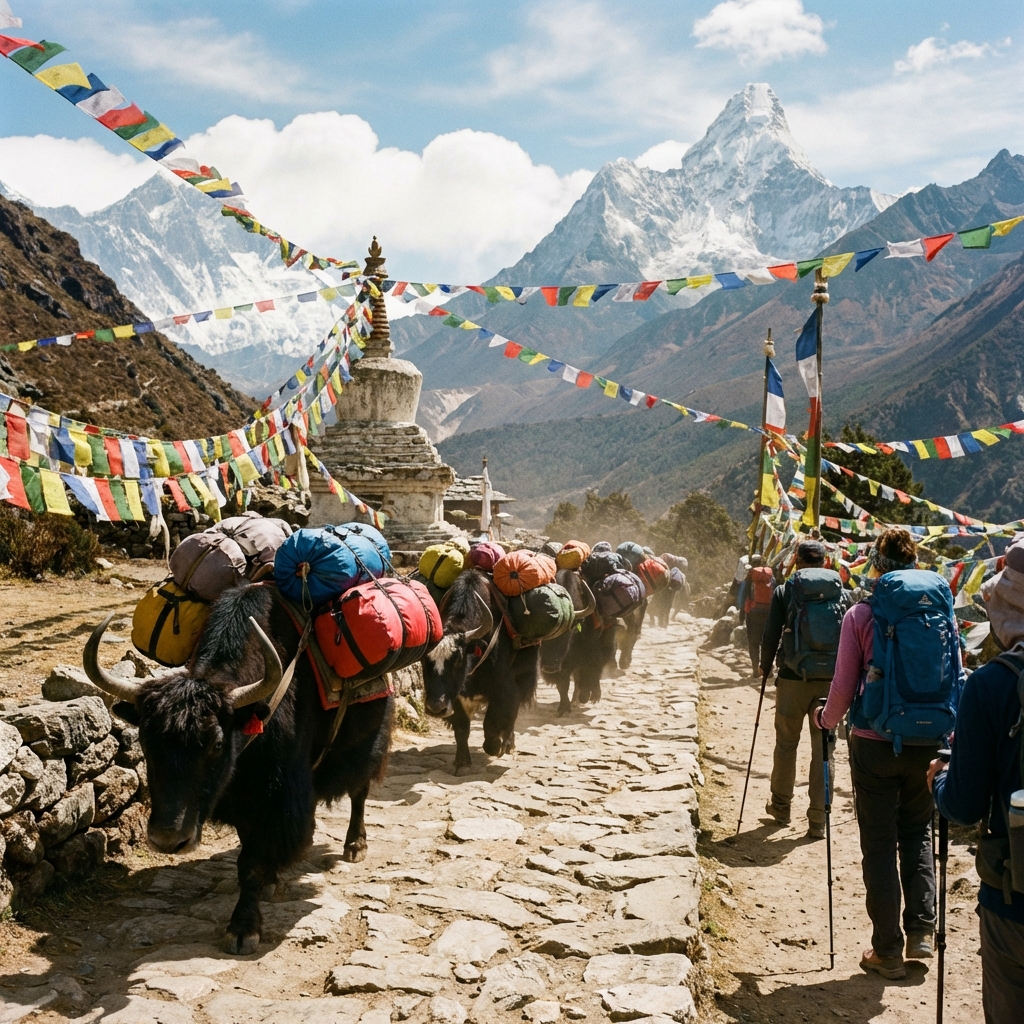
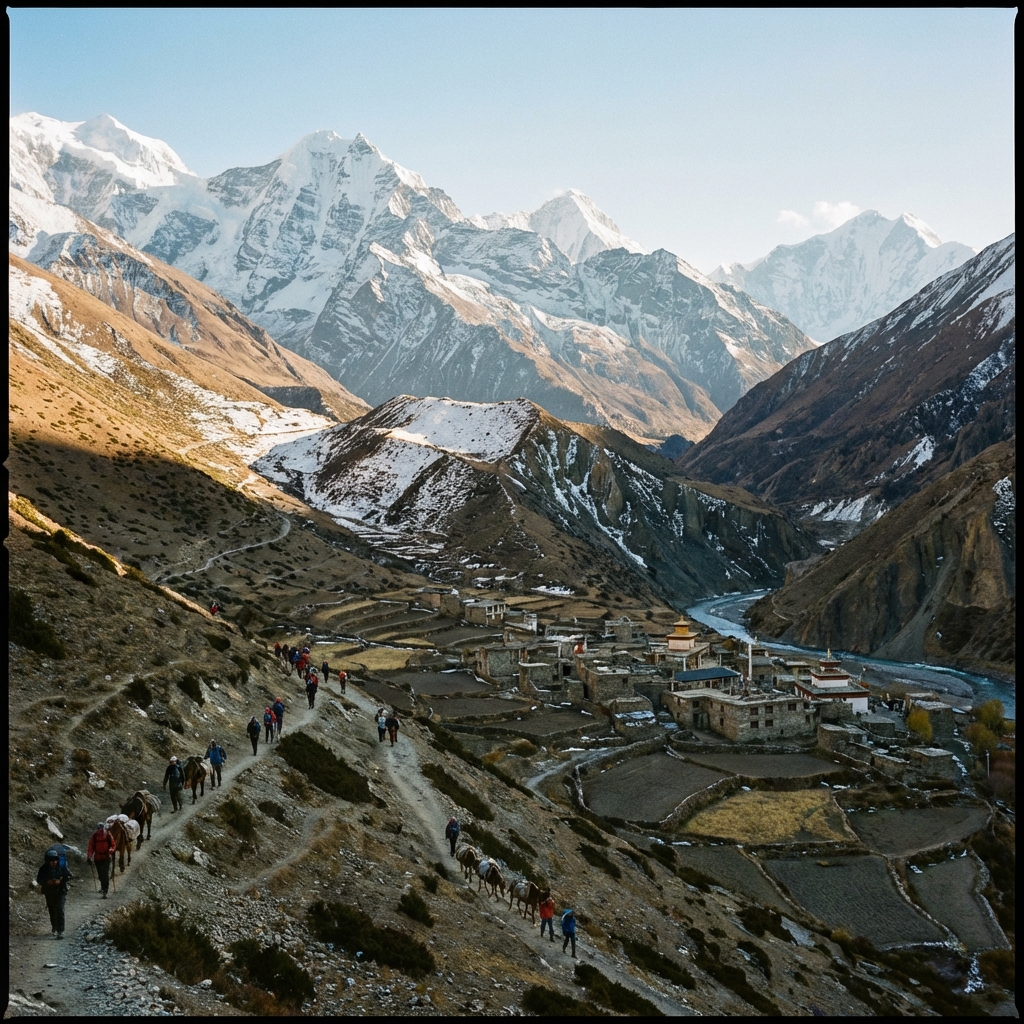
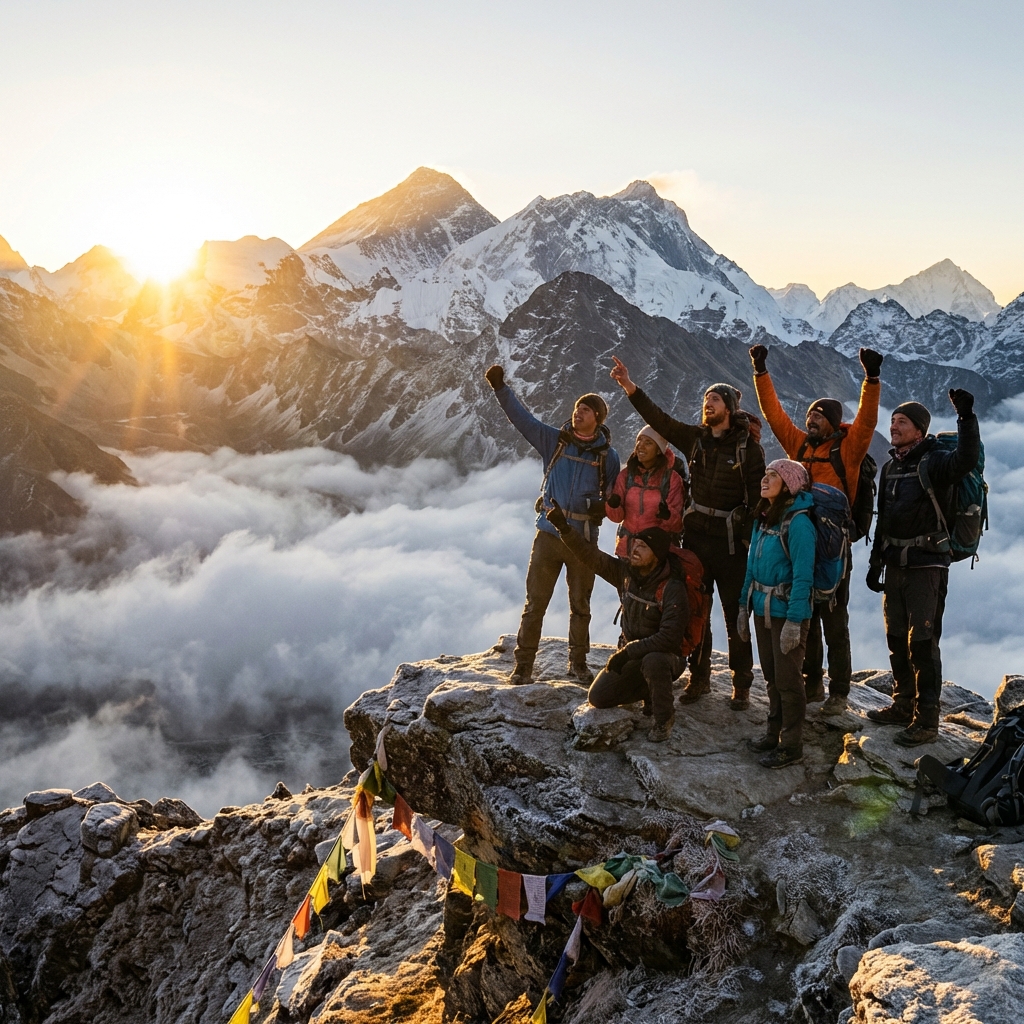
The Manaslu Circuit is the trek that experienced Himalayan trekkers describe with a knowing look and the words "it's different from what you expect." It is consistently underestimated by trekkers who have completed EBC or the Annapurna Circuit and assume Manaslu is comparable. It is not. It is harder, and this guide explains exactly why.
The Manaslu Circuit circumnavigates the world's eighth highest peak (8,163m), crossing Larkya La pass at 5,160 meters through a restricted trekking area that sees a fraction of the traffic of the Everest or Annapurna regions. This remoteness is both the trek's greatest appeal and its greatest challenge. Thinner rescue infrastructure, rougher trails, fewer lodges, longer distances between settlements, and a pass crossing that rivals Thorong La in difficulty but with less predictable conditions all combine to create a trek that demands more from trekkers than its better-known alternatives.
If you are considering the Manaslu Circuit, this honest assessment will help you decide whether you are ready and what preparation you need.
Why Manaslu Is Underestimated
The "Third Trek" Syndrome
Many Manaslu trekkers arrive having completed EBC and the Annapurna Circuit. They assume that experience prepares them fully for Manaslu. While previous Himalayan experience is valuable, it creates a dangerous complacency. Manaslu introduces difficulty factors that EBC and the Annapurna Circuit do not:
Factor 1: Genuinely Remote Trail On EBC, you are never more than a few hours from a settlement with communication. On the Annapurna Circuit, road access reaches surprisingly high. On Manaslu, you walk through valleys where the nearest road is multiple days of walking away. Between Samagaon and Bimthang (the Larkya La crossing section), there is essentially no infrastructure. If something goes wrong, you are a long way from help.
Factor 2: Rougher Trail Conditions The EBC trail is a well-maintained highway by Himalayan standards. The Annapurna Circuit has road sections and well-graded trails. The Manaslu trail includes sections of genuinely rough terrain: landslide zones, river crossings on temporary bridges, narrow cliffside paths, muddy forest trails, and rocky moraine. These sections do not require technical skill, but they demand constant attention, good balance, and confidence on exposed terrain.
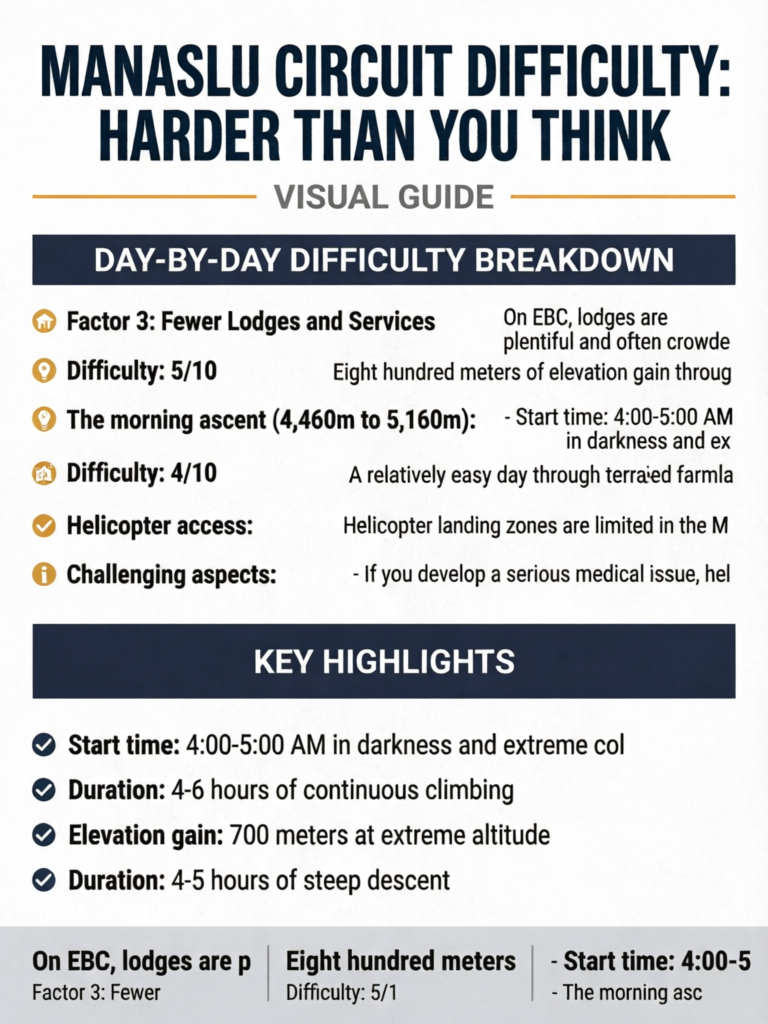
Factor 3: Fewer Lodges and Services On EBC, lodges are plentiful and often crowded. On Manaslu, lodges are basic, fewer in number, and sometimes full during peak season. You may need to share rooms with strangers or accept less comfortable accommodation. Menu choices are limited. Hot showers are rare above Samagaon. Charging facilities are unreliable.
Factor 4: Restricted Area Regulations The Manaslu region is a restricted trekking area. You must trek with a registered guide and in a group of at least two trekkers. Independent trekking is not permitted. The restricted area permit adds logistical complexity and cost. These regulations exist partly because the remoteness of the region makes solo or unsupported trekking genuinely dangerous.
The Honest Comparison
If EBC is a challenging but well-supported trek and the Annapurna Circuit is a long but varied journey, Manaslu is a genuine wilderness adventure. The infrastructure gap between Manaslu and the big two is significant. This is exactly what attracts experienced trekkers, but it also means the safety margin is thinner. Preparation, equipment quality, and guide competence matter more on Manaslu than on any other major Nepal trek.
Day-by-Day Difficulty Breakdown
This breakdown follows a standard 14-day Manaslu Circuit itinerary. Difficulty is rated 1-10 for each day.
Day 1: Soti Khola to Machha Khola (710m to 930m)
Difficulty: 4/10 The trek begins with a taste of what Manaslu has in store: an undulating trail through subtropical forest and terraced farmland. The trail climbs and drops repeatedly, never settling into a rhythm. Walking time: 6-7 hours. Altitude is not a factor, but the terrain is rougher than you expect for a first day. River crossings on suspension bridges, narrow trail sections, and muddy stretches in the monsoon aftereffects introduce the Manaslu trail character immediately.
Day 2: Machha Khola to Jagat (930m to 1,340m)
Difficulty: 5/10 More undulating trail with several significant climbs and descents. The trail passes through landslide zones that require careful navigation. Walking time: 6-7 hours. The cumulative up-and-down is tiring despite the modest net elevation gain. Hot, humid conditions at this altitude add to the challenge, particularly for trekkers accustomed to cooler mountain environments.
Day 3: Jagat to Deng (1,340m to 1,860m)
Difficulty: 5/10 Entering the restricted area. The trail improves somewhat but includes dramatic cliff-hugging sections above the Budhi Gandaki river gorge. Some sections have steel cables for handholds. Walking time: 6-7 hours. The scenery becomes increasingly dramatic as the valley narrows. Cultural transition begins as you move from Hindu villages to Tibetan Buddhist communities.
Day 4: Deng to Namrung (1,860m to 2,660m)
Difficulty: 5/10 Eight hundred meters of elevation gain through increasingly alpine forest. Walking time: 6-7 hours. The trail is well-defined but steep in sections. First views of Manaslu's lower flanks. Temperatures cool noticeably. Some trekkers begin to feel mild altitude effects in the evening.
Day 5: Namrung to Samagaon (2,660m to 3,530m)
Difficulty: 6/10 Nearly 900 meters of elevation gain into the heart of the Manaslu massif. Walking time: 6-7 hours. The landscape transforms from forest to high-altitude steppe. Samagaon is the last significant settlement before the Larkya La crossing. Views of Manaslu itself from Samagaon are stunning. Altitude effects become noticeable for most trekkers.
Day 6: Samagaon Acclimatization Day
Difficulty: 3/10 A crucial rest day. Options include hiking to Birendra Tal (a glacial lake at approximately 3,600m), visiting the ancient monastery above the village, or walking toward Manaslu Base Camp (approximately 4,400m, a strenuous full-day option). Walking time: 3-5 hours depending on activity chosen. This day is critical for acclimatization before pushing to Samdo.
Do Not Skip This Acclimatization Day
The temptation to push through Samagaon is strong, especially for experienced trekkers who "feel fine." The jump from Samagaon (3,530m) to Larkya La (5,160m) is over 1,600 meters of altitude gain. Without proper acclimatization at Samagaon, you dramatically increase your risk of serious altitude sickness during the pass crossing. This is not optional. Every credible guide insists on this rest day.
Day 7: Samagaon to Samdo (3,530m to 3,860m)
Difficulty: 4/10 A relatively short day with modest elevation gain. Walking time: 4-5 hours. The trail crosses the Budhi Gandaki river and climbs to the small settlement of Samdo, a Tibetan-influenced village near the Tibet border. The short distance is intentional: it allows further acclimatization before the push to Dharamsala.
Day 8: Samdo to Dharamsala/Larkya Phedi (3,860m to 4,460m)
Difficulty: 7/10 The approach to Larkya La. Six hundred meters of elevation gain through desolate, rocky terrain. Walking time: 4-5 hours. Despite the short distance, the altitude makes every incline demanding. Dharamsala (also called Larkya Phedi) is a collection of basic stone shelters and lodges at 4,460m. Accommodation is rough. Sleep will be difficult at this altitude. Wind is often severe. Temperatures drop well below freezing after sunset.
The atmosphere at Dharamsala: This is the most austere overnight stop on any major Nepal trek. The lodges are basic stone buildings with minimal insulation. The dining room may be a dark, cold space with a single stove. Your bed is a thin mattress in a room shared with other trekkers. The wind howls. The altitude disrupts your breathing. The anxiety of the next day's pass crossing prevents relaxation. This is the night that tests your commitment.
Day 9: Larkya La Pass Day - Dharamsala to Bimthang (4,460m to 5,160m to 3,720m)
Difficulty: 10/10 (The Crux Day)
This is the most demanding day of the Manaslu Circuit and rivals Thorong La for the title of hardest single-day effort on any major Nepal trek.
The morning ascent (4,460m to 5,160m):
- Start time: 4:00-5:00 AM in darkness and extreme cold
- Duration: 4-6 hours of continuous climbing
- Elevation gain: 700 meters at extreme altitude
- Conditions: The trail is less well-defined than Thorong La. Rocky terrain, potential snow patches, steep sections requiring careful footing. The final approach to the pass involves crossing a moraine glacier area that can be confusing in poor visibility
- At the pass (5,160m): Prayer flags, panoramic views of Manaslu, Himlung, Annapurna II, and the surrounding peaks. Wind is typically strong. Extended stops are uncomfortable and dangerous
The afternoon descent (5,160m to 3,720m):
- Duration: 4-5 hours of steep descent
- Elevation loss: 1,440 meters
- Conditions: The descent is steep, with loose rock and potential snow on the upper sections. Knee and quad strain is severe. The trail drops through moraine and then into a glacial valley before reaching Bimthang
- Bimthang's meadow setting with views of Manaslu feels like arriving in paradise after the stark Dharamsala and brutal pass crossing
Total effort: 8-11 hours of hiking with approximately 700 meters of ascent and 1,440 meters of descent at extreme altitude. This is comparable to the Thorong La crossing but with rougher terrain and less predictable trail conditions.
Larkya La vs. Thorong La: The Subtle Differences
On paper, Thorong La (5,416m) is 256 meters higher than Larkya La (5,160m). But experienced guides often rate Larkya La as equally or more difficult for several reasons: the trail is less well-maintained and harder to follow in bad visibility, the descent on the Bimthang side is steeper and rougher, there is no High Camp option (you must ascend the full 700 meters from Dharamsala), and if conditions deteriorate, rescue from the Larkya La area is significantly more difficult than from Thorong La. The lower altitude does not make it easier.
Day 10: Bimthang to Tilije (3,720m to 2,300m)
Difficulty: 6/10 A massive descent of 1,420 meters through rhododendron forest back into the treeline. Walking time: 6-7 hours. The trail is steep and rocky in the upper sections. Your body is exhausted from the pass crossing, and the sustained downhill punishes legs that have been working hard for over a week. Entering the forest and hearing birdsong again after days of stark alpine terrain is emotionally uplifting.
Day 11: Tilije to Dharapani (2,300m to 1,860m)
Difficulty: 4/10 A relatively easy day through terraced farmland and forest. Walking time: 5-6 hours. The trail is good and the altitude is low enough that breathing is effortless. The main challenge is tired legs and accumulated fatigue from 10 days of trekking.
Day 12: Dharapani to Besisahar (1,860m to 760m)
Difficulty: 3/10 The final trekking day follows a road for most of the distance to Besisahar. Walking time: 6-7 hours, or shorter if taking transport for portions. The trek ends anticlimactically on a dusty road, but the sense of accomplishment is profound.
The Remoteness Factor: What It Really Means
Rescue and Evacuation Limitations
On EBC, helicopter rescue in good weather typically reaches you within 2-3 hours of a distress call. On the Annapurna Circuit, road access provides evacuation alternatives at many points. On Manaslu, the situation is different:
Communication gaps: Phone signal is absent for significant portions of the trek. Satellite phones work but are not universally carried. Your guide's satellite communication capability is a critical safety factor.
Helicopter access: Helicopter landing zones are limited in the Manaslu region. Between Samagaon and Bimthang (including the Larkya La crossing), suitable landing areas are few and weather-dependent. Cloud cover in the valleys can prevent helicopter access for days.
Walking evacuation: If helicopter evacuation is not possible, walking out from the high sections to road access can take 2-4 days, depending on the patient's condition and location. On EBC, walking down from any point reaches Lukla (with flight access) within 1-2 days.
Medical facilities: There are no medical facilities between Samagaon and Dharapani. Your guide's first aid training and your first aid kit are your primary medical resources for this section. The nearest hospital is in Gorkha or Kathmandu.
Insurance Is Non-Negotiable
For the Manaslu Circuit, comprehensive travel insurance with helicopter evacuation coverage up to 6,000 meters is absolutely essential. Do not attempt this trek without it. Ensure your policy covers restricted area trekking specifically, as some policies exclude restricted areas. Verify this in writing with your insurer before departure. See the travel insurance guide for recommended providers.
What Remoteness Means in Practice
Positive aspects:
- Far fewer trekkers than EBC or Annapurna Circuit (2,000-4,000 per year vs. 30,000+ for EBC)
- Authentic cultural experiences with minimal tourist infrastructure
- Genuine wilderness feel: wildlife, pristine landscapes, quiet trails
- Sense of genuine adventure and accomplishment
Challenging aspects:
- If you develop a serious medical issue, help is far away
- Lodge quality is basic (expect shared rooms, limited menus, unreliable hot water)
- If Larkya La is blocked by weather, you must retrace your steps (days of walking) because there is no road alternative
- Communication with home is limited or impossible for portions of the trek
- Equipment failures (broken boot, torn tent, lost gear) cannot be easily remedied
Trail Conditions: Rougher Than EBC and Annapurna Circuit
The Manaslu Trail Character
The Manaslu trail is categorized as a trekking trail, not a mountaineering route, but it is rougher than the trails on EBC or the main Annapurna Circuit.
Lower sections (Soti Khola to Deng): The trail follows the Budhi Gandaki gorge through challenging terrain. Expect narrow paths cut into cliff faces, suspension bridges over deep gorges, landslide zones that require scrambling over debris, and sections where the trail has been washed out and rerouted. After monsoon season, trail conditions in the lower gorge can be poor.
Mid sections (Deng to Samagaon): Trail quality improves as you enter the broader Tsum/Manaslu valley. Forest trails are generally good but muddy in places. River crossings use bridges that range from solid to improvised.
High sections (Samagaon to Larkya La to Bimthang): Above Dharamsala, the trail is marked by cairns and prayer flags rather than a clear path. In fresh snow, route-finding requires experience. The moraine and glacier terrain near Larkya La is uneven, rocky, and demanding. The descent to Bimthang includes loose scree sections.
Comparison of Trail Conditions
| Trail Feature | EBC | Annapurna Circuit | Manaslu Circuit |
|---|---|---|---|
| Trail width | Wide, well-maintained | Variable (road to trail) | Narrow, rough in sections |
| Signage | Excellent | Good | Minimal |
| Landslide exposure | Low | Moderate | High (lower gorge) |
| River crossings | Solid bridges | Solid bridges | Variable quality bridges |
| Cliff exposure | Minimal | Minimal | Some sections |
| Trail marking above 4,500m | Well-cairned | Well-cairned | Adequately cairned but less clear |
Boot Choice Matters More on Manaslu
On EBC, trail running shoes or light hiking boots work for many trekkers. On Manaslu, full hiking boots with ankle support are strongly recommended. The rough terrain, loose rock, and potential wet conditions make ankle sprains a significant risk. This is not a trail for minimalist footwear.
Fitness Requirements Specific to Manaslu
Minimum Fitness Requirements
The Manaslu Circuit demands more baseline fitness than EBC or the Annapurna Circuit due to the rougher terrain and longer daily distances.
You should be able to:
- Hike 7-8 hours with a 10 kg daypack over rough, uneven terrain
- Handle 800+ meters of elevation gain in a single day
- Descend 1,000+ meters on steep, loose terrain without severe knee issues
- Complete 5+ consecutive days of 6-7 hour hikes without significant degradation in performance
- Navigate confidently on narrow, exposed trail sections (you do not need mountaineering experience, but you cannot be afraid of heights)
Recommended Fitness Targets
For a comfortable Manaslu experience:
- 8-10 hours of sustained hiking with full daypack
- 1,000 meters of elevation gain followed by 1,000 meters of descent in a single day
- 7 consecutive hiking days without rest (the Manaslu schedule is demanding)
- Stair climbing for 60 minutes with a loaded pack
- Balance and stability exercises (single-leg stands, lateral movements)
Training Emphasis for Manaslu
Endurance priority: The Manaslu Circuit has several 7-8 hour days without options to shorten. Train for duration, not speed.
Downhill conditioning: The descents on Manaslu are steep and rough. Eccentric quad training (slow squats, controlled step-downs) is critical.
Core and balance: Rough terrain demands constant micro-adjustments. Single-leg exercises, balance board work, and core stability training reduce injury risk.
Pack weight tolerance: Practice hiking with 10-12 kg even if you plan to use a porter for your main bag. Your daypack on Manaslu should contain enough to survive a night out if separated from the main group or porter (layers, water, first aid, emergency shelter).
Manaslu vs. EBC vs. Annapurna Circuit: The Three-Way Comparison
| Factor | EBC | Annapurna Circuit | Manaslu Circuit |
|---|---|---|---|
| Maximum altitude | 5,364/5,545m | 5,416m | 5,160m |
| Total days | 12-14 | 12-18 | 12-16 |
| Days above 4,000m | 6-8 | 3-5 | 4-6 |
| Trail condition | Excellent | Variable | Rough |
| Rescue accessibility | High | Moderate-High | Low-Moderate |
| Lodge quality | Good | Variable | Basic |
| Crowds (peak season) | High | Moderate | Low |
| Permit complexity | Simple | Simple | Complex (restricted area) |
| Guide required | No | No | Yes (mandatory) |
| Overall difficulty | 7/10 | 7/10 | 8/10 |
Why Manaslu Gets the Higher Difficulty Rating
Remoteness: The reduced safety infrastructure adds a genuine difficulty dimension that EBC and the Annapurna Circuit do not have. Knowing that evacuation is harder changes the psychological experience.
Trail roughness: The lower sections of the Manaslu Circuit through the Budhi Gandaki gorge are genuinely challenging terrain. Nothing comparable exists on the standard EBC or Annapurna Circuit routes.
Fewer escape routes: On EBC, you can evacuate by helicopter or walk down at any point. On the Annapurna Circuit, road access provides alternatives at multiple points. On Manaslu, once you commit to the Samagaon-Larkya La-Bimthang section, your only options are forward over the pass or back the way you came.
Duration and fatigue: The Manaslu Circuit has fewer rest days relative to its length. The cumulative fatigue from 12-14 days of demanding hiking on rough terrain is greater than EBC's fatigue profile.
Lower tourist infrastructure: Fewer lodges mean less flexibility in daily planning. You cannot easily shorten or lengthen days to match your energy because the next lodge may be 3-5 hours away.
The Manaslu Paradox
Manaslu's difficulty is partly why it is so rewarding. The remoteness that challenges you also provides the wilderness experience that crowds have diminished on EBC and the Annapurna Circuit. The rough trails mean fewer trekkers, more authentic villages, and a genuine sense of adventure. If Manaslu were easy, it would be crowded, and its magic would be diluted. Accept the difficulty as part of the reward.
Weather Dependency: Higher Than Other Treks
Why Weather Matters More on Manaslu
Larkya La's weather window: Like Thorong La, Larkya La has a morning weather window that typically closes by early afternoon. Unlike Thorong La, weather patterns in the Manaslu region are less predictable and less well-studied, meaning forecasting is less reliable.
Monsoon impact on lower trails: The Budhi Gandaki gorge is highly susceptible to monsoon damage. Landslides, trail washouts, and bridge damage are common during and immediately after monsoon season (June-September). Early October treks may encounter trail damage from the monsoon.
Snow on Larkya La: Snow can close Larkya La from late November through March. Early season snow (October) is possible and adds difficulty. Late spring (May) snow is rare but not unprecedented.
Valley weather: The Manaslu region's deep valleys create microclimates. Rain can persist in the lower gorge while the upper valley is clear, and vice versa. Multiple weather systems can affect different parts of the circuit simultaneously.
Best Weather Windows
Optimal: October 15 to November 15. Clear skies, stable weather, cold but manageable temperatures.
Good: March 15 to April 30 and September 25 to October 15. More variable but generally trekable.
Marginal: Early March, late November, early December. Snow risk on Larkya La increases. Shorter daylight hours.
Not recommended: December through February (cold, snow), June through August (monsoon, trail damage).
Who Should Attempt the Manaslu Circuit
Ideal Candidates
- Experienced trekkers who have completed at least one multi-day Himalayan trek (EBC or Annapurna Circuit)
- Physically fit individuals who train specifically for the Circuit's demands
- People who are comfortable with remoteness and basic facilities
- Trekkers who value wilderness and cultural authenticity over comfort and convenience
- Those willing to accept higher inherent risk and prepare accordingly
People Who Should Not Attempt Manaslu (Yet)
- First-time trekkers with no Himalayan experience (do EBC or ABC first)
- People who require frequent medical access or have conditions requiring regular monitoring
- Individuals uncomfortable on exposed or narrow trail sections
- Those who have had severe altitude sickness on previous treks
- Trekkers who cannot tolerate basic lodge conditions (if you struggled with EBC tea houses, Manaslu's lodges will be distressing)
- Anyone without comprehensive travel insurance including helicopter evacuation
The Best Preparation for Manaslu
If Manaslu is your goal but you have no Himalayan experience, do EBC or ABC first. These treks teach you how your body responds to altitude, how to manage multi-day hiking fatigue, how to use tea house accommodation, and how to work with a guide. That experience is invaluable on Manaslu, where the margin for error is smaller and the learning curve steeper. Think of EBC as your training trek and Manaslu as your graduation trek.
Frequently Asked Questions: Manaslu Circuit Difficulty
General Questions
Q: Is Manaslu the hardest of the three classic Nepal circuits?
Yes, by consensus among guides and experienced trekkers. Manaslu is harder than EBC and the Annapurna Circuit due to rougher trails, greater remoteness, fewer facilities, and more demanding overall logistics. The altitude is slightly lower than EBC (Larkya La at 5,160m vs. Kala Patthar at 5,545m), but altitude is only one component of difficulty.
Q: Can I do Manaslu as my first trek?
We strongly advise against it. The remoteness, rough trail conditions, and requirement for experienced decision-making make Manaslu poorly suited for first-time trekkers. Do ABC or EBC first to develop your Himalayan trekking skills and understand your body's response to altitude. Return for Manaslu with confidence and experience.
Q: How does the Larkya La crossing compare to Thorong La on the Annapurna Circuit?
Similar in overall effort. Larkya La is 256 meters lower (5,160m vs. 5,416m) but the trail is rougher, less well-marked, and the approach (from Dharamsala) is more austere. The descent from Larkya La to Bimthang is steeper and more exposed than the Thorong La descent to Muktinath. Most experienced trekkers rate them as approximately equal in difficulty, with Larkya La having higher consequences if something goes wrong due to remoteness. For detailed Larkya La preparation, see the Larkya La pass guide.
Q: What is the success rate on Larkya La?
In peak season (October-November), approximately 80-85% of trekkers who reach Dharamsala successfully cross Larkya La. The success rate is slightly lower than Thorong La (85-90%) due to rougher trail conditions and less predictable weather. Off-season rates drop to 60-70%.
Q: How many days of the Manaslu Circuit are actually hard?
Days 1-5 are moderate (comparable to any multi-day trek). Days 6-8 (acclimatization and approach to Larkya La) are challenging due to altitude. Day 9 (Larkya La crossing) is extreme. Days 10-12 are moderate (descent). The truly hard portion is a 3-4 day window from Samdo to Bimthang.
Logistics and Permit Questions
Q: Why do I need a restricted area permit?
The Manaslu region borders Tibet (China), and the Nepali government restricts access for security and conservation reasons. The permit ensures trekkers have registered guides, proper support, and can be tracked. The permit costs USD 100 per person per week (first week) plus USD 10 per additional day. See the Manaslu restricted area permit guide for application details.
Q: Can I trek Manaslu independently with a mandatory licensed guide?
No. A registered trekking guide is mandatory for the Manaslu restricted area. This is a legal requirement, not a recommendation. Solo trekking is not permitted. You must be in a group of at least two trekkers with a registered guide from a TAAN-licensed agency.
Q: What happens if Larkya La is blocked by weather?
You must return the way you came. Unlike the Annapurna Circuit, where road access from Manang provides an alternative if Thorong La is closed, there is no road alternative for Larkya La. If the pass is closed, you walk back from Dharamsala to Samagaon, then back down the Budhi Gandaki gorge to the road. This can add 3-5 days to your trek. Build buffer days into your itinerary.
Physical and Health Questions
Q: How much harder is Manaslu than EBC in practice?
Approximately 15-20% harder overall. The daily walking is longer and rougher, the lodges are more basic (affecting rest quality), and the remoteness adds psychological stress. A trekker who found EBC moderately challenging should expect to find Manaslu genuinely challenging. A trekker who found EBC easy should find Manaslu moderately challenging.
Q: What medical preparations are specific to Manaslu?
Beyond standard Nepal trekking medical preparation, Manaslu-specific considerations include: carrying a more comprehensive first aid kit (you cannot buy supplies along the trail), ensuring your guide has wilderness first aid training, carrying emergency communication devices, discussing Diamox prophylaxis with your doctor, and ensuring your insurance explicitly covers restricted area trekking and helicopter evacuation up to 6,000 meters.
Q: Are there altitude sickness evacuation points on the Manaslu Circuit?
Helicopter landing is possible at several points (Samagaon, Samdo, Bimthang, and some valley locations), but only in good weather. Cloud cover in the valleys frequently prevents helicopter access. Walking evacuation from the high sections to road access takes 2-4 days minimum. There are no permanent medical posts on the circuit.
Q: What physical conditions would make Manaslu inadvisable?
Serious knee conditions (the terrain is rough and descent-heavy), uncontrolled asthma (remoteness from medical care), heart conditions without medical clearance, fear of heights or exposed terrain (some lower trail sections are cliff-hugging), and any condition requiring regular medical monitoring or access to pharmacy supplies.
Q: How do I train specifically for Manaslu's rough terrain?
In addition to standard trekking training (cardiovascular endurance, leg strength, loaded pack walking), add: balance exercises (single-leg stands, wobble board), ankle strengthening (calf raises, ankle circles with resistance band), practice walking on uneven surfaces (rocky trails, loose ground), and core stability work. Train on the roughest trails available in your area rather than smooth paths.
For the complete itinerary, see our Manaslu Circuit 14-day guide. For permit information, read the Manaslu restricted area permit guide. For pass-specific preparation, see the Larkya La pass guide. For fitness preparation, review the fitness requirements guide.