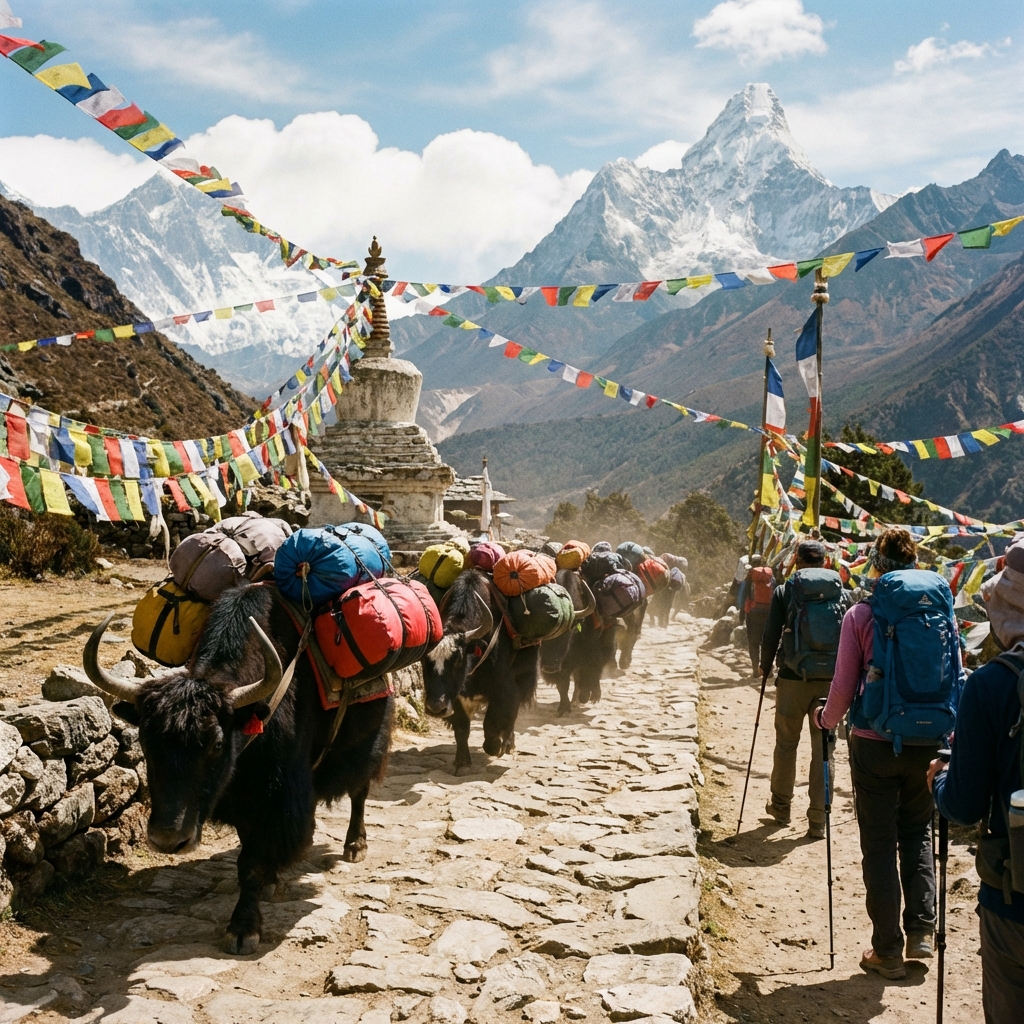
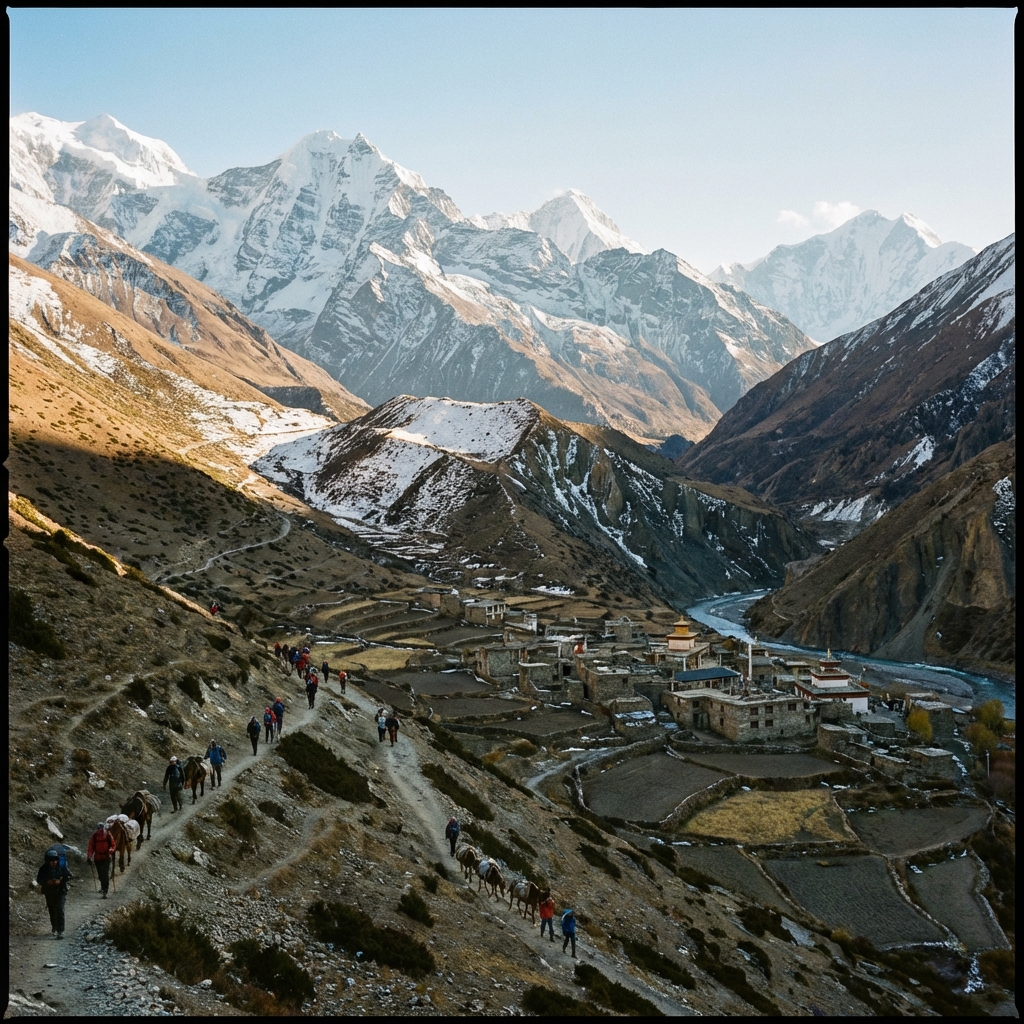
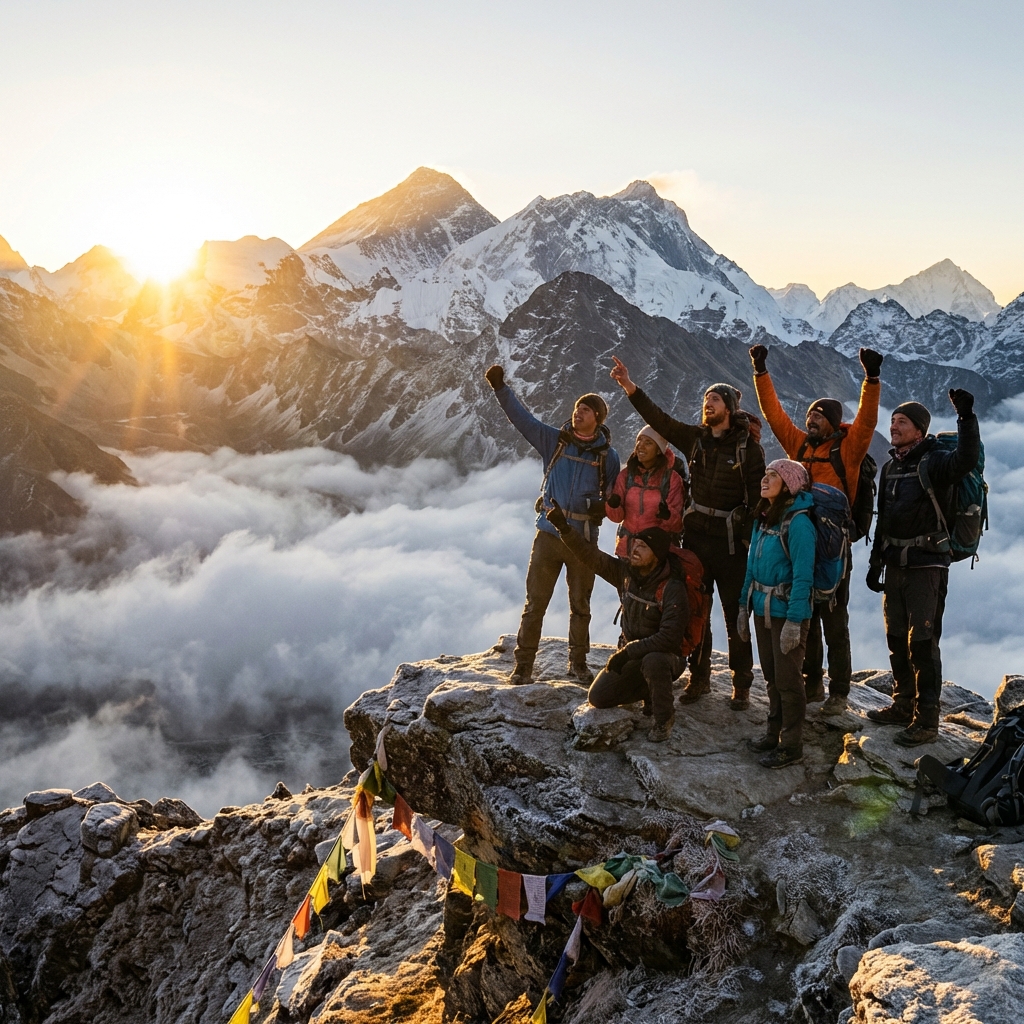
The Everest Base Camp trek is extraordinary in both autumn and spring, and both seasons deliver the full EBC experience: the Lukla flight, the Sherpa villages, the monastery at Tengboche, the glacial landscapes of the upper Khumbu, and the final push to Base Camp at 5,364m and Kala Patthar at 5,545m. Neither season is objectively wrong, and trekkers in both seasons return with life-changing memories.
But the seasons are not identical. Autumn and spring deliver meaningfully different versions of the same trek, and understanding these differences helps you choose the season that best matches your priorities. The weather is different. The crowds are different. The scenery has different character. The trail conditions vary. The logistical challenges shift. And the overall atmosphere of the Khumbu changes with the calendar.
This guide provides a comprehensive analysis of every factor that differs between autumn (October-November) and spring (March-May) EBC trekking, based on meteorological data, trekker feedback, and on-the-ground reporting from experienced guides.
Who should read this guide:
- Trekkers who have decided to do EBC but have not chosen their season
- Those with schedule flexibility who want to optimize their timing
- Repeat EBC trekkers considering the alternate season
- Anyone planning a Nepal trip and weighing seasonal options
Quick Comparison: Side-by-Side Overview
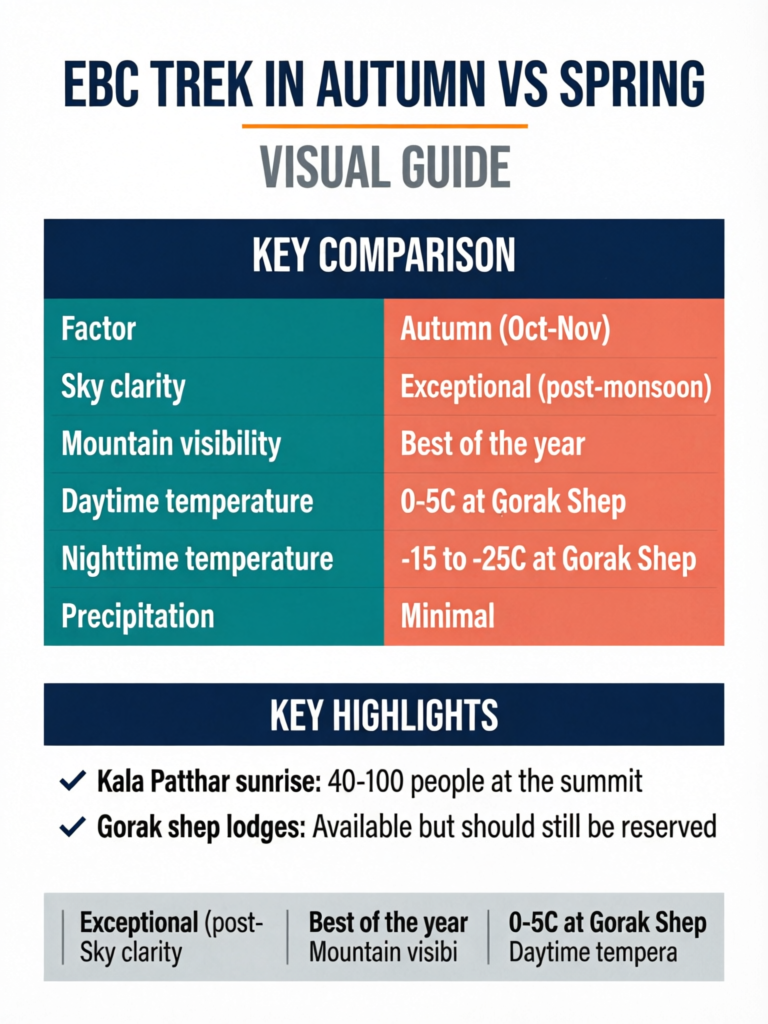
Autumn: October-November. Spring: Late March-May.
Autumn: daytime 0-5C, night -15 to -25C. Spring: daytime 2-8C, night -10 to -20C.
Autumn: very dry. Spring: occasional snow above 4,000m, some rain below.
Autumn: excellent (post-monsoon clarity). Spring: good but more afternoon cloud.
Autumn: peak (12,000-15,000/month in October). Spring: moderate-high (8,000-12,000/month in April).
Autumn: dry and dusty. Spring: some snow/ice above 4,500m, muddy below 3,000m.
Autumn: generally reliable (October). Spring: slightly less reliable (more afternoon cloud).
Autumn: golden hues, crystal-clear. Spring: rhododendron bloom, greener lower valleys.
Autumn: peak pricing. Spring: 5-15% lower (some agencies).
Autumn: 11-11.5 hours. Spring: 12-13 hours.
Autumn: post-expedition season (quieter at BC). Spring: full expedition season (active climbing camps).
Autumn for clarity and reliability. Spring for warmth and fewer crowds.
Master Comparison Table
| Factor | Autumn (Oct-Nov) | Spring (Mar-May) | Advantage |
|---|---|---|---|
| Sky clarity | Exceptional (post-monsoon) | Good, more afternoon cloud | Autumn |
| Mountain visibility | Best of the year | Very good, occasional haze | Autumn |
| Daytime temperature | 0-5C at Gorak Shep | 2-8C at Gorak Shep | Spring (warmer) |
| Nighttime temperature | -15 to -25C at Gorak Shep | -10 to -20C at Gorak Shep | Spring (warmer) |
| Precipitation | Minimal | Occasional snow/rain | Autumn |
| Trail condition | Dry, dusty | Some ice/snow above 4,500m | Autumn |
| Crowds | Peak season (highest numbers) | 20-30% fewer trekkers | Spring |
| Lodge availability | Tight (book ahead at Gorak Shep) | More availability | Spring |
| Lukla flight reliability | High (October); moderate (November) | Moderate (afternoon cloud) | Autumn (October) |
| Lower valley scenery | Golden autumn hues, harvested fields | Rhododendron bloom, spring green | Spring |
| Upper valley scenery | Brown/golden tones, stark beauty | Some snow cover, dramatic contrast | Tie |
| EBC activity | Post-expedition (quieter) | Active expeditions (exciting) | Spring |
| Photography | Cleaner light, fewer clouds | More dramatic cloud formations | Tie (style-dependent) |
| Cost | Peak pricing | Slightly lower (5-15%) | Spring |
| Daylight hours | 11-11.5 hours | 12-13 hours | Spring |
| Wind | Moderate to strong at altitude | Moderate at altitude | Spring |
| Festival timing | Tihar/Diwali (October/November) | Holi (March), Nepali New Year (April) | Tie |
| Post-trek options | Chitwan safari, Pokhara | Pokhara, lower elevation treks | Tie |
1. Weather: The Defining Difference
Weather is the most significant difference between autumn and spring EBC trekking, and it influences nearly every other factor.
Autumn Weather (October-November)
Autumn follows the monsoon season (June-September), and the atmosphere is at its cleanest. The monsoon rains have washed dust and haze from the air, leaving behind extraordinary clarity.
October weather:
- Sky clarity: Exceptional. This is the clearest month of the year. Mountain visibility can exceed 200 km on the best days. Everest, Lhotse, Ama Dablam, and distant peaks stand razor-sharp against deep blue skies.
- Precipitation: Very dry. Rainfall is minimal (typically under 30mm for the month in the Khumbu). Snow at altitude is rare in October.
- Temperature: Cool but manageable. Daytime temperatures of 10-15C at Namche (3,440m) and 0-5C at Gorak Shep (5,164m). Nighttime temperatures drop sharply: -5 to -10C at Namche and -15 to -25C at Gorak Shep.
- Wind: Moderate. Less wind than spring at most altitudes, though Kala Patthar and exposed ridges can be windy.
- Cloud: Minimal cloud cover, especially in the morning. Occasional afternoon cloud buildup, but evenings and mornings are consistently clear.
November weather:
- Sky clarity: Still excellent, though slightly less pristine than October as winter haze begins.
- Precipitation: Very dry. Snow becomes possible above 5,000m in late November.
- Temperature: Significantly colder than October. Nighttime temperatures at Gorak Shep can drop below -25C. Shorter days reduce warming time.
- Wind: Increasing. November winds at altitude are stronger than October.
- Cloud: Generally clear but increasing high cloud toward the end of the month.
Spring Weather (March-May)
Spring precedes the monsoon, and the atmosphere is warming and moistening. The weather is more variable than autumn but still predominantly good.
Late March weather:
- Sky clarity: Good. Less clear than October due to pre-monsoon haze, but still excellent mountain visibility most days.
- Precipitation: Occasional snowfall above 4,000m. Light rain possible below 3,000m. Generally dry.
- Temperature: Warming rapidly. Warmer than autumn at all altitudes. Daytime 5-10C at Gorak Shep. Nights still cold but less extreme than October/November.
- Cloud: More afternoon cloud buildup than autumn. Mornings usually clear.
April weather (peak spring):
- Sky clarity: Good to very good. Morning clarity is excellent; afternoon cloud is more common. Haze increases through the month.
- Precipitation: Snow showers above 4,500m possible (1-3 times per month). Rain below 3,000m more frequent.
- Temperature: The warmest trekking season. Comfortable daytime temperatures. Nights at Gorak Shep: -10 to -15C (much warmer than October/November).
- Cloud: Regular afternoon cloud. Mountain views best in early morning. Cloud can obscure peaks by midday.
May weather:
- Sky clarity: Declining. Pre-monsoon haze becomes significant. Mountain visibility reduced compared to October.
- Precipitation: Increasing. Snow above 4,000m more frequent. Rain below 3,000m common. Pre-monsoon showers begin.
- Temperature: Warmest. Comfortable but humid at lower altitudes.
- Cloud: Significant afternoon cloud. Morning windows for mountain views shorter and less reliable.
Weather Verdict
Autumn wins for visibility and reliability. October delivers the year's clearest skies, the sharpest mountain views, and the most reliable dry weather. If crisp, clear mountain panoramas are your priority, October is the optimal month.
Spring wins for temperature comfort. Warmer days and significantly warmer nights make spring trekking more comfortable, especially at Gorak Shep and on Kala Patthar. If cold tolerance is a concern, spring is the gentler season.
The October Sweet Spot
The first three weeks of October are widely considered the single best weather window for EBC trekking in the entire year. Post-monsoon clarity is at its peak, precipitation is minimal, and temperatures have not yet dropped to winter extremes. If you have complete scheduling flexibility, aim for a Lukla departure between October 1-15 for optimal conditions. This window is also the busiest, so book flights and lodges well in advance.
2. Crowds: The Volume Difference
Autumn Crowds
Autumn is EBC's peak season, and the numbers are significant:
- October trekker volume: 12,000-15,000 trekkers enter Sagarmatha National Park
- Daily trail traffic (Namche to Tengboche): 200-400 trekkers
- Daily trail traffic (Dingboche to Gorak Shep): 100-200 trekkers
- Kala Patthar sunrise: 80-150 people at the summit
- Gorak Shep lodges: Often fully booked; advance reservation essential
- Lukla airport queue: Long waits, tense scrambles for delayed flights
November trekker volume: 6,000-9,000 (declining as temperatures drop). Early November is still busy; late November is much quieter.
Spring Crowds
Spring is EBC's secondary season, with meaningfully fewer trekkers:
- April trekker volume: 8,000-12,000 trekkers enter Sagarmatha National Park
- Daily trail traffic (Namche to Tengboche): 150-300 trekkers
- Daily trail traffic (Dingboche to Gorak Shep): 60-150 trekkers
- Kala Patthar sunrise: 40-100 people at the summit
- Gorak Shep lodges: Available but should still be reserved
- Lukla airport queue: Shorter waits, but afternoon weather delays are common
March trekker volume: 4,000-7,000 (increasing through the month). Early March is quiet; late March approaches April volumes.
May trekker volume: 5,000-8,000 (declining as monsoon approaches).
Crowd Verdict
Spring is 20-40% less crowded than peak autumn. This difference is noticeable on the trail, in tea houses, and at viewpoints. The experience at Kala Patthar sunrise with 50 people versus 120 people is meaningfully different.
For crowd-averse trekkers: Early March or late November offer the quietest conditions within the two main seasons, though weather compromises increase at these shoulder periods.
Pro Tip
If you want autumn clarity with fewer crowds, trek in the first week of November. The post-monsoon sky clarity is still excellent, temperatures have dropped slightly (which deters some trekkers), and the October rush has passed. You will find 30-40% fewer trekkers than early October while retaining nearly identical weather quality. The trade-off is colder nights, which are manageable with a quality sleeping bag rated to minus 20 degrees Celsius.
3. Trail Conditions: Dry vs Mixed
Autumn Trail Conditions
The post-monsoon trail is dry and well-established:
- Below Namche (2,860m-3,440m): Dry, dusty in places. Well-maintained trail. Some dust kicked up by large trekker volumes. Suspension bridges in good condition.
- Namche to Tengboche (3,440m-3,860m): Dry forest trail through rhododendron (not in bloom). Clear, well-marked. Mud-free.
- Tengboche to Dingboche (3,860m-4,410m): Alpine trail, dry and rocky. Clear visibility of the trail ahead. No snow or ice in October.
- Dingboche to Gorak Shep (4,410m-5,164m): Dry moraine and rocky trail. Dusty in places. No snow cover in October; possible light snow in November.
- Kala Patthar (5,545m): Rocky scramble to the summit. Dry in October. Possible ice patches in November.
Autumn trail summary: Dry, predictable, and easy to navigate. Trail conditions are at their best in October.
Spring Trail Conditions
Spring trails are more variable:
- Below Namche (2,860m-3,440m): Can be muddy, especially in April-May as pre-monsoon rains begin. Trails through forest sections may be slippery after rain. Leeches are not present at this altitude but may appear on the Jiri approach in May.
- Namche to Tengboche (3,440m-3,860m): Generally good. Rhododendron forests may be wet after rain. Mud patches possible.
- Tengboche to Dingboche (3,860m-4,410m): Some residual snow from winter possible in March. Generally clear by April. Alpine trail in good condition.
- Dingboche to Gorak Shep (4,410m-5,164m): Snow cover possible above 4,500m, especially in March and early April. Ice patches on the trail may require careful foot placement. Later in spring (May), trail is similar to autumn conditions.
- Kala Patthar (5,545m): Snow and ice more likely than autumn. May require more careful navigation. Crampons or microspikes occasionally useful in March.
Spring trail summary: More variable than autumn. Some snow and ice above 4,500m in early spring. Muddier below 3,500m. Conditions improve through the season, with April-May trails approaching autumn quality above treeline.
Spring Snow on Upper Trail
Spring trekkers above 4,500m should be prepared for occasional snow cover on the trail, particularly in March and early April. Carry microspikes or lightweight crampons (rentable in Namche Bazaar for approximately $2-5 per day) and gaiters. After a snowfall, the trail between Lobuche and Gorak Shep can be difficult to follow. Your guide's experience is critical for safe navigation in snowy conditions. The trail is almost always passable, but snow adds time and difficulty to the final section.
Trail Verdict
Autumn provides better, more predictable trail conditions. Dry trails, no snow below 5,000m (in October), and excellent visibility make navigation straightforward.
Spring trails are manageable but more variable. Some preparation for snow and mud is necessary. The trade-off is warmer temperatures that make walking more comfortable despite the less predictable surface conditions.
4. Scenery Character: Golden vs Green
Beyond weather and visibility, the aesthetic character of the landscape differs between seasons.
Autumn Scenery
- Lower valleys: Golden and harvested. Rice paddies have been cut. Fields are stubbled gold and brown. The landscape has a warm, amber tone.
- Forests: Autumn colors are subtle in the Himalayan context (not as dramatic as North American or European fall foliage), but there is a golden-brown warmth to the broadleaf forests below 3,000m.
- Upper Khumbu: Brown, stark, and dramatic. Minimal vegetation above 4,000m appears in its barest form. The contrast between brown earth and white/blue mountains is clean and graphic.
- Sky: Deep blue, almost indigo at altitude. The post-monsoon clarity creates a sky color that is distinctive and photographically powerful.
- Sunset/sunrise: Crystal-clear alpenglow on Everest, Lhotse, and Ama Dablam. The absence of cloud creates pure, unobstructed color on the mountain faces.
Spring Scenery
- Lower valleys: Lush and green. Spring rains (when they come) produce vibrant vegetation. Fields are being planted. The landscape feels alive and fertile.
- Forests: Rhododendron bloom is the headline attraction. From late March through May, the national flower of Nepal erupts in masses of red, pink, white, and magenta across the forest belt between 2,500m and 4,000m. The Tengboche area and the approach from Lukla can be spectacular during peak bloom.
- Upper Khumbu: Similar to autumn above 4,500m (sparse vegetation regardless of season). Below 4,500m, spring brings a touch of green to scrubland and alpine meadows.
- Sky: Blue but softer than autumn. More cloud variation creates dramatic skyscapes. Less pristine but more atmospheric.
- Sunset/sunrise: Often dramatic with cloud layers. Cloud formations can create extraordinary light effects, though they can also obscure mountain views.
Scenery Verdict
For mountain photography purists: Autumn wins. Cleaner skies, sharper mountain outlines, and the graphic contrast of brown earth against white peaks and indigo sky.
For botanical beauty and overall landscape aesthetics: Spring wins. The rhododendron bloom transforms the lower trail into a flower tunnel, and the green, living landscape has a vitality that autumn's harvested fields lack.
Pro Tip
For the best rhododendron bloom on the EBC approach, trek in mid-to-late April. The forests between Lukla and Namche and between Namche and Tengboche are at their most spectacular during this window. The bloom varies by elevation: lower areas peak earlier (late March), higher areas peak later (late April to early May). Your guide can tell you where the best bloom is on any given day.
5. Lukla Flight Reliability
The Lukla flight is a critical logistical factor, and its reliability differs by season.
Autumn Lukla Flights
October: High reliability. Clear morning skies allow most scheduled flights to operate. Cancellation rate: approximately 10-15% of scheduled flights. Most delays are minor (1-2 hours).
November: Moderate reliability. Increasing morning fog and cloud reduces the operational window. Cancellation rate: approximately 15-25%. Multi-day delays become more possible in late November.
Spring Lukla Flights
March: Moderate reliability. Winter weather patterns may persist. Cloud and wind can be unpredictable. Cancellation rate: approximately 15-25%.
April: Moderate reliability. Afternoon cloud buildup can delay return flights from Lukla. Morning flights generally operate well. Cancellation rate: approximately 15-20%.
May: Lower reliability. Pre-monsoon cloud and weather increase disruptions. Cancellation rate: approximately 20-30%.
Lukla Flight Verdict
October is the most reliable month for Lukla flights. The clear post-monsoon skies provide the widest and most consistent flying window. Spring months are slightly less reliable due to afternoon cloud buildup, though morning flights usually operate.
Regardless of season: Always build 1-2 buffer days into your itinerary for potential Lukla flight delays. This is non-negotiable advice that applies equally to autumn and spring.
Ramechhap Alternative
During peak season (both autumn and spring), some flights operate from Ramechhap (approximately 5 hours from Kathmandu by road) rather than Kathmandu's Tribhuvan Airport. This is a logistical inconvenience (early morning departure from Kathmandu required) but can improve flight reliability, as Ramechhap's weather window is sometimes better than Kathmandu's. Your agency will inform you if your flight departs from Ramechhap. Factor the 5-hour drive into your schedule.
6. Cost Differences
Autumn Costs
Autumn is peak season, and pricing reflects demand:
- Lukla flights: Peak pricing, $215-400 round-trip (occasionally higher if rebooked after cancellations)
- Tea house accommodation: Standard pricing, but premium rooms at popular stops (Namche, Gorak Shep) may charge more during peak weeks
- Agency trek packages: Full peak-season pricing, no discounts
- Guide and porter rates: Standard rates, high demand
- Kathmandu hotels: Peak pricing, especially Thamel area
- Travel insurance: Standard rates
Spring Costs
Spring's lower demand creates modest savings:
- Lukla flights: Same published fare ($215-400), but less rebooking stress
- Tea house accommodation: Same published rates, but easier negotiation for discounts (5-10% possible at some lodges)
- Agency trek packages: 5-15% lower than autumn at some agencies, especially for early March or late May departures
- Guide and porter rates: Standard rates, slightly easier availability
- Kathmandu hotels: Slightly lower than autumn (5-10%)
- Travel insurance: Standard rates
Cost Verdict
Spring is marginally cheaper (5-15% overall savings possible). The difference is not dramatic, but budget-conscious trekkers can find better deals in spring, especially at the season's edges (early March, late May). Autumn pricing is firm with minimal negotiation room.
7. The EBC Atmosphere: Post-Expedition vs Active Expedition
This is a surprisingly important difference that many seasonal comparisons overlook.
Autumn EBC Atmosphere
In autumn, you arrive at Everest Base Camp after the spring/summer climbing season has ended:
- Base Camp activity: Minimal. Most expeditions operate from April through May. By October, Base Camp is largely cleared. You may see a few autumn expedition teams, but the site is far quieter than during climbing season.
- Khumbu Icefall: Visible but not in active use. The ladder routes through the icefall are typically dismantled by October.
- Expedition atmosphere: Absent. The camp area feels vast, empty, and somewhat desolate. This can be powerful (the sense of the mountain's scale without human activity) or disappointing (no expedition buzz).
- Helicopter activity: Moderate (rescue and tourist flights).
Spring EBC Atmosphere
In spring, you arrive at Everest Base Camp during the peak climbing season:
- Base Camp activity: Intense. Dozens of expedition teams are preparing for summit bids. Colorful tents, climbers preparing equipment, Sherpas carrying loads. The camp is alive with purpose and energy.
- Khumbu Icefall: In active use. Climbers and Sherpas traverse the icefall daily. You may see climbers heading up or down through the ice towers.
- Expedition atmosphere: Electric. The sense of being at the staging ground for Everest summit attempts adds a powerful dimension to the trekking experience. You may interact with climbers from around the world.
- Helicopter activity: Frequent (supply, rescue, and support flights).
Atmosphere Verdict
Spring wins for EBC atmosphere. Arriving at Base Camp during active expedition season adds a layer of excitement and human drama that autumn lacks. Watching climbers prepare for summit bids, seeing the Khumbu Icefall in active use, and sharing the campground with expedition teams transforms EBC from a destination into a living, breathing mountaineering hub.
Autumn wins for contemplative atmosphere. The emptier Base Camp in autumn creates a more serene, reflective experience. The mountain stands in its full scale without human activity to distract from its enormity. Some trekkers prefer this quieter, more personal encounter with Everest.
Pro Tip
If you trek in spring (April-May), time your Base Camp arrival for the period when expedition teams are in their acclimatization rotations (typically mid-April to early May). This is when Base Camp is most active and you are most likely to interact with climbers. By late May, teams are either on the mountain or have departed, and the camp begins to thin out.
8. Festival and Cultural Timing
Autumn Festivals
- Dashain (September-October): Nepal's biggest festival, typically falling in October. Some tea houses may be short-staffed as Nepali workers return to their home villages. Trail activity may shift slightly but rarely affects trekking significantly.
- Tihar/Diwali (October-November): The festival of lights. Beautiful celebrations in Namche Bazaar and lower villages with candles, rangoli, and cultural events. If your trek coincides, the evening celebrations in Sherpa villages add a special cultural dimension.
- Mani Rimdu (October-November): A sacred Sherpa Buddhist festival held at Tengboche Monastery. The exact dates vary by the lunar calendar. Witnessing Mani Rimdu at Tengboche is one of the Khumbu's most extraordinary cultural experiences. Check dates and plan accordingly.
Spring Festivals
- Holi (March): The festival of colors. Celebrated primarily in lowland Nepal (Kathmandu, Pokhara) rather than the Khumbu. You may encounter celebrations before or after your trek.
- Nepali New Year (mid-April): Celebrated throughout Nepal. A festive atmosphere in Kathmandu and some trail towns.
- Buddha Jayanti (April-May): Particularly significant in Buddhist areas like the Khumbu. Monasteries hold special prayers and ceremonies. Tengboche may have cultural events.
- Losar (Tibetan/Sherpa New Year, February-March): If your trek falls in early spring, Sherpa villages may be celebrating Losar with traditional dances, prayers, and feasting.
Festival Verdict
Both seasons offer cultural richness. Autumn's Mani Rimdu at Tengboche is the standout festival experience in the Khumbu. Spring's Buddha Jayanti and Losar celebrations are meaningful but less predictable in timing. Neither season has a decisive advantage, but both can coincide with memorable cultural events with careful planning.
Which Season Has Better Weather?
Autumn (October-November) wins for weather reliability. Post-monsoon clarity delivers the year's clearest skies, driest trails, and most reliable Lukla flights. Spring (March-May) is warmer but brings more afternoon cloud, occasional snow above 4,500m, and pre-monsoon haze that builds through May. For the single best weather window, aim for the first three weeks of October. See our trekking in October guide for details.
Which Season Is Less Crowded?
Spring is 20-40% less crowded than peak autumn. October sees 12,000-15,000 trekkers enter Sagarmatha National Park, while April sees 8,000-12,000. The difference is noticeable at Kala Patthar sunrise (50 vs 120 people) and at Gorak Shep lodges. For the quietest conditions within main seasons, trek in early March or late November. See our EBC route guide for itinerary planning.
Which Season Is Cheaper?
Spring is marginally cheaper with 5-15% savings possible on agency packages and Kathmandu hotels. Tea house rates are officially the same but slightly more negotiable in spring. The biggest saving is reduced competition for Lukla flights and lodge rooms. Pack warm regardless of season using our down jacket guide and sleeping bag guide.
9. Decision Framework: Which Season Matches You?
Choose Autumn (October-November) If:
Mountain photography is a primary goal. October's post-monsoon clarity produces the year's best conditions for mountain photography. If sharp, clean images of Everest, Ama Dablam, and the Khumbu peaks are important to you, autumn delivers unmatched visual quality.
You want the most reliable weather. October is the most predictable trekking month. Dry trails, clear skies, and minimal precipitation create a weather window that spring cannot guarantee. If weather anxiety affects your planning, autumn provides the strongest reassurance.
You want the most reliable Lukla flights. October's clear skies produce the year's highest Lukla flight reliability. If your schedule is tight and flight delays could cause problems, October minimizes (but never eliminates) this risk.
You prefer dry trail conditions. If snow, ice, and mud on trails sounds unappealing, autumn's dry conditions are preferable. The trail is at its most walkable in October.
You want to witness Mani Rimdu at Tengboche. If the dates align, the Mani Rimdu festival at Tengboche Monastery is a once-in-a-lifetime cultural experience that is available only in autumn.
You are willing to accept peak crowds and pricing. Autumn's advantages come with the cost of maximum crowds and firm pricing. If these trade-offs are acceptable, autumn rewards you with the best overall conditions.
Choose Spring (March-May) If:
Warmer temperatures improve your experience. If cold tolerance is a concern, spring's significantly warmer nights (5-10 degrees warmer at Gorak Shep) make the high-altitude experience more comfortable. This is particularly relevant for trekkers sensitive to cold or those with less effective sleeping bags.
You want fewer crowds. Spring offers 20-40% fewer trekkers than peak autumn. Quieter trails, available lodge rooms, and less crowded viewpoints create a more intimate trekking experience.
The rhododendron bloom appeals to you. The spectacular bloom of Nepal's national flower in the forests below 4,000m adds a botanical dimension that autumn lacks entirely. If flower-studded trails enhance your enjoyment, spring delivers.
You want to see Base Camp during expedition season. Arriving at EBC during active climbing season adds excitement, drama, and human interest that the empty autumn camp cannot provide. If the mountaineering atmosphere matters, spring is the time.
You have more flexible dates. Spring offers a wider effective window (late March through May) compared to autumn's concentrated peak (October through mid-November). More flexibility to shift dates within the season.
Budget optimization matters. Spring's modestly lower costs (5-15% savings possible) may be relevant for budget-conscious trekkers. The savings are not dramatic but can add up across a two-week trek.
You prefer longer daylight hours. Spring's 12-13 hours of daylight versus autumn's 11-11.5 hours provides more walking time and more photography time per day. This can be particularly valuable on the demanding Kala Patthar and Base Camp days.
Late May Monsoon Risk
Do not extend a spring EBC trek beyond late May. The monsoon typically arrives in the Khumbu in early June, and pre-monsoon weather in late May can already produce significant cloud, rain, and snow. Trails become muddy, visibility drops, and Lukla flights become unreliable. If trekking in spring, aim to be back in Lukla by May 20-25 at the latest.
Frequently Asked Questions
Which month is the single best month for EBC?
October. The combination of post-monsoon sky clarity, dry trails, reliable Lukla flights, and moderate (not yet winter) temperatures makes October the single highest-rated EBC trekking month. The trade-off is maximum crowds. For the second-best month, April offers warmer temperatures with good (not quite October-level) visibility and fewer crowds.
Is EBC possible in December or January?
Possible but challenging. Temperatures at Gorak Shep can drop below -30C at night. Shorter daylight hours limit walking time. Some tea houses close. Lukla flights are unreliable. The trail may be snow-covered above 4,500m. Only well-equipped, cold-tolerant, experienced trekkers should consider winter EBC. The reward is near-total solitude and dramatically clear skies.
Does the rhododendron bloom really make a difference?
Yes, significantly below 4,000m. The trail between Lukla and Tengboche passes through extensive rhododendron forest, and during peak bloom (mid-April to early May), the effect is stunning: entire hillsides covered in red, pink, and white flowers beneath snow-capped peaks. Above 4,000m, there are no rhododendrons, so the upper trail looks similar in both seasons.
How much colder is autumn than spring at Gorak Shep?
Approximately 5-10 degrees Celsius colder at night. October nights at Gorak Shep average -15 to -20C, while April nights average -10 to -15C. This difference is very noticeable when sleeping (or trying to sleep) at 5,164m. A sleeping bag rated to minus 20C is essential for autumn; minus 15C may suffice for spring.
Are Lukla flights really more reliable in autumn?
Yes, particularly in October. Post-monsoon clarity provides consistent morning flying conditions. Spring mornings are usually clear as well, but afternoon cloud builds more rapidly, which can delay return flights from Lukla. The difference is modest (10-15% variation in cancellation rates) but real.
Will I see Everest clearly in spring?
Yes, almost certainly. Spring mornings are typically clear with excellent mountain visibility. The difference from autumn is in afternoon cloud buildup and occasional haze. Kala Patthar sunrise views of Everest are excellent in both seasons. The risk of a completely clouded-out view is very low in either autumn or spring during their core months.
Is the EBC trail more dangerous in spring due to snow?
Slightly. Residual snow and ice above 4,500m in March and early April create additional traction challenges. The trail itself remains the same, but footing requires more attention. Microspikes eliminate this concern almost entirely. By late April, snow has largely melted from the main trail. The increased risk is minor and manageable.
Which season is better for the Kala Patthar sunrise?
Autumn provides more consistently clear sunrise views. Spring provides warmer temperatures for the pre-dawn climb and occasionally more dramatic sky colors from cloud formations. Both seasons deliver extraordinary Kala Patthar sunrises the vast majority of the time. If this single experience is your top priority, autumn's reliability gives it a slight edge.
Can I combine the EBC trek with another trek in the same season?
Yes, in both seasons. Autumn allows combining EBC with lower-altitude treks like Langtang (afterward, descending for rest). Spring allows combining EBC with Annapurna region treks. Allow at least 5-7 rest days between major treks. The longer spring season provides more calendar flexibility for double-trek planning.
Is travel insurance more expensive for one season?
No. Standard trekking travel insurance rates do not vary by season for EBC. The coverage requirements (helicopter evacuation, high-altitude coverage to 6,000m) are identical regardless of when you trek. Ensure your policy covers trek cancellation due to weather in both seasons.
Related Resources
- EBC Best Time to Trek
- Trekking Nepal in October
- Trekking Nepal in March
- Spring vs Autumn Trekking Nepal (General)
- Everest Base Camp Route Guide
- EBC Difficulty Assessment
Final Verdict: Both Excellent, One Slightly Better for Most
The EBC trek in autumn and the EBC trek in spring are both world-class experiences that deliver everything the Everest region promises. Neither season fails. Neither season disappoints. The differences are real but secondary to the overwhelming quality of the experience itself.
Autumn (October-November) is the marginally better season for most trekkers. The post-monsoon sky clarity, dry trail conditions, reliable Lukla flights, and the sheer visual intensity of the Himalayas against indigo skies make October the default recommendation. This is why it is the peak season, and why the majority of EBC trekkers choose it.
Spring (March-May) is the better season for trekkers who prioritize warmth, fewer crowds, and the active expedition atmosphere at Base Camp. The rhododendron bloom adds beauty that autumn cannot match, the warmer nights are a genuine comfort advantage, and arriving at an active Everest expedition staging ground adds a dimension of excitement unique to spring.
If your schedule allows both: trek in October for the definitive EBC experience. If October does not work: trek in April with complete confidence that you will have an extraordinary time.
The mountain does not care what month you visit. It will be there, enormous and humbling, in any season.
Last updated: February 2026. Weather data verified against Nepal Department of Hydrology and Meteorology records. Trekker volume data from Sagarmatha National Park Authority and Nepal Tourism Board. Lukla flight reliability based on Civil Aviation Authority of Nepal records. All data reflects the 2026/2027 seasons.