Two regions dominate the conversation when trekkers discuss the world's greatest hiking destinations: Nepal's Himalaya and South America's Patagonia. Both offer landscapes that defy description -- towering peaks, glacial valleys, pristine wilderness, and trekking experiences that consistently appear on every "best treks in the world" list. Both attract adventure travelers from across the globe. And both present very different challenges, costs, and rewards.
Yet these two destinations could hardly be more different. Nepal offers the world's highest mountains, tea house infrastructure, affordable guided trekking, and an altitude challenge that defines the Himalayan experience. Patagonia offers fierce winds, dramatic granite spires, glacial ice fields, and a trekking culture rooted in self-sufficiency and backcountry camping.
This comparison examines every dimension of trekking in both destinations -- from the practical (costs, seasons, infrastructure) to the experiential (mountain views, cultural encounters, wilderness feeling) -- to help you decide which should be your next great adventure.
Who should read this guide:
- Trekkers choosing their next major international trip
- Experienced hikers who have done one destination and are considering the other
- First-time international trekkers evaluating both options
- Adventure travelers comparing costs, logistics, and experiences
- Anyone building a lifetime trekking bucket list
1,000m to 5,545m+ (high altitude defines the experience)
50m to 1,200m (low altitude, wind defines the experience)
October-November (best) and March-May
November-March (Southern Hemisphere summer)
Tea houses (mountain lodges) -- no tent needed on popular routes
Mix of refugios (mountain huts), camping, and backcountry
$30-80 per day (tea house trekking)
$50-150+ per day (refugios/camping)
$600-1,200 from US/Europe to Kathmandu
$800-1,800 from US/Europe to Punta Arenas or El Calafate
Visa on arrival for most nationalities ($30-50)
No visa needed for most nationalities (Chile/Argentina)
Side-by-Side Comparison Table
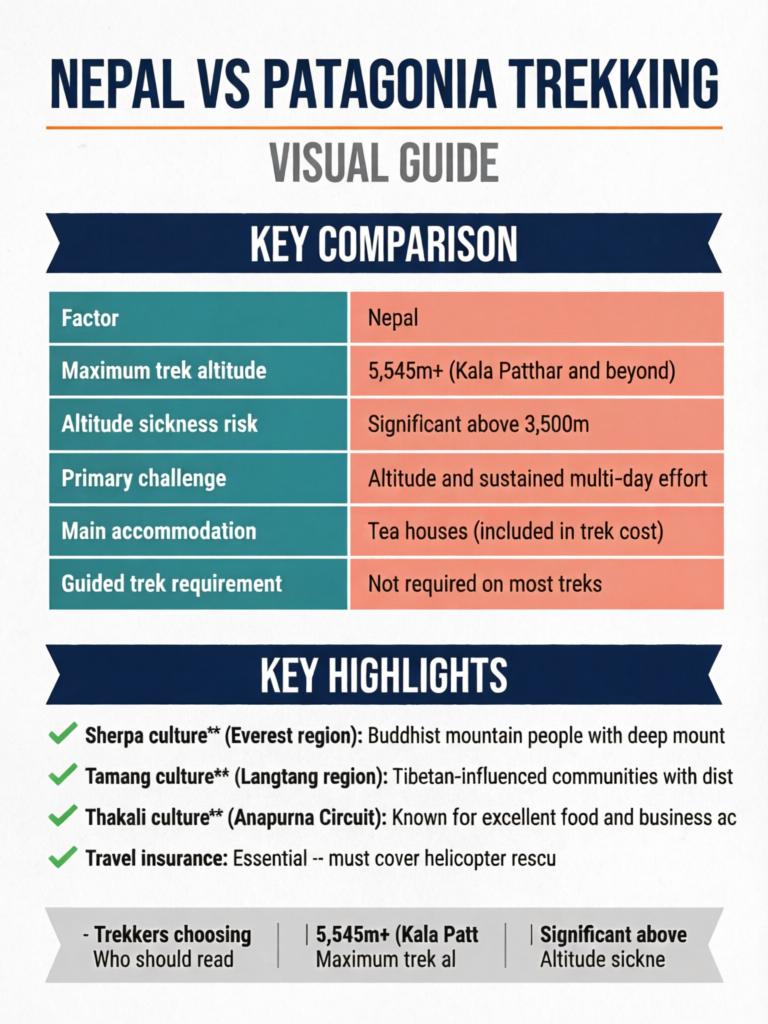
| Factor | Nepal | Patagonia | Advantage |
|---|---|---|---|
| Maximum trek altitude | 5,545m+ (Kala Patthar and beyond) | 1,200m (rarely above) | Depends on preference |
| Altitude sickness risk | Significant above 3,500m | None | Patagonia |
| Primary challenge | Altitude and sustained multi-day effort | Wind, weather changeability, and distance | Different challenges |
| Main accommodation | Tea houses (included in trek cost) | Refugios ($50-120/night) + camping | Nepal (more affordable) |
| Guided trek requirement | Not required on most treks | Not required on most treks | Tie |
| Daily on-trek cost | $30-80 | $50-150+ | Nepal |
| International flight cost | $600-1,200 (US/Europe) | $800-1,800 (US/Europe) | Nepal (generally cheaper) |
| Best season | Oct-Nov, Mar-May (Northern Hemisphere) | Nov-Mar (Southern Hemisphere summer) | Complementary |
| Trek duration (major routes) | 7-21 days | 4-10 days | Patagonia (shorter options) |
| Mountain scenery type | Massive 7,000-8,000m snow-covered peaks | Dramatic granite spires, glaciers, ice fields | Both extraordinary |
| Cultural experience | Rich -- Sherpa, Gurung, Tamang communities | Limited -- small ranching communities | Nepal |
| Wildlife | Limited large wildlife on popular trails | Guanacos, condors, foxes, pumas (rare) | Patagonia |
| Wilderness feeling | Moderate on popular routes, high on remote routes | High on most routes | Patagonia |
| Infrastructure maturity | Decades-established tea house system | Mix of developed and wild | Nepal (for tea house treks) |
| Permits cost | $30-300 depending on route | $0-40 (national park fees) | Patagonia |
| Language barrier | Moderate (English widely spoken on trails) | Moderate-High (Spanish dominant outside tourist areas) | Nepal |
| Visa requirements | Visa on arrival ($30-50) | No visa for most (90-day free entry) | Patagonia |
| Travel insurance need | Essential (altitude, helicopter rescue) | Recommended (weather, evacuation) | Both essential |
| Physical fitness required | Moderate to high (altitude compounds effort) | Moderate to high (wind, terrain, distance) | Similar |
| Trekking pole usefulness | High (altitude, descents) | High (wind balance, river crossings) | Both essential |
| Connectivity on trail | WiFi at most tea houses ($2-5/day) | Limited to no connectivity on most trails | Nepal |
| Food on trek | Tea house meals ($5-15 each) | Self-carried or refugio meals ($20-40 each) | Nepal (more convenient and cheaper) |
The Mountains: Himalayan Giants vs Patagonian Spires
Nepal: The Roof of the World
Nepal contains eight of the world's fourteen 8,000-meter peaks. The mountain scenery here is defined by sheer scale -- massive snow and ice-covered peaks that rise to nearly 9,000 meters above sea level, dwarfing everything around them.
What Himalayan mountains look like from the trail:
- Enormous walls of snow and ice that stretch across the entire horizon
- Mountains so high they create their own weather systems, with plumes of snow streaming from summits
- Glacial valleys flanked by peaks that tower 3,000-4,000 meters above you
- Sunrise and sunset colors that transform white peaks into gold, pink, and purple
- Individual peaks that would be the tallest in any other mountain range relegated to "minor" status
Nepal's most famous trekking views:
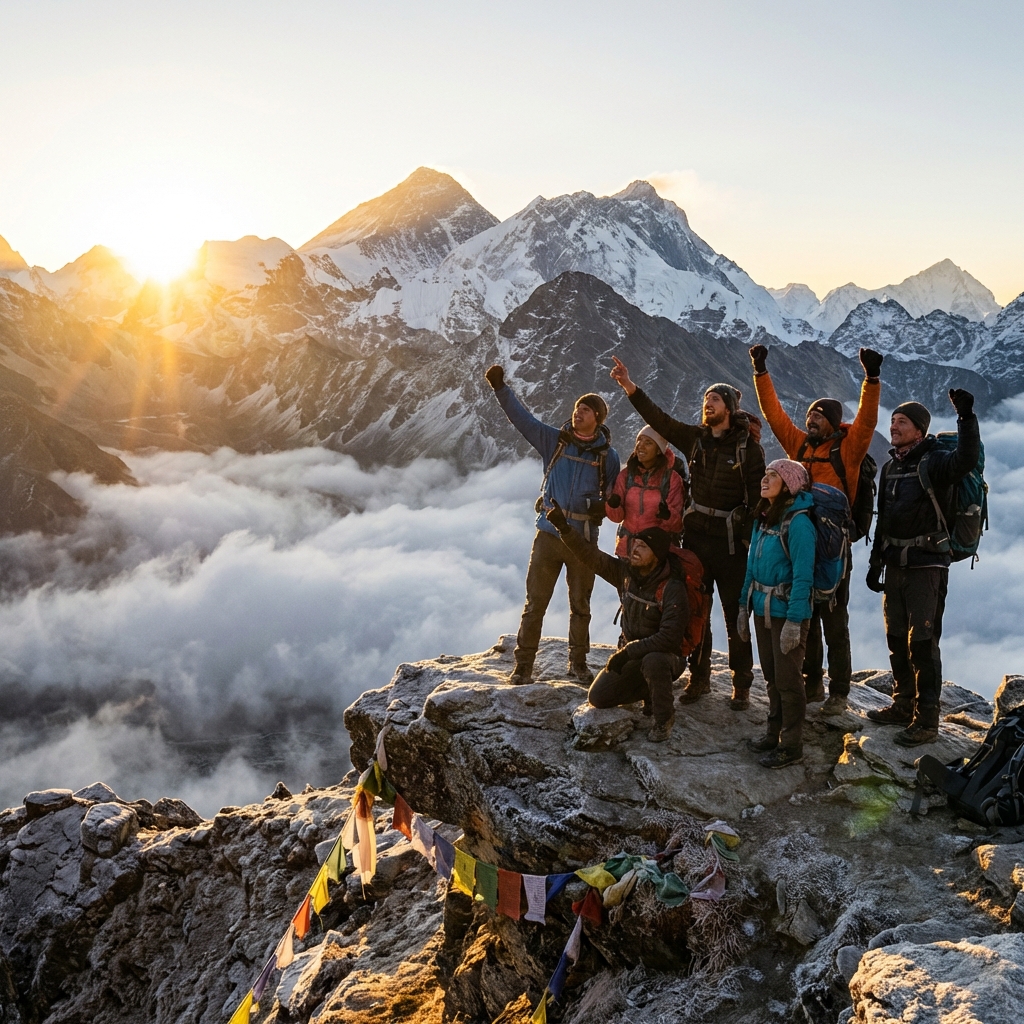
- Everest, Lhotse, and Nuptse from Kala Patthar (5,545m)
- The Annapurna Sanctuary amphitheater from ABC (4,130m)
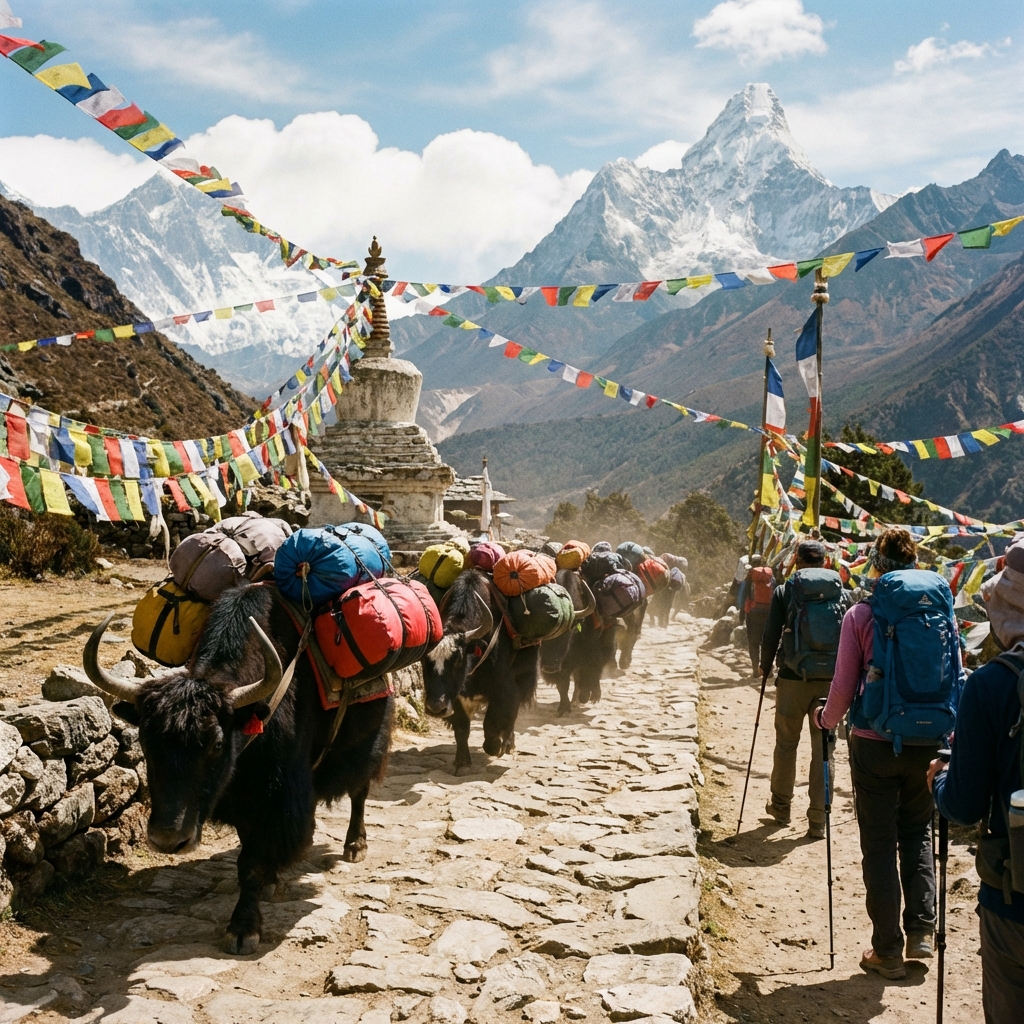
- Ama Dablam from the trail below Tengboche
- Machapuchare from Poon Hill or Mardi Himal
- Dhaulagiri and Annapurna from Poon Hill
- Manaslu from Samagaon on the Manaslu Circuit
Patagonia: Dramatic Geology
Patagonia's mountains are geologically different from the Himalayas -- younger granite formations shaped by glacial erosion into dramatic spires, horns, and towers. They are lower in absolute altitude but visually dramatic in ways that Himalayan peaks are not.
What Patagonian mountains look like from the trail:
- Vertical granite towers rising abruptly from ice fields and glacial lakes
- Brilliant turquoise lakes reflecting jagged peaks
- Massive glaciers -- Perito Moreno, Grey Glacier -- that you can approach closely on foot
- Constantly changing cloud formations wrapping and unwrapping peaks throughout the day
- An interplay of rock, ice, water, and wind that creates an endlessly dynamic landscape
Patagonia's most famous trekking views:
- Torres del Paine towers reflected in Lago Torres at sunrise
- Mount Fitz Roy and Cerro Torre from Laguna de los Tres
- The Grey Glacier from the Torres del Paine W trek
- Perito Moreno Glacier from various viewpoints near El Calafate
- The Cerro Torre range from the trail to Laguna Torre
The honest comparison: Nepal's mountains are bigger, higher, and more numerous. Patagonia's mountains are more visually dramatic in terms of shape and geological character. Nepal overwhelms with scale; Patagonia astounds with form. Both are among the finest mountain scenery on Earth.
Pro Tip
Infrastructure and Accommodation: Tea Houses vs Refugios vs Camping
This is one of the most significant practical differences between the two destinations.
Nepal: The Tea House System
Nepal's tea house system is unique in the world of mountain trekking. Along all major routes, privately operated mountain lodges ("tea houses") provide food and accommodation at regular intervals -- typically every 1-3 hours of walking. This system means:
- No tent needed on popular routes (EBC, ABC, Annapurna Circuit, Langtang, etc.)
- No cooking equipment required -- tea houses serve meals from extensive menus
- Warm common rooms with wood or yak-dung stoves for socializing
- Private rooms with twin beds and blankets at most tea houses
- Basic but adequate facilities -- toilets, sometimes hot showers, often WiFi and charging
The tea house system makes Nepal trekking remarkably accessible. You walk with a light daypack (or hire a porter), eat hot meals prepared for you, and sleep in a bed. The "roughing it" element is mild compared to backcountry camping.
Cost: $3-10 per night for a room (often free if you eat meals at the tea house). Meals: $5-15 each.
Patagonia: Refugios and Camping
Patagonia offers a mix of accommodation options:
Refugios (Mountain Huts):
- Found along the W Trek and O Circuit in Torres del Paine
- Dormitory-style accommodation with bunk beds, meals, and hot showers
- Significantly more expensive than Nepal's tea houses: $50-120 per person per night with meals
- Must be booked months in advance for peak season (December-February)
- Comfortable but not cheap
Camping:
- Free and paid campsites along major routes
- Requires carrying a tent, sleeping bag, and often cooking equipment
- Adds significant weight to your pack (7-12 kg of gear)
- Some camps are free (basic, minimal facilities); others charge $10-30/night
- Wild camping is restricted in Torres del Paine but permitted in some Argentine parks
Self-sufficiency requirement: Unlike Nepal, Patagonia trekking often requires carrying your own food and cooking equipment, especially on longer routes or the O Circuit. This means heavier packs and more logistics planning.
The Weight Factor
A typical pack weight for Nepal tea house trekking (daypack, warm clothes, personal items) is 5-8 kg. A typical pack weight for Patagonia camping trekking (tent, sleeping bag, food, cooking gear, clothes) is 15-20 kg. This difference fundamentally changes the trekking experience -- Nepal's lighter loads allow longer daily distances and less physical strain, while Patagonia's heavier packs make each day more demanding. Many trekkers who do both destinations are surprised by how much more tiring Patagonia camping feels, despite the much lower altitude.
Cost Comparison: The Complete Financial Picture
Getting There
| Cost Category | Nepal | Patagonia |
|---|---|---|
| Flight from US (round trip) | $700-1,200 | $900-1,800 |
| Flight from Europe (round trip) | $600-1,000 | $800-1,500 |
| Flight from Australia (round trip) | $600-900 | $1,200-2,000 |
| Visa cost | $30-50 (visa on arrival) | Free (most nationalities, Chile/Argentina) |
| Domestic flights to trek area | $0-400 (Lukla flight for Everest region) | $215-400 (flights within Chile/Argentina) |
On-Trek Costs
| Cost Category | Nepal (per day) | Patagonia (per day) |
|---|---|---|
| Tea house/refugio accommodation | $3-10 | $50-120 (refugio) or $10-30 (paid camping) or $0 (free camping) |
| Meals (three per day) | $15-35 | $30-60 (refugio) or $10-20 (self-catered) |
| Permits | $3-20 per day (varies by trek) | $3-5 per day (park fees spread over trek duration) |
| Guide (if hired) | $25-35 per day | $100-200+ per day |
| Porter | $20-25 per day | Not commonly available |
Total Trip Cost Estimates (Including Flights from US)
| Budget Level | Nepal (14-day EBC trek) | Patagonia (7-day W Trek) |
|---|---|---|
| Budget | $2,000-2,800 | $2,500-3,500 |
| Mid-range | $2,800-4,000 | $3,500-5,000 |
| Comfortable | $3,500-5,500 | $4,500-7,000 |
| Luxury | $5,000-10,000+ | $6,000-12,000+ |
Key cost insight: Nepal offers dramatically better value for the on-trek experience. A day of tea house trekking in Nepal costs $30-80, while a day of refugio trekking in Patagonia costs $80-180. The gap narrows if you camp in Patagonia, but then you carry more weight and have less comfort. Nepal's tea house system is one of the best-value adventure travel experiences in the world.
Pro Tip
Altitude vs Wind: Two Different Challenges
Nepal: The Altitude Equation
Nepal's defining trekking challenge is altitude. All major treks climb above 3,500m, where the reduced oxygen pressure begins affecting the body. The top treks reach 4,000-5,500m, where:
- The air contains 50-65% of sea-level oxygen
- Physical exertion feels dramatically harder
- Acute Mountain Sickness (AMS) affects 30-50% of trekkers to some degree
- Acclimatization days are essential (adding 2-4 days to itineraries)
- Serious altitude illness (HAPE, HACE) is a real risk requiring awareness and sometimes evacuation
- Diamox may be recommended as a preventive medication
Altitude turns an otherwise moderate walk into a genuine physical challenge. Steps that would be easy at sea level become exhausting at 5,000m. Sleep quality decreases, appetite drops, and headaches are common. For many trekkers, managing altitude is the central challenge of a Nepal trek.
Patagonia: The Wind Equation
Patagonia's defining challenge is wind. The region sits in the path of the roaring forties and furious fifties -- latitudinal bands of persistent westerly winds that create some of the strongest sustained winds on any trekking trail in the world.
- Wind speeds of 60-100 km/h are common and can gust much higher
- Wind can knock trekkers off their feet on exposed ridges
- Setting up tents in Patagonian wind is a skill in itself
- Wind drives rapid weather changes -- four seasons in one day is a local cliché
- Wind chill can drop effective temperatures dramatically even in summer
- Dust and grit carried by wind can be uncomfortable
Unlike altitude, wind cannot be acclimatized to. You simply deal with it through proper gear, good camp selection, and patience. Many trekkers find Patagonian wind more mentally challenging than physically dangerous -- it is relentless, and it can make otherwise beautiful days feel arduous.
Nepal Altitude Sickness Warning
Altitude sickness is the single most serious health risk in Nepal trekking and has no equivalent in Patagonia. If you have never been above 3,500m, research altitude sickness symptoms before traveling to Nepal. Know the signs of AMS (headache, nausea, dizziness, loss of appetite), and understand that the only reliable treatment for worsening symptoms is descent. Travel insurance with helicopter evacuation coverage is essential for Nepal treks above 3,500m. Read our comprehensive altitude sickness guide before your trek.
Best Treks in Each Destination
Nepal's Top Treks
| Trek | Duration | Max Altitude | Difficulty | Cost |
|---|---|---|---|---|
| Everest Base Camp | 12-16 days | 5,545m | Moderate-Challenging | $1,500-3,500 |
| Annapurna Circuit | 12-21 days | 5,416m | Moderate-Challenging | $800-2,500 |
| Annapurna Base Camp | 7-12 days | 4,130m | Moderate | $600-1,800 |
| Langtang Valley | 7-12 days | 5,033m | Moderate | $500-1,500 |
| Manaslu Circuit | 14-18 days | 5,160m | Challenging | $1,500-3,500 |
| Poon Hill | 3-5 days | 3,210m | Easy | $250-600 |
| Mardi Himal | 5-7 days | 4,500m | Moderate | $350-800 |
| Upper Mustang | 10-14 days | 3,810m | Moderate | $2,000-4,000 |
Patagonia's Top Treks
| Trek | Duration | Max Altitude | Difficulty | Cost (on-trek) |
|---|---|---|---|---|
| Torres del Paine W Trek (Chile) | 4-5 days | 850m | Moderate | $400-1,200 |
| Torres del Paine O Circuit (Chile) | 7-10 days | 1,200m | Challenging | $600-1,800 |
| Fitz Roy and Cerro Torre (Argentina) | 2-4 days | 1,200m | Moderate | $100-400 |
| Huemul Circuit (Argentina) | 4 days | 1,100m | Challenging | $200-500 |
| Dientes de Navarino (Chile) | 4-5 days | 900m | Challenging | $150-400 |
| Tierra del Fuego circuits | 3-7 days | 800m | Moderate-Challenging | $150-500 |
The Trek Duration Difference
Notice the fundamental difference: Nepal's major treks are 7-21 days. Patagonia's major treks are 2-10 days. This reflects both geography (Himalayan valleys are enormous) and infrastructure (tea houses allow longer treks without resupply). If you have limited vacation time, Patagonia's shorter treks may be more practical.
Season Comparison: Opposite Hemispheres
Nepal and Patagonia have complementary trekking seasons, making it possible to trek one in autumn and the other in spring.
Nepal Trekking Seasons
| Season | Months | Conditions | Rating |
|---|---|---|---|
| Autumn (best) | Oct-Nov | Clear skies, stable weather, cool-cold at altitude | Best |
| Spring | Mar-May | Warming, clear, rhododendron blooms, haze at lower altitude | Excellent |
| Winter | Dec-Feb | Cold, clear, few trekkers, some high passes blocked | Good (challenging at altitude) |
| Monsoon | Jun-Sep | Heavy rain, leeches, cloud, trail erosion | Not recommended |
Patagonia Trekking Seasons
| Season | Months | Conditions | Rating |
|---|---|---|---|
| Summer (best) | Dec-Feb | Longest daylight (17+ hrs), warmest, very windy, busiest | Best |
| Shoulder | Nov, Mar | Cooler, fewer people, still manageable conditions | Good |
| Autumn | Apr-May | Cooling, fall colors, shorter days, fewer trekkers | Fair |
| Winter | Jun-Aug | Snow, very cold, many trails closed or extremely challenging | Not recommended |
The seasonal synergy: Nepal's best season (October-November) coincides with Patagonia's spring/early summer. Conversely, Patagonia's best season (December-February) coincides with Nepal's winter. For dedicated trekkers, this means you could potentially trek Nepal in October and Patagonia in January within the same travel year, experiencing both destinations at their best.
Pro Tip
Cultural Experience Comparison
Nepal: Deep Cultural Immersion
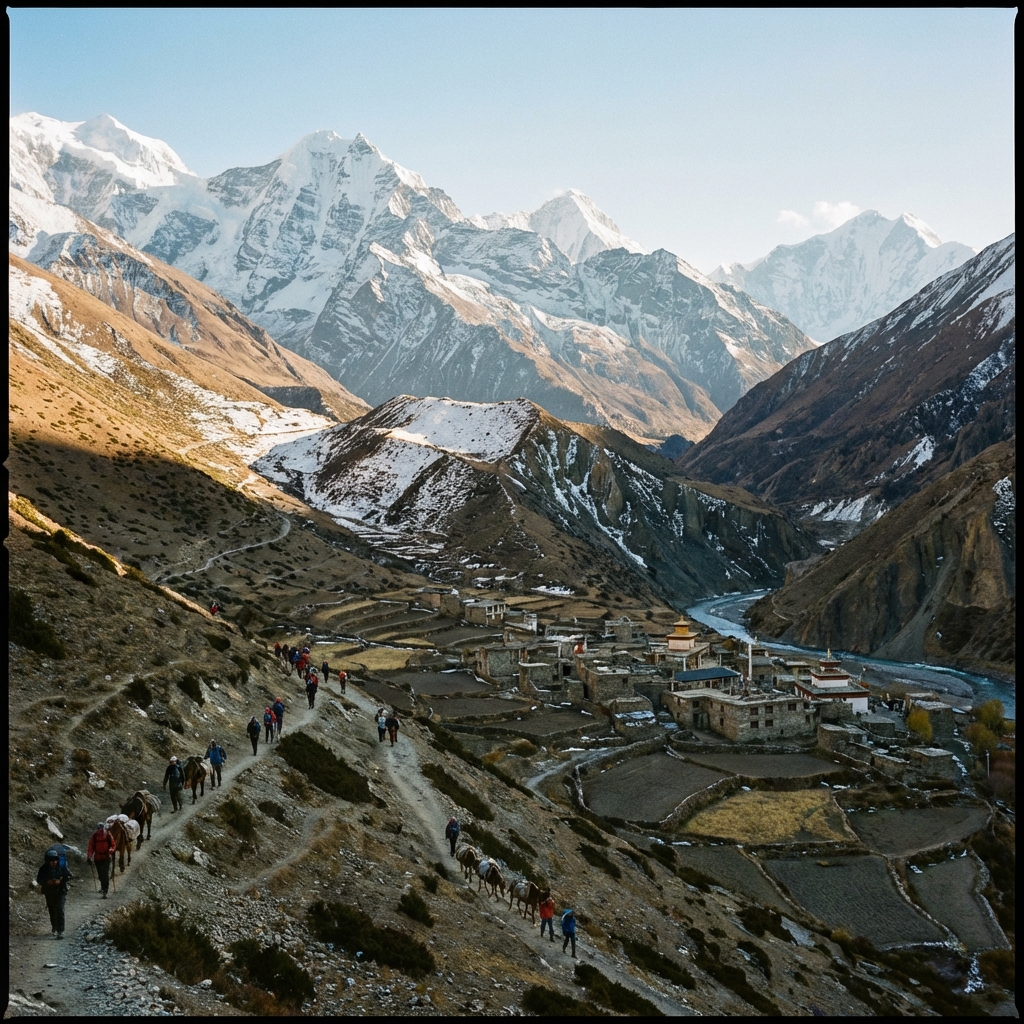
Nepal trekking is inseparable from cultural experience. Every major trek passes through villages where distinct ethnic communities live and work:
- Sherpa culture (Everest region): Buddhist mountain people with deep mountaineering heritage
- Gurung culture (Annapurna region): Warm hospitality, traditional stone villages, military service tradition
- Tamang culture (Langtang region): Tibetan-influenced communities with distinctive architecture
- Thakali culture (Annapurna Circuit): Known for excellent food and business acumen
Tea house stays naturally create cultural interactions. You eat meals prepared by local families, share stories around wood stoves, and observe daily village life. The cultural dimension adds richness that pure wilderness trekking cannot match.
Patagonia: Wilderness First, Culture Second
Patagonia's trekking culture is primarily about wilderness immersion. The region is sparsely populated, and the treks pass through largely uninhabited terrain. Cultural elements exist but are secondary:
- Estancia (ranch) culture: Some treks pass near working sheep ranches with gaucho heritage
- Indigenous Tehuelche and Mapuche heritage: Present in the region's history but less visible on trekking trails
- Mountain town culture: El Chalten, Puerto Natales, and Punta Arenas have their own character
- Refugio community: The mountain hut culture creates social gatherings among trekkers
The honest comparison: If cultural immersion is important to your trekking experience, Nepal is the clear winner. Patagonia excels at wilderness immersion and the feeling of walking through untouched landscapes. Both are valuable; they simply emphasize different dimensions of the adventure travel experience.
Visa and Travel Logistics
Nepal
- Visa: Required for most nationalities. Available on arrival at Kathmandu airport ($30 for 15 days, $50 for 30 days, $125 for 90 days)
- Getting there: International flights to Kathmandu (TIA). Major connections through Delhi, Doha, Bangkok, Kuala Lumpur
- In-country transport: Domestic flights (Lukla, Pokhara), buses, jeeps -- all very affordable
- Health requirements: No mandatory vaccinations for entry, but Hepatitis A, Typhoid, and Tetanus recommended
- Travel insurance: Essential -- must cover helicopter rescue above 3,500m
- Currency: Nepalese Rupee (NPR). ATMs available in Kathmandu, Pokhara, Namche Bazaar. Cash only on most trails
Patagonia (Chile and Argentina)
- Visa: Not required for most Western nationalities (90-day tourist entry)
- Getting there: Flights to Santiago (Chile) or Buenos Aires (Argentina), then domestic flights to Punta Arenas/Puerto Natales (Chile) or El Calafate (Argentina)
- In-country transport: Domestic flights ($100-400), long-distance buses ($30-100), shuttles
- Health requirements: No specific vaccinations required
- Travel insurance: Recommended -- should cover evacuation and weather-related delays
- Currency: Chilean Peso (CLP) or Argentine Peso (ARS). Credit cards widely accepted in refugios and towns. ATMs available in gateway towns
Combining Both Destinations
For trekkers with 4-6 weeks of travel time and flexible scheduling, a combined Nepal-Patagonia trip is possible within the same travel year. Trek Nepal in October-November, fly to South America in December-January for Patagonia. This "hemisphere hop" lets you experience both destinations at their best and is the ultimate trekking year for serious adventurers.
Which Destination Is Harder?
Nepal treks are harder due to altitude. Popular routes reach 4,000-5,500m where thin air creates altitude sickness risk. Patagonia treks stay below 1,200m but subject you to extreme wind (gusts of 100+ km/h). Nepal's challenge is physiological; Patagonia's is meteorological. If altitude concerns you, Patagonia is the safer bet. If wind and cold bother you more, Nepal's tea houses provide shelter. See our altitude sickness guide for Nepal preparation.
Which Destination Is Cheaper?
Nepal is significantly cheaper. Tea house trekking costs $30-80/day, while Patagonia's refugios and camping cost $50-150+/day. Nepal's tea house system eliminates the need for tents and cooking equipment. International flights to Kathmandu are often cheaper than flights to Patagonia's remote airports. A two-week Nepal trek costs $1,200-3,000 total versus $2,000-5,000+ for a comparable Patagonia trip. See our budget trekking guide for Nepal cost-saving strategies.
Which Has Better Mountain Views?
Both are world-class but completely different. Nepal offers the earth's highest peaks -- 8,000m Himalayan giants visible from trails at 3,000-5,500m, with multiple 8,000m peaks visible simultaneously. Patagonia offers dramatic granite spires (Torres del Paine, Fitz Roy) rising from near sea level, creating a vertical drama that is visually stunning despite lower absolute altitude. Nepal wins on scale; Patagonia wins on dramatic contrast. Check our Annapurna Circuit route and EBC route for Nepal's top treks.
Choose Nepal If...
- High-altitude Himalayan experience is your goal -- nothing in Patagonia exceeds 1,200m
- Budget is important -- Nepal offers far more trekking value per dollar
- You want longer treks (7-21 days) with built-in food and accommodation
- Cultural immersion through mountain communities enriches your trekking experience
- Tea house trekking appeals -- sleeping in beds and eating hot meals without carrying gear
- You want to see 8,000m peaks up close -- eight of the world's fourteen highest mountains are here
- Altitude challenge is part of the appeal -- testing yourself above 4,000-5,500m
- You want guide and porter support at very affordable rates
- You enjoy varied cuisine on trek -- Nepal's tea house menus offer diverse options
- You are planning a first major trek and want strong support infrastructure
- The names "Everest" and "Annapurna" carry deep personal significance
Choose Patagonia If...
- Altitude is a concern -- Patagonia's low altitude eliminates altitude sickness entirely
- Dramatic granite formations (towers, spires, horns) appeal more than massive snow peaks
- Glaciers at close range fascinate you -- Grey Glacier, Perito Moreno, and others are accessible
- Wilderness solitude is your priority -- parts of Patagonia feel truly untouched
- You prefer shorter treks (2-7 days) that can combine with other travel
- Self-sufficiency and camping are part of the adventure you seek
- Wildlife encounters matter -- guanacos, condors, and (rarely) pumas inhabit the region
- You are already in South America or have travel connections that make Patagonia cheaper to reach
- Wind and wild weather sound exhilarating rather than miserable
- Late December-February is your travel window (winter in Nepal, summer in Patagonia)
- You dislike the idea of trekking with hundreds of other people on the same trail (though Torres del Paine is also quite busy in peak season)
The Verdict: Our Recommendation
For first-time international trekkers: Nepal is the better first choice for most people. The tea house system eliminates the need for camping gear and cooking equipment, the guide and porter infrastructure provides safety and comfort at affordable rates, and the range of treks from easy (Poon Hill) to challenging (EBC) means there is a perfect option for every fitness level. Nepal is simply more accessible as a trekking destination, despite its higher altitude.
For experienced trekkers who have done Nepal: Patagonia is an outstanding next destination. The completely different geology, climate, and trekking style provides fresh challenges and perspectives. After years of tea house trekking, the self-sufficiency of Patagonia camping feels like a reset -- and the mountains are unlike anything in the Himalayas.
For trekkers who want the "best" overall: This is impossible to answer objectively. Nepal offers more variety, more cultural depth, better value, and the world's highest mountains. Patagonia offers more dramatic geology, better wildlife, no altitude concerns, and a fiercer wilderness atmosphere. They are complementary rather than competitive -- the ideal trekking life includes both.
Our practical recommendation: If you can only do one, do Nepal first. If you have done Nepal, do Patagonia next. If you have done both, go back to whichever called to you more strongly. And if you have the time and budget, plan a year that includes both -- Nepal in October, Patagonia in January. That is the trekking year of a lifetime.
Read our comprehensive Nepal trekking costs guide for detailed budgeting, and our best time to trek Nepal for seasonal planning.
Important Insurance Difference
Nepal trekking requires specialized travel insurance that covers helicopter rescue at altitude -- standard travel insurance usually excludes this. Patagonia trekking generally requires standard adventure travel insurance without altitude-specific coverage. Verify your policy covers the specific activities and altitudes planned before either trip. Read our travel insurance guide for Nepal-specific recommendations.
Frequently Asked Questions
Is Nepal or Patagonia harder to trek?
Neither is universally "harder" -- they present different challenges. Nepal's difficulty comes primarily from altitude: walking at 4,000-5,500m with reduced oxygen is physically demanding regardless of fitness level. Patagonia's difficulty comes from weather (extreme wind), self-sufficiency requirements (carrying heavy packs), and terrain. A fit sea-level hiker with no altitude experience may find Nepal harder due to altitude; an experienced altitude trekker may find Patagonia's wind and camping demands more challenging than expected.
Which destination is cheaper for trekking?
Nepal is significantly cheaper for the on-trek experience. Tea house accommodation costs $3-10/night versus Patagonia's refugio rates of $50-120/night. Meals in Nepal cost $5-15 versus $20-40 in Patagonia. Guides in Nepal cost $25-35/day versus $100-200+/day in Patagonia. International flights are generally comparable, though Nepal is often slightly cheaper from most origins. Overall, a 14-day Nepal trek typically costs $2,000-4,000 total, while a 7-day Patagonia trek costs $2,500-5,000 total.
Do I need camping gear for Nepal trekking?
For the vast majority of Nepal treks (EBC, ABC, Annapurna Circuit, Langtang, Poon Hill), no camping gear is needed. Tea houses provide accommodation and meals along all major routes. You need a sleeping bag for colder tea houses at altitude, but not a tent, stove, or cooking equipment. Some remote and off-beaten treks in Nepal require camping, but these are the exception rather than the rule.
Can I trek Patagonia without camping?
Yes, on the Torres del Paine W Trek, you can book refugios (mountain huts) at every overnight stop, eliminating the need for a tent. However, refugios are expensive ($50-120/night), must be booked months in advance for peak season, and have limited availability. The O Circuit requires camping on several sections where no refugios exist. The Fitz Roy area around El Chalten has free campgrounds but no refugio accommodation on the trail itself.
Which has better weather for trekking?
Nepal in October-November offers remarkably stable weather -- clear blue skies day after day, with occasional afternoon clouds. Patagonia in December-February has more variable weather with frequent wind and the possibility of four-season days. Nepal's weather predictability makes trip planning easier and photographic conditions more reliable. Patagonia's weather unpredictability means you may get spectacular conditions one moment and sideways rain the next.
Is altitude sickness a real problem in Nepal?
Yes. Altitude sickness affects 30-50% of trekkers to some degree above 3,500m. Symptoms range from mild (headache, fatigue) to severe (life-threatening pulmonary or cerebral edema). Proper acclimatization, adequate hydration, and willingness to descend if symptoms worsen are essential. This risk does not exist in Patagonia, where treks rarely exceed 1,200m. See our altitude sickness guide for comprehensive information.
Which destination has better wildlife?
Patagonia generally offers better wildlife viewing. Guanacos (wild relatives of llamas) are common, Andean condors soar overhead, foxes are frequently spotted, and pumas -- while rarely seen -- inhabit Torres del Paine and other parks. Nepal's popular trekking trails have less visible large wildlife due to higher human traffic, though Himalayan tahr, langur monkeys, and various bird species are present.
Can I combine a Nepal trek and a Patagonia trek in one trip?
Geographically, these destinations are on opposite sides of the world, so combining them requires two separate trips or a very long around-the-world itinerary. However, their complementary seasons make them perfect for a "trekking year": Nepal in October-November, Patagonia in January-February. Some tour companies offer combined packages for serious trekkers.
Which is better for a solo trekker?
Both destinations are solo-trekker friendly, but in different ways. Nepal's tea house system provides built-in social opportunities -- you eat and sleep alongside other trekkers, making it easy to meet people. Patagonia's camping-focused treks can be more solitary, though refugios and campground common areas provide social interaction. Nepal's affordable guide options also make solo trekking safer and more social. For more solo trekking advice, see our solo trekking Nepal guide.
How far in advance should I book?
Nepal: Tea houses generally do not require advance booking (except during peak October weeks). Flights to Lukla should be booked 1-2 months ahead. Agency treks and permits can usually be arranged in Kathmandu 1-2 days before departure. Patagonia: Refugios in Torres del Paine must be booked 3-6 months in advance for peak season. Campsite reservations are also required and fill up quickly. Hotels in El Chalten and Puerto Natales should be booked 1-2 months ahead for peak season.
Which is more physically demanding?
For raw physical exertion, Patagonia camping treks are often more demanding due to heavy packs (15-20 kg versus 5-8 kg in Nepal). For total body stress, Nepal treks are more demanding due to altitude effects -- walking at 5,000m with half the oxygen makes every step harder. The subjective experience depends on your personal fitness and altitude tolerance.
Are there beginner-friendly options in both destinations?
Yes. Nepal: Poon Hill trek (3-5 days, maximum 3,210m, well-marked trail, excellent tea houses) is ideal for beginners. Patagonia: Day hikes to Laguna de los Tres (Fitz Roy viewpoint) from El Chalten or the shorter variations of the W Trek provide accessible Patagonian experiences without multi-day commitment or full camping gear.
What languages are spoken on each trail?
Nepal: English is widely spoken by guides, tea house staff, and many trekkers. Nepali is the local language, with regional languages (Sherpa, Tamang, Gurung) in specific areas. Communication is rarely a problem for English-speaking trekkers. Patagonia: Spanish is the primary language. English is spoken in major tourist areas and refugios, but less so in smaller towns. Basic Spanish is helpful and appreciated. Park ranger communications are typically in Spanish.