
Manaslu Is Not a Budget Trek
Unlike Annapurna Base Camp or even the Annapurna Circuit, you cannot trek Manaslu on a shoestring. The restricted area permit costs $100 per week, a licensed guide is legally mandatory, and solo trekking is prohibited (minimum 2-person group). These non-negotiable requirements create a cost floor that exceeds many popular Nepal treks before you even account for food and accommodation. Plan your budget accordingly—Manaslu rewards preparation but punishes wishful thinking.
The Manaslu Circuit is one of Nepal's finest trekking experiences: remote Tibetan-influenced villages, the dramatic Larkya La pass crossing at 5,160m, and a fraction of the crowds found on the Everest and Annapurna trails. But this remoteness and restricted status come with a price tag that surprises many trekkers who assume all Nepal treks cost roughly the same.
Understanding why Manaslu costs more—and where exactly your money goes—transforms budget anxiety into informed planning. The restricted area permit ($100 per week, totaling $200 for most treks) and mandatory guide requirement (adding $350-700 to your costs) are the primary cost drivers. But beyond these fixed expenses, you still have meaningful choices about accommodation quality, food variety, transport comfort, and trek duration that can swing your total by $1,000 or more.
This comprehensive guide breaks down every cost category with verified 2026 pricing, compares budget/mid-range/premium options, shows how Manaslu compares to EBC and ABC costs, reveals hidden expenses most itineraries don't mention, and provides proven strategies to optimize value within Manaslu's mandatory requirements.
Table of Contents
- Quick Cost Summary
- Why Manaslu Costs More Than EBC and ABC
- Restricted Area Permit: The Big Mandatory Cost
- MCAP Fee and Other Permits
- Mandatory Guide Costs
- Porter Costs
- Transport: Kathmandu to Soti Khola and Back
- Accommodation Costs by Village
- Food Costs by Section
- Daily Expense Breakdown by Budget Level
- Total Budget: Budget, Mid-Range, and Premium
- Cost Comparison: Manaslu vs EBC vs ABC
- Hidden Costs Most Guides Don't Mention
- Money Management: No ATMs on Manaslu
- Tipping Guide for Manaslu
- Money-Saving Strategies
- Package vs Independent Cost Comparison
- Frequently Asked Questions
Quick Cost Summary
$1,900-2,300 per person
$2,400-3,200 per person
$3,200-4,500 per person
$4,500-7,000+ per person
$100/week ($200 for most treks)
$30 per person
$25-45/day
$30-50 (budget) to $80-120+ (premium)
$40-120 per person
2 people (solo not permitted)
Why Manaslu Costs More Than EBC and ABC
Before diving into detailed numbers, understanding the structural cost differences explains why Manaslu carries a premium over Nepal's most popular treks.
The Three Mandatory Cost Drivers
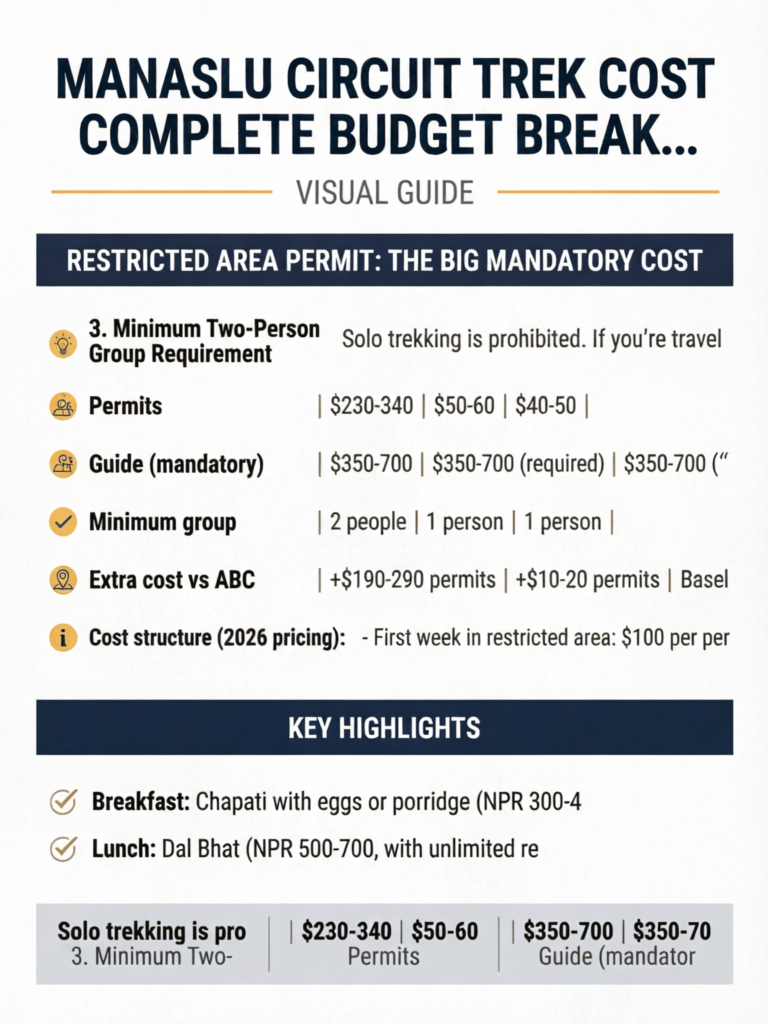
1. Restricted Area Permit (RAP): $200 for most treks
Manaslu is classified as a restricted trekking area due to its proximity to the Tibetan border and the government's desire to limit environmental and cultural impact on remote communities. Every trekker pays $100 per week in the restricted zone, and since most Manaslu Circuit treks spend 10-14 days in the restricted area, two weekly permits are required.
Comparison: EBC permits total approximately $50-60. ABC permits total approximately $40-50. The Manaslu RAP alone costs $200—roughly four times the EBC permit cost.
2. Mandatory Licensed Guide: $350-700
Unlike EBC (where guides are technically required since 2026 but enforcement varies) or ABC, Manaslu strictly enforces the guide requirement. You cannot enter the restricted area with a mandatory licensed guide registered through a TAAN-affiliated agency. This isn't negotiable, and checkpoints verify guide documentation.
3. Minimum Two-Person Group Requirement
Solo trekking is prohibited. If you're traveling alone, you must either pay for two permits ($400 total) or find a trek partner/join a group. This requirement makes solo budget trekking impossible on the Manaslu Circuit.
What These Requirements Add to Base Costs
| Cost Factor | Manaslu | EBC | ABC |
|---|---|---|---|
| Permits | $230-340 | $50-60 | $40-50 |
| Guide (mandatory) | $350-700 | $350-700 (required) | $350-700 (required) |
| Minimum group | 2 people | 1 person | 1 person |
| Extra cost vs ABC | +$190-290 permits | +$10-20 permits | Baseline |
The net result: before accounting for food, accommodation, or transport, Manaslu costs $190-$290 more than equivalent treks in permits alone. When you add the absolute guide requirement (with strict enforcement), Manaslu's cost floor is meaningfully higher.
Restricted Area Permit: The Big Mandatory Cost
How the RAP Works
The Restricted Area Permit is issued by Nepal's Department of Immigration through registered trekking agencies. Individual trekkers cannot apply directly.
Cost structure (2026 pricing):
- First week in restricted area: $100 per person
- Each additional week (or partial week): $100 per person
- No pro-rating for partial weeks—entering day 8 triggers the second weekly fee
The week counter starts at the first restricted area checkpoint, which is typically at Jagat (approximately day 2-3 from Soti Khola). It does not start from Kathmandu.
Typical permit costs by trek duration:
| Trek Style | Days in Restricted Area | RAP Cost |
|---|---|---|
| Fast 14-day trek | 10-11 days | $200 (2 weeks) |
| Standard 16-day trek | 12-13 days | $200 (2 weeks) |
| Relaxed 18-day trek | 14-15 days | $200-300 (2-3 weeks, depending on entry/exit timing) |
| Extended with Tsum Valley | 18-22 days | $300-400 (3-4 weeks) |
Required documents:
- Valid passport (6+ months validity beyond trek end date)
- Nepal visa (obtained at airport or embassy)
- 4 passport-size photos
- Completed application form (agency handles this)
- Detailed itinerary (prepared by agency)
Processing time: 2-3 business days in Kathmandu. Agencies typically handle this while you prepare in the city. Rush processing is sometimes possible for an additional fee.
Pro Tip
If your trek is going to span exactly 14 days in the restricted area, discuss the timing carefully with your agency. Entering the restricted zone one day later (day 3 from Soti Khola instead of day 2) might keep your restricted-area days within 14, avoiding a potential third weekly permit fee of $100. Experienced agencies optimize entry timing to save you money.
Season-Based Permit Pricing
Unlike Upper Mustang (where permit costs change between peak and off-peak seasons), the Manaslu RAP is a flat $100/week regardless of season. However, the Nepal government periodically reviews restricted area fees. The $100/week rate has been stable since 2023, but always confirm current pricing when booking.
MCAP Fee and Other Permits
Manaslu Conservation Area Permit (MCAP): $30
What it is: Conservation fee administered by the National Trust for Nature Conservation (NTNC). Revenue funds trail maintenance, community development, and environmental protection in the Manaslu Conservation Area.
Cost: $30 per person (flat fee regardless of trek duration)
Where obtained: NTNC office in Kathmandu or through your trekking agency. Most agencies handle this as part of permit processing.
TIMS Card: $10-20
What it is: Trekkers' Information Management System card. Provides trekker tracking data and emergency contact information.
Cost: $10 through an agency, $20 for FIT (Free Individual Trekker) processing
Note: Since the RAP already provides tracking through restricted area checkpoints, TIMS enforcement is less strict on Manaslu than on open routes. However, agencies typically process it as part of the standard permit package.
Total Mandatory Permit and Fee Costs
| Component | Cost Per Person |
|---|---|
| Restricted Area Permit (2 weeks) | $200 |
| MCAP | $30 |
| TIMS Card | $10-20 |
| Total | $240-250 |
For treks exceeding 14 days in the restricted area, add $100 per additional week.
Mandatory Guide Costs
Guide Pricing Tiers (2026)
Guides for Manaslu must be licensed and affiliated with a TAAN-registered agency. Here's what different guide levels cost:
Budget Guide: $25-30 per day
- TAAN-licensed, basic certification
- Typically 2-5 years guiding experience
- Adequate English for basic communication
- May lead groups of 4-6 trekkers
- Basic first aid training
Mid-Range Guide: $30-40 per day
- 5-10 years guiding experience
- Good English communication
- Wilderness first aid certified
- Leads groups of 2-4 trekkers
- Knowledgeable about local culture and history
- Emergency communication training
Premium Guide: $40-55 per day
- 10+ years experience, senior guide status
- Excellent English (sometimes additional languages)
- Wilderness first responder certification
- Private guide or maximum 2 trekkers
- Deep knowledge of Manaslu region ecology, culture, and history
- Satellite communication equipment
- May have summited peaks in the region
Guide Cost Calculation
| Guide Level | Daily Rate | 14-Day Trek | 16-Day Trek | 18-Day Trek |
|---|---|---|---|---|
| Budget | $25-30 | $350-420 | $400-480 | $450-540 |
| Mid-Range | $30-40 | $420-560 | $480-640 | $540-720 |
| Premium | $40-55 | $560-770 | $640-880 | $720-990 |
Important: Guide costs typically include the guide's own food and accommodation (paid by the agency). Your payment covers the guide's professional service, not their expenses.
Splitting Guide Costs
Since guides can lead multiple trekkers, sharing costs dramatically reduces per-person expense:
$25-$35 /day mid-range guide, 14-day trek ($490 total):
- Solo: $490 per person
- 2 trekkers: $245 per person
- 3 trekkers: $163 per person
- 4 trekkers: $123 per person
Guide Quality Matters More on Manaslu
On popular routes like EBC, the trail is so well-established that guide quality affects comfort more than safety. On Manaslu, your guide's experience directly impacts safety: the Larkya La crossing in poor weather requires route-finding expertise, river crossings change seasonally, and the remoteness means your guide is your primary emergency resource. Investing in a mid-range or premium guide on Manaslu delivers more tangible value than on easier routes.
Porter Costs
Are Porters Mandatory on Manaslu?
Porters are not legally required, but they are strongly recommended. Manaslu's terrain is more rugged and remote than EBC or ABC, with longer days, steeper sections, and limited access to resupply. Carrying a full pack over Larkya La (5,160m) in potentially harsh conditions adds significant physical strain to an already demanding day.
Porter Pricing (2026)
Standard Porter: $18-25 per day
- Carries up to 25-30kg (typically 2 trekkers' main bags)
- Basic English (or none—communication through guide)
- Food and accommodation typically provided by agency
Porter-Guide (Dual Role): $30-40 per day
- Carries your bag AND provides basic guiding
- Suitable for experienced trekkers who don't need a dedicated guide
- Not a substitute for the mandatory licensed guide on Manaslu—you still need a separate licensed guide
Porter Cost Calculation
| Porter Type | Daily Rate | 14-Day Trek | Per Person (2 sharing) |
|---|---|---|---|
| Standard | $18-25 | $252-350 | $126-175 |
| Porter-Guide | $30-40 | $420-560 | $210-280 |
Transport: Kathmandu to Soti Khola and Back
Getting to the Trailhead
The Manaslu Circuit begins at Soti Khola (730m), reached from Kathmandu via Arughat. The journey takes 7-10 hours depending on transport type and road conditions.
Route: Kathmandu → Dhading Besi → Arughat → Soti Khola
Transport options:
| Option | Cost (Per Person) | Duration | Comfort Level |
|---|---|---|---|
| Local bus to Arughat + jeep to Soti Khola | $15-25 | 9-12 hours | Basic (crowded, frequent stops) |
| Tourist bus/jeep | $30-45 | 7-10 hours | Moderate |
| Private jeep (shared 4-6 people) | $40-60 per person | 7-9 hours | Good |
| Private jeep (solo/couple) | $150-250 total | 7-9 hours | Excellent |
Road conditions warning: The road from Arughat to Soti Khola is unpaved, rough, and subject to landslides during and after monsoon season. Even "private jeep" transport involves jarring, dusty conditions on this final section. During heavy rain, the road may be impassable, requiring walking the final section.
Return Transport
The trek typically ends at Dharapani, which connects to the Annapurna Circuit road network leading to Besisahar and then Kathmandu.
Route: Dharapani → Besisahar → Kathmandu
| Option | Cost (Per Person) | Duration |
|---|---|---|
| Local bus | $10-15 | 8-10 hours |
| Tourist bus | $20-30 | 7-9 hours |
| Private jeep (shared) | $30-50 per person | 6-8 hours |
Total Transport Costs
| Budget Level | Outbound | Return | Total |
|---|---|---|---|
| Budget | $20 | $12 | $32 |
| Mid-Range | $40 | $25 | $65 |
| Premium | $60 | $40 | $100 |
| Private (couple) | $80-125 each | $50-75 each | $130-200 each |
Accommodation Costs by Village
Manaslu tea houses are generally more basic than those on the EBC or Annapurna Circuit, reflecting lower trekker traffic and more remote logistics. Accommodation quality and pricing vary significantly by altitude and village size.
Accommodation Prices by Section
| Village/Section | Altitude | Basic Room | Better Room |
|---|---|---|---|
| Soti Khola | 730m | NPR 200-400 ($1.50-$3) | NPR 500-800 ($3.70-$6) |
| Machha Khola | 930m | NPR 200-400 ($1.50-$3) | NPR 500-800 ($3.70-$6) |
| Jagat | 1,340m | NPR 300-500 ($2.20-$3.70) | NPR 600-1,000 ($4.40-$7.40) |
| Deng | 1,860m | NPR 300-500 ($2.20-$3.70) | NPR 600-1,000 ($4.40-$7.40) |
| Namrung | 2,660m | NPR 400-700 ($3-$5.20) | NPR 800-1,200 ($6-$9) |
| Lho | 3,180m | NPR 500-800 ($3.70-$6) | NPR 1,000-1,500 ($7.40-$11) |
| Samagaon | 3,530m | NPR 500-1,000 ($3.70-$7.40) | NPR 1,000-1,800 ($7.40-$13) |
| Samdo | 3,860m | NPR 600-1,000 ($4.40-$7.40) | NPR 1,000-1,500 ($7.40-$11) |
| Dharamsala/Larkya Phedi | 4,460m | NPR 800-1,500 ($6-$11) | NPR 1,500-2,000 ($11-$15) |
| Bimthang | 3,720m | NPR 500-800 ($3.70-$6) | NPR 1,000-1,500 ($7.40-$11) |
| Tilije | 2,300m | NPR 300-500 ($2.20-$3.70) | NPR 600-1,000 ($4.40-$7.40) |
| Dharapani | 1,860m | NPR 300-500 ($2.20-$3.70) | NPR 500-800 ($3.70-$6) |
What to Expect from Manaslu Accommodation
Basic rooms (NPR 200-800):
- Thin plywood walls, basic bed with mattress
- Shared squat toilet (sometimes outside)
- No heating
- Limited or no electricity
- Cold water only (hot water costs extra)
Better rooms (NPR 800-2,000):
- Slightly thicker walls, better mattress
- Shared western toilet (sometimes)
- Solar electricity for lighting (not guaranteed)
- Hot water available (paid)
- WiFi may be available at select lodges (paid, slow)
Key differences from EBC/ABC lodges:
- Fewer choices per village (often 2-4 lodges vs 5-10 on EBC)
- Lower overall quality at equivalent altitudes
- Less competition means less incentive to upgrade facilities
- Higher-altitude lodges may be very basic (Dharamsala is essentially a dormitory-only stop)
Total Accommodation Cost Estimate (14 nights)
| Budget Level | Average Per Night | Total |
|---|---|---|
| Budget | NPR 400-600 ($3-4.50) | NPR 5,600-8,400 ($42-62) |
| Mid-Range | NPR 700-1,000 ($5-7.50) | NPR 9,800-14,000 ($73-104) |
| Premium | NPR 1,000-1,500 ($7.50-11) | NPR 14,000-21,000 ($104-156) |
Food Costs by Section
Food on the Manaslu Circuit follows the universal Nepal trekking pattern: prices increase with altitude because everything must be carried further from road access.
Food Prices by Altitude Zone
Lower Section (700-2,000m):
| Item | Price (NPR) | Price (USD) |
|---|---|---|
| Dal Bhat | 400-550 | $3.00-4.10 |
| Fried Rice/Noodles | 350-450 | $2.60-3.30 |
| Eggs (2) | 200-300 | $1.50-2.20 |
| Tea | 50-80 | $0.40-0.60 |
| Coffee | 80-120 | $0.60-0.90 |
| Bottled Water (1L) | 80-120 | $0.60-0.90 |
Middle Section (2,000-3,500m):
| Item | Price (NPR) | Price (USD) |
|---|---|---|
| Dal Bhat | 550-750 | $4.10-5.60 |
| Fried Rice/Noodles | 450-600 | $3.30-4.40 |
| Eggs (2) | 300-400 | $2.20-3.00 |
| Tea | 80-150 | $0.60-1.10 |
| Coffee | 120-200 | $0.90-1.50 |
| Bottled Water (1L) | 120-200 | $0.90-1.50 |
High Section (3,500-4,500m+):
| Item | Price (NPR) | Price (USD) |
|---|---|---|
| Dal Bhat | 750-1,000 | $5.60-7.40 |
| Fried Rice/Noodles | 600-850 | $4.40-6.30 |
| Eggs (2) | 400-500 | $3.00-3.70 |
| Tea | 150-250 | $1.10-1.85 |
| Coffee | 200-350 | $1.50-2.60 |
| Bottled Water (1L) | 200-400 | $1.50-3.00 |
| Chocolate Bar | 250-450 | $1.85-3.30 |
| Coca-Cola/Beer | 500-800 | $3.70-6.00 |
Daily Food Budget Estimates
Budget eating ($20-28/day):
- Breakfast: Chapati with eggs or porridge (NPR 300-400)
- Lunch: Dal Bhat (NPR 500-700, with unlimited refills)
- Dinner: Dal Bhat again (NPR 500-700)
- Tea: 3-4 cups (NPR 200-400)
- Total: NPR 1,500-2,200 per day
Standard eating ($28-40/day):
- Breakfast: Pancakes, eggs, and tea (NPR 400-600)
- Lunch: Dal Bhat or fried noodles (NPR 550-750)
- Dinner: Mixed menu—soup, main course, dessert (NPR 800-1,200)
- Snacks and drinks: (NPR 300-500)
- Total: NPR 2,050-3,050 per day
Comfortable eating ($40-55/day):
- Breakfast: Full breakfast with multiple items (NPR 600-900)
- Lunch: Choice of menu (NPR 700-1,000)
- Dinner: Best available—multiple courses (NPR 1,000-1,500)
- Snacks, treats, extra drinks: (NPR 500-800)
- Total: NPR 2,800-4,200 per day
Total Food Cost Estimate (14 days)
| Level | Daily Average | 14-Day Total (NPR) | 14-Day Total (USD) |
|---|---|---|---|
| Budget | NPR 1,800 | NPR 25,200 | $187 |
| Standard | NPR 2,500 | NPR 35,000 | $259 |
| Comfortable | NPR 3,500 | NPR 49,000 | $363 |
Pro Tip
Dal Bhat is your best value meal on the Manaslu Circuit—and every other Nepal trek. It's the most filling option (rice, lentil soup, vegetable curry, and usually pickles), comes with unlimited refills at most tea houses, and typically costs less than fried dishes. Eating Dal Bhat for both lunch and dinner saves NPR 200-400 per day compared to ordering fried rice or noodles, which adds up to NPR 2,800-5,600 ($20-41) over a 14-day trek.
Daily Expense Breakdown by Budget Level
Budget Level: $30-40 per day on trail
| Expense | Daily Cost (NPR) | Daily Cost (USD) |
|---|---|---|
| Accommodation | 400-600 | $3-4.50 |
| Food (3 meals + tea) | 1,500-2,200 | $11-16 |
| Water purification (tablets/SteriPen) | 50-100 | $0.40-0.75 |
| Hot shower (every 3-4 days) | 75-150 average | $0.55-1.10 |
| Phone charging (every 2-3 days) | 50-100 average | $0.40-0.75 |
| Misc (snacks, tips to kitchen staff) | 200-300 | $1.50-2.20 |
| Daily Total | NPR 2,275-3,450 | $17-26 |
Note: Guide and permit costs are pre-paid and not included in daily on-trail spending.
Mid-Range Level: $40-60 per day on trail
| Expense | Daily Cost (NPR) | Daily Cost (USD) |
|---|---|---|
| Accommodation | 700-1,000 | $5-7.50 |
| Food (3 meals + snacks + drinks) | 2,500-3,500 | $19-26 |
| Bottled water or purification | 100-200 | $0.75-1.50 |
| Hot shower (every 2 days) | 150-250 average | $1.10-1.85 |
| Phone charging | 100-150 | $0.75-1.10 |
| WiFi (when available) | 100-200 | $0.75-1.50 |
| Snacks and treats | 200-400 | $1.50-3.00 |
| Daily Total | NPR 3,850-5,700 | $29-42 |
Premium Level: $60-90+ per day on trail
| Expense | Daily Cost (NPR) | Daily Cost (USD) |
|---|---|---|
| Accommodation (best available) | 1,000-1,800 | $7.50-13 |
| Food (full menu freedom) | 3,500-5,000 | $26-37 |
| Bottled water | 200-400 | $1.50-3.00 |
| Hot shower (daily where available) | 300-500 | $2.20-3.70 |
| Phone charging | 200-300 | $1.50-2.20 |
| WiFi | 200-400 | $1.50-3.00 |
| Beer/treats/extras | 500-1,000 | $3.70-7.40 |
| Daily Total | NPR 5,900-9,400 | $44-70 |
Total Budget: Budget, Mid-Range, and Premium
Budget Total: $1,900-2,300 (14-day trek, group of 2-3)
| Category | Cost Per Person |
|---|---|
| Restricted Area Permit (2 weeks) | $200 |
| MCAP + TIMS | $40 |
| Guide (shared, 14 days @ $28/day average, split 3 ways) | $130 |
| Porter (shared, 14 days @ $22/day, split 2 ways) | $154 |
| Transport (local bus/jeep) | $35 |
| Accommodation (14 nights) | $45-65 |
| Food (14 days) | $190-230 |
| Extras (showers, charging, snacks) | $50-80 |
| Tips (guide + porter, shared) | $120-170 |
| Kathmandu hotel (2 nights) | $30-50 |
| Contingency (10%) | $100-120 |
| Total | $1,094-$1,319 |
Wait—that's below $1,900? Yes, because the minimum realistic budget also includes:
- International flights to Kathmandu (not trek-specific)
- Travel insurance ($80-$150, mandatory)
- Gear (if not already owned)
- Visa ($30-$50)
- Kathmandu meals and expenses ($50-$100)
- Agency service fee ($300-$600 markup over component costs)
With agency package (budget tier): $1,500-$1,800 package + $300-$500 extras/tips = $1,900-$2,300 total Nepal trek cost
Mid-Range Total: $2,400-3,200 (16-day trek, group of 2)
| Category | Cost Per Person |
|---|---|
| Agency package (permits, guide, porter, transport, accommodation, meals) | $1,800-2,400 |
| Extras on trail (showers, WiFi, charging, snacks, drinks) | $150-250 |
| Tips (guide + porter) | $200-300 |
| Kathmandu hotel (2-3 nights, mid-range) | $80-150 |
| Kathmandu meals and expenses | $50-100 |
| Travel insurance | $100-150 |
| Total | $2,380-$3,350 |
Premium Total: $3,200-4,500 (16-18 days, private or couple)
| Category | Cost Per Person |
|---|---|
| Agency package (all-inclusive premium) | $2,500-3,500 |
| Extras on trail | $200-350 |
| Tips (guide + porter, generous) | $300-450 |
| Kathmandu hotel (3 nights, 4-star) | $150-300 |
| Kathmandu dining and activities | $100-200 |
| Travel insurance (comprehensive) | $150-250 |
| Total | $3,400-$5,050 |
Luxury Total: $4,500-7,000+ (18-21 days with Tsum Valley)
For trekkers adding the Tsum Valley extension and wanting the highest service level:
- Premium agency all-inclusive package with Tsum Valley: $3,500-$5,000
- Additional RAP fees for extended duration: $100-200
- Premium tips and extras: $500-800
- Luxury Kathmandu arrangements: $300-500
- Total: $4,400-$6,500+
Cost Comparison: Manaslu vs EBC vs ABC
Side-by-Side Comparison (Mid-Range, Per Person)
| Cost Category | Manaslu Circuit (16 days) | EBC (14 days) | ABC (10 days) |
|---|---|---|---|
| Permits | $240 | $55 | $45 |
| Guide (mandatory, shared) | $250 | $250 | $200 |
| Porter (shared) | $175 | $175 | $125 |
| Transport to/from trail | $65 | $380 (Lukla flights) | $215 |
| Accommodation | $80-105 | $215-175 | $60-85 |
| Food | $260-370 | $350-490 | $200-300 |
| Extras | $150-250 | $150-250 | $100-175 |
| Tips | $200-300 | $200-300 | $150-250 |
| Insurance | $120 | $120 | $100 |
| Kathmandu/Pokhara hotel | $100 | $100 | $80 |
| Total | $1,640-$1,935 | $1,900-$2,295 | $1,090-$1,310 |
| Typical agency package total | $2,400-3,200 | $2,000-2,800 | $1,200-2,000 |
Key Takeaways from Comparison
Manaslu vs EBC: Total costs are actually comparable for mid-range packages. Manaslu has higher permit costs ($240 vs $55) but dramatically lower transport costs ($65 vs $380 for Lukla flights). Food and accommodation are slightly cheaper on Manaslu due to lower altitude-driven pricing. The net difference between mid-range Manaslu and EBC packages is typically only $200-$400.
Manaslu vs ABC: Manaslu costs roughly $1,000-$1,400 more than ABC for a mid-range experience. The primary drivers are: longer trek duration (16 vs 10 days), higher permit costs ($240 vs $45), and more trail days of food and accommodation. ABC is Nepal's most cost-effective major trek.
The Lukla flight factor: EBC's single largest cost component is the Lukla flight ($215-$400 round trip). Manaslu avoids this entirely, which partially offsets the higher permit costs.
Pro Tip
If you're choosing between Manaslu and EBC purely on cost, they're closer than most people assume. Manaslu's permits are more expensive, but EBC's Lukla flights largely neutralize that difference. The real cost difference is in daily spending—EBC's Namche-to-Gorak-Shep corridor is more expensive for food and accommodation than Manaslu's equivalent section. For trekkers on a fixed budget, the experience-per-dollar ratio on Manaslu is arguably higher because you get a longer, more remote, and less crowded trek for a similar total cost.
Hidden Costs Most Guides Don't Mention
1. Hot Showers: $2-$5 Each
Hot showers cost NPR 300-700 per shower, depending on altitude and heating method (solar vs gas). Over a 14-day trek with showers every 2-3 days, budget NPR 1,500-3,500 ($11-26).
2. Phone and Device Charging: $1.50-$5 Per Charge
Every charge from tea house solar panels or generators costs NPR 200-700. If you're charging a phone and power bank daily, that's NPR 400-1,000+ per day at higher altitudes. Budget NPR 3,000-7,000 ($22-52) for the full trek.
3. WiFi: $2-$8 Per Day (Where Available)
WiFi is available in some lower and mid-altitude lodges on Manaslu, but coverage is significantly sparser than EBC or ABC. When available, expect NPR 300-1,000 per day. Total: NPR 0-5,000 ($0-37) depending on usage.
4. Boiled/Treated Water: $1-$3 Per Liter
If you prefer boiled water over purification tablets, tea houses charge NPR 100-400 per liter. Over 14 days consuming 3-4 liters daily: NPR 4,200-22,400 ($31-166). This is a major hidden cost. Money-saving solution: Carry a SteriPen UV purifier or water purification tablets and treat tap/stream water for free after the initial equipment investment.
5. Extra Acclimatization Days
If altitude sickness symptoms force additional rest days, you'll pay for extra accommodation, food, and potentially guide/porter wages:
- Per rest day cost: NPR 3,000-5,000 ($22-37) food and accommodation
- Per rest day guide cost: $25-45 (if paying guide daily rather than package)
- Budget for 1-2 unexpected rest days: $50-120
6. Gear Rental (If Not Owned)
If renting gear in Kathmandu:
- Sleeping bag: NPR 100-200/day ($0.75-$1.50) = $11-24 for 14 days
- Down jacket: NPR 100-200/day ($0.75-$1.50) = $11-24 for 14 days
- Trekking poles: NPR 50-100/day ($0.40-$0.75) = $6-11 for 14 days
- Total rental: $28-60
7. Kathmandu Waiting Days
Weather, permits, or logistics may require extra days in Kathmandu before or after the trek:
- Budget hotel: NPR 1,000-2,500/night ($7-18)
- Meals: NPR 1,500-3,000/day ($11-22)
- Per day cost: $18-40
- Budget for 1-2 extra days: $36-80
Total Hidden Costs: $150-400
These hidden costs are often the difference between your planned budget and actual spending. Adding $200-300 to your calculated budget prevents unpleasant surprises.
Money Management: No ATMs on Manaslu
The Cash Reality
There are zero ATMs on the entire Manaslu Circuit. The closest ATMs to the trailhead are:
- Arughat Bazaar: One or two ATMs exist but are unreliable (frequent outages, limited cash, connectivity problems). Do NOT count on them.
- Gorkha town: More reliable than Arughat but still inconsistent.
- Kathmandu: Last fully reliable ATM location.
Recommendation: Withdraw all cash needed for the entire trek in Kathmandu before departure. See our complete ATM and cash guide for detailed withdrawal strategies.
How Much Cash to Carry
If your agency package is pre-paid (most common):
| Purpose | Amount (NPR) | Amount (USD) |
|---|---|---|
| Extras (showers, charging, WiFi, snacks) | 8,000-15,000 | $60-110 |
| Tips (guide + porter) | 25,000-45,000 | $185-330 |
| Contingency/emergency | 10,000-20,000 | $75-150 |
| Total cash to carry | 43,000-80,000 | $320-590 |
If paying food and accommodation separately:
| Purpose | Amount (NPR) | Amount (USD) |
|---|---|---|
| Food (14-16 days) | 25,000-50,000 | $185-370 |
| Accommodation (14-16 nights) | 6,000-16,000 | $44-118 |
| Extras | 8,000-15,000 | $60-110 |
| Tips | 25,000-45,000 | $185-330 |
| Contingency | 15,000-25,000 | $110-185 |
| Total cash to carry | 79,000-151,000 | $585-1,120 |
Cash Denomination Strategy
Request a mix when withdrawing:
- 40% in NPR 1,000 notes (for tips and larger payments)
- 35% in NPR 500 notes (for daily meals and accommodation)
- 20% in NPR 100 notes (for tea, small purchases, change situations)
- 5% in NPR 50 notes (for small tips and snacks)
Change Is Scarce Above 3,000m
Tea house owners at higher altitudes frequently cannot make change for NPR 1,000 notes. If your daily bill is NPR 800, paying with a 1,000 may result in the owner asking you to "settle later" or rounding in their favor. Carrying adequate smaller denominations prevents this friction. Break large notes at lower-altitude stops where change is more available.
Tipping Guide for Manaslu
Standard Tipping Rates (2026)
| Recipient | Rate Per Trekking Day | 14-Day Trek Total | 16-Day Trek Total |
|---|---|---|---|
| Guide | NPR 1,500-2,500 ($11-18) | NPR 21,000-35,000 ($155-259) | NPR 24,000-40,000 ($178-296) |
| Porter | NPR 1,000-1,500 ($7-11) | NPR 14,000-21,000 ($104-155) | NPR 16,000-24,000 ($118-178) |
| Assistant Guide | NPR 1,000-1,500 ($7-11) | NPR 14,000-21,000 ($104-155) | NPR 16,000-24,000 ($118-178) |
Group Tipping
When sharing guide and porter services:
- Tips are typically pooled from all group members
- Each trekker contributes their share
- One person collects and presents on behalf of the group
Example: 3 trekkers, 14-day trek
- Guide tip (total): NPR 28,000 ($207) → NPR 9,333 ($69) per person
- Porter tip (total): NPR 17,500 ($130) → NPR 5,833 ($43) per person
- Per person total tip: NPR 15,166 ($112)
When and How to Tip
- Timing: Final day of trek, typically at Dharapani or the farewell meal
- Currency: Nepali Rupees (strongly preferred over USD)
- Presentation: In an envelope is a respectful touch
- Verbal thanks: A brief expression of gratitude—even basic Nepali phrases—is deeply appreciated
- Written reference: If your guide was excellent, offer to write a reference they can show future clients
Pro Tip
Set aside your tipping cash in a separate, clearly marked envelope in your money belt at the start of the trek. This prevents the common problem of gradually spending your tip money on extra hot chocolates and Snickers bars over 14 days. Your guide and porter have worked hard in challenging conditions to support your trek—their tip should be the last expense you'd consider cutting.
Money-Saving Strategies
1. Form or Join a Group (Save $200-$500 per person)
The single most effective cost reduction. Guide and porter costs divided among 3-4 trekkers cut per-person expenses dramatically:
| Expense | Solo | Group of 2 | Group of 3 | Group of 4 |
|---|---|---|---|---|
| Guide ($20-$30 /day, 14 days) | $490 | $245 | $163 | $123 |
| Porter ($22/day, 14 days) | $308 | $154 | $103 | $77 |
| Transport (private jeep) | $200 | $100 | $67 | $50 |
| Shared total | $998 | $499 | $333 | $250 |
| Savings vs solo | — | $499 | $665 | $748 |
Where to find trek partners:
- Nepal trekking Facebook groups (search "Manaslu Circuit 2026")
- Reddit r/Nepal and r/trekking
- Lonely Planet Thorn Tree forums
- Hostel notice boards in Kathmandu (Thamel area)
- Ask your agency about group departure dates
2. Book Directly with Kathmandu Agency (Save $200-$600)
International booking platforms and overseas travel agencies add 15-30% markups over local Kathmandu agencies. Booking directly in person after arriving in Kathmandu saves money, though it requires 2-3 days of research and agency visits.
3. Trek in Shoulder Season (Save $100-$250)
Best value periods:
- Late September (season just starting, fewer trekkers, negotiable prices)
- Late November to early December (season ending, agencies filling last spots)
Avoid October (peak demand, highest prices) if budget is your primary concern.
4. Eat Dal Bhat Twice Daily (Save $150-$250 over 14 days)
Dal Bhat is the cheapest AND most nutritious meal option, with unlimited refills at most tea houses. Western-style foods (pancakes, pizza, pasta) cost more and provide less energy for trekking.
5. Purify Your Own Water (Save $30-$170)
A SteriPen UV purifier ($60-90, reusable for years) or chlorine dioxide tablets ($8-12 per trek) eliminates the cost of buying bottled or boiled water at altitude prices. This saves NPR 200-400 per day above 3,000m.
6. Charge Strategically (Save $15-$30)
Charge all devices fully at lower altitudes where charging is free or cheap. Use a power bank (20,000 mAh) charged at low altitude to avoid paying NPR 500-700 per charge at high altitude.
7. Skip WiFi on Trail (Save $20-$40)
Use mobile data (Ncell has some coverage in lower Manaslu sections) instead of paid tea house WiFi. Or simply disconnect for the trek duration—many trekkers find this liberating.
8. Bring Snacks from Kathmandu (Save $30-$50)
Stock up on chocolate bars, energy bars, dried fruit, and nuts from Kathmandu supermarkets (Bhatbhateni, Salesberry). Trail prices are 2-4 times Kathmandu prices.
Package vs Independent Cost Comparison
Agency Package (Most Common for Manaslu)
Since guides are mandatory, most trekkers book packages. Here's what budget through premium packages typically include and cost:
Budget Package: $1,500-$1,800
- All permits (RAP, MCAP, TIMS)
- Licensed guide (shared among 3-4 trekkers)
- Shared porter
- Local bus/jeep transport to/from trailhead
- Basic tea house accommodation
- 3 meals daily (set menu)
Mid-Range Package: $2,000-$2,600
- Everything above, plus:
- Experienced guide (2-3 trekkers per guide)
- Personal porter
- Better tea house selection
- Menu flexibility
- Private vehicle transport
- 1-2 nights Kathmandu hotel
- Emergency communication equipment
Premium Package: $2,800-$3,800
- Everything above, plus:
- Senior private guide
- Personal porter
- Best available lodges
- Full menu freedom
- Private transport throughout
- 2-3 nights 4-star Kathmandu hotel
- Satellite communication
- Comprehensive briefing and support
- Optional Tsum Valley extension (additional cost)
True Total Cost (Package + Extras + Tips)
| Package Level | Package Price | Extras | Tips | True Total |
|---|---|---|---|---|
| Budget | $1,500-1,800 | $150-250 | $120-180 | $1,770-2,230 |
| Mid-Range | $2,000-2,600 | $200-350 | $200-300 | $2,400-3,250 |
| Premium | $2,800-3,800 | $250-400 | $300-450 | $3,350-4,650 |
Frequently Asked Questions
1. How much does the Manaslu Circuit actually cost in total?
The realistic total cost ranges from $1,900 to $4,500+ per person for a 14-18 day trek, including all permits, guide, transport, accommodation, food, extras, and tips. Most trekkers booking mid-range packages spend $2,400-$3,200 total. This is higher than ABC ($1,200-$2,000) and comparable to EBC ($2,000-$2,800) when all costs are included.
2. Why is Manaslu more expensive than Annapurna Circuit?
Three mandatory requirements drive the cost difference: (1) Restricted Area Permit at $200+ versus ACAP at $30, (2) Strictly enforced mandatory guide requirement with no exceptions, (3) Minimum 2-person group rule that prevents solo budget trekking. These add $300-$700 compared to the Annapurna Circuit at equivalent service levels.
3. Can I trek Manaslu solo to save money?
Not legally. Nepal requires a minimum 2-person group for Manaslu's restricted area. Solo travelers must either pay double permit fees ($400 for RAP instead of $200) or join an existing group. Agencies frequently match solo travelers with others—ask about group departure dates when booking.
4. How much cash do I need to carry on the Manaslu Circuit?
If your agency package is pre-paid, carry NPR 43,000-80,000 ($320-$590) for extras, tips, and emergencies. If paying food and accommodation separately, carry NPR 79,000-151,000 ($585-$1,120). There are zero ATMs on the trail—withdraw everything in Kathmandu.
5. Is the Manaslu restricted area permit worth the extra cost?
Yes, if you value authenticity and solitude. Manaslu sees approximately 7,000-8,000 trekkers annually versus 170,000+ on the Annapurna Circuit. The permit cost funds conservation and community development in one of Nepal's most culturally preserved regions. For trekkers seeking a "pre-tourism" Himalayan experience, the premium is well justified.
6. Can I get the restricted area permit independently?
No. Restricted area permits must be processed through a TAAN-registered trekking agency. You cannot apply as an individual. The agency handles all paperwork, photos, and submission to the Department of Immigration. Processing takes 2-3 business days.
7. What happens if my trek takes longer than planned?
If you exceed your permitted weeks in the restricted area, you'll need to purchase an additional weekly permit ($100). Your agency can arrange this, sometimes at checkpoints. Build buffer into your permit timing—experienced agencies account for possible delays due to weather, illness, or acclimatization.
8. How does the weekly permit counter work?
The $100/week counter begins when you enter the restricted area (first checkpoint at Jagat), not when you leave Kathmandu. Most 14-16 day Manaslu treks spend 10-13 days in the restricted zone, requiring 2 weekly permits ($200). Entering day 8 triggers the second weekly fee regardless of how many remaining days you spend.
9. Should I book a package or arrange components separately?
For Manaslu, packages are almost always better value and logistically simpler. Since you need an agency for permits and a guide regardless, the marginal cost of including accommodation and food in a package is modest. Arranging components separately saves money only if you're very experienced with Nepal trekking logistics and have local contacts.
10. How much should I tip my guide and porter on Manaslu?
Standard 2026 tipping rates: Guide NPR 1,500-2,500 per day ($11-18), Porter NPR 1,000-1,500 per day ($7-11). For a 14-day trek, this means approximately NPR 35,000-56,000 ($260-$414) total for one guide and one porter. When sharing, tips are divided among group members. Tips should be in Nepali Rupees, presented on the final day.
11. Is the Tsum Valley extension worth the additional cost?
The Tsum Valley adds 4-5 days and $400-$800 to your total cost (additional RAP fees, food, accommodation, guide days). It's worth it if you value: untouched Tibetan Buddhist culture, dramatically fewer trekkers (even fewer than main Manaslu), stunning valley scenery, and ancient monasteries. Skip it if budget or time is tight—the main Manaslu Circuit is already exceptional.
12. When is the cheapest time to trek Manaslu?
Late September (season opening) and late November (season closing) offer the lowest agency package prices, typically 10-15% below peak October rates. Weather is still good during these shoulder periods. Early December is possible but increasingly cold, with some lodges closing. Avoid December-February (winter closure) and June-August (monsoon).
Related Guides
- Manaslu Circuit Route Guide: Complete route information, itinerary, and trail details
- Manaslu Restricted Area Permit Guide: Detailed permit application process and requirements
- Nepal Trekking Costs Complete Guide: Overview of costs across all major Nepal treks
- Manaslu Circuit 14-Day Itinerary: Day-by-day itinerary with altitude profiles
This guide is independently researched with verified 2026 pricing from multiple trekking agencies and recent trekker surveys. Prices fluctuate with exchange rates, seasonal demand, and government fee changes. Confirm current pricing when booking. Last verified: February 2026.