
Rest feet, dry boots, bathroom trips, tea house comfort
Flip-flops at 100-150g per pair
Down booties at 150-250g per pair
Sport sandals (Teva/Chaco style) at 300-500g
Crocs or foam slides at 200-350g
$5-80 depending on type
Keep camp shoes under 350g if possible
Flip-flops and Croc copies widely available
Camp Shoes and Sandals for Nepal Trekking
The best camp shoes and sandals for Nepal trekking are lightweight, slip-on, closed-toe footwear you wear at tea houses each evening. For most trekkers, a pair of Crocs or foam clogs (200-350g) is ideal; add down booties (150-250g) above 4,500m for cold lodges. Aim to keep total camp footwear under 350g.
After eight to ten hours of trekking in heavy boots, your feet are swollen, hot, and compressed. The single greatest comfort upgrade at the end of each trekking day is not a better sleeping bag or a warmer jacket -- it is taking off your boots and putting on something light, open, and unrestricted. Camp shoes and sandals are the gear item that first-time trekkers most often leave behind and most consistently regret not bringing.
The case for camp shoes on a Nepal trek extends beyond simple comfort. Your trekking boots need time to air out and dry overnight, especially if they have absorbed sweat or encountered rain during the day. Wearing them inside the tea house prevents this drying process and tracks trail mud across the lodge floor (which tea house owners understandably dislike). Camp shoes give your boots the overnight rest they need while giving your feet the relief they deserve.
Beyond evening comfort, camp shoes serve practical functions: bathroom trips at 2am when you do not want to lace up full boots in the dark, walking around the tea house and dining room, short walks to viewpoints near the lodge, and on rest days when a full boot is overkill for wandering a small village. On tea house treks, where you have a roof over your head every night and solid floors to walk on, camp shoes are not a luxury -- they are a daily quality-of-life essential.
This guide covers every camp shoe option, the weight and warmth trade-offs at different altitudes, what works inside cold tea houses above 4,000m versus warm lodges in the lowlands, and clear recommendations for every trek type and budget.
Why Camp Shoes Matter More Than You Think
Foot Recovery
Your feet work harder during Himalayan trekking than in almost any other activity. A typical trekking day involves 15,000-25,000 steps on uneven terrain, with the full weight of your body plus a daypack pressing down through rigid boot soles. The result is compressed toes, swollen arches, and fatigued connective tissue. Changing into open, unstructured footwear at the end of each day allows your feet to decompress, reduces swelling, and promotes blood circulation. This is not a minor comfort issue -- foot health directly affects your ability to trek the next day.
Trekkers who wear their boots all evening, including inside the tea house, consistently report more foot problems: blisters that do not heal, toenail bruising, persistent swelling, and plantar fascia pain. Giving your feet four to six hours in camp shoes each evening provides the recovery window that prevents these cumulative issues from becoming trek-ending problems.
Boot Drying
Even in dry conditions, trekking boots absorb significant moisture from foot perspiration. An average person's feet produce roughly 250ml of sweat per day, and this number increases with exertion and altitude. Most of this moisture is absorbed by your socks and the boot's interior lining. If you wear the boots continuously, this moisture never fully evaporates, and each subsequent day starts with a slightly damper boot interior. Over a two-week trek, this cumulative moisture softens the foot, increases blister risk, and can degrade the boot's insole.
Removing your boots at camp and placing them in a ventilated area (but not outside in freezing conditions, which damages wet leather and stiffens synthetic materials) allows overnight drying. Stuffing boot interiors with newspaper or a dry cloth accelerates the process. Your camp shoes serve as the enabling footwear that makes this boot maintenance possible.
Never Leave Boots Outside Overnight Above 4,000m
It is tempting to leave damp boots on the tea house porch to air out, but above 4,000m, overnight temperatures regularly drop below freezing. Wet boots left outside will freeze solid, becoming impossible to put on in the morning without extended thawing. Worse, freeze-thaw cycles damage boot adhesives and can cause sole delamination. Keep boots inside the tea house (in a stuff sack to contain mud), and use your camp shoes for evening wear.
Tea House Etiquette
Most tea houses in Nepal expect trekkers to remove their boots at the door, especially in the dining room area. This is both practical (muddy boots on wooden floors create a mess) and cultural (removing outdoor shoes before entering a living space is standard Nepali practice). Having camp shoes ready means you can comply with this expectation without walking in socks on potentially cold, dirty floors.
Some higher-altitude tea houses have rough concrete or stone floors that are uncomfortable and cold in socks alone. Camp shoes with some insulation or a closed toe protect your feet from the cold floor while respecting the no-boots-indoors norm.
Nighttime Bathroom Trips
At altitude, where most trekkers experience increased urination due to acclimatization medications (Diamox) and the body's natural altitude response, nighttime bathroom trips are frequent. The typical tea house toilet is outside the main building or at the end of a cold hallway, requiring you to walk over potentially icy, rough, or muddy ground. Camp shoes that you can slip on in two seconds, without lacing, in total darkness, are a genuine quality-of-life improvement over fumbling with trekking boots at 3am.
Pro Tip
Keep your camp shoes and a headlamp inside your sleeping bag stuff sack or directly next to your bed. At altitude, nighttime bathroom urgency does not allow time for searching through your pack. Having camp shoes within arm's reach means you can be up and moving in seconds. If your camp shoes are the slip-on type (Crocs, slides, flip-flops), this is a five-second process even in groggy, oxygen-deprived darkness.
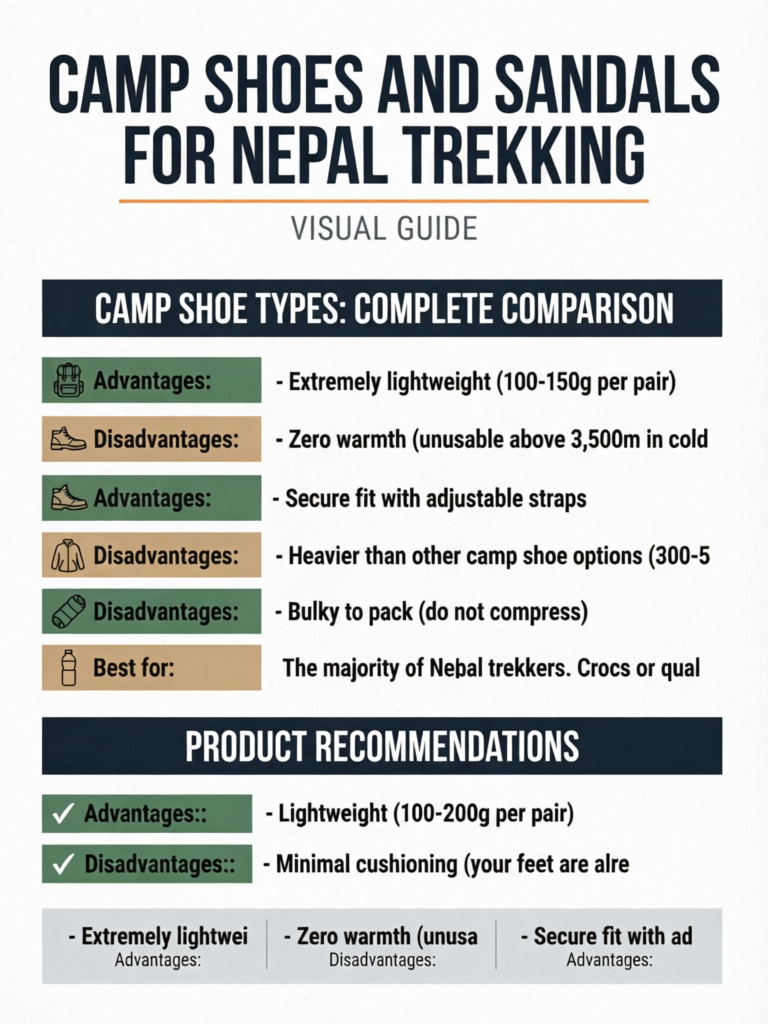
Camp Shoe Types: Complete Comparison
Flip-Flops
The lightest and simplest option. Thin rubber or foam soles with a Y-strap between the toes.
Advantages:
- Extremely lightweight (100-150g per pair)
- Minimal pack space
- Cheapest option (available for under $5 in Kathmandu)
- Maximum ventilation for sweaty feet
- Can double as shower shoes
Disadvantages:
- Zero warmth (unusable above 3,500m in cold evenings)
- No ankle security on uneven tea house grounds
- The between-toe strap can irritate after a day of trekking
- No traction on wet surfaces
- Offer no protection from stubbing toes on rough floors
Best for: Lower-altitude treks (below 3,000m), warm-season trekking, and trekkers who prioritize absolute minimum weight. Flip-flops work well for the first few days of approach valleys on the Annapurna Circuit or the Lukla to Namche section of EBC where evening temperatures are mild.
Not suitable for: Cold tea houses above 4,000m, rough outdoor terrain around lodges, or trekkers with any foot sensitivity.
Sport Sandals (Teva, Chaco, Bedrock Style)
Sturdy sandals with multiple straps, contoured footbeds, and grippy rubber soles. These are the most versatile camp shoe option because they can also handle light trail use.
Advantages:
- Secure fit with adjustable straps
- Good traction on wet and uneven surfaces
- Contoured footbed supports the arch
- Can handle light trail walking, river crossings, and rest-day exploration
- Durable construction that lasts multiple treks
- Open design allows foot ventilation and drying
Disadvantages:
- Heavier than other camp shoe options (300-500g per pair)
- No warmth benefit in cold conditions
- Bulkier to pack
- Overkill for purely indoor camp shoe use
- Most expensive option ($40-80)
Best for: Trekkers who want a camp shoe that doubles as a river crossing shoe and rest-day explorer. Sport sandals excel on treks with river crossings (Manaslu lower section), hot approach valleys, and rest days in villages like Namche Bazaar where you might walk around town.
Crocs and Foam Clogs
The most popular camp shoe on Nepal's trekking trails, and for good reason. Crocs and their many imitations offer a remarkable balance of weight, comfort, warmth, and convenience.
Advantages:
- Lightweight (200-350g per pair depending on size and model)
- Slip-on design requires zero effort
- Closed toe protects against stubbing and cold
- The foam insulates slightly against cold floors
- Ventilation holes allow some airflow
- Available everywhere in Kathmandu for NPR 200-800 ($2-7 for copies)
- Easy to clean (rinse under a tap)
Disadvantages:
- Bulky to pack (do not compress)
- No ankle support
- Limited traction on wet or icy surfaces
- Look ridiculous (though trekking fashion standards are forgiving)
- Copies vary enormously in quality and comfort
Best for: The majority of Nepal trekkers. Crocs or quality foam clogs are the default recommendation for tea house trekking at any altitude. The closed-toe design works from the warm Pokhara valley to cold evenings at Gorak Shep (5,164m), and the slip-on convenience makes them ideal for bathroom trips, dining room visits, and rest-day wandering.
Pro Tip
If you buy Crocs copies in Kathmandu, test them by flexing the sole. Quality foam returns to shape immediately. Cheap foam stays bent, which means it will flatten under your weight within days and provide no cushioning or insulation. Genuine Crocs are available in some Thamel shops for NPR 2,500-4,000 ($20-33), which is worth the investment if you plan to use them on multiple treks. The cheap copies at NPR 200-400 work fine for a single trek but will not survive much beyond that.
Down Booties and Insulated Camp Shoes
For high-altitude trekking where evening temperatures drop well below freezing, insulated camp shoes provide warmth that sandals and Crocs cannot match.
Advantages:
- Extremely warm (rated to minus 10 to minus 30 degrees Celsius)
- Very lightweight for the warmth provided (150-250g per pair)
- Compresses to almost nothing in your pack
- Luxurious comfort after a cold day of trekking
- Some models have water-resistant soles for brief outdoor trips
Disadvantages:
- Not durable enough for outdoor walking (thin soles, fragile uppers)
- No traction on any surface
- Expensive for quality options ($40-80)
- Single-purpose (only useful in cold conditions)
- Cannot get wet without losing all insulation value
Best for: Trekkers heading above 4,500m who prioritize warmth during tea house evenings. Down booties are particularly valuable at EBC-area lodges (Lobuche, Gorak Shep, Dingboche) where dining rooms may not be heated and evening temperatures inside the lodge can drop to zero or below. They also work well inside your sleeping bag as foot warmers on the coldest nights.
Lightweight Camp Shoes (Xero, Vivobarefoot, Minimal Style)
A growing category of ultralight, packable camp shoes that offer more structure than flip-flops but less weight than sport sandals. These are typically minimal construction with thin, flexible soles and simple upper designs.
Advantages:
- Lightweight (100-200g per pair)
- Packable and compressible
- More secure than flip-flops
- Better ground feel than thick foam options
- Some models are surprisingly versatile
Disadvantages:
- Minimal cushioning (your feet are already tired)
- Limited warmth
- Thin soles feel cold floors
- Less widely available
Best for: Ultralight trekkers who want something more functional than flip-flops but refuse the bulk of Crocs or the weight of sport sandals.
Camp Shoe Comparison Table
| Type | Weight (pair) | Warmth Rating | Versatility | Durability | Pack Size | Cost | Best Altitude Range |
|---|---|---|---|---|---|---|---|
| Flip-Flops | 100-150g | None | Low | Low | Minimal | $2-10 | Below 3,000m |
| Sport Sandals | 300-500g | None | High | High | Large | $40-80 | Below 4,000m |
| Crocs / Foam Clogs | 200-350g | Low-Moderate | Moderate | Moderate | Large (bulky) | $2-50 | All altitudes |
| Down Booties | 150-250g | Excellent | Low | Low | Minimal | $40-80 | Above 4,000m |
| Minimal Camp Shoes | 100-200g | Low | Moderate | Moderate | Small | $30-60 | Below 4,000m |
What Works at Different Altitudes
The right camp shoe changes with altitude because temperature is the controlling variable. What works at 2,000m in October is useless at 5,000m in the same month.
Below 2,500m: Warm Evenings
At lower altitudes, evening temperatures in peak season (October-November) remain comfortable at 10-20 degrees Celsius. Any camp shoe works here. Flip-flops are perfectly adequate. Sport sandals let you explore villages. The warm conditions mean foot warmth is not a concern -- ventilation and comfort are the priorities.
Recommendation: Whatever is lightest. Flip-flops or minimal camp shoes.
2,500m to 4,000m: Cool Evenings
Tea house dining rooms at these altitudes are typically heated by a central wood or yak-dung stove in the evenings, but bedrooms and hallways are unheated. Evening temperatures range from 0 to 10 degrees Celsius. Flip-flops become uncomfortable for the walk from bedroom to dining room and for outdoor bathroom trips in the cold.
Recommendation: Crocs or foam clogs. The closed toe and slight foam insulation make a meaningful difference.
4,000m to 5,000m: Cold Evenings
Above 4,000m, evening temperatures in peak season regularly drop to minus 5 to minus 10 degrees Celsius. Tea house dining rooms may or may not be heated, and the heat dissipates quickly after the stove goes out. Floors are cold stone or concrete. Socks alone on these floors results in cold feet within minutes.
Recommendation: Crocs with a pair of thick wool socks, or down booties. Many experienced trekkers carry both -- Crocs for the dining room and general tea house use, and down booties for sleeping and extreme cold evenings.
Above 5,000m: Bitter Cold Evenings
At Gorak Shep (5,164m), Lobuche (4,910m), or high camps on any route, evening temperatures can plunge to minus 15 to minus 20 degrees Celsius. Tea house conditions at these altitudes are basic, and heating is minimal or nonexistent in bedrooms. The floor is cold enough to numb feet through any uninsulated shoe.
Recommendation: Down booties are the primary camp shoe. Crocs as a secondary option for dining room use with heavy socks. The warmth difference between down booties and any other camp shoe at this altitude is dramatic and noticeable within seconds of putting them on.
The Two-Shoe Strategy Above 4,500m
Many experienced Himalayan trekkers carry two camp shoe options for treks that go above 4,500m: a pair of Crocs (or foam clogs) for general tea house use and a pair of down booties for cold evenings and sleeping. The combined weight of both is typically 350-550g, which is less than a single pair of sport sandals. The Crocs handle dining room floors, bathroom trips, and mild evenings, while the down booties provide essential warmth in bedrooms and during the coldest nights. This system covers every condition from the warm Lukla valley to the freezing lodges at Gorak Shep.
Product Recommendations
Best Overall: Crocs Classic Clog
Weight: 200-300g per pair. The undisputed champion of tea house footwear across Nepal. The closed-toe design, easy slip-on, reasonable warmth with socks, and dirt-cheap availability in Kathmandu make Crocs the default recommendation. Genuine Crocs are more comfortable and durable than copies, but even copies work for a single trek. Carry them clipped to the outside of your daypack during trekking hours to save interior pack space.
Best Lightweight: Xero Shoes Z-Trail
Weight: 170g per pair. A minimalist sport sandal with a thin Vibram sole and simple strap system. Packs flat, weighs almost nothing, and provides more security and traction than flip-flops. Works well for warm-altitude camp use and doubles as a river-crossing shoe.
Best Warmth: Western Mountaineering Down Booties
Weight: 200g per pair. The gold standard for high-altitude camp warmth. 850-fill goose down insulation in a nylon shell with a basic non-slip sole. Rated to minus 25 degrees Celsius. These transform freezing tea house bedrooms from miserable to tolerable. They also work inside your sleeping bag as foot warmers on the coldest nights.
Best Value: Kathmandu Market Flip-Flops + Down Booties
For budget-conscious trekkers, the most cost-effective camp shoe system is a pair of cheap flip-flops or foam sandals from Kathmandu ($2-5) for lower altitudes combined with budget down booties or thick fleece socks for high altitude. Total cost: under $20. Total weight: 200-350g. This covers every condition without the bulk of Crocs or the cost of sport sandals.
Best Versatility: Teva Hurricane XLT2
Weight: 430g per pair. A robust sport sandal with adjustable straps, contoured footbed, and aggressive tread. Handles camp use, rest-day walking, river crossings, and even light trail hiking. The weight penalty is significant compared to Crocs or flip-flops, but if you want one shoe that does everything from camp comfort to village exploration, this is the pick. Works best on treks that stay below 4,000m where warmth is less critical.
Pro Tip
Attach your camp shoes to the outside of your daypack using a carabiner or the pack's external attachment points during trekking hours. This keeps them accessible for river crossings and rest stops without taking up interior pack space. Crocs and flip-flops have convenient holes or strap loops for carabiner attachment. Sport sandals can clip by their back strap. Down booties should stay inside your pack in a stuff sack to protect the delicate fill from snagging.
Weight Considerations: How Much Is Too Much?
Every gram matters when you are carrying your own daypack at altitude, and camp shoes are a discretionary weight item that you need to justify against the comfort they provide.
The Weight Calculation
A typical Nepal tea house trek is 12-16 days. You will use camp shoes for approximately 4-6 hours every evening. Over a 14-day trek, that is 56-84 hours of use. The question is: how much weight is each hour of foot comfort worth?
For most trekkers, the answer is generous. Feet that recover properly each evening perform better the next day. Blisters that get air time heal faster. Toenails that decompress from tight boot boxes develop fewer bruises. The 200-400g weight cost of camp shoes pays for itself in foot health over a multi-week trek.
Weight Budget by Camp Shoe Type
| Camp Shoe | Weight Budget Impact | Comfort Hours per Trek | Grams per Comfort Hour |
|---|---|---|---|
| Flip-flops (120g) | Negligible | 70+ hours | 1.7g per hour |
| Crocs (280g) | Low | 70+ hours | 4g per hour |
| Down Booties (200g) | Low | 40-50 hours (cold evenings) | 4-5g per hour |
| Sport Sandals (450g) | Moderate | 70+ hours + rest days | 5-6g per hour |
| Crocs + Down Booties (480g) | Moderate | 70+ hours camp + 40 hours warmth | 4-5g per hour |
When to Skip Camp Shoes
The only scenario where skipping camp shoes entirely is justifiable is on a fast, ultralight trek of five days or fewer where weight savings are critical and you plan to simply wear thick socks in the tea house. Even then, most ultralight trekkers carry at least flip-flops because the weight is so minimal and the comfort benefit so high.
Do Not Trek in Camp Shoes
Camp shoes are for camp, not for trail. We see trekkers every season attempting trail sections in Crocs, flip-flops, or sandals. On maintained paths below 2,500m, this works but provides no ankle support, no toe protection, and no traction on wet surfaces. On rocky, uneven Himalayan trails above 3,000m, it is genuinely dangerous. One twisted ankle in flip-flops on the descent from Namche to Lukla and your trek is over. Keep camp shoes for camp and proper boots for the trail.
Buying Camp Shoes in Kathmandu
Kathmandu offers abundant camp shoe options at prices well below international retail.
What Is Available
- Flip-flops: Every shop in Thamel sells flip-flops for NPR 100-500 ($1-4). Quality ranges from single-use thin foam to reasonable rubber that lasts a trek.
- Crocs copies: Foam clogs in every color and size are available throughout Thamel for NPR 200-800 ($2-7). Quality varies enormously -- test the foam firmness before buying.
- Genuine Crocs: Available in some mall shops and specialty stores for NPR 2,500-4,000 ($20-33). Worth it for multi-trek use.
- Sport sandals: Teva and Chaco are occasionally available in higher-end outdoor shops. Prices are typically 20-40% above international retail. Generic sport sandals are available for NPR 500-2,000 ($4-16).
- Down booties: Rarely available in Kathmandu. A few high-end gear shops stock them seasonally for NPR 4,000-8,000 ($33-66). Bring from home if you want quality.
Buy at Home vs. Buy in Kathmandu
For flip-flops and Crocs copies, buy in Kathmandu. The prices are negligible, the weight savings of not carrying them on the flight are real, and you can test the fit with your trekking socks before purchasing. For sport sandals and down booties, buy at home where selection, quality, and fit options are vastly superior. A poorly fitting sport sandal or a leaky down bootie purchased hastily in Kathmandu is worse than no camp shoe at all.
Care and Maintenance on the Trek
Drying Camp Shoes
Ironically, your camp shoes may also get wet -- from bathroom trips in the rain, wet tea house floors, or splashes while hand-washing clothes. Shake off excess water before bringing them inside. Foam shoes (Crocs) can be wiped dry with a cloth. Sport sandals dry quickly if left in a ventilated area. Down booties should never get wet -- if they do, dry them thoroughly before the down loses loft and insulation value.
Hygiene
Camp shoes worn in tea house bathrooms contact floors that may harbor bacteria and fungi. Rinse the soles periodically, especially if you have any cuts or blisters on your feet. Wear socks with camp shoes if you have open wounds on your feet to prevent infection. In particular, the shared bathrooms above 4,000m where water for cleaning is scarce are not the cleanest environments.
Storage During the Trek
Camp shoes ride on the outside of your pack during trekking hours and inside the tea house room during evenings. Do not leave them in the dining room overnight -- other trekkers' camp shoes all look similar, and accidental swaps happen. Mark your camp shoes with a small piece of tape or a distinctive mark if they are a common brand and color.
Frequently Asked Questions
Do I Need Camp Shoes for Nepal Trekking?
Yes. Camp shoes are one of the highest comfort-to-weight ratio items on any Nepal trek. After 8-10 hours in trekking boots on routes like Everest Base Camp or the Annapurna Circuit, your feet need decompression time to prevent cumulative injuries. Camp shoes weighing just 100-400g deliver foot recovery, boot drying time, tea house etiquette compliance, and nighttime bathroom convenience. Even on short treks like Poon Hill or Mardi Himal, the comfort upgrade is significant. The only trekkers who might skip them are ultralight hikers on treks under five days, and even then, 120g flip-flops are worth the negligible weight.
What Camp Shoes Do I Need for Everest Base Camp?
The Everest Base Camp trek spans altitudes from 2,860m at Lukla to 5,364m at EBC, so your camp shoe needs change as you ascend. For the lower sections through Namche Bazaar, any camp shoe works. Above Dingboche (4,410m), you need closed-toe insulation. The best strategy for EBC is the two-shoe approach: Crocs for the dining room and general tea house use, plus down booties for cold evenings and sleeping at Lobuche and Gorak Shep. This combined system weighs under 550g and covers every temperature from the warm Lukla valley to the freezing lodges at the highest stops. If carrying two pairs feels excessive, a single pair of Crocs with thick wool socks handles most conditions, though you will sacrifice warmth in unheated bedrooms above 4,500m.
Where to Buy Camp Shoes in Kathmandu
Kathmandu's Thamel district is the best place to pick up budget camp shoes before your trek. Flip-flops and Croc copies are available in hundreds of shops for NPR 100-800 ($1-7). For guidance on navigating Thamel's gear market, bargaining strategies, and quality assessment, see our rent vs buy gear guide. Genuine Crocs are stocked in select shops for NPR 2,500-4,000. Down booties are rarely available in Kathmandu, so bring those from home if they are part of your plan.
Final Recommendation
For most Nepal trekkers, a pair of Crocs or quality foam clogs is the ideal camp shoe. They weigh 200-350g, cost very little (especially if bought in Kathmandu), slip on and off instantly, provide closed-toe protection and moderate warmth with socks, and handle every tea house situation from warm Pokhara lodge to cold Gorak Shep shelter.
If your trek goes above 4,500m and cold feet are a concern, add a pair of down booties (150-250g) for bedroom and sleeping use. The combined system weighing under 550g covers every altitude and temperature you will encounter.
Include camp shoes in your overall packing list alongside your trekking boots, your layering system, and the rest of your gear list. For routes like the Langtang Valley or Manaslu Circuit, camp shoes follow the same altitude-based logic outlined above. Your feet will thank you every single evening of the trek.
Ready to plan your Nepal trek?
Get a tailored kit list and an itinerary from a verified local agency before you book.