
$80–$150 (Columbia, Merrell, Keen)
$150–$250 (Salomon, La Sportiva, Scarpa)
$250–$400+ (Lowa, Hanwag, Arc'teryx)
4–6 weeks / 50+ km of walking minimum
900g–1,800g depending on category
800–1,500 km of trekking use
Mid-cut to full-ankle leather/synthetic boots
$25–$60 (Superfeet, Sole, Currex)
Best Trekking Boots for Nepal
The best trekking boots for Nepal are mid-cut to full-ankle waterproof (Gore-Tex) boots with a stiff Vibram sole, matched to your trek. For Everest Base Camp, Annapurna Circuit and Manaslu, choose full-ankle backpacking boots like the Salomon Quest 4 GTX, Lowa Renegade GTX or Scarpa Zodiac Plus GTX; for lower treks like Poon Hill or ABC, a mid-cut boot is enough. Whatever you pick, fit it to your larger foot and break it in for 4-6 weeks before flying to Nepal.
Your trekking boots are the single most important gear decision you will make for any Nepal trek. Not your sleeping bag. Not your down jacket. Not your backpack. Your boots. Every other piece of equipment can be swapped, borrowed, rented, or improvised on trail. But once you are three days into the Everest Base Camp trek with boots that are shredding your heels or crushing your toes on steep descents, there is no fix. There is no shop at Namche Bazaar that carries your size in a properly fitted boot. There is no amount of moleskin, duct tape, or willpower that can compensate for fundamentally wrong footwear over 130 kilometers of rocky Himalayan terrain.
Every season, we see trekkers abandon their trips because of boot-related injuries. Blisters that become infected. Bruised and blackened toenails from boots that are too short. Rolled ankles from floppy trail shoes on loose moraine. Frozen feet from boots that cannot handle sub-zero temperatures at Thorong La or Cho La pass. These are not rare stories. They happen with alarming regularity, and they are almost entirely preventable.
This guide draws on years of collective trekking experience in the Nepal Himalayas, conversations with professional boot fitters, and real-world feedback from hundreds of trekkers who have walked these trails. Whether you are planning a short Poon Hill circuit or a full Annapurna Circuit with the Thorong La pass, this guide will help you choose the right boots, fit them properly, break them in, and care for them on trek.
What this guide covers:
- Boot categories explained and matched to specific Nepal treks
- Key features that matter on Himalayan terrain (and features that are just marketing)
- Specific boot recommendations across three budget tiers
- The complete boot fitting process that most people skip
- Break-in protocols that prevent on-trail disasters
- Boot care, sock strategy, and camp shoe essentials
The right pair of boots, properly fitted and broken in, will carry you through the most spectacular landscapes on Earth in comfort. The wrong pair will make you miserable. Let's make sure you choose wisely.
Boot Categories for Nepal Trekking
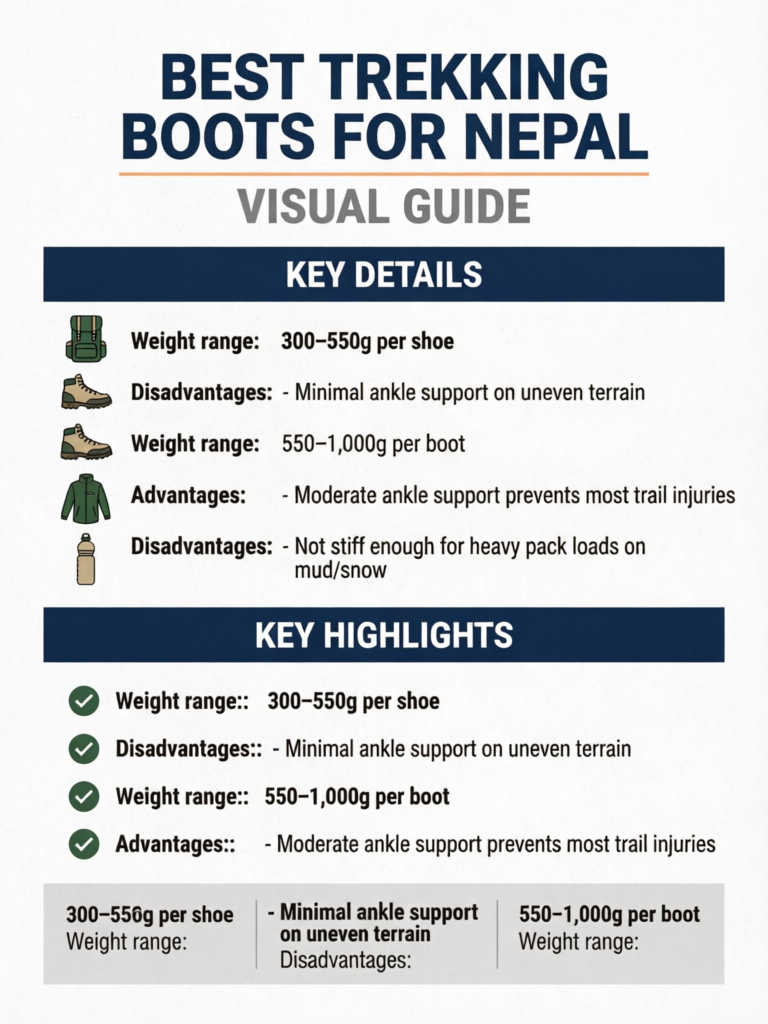
Not all Nepal treks demand the same level of footwear. The terrain ranges from well-maintained stone paths at lower elevations to rocky moraine fields, glacier crossings, and snow-covered high passes. Understanding the four main boot categories helps you match your footwear to your specific trek.
Trail Running Shoes & Approach Shoes
Best for: Poon Hill, Ghorepani Ghandruk, short lower-altitude treks below 3,500m
Weight range: 300–550g per shoe
Trail running shoes and approach shoes are the lightest option, and they are suitable for well-established lower-altitude treks where the trails are mostly stone steps, packed dirt, and graded paths. For a three-to-five day trek like Poon Hill where maximum elevation is around 3,210 meters, many experienced trekkers prefer the agility and comfort of a good trail runner.
Advantages:
- Significantly lighter, reducing leg fatigue over long days
- Better breathability in warmer lower-altitude valleys
- More natural foot movement and flexibility
- Faster drying when wet
- No break-in period required
Disadvantages:
- Minimal ankle support on uneven terrain
- Less protection against rocks and root strikes
- Not waterproof (mesh uppers soak through quickly)
- Inadequate insulation for cold mornings at altitude
- Thin soles feel every sharp rock underfoot
Notable models: Salomon X Ultra Pioneer ($120), La Sportiva TX4 ($150), Hoka Speedgoat 5 ($145), Altra Lone Peak 8 ($130)
Trail shoes work well for fit, experienced trekkers carrying a light pack on established lower trails. But even on Poon Hill, conditions vary. During monsoon season, the stone steps become slippery waterfalls, and the lack of ankle support becomes a genuine liability. If you have any doubt, go with a mid-cut boot instead.
Mid-Cut Hiking Boots
Best for: Annapurna Base Camp (ABC), Langtang Valley, Mardi Himal, Gokyo Lakes (without passes)
Weight range: 550–1,000g per boot
Mid-cut hiking boots sit above the ankle but below the full cuff height of a backpacking boot. They represent the sweet spot for the majority of Nepal's teahouse treks that stay below 5,000 meters and do not involve technical terrain or glacier travel.
For a trek like the Annapurna Base Camp route, where you are walking on stone steps, suspension bridges, and well-maintained trails through rhododendron forests up to approximately 4,130 meters, a mid-cut boot provides the ideal balance of support, protection, and weight.
Advantages:
- Moderate ankle support prevents most trail injuries
- Significantly lighter than full backpacking boots
- Easier to break in (usually 2–3 weeks is sufficient)
- Comfortable for both ascending and descending
- Good enough for light snow and cold mornings
Disadvantages:
- Not stiff enough for heavy pack loads on multi-week treks
- Ankle support may be insufficient on loose scree and moraine
- May not be warm enough for high-altitude cold snaps
- Less durable than full leather backpacking boots
Notable models: Salomon X Ultra 4 Mid GTX ($175), Merrell MQM 3 Mid GTX ($160), La Sportiva Ultra Raptor II Mid GTX ($185), Keen Targhee III Mid WP ($155)
Pro Tip
If you are only doing one Nepal trek and it is a moderate route like ABC, Langtang, or Mardi Himal, a mid-cut Gore-Tex hiking boot is probably the best investment. You will also get far more use out of it at home for day hikes and weekend trips than you would from a heavier backpacking boot.
Full Ankle / Backpacking Boots
Best for: Everest Base Camp, Annapurna Circuit (with Thorong La), Manaslu Circuit, Upper Mustang, any trek crossing passes above 5,000m
Weight range: 1,000–1,800g per boot
Full ankle backpacking boots are the workhorse of Himalayan trekking. They feature a higher cuff that wraps fully around and above the ankle, a stiffer midsole that supports heavy loads over long days, and a more robust outsole that grips on loose rock and frozen ground. For any Nepal trek that reaches above 5,000 meters, involves crossing a high pass, or lasts more than 10 days with a loaded pack, this is the category you need.
On the EBC trek, you will walk across rocky glacial moraine approaching Gorak Shep at 5,164 meters. The trail surface is a chaotic mix of loose rocks, frozen dirt, and occasional ice. Wind chill can drop temperatures well below freezing even in peak season. A mid-cut hiking boot simply does not provide enough stability, insulation, or protection for these conditions.
Advantages:
- Full ankle protection on loose, uneven terrain
- Stiff midsole supports heavy pack loads without foot fatigue
- Better insulation for high-altitude cold
- Robust construction handles weeks of daily punishment
- Compatible with semi-automatic crampons (some models)
Disadvantages:
- Heavier, adding to overall leg fatigue
- Requires 4–6 weeks of break-in
- More expensive
- Can feel overly stiff on easy, flat sections of trail
- Overkill for short, lower-altitude treks
Notable models: Lowa Renegade GTX Mid ($230), Scarpa Zodiac Plus GTX ($280), La Sportiva Trango TRK GTX ($220), Hanwag Tatra II GTX ($290), Salomon Quest 4 GTX ($200)
Mountaineering Boots
Best for: Island Peak (6,189m), Mera Peak (6,476m), Lobuche East (6,119m), any peak climbing that requires crampons and potentially technical ice
Weight range: 1,600–2,500g per boot
Mountaineering boots are a specialized category that most trekkers will never need. They feature a rigid sole rated B1 (semi-rigid, compatible with strap-on crampons) or B2 (fully rigid, compatible with step-in crampons), insulation rated for extreme cold, and a construction designed for ice axe and crampon work.
If your itinerary includes a trekking peak like Island Peak after the EBC trek, you will need mountaineering boots for the summit push. However, many trekkers use their backpacking boots for the trek approach and switch to mountaineering boots only for the climbing days. Some expedition companies provide mountaineering boots as part of the peak climbing package.
Advantages:
- Crampon compatible (essential for glacier and ice travel)
- Extreme cold rated (down to -20°C or lower)
- Maximum ankle stability on technical terrain
- Rigid sole for front-pointing on steep ice
Disadvantages:
- Extremely heavy and uncomfortable for normal trail walking
- Very expensive ($350–$800)
- Massive break-in required
- Far too stiff for regular trekking terrain
Notable models: La Sportiva Nepal Cube GTX ($550), Scarpa Mont Blanc Pro GTX ($500), Lowa Alpine Expert II GTX ($450), La Sportiva Trango Tower GTX ($380, B1 rating)
Do Not Trek in Mountaineering Boots
A common mistake for first-time Himalayan trekkers is buying mountaineering boots "just in case." Unless you are specifically climbing a peak that requires crampons, do not wear mountaineering boots on a trekking route. They are too heavy, too stiff, and too uncomfortable for trail walking. Your feet will hate you by day three. Use backpacking boots for the trek and carry or rent mountaineering boots for peak climbing days only.
Which Boot for Which Trek
Matching the right boot category to your specific trek is critical. Here is a practical reference table covering the most popular Nepal treks:
| Trek / Route | Duration | Max Altitude | Terrain Type | Recommended Boot |
|---|---|---|---|---|
| Poon Hill / Ghorepani | 3–5 days | 3,210m | Stone steps, packed trails | Trail shoes or mid-cut boots |
| Mardi Himal | 5–7 days | 4,500m | Forest trails, ridge walking | Mid-cut hiking boots |
| Langtang Valley | 7–10 days | 4,984m (Kyanjin Ri) | River valley, rocky trails | Mid-cut hiking boots |
| Annapurna Base Camp | 7–12 days | 4,130m | Stone steps, forest, alpine | Mid-cut hiking boots |
| Everest Base Camp | 12–16 days | 5,364m (Kala Patthar) | Moraine, rocky trails, potential ice | Full ankle backpacking boots |
| Annapurna Circuit + Thorong La | 12–18 days | 5,416m | Varied terrain, high pass with snow | Full ankle backpacking boots |
| Manaslu Circuit | 14–18 days | 5,160m (Larkya La) | Remote trails, glacial moraine, snow | Full ankle backpacking boots |
| Upper Mustang | 10–14 days | 3,800m | Arid desert terrain, rocky paths | Mid-cut or full ankle boots |
| Three Passes (EBC) | 18–22 days | 5,535m (Kongma La) | Glacier, moraine, steep passes, snow | Stiff backpacking boots |
| Winter treks (any route) | Varies | Varies | Frozen trails, snow, ice | Stiff backpacking boots with insulation |
| Island Peak / Mera Peak | 18–22 days | 6,189m / 6,476m | Glacier, ice, snow, rock | B1/B2 mountaineering boots (for summit) |
Key principle: When in doubt between two categories, go one level sturdier. You can always walk comfortably in boots that are slightly more supportive than necessary, but walking in boots that are too light for the terrain creates real problems.
Key Features to Look For
Not all boots within the same category are created equal. When evaluating specific models for Nepal trekking, these five features matter most.
Waterproofing
Nepal trekking involves crossing streams, walking through morning dew, encountering afternoon rain showers, and occasionally trudging through snow. Wet feet lead to blisters, cold injuries, and misery. Waterproofing is not optional for any trek above the lowest altitudes.
Water-resistant vs water-repellent vs waterproof — know the difference. These three terms are not interchangeable, and marketing departments blur them on purpose. Waterproof means a membrane (Gore-Tex, eVent, or equivalent) physically blocks liquid water from entering — this is what you want for any Himalayan trek with snow, river crossings, or sustained rain. Water-repellent describes a DWR coating that makes water bead and roll off the surface; it holds out a passing shower but soaks through in prolonged wet. Water-resistant is the weakest tier — it merely slows water absorption and is only acceptable on a short, dry-season trek like Poon Hill. For trekking in Nepal above roughly 3,500m, insist on a fully waterproof boot, then maintain its water-repellent outer coating with DWR re-treatment.
Gore-Tex (GTX): The industry standard waterproof-breathable membrane. Licensed to most major boot brands. Reliably keeps water out while allowing some moisture vapor to escape. Look for "Gore-Tex Surround" or "Gore-Tex Extended Comfort" in boot specs. The membrane typically lasts the life of the boot if cared for properly.
eVent: A competing membrane technology found in some Boreal and Hi-Tec boots. Slightly better breathability than Gore-Tex in some tests, but less widely available.
Proprietary membranes: Brands like Keen (KEEN.DRY), Columbia (OutDry), and Salomon (CSWP) use their own waterproofing technologies. These are generally effective but vary in long-term durability. Columbia's OutDry is notably good because it bonds the membrane directly to the outer material, eliminating the saturation of the outer fabric layer.
Waterproofing limitations: No boot stays waterproof if water pours in over the top of the collar. On deep stream crossings, water will enter regardless of the membrane. In heavy rain lasting hours, even Gore-Tex boots eventually feel damp inside from condensation. The solution is not to expect perfection but to pair waterproof boots with good socks and proper drying techniques at tea houses.
Waterproof Treatment Maintenance
Factory waterproofing degrades over time, especially with heavy use. Apply a DWR (Durable Water Repellent) treatment like Nikwax Fabric & Leather Proof or Granger's Footwear Repel to your boots before departure and carry a small travel-size bottle on trek. Re-treat every 5–7 days of heavy use, focusing on seams and flex points where waterproofing fails first.
Sole Stiffness
Sole stiffness is one of the most misunderstood boot features. Many first-time trekkers assume flexible soles are more comfortable. On flat, groomed trails, they are. On the rocky, uneven terrain that characterizes most Nepal treks above 3,500 meters, a stiffer sole is dramatically more comfortable and safer.
Why stiffness matters:
- Rocky terrain: A flexible sole transmits every sharp rock directly to your foot. After eight hours of walking on river stones and moraine rubble near EBC, your feet will be bruised and aching. A stiffer sole distributes the pressure across a wider area.
- Heavy pack loads: When carrying a 6–10 kg daypack, the additional weight drives your foot harder into the ground with each step. A stiff midsole prevents your arch from collapsing under load.
- Steep descents: On long downhill sections, a stiff sole prevents your foot from bending excessively at the toe, which reduces the hammering your toenails take.
Vibram outsoles: The majority of quality trekking boots use Vibram rubber outsoles. Look specifically for Vibram Megagrip (excellent grip on wet rock) or Vibram Mont (designed for mountain terrain). The tread pattern matters too. Deep, widely spaced lugs grip better on mud and loose soil, while closer-spaced lugs perform better on rock.
Stiffness rating guide:
- Flex 1–2 (very flexible): Trail runners, approach shoes. Fine for Poon Hill.
- Flex 3–4 (moderate): Mid-cut hiking boots. Good for ABC, Langtang.
- Flex 5–6 (stiff): Backpacking boots. Ideal for EBC, Annapurna Circuit, Manaslu.
- Flex 7+ (rigid): Mountaineering boots. For peak climbing only.
Ankle Support
The topic of ankle support generates heated debate in hiking communities. Ultralight advocates argue that ankle support is a myth and that strong ankles developed through training are more important. They are not entirely wrong for fit, experienced hikers on well-maintained trails. But for Nepal trekking, the context is different.
Why ankle support matters in Nepal:
- You are walking 6–10 hours daily for 10–18 consecutive days with no rest days on some routes
- You are carrying a pack, which shifts your center of gravity
- Trail surfaces change constantly: stone steps, loose gravel, river crossings, frozen mud, moraine boulders
- Fatigue accumulates over days, reducing your proprioception and reaction time
- A rolled ankle three days from the nearest road is a serious logistical problem, not just an inconvenience
For treks above 5,000 meters or lasting more than 10 days, full ankle-height boots with a padded collar and heel counter provide meaningful protection. The boot should hold your ankle firmly without restricting your natural range of motion. You should be able to flex forward easily (for uphill walking) while the boot prevents excessive lateral rolling.
Weight
Boot weight directly affects how tired your legs feel at the end of each day. The old mountaineering saying claims that "one pound on the feet equals five pounds on the back," and while the actual ratio varies, the principle holds. Heavier boots require more energy per step, and over thousands of steps per day across multiple weeks, the cumulative effect is significant.
Weight guidelines by category:
- Trail shoes: 300–550g per shoe (600–1,100g per pair)
- Mid-cut boots: 550–800g per boot (1,100–1,600g per pair)
- Full ankle boots: 800–1,000g per boot (1,600–2,000g per pair)
- Mountaineering boots: 1,000–1,300g per boot (2,000–2,600g per pair)
The weight sweet spot for most Nepal treks is between 1,200g and 1,800g per pair. Below that, you are likely sacrificing durability, waterproofing, or support. Above that, you are carrying unnecessary weight unless you are heading into genuinely technical terrain.
Weight-saving tip: A pair of quality aftermarket insoles (Superfeet Green, Sole Active Medium, or Currex RunPro) weighing 50–80g can improve comfort and support enough that you can choose a slightly lighter boot without sacrificing foot support.
Toe Protection
Nepal's trails are littered with rocks, roots, and stone steps. Stubbing your toe at altitude when your reaction time is dulled by fatigue is extremely common. Boots with a robust rubber toe cap (sometimes called a "rubber rand") protect against these impacts.
Look for boots where the rubber rand extends not just over the toe but wraps around the sides of the forefoot. This provides protection on traverse sections where the side of your boot scrapes against rocks. The rand also adds durability and water resistance to the most vulnerable part of the boot.
Every boot recommended in this guide features some form of toe protection. If a boot you are considering does not have a rubber toe bumper, it was not designed for terrain like Nepal's trails.
Boot Recommendations by Budget
We have organized our recommendations into three tiers. Every boot listed here has been used successfully on Nepal treks and is widely available internationally. Prices are approximate retail as of early 2026 and may vary by retailer and region.
Budget: $80–$150
At this price point, you are making some trade-offs: heavier weight, less breathable waterproofing, faster wear on the outsole, and potentially less refined fit. But the boots in this tier are genuinely functional for Nepal trekking if properly fitted and broken in.
Columbia Newton Ridge Plus II Waterproof ($90–$110) A consistently popular choice for budget-conscious trekkers. Full leather and suede upper with Columbia's Omni-Grip outsole. The waterproofing uses a seam-sealed construction rather than a membrane, which is less breathable but effective. Runs slightly narrow. A solid choice for ABC and similar moderate treks.
Merrell Moab 3 Mid Waterproof ($130–$145) The Moab (Mother Of All Boots) line has been a best-seller for years, and the version 3 is the most refined yet. Bellows tongue keeps debris out, Vibram TC5+ outsole provides reliable grip, and the fit accommodates wider feet well. The Moab 3 is one of the most comfortable boots out of the box, requiring minimal break-in. Good for treks up to ABC level.
Keen Targhee III Mid Waterproof ($145–$155) Keen's signature wide toe box is a blessing for trekkers with broader feet or those who experience toe swelling at altitude. KEEN.DRY waterproof membrane, ESS shank for torsional stability, and a lugged outsole that performs well on mixed terrain. The Targhee III is slightly heavier than the Moab 3 but offers better ankle support.
Timberland White Ledge Mid Waterproof ($80–$100) The most affordable option on this list. Full-grain leather upper, seam-sealed waterproofing, rubber lug sole. It lacks the technical features of the other options, but for a short trek like Poon Hill or Ghorepani in dry conditions, it gets the job done. Not recommended for treks above 4,000 meters.
Mid-Range: $150–$250
This is where the quality jump becomes significant. Boots in this range feature genuine Gore-Tex waterproofing, Vibram outsoles, more refined lasts (foot shapes), better materials, and noticeably improved comfort on long days. For any Nepal trek of 10+ days or above 5,000 meters, this tier is where you should start looking.
Salomon Quest 4 GTX ($195–$210) One of the most popular choices for EBC trekkers, and for good reason. The Quest 4 uses Salomon's Advanced Chassis system for excellent stability, a Gore-Tex membrane, and a Contagrip MA outsole that grips brilliantly on wet rock. The fit is slightly narrow, so try before buying. Weighing around 1,360g per pair, it hits a great balance between support and weight. Suitable for EBC, Annapurna Circuit, and Manaslu.
La Sportiva Trango TRK 2.0 GTX ($210–$230) A favorite among trekkers who value precision on technical terrain. The Trango line comes from La Sportiva's mountaineering heritage, and even the trekking version feels remarkably planted on rocky ground. Vibram Megagrip outsole, Gore-Tex lining, and a 3D Flex ankle system that allows natural movement while maintaining support. Excellent for EBC and high-pass crossings. Runs small, so go at least a half size up.
Scarpa Zodiac Plus GTX ($265–$280) Approaching the premium tier in quality but priced at the top of mid-range. Italian-made with a Perwanger leather upper that molds to your foot over time, Vibram Drumlin outsole, and Gore-Tex lining. The Zodiac Plus is renowned for its comfort on multi-week treks. It handles the EBC moraine fields, Three Passes route, and Annapurna Circuit with equal aplomb. Heavier at around 1,600g per pair, but the comfort and durability justify the weight.
Merrell MQM 3 Mid Gore-Tex ($155–$170) A more athletic, lightweight option in the mid-range. Uses Merrell's Quantum Grip outsole and a Gore-Tex membrane. At approximately 1,100g per pair, it is one of the lightest Gore-Tex mid-cuts available. Best suited for treks up to ABC or Langtang where maximum altitude is below 5,000m. Not stiff enough for heavy loads on EBC.
Premium: $250–$400+
These are the boots that professional guides and repeat Himalayan trekkers tend to gravitate toward. The materials are superior, the construction is more durable, the fit is more refined, and the comfort over multi-week treks is noticeably better. If you plan to trek regularly or are investing in a once-in-a-lifetime Himalayan expedition, this tier is worth the investment.
Lowa Renegade GTX Mid ($230–$260) Arguably the most recommended trekking boot in the world, and for good reason. German-made with a PU Monowrap frame that provides exceptional stability without excessive weight. Vibram EVO outsole, Gore-Tex lining, and a fit that accommodates most foot shapes. Available in regular and wide widths. The Renegade has been refined over decades and represents the benchmark against which other boots are measured. Outstanding for EBC, Annapurna Circuit, and anything short of technical mountaineering.
Hanwag Tatra II GTX ($280–$310) Handcrafted in Bavaria with a reputation for lasting thousands of kilometers. The Tatra II uses Hanwag's proven Futura last, which provides a roomy forefoot with a snug heel. Vibram Endurance outsole, Gore-Tex lining, and a one-piece leather upper that minimizes seam-related failure points. These boots are built to be resoled, making them a long-term investment. Slightly heavy at around 1,700g per pair, but the comfort and durability are exceptional.
Scarpa Mescalito TRK Pro GTX ($300–$330) Scarpa's most advanced trekking boot combines their mountaineering expertise with trail comfort. Perwanger leather and microfiber upper, Vibram Megagrip outsole, and the SOCK-FIT PRO system that wraps the foot precisely. Excellent on technical terrain and loose scree. One of the best choices for the Three Passes trek or winter trekking in Nepal.
Arc'teryx Acrux TR GTX ($350–$400) The premium option from a brand known for obsessive attention to detail. Arc'teryx's proprietary Adaptive Fit Lite technology creates a precise wrap around the foot, while the Vibram Megagrip outsole with full rubber rand provides bombproof protection. Lighter than expected for its category at approximately 1,400g per pair. The price is steep, but for trekkers who value light weight without compromising support, it is hard to beat.
Pro Tip
Buy your boots from a specialty outdoor retailer with a generous return policy, not from a general online marketplace. Stores like REI (60-day return), Cotswold Outdoor (90-day guarantee), or local specialty shops employ trained boot fitters who can assess your foot shape, gait, and specific trek requirements. The time spent getting a professional fitting is worth more than the money saved buying online.
The Critical Importance of Boot Fitting
A $400 boot that fits poorly will perform worse than a $120 boot that fits well. Fit is everything. More trekkers are derailed by poorly fitting boots than by any other gear failure. The fitting process takes time, but every minute invested prevents potential agony on trail.
How to Measure Your Feet Properly
Your feet are not the same size. Most people have one foot that is 3–8mm longer than the other. Always fit boots to your larger foot. Here is how to get an accurate measurement:
- Measure in the afternoon or evening. Feet swell throughout the day and are largest in the late afternoon, similar to how they swell during trekking.
- Stand up while being measured. Your foot spreads under your body weight. Seated measurements are inaccurate.
- Wear the socks you will trek in. This typically means a medium-weight merino wool trekking sock, possibly with a thin liner sock underneath.
- Measure both feet. Record the length and width of each foot. Use a Brannock device if available, or trace your foot on paper and measure from heel to longest toe.
- Account for swelling at altitude. Feet swell at higher altitudes due to reduced atmospheric pressure and increased blood flow. Many experienced trekkers go a half size up from their measured size for this reason.
Wide Foot Considerations
Standard boot lasts are designed for medium-width feet. If you have wide feet (E width for men, D width for women), do not try to force your foot into a standard-width boot and hope it will stretch. It will not stretch enough, and you will be in pain.
Brands known for accommodating wider feet include Keen (their wide toe box is legendary), Lowa (available in wide versions of many models), Merrell (Moab line fits wide), and New Balance (their hiking boots run wide). La Sportiva and Scarpa, being Italian brands, tend to run narrower. Test before committing.
Trying Boots with Trekking Socks
Never try on trekking boots wearing thin cotton socks or dress socks. Bring the exact socks you plan to trek in. This typically means:
- A thin merino or synthetic liner sock
- A medium-weight merino wool trekking sock over the top
The combined thickness of these socks significantly changes how a boot fits. A boot that feels perfect with thin socks will feel tight and restrictive with proper trekking socks.
The Downhill Test
This is the single most important test you can perform in the shop. Put on both boots, lace them up firmly (especially the ankle hooks), and walk down a steep incline. Most good outdoor stores have a ramp or inclined surface for this purpose.
What you are testing: When walking steeply downhill, your foot naturally slides forward inside the boot. If your toes hit the front of the boot on the ramp, they will be smashing into the front of the boot on every one of the thousands of downhill steps on a Nepal trek. This causes bruised toenails, blisters on the toes, and tremendous discomfort.
The correct fit: With the boot firmly laced, you should be able to wiggle your toes freely at the front even while walking downhill. There should be approximately one thumb's width of space between your longest toe and the front of the boot. Your heel should remain locked in place without lifting.
When to Go Half-Size Up
Go at least a half size up from your regular shoe size if:
- Your feet swell noticeably during exercise
- You will be trekking above 4,500 meters (altitude-related swelling)
- You plan to use thick trekking socks with liners
- You have any doubt between two sizes
It is far easier to compensate for a slightly too-large boot (thicker socks, tighter lacing, aftermarket insoles) than to deal with a too-small boot. On a Nepal trek, your feet will swell. Plan for it.
Breaking In Your Boots
New boots, no matter how comfortable they feel in the shop, must be broken in before a Nepal trek. The materials need to flex and soften, the insole needs to conform to your foot shape, and you need to identify any hot spots before you are days from civilization.
Minimum Break-In Period
Plan for a minimum of 4–6 weeks and at least 50 kilometers of walking before your trek. This is not a suggestion. This is essential. Every year, trekkers show up at Lukla or Nayapul in brand-new boots and pay for it within 48 hours.
The break-in process serves two purposes. First, it softens the boot materials: leather, synthetic overlays, and the midsole all become more pliable with use, conforming to the specific shape and movement pattern of your foot. Second, it reveals fit problems. A subtle pressure point that is unnoticeable during a 30-minute shop visit becomes a blister generator after four hours of walking.
Progressive Break-In Schedule
Week 1: Wear the boots around the house for 1–2 hours daily. Walk on carpet, hardwood, up and down stairs. This starts the softening process without risking blisters.
Week 2: Short outdoor walks of 3–5 kilometers on paved or easy surfaces. Wear your trekking socks. Begin lacing firmly around the ankle.
Week 3: Longer walks of 5–10 kilometers on mixed terrain (trails, hills, uneven ground). Carry a light daypack (5 kg) to simulate some load.
Week 4: Full day hikes of 10–15 kilometers with your actual trekking daypack weighted to 8–10 kg. Include significant elevation gain and loss. This is your dress rehearsal.
Weeks 5–6: Continue day hikes and wear the boots for any outdoor walking. By this point, the boots should feel like extensions of your feet. If there are still hot spots or discomfort, you may need a different boot.
Warning Signs of Bad Fit During Break-In
Stop and reassess if you experience any of the following during the break-in process:
- Persistent heel lift: Your heel should not slide up and down inside the boot after the laces are properly tightened. Some initial movement is normal in new boots, but if it persists after 30+ km of break-in, the boot does not fit your heel shape.
- Numbness or tingling: Pressure on nerves across the top of the foot or around the ankle indicates the boot is too tight or the tongue is too stiff. Try different lacing techniques first, but if the issue persists, the boot is wrong.
- Blisters in the same spot repeatedly: One blister is normal during break-in. Blisters that keep forming in the same location indicate a structural fit problem that will only worsen on a multi-week trek.
- Toe impact on moderate downhills: If your toes hit the front on any downhill grade, the boot is too short. Exchange for a larger size.
Never Trek in New Boots
This warning cannot be stated strongly enough: do not begin a Nepal trek in boots you have not broken in. "I will break them in on the trail" is a recipe for disaster. The Himalaya does not forgive equipment mistakes. A blister that would be a minor annoyance on a day hike at home becomes a debilitating injury when you have eight hours of walking ahead of you the next day, and the next, and the next. Buy your boots at least six weeks before departure. No exceptions.
Pro Tip
During break-in, do at least two day hikes wearing the exact same sock combination and carrying the same approximate pack weight you will carry in Nepal. Walk both uphill and especially downhill for extended periods. This is the truest test of fit. If your boots pass this test comfortably, they will perform well on trek.
Boot Care on Trek
Your boots will endure brutal conditions on a Nepal trek: mud, river crossings, snow, dust, extreme temperature swings, and thousands of kilometers of rocky impacts. Proper care extends their life and maintains their performance throughout your trek.
Drying Wet Boots at Tea Houses
Wet boots are almost inevitable at some point during a Nepal trek, whether from rain, stream crossings, or morning frost. How you dry them matters significantly.
Do:
- Remove the insoles and laces each evening
- Stuff boots loosely with newspaper, toilet paper, or dry cloth to absorb internal moisture (ask tea house owners; most have old newspapers)
- Place boots near (not on or directly against) a heat source like a wood stove or yak dung fire
- If no heat source is available, stuff with dry material and leave in the driest spot in your room
Do not:
- Place boots directly on or against a hot stove. This can melt adhesives, warp the sole, and destroy waterproof membranes. The optimal drying temperature is warm to the touch, not hot.
- Leave boots outside overnight. In high-altitude tea houses, your boots will freeze solid by morning. Always bring them inside.
- Wear wet boots the next morning if you can avoid it. Even partially damp boots create blisters far faster than dry ones.
Waterproofing Re-Treatment
Carry a small bottle (50ml) of spray-on DWR treatment like Nikwax Fabric & Leather Proof or Granger's Footwear Repel. Every 5–7 days on trek, or whenever you notice water no longer beading on the boot surface, apply a light coat to the outer fabric, paying special attention to seams, flex points at the ankle, and the toe area. Allow to dry overnight.
Dealing with Sole Separation (Emergency Repair)
Sole delamination—where the outsole begins peeling away from the midsole or upper—is the most common catastrophic boot failure on trek. It typically happens with older boots where the adhesive has degraded, or with cheap boots where the bonding was poor to begin with.
Emergency fix: Carry a small tube of Shoe Goo, Aquaseal, or all-purpose cyanoacrylate glue (super glue) in your repair kit. Clean and dry both surfaces as much as possible, apply adhesive liberally, press firmly together, and wrap tightly with duct tape or athletic tape. Allow maximum curing time before walking. This is a temporary fix, but it can last several days if done well.
Prevention: Inspect your boot soles carefully before departure. If you see any gap forming between the sole and upper, or if the midsole foam is crumbling (common in boots older than 5–6 years), replace the boots before your trek. Polyurethane midsoles degrade over time even when not in use, a process called hydrolysis. Old boots sitting in a closet for years may look fine externally but have compromised midsole adhesion.
Rotating with Camp Shoes in Evenings
Taking your boots off at the end of each trekking day is essential for foot health and boot longevity. Your feet need to air out, and the boot interiors need time to dry. Always change into camp shoes (sandals, flip-flops, or down booties) as soon as you arrive at your tea house. This gives your boots a full 12–14 hours to dry and your feet a full 12–14 hours to recover.
Socks Matter: The Perfect Pairing
The best boots in the world will not save you from blisters and cold feet if your socks are wrong. Sock choice is the most overlooked aspect of trekking footwear, and it is nearly as important as the boot itself.
Merino Wool Trekking Socks
Merino wool is the gold standard for trekking socks, and nothing else comes close. Compared to cotton (which absorbs moisture and loses all insulating properties) or basic synthetic (which develops odor rapidly), merino wool offers a unique combination of moisture management, temperature regulation, cushioning, and odor resistance.
Top recommendations:
- Darn Tough Hiker Micro Crew Cushion ($25–$30): Made in Vermont with a lifetime guarantee. The most durable trekking sock available. Medium cushion throughout, seamless toe construction, and a fit that does not slip or bunch. Available in light, medium, and full cushion weights.
- Smartwool Hike Classic Edition Full Cushion Crew ($22–$28): A classic choice with Indestructawool technology for durability. Slightly thicker than Darn Tough, which some trekkers prefer for cold-weather treks. Good elasticity retention over many washes.
- Icebreaker Hike+ Medium Crew ($24–$30): New Zealand merino with a dense terry loop cushion in the sole. Excellent moisture wicking. The slightly thicker toe box padding is appreciated on rocky trails.
Sock Liner Strategy for Blister Prevention
The two-sock system—a thin liner sock underneath a thicker outer sock—is one of the most effective blister prevention strategies available. The liner sock creates a low-friction layer between your skin and the outer sock. When your foot moves inside the boot, the friction occurs between the two sock layers rather than between the sock and your skin.
Recommended liners: Injinji toe liner socks (separating each toe individually), Smartwool Liner Crew, or any thin merino or silk sock. Avoid cotton liners; they absorb moisture and become friction generators. For the full picture on fabric choice, see our guide to merino wool vs synthetic for trekking and our trekking socks guide. If a hot spot does develop, our blister prevention and treatment guide covers taping and on-trail care.
How Many Pairs to Pack
For a standard 12–16 day Nepal trek, pack:
- 3–4 pairs of merino trekking socks. Rotate daily, washing the worn pair and clipping it to your pack to dry.
- 2–3 pairs of liner socks if using the two-sock system.
- 1 pair of warm wool socks for sleeping and cold tea house evenings.
This might seem like a lot of socks relative to other clothing items, but it is the right number. Socks wear out faster than any other garment on trek, and having a fresh pair each morning is one of the simplest ways to keep your feet healthy and your morale high.
For a complete approach to dressing for Nepal's variable conditions, see our layering guide which covers the full clothing system from base layers to outer shells.
Camp Shoes & Secondary Footwear
Camp shoes are not an optional luxury. They are a functional necessity that protects your feet, helps your boots dry, and dramatically improves your quality of life during the 14–16 hours each day you are not walking.
Lightweight Sandals or Flip-Flops
A pair of lightweight sandals or flip-flops weighing 200–400 grams serves multiple purposes on trek:
- Evening comfort: Walking around the tea house, going to the dining hall, and using the bathroom without putting your heavy, possibly wet trekking boots back on.
- Stream crossings: On some trails, particularly in the Langtang Valley and Annapurna region, you may need to wade through streams. Crossing in your trekking boots soaks them; crossing in sandals keeps your boots dry.
- Shower shoes: Tea house bathrooms range from basic to primitive. Sandals protect your feet from cold, wet concrete floors.
Popular choices include Teva Original Universal sandals ($35), Crocs Classic Clogs ($35–$45, bulkier but very comfortable), or simple rubber flip-flops purchased in Kathmandu for $3–$5.
Down Booties for Cold Tea Houses
For treks above 4,000 meters, especially in autumn and winter, tea house rooms are unheated and temperatures can drop well below freezing overnight. Down booties weigh almost nothing (100–200 grams per pair), pack to the size of a fist, and provide extraordinary warmth for cold evenings and middle-of-the-night bathroom trips.
Recommended options: Western Mountaineering Down Booties ($80), Exped Camp Booty ($50), or Mountain Equipment Down Universe Slipper ($60). These collapse into their own stuff sacks and occupy negligible space in your duffel bag.
If you are trekking above 5,000 meters or in winter conditions, down booties are worth every gram and every dollar.
Why They Are Not Optional Luxuries
Consider the math: on a 14-day EBC trek, you spend approximately 7–8 hours walking each day. That leaves 16–17 hours at the tea house. During those hours, your trekking boots need to dry and your feet need to breathe and recover. Without camp shoes, you have two choices: walk around in your wet boots (destroying your feet) or walk around in socks on cold, dirty tea house floors (destroying your socks and potentially your feet from the cold). Neither is acceptable. Camp shoes solve this problem entirely, and they add trivial weight to your pack.
For a full rundown of everything you should bring, check our complete gear list and our packing list.
Rent vs Buy Boots
This is one of the few categories where our advice is unequivocal: buy your trekking boots. Do not rent them.
Why You Should Never Rent Trekking Boots
Rental boots in Kathmandu and Pokhara shops have several serious problems:
- Fit is unknown. The most critical factor in boot performance is how well they fit your specific feet. A rental boot has been molded to someone else's foot shape. It may look like the right size, but the heel cup, arch support, and forefoot width will be wrong for your feet.
- Break-in is impossible. You cannot break in a rental boot before your trek. You will be starting your trek in unfamiliar footwear that has not been adapted to your foot's movement pattern.
- Wear and hygiene. Rental boots have absorbed the sweat of dozens of previous wearers. The insoles are compressed, the waterproofing is degraded, and the midsole cushioning is partially collapsed. They will blister you in places the previous wearer did not because your foot sits differently.
- Condition is uncertain. You cannot assess the true condition of a rental boot's adhesives, waterproofing, or structural integrity. Sole separation mid-trek is a real risk with heavily used rental boots.
The cost argument does not hold up. Quality trekking boots in the $150–$250 range will last through multiple Nepal treks and years of use at home. Rental boots in Kathmandu cost $1–$3 per day, which means a 14-day EBC trek costs $14–$42 in boot rental. But the risk of blisters, injury, or boot failure that can curtail a $3,000+ trip is simply not worth the savings.
The Exception: Mountaineering Boots
Mountaineering boots are the one exception to the "never rent" rule. If you are doing a one-time peak climbing expedition like Island Peak or Mera Peak and have no plans to do more mountaineering in the future, renting B1 or B2 mountaineering boots in Kathmandu ($5–$10 per day) can make sense. These boots cost $400–$800 to buy, and if you only need them for 2–3 summit days, the rental economics work.
Important: Even with rental mountaineering boots, try them on carefully, walk around the shop for at least 30 minutes, and test them with the crampons you will use. Ensure the boot-crampon interface is secure and the fit is acceptable.
For a broader analysis of what to rent versus buy for your Nepal trek, see our detailed rent vs buy guide.
Frequently Asked Questions
Do I Need Waterproof Boots for Nepal Trekking?
For most Nepal treks, yes. Waterproof boots with a Gore-Tex or similar membrane protect against rain, stream crossings, wet morning dew on grass, and snow at higher altitudes. On routes like the Annapurna Circuit and Manaslu Circuit, trails pass through wet valleys where non-waterproof boots soak through within hours. Even on the Everest Base Camp route in peak season, morning frost melt and occasional rain showers make waterproofing valuable. The only scenario where non-waterproof trail shoes are acceptable is short, low-altitude treks like Poon Hill in dry October weather.
What Boots Do I Need for Everest Base Camp?
For the standard EBC trek, mid-cut to full-ankle waterproof boots with a stiff sole are the minimum requirement. The terrain includes rocky moraine, uneven stone paths, and potential snow above Lobuche. For the Three Passes Trek, upgrade to full-ankle B1 boots that can accept semi-automatic crampons. Break in any new boots for at least 4-6 weeks and 50+ km before your trek. Pair with quality trekking socks, camp shoes for evenings, and gaiters if crossing snow. See our packing list and our trekking boots and footwear overview for the complete footwear system. When you book your Everest Base Camp trek with a verified local agency, your guide can advise on conditions and confirm whether crampons are needed for your dates.