200+ shops in the district
40-60% vs Western retail prices
$1-5/day per item
$40-80 (local manufacture)
$1-2/day
$20-50 typical per item
Start at 50% of asking price
Rent vs Buy Gear in Kathmandu: The 2026 Trekker's Guide
Should you rent or buy gear in Kathmandu? Rent bulky, single-use items (sleeping bag, trekking poles, duffel) for $1-5/day, buy cheap insulation and accessories (down jacket $40-80, fleece $15-30), and bring fit-critical or safety-critical gear (boots, rain jacket, base layers) from home. For most trekkers doing one or two Nepal trips, this hybrid approach saves 40-60% versus buying everything at Western retail.
One of the smartest decisions you can make for your Nepal trek is knowing exactly what to bring from home and what to buy or rent in Kathmandu. Thamel's gear shops can save you hundreds of dollars -- but only if you know how to navigate the quality spectrum, the art of bargaining, and the genuine-vs-counterfeit maze that defines this legendary shopping district.
Every season, thousands of trekkers walk into Thamel with one of two problems: they either arrive with suitcases overflowing with expensive gear they could have picked up for a fraction of the price in Nepal, or they show up with almost nothing and scramble to find quality equipment under time pressure. Neither approach is ideal.
This guide gives you a street-smart, insider breakdown of what to rent, what to buy, and what to absolutely bring from home. We have tracked prices across 30+ Thamel shops, tested rental gear quality firsthand, and compiled feedback from hundreds of trekkers who have navigated Kathmandu's gear scene. Whether you are heading to Everest Base Camp, the Annapurna Circuit, or any other Himalayan trek, this is the gear shopping guide you need before you hit the streets of Thamel.
The Golden Rule: What to Bring vs What to Get in Nepal
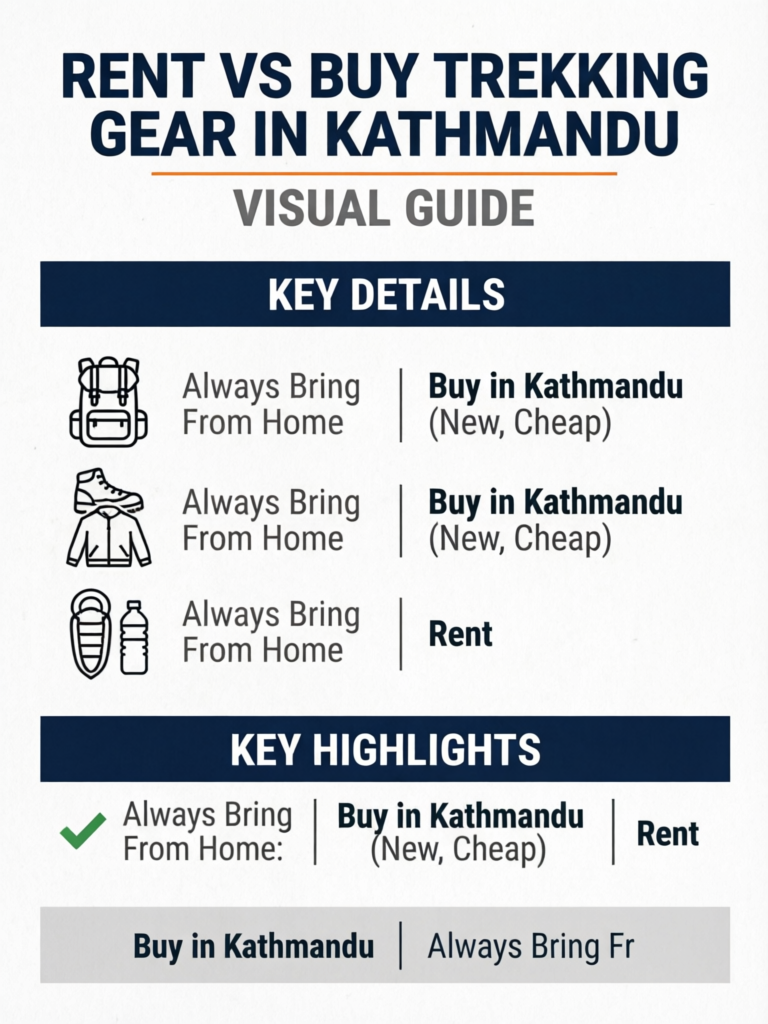
Before we get into the specifics, here is the fundamental framework. Some items are simply too important to leave to chance in Kathmandu. Others are so cheap and readily available that bringing them from home is a waste of luggage space and money.
| Always Bring From Home | Buy in Kathmandu (New, Cheap) | Rent in Kathmandu |
|---|---|---|
| Trekking boots (fit is critical -- never buy boots you have not broken in) | Down jacket ($40-80) | Sleeping bag ($1-3/day) |
| Technical base layers (merino wool/synthetic) | Fleece jacket ($15-30) | Trekking poles ($0.50-1/day) |
| Underwear and sports bras | Trekking pants ($15-25) | Large duffel bag ($0.50-1/day) |
| Prescription sunglasses or glacier glasses | Gloves -- liner and outer ($5-15) | Mountaineering boots ($3-5/day, peak climbing only) |
| Personal medications and first aid essentials | Warm hat and sun hat ($3-8) | Crampons ($2-4/day, peak climbing) |
| Broken-in daypack you trust | Buff/neck gaiter ($3-5) | Ice axes ($2-4/day, peak climbing) |
| Quality rain jacket (genuine waterproofing) | Backpack rain cover ($3-5) | Gaiters ($1-2/day) |
| Electronics and power banks | Basic thermal layers ($10-20) | Large expedition packs (peak climbing) |
The logic here is straightforward. Anything that depends on fit, technical performance in critical conditions, or personal hygiene should come from home. Anything that is essentially a commodity -- warm layers, accessories, or gear you will use once and may not need again -- is fair game for Kathmandu shopping. Rental makes sense for expensive items you will only need for a single trek, especially bulky sleeping bags and trekking poles.
Pro Tip
If you are flying to Nepal with a budget airline that charges for checked baggage, the math gets even more favorable for buying in Kathmandu. A checked bag fee of $30-50 each way can offset the cost of buying a down jacket and fleece in Thamel. Travel light, shop smart.
What to Rent: Complete Rental Guide
Renting gear in Kathmandu is a well-established system that works surprisingly well for most trekkers. Dozens of shops in Thamel specialize in rentals, and the process is straightforward: choose your gear, pay a deposit, trek, return the gear, and get your deposit back. Here is what to rent and what to look for. For a shop-by-shop rental walkthrough, see our dedicated Kathmandu gear rental guide, and cross-check what you actually need against the complete Nepal trekking packing list.
Sleeping Bags ($1-3/day)
Sleeping bags are the single most popular rental item in Kathmandu, and for good reason. A quality four-season sleeping bag costs $200-400 at home, weighs 1.5-2 kg, and takes up a huge amount of luggage space. Meanwhile, a perfectly functional rental sleeping bag in Thamel costs $1-3 per day depending on the rated temperature and quality.
What to expect: Most rental sleeping bags are rated between -10 and -15 degrees Celsius, which is adequate for the majority of popular treks including Everest Base Camp and Annapurna Circuit during peak season. For winter treks or high passes above 5,400m, look for bags rated to -20 degrees Celsius or colder -- these will be at the higher end of the rental price range.
Quality check before renting:
- Fill loft test: Shake the bag out and let it loft for a few minutes. A well-maintained bag should puff up significantly. Flat, lifeless fill means poor insulation.
- Zipper test: Zip and unzip the full length multiple times. Snagging or sticking means a miserable night ahead.
- Smell test: Give it a serious sniff. Musty or sour smells mean the bag has not been properly cleaned or dried between users. Ask for a different one.
- Cold spot check: Run your hands across the filled baffles. Uneven distribution or thin spots will leave you cold at altitude.
- Compression sack: Make sure a compression sack or stuff sack is included.
For a detailed breakdown of sleeping bag temperature ratings and what you actually need for your specific trek, see our sleeping bag temperature guide.
Pro Tip
Always bring your own sleeping bag liner from home -- a silk or cotton liner weighs almost nothing, packs tiny, and creates a hygienic barrier between you and a rental bag that has been used by hundreds of previous trekkers. A liner also adds 5-10 degrees of warmth. This is genuinely one of the best ultralight items you can carry.
Down Jackets ($1-2/day)
If you do not want to buy a down jacket in Kathmandu (covered in the next section), renting is a solid option for a single trek. Rental down jackets are typically locally made, filled with duck down in the 550-650 fill power range, and perfectly adequate for staying warm during evenings in teahouses and cold morning starts.
Quality check before renting:
- Fill loft test: Squeeze the jacket into a ball and release. Quality down springs back within 10-15 seconds. If it stays compressed, the fill is degraded.
- Cold spots: Hold the jacket up to a light source and look for translucent patches where fill is thin or missing.
- Zipper function: The main zipper is your primary defense against cold. It must work perfectly.
- Smell test: Musty jackets have been stored wet. This degrades down and means the jacket will not perform to its rating. Walk away from musty jackets.
Trekking Poles ($0.50-1/day or $5-15 for full trek)
Trekking poles are essential for Nepal trekking -- the long, steep descents absolutely punish your knees without them. Rental poles are widely available and typically cost less than a dollar per day, making them one of the best rental deals in Thamel.
Quality check before renting:
- Locking mechanism: This is the single most important test. Extend each pole to your preferred height and apply firm downward pressure. If the pole collapses or slips under pressure, the locks are worn out. Test both twist-lock and flick-lock mechanisms.
- Shaft integrity: Sight down each shaft like a pool cue. Bent shafts will not telescope properly and can collapse at the worst moment.
- Tip condition: Carbide tips should still have a point. Completely worn-down tips provide no grip on rock and ice.
- Wrist straps: Check that straps are present and adjustable. You will use them constantly.
Duffel Bags ($0.50-1/day)
If you are using a porter (which most organized treks include), your main gear goes in a large duffel bag. Renting a duffel is one of the easiest decisions -- they are cheap, widely available, and you definitely do not need to haul a big duffel from home.
What to check:
- Strap and handle integrity (porters carry these with head straps -- the bag needs to hold together)
- Zipper quality along the main opening
- Reasonable waterproofing or at minimum a waterproof liner/cover included
- 60-80 liter capacity is standard and sufficient
Mountaineering Boots ($3-5/day, Peak Climbing Only)
You only need mountaineering boots if you are climbing a trekking peak like Island Peak, Mera Peak, or Lobuche Peak. These are plastic or insulated boots designed for crampons and snow travel, completely different from your trekking boots.
Critical checks:
- Crampon compatibility: Bring or rent your crampons at the same time and verify they clip on securely.
- Fit with thick socks: Try boots wearing the socks you will actually climb in. You need about a finger-width of space at the toe.
- Shell condition: Check for cracks in plastic boots, especially around the hinge points.
- Liner condition: Inner liners should be intact and not compressed flat.
Crampons and Ice Axes ($2-4/day, Peak Climbing)
Also only relevant for peak climbing. Your climbing agency will typically arrange these rentals, but always inspect the gear yourself before heading to base camp.
Check crampons for: Sharp front points (not filed down or rounded), functional binding straps or step-in mechanisms, and correct sizing to your boots. Check ice axes for: A secure head (no wobble at the shaft-head junction), intact pick and adze, and comfortable grip length for self-arrest.
What to Buy in Kathmandu: Best Deals
Buying gear in Kathmandu is where the real savings happen. The manufacturing ecosystem in Nepal produces an enormous volume of trekking clothing and equipment, much of it surprisingly functional for the price. Here is what is worth buying and what you can expect for your money.
Down Jackets ($40-80)
This is the signature Kathmandu gear purchase. Locally manufactured down jackets are available on almost every corner of Thamel, and they represent genuinely good value. A $50-60 jacket from a decent Thamel shop will keep you warm on the Annapurna Circuit or Everest Base Camp trek, period.
What you are actually getting:
- Duck down fill, typically 550-700 fill power (lower than premium Western brands but still warm)
- Nylon shell of reasonable quality
- Functional zippers, pockets, and hood
- Weight around 500-700 grams
What you are NOT getting:
- Genuine North Face, Rab, Mountain Hardwear, or any other international brand (even if the label says so)
- Premium 800+ fill power goose down
- Technical waterproof or windproof membrane
- A jacket that will last five years of regular use
The honest assessment: A $50 Thamel down jacket is perfectly adequate for one trek and may serve you well for several more. It will not match the warmth-to-weight ratio, durability, or packability of a $300 Patagonia or Rab jacket, but for most trekkers doing one or two Nepal trips, it is the smart financial choice.
For a complete breakdown of what to look for in down jackets for Nepal, see our down jacket guide.
Fleece Jackets ($15-30)
Mid-layer fleece jackets are available everywhere in Thamel and are generally a safe buy. A $20 fleece is a $20 fleece regardless of what brand name is stitched on it -- the technology is simple and hard to get wrong. Look for:
- 200-300 weight fleece (heavier = warmer but bulkier)
- Full-zip front (more versatile for temperature regulation than half-zip)
- Adequate sleeve length and torso length for layering
For more on building an effective layering system, see our dedicated guide.
Trekking Pants ($15-25)
Lightweight, quick-drying trekking pants are widely available and a reasonable buy in Kathmandu. Convertible pants (zip-off legs to become shorts) are popular and practical for varying altitudes.
What to look for:
- Nylon or nylon-blend fabric (avoid cotton)
- Reinforced knees and seat
- Zip-off legs if you want the convertible option
- Elastic or drawstring waist (comfortable under a hip belt)
Gloves ($5-15)
The layered glove system (thin liner gloves plus insulated outer gloves or mittens) works best for trekking, and Thamel is full of affordable options.
- Fleece liner gloves ($3-5): Buy two pairs. They are small, cheap, and you will use one pair while the other dries.
- Insulated outer gloves or mittens ($8-15): Look for wind-resistant or waterproof outer material. For winter treks, heavily insulated mittens are essential.
Hats, Buffs, and Neck Gaiters ($3-10)
Thamel is absolutely overflowing with warm hats, sun hats, buffs, and neck gaiters. These are among the best-value purchases you can make:
- Warm fleece or wool beanie ($3-5): Essential for cold mornings and evenings
- Sun hat with brim ($5-8): Critical for sun protection at altitude
- Buff or neck gaiter ($3-5): Versatile piece that works as neck warmer, face cover, dust filter, and headband
- Yak wool products: Nepal is famous for beautiful yak wool scarves, hats, and gloves. They make great souvenirs and functional gear.
Base Layers ($10-20)
Thermal underwear and base layer tops are available in Thamel, but this is one category where quality really matters and Kathmandu options are hit-or-miss.
Our recommendation: Bring quality merino wool or synthetic base layers from home if you have them. If you forgot or need a backup set, Kathmandu base layers will work, but inspect the fabric carefully -- it should feel soft, stretchy, and not plasticky or stiff.
Backpack Rain Covers ($3-5)
A simple, lightweight rain cover for your daypack is one of the best $3-5 purchases in Thamel. These are simple nylon covers that stretch over your pack, and the quality is perfectly adequate regardless of price point. Buy one even if you already have a rain cover -- they are light and a backup never hurts during monsoon season or unexpected storms.
Navigating Thamel: The Gear Shopping District
Thamel is one of the most concentrated outdoor gear markets in the world. Within roughly a square kilometer, you will find over 200 shops selling trekking gear, mountaineering equipment, and outdoor clothing. It can be overwhelming, but understanding the layout and shop types will help you shop efficiently.
Where to Shop
- Thamel main streets: The highest concentration of gear shops runs along the main pedestrian areas of Thamel. This is where you will find the biggest selection but also the most tourist-focused pricing.
- JP Road and Mandala Street area: This zone has a good mix of shops with competitive pricing. Several well-established rental shops are located here.
- Side streets and alleys: Wander off the main drag and you will often find smaller shops with lower overhead costs and accordingly lower prices. These shops are often more willing to negotiate and may offer better deals on bulk purchases (renting multiple items, for example).
- North Thamel near Thamel Chowk: Slightly less tourist-dense, with shops that cater more to local trekkers and guides. Prices can be 10-20% lower here.
Types of Shops
Understanding the different shop tiers helps you set realistic expectations:
Premium/Genuine Brand Dealers: These are authorized retailers for brands like The North Face, Sherpa Adventure Gear, and a few other genuine international brands. Prices are significantly higher (often 80-90% of Western retail) but you are getting authentic products with real warranties. Look for official authorization certificates displayed in the shop.
Mid-Range Mixed Shops: The majority of Thamel shops fall into this category. They stock a combination of locally manufactured gear, some genuine budget brands, and varying quality levels. This is where most trekkers end up shopping, and where your bargaining skills and quality assessment knowledge will serve you best.
Budget Shops: These shops sell exclusively local-manufactured gear and copies. Prices are the lowest, but so is average quality. That said, for items like fleece jackets, hats, and gloves, budget shops can offer perfectly adequate products at rock-bottom prices.
Agency-Affiliated Shops: Many trekking agencies have partnerships or own gear shops. If your agency offers gear as part of the package, the quality is often acceptable but the selection may be limited. Feel free to shop independently for better deals or specific items.
Best Time to Shop
- Arrive 1-2 days before your trek starts: Give yourself time to compare shops, try on multiple options, and make decisions without pressure. Rushing through gear shopping leads to poor choices.
- Morning shopping: Shop owners are generally fresher and less pressured in the morning. The negotiation atmosphere is often more relaxed early in the day.
- Avoid last-minute panic buying: If your trek starts tomorrow morning, you have zero bargaining power and you will accept whatever is available at whatever price. This is how trekkers end up with overpriced, poor-quality gear.
Gear Shopping Timeline
The ideal approach is to arrive in Kathmandu two full days before your trek departure. Day one: explore Thamel, visit 5-6 shops, compare prices and quality, try things on. Day two: return to the best shops, negotiate, and make your purchases or rentals. This two-pass approach consistently results in better gear at better prices.
The Bargaining Game: How to Get Fair Prices
Bargaining is an expected and integral part of the Thamel shopping experience. Fixed prices are the exception, not the rule, and every price you see on a tag or hear from a shopkeeper is a starting point for negotiation. Here is how to play the game fairly and effectively.
The Basic Framework
- Ask the price. The shopkeeper will give you the "tourist price," which is typically 40-100% above what they expect to actually receive.
- Counter at 40-50% of the asking price. Yes, this feels aggressive. It is expected. The shopkeeper will not be offended.
- Negotiate back and forth. Expect 2-4 rounds of offers and counteroffers.
- Settle around 60-70% of the initial asking price. This is the sweet spot where both parties feel the transaction is fair.
Advanced Tactics
- The walk-away: This is your most powerful tool. If negotiations stall, politely say "thank you, I will think about it" and genuinely walk toward the door. In roughly half of cases, the shopkeeper will call you back with a better price. If they do not, you can always return later.
- Bundle deals: Renting or buying multiple items from one shop gives you significant leverage. "I need a sleeping bag, down jacket, poles, and gloves -- what is the best price for all four?" will almost always yield a better total than negotiating each item separately.
- Cash advantage: Some shops offer a small discount (5-10%) for cash payment versus credit card, since card processing fees cut into their margin.
- Know your reference prices: Before hitting Thamel, check online prices for equivalent gear. Knowing that a comparable down jacket sells for $80-120 online gives you a realistic baseline for negotiation.
Pro Tip
Visit 3-4 shops for the same item before committing to a purchase. On your first pass through Thamel, ask prices and inspect quality without buying anything. Take notes on your phone -- which shop had the best-feeling down jacket, which had the smoothest zipper, which quoted the lowest price. Then go back to the best option with confidence.
Bargaining Ethics
Fair Bargaining Matters
While bargaining is expected and appropriate in Thamel, there is an important line between getting a fair price and squeezing every last rupee from a small shop owner. Many of these shops are family businesses that support multiple generations. Bargaining hard at a large tourist-focused store is fine. Aggressively lowballing a small side-street shop where the owner is clearly offering reasonable prices is not a good look. If a price seems genuinely fair, accept it. The difference of $2-3 means much more to a Nepali family than to a visiting trekker.
Genuine vs Counterfeit Gear: The Thamel Reality
This is the elephant in every Thamel gear shop. Let us be direct about it.
The Truth About "North Face" in Thamel
Walk into almost any shop in Thamel and you will see racks full of gear bearing logos from The North Face, Marmot, Rab, Mountain Hardwear, Patagonia, and every other major outdoor brand. The overwhelming majority of this gear -- conservatively 95% or more -- is counterfeit. Locally manufactured clothing with brand labels stitched on.
This is not a secret. Everyone in Thamel knows it. The shopkeepers know it. The trekking agencies know it. And now you know it too.
The important thing is not to be outraged by this reality but to understand it and make smart decisions accordingly.
Some copies are surprisingly well-made. A well-constructed, locally manufactured down jacket with a fake North Face logo can be genuinely warm and functional. The fill may be decent duck down, the stitching may be solid, and the zippers may work smoothly. For a $50 jacket used on one trek, it gets the job done.
Some copies are terrible. Thin fill, poor stitching, zippers that jam on day two, and fabric that tears on the first bush you brush against. The brand label on these items is the only thing they share with the genuine product.
The quality difference between a good copy and a bad copy is enormous, which is exactly why the quality assessment skills we cover in this guide are so important.
When Authenticity Matters
Not all gear categories are equal when it comes to the genuine-vs-copy question. Here is where authenticity makes a real difference and where it does not:
Boots -- ALWAYS buy genuine: This is the one category where you should never compromise. Your trekking boots are a safety-critical piece of equipment. They need to provide ankle support on uneven terrain, reliable grip on wet rock and loose gravel, waterproof protection, and all-day comfort over multiple weeks. Fake boots may look similar but the sole construction, midsole support, and waterproofing are drastically inferior. Always bring broken-in, quality boots from home.
Waterproof shells -- genuine matters: A rain jacket's entire purpose is to keep you dry. Genuine Gore-Tex or equivalent membranes actually do this. A "waterproof" jacket from Thamel that costs $20-30 is almost certainly not truly waterproof -- it may resist light drizzle but will wet through in sustained rain. If you are trekking during monsoon season or on routes with significant precipitation, bring a genuine waterproof shell from home. See our complete gear list for recommendations.
Down jackets for one trek -- copies are usually adequate: As covered above, a well-chosen locally made down jacket works fine for insulation purposes. You are not climbing Everest; you are staying warm in a teahouse. The $250 savings versus a genuine brand is hard to argue with.
Sleeping bags for rental -- function matters more than brand: Whether a rental sleeping bag has a genuine Marmot label or a handwritten tag, what matters is the fill loft, zipper function, and actual warmth. Judge by performance, not branding.
Fleece, hats, gloves, buffs -- brand is irrelevant: These simple garments function the same regardless of whose logo is on them. Buy the cheapest option that feels decent.
How to Spot Quality Regardless of Brand
Since branding is unreliable in Thamel, here is how to assess actual quality:
- Stitch quality: Look at the seams closely. Even, consistent stitching with no loose threads or skipped stitches indicates better manufacturing. Double-stitched seams at stress points (shoulders, armpits, side seams) are a good sign.
- Zipper quality: Look for YKK brand zippers -- they are the global standard for reliability. If the zipper pull says YKK, the manufacturer invested in a quality component. Non-branded zippers are more likely to jam or fail.
- Fill quality (for down items): Quality down should feel soft, lofty, and springy. It should not feel lumpy, flat, or crunchy. Compress the jacket or bag and release -- good down rebounds within seconds.
- Material feel: Touch the outer fabric. It should feel substantial, slightly slick (nylon), and not papery-thin. Very thin, crinkly fabric tears easily and offers poor wind protection.
- Hardware: Check snaps, buckles, Velcro, and drawcords. Quality hardware operates smoothly and feels solid. Cheap hardware feels flimsy and sticks.
Do Not Pay Genuine Prices for Counterfeit Gear
The most common scam in Thamel is not selling fake gear -- it is selling fake gear at prices that imply authenticity. If a "North Face" down jacket is priced at $30-50, everyone understands it is locally made. But some shops price identical counterfeit products at $100-150, implying they are genuine imports. They are not. A genuine North Face Summit Series down jacket retails for $300-400. If it is in Thamel for $120, it is still a copy -- just an expensive one. Do not pay a premium for a counterfeit product.
Quality Assessment Checklist
Use this checklist every time you rent or buy gear in Kathmandu. It takes five minutes and can save you from a miserable trek:
- Zipper test: Does every zipper zip smoothly along its full length? Are zippers branded YKK? Can you operate them with gloves on? (You will need to at altitude.)
- Fill test (for down items): Squeeze the jacket or bag firmly into a ball and release. Does the fill spring back within 10-15 seconds to its original loft? If not, the down is degraded or low quality.
- Smell test: Give the item a thorough sniff, especially inside sleeping bags. Musty, sour, or chemical smells indicate poor storage, inadequate cleaning, or low-quality materials. Reject anything that smells off.
- Seam inspection: Check major seams (shoulders, sides, cuffs) for double stitching. Look for loose threads, skipped stitches, or puckered seams. Pay extra attention to seams under stress points.
- Waterproof test: For any item claimed to be waterproof, pour a small amount of water on the surface fabric. It should bead up and roll off. If water soaks through, the item is water-resistant at best. Ask the shopkeeper if you can do this test -- reputable shops will not object.
- Velcro test: Press and pull Velcro closures (wrist cuffs, storm flaps). Strong, fresh Velcro grips firmly. Worn Velcro barely holds and will not seal out cold wind at altitude.
- Elastic test: Check all elastic components -- wrist cuffs, ankle cuffs, hood drawcords, hem adjustments. Elastic should snap back firmly. Limp elastic means the garment has been over-used and stretched out.
- Size check: This is critical. Try on every item wearing the layers you will actually have underneath. A down jacket that fits perfectly over a t-shirt in a warm Thamel shop will be too tight over two base layers and a fleece at 5,000 meters. Size up when in doubt.
Deposit and Return Process
Understanding the rental deposit system before you walk into a shop helps you negotiate better and avoid misunderstandings.
Standard Process
- Choose your gear and agree on rental rates (daily or flat rate for your trek duration).
- Pay a deposit of $20-50 per item, depending on the item's value. Sleeping bags and down jackets typically require $30-50. Trekking poles and duffel bags are $20-30.
- Get a written receipt itemizing: each rented item, its condition, the daily or flat rate, the deposit amount, the expected return date, and the refund terms.
- Photograph everything at pickup. Take photos of each rented item showing its current condition, including any pre-existing damage, stains, or wear. This is your insurance against unfair damage claims at return.
- Return gear within the agreed timeframe, typically your trek end date plus 1-2 buffer days.
- Inspection at return: The shopkeeper will examine each item for new damage. Normal wear (trail dust, minor scuffs) is expected and should not incur charges. Torn fabric, broken zippers, or lost items will result in deposit deductions.
- Receive your deposit refund in the agreed-upon form.
Pro Tip
Before paying your deposit, explicitly ask: "Is the deposit refundable in cash, or only as store credit?" Some shops default to store credit refunds, which is useless if you are flying home tomorrow. Get a cash refund agreement written on the receipt. Also clarify whether the deposit is in USD or Nepali Rupees, and at what exchange rate -- this avoids disputes when currency rates shift during a two-week trek.
Deposit Tips
- Credit card hold: Some shops can do a credit card authorization hold instead of taking a cash deposit. This means no actual charge unless you damage or lose the gear. If available, this is often the best option.
- Negotiate the deposit: Deposits are negotiable, especially when renting multiple items. "I am renting five items -- can we do a single $80 deposit instead of $50 per item?" is a reasonable ask.
- Keep your receipt safe: Photograph it and store the original in your daypack, not in the duffel bag that goes with the porter. You need the receipt to get your deposit back.
- Return timing: Try to return gear early in the day and not on the day of your flight. This gives you time to resolve any disputes without the pressure of an airport deadline.
Complete Cost Comparison: Rent vs Buy vs Bring
This table compares the three approaches across essential gear items, using average prices tracked across 30+ Thamel shops in February 2026. The "bring from home" prices assume quality mid-range brands purchased at Western retail.
| Item | Bring From Home | Buy in Kathmandu | Rent (14-day trek) | Recommendation |
|---|---|---|---|---|
| Down jacket | $200-350 (premium brand) | $40-80 | $14-28 | Buy in Kathmandu (best value for 1-2 treks) |
| Sleeping bag (-15C) | $200-400 | $60-120 | $14-42 | Rent (saves luggage space and money) |
| Trekking poles (pair) | $60-150 | $15-35 | $7-14 | Rent for one trek; buy KTM if doing multiple treks |
| Trekking boots | $150-280 | NOT recommended | NOT recommended | Bring from home (fit and safety critical) |
| Fleece jacket | $60-120 | $15-30 | N/A (buy) | Buy in Kathmandu (easy savings) |
| Trekking pants (x2) | $80-160 | $30-50 | N/A (buy) | Buy in Kathmandu or bring if you have them |
| Rain jacket | $100-300 (Gore-Tex) | $20-40 (fake waterproof) | N/A | Bring from home (genuine waterproofing matters) |
| Gloves (liner + outer) | $30-60 | $8-15 | N/A (buy) | Buy in Kathmandu |
| Warm hat | $15-30 | $3-8 | N/A (buy) | Buy in Kathmandu |
| Duffel bag | $40-80 | $15-25 | $7-14 | Rent (no need to own one) |
| Buff/neck gaiter | $20-30 | $3-5 | N/A (buy) | Buy in Kathmandu |
| Backpack rain cover | $15-25 | $3-5 | N/A (buy) | Buy in Kathmandu |
| TOTAL | $970-1,985 | $212-418 | $42-98 (rental items only) |
Total Cost by Strategy
Strategy A -- Bring Everything From Home: $970-1,985. Best for frequent trekkers who will use the gear repeatedly. Highest upfront cost but lowest per-trip cost over time.
Strategy B -- Hybrid Approach (Recommended): Bring boots, rain jacket, base layers, and electronics from home ($300-600). Buy down jacket, fleece, pants, gloves, hat, and accessories in Kathmandu ($80-160). Rent sleeping bag, poles, and duffel ($35-70 for a 14-day trek). Total: $415-830 for complete gear coverage. This represents savings of 50-60% versus buying everything at home.
Strategy C -- Maximum Budget Mode: Bring only boots and rain jacket from home ($250-450). Buy and rent everything else in Kathmandu. Total: $350-600. Slightly more risk on quality but dramatically lower cost. See our budget trekking guide for more money-saving strategies.
If You Plan to Trek Again
If you know you will return to Nepal or trek elsewhere in the future, the calculus shifts. Buying quality gear at home that will last for years becomes more cost-effective than repeatedly buying cheap Kathmandu gear. A $300 down jacket that lasts ten years costs $30 per trek. A $50 Kathmandu jacket that lasts two treks costs $25 per trek -- not as different as it first appears. Factor in your future plans when deciding.
Selling Gear After Your Trek
Here is a bonus strategy that many experienced trekkers use: buy gear in Kathmandu, trek with it, and sell it back to a shop (or to another trekker) when you are done.
Selling to shops: Some Thamel shops will buy back gently used gear at approximately 30-50% of what you paid. A $60 down jacket might sell back for $20-30. This effectively means you "rented" a jacket for $30-40 and got to choose your own brand-new item rather than using someone else's rental gear. Not every shop does buy-backs, so ask at the time of purchase if they accept returns or buy-backs.
Selling to other trekkers: Hostels, guest houses, and online trekking forums in Kathmandu have active second-hand gear markets. Post a note on a hostel bulletin board or in a Facebook group the day before you fly out. Other arriving trekkers are often happy to buy used gear at a discount.
Donating: If selling is too much hassle, several organizations in Kathmandu accept used trekking gear donations, which are distributed to porters and local trekkers who cannot afford their own equipment. Ask at your hotel or trekking agency for donation drop-off points, or see our gear donation guide for Nepal for where and how to give your gear a second life.
Common Mistakes to Avoid
After surveying hundreds of trekkers about their Kathmandu gear shopping experience, these are the most frequent regrets:
-
Buying boots in Kathmandu. We cannot emphasize this enough. Trekking boots need to be broken in over weeks of walking. Buying new boots the day before your trek is a recipe for blisters, pain, and potentially having to abandon your trek. Always bring broken-in boots from home.
-
Overpacking "just in case" gear from home. Many trekkers arrive in Kathmandu with 30 kg of gear, half of which they never use. Trust the system: bring the essentials from home, buy and rent the rest in Thamel.
-
Paying full asking price. The first price quoted in Thamel is never the final price. Always negotiate.
-
Not testing gear before leaving Thamel. Try on every item. Test every zipper. Check every strap. Do this in the shop, not on the trail. Shops will not exchange gear once you have left for your trek.
-
Panic buying on departure day. Give yourself at least one full day for gear shopping. Last-minute buyers overpay and under-inspect.
-
Assuming "waterproof" means waterproof. In Thamel, the word "waterproof" is applied to almost anything with a DWR coating. True waterproofing requires a membrane (Gore-Tex, eVent, or similar). A $25 Thamel rain jacket will not keep you dry in real rain. Bring genuine waterproof layers from home or consider water purification options for planning your wet-weather strategy.
-
Not bringing a sleeping bag liner. This tiny, lightweight item is the single most important hygiene accessory for anyone renting a sleeping bag. Bring one from home.
-
Forgetting to photograph rental gear. Without photos of the gear's condition at pickup, you have no defense against unfair damage charges. Take photos of every rental item before leaving the shop.
FAQ
Final Thoughts
Kathmandu's Thamel district is a trekker's paradise for affordable gear -- if you know how to navigate it. The system of buying and renting gear locally has served hundreds of thousands of trekkers well, saving them significant money and luggage hassle.
The golden rules are simple: bring safety-critical and fit-dependent items from home (boots, rain jacket, base layers). Buy commodity insulation and accessories in Kathmandu (down jacket, fleece, gloves, hats). Rent expensive, bulky items you will only need once (sleeping bag, poles, duffel). Inspect everything thoroughly, bargain fairly, and give yourself enough time to shop properly.
Whether you are a budget backpacker trying to trek Nepal for under $1,000 or a comfort-focused trekker who wants to optimize value, Thamel in 2026 has what you need at prices that still undercut Western retail by 40-60%. Walk the streets, talk to shopkeepers, compare options, and enjoy the experience. Gear shopping in Thamel is, for many trekkers, the first real taste of the adventure that awaits in the Himalayas.
For a comprehensive overview of everything you need to bring, check our complete trekking gear list. And for route-specific gear advice, see our guides for Everest Base Camp and Annapurna Circuit.
Trek smart. Shop smart. The mountains are waiting.
Planning your Nepal trek?
Sort your gear in Thamel, then trek with confidence. Get a free quote from a verified local agency that handles permits, guides, porters, and gear logistics for you.