
-10 to -20°C comfort for EBC / high-altitude treks
$1-3/day (NPR 130-400)
$80-400 depending on fill and brand
0.8-2.5 kg (down lighter than synthetic)
~5°C at best; inadequate above 3,500m
650-900+ (higher = warmer per gram)
Sleeping Bag Temperature Guide for Nepal Trekking
Quick answer: Use this sleeping bag temperature guide to match a bag's comfort rating (not its limit or extreme rating) to the coldest night you expect, then add a 5-10°C buffer. For most Nepal treks that means a -10°C to -15°C comfort bag; for Everest Base Camp in autumn, aim for -15°C to -20°C comfort because Gorak Shep (5,164m) drops to -15°C or colder.
A sleeping bag is, without exaggeration, the single most important piece of gear you carry on a Nepal trek. Not your boots. Not your jacket. Your sleeping bag. Here is why: after eight to ten hours of walking at altitude, your body needs deep, restorative sleep to recover and acclimatize. If you spend the night shivering in an inadequate sleeping bag at 4,900m in Gorak Shep, where nighttime temperatures drop to -15°C or lower, you will not sleep. And if you do not sleep, the next day's trek becomes dangerous. Poor rest compounds altitude sickness symptoms, destroys morale, and turns what should be a life-defining adventure into a miserable endurance test.
Every trekking season, guides report trekkers who underestimated how cold the Himalayas get at night. They assumed the tea house would be warm (it will not be above 3,500m), that two blankets would suffice (they will not), or that their "three-season" sleeping bag rated to 0°C would handle Everest Base Camp (it absolutely will not). This guide exists to make sure you are not one of those trekkers.
Whether you are heading to Everest Base Camp, Annapurna Base Camp, Langtang Valley, or any of Nepal's high-altitude routes, this guide will help you choose the right sleeping bag for the temperatures you will actually encounter, understand what the numbers on the label mean, and make a smart decision about whether to rent, buy locally, or bring your own.
What this guide covers:
- How temperature ratings actually work (and why most people read them wrong)
- Exact nighttime temperatures at key tea house stops across major treks
- Down vs synthetic fill: an honest comparison for Himalayan conditions
- Fill power, shape, features, and why they matter
- The sleeping bag liner strategy that experienced trekkers swear by
- Renting vs buying: costs, quality, and what to inspect
- Tea house blanket reality check
Understanding Temperature Ratings
Before you look at a single sleeping bag, you need to understand what the temperature numbers printed on it actually mean. This is where most trekkers get it wrong, and where bad decisions start.
How Sleeping Bags Are Tested
Modern temperature ratings come from a standardized lab test, not a manufacturer's guess. Under EN 13537 (now ISO 23537), a heated mannequin fitted with temperature sensors is dressed in standard base layers and a cold-weather mask, placed on a standardized sleeping pad inside a climate-controlled chamber, and the lab measures how much power is needed to keep it warm. That thermal-resistance figure is converted into the three published ratings (comfort, limit, extreme).
Two things this means for you as a trekker:
- The number in a bag's name is not its real rating. A bag marketed as a "15" might carry an ISO lower-limit rating of 18°F. Brands round to clean numbers, so always read the actual comfort/limit figure on the spec sheet, not the name.
- The test is repeatable but not personal. The standardized mannequin does not eat, sleep restlessly, get dehydrated, or sit at 5,000m. It also excludes true expedition bags (limit colder than roughly -24°C), so very cold bags often carry an estimated rating rather than a tested one. Treat the lab number as an apples-to-apples comparison tool between brands, then adjust for your own situation at altitude.
Comfort Rating vs Limit Rating vs Extreme Rating
Modern sleeping bags tested under the European EN 13537 standard (or the newer ISO 23537) carry three temperature ratings:
Comfort Rating — The temperature at which a "standard" woman (25 years old, 60 kg, 160 cm) can sleep comfortably in a relaxed position for a full night. This is the number that matters for most trekkers.
Lower Limit Rating — The temperature at which a "standard" man (25 years old, 80 kg, 173 cm) can sleep for eight hours in a curled position without waking from cold. This is sometimes marketed as the "main" rating. It is optimistic for most people.
Extreme Rating — The minimum temperature at which a standard woman can survive (not sleep comfortably, just survive) for six hours without risk of hypothermia. This number exists for emergency reference only. Never, ever plan around this number.
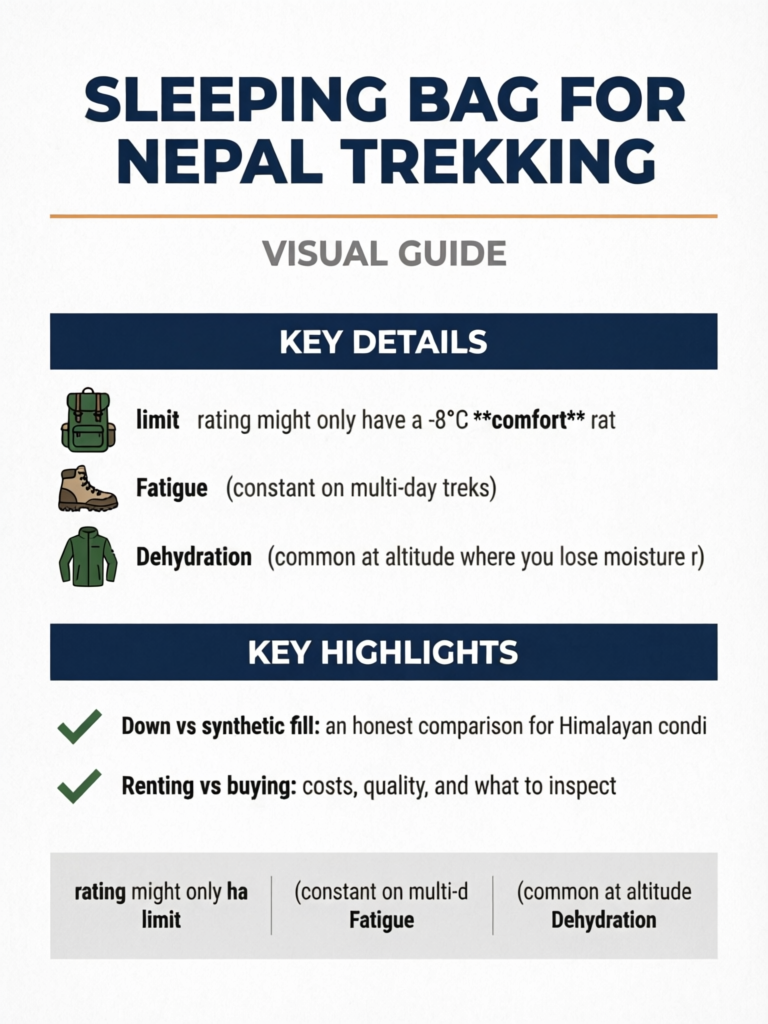
The critical distinction: if a sleeping bag is labeled "-15°C," you need to determine which of these three ratings that refers to. A bag with a -15°C limit rating might only have a -8°C comfort rating. That is a massive difference when you are sleeping at 5,100m altitude.
Why the Comfort Rating Is the Only Number That Matters
When you are trekking at altitude, your body is already under stress. You are dehydrated. You are fatigued. Your metabolism may be suppressed by altitude. You are not a laboratory test subject sleeping in controlled conditions. You are a tired trekker in a tea house where the wooden walls have gaps, the windows do not seal properly, and there is no heating after the dining room stove goes out around 8 PM.
Always select your sleeping bag based on the comfort rating, not the limit or extreme rating.
One detail the lab test quietly assumes: a sleeping pad underneath the bag. A bag's published rating only holds if you insulate yourself from the cold ground or tea house floor. On the standardized test a pad is always present, so pairing your bag with an adequate sleeping pad or mat is part of hitting the rating, not an optional extra.
How Gender Affects Temperature Ratings
Women statistically sleep colder than men, and the EN/ISO testing standards reflect this. The comfort rating is calibrated to a female sleeper; the lower limit to a male sleeper. If you are a woman, the comfort rating is your benchmark. If you are a man, you can sometimes get away with a bag where the lower limit matches your expected temperature, but adding a buffer is still wise.
Other factors that make you sleep colder:
- Fatigue (constant on multi-day treks)
- Dehydration (common at altitude where you lose moisture rapidly through breathing)
- Low body weight or low body fat percentage
- Age over 50 (metabolism changes reduce heat production)
- Altitude itself (reduced oxygen means less efficient metabolic heat generation)
The Buffer Rule: Add 5-10°C
Here is the practical rule that experienced Himalayan guides recommend: take the lowest temperature you expect to encounter, then subtract another 5-10°C. That is your target comfort rating.
If Gorak Shep at 5,164m can drop to -15°C in late October, your sleeping bag should have a comfort rating of -20 to -25°C. That may sound extreme, but it is better to unzip a too-warm sleeping bag than to spend the night shivering in one that is not warm enough. You cannot add warmth that is not there.
Do Not Trust Unrated or Non-EN/ISO Tested Bags
Many budget sleeping bags sold in Kathmandu's Thamel district carry temperature ratings that have not been independently tested. A locally made bag labeled "-20°C" may in practice only be comfortable to -5°C or -10°C. If you are buying in Kathmandu, judge by loft (puffiness), weight, and feel rather than the printed number. When renting, the same caution applies double.
What Temperature Rating Do You Need?
The right sleeping bag depends entirely on where you are going, when you are going, and how cold you personally sleep. Here is a breakdown by trek and season with actual recorded nighttime temperatures at key stops.
Sleeping Bag Temperature Guide at a Glance
If you only read one table, read this one. It maps the maximum altitude of your trek to the comfort rating you should target (buffer already included).
| Max Trek Altitude | Conditions | Target Comfort Rating |
|---|---|---|
| Below 2,500m | Lowland / foothill treks | +5°C to 0°C |
| 2,500-3,500m | Spring / autumn | 0°C to -5°C |
| 3,500-4,500m | Spring / autumn (ABC, Langtang) | -10°C to -15°C |
| 4,500-5,500m | Spring / autumn (EBC, Gokyo) | -15°C to -20°C |
| Any high-altitude trek | Winter (Dec-Feb) | -20°C to -25°C |
Temperature Ratings by Trek and Season
| Trek / Route | Season | Recommended Comfort Rating | Why |
|---|---|---|---|
| Poon Hill / Ghorepani | Spring / Autumn | 0°C to -5°C | Max altitude 3,210m; cold but not extreme |
| Poon Hill / Ghorepani | Winter | -10°C to -15°C | Snow and sub-zero nights even at moderate altitude |
| Annapurna Base Camp | Autumn (Oct-Nov) | -10°C to -15°C | ABC at 4,130m sees -10 to -15°C nights in November |
| Annapurna Base Camp | Spring (Mar-Apr) | -5°C to -10°C | Warmer nights, but still cold at ABC |
| Langtang Valley | Autumn | -10°C to -15°C | Kyanjin Gompa at 3,870m drops to -8 to -12°C |
| Everest Base Camp | Autumn (Oct-Nov) | -15°C to -20°C | Gorak Shep at 5,164m regularly hits -15°C or colder |
| Everest Base Camp | Spring (Mar-May) | -10°C to -15°C | Warmer than autumn, but nights still frigid above 4,000m |
| EBC / Any trek | Winter (Dec-Feb) | -20°C to -25°C | Extreme cold at all altitudes; fewer trekkers for a reason |
| Three Passes Trek | Autumn / Spring | -15°C to -20°C | Passes above 5,300m; exposed camping at altitude |
| Manaslu Circuit | Autumn | -10°C to -15°C | Larkya La base camp at 4,460m is very cold |
| Upper Mustang | Autumn | -10°C to -15°C | High desert; cold, dry nights despite lower humidity |
Actual Nighttime Temperatures at Key Stops
These are real-world temperature ranges based on trekker temperature logs and guide reports across autumn (October-November) seasons:
Everest Base Camp Trek:
- Lukla (2,860m): 2°C to 8°C — cool but manageable
- Namche Bazaar (3,440m): -2°C to 5°C — getting cold, blankets still borderline adequate
- Tengboche (3,870m): -5°C to 0°C — you need your sleeping bag from here
- Dingboche (4,410m): -8°C to -3°C — tea house rooms are noticeably cold
- Lobuche (4,940m): -12°C to -5°C — ice forms inside windows
- Gorak Shep (5,164m): -18°C to -10°C — the coldest night of the trek for most people
- EBC (5,364m): -20°C to -12°C — if camping, this is brutal
Annapurna Base Camp Trek:
- Ghorepani (2,860m): 0°C to 6°C
- Tadapani (2,630m): 2°C to 8°C
- Deurali (3,230m): -3°C to 3°C
- Machhapuchhre Base Camp (3,700m): -6°C to -1°C
- Annapurna Base Camp (4,130m): -12°C to -5°C
Langtang Valley Trek:
- Lama Hotel (2,480m): 3°C to 10°C
- Langtang Village (3,430m): -3°C to 4°C
- Kyanjin Gompa (3,870m): -10°C to -3°C
Pro Tip
Write down the altitude and expected nighttime temperature of the highest point on your trek. That single number determines your sleeping bag choice more than anything else. For EBC trekkers, that number is Gorak Shep at 5,164m with nighttime lows around -15 to -18°C in peak autumn season. Your sleeping bag comfort rating should match or exceed that.
Down vs Synthetic Fill
The fill inside your sleeping bag determines its warmth, weight, packability, and how it behaves in wet conditions. For Nepal trekking, both down and synthetic have legitimate roles, and the right choice depends on your trek type, budget, and conditions.
Down Sleeping Bags
Down is nature's best insulator. Goose down (and to a lesser extent, duck down) traps an extraordinary amount of warm air relative to its weight. High-quality down sleeping bags are lighter, more compressible, and warmer than any synthetic equivalent.
Advantages:
- Superior warmth-to-weight ratio — A 900-fill-power down bag rated to -15°C comfort might weigh just 1.0-1.2 kg. A synthetic bag with the same rating weighs 1.8-2.5 kg.
- Excellent packability — Down compresses to a fraction of its lofted size, saving crucial space in your duffel bag.
- Longevity — A well-cared-for down bag maintains its loft for 10-15 years or more. Quality down outlasts synthetic fill by a wide margin.
- Comfort — Down sleeping bags drape naturally around your body, reducing cold spots.
Disadvantages:
- Useless when wet — This is the critical weakness. Wet down clumps together and loses nearly all insulating ability. In the Himalayas, condensation inside tea houses, unexpected rain, or a spilled water bottle can be problematic.
- Expensive — Quality down bags start around $200 for basic models and run $300-500+ for premium options.
- Drying time — Wet down takes hours to days to dry, and you will not have a dryer on the trail.
- Ethical considerations — Some trekkers prefer to avoid animal products. Look for RDS (Responsible Down Standard) certified bags if ethics matter to you.
Modern mitigation: Many premium down bags now feature hydrophobic down treatment (such as Nikwax or DownTek), which causes the down clusters to resist moisture. This significantly reduces the wet-weather vulnerability, though it does not eliminate it entirely.
Synthetic Sleeping Bags
Synthetic insulation uses polyester fibers arranged to mimic down's loft. While heavier and bulkier, synthetic fill offers meaningful advantages in specific conditions.
Advantages:
- Insulates when damp — Synthetic fill retains 80-85% of its warmth even when wet. In humid conditions or if your sleeping bag gets soaked, this is a genuine safety advantage.
- Affordable — Decent synthetic bags rated to -10°C comfort can be found for $80-150. Budget-friendly options exist at $50-80, though quality varies.
- Quick drying — Synthetic fill dries much faster than down if it does get wet.
- Low maintenance — Synthetic bags are easier to wash and more forgiving of rough treatment.
- Hypoallergenic — No animal products; no risk of down allergies.
Disadvantages:
- Heavier — Expect 30-50% more weight than an equivalent-warmth down bag.
- Bulkier — Synthetic fill does not compress as well, taking up more space in your pack or duffel.
- Shorter lifespan — Synthetic insulation degrades faster than down, losing loft after 3-5 years of regular use.
- Less warm per gram — You simply need more synthetic material to achieve the same warmth as down.
When to Choose Which
Choose down if:
- You are doing a tea house trek (sleeping indoors reduces moisture exposure)
- Weight and packability matter to you
- You are investing in gear for multiple treks
- You can protect the bag from moisture with a dry bag or waterproof stuff sack
- Your budget allows $200+
Choose synthetic if:
- You are camping or doing a trek with significant rain exposure
- You are trekking in monsoon season (June-September)
- Budget is your primary concern
- You plan to rent in Kathmandu (most rental bags are synthetic)
- You are a one-time trekker and do not want to invest heavily
The practical reality: For the vast majority of Nepal tea house trekkers heading to Everest Base Camp, Annapurna Base Camp, or Langtang Valley in the peak autumn or spring seasons, a down sleeping bag is the better choice. You are sleeping indoors every night, humidity is relatively low in these seasons, and the weight and pack-size savings are significant when your porter has a weight limit.
For a detailed comparison of down insulation in jackets, which follows similar principles, see our down jacket guide.
Fill Power Explained
Fill power is the measure of down quality, expressed as the volume (in cubic inches) that one ounce of down occupies when fully lofted. Higher fill power means the down traps more air per ounce, which means more warmth for less weight.
Fill Power Tiers
650 Fill Power — Budget / Entry Level
- Adequate warmth, but heavier and bulkier
- A -15°C comfort bag might weigh 1.8-2.2 kg
- Good option if you prioritize cost over weight
- Typical of locally made bags in Kathmandu ($80-150)
- Pack size: roughly the size of a large watermelon
800 Fill Power — Mid-Range Sweet Spot
- Excellent warmth-to-weight ratio
- A -15°C comfort bag might weigh 1.2-1.5 kg
- The best balance of performance and price for most trekkers
- Brands like Marmot, Mountain Hardwear, and REI offer solid options ($200-350)
- Pack size: roughly the size of a cantaloupe
900+ Fill Power — Premium / Ultralight
- Maximum warmth with minimum weight
- A -15°C comfort bag might weigh just 0.9-1.2 kg
- Significantly more expensive ($350-600+)
- Brands like Western Mountaineering, Feathered Friends, Rab Neutrino
- Pack size: roughly the size of a grapefruit
- Best for trekkers who do multiple expeditions and value every gram
The Math Behind Fill Power
Here is a concrete example. To achieve the same warmth:
- A 650-fill bag needs approximately 700g of down
- An 800-fill bag needs approximately 500g of down
- A 900-fill bag needs approximately 400g of down
The shell fabric, zipper, and other components add similar weight across all three, so the total weight difference between a 650-fill and 900-fill bag of equal warmth can be 500g or more. Over a two-week trek, every gram you carry adds up.
Bottom line: If budget allows, aim for 800 fill power. It is the sweet spot where you get meaningfully lighter weight without paying the premium markup that 900+ fill commands. If budget is tight, 650 fill power still works; you just carry a bit more weight.
Shape & Features
The shape and features of your sleeping bag affect warmth, comfort, and weight. Here is what matters for Himalayan trekking.
Mummy vs Semi-Rectangular
Mummy Shape
- Tapers from shoulders to feet, closely following body contours
- Most thermally efficient design: less dead air space to heat
- Lighter weight (less fabric and insulation needed)
- Can feel restrictive if you are a restless sleeper or claustrophobic
- Recommended for treks above 4,000m where every degree of warmth matters
Semi-Rectangular / Modified Mummy
- Wider through the hips, knees, and feet
- More comfortable for side sleepers and those who toss and turn
- Slightly less warm than a true mummy due to more air space
- Slightly heavier
- Acceptable for treks below 4,000m or for those who truly cannot tolerate mummy bags
The verdict for Nepal: A mummy bag is the standard recommendation. The warmth-to-weight advantage is meaningful at altitude. If you find mummy bags uncomfortable, look for "relaxed mummy" or "wide mummy" designs that offer a bit more room without the penalty of a full rectangular bag.
Hood Design
At high altitude, you lose a significant percentage of body heat through your head. A well-designed hood is not optional; it is essential.
What to look for:
- Insulated hood that wraps around your head and cinches down with a single drawcord
- Contoured shape that follows the curve of your head without gaps
- Draft tube behind the drawcord to prevent cold air entering at the opening
- The ability to cinch the hood down until only your nose and mouth are exposed (you will do this at Gorak Shep)
Bags without hoods (rectangular or "blanket-style") are not suitable for high-altitude Nepal treks. Period.
Draft Collar and Zipper Baffles
Draft collar: An insulated tube that sits around your neck/shoulders and prevents warm air from escaping out the top of the bag when you are cinched in. Critical for bags rated below -10°C.
Zipper baffles: Insulated tubes that run along the inside of the zipper, preventing cold air from seeping through the zipper teeth. A zipper without a baffle is a thermal weakness in any sleeping bag. Quality bags have full-length insulated zipper baffles on both sides.
Zipper Considerations
Full-length zipper: Allows complete opening for ventilation on warmer nights (useful at lower altitudes) and easier entry/exit. Adds a small amount of weight.
Half-length zipper: Lighter, but you cannot open the bag fully for temperature regulation. Fine for dedicated cold-weather bags.
Left zip vs right zip: This matters if you trek with a partner and want the option of zipping two bags together. Two bags can be joined if one has a left zip and the other a right zip (same brand and model works best). However, zipped-together bags are significantly less warm than individual mummy bags because the mummy shape loses its thermal advantage. This is only practical at lower altitudes.
The Secret Weapon: Sleeping Bag Liners
If there is one piece of advice that separates experienced Himalayan trekkers from first-timers, it is this: bring a sleeping bag liner. A good liner adds meaningful warmth, extends the temperature range of your sleeping bag, and keeps the inside of the bag cleaner and more hygienic. For the full breakdown of liner fabrics and warmth ratings, see our dedicated sleeping bag liners guide.
Liner Types and Temperature Additions
Silk Liners
- Temperature boost: +5 to 8°C
- Weight: 100-150g
- Pack size: fits in your palm
- Feel: luxurious against the skin, smooth, breathable
- Cost: $30-60
- Best for: adding moderate warmth without noticeable weight; doubles as a standalone sheet in warm conditions
Thermal Fleece Liners
- Temperature boost: +10 to 15°C
- Weight: 300-500g
- Pack size: about the size of a water bottle
- Feel: warm and soft, but can feel bulky inside a tight mummy bag
- Cost: $25-50
- Best for: significant warmth addition when your sleeping bag is borderline for the temperatures
Reactor Liners (Thermolite / ThermoLite Reactor)
- Temperature boost: +8 to 15°C (varies by model)
- Weight: 250-350g
- Pack size: slightly smaller than a fleece liner
- Feel: stretchy, wicking, comfortable
- Cost: $40-80
- Best for: maximum warmth boost with reasonable weight; popular among trekkers who want premium performance
Cotton Liners
- Temperature boost: +2 to 3°C
- Weight: 300-400g
- Not recommended for trekking: heavy for minimal warmth gain, slow to dry
The Hygiene Factor
Tea house bedding in Nepal ranges from reasonably clean to questionable. Above 3,500m, where water is scarce and laundry facilities nonexistent, blankets and mattresses may not be washed between guests for weeks or months during peak season. A sleeping bag liner creates a barrier between you and the mattress (and between you and the inside of a rented sleeping bag, which may have been used by dozens of trekkers before you).
Bed bugs, while not universal, do exist in some tea houses. A liner will not fully prevent bites, but it adds a layer of protection and gives you peace of mind.
The Liner Strategy
Pro Tip
A quality thermal liner can effectively turn a 0°C sleeping bag into a -10°C sleep system, or a -10°C bag into a -20°C system. If you already own a three-season sleeping bag rated to 0°C or -5°C, buying a Thermolite Reactor liner ($50-80) is far cheaper than buying an entirely new cold-weather sleeping bag ($200-400). Pack both, and you have a versatile system that works from Pokhara's warmth to Gorak Shep's bitter cold.
Recommended combinations:
| Sleeping Bag Rating | Liner Type | Combined System Rating | Suitable For |
|---|---|---|---|
| 0°C comfort | Thermolite Reactor (+10°C) | ~-10°C | ABC in autumn, Langtang |
| -5°C comfort | Silk liner (+5°C) | ~-10°C | ABC, Langtang, lower EBC |
| -10°C comfort | Thermolite Reactor (+10°C) | ~-20°C | EBC, Three Passes, winter treks |
| -10°C comfort | Fleece liner (+12°C) | ~-22°C | Cold sleepers on EBC, winter |
| -15°C comfort | Silk liner (+5°C) | ~-20°C | EBC peak season, reliable system |
Rent vs Buy Your Sleeping Bag
This is one of the most common questions among first-time Nepal trekkers, and the answer depends on your trekking frequency, budget, and comfort with uncertainty.
Rental Options in Kathmandu and Pokhara
Sleeping bag rental is widely available in both Kathmandu (primarily Thamel) and Pokhara (Lakeside). Dozens of shops offer rental gear, and your trekking agency may also include a sleeping bag in their package.
Typical rental costs:
- Basic synthetic bag (rated -5 to -10°C claimed): NPR 100-200/day ($0.75-1.50)
- Better synthetic or budget down bag (rated -10 to -15°C claimed): NPR 200-300/day ($1.50-2.25)
- Quality down bag (rated -15 to -20°C claimed): NPR 300-400/day ($2.25-3.00)
For a 14-day EBC trek, rental costs range from $10 to $40 total. That is undeniably cheap compared to buying.
The Quality Problem with Rentals
Here is the catch: rental sleeping bags in Kathmandu vary enormously in quality. Some shops maintain clean, well-lofted bags from reputable brands. Others rent out bags that have been compressed in stuff sacks for months, losing loft and warmth, with zippers that snag and fill that has clumped.
What to inspect before renting:
- Loft — Lay the bag flat and wait five minutes. It should puff up to at least 10-15 cm of loft for a -10°C bag. If it lies flat and thin, the insulation is dead.
- Zipper — Zip and unzip the full length. Snagging zippers at 2 AM in the dark at 5,000m are infuriating and potentially dangerous if you need to get up quickly.
- Smell — Sniff the inside. A musty, body-odor-heavy sleeping bag suggests poor maintenance. You will be sleeping with your face in this material for two weeks.
- Seams and tears — Check for ripped baffles, torn shell fabric, and exposed insulation. Down leaking out means warmth leaking out.
- Drawcords — Test the hood drawcord and any collar drawcords. They should cinch smoothly and hold.
- Stuff sack and compression straps — Make sure you have a way to pack it.
Temperature Ratings on Rental Bags Are Unreliable
Rental bags in Kathmandu almost never have EN/ISO tested ratings. A bag labeled "-20°C" might provide -10°C of actual warmth, or it might provide -5°C if the fill is old and compressed. Judge the bag by its loft, weight, and overall condition, not by the tag. If in doubt, rent a bag rated colder than you think you need, or supplement with a thermal liner.
When Buying Makes Sense
Buy if:
- You plan to trek in Nepal more than once (the cost-per-use drops rapidly)
- You do other outdoor activities (camping, backpacking, mountaineering) where the bag is useful
- You are a cold sleeper and need guaranteed warmth
- You want the security of a known, tested temperature rating
- You are doing a high-altitude or winter trek where an inadequate bag is genuinely dangerous
Buying in Kathmandu: Thamel is packed with outdoor shops selling sleeping bags. Options include:
- Locally made bags (brands like Sherpa, Himalayan, and unbranded): $50-120 for synthetic, $80-200 for down. Quality varies. Some are surprisingly good; others are poorly constructed with low-quality fill.
- Brand-name bags (North Face, Mountain Hardwear, Marmot): $150-350. Verify authenticity; counterfeit gear is common in Thamel. Authorized retailers exist but are outnumbered by shops selling copies.
- Genuine premium bags (Western Mountaineering, Rab, Sea to Summit): Rarely available in Kathmandu. Best purchased before your trip or online.
Buying at home before your trip: This gives you access to EN/ISO tested bags from reputable brands, the ability to test the bag before traveling, and the security of a manufacturer warranty. Prices are higher than Kathmandu, but you know exactly what you are getting.
For a broader discussion of the rent-vs-buy decision for all trekking gear, see our rent vs buy guide.
Cost Comparison: Rent vs Buy
| Scenario | Rental Cost | Purchase Cost | Winner |
|---|---|---|---|
| Single 14-day trek, budget | $15-30 rental | $80-150 (Kathmandu synthetic) | Rent |
| Single 14-day trek, comfort priority | $30-45 rental | $200-350 (quality down) | Depends on risk tolerance |
| Two treks over 2 years | $30-60 total rental | $200-350 (quality down) | Buy |
| Three+ treks | $45-90+ total rental | $200-350 (quality down) | Buy (clear winner) |
| Winter or high-altitude trek | $30-45 rental (risky quality) | $250-400 (reliable rated bag) | Buy (safety matters) |
Sleeping Bag Care on Trek
How you treat your sleeping bag during the trek directly affects how well it performs. A few simple habits make a significant difference.
Daily Routine at Tea Houses
Morning: When you wake up, unzip your sleeping bag fully and drape it over your bed, a chair, or hang it in a sunny spot if possible. Even 30 minutes of airing allows body moisture absorbed overnight to evaporate. Down bags benefit enormously from this; moisture is their enemy.
During the day: If you are staying at the same tea house for an acclimatization day (common at Namche Bazaar on the EBC trek), leave your sleeping bag unzipped and spread out in your room rather than stuffing it back into its compression sack. Prolonged compression degrades insulation over time, and there is no reason to compress it if you are not moving.
Evening: Unpack your sleeping bag 15-20 minutes before you plan to sleep. This allows the fill to loft fully, maximizing warmth. A sleeping bag pulled straight from a compression sack and immediately slept in is not at full insulating potential.
Keeping Your Sleeping Bag Dry
Moisture is the single greatest threat to your sleeping bag's performance on trek, especially if it is a down bag.
Protection strategy:
- Stuff sack inside a dry bag — Your sleeping bag's stuff sack alone is not waterproof. Place it inside a lightweight dry bag (Sea to Summit makes excellent ones) or a heavy-duty plastic bag as a backup.
- Inside your duffel — Place the sleeping bag in the center of your duffel, surrounded by other gear. This provides an additional buffer against rain.
- Avoid placing on wet surfaces — Tea house floors can be damp. Keep your sleeping bag on the bed, not on the floor.
- Vapor barrier — In extremely cold conditions (below -15°C), consider a vapor barrier liner inside your sleeping bag to prevent body moisture from reaching the insulation.
Storage at Home Between Treks
Do not store your sleeping bag compressed in its stuff sack. This is one of the most common mistakes that kills sleeping bag performance over time.
- Down bags: Hang in a closet on a wide hanger, or store loosely in a large cotton or mesh storage sack (most quality bags come with one). Down clumps and loses loft when compressed long-term.
- Synthetic bags: Same advice. Store loosely. Synthetic fibers break down faster than down when kept compressed, leading to permanent loft loss.
Washing Your Sleeping Bag
Wash your sleeping bag only when truly necessary (once a season or less). Use a sleeping bag liner on every trek to reduce washing frequency.
Down bags:
- Use a front-loading washing machine (never top-loading with an agitator)
- Use Nikwax Down Wash or a similar down-specific detergent
- Wash on a gentle, cold cycle
- Tumble dry on low heat with clean tennis balls to break up down clumps
- Drying takes 2-4 hours; the bag must be completely dry before storage
Synthetic bags:
- Front-loading machine, gentle cycle, mild detergent
- Air dry or tumble dry on low heat
- Easier and more forgiving than down
Pro Tip
Here is a veteran guide trick for warmer sleep at altitude: fill a Nalgene bottle with boiling water from the tea house kitchen (available at most stops for NPR 100-200), wrap it in a spare sock or buff, and place it inside your sleeping bag 10-15 minutes before you get in. The bottle radiates heat for hours, pre-warming the bag and keeping your core warm well into the night. This simple technique can effectively add 3-5°C to your sleeping system's performance and costs almost nothing.
Tea House Blankets: Can You Skip a Sleeping Bag?
This question comes up every trekking season, usually from trekkers trying to minimize gear or save money. The answer is nuanced but leans heavily toward no for most treks.
What Tea Houses Actually Provide
Tea house rooms on major trekking routes typically include:
- A basic bed frame with a thin foam mattress (2-5 cm thick)
- One or two blankets or quilts (thickness and cleanliness vary by altitude and establishment)
- A pillow (usually thin, sometimes just a folded blanket)
At lower altitudes (below 2,500m), blankets are generally adequate for a comfortable night if you are wearing warm base layers. Some well-run tea houses in popular areas like Lukla, Ghandruk, or Jhinu Danda offer thick quilts that are genuinely cozy.
The Altitude Threshold: 3,500m
Above 3,500m, the calculus changes dramatically:
- Tea house rooms are unheated. Any warmth from the dining room stove disappears when the stove goes out around 8-9 PM.
- Walls are thin wood, stone, or corrugated metal. Insulation is minimal or nonexistent.
- Windows may not close fully. Drafts are common.
- The blankets provided are often thin, worn, and insufficient for sub-zero temperatures.
- At 4,000m+, indoor room temperatures can drop to -5°C to -15°C by morning.
At Dingboche (4,410m), Lobuche (4,940m), or Gorak Shep (5,164m), tea house blankets alone are not just uncomfortable; relying on them is a genuine health risk. Hypothermia at altitude is dangerous and impairs your judgment, making it harder to recognize and respond to altitude sickness symptoms.
When Blankets Might Be Enough
- Treks that stay below 3,000m (some Annapurna foothills routes, Kathmandu Valley rim treks)
- Autumn season at lower-altitude tea houses with good reviews for bedding
- If you are carrying a thermal liner as backup and wearing full base layers, fleece, and a down jacket to sleep
Even in these scenarios, a lightweight sleeping bag provides insurance against unexpectedly cold nights, drafty rooms, or tea houses where the blankets are thinner than expected.
Hygiene Considerations
Beyond warmth, there is the hygiene factor. Tea house blankets are shared among thousands of trekkers each season. While most tea house owners do their best, washing blankets and mattress covers at altitude, where water must often be carried or heated, is difficult and infrequent. Bed bugs, while not endemic, have been reported at various tea houses across all major trekking routes.
A sleeping bag or, at minimum, a sleeping bag liner creates a personal, clean sleeping environment regardless of the tea house's hygiene standards.
The Bottom Line on Tea House Blankets
For any trek that goes above 3,500m, bring a sleeping bag. Below 3,000m in autumn or spring, blankets may suffice if you are a warm sleeper and carry a liner as backup. But the weight of a sleeping bag (1-2 kg) is a small price for guaranteed warm, clean sleep every night of your trek. Almost no experienced trekker or guide would recommend skipping a sleeping bag on any trek that reaches high altitude.
Recommended Sleeping Bags by Budget
To make your decision easier, here are specific recommendations across three budget tiers. These are based on real-world performance in Himalayan conditions.
Budget Tier: $50-120
- Kathmandu-purchased locally made bags — Available throughout Thamel. Look for bags with at least 650-fill duck down or thick synthetic fill. Test the loft in the shop. Negotiate; prices drop significantly with bargaining.
- Naturehike CW280 / CW400 — Popular among budget trekkers. Chinese-made, available online. 800-fill duck down, reasonable quality for the price. The CW400 is rated to around -5°C comfort and weighs approximately 1.0 kg.
- Rental + thermal liner — Rent a basic bag in Kathmandu ($1-2/day) and bring a Thermolite Reactor liner from home. Combined cost under $100.
Mid-Range Tier: $150-300
- Marmot Trestles / Ironwood series — Reliable synthetic options, well-constructed, honest temperature ratings.
- Kelty Cosmic Down 20 — 600-fill DriDown, -7°C comfort rating, excellent value at around $170. Weighs 1.3 kg.
- REI Magma 15 — 850-fill DownTek, -9°C comfort rating, around $280. Weighs 0.9 kg. One of the best value-for-warmth options available.
- Sea to Summit Trek TkII — Versatile, well-designed, with excellent draft collar and hood.
Premium Tier: $300-550
- Western Mountaineering Ultralite — 850+ fill, -7°C comfort, legendary quality and longevity. Around $450.
- Rab Neutrino 400 — 800-fill Nikwax hydrophobic down, -10°C comfort, 0.85 kg. Around $380. Excellent for Himalayan conditions.
- Feathered Friends Swallow YF — 900+ fill, superb construction, made in Seattle. Around $450-500.
- Mountain Hardwear Phantom 15 — 800-fill Q.Shield down, -9°C comfort, 0.85 kg. Around $350.
These premium bags are genuine long-term investments. A Western Mountaineering or Feathered Friends bag, properly cared for, will last 15-20 years and thousands of nights.
Putting It All Together: Decision Framework
If the options feel overwhelming, here is a simple decision tree:
Step 1: Identify the coldest temperature you will encounter (use the table above).
Step 2: Add a 5-10°C buffer. This is your target comfort rating.
Step 3: Decide on down vs synthetic based on your trek type and budget.
Step 4: Choose your budget tier and select a bag.
Step 5: Add a sleeping bag liner for versatility and hygiene.
Step 6: If renting, inspect thoroughly using the checklist above.
Example for an October EBC trek:
- Coldest expected: -15 to -18°C at Gorak Shep
- With buffer: target -20 to -25°C comfort
- Tea house trek, dry season: down preferred
- Mid-range budget: a bag like the REI Magma 15 (-9°C comfort) plus a Thermolite Reactor liner (+10°C) gives approximately -19°C combined system
- Total cost: approximately $330 for a system that works for any Nepal trek and future adventures
This approach matches what you will find recommended in our complete gear list and packing list. For the broader context of layering and warmth systems, your sleeping bag is the final and most critical layer.
Frequently Asked Questions
Final Thoughts
Your sleeping bag choice comes down to one fundamental question: will you sleep warm and recover properly, or will you spend nights shivering and arrive at each day's trailhead exhausted?
The difference between a good sleeping bag and a bad one is the difference between a transformative Himalayan experience and a miserable one. Whether you spend $50 on a rental with a thermal liner or $400 on a premium down bag, make sure your sleep system matches the temperatures you will actually face. Check the comfort rating (not the limit or extreme). Add a buffer. Bring a liner. And if renting, inspect the bag as if your comfort depends on it, because it does.
For a complete overview of everything you need for your Nepal trek, see our complete gear list and packing list. Understanding the best trekking seasons will also help you calibrate your sleeping bag choice to the conditions you will encounter.
Sleep warm. Trek strong.