3,500m altitude
200-600g
550-900
$1-2/day
$40-400
-5 to -25°C depending on layers
150-220g for most treks
Roughly a 1-liter water bottle
Down Jacket for Nepal Trekking
A down jacket for Nepal trekking should have 650-800 fill power and 150-220g of fill weight, with a hood, for any route above 3,500m. This handles tea house evenings of -10 to -20°C on Everest Base Camp and Annapurna treks. Buy one in Thamel for $40-80, rent for $1-2/day, or bring a premium 800-fill jacket from home for repeat use.
The down jacket is arguably the most important single piece of insulation you will carry on a Nepal trek. It is the one item that separates a miserable evening shivering in a tea house from a comfortable night spent playing cards with fellow trekkers. Above 3,500m, temperatures plummet the moment the sun drops behind the peaks. Your base layers and fleece mid-layer handle the hiking, but the down jacket handles everything else: tea house evenings, early morning starts, rest stops on exposed ridgelines, and those unforgettable sunrise viewpoints where you stand still for 30 minutes in sub-zero wind.
Whether you are heading to Everest Base Camp, the Annapurna Circuit, or Annapurna Base Camp, this guide will help you choose the right down jacket for your trek, your budget, and the conditions you will face. It pairs with our broader down jackets overview and what to wear trekking in Nepal guides. We cover insulation types, fill power ratings, essential features, specific product recommendations at every price point, and practical advice on caring for your jacket at altitude.
Unlike other gear decisions where "good enough" often works, your choice of insulation jacket directly affects how much you enjoy your trek. A trekker who is warm and comfortable at a 4,400m tea house spends the evening socializing, journaling, and appreciating where they are. A trekker who is cold spends the evening counting the hours until they can crawl into their sleeping bag. The difference between those two experiences often comes down to the jacket on your back.
Why a Down Jacket is Essential for Nepal Trekking
If you have never trekked at altitude, the temperature swings in Nepal will surprise you. During the day, you might be hiking in a t-shirt at 4,000m with the sun warming your back. Two hours after sunset, the same spot is well below freezing. Understanding this reality is key to appreciating why a down jacket is non-negotiable for any trek that goes above 3,000m.
The Temperature Reality at Altitude
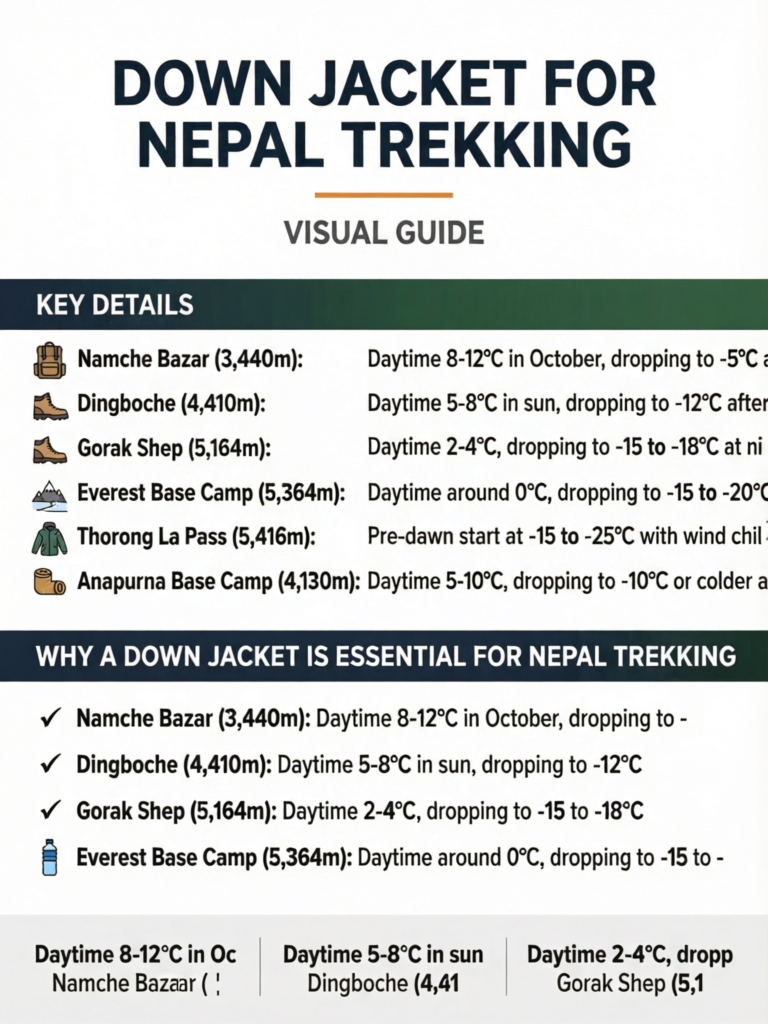
Temperature drops approximately 6.5°C for every 1,000m gained in elevation. At sea level in Kathmandu, a pleasant 20°C afternoon becomes -6°C at 4,000m before accounting for wind chill or nighttime drops. Here is what that looks like on the trail during the peak October-November trekking season:
- Namche Bazaar (3,440m): Daytime 8-12°C in October, dropping to -5°C at night
- Dingboche (4,410m): Daytime 5-8°C in sun, dropping to -12°C after sunset
- Gorak Shep (5,164m): Daytime 2-4°C, dropping to -15 to -18°C at night
- Everest Base Camp (5,364m): Daytime around 0°C, dropping to -15 to -20°C at night
- Thorong La Pass (5,416m): Pre-dawn start at -15 to -25°C with wind chill
- Annapurna Base Camp (4,130m): Daytime 5-10°C, dropping to -10°C or colder at night
These numbers get more extreme during winter trekking (December-February), when nighttime temperatures at Gorak Shep can reach -25°C or lower, and even the moderate elevations around Namche Bazaar regularly see -10°C nights. Check our trekking seasons guide for month-by-month temperature expectations.
Tea Houses Are Not Heated
This is the detail that catches many first-time trekkers off guard. Above 3,000m, most tea houses either have no heating at all or rely on a single yak-dung stove in the dining hall that operates for a few hours in the evening. Your bedroom will be unheated. The thin walls and single-pane windows offer minimal insulation from the mountain night. Some tea houses at higher elevations have stone or concrete walls that actively radiate cold into the room.
Picture this real-world scenario: you arrive at a tea house in Dingboche at 4,410m around 3pm. You have been hiking for six hours and generated plenty of body heat. You stop, peel off your sweaty base layer, and change into a dry one. Within 15 minutes, the sweat on your skin has evaporated and you are starting to feel the chill. The sun sets behind Ama Dablam at 5pm, and the temperature drops from 8°C to -5°C in under an hour. By dinner at 7pm, it is -10°C outside and barely warmer inside the dining hall. The stove has been lit, but it warms only those sitting within a meter of it. You will sit in the dining hall for three hours eating dal bhat, writing in your journal, and chatting with fellow trekkers. Without a down jacket, those three hours are genuinely uncomfortable. With a good down jacket over a dry base layer and fleece, you are warm, relaxed, and enjoying the experience.
Every Stop Means Rapid Cooling
Active hiking generates significant body heat. Most trekkers are comfortable in a base layer and thin fleece while moving uphill, even at 4,500m. But the moment you stop, whether for a rest break, a photo opportunity, or a lunch stop at a high-altitude lodge, your body temperature drops rapidly. The physics are simple: your body was producing heat to match the cold, and now it has stopped producing heat while the cold continues. At altitude, the thin air provides less insulation, wind speeds are often higher, and any breeze cuts straight through mid-layers that felt fine while you were moving.
A down jacket that packs into a small stuff sack and can be thrown on in 20 seconds is the difference between enjoying your lunch stop and rushing through it. Veteran trekkers develop a rhythm: stop walking, pull on down jacket immediately, take photos, eat, drink water, remove jacket, resume hiking. This becomes second nature by day three.
Pro Tip
Keep your down jacket at the top of your daypack, not buried at the bottom. You will pull it out 5-10 times per day above 3,500m: at every rest stop, every viewpoint, and every time a cloud covers the sun. A stuff sack that opens quickly is more practical than one that compresses to the absolute smallest size. Some trekkers skip the stuff sack entirely and just shove the jacket loosely into the top of their pack for instant access.
Down vs Synthetic Insulation: The Complete Comparison
The first decision you need to make is whether to go with natural down or synthetic insulation. Both have legitimate uses in Nepal trekking, and the right choice depends on your specific trek, the season, and how you will use the jacket.
Down Insulation: How It Works
Down insulation comes from the soft, fluffy clusters found beneath the outer feathers of geese or ducks. Each down cluster has thousands of tiny filaments that interlock and trap air. This trapped air is what provides insulation, not the down material itself. The more air trapped per unit of weight, the warmer the jacket. Down clusters are three-dimensional and expand to fill space, which is why down jackets "loft" when you shake them out of compression. The loftier the down, the more dead air space created, and the warmer you stay.
The key advantage of down is its unmatched warmth-to-weight ratio. No synthetic insulation on the market matches the warmth that high-quality down provides per gram. A 300g down jacket can provide the same warmth as a 500g synthetic jacket. This matters when you are carrying everything on your back or in a porter's duffel at altitude, where every extra 100 grams of pack weight is felt more acutely due to reduced oxygen.
Goose down generally outperforms duck down at the same fill power rating because goose clusters are larger and more resilient. However, high-quality duck down (650+ fill) is perfectly adequate for Nepal trekking and costs considerably less than goose down.
Synthetic Insulation: How It Works
Synthetic insulation uses polyester filaments engineered to mimic down clusters. Modern synthetics like PrimaLoft Gold, Climashield APEX, and Coreloft use continuous filament or short-staple fibers arranged to trap air in a similar way to down. The key difference is that synthetic fibers do not absorb water. When a synthetic jacket gets wet, whether from rain, condensation, or sweat, the fibers maintain their structure and continue to trap air, providing meaningful insulation even when soaked. Synthetic insulation retains approximately 60-70% of its warmth when wet, compared to down which loses up to 90%.
The trade-off is weight and packability. A synthetic jacket providing equivalent warmth to a down jacket will typically weigh 30-40% more and compress to roughly twice the packed volume. Synthetic insulation also degrades faster over time. After 3-5 years of regular use and compression, synthetic fibers lose their spring and the jacket becomes noticeably less warm. A well-maintained down jacket can last 10-15 years.
Head-to-Head Comparison
| Feature | Down Insulation | Synthetic Insulation |
|---|---|---|
| Warmth-to-Weight | Excellent (best available) | Good (30-40% heavier for same warmth) |
| Packability | Excellent (compresses very small) | Moderate (roughly 2x the packed volume) |
| Wet Performance | Poor (loses up to 90% loft when wet) | Good (retains 60-70% warmth when wet) |
| Dry Time | Slow (many hours to fully dry) | Fast (dries in 1-2 hours) |
| Durability | Excellent (10-15 years with care) | Moderate (loft degrades after 3-5 years) |
| Cost | Higher ($100-400) | Lower ($60-200) |
| Care Required | Special wash needed | Machine washable |
| Environmental Impact | Natural, biodegradable | Petroleum-based, microplastic shedding |
| Best For | Tea house treks, dry cold, weight-conscious | Camping, monsoon, wet conditions, budget |
The Verdict for Nepal
For standard tea house trekking in peak season (October-November, March-May), down wins. Here is why: on a tea house trek, your down jacket primarily serves as a stationary insulation layer. You wear it indoors, at rest stops, and during sunrise viewpoints. It stays in your pack during active hiking. Because you are mostly using it indoors or during dry, cold conditions, the main weakness of down (poor wet performance) rarely comes into play. You sleep under a roof every night, and the autumn and spring trekking seasons are predominantly dry.
The weight and packability advantages of down are significant when you are managing pack weight at altitude, where every extra 100 grams feels meaningful. A down jacket that compresses to the size of a water bottle leaves more room in your daypack for water, snacks, and camera equipment.
Synthetic is the better choice for: camping treks where your gear may be exposed to condensation inside a tent, monsoon season treks (June-September) where rain is frequent and unpredictable, expedition-style treks where the jacket may get wet during extended outdoor use, and budget-conscious trekkers who want a simpler, lower-maintenance option.
Hydrophobic Down: The Best of Both Worlds?
Several manufacturers now offer hydrophobic down, which is treated with a water-resistant coating at the molecular level. Brands like Nikwax, DownTek, and Allied Hyperdry treat individual down clusters to resist moisture absorption. Hydrophobic down retains roughly 60% more loft than untreated down when exposed to moisture, and it dries significantly faster. It is not waterproof, but it substantially reduces the main weakness of natural down. If budget allows, a jacket with hydrophobic down is an excellent choice for Nepal trekking, providing near-synthetic wet-weather resilience with the superior warmth-to-weight of natural down.
Fill Power Explained: What the Numbers Mean
Fill power is the single most important specification when comparing down jackets, yet it is also one of the most misunderstood. Fill power measures the loft (fluffiness) of down by indicating how many cubic inches one ounce of down occupies in a standardized test cylinder. Higher fill power means the down traps more air per ounce, which means more warmth for less weight.
To visualize this: imagine placing one ounce of 550-fill down and one ounce of 800-fill down side by side. The 800-fill ounce would puff up nearly 50% larger, trapping significantly more dead air space, which is what actually insulates you.
Here is a practical breakdown of each fill power range and what it means for Nepal trekking:
550 Fill Power: Budget Range
- Weight for equivalent warmth: Heaviest option
- Typical jacket weight: 450-600g
- Cost range: $40-80
- Best for: Budget trekkers, moderate cold (down to -5°C with layers), lower altitude treks
- Reality check: A 550-fill jacket works perfectly well for treks that stay below 4,500m in peak season. The locally-made jackets available in Kathmandu's Thamel district typically use 550-650 fill down and have kept thousands of trekkers warm on EBC and Annapurna treks. These jackets are heavier and bulkier, but they do the job. Do not let gear snobs tell you otherwise. If you are on a tight budget, a 550-fill jacket from Thamel paired with good base layers and a fleece will handle the most popular treks in Nepal during peak season.
650 Fill Power: Good Balance
- Weight for equivalent warmth: Moderate
- Typical jacket weight: 350-450g
- Cost range: $80-150
- Best for: Most Nepal trekkers, good warmth-to-weight compromise, three-season trekking
- Reality check: This is the sweet spot for the majority of trekkers. Jackets in this range offer meaningfully better warmth-to-weight than 550-fill without the premium price of 800+ fill. You save 100-150g compared to a 550-fill jacket of equal warmth, and the packed size shrinks noticeably. The Decathlon Trek 500 Down Jacket sits in this range and is one of the best value options available anywhere in the world. If you are trekking once or twice and want reliable performance without overspending, 650-fill is your target.
800 Fill Power: Premium Sweet Spot
- Weight for equivalent warmth: Excellent
- Typical jacket weight: 250-350g
- Cost range: $150-300
- Best for: Serious trekkers, winter treks, anyone prioritizing weight savings, high-altitude routes above 5,000m
- Reality check: An 800-fill jacket feels noticeably lighter in hand and packs noticeably smaller than a 650-fill jacket of equivalent warmth. The difference is immediately apparent when you stuff it into your daypack. If you trek regularly, plan to go above 5,000m in cold conditions, or value having a jacket that doubles as everyday outerwear at home, this is the fill power to target. The Mountain Hardwear Ghost Whisperer and Rab Microlight Alpine both deliver outstanding performance at this tier.
900+ Fill Power: Ultralight Premium
- Weight for equivalent warmth: Best available
- Typical jacket weight: 200-280g
- Cost range: $250-400+
- Best for: Weight-obsessed trekkers, serious mountaineering, ultralight backpackers, those willing to invest in the absolute best
- Reality check: The warmth difference between 800 and 900+ fill is marginal in a trekking jacket context. You are paying a significant premium (often 50-100% more) for a modest weight saving of 30-50g. The down at this tier is also more delicate and requires more careful handling. Unless you are climbing peaks, counting every gram for a fast-and-light attempt, or simply want the best money can buy, 800-fill offers substantially better value for Nepal trekking.
Fill Weight vs Fill Power: Both Matter
Here is the detail many trekkers miss, and it is arguably more important than fill power: fill power tells you the quality of the down, but fill weight tells you how much down is actually in the jacket. Both numbers matter, and fill weight is often the deciding factor in determining actual warmth.
A practical example: A jacket with 200g of 800-fill-power down will be significantly warmer than a jacket with 150g of 900-fill-power down. The first jacket has more total insulation material, even though each gram of that material is slightly less efficient. When comparing jackets, always check both the fill power and the total fill weight. Manufacturers sometimes use high fill power as a marketing highlight while skimping on fill weight to reduce cost and material.
Think of it this way: fill power is the quality of the fuel, and fill weight is the size of the tank. A large tank of good fuel outperforms a small tank of premium fuel every time. An ultralight jacket with 80g of 900-fill down is designed as a layering piece for active use, not as a standalone insulator for sitting in a freezing tea house for three hours. For Nepal trekking, prioritize adequate fill weight.
Recommended fill weights for Nepal:
- Below 4,000m, peak season: 100-140g fill weight is adequate
- 4,000-5,000m, peak season: 140-180g fill weight recommended
- Above 5,000m or winter trekking: 180-220g fill weight strongly recommended
- Extreme conditions (winter above 5,000m): 220g+ fill weight, consider expedition-grade jackets
Pro Tip
When shopping in Kathmandu, sellers often quote fill power without mentioning fill weight. Ask specifically: "How many grams of down fill does this jacket have?" A jacket marketed as "800-fill" with only 80g of fill will not keep you warm at Everest Base Camp. Look for at least 150g of fill for moderate cold and 200g+ for serious winter trekking above 5,000m. If the seller cannot answer the fill weight question, be cautious about the claimed fill power rating as well.
Key Features to Look For
Beyond insulation type and fill power, several design features significantly affect how well a down jacket performs at altitude. Here is what to prioritize when choosing your jacket for Nepal.
Hood: Essential for Heat Retention
A hooded down jacket is not optional for Nepal trekking. Your head is one of the most vascularized parts of your body, and an uncovered head at altitude, where blood flow prioritizes your core organs, can make you feel dramatically colder overall. A well-designed insulated hood:
- Retains significant warmth that a hoodless jacket loses through the neck opening
- Fits over a beanie or balaclava for extreme cold (look for hoods with volume adjustment)
- Has an adjustable drawcord to seal around your face in wind, creating a warm microclimate
- Eliminates the cold gap between jacket collar and hat that lets heat escape
- Can be worn loose around the neck as a warm collar when the hood is not needed
Every jacket recommendation in this guide includes a hood. Do not buy a hoodless down jacket for trekking above 4,000m. The weight saved (typically 30-40g) is not worth the warmth lost.
Pockets: More Than Convenience
At altitude, pockets serve critical functions beyond storing snacks and trekking permits:
- Hand-warmer pockets with fleece lining keep fingers functional between glove use. Position matters: they should be accessible above a hipbelt or pack waistband. Some cheaper jackets place pockets too low, making them useless when wearing a backpack
- Internal chest pocket keeps your phone battery warm. This is not a minor detail. Lithium batteries lose 20-40% of their capacity in cold temperatures. At -15°C, your phone may die at 40% battery. Keeping it in an inside pocket against your body preserves battery life for photos, navigation, and emergency communication
- External chest pocket provides quick access to small items like lip balm, cash, or a headlamp
- Look for at least two hand-warmer pockets and one internal pocket. Zippered pockets are preferable to open pockets at altitude where dropped items can be lost on steep terrain
Packability: Stuff Sack and Compression Size
Your down jacket needs to fit inside your daypack when not in use, alongside your water bottles, snacks, camera, and rain gear. Key considerations:
- Most quality down jackets come with a stuff sack or compress into their own pocket
- An 800-fill jacket compresses to roughly the size of a 1-liter water bottle
- A 650-fill jacket compresses to roughly the size of a football (soccer ball)
- A 550-fill jacket may compress to the size of a small pillow
- Some trekkers prefer using the jacket as a pillow at night rather than compressing it, which is actually better for the down's longevity since it avoids prolonged compression
Water-Resistant Treatment
Since down's greatest weakness is moisture, look for these protective features:
- DWR (Durable Water Repellent) coating on the outer shell fabric causes light rain and snow to bead off rather than soaking through to the down. DWR degrades over time but can be reapplied at home with products like Nikwax TX.Direct
- Hydrophobic down treatment (DownTek, Nikwax, Allied Hyperdry) adds water resistance at the individual down cluster level, protecting the insulation even if moisture penetrates the shell
- Ripstop nylon shell resists tears from rock contact, snagging on branches, or abrasion against pack straps. Look for 10-20 denier ripstop for a good balance of weight and durability
- Note: no down jacket is waterproof. In sustained rain, always cover it with a hardshell or rain jacket. DWR handles light moisture only.
Zipper Quality
A zipper failure at 5,000m is more than an inconvenience; it compromises the jacket's ability to seal in warmth. Look for:
- YKK zippers (the industry standard for reliability, used by most reputable brands)
- Full-length front zip that opens smoothly with cold, gloved hands. Test this in the store
- Internal draft flap (also called a wind flap) behind the main zipper to block cold air from penetrating through the zipper teeth
- Zipper garage at the chin to prevent the slider from catching skin or chin fabric
- Avoid jackets with thin, exposed coil zippers that are prone to snagging and jamming in cold conditions
Fit: Room for Layering
Your down jacket should not fit like a slim fashion piece. At altitude, you will wear it over a base layer and fleece mid-layer, and occasionally under a hardshell. A too-tight fit compresses the down against your body, reducing its loft and therefore its insulation. When trying on a down jacket:
- Wear your intended fleece mid-layer underneath during fitting
- Raise your arms overhead. The jacket should not ride up past your waist, exposing your lower back
- Bend forward as if adjusting boot laces. The back should still cover your lower back completely
- Zip it fully with layers underneath. It should feel snug but not restrictive, with room for the down to loft
- Swing your arms in circles. There should be no pulling or restriction across the shoulders
- If buying online, go one size up from your regular shirt size to accommodate layering
Down Jacket Recommendations by Budget
Based on extensive gear testing and trekker feedback across hundreds of Nepal treks, here are our top recommendations at three price points. Each jacket listed has a hood, which we consider essential.
Budget: $40-100
Kathmandu-Purchased Down Jackets ($40-80) The locally-made down jackets available in Thamel, Kathmandu are a legitimate option that has kept thousands of trekkers warm on Everest Base Camp and Annapurna treks. They typically use 550-650 fill duck down, weigh 400-550g, and come in a wide variety of colors and sizes. Quality varies between shops and even between jackets in the same shop, so inspect carefully: squeeze the jacket into a ball and release it. Good down should spring back to full loft within 5-10 seconds. Check all zippers, inspect seams for loose stitching, and ensure the hood drawcord adjusts smoothly.
Advantages: extremely affordable, available for last-minute purchase, surprisingly warm for the price, easy to replace if damaged, and you support local manufacturing. Disadvantages: heavier and bulkier than branded alternatives, inconsistent quality control between batches, DWR coating may be absent or minimal, and durability may be limited to 2-3 seasons of hard use before the down compresses permanently.
Decathlon Trek 500 Down Jacket ($70-90) If you have access to a Decathlon store (there is one in Kathmandu on New Road), the Trek 500 is remarkably good for its price. It uses 650-fill duck down with a respectable 140g fill weight, weighs around 370g, and includes a hood. The shell fabric has a DWR coating, and the construction quality is consistent (Decathlon has excellent quality control for its price point). For the price, it punches well above its weight class and outperforms most jackets costing twice as much. This is our top budget recommendation for trekkers who want reliable, predictable performance.
Mid-Range: $100-200
Mountain Hardwear Ghost Whisperer/2 ($150-200) A legendary ultralight down jacket with 800-fill goose down, weighing just 220-260g depending on the version. It packs into its own pocket to roughly the size of a grapefruit. The Ghost Whisperer is a trekking and climbing staple for good reason: exceptional warmth-to-weight ratio, excellent packability, and a proven track record across thousands of Himalayan treks. Fill weight is around 85-100g, which means it excels as a layering piece and light insulator but may not be warm enough as a standalone jacket for extended tea house evenings at 5,000m in cold conditions. Best paired with a quality fleece underneath.
Rab Microlight Alpine ($160-190) A step warmer than the Ghost Whisperer with 170g of 700-fill hydrophobic down and a more robust Pertex Quantum shell. At 370g, it is heavier but provides noticeably more warmth for sitting around in tea houses. The hydrophobic down treatment gives it better moisture resistance than standard down jackets. The Microlight Alpine includes a helmet-compatible hood that works well over a beanie and features excellent baffling that prevents cold spots. Our top recommendation in the mid-range category for Nepal trekking.
Patagonia Down Sweater Hoody ($160-200) 800-fill goose down in a durable ripstop shell with 91g fill weight. The Down Sweater Hoody is comfortable, well-built, and backed by Patagonia's excellent repair guarantee and Worn Wear program. At 370g, it sits between the ultralight Ghost Whisperer and the warmer Rab Microlight. A solid, reliable option from a brand known for durability and ethical down sourcing. It doubles beautifully as a casual jacket at home, which adds to its value proposition.
Premium: $200-400
Arc'teryx Cerium Hoody ($280-350) One of the best-designed down jackets available for trekking. The Cerium uses 850-fill goose down in the core body panels where maximum warmth is needed and Coreloft synthetic insulation in moisture-prone areas (underarms, collar, cuffs) where sweat and environmental moisture would degrade pure down. This hybrid approach provides the warmth efficiency of down where it counts with the wet-weather reliability of synthetic where it matters most. Weight is around 300g with excellent packability. The fit is trim but accommodates layers well, and the overall build quality is exceptional. If budget is not a primary concern, this is arguably the best all-round choice.
Rab Neutrino Pro ($280-340) Purpose-built for Himalayan conditions with 220g of 800-fill hydrophobic goose down, a Pertex Endurance shell that provides wind and moisture resistance, and a generous fit designed specifically for layering over multiple mid-layers. At 460g, it is one of the warmer jackets on this list and genuinely comfortable as a standalone insulation layer down to -15°C with a base layer underneath. The box-wall baffle construction eliminates cold spots that can occur in sewn-through designs. If you are trekking in winter or at very high altitude where warmth is the top priority, the Neutrino Pro delivers serious, expedition-grade warmth.
Mountain Equipment Earthrise Hooded Jacket ($200-260) A well-priced premium option with 700-fill down, a durable 30-denier outer fabric, and a generous 180g fill weight. The Earthrise is built for durability and comfort rather than ultralight performance. At 480g, it is heavier than some alternatives, but the build quality and warmth output make it a reliable long-term investment. The thicker shell fabric is more resistant to tears and abrasion, which matters if you use your jacket hard. A strong choice for trekkers who value robustness and plan to use the jacket for many years across multiple treks.
A Note on Brand Availability in Nepal
In Kathmandu's Thamel district, you will find shops selling both locally-made down jackets and what appear to be branded jackets (North Face, Rab, Mountain Hardwear, Arc'teryx). Be aware that most branded items in Thamel are counterfeit. The stitching, materials, and down quality of fake branded jackets are significantly worse than the genuine articles, yet they often cost more than the honest locally-made unbranded alternatives. If you want a genuine branded jacket, buy it before arriving in Nepal or purchase from authorized retailers in Kathmandu like the North Face store in Durbar Marg. The locally-made unbranded jackets are often better value and more honestly represented than fake branded ones.
When to Wear Your Down Jacket on Trek
Understanding when to wear and when not to wear your down jacket will maximize both its performance and its lifespan. This may sound obvious, but getting the timing right significantly affects your comfort and the jacket's longevity.
Primary Use: Tea House Evenings and Mornings
This is where your down jacket earns its place in your pack. From the moment you arrive at your tea house in the afternoon until you warm up on the trail the next morning, your down jacket is your primary warmth layer. In the dining hall, in your bedroom, walking between buildings to use the outdoor toilet at 2am, stepping outside to photograph the stars or the moonlit peaks. Plan for 12-14 hours of wear time per day above 4,000m during peak season.
On cold nights, many trekkers sleep in their down jacket inside their sleeping bag for additional warmth. This is perfectly fine and is standard practice at high camps. If your sleeping bag is rated to -10°C but the night will drop to -18°C, wearing your down jacket inside the bag bridges that gap effectively.
Rest Stops and Lunch Breaks Above 3,500m
Any time you stop moving for more than 5 minutes above 3,500m, put on your down jacket. This includes lunch stops at high-altitude lodges, rest breaks on exposed ridgelines, waiting for trail companions at checkpoints, and pausing to take photographs at viewpoints. Your body cools remarkably fast at altitude due to the thin air, strong UV radiation drawing away heat, and ever-present wind. It is far easier to maintain warmth than to rewarm a cold body once you have started shivering.
Early Morning Summit Day Starts
Sunrise excursions are a highlight of Nepal trekking. The 4am start for Kala Patthar (5,545m) to watch the sun hit Everest. The pre-dawn climb to Poon Hill (3,210m) for the Annapurna panorama. The cold crossing of Thorong La Pass (5,416m) on the Annapurna Circuit. On these occasions, you start hiking in your down jacket because the temperatures are too extreme for just mid-layers. As your body generates heat and the sun rises, you will eventually stow the jacket, but for those first 1-2 hours, it is essential.
Layered Under a Hardshell in Extreme Cold
In winter trekking or during high-altitude passes, your down jacket becomes a mid-layer worn under your waterproof hardshell. This combination, base layer plus fleece plus down jacket plus hardshell, creates your maximum warmth system and can handle temperatures down to -25°C depending on the quality of each layer. The hardshell adds critical wind protection that amplifies the down's insulation. See our layering system guide for detailed advice on building your complete layering system.
When NOT to Wear Your Down Jacket
Do not hike in your down jacket during normal daytime trekking. This is the most common mistake we see, particularly among inexperienced trekkers who feel cold at the start of the day and are reluctant to remove the jacket once warmed up. Active hiking generates significant body heat, and wearing a down jacket while moving causes excessive sweating. Sweat is the enemy of down insulation. Moisture from your body will dampen the down from the inside, reducing its loft and warmth. Over time, repeated sweat exposure degrades down clusters and creates a persistent musty odor that is difficult to remove.
If you are cold while hiking, add a fleece or windbreaker layer instead. Save the down jacket for stationary periods. The only exceptions are pre-dawn starts in extreme cold (where you will shed the jacket once warmed up) and very slow, flat walking in sustained cold temperatures where your body is not generating significant heat.
Caring for Your Down Jacket on Trek
Down is a natural material that requires some care to maintain its performance over a multi-week trek. These trail-tested practices will keep your jacket performing at its best throughout your journey and for years afterward.
Keep It Dry
This is the single most important rule for down jacket care. On the trail, store your down jacket in a dry bag or waterproof stuff sack inside your daypack. Even if your pack has a rain cover, a separate dry bag provides essential backup protection, as rain covers can shift in wind and pack contents can absorb moisture from wet outer fabric. If it starts raining while you are wearing your down jacket, immediately cover it with your hardshell rain jacket or stow the down jacket and switch to a synthetic layer or fleece.
Air It Out Daily
When the sun hits your tea house in the morning, take your down jacket outside and drape it over a railing, a rock, or a clothesline in direct sunlight for 30-60 minutes. Shake it vigorously first to redistribute the down and break up any clumps. Sunlight and dry mountain air help evaporate the body moisture that accumulates in the down overnight from your breath and skin. This simple daily habit maintains loft and prevents the gradual moisture buildup that reduces warmth over a multi-week trek. By day 10 of a trek, a jacket that has been aired daily will be noticeably warmer than one that has been stuffed straight into a pack each morning.
Do Not Over-Compress It
Down clusters can be damaged by prolonged tight compression. The natural spring of down comes from the three-dimensional structure of each cluster, and crushing those structures flat for 8-10 hours every day gradually reduces their ability to loft fully. During the day, avoid cramming your jacket into the smallest possible stuff sack for hours on end. A looser compression or simply stuffing it into the top of your pack allows the down to maintain better loft. At tea houses, take it out of its stuff sack and either wear it or let it hang loose. Some trekkers use their down jacket as a pillow at night, which is gentle on the down and eliminates the need to carry a separate pillow.
If It Gets Wet
If your down jacket does get wet, do not panic. Shake it vigorously to break up any clumped-down clusters, then put it on. Your body heat is the fastest available heat source on the trail and will slowly dry the down from the inside out. If you have access to sunlight, spread the jacket out and let it dry naturally, periodically shaking and fluffing the down to prevent clumping.
At a tea house, you can ask if they will let you dry it near the dining hall stove, but keep it at a safe distance from open flame. Nylon shell fabrics melt easily and quickly, and a spark hole in your down jacket will leak feathers for the rest of the trek.
Washing at Home After Your Trek
When you return home, wash your down jacket properly to restore full performance and remove accumulated body oils, dirt, and salt:
- Use a down-specific detergent (Nikwax Down Wash Direct or Granger's Down Wash) as regular detergent strips the natural oils from down clusters, reducing their loft permanently
- Front-loading washing machine only (top-loaders with central agitators can tear baffles and damage the jacket's internal structure)
- Gentle cycle, warm water (not hot), extra rinse cycle to remove all detergent residue
- Tumble dry on low heat with 2-3 clean tennis balls. The tennis balls physically break up clumped down clusters and restore the jacket's full loft. This step is essential.
- The drying cycle takes 2-3 hours. Check periodically by removing the jacket and feeling for damp clumps. The jacket must be completely dry before storage, as any remaining moisture will cause mold and odor
- Store hanging in a closet or in a large, breathable cotton storage sack, never in a compressed stuff sack long-term. Prolonged compression during storage permanently reduces loft.
Rent vs Buy in Kathmandu
One of the most common questions from trekkers planning their first Nepal trip is whether to bring a down jacket from home or sort it out in Kathmandu. Both approaches work, and the right choice depends on your budget, future trekking plans, and how particular you are about gear quality.
Renting in Kathmandu: $1-2 Per Day
Dozens of gear shops in Thamel rent down jackets for NPR 100-200 per day ($1-2 USD). For a 14-day EBC trek, that is $14-28 total, making this the most affordable option by far. Shops require a deposit (typically NPR 3,000-5,000 or your passport copy) which is refunded when you return the jacket in acceptable condition.
Advantages: minimal cost, no need to carry a jacket from home or in your luggage, easy to exchange if the first one does not fit well or is not warm enough, and zero commitment if you are unsure whether you will trek again. Disadvantages: inconsistent quality, the down may be old and partially compressed from hundreds of rental cycles (reducing warmth significantly), limited size options for very tall or broad trekkers, limited color choices, and hygiene concerns. Most shops wash rental gear between customers, but the down in heavily-used rental jackets is often a shadow of its original loft.
If you rent, inspect the jacket carefully: squeeze the body of the jacket firmly, then release. Quality down springs back to full loft within 5-10 seconds. If the jacket stays compressed or feels thin and flat, reject it and ask for another. Check the main zipper from bottom to top and back again. Inspect the hood drawcord. Look for tears or patches that indicate previous damage. Smell the jacket; strong odors suggest inadequate cleaning. Try it on over your fleece to verify fit.
Buying in Thamel: $40-80
Purchasing a locally-made down jacket in Kathmandu is a popular middle ground. You get a new jacket with fresh, uncompressed down, can try it on properly, and the cost is still remarkably low by Western standards.
What you get: a new jacket with 550-650 fill duck down, nylon shell, hood, and pockets. The stitching and construction are basic but functional. These jackets are made in Nepal, often in small workshops in the Kathmandu Valley, and are the same ones that thousands of successful EBC and Annapurna trekkers have worn. Some are surprisingly well-made; others cut corners on details like zipper quality and seam reinforcement.
Shopping tips: visit at least 3-4 shops to compare quality and prices before buying. Negotiate firmly but fairly (starting prices are typically 30-50% above the expected selling price). Check the squeeze test for down quality. Ensure the zippers work smoothly with cold hands. Try the jacket on over your fleece. Check that the hood drawcord adjusts and stays set. Buy in the morning when you are fresh and thinking clearly, not in the evening after a long day of sightseeing when impulse purchases are more likely.
For a detailed guide on what to rent versus buy across all gear categories, see our rent vs buy guide.
Bringing a Premium Jacket from Home
If you already own a quality down jacket or plan to trek regularly, bringing your own from home guarantees the performance, fit, and quality you need. You know exactly how warm it is, you know it fits over your layers, and you can rely on it absolutely in the conditions that matter most.
Best for: experienced trekkers who will reuse the jacket many times, winter trekking above 5,000m where guaranteed warmth is a safety matter, anyone who values predictable performance, and trekkers who already own a suitable jacket and would gain nothing from buying another.
Watch Out for Fake Down in Kathmandu
Some cheaper jackets sold in Thamel are filled with polyester batting or low-grade feather fill rather than real down, despite being labeled as "down jackets." The squeeze test is your best defense: grip a handful of the jacket's insulation through the shell fabric. Real down feels soft, springy, and three-dimensional with no distinct individual fibers. Fake down or feather fill feels stiffer, flatter, more uniform in texture, and does not spring back the same way. If the jacket costs less than $30 and claims to be "800-fill goose down," it almost certainly is not. Stick to shops that are transparent about their materials and willing to let you inspect carefully.
Pro Tip
If you buy a locally-made down jacket in Kathmandu and find that it is not warm enough on the trek, you can supplement it with a fleece vest worn underneath. This combination (budget down jacket plus fleece vest) often matches the warmth of a single premium jacket at a fraction of the cost. You can buy a decent fleece vest in Thamel for $10-15. This layered approach also gives you more temperature flexibility: wear the jacket alone in moderate cold, add the vest underneath in serious cold.
Down Jacket Care by Trek and Season
Different treks and seasons put different demands on your down jacket. Here is a quick reference to help you calibrate your gear choice and care routine to your specific trip.
Peak Season (October-November, March-May)
Standard down jacket use. A 650-fill jacket with 140-180g of fill handles most conditions on the popular tea house treks including Everest Base Camp and Annapurna Base Camp. Conditions are generally dry, which plays to down's strengths. Wind protection is important in autumn as afternoons can be breezy at exposed tea houses. Refer to our trekking seasons guide for detailed seasonal information.
Winter Trekking (December-February)
Temperatures at high camps can reach -25°C or lower. An 800-fill jacket with 200g+ of fill is strongly recommended. Consider a jacket rated for mountaineering rather than general trekking, with features like box-wall baffles and a longer cut that covers the hips. At these temperatures, insulation alone is not enough: protect your extremities with proper gloves and review frostbite and hypothermia prevention before any December-February trek. Winter trekking also demands a warmer sleeping bag, so your overall insulation system needs to be upgraded across the board. The air is very dry in winter, which is ideal for down performance, but extreme cold means you cannot afford any weak links in your warmth system.
Monsoon Season (June-September)
If you trek during monsoon, a synthetic insulated jacket is arguably the better choice due to frequent rain, high humidity, and persistent cloud cover that limits drying opportunities. If you bring down, ensure it has hydrophobic treatment and always carry it in a waterproof dry bag. Keep a synthetic mid-layer as a backup insulation option. Monsoon treks tend to stay at lower elevations where temperatures are milder, reducing the need for maximum insulation performance.
For a complete overview of what gear you need for any Nepal trek, consult our complete gear list.
Altitude Sickness is More Dangerous Than Cold
No amount of insulation will help you if you ascend too fast. Acute mountain sickness (AMS), high-altitude pulmonary edema (HAPE), and high-altitude cerebral edema (HACE) are life-threatening conditions that require descent, not warmer clothing. Follow proper acclimatization schedules, stay hydrated, and know the warning symptoms. Your down jacket keeps you comfortable at altitude, but proper acclimatization keeps you alive. Never push through symptoms of AMS just because you feel physically warm enough to continue. If you experience persistent headache, nausea, dizziness, or breathlessness at rest, descend immediately regardless of your gear quality.
Frequently Asked Questions
Do I Need a Down Jacket for Nepal Trekking?
Yes, for any trek going above 3,000m altitude. Above this elevation, evening temperatures drop below freezing even in peak October-November season. Tea houses are minimally heated, and you will spend 3-4 hours each evening in dining rooms where temperatures can approach zero. A down jacket is the single piece of insulation that makes these hours comfortable rather than miserable. On treks like Everest Base Camp, the Annapurna Circuit, or Langtang Valley, it is non-negotiable. Even on lower treks like Poon Hill, early mornings at the viewpoint are cold enough to warrant one. Include it in your packing list and pair it with a proper layering system.
What Down Jacket Do I Need for Everest Base Camp?
For the EBC trek, you need a down jacket with a minimum of 650 fill power and 150-200g of fill weight. This handles evening temperatures of -15 to -20 degrees Celsius at Gorak Shep and Lobuche when worn over a fleece mid-layer and dry base layer. For winter EBC (December-February), upgrade to 800+ fill power with 200-250g of fill weight. A hood is essential above 4,000m. Keep the jacket in a dry bag inside your duffel to protect the down from moisture. See our rent vs buy guide for Kathmandu options starting at $40.