
Up to 25% on descents
200-600g per pair
$5-15 for the full trek
$25-200 depending on materials and brand
8+ day treks, knee issues, age 35+, steep terrain
35-65cm when folded
Hiking Poles for Nepal: Do You Need Trekking Poles?
Hiking poles (also called trekking poles) are not legally required in Nepal, but they are strongly recommended for most Himalayan treks. Research in orthopedic sports medicine shows a pair of hiking poles reduces knee impact by up to 25% on descents and improves stability on uneven terrain. For treks of 8+ days, steep high passes, or trekkers over 35, they are a genuine game-changer.
"Do I need hiking poles for Nepal?" is one of the most common questions we hear from trekkers preparing for their Himalayan adventure. Whether you are heading to Everest Base Camp, the Annapurna Circuit, or a shorter route like Poon Hill, the answer shapes your packing list, your budget, and potentially the health of your knees for years to come.
Thousands of people complete the biggest Himalayan trails every year without them. But for multi-day treks with heavy packs, steep high-altitude passes, and unpredictable trail conditions, hiking poles are one of the most worthwhile pieces of gear you can carry. (Note that while a licensed guide is now required on most national-park routes since April 2023, poles themselves are never mandatory.)
This guide breaks down everything you need to know: the science behind why hiking poles work, which treks demand them, what type to buy or rent, how to size them, proper technique, and honest recommendations across every budget. By the end, you will know exactly whether trekking poles belong on your complete gear list for Nepal.
The Science: Why Trekking Poles Work
Trekking poles are not just a comfort accessory. They fundamentally change the biomechanics of how your body handles the stresses of hiking, especially on the kind of demanding, multi-day terrain you will encounter in Nepal.
Distributing Weight Across Four Points Instead of Two
Without poles, every step you take on a descent sends the full impact of your body weight plus your pack straight through your knees, ankles, and hips. With two poles, you effectively transform yourself from a biped into a quadruped, distributing load across four contact points instead of two.
A widely cited study published in the Journal of Sports Medicine found that trekking poles can reduce compressive force on the knee joint by up to 25% during downhill walking. On a trek like the Everest Base Camp route, where you face a long, steep descent from Namche Bazaar back to Lukla over two days, that 25% reduction translates to thousands fewer pounds of cumulative force on each knee.
Knee Joint Stress Reduction
The knee is the most vulnerable joint during trekking, especially on descents. Every step downhill generates forces of 3-4 times your body weight through the knee joint. For a 75 kg trekker carrying a 10 kg daypack, that means roughly 255-340 kg of force per step. Over a full day of 15,000-20,000 steps, the cumulative impact is staggering.
Trekking poles help in two ways:
- Direct load transfer: Each time you plant a pole, some of your weight transfers through your arm and shoulder to the pole tip, bypassing your legs entirely.
- Controlled deceleration: Poles allow you to brake gradually on descents rather than absorbing impact abruptly through your knees with each step.
For trekkers over 35, those with previous knee injuries, or anyone carrying significant pack weight, this reduction is not just about comfort. It is about preventing the kind of overuse injuries that can end a trek early. For a deeper look at protecting your joints on long descents, see our knee protection guide for Nepal trekking.
Balance and Stability on Loose and Rocky Terrain
Nepal's trails are not smooth, groomed paths. You will encounter loose scree, wet rock slabs, muddy switchbacks, river-polished stones, and icy patches above 4,000 meters. Two additional points of contact dramatically improve your stability on all of these surfaces.
Research on fall prevention in elderly hikers (applicable to anyone on unstable terrain) demonstrates that poles reduce the risk of slips and falls by providing continuous feedback about ground conditions and instant stabilization when you start to lose balance.
Reduced Fatigue Over Multi-Day Treks
This is where poles pay their biggest dividend on long Nepal treks. Studies measuring oxygen consumption and perceived exertion show that while poles slightly increase energy expenditure on flat terrain (you are moving your arms more), they reduce overall fatigue on varied terrain by distributing effort across more muscle groups.
On day 10 of a 14-day trek, when your legs feel like concrete and you are navigating rocky switchbacks at 4,500 meters, the ability to lean on your poles and let your upper body share the work is invaluable. Many trekkers report that poles gave them a "second wind" on the toughest days.
River Crossing Safety
Multiple Nepal trekking routes involve crossing streams and rivers, especially during the monsoon shoulder seasons. Poles provide critical stability when wading through moving water over slippery rocks. They allow you to probe water depth, test footing, and maintain three points of contact while moving through a current.
Emergency Shelter Support
In a pinch, trekking poles can serve as tent poles, tarp supports, or even improvised splints. While you should never rely on them as your primary shelter system, the ability to rig a rain tarp or emergency bivouac using trekking poles has helped more than a few trekkers caught in unexpected weather above the tree line.
When Trekking Poles Are Essential vs Optional
Not every trek in Nepal demands poles. Here is an honest breakdown based on terrain, duration, and altitude.
Essential
These treks involve sustained steep descents, high passes, or extended durations where cumulative knee stress becomes a real concern:
- Everest Base Camp: The descent from Namche Bazaar to Lukla features 1,500+ meters of steep, rocky downhill over two days. Poles are heavily used by guides and experienced trekkers alike.
- Annapurna Circuit: The descent from Thorong La Pass (5,416m) to Muktinath drops 1,600 meters in a single day over loose scree and gravel. This is the single most pole-dependent section on any major Nepal trek.
- Three Passes Trek: Three high passes over 5,300 meters, each with steep approaches and descents. Extended duration (18-20 days) compounds fatigue.
- Any trek lasting 10+ days: Cumulative joint stress over extended treks makes poles increasingly valuable with each additional day.
- Trekkers with existing knee problems: If you have any history of knee pain, meniscus issues, or ligament problems, poles are non-negotiable.
- Trekkers aged 45+: Natural cartilage degradation means older trekkers benefit even more from impact reduction.
- Winter treks (December-February): Icy trails, snow-covered paths, and reduced traction make poles essential for safety.
Highly Recommended
These treks are manageable without poles, but most experienced trekkers and guides would recommend them:
- Annapurna Base Camp (ABC): The stone staircase sections above Chomrong are brutal on knees, especially descending. The 3,700-step descent from Chomrong back to Jhinu is legendary for knee pain.
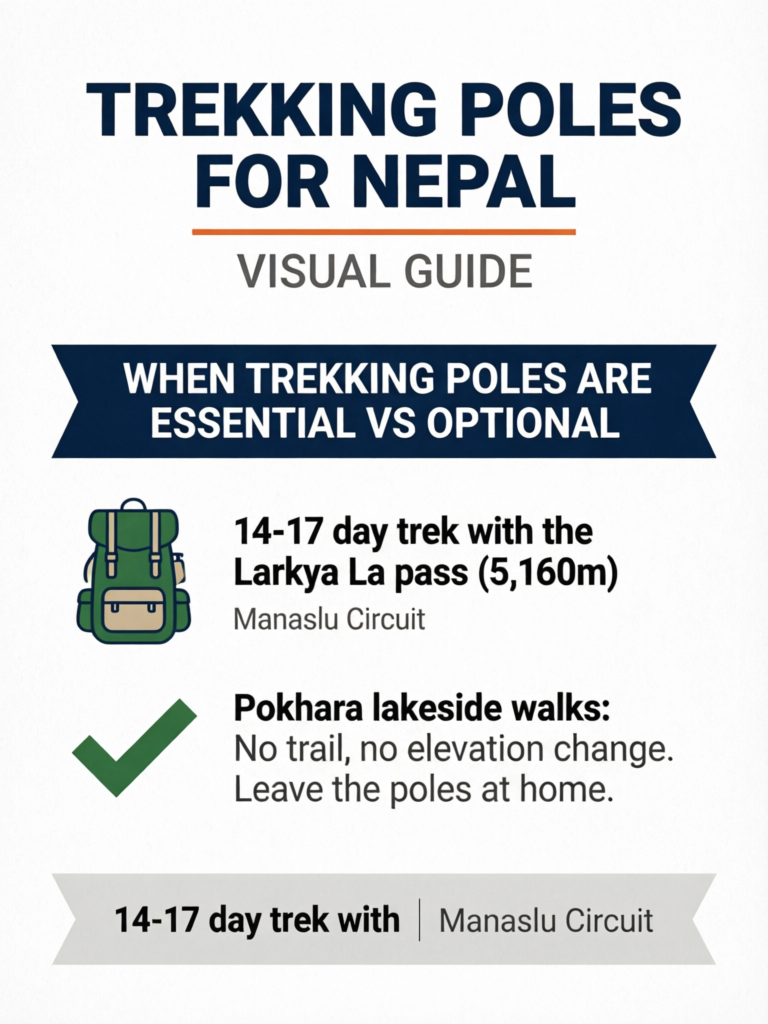
- Manaslu Circuit: 14-17 day trek with the Larkya La pass (5,160m) featuring a long, steep descent.
- Langtang Valley: Moderate terrain but the trek to Kyanjin Ri and Tserko Ri involves steep sections at altitude.
- Any trek crossing a high pass: Passes above 5,000 meters typically involve loose, steep terrain on both sides.
Optional
You can comfortably complete these without poles, though some trekkers still prefer them:
- Poon Hill (3-5 day trek): Short duration, moderate terrain, well-maintained stone steps. The climb to Poon Hill viewpoint is steep but brief.
- Ghorepani-Ghandruk Circuit (3-4 days): Similar to Poon Hill. Manageable without poles for reasonably fit trekkers.
- Mardi Himal (4-5 days): Short trek with some steep sections, but limited duration means knee stress stays manageable.
Not Needed
- Kathmandu Valley day hikes: Nagarkot, Champadevi, Shivapuri. Well-maintained trails, short duration.
- Flat approach walks: The initial valley walking before gaining altitude on most treks.
- Pokhara lakeside walks: No trail, no elevation change. Leave the poles in your room.
The Honest Assessment
If you are under 35, have healthy knees, carry a light pack, and are doing a trek under 7 days on moderate terrain, you can probably skip poles without any problems. But if any of those conditions change — longer trek, heavier pack, older knees, steep passes — the equation shifts strongly in favor of bringing them. When in doubt, rent a pair cheaply in Kathmandu and try them on the first day. You can always stow them on your pack if you don't like them.
Hiking Poles vs a Single Hiking Staff
Before choosing a design, decide whether you want a pair of hiking poles or a single hiking staff. The short answer for Nepal: use two poles.
- Hiking poles (a pair): Used in tandem, they enhance stability, distribute load symmetrically, and reduce force on your knees on descents. This is the right choice for any Nepal trek with real elevation change.
- Hiking staff (a single pole): A single walking pole is most effective on relatively flat terrain with little or no pack weight. Some staffs even include a built-in camera mount under the handle so the staff doubles as a monopod for photos. On steep Himalayan trails it offers far less benefit than a matched pair.
For the steep, multi-day terrain of treks like Everest Base Camp and the Annapurna Circuit, a single staff creates an asymmetrical gait that can strain one knee and hip. Two poles win every time.
Types of Trekking Poles
Trekking poles come in three main designs, each with distinct advantages for Nepal trekking.
Telescoping Poles (Most Common)
Telescoping poles use two or three nested sections that slide into each other and lock at your desired length. This is the most popular design you will see on Nepal trails and the type most commonly available for rental in Kathmandu.
Pros:
- Fully adjustable length (typically 65-135cm range)
- Very sturdy when properly locked
- Most affordable option
- Easy to find replacements if damaged on trek
- Wide range of quality levels available
Cons:
- Heavier than folding designs (typically 250-350g per pole)
- Slower to set up and adjust
- Larger packed size (55-65cm collapsed)
- Locking mechanisms can slip if not maintained
Telescoping poles are the best all-around choice for most Nepal trekkers. The adjustability matters enormously when you are constantly switching between steep uphills, flat traverses, and long descents throughout a single day.
Folding/Collapsible Poles (Z-Pole Design)
Folding poles use a system of interconnected segments held together by an internal cord, similar to a tent pole. They fold down into three or four short sections and snap together for deployment.
Pros:
- Ultralight (many models under 200g per pole)
- Very compact packed size (35-40cm)
- Fastest deployment — snap together in seconds
- Excellent for stowing in or on a pack when not in use
Cons:
- Limited or no length adjustability (some models offer 10-15cm of adjustment in the top section)
- More expensive than comparable telescoping models
- Can feel less rigid than a well-locked telescoping pole
- Internal cord can wear over time, especially in dusty/sandy conditions
Folding poles are ideal for ultralight trekkers and those who frequently switch between using and stowing poles throughout the day. The compact size is a genuine advantage when you need to strap them to your daypack for scrambling sections.
Fixed-Length Poles (Single Piece)
Fixed-length poles are exactly what they sound like: one solid piece with no adjustment mechanism.
Pros:
- Lightest possible weight for their strength
- Strongest design (no joints or locking mechanisms to fail)
- Simplest construction, least likely to malfunction
Cons:
- Zero adjustability — stuck at one length regardless of terrain
- Awkward to carry when not in use (cannot collapse)
- Must choose your exact length before the trek
- Very rare in Nepal
For Nepal treks, we recommend telescoping or folding poles. The constantly changing terrain — steep uphills followed by flat sections followed by long descents — demands adjustability. A pole length that is perfect for climbing to Thorong La will be completely wrong for the descent on the other side.
Pro Tip
If you cannot decide between telescoping and folding, consider how often you will stow your poles. On treks like Everest Base Camp where you use poles almost constantly, telescoping is fine. On treks with frequent scrambling sections where you need free hands, the fast deployment and compact size of folding poles gives them an edge.
Materials: Aluminum vs Carbon Fiber
The two dominant trekking pole materials offer genuinely different tradeoffs, and the right choice depends on your budget, trekking style, and priorities.
Aluminum
Aluminum remains the most popular material for trekking poles worldwide, and for good reason.
- Weight: 250-350g per pole (500-700g per pair)
- Price: $25-80 per pair
- Durability: Bends under extreme stress rather than breaking. A bent aluminum pole can often be straightened enough to continue using it.
- Feel: Slightly more flex and vibration absorption than carbon
- Repairability: Can be field-repaired with duct tape and creative bending. Replacement sections are sometimes available in trekking shops in Namche Bazaar or Manang.
Aluminum poles are the practical choice for most Nepal trekkers. They handle the abuse of rocky trails, accidental drops off ledges, and general rough treatment without catastrophic failure. If a rock jams your pole at an awkward angle, aluminum bends. You straighten it and keep walking.
Carbon Fiber
Carbon fiber poles represent the premium end of the market, favored by ultralight enthusiasts and experienced trekkers willing to pay more for less weight.
- Weight: 150-250g per pole (300-500g per pair)
- Price: $80-200 per pair
- Durability: Very stiff and strong under normal loads, but can shatter on hard lateral impacts. A cracked carbon pole is usually unrepairable in the field.
- Feel: Stiffer, with less vibration transfer to hands. Many trekkers prefer this "planted" feeling.
- Repairability: Essentially none. A broken carbon pole means buying a new one or fashioning a wooden walking stick from the nearest tree.
Carbon fiber makes the most sense for experienced trekkers who handle their gear carefully, value weight savings, and can afford the replacement cost if something goes wrong. The 200-300g weight savings per pair does add up over a 14-day trek, but it is not transformative for most people.
Our recommendation: Aluminum for budget-conscious trekkers, first-timers, and anyone who tends to be rough on gear. Carbon fiber for ultralight enthusiasts, experienced hikers, and those who prioritize the feel and swing weight of their poles. If you are renting in Kathmandu, you will almost certainly get aluminum, and that is perfectly fine.
Carbon Fiber Warning for Nepal
Nepal's trails include rocky sections where poles can get jammed between boulders. Aluminum bends and survives. Carbon can crack or shatter, leaving you with an expensive pile of splinters and no pole for the rest of your trek. If you bring carbon poles, carry extra care and consider bringing pole repair tape or a lightweight aluminum backup section.
Key Features to Evaluate
Beyond type and material, several features distinguish a good trekking pole from a frustrating one. Here is what to check when buying or renting.
Locking Mechanisms
The locking mechanism keeps your pole at the set length. A failed lock means a collapsing pole, which can cause a fall on steep terrain.
- Twist-lock (internal): Oldest design. Twist the pole sections to tighten an internal expander. Simple but can slip when wet, cold, or worn. Common on budget and rental poles in Kathmandu.
- Lever-lock (external): A flip lever clamps down on the pole section. More reliable, easier to adjust with gloves, and provides clear visual confirmation of being locked. The best option for Nepal conditions.
- Push-button (pin-lock): Common on folding poles. A spring-loaded pin snaps into a hole when the section is extended. Reliable but offers no fine adjustment.
For Nepal: Lever-lock is the gold standard. If you are renting, test the locking mechanism thoroughly before leaving Kathmandu. Reject any pole where the lock slips under firm pressure.
Grips
Your hands will be on these grips for 6-8 hours a day. Material matters.
- Cork: The best all-around grip material. Wicks moisture, molds to your hand shape over time, reduces vibration, and provides good grip when sweaty. Preferred by most experienced trekkers.
- Foam (EVA): Softer and more cushioned than cork. Absorbs moisture rather than wicking it, which can be a disadvantage on warm days but comfortable in cold conditions. Popular and effective.
- Rubber: Common on budget poles. Insulates well in cold weather but can cause blisters on long, sweaty days. Not ideal for multi-day treks.
For Nepal: Cork or foam. Both work well. Avoid rubber grips if you will be trekking in warmer lower-altitude sections.
Wrist Straps
Often overlooked, the wrist strap is critical for proper technique (more on this below). It should be padded, adjustable, and quick-release for safety.
Quick-release straps detach if a pole gets caught, preventing wrist injury. These are a genuine safety feature worth looking for, especially on technical terrain.
Tips
The tip is the business end of the pole, and different conditions demand different tips.
- Carbide or tungsten tips: Hard, aggressive tips that grip rock, ice, and packed earth. Standard on most quality poles and essential for Nepal's rocky trails.
- Rubber tip caps: Slip over the carbide tip for paved sections, airport floors, and to protect your gear bag. Bring a pair even if your poles don't come with them.
Baskets
Baskets are the small discs near the tip that prevent poles from sinking too deep.
- Small/trekking baskets: Standard for rocky trails. Prevent the tip from getting wedged between rocks.
- Large snow baskets: Essential for winter treks or any trek above 5,000m where you may encounter deep snow. Most poles come with small baskets; snow baskets are usually sold separately.
For Nepal: Small trekking baskets for spring and autumn treks. Bring snow baskets if trekking in winter (December-February) or on routes like the Three Passes that cross snow-covered terrain.
Shock Absorption
Some poles include a built-in spring mechanism that absorbs impact.
- Pros: Reduces vibration transferred to your hands, elbows, and shoulders. Particularly beneficial for trekkers with joint issues in the upper body.
- Cons: Adds 30-50g per pole, increases cost by $10-30, and the spring mechanism can feel "mushy" when pushing off on uphills.
Most experienced trekkers prefer poles without shock absorption, finding them more responsive and efficient. But if you have wrist, elbow, or shoulder problems, the dampening is genuinely helpful.
Proper Trekking Pole Technique
Owning good poles is only half the equation. Using them correctly makes the difference between poles that transform your trek and poles you abandon in frustration after day two.
Setting the Right Length
Start by standing on flat ground with your boots on. Hold the pole with the tip on the ground beside your foot. Your elbow should form approximately a 90-degree angle. If the angle is less than 90 degrees (forearm pointing up), the pole is too long. If more than 90 degrees (forearm pointing down), it is too short.
For most people, this means:
- Height 5'0" - 5'5" (152-165cm): Pole length around 100-110cm
- Height 5'5" - 5'10" (165-178cm): Pole length around 110-120cm
- Height 5'10" - 6'2" (178-188cm): Pole length around 120-130cm
- Height 6'2"+ (188cm+): Pole length around 125-135cm
These are starting points. Fine-tune based on comfort during the first hour of trekking.
Women's, unisex, and kids' poles: Most adjustable hiking poles are unisex and work for any trekker once set to the 90-degree elbow length. Women's-specific models simply offer narrower, smaller-diameter grips and a shorter maximum length suited to smaller hands and shorter heights — useful if standard grips feel bulky. For children, look for short-extension poles (often sold as a junior or youth size) rather than oversized adult poles set to their shortest length, which still tend to be too long.
Uphill Technique
When climbing, shorten your poles by 5-10cm from your flat-ground setting. This keeps your elbows at approximately 90 degrees despite the incline.
- Plant each pole slightly ahead of you and push off as you step forward
- Use a natural, alternating rhythm: left pole with right foot, right pole with left foot
- Do not over-reach — plant the pole at a comfortable distance ahead
- Use the poles to pull yourself uphill, engaging your upper body to share the work with your legs
- On very steep sections, you can use both poles simultaneously, planting them ahead and pulling yourself up
Downhill Technique
Descending is where poles earn their keep. Lengthen your poles by 5-10cm from your flat-ground setting.
- Plant both poles slightly ahead and downhill of your current position
- Step down to the poles, using them as brakes to control your descent speed
- Keep your arms slightly bent, never fully locked out
- Let the poles absorb impact before your knees do
- On very steep descents, consider planting both poles simultaneously for maximum braking force
- Lean slightly forward — the poles should give you confidence to maintain a forward center of gravity rather than leaning back (which increases fall risk)
Flat Terrain
On flat sections, return poles to your neutral 90-degree setting.
- Use a natural arm swing, planting poles lightly with each alternating step
- Do not grip tightly — let the wrist straps carry most of the connection
- Think of it as "walking with your arms," not "pushing with your hands"
- The touch should be light; save your energy for the uphills and descents
Traversing (Sidehill Walking)
When crossing a hillside, the terrain is uneven — one side higher than the other.
- Shorten the uphill pole by 5-10cm
- Lengthen the downhill pole by 5-10cm
- This keeps your body upright and balanced rather than leaning into the hillside
- Adjust each time the trail switches direction
River Crossings
Nepal treks, particularly during the spring and autumn seasons, include numerous stream and river crossings.
- Always face upstream when crossing
- Plant your downstream pole first to create a stable anchor against the current
- Move one foot at a time, maintaining at least three points of contact
- Probe ahead with your pole to check water depth and bottom stability before committing your weight
- Unbuckle your hip belt and sternum strap before crossing — if you fall, you need to be able to shed your pack quickly
Pro Tip
Correct wrist strap use is the single most important technique tip for trekking poles. Your hand should enter the strap from below, coming up through the loop. When you grip the pole, the strap sits across the back of your hand between thumb and forefinger. This allows you to rest your weight on the strap rather than gripping the pole tightly, which prevents hand fatigue and blisters over long days. Most trekkers use straps incorrectly — fix this on day one and your hands will thank you for the rest of the trek.
Trekking Pole Recommendations
Here are our recommendations across three budget tiers, all tested or reviewed for Nepal Himalayan conditions.
Budget ($25-60)
For trekkers watching their budget or first-timers unsure about long-term pole use.
- Kathmandu rental or purchase: The cheapest option. Aluminum telescoping poles available in every Thamel shop for $15-30 to buy or $5-15 to rent for a full trek. Quality varies significantly.
- Decathlon Forclaz 500: Solid aluminum telescoping pole with lever locks, foam grip, and decent baskets. Available in Kathmandu Decathlon stores. Excellent value for the price.
- Generic aluminum 3-section poles: Widely available online and in outdoor shops worldwide. Look for lever-lock mechanisms and cork or foam grips. Avoid twist-lock at this price point.
Budget poles work. They are heavier, the grips are less comfortable over long days, and the locking mechanisms require more attention. But for a single Nepal trek, a $30 pair of aluminum poles will get the job done.
Mid-Range ($60-120)
The sweet spot for most trekkers. Better materials, more reliable mechanisms, and noticeably more comfortable over long treks.
- Black Diamond Trail: A genuine classic. Aluminum shafts, dual FlickLock adjustability, comfortable foam grips with extended grip sections for choking up on climbs. Durable and reliable.
- Leki Makalu Lite: German-engineered with Leki's excellent Speed Lock 2 mechanism. Lightweight aluminum, comfortable Aergon grips, and a well-designed strap system.
- REI Co-op Traverse: REI's house brand offering solid performance at a fair price. Aluminum with lever locks, padded cork grips. Good warranty support if you are US-based.
Mid-range poles offer the best value proposition for Nepal trekking. The locking mechanisms are more reliable, the grips are comfortable for full-day use, and the build quality means they will last through multiple treks.
Premium ($120-200)
For experienced trekkers, ultralight enthusiasts, and those who trek frequently enough to justify the investment.
- Black Diamond Distance Carbon Z: The gold standard for folding carbon poles. Incredibly light (150g per pole), compact packed size, and fast deployment. The non-adjustable length means you need to choose your size carefully.
- Leki Micro Vario Carbon: Carbon fiber with Leki's proven folding design plus 16cm of adjustability in the top section — solving the biggest drawback of most folding poles. Speed Lock mechanism is excellent.
- Gossamer Gear LT5: Ultralight carbon at 140g per pole. Three-section folding design. Minimalist but effective. Popular in the ultralight trekking community.
Premium poles are genuinely nicer to use. The weight savings is noticeable over a full day, the grips and straps are more comfortable, and the build quality inspires confidence. But they are not necessary for a great trek. If the budget is tight, spend the savings on a better sleeping bag or trekking boots instead.
Rent vs Buy in Kathmandu
One of the biggest decisions for trekking poles is whether to bring your own, buy in Kathmandu, or rent for the trek.
Renting in Kathmandu
Cost: $5-15 for the duration of your trek (negotiable, especially in the off-season).
Availability: Trekking pole rentals are available at practically every outdoor shop in Thamel, as well as in Pokhara for Annapurna-region treks. You will not have trouble finding a pair.
Quality concerns: This is where renting gets tricky. Rental poles see heavy use from multiple trekkers. Before accepting a pair, check:
- Locking mechanisms: Extend each section and push down firmly. If the pole collapses under pressure, reject it.
- Shaft straightness: Sight down each pole like a rifle barrel. Bent shafts indicate previous damage and compromised strength.
- Tip condition: Worn or missing carbide tips significantly reduce grip on rock. Make sure tips are intact.
- Strap condition: Frayed or torn straps are useless. Check that straps adjust and hold.
- Basket attachment: Baskets should be firmly attached, not spinning freely or about to fall off.
Renting makes sense for first-time trekkers, those who do not hike regularly at home, or anyone who wants to try poles without committing to a purchase.
Buying Cheap in Kathmandu
Cost: $15-30 for basic aluminum telescoping poles from Thamel shops.
Quality: Better than most rental options because they are new. Still budget-level in terms of materials, grips, and locking mechanisms. Most are Chinese-manufactured generic designs, which is perfectly fine for a single trek.
Advantage over renting: You know they are not worn, you can break them in on shorter walks around Kathmandu before your trek, and you can leave them behind (or donate them to your guide) after the trek without worrying about returning them.
Bringing Your Own
When it makes sense: If you already own quality poles, if you trek regularly, if you have specific knee issues that require reliable equipment, or if you plan to do multiple treks over time.
Airline considerations: Most trekking poles must go in checked luggage (they have sharp tips and are classified as potential weapons in carry-on). Folding poles in a backpack-friendly size are easiest. Some airlines charge extra for oversized items, but trekking poles inside a checked duffel generally cause no issues.
For a detailed comparison of all gear rental versus purchase decisions, see our rent vs buy gear guide.
Rental Pole Failure on the Trail
We hear stories every season of rental poles failing at the worst possible moment — a lock giving way during a steep descent, a tip falling off on rocky terrain, or a shaft bending under normal use. If you rent, inspect thoroughly and consider carrying a few wraps of duct tape as an emergency repair kit. If a pole fails on the trail, you can sometimes buy a replacement in larger villages like Namche Bazaar or Manang, but selection is limited and prices are higher. For critical treks with major pass crossings, seriously consider buying a new budget pair rather than renting a used one.
Caring for Your Trekking Poles on Trek
A few minutes of maintenance keeps your poles performing reliably throughout your trek.
Daily Care
- Wipe down pole sections after trekking through mud, dust, or water. Grit in the locking mechanisms causes slippage and premature wear.
- Collapse and store poles properly at teahouses. Leaving them extended and leaning against walls invites them to fall and bend.
- Dry pole sections before collapsing. Moisture trapped inside telescoping poles causes corrosion and can freeze at altitude, making them impossible to extend in the morning.
On-Trail Fixes
- Slipping lock: Tighten the tension adjustment on lever locks (usually a small screw). For twist locks, clean the internal expander with water and re-tighten.
- Lost basket: Wrap duct tape around the shaft just above the tip to create a makeshift basket. Not ideal, but it prevents the pole from sinking between rocks.
- Bent shaft: Aluminum can often be carefully bent back to near-straight using two hands and a solid anchor point (like a rock). Do not attempt this with carbon fiber.
- Lost tip cap: Wrap the carbide tip with duct tape when walking on paved sections to protect both the tip and the pavement.
Post-Trek
- Fully extend and dry all sections before storage
- Loosen all locking mechanisms to relieve tension on springs and seals
- Check tips and baskets for wear, replace as needed before your next trek
- Store in a cool, dry place, not compressed in a bag
Common Mistakes Trekkers Make with Poles
Avoid these errors that we see repeatedly on Nepal trails.
Gripping too tightly: Your hands should be relaxed. Death-gripping the handles causes forearm fatigue, blisters, and reduces the effectiveness of your wrist straps. Let the straps do the work.
Never adjusting length: Many trekkers set their poles once and never touch them again. You should be adjusting for uphills, downhills, and traverses throughout every day. It takes 10 seconds and makes a meaningful difference.
Using only one pole: Some trekkers bring only one pole or use only one while stashing the other. Two poles provide symmetrical support and balanced effort. One pole creates an asymmetrical gait that can actually increase strain on one side of your body.
Planting poles too far ahead: Over-reaching with your poles forces you into an inefficient, hunched posture. Plant close enough that your arms maintain a natural, slightly bent position.
Ignoring poles on flat sections: Even on flat terrain, light pole use maintains rhythm, engages your upper body, and keeps you warmed up for the next steep section. You do not have to pound the ground — a light touch is sufficient.
Not using straps at all: Some trekkers remove the straps entirely. This forces you to grip harder and eliminates the primary load-bearing mechanism. Use the straps correctly.
Pro Tip
Practice your pole technique on a few day hikes at home before your Nepal trek. The first day of a major Himalayan trek is not the time to figure out how your poles work. Even a single afternoon on hilly terrain will teach you the basic rhythm, help you find your ideal length settings, and reveal any issues with your specific poles before you are days from the nearest gear shop.
FAQ
Final Verdict: Should You Bring Trekking Poles to Nepal?
For treks lasting 8 or more days, routes with significant elevation change, any trek crossing a high pass, and trekkers over 35 or with knee concerns: yes, bring trekking poles. The 25% reduction in knee impact, improved stability, and reduced fatigue are meaningful benefits backed by both research and the unanimous recommendation of experienced Himalayan guides.
For short treks on moderate terrain by young, fit trekkers with no joint issues: poles are optional. You will be fine without them, though you might find yourself wishing you had them on the steeper sections.
The most practical approach for many first-time Nepal trekkers is to rent a pair cheaply in Kathmandu, try them on the first day or two, and either continue using them or strap them to your pack. At $5-15 for the entire trek, the cost of trying is negligible compared to the potential benefit to your knees and overall trekking experience.
Whatever you decide, combine your pole decision with the rest of your gear planning using our complete trekking gear list and Nepal packing list. And make sure your trekking boots are properly broken in — no amount of pole technique can compensate for blisters.
Happy trekking.