
+5 to 15°F (+3 to 8°C) depending on material
Silk liner at 100-140g
Fleece liner at +10-15°F boost
Merino wool or silk-blend
$15-70 depending on material
Protects bag from sweat, dirt, and body oils
Essential with any Kathmandu rental sleeping bag
Smaller than a tennis ball
A sleeping bag liner is the most underrated piece of gear in your Nepal trekking kit. It weighs between 100 and 500 grams, packs smaller than a water bottle, costs a fraction of a sleeping bag, and delivers two benefits that experienced Himalayan trekkers consider non-negotiable: a meaningful warmth boost to your sleeping bag's temperature rating and a critical hygiene barrier between you and a sleeping bag that has been used by hundreds of trekkers before you.
If you are renting a sleeping bag in Kathmandu -- which roughly 40% of trekkers on the EBC and Annapurna routes do -- a liner is not optional. It is essential. Those rental bags have been through dozens of treks and hundreds of nights without professional washing. A liner creates a clean, personal sleep surface that you control. If you are bringing your own sleeping bag, a liner extends its effective temperature rating by 3-8 degrees Celsius, which can be the difference between sleeping comfortably and shivering until dawn at a 5,000m tea house.
This guide covers every liner material available, honest temperature boost numbers from real-world testing (not optimistic manufacturer claims), the specific scenarios where each material excels, and a clear recommendation for every type of Nepal trek and every budget level.
Why Sleeping Bag Liners Matter for Nepal Treks
Before diving into materials and products, let us establish why a liner deserves space in your already-tight packing list. There are three compelling reasons, and each one independently justifies the 100-500g weight penalty.
Reason 1: Hygiene in Tea House Sleeping Bags
Tea house sleeping situations in Nepal range from perfectly clean at lower-altitude lodges to questionable at high-altitude shelters where water for laundry is scarce and freezing cold. Above 4,000m, where water must sometimes be carried and heated by hand, sleeping bag washing simply does not happen with any regularity.
If you are renting a sleeping bag from a gear shop in Kathmandu, that bag has been used by an average of 30-50 trekkers per season for potentially multiple seasons. The inner fabric absorbs sweat, body oils, dead skin cells, and occasionally illness-related fluids from each user. Rental shops vary in their cleaning practices -- some wash bags after every return, while others simply air them out and restuff them. Even bags that are washed may not be fully sanitized, as sleeping bag wash protocols require specific detergent and gentle cycles that not all shops follow.
A liner creates a personal, washable barrier that you sleep inside. Your skin contacts the liner, not the sleeping bag. After each night, you shake the liner out. Every few days at a tea house with warm water, you can hand-wash it. At the end of the trek, you wash the liner thoroughly, and your own sleeping bag (or the rental bag you return) stays cleaner.
Beyond rental bags, even your own personal sleeping bag benefits from a liner. Washing a down sleeping bag is a delicate process that should happen only a few times per year to preserve loft. A liner absorbs the nightly wear so the sleeping bag does not have to, extending the time between washes and prolonging the bag's insulation life.
Tea House Blankets and Provided Bedding
Some tea houses above 3,000m provide blankets instead of sleeping bags. These blankets are shared among all guests and washed infrequently. If you are relying on tea house-provided bedding rather than your own sleeping bag, a liner becomes even more important as your primary clean sleep surface. A fleece liner plus tea house blankets can work for lower-altitude treks, but above 4,000m, this combination is inadequate for warmth. You need a proper sleeping bag with a liner inside it.
Reason 2: Meaningful Warmth Boost
Every sleeping bag has a comfort rating, and nearly every trekker encounters at least one night where the actual temperature drops below that rating. A liner adds a measurable buffer. The exact boost depends on the liner material:
| Liner Material | Temperature Boost | Best Conditions |
|---|---|---|
| Silk | +5-8°F (+3-5°C) | Three-season, weight-sensitive |
| Cotton | +3-5°F (+2-3°C) | Budget, lower altitude, warm climates |
| Merino Wool | +7-11°F (+4-6°C) | Cold conditions, odor resistance |
| Synthetic Fleece (Micro) | +8-12°F (+5-7°C) | Very cold conditions, bulk acceptable |
| Synthetic Fleece (Expedition) | +12-15°F (+7-8°C) | Winter trekking, extreme cold |
| Thermal (Reactor-style) | +10-15°F (+6-8°C) | Technical, weight-efficient warmth |
These numbers come from real-world testing, not manufacturer optimism. Lab tests in controlled conditions often show slightly higher numbers, but in the variable conditions of a tea house bedroom -- where drafts come through wall gaps, the liner may shift during sleep, and your body temperature fluctuates with altitude fatigue -- the actual boost is somewhat lower. We use conservative estimates throughout this guide.
The warmth boost works through a simple mechanism: the liner creates an additional layer of trapped air between your body and the sleeping bag shell. Air is an excellent insulator, and even a thin layer of trapped air adds meaningful thermal resistance. Thicker materials like fleece trap more air and therefore provide greater warmth, but at the cost of weight and bulk.
Reason 3: Sleep Comfort and Versatility
Beyond warmth and hygiene, a liner makes sleeping in a bag more comfortable in ways that are hard to appreciate until you experience them:
- Smoother surface feel. The interior of many sleeping bags, especially rental bags and budget synthetic bags, feels rough against skin. A silk or merino liner provides a soft, pleasant surface to sleep on.
- Moisture management. Your body releases moisture through the night via respiration and skin evaporation. A good liner wicks this moisture away from your skin, preventing the clammy feeling that wakes you at 3am.
- Temperature regulation. On warmer nights at lower altitudes, you can sleep in just the liner with the sleeping bag unzipped, giving you a light-sheet option without carrying a separate sheet.
- Standalone use at low altitude. For the first and last days of a trek, below 2,500m where temperatures may be 10-15 degrees Celsius at night, a silk or merino liner alone can serve as your complete sleep system, saving you the hassle of unpacking your sleeping bag.
Pro Tip
On warm-to-cold transition treks like the Annapurna Circuit, where you start at 800m and climb to 5,416m, a liner serves double duty beautifully. Use it alone for the first few hot nights in the lower Marsyangdi valley, add it inside your sleeping bag as you gain altitude and temperatures drop, and use it alone again during the warm descent through Muktinath and Jomsom. This versatility means you get comfortable sleep from the lowest to the highest point of the trek.
Liner Materials Compared: The Complete Guide
Silk: The Lightweight Champion
Silk is the classic trekking liner material, and for good reason. It offers the best combination of warmth, weight, and packability of any natural fiber.
Advantages:
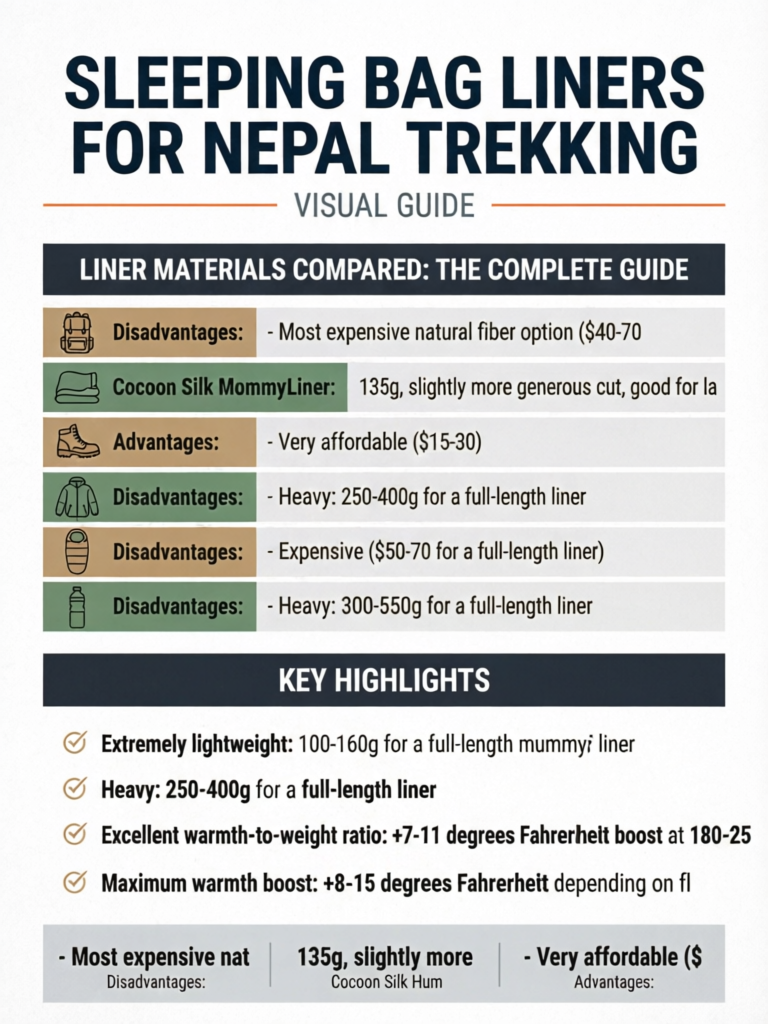
- Extremely lightweight: 100-160g for a full-length mummy liner
- Compresses to the size of a fist or smaller
- Smooth, luxurious feel against skin
- Natural temperature regulation -- breathes well in warm conditions, retains some warmth in cold
- Moderate moisture-wicking capability
- Quick-drying compared to cotton (2-4 hours in dry mountain air)
- +5-8 degrees Fahrenheit warmth boost
Disadvantages:
- Most expensive natural fiber option ($40-70 for a quality liner)
- Less durable than synthetic options -- silk fibers can snag and develop small holes over time
- Less warmth boost than fleece or thermal liners
- Requires gentle hand-washing (no wringing, no hot water)
- Develops odor faster than merino, requiring more frequent washing on long treks
Best for: Weight-conscious trekkers on standard tea house routes in peak season (October-November, March-May) who already have an adequately-rated sleeping bag and want hygiene protection with minimal weight. Silk is also ideal for ultralight backpackers who count every gram.
Top picks:
- Sea to Summit Premium Silk Liner (Mummy): 115g, excellent construction, the benchmark silk liner. $55-65.
- Cocoon Silk MummyLiner: 135g, slightly more generous cut, good for larger trekkers. $50-60.
- Kathmandu-purchased silk liner: 120-150g, available in Thamel for $15-25, quality varies but generally adequate. Inspect seams before buying.
Cotton: The Budget Option
Cotton liners are the cheapest option and the heaviest. They serve a specific purpose but are not ideal for most Nepal trekking.
Advantages:
- Very affordable ($15-30)
- Soft and comfortable against skin
- Widely available in Kathmandu's Thamel district
- Easy to wash with no special care required
- Durable -- cotton withstands rough handling and many wash cycles
Disadvantages:
- Heavy: 250-400g for a full-length liner
- Bulky when packed -- 3-4 times the volume of a silk liner
- Absorbs moisture and dries very slowly (8-12 hours)
- Minimal warmth boost (+3-5 degrees Fahrenheit)
- Becomes cold and clammy when damp from body moisture
- Poor performance in cold, humid conditions
Best for: Budget trekkers on lower-altitude routes (Poon Hill, lower Langtang) where temperatures do not drop below minus 5 degrees Celsius. Also suitable as a tea house sheet-replacement below 3,000m where warmth is not the priority.
Top picks:
- Sea to Summit Cotton Liner: 325g, well-constructed, rectangular or mummy shape available. $20-30.
- Kathmandu cotton liner: 300-400g, widely available in Thamel for $8-15. Perfectly adequate for the purpose.
Merino Wool: The Performance Choice
Merino wool liners offer an excellent balance of warmth, moisture management, and odor resistance. They are the preferred choice for experienced trekkers who prioritize performance.
Advantages:
- Excellent warmth-to-weight ratio: +7-11 degrees Fahrenheit boost at 180-250g
- Outstanding moisture wicking -- merino actively transports moisture away from skin
- Naturally antimicrobial -- resists odor far longer than silk or cotton (5-7 days of use before noticeable smell)
- Comfortable across a wide temperature range (thermoregulating)
- Soft, non-itchy feel (unlike traditional wool)
- Retains warmth even when damp -- wool insulates at up to 80% efficiency when wet
Disadvantages:
- Expensive ($50-70 for a full-length liner)
- Heavier than silk (180-250g vs 100-160g)
- Slower to dry than silk (4-6 hours)
- Less durable than cotton or synthetic -- merino develops thin spots and small holes over time with friction
- Requires gentle washing (cool water, no tumble dry on high heat)
Best for: Cold sleepers, trekkers on routes that go above 4,500m, winter trekkers, and anyone who values odor resistance on multi-week treks. Merino is the best all-around choice for trekkers willing to pay the premium and accept the slightly higher weight versus silk.
Top picks:
- Sea to Summit Merino Blend Liner: 220g, 50/50 merino-polyester blend for durability, mummy or rectangular. $55-65.
- Cocoon MerinoSilk Liner: 175g, merino-silk blend that combines the warmth of merino with the lightness of silk. Outstanding hybrid. $60-70.
- Icebreaker Cool-Lite Liner: 200g, merino-Tencel blend, excellent moisture management. $50-60.
Synthetic Fleece: The Warmth Maximizer
Fleece liners deliver the most warmth of any liner type but come with significant weight and bulk penalties. They are the right choice for specific situations, not as a default.
Advantages:
- Maximum warmth boost: +8-15 degrees Fahrenheit depending on fleece weight
- Retains warmth even when wet
- Very fast drying (1-2 hours)
- Durable and machine-washable
- Affordable ($25-45)
- Comfortable, soft feel
Disadvantages:
- Heavy: 300-550g for a full-length liner
- Very bulky when packed -- the largest liner option by far
- No odor resistance -- absorbs and retains body odor quickly
- Less breathable than natural fibers -- can feel stuffy in warmer conditions
- Static buildup in dry conditions
Best for: Winter trekking (December-February) above 4,000m, camping treks in extreme cold, and trekkers whose sleeping bag is borderline inadequate for their destination temperatures. A fleece liner is essentially a substitute for buying a warmer sleeping bag. If your bag is rated to minus 10 degrees Celsius and you need minus 18 degrees Celsius performance, a fleece liner bridges that gap.
Top picks:
- Sea to Summit Reactor Fleece Liner: 375g, +14 degrees Fahrenheit claimed (real-world: +10-12 degrees Fahrenheit). The warmest liner we have tested. $45-55.
- Cocoon Thermolite Radiator Liner: 340g, Thermolite insulation with aluminum-dotted interior that reflects body heat. Innovative design. $40-50.
- Sea to Summit Reactor Extreme: 420g, +25 degrees Fahrenheit claimed (real-world: +15-18 degrees Fahrenheit). For genuinely extreme conditions only. $55-65.
Thermal/Reactor-Style Liners: The Technical Option
These are synthetic liners that use advanced materials (Thermolite hollow-core fiber, reflective coatings) to maximize warmth per gram. They fall between silk and fleece in both weight and warmth output.
Advantages:
- High warmth-to-weight ratio: +10-15 degrees Fahrenheit at 200-350g
- More compact than fleece for equivalent warmth
- Quick-drying (2-3 hours)
- Machine-washable, low maintenance
- Some models use body-heat-reflecting technology for additional warmth
Disadvantages:
- Synthetic feel -- not as comfortable against skin as silk or merino
- Moderate odor resistance (better than fleece, worse than merino)
- Can feel clammy if you are a heavy sweater
- Higher cost than basic fleece ($35-60)
Best for: Trekkers who want significant warmth boost without the bulk of fleece. An excellent choice for those who are bringing a sleeping bag rated close to -- but not quite adequate for -- their expected temperatures.
When a Liner Plus Rental Bag Beats Buying a Sleeping Bag
One of the smartest gear strategies for Nepal trekking, especially for one-time or infrequent trekkers, is combining a quality liner with a rental sleeping bag from Kathmandu. Here is when this approach makes sense and when it does not.
The Math Behind Renting Plus Liner
A quality down sleeping bag rated to minus 15 degrees Celsius comfort costs $200-400 to buy. A rental sleeping bag in Kathmandu costs $1-3 per day, totaling $14-42 for a standard 14-day trek. A good silk or merino liner costs $40-70 and weighs 120-250g. Total cost of renting plus liner: $55-110. That is a saving of $100-300 compared to buying a sleeping bag you may use once.
The liner solves the two biggest problems with rental bags: hygiene and insufficient warmth. You sleep inside your personal liner, not touching the rental bag fabric directly. And the liner adds 3-8 degrees Celsius to the rental bag's effective rating, compensating for the fact that rental bags are often less warm than their labeled ratings suggest (worn insulation, compressed loft from repeated use).
When Renting Plus Liner Works Well
- First-time trekkers who are unsure if they will trek again and do not want to invest in an expensive sleeping bag
- Trekkers on standard routes (EBC, Annapurna Circuit, Langtang) in peak season where temperatures are cold but not extreme
- Budget-conscious trekkers who need to minimize upfront costs
- Trekkers flying in with limited luggage allowance who cannot carry a bulky sleeping bag
When You Should Buy Your Own Sleeping Bag
- Winter trekking (December-February) where temperatures drop below minus 20 degrees Celsius and rental bag quality is a genuine risk
- Camping treks where you need guaranteed performance and cannot swap bags if yours is inadequate
- Frequent trekkers who will use the bag multiple times, making the purchase cost-effective
- Cold sleepers who need a specific comfort rating and cannot rely on variable rental quality
- High-altitude routes (above 5,500m) where the margin for sleeping bag failure is very small
How to Evaluate a Rental Bag
When picking up a rental sleeping bag in Kathmandu, bring your liner with you and check:
- Loft test: Lay the bag flat and uncompressed. A well-maintained bag should loft to 4-6 inches of thickness. If it lies flat and thin, the insulation is compressed and the bag will be colder than its rating.
- Smell test: Open the bag and smell the interior. A moderate "used" smell is normal. A strong odor of mildew, body odor, or chemicals suggests the bag has not been properly cleaned.
- Zipper test: Zip and unzip the bag fully. A sticking or broken zipper will let cold air in all night and is not worth the savings.
- Size check: Make sure the bag fits your body with your liner inside. A too-small bag compresses the insulation at your shoulders and feet, creating cold spots.
Liner Shape Matters with Rental Bags
Rental sleeping bags in Kathmandu come in mummy shapes almost exclusively. If your liner is rectangular, it will bunch up inside the tapered foot section of a mummy bag, creating uncomfortable folds that disrupt sleep and reduce the warmth benefit. Always choose a mummy-shaped liner for Nepal trekking unless you own a rectangular sleeping bag. The tapered shape moves with you during the night and maintains consistent contact with the bag's insulation.
Pro Tip
Before your trek, test the liner-plus-rental-bag combination for one night at home. Rent the bag in Kathmandu a day before your trek starts. Sleep in it with your liner at your hotel. If the combination is not warm enough, you still have time to rent a warmer bag, add a second liner (some trekkers stack a silk liner inside a fleece liner for maximum warmth), or buy a bag outright. Testing at home is far better than discovering the problem at 4,800m at midnight.
Best Liners for Each Trek Type and Season
Everest Base Camp (Spring/Autumn): Silk or Merino
The standard EBC route reaches 5,364m with nighttime temperatures of minus 10 to minus 20 degrees Celsius at the highest points. In peak season (October-November, March-May), a sleeping bag with a minus 15 degrees Celsius comfort rating plus a silk liner (adding 3-5 degrees Celsius) or merino liner (adding 4-6 degrees Celsius) creates an effective system rated to minus 18 to minus 21 degrees Celsius, which is adequate for all but the coldest nights at Gorak Shep.
Recommended liner: Sea to Summit Premium Silk Liner (115g, $55) for weight-conscious trekkers, or Cocoon MerinoSilk Liner (175g, $65) for cold sleepers.
Everest Base Camp (Winter): Fleece or Thermal
Winter EBC sees nighttime temperatures of minus 20 to minus 30 degrees Celsius at Gorak Shep. A silk liner is insufficient. You need maximum warmth boost from a fleece or thermal liner combined with a sleeping bag rated to at least minus 20 degrees Celsius comfort.
Recommended liner: Sea to Summit Reactor Fleece (375g, $50) or Sea to Summit Reactor Extreme (420g, $60) for the coldest conditions.
Annapurna Circuit (Peak Season): Silk
The Annapurna Circuit's highest point is Thorong La (5,416m), but you only spend one or two nights above 4,500m. Most of the trek is at moderate altitude where a silk liner's light weight and versatility outweigh the extra warmth of heavier options.
Recommended liner: Sea to Summit Premium Silk Liner (115g, $55). Use it alone on the warm lower sections and inside your bag above 3,500m.
Annapurna Base Camp (Peak Season): Silk or Merino
ABC reaches 4,130m with nighttime temperatures of minus 5 to minus 15 degrees Celsius in peak season. The approach is through lush rhododendron forests where evenings are relatively warm. A silk liner works for most trekkers; cold sleepers should opt for merino.
Recommended liner: Silk for most trekkers; merino for cold sleepers or autumn late-season trekkers (late November).
Langtang Valley (Peak Season): Merino
Langtang reaches 3,870m at Kyanjin Gompa, with an optional climb to Tserko Ri at 4,984m. The valley catches cold winds from Tibet, making nighttime temperatures colder than comparable altitudes on the Annapurna or EBC routes. Merino's superior warmth and moisture management suit this route well.
Recommended liner: Sea to Summit Merino Blend Liner (220g, $60).
Manaslu Circuit: Merino or Thermal
The Manaslu Circuit reaches 5,160m at Larkya La, with several nights above 4,000m in tea houses that are more basic than those on EBC or Annapurna routes. The higher altitude and more remote conditions warrant a warmer liner.
Recommended liner: Cocoon Thermolite Radiator Liner (340g, $45) or Cocoon MerinoSilk Liner (175g, $65).
Camping Treks (Upper Dolpo, Makalu, Great Himalaya Trail): Fleece
On camping treks where you sleep in tents at exposed high-altitude campsites, temperatures can drop lower than tea house bedrooms (which offer at least some wind protection). A fleece liner provides maximum warmth insurance.
Recommended liner: Sea to Summit Reactor Fleece (375g, $50) or Sea to Summit Reactor Extreme (420g, $60).
Weight vs Warmth vs Cost: Decision Matrix
| Liner | Material | Weight | Warmth Boost | Pack Size | Cost | Best For |
|---|---|---|---|---|---|---|
| Sea to Summit Silk | Silk | 115g | +5-8°F | Tennis ball | $55 | Ultralight, peak season |
| Cocoon MerinoSilk | Merino-Silk blend | 175g | +8-10°F | Softball | $65 | Cold sleepers, best hybrid |
| Sea to Summit Merino | Merino-Poly blend | 220g | +7-11°F | Softball | $60 | All-season, odor resistant |
| Kathmandu Cotton | Cotton | 350g | +3-5°F | Grapefruit | $12 | Budget, low altitude |
| Sea to Summit Reactor Fleece | Synthetic fleece | 375g | +10-14°F | Large grapefruit | $50 | Winter, extreme cold |
| Cocoon Thermolite Radiator | Thermolite | 340g | +12-15°F | Softball+ | $45 | Technical warmth, good value |
| Sea to Summit Reactor Extreme | Synthetic thermal | 420g | +15-18°F | Small melon | $60 | Extreme winter, camping |
Caring for Your Liner on Trek
Washing on the Trail
One of the great advantages of a liner is that it can be washed more frequently and easily than a sleeping bag. Here is how to maintain it on trek:
- Every 3-5 days: Hand-wash the liner in warm water with a small amount of biodegradable soap. Most tea houses can provide a basin and warm water for this purpose. Wring gently (silk especially should not be wrung hard) and hang to dry in the afternoon sun. At altitude, the thin, dry air means even cotton liners dry in 4-6 hours in direct sunlight.
- Daily maintenance: Shake the liner out vigorously after sleeping. Turn it inside out and air it on your pack during the morning while you eat breakfast. This removes moisture from body heat and reduces odor buildup.
- Quick-dry rotation: If you carry two liners (one light, one warm), you can alternate them, washing one while using the other. This is overkill for most trekkers but valuable on 20-plus-day treks.
Material-Specific Care
Silk: Wash in cool to lukewarm water only. Use silk-specific soap if available, or a small amount of mild shampoo (yes, shampoo -- it is designed for protein fibers like hair and silk). Do not wring. Squeeze gently in a towel to remove excess water, then hang to dry. Silk dries in 2-3 hours in dry mountain air.
Cotton: Machine or hand-wash with standard soap. Cotton is the least fussy material. However, it dries slowly (6-12 hours), so plan wash days for rest days with good sun.
Merino: Wash in cool water with wool-safe soap or a small amount of shampoo. Do not tumble dry on high heat. Merino dries faster than cotton (3-5 hours) and its natural antimicrobial properties mean you can go longer between washes.
Fleece/Synthetic: Machine or hand-wash with standard soap. Dries fastest of all materials (1-2 hours in dry conditions). No special care required.
Pro Tip
Pack a small (30ml) bottle of Dr. Bronner's concentrated soap for liner washing on trek. It works as body soap, hair shampoo, and laundry soap, reducing the number of toiletry items you carry. One bottle lasts an entire 14-day trek for all purposes. It is biodegradable, which matters when washing water drains into mountain streams. Available at outdoor stores and in Kathmandu.
What to Buy at Home vs Buy in Kathmandu
Buy Before You Leave
Silk liners: While silk liners are available in Kathmandu's Thamel district, quality varies significantly. Some Thamel silk liners are blended with polyester and marketed as "100% silk." If silk purity matters to you (for weight, feel, and warmth), buy from a reputable outdoor brand at home. Sea to Summit and Cocoon are the gold standard.
Merino liners: Genuine merino liners are rarely available in Kathmandu. If you want merino, buy it at home.
Thermal/Reactor liners: Specialized liners like the Sea to Summit Reactor series are not available in Nepal.
Available in Kathmandu
Cotton liners: Widely available in Thamel for $8-15. Quality is consistent and perfectly adequate.
Basic silk liners: Available for $15-25 in Thamel. Quality varies. Inspect the fabric closely: pure silk has a distinctive sheen and smooth feel that blended fabric lacks. If the price seems too good to be true for "100% silk," it probably is not 100% silk.
Fleece liners: Basic fleece liners are available in Thamel for $10-20. These work well and the quality concern is minimal since fleece performance is consistent regardless of brand.
The Thamel Silk Test
To check if a liner sold as silk in Thamel is genuine, try the ring test: pull a corner of the fabric through a finger ring. Pure silk, being extremely fine and smooth, passes through easily. Blended or synthetic fabric bunches up and resists. Also check the weight: a full-size mummy silk liner should weigh 100-160g. If it is noticeably heavier, it is likely blended with a heavier fiber.
Liner Shape Guide
Mummy Shape
Tapered from shoulders to feet, matching the shape of most trekking sleeping bags. This is the correct shape for Nepal trekking in almost all cases.
Advantages: Moves with you during sleep, maintains consistent contact with the sleeping bag insulation, lighter than rectangular for the same material, no excess fabric bunching at the foot.
Disadvantages: Less roomy, can feel restrictive for trekkers who move a lot during sleep.
Rectangular Shape
Straight sides with equal width from shoulders to feet. Best for large or restless sleepers, but only suitable if your sleeping bag is also rectangular (uncommon for trekking bags).
Advantages: More room to move, can be fully unzipped and used as a sheet, works as a standalone blanket at low altitude.
Disadvantages: Bunches up inside mummy bags, heavier than mummy for the same material, excess fabric creates cold pockets.
Traveler/Long Shape
Similar to mummy but with more room and a pillow pocket at the top. Designed for tea house or hotel use where a sleeping bag may not be involved.
Advantages: Built-in pillow pocket keeps the liner anchored, roomier than standard mummy, works well as a standalone sleep system at low altitude.
Disadvantages: Slightly heavier, not ideal inside a tight-fitting sleeping bag.
Our recommendation: Mummy shape for all Nepal trekking. The only exception is if you own a rectangular sleeping bag.
Advanced Liner Strategies
Double Liner System
For extreme cold (winter trekking above 4,500m), some experienced trekkers stack two liners: a silk liner against the skin for comfort and hygiene, and a fleece or thermal liner as the outer warmth layer. The combined warmth boost can reach +15-20 degrees Fahrenheit, which effectively upgrades a minus 10 degrees Celsius sleeping bag to minus 20 degrees Celsius or colder performance.
Weight penalty: 480-560g for silk plus fleece combination When it makes sense: When buying a warmer sleeping bag is not feasible, when renting in Kathmandu and adding maximum warmth insurance, or as an emergency warmth system
Liner as Clothing Layer
On exceptionally cold nights, some trekkers wrap their liner around their upper body inside the sleeping bag, creating an additional torso insulation layer that targets the chest and shoulders where heat loss is greatest. This works better with rectangular liners that can be folded. Not elegant, but effective in an emergency.
VBL (Vapor Barrier Liner) Strategy
An advanced technique borrowed from mountaineering: placing a thin waterproof liner (or even a large garbage bag) between your body and the sleeping bag liner. This traps body moisture against your skin, preventing it from migrating into the sleeping bag insulation where it would reduce loft and warmth. The VBL strategy is only relevant for multi-day camping in sustained temperatures below minus 15 degrees Celsius, and it is uncomfortable (you sleep in your own humidity). Not recommended for tea house trekking.
Liner Size Compatibility
Before buying a liner, check its dimensions against your sleeping bag's internal dimensions. A liner that is wider or longer than your sleeping bag will bunch up inside, creating uncomfortable lumps and reducing its warmth effectiveness. A liner that is too small will pull tight when you move, potentially tearing at the seams. Most mummy liners fit standard trekking sleeping bags well, but if you are very tall (above 190cm) or very broad-shouldered, look for "long" or "wide" versions.
Frequently Asked Questions
Do I really need a sleeping bag liner for Nepal trekking?
It is not technically required, but it is one of the most valuable items per gram in your entire kit. For hygiene alone, a liner is worth carrying if you are sleeping in tea houses or using a rental bag. The warmth boost is a significant bonus. Roughly 80% of experienced Nepal trekkers carry a liner, and among guides and repeat trekkers, the figure is closer to 95%.
What is the warmest sleeping bag liner for trekking?
The Sea to Summit Reactor Extreme provides the highest warmth boost at +15-18 degrees Fahrenheit in real-world conditions, at a weight of 420g. The Cocoon Thermolite Radiator is a close second at +12-15 degrees Fahrenheit and 340g. For the best warmth-to-weight ratio, the Cocoon MerinoSilk blend at 175g provides +8-10 degrees Fahrenheit, making it the most weight-efficient warm liner available.
Can I use a sleeping bag liner without a sleeping bag?
Yes, at lower altitudes. A silk or merino liner alone is comfortable for sleeping at temperatures of 15-20 degrees Celsius, which covers the lower sections of most Nepal treks (below 2,500m) during peak season. Above 3,000m, a liner alone is inadequate. Even on the warmest autumn nights at 3,500m, temperatures drop to 0-5 degrees Celsius, which requires a proper sleeping bag.
Silk vs merino liner: which is better for Nepal?
Both are excellent choices. Silk wins on weight (115g vs 175-220g) and packability. Merino wins on warmth (+7-11 degrees Fahrenheit vs +5-8 degrees Fahrenheit), odor resistance (5-7 days vs 2-3 days before washing), and wet-weather performance. For peak-season tea house treks where weight matters and warmth needs are moderate, silk is ideal. For colder treks, longer durations, or cold sleepers, merino is better.
How often should I wash my liner on trek?
Every 3-5 days in ideal conditions. In practice, wash opportunities depend on water availability and drying conditions. Silk and merino can go longer between washes thanks to their natural odor resistance. Cotton and fleece should be washed more frequently (every 2-3 days) as they absorb and retain odor faster. At minimum, shake out and air your liner daily.
Can a liner replace a sleeping bag on the EBC trek?
No. Not even close. Nighttime temperatures at Gorak Shep (5,164m) drop to minus 15 to minus 20 degrees Celsius. The warmest liner available provides plus 15-18 degrees Fahrenheit of warmth boost over bare body temperature, which is insufficient for sub-zero conditions. A liner is always a supplement to a sleeping bag, never a replacement above 3,000m.
What shape liner should I get for Nepal trekking?
Mummy shape. Nearly all trekking sleeping bags and all rental sleeping bags in Kathmandu are mummy-shaped. A mummy liner fits inside without bunching, moves with you during sleep, and weighs less than a rectangular liner of the same material. Only choose rectangular if you specifically own a rectangular sleeping bag.
Are the silk liners sold in Kathmandu genuine silk?
Some are, some are not. Genuine silk liners are available in Thamel for $15-25, which is cheaper than international brand prices ($40-70). However, some liners marketed as "100% silk" are blended with polyester. Use the ring test (pull fabric through a finger ring -- pure silk passes easily) and weight check (genuine silk mummy liners weigh 100-160g) to verify. If you want guaranteed purity, buy from Sea to Summit or Cocoon before your trip.
Can I use a liner with a tea house blanket instead of a sleeping bag?
For altitudes below 3,000m in peak season, a fleece liner combined with one or two tea house blankets can be adequate. Above 3,000m, this combination is insufficient. Tea house blankets are thin, often damp, and provide minimal insulation. By 4,000m, you need a proper sleeping bag. A liner enhances whatever sleep system you have, but it cannot substitute for adequate insulation in genuinely cold conditions.
How much warmer does a fleece liner really make a sleeping bag?
In our real-world testing across multiple treks, a quality fleece liner (Sea to Summit Reactor Fleece) consistently added 10-12 degrees Fahrenheit (5-7 degrees Celsius) to the effective comfort rating of the sleeping bag. Manufacturer claims of +14-15 degrees Fahrenheit are achievable in controlled conditions but slightly optimistic for typical tea house use where drafts and movement reduce the liner's effectiveness. Even the conservative real-world figure represents a significant upgrade.
Is it worth carrying two liners?
For standard peak-season tea house treks, one liner is sufficient. For winter trekking, extended camping treks, or if you are a very cold sleeper, a double-liner system (silk inside fleece) provides maximum warmth and hygiene. The weight penalty is 480-560g for the pair, which is less than the weight difference between a moderate and an expedition-grade sleeping bag. Two liners also give you versatility: use the silk alone at low altitude, the fleece alone for moderate cold, and both together for extreme cold.
What is the best sleeping bag liner for rental bags in Kathmandu?
A silk liner (Sea to Summit Premium Silk or equivalent) is the best default choice. It addresses the primary concern with rental bags -- hygiene -- at the lightest possible weight, while adding a meaningful warmth boost. If you know you are heading above 5,000m in cold conditions and the rental bag's warmth rating is uncertain, step up to a merino or thermal liner for the additional warmth buffer. The combination of a $50 silk liner and a $25-40 rental fee is the most cost-effective sleep system for one-time trekkers.
Do liners make sleeping bags harder to get in and out of?
Slightly. The liner adds another layer that can shift and bunch when you are trying to slide into your bag in a dark tea house room at 5am. The solution is simple: tuck the liner into the sleeping bag before bedtime so it forms a single unit. Most liners have a drawcord or elastic at the top that attaches to the sleeping bag's hood or collar, keeping the liner aligned inside the bag. With practice, you barely notice the extra layer.
Final Recommendation
For most Nepal trekkers, our single best recommendation is the Cocoon MerinoSilk Liner (175g, $65). It combines the lightweight packability of silk with the warmth, odor resistance, and moisture management of merino. The warmth boost of +8-10 degrees Fahrenheit is significant enough to matter at high altitude, the weight is manageable, and the antimicrobial properties of merino mean it stays fresh for a week between washes. It works beautifully with both personal and rental sleeping bags, from the warm lower valleys to the coldest nights at Gorak Shep.
If budget is the primary concern, a cotton liner from Kathmandu ($10-15) solves the hygiene problem and provides a small warmth boost, though the weight and drying time are suboptimal.
If maximum warmth is the priority (winter trekking, camping, cold sleepers), the Sea to Summit Reactor Fleece (375g, $50) or the double-liner strategy (silk plus fleece) provides serious cold-weather performance that can rescue an otherwise inadequate sleeping bag.
Whatever liner you choose, the key point is this: bring one. It is the lightest, cheapest, and most impactful upgrade to your sleep system on any Nepal trek.