

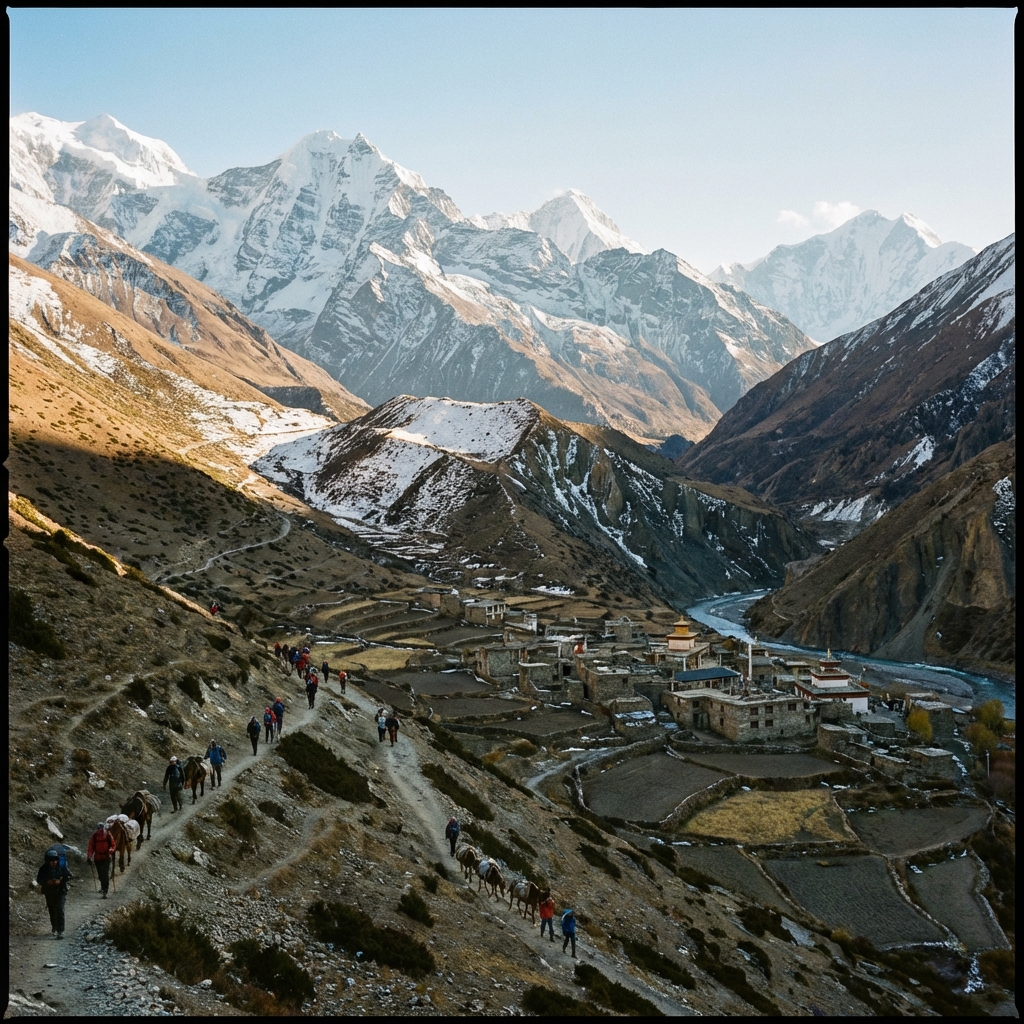

Bird Watching on Nepal Treks: A Complete Guide to Himalayan Birding
Nepal is one of the world's premier birding destinations, and the best part for trekkers is that you do not need to make a separate trip. Every major trekking route in the country passes through habitats that support a staggering diversity of avian life, from iridescent sunbirds in subtropical forests to soaring lammergeiers above the highest peaks. With over 900 confirmed species packed into a country smaller than many US states, Nepal ranks among the top ten countries globally for bird diversity relative to land area.
Whether you are a dedicated lister aiming to tick off Himalayan specialties or a casual trekker who simply wants to know what that brilliant flash of color in the rhododendron forest was, this guide will help you understand, find, and appreciate Nepal's extraordinary birdlife along the trails.
Over 900 confirmed species in Nepal, roughly 9% of world total
Spiny babbler is Nepal's only true endemic bird species
Danphe (Impeyan Pheasant) - iridescent plumage, found 2,500-5,000m
March-May (spring migration, breeding displays, clear weather)
Over 60 species of raptors including vultures, eagles, and hawks
Birds recorded from 60m Terai plains to above 7,000m on peaks
Over 30 species in Nepal classified as globally threatened
27 Important Bird Areas designated across Nepal
Why Nepal Is a Birding Paradise
Nepal's extraordinary bird diversity results from the same factors that create its spectacular trekking: extreme elevation gradients compressed into a narrow geographic band. Within a horizontal distance of just 150 km, the terrain rises from sea-level plains to the summit of Everest. This creates a continuous gradient of habitats, from tropical grasslands and sal forests through temperate broadleaf woodlands and conifer stands to alpine scrub and bare rock, each supporting specialized bird communities.
The country also lies at the intersection of the Palearctic and Indo-Malayan biogeographic realms, drawing species from both Central Asian and tropical South Asian avifaunas. Add to this the Himalayas' role as a migration corridor, with millions of birds passing through on their way between breeding grounds in Tibet, Mongolia, and Siberia and wintering areas in the Indian subcontinent, and you have a concentration of birdlife that is genuinely world-class.
What makes trekking and birding such a natural combination in Nepal:
- Every major trek traverses multiple habitat zones, maximizing species diversity
- Trail speeds (walking pace) are ideal for birding observation
- Dawn starts for trekking coincide perfectly with peak bird activity
- Remote mountain habitats shelter species that are rare or absent in lowland birding sites
- Many target Himalayan species are only accessible via trekking routes
The 100-Species Trek
A well-prepared birder on a two-week trek through the Annapurna region during spring can realistically record 150-250 species. Even casual observers who simply pay attention and carry binoculars can expect 80-120 species on a standard EBC or ABC trek. The key is covering a wide elevation range and spending time in forested sections rather than rushing through them.
Key Species by Altitude Band
Understanding which birds occupy which elevation zones is the foundation of productive birding on Nepal treks. The following breakdown covers the species you are most likely to encounter at each altitude band.
Subtropical Zone (500-1,500m)
The lowest sections of most treks pass through warm, lush forests and cultivated areas that support a rich community of colorful species.
Star species:
- Crimson sunbird (Aethopyga siparaja): Males are brilliant crimson with metallic blue-green crowns. Common in flowering trees and shrubs. Often seen hovering at flowers like a miniature hummingbird.
- White-rumped shama (Copsychus malabaricus): One of Asia's finest songsters, with a long tail and rich, melodious song. Found in dense undergrowth.
- Greater racket-tailed drongo (Dicrurus paradiseus): Unmistakable with its elongated outer tail feathers ending in racket-shaped tips. A bold, vocal bird that often leads mixed-species feeding flocks.
- Plumbeous water redstart (Phoenicurus fuliginosus): Males are slate-blue with a chestnut tail. Found on rocks in fast-flowing streams, constantly bobbing and fanning their tails.
- Red-billed blue magpie (Urocissa erythroryncha): A spectacular, long-tailed bird with brilliant blue plumage and a red bill. Noisy and conspicuous in forest edges.
Other frequently seen species: Asian paradise flycatcher, scarlet minivet, long-tailed broadbill, spotted forktail, slaty-backed forktail, various bulbuls, and a wide array of warblers.
Temperate Forest Zone (1,500-3,000m)
This is arguably the richest bird zone on Nepal treks, corresponding to the oak, maple, and lower rhododendron forests that blanket the mid-hills.
Star species:
- Various laughingthrushes: Nepal hosts over 15 species of laughingthrush, colorful and vocal birds that travel in noisy flocks through the forest understory. The white-crested laughingthrush, rufous-chinned laughingthrush, and streaked laughingthrush are among the most commonly seen.
- Fire-tailed myzornis (Myzornis pyrrhoura): A stunning small bird with bright green plumage and a fiery red tail. Found in mossy, epiphyte-laden forests, often clinging to branches like a nuthatch.
- Mrs. Gould's sunbird (Aethopyga gouldiae): Males sport brilliant violet, red, and yellow plumage. Common in rhododendron forests during bloom, feeding on nectar.
- Rufous-bellied niltava (Niltava sundara): Males are deep blue with a rufous belly. A skulking species of dense forest undergrowth.
- Kalij pheasant (Lophura leucomelanos): A large, dark pheasant commonly seen scratching in leaf litter along trails. Males are glossy black-blue; females are brown.
Mixed-Species Flocks
One of the most rewarding birding phenomena on Nepal treks is the mixed-species feeding flock. In temperate forests, you may suddenly be surrounded by 20-40 birds of 8-15 different species all moving through the canopy together. These flocks typically include yuhinas, minlas, fulvettas, warblers, and tits, with larger species like laughingthrushes and treecreepers following along. When you encounter one of these flocks, stop and scan carefully for 10-15 minutes. The diversity can be astonishing.
Subalpine Zone (3,000-4,000m)
As the forest thins into rhododendron scrub and birch woodland, the bird community becomes more specialized. Species here are adapted to cold and thin air, and many are Himalayan specialties found nowhere else on Earth.
Star species:
- Danphe / Impeyan pheasant (Lophophorus impejanus): Nepal's national bird is a genuine showstopper. Males display iridescent copper, green, blue, and purple plumage that flashes brilliantly in sunlight. They are surprisingly common in rhododendron forest and alpine scrub between 2,500m and 5,000m. Their loud, mournful whistle is a signature sound of the high Himalayas.
- Blood pheasant (Ithaginis cruentus): Named for the blood-red streaks on the male's breast, this high-altitude pheasant is found in dense bamboo and rhododendron scrub. Small flocks scratch through leaf litter and snow, often allowing close approach.
- Grandala (Grandala coelicolor): Males are an extraordinary uniform deep blue, looking almost unreal perched on a rock at 4,000m. Often seen in large flocks of 50 or more, sweeping across alpine meadows.
- Himalayan monal (same as Danphe): Included here again because this bird truly dominates the subalpine birding experience and is the single most-photographed bird on Nepal treks.
- White-winged grosbeak (Mycerobas carnipes): A heavy-billed finch found in conifer and rhododendron forests. Males are black and yellow; the cracking sound of seeds in their powerful bills is often the first sign of their presence.
Alpine and Nival Zone (Above 4,000m)
Above the treeline, the bird community is sparse but includes some of the most charismatic and specialized species on the planet. These birds have adapted to extreme cold, thin air, and relentless wind.
Star species:
- Himalayan griffon vulture (Gyps himalayensis): One of the largest flying birds in the world, with a wingspan of nearly 3 meters. Commonly seen soaring on thermals above valleys throughout the high Himalayas. Groups of 20 or more are not unusual near carcasses or along migration corridors.
- Lammergeier / bearded vulture (Gypaetus barbatus): Perhaps the most dramatic bird on any Nepal trek. This massive vulture, with a wingspan exceeding 2.5 meters, is famous for dropping bones from great heights onto rocks to access the marrow inside. Its wedge-shaped tail, reddish breast, and "bearded" face are unmistakable. Watch for them along cliff faces and ridgelines.
- Alpine chough (Pyrrhocorax gracilis): These glossy black birds with yellow bills and red legs are the constant companions of high-altitude trekkers, often seen in large, acrobatic flocks around teahouses and on passes. Their tumbling aerial displays are mesmerizing.
- Red-billed chough (Pyrrhocorax pyrrhocorax): Similar to the alpine chough but with a red, curved bill. Often found in mixed flocks with alpine choughs at high altitude.
- Snow pigeon (Columba leuconota): A striking pigeon of cliffs and rock faces above 3,000m, with a pale body and dark wing bars. Flocks fly in tight formation past cliff faces.
Altitude Affects Your Birding Performance
Above 4,000m, reduced oxygen affects your cognitive function, including your ability to focus on bird identification. You may find yourself slower to react to movement, less able to concentrate on field marks, and more easily frustrated by difficult identifications. Accept that your birding performance will decline at altitude, bring a good field guide to verify identifications later, and focus on enjoying the experience rather than completing a checklist. Take notes and photographs that you can review at lower elevation with a clearer head.
Best Treks for Bird Watching
Langtang Valley Trek
The Langtang region is widely regarded as Nepal's premier birding trek, offering exceptional species diversity across a manageable distance and duration.
Why it excels for birding:
- Dense, relatively undisturbed forests from 1,500m to 4,000m
- Lower trekker traffic than Everest or Annapurna means less bird disturbance
- Excellent rhododendron and bamboo forests at mid-elevations (prime habitat)
- Good chances for rare species like the fire-tailed myzornis and rufous-vented tit
- Red panda habitat overlaps with prime birding zones (dual wildlife bonus)
Key birding spots:
| Location | Elevation | Target Species | Habitat Type |
|---|---|---|---|
| Syabrubesi area | 1,500m | Laughingthrushes, sunbirds, flycatchers | Subtropical forest |
| Bamboo to Lama Hotel | 1,900-2,480m | Kalij pheasant, forktails, niltavas | Temperate forest |
| Lama Hotel to Langtang Village | 2,480-3,430m | Blood pheasant, grandala, rosefinches | Subalpine forest |
| Kyanjin Gompa area | 3,870m | Himalayan griffon, choughs, snow pigeon | Alpine scrub |
Species count potential: 150-200 species on a 10-day trek during spring.
Annapurna Region Treks
The Annapurna region, particularly the lower sections of the Annapurna Circuit and the Ghorepani-Poon Hill trek, offers superb birding alongside Nepal's most iconic mountain scenery.
Poon Hill trek is especially recommended because:
- The trail passes through some of Nepal's finest rhododendron forests
- Elevation range from 1,000m to 3,210m covers the richest bird zones
- Spring bloom period (March-April) coincides with peak bird activity
- Relatively short duration (4-5 days) is perfect for a dedicated birding trip
- The Ghorepani area is one of the best locations in Nepal for Danphe pheasant
Annapurna Circuit adds higher-elevation specialties, with the Manang Valley offering alpine species like snow pigeon, Tibetan snowfinch, and wallcreeper.
Annapurna Base Camp trek provides excellent mid-elevation forest birding between Ghandruk and Machhapuchhre Base Camp, with laughingthrushes, sunbirds, and pheasants being the highlights.
Helambu Trek
The Helambu circuit, accessible from Kathmandu without a flight, is an underrated birding destination that deserves more attention.
Why birders love Helambu:
- Pristine oak, rhododendron, and conifer forests
- Very few trekkers compared to Everest and Annapurna
- Excellent for warblers, laughingthrushes, and other skulking species
- Good altitude range (1,500-4,600m) covering multiple bird zones
- Can be combined with the Langtang trek for maximum birding potential
Other Excellent Birding Treks
| Trek | Duration | Birding Rating | Key Species | Best Season |
|---|---|---|---|---|
| Langtang Valley | 7-10 days | Outstanding | Blood pheasant, fire-tailed myzornis, grandala | Mar-May |
| Poon Hill / Ghorepani | 4-5 days | Excellent | Danphe, laughingthrushes, sunbirds | Mar-Apr |
| Annapurna Circuit (lower) | 14-18 days | Excellent | Huge variety across elevation zones | Oct-Nov, Mar-May |
| Helambu | 5-7 days | Very Good | Warblers, laughingthrushes, rosefinches | Mar-May |
| Everest Base Camp | 12-14 days | Good | Himalayan griffon, lammergeier, tahr (mammal bonus) | Oct-Nov |
| Makalu Base Camp | 18-20 days | Outstanding | Remote species, minimal disturbance | Oct-Nov, Mar-May |
| Kanchenjunga | 20-25 days | Outstanding | Eastern Himalayan specialties | Oct-Nov, Mar-May |
The Poon Hill Birding Secret
Most trekkers rush to Poon Hill for the famous sunrise over Dhaulagiri and Annapurna. But birders know that the forests between Ghorepani and Tadapani, typically covered in a single hiking day, are among the finest birding walks in the entire Himalayas. Slow down through this section, spending a full day covering what most trekkers walk in 4-5 hours. The rhododendron forest here supports an extraordinary density and diversity of birds, including multiple pheasant species, laughingthrushes, sunbirds, and warblers.
Seasonal Birding Guide
Spring (March-May): The Premier Birding Season
Spring is unquestionably the best season for birding on Nepal treks. The combination of factors creates a perfect storm of bird activity.
Why spring dominates:
- Breeding season: Most resident species are in full breeding plumage and actively singing, making them easier to detect and identify
- Migration: Millions of birds pass through Nepal on their way to breeding grounds in Tibet and Central Asia, dramatically boosting species counts
- Rhododendron bloom: The spectacular flowering of rhododendron forests (mid-March through late April) attracts nectar-feeding species like sunbirds and creates stunning photographic backdrops
- Dawn chorus: The spring dawn chorus in Nepal's temperate forests is one of the great natural sound experiences on Earth, with dozens of species singing simultaneously
- Visibility: Pre-monsoon conditions offer reasonable clarity, though not as crystal-clear as autumn
Month-by-month spring breakdown:
| Month | Birding Highlights | Conditions | Rating |
|---|---|---|---|
| March | Early migrants arrive, lower forests blooming, pheasant displays begin | Warming temperatures, some haze | Excellent |
| April | Peak rhododendron bloom, migration in full swing, breeding activity peaks | Warm days, occasional afternoon clouds | Outstanding |
| May | Last migrants, high-altitude species fully active, butterfly bonus | Warmer, pre-monsoon buildup, some rain | Very Good |
Autumn (October-November): Clear Skies and Migration
Autumn is the premier trekking season and also offers excellent birding, though species diversity is somewhat lower than spring.
Autumn advantages:
- Crystal-clear mountain views provide spectacular birding backdrops
- Southbound migration brings high-altitude species to more accessible elevations
- Post-monsoon lush vegetation supports abundant insect prey
- Comfortable temperatures across all elevation bands
Autumn limitations:
- No spring bloom backdrop for photography
- Less vocal activity (most breeding is over)
- Some migratory species have already departed
Winter (December-February): Concentrated Birding
Winter pushes many high-altitude species to lower, more accessible elevations, creating concentrated birding opportunities in specific areas.
Winter highlights:
- Raptors concentrated at lower elevations
- Waterfowl present on lakes and rivers
- Less foliage makes birds easier to see
- Fewer trekkers mean less disturbance
Monsoon (June-September): The Specialist's Season
The monsoon is challenging for trekking but offers unique birding opportunities for the adventurous.
Monsoon birding:
- Breeding warblers at peak vocal activity
- Cuckoos calling from forest canopy
- Lush habitat supports peak insect and amphibian populations
- Leeches, rain, and muddy trails are significant drawbacks
Equipment for Birding on Nepal Treks
Binoculars: Your Most Important Tool
Binoculars are the single most important investment for birding on Nepal treks. A good pair transforms casual observation into detailed, rewarding bird study.
Recommended specifications:
| Feature | Ideal for Trekking | Why |
|---|---|---|
| Magnification | 8x or 10x | 8x offers wider field of view and steadier image; 10x provides more detail at distance |
| Objective lens | 42mm | Best balance of light-gathering and weight |
| Weight | 500-700g | Manageable for all-day carry at altitude |
| Waterproofing | Fully waterproof, nitrogen-filled | Essential for rain, mist, and condensation |
| Close focus | Under 2 meters | Important for warblers and skulking species in dense cover |
| Eye relief | 15mm or more | Accommodates eyeglass wearers |
Budget recommendations:
- Entry level (under $150): Nikon Prostaff P3 8x42 or Vortex Crossfire HD 8x42
- Mid-range ($300-600): Vortex Diamondback HD 8x42 or Nikon Monarch M5 8x42
- High-end ($800+): Swarovski CL Companion 8x30 (compact) or Zeiss Terra ED 8x42
Do Not Skip Binoculars
Attempting to bird on Nepal treks without binoculars is like trying to photograph mountains without a camera. Many of the most rewarding species are small, cryptically colored, or perched in dense canopy where the naked eye simply cannot resolve identifying features. Even a budget pair of 8x42 binoculars will transform your birding experience from frustrated squinting to genuine identification and appreciation.
Field Guides
A good field guide is your second essential piece of birding equipment. The following are recommended for Nepal trekking:
Primary reference:
- "Birds of Nepal" by Richard Grimmett, Carol Inskipp, Tim Inskipp, and Hem Sagar Baral - The definitive field guide, comprehensive with excellent illustrations. This is the standard reference carried by virtually all serious birders in Nepal.
Supplementary resources:
- "A Pictorial Field Guide to the Birds of Nepal" by Hari Sharan Nepali - Good photographic guide for those who prefer photos to illustrations
- Merlin Bird ID app (Cornell Lab of Ornithology) - Free app with sound identification that works offline once Nepal bird packs are downloaded. Excellent for identifying species by their calls
- eBird app - For recording sightings and contributing to citizen science. Also shows recent sightings by other birders in your area
Photography Equipment
For birding photography on treks, the same principles from our trekking photography guide apply, with additional emphasis on telephoto reach.
Recommended setup:
- 100-400mm zoom lens (the most versatile option for birding while trekking)
- 1.4x teleconverter (adds reach with minimal weight)
- Fast continuous autofocus camera body
- Lightweight monopod or use trekking pole as brace
For more on photography equipment and techniques, see our guide to the best photography treks in Nepal.
Use Your Phone for Bird Calls
Download the Merlin Bird ID app before your trek and install the Nepal bird sound pack. When you hear an unfamiliar call in the forest, the app can record and identify it with surprising accuracy. This is especially useful for skulking species like warblers and laughingthrushes that are heard far more often than seen. The app works offline once the sound pack is downloaded, which is essential since cell service is unreliable on most treks.
Birding Techniques for the Trail
Walking and Watching
The most productive birding on a trek happens when you combine walking with systematic scanning. Rather than rushing between teahouses, adopt these habits:
- Stop every 15-20 minutes in good habitat to scan and listen for 5 minutes
- Focus on habitat edges: The border between forest and clearing, between bamboo and rhododendron, or between scrub and alpine meadow concentrates birds
- Look for movement, not birds: Train your eyes to detect movement in foliage rather than searching for recognizable shapes
- Listen first, then look: Most birds reveal themselves by sound before sight. Learn to distinguish different call types, such as alarm calls, songs, and contact calls
- Check water sources: Streams, pools, and wet areas attract birds for drinking and bathing, especially in the drier months
Identifying Difficult Species
Nepal's bird diversity includes many groups with confusing similar species. Here are strategies for the toughest groups:
Warblers: Nepal hosts over 80 warbler species, many of which look nearly identical. Focus on song (each species has a distinctive call), habitat preference (altitude band and vegetation type), and subtle structural features like bill shape and tail length rather than plumage color.
Rosefinches: Males are distinctive but females are frustratingly similar across species. Note altitude, habitat, bill size, and any subtle streaking patterns.
Raptors: Soaring raptors can be identified by silhouette, flight pattern, and size. Carry a raptor identification guide showing underwing patterns.
Dawn Birding Protocol
The first hour of daylight is the most productive birding time on any trek day. Here is how to maximize it:
- Set your alarm 15 minutes before dawn (around 5:00-5:30 AM depending on season)
- Step outside the teahouse quietly with binoculars and field guide
- Stand still and listen for the first 5 minutes, noting all calls you hear
- Scan open areas and treetops where birds perch to warm up in first sunlight
- Walk slowly along the nearest trail section for 30-45 minutes before breakfast
- Record observations while having tea or breakfast, when details are fresh
Notable Birding Records and Rarities
Nepal's position on migration routes means that rare and unexpected species turn up regularly. Recording your sightings on eBird contributes valuable data to ornithological research.
Species of Special Conservation Concern on Trekking Routes
| Species | Status | Where Found | Key Threat |
|---|---|---|---|
| Bengal florican | Critically Endangered | Chitwan (not on standard treks) | Grassland loss |
| White-rumped vulture | Critically Endangered | Lower elevations, formerly common | Diclofenac poisoning |
| Slender-billed vulture | Critically Endangered | Lower hills | Diclofenac poisoning |
| Cheer pheasant | Vulnerable | Western Nepal mid-hills | Habitat fragmentation |
| Satyr tragopan | Near Threatened | Eastern Nepal temperate forests | Hunting, habitat loss |
| Himalayan quail | Critically Endangered (possibly extinct) | Historical range: western Nepal | Unknown (not recorded since 1876) |
| Saker falcon | Endangered | Passage migrant, high plateaus | Trapping for falconry |
Citizen Science: How Your Sightings Help
Recording your bird observations on eBird (free app and website from Cornell Lab of Ornithology) makes a genuine contribution to ornithological science. Data from trekker observations helps researchers:
- Track population trends of Himalayan species
- Monitor the effects of climate change on altitudinal distributions
- Identify critical habitats that need protection
- Understand migration timing and routes
Even casual observations with approximate locations and counts are valuable. Complete checklists (recording all species seen during a defined period) are especially useful.
Planning a Birding Trek
Hiring a Birding Guide
A knowledgeable birding guide can double or triple your species count and transform your understanding of the birds you encounter. Not all trekking guides have birding expertise, so seek out specialists.
What to look for in a birding guide:
- Demonstrated bird identification skills (ask about their personal species list for Nepal)
- Ability to identify birds by call as well as sight
- Knowledge of species-specific habitat preferences and behavior
- Patience to spend time at productive birding spots
- Carrying binoculars and a field guide themselves
- Experience with international birding clients
Where to find birding guides:
- Bird Conservation Nepal can recommend certified bird guides
- Specialized birding tour companies operating in Nepal
- Ask at the Natural History Museum of Nepal in Kathmandu
- Online birding forums where Nepal birders share guide recommendations
Sample Birding Itinerary: 14-Day Annapurna Birding Trek
| Day | Location | Elevation | Key Birding Targets |
|---|---|---|---|
| 1 | Kathmandu - Nayapul - Tikhedhunga | 1,500m | Sunbirds, bulbuls, drongos |
| 2 | Tikhedhunga - Ghorepani | 2,850m | Laughingthrushes, minlas, yuhinas |
| 3 | Poon Hill dawn, Ghorepani area | 3,210m | Danphe pheasant, blood pheasant, grandala |
| 4 | Ghorepani - Tadapani (slow birding pace) | 2,630m | Fire-tailed myzornis, niltavas, mixed flocks |
| 5 | Tadapani - Chuile | 2,050m | Laughingthrushes, wren-babbler, forktails |
| 6 | Chuile - Ghandruk | 1,940m | Kalij pheasant, barbets, leafbirds |
| 7 | Ghandruk - Chhomrong | 2,170m | Sunbirds in rhododendron, flycatchers |
| 8 | Chhomrong - Bamboo | 2,335m | Parrotbills, warblers, treecreepers |
| 9 | Bamboo - Deurali | 3,230m | Blood pheasant, rosefinches |
| 10 | Deurali - Annapurna Base Camp | 4,130m | Snow pigeon, choughs, Himalayan griffon |
| 11 | ABC - Bamboo (return) | 2,335m | Afternoon birding, different light angles |
| 12 | Bamboo - Jhinu Danda | 1,780m | Lower forest species, hot springs rest |
| 13 | Jhinu Danda - Nayapul | 1,070m | Subtropical species, river birds |
| 14 | Nayapul - Pokhara | 800m | Phewa Lake waterbirds, final birding |
Birding Pace vs Trekking Pace
Standard trekking itineraries assume 5-7 hours of walking per day. A birding-focused trek covers the same routes but should allow 7-9 hours for each section, with frequent stops for observation. Discuss this with your guide and agency when planning, and be explicit that you want a birding pace, not a standard trekking pace. Some agencies offer specific birding trek packages that build in this extra time.
Bird Photography on Nepal Treks
Challenges Specific to Bird Photography at Altitude
Photographing birds on Nepal treks combines all the challenges of bird photography with all the challenges of high-altitude trekking. Key issues include:
- Weight: Telephoto lenses are heavy, and every gram counts at altitude
- Cold: Batteries drain rapidly, fingers become numb, and autofocus can slow in extreme cold
- Speed: Many target species are fast-moving and appear briefly
- Light: Dense forest canopy creates low-light conditions requiring high ISO settings
- Stability: Handheld telephoto shooting while breathing hard at altitude is challenging
Practical Setup for Bird Photography While Trekking
Minimum viable setup:
- Camera body with decent high-ISO performance (usable at ISO 3200-6400)
- 100-400mm or 70-300mm zoom lens
- Lightweight monopod or trekking pole camera mount
Optimal setup (if you can carry the weight):
- Mirrorless body with fast continuous AF (10+ fps)
- 100-400mm f/4.5-5.6 zoom as primary lens
- 1.4x teleconverter for extra reach
- Compact monopod
- Extra batteries kept warm in inside jacket pocket
Settings for common scenarios:
| Scenario | Shutter Speed | Aperture | ISO | Focus Mode |
|---|---|---|---|---|
| Bird perched in good light | 1/500s | f/5.6-8 | Auto | Single AF, focus on eye |
| Bird in forest shade | 1/500s | Wide open | 1600-6400 | Single AF |
| Bird in flight | 1/2000s+ | f/5.6-8 | Auto (up to 6400) | Continuous AF tracking |
| Pheasant on ground | 1/250-500s | f/5.6 | Auto | Single AF |
| Vulture soaring | 1/1000s | f/8 | Auto | Continuous AF |
The Digiscoping Option
If you have a good spotting scope or even binoculars, consider digiscoping: holding your smartphone camera up to the eyepiece. Modern smartphone cameras combined with 8x or 10x binoculars can produce surprisingly good bird photos at a fraction of the weight of a dedicated telephoto lens setup. Universal phone-to-binocular adapters weigh only 50g and cost around $20. This is an excellent backup option even if you carry a dedicated camera.
Frequently Asked Questions
Q: How many bird species can I expect to see on a standard Nepal trek? A: A casual observer with binoculars can expect 60-100 species on a two-week trek. An experienced birder with a guide can record 150-250 species in the same period. Your count depends heavily on season (spring is best), region (Annapurna and Langtang offer the most diversity), pace (slower is better), and elevation range covered (more range equals more species).
Q: Do I need to be an experienced birder to enjoy bird watching on Nepal treks? A: Absolutely not. Nepal's birdlife includes many spectacular, easy-to-identify species that delight complete beginners. The Danphe pheasant, Himalayan griffon vulture, alpine chough, and various sunbirds are visually stunning and require no expert knowledge to appreciate. A field guide and binoculars are all you need to get started.
Q: What is the single best bird to look for on a Nepal trek? A: The Danphe (Impeyan Pheasant), Nepal's national bird, is the consensus answer. The male's iridescent plumage is genuinely breathtaking, it is reasonably common between 2,500m and 5,000m, and its loud call makes it detectable even before you see it. Seeing one in full sunlight is one of the great birding experiences anywhere in the world.
Q: Can I see the lammergeier (bearded vulture) on popular treks? A: Yes. Lammergeiers are regularly seen soaring along cliff faces and ridgelines above 3,000m on both the Everest Base Camp and Annapurna treks. Look for their distinctive wedge-shaped tail and enormous wingspan. They are most often seen during the warmest hours of the day (10 AM - 2 PM) when thermal updrafts are strongest.
Q: Is spring or autumn better for birding? A: Spring (March-May) is definitively better for birding. The combination of breeding activity, migration, vocal displays, and rhododendron bloom creates far more birding opportunities. Autumn (October-November) is better for mountain views and general trekking but offers somewhat lower bird diversity and activity.
Q: Do I need a special permit for bird watching on Nepal treks? A: No. Standard trekking permits and national park or conservation area entry fees cover all wildlife observation including birding. No additional permits are needed for birding or bird photography.
Q: What bird calls should I learn before my trek? A: Focus on the Danphe pheasant (a loud, mournful whistle), the calls of common laughingthrushes (raucous, chattering), the alpine chough (a sharp, ringing call), and the Himalayan griffon vulture (usually silent but hisses when disturbed). The Merlin Bird ID app is excellent for learning calls before your trip.
Q: Are there any venomous birds in Nepal? A: No. There are no venomous or dangerous birds in Nepal. The only bird-related hazard is the possibility of being startled by a pheasant flushing from undergrowth at close range, which can be momentarily alarming on a narrow mountain trail.
Q: How does climate change affect Nepal's birds? A: Research shows that many Himalayan bird species are shifting their ranges upward in response to warming temperatures. Species that were formerly found at 2,000m are now being recorded at 2,500m or higher. For high-altitude specialists with nowhere higher to go, this represents a serious long-term threat. Your eBird observations help researchers track these shifts.
Q: Can I combine bird watching with peak climbing in Nepal? A: While the higher-elevation approach stages of peak climbing routes pass through alpine bird habitat, the demanding nature of peak climbing leaves little time or energy for birding. A better strategy is to plan a dedicated birding trek before or after a climbing expedition, or to add birding-focused rest days at lower elevations during acclimatization.
Q: What is Nepal's rarest bird? A: The Himalayan quail (Ophrysia superciliosa) has not been reliably recorded since 1876 and may be extinct. Among currently surviving species, the Bengal florican (Critically Endangered) is one of the rarest birds found in Nepal, though it inhabits the lowland Terai rather than trekking regions. On trekking routes, the satyr tragopan of eastern Nepal's temperate forests is among the hardest species to observe.
Q: Should I carry a spotting scope on a trek? A: Generally, no. Spotting scopes add significant weight (1-2 kg with tripod) and are cumbersome on mountain trails. Binoculars handle 95% of trekking birding situations. The exception would be a dedicated birding expedition to open alpine areas where scanning distant slopes for large birds like snow pigeons or raptors can benefit from a scope. In that case, a compact scope under 500g with a lightweight travel tripod could be worthwhile.
Related Resources
- Wildlife of Nepal's Trekking Regions - Complete guide to mammals and other wildlife on trails
- Nepal's National Parks and Conservation Areas - Protected areas where the best birding occurs
- Best Photography Treks in Nepal - Top routes for capturing birds and landscapes
- Trekking Photography Guide - Camera techniques for the Himalayas
- Langtang Region Guide - Nepal's premier birding trek region
- Annapurna Region Guide - Diverse habitats across the largest conservation area
- Rhododendron Forests and Flora of Nepal - The flowering backdrop to spring birding