
Wildlife of Nepal's Trekking Regions: Animals You Might Encounter on the Trail
Nepal is not only a trekking paradise but one of the most biodiverse countries on Earth. Compressed between the steamy lowland Terai and the frozen summits of the Himalayas, the country spans an elevation range of over 8,000 meters, creating an extraordinary variety of habitats within a relatively compact area. For trekkers, this biodiversity means that virtually every major trail offers chances to encounter wildlife, from cheeky rhesus macaques at lower elevations to the elusive snow leopard high in the alpine zone.
This guide covers the animals you are most likely to see (and a few you can only dream of spotting) across Nepal's major trekking regions. We include practical advice on where and when to look, how to photograph ethically, and what behaviors to expect from the creatures that call the Himalayas home.
208 species recorded in Nepal, including 30+ threatened
Over 900 species, making Nepal a global birding hotspot
12 national parks and 6 conservation areas covering 23% of land
Estimated 300-500 individuals in Nepal's high Himalayas
Commonly sighted around Everest Base Camp trail above 3,500m
Fewer than 1,000 estimated in Nepal, best seen in Langtang
Danphe (Impeyan Pheasant), commonly seen 2,500-5,000m
Wildlife habitats from 60m Terai to above 6,000m alpine
Why Nepal Is a Wildlife Hotspot
Nepal sits at a biogeographic crossroads. The Palearctic realm of Central Asia meets the Indo-Malayan realm of tropical South Asia right here, producing a species diversity that far exceeds what you would expect from a country roughly the size of Arkansas. Within a single day's drive from Kathmandu, you can pass through subtropical sal forests, temperate oak and rhododendron woodlands, subalpine birch and conifer stands, and treeless alpine meadows, each supporting distinct animal communities.
For trekkers, this means that wildlife encounters are not a matter of if but when and what. The species you see depend on three main factors: the region you trek in, the elevation band you are passing through, and the season. Understanding these variables can dramatically increase your chances of memorable wildlife sightings.
Key factors that influence wildlife sightings:
- Elevation: Different species occupy different altitude bands, from subtropical forests below 1,000m to alpine zones above 4,000m
- Season: Spring (March-May) and autumn (October-November) offer the best wildlife viewing, with animals more active and visible
- Time of day: Dawn and dusk are peak activity times for most mammals
- Trail traffic: Quieter, less-traveled trails yield more sightings
- Habitat type: Forest edges, meadows, and water sources are wildlife magnets
Early Morning Advantage
The single best thing you can do to increase wildlife sightings is to start trekking at first light. Most mammals are crepuscular (active at dawn and dusk), and the period from 5:30 to 7:30 AM offers the highest probability of encounters. Himalayan tahr, musk deer, and even snow leopards are most visible during these golden hours when they feed before retreating to cover.
Everest Region Wildlife
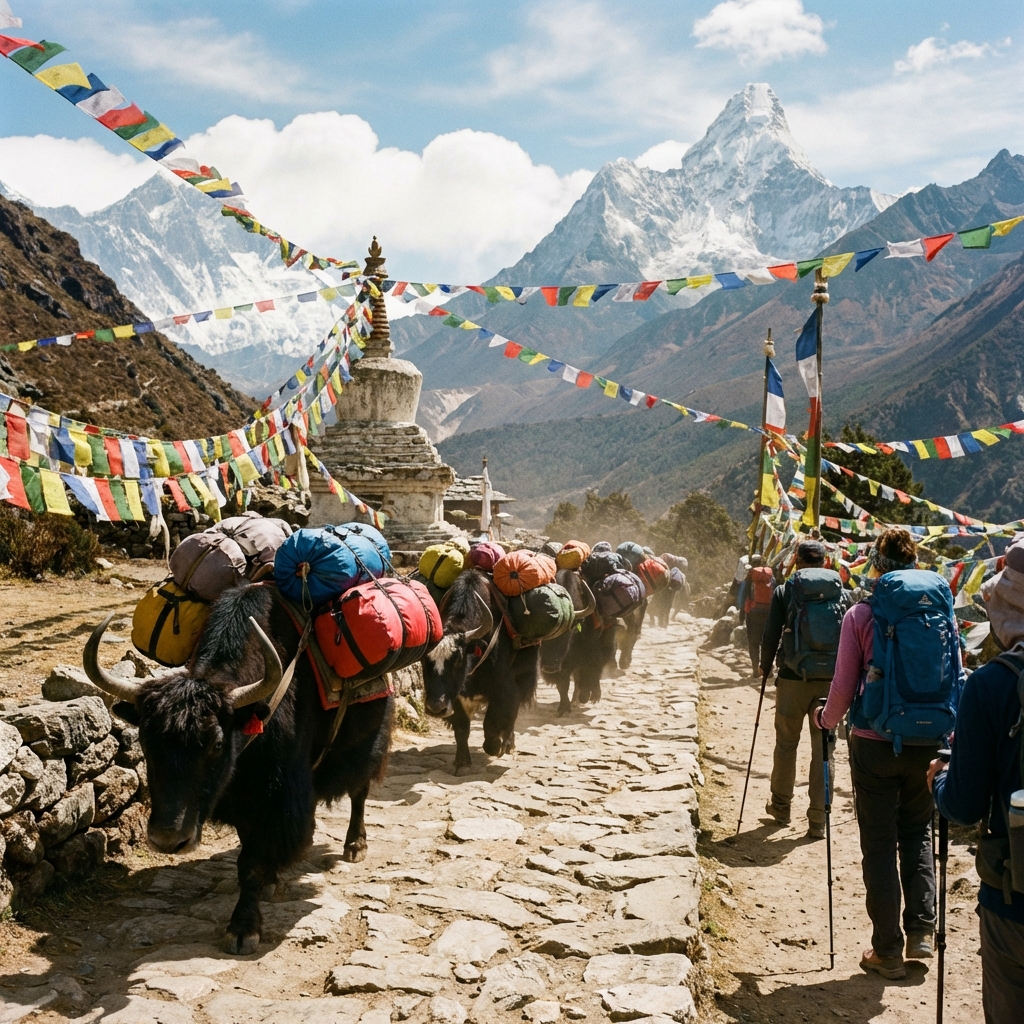
The Sagarmatha (Everest) region, encompassing Sagarmatha National Park and the Khumbu Valley, is one of Nepal's premier wildlife-watching destinations for trekkers. The park protects a dramatic landscape ranging from around 2,845m at the entrance near Monjo to over 8,848m at the summit of Everest itself. The combination of strict national park protections since 1976 and the Sherpa community's Buddhist reverence for wildlife has allowed many species to thrive here.
Himalayan Tahr (Hemitragus jemlahicus)
The Himalayan tahr is the animal you are most likely to see on the Everest Base Camp trek, and the sighting never disappoints. These stocky, wild goats with their shaggy coats and backward-curving horns are remarkably surefooted on the steep rocky terrain above Namche Bazaar. Males can weigh up to 100 kg and sport impressive dark manes during the winter breeding season.
Where to see them: The stretch between Namche Bazaar and Tengboche (3,860m) is prime tahr territory. Look for them on the rocky slopes above the trail, particularly in the early morning. The trail from Khumjung to Tengboche is another excellent spot, with herds of 10-30 animals regularly seen grazing on steep grassy ledges.
Best season: October through December, when males display their full winter coats and engage in dramatic head-butting contests during the rut. Spring (March-May) is also good, when mothers with young kids are visible on lower slopes.
Musk Deer (Moschus leucogaster)
The Himalayan musk deer is one of the most unusual animals in the Everest region. Males lack antlers but sport elongated canine teeth that protrude like small tusks, giving them an almost vampiric appearance. These solitary, shy animals are primarily nocturnal, making sightings uncommon but deeply rewarding.
Where to see them: Dense rhododendron and birch forests between 2,500m and 4,000m, particularly in the Phortse area and around Tengboche monastery. The forests above Namche Bazaar occasionally yield sightings at dawn.
Conservation note: Musk deer are classified as Vulnerable by the IUCN, primarily due to poaching for musk glands used in traditional medicine and perfumery. Sagarmatha National Park provides crucial protection for this declining species.
Danphe Pheasant (Lophophorus impejanus)
Nepal's national bird, the Danphe or Impeyan Pheasant, is a genuine showstopper. The male sports an iridescent plumage of copper, green, purple, and blue that flashes in sunlight like a living jewel. Females are a more modest mottled brown, providing excellent camouflage on the forest floor.
Where to see them: Common between 2,500m and 5,000m throughout the Everest region. The forests around Tengboche monastery are an especially reliable spot. Listen for their distinctive loud, plaintive whistle, which echoes through valleys at dawn.
Best season: Spring (March-May) when males perform elaborate courtship displays, fanning their tails and inflating their iridescent throat feathers.
Sherpa Conservation Ethic
The Sherpa people's Buddhist beliefs prohibit the taking of animal life, creating an unofficial wildlife sanctuary throughout the Khumbu Valley long before formal national park designation. This cultural protection means that animals in the Everest region are often less wary of humans than in other parts of Nepal, providing better viewing opportunities. Respect this tradition by never harassing or feeding wildlife.
Other Everest Region Species
| Animal | Elevation Range | Likelihood of Sighting | Best Location |
|---|---|---|---|
| Himalayan tahr | 3,000-5,000m | Very High | Namche to Tengboche |
| Danphe pheasant | 2,500-5,000m | High | Tengboche forests |
| Musk deer | 2,500-4,000m | Low (nocturnal) | Phortse, Tengboche |
| Yellow-throated marten | 1,500-4,000m | Moderate | Lukla to Namche forests |
| Himalayan pika | 3,500-5,500m | High | Rocky areas above Dingboche |
| Himalayan mouse hare | 4,000-5,500m | High | Gorak Shep area |
| Red fox | 3,000-5,000m | Moderate | Near settlements at dusk |
| Himalayan griffon vulture | 2,000-5,500m | High | Soaring above valleys |
Annapurna Region Wildlife
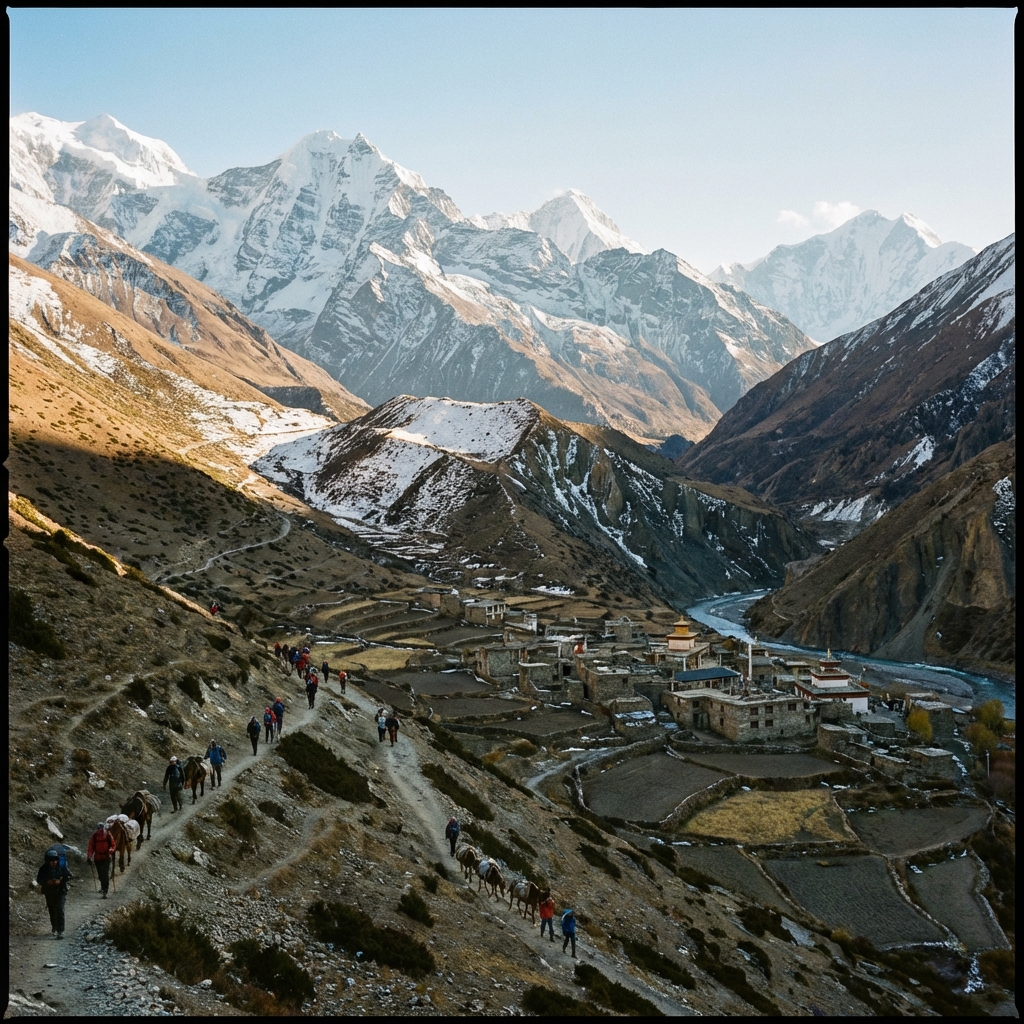
The Annapurna Conservation Area (ACA) is the largest protected area in Nepal, covering 7,629 sq km and spanning an enormous elevation range from around 800m in the subtropical lowlands to over 8,091m at the summit of Annapurna I. This vast altitudinal gradient creates an exceptional diversity of habitats and wildlife. The ACA model of community-based conservation has been remarkably successful, with local communities actively managing wildlife protection.
Blue Sheep (Bharal) (Pseudois nayaur)
The blue sheep, or bharal, is the quintessential high-altitude ungulate of the Himalayas and a critical prey species for the snow leopard. Despite their name, they appear more gray-brown than blue, though their fur can take on a bluish sheen in certain light conditions. They are gregarious animals, often seen in herds of 10-50 individuals on steep rocky slopes above the treeline.
Where to see them: The upper sections of the Annapurna Circuit, particularly around Manang (3,540m) and the approach to Thorong La Pass. The Tilicho Lake side trek also offers excellent blue sheep viewing. On the Annapurna Base Camp trek, look for them on the rocky slopes above Machhapuchhre Base Camp.
Best season: Autumn (October-November) when herds are easily visible on open slopes before winter snows push them lower. Spring viewing is also good.
Langur Monkeys (Semnopithecus entellus)
The Hanuman langur is one of the most commonly encountered primates in the Annapurna region. These elegant gray monkeys with black faces and long tails move through the forest canopy in troops of 20-40 individuals. They are primarily leaf-eaters, spending hours feeding on leaves, fruits, and flowers in the mid-elevation forests.
Where to see them: The lower sections of the Annapurna Circuit between Besisahar and Chame (1,000-2,700m) offer regular sightings. On the ABC trek, the forest sections between Ghorepani and Tadapani are prime langur habitat. The Poon Hill trek is particularly reliable for langur encounters.
Behavior to watch for: Langurs are remarkably acrobatic, making spectacular leaps between trees. Dominant males sometimes defend their troops with impressive threat displays, including loud barking calls that echo through valleys. They are generally tolerant of trekkers but may become aggressive around food.
Snow Leopard (Panthera uncia)
The snow leopard is the ultimate prize for wildlife enthusiasts in the Annapurna region, though sightings remain exceptionally rare. Known as the "ghost of the mountains," this elusive big cat inhabits the remote high-altitude terrain above 3,000m, following herds of blue sheep across impossibly steep terrain.
Where to see them: The Upper Mustang region, the Nar-Phu Valley, and the areas around Manang offer the best snow leopard habitat in the Annapurna region. However, dedicated snow leopard tracking expeditions are typically required, as these cats are masters of camouflage and operate across vast home ranges of 12-40 sq km.
Reality check: Your chances of seeing a snow leopard on a standard trek are extremely slim, likely well under 1%. Even dedicated wildlife researchers spend months in the field between sightings. If you do encounter one, consider yourself extraordinarily fortunate.
Do Not Approach Snow Leopards
In the incredibly unlikely event that you spot a snow leopard, maintain a distance of at least 100 meters. Do not attempt to approach, follow, or corner the animal. Snow leopards are not typically aggressive toward humans, but a cornered or surprised animal could become defensive. Report any sighting to the local ACAP checkpoint, as this data is invaluable for conservation research.
Other Annapurna Region Species
| Animal | Elevation Range | Likelihood of Sighting | Best Location |
|---|---|---|---|
| Blue sheep | 3,500-5,500m | High | Manang, Thorong La approach |
| Langur monkey | 800-3,500m | Very High | Lower Circuit, Ghorepani |
| Snow leopard | 3,000-5,500m | Extremely Low | Upper Mustang, Nar-Phu |
| Himalayan goral | 1,000-4,000m | Moderate | Forest edges, Ghandruk area |
| Barking deer (muntjac) | 500-3,000m | Moderate | Lower forests, early morning |
| Jackal | 500-3,500m | Moderate | Near villages at dusk |
| Rhesus macaque | 500-2,500m | Very High | Lower trail sections |
| Himalayan marmot | 3,500-5,500m | High | Alpine meadows near Manang |
Langtang Region Wildlife
The Langtang National Park, located just 30 km north of Kathmandu, is arguably Nepal's best trekking region for wildlife watching. The park's relatively dense forests, lower visitor numbers compared to Everest and Annapurna, and strict protection measures have allowed some of Nepal's most endangered species to thrive. The Langtang Valley trek and Helambu circuit both pass through exceptional wildlife habitat.
Red Panda (Ailurus fulgens)
The red panda is the star wildlife attraction of the Langtang region and one of Nepal's most beloved animals. These charming, fox-sized creatures with their russet fur, bushy ringed tails, and masked faces inhabit the temperate bamboo and rhododendron forests between 2,200m and 4,800m. They are primarily arboreal and feed mainly on bamboo leaves, supplemented by berries, acorns, and bird eggs.
Where to see them: The forests between Lama Hotel (2,480m) and Langtang village (3,430m) represent prime red panda habitat. The bamboo groves and rhododendron forests along this stretch contain one of Nepal's densest red panda populations. Early morning treks through this section offer the best chances.
Best season: Late autumn (November) and spring (March-April) when red pandas are most active during daylight hours. In summer, they tend to be more nocturnal and harder to spot.
Conservation status: The red panda is classified as Endangered by the IUCN, with fewer than 1,000 individuals estimated in Nepal. Habitat loss, bamboo die-off, and poaching for their beautiful pelts are the primary threats. Your trekking fees contribute directly to their protection through Langtang National Park management.
Red Panda Spotting Technique
Red pandas spend most of their time in trees, so look up rather than at ground level. Scan the canopy systematically, focusing on the forks of large rhododendron and oak trees where red pandas curl up to sleep. Their russet fur blends surprisingly well with the reddish-brown bark. Look for a dangling ringed tail as your first clue, then trace upward to find the animal.
Himalayan Black Bear (Ursus thibetanus)
The Asiatic black bear, recognizable by its distinctive white chest crescent, inhabits the forests of the Langtang region between 1,500m and 4,300m. These bears are primarily vegetarian, feeding on fruits, nuts, insects, and honey, though they will occasionally take small mammals. They are generally shy and avoid human contact, but encounters do occur, particularly in spring when bears emerge from semi-hibernation.
Where to see them: The lower forests between Syabrubesi and Lama Hotel offer the best black bear habitat. Bears are also occasionally reported in the Gosaikunda area. Signs of bear activity, such as scratched tree trunks and overturned rocks, are more common than actual sightings.
Safety considerations: While Himalayan black bears rarely attack humans, they can be dangerous if surprised or if a mother perceives a threat to her cubs. Make noise while trekking through dense forest, particularly in the early morning. If you encounter a bear, back away slowly while facing the animal. Do not run, climb trees, or make sudden movements.
Bear Safety in Langtang
Bear encounters in the Langtang region are uncommon but not unheard of. Trek with a guide familiar with bear behavior in this area, make noise in dense forest sections, and never store food in your tent. If camping, hang food bags at least 4 meters off the ground and 2 meters from the nearest trunk. Most importantly, maintain distance and never approach a bear, especially a mother with cubs.
Other Langtang Region Species
| Animal | Elevation Range | Likelihood of Sighting | Best Location |
|---|---|---|---|
| Red panda | 2,200-4,800m | Low-Moderate | Lama Hotel to Langtang Village |
| Himalayan black bear | 1,500-4,300m | Low | Syabrubesi to Lama Hotel |
| Wild boar | 800-3,000m | Moderate | Lower forests |
| Himalayan serow | 2,000-4,000m | Low | Steep forested slopes |
| Yellow-throated marten | 1,500-4,000m | Moderate | Forest edges |
| Assamese macaque | 1,500-3,500m | Moderate | Mid-elevation forests |
| Himalayan weasel | 2,000-5,000m | Low | Rocky terrain |
| Himalayan pika | 3,500-5,500m | High | Alpine meadows, Kyanjin area |
Lower Elevation Wildlife (Below 2,500m)
The lower sections of virtually every major trek in Nepal pass through subtropical and warm temperate forests that support a different but equally fascinating set of wildlife species. These lower elevations are often overlooked by trekkers eager to reach the mountains, but they offer some of the richest wildlife-watching opportunities.
Rhesus Macaques (Macaca mulatta)
Rhesus macaques are the most commonly encountered primates in Nepal and are virtually guaranteed sightings on the lower portions of any trek. These highly social monkeys live in large troops of 20-200 individuals and are remarkably comfortable around humans, sometimes to the point of being a nuisance.
Where to see them: Everywhere below 2,500m. The approaches to all major treks pass through rhesus macaque territory. Particularly abundant around Besisahar (Annapurna Circuit start), Nayapul (ABC/Poon Hill start), and the trail from Jiri to Lukla.
Caution: Rhesus macaques can be aggressive around food. Never feed them (it encourages problematic behavior), secure food items in your pack, and avoid making direct eye contact, which can be interpreted as a threat. A macaque that bares its teeth or lunges is performing a threat display; back away calmly.
Golden Jackals (Canis aureus)
The golden jackal is one of Nepal's most adaptable predators, found from the lowland Terai to elevations of about 3,500m. These fox-sized canids are primarily nocturnal but can sometimes be seen at dawn and dusk near villages and settlements along trekking routes.
Where to see them: Listen for their eerie, yipping howls at dusk near any settlement below 3,000m. They are particularly common around the lower sections of the Annapurna Circuit and on the approach to the Langtang Valley. Visual sightings are less common but do occur, typically of solitary animals trotting across open areas.
Common Leopard (Panthera pardus)
The common leopard is present throughout Nepal's mid-hills and lower mountain forests, though sightings on trekking routes are quite rare. These highly adaptable cats survive remarkably close to human settlements, hunting at night and resting in dense cover during the day.
Where to see them: You almost certainly will not see one on a standard trek, but leopards are present in the forests below 3,000m along most major routes. Pugmarks (paw prints) and scratch marks on trees are occasionally found on quieter trails. The Helambu and lower Langtang areas have healthy leopard populations.
Tracks and Signs
Even if you never see the animals themselves, learning to read wildlife tracks and signs dramatically enriches your trekking experience. Look for pugmarks (cat prints without claw marks for leopards, with claw marks for dogs and jackals) in soft mud near water sources. Scratched tree bark indicates bears or cats marking territory. Droppings (scat) with fur and bone fragments indicate carnivore presence. Your trekking guide can often identify species from these signs.
Wildlife Spotting by Trek Route and Season
The following comprehensive table summarizes your best wildlife-watching opportunities across Nepal's most popular treks, broken down by season.
| Trek Route | Key Wildlife | Best Season | Sighting Probability | Notes |
|---|---|---|---|---|
| Everest Base Camp | Himalayan tahr, Danphe pheasant, pika | Oct-Nov | High | Tahr nearly guaranteed above Namche |
| Everest Base Camp | Musk deer, yellow-throated marten | Mar-May | Low-Moderate | Dawn in forests near Tengboche |
| Annapurna Circuit | Blue sheep, Himalayan marmot | Oct-Nov | High | Upper sections near Manang |
| Annapurna Circuit | Langur monkeys, rhesus macaques | Year-round | Very High | Lower sections Besisahar-Chame |
| Annapurna Base Camp | Langur monkeys, barking deer | Oct-Apr | High | Forest sections Ghandruk-Tadapani |
| Poon Hill | Langur monkeys, Danphe pheasant | Mar-May | High | Rhododendron forests |
| Langtang Valley | Red panda, Himalayan black bear | Oct-Nov, Mar-Apr | Low-Moderate | Forests Lama Hotel to Langtang |
| Langtang Valley | Himalayan tahr, pika | Oct-Nov | Moderate-High | Alpine areas near Kyanjin Ri |
| Manaslu Circuit | Blue sheep, Himalayan marmot | Oct-Nov | High | Upper sections near Samdo |
| Upper Mustang | Blue sheep, Tibetan wolf | Oct-Nov | Moderate | Trans-Himalayan steppe |
| Helambu | Langur, leopard signs, wild boar | Year-round | Moderate | Dense forests throughout |
| Makalu Base Camp | Serow, wild boar, red panda | Oct-Nov, Mar-May | Low-Moderate | Remote forests with less traffic |
Choose Quieter Trails for Better Wildlife
If wildlife watching is a priority, consider less-trafficked alternatives to the most popular routes. The Manaslu Circuit, Langtang Valley, and Makalu Base Camp offer significantly better wildlife viewing than the busier Everest Base Camp and Annapurna Circuit trails, simply because fewer trekkers mean less disturbance. The Tamang Heritage Trail near Langtang is another excellent option combining cultural richness with wildlife encounters.
Wildlife Photography on the Trail
Photographing wildlife while trekking presents unique challenges. You are carrying weight over long distances at altitude, your subjects are often distant or fast-moving, and you have limited control over conditions. Here are practical strategies for capturing memorable wildlife images.
Essential Equipment
Camera body: Any modern mirrorless or DSLR with good autofocus performance will work. Fast continuous shooting (at least 5 frames per second) helps capture fleeting moments.
Lens choices: A 70-300mm or 100-400mm zoom lens is the ideal wildlife trekking lens, offering enough reach for most subjects while remaining reasonably portable. Fixed 400mm or 600mm lenses are too heavy and specialized for trekking.
Support: A lightweight monopod weighs a fraction of a tripod and provides enough stability for telephoto shooting. Many trekking poles can serve double duty with a camera mount adapter.
Extras: Extra batteries (cold kills batteries fast above 4,000m), a lens cleaning cloth, and a rain cover for your camera bag.
For comprehensive photography gear advice, see our trekking photography guide and best photography treks in Nepal.
Camera Settings for Wildlife
| Situation | Mode | Shutter Speed | Aperture | ISO | Notes |
|---|---|---|---|---|---|
| Perched birds | Aperture Priority | 1/500+ | f/5.6-8 | Auto (max 3200) | Focus on the eye |
| Birds in flight | Shutter Priority | 1/2000+ | Auto | Auto (max 6400) | Continuous AF, burst mode |
| Mammals, stationary | Aperture Priority | 1/250+ | f/5.6-8 | Auto (max 1600) | Focus on the eye |
| Mammals, moving | Shutter Priority | 1/1000+ | Auto | Auto (max 3200) | Continuous AF tracking |
| Dawn/dusk low light | Manual | 1/250+ | Wide open | 3200-6400 | Brace against rock or use monopod |
Composition Tips
- Habitat context: Do not always zoom in tight. Show the animal in its mountain environment for more compelling storytelling
- Eye contact: An image where the animal looks toward the camera is almost always more engaging than a profile shot
- Behavior: Feeding, playing, grooming, and courtship behaviors create far more interesting images than static portraits
- Golden light: Wildlife in the warm light of early morning or late afternoon transforms ordinary shots into extraordinary ones
- Patience: The best wildlife photographers spend 90% of their time waiting. If you spot an animal, settle in quietly and wait for the right moment rather than firing away immediately
Ethical Wildlife Viewing
Encountering wildlife on a trek carries ethical responsibilities. The Himalayas are home to many threatened species, and trekker behavior directly affects their welfare and survival.
Minimum Safe Distances
| Animal Category | Minimum Distance | Reason |
|---|---|---|
| Large mammals (bears, wild boar) | 100+ meters | Safety and animal stress |
| Ungulates (tahr, blue sheep, serow) | 50+ meters | Prevent flight response |
| Primates (langurs, macaques) | 15+ meters | Avoid habituation to humans |
| Ground-nesting birds | 30+ meters | Prevent nest abandonment |
| Snow leopard | 100+ meters | Extreme rarity, stress sensitivity |
| Any animal with young | Double standard distance | Mothers are defensive and stressed |
The Golden Rules of Wildlife Viewing
-
Never feed wildlife: This habituates animals to humans, changes natural foraging behavior, can introduce harmful foods, and often leads to aggressive encounters. Rhesus macaques that have been fed by tourists frequently steal food and even bite trekkers.
-
Stay on the trail: Leaving the trail to approach animals damages fragile vegetation and disturbs animals in their refuges. Use your telephoto lens or binoculars instead.
-
Minimize noise: Loud talking, music, and sudden movements drive wildlife away and cause stress. In wildlife-rich areas, trek quietly and signal companions with hand gestures rather than shouts.
-
Do not chase or corner animals: If an animal moves away from you, it is signaling that you are too close. Never follow a retreating animal or try to block its escape route.
-
Report poaching: If you see evidence of poaching (snares, traps, carcasses) or encounter poachers, report immediately to the nearest national park or conservation area checkpoint. Do not confront poachers directly.
Feeding Wildlife Is Illegal
Feeding wildlife within Nepal's national parks and conservation areas is prohibited by law and can result in fines. Beyond the legal consequences, feeding wild animals causes genuine harm: it alters natural diets, creates dependency, encourages aggression, and can transmit diseases between humans and animals. No matter how cute or hungry an animal appears, resist the temptation to share food.
Wildlife Conservation in Nepal's Trekking Regions
Nepal has achieved some remarkable conservation successes that directly benefit trekkers. Understanding these efforts provides context for the wildlife you encounter and shows how your trekking fees contribute to protection.
Conservation Success Stories
Snow leopard recovery: Nepal's snow leopard population has stabilized and may be growing, thanks to community-based anti-poaching patrols and livestock insurance programs that reduce retaliatory killing. Camera trap surveys have documented snow leopards across multiple trekking regions.
Community forestry: Nepal's groundbreaking community forestry program has reversed deforestation in many areas, restoring habitat for species like the red panda, musk deer, and Himalayan black bear. Forest cover in many trekking regions has actually increased since the 1990s.
Sagarmatha cleanup: The Sagarmatha (Everest) Pollution Control Committee has removed over 100,000 kg of waste from the Everest region since 1991, directly improving habitat quality for wildlife.
Annapurna Conservation Area success: The ACAP model of community-managed conservation has become a global best practice, generating income for local communities while protecting wildlife and habitat across 7,629 sq km.
For more on Nepal's protected areas, see our comprehensive guide to Nepal's national parks and conservation areas.
How Trekkers Contribute
Every trekker who enters a national park or conservation area pays an entry fee that funds:
- Anti-poaching patrols and wildlife monitoring
- Habitat restoration and reforestation projects
- Community education and alternative livelihood programs
- Wildlife research, including camera trap surveys and population counts
- Infrastructure to reduce human-wildlife conflict
Your presence on the trail, when conducted responsibly, is part of the conservation solution, not the problem.
Support Conservation Directly
Beyond paying entry fees, you can contribute to Nepal's wildlife conservation by donating to organizations like the Snow Leopard Conservancy Nepal, the Red Panda Network, or the National Trust for Nature Conservation. Some trekking agencies also partner with conservation organizations and channel a percentage of their fees to wildlife protection. Ask about this when choosing a trekking agency.
Dangerous Wildlife: What to Know
While Nepal's trekking trails are generally safe, a few species warrant respect and caution.
Bears
Himalayan black bears and, rarely, brown bears can be encountered in forested areas. Attacks are uncommon but not unheard of, typically involving a surprised mother with cubs.
Prevention: Make noise in dense forest, trek in groups, avoid trekking alone at dawn or dusk in known bear areas.
If you encounter a bear: Do not run. Stand your ground, make yourself appear large, speak in a calm, firm voice, and back away slowly. If a black bear attacks, fight back (do not play dead, as that strategy is only for grizzly/brown bear encounters in North America).
Snakes
Venomous snakes, including pit vipers and kraits, inhabit the lower elevations (below 2,000m) of many trekking routes, particularly during the monsoon season (June-September).
Prevention: Watch where you step, especially on rocky or leaf-covered terrain. Wear boots and gaiters. Never put your hands into crevices or under rocks. Check boots and clothing in the morning before putting them on.
If bitten: Keep the victim calm and immobilized, remove jewelry from the affected limb, mark the edge of swelling with a pen and note the time, and evacuate to medical care immediately. Do not apply tourniquets, cut the wound, or attempt to suck out venom.
Leeches
While not dangerous, leeches are the most frequently encountered "wildlife hazard" on Nepal treks during the monsoon season. They are abundant in wet forests below 3,000m from June through September.
Prevention: Tuck pants into socks, apply DEET-based repellent to boots and lower legs, check regularly during and after trekking. Salt or a lighter flame can remove attached leeches, though they will fall off naturally once full.
Best Seasons for Wildlife Viewing
| Season | Wildlife Activity | Pros | Cons |
|---|---|---|---|
| Spring (Mar-May) | Breeding displays, migratory birds arrive, animals active on lower slopes | Best birding season, dramatic courtship displays, rhododendron bloom provides stunning backdrop | Haze can reduce visibility, increasing heat at lower elevations |
| Pre-monsoon (May-Jun) | Animals moving to higher elevations, last push of bird migration | Fewer trekkers mean less disturbance | Building heat and humidity, leeches begin |
| Monsoon (Jun-Sep) | Lush vegetation, amphibians active, butterflies abundant | Greenest landscapes, excellent for insects and amphibians | Leeches, wet trails, poor visibility, landslide risk |
| Autumn (Oct-Nov) | Clear skies, animals preparing for winter, ungulates rutting | Best visibility, comfortable temperatures, peak trekking season | More trekkers on popular routes |
| Winter (Dec-Feb) | Animals at lower elevations, easier to spot against bare vegetation | Animals concentrated in smaller areas, snow tracking possible | Cold, shorter days, some trails closed, fewer species active |
Combine Peak Trekking with Wildlife
Autumn (October-November) offers the best combination of excellent trekking weather and good wildlife viewing. The clear skies provide stunning mountain views while animals are active preparing for winter. For dedicated wildlife watchers, late October through mid-November is the sweet spot, with comfortable temperatures, minimal rain, and active wildlife across all elevation bands.
Planning a Wildlife-Focused Trek
If wildlife watching is a primary goal, consider these strategies when planning your trek.
Choose the Right Guide
A guide with wildlife knowledge makes an enormous difference. Standard trekking guides may know the trail well but lack the ability to identify species, read tracks, or know where to look. Look for guides with:
- Experience leading wildlife-focused treks or birding trips
- Knowledge of local wildlife species and their habits
- Ability to identify animal tracks, calls, and signs
- Willingness to adjust the pace and itinerary for wildlife viewing
- Binoculars and field guide references
Pack Wildlife-Watching Essentials
- Binoculars: 8x42 or 10x42 are the best all-around sizes for trekking wildlife viewing
- Field guide: "Birds of Nepal" by Grimmett et al. and "Mammals of Nepal" are standard references
- Telephoto lens: 100-400mm range for photography
- Notebook: Recording sightings with date, time, location, and behavior enriches the experience and contributes to citizen science
- Headlamp with red filter: For nocturnal wildlife viewing without disturbing animals
Itinerary Adjustments
- Add rest days at wildlife hotspots rather than rushing through
- Start each day at dawn when wildlife is most active
- Plan evening walks near water sources where animals come to drink
- Choose teahouses near forest edges rather than in village centers
- Consider extending your trek to include less-trafficked side valleys
Frequently Asked Questions
Q: What is the most commonly seen animal on Nepal treks? A: Rhesus macaques are the most commonly seen mammals on virtually all treks with lower-elevation sections. Among higher-altitude species, Himalayan tahr are the most frequently encountered, particularly on the Everest Base Camp trek above Namche Bazaar.
Q: Can I see a snow leopard on a standard trek? A: Realistically, no. Snow leopard sightings on standard trekking routes are extraordinarily rare. These cats are masters of camouflage, cover vast territories, and actively avoid humans. Dedicated snow leopard tracking expeditions in areas like Upper Dolpo or the Tsum Valley offer better odds, but even these report sighting success rates of only 10-30% over multi-week trips.
Q: Are there dangerous animals on Nepal's trekking trails? A: Serious wildlife-related incidents on Nepal treks are very rare. Himalayan black bears in forested areas (primarily Langtang and lower elevations of other regions) are the main concern. Venomous snakes exist below 2,000m but bites are uncommon. Making noise while trekking and being aware of your surroundings are sufficient precautions for most routes.
Q: What is the best trek for wildlife watching? A: The Langtang Valley trek offers the best combination of accessible wildlife (red panda, Himalayan black bear, diverse bird species), relatively low trekker traffic, and stunning scenery. The Everest Base Camp trek is excellent for Himalayan tahr and Danphe pheasant. For blue sheep and high-altitude species, the Annapurna Circuit and Manaslu Circuit are outstanding.
Q: Do I need binoculars for wildlife watching on treks? A: While not essential, binoculars dramatically improve your wildlife experience. A compact 8x42 pair weighs around 500g and allows you to observe animals in detail from a respectful distance. For birding, binoculars are virtually mandatory.
Q: Will wildlife be scared away by large trekking groups? A: Generally, yes. Large groups make more noise and create more disturbance, pushing wildlife further from trails. If wildlife viewing is a priority, trek independently or with a small group of two to four people. Avoid trekking with groups of more than eight if possible.
Q: When is the best time of day to see wildlife? A: Dawn (5:30-7:30 AM) and dusk (4:30-6:00 PM) are the prime activity periods for most mammals. Birds are most active from dawn through mid-morning. The midday period (10 AM - 3 PM) is typically the slowest for wildlife sightings, though soaring raptors like Himalayan griffon vultures are best seen during the warmest hours when thermal updrafts develop.
Q: Can I see red pandas in the wild? A: It is possible but requires effort and luck. The Langtang region offers the best chances, with the forests between Lama Hotel and Langtang Village being prime habitat. Hiring a local guide with red panda tracking experience significantly increases your odds. Still, expect sighting probability of around 10-20% on a single trek through the area.
Q: Are there any wildlife permits required beyond standard trekking permits? A: Standard national park and conservation area entry permits cover wildlife viewing. No additional wildlife-specific permits are needed for observation and photography. However, if you plan to conduct formal wildlife research, additional permits from the Department of National Parks and Wildlife Conservation are required.
Q: How do trekking fees help wildlife conservation? A: A significant portion of national park and conservation area entry fees (typically NPR 3,000 for foreigners) goes directly to wildlife conservation activities, including anti-poaching patrols, habitat restoration, wildlife monitoring programs, and community conservation education. By trekking in protected areas, you are actively funding the preservation of Nepal's wildlife.
Q: Is it ethical to go on dedicated snow leopard tracking expeditions? A: When conducted responsibly, snow leopard tracking expeditions support conservation by generating revenue for local communities, funding anti-poaching efforts, and raising awareness about this endangered species. Choose operators that employ local trackers, maintain strict minimum distances, limit group sizes, and contribute to research. Avoid operators who bait or lure snow leopards for viewing.
Q: What should I do if I find an injured wild animal on the trail? A: Do not attempt to handle or treat the animal yourself. Note the exact location, take photos if possible from a safe distance, and report the finding at the nearest national park or conservation area checkpoint. Park staff or wildlife veterinarians can then assess and respond appropriately.
Related Resources
- Bird Watching on Nepal Treks - Detailed guide to Nepal's 900+ bird species on trekking routes
- Nepal's National Parks and Conservation Areas - Complete guide to protected areas you trek through
- Best Photography Treks in Nepal - Top treks for capturing wildlife and landscapes
- Trekking Photography Guide - Complete photography techniques for the Himalayas
- Langtang Region Guide - Nepal's best region for wildlife encounters
- Everest Region Guide - Wildlife of the Khumbu Valley
- Annapurna Region Guide - Diverse wildlife across Nepal's largest conservation area